Which came first? The butterfly or the flower? And how did flowers happen at all?
The question hasn’t been answered yet, not quite. But scientists are closer to finding answers. Meanwhile, wondering whether chickens or eggs came first gives philosophers something to do.
Aristotle came up with an answer. So did Anaximander, who figured thunder and lightning were natural events: not evidence of divine anger issues. I’ll talk about those two, beetles, and Orlando Ferguson’s flat Earth map.
Also butterflies, flowers and why I think pursuing truth and seeking God work together.
- Looking back
- In the news
- Making sense
Professor Ferguson’s Amazing “Bible Map of the World”

(Orlando Ferguson’s 1893 “Map of the Square and Stationary Earth.” The legend at top says, in part, “this … is the Bible Map of the World.”)
It could be worse. Christian bookstores where I grew up didn’t have entire sections devoted to earnest and well-illustrated defenses of a flat Earth.
They did, however sell a great many books condemning evil influences like evolution and the Catholic Church. Evil in their eyes, not mine.
 It helps, maybe, that many folks in my civilization have realized Earth is round for millennia. We’ve had ‘flat Earth’ enthusiasts of various sorts, but they’re a colorful sideshow: not the main event. (November 5, 2017; May 19, 2017)
On the other hand, enough Christians have odd notions to keep stereotypes going.
I read a comment something like this several years back: ‘Christians? They think Earth is flat.’ That’s a paraphrase, but a close one. I wasn’t taking notes that time.
Seeing stuff like this isn’t an everyday thing for me.
But it happens, and I don’t like it. That’s almost inevitable, since I’m interested in science, among a great many other things.
I’m also a Christian and take my faith seriously. But I’m not the sort of Christian who dotes on shunning science and opposing Catholic influences. I’m a Catholic.
I was taking notes when someone made this request — “Please cite the Bible as your source, so that everyone can be keenly aware you have made no distinction between mythology and science….” (May 19, 2017)
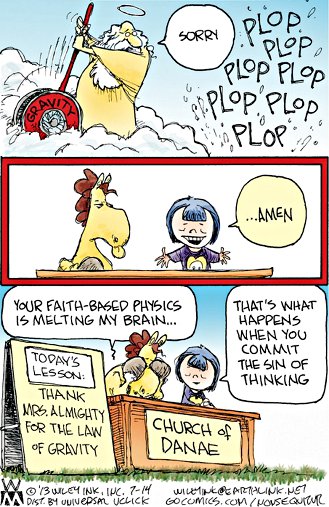
 This is where I could imitate Non Sequitur’s Danae. I won’t.
Partly because I don’t have minions. Mostly because I’d much rather make sense.
Back to that “Bible Map.”
I give Orlando Ferguson’s variation on the flat Earth theme points for originality.
I don’t remember another anachronistic ‘Bible truth’ trying to accommodate reality by curving Earth’s northern hemisphere.
I did a little checking. “Prof. Orlando Ferguson” was from Hot Springs, South Dakota: as it says on his map.
He was a “professor,” too: a real estate developer by trade, professing his apparently-unique mix of Bible verses and science with a 92-page lecture.
He went on tour with his lecture and map, selling the maps for 25 cents a pop. At least one has survived: remarkable, considering the flimsy paper used.
I see its preservation as a good thing. A lot of work went into making it. It’s an attractive curio — and a nice showpiece of late-19th century culture.
Bible Bits and a Blood Moon
 Orlando Ferguson’s map says he’s got 400 bits from the Bible “that Condemn the Globe Theory, or the Flying Earth, and None Sustain It.” That’s near the top.
I’m a Catholic, so taking the Bible seriously isn’t an option. It’s a requirement. I talk about that, and what we’ve been passing along for two millennia, fairly often. (August 18, 2017; July 30, 2017)
Basically, Catholicism isn’t a roll-your-own faith. (Catechism of the Catholic Church, 74–95, 101–133)
Taking Sacred Scripture, the Bible, seriously is one thing. Deciding that it means what I want it to mean is something else. Also a bad idea. (Catechism, 85, 890, 2033)
Back to Professor Ferguson’s amazing Bible Map. Again. An impressive number of Bible verses fills the lower left corner.
Each verse includes an excerpt: in “thus sayeth” and “hath laid” ye olde style English. I see a lot less of that these days, and that’s another topic.
Ferguson’s map listing leads with Exodus 17:12; Joshua 10:12-13 and Chronicles 16:30. He doesn’t say if that’s Chronicles 1 or 2. My guess is that he used a Hebrew Bible.
More Bible bits from Prof. Ferguson: Psalms 136:6-7; Isaiah 12:10, 11:12 14:7, 30:1, 38:8-9, 40:22, 52:5, 54:24 and 58:13. Plus Isaiah’s entire 29th chapter. Jeremiah 31:35-36 and Acts 2:20 wrap up Professor Ferguson’s Bible verse map listing.
I’ll give him credit for doing his Bible research. I’m not sure how Isaiah 29 supports his flat Earth idea. Prophecies and getting a grip are yet another topic, for another day.
 His verse from Acts talks about the sun going dark and the moon turning to blood “before the coming of the great and splendid day of the Lord.” (Acts 2:20)
I talked about a “blood moon prophecy” and another fizzled ‘End Times’ prognostication last year. (August 23, 2017)
Like I said, it could be worse.
Mainstream American Protestant outfits were defending Christianity against the Copernican threat up to the early 20th century. I gather that the Missouri Synod started distancing themselves from those fervent faithful in 1902.1
Defending the Weak?
 I like to think that many or most folks mean well. That includes those who say they’re defending impressionable minds from enticing but evil ideas.
Those defending others from religion may honestly believe that outfits like Pillar of Fire represented Christian values.
That lot were wacky even by 1920s conservative standards. Their ilk tend to be among the loudest voices. I think their enthusiasm is admirable. Not their beliefs. (September 22, 2017; August 13, 2017)
I don’t like seeing bad behavior by Christianity’s lunatic fringe getting so much attention. But I see no point in denying that it happens.
I’m more upset about less loony Christians who seem determined to defend others from science. Some may believe that science, particularly evolution, is evil because they think it’s responsible for moral decay, racism, and other social ills.
I’ll assume that they also mean well. But I think they unintentionally support the ‘faith demands ignorance’ stereotype.
Christians who see the Catholic Church as a threat may mean well well, too. Fulton Sheen got it right, I think:
“There are not a hundred people in America who hate the Catholic Church. There are millions of people who hate what they wrongly believe to be the Catholic Church — which is, of course, quite a different thing.”
(“Radio Replies Vol. 1,” Forward, page ix, Fulton J. Sheen (1938) via Wikiquote)
Bias, Being Human, and Aristotle
 Ideally, researchers would never have biases. Or at least not let their flawed perceptions affect their work.
Like I keep saying, we don’t live in an ideal world. Scientists and scholars are human.
We’ve had a few outright fraudsters. Some may have honestly believed what they said.
Nott and Gliddon’s 1857 “Indigenous races of the earth” probably played well in the Victorian age. Its ‘white folks are better’ conclusions didn’t stand up to analysis.
F. Kupka’s iconic “caveman” Neanderthal rendering was another matter.
I don’t blame the artist. It’s taking scientists a long time to get used to evidence that Neanderthals may have been much more ‘human’ than the grunting brutes we imagined (March 10, 2017; September 23, 2016)
The problem isn’t just with science. Mistaking strong feelings and cultural quirks for truth and unchanging realities can affect anything we do. And sometimes does, sadly.
I’ve talked about ersatz science, published gibberish and the Thirty Years’ War before. (August 4, 2017; April 28, 2017; August 26, 2016)
 Darwin’s “Origin of Species” came out a few years after the Nott and Gliddon book.
Darwin’s research was sound science. I suspect one reason it’s still such a hot-button item is that it doesn’t pander to what some folks want to believe is true.
Besides science, Darwin apparently knew some history. He added a history of evolutionary thought to later “Origin” editions, going back to Aristotle.
I think Aristotle was smart. He gave my civilization quite a few good ideas, and some that we’ve learned aren’t accurate.
Most of us have gotten over the shock of learning that Aristotle was wrong and Aristarchus of Samos was on the right track about Earth and our sun.
Strong evidence of that was accumulating about 475 years back. Copernicus was right, pretty much, and that’s yet again another topic. (April 28, 2017; March 24, 2017)
Maybe by the 2490s most of us will realize that accepting evolution won’t shatter an informed Christian faith. Provided we keep up today’s pace.
If I take Aristarchus-to-Copernicus as my ‘norm,’ reality won’t sink in for many until the early 4100s. (April 28, 2017; March 24, 2017)
Aristarchus, Anaximander, and Aristotle are among my favorite examples of smart folks who had good reasons for what they figured was true. But who turned out to be mistaken. At least in part.
Chickens and Cosmologies
 Getting back to the “chicken or egg” causality dilemma, Aristotle saw chickens and eggs as an infinite sequence, with no true start. That was a good fit with Aristotelian cosmology, and his idea that species can’t change.
Many of Anaximander’s ideas were close to what we’ve learned recently.
His cosmology included a free-floating Earth and the possibility of multiple worlds. He thought lightning and thunder were what we call natural events: not evidence of divine anger.
Unlike Aristotle, he figured species can change. He suggested that we happened when critters had to adapt to dry land.2
Anaximander was right, basically. But he didn’t have much data to back up his speculation. Neither did Aristotle, although his Earth-centered cosmology may have seemed much more reasonable. Still does, to some.
Anaximander might have had more influence, sooner, if scholars had kept more of his work. As it is, much of what we know about him is what Aristotle wrote.
I see Aristotle’s logic as a huge factor in his later acceptance. I also see an impressive lack of logic in what some of his fans assumed. (November 5, 2017)
Nearly 24 centuries after Anaximander, some folks — Christians — still saw lightning as God’s thunderbolts.
Some still do, apparently. Seeing the Almighty as a sort of super-Zeus enjoys perennial popularity. I’m not sure why. (November 19, 2017; September 10, 2017; October 16, 2016)
Bombardier Beetles
 J. B. S. Haldane’s observation that “God has an inordinate fondness for beetles” reflected his belief that God isn’t there.
I don’t agree with Haldane’s philosophical beliefs. But I like the quote.
I see it more as illustrating that Isaiah 55:8–9 is right. God’s thoughts aren’t ours.
Someone asked me about bombardier beetles and evolution in January of 2014. He’d read an assertion that the beetles couldn’t have survived evolution. The idea was that their explosive exhaust would have obliterated them before their ‘canon’ was complete.
A mental image of exploding beetles and more cerebral interests appealed to me. I started checking sources, and posted an answer. Scientific sources, not Leviticus 11:22 or Psalms 78:45. Today’s ‘flowers and butterflies’ post seems like a good time to bring beetles up again.
The story of how bombardier beetles got their unique defense mechanism is something we’re still learning. It’s a mystery in the sense that we haven’t found fossil or other hard evidence verifying a particular step-by-step sequence.
But scientists have enough pieces of the puzzle to show how it could have been done. That probably wouldn’t be enough to convince a dedicated disciple of Ussher or today’s creation science enthusiasts. I can’t imagine what would be.
Briefly, all animals produce the chemicals in bombardier beetle ‘boom juice.’ All insects have at least some of the bombardier beetle’s mechanisms. This critter isn’t as inexplicable as it seems.3
But it’s still weird. So are platypuses. Platypi? Those duck-billed Australian whatsits.
As usual, there’s more to say about beetles and other strange critters. But that’ll wait.
Floral Success Puzzle Answered: Maybe

(From Getty Images, via BBC News, used w/o permission.)
(“Angiosperms are the most diverse group of land plants, with hundreds of thousands of known species”
(BBC News))
“How flowering plants conquered the world”
Helen Briggs, BBC News (January 14, 2018)“Scientists think they have the answer to a puzzle that baffled even Charles Darwin: How flowers evolved and spread to become the dominant plants on Earth.
“Flowering plants, or angiosperms, make up about 90% of all living plant species, including most food crops.
“In the distant past, they outpaced plants such as conifers and ferns, which predate them, but how they did this has has been a mystery.
“New research suggests it is down to genome size – and small is better….”
I like that last sentence: saying “research suggests” instead of ‘scientists declare!’
I prefer science news written by someone who understands that scientists aren’t prophets or preachers. Some scientists may see themselves that way, and that’s still another topic.
We’ve known about cells for a few centuries now, and understand some of their functions. But there’s a lot we don’t know. Not yet. We’ve learned enough to make this research possible: and intriguing.4
Genomes and Pores

(Simonin, Adam B. Roddy; via PLOS Biology; used w/o permission.)
(Genome size in 393 land plant species.)
“Small is better” for plant cells, maybe, since smaller photosynthesizing cells can process more carbon dioxide per unit volume than bigger ones.
Smaller cells let plants get more cells for each bit of nutrients they absorb. Smaller cells mean smaller — and more — veins and pores on leaves. That’s another productivity boost.
That’s what these scientists say may be so. It makes sense. They’ve got statistical data to back up the suggestion. They could easily be on the right track.
Right now, this is a “research suggests” situation. I figure we’ll know more in a few years. Or decades. Probably both. Genetic analysis is a new field, and just one of many new research tools we’ve been developing.
Dawn of the Lepidoptera

(From Bas van de Schootbrugge, via BBC News, used w/o permission.)
(“One of the scales under the microscope”
(BBC News))
“Meet the butterflies from 200 million years ago”
Helen Briggs, BBC News (January 10, 2018)“Newly discovered fossils show that moths and butterflies have been on the planet for at least 200 million years.
“Scientists found fossilised butterfly scales the size of a speck of dust inside ancient rock from Germany.
“The find pushes back the date for the origins of the Lepidoptera, one of the most prized and studied insect groups.
“Researchers say they can learn more about the conservation of butterflies and moths by studying their early evolution….”
I’m pretty sure that this article’s first four paragraphs could spark heated discussions. Starting with whether or not butterflies need conservation and when the critters first showed up.
Using some criteria, butterflies didn’t exist until the Palaeocene, about 56,000,000 years back. That’s way before Ussher’s ‘first light’ in 4004 BC.
I’ll get to belief, reality, the universe and me after chasing a few butterflies.
Scientists found the oldest ‘Paleocene’ butterfly fossils in Denmark’s Fur Formation. The oldest known American butterfly is Prodryas persephone. Prodryas lived about 34,000,000 years back, where Colorado is now.
Post-dinosaur butterflies were more like current models than the critters these scientists studied. What’s really odd about the 200 million year old critters is that they had may have had structures like the ones butterflies use to get nectar from flowers.
That’s downright puzzling. Flower didn’t come until long after these early lepidopterans. Scientists had figured that butterfly mouths and flowers had evolved side-by-side. If that was so, nectar-adapted butterflies wouldn’t have shown up before flowers.
Maybe someone will say this proves that evolution is a lie, a vile religion of the Antichrist, or whatever seems like a catchy slogan.
I don’t think so. I think we’ve got a new puzzle to work on. A delightfully complicated one.
A Big Puzzle

(From Timo J. B. van Eldijk et al., via Science Advances, used w/o permission.)
(Fossil scales, up close. The black bars with each scale are 20 micrometers long. A micrometer, or micron, is one thousandth of a millimeter. That’s 0.000039 inch.)
About conserving butterflies and all that, I think Earth is where live. Taking reasonably good care of the place makes sense. Emphasis on reasonably. It’s also part of our job.
I see no point in jumping on the latest ‘we’re doomed’ bandwagon, or imagining that what we do doesn’t matter. (August 11, 2017)
Now, about these scales and the critters that grew them.
Some of these early lepidopterans lived in the Rhaetian, right before the Triassic–Jurassic extinction event. About half of Earth’s species didn’t survive that. But the rest did, including critters that would be ancestors of dinosaurs, butterflies — and us.
Don’t bother trying to remember those names. There won’t be a test. I’ve put a few links near the end of this post.5
Like I said, I expect lively debate about these scales: and how they fit into life’s story.
I’m pretty sure there won’t be much trouble establishing that they are from lepidoptera: critters like moths and butterflies. Scientists have gotten pretty good at classifying critters by looking at very tiny details in scales, hair, and the like.
A big puzzle involves flowers and nectar.
Hard Work Ahead
 Some of those scales came from critters very much like, and presumably ancestors of, living insects with specialized nectar-drinking mouths.
It’s likely that the Rhaetian and Hettangian critters had similar mouths.
If that’s so, it’s pretty much a sure thing that they used the ‘nectar-adapted’ mouths for something else. Learning what that was should keep at least a few scientist busy for quite a while.
It’ll be hard work. Particularly since we’ve found very few fossilized lepidoptera.
That’s hardly surprising. Butterflies and moths generally doesn’t live where fossils easily form. On top of that, we’ve learned that one bunch migrated over open water: what’s now the North Sea. That was after dinosaurs and before the mesonyx heyday.
Mesonyx is another odd critter, by today’s standards. Was. Think a wolf. With hooves.
Back to butterflies. Scientists have been doing well to find fossilized bits and pieces: including these microscopic scales. Most of what we know comes from DNA analysis.
There’s more to say about butterflies, fossils, and strange critters.
But I said I’d talk about belief, reality, and why I see no problem with using my brain. I’ll get to that next.
After a tip of the hat to Leeuwenhoek, Mendel and the Human Genome Project.
Animalicules
 European scholars were probably using magnifying glasses before Galileo got in trouble for dissing Aristotle. His personality didn’t help. (March 24, 2017; June 2, 2017)
Leeuwenhoek built his microscope a few decades later. He called tiny critters he saw “animalcules.”
Robert Hooke wrote about “cells” he’d seen in cork slices. That was in 1665. He figured what he was seeing wasn’t alive, which was true.
He’d seen and described cell walls: not the living cells. Maybe Hook’s descriptions are a reason Hook often gets credit for discovering cells.
Gregor Mendel studied inherited traits in peas during the late 1850s and early 1860s. Friedrich Miescher discovered nucleic acids in 1869. The Human Genome Project mapped the human genome on April 14, 2003. It’s been an eventful century-and-a-half.
I think we’ve just started getting answers from genetics research. And many new puzzles. (November 3, 2017; March 31, 2017; September 23, 2016)
Drinking May be Hazardous to Your Health
 Aristotle didn’t say anything about cells. The Bible doesn’t mention them.
Not unless you count Psalms 139:13. On the other hand, I can imagine someone using Ezekiel 27 as a prophecy against believing that we don’t have any parts smaller than bones and sinews.
That wouldn’t, I think, make sense. But neither do some other fervently-held beliefs I’ve seen. I haven’t run across a tightly-wound Christian who won’t believe in cells because they’re not Biblical. I’m not sure why.
Maybe it’s because we’ve known about cells for a few centuries, and finally learned that drinking animalcules was a bad idea. On the other hand, some folks didn’t ‘believe in’ vaccinations in 1902, and still don’t. (July 21, 2017; August 21, 2016)
Changes
 I don’t “believe in” cells or cell theory. Or evolution. Not in the sense that I expect any or all to answer the big questions.
But I’m quite sure cells exist and that some affect our health.
I’m also quite sure that critters have been changing for a very long time.
I talked about science, religion, and the Big Bang model last week. (January 12, 2018)
Recapping what I keep saying, the Bible isn’t a science textbook. Genesis wasn’t written by an American.
I don’t expect ‘just the facts’ from a book of poetry, or metaphorical flights of fancy from a paper on orbital mechanics. That said, I’ll start with “let there be LIGHT.”
Fast-forwarding from Genesis 1:3 to 1:11, the first plants appeared about a half-billion years back.
Later, if you don’t think of eukaryotic algae as plants.
Earlier, if you count cynaobacteria. Lots earlier. That’s looking at life on Earth through a scientist’s eyes.6
Metaphorically speaking.
I don’t think God gives us brains and has a snit when we use them. Or blundered by including curiosity in our motivational toolkit.
 The problem Darwin had with flowering plants is that they showed up so abruptly.
His evolutionary theory involved gradual change of one species into another.
Not the sort of abrupt jump he’d found in the fossil record.
We’ve found many more fossils since then, and learned quite a bit about life’s long story. Darwin, it turns out, was wrong.
But not entirely. Evolution happens. Species change. Sometimes they change gradually. Sometimes the change is — apparently — abrupt.
We’ve learned about DNA. Genetic analysis is showing us relationships between critters we hadn’t seen before.
And another reason the ‘tree of life’ has been rearranged a few times. I think we’ll see quite a few more changes in how scientists define species, kingdoms, domains, and all that.
Folks who like everything to stay pretty much the way it was when they grew up won’t like that. I’m having a ball, trying to keep up with what we’re learning.
Living in a Post-Lagash World
 I could believe that we live on a flat plate, no more than a few thousand miles across, with nothing but a dome between us and the cosmic ocean.
I might have, if I’d lived in Lagash when Urukagina was cleaning up a mess left by Lugalanda; or Ur when Enheduanna’s poetry was enriching Sumerian literature.
It’s a ‘Biblical’ cosmology, in the sense that Sacred Scripture includes poetic imagery from Mesopotamian culture.
I see that as resulting from folks who the Bible living in the western reaches of that civilization. The imagery would have been familiar to them.
I think the Bible is God’s word. I also think God decided to have human authors write Scripture. (Catechism, 101–106)
Some living today may firmly believe that they live on a plate supported by pillars. Some of that fraction may also say they are Christians. If they are consciously following our Lord, doing God’s will as well as they can, I think they’re Christians.
But I also think they’re mistaken about the size and structure of God’s visible world.
Knowing what I do about post-Lagash developments, I couldn’t embrace ancient Mesopotamian cosmology and follow our Lord. Accepting truth is part of my faith.
In a State of Journeying
 Since the notion that seeking knowledge offends God is rather well-entrenched in some circles, I’d better explain that.
And why I do not think acknowledging orderly change means believing that an orderly God cannot exist.
I’m a Catholic. I see faith as a willing and conscious “assent to the whole truth that God has revealed.” (Catechism, 142–150)
Again, I think God’s revealed truth is in the Bible.
I also think God’s truth is in everything we can observe. If I’m paying attention, I’ll find God’s truth in the natural world’s order and beauty. Noticing, understanding, and appreciating this world’s wonders is a good idea. (Catechism, 32, 41, 74, 283, 341, 2500)
Or I can close my eyes, cover my ears, and hum real loud: stalwartly ignoring God’s work. That doesn’t strike me as a good way to show appreciation, so I won’t.
I think God could have made a world, a universe, that was perfect from the start: and couldn’t change. Maybe there are physical realities like that, not part of this space-time.
But the continuum we’re in changes. I’m okay with that. Not that my attitude could change God’s source code for this reality. God’s God, I’m not, and that’s a good thing.
I don’t know why God made this universe “in a state of journeying,” moving toward an ultimate perfection: but not there yet. (Catechism, 302)
My guess is that even if God somehow showed me the reasons, I wouldn’t understand. Not completely. It’s not possible for any creature.
God is the Almighty, infinite, eternal, beyond human understanding. Even so, wanting and trying to understand is a good idea. (Catechism, 27, 155, 202, 206–209, 230)
So is using our brains. Noticing the order and beauty surrounding us is part of what we’re supposed to be doing. If we’re doing it right, we’ll learn something about God in the process. (Catechism, 31–32, 35–36, 301, 303–306, 311, 319, 1704, 2293–2296)
“Wonderful Things”
 Pursuing knowledge and seeking God both mean learning something new, at least occasionally. Sometimes that’s not easy, particularly if what’s new doesn’t fit neatly into old assumptions.
But I think it’s a good idea. And sometimes we find “wonderful things.”
“…Occasionally people ask me how I can be Catholic and a science journalist. The answer is simple: Truth does not contradict truth. Both science and religion are pursuit of truth. They’re after different aspects of truth, different layers of reality, but they’re still both fundamentally about truth….”
(Camille M. Carlisle, Sky and Telescope (June 2017))“…faith must be there first, if one wishes to see God in Creation.”
(Brother Guy Consolmagno, Vatican Observatory, in a Zenit interview (May 2017))“No matter where and how far we look, nowhere do we find a contradiction between religion and natural science. On the contrary, we find a complete concordance in the very points of decisive importance. Religion and natural science do not exclude each other…. They mutually supplement and condition each other.
“Religion and natural science are fighting a joint battle in an incessant, never relaxing crusade against scepticism and against dogmatism, against disbelief and against superstition, and the rallying cry in this crusade has always been, and always will be: ‘On to God!’”
(“Religion and Natural Science,” Lecture about the relationship between religion and science. Originally entitled Religion und Naturwissenschaft. (1937) Complete translation into English: “Max Planck: Scientific Autobiography and Other Papers” (1968); via Wikiquote [emphasis mine])“…Even if the difficulty is after all not cleared up and the discrepancy seems to remain, the contest must not be abandoned; truth cannot contradict truth…”
(“Providentissimus Deus,” Pope Leo XIII (November 18, 1893))Lord Carnarvon: “Can you see anything?”
Howard Carter: “Yes, wonderful things!”
(First look into Tutankhamen’s tomb (1922) via Wikipedia)
I think we’ve barely begun discovering “wonderful things:”
- “Science and Religion”
(January 12, 2018) - “Values and Ichthyosaurs”
(September 22, 2017) - “Knowledge: Opening the Gift”
(September 17, 2017) - “Old Truths, New Aspects”
(March 26, 2017) - “Europa, Mars, and Someday the Stars”
(September 30, 2016)
1 Dealing with reality, and other options:
- Wikipedia
- “Ingenious ‘Flat Earth’ Theory Revealed In Old Map”
Natalie Wolchover, Live Science (June 23, 2011)
2 Chickens, eggs, and philosophers:
- Wikipedia
- “Symposiacs,” Book 2, Question 3
Plutarch (1st century AD) From “The complete works of Plutarch: essays and miscellanies,” Thomas Y. Crowell (1909) via The University of Adelaide Library
3 Bombardier beetles, briefly:
- Wikipedia
- Bombardier beetles
Moore Lab at The University of Arizona Arthropod Systematics
[Text and short video demo] - “Unravelling the Mysteries of the Explosive Bombardier Beetle”
Principal Investigators: Dr. Tanya Renner, San Diego State University; Dr. Aman Gill, University of California, Berkeley; Dr. Wendy Moore, University of Arizona; Dr. Kipling Will, University of California, Berkeley; Dr. Athula Attygalle, Stevens Institute of Technolog
2017 SMRT Grant Finalist, PacBio.com
- Wikipedia
- “Genome downsizing, physiological novelty, and the global dominance of flowering plants”
Kevin A. Simonin, Adam B. Roddy; PLOS Biology (January 11, 2018)
5 More than you need to know about lepidoptera:
- Wikipedia
- “A Triassic-Jurassic window into the evolution of Lepidoptera”
Timo J. B. van Eldijk, Torsten Wappler, Paul K. Strother, Carolien M. H. van der Weijst, Hossein Rajaei, Henk Visscher, Bas van de Schootbrugge; Science Advances (January 10, 2018)






 I check my Google news feed regularly, at least once a day. I ran into that ‘hit and run’ entry yesterday.