TRAPPIST-1: Water? Life??

TRAPPIST-1’s planets may support life: or not. We don’t know. Not yet.

We’re pretty sure that all seven are rocky worlds, like the Solar System’s inner planets.

Three are in the star’s habitable zone. The inner two definitely do not have one sort of atmosphere that would make life as we know it impossible.

Even if we don’t find life there, we’ll learn a great deal while looking.

  1. Size, Comparisons, and a Little Math
  2. Alien Life, Tourists, and Robots
  3. Voyage to a Distant Star
  4. Beyond Setting Records

Bigger than Jupiter: But Not by Much


(From ESO/O. Furtak, used w/o permission.)

TRAPPIST-1 is a small, very dim, very cool, star. Its diameter is about 158,600 kilometers, bigger than Jupiter’s 142,900, but not by much. TRAPPIST-1 b through h orbit very close to their sun.1
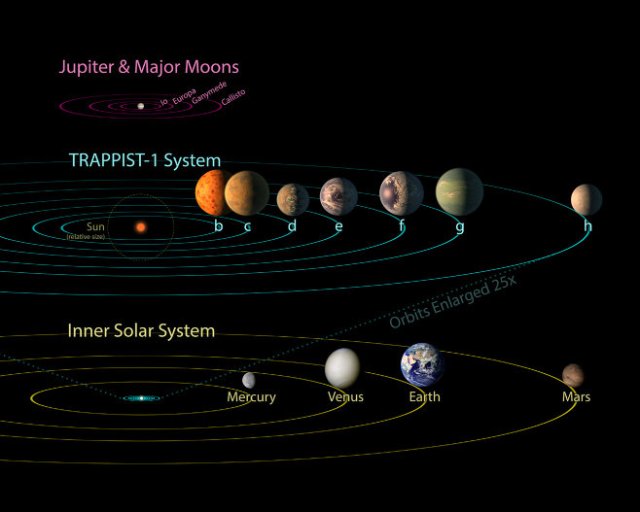

(From NASA/JPL-Caltech, used w/o permission.)

We know how big the TRAPPIST-1 planets are, but not what they look like.

Like I said, we don’t know if there’s life on any of them; or even if it’s possible.

But I won’t claim that God can’t have life anywhere but Earth. I’ve talked about Aristotle, 1277, and getting a grip, before. (December 16, 2016; December 2, 2016)

Truth cannot contradict truth, being curious is a good idea, and scientific discoveries are opportunities for greater admiration of God’s creation. (Catechism of the Catholic Church, 159, 214217, 283, 294, 341)

I’ve been over that before, too. Quite often, actually:

A Belgian Telescope, Monks, and Beer


(From TRAPPIST/ESO, used w/o permission.)
(“TRAPPIST–South First Light Image of the Tarantula Nebula”
(ESO))

“…TRAPPIST (TRAnsiting Planets and PlanetesImals Small Telescope) is a project led by the Department of Astrophysics, Geophysics and Oceanography (AGO) of the University of Liège (Belgium), in close collaboration with the Observatory of Geneva (Switzerland). TRAPPIST is mostly funded by the Belgian Fund for Scientific Research (FNRS) with the participation of the Swiss National Science Foundation (SNF).

“The team is composed of Emmanuël Jehin, Michaël Gillon, Pierre Magain, Virginie Chantry, Jean Manfroid, and Damien Hutsemékers (University of Liège, Belgium) and Didier Queloz and Stéphane Udry (Observatory of Geneva, Switzerland).

“The name TRAPPIST was given to the telescope to underline the Belgian origin of the project. Trappist beers are famous all around the world and most of them are Belgian. Moreover, the team members really appreciate them!”
(eso1023 — Organisation Release (June 8, 2010))

“Trappists” is what folks call monks in the Order of Cistercians of the Strict Observance. If you’re into Latin acronyms, that’s O.C.S.O.: Ordo Cisterciensis Strictioris Observantiae. They’re contemplative monks and nuns, part of the Benedictine family. (August 14, 2016)

The monastic order got its name from La Trappe Abbey. It doesn’t have much to do with Maria von Trapp and “The Story of the Trapp Family Singers.” Not directly.


1. Size, Comparisons, and a Little Math


(From ESO/O. Furtak, via Space.com, used w/o permission.)

What Would Life Be Like on the TRAPPIST-1 Planets?
Calla Cofield, Space.com (February 24, 2017)

“The TRAPPIST-1 system is home to seven planets that are about the size of Earth and potentially just the right temperature to support life. So how would life on these alien worlds be different than life on Earth? Here are some of the major differences.

Amazing night-sky views

“Perhaps one of the most dramatic things that visitors to the TRAPPIST-1 system would notice is the view of the other six planets in the sky. In some cases, a neighboring planet might appear twice as large as the full moon seen from Earth. [Images: The 7 Earth-Size Worlds of TRAPPIST-1]

“‘If you were on the surface of one of these planets you would have a wonderful view of the other planets,’ Michaël Gillon, an astronomer at the University of Liège in Belgium and an author on the new paper, said in describing the discovery. ‘You wouldn’t see them like we see Venus or Mars, like dots of light. You would see them really as we see the moon. … You would see the structures on these worlds.’…”

I’m pretty sure that Michaël Gillon had “structures” like Lunar mare in mind, not artificial structures.

Even so, a half-dozen ‘moons’ in the sky would make landscapes on TRAPPIST-1’s planets resemble (very slightly) Golden Age of Science Fiction magazine covers.

How big each of the other planets would look would depend on where they were in their orbits. Those closer to TRAPPIST-1 than the observer would go through phases, like we see on our moon.

I like to check assertions I read, so I looked up the TRAPPIST-1 system’s orbits.

The semimajor axis for TRAPPIST-1b, the first planet out from its star, is 1,660,000 kilometers. In other words, the planet’s center is 1,660,000 kilometers from the star’s center, on average.

TRAPPIST-1c’s semimajor axis is 2,280,000 kilometers. The distance between the two orbits is around 620,000 kilometers.

Comparison time. The semimajor axis for our moon’s orbit is about 384,400 kilometers. The distance between the orbits of TRAPPIST-1b and c is only about 1.6 time the distance to our moon.

Each planet is about the size of Earth, so when they’re close, the other world would look a lot larger than our moon does from Earth.

If any have water and support life, that’s a big “if,” I suspect poets will eventually wax eloquent about crescent worlds over the sparkling waters of distant lands.

Their “sun” would look much larger than ours, too, but TRAPPIST-1 is much smaller than our star.

That may be why its planets orbit so closely: or not. We’ve learned quite a bit about how stars and planets form, and there’s a great deal left to learn.


2. Alien Life, Tourists, and Robots


(From NASA-JPL/Caltech, via NPR, used w/o permission.)

Trappist-1 Planet Discovery Ignites Enthusiasm In Search For Alien Life
Marcelo Gleiser, Op-ed, NPR (February 23, 2017)

“A group of astronomers announced Wednesday that seven Earth-size planets orbit a small, red, dwarf star 40 light-years away.

“The findings were published in the journal Nature. Observations indicate that at least three of the planets may be at temperate zones where liquid water may exist.

“The extraordinary finding — discovered by astronomers from an international collaboration led by Michaël Gillon from the University of Liège in Belgium, places the search for Earth-like planets and, more spectacularly, the search for alien life, under a brand-new lens. NASA released a fun poster about the findings….”

That poster is from NASA’s strictly-for-fun “Exoplanet Travel Bureau.”

Space tourism is real enough. Folks have been on Soyuz flights to the ISS since 2001. Not many folks can afford it, though, and that’s another topic.

Elon Musk says his SpaceX company will fly tourists around Earth’s moon in late 2018. (BBC News (February 28, 2017))

Sending human explorers to Mars may happen in the 2030s. Reaching the stars — I’ll get back to that.

Finding alien life depends, basically, on two things: extraterrestrial life existing; and knowing what to look for.

There’s a lively debate going on about how, exactly, to define “life” in the physical sense. Searching for alien life depends on knowing what we should look for.

Defining “life” seems simple enough. A Wikipedia page says “Life is a characteristic distinguishing physical entities having biological processes, such as signaling and self-sustaining processes….”

Another Wikipedia page says biological process are “processes vital for a living organism to live…” That definition brings us back to defining “life,” both of which are not particularly helpful, so far.

If “signalling and self-sustaining processes” are what makes something “alive,” then rovers like Curiosity are close to being “alive.” That definition isn’t particularly useful, assuming that most folks don’t think robots are “alive.”

Living critters on Earth are “organic” in the sense that we’re made of organic compounds.

“Organic” in that sense means that the compound contains carbon. The term goes back to when vitalism still made sense, and that’s yet another topic.

Stretching Definitions

We’ve downgraded hopes for Mars from finding Martian people to finding Martian microbes. (December 16, 2016)

We’re also learning a great deal about how to look for extraterrestrial life.

Oxygen in a planet’s atmosphere seemed like an obvious biomarker. Then the National Institutes of Natural Sciences’ Norio Narita and Shigeyuki Masaoka showed how non-biological processes could oxygenate a planet’s atmosphere.2

Making the search more interesting, some critters don’t need oxygen. Or sunlight, for that matter.

Definitions of life-as-we-know-it got stretched in 1977. That’s when researchers found critters living around hydrothermal vents in the Galápagos Rift.

Up to that point, assuming that all life needed sunlight seemed reasonable. After all, plants photosynthesize using sunlight, which provides food for other critters.

Since then, we’ve found extremophiles, critters living in “extreme” places, in quite a few ‘uninhabitable’ spots.

No matter where they live, though, all living critters need water.

Probably.

Life as We Know It: and Otherwise, Maybe


(From NASA/JPL-Caltech, used w/o permission.)
(TRAPPIST-1 and Solar planetary systems. The green areas are the two stars’ habitable zones, where liquid water could exist on an Earth-like planet.)

I’ve talked about habitable zones before. (September 2, 2016; July 29, 2016)

It’s where a planet like Earth is far enough from its star for water to be liquid, but not so far that it freezes. But they’re not the only places where we can look for life.

We’ve learned that liquid water can, and almost certainly does, exist in the outer Solar System. Subsurface oceans of Europa and Enceladus, moons of Jupiter and Saturn, may support life. (September 30, 2016)

That’s “life as we know it:” organic chemistry with water serving as a solvent.

That may be the only way “life” can work. Properties of the elements and compounds in our bodies seem ideally suited for life’s complex chemistry.

Carbon can bond with a great many other elements, and will form extremely complex molecules.

Water is a really good solvent, and stays liquid over a wide temperature range. It doesn’t get hotter or colder easily, and has other properties that make it an obvious choice for life’s working fluid.

Maybe it’s the only possible choice. Then again, maybe not.

In the ’60s, a former professor at Boston University suggested more-or-less-plausible life chemistries for temperatures ranging from near red-hot to near absolute zero.

We’re third down, nucleic acid/protein (O) in water:

  • Fluorosilicone in fluorosilicone
  • Fluorocarbon in sulfur
  • Nucleic acid/protein (O) in water
  • Nucleic acid/protein (N) in ammonia
  • Lipid in methane
  • Lipid in hydrogen
    (“View from a Height” Isaac Asimov (1963), Lancer Books (p. 63))

Isaac Asimov’s grasp of ecology and physics was a trifle shaky in his fiction: but this time he was speculating in his professional field, chemistry.

Since then, quite a few scientists have started taking non-organic life chemistries seriously.3


3. Voyage to a Distant Star


(From ESO/M. Kornmesser/spaceengine.org, via Space.com, used w/o permission.)

TRAPPIST-1: How Long Would It Take to Fly to 7-Planet System?
Hanneke Weitering, Space.com (February 23, 2017)

“The discovery of seven Earth-size planets around a nearby star, TRAPPIST-1, is certainly exciting news. But what would it take to visit one of these potentially Earth-like alien worlds?

“TRAPPIST-1 is 39 light-years away from Earth, or about 229 trillion miles (369 trillion kilometers). It would take 39 years to get to its current location traveling at the speed of light. But no spacecraft ever built can travel anywhere near that fast.

“That said, people have sent some pretty fast vehicles into outer space. With today’s technology, how long would it take to get to TRAPPIST-1?…”

Eventually, we’ll probably send a ship to orbit and study each of its planets; like the Dawn mission to Vesta and Ceres.

I doubt it will be our first interstellar destination. That could be Proxima Centauri b, about 4.2 light-years away. (September 2, 2016)

We’ll have to be patient. Light from TRAPPIST-1 takes about 39 years to get here, and today’s spacecraft are a whole lot slower.

New Horizons would make the trip in 817,000 years. Voyager 1 is faster, and would cover the distance in 685,000 years.

Stephen Hawking’s Breakthrough Starshot initiative microprobes would be much faster, once folks develop the technology. They’d go 39 light-years in roughly 200 years.

Meanwhile, scientists are studying the TRAPPIST-1 system the way Galileo studied Mars and other Solar planets: using telescopes. (December 16, 2016)

Starchips and Laser Cannons

Something like Hawking’s Breakthrough Starshot is probably our best option for interstellar probes using technology that’s not too far from off-the-shelf hardware.

Instead of building a single probe, Hawking’s Starshot would be a fleet of 1,000 StarChip mini-probes.

Each StarChip would be a light sail, like NASA’s NanoSail-D: only smaller. A lot smaller. Each mini-probe would be a centimeter across, equipped with a tiny camera, electronics, and a transmitter.

Once in space, several gigawatt lasers — this is tech we don’t quite have yet — would push them up to about 20% speed of light.

They could reach Proxima Centauri in about two decades. A quarter-century after launch, pictures taken by the probes and transmitted back to Earth would give us the first close(ish) pictures of Proxima Centauri b.

We’ve made lasers, like the Argus, handling gigawatt-level emissions.

Getting the things to last more than a few moments, and focusing the beam, is another matter. Besides, I’m not sure how national leaders would take the idea of someone building what amounts to a laser cannon.


4. Beyond Setting Records


(From ESO, via BBC News, used w/o permission.)

Star’s seven Earth-sized worlds set record
Paul Rincon, BBC News (February 22, 2017)

Astronomers have detected a record seven Earth-sized planets orbiting a single star.

“The researchers say that all seven could potentially support liquid water on the surface, depending on the other properties of those planets.

“But only three are within the conventional ‘habitable’ zone where life is considered a possibility.

“The compact system of exoplanets orbits Trappist-1, a low-mass, cool star located 40 light-years away from Earth.

“The planets, detected using Nasa’s Spitzer Space Telescope and several ground-based observatories, are described in the journal Nature….”

Folks at SETI checked the TRAPPIST-1 system for radio signals last year, using the Allen Telescope Array. They ‘heard’ no obviously-artificial signal, but will try again.4

That could mean there’s nobody there.

Or maybe radio isn’t the only long-range communication technology. We started using wavelengths between 1 millimeter and 100 kilometers about a century back. I’ve talked about tech, time, and SETI, before. (December 16, 2016; September 16, 2016)

Finding life, intelligent or otherwise, would be enormously exciting. But that’s not the only reason scientists study TRAPPIST-1 and its planets.

Because the star is so dim, and fairly close, studying its planets will be comparatively easy. As BBC Science Editor David Shukman said, “telescopes studying the planets are not dazzled as they would be when aiming at far brighter stars.” (BBC News)

Besides being much closer than most of our galaxy’s stars, TRAPPIST-1’s planets pass between their star and ours once each of their years. That lets scientists study light that passes through their atmosphere. Assuming they have atmospheres.

TRAPPIST-1 b and c: Learning What’s Not There


(From NASA’s Goddard Space Flight Center, used w/o permission.)
(“To determine what’s in the atmosphere of an exoplanet, astronomers watch the planet pass in front of its host star and look at which wavelengths of light are transmitted and which are partially absorbed.”
(NASA))

J. de Wit’s artwork shows TRAPPIST-1 and two of its planets. It’s a good illustration, but includes details that are educated guesses: not facts.

The first low-resolution images of a star other than ours, Betelgeuse, go back to the 1970s. But that star is very bright, giving instruments lots of light to work with.

Scientists got a picture of TRAPPIST-1 last year, but they were looking for a companion star or brown dwarf. Those images were very low-resolution, too; and confirmed that TRAPPIST-1 is a single star.5 The pictures didn’t show planets, and weren’t intended to.

We use something like transmission and absorption spectroscopy each time we look at something and notice what color it is. Different materials reflect, transmit, and absorb, light in distinct ways.

I could explain that by saying “energy associated with the quantum mechanical change primarily determines the frequency of the absorption line.” If you’re interested, I put a few links to geek-speak resources near the end of this post.6

You can blame Isaac Newton for spectroscopy. He called the colors we get when light passes through a prism a spectrum. William Hyde Wollaston noticed dark absorption lines in our star’s spectrum in 1802.

Joseph von Fraunhofer noticed them in 1814. I don’t know why we call them Fraunhofer lines, not Wollaston lines.

Anyway, each element emits a particular set of wavelengths if it’s heated enough; and absorbs those wavelengths if it’s not. I’m over-simplifying it: a lot.

Wondering why elements act that way helped scientists develop quantum mechanics, and that’s yet again another topic.

Scientists got a ‘look’ at the atmospheres of TRAPPIST-1 b and c last year. (July 29, 2016)

They found a “featureless spectrum,” which rules out a puffy atmosphere of mostly hydrogen.

We’re still not sure what their atmospheres are like, but we know their masses and diameters. Scientists think the odds are good that each of the seven planets found so far are rocky, like the Solar System’s inner worlds.

X-rays, Life, and Surprises


(From NASA/JPL-Caltech, used w/o permission.)
(“This illustration shows the possible surface of TRAPPIST-1f, one of the newly discovered planets in the TRAPPIST-1 system….”
(NASA/JPL-Caltech))

TRAPPIST-1 is upwards of 500,000,000 years old. How much older is hard to say, since low-mass stars change very slowly after settling on to the main sequence. A star like TRAPPIST-1 could last a hundred billion years.

That could mean that habitable planets in such systems stay habitable for a very long time.

On the other hand, last year scientists measured x-rays from TRAPPIST-1. That’s nothing unusual. Our star produces about as much x-ray radiation during its quiet phase.

TRAPPIST-1’s planets are so close, though, that these x-rays could do a lot more than the ones hitting Earth. That may affect the TRAPPIST-1 planetary atmospheres, or not.7

The planets are almost certainly either tidally locked, with one side always facing their sun, or in a spin-orbit resonance like Mercury. Either way, life on such worlds wouldn’t be entirely like its terrestrial analog.8

That could mean that life on the TRAPPIST-1 planets is impossible — or that this amazing puzzle collection we call the universe has more surprises for us.

More about how I see life, science, and the Fermi paradox:


1 TRAPPIST-1, still learning:

2 Oxygen, atmospheres, and life:

3 Life, science and informed speculation:

4 SETI and TRAPPIST-1:

5 Getting images of other stars:

6 More than you may want to know about spectroscopy:

7 X-rays and TRAPPIST-1:

8 Habitability and habitable zones, informed speculation:

Posted in Science News | Tagged , , , , , , , , , , , , | 3 Comments

Olathe: Death and Hope

Murder and attempted murder in the Kansas City metropolitan area last week is international news.

If the suspect’s neighbor is right, the ‘drunken mess’ who killed an engineer from India was having trouble dealing with his father’s death.1

I think he could have found a better outlet for his grief.

Bad, But It Could be Worse


(From Facebook, via the BBC News, used w/o permission.)
(Srinivas Kuchibhotla, Alok Madasani, and Ian Grillot.)

Srinivas Kuchibhotla and his friend were enjoying a beer after work last Wednesday. A man started yelling racial slurs at them.

That didn’t sit well with other folks at the bar and grill. The man left, came back with a gun, apparently told Srinivas Kuchibhotla and Alok Madasani to “get out of my country,” and shot them. He also shot Ian Grillot, who trying to help the first two victims.

Srinivas Kuchibhotla is dead, his friend isn’t, and Ian Grillot is in a hospital.

Alok Madasani was hurt, but not hospitalized. He stopped by Ian Grillot’s room to thank him for trying to help.

The man who apparently caused the trouble has been arrested and charged with one count of premeditated first-degree murder, plus two counts of attempted premeditated first-degree murder.

The FBI is looking at his motives, so hate crime may be added to his legal troubles.

It could be worse.

I think it’s likely that the man responsible will be kept from hurting anyone else. Whether he will be treated with justice or vengeance is another topic. (January 11, 2017)

Quite a few Americans aren’t like that man. Donations to GoFundMe pages, including Srinu’s Family/Recovery Support, passed $1,000,000 yesterday. This won’t bring Srinivas Kuchibhotla back, but it should help his widow.

$1 million and counting: GoFundMe donors step up for Olathe shooting victims
Eric Adler, The Kansas City Star (February 25, 2017)

“Well, that didn’t take long.

“By Saturday afternoon — less than three days after shootings that are being investigated as a possible hate crime at an Olathe bar — donations of more than $1 million had poured into four GoFundMe sites established for one man fatally shot and two victims wounded.

“The donations — more than 26,000 in all — came from all 50 states and at least 38 countries, according to GoFundMe….”

“Which country are you from?…”

I think Srinivas Kuchibhotla’s widow has been taking this very well, under the circumstances:

“… ‘Just last week we drove to Iowa to see our friends and their new baby,’ she said. ‘When we came back, he was working in the car while I was driving. That’s how much he loved working… He personally wanted to do so much for this country.’

“Mr Kuchibhotla worked at the US technology company Garmin, alongside his friend Mr Madasani, who has now been released from hospital. The pair were regulars at Austin’s Bar and Grill where they enjoyed sharing a drink after work.

“But on Wednesday night another customer, Adam Purinton, was shouting racist slurs and told the two men they did not belong in America, witnesses said….

“…In a separate interview, Mr Madasani told the BBC: ‘This guy just randomly comes up and starts pointing fingers… We knew something was wrong… He said: “Which country are you from? Are you here illegally?”‘…”
(Rajini Vaidyanathan, BBC News (February 25, 2017))

Srinivas Kuchibhotla came from Hyderabad, India. He’s been in America since 2005. Since then, he earned a master’s degree in electrical engineering, and worked as a software and systems engineer in Iowa and Kansas.

I don’t think that makes him a threat.

That’s no great virtue on my part. I like living in a world where everybody doesn’t look and act like me.

More to the point, loving God and my neighbors — all my neighbors — is important. So is treating other folks the way I want them to treat me. (Matthew 5:4344, 7:12, 22:3640; Mark 12:2831; Luke 6:31 10:2527, 2937; Catechism of the Catholic Church, 1789, 1825)

I’ve said that before. A lot. (February 26, 2017; February 1, 2017; January 22, 2017; November 29, 2016)

I’m “from America,” and look “American” in the WASP sense.

Again, that’s no great virtue — and hardly surprising. I look a bit like my ancestors, who came from Norway, Ireland, and Scotland. All folks with northwestern European ancestry look a bit like me.

So how come I’m not raving about America being overrun by “foreigners?”

That’d be daft, since I’m among the 99% of Americans whose ancestors were immigrants no more than a few centuries ago.

Besides, I take my faith seriously.

Equal Dignity

I think human beings are people: all human beings. Each of us has equal dignity: no matter where we are, who we are, or how we act. (Catechism, 360, 17001706, 1929, 19321933, 1935, 2334)

Part of my job as a citizen is contributing “to the good of society in a spirit of truth, justice, solidarity, and freedom.” (Catechism, 2239)

America doesn’t have the world’s highest gross domestic product (GDP) per capita. That’s Liechtenstein or Luxembourg, depending on whose numbers you use. But we’re in the top 10, and America and the European Union are in the top two spots for GDP.

That makes America one of the world’s wealthier countries. We’re obliged to welcome folks looking for a safer and more prosperous place to live and work. (Catechism, 2241)

Treating newcomers decently is hardly a new idea.

“You shall not oppress an alien; you well know how it feels to be an alien, since you were once aliens yourselves in the land of Egypt.”
(Exodus 23:9)

“‘When an alien resides with you in your land, do not molest him.
“You shall treat the alien who resides with you no differently than the natives born among you; have the same love for him as for yourself; for you too were once aliens in the land of Egypt. I, the LORD, am your God.”
(Leviticus 19:3334)

“For I was hungry and you gave me food, I was thirsty and you gave me drink, a stranger and you welcomed me,”
(Matthew 25:35)

Mr. Kuchibhotla may not have been fleeing violence and poverty, but I don’t think that means he shouldn’t have been working here. “Access to employment and to professions must be open to all without unjust discrimination….” (Catechism, 2433)

Political leaders can make rules about immigration, within reason. Immigrants have responsibilities, too. (Catechism, 2241)

But I have seen no indication that Mr. Kuchibhotla was in America illegally, or that he was doing anything other than contribute to my nation’s economy — and enjoying an occasional beer with his friend.

He will be missed.

At least some folks in India are upset about this murder, and don’t want their kids coming to this country. I can’t say that I blame them.

The sad, and hopeful, side of this is that apparently quite a few folks in the Kansas City area are showing support and sympathy for their “foreign” neighbors.2

“…The Civilization of Love….”

Jubilee of Mercy, Rome, from the Vatican, used w/o permission.That’s a step toward building a “civilization of love.”

“…The answer to the fear which darkens human existence at the end of the twentieth century is the common effort to build the civilization of love, founded on the universal values of peace, solidarity, justice, and liberty….”
(“To the United Nations Organization,” Pope St. John Paul II (October 5, 1995))

And that’s yet another topic. (November 29, 2016; November 27, 2016)

More about acting as if God and love matter:


1 Response, background and news:

2 More news and views:

Posted in Being a Citizen, Being Catholic | Tagged , , , , , | 2 Comments

Oatmeal For Lent

I’ll be eating oatmeal for breakfast during Lent, and walking around more. If I was in England, I’d probably call it porridge, and that’s another topic.

It’ll be be good for my health, and I’m sure that’s one reason my wife suggested it. But that’s not the only, or the main, reason.

Lent isn’t about me.

It’s part of the annual cycle of Advent, Lent, and Easter.

We’re remembering and, in a sense, re-living what our Lord did, two millennia back now. (Catechism of the Catholic Church, 1095)

Lent is when we join Jesus in the desert. Sort of. (Catechism, 540)

Lent: A New Beginning


(Badlands National Park, South Dakota: semi-arid, not quite a desert.)

I live in central Minnesota, where the nearest dunes I know of are in the Sand Dunes State Forest, a bit over an hour east of my town.

Folks going to the Dunes see savanna, forest, and wetlands: or go boating on Ann Lake. Even in drought years, Minnesota isn’t a particularly dry state.

Heading west and a little south for several hours, I’d reach the South Dakota Badlands. They look like a desert, but I’d have to keep going until I reached the Great Basin between California and Wyoming to find a desert.

Happily, I can work at joining our Lord in the desert right here in central Minnesota.

Again: Lent isn’t about self-improvement, or a road trip to arid land.

“Lent is a new beginning, a path leading to the certain goal of Easter, Christ’s victory over death. This season urgently calls us to conversion. Christians are asked to return to God ‘with all their hearts’ (Joel 2:12), to refuse to settle for mediocrity and to grow in friendship with the Lord. Jesus is the faithful friend who never abandons us. Even when we sin, he patiently awaits our return; by that patient expectation, he shows us his readiness to forgive (cf. Homily, 8 January 2016)….”
(Pope Francis1 (October 18, 2016))

Spiritual Training

Prayer, almsgiving, and fasting — the three vital forms of interior penance — are ways we fix our relationships with others, God, and ourselves. (Catechism, 1434)

About fasting: ordering Lobster Thermidor instead of beef bourguignon misses the whole point of penitential fasting.

There’s nothing particularly ‘penitential’ about porridge. On the other hand, I don’t like it as much as the yogurt I’ve been having for breakfast. Besides, it’ll save a few cents each day. I’ll be serving my family, in a minuscule way, which is a good idea. (Catechism, 1616, 2201-2206)

Almsgiving is a good idea, too. It gives a measure of relief to folks who need the money, and helps the giver remember that this world is God’s gift to everyone, not just whoever has the most stuff. (Genesis 1:2731; Catechism, 2401-2406)

I’ve talked about the universal destination of goods, Trappists, and getting a grip, before. (February 10, 2017; September 25, 2016; August 14, 2016 )

Almsgiving is an opportunity to see our Lord in others.

“…Dear brothers and sisters, Lent invites us to ‘train ourselves’ spiritually, also through the practice of almsgiving, in order to grow in charity and recognize in the poor Christ Himself. In the Acts of the Apostles, we read that the Apostle Peter said to the cripple who was begging alms at the Temple gate: ‘I have no silver or gold, but what I have I give you; in the name of Jesus Christ the Nazarene, walk’….” (Acts 3: 6)
(Benedict XVI (October 30, 2007))

After Peter helped the crippled beggar stand up, he was “walking and jumping and praising God.” The beggar, that is. (Acts 3:78)

Miracles?

Miracles like that happen. (Acts 2:22; Catechism, 547-549)

MIRACLE: A sign or wonder, such as a healing or the control of nature, which can only be attributed to divine power. The miracles of Jesus were messianic signs of the presence of God’s kingdom (547).”
(Glossary, Catechism)

Accepting miracles is one thing.

Expecting God to act as a sort of magic wand, putting God’s power “to the test,” is a bad idea. I’ll get back to that.

As I keep saying, we’ve got brains. Using them is part of our job. Science and technology are tools, not transgressions. God gave us brains, and expects us to use them. (Catechism, 1730-1742, 1778, 2292-2296, 2402–2405, 2456)

Ethics apply, no matter what sort of tech we use, or how curious we are, and that’s yet another topic. (October 16, 2016; August 21, 2016)

Where was I? Brains, miracles — almsgiving. Right.

Giving to some charitable outfit can be almsgiving — or a prestige-building photo op. I’m not sure where filling out the ‘charitable giving’ part of tax forms falls on that continuum.

1 “(But) take care not to perform righteous deeds in order that people may see them; otherwise, you will have no recompense from your heavenly Father.
“When you give alms, do not blow a trumpet before you, as the hypocrites 2 do in the synagogues and in the streets to win the praise of others. Amen, I say to you, they have received their reward.”
(Matthew 6:12)

The Desert and Deuteronomy


(From Ivan Nikolaevich Kramskoi, via the Google Cultural Institute and Wikimedia Commons, used w/o permission.)
(Ivan Nikolaevich Kramskoi’s “Christ in the Wilderness.” (1872))

That brings me to next week’s Gospel reading, Matthew 4:111. Pretty much the same thing is in Luke 4:113.

It’s the bit where our Lord says “It is written: ‘One does not live by bread alone, but by every word that comes forth from the mouth of God.'” (Matthew 4:4)

“It is written” in Deuteronomy 8:23, where that forty-year desert detour gets presented as a learning experience:

“…to show you that not by bread alone does man live, but by every word that comes forth from the mouth of the LORD.”
(Deuteronomy 8:3)

Quoting Deuteronomy was our Lord’s response to a three-part temptation: hunger, worldly power and prestige, and tempting God. The latter is “putting his goodness and almighty power to the test by word or deed,” and a very bad idea. (Catechism, 2119)

Tempting God isn’t the sort of testing mentioned in 1 Thessalonians 5:1921 and that’s yet again another topic. (Catechism, 801)

Getting back to that desert encounter, our Lord countered the temptations with his relationship with God the Father. I think abstract principles, moral strength, or a code of ethics, can be good things.

But they’re not what’s really important in a crisis. Love is.

Jesus repeats what God said, in Deuteronomy 6:13, 6:16, and 8:3.

Jesus loves his Father too much to let anything interfere with that relationship. That’s a contrast to the disastrous choice the first of us made, making something other than God top priority. (Catechism, 538540)

Still Shining

For two millennia, we’ve been passing along the best news humanity ever had — God loves us, and wants to adopt us. All of us. (John 1:1214, 3:17; Romans 8:1417; Peter 1:34; Catechism, 2730, 52, 1825, 1996)

Accepting the invitation or not is up to each of us, of course. We have free will. (Catechism, 10211037)

I decided that following our Lord makes sense long before learning who holds the authority Peter received, and that’s still another topic.2

As an adopted child of God, acting like part of the family makes sense: to me, anyway. (September 11, 2016)

God’s ‘family values’ are pretty simple: I should love God, love my neighbors, see everybody as my neighbor, and treat others as I want to be treated. (Matthew 5:4344, 7:12, 22:3640, Mark 12:2831; Luke 6:31 10:2527, 2937)

“Simple” isn’t necessarily “easy,” and I’ve been over that before. (December 11, 2016; November 29, 2016)

Finally — Lent isn’t about oatmeal or deserts. It’s about the Word who brought us life, light, and hope:

1 2 In the beginning was the Word, and the Word was with God, and the Word was God.
“He was in the beginning with God.
3 All things came to be through him, and without him nothing came to be. What came to be
“through him was life, and this life was the light of the human race;
4 the light shines in the darkness, and the darkness has not overcome it.”
(John 1:15)

More, mostly about acting like God matters:


1 More about taking love seriously:

2 I’m an adult convert. A little more about that is in “Becoming a Catholic.”

Posted in Being Catholic | Tagged , , , , , , | 10 Comments

Face Transplant at Mayo

Andy Sandness wasn’t born looking like that. He’s lived with the consequences of a “wrong choice” for more than a decade.

Agreeing to get Mayo Clinic’s first face transplant won’t undo his decision. But now he has a second chance for a normal life.

  1. “A Little Nervous” About Mayo Clinic’s First Face Transplant
  2. Decisions
  3. “Far Exceeded My Expectations”

Guys do stupid things. I should know, since I am one. Some of us, eventually, learn a little wisdom.


Remembering Everett “Red” Knowles

Everett Knowles, from Mass. Gen. Hosp, via Wired, used w/o permission.Everett “Red” Knowles was 12 when he decided to hop a freight train on his way home. That was May 23, 1962.

Red doesn’t know what happened right after he grabbed a passing freight car. The next thing he remembered is being at the bottom of a slope. Doctors figure, from the way his arm was avlused (torn off) at the shoulder, that he hit a bridge abutment.1

Red got up and walked away, holding on to his arm, still inside his shirt sleeve. Folks working in the area helped him get to a police ambulance, which carried him across the Charles River to a Boston, Massachusetts, emergency room.

He and Dr. Ronald Malt, Massachusetts General Hospital’s 30-year-old chief surgical resident, achieved a measure of fame that year.

Red’s arm was kept on ice until surgeons could start work reattaching it. Doctors had reattached blood vessels, nerves, muscles, bones, and other tissues, before: but never an entire limb.

Dr. Malt’s team reconnected Red’s bone, muscles, skin, and blood vessels first. I’m not entirely sure why they waited until September to reattach the nerves. I gather that they figured letting the arm heal a bit before working on the wiring was a good idea.

A few weeks later, Red was feeling severe pain in his right arm: which was good news, under the circumstances. A year or so later, Red was playing baseball again: as a lefty.

As an adult, folks called Everett Knowles “Eddie.” For a while he made a living lifting sides of beef. He drove trucks, taxis, and school vans; did volunteer work; and died last year.

Someone called him “a good friend and a pretty good mechanic.”2 I think that’s a good way to be remembered.

Life, Health, and a Severed Arm

I was 11 when I read about “Red” Knowles’ accident.1 That was a few years before Christiaan Barnard’s successful human-to-human heart transplant, so reattaching an arm was a very big deal.

It still is, for that matter.

But is is the right thing to do? After all, some painfully-religious folks had conniptions over smallpox inoculations. Also lightning rods. I’ve talked about that before. (October 16, 2016; August 21, 2016)

Like I keep saying, I’m a Catholic: so using my brain is okay. It’s an obligation, actually. (January 11, 2017; December 23, 2016; November 29, 2016)

Being alive is good. So is being healthy. Both “are precious gifts entrusted to us by God.” Taking good care of my health, within reason, is a good idea. (Catechism of the Catholic Church, 22882290)

But extreme medical procedures aren’t required. Not if they would be overly hard to endure, dangerous, “extraordinary, or disproportionate to the expected outcome.” (Catechism, 2278)

What’s “extraordinary” has changed over the millennia. Quite a bit of that change happened since I was a child.

Putting good health at the tip of my priority list, idolizing physical perfection, is not a good idea. Putting anything or anyone where God belongs is a bad idea, and I shouldn’t do it. (Catechism, 21122114, 2289)

I don’t think reattaching a 12-year-old’s arm was a bad decision. Maybe it’s an ‘extreme medical procedure,’ but the expected outcome was extreme, too: four working limbs, not three, for someone who could reasonably be expected to live for decades.

Suicide

I’ll be talking about a face transplant done at Mayo Clinic. The patient had lived about a decade without most of his face, thanks to an unsuccessful suicide attempt. The donor tried to kill himself, too: and succeeded.

Suicide is a bad idea. (October 14, 2016)

Human life is sacred, a gift from God. I’m a steward of my life, not its owner, with no authority to end it. (Catechism, 2258, 22802282)

That said, I must not assume that suicide is an automatic ticket to Hell. The Church prays for folks who have taken their own lives. (Catechism, 2283)

Suicide is a personal topic for me. My first suicidal impulse came in my teens, a woman who was very dear to me killed herself, and that’s another topic, for another post.

Vishpala and Tabaketenmut: Replacement Parts, the Early Years

We’ve been getting replacement parts for ourselves for a long time, like that artificial big toe. I’ll get back to that.

Vishpala’s iron leg is the first one we know of. She was either a warrior or a horse. Folks writing the earliest Rigveda books apparently assumed their readers knew all about her.

That was about 32 centuries back now: around the time Hattusa fell. My civilization’s records for the era are a trifle sketchy. That’s understandable, since the Late Bronze Age collapse happened then, and that’s yet another topic. (November 29, 2016)

Where was I? Vishpala, Hattusa, replacement parts. Right.

Herodotus wrote about Hegesistratus of Elis. Apparently he cut off part of his foot to escape Spartans. Hegesistratus , that is. Later, he “made himself a foot of wood.” (“The Histories,” 9.37, Herodotus) That was about two dozen centuries back now.

The Capua Leg was buried with someone about 300 BC. It was destroyed during World War II, but there’s a replica in London’s Science Museum.

The oldest prosthetic we’ve found so far is Tabaketenmut’s wooden toe. She was buried in the Theban necropolis in 800 BC, give or take a century or so. Testing with a replica showed that it would have let Tabaketenmut walk while wearing Egyptian sandals.

Replacement Parts: Current and In Development

Themistocles Gluck made the first endoprosthesis in 1890, using ivory to resurface someone’s wrist. The first metal hip replacement was done in 1940.

Both of my hip joints were swapped out, replaced with metal and synthetic parts, several years back. They’re working quite well: better than the original equipment. (October 9, 2016; October 7, 2016)

Basic research leading to artificial heart pacemakers started in 1889.

That’s when John Alexander MacWilliam noticed that “strong galvanic and faradic currents” could make a human heart beat: or stop it, and the human, permanently. More research was needed, obviously.

Arne Larsson received the first (working) artificial pacemaker in 1958. Melanoma killed him a little over 43 years later. Heart-lung machines have a similar history; but they’re still too big to fit inside someone. We have a few artificial heart prototypes, though.

Scientists grew a working mouse thymus inside another mouse recently. That research, published in 2014, is promising. But we’re still a very long way from growing human organs suitable for transplantation.3

I mentioned Paolo Macchiarini’s 2008 experiment last year. (November 11, 2016)

Like I said, being healthy and staying healthy is okay: within reason. But are organ transplants “within reason?”

Heart-lung machines and pacemakers weren’t invented until well after the Gospels were written, so our Lord didn’t mention them specifically.

We were, however, told that love supports “the whole law and the prophets.”

If I take Jesus seriously, and I do, I will love God, love my neighbor, see everybody as my neighbor, and treat others as I’d like to be treated. (Matthew 5:4344, 7:12, 22:3640, Mark 12:2831; Luke 6:31, 10:2527, 2937; Catechism, 1789)

Organ transplants are okay if expected benefits outweigh the risks. Donating organs after death “…is a noble and meritorious act….” On the other hand, killing someone and breaking them down for parts is a bad idea. (Catechism, 2296)

Simple? I think the answer is yes: and no.


1. “A Little Nervous” About Mayo Clinic’s First Face Transplant


(From Mayo Clinic, via KARE, used w/o permission.)
(“Man receives face transplant 10 years after suicide attempt”
(KARE))

Mayo Clinic announces first facial transplant surgery
Jay Olstad, KARE (February 17, 2017)

“For the past 10 years, 32-year-old Andy Sandness has been faced with the worst mistake he’s ever made.

“He was 21, battling depression and so he decided to shoot himself in the face. He says he immediately regretted it.

“‘I was stupid. I made the wrong choice and I’m paying for it for the rest of my life.’

“A decade later, the eastern Wyoming man got a second chance at a new life.

“‘I’m here, a little excited, happy. A little nervous,’ he told the Mayo Clinic’s videographer right before the surgery….”

I should think he’d be “a little nervous.” Upwards of 20 face transplants have been done since the first one, in 2005,4 but it’s still a very new procedure.

Face “replants” are a bit older.

Sandeep Kaur was nine when her hair got caught in a thresher, tearing off her face. Her mother saw the accident and got her daughter to a hospital, carrying both pieces of the girl’s face in a plastic bag.

That was in 1994. Abraham Thomas, a very skilled microsurgeon, reconnected the pieces. Sandeep recovered, with some scarring and muscle damage. As of 2004, she was learning to be a nurse.

The first partial face transplant, in 2005, was successful, at least for a while.

Isabelle Dinoire’s Labrador retriever had bitten off part of her face, probably while trying to revive her. She’d taken an unusually large dose of sleeping pills, for reasons that vary according to who’s talking.5

The donor, another woman who may or may not have committed suicide, was brain-dead when part of her face was removed. I hope so, at least.

We have inconsistent accounts of Dinoire’s and the donor’s cause of unconsciousness and death. I suspect that’s because suicide is an uncomfortable topic. As I said before, I think it’s a bad idea. If nothing else, it seems to make messes worse.

Anyway, Isabelle Dinoire’s 2005 surgery was successful, in the sense that drugs kept her body from rejecting the transplant. At least for a while. She apparently lost use of her lips during the winter of 2015-2016, and died the next April.

I don’t know what the procedure’s legal status is in America, but at least one person thought it was “experimental” and debatably ethical a few years back:

That author’s concern for “the relationship between nationalism and medical advancement” is a can of worms I’ll leave for someone else.

“…It Would be Nice….”

This YouTube video is from Mayo Clinic:

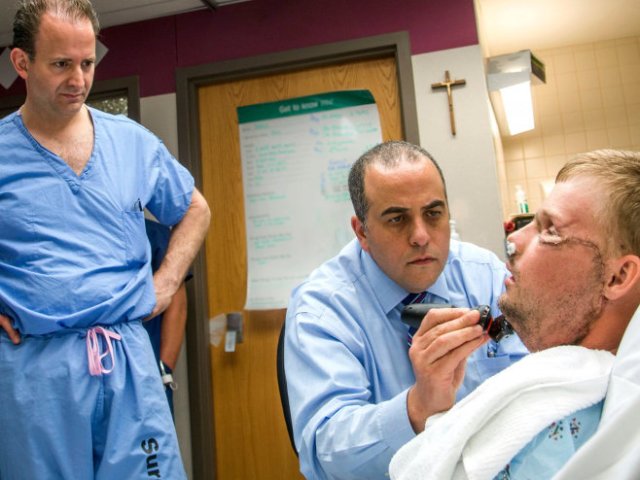
As Dr. Samir Mardini said, most of Andy’s upper and lower jaws were missing, along with his nose. There wasn’t much left to reconstruct.

The good news was that surgeons could patch and stitch what was left of his lower face into a small mouth and single nostril. The not-so-good news was that he looked — odd.

As the narrator said, “social interactions have been a challenge, and dating nearly impossible.” He spent a lot of time in Wyoming’s high country.

Some, not many, men have chosen a life far from other folks. Most of us prefer living among other people.

I think Andy summarized it nicely: “It would be nice to have – to settle down, have a wife and kids.”


2. Decisions


(From Mayo Clinic, via Business Insider, used w/o permission.)
(Before the surgery)


(From Charlie Neibergall/AP, via Business Insider, used w/o permission.)
(“Face transplant recipient Andy Sandness is hugged by Dr. Samir Mardini, foreground.”
(Business Insider))

2 tragedies intersected to give this man a face transplant — and the story that unfolded is powerful
Lydia Ramsey, Business Insider (February 17, 2017)

“In June, the Mayo Clinic performed its first face transplant.

“The medical feat, which is still a relatively uncommon procedure, was punctuated by the heartbreaking stories of two young men under very similar circumstances — one ending with a damaged face, the other in a death.

“Here’s how the decade-long story unfolded….”

Depression apparently factored into Andy Sandness trying to kill himself, and nearly succeeding. That photo shows what he looked like ‘before.’

Folks apparently are learning that “depression,” major depressive disorder, is a disorder: not an unwillingness to be peppy. I remember when we were on a similar learning curve with epilepsy, and that’s yet again another topic. Topics.6

I haven’t read why Calen “Rudy” Ross decided to kill himself. He’s the other young man Lydia Ramsey mentioned.

Rudy apparently had no obvious reason to commit suicide. He was 21, healthy, recently married, with a child on the way.7

My hat’s off to his widow. She was 19, eight months pregnant, and handled the additional decision-making with what I think is admirable reason, foresight, and resolve.

Her husband’s driver’s license had the ‘organ donor’ option checked. A few discussions later, she, LifeSource, and Mayo Clinic, were working to honor Rudy’s wish.

“…Months earlier, both he [Sandness] and Lilly Ross had expressed interest in learning about each other. She particularly wanted him to know about her husband, an adventurous, spontaneous guy.

“Last fall, she wrote to Sandness and the five others who received her husband’s organs. She described Ross, her high school sweetheart, as a ‘giving person’ who loved hunting, trapping and being with his dog, Grit. ‘I am filled with great joy knowing that he was able to give a little of himself to ensure a better quality of life for someone else,’ she wrote.

“As for the face transplant, she thought of her baby son when she agreed to it. ‘The reason that I decided to … go through with it was so that I can later down the road show Leonard what his dad had done to help somebody,’…”
(Associated Press/syracuse.com, LifeSource)

I don’t think the organ and face donations make Rudy’s suicide “okay.” I do think Lilly made a good decision, under extremely difficult circumstances.

Like I said earlier, suicide is a bad idea: and the Church prays for those who kill themselves. (Catechism, 22802283)

We’re even told that psychological factors make a difference. (Catechism, 2282)

I can’t reasonably say that suicide or any other bad idea is okay.

But recognizing that an action is a “grave offense” is one thing. Judging the person who commits the act is something I must leave to God. My job, part of it, is responding with charity and justice. (Catechism, 1861, 19281942, 21972246, 2401)

Happily, my connection with Rudy, Lilly, Leonard, Andy, and all, is quite remote. At the moment, my concern is mostly making sense in this post.

“…A Second Chance….”


(From Mayo Clinic, via Business Insider, used w/o permission.)

“…The moment Sandness realized his face finally looked normal came three months after the procedure. He was in an elevator, and a little boy glanced up at him without being startled, something that had never happened before the surgery.

“In the time since the procedure, Sandness has also regained the ability to smell, breathe, and eat as he could before the transplant. For now, he’s enjoying being able to blend into the crowd….”
(Lydia Ramsey, Business Insider)

Doctors at Mayo Clinic needed to be reasonably sure that Sandness knew the risks involved with this procedure, and could live with the consequences:

“…Sandness had to undergo a rigorous psychiatric and social work evaluation to address, among other things, a key question: Should this surgery be performed on someone who’d attempted suicide?

“Several factors were in his favor: His resilience and motivation, a strong support network of family and friends, a long-standing rapport with Mardini and a gap of several years since the shooting. Doctors also noted others with self-inflicted injuries, such as excessive drinkers, have received liver transplants.

“‘I don’t think there’s anybody who doesn’t deserve a second chance,’ Mardini says….”
(CBS News (February 17, 2017))

Since I take Jesus seriously, and have read Matthew 18:2135, I won’t argue against second chances. I’ve talked about mercy, forgiveness, and getting a grip, before. (December 4, 2016; November 21, 2016)

Transplants from one person to another trigger an immune response, unless the donor and recipient are twins. Our immune system is pretty good at attacking critters in our body that don’t have our genes.

That’s a good thing; when bacteria, viruses, or parasites get past our skin. When the non-identical code is in a transplanted organ, it’s not so good.

That’s why folks with transplanted parts take immunosuppressive drugs for the rest of their lives. The drugs have various unpleasant side effects, but not taking them means the new kidney, heart, or whatever, stops working.

Having an offline immune system isn’t good, either, which is why balancing benefits and risks is so important.


3. “Far Exceeded My Expectations”


(From Michael Cleary/Mayo Clinic via AP/STAT News, used w/o permission.)
(“The team at Mayo Clinic that carried out the surgery.”
(STAT News))

A ‘miracle’ face transplant gives young man a new life
Sharon Cohen, Associated Press, STAT News (February 17, 2017)

“He’d been waiting for this day, and when his doctor handed him the mirror, Andy Sandness stared at his image and absorbed the enormity of the moment: He had a new face, one that had belonged to another man.

“His father and his brother, joined by several doctors and nurses at Mayo Clinic, watched as he studied his swollen features. He was just starting to heal from one of the rarest surgeries in the world — a face transplant, the first at the medical center. He had the nose, cheeks, mouth, lips, jaw, chin, even the teeth of his donor. Resting in his hospital bed, he still couldn’t speak clearly, but he had something to say.

“He scrawled four words in a spiral notebook:

“‘Far exceeded my expectations,’ he wrote, handing it to Dr. Samir Mardini, who read the message to the group.

“‘You don’t know how happy that makes us feel,’ Mardini said, his voice husky with emotion as he looked at the patient-turned-friend he had first met nearly a decade earlier….”

The transplant operation kept two operating rooms, about 60 surgeons, nurses, anesthesiologists, and other folks busy for 56 hours.

They didn’t stay awake through the whole thing. STAT News says that individuals would take four-hour breaks along the way.

These ‘before’ and ‘after’ photos, and the picture of facial muscles and nerves, are screen captures from two YouTube videos:

One of the really tricky, or maybe tedious, parts of the process was testing the nerve branches to see which should be connected.

Neural ‘wiring’ in the human face is nowhere near as simple as that picture makes it look. Doctors tested the circuits by applying electric current to nerves and watching what happened.8

We’ve come a long way since Luigi Galvani learned how to make a dead frog’s legs jerk, and that’s still another topic.

No Stares, No Whispers


(From Mayo Clinic, via Business Insider, used w/o permission.)

“…He’s thrilled to smell again, breathe normally, and be eating foods that were off-limits for a decade: apples, steak, and pizza that he shared with his doctors.

“His transformation isn’t just visible. After the shooting, he says, when he dreamed, he still had his old face. Now, his new face appears in his dreams.

“Sandness, now 31, plans to return to Wyoming, work as an electrician and, he hopes, marry and have a family someday.

“For now, he savors his anonymity. Recently, he attended a Minnesota Wild game. He bought some popcorn. He watched some hockey. He didn’t see any stares or hear any whispers.

“He was, as he says, ‘just another face in the crowd.’ Just thinking about that makes him smile.”
(Sharon Cohen, Associated Press, STAT News)

Being able to eat an apple and not scare children is nice. So, I think, is raising a family.

I’m glad that Sandness has a second chance.

More about life, death, and decisions:


1 From 1962:

2 Medical history, “a good friend and a pretty good mechanic:”

3 Replacement parts:

4 About face transplants:

5 First face transplant, 2005:

6 Some of what we’ve learned so far:

7 Mayo Clinic’s first face transplant:

8 Inside the human face:

Posted in Science News | Tagged , , , , | 3 Comments

New Daily Prayer Routine

I tried — briefly — bargaining with God when we lost Elizabeth, our youngest child. (October 9, 2016)

When the somewhat one-sided conversation was over, I was accepting the unpleasant realities, and asking for help dealing with them: so I don’t feel particularly guilty.

I suspect that some folks say bargaining with God is always wrong because they see it as trying to manipulate God. That’s a bad idea: also impossible. The Almighty is just that. I can’t make God do anything. (Catechism of the Catholic Church, 268274, 21182119)

God is good, merciful, and loving. But because we live with consequences of a really bad decision, seeing that love as jealousy and vengeance is easy; and that’s another topic. (Exodus 34:6; Psalms 73:1, 103:8, 136:126; Catechism, 270271, 385, 397406, 1472)

I’ve talked about anger, vengeance, and free will’s down side, before. (February 12, 2017; November 21, 2016; November 13, 2016: November 6, 2016; October 5, 2016)

“A Vital and Personal Relationship”

Abraham’s discussion with God in Genesis 18:2033 was, I think, a different sort of “bargaining.” The patriarch was apparently showing concern for God’s reputation.

Prayer should be “a vital and personal relationship with the living and true God.” (Catechism, 2258)

“For me, prayer is a surge of the heart; it is a simple look turned toward heaven, it is a cry of recognition and of love, embracing both trial and joy.”
(St. Thérèse of Lisieux, Manuscrits autobiographiques, C 25r.; via Catechism, 2258

“Prayer is the raising of one’s mind and heart to God or the requesting of good things from God.”
(St. John Damascene, De fide orthodoxa 3,24:PG 94,1089C; via Catechism, 2259)

Ideally, Christian prayer is a gift of God, covenant, and communion. (Catechism, 22582565)

I’m pretty sure that my prayers aren’t close to that ideal, but I’m working on it.

Routines and Meaning

Most of my prayers are part of my daily and weekly routines. I don’t see that as a problem, since they’re supposed to be routine: like prayer before meals and during Mass. (Catechism, 1342, 13451405, 2698)

A few folks have told me that prayers shouldn’t be memorized, that prayer should always be spontaneous. They had a point.

“…To attribute the efficacy of prayers or of sacramental signs to their mere external performance, apart from the interior dispositions that they demand, is to fall into superstition.41
(Catechism, 2111)

Reducing prayer to ritual words and postures is a bad idea. so is seeing it as just psychological activity, or an effort to make my mind blank. (Catechism, 2726)

Prayer is a gift of grace, and something I can’t do unless I decide it’s worth the effort. (Catechism, 2725)

Prayer is also a battle against attitudes I’ve learned from “this present world,” pitfalls dug when time did not yet exist, and against my own shortcomings. (Catechism, 391395, 27252728)

Happily, there’s help available: drawing from two millennia of Christian experience, built on a much deeper foundation. (Catechism, 26852690)

Memorized prayers are in the mix, with a reminder that it’s not just the words. Thinking about what the words mean is important. (Catechism, 2688)

Prayer is always possible. (Catechism, 2743)

However, as anyone who has tried forming a habit of prayer knows, it’s not always easy:

“…There was a moment when I nearly refused to accept. — Deliberately I took the Rosary and very slowly and without even meditating or thinking – I said it slowly and calmly. The moment passed — but the darkness is so dark, and the pain is so painful….”
(Letter to Bishop Lawrence Trevor Picachy (September 1962), as quoted in Mother Teresa: Come Be My Light (2009) by Brian Kolodiejchuk, 2009, p. 238; via Wikiquote)

I think memorized prayers help at times like that.

Even when it’s not easy, prayer is always possible. That’s a good thing, because living as a Christian without prayer doesn’t work. Prayer is what makes sharing the love Jesus has for us possible. (Catechism, 27422745)

That’s not easy, either, and that’s yet another topic.

Lauds, Vespers, and Me


(From James Chan, via Wikimedia Commons, used w/o permission.)

I started a daily prayer routine after reading David Torkington’s “The Resolution to end all Resolutions” (February 3, 2017).

Started the next day, actually.

I read “Resolution…” last Sunday, and thought finding “one resolution that will help you keep them all” was a good idea. After a little checking, I decided the Liturgy of the Hours would be a good starting point.

I’m a Catholic layman, not a priest, so doing the entire Liturgy of the Hours isn’t required.

Different prayers, Psalms, and assorted hymns go with each hour of each day throughout the year. Details have changed over the centuries. That probably upset quite a few tight-collared folks along the way, and that’s yet again another topic.

Instead of trying to jump straight into a prayer regimen designed for someone else, I looked through the major hours. By the end of Sunday evening, I had a morning and an evening set of prayers, based on Lauds and Vespers.

I speak English, so the starting prayer for both is “God, come to my assistance; Lord, make haste to help me.”

Each ends with a form of the doxology: “Glory be to the Father, and to the Son, and to the Holy Spirit. As it was in the beginning, is now and ever shall be, world without end. Amen.”

“World without end” isn’t a literal translation of in saecula saeculorum.

That can be translated as “forever,” “to the ages of ages,” or “unto the ages of ages.” I understand that “world without end” is a synonym for “eternity;” it’s more comfortable, metrically, in my language; so I’m a happy camper.

Together, my morning and evening prayers add up to 520 words. Each includes the Lord’s Prayer, plus something to get started each day — and wrap up with thanks and resolution to do better. I haven’t missed either set so far.

Having both printed out and displayed on my desk helps. A lot.

Matthew’s Gospel has all seven petitions of the Lord’s Prayer, Luke has five, and that’s still another topic. (Matthew 6:913; Luke 11:14; Catechism, 2759, 28032854)

A Prayer for Clouded Hearts


(From Sb2s3, via Wikipmedia Commons, used w/o permission.)

Some prayers, like the Lord’s Prayer, have been around for millennia.

Compline goes back to somewhere in the fourth to sixth centuries: there’s been some discussion of that, and we’re still not sure.

St. Francis of Assisi probably wrote most of the Canticle of the Sun in 1224, and folks are still thinking of new prayers. I don’t see a problem with that, provided that the new prayer makes sense.

My third-oldest daughter wrote a prayer somewhere around December 1, 2011. She said sharing it was okay:

I pray to You, O Gracious Shepherd
For the sheep who’ve gone astray.
Grant that through Your Wondrous Power
Their clouded hearts will stir today.

Let them know Your Constant Mercy
Let Their hearts and souls be blessed
Grant that this, my prayer, be answered
Bring them safely home to rest.

Jesus, I Trust in You

Amen

Other posts, not entirely unrelated:

Posted in Being Catholic | Tagged , , | 7 Comments