Mass Murder: No Fast Fix

This year’s Ash Wednesday and Valentine’s Day were the same day.

Folks exchanged greeting cards. Many got their foreheads marked with ashes. And 17 were killed at a high school.

Someone’s already called last Wednesday’s mass murder the ‘Valentine’s Day Massacre of 2018.’ The famous Valentine’s Day Massacre was in 1929. It happened when a Chicago gang tried resolving a disagreement over bootleg booze. It didn’t succeed. Not quite.

Last week’s murders almost certainly weren’t gang-related.

Maybe I could come up with a catchy name that wasn’t related to the date, but that seems like a waste of effort. At best.

Life

Philippe de Champaigne's 'Still-Life with a Skull', a vanitas painting. (c. 1671) left to right: life, death, and time.I’m quite sure the 17 folks killed at Stoneman Douglas High School will be missed by their families, friends, and acquaintances.

One was a football coach. One of the dead students had won a swimming scholarship to the University of Indianapolis.

Others were on the school honor guard, enjoyed playing soccer or dancing. A geography teacher died while trying to barricade a door. Like I said, they will be missed.

Nothing I say or do will change what happened. But I can talk about why I think murder is a bad idea. Among other things.

Deliberately killing an innocent person is wrong. That’s because human life as sacred. All human life. My life — and everyone else’s — is a gift from God. (Catechism of the Catholic Church, 22582317)

I decide what I do with my life. I can try helping or hurting others. We all can. (Catechism, 17011709, 2258)

Here’s where it gets complicated.

Every human life is precious. That’s why defending our lives, using the least force necessary, is okay: even if that action results in the attacker’s death. (Catechism, 22632267)

Like I said: complicated. (January 22, 2017; January 11, 2017)

Opinions

Some media outlets lost no time giving their views on what oughta be done.

It’s nice, in a way, seeing so many cries for consciousness raising, or whatever it’s called these days. It’s arguably better than not caring, or enjoying the carnage.

I think they’re right. We’ve got problems. I’m none too satisfied with the status quo. And haven’t been since the 1960s.

Hoo boy. That, I’d better explain.

I’m not a soft-headed liberal or heartless conservative.

I sometimes get pegged as “conservative.” Partly, I suspect, because I’m not on the same page as today’s establishment. Not even close.

What I think is too well-defined to be “moderate.” Not in the blandly placating sense.

I think social justice, the kind that makes sense, is a good idea. So is private property, within reason. It boils down to taking love and hope seriously. And God:

For fun, and to see what happened, I’ve tried some of those ‘what are your political views?’ online freebies.

The ones I checked kept it simple, no more than maybe 20 or so questions. Each picked a different theme: economics, civil rights, that sort of thing.

I wasn’t surprised when some results showed that I was pretty far into the ‘right wing conservative’ spectrum. Others identified me as a liberal. One showed me as a libertarian.

Each, I think, was accurate: sighting along the angle the test designers chose.

Crazy Ideas

Getting back to current news and views, nobody has said that Hallmark is to blame, or that we should abolish all holidays with religious origins.

Or that we should remove environmental regulations and ban environmentalist “propaganda.”

Folks with that view could point out that Stoneman Douglas High School is named after Marjory Stoneman Douglas. She’s an environmentalist, feminist and journalist. Was. She died 20 years back. At age 108.

More accurately, I haven’t seen those opinions in my news feeds or social media. And I don’t plan to go looking for ‘news and views from the weird side.’

On the other hand, I could share a crackpot notion. And will.

I made this up, and most emphatically do not believe it. I figure it’s safe to post, since only a few folks might take it seriously. And they almost certainly won’t read this blog. Even if they do, I doubt it’d get much attention. Apart from discussions of weird notions. Maybe.

It starts with a fact: and a preference I occasionally see, and do not think makes sense.

Every mass murder at a school has happened — at a school.

Other mass murders happened when folks got together. For fun. Like music festivals or night clubs or suchlike suspicious things.

‘Obviously,’ we should outlaw public gatherings. And private ones.

Or at least abolish schools.

While we’re at it, outlaw education. It just gives kids ideas.

At least stop telling those impressionable youngsters that Earth is round.

And stop teaching them to read. There’s no telling what they’ll learn.

Given today’s background ‘nonsense’ noise, I’d better make a disclaimer: I’m kidding!

I think reading is a good idea.

So is education.

One reason reading is a good idea is that it makes studying the Bible easier. The whole Bible, not just a few favorite verses.

About that last, Catholics are strongly encouraged “…to learn the surpassing knowledge of Jesus Christ, by frequent reading of the divine Scriptures….” (Catechism, 101133)

There’s no ‘reading requirement’ for being Catholic. But it makes studying the Bible easier. Which doesn’t mean what some folks may assume.1

Another crazy idea would be outlawing cars. From what I’ve read, many recent mass murderers drove cars. One used a car to kill people. (August 14, 2017)

I’ll get back to that.

Thinking

I get the impression that few if any Americans are delighted, or even smugly certain, that our country is just fine the way it is.

Some yearn for the imagined halcyon days of the 1940s or ’50s. Others apparently feel that the answer is doing what we did in the 1960s and ’70s: only moreso. Or “more so,” for those who prefer pre-21st-century spelling.

I’m not at all happy about current events and attitudes. But I don’t think being frantic or hopeless will help. I’m slightly sympathetic with folk longing for ‘happy days’ America and those carrying a torch for ’60s sensibilities. (January 21, 2018; June 4, 2017)

A particular technology is a hot-button political issue. I’m sure folks on both, all, sides are passionately convinced that they must be right.

I understand feeling good or bad about something. I’m a very emotional man. But I think feelings are a poor substitute for facts and reason. (October 8, 2017; July 2, 2017)

My son-in-law is as interested in facts and analysis as I am. And better at making practical use of them, which is another topic. Anyway, he looked up a few numbers:

Aaron McWilliams
February 14 ·

“Chances of being killed in a School shooting: 1 in 67,500

“Today we learned of yet another tragic school shooting. Let us remember the families of all of those effected in our prayers both today and for years to come.

“I pondered why these things happen, how often they happen, and how big of a problem it is. What are the chances of getting killed in a school shooting? After collecting some data and doing some math it comes out to about 1 in 67,500 or a .0015% chance. This mean that you are 104 times more likely to git hit by a car over your lifetime.

“Why post this? I believe it is important to put things into perspective. Yes, all school shootings are terrible and should never happen. It is good and right to speak out against evil but we must not allow ourselves to live in fear and sacrifice our freedoms. Fear is not of the Lord.”

I think he’s right. Mass murder at schools is not right. It’s wrong. Saying so is a good idea.

But letting fear take control is not good. It is a bad idea, and we shouldn’t do it. Feelings are fine. But we’ve got brains. We should use them. (Catechism, 1730, 17621770, 1778, 1804, 2339)

Many Questions, Few Answers

Details of what happened Wednesday and who was involved are still unsettled.

We know that 17 folks were killed.

I don’t think there’s reasonable doubt that a 19-year-old former student killed them.

There’s the usual speculation, and a few facts.2 The speculation ranges from common sense to what may be the usual demonizing, or overly-imaginative memory at work.

The young man sounds like other recent mass murderers: a depressed loner. He’s still alive. And in custody.

In 20-20 hindsight, someone should have done something different. Probably several ‘someones.’ Folks will be playing blame games for quite a while.

I hope and trust that others will look at the facts and see what should be changed. And what went right, and shouldn’t be changed.

I am quite sure that 17 folks were killed, that one person killed them, and that the killer is not an immediate danger to others. Aside from that, I don’t know enough to have an informed opinion.

It’s not all bad news and slanted views.

I have seen a refreshing lack of appeals for putting tighter restrictions on crazy people.

How we treat folks with psychological and psychiatric conditions occasionally needs review. I suspect it does now, but haven’t researched the issue.

I also think ‘lock them all up’ isn’t a reasonable policy.

Partly because I’m one of ‘them.’ That doesn’t make me a menace to society. I’m pretty sure about that. (January 7, 2018; December 17, 2017; November 19, 2017)

I’d love to have a simple solution to the world’s woes. Simple and easy. Preferably a nice slogan or sound bite.

Simple I can do. Simple and easy, no. Not even close.

Love

Mass murder isn’t our only problem.

Wars are in progress around the world. Small ones, but lethal just the same. Food isn’t getting to folks who need it. Neither is adequate medical care. Slavery is illegal in some places, and surprisingly unfashionable. But it’s still done, and a bad idea. (Catechism, 2414)

Those aren’t the only problems, sadly.

I think the solution is simple. And very, very far from easy.

I should love God, and my neighbors. I should see everyone as my neighbor. Everyone. No exceptions. (Matthew 5:4344, 22:3640; Mark 12:2831; Luke 6:31 10:2527, 2937; Catechism, 1789)

It’s not just me, of course. That’s why I keep suggesting that loving neighbors, respecting humanity’s transcendent dignity, makes sense. (Catechism, 1929)

Knowing what I should do, and actually doing it, isn’t the same thing. But doing what’s right and avoiding what’s not is still a good idea.

“…The answer to the fear which darkens human existence at the end of the twentieth century is the common effort to build the civilization of love, founded on the universal values of peace, solidarity, justice, and liberty….”
(“To the United Nations Organization,” Pope St. John Paul II (October 5, 1995))

Building something like St. John Paul II’s civilization of love3 won’t be finished in my lifetime. I think we’ll be doing well to get a first approximation in a few centuries.

I also think we can do better. I am sure that we must try:


1 Taking the Bible seriously doesn’t mean trying to ignore what we’re learning. I keep running into Christians, some of the Catholics, who seem convinced that evolution can’t happen because it’s not ‘Biblical.’ (July 23, 2017)

But oddly enough, I’ve yet to meet a Christian who thinks Earth is flat. Copernican heliocentrism is another matter. (January 19, 2018; December 2, 2016)

2 What happened Wednesday, from Friday’s news:

3 A civilization of love; it’s a work in progress:

Posted in Being Catholic | Tagged , , , , , , , , , , | 2 Comments

Lent: Not Doing Too Much

Quite a bit happened this week.

We started Lent’s 40-day stay with our Lord in the desert. Not literally. That’s mentioned in today’s Gospel: Mark 1:1215. I’ve talked about deserts and Deuteronomy, penance and porridge, before. (February 11, 2018; February 26, 2017)

There’s a more technical — and more useful, probably — discussion in the Catechism of the Catholic Church 538540.

This year’s Ash Wednesday was also St. Valentine’s Day. We’d been celebrating St. Valentine of Rome for centuries before the High Middle Ages. That’s when he got associated with courtly love. His feast day has been February 14 ever since.

St. Valentine of Rome’s portfolio includes engaged couples, beekeepers, happy marriages, love, plague and epilepsy. “Courtly love” is a can of worms I’ll leave for another day.

Starting Lent

If I believed Lent was all about feeling far less than chipper, I’d be pretty impressed with myself.

I’m not. Either chipper or impressed. The latter would make about as much sense as seeing health as a reward for holiness. (January 7, 2018)

I’m not quite sick, not enough to warrant medical attention. But I’m not well either.

It’s frustrating, and kept me home on Ash Wednesday. My wife and #3 daughter did the same, for the same reason.

My son, happily, is less under par, and brought home this year’s cross and necklace. I’m wearing both now. I haven’t timed it, but the ‘chaplet’ prayers are probably the shortest part of my Lenten ‘add-on’ routine.

Keeping it Simple

What I’m doing for Lent is pretty minimal. Along with the chaplet, I read whatever’s on a Lent 2018 Calendar. It’s from the USCCB.

Each day there’s something from the Bible, a prayer, something written in the last two millennia. That sort of thing.

There’s a printable copy: six sheets/pages. My copy is virtual: a *.pdf I filed under ‘devotionals.’ That lets me get at it easily, without expending paper and ink.

I could waste time and effort, agonizing over my ‘keep it simple’ decision. But I won’t. This reading-and-prayer routine is something I can do. I figure doing what I can is more productive than fretting about what I can’t.

It seems I’m not the only one who thinks being reasonable makes sense. “Don’t do too much” is the sixth of ten points on a ‘what to remember’ list:

I’ll probably look at how ‘dying to myself’ doesn’t mean indulging in self-inflicted pain and suffering. Eventually.

What with flagellants and ‘more ascetic than thou’ enthusiasts, it’s a wonder more folks don’t assume “Christian” and “crazy” are synonyms. And that’s another topic.

Then there’s observing Lent’s ‘meatless Fridays’ by going to a swanky restaurant and ordering Lobster Thermidor. That’s not how it works.

Or why. The goal is taking my cues from our Lord:

Posted in Being Catholic | Tagged , , , , | 2 Comments

Mars and Beyond

Falcon Heavy’s test flight last week wasn’t perfect. But I’ll call it a success. That’s good news for SpaceX. My opinion isn’t the good news, I’m nowhere near that influential. It’s the largely-successful flight.

The test flight’s dummy payload included an actual dummy. “Starman” is the mannequin wearing a spacesuit at the wheel of a red Tesla roadster.

I’ll be talking about that, also how I see the news, technology, and humanity’s new horizon.


Tickets to Other Worlds


(From Falcon Heavy Demo Mission, SpaceX; via Wikimedia Commons, used w/o permission.)
(Falcon Heavy Lift side boosters landing: February 6, 2018.)

We still don’t have spaceliners or daily low Earth orbit commuter runs. But we’re another step closer to those science fiction staples.

I’ll probably talk about energy costs, efficiency, and the economics of spaceflight in more detail. Eventually. Not this week.

Briefly, going from Earth’s surface into orbit is more expensive than taking a flight from Houston to Dallas.

Partly, I think, because there’s not much traffic between the surface and orbit.

It’ll always be a bit more pricey, probably. Lifting something into Earth orbit takes a fair amount of energy.

But that’s not, I think, the main reason we don’t have passenger service to Lunar cities. Lunar cities? That’s another topic. Several, actually.

We’ve had ocean liners for generations. Cruise ships are still a vacation option. Airlines make global travel possible for many folks. Including transpacific flights.

None of that would be possible if airlines had to buy a new Airbus for each trip. Or Royal Caribbean International needed a new Harmony of the Seas for each cruise.

Which gets me to why we don’t have spaceliners. Yet.

Harmony of the Seas cost about $1,350,000,000. It carries 5,479 passengers at “double occupancy.”

How they get an odd number out of “double,” I don’t know. There’s also a crew of 2,300 or so.

A new cruise shop would cost — only $246,395 per passenger. That’s not ridiculously expensive. Beyond my household’s budget, though.

Getting a vehicle isn’t the only expense, of course. Figuring out wages, fuel, maintenance and the rest — would take time. More than I’m willing to spend this week.

I’ll be optimistically vague instead.

Let’s say that ticket cost per passenger with a new Harmony each time would be around a million dollars. Probably more, since folks with that sort of money might want roomier quarters and more staff.

If each of the world’s 2,000 or so billionaires took a million-dollar Caribbean cruise each year? My guess is that most would prefer their own yacht to a cruise ship. Assuming they didn’t have other plans, or put vacations off until retirement.

Developing Tech


(From NASA, used w/o permission.)

I might be around when the first humans set out for Mars. Or not.

I’m about as sure as I can be that we’ll get there. Whether it takes decades, centuries or millennia depends more on economics and preference than technology. My opinion.

We don’t have the tech now. Not quite.

Outfits like SpaceX are very close to launching commercial vehicles capable of getting to Mars. Keeping folks in good shape on the way? That’s in development. Making it reliable and ready will take time.

Whether or not the first human arrivals are explorers or colonists, they’ll almost certainly set up a habitat. One that’ll support them for months.

That’d suit scientists with a new planet to study. But they’d be stuck there anyway, regardless of their druthers. Physics makes the stopover necessary.

Round Trip to Mars

Getting to Mars and back takes roughly 21 months with something like today’s tech.

Walther Hohmann‘s 1925 book described the orbital mechanics.

Hohmann transfer orbits aren’t spot-on accurate, since they don’t take the Solar System’s gravity fields into account. Other than our sun’s, that is.

But they’re close enough for ballpark estimates.

Using minimum fuel, it takes nine months to reach Mars from Earth. Heading back to Earth’s orbit can be done any time after that.

Folks who want Earth to be there when they arrive must wait three months. Then it’s another nine month coast to Earth. Roughly.

That’s something like 21 months, living on whatever we bring along. For six people, that’d be about 3,000,000 pounds of supplies. That’s around 1,500 tons. U.S. measurements.

If I’m reading the numbers right, that’s very roughly how much cargo many container ships carry.

Building a life support module that big should be possible. Expensive, but possible.

Adding enough fuel to get the thing to Mars and back? Even leaving used parts behind for the return trip?

I doubt anyone would see the proposal as affordable.

Knowing how something can be done, the science involved, is one thing. Working bugs out of prototype tech is another. Next comes putting the pieces together and making it all mildly reliable. That’s assuming that resources and interest kept up.

It took us nearly two millennia to go from aeolipiles to steam engines and robotic spaceships. We managed the last step in a few centuries. (February 5, 2017)

We’ve got much more effective data storage, retrieval, and analysis tech now, which should speed things up. Yet more topics. (January 26, 2018; December 1, 2017)

Plans


(From NASA/Clouds AO/SEArch, used w/o permission.)

The first Martian habitats may not look quite like the Langley/Clouds Architecture Mars Ice Dome. But they won’t be much different either.

Most plans include intensive agriculture, high tech gardening, and pressure vessels to keep the plants and people alive.

Since Mars has a thin atmosphere and no magnetic field to speak of, plants and people both need radiation shielding.

That makes getting light to the plants and providing folks with a view outside a bit challenging. We don’t need to see out the way plants need light. But looking outside is arguably important psychologically.

Something like the Mars Ice Dome would work for explorers. As a combination home and workshop/lab, it’s not overly roomy.

Clouds AO and SEArch’s plans seem to show enough elbow room, though. It’s more like today’s Antarctic research stations than the huts built by early expeditions.

Settlers could make do with habitats like that at first. Folks planning to live on Mars will almost certainly want more room, though.

Options

Why go to Mars at all? Or anywhere besides where we live today? And why waste valuable time and resources learning about anything new, when we’ve got so many problems here in Earth?

If it was an either/or situation, I’d probably opt for solving current issues first.

I’m pretty sure that’s not how it works, though: any more than I think it’s caring about either people or the environment. (August 11, 2017)

That “probably” needs explanation. Maybe. I couldn’t support a ‘people first’ proposal I thought would make matters worse. I shouldn’t, at any rate.

Some folks think sending robot probes to other worlds makes sense, but not humans. They have a point. We’re learning quite a bit about Mars from flybys, orbital missions, and surface rovers: without ever leaving Earth.

Automated probes can be smaller, lighter and less expensive than something carrying us. Safer, too, since ground controllers don’t have to endure anything except rush hour traffic.

Reducing risks and expenses makes sense.

So, I think, does seeing what other worlds look like with our own eyes: not through a probe’s cameras. Video from Apollo 17 showed that plainly enough, I think.

Harrison Hagan “Jack” Schmitt, a geologist, was one of the two astronauts on the surface.

Astronauts on earlier missions had done geological — selenological? — survey work. They followed procedures with professional skill, bringing back samples we’re still analyzing.

Schmitt did the planned survey work, too. But he was a geologist, the first one on a new world.

I’ve seen puppies less excited than he was.

He did something in one spot I hadn’t seen before. He lifted his suit’s outer gold-coated sun visor.

My guess is that lifting the visor wasn’t part of official procedures. The visor is there to block light and heat. It’s useful, even necessary, on the lunar surface.

There was no immediate reason for Schmitt to lift his visor. But doing so almost certainly gave him a better view of the rock he was holding. Can’t say that I blame him.

The risk would have been minimal. Plus, he had three days to see what he could between the South Massif and Sculptured Hills in Taurus-Littrow. Observing as much as he could, as well as he could, made sense.

I share Schmitt’s excitement over the airless world circling ours.

The Apollo missions probably weren’t the most important thing happening in the 20th century. But I think there’s wisdom in remembering the excitement they inspired around the world. I’ll be talking more about that, and what I see ahead.

After talking about the Falcon Heavy launch and red roadster.


Falcon Heavy Test Flight


(From Falcon Heavy Demo Mission, SpaceX; via Wikimedia Commons, used w/o permission.)
(Elon Musk’s Tesla Roadster on the Falcon Heavy upper stage.)

Elon Musk’s Falcon Heavy rocket launches successfully
Jonathan Amos, BBC News (February 7, 2018)

US entrepreneur Elon Musk has launched his new rocket, the Falcon Heavy, from the Kennedy Space Center in Florida.

“The mammoth vehicle – the most powerful since the shuttle system – lifted clear of its pad without incident to soar high over the Atlantic Ocean.

“It was billed as a risky test flight in advance of the lift-off.

“The SpaceX CEO said the challenges of developing the new rocket meant the chances of a successful first outing might be only 50-50.

“‘I had this image of just a giant explosion on the pad, a wheel bouncing down the road. But fortunately that’s not what happened,’ he told reporters after the event….”

The Falcon Heavy test mission wasn’t flawless. Only two of the three boosters landed. But I’m going to look at this as a ‘glass half full’ situation. More that half, actually.

Even so, I see it as a successful test flight. Apart from the center booster’s crash landing. It hit the water at about 300 miles an hour, 500 kph, a hundred yards off target. One of its engines fired on the way down. The others didn’t.

We’ve come a long way since the 1950s.

Just getting a vehicle off the pad and clear of the umbilical tower was something of an accomplishment in those ‘good old days.’

The first Vanguard launch got four feet up before heading back down.

The satellite survived the explosion and kept transmitting. It was in no shape for use, though, and ended up in the National Air and Space Museum.

Journalists came up with imaginative nicknames. Like kaputnik, flopnik, puffnik and stayputnik.

The latter two were misnomers, I think. It didn’t actually go “puff,” and traveled several yards from the launch site. The launch was far from a success, though.

In sharp contrast, the Falcon Heavy’s test flight went pretty much as planned.

Including sending a sports car toward the stars. Toward the stars. The roadster won’t be leaving the inner Solar System. I’ll get back to that.

Technicians at SpaceX will almost certainly be going over telemetry with the proverbial fine tooth comb. Still, landing two of the three boosters is good. Landing all three would have been better. They’ll want to learn what went wrong with the third booster.

Those things are expensive, which is why so many folks have been developing practical designs for reusable spacecraft.

And a Red Roadster


(From Falcon Heavy Demo Mission, SpaceX; via Wikimedia Commons, used w/o permission.)

I’m happy to see systems like India’s GSLV in operation. But it’s nice to see folks in my country keeping up, too. (June 9, 2017)

The Falcon Heavy is impressive, the first American vehicle its size since the Saturn V and Shuttle. It’s currently the world’s most powerful rocket. I’m pretty sure that’ll change soon.

I didn’t know what to think of that red sports car in space.

Given Elon Musk’s theatrical flair, it wasn’t a surprise. My view is that it’s his company and his car. If he wanted to have its virtual driver take selfies, that’s his decision.

Aside from ruffling a few feathers in excessively serious circles, I don’t see the harm. And launching a red sports car into space gave me topnotch images for this post. There’s more to it than a publicity stunt, though.

Having Fun


(From Falcon Heavy Demo Mission, SpaceX; via Wikimedia Commons, used w/o permission.)

SpaceX designed the Falcon Heavy to lift satellites into geosynchronous orbit. Or low Earth orbit. Or both. Or toward Mars. The Falcon Heavy’s upper stage can restart in space, delivering packages to different orbits.

Since this isn’t one of those ‘Earth’s fate hangs in the balance’ movies, testing the vehicle with something less valuable than a high-tech satellite made sense.

The dummy payload would normally have been something like steel or concrete blocks. But a red roadster was more fun.1

“…SpaceX decided it would be more worthwhile to launch something fun and without irreplaceable sentimental value: a red Roadster for the red planet. Following launch, Falcon Heavy’s second stage will attempt to place the Roadster into a precessing Earth-Mars elliptical orbit around the sun.

“It’s important to remember that this mission is a test flight….”
Falcon Heavy Demonstration Mission,” SpaceX (February 2018)

Concrete blocks would have been a less expensive dummy payload. I gather that a Tesla Roadster sells for between $200,000 and $250,000 or thereabouts.

On the one hand, that’s a pricey bit of “fun.” On the other, pictures from the Falcon’s outward-bound upper stage gave SpaceX and Tesla the sort of publicity you can’t buy.

Orbits


(From nagualdesign, via Wikimedia Commons, used w/o permission.)
(The Tesla sports car’s orbit (red) takes it a little farther out than Mars.)

I don’t know how many folks think the Tesla is headed for Mars. It’s not.

It could have been, if Earth and Mars had been elsewhere in their orbits at launch. Even then, the roadster wouldn’t have done much. The Falcon Heavy upper stage wasn’t rigged for deep space course corrections, for starters.

As it is, the rocket and roadster will be orbiting our star for a long time. We’ll be tracking them, at least for a while. About that — Jet Propulsion Laboratory’s HORIZONS web interface lists the Falcon’s upper stage and Tesla roadster as 2018-017A, or Starman.

It’s a good thing that nobody’s in that SpaceX spacesuit. Folks in the company’s Dragon 2 will wear it, or something like it, on the way up and back down. It’s designed for short-term safety and comfort inside a spaceship. Not working a shift outside.


Zeal and Amos


(From SpaceX/Shutterstock, via The Guardian, used w/o permission.)

The SpaceX roadster’s publicity hasn’t been all positive.

I appreciate Mr. McKenna’s zeal in protecting Earth’s ozone layer, class-struggle causes, and all that.

I might not have picked a sports car running on lithium-ion batteries as my target. But environmental and social justice concerns can be reasonable. Or not.

Some folks with wealth and influence don’t use their power well. That was a problem when Hammurabi’s law code was new. It’s a problem today. I figure it’ll be a problem when Hammurabi, Spartacus and Karl Marx seem roughly contemporary.

The problem isn’t wealth. It’s misused wealth and misplaced priorities. It’s the sort of problem we’ve had almost from the start. (Amos 8:46; Proverbs 23:3; 1 Timothy 6:1; Catechism of the Catholic Church, 396406, 19281942)

And that’s yet again another topic.

Space Junk

The ‘space junk’ criticism is somewhat reasonable. It’s stuff, mostly in Earth orbit, that we’ve left there.

Some is small, like dust from solid rocket motors. Some is about as big as that roadster.

Most of the debris is in geosynchoronous orbit, along with a great many working satellites. It’s pretty much everywhere we’ve been. Either in person, or through our robotic proxies.

It’s not “permanent” on a cosmic scale. Some will drop back into Earth’s atmosphere in a matter of years or decades. If left alone, some will orbit for millennia.

We can track the larger pieces, spotting collisions before they happen. The ISS has gotten out of the way a few times, giving reporters something to do.

We’re developing national and international standards for debris control. That should help slow down how fast it’s accumulating. Clearing what’s already there is an issue I’ll leave for another day.

“Depressing” News?

‘Glass half empty’ viewpoints are always an option.

Even when the glass is completely, full, a dedicated doomsayer could remember that it might be empty someday.

Or broken. Or maybe the water is polluted. I don’t see the allure in that attitude.

Back to technology and crepe hanging.

The Falcon Heavy test launch hasn’t inspired a lasting peace in Congo, ended poverty, or proven the Reimann hypotheses. Not that I know of, anyway. But it’ll help folks reach space with less expense and waste.

Now, a ‘glass half empty’ viewpoint.

Quite a few folks were killed in Syria on the day of the launch. A Mr. Robinson found that “depressing:”

He’s got a point. English-language news media focused on the launch and the sports car that day. Not the sad business-as-usual in Syria. Or Congo, Mexico, Darfur, or dozens of other places.

What I found surprising, looking back, is the SpaceX launch’s headline treatment. And generally upbeat treatment, at that.

I enjoyed the break from sturm und drang over who’s in the White House. When the press seemingly has nothing but praise and adulation for our beloved leader? It’s rare, but has happened. It’s also downright troubling. To me.

I haven’t felt unqualified loyalty to or antagonism against any president since I started paying attention, about a half-century back.

I’m “political” only in the sense that I’ve got opinions galore. But not unyielding support for some party or politico. (February 4, 2018; September 17, 2017; January 22, 2017)

And that’s still another topic.

Horizons

One of my opinions is that if folks from America, India, China, or somewhere else don’t visit Mars: someone else will.

That’s not Manifest Destiny with a global perspective. Not the way you probably heard about it in school, anyway.

I think we’ll return to Earth’s moon, visit Mars, and keep going because we’re human.

We’ve improved our tech, and look a bit different than we did when we first left home.

But we haven’t stopped being the sort of creature we are. For something like two million years, some of us have wondered what’s over the next hill. And headed for the horizon.

Politics drove the Apollo program — in part. Getting to the moon by lifting the whole works off in one launch worked. Spectacular as that was, I don’t think it was the optimal strategy. But it got the job done fast.

I think we’ve been on a more reasonable track recently. Skylab and Salyut 1 were a good tests-of-concept. The ISS is, I think, a good step too. I’m quite sure it won’t be humanity’s last orbital workshop/lab/observatory.

Low Earth orbit isn’t quite ‘over the next hill’ today. But it’s a good place to camp on our way out.

If I thought we shouldn’t ever leave Earth, I might be worried. I’m not.

I’ve enjoyed Lovecraft’s tales. But I’m not concerned that we’ll learn ‘too much.’ I do not think ignorance is our only defense against cosmic horrors. Or a good idea. (November 24, 2017; June 16, 2017)

We can learn about God by noticing order and beauty in the universe. (Catechism of the Catholic Church, 3132, 3536, 301, 303306, 311, 319, 1704, 22932296)

Curiosity is part of being human, or should be. We’ve also got free will, so ignoring the wonders around us is also an option. But not, I think, a reasonable one. (March 26, 2017)

Puzzles

My guess is that Elon Musk’s roadster will stay in orbit for quite a while.

Most of it, anyway.

The roadster’s paint, plastic, leather and tires won’t last more than maybe a year.

It’s not the vacuum. Radiation’s an issue beyond Earth’s atmosphere and Van Allen belt. So are micrometeoroids: nature’s own “space junk.”

In time, anything with carbon-carbon bonds will break down; leaving the aluminum frame, inert metal parts and the roadster’s glass.

The roadster is “space junk” in the sense that it’s not doing much. Apart from orbiting and shedding bits and pieces.

At the moment, it’s a point of potential philosophical angst, not a practical problem. I’m pretty sure that’ll the case for decades, probably longer.

But I don’t think it’ll orbit for a billion years. My guess is that it’s got no more than a few more centuries, tops.

Somebody’s going to notice something that size in orbit between Earth and the asteroid belt. What folks make of the rocket-riding roadster will depend partly on how many records of this era get preserved.

If its origins are completely forgotten, it could be quite a puzzle.

In that case, some scholars may say it’s a hoax or forgery. That’s been done with the Phaistos Disc.

Hoaxes happen. But dealing with unsolved puzzles by saying ‘I don’t understand it, therefore it must be a fake’ doesn’t seem reasonable.

Let’s see. I’ve talked about technology, being human, more technology, dealing with puzzles. There’s one more item I wanted to at least mention: life on Mars.

I don’t know if there’s life on Mars now. But I’m quite sure there will be. It’s one of our obvious ‘next steps.’

Looking Ahead


(Detail of “city night,” by molybdenumgp03, used w/o permission.)

I’ve seen opinions shift from near-certainty that we’ll find life on Mars to near-certainty that we won’t.

Few scientists took Lowell’s canal-builders seriously. But quite a few thought we’d find something like lichens or maybe moss.

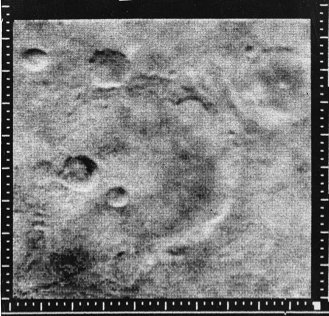
Then the first flyby showed nothing but craters. ‘Pop’ went hopes for life on the Red planet. Orbiters changed that. We saw other features. Including what looked like rivers. Dry, but the sort of sinuous channels we see on Earth.

We don’t know details of the Martian hydrologic cycle. But we’re reasonably confident that there’s water there. Probably in copious supply. Frozen, for the most part.

Martian life is still an unknown. If it’s there, it’s defied detection so far. I think one of the smartest ‘life experiments’ would have been a good microscope. But nobody asked me, and we did get interesting data from chemical tests.

If there is Martian life — that’s a very big “if.”

If we do find Martian life, at least some scientists will most likely insist that nothing but scrupulously-sterilized probes be sent anywhere near Mars.

They’ll have a point. Studying Martian critters would be harder if we first had to decide whether they’re originally from Mars, or hitched a ride from Earth.

Even if the civilization that first reaches Mars makes it a ‘no visitors’ nature preserve, I’m pretty sure that we’ll land there. Eventually. Our civilizations come and go. We keep going.

We might decide to hold off Martian settlement until after sprucing the place up. Maybe.

Terraforming an entire planet is beyond today’s tech, almost.

We’re a bit sketchy about exactly what would happen as we warm the place up and adjust the air.

And we certainly have no economic or political need to terraform Mars.

It’d be an enormously expensive job. One that’d almost certainly take millennia to show usable results.

Besides, by the time we’ve got outfits with resources on that scale, I think much of Mars will already be ‘terraformed.’

That little Mars Ice Dome is a good start. But like I said, folks will want more room. I don’t think it’ll be long before folks visiting Mars will decide to stay. ‘Not long’ by my standards, anyway. Maybe a century or so.

The first ‘settlement’ habitats probably wouldn’t be much larger than the Mars Ice Dome. Connecting several domes could work for quite a while to accommodate newcomers.

At some point folks would, I think, decide it makes more sense to build larger domes, cylinders, or other readily-pressurized shapes.

Eventually their settlements could grow into towns, cities. Some might not attract many tourists. But ‘compact’ needn’t be cramped and unpleasant. Think Positano or Ravello on the Italian coast.

I can easily imagine someone like me living in a small community not far Athabasca,2 talking with a more conventional chap. He’d be countering my interest in newfangled ideas with his version of common sense.

We’d be discussing proposed settlement plans for a nearby planetary system. He’d see that as a bad idea. Folks, in his view, should live where God intended: in places like Winnipeg, Athabasca, or Gusev City.

Looking back, around, and ahead:


1 Technology, mostly:

2 Athabasca Valles is an outflow channel on Mars, near the equator and generally south of Eleysium Mons. Gusev is a crater in the same general area.

Winnipeg is a city in North America. I live south of there, northwest of the Minneapolis-St. Paul area.

Posted in Science News | Tagged , , , , , , , | 2 Comments

Skydiving and Lent

Lent is fast approaching. How I see it and what I do is up to me. Ash Wednesday is next week, so I don’t have much time to decide.

Christians, Catholic and otherwise, in my culture generally change what we eat for this season. I’m a Catholic, so I’ve got rules.

But not all that many. Mostly they’re guidelines. I put a link to my territory’s rules about diet under ‘Fast & Abstinence‘ near the end of this post. Other resources, too.1

Days of Yore

The rules probably wouldn’t suit folks who yearn for the ‘good old days.’

They’ve changed. The rules, I mean.

I strongly suspect that kvetching about today and longing for days of yore is as old as humanity.

Some rules and definitions haven’t changed much, though.

For Lenten purposes, I see “meat” as what we get from mammals and birds, but not seafood. I’m not sure where frogs fit in.

Living in the era I do, I realize that muscle tissue in different sorts of animals is pretty much the same stuff. Not quite identical, and that’s another topic.

Some differences are important for cooks and butchers, others for scientists. I can use those viewpoints if I’m thinking about food or natural philosophy. That won’t stop me from switching to my faith’s definitions where they’re needed.

Common Sense

One of the rules I live with says Catholics should fast during Lent.

That doesn’t mean I stop eating and expect a miracle to keep me alive until Easter. It’s a bit more complicated. And reasonable.

Ash Wednesday is a ‘fasting’ day.

In my territory fasting is one complete meatless meal and optional other food that doesn’t add up to a meatless meal. That’s what I did until recently. The rule doesn’t apply to folks over 59, which includes me.

More complications. Catholics between 18 and 59 follow the fasting rules. Unless a physical or mental illness means choosing between fasting and taking health risks.

Bishops in my country put it this way: “…In all cases, common sense should prevail….”

My diabetes makes fasting dubiously prudent. That’s true for some healthy folks, too.

Women who are nursing would most likely survive fasting, and so would their babies. But like the bishops said, we’ve got brains and should use them. Holiness and healthiness aren’t at war.

Shish Kebab vs. Baked Fish

Those jousters in the foreground notwithstanding, I’m pretty sure Bruegel the Elder didn’t see Lent as a war between shish kebab and baked fish.

Or something like that. Shish kebab is marinated meat and vegetables on a skewer. All I see there is meat.

Oh great. Now I’m hungry.

My next meal won’t come for a while, so I’d better think of something besides food. Or maybe not.

I saw an obvious bit of symbolism in Bruegel the Elder’s painting. Obvious to me, anyway. The joust between rotisserie meats and baked fish clearly represents our great struggle.

On the one hand we have diet food that makes you look sick and wish you were dead. On the other are hearty meats that won’t put a bucket on your head.

The hearty food fellow seems to be pushed by someone wearing a lampshade. Likely enough there’s quite a party going on somewhere. Probably the inn.

Much more seriously, I still haven’t picked what I’ll do for Lent this year.

Balance

I could be giving up skydiving this year. And mountain climbing. I could renounce trying out for the Olympics, too.

That might work for other folks, but not me. I could fall out of a plane or off a building, but never tried. Or wanted to.

The other two activities? I can’t do either. I might as well “give up” my nonexistent pro basketball career.

I have many options. Some reasonable, some less so.

Some folks in my circles are going offline for Lent — refraining from socializing online. It might make sense. Maybe.

But I won’t be changing my online habits.

Not much, anyway. I’d consider a Web-less Lent if superficial chatter and sharing cat photos was the attraction. Or seeing what various artists are doing. Which occasionally is photographing a cat. Not often, though. Nothing wrong with any of that, I think.

I see it as a matter of balance.

Quite a bit of what I do online involves this blog, prayer, or other related activity. It’s my “work,” in a sense. Or vocation as a Catholic layperson. (August 14, 2016)

Besides, I’m human.

Part of the human vocation is being in communities. Communities can be good or bad news, depending on how we act. (Catechism of the Catholic Church, 18781889)

The communities I’m in are mostly online. Dropping out is an option. But putting my human vocation on ‘pause’ during Lent doesn’t seem prudent.

Doing What I Can

Internet communities aren’t like societies where folks meet face-to-face.

Some descriptions of ‘real’ communities approach the lyrical.

“…We can see his face, evaluate the sincerity of his smile, the purity of his gaze. We can shake his hand and measure his conviction, and his human warmth. In my body I experience the beauty of relationships, of which the physical limits are not a mortal shell, but a permeable boundary that permits communion….”
(“Technology and the New Evangelization: Criteria for Discernment,” Fr. Jonah Lynch, FSCB; Michelle K. Borras; Catholic Information Service (2012))

I’d probably prefer ‘real’ socializing to online interaction. If observing and analyzing what the other person was doing was less challenging.

It’s what most folks apparently do almost without thinking. That’s not quite my experience. I deal with something on the autism spectrum, among other things. (December 17, 2017)

I’m getting better at interpreting facial expressions and body language. Accurately replicating appropriate expressions and gestures is something else.

I gather it’s “natural” for most, as well as involving learned skills. It’s almost certainly more “learned” and less “natural” for me.

I’m moderately competent at interacting with others.

The good news is that decades of effort produced results. The less-than-ideal news is that folks with psychiatric and psychological training identify my autism thing in a few seconds. My guess is that many or most non-professionals just notice that I’m odd.

And they’re right. That’s okay. Being “normal” might be nice, but it’s not an option. I’ve spent my life doing and enjoying what I can. (November 12, 2017; March 19, 2017)

Giving up some optional pleasure for Lent is a good way to unite “… to the mystery of Jesus in the desert.” (Catechism of the Catholic Church, 540)

thefreedictionary.com says it’s a sort of penance: “an act of self-mortification or devotion performed voluntarily to show sorrow for a sin or other wrongdoing.

Penance isn’t NSSI, Non-Suicidal Self Injury. More about that later. Penance, that is.

Gloominess, Giddiness, and Weirdness

Despite the impression some folks give, “blessed are the miserable” isn’t one of the Beatitudes. (Matthew 5:312)

If sociologists have a ‘conservation of weirdness’ principle, I’m pretty sure it’s called something else. “Weirdness” doesn’t sound very scholarly.

My guess is that there’s something like ‘conservation of weirdness,’ recognized or not. That’s just a guess, though.

Over the last half-century, I seem to have been seeing about the same fraction of oddballs. What’s changed is what they’re dismal about.

I ran into more ‘gloominess is next to Godliness’ in my youth. I’m seeing more ‘we’re all gonna die’ disciples of environmental angst these days. It’s a real shift in cultural focus, more in my head than real, or something else.

Giddiness doesn’t strike me a path to Godliness either. It’s not happiness that’s a problem, and that’s yet another topic. Or maybe not so much.

Decades of undiagnosed depression and what I think is a basically upbeat personality don’t encourage me to see despondency as a virtue. (October 22, 2017; May 12, 2017; February 10, 2017; July 10, 2016)

Let’s face it. I’m a mess. But that shouldn’t keep me from seeking truth, holiness, and God.

Penance

Getting back to penance: it’s part of the conversion, penance, and satisfaction process we need when we mess up our relationship with God. It’s a good idea. (Catechism, 14311470)

Doing stuff others can see might be useful, or not. What matters is what happens inside me, turning my thoughts and desires away from offenses against truth and reason. And toward God. (Catechism, 14301432)

This interior penance gets done — mainly — by prayer, fasting, and almsgiving. (Catechism, 1434)

I’m not doing all the ‘conversion’ work myself, happily. Part of the trick is cooperating with God. (Catechism, 1428)

Today’s American culture doesn’t encourage self-inflicted pain and suffering. Not as an allegedly-pious practice that is. Some folks apparently get a kick out of being hurt, and that’s a whole different sort of weirdness.

Over the last couple millennia, some Christians have gotten overly-enthusiastic about penance. Or maybe they didn’t quite see distinctions between self-imposed limits and self-inflicted pain. And that’s yet again another topic, for another post. Maybe. Someday.

I’ve talked about health, virtue, swooning Saints and ham sandwiches before. I’m not sure what I’d make of a beatific vision. (January 7, 2018; July 2, 2017; October 16, 2016)

Choices

Having access to two millennia of assorted spiritual exercises is a good thing. But it can be a tad overwhelming.

The trick isn’t finding something.

It’s finding something that I can do that fits my native culture.

That’s a good sort of problem to have.

So is having a few more days before Lent starts.

Ash Wednesday is my deadline for deciding what I’ll do for Lent, and getting last year’s palms to the church. And that’s still another topic.

More; mostly life, the universe, and inner conversion:


1 Lenten resources, a short list:

Posted in Being Catholic | Tagged , , , , , | 6 Comments

Firestorm Comet?

Scientists figure a comet started breaking up about 12,800 years back. Nothing unusual there. Many comets break up while they’re this close to our sun.

This time Earth got in the way before the fragments spread out much.

Fire rained from the sky, consuming forest and meadow alike.

Sounds a bit like Genesis 19:1, now that I think of it. Except we didn’t start building cities until a few millennia later. Or maybe we haven’t found our first cities yet. And that’s another topic or two. (March 30, 2017; August 26, 2016)

Anyway, scientists think they’ve found evidence of epic firestorms just shy of 13 millennia back. If they’re right, the event could have triggered a severe cold spell and killed off quite a few big critters.

A key word there is “if.” Scientists who published the recent papers think they’ve got evidence and sound analysis. Quite a few other scientists aren’t agreeing.

I’ll be talking about that, ideas old and new, and quite a bit else. Even by my standards, this post is a bit nonlinear.

You might want to skip ahead to Fire and Extinctions. That’s where I talk about why some scientists think they’ve found evidence of a big firestorm. And others aren’t convinced.

Then again, maybe you’d enjoy seeing what I think about “believing,” language, God, and the Minnesota Driver’s Manual. Also science, assumptions and evolution.


Meanings and a Driver’s Manual

I don’t believe in —

I’d better explain what I mean by that.

Language, the sort folks use every day, is generally precise.

And profoundly polysemous. “Polysemy” means that a word, phrase or symbol means different things, depending on context.

Different words sounding alike is homonymy. Like ‘bears bear fur: can you bear it?’ Which doesn’t have much to do with hominy grits.

Where was I?

Let’s see. Language. Regional cuisine. Ursine ferreter. Ferreter? That’s not correct. Metaphorically, maybe. But not in this context, and that’s yet another topic.

Got it! “I don’t believe in….”

I don’t “believe in” evolution, science, or the Minnesota Drivers Manual.

Not the way I believe in God. I’m a Christian, a Catholic. I see God the Father, Son and Holy Spirit as the source of my faith. And everything else. Everyone, for that matter. (Catechism of the Catholic Church, 234, 279308)

But I “believe” that the Minnesota Drivers Manual tells me how I should drive. While in this state, anyway.

Studying God’s Universe

I “believe” that science is what we call studying this universe. But not the way artists or theologians do.

Science is pretty straightforward.

Scientists pay attention to something. Then they come up with a reasonable explanation of what they’ve noticed.

Next they see if the explanation actually works. Other scientist also test the explanation. (April 28, 2017)

I’d oppose science and all that — If I believed that God gave us brains and has a snit when we use them.

Or that the Almighty created this awesome universe so that a faithful few could get points for ignoring it. Maybe some folks believe that. I suspect it’s too blatantly illogical for any but the most muddled.

Another option is seeing this universe and everything in it as Satan’s creation — and God as Satan’s counterpart, striving to make everything immaterial.

It’s a bad idea on many levels. More about that later.

Beliefs and Babylon

I’m pretty sure at least a few Christians are convinced that our faith rests on Babylonian cosmology’s pillars.

But faith-based flat Earth societies seem to be on hiatus.

More accurately, I haven’t noticed any. And haven’t looked very hard.

On the other hand, it’s hard to not notice Christians who staunchly refuse to think evolution happens

My guess is that many of them also disapprove of this universe being more than a few millennia old.

Given their history, I can almost understand some Protestant groups defending the Ussher Chronology. Catholics who see a 17th century Calvinist’s timetable as vital to our faith, not so much. (November 5, 2017; November 3, 2017; March 24, 2017)

Beetles

I might be supporting ‘young Earth’ ideas and insisting that ‘let there be light’ happened in 4004 BC — if I lived in different reality.

One where scientists plotted world domination while chanting ‘there is no God but Darwin, and Haldane is his prophet.’

Some old-time ‘mad scientist’ movies were nearly that weird. Yet again another topic. (January 12, 2018; October 16, 2016)

I don’t agree with Haldane’s view that God’s not there.

But I like his observation that “God has an inordinate fondness for beetles.” That’s partly because I think it illustrates Isaiah 55:89. God’s thoughts aren’t ours. (January 19, 2018)

If Darwin really was widely regarded as a god, Huxley’d be a better pick for top prophet. Here in reality, Darwin’s research got scientists and quite a few other folks thinking. I see that as good news.

What happened when science and British politics mixed was not, I think, good news. On the other hand, it’s given me something to write about. (October 28, 2016)


Fire and Extinctions


(From University of Kansas News, used w/o permission.)

New research suggests toward end of Ice Age, human beings witnessed fires larger than dinosaur killer, thanks to a cosmic impact
News, The University of Kansas (February 1, 2018)

“On a ho-hum day some 12,800 years ago, the Earth had emerged from another ice age. Things were warming up, and the glaciers had retreated.

“Out of nowhere, the sky was lit with fireballs. This was followed by shock waves.

“Fires rushed across the landscape, and dust clogged the sky, cutting off the sunlight. As the climate rapidly cooled, plants died, food sources were snuffed out, and the glaciers advanced again. Ocean currents shifted, setting the climate into a colder, almost ‘ice age’ state that lasted an additional thousand years….”

It’s a good story, and may be true.

Quite a few scientists aren’t convinced. That doesn’t mean an impact event didn’t set off a recent cold spell. Or that it did.

Scientists, competent ones, don’t endorse the latest idea because it’s new and exciting.

They study it to see if it’s also reasonable and verifiable. That’s a long process.

We’re quite sure the Cretaceous-Paleogene extinction event happened, for example. But we’re still uncovering details. What set it off is another question.

We’ve had plenty of explanations, some plausible and some not so much. My guess is that the Chicxulub impact was a major factor. Maybe the most important. I also think the Deccan Traps eruptions helped. Or hurt, depending on viewpoint.

Scientists have started thinking that maybe the impact(s), eruptions, and other events made 66,000,000 years back a really bad time for dinosaurs.

And that’s still another topic.

Abstracts and Coffee

About the recent ‘comet impact’ research, I think it sounds reasonable.

I don’t know enough about the paper to have an informed opinion.

It’s not ‘open source’ research, which means that I’d have to pay a fee to read what they said. With my household’s budget, anything more expensive than “free” isn’t an option.

The cost isn’t unreasonable: $10. I suspect that’s barely enough to cover storage and database maintenance expenses.

Some Americans spend that much on a cup of coffee. The coffee: not the cup itself.

I don’t have a problem with fancy coffee. Many folks have more disposable income than I ever had. Many have less.

There’s no virtue in wealth or lack of it. What matters is what we do with what we’ve got. Finding balance and staying there isn’t easy. (July 9, 2017; September 25, 2016)

If the recently-published research sparks the discussions I think it will, some of that’ll most likely be open source. Meanwhile, happily, I can read the abstracts.1

Data, Analysis, and Healthy Skepticism

Tommaso da Modena's fresco of Albertus Magnus, in Sala del Capitolo (Seminario di Treviso). (1352) via Wikipedia, used w/o permission.These scientists seem to have done a good job. They took data from over a hundred locations. Assuming that they picked a reasonably broad selection, it should be enough for analysis.

The data may be debatable, or not. Either way, I’ll be surprised if someone doesn’t say the analysis is skewed.

Bayesian inference is a valid way to get results from a data set with pieces missing. It’ll do until scientists fill in the gaps.

Right now we’re looking at a reasonable idea that may or may not be true.

Scientists will discuss the data and analysis, look for more evidence, and run what they’ve got through other analytic tools.

That happens pretty often in science. It was happening when science was natural philosophy. It’s one way we learn.

If the ‘firestorm’ idea is true, scientists will find evidence. Wildfires scorching something like a tenth of Earth’s land will have left traces.

Healthy skepticism about the idea is reasonable, I think. It’d be a recent event, about 12,800 years back. If it really happened, it’s a bit surprising that nobody noticed earlier.

On the other hand, we’d been walking around evidence of ice ages for millennia before some scientists put the pieces together.


Conniptions


(From Ray, N. and J. M. Adams/Internet Archaeology 11; via Wikimedia Commons)

I’m not sure why uptight Christians aren’t making ice age research their prime pick for pious pique.

It’s no more “Biblical” than evolution.

Less, in ways that I’ll probably talk about when I’m feeling a trifle less like napping through each afternoon.

I’ve been dealing with “nothing serious” for over a week now. It’s not enough to warrant medical attention. That’s good news. But feeling this way isn’t. Oh, well. As we say here in Minnesota, ‘it could be worse.’ And that’s — you guessed it — another topic.

Where was I? Science. Ice ages. Folks having conniptions. Right.

I don’t know why evolution upsets so many brittle Christians. The idea is at least as old as thinking Earth is round, so novelty may not be a major irritant. I mentioned the political angle earlier. It sure didn’t help.

Maybe geography, geometry, and glacial cycles are too abstract to inspire righteous rage.

Or maybe some folks can’t stand the idea that we’re made from the stuff of this world.

I don’t mind having a body. Even now, when the physical part of me shows signs of long use.

My opinions don’t make much difference, as I said earlier. But I’ve got more than personal preference behind seeing physical reality as good.

I’ll get back to that, Zoroastrianism, and Genesis. Probably. Jekyll and Hyde, too.

Now, about evolution.

The idea’s been around for at least about 25 centuries. Anaximander suggested that animals, humans included, developed from fish. He was right about that, and how Earth and our sun move. But he didn’t have data to back up his speculations.

Other philosophers had pretty good ideas, too. Including Aristotle. He was right about some things. But not where Earth is in the universe. He didn’t have much more evidence than Anaximander. But his ideas got more fans. Lots more.

We’d collected a lot more data by the time Copernicus started thinking. He delayed publication of his analysis to avoid dealing with “babblers.” I don’t blame him.

Some folks had conniptions about the newfangled ideas, as usual. Pretty much the same thing had happened in 1277. (November 5, 2017)

We’ve been on a steep learning curve since then.

God’s Decision

ESO/INAF-VST/OmegaCAM, OmegaCen/Astro-WISE/Kapteyn Institute; via Wikimedia Commons; used w/o permission.Data and analysis show that Anaximander and Copernicus were on the right track.

We’ve learned that stars are other suns, and that we’re in one of a great many galaxies.

In a universe with more galaxies than stars in our galaxy.

Some scientists say what we’re seeing makes more sense if we’re not in the only universe. There’s a wide range of ‘multiverse’ models, long on convincing argument and short on supporting data.

I like the ideas, myself. Some of them.

I probably won’t be around when we find solid evidence that other continua exist. Or demonstrate that they don’t. Either result wouldn’t threaten my faith.

I figure it’s God’s decision.

Even if I thought God shouldn’t make other continua, I’d be obliged to accept reality. As the Church said in 1277 — God’s God, Aristotle’s not.

Neither is Copernicus, Einstein, or me.

Evidence

Nicolas Steno helped launch paleontology as a science in the 1600s.

Thomas Molyneux studied Irish elk. They weren’t in Ireland any more.

But he figured they must be alive and living somewhere else.

Given what Europeans knew in the 1600s, that made sense.

Thomas Jefferson thought mammoths couldn’t be extinct. Or any other species. Jefferson wasn’t being stubborn or deliberately ignorant. Evidence of no-longer-living species was sparse in his day.

Most philosophers thought species couldn’t change. Their arguments made sense, based on available data.

Then we found evidence that didn’t support the ‘no change’ models. Lots of evidence. (January 19, 2018; May 19, 2017; April 14, 2017)

Attitudes

By the 1800s, folks who were paying attention knew about many extinct critters.

The data inspired scientific inquiry and ‘scientific’ flights of fancy.

Thomas Hawkins wrote about “…Dragon Pterodactyles flitting in the hot air with Vampire Wing….” His florid prose reminds me of Lovecraft’s work. (January 19, 2018; May 19, 2017; April 14, 2017)

Charles Darwin’s “On the Origin of Species” wasn’t nearly as colorful. But his analysis was reasonable. With verifiable results that other scientists could test. Which they did.

Some research supported Darwin’s model. Some didn’t. Scientists eventually learned how Mendelian and biometrician models work with population genetics. Over the last half-century or so molecular evolution and genetic studies have sparked lively discussions.

We’re still not sure exactly how evolution works: the mechanics. But we know it happens.

There may be someone with a science degree who still thinks Darwin’s model is accurate. As a viable scientific theory, though, Darwinian evolution is as dead as the last iguanodon. That doesn’t mean evolution is “wrong.” Just that we’ve learned a thing or two since 1859.2

Again, I don’t know why evolution upsets so many folks.

‘It’s not in the Bible’ may be a factor, but maybe not the main one. Quite a bit of what we know isn’t ‘Biblical.’ Electricity and lightning rods come to mind.

I suspect that many folks see philosophical problems with human evolution. Sort of.

A person can’t think about human evolution without also thinking that our bodies are made from the stuff of this world.

It doesn’t bother me. But it might offend persons of fastidious taste who feel that one must reject the physical to be spiritual. And that the physical is base. Ignoble. Despicable. Just plain icky.

Getting overly-immersed in physical pleasures or interests is a bad idea. But so is disrespecting what God called “very good.”

I’ll talk about that sort of thing, and then call it a day.


Truth

Shunning science might make sense to someone who thinks anything physical must be bad. It’s not my view, obviously.

I figure studying this universe is okay because I think God created what we see, and that truth matters.

Seeing this universe as good is in the first chapter of Genesis.

You know how it goes. God makes everything: the reality we live in, and all the creatures. God’s opinion is that it’s “very good.” That works for me.

Valuing truth is “Biblical” too, but not quite so localized.

Examples — Exodus 20:16 says that “false witness” is a bad idea, Psalms 85 laments a lack of truth, and 1 Corinthians 13:6 says love “rejoices with the truth.”

I’m a Christian and a Catholic, so I’d jolly well better think truth matters.

Faith, the Catholic sort, is a conscious acceptance of “the whole truth that God has revealed.” (Catechism, 150)

All truth.

Including what’s in the Bible and Tradition. About our Tradition — it’s not trying to live like it’s 1818. (Catechism, 7487, 142155)

There’s truth everywhere, ready for anyone willing to see. God makes everything, so studying this universe can tell us about God. (Catechism, 3135, 159, 279155)

Admiring and describing God’s work is a good idea. (Sirach 17:114; Catechism, 283, 341)

That’s pretty much the opposite of believing that physical is bad and spiritual is good.

Dramatic Appeal

Seeing darkness and light, chaos and order, evil and good as equal opposites is possible.

I see dramatic appeal in imagining a reality where there’s a half-almighty evil god opposing a half-almighty good deity.

That arrangement can be internally consistent, certainly on a ‘good enough for a story’ level.

What I know of Zoroastrian beliefs look like equal but opposite good and evil. Almost equal, that is. Ahura Mazda’s ultimate victory is apparently a forgone conclusion. But Ahura Mazda made good spirits while Angra Mainyu created bad spirits.

Folks have been practicing Zoroastrianism/Mazdayasna for millennia. I can’t see that happening if the faith didn’t make sense at some level.

But I don’t see how someone can believe that good and evil are two sides of reality’s coin and accept Christianity’s basics.

That hasn’t stopped folks from trying.

Having a Great Time

I don’t know how many times someone’s repackaged ‘dualism for Christians’ in the last two millennia.

I haven’t had personal contact with full-bore dualism with a Christian paint job.

But I’ve run into close approximations. Assorted Protestants and Catholics offer different options but the same main idea.

As I see it, they agree that physical reality is basically bad. Or at least something to be shunned by “spiritual” folks. Again, I don’t agree. (January 14, 2018; July 10, 2016)

Recognizing that evil isn’t good makes sense. Seeing good and evil as separate but equal, not so much. (Catechism, 285, 386387)

And feeling that God made a horrible mistake by seeing this universe as “very good” is simply daft. Particularly coming from folks who insist that the Bible is literally true. By their standards.

Oddly enough, Genesis 1:12:3 and Genesis 2:425 not quite matching doesn’t seem to bother them.

‘Not matching’ — again assuming that both were written by someone with today’s Western mindset and no sense of poetry and metaphor.

I like data and analysis. I also like poetry and metaphor.

I’m having a great time, living in this vast and beautiful universe.

And, as Tennyson put it, following “knowledge like a sinking star” — finding nuggets of truth along the way:


1 Abstracts:

  • Extraordinary Biomass-Burning Episode and Impact Winter Triggered by the Younger Dryas Cosmic Impact ∼12,800 Years Ago. 1. Ice Cores and Glaciers
    Wendy S. Wolbach, Joanne P. Ballard, Paul A. Mayewski, Victor Adedeji, Ted E. Bunch, Richard B. Firestone, Timothy A. French, George A. Howard, Isabel Israde-Alcántara, John R. Johnson, David Kimbel, Charles R. Kinzie, Andrei Kurbatov, Gunther Kletetschka, Malcolm A. LeCompte, William C. Mahaney, Adrian L. Melott, Abigail Maiorana-Boutilier, Siddhartha Mitra, Christopher R. Moore, William M. Napier, Jennifer Parlier, Kenneth B. Tankersley, Brian C. Thomas, James H. Wittke, Allen West, d James P. Kennett; The Journal of Geology, The University of Chicago Press Journals (Received Sept 11, 2017; Accepted Sept 14, 2017; Online Feb 01, 2018)
  • Extraordinary Biomass-Burning Episode and Impact Winter Triggered by the Younger Dryas Cosmic Impact ∼12,800 Years Ago. 1. Ice Cores and Glaciers
    Wendy S. Wolbach, Joanne P. Ballard, Paul A. Mayewski, Andrew C. Parnell, Niamh Cahill, Victor Adedeji, Ted E. Bunch, Gabriela Domínguez-Vázquez, Jon M. Erlandson, Richard B. Firestone, Timothy A. French, George Howard, Isabel Israde-Alcántara, John R. Johnson, David Kimbel, Charles R. Kinzie, Andrei Kurbatov, Gunther Kletetschka, Malcolm A. LeCompte, William C. Mahaney, Adrian L. Melott, Siddhartha Mitra, Abigail Maiorana-Boutilier, Christopher R. Moore, William M. Napier, Jennifer Parlier, Kenneth B. Tankersley, Brian C. Thomas, James H. Wittke, Allen West,21,, James P. Kennett; The Journal of Geology, The University of Chicago Press Journals (Received Sept 11, 2017; Accepted Sept 14, 2017; Online Feb 01, 2018)

2 Accepting reality and other options:

Posted in Science News | Tagged , , , , , , , , , | 5 Comments