The day being what it is, I thought sharing a bit of a prayer called St. Patrick’s Breastplate might be in order.
“…Christ with me, Christ before me, Christ behind me, Christ within me, Christ beneath me, Christ above me, Christ at my right, Christ at my left…..” (St. Patrick’s Breastplate, a Todd & Stokes edit and translation (1964-1888), via Wikipedia)
Seems that the prayer, it’s a long one, comes from a complete copy written in the 11th century. And maybe dating from the ninth century. Or maybe the eighth. So maybe it’s not from St. Patrick. But ‘Saint Patrick’s Breastplate’ is what we’ve been calling it.
Today, of course, being Saint Patrick’s Day. A feast day no longer on the official liturgical calendar, but remembered nonetheless.
And, as up to now this has been a somewhat serious day for me — which did not restrain me from wearing green, I will have you know ‐ I’ll close with a ‘Happy Saint Patrick’s Day’ to you.
I’ll be discussing face masks and the COVID-19 pandemic, and why I’m not indignant that the Catholic Church hasn’t redefined the Mass or marriage.
That second item is my response to Mass and marriage headlines. The items aren’t “news” in the “unexpected,” “surprising” or “novel” sense.
But first, here’s how I see face masks, vaccines and dealing with limits.
Life During the COVID-19 Pandemic
I’m still following Minnesota’s mask and distance rules when I go out.
That hasn’t been a problem with me: partly because I don’t get out much. And partly because talking with folks who are also wearing masks doesn’t bother me. Much.
But talking with someone the other day helped me understand some of the sound and fury I’ve been seeing in my social media feeds.
I’m not exactly an introvert. But a little social interaction goes a long way for me.
The someone I talked with is close to another end of humanity’s sociability spectrum. And he had, apparently, long since reached his load limit for masks and melodrama.
I see his point. Points.
A Blocked Channel
Me, at my desk, where I almost never wear a face mask. (January 23, 2021)
Masks and casual conversation do not mix well. Pandemic and political stress aside, face masks hide a great many facial expressions.
I haven’t seen a study on it, but I’m pretty sure that between two thirds and 95% of our non-verbal facial communication happens below the nose. That leaves our eyebrows to do conversation’s non-verbal heavy lifting.
Having a critical communication channel blocked doesn’t bother me all that much.
Masked or not, having a casual face-to-face chat with someone means I’m paying close attention to their posture, movements, vocal inflections, where their eyes are pointed — and what they’re doing with their lower face.
Take away that last item, and I’ve still got enough data to work with. I’ve learned that most folks aren’t like me. For which we should all be grateful, and that’s another topic.
But someone who would, normally, perceive and process facial expressions effortlessly? (As I gather most folks do.)
Living in a masked society could be more than awkward.
The Fear Factor
CDC: visualization of the COVID-19 coronavirus. (2019)
The COVID-19 coronavirus disease has been front-page news since December of 2019.
The World Health Organization, WHO, made it an official pandemic on March 11, 2020, not quite year and a week ago today.
Depending on who you listen to, WHO should have said it was a pandemic before that. Or not scared the masses by calling it a pandemic. Or not have existed in the first place.
I figure some folks are still saying that COVID-19 pandemic isn’t happening. Or that it’s part of a conspiracy.
What’s been in my social media feed suggests that ‘COVID-19 isn’t real’ has been supplanted by ‘they’re controlling our minds with face masks’ and ‘beware vaccinations.’
I’m not trying to make conspiracy theorists look good.
But I’ll grant that fear is a powerful motivator. And it’s likely that the frenzied hysteria I see online mirrors what’s happening in face-to-face conversations.
Talking with someone who’s apparently convinced that ‘they’ are part of a conspiracy, or that anyone who’s okay with vaccinations is a second columnist?
Yeah. That could be stressful.
Me? I’m still willing to wait my turn for COVID-19 vaccinations. And I’m concerned about ethical issues. (December 5, 2020)
I’m in at least two ‘at risk’ groups. But the way I live doesn’t give me many opportunities for getting sick, and I’m quite sure there are folks who need vaccinations more than I do. which is why I’m willing to wait.
I don’t know why so many folks seem so fearful of COVID-19.
Or are so zealous in their declarations — and fervent in their denunciation of folks who don’t agree with them.
The pandemic happening during an America election year didn’t, I think, help. Politics and reason seldom mix. and that’s yet another topic.
First, our parish priest made a “Coronavirus Vaccines | A Catholic Perspective” handout available on March 3. I’ll probably be talking about that sometime. But not today, apart from noting that he included a three-tier list.
Second, and this is the point I was headed for, I’m pretty sure that many of us are suffering from second-hand stress. Encountering folks who are dancing on the edge of panic is not, I’m quite sure, a serene experience.
Update March 17, 2021
I got these responses to social media promotion of this post:
“Face mask:
NEW EVIL IN THIS WORLD!!
CONTROL!!!”
([name redacted])
“We must stop being weak and stand up for our rights!!!!!!”
([name redacted])
Five and six exclamation marks, respectively. The folks seem quite sincere. And fervent.
But I’ll continue wearing a face mask in public. As a low-impact public health measure, it strikes me as reasonable.
We Celebrate
Our Lady of the Angels polka Mass, Dale Dahmen & The Polka Beats.
Once a year, we have a polka Mass at Our Lady of the Angels, here in Sauk Centre.
I like it. I’d like it more if the oompahs had more oomph. But I like it. A lot.
Some folks apparently don’t. I can see their point. And might even agree, if our polka Mass happened during Easter’s Holy Week. Which it doesn’t.
But if the bishop said ‘no more polka Mass,’ I’d be okay with that.
Happy, no. Okay, yes.
Good grief, I live in a community that put our Divine Mercy devotion on hold until a pope who could read Polish came along. And that’s yet again another topic.
Then there’s reaction to new rules about ‘just me’ Masses at St. Peter’s in Rome.
“…A new instruction from the Vatican’s Secretariat of State has banned the practice of individual Masses inside St. Peter’s Basilica and places strict limits on the use of the Latin rite….
“…’The intent is to restore the notion of participation in liturgy and private Masses just don’t do it, said Msgr. Kevin Irwin, the longtime chairman of liturgical studies at the Catholic University of America and author of Pope Francis and the Liturgy: The Call to Holiness and Mission.
“The directives go on to note that Masses are still permitted in the chapels of the grotto of the basilica for pilgrim groups accompanied by a priest or bishop and that the use of the extraordinary (Latin) rite are limited to certain times in the Clementine Chapel in the Vatican grottos.
“Viatorian Fr. Mark Francis, who served on the International Commission on English in the Liturgy and is retired president of Catholic Theological Union, told NCR that the new decree makes clear that ‘individual priests are at the service of the church and not vice versa.’
“The Eucharist is a communal celebration,’ he said. ‘To have a private Mass is a sort of an oxymoron.’…”
National Catholic Reporter is far from the most rigidly old-school Catholic news outlet around. But the folks quoted make sense to me.
“…Until now, the 45 altars and 11 chapels in St. Peter’s Basilica have been used every morning by priests to celebrate their daily Mass. Many of them are Vatican officials who begin their day with the celebration.
“Not all of the Masses are crowded – in some cases, in fact, the priest celebrates Mass alone, with no faithful participating.
“The individual Masses were in addition to the general daily Mass schedule in St. Peter’s Basilica. According to that schedule, there is one Mass per hour from 9 a.m. to noon, in Italian, at the Altar of the Chair. There is another Mass in Italian at 8.30 a.m. at the altar of the Most Holy Sacrament, while every day at 5 p.m., there is a Mass in Latin….
“..These anomalies have prompted some speculation that the letter may have been forged. However, two Vatican officials who asked for anonymity confirmed to CNA that the document is real.”
I’m not affected by this letter. Not directly, at any rate.
And I don’t see a problem with a rule that says ‘just me’ Masses aren’t okay in St. Peter’s, Rome. That’s partly because I’m a Catholic, and have read the Catechism.
The Mass is, or should be, a community thing.
“…The Eucharistic assembly (synaxis), because the Eucharist is celebrated amid the assembly of the faithful, the visible expression of the Church.”
(Catechism of the Catholic Church, 1329)
Sex and Feelings, Marriage and Me — Briefly
I’m not political. This blog isn’t political.
Not in the ‘everyone I don’t like is a commie/fascist’ sense.
But sometimes I talk about issues with a political angle.
“While the White House on Monday would not respond to the Vatican’s statement on marriage, press secretary Jen Psaki said that President Biden supports same-sex unions.
“On Monday, the Vatican’s Congregation for the Doctrine of the Faith (CDF) issued a response to a question on the Church’s power to bless same-sex unions. The CDF said that the Church does not have the power to bless same-sex unions or any relations ‘that involve sexual activity outside of marriage.’…”
Since I want to wrap this up while today is still “today,” I’ll be terse. Terse by my standards, that is.
First, what the CDF said isn’t — or shouldn’t be — a surprise. Marriage is, or should be, a sacrament uniting a man and a woman. (Catechism, 1601-1658)
Second, I don’t see this affirmation of what marriage is as an excuse to lambast folks who aren’t just like me. If I did, my priority would be weeding out that impulse. Make that should be my priority.
A little background.
I’m human.
Emotions are part of the package. By themselves, they’re not good or bad. What matters is what I decide to do about my feelings. (Catechism, 1762-1770)
Thinking is part of being human, too. But because I have free will, thinking is an option: not a requirement. I figure, based on experience, that I’m better off if I think before I act. (Catechism, 1730, 1778, 1804, 2339)
Let’s say I’m angry about what the American president’s spokesperson said. Which, at some levels, I am.
Okay, so I’m angry. Now what?
Emotion Happens, Thought is an Option
Marilyn Monroe, from 20th Century Fox trailer, “Gentlemen Prefer Blonds”. (1953) Popular impulses from a ‘good old days’.
Basically, I’m trying to turn that anger into an awareness of a current issue. And not cherish the emotion.
Deliberately staying angry, letting that emotional impulse turn into hate or despair? That would be wrong. (Catechism, 1501, 2091)
Now, about same-sex attraction.
It happens. So do other glitches. Including ones that I struggle with.
And impulses happen. Feeling the impulse isn’t what’s sinful. It’s just feeling an impulse. Deciding to cooperate with the impulse, or deciding to go with the flow? That’s where trouble starts. (Catechism, 2357-2359)
I’m expected to recognize the action as a sin, and remember that folks deserve “respect, compassion, and sensitivity.” (Catechism, 2358)
There’s a great deal more to say, but there’s also no time left.
So I’ll recap what I’ve said before, about what I believe and how I should act.
I should love God, and my neighbor. And see everyone as my neighbor. Everyone. No exceptions. (Matthew 5:43–44, 22:36–40, Mark 12:28–31; Luke 10:25–37; Catechism, 1706, 1776, 1825, 1849-1851, 1955)
Sin is what happens when I don’t do that. It’s is an offense against reason, truth and God. (Catechism, 1849-1850)
It’s a public holiday in Ireland, Newfoundland and Labrador.
Chicago plumbers celebrate by turning the city’s river green. It’s a day when folks wear something green, and I’ve heard that some even drink green beer. Why anyone would think green beer is a good idea is beyond me, and that’s another topic.
March 17 is also the date when, in 455, Petronius Maximus became Rome’s new Emperor. He insulted the Vandal’s king, who promptly sent a fleet toward Rome. Two and a half months later, someone tossed P. Max.’s body in the Tiber.
In Suffolk County, Massachusetts, March 17 is Evacuation Day; commemorating the Siege of Boston’s end. Oddly enough, Boston has had St. Patrick’s Day parades since 1876. But Evacuation Day wasn’t an official holiday until 1901.1
Global merriment, however, has its critics.
Pick a Peck of Prickly Problems
St. Patrick’s Day has been denounced as causing drunk and disorderly conduct.
And because it’s dreadfully commercialized. According, I suspect, to some folks who remember that it’s a Saint’s feast day; and maybe have lucre scruples. Or maybe chrometophobia accounts for commerce-avoidant complaints. Or absurdly good taste.
Others, addressing a more trendy set, chastise the celebrants’ cultural appropriation. They’ve got a point. Folks who are as Irish as I’m Lakota wear green.
Then there’s the leprechaun issue. Seems that today’s leprechaun looks like 19th century anti-Irish stereotypes. Maybe so. Then again, maybe not. Either way, I see no point in being upset when folks enjoy ‘being Irish’ for a day.
Opposing “plastic paddyness” isn’t a prospecting protestor’s only option.
The Chicago River turns green on the Saturday before St. Patrick’s Day, or on the day itself, when it falls on Saturday.
It’s been a Chicago tradition since 1962.
It started back in the early 1960s, when folks used fluorescein dye to trace illegal pollution leaks in Chicago.
The stuff turned parts of the river green.
Doing so intentionally for St. Patrick’s Day seemed like a good idea at the time.
The EPA told Chicago to stop using fluorescein in 1966. The stuff’s not, apparently, environmentally friendly.
The Chicago river still turns green each year. But now the city’s plumbers use a secret mix of vegetable dyes. The EPA’s okay with that.
At least one advocacy group isn’t.
Again, as with the ‘cultural appropriation’ protestors, I see their point. A bright green river has an artificial look.2 But making Chicago’s waterway look natural while the city’s still there isn’t going to happen. Festive green or no festive green.
Previous Prickly Problems
(From Branford Clarke, Alma White; via Wikimedia Commons; used w/o permission.)
(Alma White’s “Guardians of Liberty” defending their country from people like me. (1926))
Before talking about the “Saint Patrick” part of St. Patrick’s Day, maybe a clarification is in order. Or maybe not. Either way, here it is.
Today’s America isn’t simple.
Neither was yesteryear’s.
I could take that 1854 “No Irish need apply” want ad and Boston’s 1876 St. Patrick’s Day parade, assume a straight-line progression into the 20th century: and express shocked horror that A. White — I’m not making that name up — published “Klansmen: Guardians of Liberty” in 1926.
I could, but I won’t.
Or I could take the “Saint Patrick’s Day in America — 1926” cartoon as proof that Christianity in general and American Christians in particular have no place in today’s world.
But that doesn’t strike me as reasonable.
A. White, her Pillar of Fire Church and the KKK’s second iteration were not mainstream in 1926. Times changed and so did the PFC.
To her credit, A White struggled long and hard in her efforts to defend America. I’ll assume that she sincerely saw Catholicism, Pentecostalism, the Irish, Jews and foreigners in general as threats to her native land.
I’ll also assume that A. White wasn’t your typical 1920s American. Or typical Protestant American, which isn’t quite the same thing.
Some of us were making speakeasies profitable and fueling her “anti-prohibition” concerns. Quite a few, judging from what I know of Minnesota 13.3 And that’s another topic.
Basically, I see people as anything but simple. America’s growing crazy quilt of people, backgrounds and beliefs? That’s even less so.
“…I am a Sinner” — St. Patrick, Shamrocks and All That
(From the British Library, used w/o permission.)
(First lines of St. Patrick’s Confessio, in a Medieval collection. (ca. 1100))
“My name is Patrick…
“I am a sinner, a simple country person, and the least of all believers. I am looked down upon by many….”
(St. Patrick’s Confessio, English translation at confessio.ie)
Many scholars agree that St. Patrick wrote his Confessio and Epistola, Declaration and the Letter to the soldiers of Coroticus.
He calls himself as Pātricius in those documents. Which figures, since that’s a Latin version of Pátraic (Old Irish), Pàdraig (Scottish Gaelic), Padrig (Welsh) and Petroc (Cornish).
Or, in my language, Patrick.
Evidence in what Pātricius wrote says he lived in the 400s. Give or take a bit.
Pātricius may have been, by today’s ethnic standards, Roman, Welsh, Cornish, or Celtic. Or some combination thereof.
What’s more certain is that he was born somewhere in Britannia: an imperial borderland abandoned — or liberated — when Roman generals pulled out.
Documentation for that era is sketchy. Hardly surprising, given that folks were adjusting to life without Rome’s laws and commerce. But adjust they did. And by the seventh century, Pātricius was venerated as the patron Saint of Ireland.
There’s considerable debate over St. Patrick’s chronology.
But not, apparently, over whether or not someone named Pātricius was kidnapped, sold as a slave and then became a missionary. One scholar even said there were two Patricks.
Another debatable, and debated, point is whether Pātricius was the first Christian missionary in Ireland.
There’s a story about Saint Ciarán of Saigir that makes him the first. By a few years. Maybe that’s so, maybe not. What’s more certain is that St. Ciarán of Saigir was born in Ireland, which makes him the first Saint born in Éire.4
Shamrocks
St. Patrick and the shamrock are very closely linked. Even folks who aren’t Catholic know how he used the plant as a visual aid when explaining the Trinity.
It’s a good story, and may be true. But verifying it would be tricky, since its first written version pops up in 1727.
That’s when Caleb Threlkeld, a botanist and dissenting cleric, said that the shamrock is a particular sort of clover.
“…This plant is worn by the people in their hats upon the 17. Day of March yearly, (which is called St. Patrick’s Day.) It being a current tradition, that by this Three Leafed Grass, he emblematically set forth to them the Mystery of the Holy Trinity. However that be, when they wet their Seamar-oge, they often commit excess in liquor, which is not a right keeping of a day to the Lord; error generally leading to debauchery….”
(“Synopsis Stirpium Hibernicarum…,” p. 168, Caleb Threlkeld (1727))
I’m not sure what Threlkeld was dissenting from.
I’m also not sure how long Threlkeld’s “current tradition” about St. Patrick’s shamrock had been around. For all I know, it’s an oral tradition that goes back to folks who saw St. Patrick pick a three-leafed plant while talking about the Trinity.
Over the last several centuries, the shamrock’s been positively identified5 as:
Black medick
Lesser clover
Purple field clover
Red clover
Suckling clover
White clover
Wood sorrel
I figure it’s one of those. Or some other plant with three-lobed leaves.
Or maybe the legend of St. Patrick and the shamrock is one of those tales that could have been true, but isn’t. Not literally, at any rate.
Legends and a Forbidden Pit
St. Patrick’s driving snakes out of Ireland has a ring of truth to it, since Ireland has no native snakes.
The legend is more than a bit dubious, though, since we’ve been learning that there never were snakes in Ireland. Not since the most recent glaciers melted.
Another story has St. Patrick comparing Christianity and Ireland’s pre-Christian beliefs with Caílte mac Rónáin and Oisín, a couple of Irishmen from Fionn mac Cumhaill’s outfit.
On the face of it, it’s plausible.
But I gather that it’d be a bit like Billy Graham having a chat with Thomas Paine and Ethan Allen. The ancient Irish heroes had been dead for some time when Pātricius was born. Besides; the Pat, Caílte and Oisín story doesn’t show up until the 12th century.
Still another story says that St. Patrick had the habit of pushing his walking stick into the ground wherever he stopped to talk to folks. The locals in one place took so long, catching on to what St. Patrick was saying, that his ash walking stick took root and became a tree.
Literally true, or hyperbole? I’m guessing the latter.
Another story isn’t so much a story as a place.
Ever since St. Patrick’s time, Lough Derg’s Station Island, in County Donegal, has been a pilgrimage destination. They go to be near a cave, pit, well or maybe sweat lodge where St. Patrick stayed for what we’d call a retreat.
The earliest record we have of the legend connected with “St. Patrick’s Purgatory” dates to the 12th century. We’re quite sure, though, that folks were making pilgrimages to the site, starting in the 5th century.
The cave’s been closed since 1632, by order of the English government. But we know where “St. Patrick’s Purgatory” is, and pilgrims still go there.6
Saints
Some Saints, like Sts. Patrick of Ireland and Francis of Assisi, are so famous that folks who aren’t Catholic know about them.
Others, like St. Edmund Arrowsmith, are off the radar for almost everyone.
And some, like St. Christopher, are famous but not well-documented.
Which is why his feast day is still celebrated, but hasn’t been on the official calendar since 1970. That, plus our having accumulated a great many saints over the last couple millennia and our mandate to keep liturgy focused on Jesus.
Some Saints, like Edmund Arrowsmith, had messy deaths. He was convicted of being a Roman Catholic priest in 1628; then promptly hung, drawn and quartered.
Others, like Pātricius and Francesco, kept living until accident, disease or old age caught up with them.
What makes Saints special is their “heroic virtue,” and how they “lived in fidelity to God’s grace….” (Catechism of the Catholic Church, 828)
Like I said, martyrdom is Sainthood’s fast track. But folks who lived exceptional lives but died of natural causes were venerated as Saints at least by the fourth century.
Our process for recognizing Saints — canonization — has changed considerably. By the fifth century, public veneration of a Saint needed approval from diocese’s bishop. That worked pretty well for a half-millennium.
But by the 12th century at least a few bishops and archbishops were getting sloppy, approving veneration in at least one case for someone who died in an accident caused by the Medieval equivalent of DUI.
Authority for signing off on veneration shifted to the Pope.7
Which reminds me. About St. Patrick’s Day, beer and celebrating.
Drinking, in moderation, isn’t evil. Getting drunk is a bad idea and I shouldn’t do it. (Catechism, 2290)
Due Process
Today’s canonization process includes two miracles. Verifiable miracles. Not the oddities that were spoofed 1992 “Dilbert” comic strips.
The process starts with someone asking an archbishop to start looking into a possible Saint’s eligibility.
All three major steps — “Venerable,” “Blessed” and “Saint” — involve extensive background checks.8 It’s complicated, and can be frustrating. But I think due process is a good idea in general. And a really good idea in this case.
New and Improved Folklore
I very strongly suspect that St. Patrick’s folklore is still growing.
According to informal posts I’ve found on academic websites, his name isn’t Pātricius, it’s Maewyn Succat. It’s apparently one of those ‘well-known facts:’ so well-known that its source isn’t worth citing.
When, where and how someone dug up Patrick’s ‘true name’ — that, I don’t know.
Maybe Pātricius was Maewyn Succat in his home town, taking a more widely-acceptable name for his career. Sort of like someone I knew whose name was Bogdan: but since he was in sales, his business name was “Bob.”
A less likely, but far more juicy, story popped up in 2011. Maybe earlier.
Apparently Pātricius couldn’t have been enslaved, because he couldn’t have escaped. That almost makes sense, since going over the fence in a foreign country would be tricky, at best.
One version of the ‘no escape’ scenario casts Pātricius as a Roman slave trader!9
But nobody, as far as I can tell, has said that Pātricius wrote plays, hiding the scripts in London, where they were discovered by Christopher Marlowe. Who translated and published them as William Shakespeare.
As I’ve said before, some things may be too weird even for today’s academia:
There’s more to say about Saints, veneration and the ‘treasury of the Church,’ which isn’t cash or other material assents. But that’ll wait for another day.
Vaguely-related posts, and some that are not so much:
I’ve been listening to Vatican News coverage of the Pope’s trip to Iraq.
Watching, too. All 53 minutes and 42 seconds of that video.
I’d have preferred seeing more of the medal presented to Iraqi authorities.
And the speeches were pretty much what I expected: reviews of past events, current situations and future hopes.
That drama deficit is probably why I haven’t seen much about the current papal visit in American news. Which isn’t, I think, an altogether bad thing. And that’s another topic.
About the medal: I gather that it celebrated Abram/Abraham, and his roots in the territory we’re currently calling Iraq.
And I think it’s a smart diplomatic move.
Abraham, Ur and Options
We know about Sumerian Urim, AKA Akkadian Uru and Arabic ūr.
It was a coastal city back in its prime. That was four millennia back now, give or take a few centuries.
These days, it’s an archaeological site, some 155 miles, 250 kilometers, inland. The city didn’t move, but the coastline has.
The last I checked, archaeologists and historians haven’t decided where, when and what “Ur of the Chaldeans” was.
It could be our Urim/Uru/Ur. But if that’s so, we’d need explanations for why Abram/Abraham’s home town got connected with folks who weren’t there in his day.
Letting that upset me is an option, but not a reasonable one. Getting a positive ID on Abraham’s Ur would be nice. But considering how much has happened since he moved out, I’m impressed that we know as much as we do.
In any case, Pope Leo XIII had a good idea:
“…God, the Creator and Ruler of all things, is also the Author of the Scriptures — and that therefore nothing can be proved either by physical science or archaeology which can really contradict the Scriptures. … Even if the difficulty is after all not cleared up and the discrepancy seems to remain, the contest must not be abandoned; truth cannot contradict truth….” (“Providentissimus Deus,” Pope Leo XIII (November 18, 1893) [emphasis mine])
“…A Sign of Promise and Hope….”
This is the 33rd international apostolic trip for Pope Francis. And his first to Iraq. Maybe the first of any pope to Iraq. I’d have to check on that.
Pope Francis, along with other folks in that video, has been talking about peace. Which I think is a good idea.
“…Today we, Jews, Christians and Muslims, together with our brothers and sisters of other religions, honour our father Abraham by doing as he did: we look up to heaven and we journey on earth. “We look up to heaven. Thousands of years later, as we look up to the same sky, those same stars appear…. “…By his fidelity to God, Abraham became a blessing for all peoples … God loves every people, every one of his daughters and sons! Let us never tire of looking up to heaven, of looking up to those same stars that, in his day, our father Abraham contemplated….” (Apostolic Journey to the Republic of Iraq: Interreligious meeting at the Plain of Ur; Pope Francis (March 6, 2021))
“…This evening I want to thank you for your efforts to be peacemakers, within your communities and with believers of other religious traditions, sowing seeds of reconciliation and fraternal coexistence that can lead to a rebirth of hope for everyone. “Here I think especially of the young. Young people everywhere are a sign of promise and hope, but particularly in this country. Here you have not only priceless archeological treasures, but also inestimable treasure for the future: the young!…” (Apostolic Journey to the Republic of Iraq: Meeting with Bishops, Priests, Religious, Consecrated Persons, Seminarians, Catechists; Syro-Catholic Cathedral of Our Lady of Salvation; Baghdad; Pope Francis (March 5, 2021))
Masks and Miscellanea
I don’t know why Pope Francis and others weren’t wearing face mask.
Or why a cameraman’s nose wasn’t covered, while another person was wearing a face mask correctly.
Correctly by CDC standards, that is.
I’ll assume that everyone there had good reasons for wearing or not wearing face masks. Which is no virtue on my part. I wear a face mask on my rare outings because it’s a rule here in Minnesota, and because for me it’s an easy way to cooperate.
Wrapping this up, folks at the United States Conference of Catholic Bishops asked “…all the faithful and people of good will in the United States to pray for the success and safety of Pope Francis’ Apostolic Journey to Iraq March 5-8….”
That made sense to me, so I added a rosary to my usual routine today.
My usual routine includes two Divine Mercy chaplets.
But not, oddly enough, a rosary. I had to look up a ‘how-2’ for that very ‘Catholic’ prayer:
I’d started writing about soliloquies in Marlowe’s “Dr. Faustus….” That reminded me of film noir and the Gunpowder Plot.
So today I’ll be discussing Christopher Marlowe, but mostly his era: Elizabethan England. Along with European politics and whatever else comes to mind.
I’ve talked about some of this before. Quickly recapping, in part to keep me from repeating myself overmuch — I see Marlowe’s “Dr Faustus…” as a tale based on folklore inspired by Johann Georg Faust, a German Renaissance con man.
I don’t think that Marlowe wrote Shakespeare. Oddly enough, I haven’t run across the notion that Marlowe was Shakespeare’s ‘Mr. Hyde’ nom de plume, for when the Bard of Avon wanted to cut loose.
And I’ve mentioned story archetypes, which arguably help explain why stories about Dionysus and Pentheus, Pwyll and Rhiannon — and Faust — keep getting retold.
I see Europe’s shift from lots of little warlords to a few big warlords as starting at least by the 14th century. Maybe the ‘long Renaissance’ idea is catching on, maybe not.
Either way, the odds are good that your textbooks talked about a Renaissance that happened in the 15th and 16th centuries. And that it was a time when Europe rediscovered Greco-Roman literature and lore.
History Lite versions make it even simpler: the Roman Empire’s destruction plunged Europe into a dark and dreadful age of ignorance, superstition and oppression.
Then, after a dismal and dreary Dark Age, Galileo restored light to the land and — well, you get the idea.
It makes a good story, but doesn’t quite match what happened. Pop versions of Gibbon’s 1776-1789 epic “…Decline and Fall…” notwithstanding, the Roman Empire didn’t so much fall as crumble. And that’s another topic. (March 31, 2020; January 6, 2019)
The “Dark Ages” moniker dates back to around 1600, when ecclesiastical historian Cardinal Caesar Baronius called the time between 888 and 1050, give or take a bit, the Saeculum obscurum. (July 15, 2016)
He had a point. The Church hit a rough patch in the ninth to 11th centuries.
I won’t insist on this, but we seem to have a habit of letting issues accumulate.
And then doing a major overhaul every five centuries or so.
That’s what was happening around 1500, as I see it.
Roman-era trade routes had been reopening, with southern Europe’s rulers getting most of the wealth. Northern rulers, understandably, wanted a piece of the action.1 That’s a vast oversimplification.
The point I’m making is that European rulers had their hands full in the 16th century. Their problems weren’t exactly like today’s issues, but they weren’t all that different.
Access to Information: Deciding What the Subjects See
Back then, variations on the Gutenberg printing press had been making books and pamphlets, poetry and propaganda available to anyone who could read and either buy or borrow a copy.
Potentially available, that is.
I see readily-available information as a good thing. But I’m not a monarch trying to keep my subjects from getting ‘wrong’ ideas.
“…It could not be long before a censorship of the Press was established. In 1526 the printing of books against the Catholic Faith was prohibited. Later on, that of books defending the Catholic Faith was in turn prohibited.
“It was in 1557 that the very singular powers were conferred upon the Company of Stationers of suppressing and prohibiting books either seditious or heretical. … Why the Company of 246 Stationers was entrusted with powers which belonged to the Bishop of London and the Ecclesiastical Courts does not appear. However, the Company exercised this authority for two years, when Queen Elizabeth ordered that no book should be printed without a license being first obtained….
“…The Elizabethan age was rich in every form and branch of literature; it had books of chivalry, as ‘The Seven Champions;’ story books, as ‘The Gesta Romanorum;’ jest books, as Skogan’s, Tarleton’s, Skelton’s, Peele’s; pastoral romances….”
There’s a lot going on in that excerpt: English and London political economics, or maybe economic politics; censorship; and religion.
I could compose a polemic against Catholic censorship or Protestant censorship.
Or I could adopt the relevance of my youth, declaring that religion is a tool of the oppressors and censorship is among its weapons.
Instead, I’ll skip lightly over efforts to enforce a dress code.
Also politics and economics, propaganda and perceptions.
Overdressing, the Uber-Rich (and a Whacking Great Yacht)
I don’t know why upper-crust folks of the late 1500s and early 1600s took overdressing to new highs. Or lows, depending on outlook. Not in detail.
I very strongly suspect that my counterpart in the year 2400, give or take a few decades, might be just as curious about uber-rich of the late 1900s and 2000s owning houses they didn’t actually need. And occasionally islands.
And pleasure boats with up to 24 guest cabins, two swimming pools and a disco hall. I am not making that last item up. It’s Roman Abramovich’s yacht, the Eclipse.
But now, let us return to Elizabethan England — A veritable golden age! When Good Queen Bess, Britannia personified, ruled wisely and well — or a time when England was going to Hell in a handbasket.
Having grown up in an English-speaking culture, and living some four centuries plus change after the Spanish Armada sank, I see the decades around 1600 in England as good times. Except for the parts that weren’t.
Now that I think of it, Roman Abramovich’s Eclipse — that’s the boat with two swimming pools and a disco hall — may be more than a rich man’s toy.
On the other hand, I haven’t found examples of someone renting one of, say, Sir Francis Drake’s spare outfits.
I’m not even sure whether that would have been legal. And that gets me back to Elizabethan England, actors and the end of civilization as the Lord Mayor knew it.
I’m guessing that London’s tight-collar set yearned for their “Merry England”— a term which probably started with Henry of Huntingdon’s “Anglia plena jocisyou” — or “full of fun” in my English dialect.
More or less. My Latin’s less than fluent.
Anyway, back in the Elizabethan era’s ‘good old days,’ a person’s clothing accurately reflected that person’s place in the pecking order.
England’s aristocracy wore aristocratic outfits.
Gentry dressed like the gentry.
And commoners couldn’t afford high-end wardrobes.
Then, like I said, old trade routes reopened. Merchants had access to global markets, foreign goods threatened English industry and the Black Death probably didn’t kill more than two out of three Englishmen.3
Sumptuary Laws
The Black Death came about a dozen years after the Cloth Act 1337.
But I haven’t seen the pandemic blamed on that Act of Parliament.
That wouldn’t make sense, except maybe in an election campaign. And I don’t want to go there just now.
More to the point, the 1337 legislation apparently had two intended outcomes.
First, protecting English clothmakers from foreign competition.
And second, protecting England’s upper crust from commoners wearing affordable finery.
The Cloth Act 1337 wasn’t the first sumptuary law. Not by about two millennia. At least. The earliest effort to legislate who can wear what — the earliest I know of — was the Locrian code.
A few centuries and assorted Acts of Parliament after 1337, English sumptuary laws were getting lax. From the London Lord Mayor’s viewpoint.
Actors, common-born actors, could legally wear noble costume. On stage.
And as if that wasn’t bad enough, actors occasionally walked London’s streets in their inappropriate finery: threatening the very foundation of civilized society.4
Or acting like actors. From another viewpoint.
Perceptions and Politics
(From François Dubois, via Wikimedia Commons, used w/o permission.)
(St. Bartholomew’s Day massacre, as imagined by François Dubois. (ca. 1580))
I’ve read that Christopher Marlowe was a closet Catholic and/or homosexual, spy, magician, and atheist.
But, oddly enough, I haven’t found learned arguments that he’s a shape-shifting, space-alien lizard-man. Maybe some notions are too cockeyed even for 2oth century academia, and that’s yet another topic.
Until evidence — other than Elizabethan-era rumor and wishful thinking — emerges, I’ll assume that Christopher Marlowe was human, an Englishman, and wrote plays like “Doctor Faustus….”
And maybe he really was a closet Catholic.
Marlowe studied at The King’s School, Canterbury, and Corpus Christi College, Cambridge.
There are gaps in his academic records. Maybe those gaps inspired rumors of his clandestine effort to become a Catholic priest. Or maybe that’s when he was an Elizabethan ’00 Agent’ — Marlowe, Christopher Marlowe.
Then again, maybe those gaps are when he was on world-class binges. I don’t know.
His literary career is easier to verify. The odds are good that he wrote “Doctor Faustus…” after “Dido…” and before “The Massacre at Paris: With the Death of the Duke of Guise.”
“The Massacre…” may have been the last play Marlowe wrote. It’s a very English version of what we call the St. Bartholomew’s Day massacre: assassinations and riots with body count estimates ranging from four to five figures.
The trouble had started shortly after humanity’s day one.5 But I’ll pick up this particular SNAFU in 1559.
Up for Grabs: A Brass Ring, Gold Crown, Whatever
Catherine de’ Medici’s husband, Henry II of France, died in 1559.
Catherine de’ Medici’s three sons became kings of France. Sequentially.
That wasn’t the problem.
Henry’s House of Valois had been the French royal house since 1328. Another Valois king would have been more of the same.
But the House of Guise said that they were Charlemagne’s heirs. And that as such their boy should be king.
Now that was a problem.
Catherine de’ Medici didn’t agree with the House of Guise. Neither did her sons, and so civil war ensued.
The House of Montmorency tried getting a piece of the action, but failed. Or maybe they got smart and quit.
There was a winner of sorts in 1598, France eventually recovered — and then the French Revolution happened.6
Meanwhile, in England
England’s House of Tudor might have supported the House of Valois.
If England’s Mary I hadn’t died in 1558.
But she did.
Then — this takes explaining.
But living and occasionally being executed in an era of religious whiplash would have affected Marlowe’s audience, and Marlowe, so I’ll keep writing.
England’s House of Tudor goes back to 1485, when Henry Tudor made himself king Henry VII.
Henry’s son, Arthur, would have been England’s next king. He was a healthy young man. Until he and his wife got sick. He died, his wife didn’t, and we still don’t know what killed him.
Then Arthur’s younger brother became England’s Henry VIII. These days, he’s probably most famous for his six wives. Or three, depending on who’s keeping score.
Here’s how it started. Henry VIII said he’d never really married Catherine of Aragon. The Pope didn’t back him up. Oversimplifying a rat’s nest of law, politics, personalities and religious trends — Henry VIII said that the Pope was wrong and set up his own national church.
Which, according to Henry, made England’s churches, chapels, monasteries, convents, cloisters and abbeys his property.
It wasn’t all smooth sailing for Henry VIII. Folks he put in charge of his home-brew church only annulled three of his marriages.
Then Henry VIII died, one of his sons became king and died, which left Henry and Catherine of Aragon’s daughter in charge: Mary I. AKA Mary Tudor, and Bloody Mary.
I’m leaving someone out. Just a minute. Let me think. Right. Lady Jane Grey.
English nobles who liked Henry VIII’s style said that she was England’s queen. Which she was. For nine days. My English-language history texts say she was brilliant and well-educated: among the most learned women of her era. She was also Protestant.7
A Century of Religious Whiplash
Now, about Mary Tudor, who became England’s Mary I. She was Catholic. She’s generally called Bloody Mary in my culture’s stories.
Which were told by Protestants. Who objected to her using what passed for legal procedures in 16th century England in her effort to sort out the mess Henry VIII left.
Mary Stuart might have been England’s Mary I. But she wasn’t, and this narrative is convoluted enough already.
Moving on.
Mary Tudor/Mary I/Bloody Mary tried giving confiscated property back to English churches, monasteries and so forth. Maybe because she was Catholic, and thought it was the right thing to do.
Or maybe not.
Whatever her motives, Mary Tudor died. England’s next queen, Elizabeth I, promptly took back Henry VIII’s loot and led England into a golden age. According to my culture’s version of history, as told maybe a century back.
We still see Elizabeth I’s reign, 1558-1603, as good times for England.
And that gets me back to a French fracas that started in 1559. The Houses Valois and Guise were both mostly Catholic. There’s a Valois-Tudor connection I’ll mention later. But I gather that England’s rulers didn’t get involved in the power grab. Not much, anyway.
Huguenots, French Calvinist Protestants, were also involved: both in active roles and as collateral damage.
We’re not sure where the “Huguenot” name comes from. I gather that it started as an epithet.8 Sort of like my era’s “commie,” “racist” and “fascist.”
Propaganda and Weaponized Pietism
(From Rijksmuseum, via Wikimedia Commons, used w/o permission.)
(Smashing statues in northern Europe. (1566))
Somewhere along the line we started calling the de Guise – de’ Medici conflict the “French Wars of Religion.”
My culture’s label for a 1562-1598 series of French turf wars isn’t entirely accurate. Not the way I see it. Although there was a religious angle.
Back in those days, European aristocratic houses formed alliances along lines defined by loyalty either to southern or northern Europe’s major players.
Those players, in turn, used slogans and sympathies tapping into what we call the Protestant Reformation.
I’ll grant that folks — mostly Catholic — in the Houses of Valois, Guise and Montmorency, some of them at least, may have been sincerely convinced that God was on their side. Some may even have tried being on God’s side, which isn’t the same thing.
I figure that the same was true for Huguenots.
But I don’t see a ‘God agrees with me’ feeling as an excuse for killing folks who want their big shot on the throne — instead of my pick.
By the time the Houses of Valois and Guise ran out of cannon fodder, they’d scored a body count record that stood until the Thirty Year’s War. Which was, in my view, another turf war with religion-themed propaganda.
By the time they were over, I was tired of Cold War politics, “presidents” and “dictators.”
And more than tired of venom-spitting radio preachers denouncing communism and Catholicism.10 To their credit, they fervently upheld the American ideal of freedom — for anyone who agreed with them.
On the ‘up’ side, keeping track of who the ‘good’ and ‘bad’ guys were was easier in my youth. “Presidents” were, officially, the good guys. “Dictators” were the bad guys.
Which was which depended, it seemed, on who was giving the current ruler weapons and cash. That month.
The situation wasn’t nearly that simple. And some threats were real.
I think workers kept trying to escape the ‘worker’s paradise’ for good reasons. And I think America wasn’t nearly as bad as the craziest reformers said it was. But I would rather have had my country’s decision-makers display more sense and less paranoia.
That was then, this is now. Reforms happened. Some were long overdue. Some haven’t worked out as well as I’d hoped.
And America’s Establishment has changed. A little. They’ve got new preferred realities and new slogans. But today’s lot, from what I can see, remain steadfastly dedicated to freedom of expression. For everyone who agrees with them.
Tools and Truth
Social media’s tech has changed since the Elizabethan era.
Today’s news agencies and social media services spread opinions and the occasional fact faster than yesteryear’s broadside ballads and chapbooks.
Alehouses, taverns and inns could only serve folks living nearby; and those who were passing through.
But chapbooks and blogs strike me as more of the same: providing opportunities for serving the common good. Or for hurting our neighbors. Tech, our tools, make what we do easier. What we do? That’s up to us. (January 6, 2021)
Respecting truth, freedom, justice, solidarity and charity is still a good idea. Moderation and discipline, too. (Catechism of the Catholic Church, 2494, 2496)
Doomscrolling is a bad idea and I shouldn’t do it.
Ideally, everyone would respect truth, freedom, and all that. (Catechism, 2494–2499)
But, as I keep saying, we don’t live in an ideal world.
Folks who are in charge sometimes try replacing truth with their preferred reality. This is a bad idea. (Catechism, 2494–2499)
Then there’s the matter of truth, beauty and sacred art. (Catechism, 2500–2503)
I don’t mind looking at something besides a blank wall.
Which isn’t even close to worshiping my desk lamp.
That’d be idolatry: which is a bad idea. Even if the ‘idol’ is fame, family, money — or anything other than God, at the top of my priorities. (Catechism, 2112–2114)
Beeldenstorm
(From Histoire de la guerre des Païs-Bas…., via Wikimedia Commons, used w/o permission.)
(Smashing statues in Antwerp’s Cathedral of Our Lady. (August 21, 1566))
I like Baroque and Rococo, and don’t mind worshiping in a church that’s not a sensory deprivation chamber. But I can see why someone might prefer plain white walls.
I also like living in a time and place where smashing another person’s statues is seen as vandalism:
That’s a big step up from Beeldenstorm/Bildersturm: faith-based statue-smashing street parties, popular in 16th century Europe.
I’m not sure why inspiring self-righteous fury crops up in politics and preaching.
I suspect it’s because emotional appeals keep followers from thinking too much.
And maybe because folks in charge, who should know better — sometimes don’t.
One more thing.
The “pietism” I had in mind is extreme, exaggerated religious ideas and practices.11
Plots, Real and Imagined
(From Friedrich van Hulsen, via Wikimedia Commons, used w/o permission.)
(Friedrich van Hulsen’s version of Roderigo Lopez, alleged wannabe assassin. (1627))
Meanwhile, back in Elizabethan England, home-grown assassination plots and an undeclared war with Spain encouraged public vigilance.12 Some of the plots were real.
The Throckmorton Affair
Sir Francis Throckmorton, for example, planned on killing Queen Elizabeth I, starting an English revolution and cooperating with a Spanish-backed invasion of England — with the goal of making Mary Stuart England’s queen.
None of which was the craziest part of his plan: marrying Mary Stuart to the French Duke of Guise.
That was a daft idea.
Henry I, Duke of Guise, was sincerely and fervently hated by English Protestants.
Their consensus was that he had ordered the 1572 St. Bartholomew’s Day massacre: an incident they saw as proof that Catholicism kills people and breeds treason.
The royal French version of the St. Bartholomew’s Day incident was that their Charles IX ordered the assassination. And that it was a preemptive strike, protecting the French royal family from a Huguenot plot.
I don’t know how or why Sir Throckmorton saw a Mary Stuart / Duke of Guise match as anything other than a public relations blunder of epic proportions. But he did.
He also waved metaphorical red flags. Elizabeth’s people put him under surveillance when he got back from France. He confessed, after interviews conducted with the rack.
That wasn’t the only ‘let’s assassinate the queen’ plan.
Plotters and a Peeved Earl
Roberto di Ridolfo plan was much like Sir Throckmorton’s. Except that he saw himself as Mary Stuart’s husband.
He was in Paris when his associates were caught, so he survived. And eventually moved back to Florence.
Anthony Babington and company weren’t quite so daft. But they were caught, accused, found guilty and executed. So was John Ballard, a known Jesuit and the Babington affair’s alleged mastermind.
Maybe he really was guilty. What’s more certain is that he and the other alleged plotters were hung, drawn and quartered.
Then there was Roderigo Lopez, Queen Elizabeth’s physician-in-chief.
Until he embarrassed the Earl of Essex. Who accused him of trying to poison the queen. A charge he denied. After which he was hung, drawn and quartered.
That was England’s legal penalty for treason, and had been since 1351. It was an unpleasant way to die. Particularly with perfunctory hangings, followed by vivisection.
A fair number of scholars now think Roderigo Lopez was guilty of incurring an Earl’s wrath, but that he wasn’t trying to kill the English queen.14
The Gunpowder Plot and Recent News
(From National Portrait Gallery, via Wikimedia Commons, used w/o permission.)
(Eight conspirators. (1605))
The Gunpowder plot, in contrast, was quite real. The idea was to blow up England’s House of Lords with the Lords and King James I inside.
If that sounds familiar, maybe you’re remembering news from late February and early March, 2021:
Sound, fury and perceptions in today’s America being what they are, maybe I’d better say how I see the Gunpowder Plot. And American politics.
The Gunpowder Plot was a bad idea in 1605. It would be a bad idea today. The same goes for trying a similar stunt in Washington.
Authority and Reasoned Obedience
I’m a Catholic. I think respect for authority is a good idea. So is reasoned obedience. (Catechism, 1900–1903, 1950–1960)
That doesn’t put some monarch, president or other boss above natural law. Some things are right, no matter where or when we are. (Catechism, 1950–1960)
Sometimes leaders make laws and give orders that are violations of natural law.
When that happens, the right thing to do may be to not follow orders, or to break a law. (Catechism, 2242–2243)
But a leader acting badly doesn’t make wrong behavior by others okay.
Armed resistance to an oppressive authority is an option. But only if that’s the only option left. And success is likely. And if there really isn’t any other option. (Catechism, 2243)
America’s current political mess embarrasses me. And I think our laws need changing.
That’s not even close to believing that storming the castle is a good idea. Or blowing up the House of Lords. Or, these days, blasting the Capitol Building.
Now, getting back to the Gunpowder Plot.
Obvious — in 1606
(From National Portrait Gallery, via Wikimedia Commons, used w/o permission.)
(Guy Fawkes and company being executed. (January 1606))
Evidence that’s plausible by today’s standards says that assorted English Midlanders planned to blow up The House of Lords, killing the Lords and King James I.
They apparently figured a Midlands revolt would follow. After which their preferred monarch would rule England: Elizabeth Stuart, Queen of Bohemia.
The plan failed.
Some English Jesuits may have been involved. Or maybe not. What seemed obvious to English officials in 1606 doesn’t quite resonate with some contemporary scholars.15
Hung, Drawn, Quartered and Dead: Not Necessarily in That Order
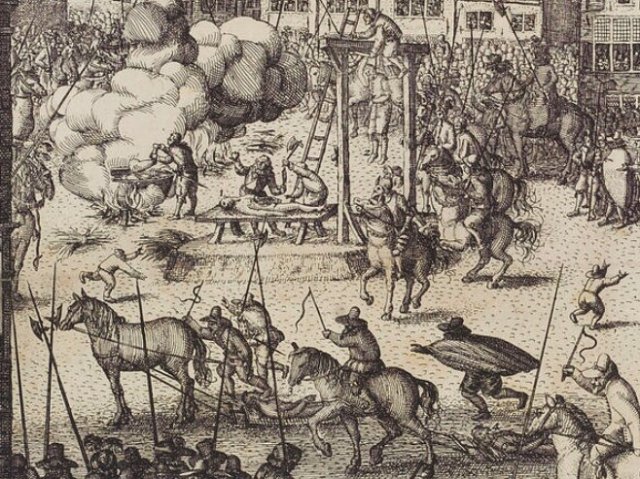
(From National Portrait Gallery, via Wikimedia Commons, used w/o permission.)
(Public vivisection in London. Detail of the ‘Gunpowder plot executions’ etching.)
At first glance, ‘hung, drawn and quartered’ may not seem so unpleasant. Apart from the process ending in death. The subject, after all, dies early in the process.
True enough, assuming that judicial hangings used today’s methods.
Turns out that snapping the prisoner’s neck with a long drop didn’t catch on until around 1850. Before that, death by strangulation was the norm. And still is, I understand, for informal lynchings.
But whether it’s sudden or slow death, hanging is often lethal.
Which brings me to Sir Everard Digby, English Protestant turned Catholic. Sir Digby was convicted of high treason and sentenced to be hung, drawn and quartered.
I don’t know why Sir Digby received special treatment.
Maybe it was because he’d tried explaining why he thought James I should have kept his promise of toleration for Catholics. Or maybe because he said Robert Catesby’s plan wasn’t a Jesuit plot. Or maybe something completely different.
In any case, Sir Digby was briefly suspended by a rope, hurt his forehead after being cut down, and was conscious when officials started vivisecting him. Then he died.16
But all that happened after Marlowe’s “Doctor Faustus…” first opened.
Bartholomew’s Day Massacre: Whodunit?
(From Frans Hogenberg, via Wikimedia Commons, used w/o permission.)
(Gaspard II de Coligny’s death and related bloodshed. By Franz Hogenberg. (ca. 1572))
The 1572 St. Bartholomew’s Day massacre — I knew I was forgetting something — was like the Gunpowder Plot. Except for how it wasn’t.
The assassinations and riots killed key Huguenots, leaving the houses of Guise and Valois comparatively free to fight each other.
Following the cui bono, who profits, principle, folks have blamed the French queen. Or the House of Guise.
For all I know, someone’s fingered the House of Montmorency. Which sort of makes sense, since François, Duke of Montmorency and governor of Paris couldn’t stop the bloodshed.
Which reminds me of claims and counter-claims during America’s recent election. And that’s yet again another topic.
England’s House of Tudor wasn’t directly affected by massacre.
But there were French connections. Catherine of Valois had married England’s Henry V and Owen Tudor. Not simultaneously.
The Owen Tudor-Valois connection led to a Tudor Henry becoming England’s Henry VII.
Let’s see, what else? Francis, Duke of Guise. Right.
He grabbed the last Tudor land in France. In 1558, during Mary I of England’s reign. And got blamed for the St. Bartholomew’s Day massacre.
More to the point, the St. Bartholomew’s Day massacre became Protestant Europe’s symbol for Catholicism as the religion of death and treason.17
And Renaissance Anglo-French relations were pretty much the opposite of simple. Yes, religion was involved: certainly as a marketing theme; arguably as a motive in some cases.
But I also see interdynastic rivalry and greed, with a generous sprinkling of xenophobia.
That was Christopher Marlowe’s world. And the world of London’s theater-going public.
Four Centuries Later and Still Learning
(From Folgerpedia, used w/o permission.)
(Map of London. (1574))
Elizabethan England wasn’t just like today’s America.
They had alehouses and inns. We have virtual hangouts like Twitter and Facebook.
They had hot button issues regarding politics, religion and which side should be in charge.
We have — pretty much the same hot button issues, actually.
But I think we’ve learned a little over the last four centuries.
We’ve even applied some of our hard-won lessons. Like letting ‘hung, drawn and quartered’ penalties quietly fade away.
Four centuries from now, maybe we’ll have learned a few more lessons. And that’s still another topic, for another day.
Now it’s time for me to (finally!) wrap up this look at Marlowe’s world. And add the usual somewhat-related links:
Karin M. Armour, A senior Thesis Submitted to the Eastern Michigan University Honors Program In Partial Fulfillment of the Requirement for Graduation with Honors in Social Science, (Approved at Ypsilanti, Michigan, on April 21, 2004)
Keep up with A Catholic Citizen in America: subscribe. (below) (Don't worry, I won't bug you. Check out my Privacy Policy.)
Weekly Schedule
Something new each Saturday.
Life, the universe and my circumstances permitting. I'm focusing on 'family stories' at the moment. ("A Change of Pace: Family Stories" (11/23/2024))
Blog - David Torkington
Spiritual theologian, author and speaker, specializing in prayer, Christian spirituality and mystical theology [the kind that makes sense-BHG]
I was born in 1951. I'm a husband, father and grandfather. One of the kids graduated from college in December, 2008, and is helping her husband run businesses and raise my granddaughter; another is a cartoonist and artist; #3 daughter is a writer; my son is developing a digital game with #3 and #1 daughters. I'm also a writer and artist.