In Praise of Lilacs, Blue Sky and Rain

“…Blue skies
Smiling at me
Nothing but blue skies
Do I see…”
(“Blue Skies,” Irving Berlin (1926) via Lyrics.com)

But that’s not literally true.

We had blue skies with clouds Monday through Wednesday.

Then it rained part of Wednesday night, pretty much all Thursday and part of Thursday night.

So maybe this is more appropriate. Or was, until Friday’s bright blue skies and sunshine.

“I’m singin’ in the rain, just singin’ in the rain
What a glorious feeling I’m happy again…”
(“Singin’ in the Rain,” Arthur Freed, Nacio Herb Brown (1928 or 1929))

Even so, the first bit of “Blue Skies” has been on my mind’s ‘top 20’ hit parade this week.


Good news, Not-So-Good News

Sauk Centre's Our Lady of the Angels church on Ash Street South.
(Looking north from my driveway on Sauk Centre’s Ash Street South. (May 22, 2021))

I’ve been hearing “blue skies” in my mind’s ear — if that wasn’t an expression before, it is now — most of this week. So how come I’ve been feeling less than perky?

Backing up a bit, I’ve been living with clinical/major depression at least since I was 12.

Then, in 2006 or thereabouts, my wife told me that maybe I should see a psychiatrist.

I agreed, and that’s when I learned that I’d been dealing with recurrent major depressive disorder. Clinical depression. Depression.

Whatever it’s called, it’s a mood disorder. Which is emphatically not just experiencing a blue mood or having a down day. It’s not fun. At all.

The good news is that my “recurrent major depressive disorder” is “in partial remission.”

No-so-good news? It isn’t something I’ll get over. But on the ‘up’ side, industrial-strength antidepressants let me think without fighting my mental machinery.

Controlling Destiny With My Mind

Sauk Centre's Ash Street South.
(Looking south from my driveway (May 22, 2021))

Whether depression led to my other psychiatric issues, or they helped launch depression is a good question. An unanswered one.

In any case, when I learned why light and color had subjectively drained from the universe, back in 1963, I began learning of my other oddities.

Seems that I’ve been dealing with generalized anxiety disorder, cluster A personality disorder and persistent depressive disorder. That last, I gather, is a sort of variation on the recurrent major depressive disorder theme.

Let’s face it. I’m a mess.

But I’ve been a more-or-less functional mess. Having an internal playlist of songs like “Singin’ in the Rain” helps.

“Life is a Song Worth Singing” has helped, too, although my mind’s disk jockey hadn’t selected it for this week’s playlist.

“…Life is a song worth singing
Why don’t you?
Sing It!
“You hold the key in the palm of your hand
Use it!
Don’t blame your life on a master plan
Change it!
Only you generate the power
To decide what to do with your life
Your a fool if you think you’re helpless
You control what you do with your life…
“…Don’t like the way you’re living
Too bad!
Can’t change your life because it’s out of your hand
So sad!
So you sit on your pants and holler
Cause the world ain’t been treating you right
Don’t you know you contain the power
To control destiny with your mind….”
(“Life is a Song Worth Singing;” written by Thom Bell, Linda Creed; first performed by Johnny Mathis (1973))

(Limited) Control


(Saturday afternoon lilacs and sunshine. (May 22, 2021))

I haven’t seen “Life is a Song Worth Singing” billed as a “Christian” song.

But I think it makes a good point or two. Like this:

“…Don’t you know you contain the power
To control destiny with your mind….”

Let’s take that one thing at a time. Starting with a definition:

  • Destiny (Cambridge Dictionary)
    1. the things that will happen in the future
    2. the force that some people think controls what happens in the future, and is outside human control

If I believed I could control all future events, my psychiatric inventory might include narcissistic personality disorder. A psychiatrist and I looked at the possibility.

It made sense, since I’ve had trouble regulating emotions, and can be impatient or angry when I don’t get special treatment. But emotional control problems come with many psychiatric glitches, and I can get impatient or angry over pretty much anything.

If I believed I had no control over my future, and was saved or damned simply because God says so, then maybe I’d get along with Christians of the Holy Willie persuasion.

Provided that I thought I was “saved.”

If I believed I was damned, no matter what I do, then the way I feel sometimes would fit my faith. But I couldn’t be a Catholic. Not a Catholic who understands our faith, at any rate.

Basically, I have free will. I can decide to act, or not act. Believe, or not believe. (Catechism of the Catholic Church, 1730-1784, 1989, pp. 430432, 482)

My salvation depends on Jesus and God’s grace, but I can say ‘thanks but no thanks.’ (Catechism, 1020-1041, 1987-2005; pp. 266272, 481266486)

That’d be a daft decision, but it’s an option.

Feelings and Free Will, Presumption and Despair

Vincent van Gogh's 
Sorrowing Old Man' or 'At Eternity's Gate.' (1890)Feelings happen. They’re part of being human. So is thinking, or should be. (Catechism, 154-159, 1763-1764; pp. 42-43, 436)

I can decide that I’ll act on whatever impulse pops up — I’ve got free will, so not thinking is an option. But forming and using my conscience involves thinking. So that’s what I’d better do.

I think predestination is real. (Catechism, 2012, p. 488)

I also think despair and presumption — abandoning hope or assuming that either I’m sufficiently Saintly on my own or that God will drag me into Heaven no matter what —

What was I saying? Right. I think despair and presumption are bad ideas, so I shouldn’t do either. (Catechism, 2091-2092; p. 507)

About predestination, Catholic style, that’s a can of worms I haven’t opened in some time.

Predestination and Viewpoints

Thomas Cole's 'The Voyage of Life, Youth;' detail. (1840)Predestination, in 25 words or less, is what free will looks like from God’s viewpoint.

I’d show the Catechism’s “predestination” glossary entry, but there isn’t one.

So I’ll pull together what the Catechism does say about where I’m going.

I’ve got free will, so I decide what I do. So I can, when I have my particular judgment, tell Jesus that I prefer Hell to Heaven. It’s a daft option, but it’s an option. I talked about that before.

“God predestines no one to go to hell….” Seriously. If I’m going to be damned, it’s up to me to commit a mortal sin; then avoid both repentance and God’s mercy. (Catechism, 1037, p. 270-271)

Again, that doesn’t makes sense. Not to me.

So what’s “predestined” about where I spend eternity? The Catholic view, basically, is that I’m “predestined” because God knows what I’ll decide.

That’s because God is there, at the moment of my death, and therefore knows what I decide. Will decide. But I don’t, because I’m not there yet.

God is immediately present in every place and every time. (Catechism, 600, p. 155)

I’d explain how that works, and how it looks from God’s perspective. But God’s God and I’m not. For which we should all be grateful, and that’s another topic. Topics.

Filling Out Forms

Lilacs in Sauk Centre's south side.
(Saturday afternoon sunshine at ‘the big yellow house on the corner.’ (May 22, 2021))

I had a medical checkup May 18. As usual, for me, it included filling out a PHQ-9 and a GAD-7. That’s medicalese for Patient Health Questionnaire and Generalized Anxiety Disorder Screening.

I could — free will, remember? — decide that the alphabet-soup forms are a violation of privacy, a tool of the medical-industrial establishment, or maybe even part of a conspiracy.

I could, but I won’t.

I’m not nearly on the same page as contemporary “privacy” enthusiasts.

As for believing that ‘they’ are out to get me: I’m crazy, by some reasonable definitions. But I’m not that crazy. Certainly not crazy in that way. Or is it “in those ways?” Never mind.

I’ll get back to that. Sort of.


Pew Cushions: Finally!

Pew cushions in Our Lady of the Angels, Sauk Centre. (May 23, 2021)
(Another Sunday morning at Our Lady of the Angels. (May 23, 2021))

Sunday, March 7, I noticed pew cushions in Our Lady of the Angels church. At least, that’s when I jotted a note to myself that I’d seen them. And learned that they were supposed to have been in place for Thanksgiving, 2020.

That didn’t happen. Thanks, I gather, to the COVID-19 pandemic. I’m not sure whether we had health concerns regarding the fabric, or if there had been a supply SNAFU. Another pandemic-related supply SNAFU. There’s been a bunch of them, and that’s yet another topic.

I’d have mentioned the pews before. Not because they’re important, but because they’re something new at the parish church. And I rather like them. They’re comfortable and aren’t particularly slippery.

Like I said, I’d have mentioned them before, but I also wanted to have a photo of them. And didn’t remember to bring a camera until last Sunday. The picture’s a bit fuzzy, but it’ll do.

Now, back to whatever it was I was talking about. Writing about. You know what I mean.


Life, Disorders, Hope — and Flowers

Lilacs. Sauk Centre.
(Sunday afternoon: more lilacs. (May 23, 2021))

Where was I?

“Blue Skies.”

“Singin’ in the Rain.”

Depression, cluster A personality disorder, generalized anxiety disorder.

There’s more, including “alcohol use disorder, mild, in sustained remission” — so it’s not all bad news.

On the other hand, it’s not exactly good news. But we’re learning more about how our minds and brains work, so again — it’s not all bad news either.

One of these days maybe I’ll talk about personality disorders and all that. But not today.

Other than responding to this subsection of cluster A personality disorders, from Personality Disorders/Overview, Mayo Clinic:

  • Schizotypal personality disorder
    • Peculiar dress, thinking, beliefs, speech or behavior
    • Odd perceptual experiences, such as hearing a voice whisper your name
    • Flat emotions or inappropriate emotional responses
    • Social anxiety and a lack of or discomfort with close relationships
    • Indifferent, inappropriate or suspicious response to others
    • “Magical thinking” — believing you can influence people and events with your thoughts
    • Belief that certain casual incidents or events have hidden messages meant only for you

Growing up where and when I did, I balk at words like “schizotypal” being applied to me.

After all, I don’t hear voices whispering in my ear. Or think that I can change reality with my thoughts: no more than anyone else, at any rate. And that’s yet again another topic.

That first point, though — “peculiar dress, thinking, beliefs, speech or behavior?”

Waving My Freak Flag — and Loving It

Lilacs. Blue Sky. Sauk Centre.
(A bright and sunny Sunday afternoon: blue sky and lilacs. (May 23, 2021))

Me, Brian H. Gill, on St. Patrick's Day. (2021)The other day, my oldest daughter noted that I wave my freak flag enthusiastically.

I’ll grant that it looks like that sometimes. Often, maybe.

But that’s not how it seems to me.

I’m not trying to exhibit “peculiar … speech or behavior.”

That’s just what happens when I relax.

Which I can when I’m with family: virtually or otherwise.

And for that I count myself greatly blessed.

So I may feel a twinge from my cultural roots, a mangled metaphor but never mind, thinking that I match some points of schizotypal personality disorder.

But I can’t reasonably argue against it.

I think there’s nothing wrong with “normal” and the 50th percentile. I also realize that I’m not all there. That didn’t come out right. Or maybe it did.

Perfect, No; And That’s Okay


(Marigolds from my granddaughter. (May 25, 2021))

There’s more, much more, to say about all of the above. I’d planned on saying some of it.

But I’m running out of time. So most of it will wait. Except for a few points.

First, how come I’m not either wracked with guilt over having disorders, or saying that faith is stupid because I’m a Catholic and my life isn’t all peaches and cream?

Questions like that are good for at least a couple books. Basically, it’s the Silaom thing. And nobody said this was going to be easy.

Second, why have I shared photos of flowers and blue sky? And at least tacitly admitted that I like both? Isn’t that “worldly?”

If I believed that flowers mattered more than anything or anyone else, then I’d have problems. I don’t, so I don’t see a problem with appreciating the beauty and wonders of God’s world.

Third, what about my PHQ-9 and GAD-7 scores? This time around they were both higher than they’d ever been. Which isn’t good news.

I wasn’t surprised.

Feeling bad about myself — down, depressed or hopeless — comes and goes.

Every time I’d filled out those forms before, I was near the top of my irregular cycle. This time I was near the bottom.

More than a year of experiencing the COVID-19 pandemic hadn’t helped. But I don’t need dreadful news to feel awful. It’s something that happens anyway.

And it’s something that doesn’t last.

Experiencing Emotion, Remembering Hope

Reid Wiseman's photo of sunrise, seen from the International Space Station. (October 29, 2014) via NASA, used w/o permissionNow, about hope.

Sometimes I don’t feel hopeful.

But even then, I can be hopeful: remembering that feelings, emotions, aren’t all there is to reality. And that I have very good reason to think that hope makes sense.

Remembering flowers and blue skies helps, too.

I’ve talked about most of this before:

Posted in Discursive Detours, Journal | Tagged , , , , , , , , | 2 Comments

Cyclone Tauktae, COVID-19 and the Siloam Lesson

This week hasn’t been a good time for India.

Statistics say Tuesday was their worst day yet for COVID-19 pandemic deaths. It’s also when the worst cyclone recorded so far hit India’s west coast.

There’s quite a bit going on here.

Cyclones generally hit India’s east coast. Or, rather, have generally hit the east coast. Weather patterns are changing, so India’s west coast can expect more cyclones.1

Part of the good news is that folks know what to do when a storm is coming. Basically, find shelter or get out of the way. Sounds simple, and sometimes it is. Sometimes it’s not.

And getting away from Tauktae hasn’t been easy near the Mumbai coast.


Comparisons (or) India isn’t Minnesota

Map of India, population per square kilometer by in States/ Union territories. Source: Office of the Registrar General and Census Commissioner, India.About 21,000 folks live in each square kilometer of Mumbai, 13,000 for Surat — a city about halfway between Ahmenadabad and Mumbai.

That compares to something like 26.6 per square kilometer in my state, 804 down in the Minnesota Metro’s Hennepin County.2

Whether they’re called cyclones or hurricanes, tropical storms don’t happen here in the Upper Midwest. Blizzards are about the nearest thing we’ve got, in terms of potential risk.

And with blizzards, evacuation isn’t an option. There really isn’t anyplace we could evacuate to. Our best option is to stay inside, wait out the storm, and hope that power failures either don’t happen or don’t last long.

Tornadoes are another matter. But again, staying inside makes survival a great deal more likely. Provided that “inside” includes a basement. Or a hardened shelter. I’ve heard about those, but never actually seen one. Possibly because it’s easier to dig a basement.

A distinct lack of hurricanes is among the reasons I enjoy life in the Upper Midwest. Blizzards, fire weather warnings during thunderstorm alerts, tornadoes and all. Our weather is wild. But it’s wild almost every year. Which I suspect helps us pay attention and stay prepared.


Hurricanes and Attitudes

Hurricane Harvey, seen from the International Space Station. (August 2017)
(From NASA, via YouTube, used w/o permission.)

Even under ideal conditions, I figure evacuating a town or city would be hard. And we don’t, I strongly suspect, often enjoy ideal conditions.

Take what happened during 2005’s Hurricane Rita, for example. My guess is that hurricane-related missteps will be debated for decades. At least.

Assumptions

March 15, 1915: Billy Sunday giving another rip-roaring performance.September of 2005’s Hurricane Katrina inspired acts of practical charity.

And at least one religious rant with an all-too-familiar slant.

Katrina: God’s Judgment on America
Anonymous; Restore America, via Beliefnet (2005)

“… There was the burgeoning Gulf Coast gambling industry, with a new casino that was to open on Labor Day weekend. But of course, what is a little gambling if it supports ‘education’ and brings revenue into government coffers? And then there was the 34th Annual gay, lesbian and transgender ‘Southern Decadence’ Labor Day gala to be held from August 31st to September 5th….”

But oddly enough, I don’t remember a parallel prophetic proclamation featuring Hurricane Rita.

Possibly because nobody’s thought of denouncing air conditioning. If someone had, then framing Houston’s Hurricane Rita evacuation debacle as the wrath of God would almost make sense, since the city was famous for its air conditioning. Among other things.3

For someone who assumed that air conditioning offends a prickly deity, 2005’s ‘death by evacuation’ might, again, look like divine retribution.

Think about it. Houston authorities had detailed evacuation plans. But about a hundred people died trying to leave the city. Surely, taking a “…God’s Judgment on America” viewpoint, their deaths were the work of a petulant Providence.

I think that’s a crazy idea, but no crazier than framing wholesale death and destruction as an anti-gambling smite-fest.

So I’ll look at what actually happened. Briefly. But not from a ‘sinners in the hands of an uptight God’ viewpoint.

Houston, 2017’s Harvey: Lessons Learned from 2005’s Debacle

Submerged Houston roads during Hurricane Harvey (2017)
(From Reuters, via Al Jazeera, used w/o permission.)
(Houston: August, 2017. Being told to not drive into submerged roads angered some. And arguably saved lives.)

Brett Coomer/Chronicle's photo of Hurricane Rita evacuation, on Interstate 45 in Huntsville, Texas. Gridlock and accidents killed roughly a hundred people. (2015)Houston authorities thought their 2005 evacuation plans would work.

Until folks were told to evacuate. And got caught in gridlock.

On the ‘up’ side, body count estimates only range from 90 to 118. Of those, 23, or maybe 24, were from a self-igniting bus. Seems that oxygen tanks, mobility-impaired passengers and unlubricated axles are a bad mix.

Comparing roughly a hundred deaths to the millions who evacuated is possible. But maybe not reasonable. Millions evacuating from the Texas coast area included folks who were getting out of Houston. But I haven’t found numbers for the Houston-only evacuation.

Based on what little I know, I think the folks in charge could have made better decisions.

Media types could have spent more time, learning what words like “voluntary” and “mandatory” mean.

Someone should have realized that an engineer’s high-resolution map doesn’t display well on television screens.

And wondered if maybe non-engineers might have trouble reading it.

And, finally, folks living in Houston could have used more common sense. Some of them.

But it’s not all bad news. Folks have studied what went wrong, thought about it: and published what they learned.4

I very strongly suspect that’s why Houston authorities didn’t tell folks to evacuate via submerged roads in 2017.


Storms, a War and “the Wakened Giant”

18th century engraving by an unknown artist, '...Wherein Rear Admiral Beaumont was lost on the Goodwin Sands....'
(From unknown artist, via Wikimedia Commons, used w/o permission.)
(The Great Storm of 1703: bad news for England.)

Storms happen. People die. That’s sad, often tragic.

Simple explanations for why disasters happen have been and still are popular.

In 1703, the War of the Spanish Succession hadn’t been all beer and skittles for England. Then a winter storm hit. It felled 4,000 oaks, collapsed 2,000 London chimneys and killed 1,000 English sailors.

Politics and propaganda of the day being what they were, England’s state church said that the storm was God’s way of punishing the English for not killing enough foreigners. Catholic foreigners, of course.

Daniel Defoe’s “The Storm,” published in 1704, said pretty much the same thing, and English pastors featured the disaster in their moralizing sermons for at least a century.5

Times change, but human nature hasn’t. Not that I can see.

Official declarations that God’s on a smiting spree because we’re not killing enough ‘bad guys’ isn’t fashionable. Not in America, at least. And I don’t mind a bit.

Mother Nature’s Gonna Get You?

Gustave Doré's illustration for Canto XXXIV of Dante's 'Divine Comedy, Inferno.'These days, we’re more likely to hear earnest glitterati blame storms on Mother Nature’s anger. Meanwhile, the more profound thinkers warn us that we have awakened the earth-giant.

Jennifer Lawrence calls hurricanes ‘Mother Nature’s rage and wrath’
Christian Holub, Entertainment Weekly (September 8, 2017)

“Jennifer Lawrence says the deadly hurricanes that have formed in the Atlantic Ocean over the last month — including Hurricane Irma, which is set to batter Florida this weekend — are the result of ‘Mother Nature’s rage and wrath.’…”

Forget ‘saving the Earth’ – it’s an angry beast that we’ve awoken
Clive Hamilton, The Conversation (May 27, 2014)

“Environmentalism is undergoing a radical transformation. New science has shown how long-held notions about trying to ‘save the planet’ and preserve the life we have today no longer apply.

“Instead, a growing chorus of senior scientists refer to the Earth with metaphors such as ‘the wakened giant’ and ‘the ornery beast’, a planet that is ‘fighting back’ and seeking ‘revenge’, and a new era of ‘angry summers’ and ‘death spirals’….”

An ‘up’ side is that C. Hamilton’s “growing chorus of senior scientists” may be consciously using metaphor. I’d rather think that, than assume that they’re on the verge of making burnt offerings to a chthonic earth-god. And that’s another topic. Topics.


Remembering What’s Important

Quirijn/Coryn Boel's 'The Good Samaritan.' ( 	1673)
(From Quirijn/Coryn Boel, via Wikimedia Commons, used w/o permission.)

Where was I? India’s May 18, 2021, death by disease and disaster. Cities, Minnesota, storms and blame games. Practical charity.

Right.

I’m a Catholic, so I think charity is a virtue:

CHARITY: The theological virtue by which we love God above all things for his own sake, and our neighbor as ourselves for the love of God (1822).”
(Glossary, Catechism of the Catholic Church)

Feeling charitable is nice. But charity, Catholic style, isn’t an emotion.

Not that there’s anything wrong with emotions. They’re part of being human, and not good or bad by themselves. What matters is what I decide to do about them. Having emotions in sync with my reason and will would be nice, and that’s yet another topic. (Catechism, 1763-1794)

Anyway, I don’t see that feeling charitable makes sense without doing something charitable. When and if possible.

I’ve talked about the Samaritan story before. (February 1, 2017)

What “doing something charitable” can mean is more than I have time for right now.

Death and Reminders

Pieter Claesz's 'Vanitas Still Life.' (1630)Death happens. It’s among the few things we can count on.

What’s less certain is when we will die.

So I figure high-profile disasters, besides being an opportunity for practicing prayer and charity, are helpful reminders that I’ve got a less-than-perfect record. And that repentance is a good idea.

“At that time some people who were present there told him about the Galileans whose blood Pilate had mingled with the blood of their sacrifices.
“He said to them in reply, ‘Do you think that because these Galileans suffered in this way they were greater sinners than all other Galileans?
“By no means! But I tell you, if you do not repent, you will all perish as they did!
“Or those eighteen people who were killed when the tower at Siloam fell on them—do you think they were more guilty than everyone else who lived in Jerusalem?
“By no means! But I tell you, if you do not repent, you will all perish as they did!'”
(Luke 13:15)

Even if the high-profile disasters aren’t high-profile a couple millennia from now. The only reason we know about the Siloam tower collapse and that particular Pilate bloodbath is that they’re recorded in Luke’s Gospel.

And that’s yet again another topic.

John Tenniel's Alice, Griffin and Mock Turtle for chapter nine of Carroll's 'Alice in Wonderland.' (1865)So are my reasons for thinking that Jesus isn’t telling me that if I don’t repent and start reeling, writhing and fainting in coils😀 ASAP, God the Father’s gonna drop a tower on me.

As I see it, admitting that I’ve messed up makes sense.

Because I have.

So does asking for mercy.

But auditioning for Sanctimonious Sourpuss of the Month? Honestly: would anyone really want that?

And that’s — like I said before — yet again another topic. Topics.

Other vaguely-related stuff I’ve written:

😀 Reeling, writhing — and recalling L. Carroll’s Mock Turtle.

“‘I couldn’t afford to learn it,’ said the Mock Turtle with a sigh. ‘I only took the regular course.’

“‘What was that?’ inquired Alice.

“‘Reeling and Writhing, of course, to begin with,’ the Mock Turtle replied: ‘and then the different branches of Arithmetic—Ambition, Distraction, Uglification, and Derision.’…

“…Alice did not feel encouraged to ask any more questions about it, so she turned to the Mock Turtle, and said, ‘What else had you to learn?’

“‘Well, there was Mystery,’ the Mock Turtle replied, counting off the subjects on his flappers,—’Mystery, ancient and modern, with Seaography: then Drawling—the Drawling-master was an old conger-eel, that used to come once a week: he taught us Drawling, Stretching, and Fainting in Coils.’…”
(“Alice’s Adventures in Wonderland,” Chapter 9: The Mock Turtle’s Story; Lewis Carroll (1866) via Wikisource)


1 India’s unpleasant Tuesday:

2 Mumbai and Minnesota, mostly:

3 Houston, air conditioning ace:

4 Learning from mistakes, it’s an option:

5 ‘And the moral of this storm is:’

Posted in Discursive Detours | Tagged , , , , , | 4 Comments

First of Two COVID-19 Vaccinations This Morning

My 'I Got My COVID-19 Vaccine!' sticker. (May 21, 2021)

I went to the local hospital this morning, got a sheaf of paper and a 3×5 card, had a short chat and followed green arrows to the elevator. I’ve walked down that corridor a fair number of times, and have even been in the elevator.

But I’d never pushed the “G” button. Which took me down one level to what I’d have thought of as the basement. I suppose it’s the “G”round floor because it’s at ground level at the back of the building.

All of which was more entertaining to me than it is for you reading this. I enjoy walking through big, complicated buildings or — better yet — building complexes.

Such exercises are among my pleasant memories of a year spent at the University of Minnesota, Minneapolis: make that U of M, Twin Cities; and that’s another topic.

Anyway, I followed a few more arrows which took me around a corner. After that, walking about a hundred feet brought me to the door of a conference room. A big one.

That’s where I got my “I Got My COVID-19 Vaccine!” sticker. It’s optional. The medico who was checking me in seemed businesslike, so I didn’t ask if I could have a gold star, too. Which is probably just as well, since I nearly walked off with her visual aid papers.

But I didn’t. A short walk brought me to one of the two screened-in ‘get your shot here’ spots. Where I got my COVID-19 vaccination. The first one.

Fact Sheets and “Privacy” — This isn’t the ‘Good Old Days’

From Testimony of Dr. Stephen Hoge, President, Moderna, Inc.; to a House subcommittee. (July 21, 2020)I wasn’t taking notes, so I can’t be sure. But I think I was told about what was the “V-Safe” sheet and a “Fact Sheet For Recipients and Caregivers.” It ran to four sheets, text on seven of the eight sides.

Plus a “Patient Education | After COVID-19 Vaccine sheet. Text on both sides.

I could complain about that, but won’t.

Partly because they gave me something to read while sitting in one of the 23 chairs — spaced at six-foot intervals, the correct position for each marked with a little yellow taped “X.”

And partly because I don’t mind getting information. Which included brief discussions of what contemporary culture calls “privacy.” This isn’t the world I grew up in. In some ways it’s better, and that’s yet another topic.

I got my vaccination at about 9:40 this morning. It’s now about half past four in the afternoon. The “Fact Sheet For Recipients and Caregivers” listed possible side effects of this vaccine. Which included a curiously-generic “feeling unwell.”

I’m pretty sure I haven’t experienced any of them. “Injection site pain,” maybe. But my right shoulder has been giving me fits off and on, so I can’t be sure about that.

And anyway, growing up with a glitchy hip encouraged my perception that discomfort isn’t “pain” until it keeps me from moving.

I’ll be going through pretty much the same routine on Friday, June 11th, when I get the second of two COVID-19 vaccinations. At least, that seems a reasonable assumption.

Side effects from that one may be more interesting.

Coming Attractions?

CentraCare, Sauk Centre, Minnesota.Last Saturday’s trip to the emergency room happened after my son got his second COVID-19 vaccination.

I can’t be sure, since a full-scale medical ‘what’s causing this’ investigation would have taken more resources than we have. And more, likely enough, than would be warranted for a situation that was unpleasant but not dangerous.

But what he was experiencing looked a lot like a selection from the listed vaccination side effects, cranked all the way up.

Which may mean that he’s got a high-performance immune system. So if I don’t run a high fever, experience hideous near-crippling pain and generally feel awful — I could fret that there’s something wrong with my immune system.

Or I could assume that my son isn’t exactly like me, which seems reasonable.

Me, Brian H. Gill, on St. Patrick's Day. (2021)Either way, I expect it’ll be an interesting experience. And, probably, something I could write about. Which I probably will.

More, mostly related to COVID-19:

Posted in Journal | Tagged , , | 4 Comments

Another Trip to the Emergency Room

Good news, my son and I had a long chat last Saturday. Not-so-good news, we had it in the local emergency room.

Still, it could have been worse. After a few hours of fluids and pain meds, he wasn’t feeling quite so awful, and I drove him home again.

Blood work told us that his major systems were working. And a scan showed that his brain wasn’t missing any pieces. So, basically, good news.

Even so, I could have done without the stress. So, I’m sure, could my son.

And I’m very glad that (almost) a week has gone by without a similar incident.

“I Told You I Was Sick”

Tombstone Parodies, knowyourmeme.com, used w/o permission.It’s been decades since I’ve heard that someone “enjoys poor health,” so maybe that phrase has dropped out of my dialect of English.

Malingering, however, is still a thing. And that’s not what’s been happening. I’m as sure of that as I can be about anything.

A key factor for enjoying poor health is that the ersatz invalid must not, in fact, be experiencing poor health. Particularly not the sort that comes with near-crippling and intermittent pain.

Imaging Tech: X-Rays and the Fabulous Foot-O-Scope


(An image from my brain scans in 2018.)

Medical diagnostic tech has come a long way since my youth, but we still can’t tap into another person’s sensory inputs. Which, from a ‘privacy’ perspective may be a good thing, and I’m wandering off-topic.

Even so, we had impressive tech in my ‘good old days.’

My childhood memories include standing on a shoe-fitting fluoroscope.

Maybe finding shoes that fit was easier with Pedoscope, Foot-O-Scope and the X-ray Shoe Fitter — which, name notwithstanding, didn’t actually fit a customer’s shoes. Someone in the shoe store used that ‘length and width’ gadget. Turns out it’s called a Brannock Device.

Anyway, shoe-fitting fluoroscopes may or may not have helped folks find shoes that fit. Either way, we started learning about ionizing radiation’s health issues in the late 1940s.1

My guess is that folks working in shoe stores were far more at risk than all but their most fanatic shoe fanciers. But the perceived risk and reward balance tipped away from retail X-ray machines, so now shoe store fluoroscopes are museum pieces.

On the other hand, medical X-ray imaging is still with us.

My routine dental exams, for example, often include getting X-ray images.

I see that as a reasonable benefit/risk tradeoff. Partly because today’s dental X-ray gadgets get results with far less energy. Greater efficiency and safer: what’s not to like?

Death During Diagnosis: MRI Scanners and Flying Oxygen Tanks

MRI scanner schematic. Source unknown. Used w/o permission.Some other medical imaging tech — like MRI, that’s magnetic resonance imaging in technospeak — uses no ionizing radiation.

Maybe someday we’ll learn that an MRI’s radio waves and intense magnetic fields can hurt us. By themselves, that is.

What’s certain is that airborne oxygen tanks are occasionally lethal.

Back in 2001, Michael Colombini, a six-year-old boy, survived an operation that removed a benign brain tumor.

Then folks at a hospital put him in their MRI scanner. After that, they turned it on. A metal oxygen tank was in the room.

It shot into the MRI scanner’s ‘donut hole.’

Where it collided with the boy’s head. He died a couple days later.2

Another Death by MRI and Oxygen Tank

Subrata Dhar's illustration of Rajesh Maru's last moments.
(From Subrata Dhar, via The Indian Express, used w/o permission.)
(January, 2018: a short flight, swift death, and many questions.)

About 17 years after M. Colombini survived surgery, but not a diagnostic scan, a man died after being pulled into an MRI scanner.

Rajesh Maru had been holding an oxygen tank. That much is certain.

I gather that he’d been with a 65-year-old woman, Laxmi Solanki, and other relatives. The 65-year-old had been in the hospital’s MICU, Medical Intensive Care Unit. Then she was taken to the hospital’s MRI room. Pretty much everyone seems to agree on this.

L. Solanki needed oxygen, which may explain the oxygen cylinder R. Maru was holding. The family says a hospital staffer told R. Maru to bring the cylinder, and assured him that the MRI magnet was inactive. The staffer says he didn’t. Understandably, perhaps.

What happened next could have been much worse.

Wrong Place, Wrong Time, Wrong Equipment

Pennsylvania Patient Safety Authority's illustration of the 5G zone around a typical MRI scanner.L. Solanki was on a conventional hospital “trolley,” one of those steel things we call gurneys. That’s what I call them, anyway.

Instead of transferring L. Solanki to a non-magnetic MRI gurney at a safe distance, hospital staff brought her and the metal gurney into “Zone III:” where the MRI’s magnetic field can cause trouble. That’s what R. Maru’s family says. Hospital staff tell another version.

In any case, R. Maru stepped too close to “Zone IV,” near the MRI.

R. Maru might have lived, if his fingers hadn’t been around the oxygen cylinder’s nozzle.

But they were. So when the MRI’s (active) magnetic field grabbed the metal cylinder, R. Maru went with it.

His upper body lodged in the MRI’s ‘donut hole.’

The oxygen cylinder’s nob snapped.

I don’t know whether it held oxygen gas at high pressure, or liquid oxygen.

I’ve read that Rajesh Maru died from a pneumothorax: lung collapse.3

Whether a blast of gas and/or liquid oxygen overloaded his body and killed him, or he died from blunt force injuries, the result’s the same. He’s dead.

But, again, it could have been worse.

Laxmi Solanki’s gurney was dangerously close to the MRI scanner, but didn’t get pulled in. Civic authorities and hospital higher-ups acknowledged that something went horribly wrong and eventually settled on who should have known better.

Risk, Minnesota’s Powerball Jackpot and Weighing the Odds

Pennsylvania Patient Safety Authority's illustration of safety events by zone. (2018)
(From Pennsylvania Patient Safety Authority, via NLM/HIH, used w/o permission.)
(PPSRS MRI safety events by zone, January 1, 2009 through December 31, 2017.)

There are lessons to be learned from those accidents, and one of them isn’t that MRI technology is bad. It’s dangerous, if we don’t pay attention. But that’s been true of every tech, from camp fires to the printing press and arc welders.

I strongly suspect that we learn more from a myriad non-fatal “screening events,” than we do from the handful of incidents where someone died after an MRI scan.

“Handful” may be overstating it.

Doctors at the University of Aberdeen did the first clinically useful MRI scan in 1980.

In 2001, a flying oxygen tank killed a patient. In 2018, another flying oxygen tank killed a patient’s relative. That’s two too many deaths.

But that’s one death out of roughly 95,000,000 MRI scans in 2018. I haven’t found estimates for the number of MRI scans in 2001.

Assuming consistent conditions worldwide, that means I had about a 1/95,000,000 chance of not surviving my MRI scan, back in 2018. The odds of my winning Minnesota’s Powerball jackpot would be even worse: 1/292,201,338.4 And that’s almost another topic.

I’ve seen scary headlines and angsty op-eds about the dangers of MRI scans.

But, although a handful of people were scanned and then died, I only found three cases where folks had demonstrated a cause-effect connection.

Three Deaths, Maybe More, and Boston’s Phenomenal Flying Gurney

Brigham and Women's Hospital's MRI room, after someone let a gurney get too close. From  Betsy Lehman Center for Patient Safety, Boston, used w/o permission. (2016)In 1992, someone died after “an undisclosed cerebral aneurysm clip” tore open an artery.

Then there were the two deaths I’ve mentioned, plus apparently “several” folks with pacemakers who died after an MRI scan.

Maybe the pacemakers moved or glitched after the scan. Or maybe the patients died after the scans, but from whatever condition warranted the MRI procedure. I don’t know, and couldn’t find details.

Getting back to my experience in 2018. Although the odds of my dying during an MRI scan were slightly better than winning Minnesota’s Powerball jackpot, I don’t think I was taking a crazy risk.

That said, an MRI scan for someone with a pacemaker that was implanted before 2011 might be too risky.

Not that I have a pacemaker. I do, however, have two artificial hip joints: which I mentioned to hospital staff before that 2018 MRI. They said they knew about them, and that the things would be okay. As it turns out, they were right.

I see an ‘up’ side in our growing files on MRI accidents, or “safety events,” as Pennsylvania’s PPSRS calls them. The more data medicos and technicians have, the more opportunities we have for developing better safety and training procedures.

But, every once in a while, someone goofs.

Like the time in 2016, when folks at Boston’s Brigham and Women’s Hospital wheeled a patient into their MRI room. On your standard metal gurney.

Then the gurney and patient started moving toward the MRI. Without anyone pulling it.

They promptly lifted the patient and stayed out of the way as the gurney took off, colliding with the scanner.

My hat’s off to folks at BWH. They acknowledged that something went wrong, found ways to reduce the odds of it happening again, and published what they learned.5

Life, Health and Making Sense

Illustration 4 of Edgar Allan Poe's Raven by Gustave Dore's illustration 4 for Edgar Allan Poe's 'The Raven.' (ca. 1845)Sooner or later, I will die. (Catechism of the Catholic Church, 1007)

But death isn’t permanent, which can be good news or bad news — depending on what I’ve done and whether or not I accept God’s love and mercy in my particular judgment. (Catechism, 991, 997, 1021-1029, 1033-1037, 1042-1050)

Since life always leads to death, and I’m looking forward to eternal life with God, shouldn’t I denounce health care, medicine and particularly newfangled contraptions like MRI scanners?

Basically, no. Although making good health my highest goal would be a bad idea.

Top priority is where God belongs. Putting anyone or anything else there — money, family, power, pleasure, anything — is idolatry. And it’s a bad idea. (Catechism, 2112-2113)

But life and health are important. They’re “precious gifts” from God. How I act matters. Getting and staying healthy is a good idea. Within reason. Being sick is okay. Painkillers are okay. Helping others get or stay healthy is okay. (Catechism, 1506-1510, 2279, 2288-2289, 2292)

So if my son or someone else in the family needs medical attention, I’ll probably worry.

But I won’t wonder if it’s a “visitation from God,” or brood over whether or not blood tests are blasphemous.

I’ve talked that, and vaguely-related topics, before:


1 Shoes and science:

2 Science, technology and an MRI scan gone wrong:

3 Another flying oxygen tank:

4 Numbers, mostly:

5 Safety and a non-lethal MRI accident:

Posted in Discursive Detours, Family Stories, Journal, Series | Tagged , , , , , | 2 Comments

Florida Indoor Fish Farm: An Aquaculture Alternative

A few groceries have been offering delicacies like elk steaks for decades, at least. But the odds are that hunters aren’t supplying your grocery’s meat department with wild game.

That’s not surprising, or shouldn’t be.

I’ll be talking about an indoor Florida fish farm, wild raspberries, chickens, and why genetically modified foods don’t fill me with fear and foreboding.


Life After the Neolithic Revolution

My ancestors were hunting for food until a little less than an millennium back.

But even then, they were also planting crops and raising livestock.

Somewhere along the line, hunting morphed into a recreation reserved for the upper crust. Which gave us some of the Robin Hood tales, and that’s another topic.

Folks started collecting and eating wild grains upwards of 100,000 years back. Then, around the time when Saharan forests and prairies were drying out, someone developed artificial plants.

Several someones, judging from the way crops like barley, lentils and flax popped up in at least five parts of Eurasia and the Americas. V. Gordon Childe called that transition the Neolithic Revolution in 1936, and the name caught on.

Oddly enough, I’ve yet to see claims that Sumerians caused the end of civilization as they knew it by growing wheat.

Or that Egypt’s parliament should pay reparation for desertification happening during Pharaoh Narmer’s administration. Never mind that the process started before folks living in the Luan River valley were making fine pottery.1

Now, about artificial organisms. Like chickens.

Wild Raspberries

'Attack of the Killer Tomatoes!' (1978)Thanks to my father’s taste for what he called “wild raspberries,” I know what real “raspberries” taste like.

I’m not entirely convinced that the tiny red berry-things he found in parts of northern Minnesota are actually a wild form of the European red raspberry.

But they look like farm-grown raspberries.

I’ve eaten both. The store-bought things have the same taste, and are much larger. But they’re also, well, insipid. Pale echoes of the wild variety.

The impression I get is that commercially-grown raspberries have the same amount of flavor per berry.

And since they’re so much larger, the flavor’s spread over more volume. Too much more, for my taste. But then, I’ve eaten the wild variety. Those pumped-up store-bought things just can’t compete.

My guess is that most Americans have never eaten “wild raspberries,” so they don’t know what they’re missing.

And many may never have eaten anything other than genetically modified foods.

Rimshot's photo of a Vorwerk chicken. (2009)Take chickens, for example.

There is, arguably, no such thing as a “non-genetically-modified” chicken.

Sure, the red junglefowl was and is native to parts of south and southeast Asia.

Those birds look like domestic chickens. Some domestic chickens.

Mainly because domestic chickens are what happened after folks started modifying red junglefowl and assorted other species.2

Attack of the Acronyms

I know that “GMOs” are — for some — a terrifying new threat to life, liberty and the status quo.

And I think that “new” isn’t always “better.”

On the other hand, I don’t think “new” is always apocalyptic.

I also suspect that unfamiliar acronyms like ACCA, CRAC and ASHRAE can be scary. So maybe sharing what GMO, TALEN and ELISA mean will help.

In any case, I enjoy learning what terms mean. You experience may vary, but I’ll go ahead with definitions anyway.

“GMO” is an acronym meaning “genetically modified organism.”

But a GMO isn’t just any old genetically modified organism.

A GMO is a critter we’ve modified with new genetic engineering technology.

And now, more acronyms:

  • Gene-modifying tools
    • CRISPR
      • Clustered Regularly Interspaced Short Palindromic Repeat
    • TALEN
      • Transcription Activator-Like Effectors Nuclease
  • Gene testing tools
    • ELISA
      • Enzyme-Linked Immunosorbent Assay
    • PCR
      • Polymerase Chain Reaction
    • RT-PCR
      • Reverse Transcription Polymerase Chain Reaction

Finally, please: relax. There won’t be a test on this. There’s no need to memorize words and alphabet soup like immunosorbent and RT-PCR.3

“Finally?” No, not really. But that’s (almost) all the acronyms I’ll use. Today.

Assumptions and Atomic Nazi Zombies

Barth F. Smets/Barkay/Colvin's Tree of Life with horizontal gene transfer.I’d like to see folks relaxing about GMOs.

That’s relaxing, not either blindly assuming that eating all the chicken we like is okay because chickens are modified organisms; or that mRNA vaccines and other newfangled biotech must be Satanic because it’s unnatural.

Or simply because it’s new.

I talked about mRNA vaccines, viewpoints, ethical issues and making sense when Moderna’s and Phizer’s were nearly ready for production. (December 5, 2020)

As I see it, “making sense” includes testing new tech. Whether it’s biotech or a kerosene lamp. (August 11, 2017)

Testing a new strain of oats or a new dog breed, for example, probably makes sense.

After all, we wouldn’t want hideously mutated oatmeal monsters attacking the General Mills headquarters in Golden Valley, Minnesota. Or unexpectedly-intelligent American Hairless Terriers demanding Federal regulation of dog sweaters.

Lobby card for Cahn and Siodmak's 'Creature with the Atom Brain.' (1955)Or a mad scientist’s GMO sorghum beer leading to a plague of atomic Nazi zombies. A threat which may have been more marketable in 1955, and that’s yet another topic.

I’d be considerably more angsty about GMOs, TALEN, CRISPR and atomic zombies if I didn’t remember horrifically horrible horrors of my youth. And hadn’t read about Joseph, Laban and Laban’s modified livestock.

Another reason I’m not railing against the evils of genetic engineering is that mixing and matching genes has been going on for a very long time. It’s called “horizontal gene transfer,” and explains how fungal genes help pea aphids hide from predators.4


Meanwhile, in Florida

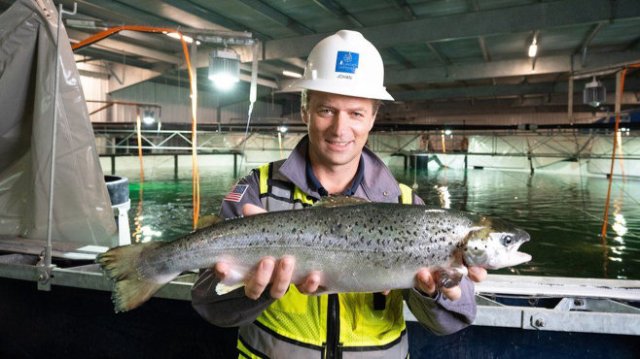
An indoor fish farm. Image copyright Aquamaof, via BBC News, used w/o permission.
(From Aquamaof, via BBC News; used w/o permission.)

Finally — that’s my third “finally” today, in case you’re keeping score — here’s what started me talking about groceries and Sumerians, chickens and GMOs.

The salmon you buy in the future may be farmed on land
Dan Gibson, BBC Business News (April 25, 2021)

In a series of indoor tanks 40 miles south west of Miami, Florida, five million fish are swimming in circles a very long way from home.

“The fish in question are Atlantic salmon, which are far more typically found in the cold waters of Norway’s fjords or Scotland’s lochs.

“As the species is not native to Florida, and would be unable to cope with the state’s tropical heat, the water tanks are kept well chilled, and housed in a vast, air-conditioned and heavily insulated warehouse-like building.

“The facility, called the Bluehouse, opened its first phase last year, and intends to be the world’s largest land-based fish farm….”

An indoor salmon farm in Florida may not be the strangest point in Dan Gibson’s article.

Bluehouse’s owner is Atlantic Sapphire, a Norwegian-owned business.

So how come a Norwegian business owns an indoor Florida fish farm?

Atlantic Sapphire folks think selling salmon to Americans will cost less if the fish aren’t flown across the Atlantic. They picked the Florida location in part because that’s where there’s access to a fresh water and a salt water aquifer. Makes sense to me.

So does the quality-control angle.

A Sinister Salmon Setting?

Energy-efficient closed-loop water recycling system for indoor fish farm.
(From Atlantic Sapphire, used w/o permission.)

The Florida fish farm’s salmon live in a closed-loop system. Water temperature and pH, day-night cycles, everything is ideal for the salmon.

It’s ‘unnatural’ — so the fish aren’t exposed to diseases and parasites. Which means that fish from the Florida farm won’t need or contain antibiotics and pesticides.

And, since the cost of Bluehouse brand salmon in American groceries doesn’t include air freight, it costs about half what we’d pay for Norwegian imports. On the other hand, Florida Bluehouse salmon won’t include free bonus protein — roundworms.5

Obviously, something is very wrong here. From tediously familiar viewpoints.


Abolish Fish Farms! Freedom For Fish!?

Bluehouse Florida fish farm, image copyright Smart Studio.
(From Smart Studio, via BBC News; used w/o permission.)
(Salmon swimming against an artificial current.)

“‘Fish farms [whether at sea, or on land] are pits of filth,’ says Dawn Carr, Peta’s director of vegan corporate projects. ‘Fish are not fish fingers with fins, waiting to be cut apart, but feeling, thinking individuals capable of joy and pain, and they belong to themselves, not to humans.

“‘Raising fish this way is wretchedly cruel and certainly unnecessary.’…”
(Dan Gibson, BBC Business News (April 25, 2021)

I wouldn’t expect, or try, to convince someone of the ‘fish are people too’ persuasion that raising disease-free, sans-roundworm salmon is not “wretchedly cruel.”

And PETA’s vegan corporate projects director almost has a point. Since humans are omnivores, we can get by without meat.

A few of us, including one of my kinsmen, can’t eat meat; or shouldn’t. For medical reasons. And that’s yet again another topic.

But trying to believe that a large opportunistic omnivore6 shouldn’t eat meat, along with plant products? That doesn’t make sense. Not to me.

Experiencing Emotions, Being Rational

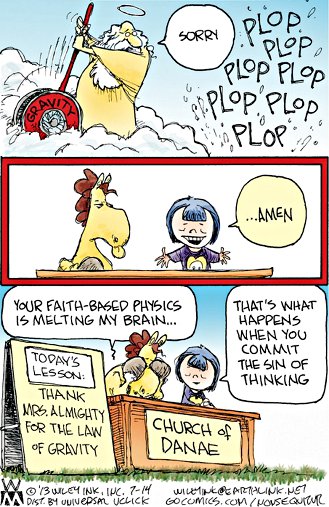
Non Sequtur's Church of Danae and faith-based physics. From Wiley Miller, used w/o permission.Since a fair number of folks see Christians as anything but reasonable — and some Christians seem dedicated to maintaining that image — explanations may be in order.

Again.

I’ve gone over this a lot. But I also run into the attitude(s) a lot, so here goes.

I’m a Catholic, so I think faith and reason get along. (Catechism of the Catholic Church, 35, 154-159)

Should get along.

I have free will. Deciding what I do, or don’t do, is up to me. (Catechism, 1730, 1778, 1804, 2339)

Within limits. I can’t, for example, decide to flap my arms and fly to the moon. I can, actually, but I won’t achieve liftoff.

Using my brain is, however, an option. Not an obligation, like breathing. Actually, it is an obligation, since I’m Catholic, and I’m straying off-topic.

I’m human, so I’m an “animal endowed with reason.” (Catechism, 1951)

And since I’m human, I experience emotions.

They’re part of a package that’s “very good.” But that doesn’t make all, or any, emotions “good.” Emotions aren’t “good” or “bad” by themselves. What I decide to do about an emotion? That’s where “good” or “bad” comes in. (Genesis 1:2731; Catechism, 1763, 1767)

Dominion

John Leech's cartoon: 'How to Insure Against Railway Accidents. Tie a couple of Directors à la Mazeppa to every engine that starts a train.' Punch (March 26, 1853)
(From Punch, via Victorian Web, used w/o permission.)

Earth, seen from the Rosetta spacecraft.Since I’m a Catholic, I think that we have dominion over this world.

And since I’m a Catholic, I do not think “dominion” means poisoning the land while ripping crusts of bread from the bleeding lips of the oppressed proletariat.

Whether or not anyone still talks that way — is still another topic.

Since I’m a Catholic, I think “dominion” is having the authority and responsibility that comes with one of our jobs: taking care of our home, and leaving it in good working order for future generations. (Genesis 1:26, 2:58; Catechism, 16, 339, 356-358, 2402, 2415-2418, 2456)

Animals

William Hogarth's 'The Second Stage of Cruelty, detail. (1751)Treating animals humanely is an ancient idea. (Exodus 23:12; Deuteronomy 25:4; Proverbs 12:10; 1 Corinthians 9:9; 1 Timothy 5:18)

Mistreating animals is a bad idea.

That’s because, besides being animals, we’re people: made “in the image of God.” Our nature comes with responsibilities: like not inflicting needless death and suffering on animals. That said, loving animals the way we (should) love people is also a bad idea. (Genesis 1:27; Catechism, 355, 361-368, 1701-1709, 1951, 2418, 2415-2418)

Respecting “the integrity of creation” makes sense. So does making reasoned, measured use of animals, plants and mineral resources. We’re stewards of this world, and responsible for handing off its resources to future generations. (Catechism, 2415-2418)
None of which comes even close to calling for piscine self-determination.


Hunting and Gathering’s Last Bastion

Global capture fisheries/aquaculture production, 2000-2018; from FAO's Statistical Yearbook 2020.
(From FAO, via Wikimedia Commons; used w/o permission.)
(World fish production: old-school capture and aquaculture, 2000-2018. FAO (2020))

David Roberts' 'Ancient Fountain:' a Persian water-wheel, used for irrigation in Nubia. (1838)Fish hatcheries existed in my youth, and zoos/aquariums were learning how to maintain healthy environments for fish.

But harvesting fish for food was almost entirely a ‘hunting and gathering’ activity.

I’d wondered how long it would take for the fishing industry to start catching up with the Neolithic Revolution. And now I’m learning that the process has begun.

Aquaculture isn’t a new idea, it goes back at least six and a half millennia.

But 97% of today’s cultured fish species were “domesticated” during the 20th and 21st centuries.

Whether they’re “domesticated” in the sense that Leghorns are domesticated chickens, that I don’t know. I’m also not sure whether “cultured” and “domesticated” mean the same thing.

I’m more certain that transitioning away from ‘hunting’ fish has been happening in part because we’ve been running out of wild fish.

And Atlantic Sapphire’s Florida fish farm’s profit potential grew because the COVID-19 pandemic has been playing hob with supply chains.7

One of these days, I’ll probably dig into details of how we’ve been transitioning away from my civilization’s last non-recreational bastion of our hunting and gathering roots. But not today. Or, likely enough, not this month.

More of how I see animals, being human and making sense:


1 Putting food on the table:

2 Poultry, naturally:

3 Acronyms and long words:

4 Genetics, mostly:

5 Parasites, seafood’s bonus(?) protein:

6 It’s who; or, rather, what we are:

7 Fish (and a chicken):

Posted in Discursive Detours | Tagged , , , , , , , , , | 2 Comments