Science stories and topics have been piling up in my ‘to do’ list for more than a year.
This week, I’m catching up on what we’re learning about life here on Earth; and developments in the ongoing search for extraterrestrial life.
Life and Chemistry

Part of the trick in looking for extraterrestrial life is knowing what to look for.
Iron, Oxygen, Evolution and Life

(From Jon Wade et al., used w/o permission.)
(Fig. 3, strategies for dealing with an iron shortage. Jon Wade et al. (December 21, 2021))
“Temporal variation of planetary iron as a driver of evolution”
Jon Wade, David J. Byrne, Chris J. Ballentine, Hal Drakesmith; PNAS (Proceedings of the National Academy of Sciences of the United States of America)
(December 21, 2021)
“Iron is an irreplaceable component of proteins and enzyme systems required for life. This need for iron is a well-characterized evolutionary mechanism for genetic selection. However, there is limited consideration of how iron bioavailability, initially determined by planetary accretion but fluctuating considerably at global scale over geological time frames, has shaped the biosphere. We describe influences of iron on planetary habitability from formation events….”
Earth is uninhabitable, and has been for about 2,000,000,000 years. Apart from a few pockets in the deep ocean, fens, bogs; and in vertebrate digestive tracts. Uninhabitable, that is, for critters that can’t tolerate oxygen.
That’s because cyanobacteria started making oxygen as a waste product, some two to two and a half billion years back. Probably.
We can’t live without oxygen, but it’s lethal for critters we call obligate anaerobic organisms. And before cyanobacteria came along, Earth’s ocean was a fine place to live. For them.
Cyanobacteria and Fun with Words
 Scientists are pretty sure about cyanobacteria’s role in the environmental disaster, but aren’t sure about the details.
For one thing, cyanobacteria multiply like, well, like bacteria. Fast.
So they should have flooded Earth’s ecosystems with oxygen in far less than a half-billion years.
For another, there’s still debate over whether oxygen releases happened fast, on a geologic timescale, or slowly.
Then there’s the matter of not knowing how Earth’s oxygen cycle worked back then; and how much it was affected by the abundance or lack of iron, nitrogen, phosphorus and maybe nickel.
Then again, maybe Earth’s oxidation had to wait for tectonic triggers and our planet’s first continental shelves.
“Tectonic triggers.” Alliterative. I like that.
I suspect the authors had a little fun with Figure 3’s caption, too.
They said that cells use biotic iron sources with “…behaviors that can be mutually beneficial, piratical, or more efficiently self-sufficient.”1 I wouldn’t have expected “piratical” in yesteryear’s pedantically professorial prose.
Adapting to an Ancient Iron Shortage
 Basically, there’s very strong evidence that life on Earth started without oxygen, and that atmospheric oxygen peaked about 300,000,000 years back.
Eukaryotes, critters whose cells have a nucleus inside a double-walled lipid membrane, showed up around the time oxygen became part of Earth’s environment. Some scientists think that the earliest eukaryotes developed in part because of the oxygen. Other scientists aren’t sure.
Animals, plants, fungi and critters with long names like glaucophytes, are eukaryotes. That’s assuming that algae aren’t, or aren’t quite, plants. And that’s another topic.
Cyanobacteria are, well, they’re bacteria. Bacteria are critters that aren’t eukaryotes and don’t have a nucleus. They’re single-celled organisms, except for the ones that aren’t; or aren’t all the time.
Bacteria are also prokaryotes. That was before the 1990s, when scientists noticed that “bacteria” came in two very different models. Some bacteria are now called archaea.2
Wade, Byrne, Ballentine and Drakesmith say that iron is the main ingredient for many of Earth’s earliest metabolic processes: nitrogenases, hydrogenases, sulfate reduction, methanogenesis and anoxygenic photosynthesis.
All of which use oxidoreductase enzymes.
Glaucophytes? Nitrogenases?? Anoxygenic??? Don’t worry about those words. There won’t be a test on this: for which I, at least, am grateful.
Wade et al.’s point is iron was abundant in Earth’s early ocean; more abundant that it is today, at any rate. And that besides killing obligate anaerobes, oxygen directly and indirectly put a big dent in the oceanic iron supply.
That, in turn, gave critters that used iron more efficiently a big survival edge.
Planetary Chemistry
 If all planets were pretty much like Earth and life could only work the way it does here, then we might have found life on Mercury, Venus and Mars.
Make that Venus and Mars, since Mercury is so close to our star.
But we’ve learned that the Solar System’s inner planets each have a different chemical mix on their surfaces.
Wade et al. say that how much of a terrestrial planet’s silicate mantle is iron very likely affects how likely it is that life can get started there.
It’s not the only factor, but they give what I think is a pretty good case for thinking that iron matters when it comes to looking for extraterrestrial life.
So, all we have to do is concentration on rocky planets around Earth’s size, but without Venus’s over-dense atmosphere, right?
It’s not that simple. And the question of habitiability goes far beyond whether or not oxygen’s in the atmospheric mix.
Unearthly Rocks
No two planets in the Solar System are exactly alike. Looks like “terrestrial” planets orbiting other stars may be even more diverse than those in our planetary system.
PWDs, Polluted White Dwarfs: Stars Eating Their Planets

(From NASA/JPL-Caltech/GSFC, used w/o permission.)
“How polluted white dwarfs expanded what exoplanets are possible”
“Studies of white dwarf stars eating their planets suggests the types of rocks and minerals making up exoplanets are stranger than scientists thought possible.”
Jon Kelvey, Inverse (November 2, 2021)
“Generally, geologists like Keith Putirka spend their careers peering down at rocks and pondering the rules of planetary evolution, not looking up at the stars.
“But when Putirka, a professor of volcanology at California State University, Fresno, learned of a certain kind of star known as a ‘polluted white dwarf,’ he realized there was a way to do both.
“Polluted white dwarfs are dense, compact stars that have recently digested one of the rocky planets that formerly orbited them, and the mineral composition of those planets can be seen, for a time, in the spectral information from the star’s light. By examining polluted white dwarfs in our Solar System’s neighborhood, Putirka could learn what those exoplanets had been made of, and how similar they were to Earth or other rocky planets around our Sun.
“The answer, as Putrika and his colleague Astronomer Siyi Xu detail in a paper published Tuesday in Nature, is not very similar at all….”
Actually, Putrika and Xu found one familiar chemical profile, so make that mostly “not very similar at all.”
They found traces of a planet similar to earth on one white dwarf, WD1145+ 017.
That’s one out of the 23 PWDs, polluted white dwarfs, they studied.3
Where is WD1145+ 017?
 WD1145+ 017 is about 570 light-years out, in the general direction of the M61 galaxy.
A probe to the white dwarf would pass Ross 128 and Beta Virginis on the way out, not that we’ll be planning interstellar missions like that any time soon.
Beta Virginis may or may not have planets, but Ross 128 does: Ross 128 b, a rocky world not much more massive than Earth.
We figure that WD1145+ 017 was an A-type main sequence star until recently. Recently on a cosmic timescale.4
Light Curves and Numbers

(From Cfa/A. Vanderburg et al., used w/o permission.)
(Expected light curves: a transiting Earth-size planet and a tiny crumbling world with a comet-like tail. Black dots are WD 1145+017 observations. Vanderburg et al. (2015))
Earth-like debris littering WD1145+ 017’s surface may be from WD1145+ 017 b. It’s about as big as the Solar System’s Haumea, a Kuiper Belt object.
Whipping around the white dwarf every four and a half hours, WD1145+ 017 b is apparently inside WD1145+ 017’s Roche limit — where tidal forces will pull apart things held together by gravity. Like planets.
WD1145+ 017 b’s orbital radius is 750,000 kilometers, 465,000 miles. So WD1145+ 017 b is a hot place: at least 4,000 K (3,730 °C; 6,740 °F), enough to boil minerals. Scientists figure WD1145+ 017 b will be gone in another 100,000,000 to 200,000,000 years.5
Valid Data, Debated Analysis

(From Science Photo Library, via BBC News, used w/o permission.)
(Earth’s structure.)
Other scientists studying WD1145+ 017 had found either high levels of calcium (Ca) and aluminum (Al), or high ratios of those elements with alkali metals like lithium (Li).
They published what they’d found in 2011, 2018 and 2021, and said that this was was evidence that a planet’s granitic crust had fallen onto the star.
Putirka and Xu agree that evidence showing that some exoplanets had a granitic crust would be “spectacular finds.”
But they also said that none of the studies had looked for Silicon (Si), and that their results likely showed that exoplanets in this galaxy reflect this galaxy’s menu of elements.
So Putirka and Xu looked for calcium (Ca), iron (Fe)magnesium (Mg), Silicon (Si), and other elements in nearby polluted white dwarfs, PWDs.
Only one of the 23 PWDs Putirka and Xu studied had debris similar to what’s inside Earth.
That one is WD1145 + 017.6
More-and-Less Terrestrial Planets

(From CfA/Mark A. Garlick, via Wikimedia Commons, used w/o permission.)
(Artist’s impression of a small world boiling away in a white dwarf’s light.)
At least one of WD1145 + 017’s planets was very likely “terrestrial:” a world made of silicate rocks or metals.
Putirka and Xu say its mantle had been mostly olivine websterite, same as Earth.
Table 1 Mantle mineral modes and rock types,
calculated from bulk silicate planet compositions.
[Excerpt from “Polluted white dwarfs reveal exotic mantle rock types on exoplanets in our solar neighborhood”
Keith D. Putirka, Siyi Xu]
| White dwarf |
Olivine (Mg, Fe) 2SiO4 |
Clinopyroxene Ca(Mg, Fe) Si2O6 |
Orthopyroxene (Mg, Fe) 2Si2O6 |
Mantle rock type |
| WD1145 + 017 |
25.7 |
13.5 |
60.8 |
Olivine Websterite |
| Sol-BSP |
34.3 |
10.5 |
55.2 |
Olivine Websterite |
Well, not exactly the same; but close. “Sol-BSP” in Putirka and Xu’s Table 1 shows the mineral fingerprint of a hypothetical Earth-like rocky planet. Whatever fell to WD1145 + 017’s surface had less olivine, but more clinopyroxene and orthopyroxene than our world.
Putirka and Xu didn’t necessarily expect to find core material, since a study published in 2020 said that a planet’s mantle and crust were more likely to get torn off by tidal forces than its core
Anyway, they found this one white dwarf littered with Earth-like debris.
But the other 22 were — different.
Take these two, for example.
Table 1 Mantle mineral modes and rock types,
calculated from bulk silicate planet compositions.
[Excerpt from “Polluted white dwarfs reveal exotic mantle rock types on exoplanets in our solar neighborhood”
Keith D. Putirka, Siyi Xu]
| White dwarf |
Olivine (Mg, Fe) 2SiO4 |
Clinopyroxene Ca(Mg, Fe) Si2O6 |
Periclase MgO |
Mantle rock type |
| HS2253 + 8023 |
75.6 |
18.0 |
6.4 |
Periclase Wehrlite |
| WD1232 + 563 |
64.5 |
4.2 |
31.2 |
Periclase Dunite |
Periclase Wehrlite and Periclase Dunite don’t exist on or in Earth. They’re names Putirka and Xu suggest for these “exotic” rocks.7
Igneous Rocks Have Names

(From University of Massachusetts, Amherst’s GEO-321 Igneous and Metamorphic Petrology; J. M. Rhodes,instructor, used w/o permission.)
(Classification of igneous rocks, from U. of Mass, Amherst’s GEO-321 class.)
Before saying why finding granite on an exoplanet would be “spectacular,” a quick look at words like olivine, clinopyroxene, orthopyroxene and websterite. They’re names for assorted types of igneous rocks: the stuff we get when lava or magma cools.
If I’d stuck with my plan to minor in geology, then I’d probably know more about why the IUGS illustrates rock types with a double ternary diagram QAPF diagram, and other geologists settle for a single ternary.
But when I was an undergrad, my college’s geology department was a married couple and their protege; and all three didn’t believe in continental drift or plate tectonics. I’d been keeping up with published research, so that didn’t impress me. And that’s yet another topic.
Briefly, most of Earth’s upper mantle is oviline. It’s a magnesium iron silicate that weathers easily, so we don’t find much near Earth’s surface.
Websterite is a mix of orthopyroxene and clinopyroxene. I put links to more than you may want to know about this stuff near the end of this piece.8
Let’s see. One more thing. Why would finding granite on an exoplanet be a big deal?
Granite: It’s Important

(From NASA Ames/JPL-Caltech/T. Pyle, via NASA, used w/o permission.)
(Tim Pyle’s impression of Kepler-186f, a maybe-habitable planet. (2014))
Basically, granite is a big part of Earth’s continental crust. It’s formed when magma reaches the surface, and that’s an oversimplification.
We’ve been learning that Earth is habitable in part because our world’s geologic processes form new crust at mid-ocean ridges and volcanoes, recycling old crust in subduction arcs. That’s also an oversimplification.
So if scientists found an exoplanet not much larger or smaller than Earth, with granite on its surface, an atmosphere and liquid water; we might be looking at a habitable planet.
Oddly enough, some scientists have started thinking that maybe planets can be more habitable than Earth: worlds that are better for life as we know it than our home.
If they’re right, we’ve found more than a dozen potentially super-habitable worlds. Maybe.9
On the other hand —
Seeking Extraterrestrial Life: Pulp Fiction to Serious Science

(From Jon Wade et al., used w/o permission.)
(Putirka & Xu’s fig. 1, comparing bulk (core + crust + mantle) composition. (November 2021))
 Spotting extraterrestrial life seemed simple, at least in yesteryear’s pulp fiction.
The job was straightforward, since life on Earth either absorbs sunlight, carbon dioxide and minerals, with oxygen as a byproduct; or absorbs oxygen and organic material, with carbon dioxide and processed organic material as byproducts.
Obviously, all we had to do was go someplace with oxygen in the atmosphere and look around for someone with the standard tetrapod body plan.
Even back in 1939, of course, scientists knew that terrestrial life wasn’t that simple.
But it wasn’t until recently that we started realizing just how many different forms terrestrial life takes.
And learned enough for geobiology to become scientific specialty.
What we’re learning has encouraged some scientists to see life as a freakishly rare thing. And think that Earth is either the only place in the universe where life exists, or among the very few habitable spots.
They may be right, although I’m not convinced. One book I’ve read came close to demonstrating that Earth can’t support life. Which seems unlikely, at best.
 In any case, we’re not in a pulp science fiction universe: with big-eared Martians, steamy Venusians and weird space alien visitors from the stars.
If we had neighbors in the Solar System, folks with technology like ours, then we’d have noticed them by now.
Depending on who’s talking, we’re Type I civilization, or maybe a 0.9, on the Kardashev Scale; although I suspect there’s more to civilizations than technology.10 And that’s yet again another topic.
“…A Much Wider, Potentially Weirder Menagerie of Exoplanets….”
 We’ve sent landers, orbiters or at least a flyby mission to every major Solar System destination from Mercury to Neptune and Pluto, and so far we’ve found no life: intelligent or otherwise.
Meanwhile, back on Earth, scientists have found life in unexpected places: like hydrothermal vents and nuclear waste. And we still don’t have a consensus on what “life” is, and what it isn’t.
Saying that a living thing is a physical entity exhibiting signaling and self-sustaining processes doesn’t leave out critters we think of as being “alive.” But our newer robots, like the Mars 2020 Perseverance rover, are next door to being “alive” by that definition.
Anyway, life here on Earth is always water with dissolved carbon compounds contained in one or more cells. Except for virusus and viroids, so maybe they’re not alive. Terrestrial life is also very modular on the sub-cellular level.
And, although scientists have started taking life not-as-we-know it seriously, the only sort of life we know about needs water and minerals that exist on Earth. And Mars.
If extraterrestrial life must be chemically similar to what’s around here, then Putirka and Xu’s research suggests that Earth may be the only place where we’ll find life. Or at least among the very few habitable spots.11
“…’They’re not Mars-like, they’re not like the Moon, they’re not like Mercury,’ Putirka tells Inverse. ‘They look like stuff that is not anything like what is in our inner Solar System.’
“It’s a finding that could change how geologists and astronomers understand planet formation and evolution and send scientists back to their labs to envision what a much wider, potentially weirder menagerie of exoplanets might look like….”
(Jon Kelvey, Inverse (November 2, 2021))
Then again, maybe not.
Stars
Stars aren’t all alike, but they do fall into distinct categories.
Stellar Evolution
 I haven’t talked about stellar evolution since last October, so maybe it’s time for a recap. But even if it’s not, here, here’s that review.
Stars form when part of a molecular cloud/nebula collapses. Depending on how much stuff collapses, that bit of the nebula becomes a blue supergiant, brown dwarf, or a star somewhere between those extremes.
Brown dwarfs aren’t massive enough to start hydrogen fusion in their cores, so they don’t do much other than gradually cool off. And maybe they should be reclassified as planets.
In contrast, supergiant stars burn through their hydrogen fast: fast on a cosmic timescale, that is.
When hydrogen in a supergiant’s core runs out, the star collapses. Then it explodes as a supernova, and/or keeps on collapsing until it’s a black hole. The process is complicated, and depends at least partly on how massive the star is.
Between those extremes, stars become white dwarfs after burning through their hydrogen. That includes our sun.
Arcturus has burned the last of its core hydrogen and ballooned into a red giant.
At this point, its core has collapsed into degenerate matter. Helium fusion will continue around the Arcturian core for a while. But then, with nothing to keep its interior hot, Arcturus will collapse again, becoming a white dwarf.
Arcturus is about as massive as our star, so we’re looking at a preview of what will happen here in several billion years. Assuming that the nebular hypothesis and what we’re learning about physics is anywhere near accurate.12
Which seems like a pretty safe bet, since we’ve found nebulae and stars all along the various development paths.
Planets (Sort of) Resemble Their Stars
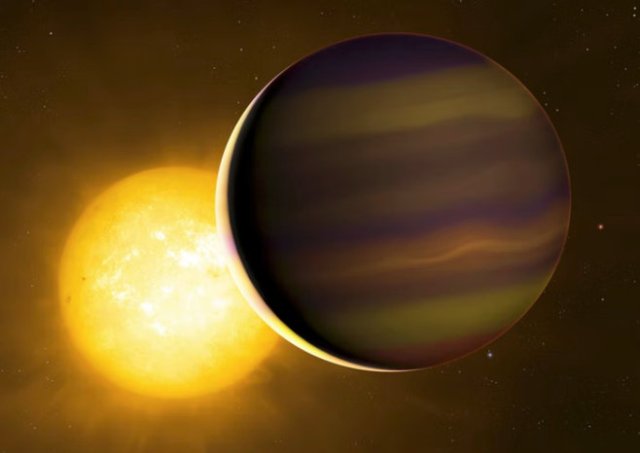
(From Mark Garlick/Science Photo Library/Getty Images, via Inverse, used w/o permission.)
(“Exoplanets and their orbiting stars share the same founding material.”
(Inverse))
“To find out what an exoplanet is made of, look to its star”
“This could help scientists find habitable exoplanets.”
Passant Rabie, Inverse (October 14, 2021)
“A swirling disc of dust surrounds young stars. That dust turns into pebbles, pebbles turn into rocks, and rocks form planets like Earth.
“The host star and its surrounding planets are bound together through more than just gravity — leftover material from the star’s formation goes into molding its orbiting worlds….
“…The team of researchers behind the new study first selected 32 roughly Earth-size exoplanets to examine. They then narrowed it down to 22 exoplanets that they knew for sure to be rocky planets so that they could be somewhat confident of their composition….”
A takeaway from this article is that Vardan Adibekyan, Caroline Dorn, and other scientists have noticed a “strong correlation” between the mix of elements in stars and on planets orbiting those stars.
That’s hardly surprising, since we’ve found strong evidence confirming that planets and stars both form from the same collapsing bit of a nebulae.
But now there’s a data set, changing ‘we think there should be’ into ‘we have evidence that there is.’
I’d like to dig into this study, but it seems to be behind a paywall. Happily, folks like me are allowed access to the abstract.13
Ingredients for Habitable Worlds

Besides, after reading and discussing the “polluted white dwarf” paper, I’m running out of time. If I’m going to have this thing ready by Saturday, that is.
So I’ll just quote another excerpt.
“…WHY IT MATTERS— A planet’s habitability depends largely on the elements that make up the planet.
“Carbon, hydrogen, oxygen, and nitrogen are considered vital elements for life on a planet. Scientists often look for these elements when they discover a new exoplanet to find out if it has potential for habitability….
“…’With the relationship that we found between the composition of the planets and the stars,’ [study lead author Vardan ] Adibekyan says. ‘By looking at the composition of the star, in a way, we can guess the composition of the planet.’…”
(Passant Rabie, Inverse (October 14, 2021))
Weird and Wonderful Worlds
(Almost) finally, a quick look at science items I’ve meant to discuss, but didn’t.
WD 1856 b: Bigger than its Star; Wider, Anyway

(From NASA/JPL-Caltech, used w/o permission.)
“NASA Missions Spy First Possible Planet Hugging a Stellar Cinder”
Felicia Chou, Claire Andreoli, Calla Cofield; JPL (September 16, 2020)
“‘WD 1856 b somehow got very close to its white dwarf and managed to stay in one piece,’ said Andrew Vanderburg, an assistant professor of astronomy at the University of Wisconsin-Madison. ‘The white dwarf creation process destroys nearby planets, and anything that later gets too close is usually torn apart by the star’s immense gravity. We still have many questions about how WD 1856 b arrived at its current location without meeting one of those fates.’…”
WD 1865 b is about 10 times Earth’s diameter, so it’s considerably larger than the white dwarf it orbits. How it got to where it is now is still a puzzle.
Since WD 1865 is part of a multiple-star system (probably), maybe gravitational interaction with the other stars resulted in its close orbit. As I said, it’s a puzzle.14
TOI 700 d: Habitable?

(From Caltech/R. Hurt (IPAC), used w/o permission.)
“NASA Planet Hunter Finds its 1st Earth-size Habitable-zone World”
Jeanette Kazmierczak; NASA’s Goddard Space Flight Center, Greenbelt, Md. (January 6, 2020)
“TESS monitors large swaths of the sky, called sectors, for 27 days at a time. This long stare allows the satellite to track changes in stellar brightness caused by an orbiting planet crossing in front of its star from our perspective, an event called a transit.
“TOI 700 is a small, cool M dwarf star located just over 100 light-years away in the southern constellation Dorado. It’s roughly 40% of the Sun’s mass and size and about half its surface temperature. The star appears in 11 of the 13 sectors TESS observed during the mission’s first year, and scientists caught multiple transits by its three planets….”
TOI 700 d is one of three, maybe four, planets orbiting a red dwarf that’s just over 100 light-years away.
It’s roughly 1.7 times as massive as Earth, and about an eighth again as wide. Mathematical models say it could have an atmosphere. It could very likely be a habitable world.15
Kepler 22 b: Not Habitable?

(From NASA/Ames/JPL-Caltech, used w/o permission.)
“Kepler-22b — Comfortably Circling within the Habitable Zone”
NASA (November 2, 2018)
“…This diagram compares our own solar system to Kepler-22, a star system containing the first ‘habitable zone’ planet discovered by NASA’s Kepler mission. The habitable zone is the sweet spot around a star where temperatures are right for water to exist in its liquid form. Liquid water is essential for life on Earth.”
A planet like Earth, in Kepler 22 b’s orbit, could be habitable; but Kepler 22 b’s diameter is about two and a half times Earth’s. We don’t know its mass, so scientists can’t be certain about what its made of.
But what we do know about planets and how they’re formed suggest that Kepler 22 b is the smallest gas giant we’ve found yet.
Or maybe an ocean world, with a great deal more water than Earth. If Kepler 22 b is an ocean world, and if such planets are habitable, then we might find live there.
Another possibilty for habitiability was an Earth-size moon orbiting Kepler 22 b. Scientists looked for evidence of such a satellite. But they learned that if Kepler has a moon, its mass is about half Earth’s or less.16
Upsilon Andromedae A’s Oddly-Orbiting Planets

(From NASA, ESA, A. Feild (STScI); used w/o permission.)
“Out of Whack Planetary System Offers Clues to a Disturbed Past”
Holly Zell, Brian Dunbar; Hubble Space Telescope, NASA (May 25, 2010)
“Astronomers are reporting today the discovery of a planetary system way out of tilt, where the orbits of two planets are at a steep angle to each other. This surprising finding will impact theories of how multi-planet systems evolve, and it shows that some violent events can happen to disrupt planets’ orbits after a planetary system forms, say researchers.
“‘The findings mean that future studies of exoplanetary systems will be more complicated. Astronomers can no longer assume all planets orbit their parent star in a single plane,’ says Barbara McArthur of The University of Texas at Austin’s McDonald Observatory….”
Upsilon Andromedae is a binary star 44 light-years out, give or take 0.1; a red dwarf orbiting an F-type main sequence star, hotter and more massive than ours.
Four planets orbit Upsilon Andromedae A: b (Saffar), c (Samh), d (Majriti) and e.
Majriti’s orbit is eccentric, but inside Upsilon Andromedae’s habitable zone. It’s a gas giant with 10 times Jupiter’s mass, so it’s not habitable.
But a rocky Earth-size moon of Majriti might support life.
That’s assuming that Majriti’s eccentric orbit isn’t too extreme for habitability.
Scientists figure that maybe Majriti and a now-lost outer planet of Upsilon Andromedae A got too close; throwing the lost world out of the system and sending Majriti into its eccentric and tilted orbit.17
Appreciating God’s Creation
Now, finally, beliefs, assumptions and making sense.
Viewpoints

(From Survata, used w/o permission.)
I don’t “believe in” extraterrestrial life, but I don’t not believe either.
Either life exists on Earth and nowhere else in the universe; or we will, eventually, find life that’s not from our home. Right now, we don’t know.
The Copernican principle — a 20th century label for the idea that Earth isn’t at the center, or bottom, of the universe — suggests that since there’s life here, we’ll find life elsewhere.
I could get upset because we’re learning that not all rocky planets are just like Earth. But that doesn’t make sense, not to me.
Besides, I don’t see that what we’re finding violates the Copernican principle. We’re just collecting data from a larger sample.
Or I could get upset because scientists are learning stuff that we didn’t know a hundred years ago. That doesn’t make sense either.
And I’m sure not going to say that God can’t arrange for life to grow on other worlds, or that God must restrict life to the planet we’re on.
God’s God, I’m not. And neither was Aristotle.
“Our God is in heaven and does whatever he wills.”
(Psalms 115:3)
I’ve talked about Aristotle’s fanboys, the Condemnation of 1277, and appreciating God’s creation before.18
1 Earth, oxygen and life:
2 Microbes, biochemistry and speculation:
3 One of 23 polluted white dwarfs:
4 Stars and the universe:
5 background:
6 WD 1145+017 b and Earth:
- Wikipedia
- “Polluted white dwarfs reveal exotic mantle rock types on exoplanets in our solar neighborhood”
Keith D. Putirka, Siyi Xu; Nature Communications (November 2021)
© Keith D. Putirka, Siyi Xu (2021)
(From nature.com/articles/s41467-021-26403-8.pdf January 12, 2022)
(This article was licensed under a Creative Commons Attribution 4.0 International License…. To view a copy of this license, visit http://creativecommons.org/licenses/by/4.0/
I changed this document’s file name, to fit my naming convention.)
- “Alkali metals in white dwarf atmospheres as tracers of ancient planetary crusts”
Mark A. Hollands, Pier-Emmanuel Tremblay, Boris T. Gänsicke, Detlev Koester, Nicola Pietro Gentile-Fusillo; Nature Astronomy (February 11, 2021)
7 Rocks, exotic and otherwise:
8 More about geology:
9 Worlds and looking for life:
10 Miscellany:
11 More miscellany:
- Wikipedia
- NASA/Jet Propulsion Laboratory, California Institute of Technology
12 Stars; old and new, big and small:
13 Stars and their planets:
- “A compositional link between rocky exoplanets and their host stars”
Vardan Adibekyan, Caroline Dorn, Sérgio G. Sousa, Nuno C. Santos, Bertram Bitsch, Garik Israelian, Christoph Mordasini, Susana C. C. Barros, Elisa Delgado Mena, …; Abstract; Science (October 14, 2021)
DOI: 10.1126/science.abg8794
14 The planet is real, how it got there is a puzzle:
15 Habitable, maybe:
- Wikipedia
- TOI 700 d
Exoplanet Exploration, Planets Beyond our Solar System; NASA
16 Not habitable, maybe:
17 Focus on Upsilon Andromedae A’s planetary system:
18 Getting over Aristotle, making sense:

 I’d expected to hear about charisms during Mass this morning.
 The other surprise at Mass was a letter from our Bishop.