Saturday afternoon, my wife told me that I was staying inside for the weekend.
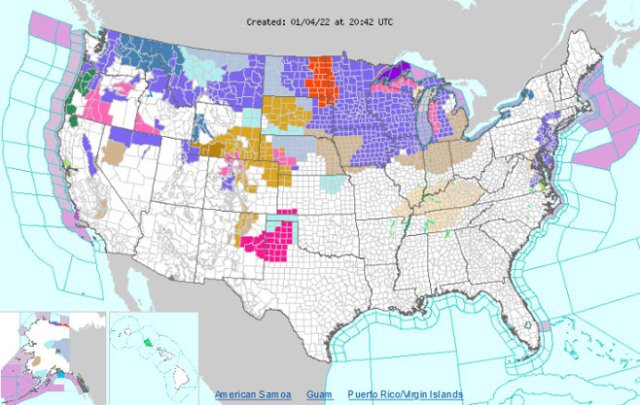
She was right. A wind chill warning would be in effect until around midday Sunday.
I’ve been experiencing ‘nothing serious’ for a week or so now. Sunday obligation is important, but so is not making myself sicker than I already am.
Life and physical health are “precious gifts.” Taking care of both is a good idea. Within reason. Obsessing over either, not so much. (Catechism of the Catholic Church, 2288-2291)
So I stayed inside until Monday, picked up meds for myself and a daughter, returned home and kept an eye on the weather.
This afternoon, sure enough: there’s a winter weather advisory in effect until the end of my Wednesday afternoon session at the Eucharistic adoration chapel.
I verified the weather report and made a phone call. It looks like I’ll be staying inside for at least another day.
I’m not happy about that, but figure that I’ll try seeing the situation as an opportunity to practice patience, get more writing done or — better yet — think about what I should be writing about.
I’d already had an opportunity to practice patience. Earlier today, I spent more than an hour dealing with a formatting detail on my ‘About Me’ pages that should have taken maybe ten minutes. Tops. And that’s almost another topic.
(From James Tissot, via Wikidata, used w/o permission.)
(James Tissot’s “Journey of the Magi.” (1890s))
“We Three Kings of Orient are,
Bearing gifts we traverse afar.
Field and fountain,
Moor and mountain,
Following yonder Star….”
(“We Three Kings,” John Henry Hopkins Jr. (1857))
As a child, “We Three Kings” was among my favorite Christmas songs. It still is.
The song’s gold, frankincense and myrrh are “Biblical,” in the sense that they’re mentioned in Matthew’s Gospel. So is the star.
As for the “Three Kings of Orient:” well, there were more than one of them, and Matthew says they were from the east. But he also called them magi.
John Henry Hopkins Jr. probably inferred their royal status from Isaiah and Psalms.
Their names — Gaspard, Melchior and Balthazar — aren’t in Matthew’s Gospel, either.1
Language, Names and Records
The earliest origin of “Gaspard” I’ve heard of is in a first century B.C. Septuagint, where it’s a Chaldean word: “Gizbar.” Seems that a gizbar is a treasurer. Or was.
The Chaldean language has been around for well upwards of two and a half millennia, and changed considerably along the way.
I gather that it’s related to Aramaic, sort of like English is related to German, and was a trade language in what we call the Neo-Babylonian Empire. Scholars figured that German, English and other Indo-European languages were also related. Maybe Indo-Semitic, too, but that’s been looking less likely lately.
We’ve known about language and languages since long before folks developed cuneiform and hanzi. But didn’t realize that families of languages exist until a few centuries back.
In 1585, Filippo Sassetti told a friend that he’d noticed similarities between Italian and Sanskrit.
In the 19th century, folks like Leopardi, Nietzsche and Schlegel noticed connections between languages like German, Iranian and other languages.
Philology as a blend of history and linguistics, with textual and literary criticism in the mix, was politicized in the 20th century and I’m drifting off-topic.
Back to names and the magi.
Melchior and Balthazar were mentioned in a Greek manuscript dating from 500 A.D. or thereabouts. Melchior’s name has been rendered as Melichior; and Balthazar’s also called Balthasar, Balthassar, and Bithisarea.
Gaspard/Gizbar’s name has morphed into Gaspar, Jaspar, Jaspas, Gathaspa and more.2
“…Tales That to Me Were So Dear….”
(From James Tissot, via Wikipedia, used w/o permission.)
“Tell me the tales that to me were so dear,
Long, long ago, long, long ago….”
(“Long Long Ago!,” Thomas Haynes Bayly (1845) via Digital Commons, Connecticut College)
We’ve collected a mess of stories about the magi over the last couple millennia. Some are as well-documented as my homeland’s tales about John Henry’s hammer and Washington’s cherry tree.
Not very, in other words.
Others may be factually accurate by today’s Western standards, but based on now-untraceable records and oral traditions.
And some are either plausible speculations, like “Amahl and the Night Visitors” and “The Other Wise Man,” or magi-themed seasonal specials, like “A Cosmic Christmas.”
I could let that bother me, but I won’t. Instead, I’ll talk about what we do know about the magi; and why I think their trip to Bethlehem was a big deal.
Right after I explain why I think the magi, Herod and Jesus are real people and that the Bible really is Sacred Scripture.
Basically, I think that the Bible is not on the same level as, say, “A History of the Life and Death, Virtues and Exploits of General George Washington:” an 1800 exaltation of America’s first president, a literary analog to Constantino Brumidi’s “The Apotheosis of Washington.”
I think the Bible tells the story of God’s relationship with Sarah and Abraham’s descendants and, later, folks like me.
The Bible’s books include history, prophecy, poetry, and correspondence. But the Bible is not a science or history textbook, and it’s not a political manifesto.3
And I certainly don’t try believing that the Bible was written by an American literalist.
Or that stories like “A Cosmic Christmas” and “The Other Wise Man” must be true because I’ve enjoyed them, and that’s almost another topic.
Herod and the Magi
(From James Tissot, via Wikimedia Commons, used w/o permission.)
“When Jesus was born in Bethlehem of Judea, in the days of King Herod, behold, magi from the east arrived in Jerusalem,
“saying, ‘Where is the newborn king of the Jews? We saw his star at its rising and have come to do him homage.'”
(Matthew 2:1–2)
There’s a lot to unpack here.
For one thing, this Herod isn’t the Herod who’s chiefly known for his role in our Lord’s trial and execution. The Matthew magi Herod is Herod the Great: who was great because of his high-end building programs, or not-so-great for pretty much the same reason.
At any rate, Herod the Great demonstrated — I’ll call it an abundance of caution — in dealing with threats, real or imagined.
Take his second wife, Mariamne, and her mother Alexandra, for example.
Josephus says that Mariamne stopped sleeping with Herod when she learned that he planned to kill her. So Herod accused Mariamne of adultery and put her on the death row waiting list.
Alexandra gave state’s evidence against her daughter, possibly because she was also slated for execution.
Then Alexandra said Herod was unfit to rule and that now she was in charge. So Herod had her executed without a trial.4
Yes, American politics could be worse, and that is another topic.
Bethlehem’s Dead Boys
(From Adam Elsheimer, via Wikimedia, used w/o permission.)
Matthew’s Gospel says that Herod had his people look up where this “newborn king of the Jews” would be.
Then he passed the information along to the magi, and told them to let him know when they’d found the kid.
They didn’t. Instead, they left the country by another route.
Meanwhile, Joseph — acting on an urgent warning — pulled Mary and Jesus out of Bethlehem and headed for Egypt.
Herod realized he’d been double-crossed, at least from his viewpoint, and implemented his usual response to threats. He told his enforcers to kill every male child in Bethlehem who was under the age of two.
The incident is recorded in Matthew’s second chapter and nowhere else.
Which doesn’t surprise me. Over the course of his career, Herod had arranged for quite a few folks to stop living: important folks, including members of his family.
At that time, Bethlehem was a small town. One scholar said a reasonable body count, considering the population, would be around 15 or 20. That’s nowhere near the 144,000 toll imagined by some medieval writers.5
Even so, from the viewpoint of Bethlehem’s families, that’s a lot of dead boys.
But first century Judea was not 21st century America. The 24-hour news cycle hadn’t been invented yet, and political leaders enjoyed a certain degree of impunity.
Like I said, I’m not surprised that killing a dozen or so obscure kids in a Podunk town didn’t get recorded, apart from Matthew’s account.
Philistines, Naaman, the Magi and Me
(From James Tissot, via Wikimedia Commons, used w/o permission.)
(Tissot’s “David Danced….” (ca. 1896-1902))
I don’t know which of the many ‘magi’ stories come closer to the mark for identifying their homelands. What is certain is that they were foreigners, gentiles. Like me.
But they weren’t the first gentiles who realized that “I AM,” who had been dealing with Abraham and Sarah’s descendants, was — special.
Take the time, for example, when Israel’s elders decided that using the Ark of the Covenant as a good luck charm would be a good idea. It wasn’t.
An Ark Incident and an Army Commander
Philistines, a bunch of Sea Peoples who had moved into the area’s coastal plain, had already defeated Israel’s forces once.
Then, when Eli’s sons, Hophni and Phinehas, showed up with the Ark, Israel’s forces let loose a whoop and a holler.
Which scared the Philistines, inspiring them to fight even harder.
When the dust settled, Hophni, Phinehas and a whole bunch of others were dead and the Ark was in Philistine hands.
Eli and company were none too pleased, but neither were the Philistines.
They’d put the Ark in Ashdod’s temple of Dagon. Then the statue of Dagon fell down. Twice.
Then folks in Ashdod started experiencing health issues and asked if anyone would take the Ark off their hands. Gath’s decision-makers obliged, but passed the Ark along to Ekron when Gathians — Gathites?? — developed the same occasionally-lethal symptoms.
Long story short, the Philistines finally decided they’d had enough, and sent the Ark back to the Levites by way of Beth-shemesh.
Then there was Naaman, a Syrian army commander who was a leper. Which means he could have had anything from psoriasis to Hansen’s disease.
At any rate, Naaman’s condition cleared up after he finally followed Elisha’s instructions. Which impressed Naaman so much that he wanted to have two mule-loads of dirt, so that he could sacrifice to Elisha’s “I AM.” Exclusively.
Well, almost exclusively. Naaman apologetically explained that his official obligations included accompanying his master in a temple of Rimmon, and bowing with his master.
We lost track of the Ark a little over two and a half millennia back. It’s not so much lost, as secured.6 And that’s yet another topic.
“…Our Life is a Journey….”
I think the magi’s journey to Bethlehem is a big deal because I think Jesus matters.
And I rejoice that folks like Naaman, the magi and me can turn toward “the messianic light of the star of David, the one who will be king of the nations.” (Catechism of the Catholic Church, 528)
And can join “a great procession that continues throughout history.”
“…The destiny of every person is symbolized in this journey of the Magi of the East: our life is a journey, illuminated by the lights which brighten our way, to find the fullness of truth and love which we Christians recognize in Jesus, the Light of the World. Like the Magi, every person has two great ‘books’ which provide the signs to guide this pilgrimage: the book of creation and the book of sacred Scripture. What is important is that we be attentive, alert, and listen to God who speaks to us, who always speaks to us….”
(Solemnity of the Epiphany of the Lord, Pope Francis (January 6, 2014))
“The Epiphany is a feast of light. ‘Arise, shine; for your light has come, and the glory of the Lord has risen upon you’ (Is 60:1). … He who is the true light, and by whom we too are made to be light, has indeed come into the world. He gives us the power to become children of God (cf. Jn 1:9,12). The journey of the wise men from the East is, for the liturgy, just the beginning of a great procession that continues throughout history….”
(Solemnity of the Epiphany of the Lord, Pope Benedict XVI (January 6, 2012))
“Adoration of the Shepherds,” James Tissot. (ca. 1890)
We’re celebrating the birth of Jesus this weekend.
Saturday night’s Gospel reading starts with “…a decree went out from Caesar Augustus….” About halfway along, we hear that Joseph finally found a place to stay in Bethlehem: but not exactly five-star accommodations.
When Jesus was born, Mary laid our Lord in a manger. Two millennia later, in my language, “manger” sounds a bit classy. But it’s a feeding trough.1
Next we hear that shepherds got “…good news of great joy….”
“The angel said to them, ‘Do not be afraid; for behold, I proclaim to you good news of great joy that will be for all the people. “For today in the city of David a savior has been born for you who is Messiah and Lord. “And this will be a sign for you: you will find an infant wrapped in swaddling clothes and lying in a manger.’ “And suddenly there was a multitude of the heavenly host with the angel, praising God and saying: “‘Glory to God in the highest and on earth peace to those on whom his favor rests.'” (Luke 2:10–14)
Okay, so just who is this “Messiah and Lord,” and how does “an infant … lying in a manger” warrant an angelic introduction?
The answer’s fairly straightforward, but has been a hard sell from the get-go.
I’ll be talking about that. But first, backing up a bit —
…The Light Shines in the Darkness – – –
“In the beginning was the Word, and the Word was with God, and the Word was God. “He was in the beginning with God. “All things came to be through him, and without him nothing came to be. “What came to be through him was life, and this life was the light of the human race; “the light shines in the darkness, and the darkness has not overcome it.” (John 1:1–5)
Jesus: Born, Lived, Tortured, Killed
That newborn, wrapped in swaddling clothes and put in a feeding trough, is — quite simply — God.
It’s that simple, and it’s been a hard sell for two millennia.
At first, the problem some folks had was thinking of Jesus as more than just someone who was either delusional or a fraud.
“Jesus said to them, ‘Amen, amen, I say to you, before Abraham came to be, I AM.’ So they picked up stones to throw at him; but Jesus hid and went out of the temple area.” (John 8:58–59)
Think about it. When Moses asked God for a name in that burning bush interview, God replied “I AM.” (Exodus 3:14)
Jesus said “before Abraham came to be, I AM.”
Jesus was saying “I am God.”
Folks have claimed divinity at least since Naram-Sin of Akkad called himself God of Akkad. The last I heard, Aleister Crowley’s Thelema belief was still extant,2 and I’m drifting off-topic.
At any rate, Jerusalem’s leaders decided they’d be better off with Jesus dead.
They arranged for the Roman governor to have Jesus tortured and executed. The disciple who had cooperated with them committed suicide.
And Then it Gets Interesting
Then Jesus stopped being dead.
He convinced the surviving disciples that they weren’t seeing a ghost, gave them instructions we’re still following, and left.3
Following those instructions, they started sharing the best news humanity’s ever had “‘…in Jerusalem, throughout Judea and Samaria, and to the ends of the earth.’…”
Eventually their successors reached my ancestral homelands. We were pretty close to the ancient world’s “ends of the earth,” so that took time. And that’s another topic.
I follow Jesus because I think he is the Son of God, and that our Lord came to save us. (Catechism of the Catholic Church, 456-478, 529, 1019)
Jesus of Nazareth was and is human: and Jesus is God. (Catechism, 422-679)
God the Father and God the Holy Spirit are also God. That’s not three gods, by the way. That’s one God, three Persons: Father, Son and Holy Spirit. They’re consubstantial, which is a fancy word meaning ‘having the same substance.’ (Catechism, 238-260)
Living in Love, Harmony and Truth: Or Not
Ideally, all the early Christians would have lived in love, joy, harmony and truth.
But we do not live in an ideal world.
Take Ananias and Sapphira, for example: savvy but shady folks who sold property, palmed part of the proceeds, and donated the remainder to the apostles.
So far, so good.
Presenting the remainder as the full amount, not so much.
Lying is a bad idea. Lying to God is a really bad idea, and in this case a lethal one. (Acts 5:1–10, see also * footnote; Catechism, 2464ff)
Deliberately replacing the knowledge and wisdom we’ve been passing along with nifty new — or old — notions; is an even worse idea. (Catechism, 74-95, 101-133, 817-819)
Being Human
Early on, most folks didn’t have trouble with seeing Jesus as divine.
What some balked at was believing that Jesus could be both God and human.
Some still have trouble with that idea.
But what can I say? That’s the way it is, and we can’t change what we’ve been passing along to make truth more in tune with whatever’s trendy at the moment.
I’ll admit to a bias.
I’m human: a creature with a physical body, made in the image of God with a soul and free will, a rational being. (Catechism, 355-373, 1730-1742, 2702)
Mind you, being a rational being doesn’t mean I always think straight. Or even think, period. I have free will, so using my brain is an option, not an obligation, and that’s yet another topic.
The point is that I like being human. I enjoy breathing, eating, perceiving this wonder-filled world with my senses. I do not yearn to be a disembodied spirit.
Let’s see, where was I? God. Jesus. Being human. Making sense: or not.
I’ve seen an early bad idea called Gnostic Docetism and just plain Docetism. Basically, the idea was that Jesus was God. But Jesus only seemed to be human. That our Lord’s physical appearance was an illusion.4
I can see the appeal, at least for folks who feel that spirit is good and physical stuff is icky.
Gnosticism
I’m guessing that if you’ve heard about Gnosticism in class, you were told that it’s a Christian thing.
If so, the professor wasn’t wrong.
Western culture’s version of Gnosticism has roots in late 1st century Christian circles. These folks felt that physical reality was flawed at best, or downright evil.
I don’t think that makes sense, since I think God creates everything: including the world we live in.
And I don’t think God makes junk. Besides, there’s this bit from Genesis:
“God looked at everything he had made, and found it very good. Evening came, and morning followed—the sixth day.” (Genesis 1:31)
At any rate, Simon Magus founded Gnosticism. Or he didn’t. What’s more certain is that he was accused of Gnosticism by 1st century Christian authorities. He’s also the chap who thought trying to buy the Holy Spirit’s gifts was a good idea.
Whoever launched what we call Gnosticism, Simonians were Gnostics who said they followed the teachings of Simon Magus. They were active from the 2nd to the 4th centuries.5
Gnew Harmony: Gnot Gnostic
Not all folks who seem uncomfortable with physical reality are Gnostics.
Take the 19th century’s New Harmony community, for example. They allowed marriage, but apparently discouraged folks from having kids.
From their viewpoint it made sense, maybe, since they also believed that Jesus was coming back during their lifetimes.
But never mind them. I was talking about Gnosticism as a ‘Christianity my way’ thing, starting with Simon Magus and the Simonians.
Next up is Cerdo, whose 15 minutes of fame was in the 130s.
Good God, Bad God and Other Bad Ideas
Cerdo started as a Simonian, then set up shop on his own.
He said there were two gods: one demanding obedience, the other good and merciful.
Cerdo’s obedience god was the Old Testament deity, the good and merciful one was superior and known only through Jesus.
And that Jesus was the son of the good deity: sent into the world to oppose evil.
But, Cerdo said, Jesus only looked human. Since the body — all bodies — was the evil deity’s work, again according to Cerdo, looking human was an illusion, and so were our Lord’s apparent sufferings and death.
I’ll give Cerdo credit for consistency. His moral system prohibited drinking wine, eating meat and getting married. Where he thought little Cerdonians would come from, that I don’t know.
Then there was Bardaisan: scholar, astrologer, philosopher, hymnographer and poet. He apparently believed that an all-powerful God existed and that we have free will. He also knew about Babylonian astrology.
How many Bardaisanite beliefs are from Bardaisan and how many were added after his death is anyone’s guess. The Bardaisanite school’s beliefs arguably influenced Valentinianism and Manichaeism.
Valens — not the Roman emperor, this is the Valens from Bacetha Metrocomia — took the ‘physical stuff is bad’ idea to a new level.
He earned a reputation for castrating travelers he met. Valesians, his followers, may have been more restrained. They seem to have encouraged self-castration.
Other Gnostic beliefs were more mainstream, like Manichaeism, Mandaeism, Sethianism and Valentinianism.6
Anaxagoras and the Cosmic Mind – or – Arianism isn’t Aryanism
A quick recap.
Gnosticism is dualistic, dividing reality into physical and spiritual. So far, so good.
But Gnostic beliefs say that physical is bad.
As I said before, I don’t buy that because I think God makes everything and that God doesn’t make junk.
I also think Gnosticism didn’t start with Christianity. Not the basic ideas.
Anaxagoras, a fifth century BC philosopher, said that Nous — a sort of cosmic mind — started sorting out an originally homogeneous universe by stirring it. He’s not as famous these days as Aristotle and Plato, and I’ve talked about that before.
The point is that Gnostic ideas predate Christian-flavored Gnosticism. And may predate Jaspers’ Axial Age, although I’ll grant that many of our current philosophical ideas got traction then.
(Almost) finally, there’s Arianism: a nifty idea promoted by Arius, who lived in the third and fourth centuries.
Scholars reconstructing that belief say that Arius saw Jesus as the Son of God: but in the sense of being created by God, a perfect but subordinate creature. And as such, not a person in the Trinity.
Arianism, by the way, isn’t Aryanism. Aryanism is a bad idea that took form in the late 19th century, boiled over in the 20th, and is still getting flushed out of my native culture.7
– – – And the Darkness Has Not Overcome It….
Getting back to that night in Bethlehem, when Mary gave birth to Jesus: and repurposed a feeding trough as a crib.
That baby really was a baby, a young human: not something incorporeal, disguised as one of us.
That baby really was and is God: the Almighty, creator of everything, merciful, knowable and unknowable. (Catechism, 31-43, 156-159 202, 268-324)
Two millennia back, some folks balked at thinking that someone could be both God and human. Some still do.
These days, I hear more about folks having trouble believing that Jesus could have been anything but a man. Or that there’s anything besides the material world.
I’m a Catholic, so I think that Jesus of Nazareth is the Second Person of the Trinity: really human and really divine.
I don’t understand how that works. Not on an operational nuts-and-bolts level. But I don’t need God-level knowledge to accept that Jesus was and is who he said he is.
Besides, one way can I think about our Lord’s unique ancestry is using myself as an example. Not that I’m claiming divinity. Trouble like that I don’t need.
My mother’s Norwegian, a short black-haired kind. My father’s Irish and Scots.
That doesn’t mean that I’m Norwegian, but only seem to be Gaelic or Celtic or whatever. I’m Norwegian on my mother’s side, more-or-less Gaelic-Celtic on my father’s.
I could try believing that I’m exclusively Scandinavian or Gaelic or Celtic or whatever. That seems silly at best.
I’m not Norwegian or Irish or Scots. I’m all of them.
Making Sense
As I see it — and I won’t insist that it’s a theologically bulletproof way of expressing the idea — our Lord’s mother is Mary and his father is God.
So Jesus is human on his mother’s side.
His life, death and resurrection wouldn’t make sense if he wasn’t.
I’m working on a “Christmas” post that should be ready by tomorrow morning. But in case it’s not, here’s something seasonal and slightly silly.
Pip’s Christmas
‘Twas the night before Christmas, and all through the shop
Nothing was stirring, you could hear a pin drop.
The sleigh was not ready, the toys were not packed,
Santa was fuming, quite lacking in tact.
“Pip!” he called out to the foreman on duty,
Where is your crew? And don’t act so snooty!
Pip’s feelings were hurt, but he wondered the same
Were they lost? Had they left? Were they playing a game?
“Never mind!” thundered Santa, while grabbing his sack,
“We’ll do it ourselves: There are toys in the back.”
So into the warehouse like madmen they flew.
Santa and Pip had much packing to do.
And then, down a corridor seldom in use,
They heard something like an hysterical goose.
But no, there were words in that hideous shriek,
It was music: now Santa was prone to critique.
Santa strode to the source of that hideous din,
Closely followed by Pip, who beheld with chagrin:
Three elves and four bottles and, there on a chair,
A boom box whose music was filling the air.
Santa stood for a moment, transfixed by the sight
Then he bellowed so loudly that Pip shook with fright.
“You! Chuckles! And Bubbles! And you, mister Suds!”
Why are you carousing while in your work duds?”
The fate of that threesome Pip would not relate,
Except to recall that the hour was late:
And Santa was anxious to fly in his sleigh,
And dealt with loose ends on the following day.
Scientists in Sweden, taking part in 2019’s BEAST program that used SPHERE on the VLT discovered an ‘it might be an exoplanet.’
In 2021, they got confirmation. They’d spotted an exoplanet.
And SPHERE on the VLT1 has an picture of the newly-discovered world.
I’d planned on talking about BEAST, SPHERE, VLT; comparing ground-based and space observatories; and whatever else came to mind. Then, on Tuesday, I started running a fever. It was of the ‘nothing serious’ variety, but quite enough to slow me down.
After that, the household got a brief visit from number-two daughter, son-in law and granddaughter: a happy occasion. Which also didn’t help me do what I’d planned.
So I trimmed my plans back to what was possible, and this is the result.
b Centauri(AB)b, AKA HD 129116 b: Big Bright Stars and a Big Mystery Planet
(From ESO, used w/o permission.) (Binary star HD 129116 and HD 129116 b, its huge exoplanet.)
“Astronomers have imaged a giant planet around a massive pair of stars known as b Centauri. While Jupiter’s orbit around the Sun is five times wider than Earth’s, this planet is 100 times farther out, circling its star at 560 times the average Earth-Sun distance….
“…Markus Janson (Stockholm University, Sweden) and colleagues discovered the planet in observations taken in 2019 as part of the B-star Exoplanet Abundance Study (BEAST), using the SPHERE instrument on the European Southern Observatory’s Very Large Telescope in Chile. Follow up in 2021 confirmed the planet’s existence. The real kicker, though, was an observation taken two decades earlier as part of a different project. The planet was visible back then but discarded for being too faint. Including the earlier observation enabled the researchers to trace the object’s orbit and confirm that not only is it moving with the b Centauri system, it’s actually orbiting the central stars….”
Monica Young’s Sky and Telescope article doesn’t mention the planet’s designation. She calls the planet’s star b Centauri. That’s the designation European Southern Observatory’s announcement used.
I called b Centauri’s planet HD 129116 b partly because Wikipedia’s page on the star uses the “HD” or Henry Draper Catalogue designation.
And partly because the “b Centauri” designation invites confusion in my language.
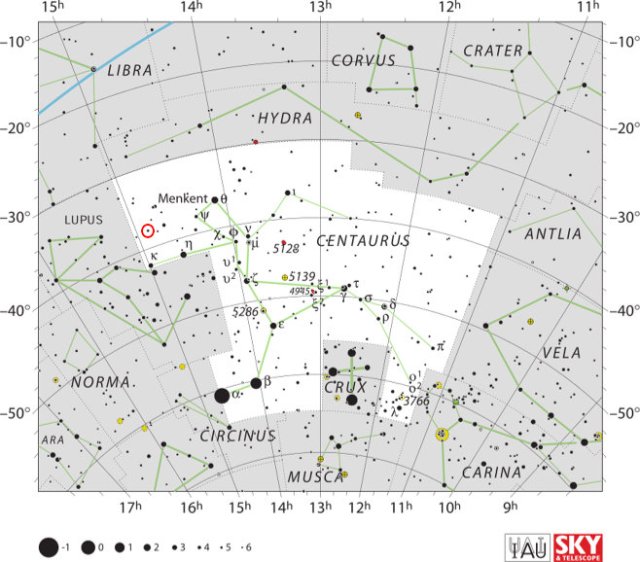
b Centauri is a legitimate Bayer Designation. But it also ‘reads’ as Beta Centauri. Maybe Beta Centauri has planets, but if so we haven’t spotted them yet.2
Awkward Designations, Pondering “Fred”
The Sky and Telescope article calls b Centauri’s planet b Centauri(AB)b: an accurate of not euphonious designation. I’ve called it HD 129116 b, but I haven’t seen that designation used.
But whether I call it HD 129116 b or b Centauri(AB)b, the designation’s awkward. For me, at any rate.
If I need to refer to it often, then I may start calling it “Fred.” Or maybe not.
I talked about names, stars, catalog designations and alphanumeric gibberish last month.3
HD 129116 b, Beta Pictoris b and More: We See You!
(From IAU, Sky & Telescope magazine/Roger Sinnott & Rick Fienberg; used w/o permission.) (Location of b Centauri (AB)b/HD 129116 circled.)
HD 129116 b isn’t the first exoplanet that astronomers have seen directly. That’d be Beta Pictoris b, imaged in 2008. Or ROXs 42Bb in 2013. Or maybe some other planet.
We’ve been finding a great many exoplanets, and who’s found what and when — to say nothing about what’s being learned and how — hasn’t been tidied up into well-organized lists yet.
On the other hand, today’s information technology helps scientists share, analyze and organize information — and lets someone like me stay more-or-less up to date with what humanity’s learning about this wonder-packed universe.
Which reminds me — b Centauri(AB)b is being presented as “a planet that shouldn’t exist:”
“Shouldn’t exist” headlines get attention, which is what headlines are supposed to do. I wouldn’t call them clickbait, since b Centauri(AB)b is hard to explain.4
Incomplete and Growing Knowledge
(From ESO/H. Avenhaus et al./E. Sissa et al./DARTT-S and SHINE collaborations, via Wikimedia Commons, used w/o permission.) (SPHERE/VLT’s images of dusty discs surrounding nearby young stars.)
The nebular hypothesis is still a hypothesis.
Immanuel Kant, possibly developing an idea of Emanuel Swedenborg’s, said that the Solar System could have formed when a nebula collapsed into a rotating disk which then became our star and planets.
That was in 1755.
Pierre-Simon Laplace came up with a similar model in 1796.
We’ve learned a great deal since then. And over the last few decades we’ve found collapsing nebulae and protoplanetary disks.5
Assuming that they’re similar phenomena, seen at different times during their development, is an assumption. A reasonable one.
But we don’t know that’s how our Solar System formed. Not the way we know that Abraham Lincoln gave the Gettysburg address.
That sort of knowledge may have to wait until we’ve been making and recording observations of collapsing interstellar clouds for a few million years.
Meanwhile, scientists have been baffled by the conundrum of planetary formation.
Or, looking at it from another angle, they’ve been fine-tuning the nebular hypothesis and uncovering new questions.
It’s There, But How?
One of these new questions is how “a planet that shouldn’t exist” formed.
Based on what we’ve learned so far, scientists figure that most planets when a protoplanetary disk’s dust grains stick together.
Then the dust clump collides with other grains and clumps, eventually getting as big as a planet. Meanwhile, the protoplanetary disk’s gas and ice will have been falling one the growing planet.
That model, along with what we’re learning about how gravity, growing planets and protoplanetary disks interact, looks like a good fit with the Solar System’s planets. And with planets we’ve been finding around other stars.6
Informed Speculations
Except for b Centauri(AB)b.
It’s huge, roughly 11 times as massive as Jupiter. Maybe it formed closer to b Centauri(AB) and then was flung out to its current orbit.
A problem with that idea is that, although b Centauri(AB) b’s orbit is a bit eccentric — 0.4, give or take a bit — it’s not nearly as eccentric is it should be, in the ‘flung outward’ scenario.
Or maybe b Centauri(AB) b formed where it is now, through gravitational instability. If that’s what happened, part of the b Centauri(AB)’s protoplanetary disk became so dense that the denser part’s gravity pulled into the exoplanet.
A problem with the gravitational collapse model is that our models say that it’s far more likely to work when there’s enough mass in the lump to make a star.
Since astronomers have been finding a fair number of oversize planets in big orbits around massive stars, whatever process or processes are at work: they’re not rare.7
That’s all I have time for this week. Well, almost all.
Living With Reality: And Loving It
Since at least some folks see religion and science as incompatible: and, some of them, apparently think that science real and religion requires intellectual blinders. Then there are ‘religious’ folks who seem determined to encourage the notion.
I’ve explained why reality doesn’t threaten my faith, and why I think seeking truth is a good idea. Often.
So, instead of repeating that sort of thing, I’m developing a Science AND Religion section on A Catholic Citizen in America.
Finally, the usual links to more-or-less related stuff I’ve written.
Keep up with A Catholic Citizen in America: subscribe. (below) (Don't worry, I won't bug you. Check out my Privacy Policy.)
Weekly Schedule
Something new each Saturday.
Life, the universe and my circumstances permitting. I'm focusing on 'family stories' at the moment. ("A Change of Pace: Family Stories" (11/23/2024))
Blog - David Torkington
Spiritual theologian, author and speaker, specializing in prayer, Christian spirituality and mystical theology [the kind that makes sense-BHG]
I was born in 1951. I'm a husband, father and grandfather. One of the kids graduated from college in December, 2008, and is helping her husband run businesses and raise my granddaughter; another is a cartoonist and artist; #3 daughter is a writer; my son is developing a digital game with #3 and #1 daughters. I'm also a writer and artist.