Easter: Parades, Eggs, and the Best News Ever

Brian H. Gill's 'Easter Egg.' (2016)

Easter Sunday is a very big deal.

It’s “the greatest of all Sundays,” since it’s when we celebrate our Lord’s resurrection.

Begin celebrating, actually. The Easter season lasts until Pentecost Sunday: not quite two months from now.

Maybe “our Lord’s resurrection” sounds routine, familiar, two millennia after that post-Passover surprise.

But let’s remember that the 12 Apostles, make that 11 after Judas Iscariot killed himself, and everyone else close to Jesus expected him to stay dead.

Mary of Magdala, “the other Mary,” Peter, John: everyone who had been traveling with Jesus knew that he was dead. He’d been tortured, crucified, and given a postmortem poke with a lance. (Matthew 27:4561; Mark 15:3347John 19:34)

I gather that folks had seen Jesus as a king of the military and political sort: someone who would lead them in victory to freedom from Roman rule.1

Which accounts for the triumphal entry we celebrated last week. And the Sanhedrin having conniptions, imagining how Roman forces might react to a popular revolt.

The Sanhedrin’s concerns were, I think, valid: from a political viewpoint, anyway. And if I assumed that Jesus of Nazareth was the grassroots rabble-rouser they feared.

Which I don’t. But I’m living in an era that’s two millennia in their future, which gives me a better look at the big picture.

Jerusalem Riots of 66, Masada: Looking Back

Godot13's photo of Masada, in the Judaean Desert, with the Dead Sea in the distance. (March 28, 2013)Jewish beliefs and culture weren’t a good match with either Hellenization — Greek culture was the era’s Disney and Coca-Cola, impossible to ignore — or Roman law.

Then, three decades after Jesus had been executed, Greek-Jewish tensions and tax protests boiled over in Jerusalem.

Gessius Florus, Roman procurator of Judea, couldn’t restore the status quo. Extracting what he said were back taxes from the Temple treasury hadn’t helped.

After that, Gaius Cestius Gallus, Rome’s Syrian Legate, marched in and led his forces to defeat.

Then Vespasian waded in.

Seven years later, the revolt’s last heroes, or fanatics, depending on who’s talking, regrouped in Masada: a fortified plateau that might have been invincible if the besiegers hadn’t been Romans. But they were.

After turning several thousand tons of rock and dirt into a ramp giving access to the plateau, Roman forces entered Masada: and found pretty much everyone dead.

Or something like that. The incident is still controversial.

Someone said that a contemporary account doesn’t line up with what other Roman forces did in other places.

And it seems that after two millennia, there’s not much forensic evidence left at the scene. So, according to at least one academic perspective, the mass suicide probably didn’t happen. Or can’t be verified.2

I recognize the value of physical evidence, and the wisdom of taking testimony with a grain of salt. Which may be why Thomas is one of my favorite Apostles.


“I Have Seen the Lord”

James Tissot's 'Mary Magdalene Questions the Angels in the Tomb.' (between 1886 and 1894)Recapping, Jesus of Nazareth had been held by the authorities.

He had been questioned, tortured and finally nailed to a cross on Golgotha.

Then he died.

It was a very public death.

After that, he was buried.

“They took the body of Jesus and bound it with burial cloths along with the spices, according to the Jewish burial custom.
“Now in the place where he had been crucified there was a garden, and in the garden a new tomb, in which no one had yet been buried.
“So they laid Jesus there because of the Jewish preparation day; for the tomb was close by.”
(John 19:4042)

Friday night and Saturday passed.

Sunday morning, Mary of Magdala and maybe others noticed that the tomb’s stone had been rolled away.

She ran to tell Peter and “the other disciple” what she saw.

They returned, finding an empty tomb.

Make that almost empty. Mary of Magdala stayed behind, weeping. When she looked into the tomb, she saw two angels.

After a short Q & A with the angels, she saw, but didn’t at first recognize, Jesus. Then she told the other disciples what and who she had seen.

Later, Jesus showed up — in a locked room — which I figure helped many disciples believe that Mary of Magdala hadn’t been having hallucinations.

But at least one of them, Thomas, hadn’t been there. (John 20:123)

Testimony, Evidence and Belief

Anthony van Dyck's 'Bust of the Apostle Thomas. (1620?)Small wonder Thomas wasn’t taking “I have seen the Lord” statements as absolute proof.

Again, at least some of the folks who had been following Jesus had seen him die.

And they all knew that dead is dead. Particularly when crucifixion was the cause of death.

So Thomas wouldn’t believe that Jesus had stopped being dead.

Not unless he had physical evidence.

“Thomas, called Didymus, one of the Twelve, was not with them when Jesus came.
“So the other disciples said to him, ‘We have seen the Lord.’ But he said to them, ‘Unless I see the mark of the nails in his hands and put my finger into the nailmarks and put my hand into his side, I will not believe.’
“Now a week later his disciples were again inside and Thomas was with them. Jesus came, although the doors were locked, and stood in their midst and said, ‘Peace be with you.’
“Then he said to Thomas, ‘Put your finger here and see my hands, and bring your hand and put it into my side, and do not be unbelieving, but believe.’
“Thomas answered and said to him, ‘My Lord and my God!’
“Jesus said to him, ‘Have you come to believe because you have seen me? Blessed are those who have not seen and have believed.'”
(John 20:2428)

His insistence on evidence inspired the “Doubting Thomas” nickname.

Which I gather dates back to around the 17th century.3

Granted, Jesus said that folks who believed without physical evidence are blessed.

But I think remembering that Jesus showed up for Thomas is prudent. And that Thomas, given the evidence he’d said he needed — believed.

I like Thomas, partly because he asked a reasonable question: and accepted the answer.

And partly because of something I’ll get back to.


“…In the Easter Parade….”

U.S. Bureau of Public Roads' photo by an unknown photographer: New York City's 1900 Easter Parade. (Easter Sunday, April 15, 1900)
(U.S. Bureau of Public Roads, via Wikimedia Commons, used w/o permission.)

“In your Easter bonnet
With all the frills upon it
You’ll be the grandest lady
In the Easter parade….”
(“Easter Parade,” Irving Berlin (1933) via family-friendly-movies.com)

Easter parades aren’t new. They go back, arguably, to our Lord’s triumphal entry into Jerusalem and his trek to Golgotha.

Parades of one sort or another go back to festival and funeral processions in ancient Egypt. And almost certainly earlier, since that’s about as far back as our records go.

Processions can be for advertising, entertainment, showing power or solidarity, or marking the start or end of events.

Catholic processions, from carrying the Gospel Book at the start of Mass to the Lord of Miracles procession in Lima, Peru, are part of our worship.

In a sense, they advertise, entertain and share other aspects with secular processions.

Which doesn’t bother me, since I see worship as part of living: not an airtight compartment, unrelated to the rest of my existence.

Collage from globalnews.ca's coverage of Macy's Thanksgiving Day Parade. (November 25, 2021)And I enjoy non-religious parades, including Macy’s Thanksgiving Day Parade.4

Even though my culture’s ‘shop till you drop’ winter solstice celebration and Christmas overlap.

That’s partly because the Macy’s procession is on America’s Thanksgiving day. And, although our harvest festival has religious aspects, I see it as mainly a secular celebration.

America’s traditional Easter parades are another matter.

Sunday Best, Symbolism and a Fashion Extravaganza

Adolf Dehn's lithograph, untitled 'Easter Parade.' (ca. 1940-1949) via Smithsonian American Art Museum
(From Smithsonian American Art Museum, used w/o permission.)
(America’s Easter parade, as imagined by Adolf Dehn. (ca.1940-1949))

My ‘Sunday best’ wardrobe is a subset of my ‘out of the house’ clothes. But some other men in the parish wear my culture’s conventional business suite during Mass.

And that’s okay, I figure, since my ‘Sunday best’ shirt and slacks are clean, unpatched and less informal than what I’ll occasionally wear around the house.

I can see how wearing new clothes for Easter symbolizes new life, which is appropriate for celebrating our Lord’s resurrection.

On the other hand, warding off bad luck by wearing new homespun isn’t an option.

Mainly because that’s being superstitious, and acting on superstitions is a bad idea. (Catechism of the Catholic Church, 2110-2111)

I’m not convinced that America’s traditional Easter Day parade started in New York City, and that it set the tone for American Easter celebrations from from the 1880s to 1950s; but digging out the fashion extravaganza’s roots would take more time than I like.

However, cultural references like the 1948 Fred Astaire and Judy Garland “Easter Parade” movie, Irving Berlin’s song, and a charming children’s book whose title I forget strongly suggest that Easter parades were a big deal in my country.5

Make that had been a big deal, before I started noticing national-level current events.

Spring Fashions, Easter and Ecclesiastes

Brian from Hoboken's photo of folks in New York City's Easter Parade. (April 8, 2007)I’ll indulge in nostalgia now and again, but I remember ‘the good old days;’ and they weren’t nearly as idyllic as rose-colored memory filters might suggest.

That photo of Easter Day parade participants, taken in 2007, suggests that the event has become at least partly a nostalgic tradition.

Which can be okay.

I don’t see ‘traditional’ as automatically good or bad. It’s just something that we’ve been doing for a while, or had been doing.

Some traditions are worth keeping, some aren’t, traditions aren’t Tradition, capital “T,” and that’s another topic.

Parading down New York City’s streets in the latest — or yesteryear’s — spring fashions may not be intrinsically wrong, and probably isn’t.

But I’m not entirely comfortable with that fine old American tradition.

Maybe because I’ve read Ecclesiastes.

“The words of David’s son, Qoheleth, king in Jerusalem:
“Vanity of vanities, says Qoheleth,
vanity of vanities! All things are vanity!”
(Ecclesiastes 1:12)

I’ve paraphrased the book as “I’ve had everything, I’ve done everything, I’ve been everything: add it all up, and what have I got? NOTHING!

That’s not quite an accurate reflection of the wisdom book.

“There is nothing better for mortals than to eat and drink and provide themselves with good things from their toil. Even this, I saw, is from the hand of God.
“For who can eat or drink apart from God?”
(Ecclesiastes 2:2425)

Enjoying “good things,” within reason, is a good idea. (Catechism, 1809)

Wearing nice new clothes for Easter strikes me as being within reason. For folks who can afford doing so, at any rate.

Sashaying down New York City’s streets in nifty spring fashions?

Again, maybe it’s not a problem.

“…The Photographers Will Snap Us….”

The George Grantham Bain Collection's photo of folks enjoying New York City's Easter parade. (1908)
(From George Grantham Bain Collection, via Wikimedia Commons, used w/o permission.)
(Easter bonnets on New York City’s Fifth Avenue. (1908))

“…On the avenue, Fifth Avenue
The photographers will snap us
And you’ll find that you’re
In the rotogravure….”
(“Easter Parade,” Irving Berlin (1933) via family-friendly-movies.com)

“…Start on a leisurely stroll up Fifth Avenue,
There is where with haughty air
You’ll see them as they walk!
With velvets and laces and sables enfolding them….”
(“The Streets of New York,” ) Henry Blossom, Victor Herbert (1906) via RagPiano.com)

America’s traditional Easter parade may not be my country’s upper crust showing off their wealth, but seeing it that way takes little effort.

And that’s too close to encouraging pride and envy for my comfort.

Pride — self-esteem run amok, not my share in humanity’s transcendent dignity — and envy are both bad ideas. They’re in the list of capital sins: “capital,” because they’re bad ideas that lead to more bad ideas. (Catechism, 1700ff, 1866, 1929, Glossary)

I don’t know why folks in New York City started adding a fashion parade to their Easter Sunday routine. Maybe it was nothing more than an exuberant expression of happiness that summer was coming, enhanced by the Easter Sunday celebration.

So I won’t denounce America’s traditional Easter parade.

But having it on Easter Sunday, a high point of our year? I’m not comfortable with that.

And that’s why I won’t mind if America’s Easter parade transitions from a nostalgic big-city tradition to a quaint custom of days gone by.


Eggs, Ancient and Otherwise

Diego Delso's photo: Easter eggs in front of the Zagreb cathedral, Croatia. (April 13, 2014)
(Diego Delso, delso.photo, License CC-BY-SA; via Wikimedia Commons, used w/o permission.)
(Pisanica: Easter eggs, Croatian style. Big ones. Photo by Diego Delso. (2014))

Carl Fleischhauer (Library of Congress employee)'s photo of Ukrainian Easter eggs. (1981)Folks in places like Bosnia, Croatia, Poland and Ukraine were decorating eggs before they heard of Jesus.

After becoming Christians, they could have abandoned their egg-decorating crafts.

Instead, they kept writing their intricate designs on chicken eggs, applying their ‘pagan’ craft and symbolism to the Christian celebration.

I could let that bother me. But I won’t, since it makes about as much sense to me as having conniptions about Christmas trees and candles.

Christians in or around Persia may have been the first to decorate eggs as part of their Easter celebrations. Like folks in Slavic cultures, they were applying a pre-Christian craft and art form to Christian celebration and worship.

And again, I could let that upset me. But I won’t.

The earliest decorated eggs we’ve found so far are are ostrich eggshells from the Diepkloof Rock Shelter in Africa. They’re about 60 millennia old, were apparently used as water flasks, and I’m drifting off-topic.

As Christian symbols, Easter eggs can represent new life and our Lord’s empty tomb.6

They’re also colorful, decorative, and something I enjoyed making with the kids when they were young.


Attitudes and Assumptions, Peter and Thomas

'Jesus Cleanses the Temple,' Otto Elliger. (1700) from Pitts Theological Library, Candler School of Theology, Emory University, Atlanta (Georgia); used w/o permission.

“So then Jesus said to them clearly, ‘Lazarus has died.
“And I am glad for you that I was not there, that you may believe. Let us go to him.’
“So Thomas, called Didymus, said to his fellow disciples, ‘Let us also go to die with him.'”
(John 11:1416)

Jesus the Nazarene did not maintain a low profile after starting his public life. Take the time he told Lazarus of Bethany to stop being dead, for example.

The only record of the incident is in John’s Gospel. It doesn’t fit neatly into the other Gospels.

The lack of conformity to post-Enlightenment Western attitudes has given assorted academics something to write about since the early 1800s, and that’s yet another topic.

Instead of diving down a selection of the higher criticism rabbit holes, I’ll talk about another reason Thomas is one of my favorite Apostles. Briefly, since I’m running short on time this week. Again.

The important part of the raising of Lazarus account is, well, the raising of Lazarus; but I’ll focus on Thomas and his “Let us also go to die with him” remark.

I’ve seen it described as despairing.7

“…Moulton says these words reveal love, but they are ‘the language of despair and vanished hope. This is the end of all — death, not Messianic kingdom.’…”
(The Pulpit Commentary, Volume 7;” Joseph S. Exell, Henry Donald Maurice Spence-Jones; Delmarva Publication (2013))

Maybe so, and I’m glad to see that Moulton also saw love in those words.

What I see in “Let us also go to die with him” is more like grim determination.

Despair? or Grim Determination?

'Crucifixion,' detail, Jacopo Tintoretto. (1565)Jesus had been attracting huge crowds and offending the powers that be. And, as I said before, giving the Sanhedrin conniptions.

Thomas and the other Apostles must have realized how much potentially-lethal attention Jesus was getting.

Attention which they’d share, when someone with clout finally snapped.

I figure that awareness, and sincere concern for our Lord’s welfare, was behind Peter’s “God forbid, Lord! No such thing shall ever happen to you.”

It was a very human response. Problem is, what our Lord had in mind was a God-level operation. (Matthew 16:2123)

Which brings me back to ‘let’s go die with him’ and perceptions.

Maybe Thomas was feeling despair.

But for the time being, I’ll stick with my ‘grim determination’ opinion.

What Thomas said, as recorded in John 11, reminds me of the way someone characterized an old-school Norse attitude: ‘the gods are doomed, I stand with the gods.’

I’d say where I read that, but I haven’t been able to track down the quote.


The Man Who Defeated Death

'The Resurrection of Jesus Christ,' Piero della Francesca. (1463)

As I said, Thomas is one of my favorite Apostles. Maybe because of the attitude I see in his ‘let’s go die with him’ remark.

But I don’t follow Thomas, or Peter, or John, or any of the other remarkable folks who have decided to follow our Lord.

I follow Jesus because I am convinced that he is who he said he is: the Son of God.

I think that he is human on his mother’s side, came here to save us, and — this is best news ever — defeated death. For all of us. (John 1:15, 14, 3:17, 8:5859; Acts 2:24; Philippians 2:68; Catechism, 232-260, 456-478, 529, 631-655, 988-1019)

All of us who are willing to accept his offer of adoption, and that’s yet again another topic.

If this sounds familiar, I’m not surprised. I’ve talked about it before:


1 The greatest Sunday:

2 Seven disastrous decades:

3 An idiom and an Apostle:

4 Processions, from ancient Egypt to New York City:

5 Springtime and my culture:

6 Symbols and eggs:

7 Lazarus and Thomas, a little background:

Posted in Being Catholic, Discursive Detours | Tagged , , , , , , , | 3 Comments

I’m Not as Crazy as You Think I Moose!

Gustave Doré's illustration for Poe's 'The Raven.' (1884)
(From Gustave Doré, via Library of Congress, used w/o permission.)

I’ll be talking about ADHD, PDD, PTSD, ASD and me; and what that alphabet-soup assortment of acronyms means.

But first, a spot of poetry.

“…Eagerly I wished the morrow;—vainly I had tried to borrow
From my books surcease of sorrow—sorrow for the lost Lenore—….”
(“The Raven,” Edgar Allen Poe (1884) via Wikipedia)

Fast-forward 35 years —

“…Things fall apart; the centre cannot hold;
Mere anarchy is loosed upon the world,
The blood-dimmed tide is loosed, and everywhere
The ceremony of innocence is drowned;
The best lack all conviction, while the worst
Are full of passionate intensity.

“Surely some revelation is at hand;
Surely the Second Coming is at hand…..”
(“The Second Coming,” William Butler Yeats (1919))

New York Times 'Crossword Mania Breaks Up Homes' article (December 10, 11, 1924), New Britain Herald 'The Cross-Word Puzzles Bridegroom' cartoon. (July 18, 1924)Instead of the Second Coming, we got the Roaring Twenties and Crossword Mania.

I talked about that a couple weeks back.

But I haven’t talked about the Second Coming, AKA Final or Last Judgment, for some time.

Looking Forward to Judgment Day?

Lucas Cranach the Elder's 'The Last Judgment.' (ca. 1524 (but not before 1520), 'meat grinder' detail.)
(From Lucas Cranach the Elder/Gemäldegalerie, Berlin, via Wikimedia Commons, used w/o permission.)

The Last Judgment is this creation’s closing ceremony. It’s when everything each of us has done, or not done, will go public. (Catechism of the Catholic Church, 1038-1041)

But before that, I’m looking forward to my particular judgment. Then, after an interview with our Lord, I’ll live with Jesus for eternity. Or I won’t. (Catechism, 1021-1050)

I’m “looking forward” to my particular judgment, in the sense that I’m anticipating it.

But since each of our particular judgments is a performance review, it’s not the sort of anticipation I feel when looking forward to reading a good book. More like “looking forward” to finals week before graduation. Only more so.

What happens then is up to me: what I do now, how well I love God and neighbor; and what I decide at my particular judgment.

I can opt out of Heaven. It’d be a daft decision, but it is possible. (Catechism, 1021)

Bosch’s “Last Judgment,” a Triptych Tangent

Hieronymus Bosch's (?) 'The Last Judgment.' (after 1482)
(From Hieronymus Bosch (?)/Groeningemuseum, via Wikimedia Commons, used w/o permission.)

Now, about that weird picture: it’s from a “Last Judgment” triptych, a three-panel painting, done by Lucas Cranach the Elder. He’s a bit younger than Hieronymus Bosch, and nowhere near as famous. Not in my country, at any rate.

If you’re a Bosch buff, you’ll likely think the Cranach painting looks like one of the Bosch “Last Judgment” triptychs. Which it should, since Cranach copied the Bosch original.

The Bosch original is in the Academy of Fine Arts in Vienna, Austria. Or it’s in the Groeningemuseum in Bruges. On the other hand, maybe there are two identical Bosch triptychs. But that seems unlikely.

I’m pretty sure that Cranach’s copy is in the Staatliche Museen zu Berlin’s Gemäldegalerie.

The Bosch ‘Vienna’ original, assuming that Bosch painted it, has been ‘restored’ a few times, so odds are that the Cranach copy looks more like the original than the current triptych that’s in Vienna. Or Burges.

I don’t know why different folks say the Bosch triptych’s in different places. I suspect that it’s at least partly due to a post-World-War-II scramble, sorting out who had looted what from where.

Looting, souvenir collecting, or whatever, isn’t new. But I like to think that we’re developing respect for the Decalogue’s ‘don’t steal’ instruction. (Exodus 20:15; Deuteronomy 5:19; Catechism, 2401-2449)

Art restoration, these days, at least for museums, focuses on restoring artwork to the way it looked when it was new.1 Art restoration’s goals have shifted over the centuries, and that’s another topic. Topics.

The Last Judgment’s Go Time, Doomsayers: and Something from Sirach

Wiley Miller's 'Non Sequitur.' (June 13, 2011)I take the Last Judgment, this creation’s closing ceremony, seriously.

My native culture’s perennial End Times Bible Prophecies, not so much.

I haven’t run into the COVID-19 pandemic being ‘prophetically revealed’ as a horseman of the apocalypse. (Revelation 6:18)

Which strikes me as a bit odd.

Particularly since showing our ongoing supply chain SNAFU as the third horseman’s effect on wheat and barley prices might seem plausible; given flamboyant delivery, a receptive audience and carefully-selected Bible bits.

Then there’s Russia’s ongoing invasion of Ukraine, which so far hasn’t gone nuclear. For which I’m duly thankful.

But with at least three of the four horsemen in daily headlines? Like I said: I’m not sure why someone hasn’t packaged these current events as perilous portents of Armageddon.

Maybe End Times Bible Prophecy books aren’t potential best sellers when folks are faced with real problems. And that’s yet another topic.

As for why I don’t take ‘Bible-based’ doomsayers seriously, apart from effects they have on their followers — I read the Bible.

Our Lord said that only God the Father knows when the Last Judgment will happen. (Matthew 24:3644, 25:13, Mark 13:3233)

Sounds to me like go time for Judgement Day is available on a need-to-know basis. And if the Son of God didn’t need to know, I sure don’t.

Besides, I’m in no hurry for judgment.

“When mortals finish, they are only beginning, and when they stop they are still bewildered….
“…The number of their days seems great if it reaches a hundred years.
“Like a drop of water from the sea and a grain of sand, so are these few years among the days of eternity.
“That is why the Lord is patient with them and pours out his mercy on them.”
(Sirach 18:711)

I’m Not Normal: ADHD And All That

My methylphenidate prescription, with one day left. (June 10, 2021)

If I yearned with every fiber of my being to be a nice, normal member humanity’s teeming throng, I’d be a mighty morose man.

Brian H. Gill. (March 17, 2021)That’s because I’m not normal.

My second-oldest daughter said I am eccentric, scholarly and eclectic. She’d been asked to describe me in three words. The second word might have been “academic,” or something of the sort, and I’m drifting off-topic again.

The point is, she’s right. On all three counts. My interests are varied, I enjoy doing research and sharing what I find; and I don’t do “conventional.”

Being eccentric accounts for “Cluster A personality disorder” having been among my diagnosed quirks. It’s the DSM’s label for folks who act oddly.

As I said, I don’t do “conventional.” Not convincingly, at any rate. And small wonder. Here’s a half-dozen items that have appeared at various times in my medical records:

  • ADHD: Attention deficit hyperactivity disorder, inattentive type
  • ASD: Autism spectrum disorder
  • Cluster A personality disorder
  • GAD: Generalized anxiety disorder
  • PDD: Persistent depressive disorder
  • PTSD: Post traumatic stress disorder

DSM? That’s the Diagnostic and Statistical Manual of Mental Disorders.2
And that’s where I get back to acronyms and me.

ADHD and More

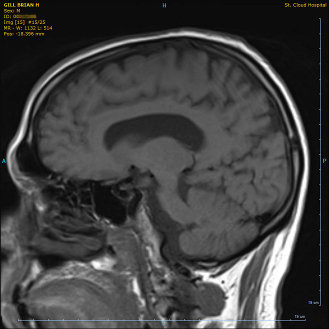
An image from Brian H. Gill's brain scans in 2018.ADHD often gets diagnosed in childhood.

Today.

If I’d been born in the early 21st century instead of the late Truman administration — but I was born when I was born, and was a middle aged man when I began learning about my versions of ADHD and the rest.

I’ve got the inattentive version, apparently, which arguably accounts for my train of thought’s frequent derailments and mood swings. Make that mood ricochets.

On the other hand, I’m not a typical adult with ADHD. Good grief, I’m not even conventionally unconventional.

An article in The Conversation got me started thinking about ADHD this week:

“ADHD looks different in adults. Here are 4 signs to watch for.” (Tamara May, Mark Bellgrove)3 Paraphrasing their four-point list:

  1. An inner sense of restlessness, feeling driven to always do something
  2. Start organized, then feel overwhelmed
  3. Procrastination
  4. Poor timing: underestimating how long something takes

I’m not a perfect match for that list, either. Which isn’t surprising, since that article was giving an overview, not diving deep into details.

The “attention deficit” part of ADHD may be why I skipped from psychiatric disorders and acronyms to weird paintings and the Last Judgment.

ASD, Autism Spectrum Disorder, strikes me as a catch-all category for a whole mess of glitches that we’ve been studying.

I’ve watched definitions shift over the last several years, as researchers collected data, formed theories, collected more data — and I am not going to start discussing scientific method. Not this week.

Cluster A personality disorder? I talked about that earlier.

GAD, generalized anxiety disorder, is just what it says: fretting above and beyond the call of reason. I wouldn’t rank it as my top problem, but I do need to rein in my inner worrier more often than I like.

Depression and Something I Don’t Remember

National Institutes of Health's illustration: regions of the brain affected by PTSD and stress. (ca. 2018)PDD, persistent depressive disorder, AKA dysthemia, is pretty much like major depressive disorder. It’s a mood disorder, and involves neurochemical glitches.

PDD is “persistent” because it’s chronic. In other words, it sticks around. Which can make diagnosis difficult, since folks like me can assume that feeling this way is “normal.”

And that brings me to — oh, goody — PTSD, post traumatic stress disorder.

PTSD has been in my diagnosis list, but wasn’t there the last time I checked. Why it was removed, at least from the copy I can access, I don’t know. If that detail becomes important, I’ll dig into it. But I’ve got enough on my plate without trying to unravel metaphoric red tape.

Assuming that I have experienced PTSD, which seems reasonable, I’m pretty sure that it was triggered by something that happened around Christmas, when I was 12.

Talking or writing about it hurts, so I’ll repeat what I said last year:

“…When I was 12, my mother had a severe stroke. I’m told that I was with her at the time, and accompanied her in an ambulance. My father tells me that he blamed me. That’s understandable. Dealing with me can be stressful.

“I have no memory at all of the ‘stroke’ events, all my knowledge of them and the month or so surrounding them I have second-hand, from my parents.

I suspect that’s how PTSD got on my list, and am as sure as I can be that those events started my experience with depression….”
(August 7, 2021)

Perceptions, Beauty, and a Decision

W. Spooner's (?) 'A wretched man with an approaching depression; represented by encroaching little devils.' Coloured lithograph (1830s)/ Vincent van Gogh's 'Sorrowing Old Man (At Eternity's Gate.' (1890)I remember seeing sunlight on green grass, in the spring after that event, correctly perceiving that it was beautiful, and noticing that I was not experiencing an emotional response to the perceived beauty.

I had grown a foot while staying the same weight that year, and knew that I was going through puberty.

At the time, I thought that maybe all the metaphoric light and color draining out of my universe was normal for someone transitioning into adulthood. The ‘dead-behind-the-eyes’ look I’d noticed in so many adult faces seemed to support that assumption.

I was also wanted to avoid becoming blind to beauty and wonders, so I made a point of paying attention; and I’ve probably talked about that before.

Fast-forward several decades.

At my wife’s recommendation, I talked with a psychiatrist. Then came diagnoses of depression plus an assortment pack of other psychiatric issues. I’ve been taking prescribed medications, including methylphenidate ever since. That’s geek-speak for Ritalin.4

Taking my Medicine

Illustration of 'icepick' lobotomy, from Dr. Walter Freenan II's 'Psychosurgery in the Treatment of Mental Disorders and Intractable Pain.' (1950)Methylphenidate is a Schedule II controlled substance, so every month I have to get authorization for the prescription.

The process usually goes smoothly.

But several times, years back, the authorization documents got lost. I never discovered what kept happening to the paperwork.

But I did get to experience discontinuation syndrome when my month’s supply of meds ran out. Several times, as indicated above.

And I learned that “discontinuation syndrome” is a euphamism for withdrawal. Which helps me understand the (very unpleasant) experience, so I’ll count that as a “plus.”

I like being able to use my brain without fighting the neural machinery, so I don’t mind taking my prescribed medications.

And I certainly don’t mind living in the early 21st century, when lobotomies aren’t as fashionable as they were in my younger years.5 And that’s yet again another topic.

But — is it right to take my medicine?

Since I’m a Catholic, and briefly, yes.

Life is a ‘precious gift’ from God. So is health. Getting and staying healthy is a good idea. Within reason. Even taking painkillers is okay. Again, within reason. (Catechism, 1506-1510, 2279, 2288-2289, 2292)

I was going to say more about (not) being normal, sharing in humanity’s transcendent dignity, and related topics. But getting authorization for methylphenidate was a tad more labor-intensive this month.

And there’s that ‘underestimating how long something takes’ thing, too.

So (not) being normal and all that will wait for another time.

Finally, the usual links of allegedly-related stuff:


1 Art and artists:

2 ADHD, PTSD, and points between:

3 Here’s what got me started this week:

4 Irksome, occasionally; but effective:

5 Rules and unpleasantness:

Posted in Being Catholic, Discursive Detours, Journal | Tagged , , , , , , , | Leave a comment

Norbert Nerdly Rides Again: Keyboard Concerns

Brian H. Gill's 'Meet Norbert Nerdly.' (2015)
(Norbert Nerdly — my frustrations, personified.)

I had finished last week’s discussion of crossword mania and the end of civilization before the trouble started. That’s part of the good news.

Then my computer’s operating system told me it was time for an update. I still haven’t decided whether that news was good, bad or just routine. I’ve filed it under ‘routine’ for the time being.

The update went smoothly. That’s what I’m assuming, at least.

When it was over, a browser that hadn’t been there before asked me to make it my default interface for the web.

Saying “no” and making it stick didn’t take more than a few minutes.

Then I noticed that Control-Alt-Delete didn’t work any more.

I’d been expecting this.

My news feed includes the occasional technogeek headline, so I was aware that Control-Alt-Delete was right up, or down, there with the abomination of desolation in terms of bad ideas that should never have been implemented.

In the ardent opinion of one technogeek, at any rate. I didn’t read the op-ed, so I don’t know why Control-Alt-Delete is or should be anathema.

I probably wouldn’t have agreed, since I prefer using keyboard commands for several functions: particularly when point and click becomes, well, pointless. Partly, I suspect, because I remember when graphic interfaces and mice — mouses??? — were new.

Good grief, I remember when electric typewriters were new.

So I resigned myself to life without Control-Alt-Delete. And within a few minutes I discovered that nothing happened when I tried keying in characters like “*” and “-.”

Don’t let my phlegmatic recitation of sequential frustrations give the impression that I remained cool as a cucumber throughout this concatenation of calamitous keyboard crises.

I was — I’ll say peeved, and leave it at that.

Intermittent Weirdness: a Capricious Keyboard

Brian H. Gill: brilliant, talented and on medication. (2021)It’s been years since I thought about remapping a keyboard.

And even then, I hadn’t seriously considered turning my QWERTY keyboard into a much-cooler Dvorak, Colemak or MTGAP layout.

I don’t deplore efficiency or new ideas.

But I learned touch typing on a QWERTY layout, have used that skill almost daily for over a half-century, and don’t see a point in developing a new set of muscle memory routines.

Before I’d gotten very far in my quest for keyboard remapping utilities, my son did a quick diagnostic on my system.

It wasn’t the operating system update that was close to giving me conniptions.

My keyboard was due for replacement. Overdue, actually.

Makes sense. I’d noticed that some of the new weirdness was intermittent. Sometimes I could key in an “*” and sometimes I couldn’t.

Ideally, I’d have suspected that my keyboard issues starting right after the update was coincidence. But, as I’ve said before and probably will again, we don’t live in an ideal world. And I’m not an ideal human being, which is another topic.

Before I could get started on pricing keyboards, my youngest daughter told me that my son had ordered a new one — an ergonomic keyboard, somewhat like the one I’d inherited from my father — and that it should arrive Wednesday.

I decided that trying to type with a capricious keyboard was an exercise in frustration.

Since my frustrations don’t need exercise, I also decided to spend the bulk of this week reading, and working with a graphic/3D program that has a very point-and-click interface.

A Family Visit and Looking Ahead

Streaming together for ThanksgivingSecond-oldest daughter, son-in-law and granddaughter arrived Wednesday.

They were on their way back from a wedding, with side trips to Mammoth Cave and other points of interest.

Areas of interest? Never mind.

The point is that I thoroughly enjoyed the visit, appreciated photos from the wedding, Mammoth Cave and a nifty dinosaur park whose name escapes me.

Then the traveling trio embarked on the last leg of their return trip, the new keyboard arrived and was introduced to my my computer by my son. Not necessarily in that order.

And that’s all I’ve got for this week.

I’ll have more, I trust, by next Saturday. Maybe about curiosity.

One of the Parishes on the Prairie priests pointed me to something St. Thomas Aquinas wrote about “the unknown vice.”

It’s in “Summa Theologica,” II, 2, Question 167; and so far I’m about half-way through. St. Thomas Aquinas is chattier than I am, and that’s saying something.

One more thing.

We’re in the final two weeks of Lent. It ends on Thursday, April 14, this year. Then it’s Good Friday, Holy Saturday and the best news humanity’s ever had.

Maybe that’s what I’ll talk about next week. That’d give me more time to think about what St. Thomas Aquinas wrote.

Finally, the usual ‘stuff that’s not entirely unrelated’ link list:

Posted in Journal | Tagged , , , | Leave a comment

Crosswords! Or, the End of Civilization As We Know It

New York Times 'Crossword Mania Breaks Up Homes' article (December 10, 11, 1924), New Britain Herald 'The Cross-Word Puzzles Bridegroom' cartoon. (July 18, 1924)
(From New Britain Herald, via Nieman Journalism Lab, Harvard College; used w/o permission.)

Ah! For those halcyon days of yesteryear!

Like the 1920s, the Roaring Twenties: the Jazz Age, or, if you like that European flair, the Années folles. That’s French, and means “Crazy Years.” They weren’t wrong about that.1

Crossword Puzzles and Divorce: 1924

Oliver Herford's 'Demon Rum' editorial cartoon. Demon Rum and assorted drug-addiction monsters bothering Uncle Sam. (1919)
(From O. Herford, via Life Magazine/Wikimedia Commons, used w/o permission.)

Title page, 'The War That Will End War,' H. G. Wells. (1914) From Internet Archive, via Wikimedia Commons, used w/o permission.“The War That Will End War” was over.

In America, prosperity ran rampant while Charlie Chaplain made movies. Women had the right to vote, and Demon Rum had been banned from the land

Meanwhile, in Germany, policies, politics and punishments led to one gold German Mark being worth a trillion paper Marks.2 And that’s almost another topic.

But back here in the Land of the Free, speakeasies flourished and a creeping madness threatened the very foundations of society.

I refer to crossword puzzles. As perceived by at least some serious thinkers of the day.

CROSSWORD MANIA BREAKS UP HOMES
Neglected Cleveland Wives Said to Plan Divorces From Stricken Husbands.

“CLEVELAND, Dec. 10 [1924] — Homes in this city are now threatened by cross-word Puzzles. The innocent little white and white and black squares have fascinated so many husbands that legal aid organizations are being swamped with requests to solve the enigma or to start divorce proceedings.

“This direful state of affairs was disclosed today by the manager of one of the legal aid organizations, who said that his office was receiving an average of ten letters a day from wives who have to remain at home these evenings just because their husbands are suffering from ‘cross-word puzzleitis.’…”
(New Britain Herald (July 18, 1924) via Nieman Journalism Lab

I wouldn’t call getting 10 letters a day from worried wives a “direful state of affairs,” mostly because I don’t often use words like “direful.” But I would call it serious.

That’s partly because I think marriage and family are important. (Catechism of the Catholic Church, 2197-2233)

So is remembering that both are more important than crossword puzzles, social media, or playing pinochle.

Then there was the “Crossword Murder.”

“Driven to Madness by Crossword Puzzles…”

'Crossword Murder,' The Cincinnati Post. (December 18, 1925; page 15) Clipping from lansow91 and Newspapers.comI don’t know if The Cincinnati Post called for tougher crossword control laws in response to a 1925 Christmas season murder and attempted suicide.

CROSSWORD MURDER
Man, Crazed by Them, Slays Wife and Wounds Self.

Brooklyn, N.Y., Dec. 18 — Driven to madness by crossword puzzles, Theodore Koerner shot and killed his wife because she declined to help him solve one….

“…The husband had suffered two nervous breakdowns since last summer.”
(The Cincinnati Post (December 18, 1925))

I don’t doubt that crossword puzzles were part of the “Crossword Murder.”

But, catchy as that “Crossword Murder” headline is, I don’t think crossword puzzles made Mr. Koerner kill his wife, any more than I would blame his wife. Even though she wouldn’t help him solve one.

Almost a century later, ‘husband kills wife’ and ‘husband kills family’ headlines are still part of the Christmas season.

I don’t know if there’s an uptick in domestic murders then, or if such tragedies are more newsworthy during the holidays. And that’s yet another topic.

Death and divorce weren’t the only crossword-related issues of the 1920s.

‘Experts Speak Out’

'A Familiar Form of Madness' op-ed, clipping, The New York Times (November 17, 1924)
(From The New York Times, via Nieman Journalism Lab, used w/o permission.)
(Op-ed, The New York Times. (November 17, 1924))

CROSS-WORD HEADACHE BOOMS OPTICAL TRADE,' 'Cross-Worditis...' and other headlines. (1920s)Medical experts said crossword puzzles hurt your eyes and steal memory from crossword addicts. Yes, crossword addiction was a thing in the 1920s; and may still be.

Psychological addiction isn’t the same as substance addiction, but they’re similar enough to warrant similar names.

On the other hand, I’m a bit dubious when experts slap the “addiction” label on something that’s new and out of favor with my culture’s better sort.

Or when society’s self-appointed guardians recoil in horror from the latest “direful” threat. Like the angsty articles published during my youth, back when the telephone was destroying society.

My generation, I learned from these doomsayers, never communicated. We just sat for hours, talking on the telephone.

I didn’t, but I suppose some folk my age did. And do, since now I’m reading that folks pay too much attention to their smartphones.

Those 1920s medical experts had a point. Extended focusing on crossword puzzles, comic books, or needlepoint leads to eyestrain. Let’s see what medical experts who aren’t quoted in the news say about that.

“…Eyestrain can be annoying. But it usually isn’t serious and goes away once you rest your eyes or take other steps to reduce your eye discomfort. In some cases, signs and symptoms of eyestrain can indicate an underlying eye condition that needs treatment.”
(Eyestrain, Symptoms and Causes, Mayo Clinic)

I did a little checking, and learned that if someone reads for years and years, that that person almost always develops presbyopia.

Which, oddly enough, has nothing to do with being a Presbyterian. It’s what happens to our eyes if we don’t die young.3 A less highfalutin term is “age-related farsightedness.”

“Word-Cross” Origins, From Sator Squares to a Sunday Supplement

Queen Victoria's, 'Windsor Enigma,' from 'Victorian Enigmas, or Windsor Fireside Researches' by Charlotte Eliza Capel (1861))
(From Queen Victoria of England, via The Paris Review, used w/o permission.)

So, who is responsible for crossword puzzles? Did some malevolent mastermind corrupt our minds and blur our eyes, driven by dread desire and devious intent?

Well, no.

I’m pretty sure that The New York World’s Sunday Supplement of December 21st, 1913, held the first crossword puzzle. The first in more-or-less today’s format, that is.

The “mental exercise” was concocted by Arthur Wynne, formerly of Liverpool, England; and then employed as a journalist by the Pittsburgh Press and The New York World.

Mr. Wynne called his word-puzzle “Word-Cross.” An illustrator changed it to Cross-Word, Mr. Wynne didn’t mind, and now crosswords are part of our language.

Dodgson and an Ancient Palindrome

John Tenniel's Cheshire cat illustration for Charles Dodgson's 'Alice's Adventures in Wonderland.' (1869)But before that, Charles Dodgson invented a game he called doublets, where you’d change one word into others by changing one letter at a time. It’s sort of like a crossword puzzle, but not quite.

And before that, England’s Queen Victoria assembled the “Windsor Enigma,” which brought coals to Newcastle. By way of Naples, Washington, Cincinnati, and other famous cities.

And way before that, ancient Romans made their Sator Square their empire’s “Kilroy was here.” The latter showed up in the 1940s, probably, thanks to American soldiers, maybe. Origins of Kilroy are debatable and debated.

The earliest Sator Squares we know about were in Pompeii.

A Sator Square is a two-dimensional palindrome with four symmetries. The 2D palindrome’s symmetry group is the Klein four-group, not the dihedral group of order 8, for reasons that are yet again another topic.

R O T A S S A T O R
O P E R A A R E P O
T E N E T T E N E T
A R E P O O P E R A
S A T O R R O T A S

I’d keep talking about crossword puzzles, palindromes, academic debates and 20th century graffiti, but I’m running out of time. So if you’re interested, check out some of the articles I found: I’ve linked to them, near the end of this piece.4

It’s Still the End of Civilization as We Know It

Dik Browne's 'Hagar the Horrible:' 'It may be the end of civilization as we know it.' (February 25, 1973)
(From Dik Browne, used w/o permission.)

A century has passed since cross-word puzzleitis threatened America’s very foundations. According to some serious thinkers, that is.

And we’re still here.

Although this isn’t the America of the Roaring Twenties: or America of the Progressive Era and First Red Scare that came before.5

Priorities and Perspective

Walt Kelly's Deacon Mushrat, Pogo and Albert the Alligator, from 'The Pogo Papers.' (1953)Can’t say that I’m sorry those ‘good old days’ are over.

And I do not I yearn for the ‘good old days’ of my childhood, when “she’s smart as a man” was supposed to be a compliment.

Or the Sixties, when doomsayers mourned the end of civilization as they knew it.

They were right, by the way, it was the end of the old status quo.

I’m pretty sure that crosswords don’t deserve blame for divorce, death and other direful doings during the Roaring Twenties. Not as an underlying cause, at any rate.

I’m also pretty sure that some folks really were were letting themselves get distracted by crossword puzzles and trolley parks.

Just as today some of us give new tech more attention we should.

And just as this week I’ve been paying overmuch to a not-so-new game/simulation: SimCity 4. Which is why I’m rushing to get this written in time for Saturday morning.

Given what I’ve done this week, I could denounce or renounce SimCity 4,6 computers or recreation in general.

Instead, I’ll share my experience: and try putting my priorities in proper order next week. Or better order, at any rate.

And repeat what I’ve said before.

Change happens. Fearing change doesn’t make sense; or isn’t useful, at any rate.

And blaming crossword puzzles, telephones, social media or any other newfangled fad, fashion or tech for problems that have been plaguing humanity since the first of us made a bad choice doesn’t make sense.

Now, the usual ‘(sort of) related stuff’ link list:


1 Those were the days, my friend …:

2 Remembering the 1920s:

3 Addiction, dependence and our eyes:

4 More than you may want to know about group theory, graffiti and crossword puzzles:

5 … we thought they’d never end, but they did:

6 My distraction this week:

Posted in Discursive Detours, Journal | Tagged , , | Leave a comment

Brain Defogging, Technical Issues, and Me

I’m doing a quick ‘it’s all about me’ post today, just in case I don’t get this week’s piece about crossword puzzles and other threats to civilization done. Perceived threats, I should say.

Okay. That’s why I’m writing this. Onward!

A week ago Monday — That’s March 14, 2022 — I felt less fogbound than I had since the end of January. That’s good news.

I’m still assuming that whatever bug I had is COVID-19. Whether it is or not, my fever is still going down. It’s fairly consistently below 100° F — which is probably linked with the comparative clarity I’m feeling. Again, good news.

On the other hand, staying focused on what I’ve decided should get done is harder than usual. Or harder than I feel it should be, at any rate. But again: the fog is lifting, and this is good news.

Technical Issues Continue

I’m pretty sure that Nobody can comment on ‘A Catholic Citizen in America’ posts.

As I said a few weeks back: sorry about that!

I am still getting ready to upgrade ‘A Catholic Citizen in America.’ The process might go faster if brain fog wasn’t a factor, and I talked about that before.

Let’s see. I talked about me, about the current technical frustration, and now I think I’m done.

Yep. Definitely. I’m done for the day. Done here, that is.

Good evening, and I hope you’ll check back on Saturday. The subject will be crosswords.

Posted in Journal | Tagged , , , | Leave a comment