Elizabeth II of England: April 21, 1926 – September 8, 2022

Queen Elizabeth II of England

Elizabeth Alexandra Mary became Elizabeth II of England 70 years ago.

She died this afternoon.

Queen Elizabeth II has died
BBC News (September 8, 2022)

“Queen Elizabeth II, the UK’s longest-serving monarch, has died at Balmoral aged 96, after reigning for 70 years.

“She died peacefully on Thursday afternoon at her Scottish estate, where she had spent much of the summer.

“The Queen came to the throne in 1952 and witnessed enormous social change….”

There will be no shortage, I’m sure, of pieces written about Elizabeth II.

But I’ll just say that I think she is and will be missed, and go back to what I had been getting ready for this week.

Although the death of Elizabeth II is ‘current events,’ I’ve applied the history tag to this post. That makes sense to me. I’ve talked about history and how I see it fairly often, including this stuff:

Posted in Discursive Detours | Tagged | 2 Comments

Back to the Moon, Onward to Mars: Artemis I

NASA's infographic: 'Artemis I Map' (2018)

Nobody’s in the Artemis I Mission’s Orion capsule.

But if today’s test flight goes well, Artemis II will carry four folks around the Moon before returning to Earth. And Artemis III will bring humans to the Moon’s surface for the first time since 1972.


Update September 5, 2022

Updating my September 3, 2022 update; NASA posted another update, detailing issues the Artemis I team found. Looks like the earliest possible launch date now is September 19.

As I said yesterday, a ‘better safe than sorry’ approach makes sense for this test flight.

And, since these updates are taking up considerable room, putting a link to “I’ll be taking a look at where we’ve been….” which introduced links to this week’s post sections. Happily, what I had ready for this week didn’t depend on the moon rocket taking off on schedule.

Times listed for the NASA update is EDT.

NASA to Stand Down on Artemis I Launch Attempts in Early September, Reviewing Options
Rachel Kraft, Artemis, NASA (September 3, 2022; 6:26 p.m.)
“After standing down on today’s Artemis I launch attempt when engineers could not overcome a hydrogen leak in a quick disconnect, an interface between the liquid hydrogen fuel feed line and the Space Launch System (SLS) rocket, mission managers met and decided they will forego additional launch attempts in early September.
“Over the next several days, teams will establish access to the area of the leak at Launch Pad 39B, and in parallel conduct a schedule assessment to provide additional data that will inform a decision on whether to perform work to replace a seal either at the pad, where it can be tested under cryogenic conditions, or inside the Vehicle Assembly Building….”


Update September 3, 2022

Today’s Artemis I test flight has been called off.

Seems that the weather at the Kennedy Space Center was okay, but a seal for one of the fuel tanks wasn’t.

I’m a little frustrated, and slightly disappointed; but not surprised. The Space Launch System is a very complex system. And expensive. I don’t mind that NASA is taking a ‘better safe than sorry’ approach.

Here are the most recent (It’s 11:10 a.m. here in Minnesota, 12:10 p.m. in Florida) Artemis I updates I’ve seen:

Times listed for the NASA updates are EDT.

NASA to Stand Down on Artemis I Launch Attempts in Early September, Reviewing Options
Rachel Kraft, Artemis, NASA (September 3, 2022; 6:26 p.m.)
“After standing down on today’s Artemis I launch attempt when engineers could not overcome a hydrogen leak in a quick disconnect, an interface between the liquid hydrogen fuel feed line and the Space Launch System (SLS) rocket, mission managers met and decided they will forego additional launch attempts in early September.
“Over the next several days, teams will establish access to the area of the leak at Launch Pad 39B, and in parallel conduct a schedule assessment to provide additional data that will inform a decision on whether to perform work to replace a seal either at the pad, where it can be tested under cryogenic conditions, or inside the Vehicle Assembly Building….”

Artemis I Launch Attempt Scrubbed
Rachel Kraft, Artemis, NASA (September 3, 2022; 11:22 am)

“The launch director waived off today’s Artemis I launch attempt at approximately 11:17 a.m. EDT. Teams encountered a liquid hydrogen leak while loading the propellant into the core stage of the Space Launch System rocket. Multiple troubleshooting efforts to address the area of the leak by reseating a seal in the quick disconnect where liquid hydrogen is fed into the rocket did not fix the issue. Engineers are continuing to gather additional data.”

Liquid Hydrogen Leak Detected Once Again
Rachel Kraft, Artemis, NASA (September 3, 2022; 10:28 a.m.)

“After the third troubleshooting attempt, the liquid hydrogen leak has occurred again. Teams are discussing next steps.”

Liquid Hydrogen Flows Again to Core Stage Tank
Rachel Kraft, Artemis, NASA (September 3, 2022; 10:18 a.m.)

“After warming up the area of the liquid hydrogen leak, engineers are once again flowing liquid hydrogen to the core stage.”


I’ll be taking a look at where we’ve been, and why ‘phantom’ torsos are riding along with Commander Moonikin Campos.

I’ll also be watching NASA TV’s coverage. 😀

Launch coverage begins at 12:15 p.m. EDT, 4:15 p.m. UTC, September 3, 2022:


Looking Back, and Ahead

Collage: Apollo 11, Tranquility Base; people around the world watched humanity's first walk on another world. (July 1969)

Thomas Voter's cover for Robert A. Heinlein's 'Rocket Ship Galileo,' Scribner's first edition. (May 1, 1947) Thomas Voter/Scribner, via Wikipedia, used w/o permission.I remember when going to Earth’s moon was becoming less science fiction and more political issue.

The Apollo program’s moon landings were among the most exciting events of the late 1960s and early 1970s. Although levels of excitement varied considerably.

For example, I didn’t see Apollo 13 commander Jim Lovell’s broadcast on the mission’s third day.

This was 1970, when news wasn’t news unless at least one of the television networks decided it was news. Or The New York Times decided it was fit to print, and that’s another topic.

Lovell’s April 13, 1970, broadcast was live in Mission Control. Period. I’ve been told that ‘the public grew apathetic’ about the Apollo program. Maybe so.

At any rate, Apollo 13 wasn’t news until a few minutes after that broadcast ended. That’s when a routine stirring of the service module’s number two oxygen tank started a fire which in turn made the tank explode.

That was news. So was the safe return of Apollo 13, and so were moments of the remaining four Apollo missions.

Then, in December of 1972, Harrison Schmitt — the first geologist on the moon — and Gene Cernan packed their gear, rejoined Ronald Evans in the orbiting command module, and returned home.

No human has visited Earth’s moon since.

On the other hand, we’ve hardly forgotten the place.

Robots, from Luna 21 and its Lunokhod 2 rover to the Chang’e 5 mission’s lander and rover, have been swarming on and around the Moon. And the last I heard, scientists are still studying stuff we brought back a half-century ago.1

So, why bother returning to the Moon?

The Moon, Mars, Motives and Being Human

NASA/Clouds AO/SEArch's illustration: An artist's rendering of the Mars Ice Home concept. 'NASA Langley’s Icy Concept for Living on the Red Planet.' (December 29, 2016)Economic motives may be in the mix; although humanity isn’t in desperate need of Element X, vital to maintenance of our atomic pogo sticks, and obtainable only on the Moon.

I’m pretty sure that there’s a political angle to the Artemis program, but I’m also pretty sure that we’re going back because we need a maintenance and refueling base near the Moon’s south pole.2

We need that outpost because we’ll be sending folks to Mars soon.

And we’ll be sending folks to Mars because — well, I think we’re going because we were human in the 1960s, and we still are.

In a sense, the first step of our journey to the Moon, Mars and beyond began when someone decided to see what’s over the next hill.

Now, uncounted generations later, “the next hill” is on other worlds.

I don’t see this as a problem.

Wondering what’s over the next hill, metaphorically at least, and curiosity in general, can be a problem. (Catechism of the Catholic Church, 2115-2116)

But it’s also part of being human.

And — I’ve said this before, often — paying attention to the wonders in this universe is a good idea.

We’re surrounded by beauty and wonders. Studying the created world’s order and harmony can help us better understand and appreciate God. Faith and reason, science and religion, get along fine; or should. That said, ‘it’s for science’ doesn’t make overly-risky experiments with humans okay. (Catechism, 32, 39, 283, 341, 2292-2295)

I don’t think exploring this universe will make any of us more — or less — likely to acknowledge God’s work and our nature.

But I don’t see a problem with getting a closer look at what’s beyond the next hill. Or being human.

“What are humans that you are mindful of them, mere mortals that you care for them?
“Yet you have made them little less than a god, crowned them with glory and honor.”
(Psalms 8:56)

“Terrible and awesome are you,
stronger than the ancient mountains.”
(Psalms 76:5)

“Yours are the heavens, yours the earth;
you founded the world and everything in it.”
(Psalms 89:12)

“Indeed, before you the whole universe is like a grain from a balance,
or a drop of morning dew come down upon the earth.”
(Wisdom 11:22)


Radiation and Changing Attitudes

StemRad/NASA's photo: Helga and Zohar, 'phantom' torsos equipped with radiation sensors, stand-ins for Orion's crew for the Artemis I mission.
(From StemRad, via NASA, used w/o permission.)
(Artemis I ‘phantom’ torsos Helga and Zohar, testing radiation exposure.)

Posters produced at Oak Ridge National Laboratory: 'Radiation Need Not be Feared / But it Must Command Your Respect / Health Physics For Your Protection' (1947)My father told me that when he and his buddies were boys, they’d get free roller coaster rides at an amusement park. Until his mother learned what was happening.

My guess is that regulations back then made roller coaster operators test the rides at regular intervals, with weights simulating paying customers.

The tests could be done with sandbags, but a bunch of Irish kids would give more realistic results. And if something went wrong, well: Irish kids were less disposable than sandbags, but maybe not by much.

At any rate, my paternal grandmother put an end to my father’s free rides, ‘Irish Need Not Apply’ notices are a thing of the past, I don’t miss ‘the good old days,’ and that’s yet another topic.

More to the point, the Civil Aeronautics Administration’s Oscar and Elmer test dummies have been replaced by Hybrid III — and the ‘crew’ of Artemis I: Commander Moonikin Campos, Helga and Zohar.

Moonikin Campos, sitting in the commander’s seat, carries two radiation sensors and is wearing a first-generation Orion Crew Survival System suit. His seat has been outfitted with two acceleration and vibration sensors.

Helga and Zohar — Helga’s wearing an AstroRad radiation vest, Zohar isn’t — are part of the Matroshka AstroRad Radiation Experiment, or MARE. Each ‘phantom’ torso holds a three-centimeter sensor grid, embedded in material that acts like bone and soft tissue.3

Ionizing Radiation: New Science, Old Hazard

Black body radiation curve, Astronomy Education at the University of Nebraska-Lincoln.That’s important, because Artemis missions will spend much more time around and on the Moon than the Apollo voyages.

Most of the Artemis I not-quite-38-day mission, for example, will be spend outside Earth’s Van Allen radiation belt.

We don’t have much information on long-term exposure to the sort of ionizing radiation the Orion capsule and virtual crew will experience. And even less on how it may affect women.

Backing up a bit: ionizing radiation is what we call electromagnetic radiation or subatomic particles carrying enough energy to knock electrons off atoms or molecules.

Radiobiology, medical science studying ionizing radiation, is a fairly new field. But we’ve been dealing with ionizing radiation since day one. High-end ultraviolet light is what makes sunburn a real health hazard.

And, starting in the early 20th century, some folks began panicking when “radiation” was mentioned. And that’s yet again another topic.4

Societal Summary, 1959-2022

Collage, pulp science fiction magazine covers.

Illustration by anonymous artist, iStock image, for 'How do you stop astronauts going mad?' Paul Marks, BBC Future (February 10, 2017)Not all pulp science fiction featured marauding Martian mechanical men and space aliens committing grand theft skyscraper, but the genre’s more colorful authors may have had undue influence on experts.

Space madness: the dreaded disease that never was
Matthew H.Hersch, Endeavour (March 2012) via ScienceDirect

“…psychiatrists working with the National Aeronautics and Space Administration in 1959 feared the worst of the men selected to be America’s first astronauts: that they would be impulsive, suicidal, sexually aberrant thrill-seekers. The examiners, though, were surprised — and a little disappointed — when tests revealed the would-be spacemen to be sane, poised professionals able to absorb extraordinary stresses….”

Since then, we’ve learned that astronauts are human: and are neither particularly prone to insanity nor likely to exhibit the emotional range of a stuffed frog.

We’ve learned that civilians can work in space without going bonkers, and — extending my societal summary beyond the space program — that women are people.

Most of us, that is.

I gather that a few wunderkinds are still astonished and incredulous when presented with a woman who acts as if “she’s smart as a man” isn’t a compliment. That may be why discussions of differences between men and women occasionally get weird.

On the ‘up’ side, it’s been decades since I’ve been told that there’s no difference between men and women. Which almost makes sense, since the tallest woman is taller than the shortest man; and some men aren’t as strong as the strongest woman.

Granted, humans aren’t like mandrills and gorillas — where males weigh, on average, twice as much as females.

But men and women aren’t indistinguishable. And the half of humanity that’s playing with a full deck, genetically speaking, is a bit more sensitive to ionizing radiation.

Which I see as a good reason for sending Helga and Zohar along on the Artemis I mission.

Data from their sensors, plus the experiences of ISS staff who have been wearing a version of the AstroRad radiation vest, will help mission planners keep folks safe in deep space.5

Which I think is a good idea.

Commander Moonikin Campos and the Artemis I Crew

NASA's photo: crash-test dummies, outfitted with suits and sensors, secured in an Orion test article before being dropped into Langley Research Center's Hydro Impact Basin. (2016)
(From NASA, used w/o permission.)
(Manikins in an Orion capsule test at Langley Research Center. (2016))

Now, about choosing a name for Commander Moonikin Campos. NASA had a contest, giving folks a choice of eight names for the space-suited crash test dummy/manikin.

“…We want your help to select a name for the suited manikin, or Moonikin in this case, that will fly aboard Orion to help gather data before missions with astronauts!…”

“…This Moonikin is a male-bodied manikin previously used in Orion vibration tests. He will be accompanied on Artemis I by….”
(“Bracket Contest to Help NASA Name ‘Moonikin’ Flying on Artemis I Mission Around Moon,” (June 15, 2021))

They started with a selection of eight names. Or, rather, seven names and an acronym.

  • ACE, for “Artemis Crew Explorer.”
  • CAMPOS, a dedication to Arturo Campos, key player in bringing Apollo 13 home.
  • DUHART, a dedication to Irene Duhart Long, chief medical officer at Kennedy Space Center from 2000 to 2010.
  • MONTGOMERY, dedication to Julius Montgomery, first African American to work as a technical professional at Cape Canaveral Air Force Station, now known as Cape Canaveral Space Force Station.
  • RIGEL, a giant superstar in the Orion constellation.
  • SHACKLETON, a crater on the Moon’s South Pole, which is named after famous Antarctic explorer Ernest Shackleton.
  • WARGO, a dedication to Michael Wargo, NASA’s first chief exploration scientist.

More than 300,000 votes later, “Campos” was the winning name.

So Commander Moonikin Campos, Helga and Zohar will be leading humanity’s return to the Moon.

Assuming that the Saturday, September 3, 2022, Artemis I launch goes well. If it does, it’ll happen in the afternoon: after I’ve posted this.

I’m forgetting something. Right. Why the Monday launch was rescheduled.

One of the four RS-25 engines, number three, hadn’t been cooling off enough before Artemis I’s first launch attempt on Monday. That’s what the engine’s sensors said, at any rate.6 Taking a ‘better safe than sorry’ approach makes sense. To me, at any rate.

As for why for Moonikin Campos, “a male-bodied manikin,” is in the commander’s seat while Helga and Zohar are passengers: that’s still another topic, for another day.


A NASA Infographic and Assorted Links

NASA/Kevin O'Brien's infographic: 'The Space Launch System: NASA's Artemis I Moon Rocket' (2002)(From NASA/Kevin O’Brien, used w/o permission.)
(Artemis I Moon Rocket, from NASA’s Space Launch System (SLS) Infographics.)

Humanity’s long journey to the stars isn’t my only interest. But it’s at least in my top 20:


1 A little history:

2 Dreamers, scientists and technicians:

3 Miscellanea:

4 Radiation, Artemis I and a phobia:

5 Science, sex and differences:

6 More miscellania:

Posted in Back to the Moon, Onward to Mars, Science News, Series | Tagged , , , , | Leave a comment

Tuesday, August 30, 2022: Son-in-Law Update, and a Coffee Break

Photo: Brian H. Gill, at his desk. (March 2021)On the ‘up’ side, I’m getting over what I’m calling a summer cold. And I’ve even decided what I’ll be writing about this week.

On the other hand: well, actually, it’s shaping up to be a pretty good day. And a pretty good week.

Sunday night’s tornado watch was lifted at a decent hour, so I got a good night’s sleep. And, although I overslept, I didn’t miss the Artemis 1 launch Monday morning.

Mainly because it was called off, due to technical issues. That’s part of what I’ll be writing about this week.

Deciding what I’ll write about is one thing.

Deciding how I’ll write about it is another: and that’s what I’ll start working on after I finish this post. After I finish this post, that is, and get a cup of coffee.

And sit of the front stoop for a few minutes. It’s a sunny day, neither too warm or too cool; and with winter coming, that’s not something to ignore.

Before I sign off, a few words about my son-in-law. I’d been hoping they’d fit into a ‘regular’ weekly post. But since that likely won’t happen, here they are.

My son-in-law, Aaron McWilliams, is adding fill-in guest talk show host to his catalog of roles and functions.

I gather that this is his first week. Don’t know which time slots.

I’d be listening: but Grand Forks is a little over three hours up the road from here, on the way to Winnipeg, Canada. That’s well outside the KNOX broadcasting area, and I haven’t found an online ‘radio station’ for KNOX.

Oh. Wait. I found one.

  • KNOX Radio
    Grand Forks, 1310 kHz AM, via Online Radio Box

Definitely want that cup of coffee. And a few minutes of fresh air.

Looking Back, Thinking Ahead

Screen capture, NASA Live: interior of Crew Dragon spacecraft during Demo-2 mission. (May 27, 2020)

But first, links from 2020 that relate to this week’s post:

And, yes: my son-in-law is mildly famous 😉 :

Posted in Being a Writer, Journal | Tagged , , | Leave a comment

Killing Prisoners, Valuing Human Life

Police photo (probably the Coconut Creek Police Department): Police arresting Nikolas J. Cruz in Florida, following the Stoneman Douglas High School shooting. (February 14, 2018)
(From Coconut Creek Police Department(?), via Wikipedia, used w/o permission.)
(Suspect arrested, after the Stoneman Douglas High School shooting. (2018))

A fervent defense of capital punishment popped up in my social media feeds recently.

By the time I went back, looking for the post, it had disappeared into the digital mists.
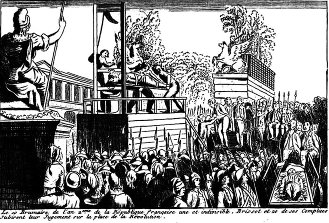
Engraving by an anonymous artist: Execution of Jacques Pierre Brissot and other subversives. (1793)I don’t remember what had inspired the declaration of allegiance to execution.

But I do remember that he was a self-identified “traditional Catholic.” And that he had disdain for folks who said they were Catholic, but didn’t agree with him.

None of that’s particularly noteworthy. Fervent defenses, denunciations and declarations happen. Sometimes they’re aimed at old-school ideas, sometimes new notions are targets of praise or blame.

Maybe headlines like this triggered last weekend’s acclamation of executions:

Then again, maybe not. Either way, that person’s support for killing prisoners reminded me that I haven’t written about capital punishment for quite a while.

As usual, when humans are involved, the issues are complicated. And, in another way, they’re simple.


The Execution Option: Two Examples

Claes Jansz Visscher's Gunpowder plot executions etching, detail. (1606)
(From National Portrait Gallery, via Wikimedia Commons, used w/o permission.)
(English justice, 1606: public vivisection after the Gunpowder Treason Plot.)

Capital punishment, state-sanctioned killing of individuals, goes back at least to the days of Ur-Nammu, when conviction for robbery meant death.

I don’t know of an American state which executes robbers, but several do retain the right to kill folks who have been convicted of serious crimes.

And my country’s federal government has retained its right to kill citizens: again, those who have been convicted of serious crimes.1

I’ll be looking at cases involving the execution option: the Stoneman Douglas High School (Parkland, Florida) mass murder in 2018, and the Boston Marathon bombing in 2013.

Stoneman Douglas High School Massacre

BBC News: 'Peter Wang, Marjory Stoneman Douglas High School student.'
(From BBC News, used w/o permission.)
(Peter Wang; November 9, 2002 — February 14, 2018; killed while helping fellow-students evacuate Stoneman Douglas High School.)

There were heroes at the school, back in 2018.

Teacher Scott Beigel unlocked a classroom for fleeing students. Assistant football coach and security guard Aaron Feis shielded two students from the killer. Athletic director Chris Hixon heard gunfire and began running toward the trouble.

Student Peter Wang kept a door open so that others could flee. Student Meadow Pollack was shot four times. Then she tried shielding Cara Loughran, another student.

All were killed by the person who had picked that day for bringing death to Stoneman High School .

Great Seal of the United States, 'Annuit coeptis Novus ordo seclorum' 'He favors/has favored [our] undertakings - New order of the ages' (2008) rendered by Ipankonin, via Wikipedia, used w/o permission. I’m guessing that the incident is a hot-button issue in some circles. Largely because I’ve seen crazy claims about the mass murder. For example, I’ve read that:

  • The dead students weren’t students
  • The mass murder was an American conspiracy
  • Surviving students and staff are enemies of the people.

But oddly enough, I’ve yet to be told that Florida doesn’t really exist.

Or that Stoneman Douglas High School is really a KGB/Illuminati front, bent on replacing humans with shape-shifting space-alien lizard-men.

I suppose some crazy notions are too crazy for even the most fervent conspiracy buffs. And that’s another topic.

Surveillance camera video and survivors identified a young man as the killer.

He’s been accused and tried. He pleaded guilty last year. Or should that be “pled guilty?” Anyway, the sentencing phase of his trial is in progress. A jury and judge are making a go/no-go decision ordering his execution.2

Heroes and the Perpetrator

Marjory Stoneman Douglas High School. (June 2008)Even allowing for a tendency to remember the best of folks who have died, I think we lost good people on February 14, 2018.

The perpetrator, on the other hand, hasn’t been looking too good. Understandably.

If news media had been painting a glowing picture of Nikolas Cruz: we’d have another sort of problem on our hands. And I think not making him into a celebrity of sorts, renowned for his bad behavior and sad past, was a good idea.

I am, however, left with a sketchy and inconsistent description of the young man.

According to these news items, one written shortly after the mass murder, the other this week, the perpetrator was a social media racist with a strong “B” average in school.

And a mentally stricken chap who had been “struggling in school socially and academically throughout his young life.” Granted, that’s what his defense attorney said.

Nikolas Cruz’s defense says his brain was ‘poisoned’ by birth mother’s addictions in death penalty trial
Eric Levenson, Denise Royal, Sara Weisfeldt; CNN (August 23, 2022)

“…In particular, McNeill highlighted his birth mother’s abuse of drugs and alcohol during his pregnancy, saying Cruz showed signs from a young age of fetal alcohol spectrum disorder and antisocial personality disorder….

“…In opening statements Monday, McNeill laid out Cruz’s difficult family life, including his birth mother’s history of addiction and the death of his adoptive parents Lynda and Roger Cruz….

“…Cruz first received special education services at age 6, struggling in school socially and academically throughout his young life, she said….”

Social media paints picture of racist ‘professional school shooter’” Eliott C. McLaughlin, Madison Park; CNN (February 16, 2018)

“…Cruz appears to have been involved in the high school’s Junior Reserve Officers’ Training Corps program, as his name is listed under several awards in 2016, including academic achievement for maintaining an A grade in JROTC and Bs in other subjects….”

Still, those two pieces, written four and a half years apart, don’t give a consistent picture of the individual who decided that killing people was a good idea.

Again, understandably. Reporters and news editors have had years to collect opinions and facts: and decide which slices of reality they think will interest their readers.

Plus, I’ve been seeing the usual 20-20 hindsight and Monday morning quarterbacking in assorted news and views.3

Drawings, Declarations and a Satanic Misspelling

A drawing by Nikolas Cruz: 666 and other symbols. From Broward County Sheriff, via New York Post.
(From Broward County Sheriff, via New York Post, used w/o permission.)
(Nikolas Cruz: “Hail Lusifer” [sic] and more, drawn while in custody.)

Drawing by Nikolas Cruz: depiction of a school shooting. From Broward County Sheriff, via New York Post.
(From Broward County Sheriff, via New York Post, used w/o permission.)
(A school shooting, as drawn while in custody.)

Some of what I’ve read, including his — fervent? — written declarations, very strongly suggest to me that Nicholas Cruz is not a happy person.

“…Several pages feature declarations of love for Satan and pictures of various types of guns and ammunition.

“Another entry calls for more mass shootings.

“Cruz wrote asking for ‘my brothers and sisters of blood and death to kill your children.’

“‘I ask for mass murders and terrorists to destroy this f—– country and spread evil and destruction,’ he added….”
(“Parkland shooter Nikolas Cruz scrawled ‘666’ on prison cell wall in his own blood,” Selim Algar, New York Post (August 23, 2022))

Or maybe he thinks he’s been setting up an insanity defense.

I don’t know, and am very thankful that I’m not sitting on that jury. “Distasteful” is the mildest adjective I can think of, describing the sort of intellectual and emotional sewage they’re wading through.

As for his apparent attitude toward guns and Satan, I’m not surprised at the distinct lack of ‘gun rights exposed as Satanic plot’ headlines. I’ll get back to that, briefly.

Which brings me to why I’m neither surprised at “declarations of love for Satan,” nor willing to go ballistic over the defendant’s drawings.

Demons: Seriously, but Not Obsessively

Louis-Léopold Boilly's 'Tartini's Dream.' (1824)I think Satan exists. That’s not even close to believing that demons look like my culture’s depictions of fallen angels.

Or that demons ‘look like’ anything. They’re profoundly not like us, and that may take a little explaining.

Humans have intelligence and will. We’re made of spirit and the stuff of this universe. (Catechism of the Catholic Church, 355-373, 1730)

Angels have intelligence and will, too. In that way, they’re people, persons, like us. But angels are spirits with no physical bodies. (Catechism, 328-330)

Demons are angels who made a really bad decision. The devil, or Satan, is our name for the angel who decided that saying “no” to God made sense. (Catechism, 391-395)

Now, I’ll grant that what we know about Satan makes for some colorful imagery.

“Jesus said, ‘I have observed Satan fall like lightning from the sky.”
(Luke 10:18)

But I also think C. S. Lewis has a point. Acknowledging a fellow-creature’s existence makes sense. Giving that creature my mind’s center stage doesn’t.

“…There are two equal and opposite errors into which our race can fall about the devils. One is to disbelieve in their existence. The other is to believe, and to feel an excessive and unhealthy interest in them. They themselves are equally pleased by both errors and hail a materialist or a magician with the same delight….”
(“The Screwtape Letters,” Preface, C. S. Lewis (1942))

As for ‘gun rights exposed as Satanic plot’ headlines? I don’t think we’ll see that.

My experience strongly suggests that there are folks who see Satanic plots under every rock; while other folks fear firearms with a passion reminiscent of commie-hunters. And that’s yet another topic.4

But, although they exhibit similar levels of unswerving zeal, the ‘Satanic plots’ demographic and ‘beware guns’ contingent don’t strike me as overlapping.

Not to any great extent. I’d be surprised if more than a few individuals have been denouncing Satanic firearms. And for that I will be grateful.

Boston Marathon Bombing

Aaron Tang's photo: Shortly after the first Boston Marathon explosion. (April 15, 2013)
(From Aaron Tang, via Wikimedia, used w/o permission.)
(Spectators down. Boston Marathon: April 15, 2013.)

What happened during the 2013 Boston Marathon could have been much worse.

Only three spectators were killed, although hundreds were injured, when two pressure cooker bombs detonated near the finish line.

Several more deaths followed:

  • An MIT police officer, killed by one of the two perpetrators
  • Another police officer who died a year later from injuries inflicted by the pair
  • One of the bombers
  • A man who was driven to suicide by enthusiastic vigilantes

And, maybe, Ibragim Todashev’s death. A law enforcement official killed him while he was writing a statement about the Boston Marathon bombing. Seems that Todashev attacked the official with a samurai sword. Or a pipe. Or a knife: or something like that, anyway.5

This is among the reasons that, on those rare occasions when I have been interviewed by law enforcement officials, I make it a point to move slowly.

Also speak mildly, and do my level best to put the other folks at ease.

They’ve got stressful jobs, and it’s in my interest to avoid making them any more difficult.

Pressure Cookers, Purported Plots and Punishment Permutation

FBI's photo: fragment which may have been part of bomb used in the 2013 Boston Marathon bombings. (April 15, 2013?) via New York Times, Wikimedia Commons, used w/o permissionAgain, the Boston Marathon bombing could have been much worse.

Despite a clear connection between culinary technology and the terrorist attack, pressure cookers are still legal in America.

Although I suppose that someone, somewhere, is calling for stronger pressure cooker control laws.

And I don’t recall anyone claiming that foot races lead to terrorism.

But we did get a modest selection of crazy claims. That the bombing, for example, was an American plot, a Saudi plot, a Russian-American plot; or, on a more traditional note, a diabolical scheme conceived by Zionist Jews.

In any case, by April 20, 2013, two brothers had been identified as the ones who had bombed the Boston Marathon. One was dead and the other caught.

Dzhokhar Tsarnaev was found guilty of 30 federal offenses, and sentenced to death.

The legal story hadn’t been simple from the get-go, but it’s gotten even more complicated.

In 2020 a few minor charges were reversed along with his death sentence.

He was still looking at life in prison. Then, in March of this year, the death sentence went back into effect

I gather that the Tsarnaev brothers weren’t connected with any terrorist groups, but had decided that killing and injuring spectators at the Boston Marathon would protect Islam from the United States.

That makes as about much sense to me as the Stoneman killer’s “Hail Lusifer” [sic].

But I’m not a Kyrgyz-American whose family had been yanked out of Chechnya by the Soviet Union, was born in Kyrgyzstan, and ended up in Massachusetts after a stopover of sorts in Dagestan.6


Capital Punishment?

Branford Clarke's cartoon, from page 21 of Alma White's 'Klansmen: Guardians of Liberty;' Zarephath, New Jersey. (1926)
(From Branford Clarke, Alma White; via Wikimedia Commons; used w/o permission.)

I don’t know how or why the Tsarnaev brothers started taking their cues from an online Al-Qaeda magazine. I’m far less uncertain as to why some American Christians feel a need to protect their country from people like me.7 And that’s yet again another topic.

But I do know why I can’t jump on ‘support capital punishment’ bandwagons.

Briefly, I’m not allowed to.

Or, rather, I can’t: not if I take my faith seriously, which I do.

Death, Life and Principles

Philippe de Champaigne's 'Vanitas.' (ca. 1671)
(From CoPhilippe de Champaigne, via Wikimedia Commons, used w/o permission.)
(“Vanitas,” Philippe de Chapaigne. (ca. 1871))

Basically, I think human life matters. That’s not just my opinion.

If I’m going to take my faith seriously, I must think that human life is sacred, a gift from God. Every human life. Each human life: no matter how young or old, healthy or sick we are. (Catechism, 2258, 2261, 2268-2283)

Here’s where it gets interesting.

I can’t decide that I’m human: but that another human who’s not like me isn’t.

We’re all human: no matter what we do, what we believe, or where we live. And we’re all obliged to “to do what is good and avoid what is evil.” (Catechism, 360, 1700-1706, 1932-1935)

The lives of Dzhokhar Tsarnaev and Nikolas Cruz matter because they’re human.

What they did, and what they believe, doesn’t change that. Like it or not, we’re all made “in the image and likeness of God.” Respecting “the transcendent dignity of man” may be inconvenient, but it’s part of my faith. (Catechism, 360, 1700-1706, 1928-1942)

So is remembering that responsibility and justice matter.

Like everybody else, I can try helping or hurting others. And I’m responsible for my actions. (Catechism, 1701-1709, 1730-1738, 2258)

But, although justice is a cardinal virtue, vengeance isn’t. (Deuteronomy 32:35; Sirach 27:2728; Romans 12:19; Hebrews 10:3031; Catechism, 1807, 2262)

I’ve talked about that before, and the principles involved.

They’re pretty simple, actually. But not at all easy.

I should love God, love my neighbor, and see everybody as my neighbor. Everybody. No exceptions. (Matthew 5:4344, 22:3640; Mark 12:2831; Luke 6:31, 10:2537; Catechism, 1789)

A Rule That Changed

Pieter Claesz, 'Vanitas Still Life.' (1630) currently in the Royal Picture Gallery Mauritshuis, The Hague.
(From Pieter Claesz, via Wikimedia Commons, used w/o permission.)
(“Vanitas Still Life,” Pieter Claesz. (1630))

The Atlanta Georgian: April 29, 1913. 'Police Have the Strangler' headline, a pre-trial announcement that Leo Frank had murdered Mary Phagan.Thinking that human life matters, and that people who commit appalling crimes are human, puts a crimp in old-school attitudes toward ‘bad guys.’

This was true, back when someone attacked folks in Stoneman High School.

“Assuming that the guilty party’s identity and responsibility have been fully determined, the traditional teaching of the Church does not exclude recourse to the death penalty, if this is the only possible way of effectively defending human lives against an unjust aggressor.

“If, however, non-lethal means are sufficient to defend and protect people’s safety from the aggressor, authority will limit itself to such means, as these are more in keeping with the concrete conditions of the common good and more in conformity with the dignity of the human person.

“Today, in fact, as a consequence of the possibilities which the state has for effectively preventing crime, by rendering one who has committed an offense incapable of doing harm – without definitively taking away from him the possibility of redeeming himself — the cases in which the execution of the offender is an absolute necessity ‘are very rare, if not practically non-existent.’†”
(Catechism, 2267, prior to August, 2018)
(†Pope St. John Paul II, Encyclical Evangelium vitae 56)

I figured that “the cases in which the execution of the offender is an absolute necessity” involved places that were so isolated and dirt-poor that the folks couldn’t afford to build a jail, let alone hire a jailer.

But I also figured that it’s a big world: and that maybe such places existed. A desert island, say, where folks would starve if everyone didn’t go out and catch fish every day.

I didn’t know of any place like that, but realized that it might, hypothetically, exist.

Then, six months after the Stoneman High School killings, that rule changed.8

“Recourse to the death penalty on the part of legitimate authority, following a fair trial, was long considered an appropriate response to the gravity of certain crimes and an acceptable, albeit extreme, means of safeguarding the common good.

“Today, however, there is an increasing awareness that the dignity of the person is not lost even after the commission of very serious crimes. In addition, a new understanding has emerged of the significance of penal sanctions imposed by the state. Lastly, more effective systems of detention have been developed, which ensure the due protection of citizens but, at the same time, do not definitively deprive the guilty of the possibility of redemption.

“Consequently, the Church teaches, in the light of the Gospel, that ‘the death penalty is inadmissible because it is an attack on the inviolability and dignity of the person’,‡ and she works with determination for its abolition worldwide.”
(Catechism, 2267, after August, 2018)
(‡ Francis, Address to Participants in the Meeting organized by the Pontifical Council for the Promotion of the New Evangelization, 11 October 2017: L’Osservatore Romano, 13 October 2017, 5.)

I don’t mind the revised Catechism, 2267.

Partly because I realize that conditions have changed over the last 30 years. And partly because I don’t mind having one less opportunity for authorities to weasel out of ethical obligations, while mimicking respect for Catholic teaching. And that’s still another topic.

Finally, I realize that that our rules, like which liturgical colors go with which season, or how we accommodate native customs — killing prisoners, for example — change.

The reasons we have for making, and occasionally changing, our rules? Those don’t change. And that’s — you guessed it — even more topics.


1 Death penalty, from Ur-Nammu to the United States:

2 Perceptions and an incident in Parkland:

3 More perceptions:

4 Attitudes, then and now:

5 Spring, 2013; bad, but could have been worse:

6 Boston Marathon bombing, making sense and other alternatives:

7 Attitudes:

8 Catechism of the Catholic Church, 2267, background:

Posted in Being Catholic, Discursive Detours | Tagged , , , , , , | Leave a comment

Meanwhile, Back on Mars, New Dust Storm Data

NASA/JPL-Caltech/SSI's image from the Perseverance Mars rover: a massive dust cloud in Jezero Crater. (June 18, 2021)It’s been a year since I wrote about the Mars 2020 mission.

This seemed like a good time to catch up on what the Perseverance rover and Ingenuity helicopter have been up to in Jezero Crater.

The Ingenuity helicopter has been scouting ahead, giving folks back on Earth up-close aerial views of places the Perseverance rover will be visiting. It was a test vehicle for powered flight on Mars, so it wasn’t loaded with a great many sensors.

The science focus for Mars 2020 is mainly geology. With a focus on learning how habitable Mars used to be. Perseverance has been collecting samples that a later mission will pick up and return to Earth.

But the rover’s MEDA, Mars Environmental Dynamics Analyzer, has also been sending back daily weather reports.1

And in June, 2021, the Perseverance rover observed a dust storm and dust devils in Jezero Crater, sending us pictures from its navigation camera.

We’ve known a little about dust storms on Mars for generations. The 2021 dust storms, near the Perseverance rover, gave scientists their first detailed look at how they form.


Studying Mars, from Ancient Egypt to the Mariner Probes

Giovanni Virginio Schiaparelli's Mars map, showing Martian continents and seas. (1877)
(From Giovanni Schiaparelli, via Meyers Konversationslexikon/Wikimedia Commons, used w/o permission.)
(Giovanni Schiaparelli’s map of Mars. (1877))

We don’t know who first noticed that Mars wasn’t always in the same part of our sky. By the time Senenmut was managing building projects for Hatshepsut, astronomers knew about the planet’s retrograde motion. Egyptian astronomers, that is.

Make that apparent retrograde motion. Earth and Mars orbit the sun at different rates, so it sometimes looks like Mars backs up in our sky.

Fast-forward about 33 centuries. Amateur astronomer Honoré Flaugergues was observing Mars, trying to determine the length of the Martian day. This was in 1809.

He was noting how long it took dark blotches to reappear as Mars turned. His numbers weren’t consistent from one Martian day to another. So he figured that at least some of what he was seeing, or not seeing, were atmospheric phenomena.

These days, some folks say Flaugergues had been observing yellow dust clouds on Mars. Others say he couldn’t have. That’s because his 13.4 meter focal length telescope, with a magnification of 90 times, wasn’t big enough. According to those folks.

Maybe so.

At any rate, Giovanni Schiaparelli noticed that sometimes Mars looked yellower than usual. I gather this was in the 1870s. Eugène Michel Antoniadi said maybe dust clouds caused the Martian color changes.

On the other hand, Schiaparelli had daltonism: a sort of red-green color blindness, and described how his vision and optical properties of his telescope affected his observations.

His daltonism didn’t keep Schiaparelli from noticing and mapping light and dark patches on Mars: which he, along with many other scientists of his era, thought were probably continents and seas.

Sometimes Schiaparelli perceived “canali,” channels, on Mars.2

Seeing may be believing, but it’s not necessarily proof that something’s real.

Schiaparelli and Lowell, Channels and Canals, Craters and Rivers

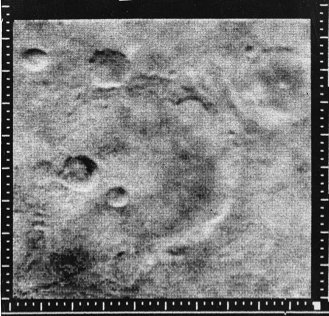
NASA/JPL/Mariner 4's image, taken during the spacecraft's Martian flyby. One of the craters is now called Mariner. (July 14, 1965)Almost a century after Honoré Flaugergues observed, or didn’t observe, dust clouds while timing the Martian day, Percival Lowell saw canals on Mars.

So did a few other astronomers, although many didn’t. If Schiaparelli’s canali and Lowell’s canals had been real Martian surface features, they were just barely obvious enough to be seen through 20th century Earthbound telescopes.

Then, in 1965, Mariner 4 flew past Mars and sent back pictures. Pictures of craters, more craters, and no trace of either channels or canals. On the ‘up’ side, the images gave us a clear look at the Martian surface.

That’s why, when Mariner 9 arrived and began orbiting Mars in 1971, scientists were looking forward to crisp, clear images of Martian terrain.

What they got were crisp, clear images of a planet-wide dust storm. And the very top of Olympus Mons: the second-highest known mountain in the Solar System. Our planetary system’s tallest known mountain currently is Rheasilvia’s central peak, on Vesta.

A few months later, after the dust settled, Mariner 9 sent back more than 7,000 images: including features that we’ve since confirmed are, or were, river beds.

Well, almost confirmed. A few scientists have pointed out that just because something looks like a channel, with dendritic branching and a fan-shaped delta at its low end, that doesn’t prove that it used to be a river.3

Fair enough. But there’s considerable evidence that water did flow on Mars. Long ago.


Video Shows Wind-Swept Dust Cloud – – –


(From NASA/JPL-Caltech/SSI, used w/o permission.)
(Dust storm on Mars, observed by Perseverance Rover. (June 18, 2021))

Perseverance Views Wind Lifting a Massive Dust Cloud
Images, NASA (June 1, 2022)

“This series of images from a navigation camera aboard NASA’s Perseverance rover shows a gust of wind sweeping dust across the Martian plain beyond the rover’s tracks on June 18, 2021 (the 117th sol, or Martian day, of the mission). The dust cloud in this GIF was estimated to be about 1.5 square miles (4 square kilometers) in size; it was the first such Martian wind-lifted dust cloud of this scale ever captured in images….”

A key phrase here is “of this scale.” Earth-bound Astronomers have been observing Martian dust clouds since the 19th century. Our robot explorers have been sending us pictures for decades.

What’s special about the June 18, 2021, video was that this time we had a robot on site, outfitted with sensors that let scientists study a dust storm as it was happening. Or, rather, study as-it-was-happening data after the Mars rover’s information reached Earth.4

– – – And Dust Devils

Giovanni Virginio Schiaparelli's Mars map, showing Martian continents and seas. (1877)
(From NASA/JPL-Caltech/SSI, used w/o permission.)
(Dust devils in Jezero Crater, spotted by Perseverance rover. (July 20, 2021))

NASA’s Perseverance Studies the Wild Winds of Jezero Crater
News, NASA (June 1, 2022)

“…A paper recently published in Science Advances chronicles the trove of weather phenomena observed in the first 216 Martian days, or sols. The new findings enable scientists to better understand dust processes on Mars and contribute to a body of knowledge that could one day help them predict the dust storms that Mars is famous for – and that pose a threat to future robotic and human explorers.

“‘Every time we land in a new place on Mars, it’s an opportunity to better understand the planet’s weather,’ said the paper’s lead author, Claire Newman of Aeolis Research, a research company focused on planetary atmospheres. She added there may be more exciting weather on the way: ‘We had a regional dust storm right on top of us in January, but we’re still in the middle of dust season, so we’re very likely to see more dust storms.’…”

These scientists figure that aeolian processes — wind moving sand and lifting dust in to the Martian atmosphere — account for many or most changes we’ve been noticing on the planet’s surface and in its atmosphere.

It’s a reasonable assumption, and one that’s been accepted as a possible model for Martian dust storms.

But until last year, scientists didn’t know how dust gets lifted off the surface and into the atmosphere. They’ve done wind tunnel tests here on Earth, which have been useful, but aren’t as valuable as actual on-site observations.

That’s why the June, 2021, dust storm and dust devils are so important in telling us how Martian weather works.

It’s the first time that a probe with the right sensors, in a dusty place, has been looking in the right direction during a windy season.

The Curiosity rover, for example, observed quite a bit of sand motion and many vortices/dust devils: but wasn’t equipped with adequate wind sensors.

The Mars Pathfinder’s rover, Sojourner, carried an MAE: Materials Adherence Experiment. Scientists knew that Mars was a dusty place, but didn’t know how fast dust would accumulate on a rover’s solar cells.

So between July 4, 1997 and August 12, 1997, the MAE let dust gather on a glass plate covering solar cells, rotated the plate to remove the dust, and repeated the cycle.

That told scientists how fast dust accumulated on that part of Mars during that season, but not how or why it does so.

The Insight lander has detected vortices, but so far hasn’t spotted major surface changes.

And the Spirit rover’s solar panels were swept clean of dust a few times. But not when the rover was ‘watching’ the process.5


Gathering Data, Finding New Questions

SA/Roscosmos/CaSSIS, CC BY-SA 3.0 IGO, ESA's Mars Express image: dust storm, an upwelling front of dust clouds near the north polar cap; one of several local small-scale dust storms observed during a particularly intense dust storm season. (April 2018)
(From SA/Roscosmos/CaSSIS, CC BY-SA 3.0 IGO, via Smithsonian, used w/o permission.)
(Martian dust storm, observed near the north polar ice cap. (April 2018))

We’ve coming a long way since the Mariner 4 Martian flyby mission. NASA’s Mars Odyssey and ESA’s Mars Express orbiters have been sending back data since 2001 and 2003.

UAE Space Agency's infographic: illustrating insertion orbit and science orbit. (2021) via BBC NewsAnd the United Arab Emirates Mars Mission, mašrū’ al-Imārāt l-āstikšāf al-Murīkh, مشروع الإمارات لاستكشاف المريخ, has been studying daily and seasonal weather cycles since last year.

The UAE’s Hope orbiter as given scientists enough data for at least five research papers that I know of.

Meanwhile, data from NASA’s Mars Global Surveyor, Mars Science Laboratory’s Curiosity rover, and InSight missions show that heat from the sun makes for strong daily and seasonal changes of Mars.

And this helps explain the planet’s seasonal dust storms. Probably.6

I get the impression that, although we’re gathering a great deal of information about Martian weather and the Martian climate — we’re finding new questions almost as fast as we’re getting answers.

Martian Ice Ages

NASA/JPL/Brown University's illustration of Mars during a possible ice age, some 2,400,000 to 400,000 years ago. (2003)
(From NASA/JPL/Brown University, used w/o permission.)
(Mars may have been in an ice age, between 2.4 million and 400,000 years back.)

For example, we’ve been learning that the Martian climate has changed — a lot — since the planet formed.

That’s why the Mars 2020 mission is looking for evidence of past life on Mars. There’s almost no chance that anything lives there now, but Earth’s neighbor wasn’t always the desiccated wasteland it is today.

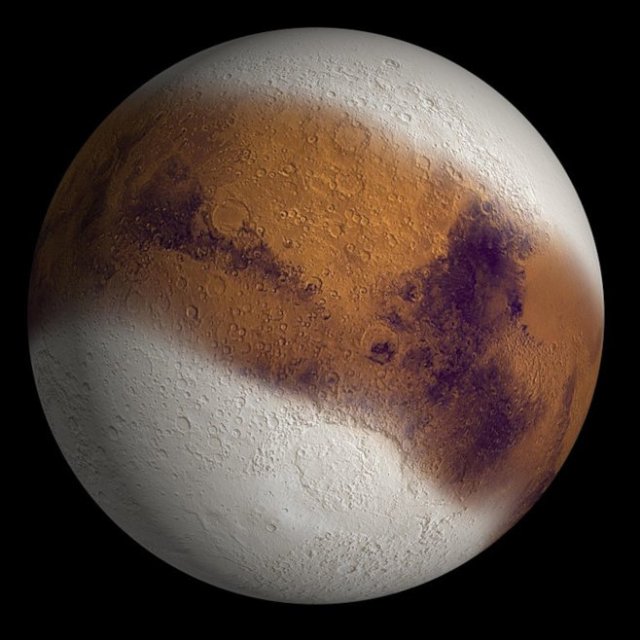
There’s even evidence of a Martian ice age, from maybe 2,400,000 to 400,000 years back. Maybe.7

There’s a great deal more to say about Martian weather, climate, seasons and cycles.

But that will have to wait. Thanks partly to a summer cold I’ve been having, and partly to a particularly annoying Internet service outage, I’ve had ample opportunity to practice patience this week. And that’s another topic.

More Martian monographs by me:

And why “…I see no problem with seeking truth that we find in this universe and seeking truth’s source….”


1 Mars 2020 mission, briefly:

2 Eyes on Mars:

3 Mars; getting a closer look:

4 Measuring Martian winds:

5 Dusty rovers and science:

6 Studying Martian weather and climate:

7 Lost oceans and a changing world:

Posted in Discursive Detours, Science News | Tagged , , , , , , , | Leave a comment