“Researchers using NASA’s James Webb Space Telescope are getting their first look at star formation, gas, and dust in nearby galaxies with unprecedented resolution at infrared wavelengths….”
“…’The clarity with which we are seeing the fine structure certainly caught us by surprise,’ said team member David Thilker of Johns Hopkins University in Baltimore, Maryland.
“‘We are directly seeing how the energy from the formation of young stars affects the gas around them, and it’s just remarkable,’ said team member Erik Rosolowsky of the University of Alberta, Canada….”
The Webb data had already been used in 21 research papers, back in February.
I’d prefer looking up a few of them, picking out one that sounded interesting, and talking about it. But I’ve had a distracted week. So today I’ll focus on some really cool pictures from the JWST/Webb telescope. Mostly.
(I gave the pictures links, so clicking on them takes you to the articles or resources I found them in.)
NGC 1433: Hubble Space Telescope’s View
NGC 1433, image from Hubble Space Telescope, a mix of ultraviolet, visible and infrared light. (July 2014)
Since the Hubble Space Telescope image (above) shows NGC 1433 in ultraviolet, visible and infrared light, and the Webb image (right) shows three colors of infrared, this isn’t an apples-to-apples comparison.
But it’s not apples-to-oranges, either. Maybe oranges-to-tangerines.
The point is that the Webb telescope shows NGC 1433 in somewhat higher resolution, and at different wavelengths; which lets scientists see new details. NGC 1433 is a bared spiral galaxy with a bright nucleus, the sort astronomers call a Seyfert galaxy.1
One more excerpt from that February 16, 2023 piece:
“…Webb’s powerful infrared capabilities can pierce through the dust to connect the missing puzzle pieces.
“For example, specific wavelengths observable by MIRI (7.7 and 11.3 microns) and Webb’s Near-Infrared Camera (3.3 microns) are sensitive to emission from polycyclic aromatic hydrocarbons, which play a critical role in the formation of stars and planets. These molecules were detected by Webb in the first observations by the PHANGS program.
“Studying these interactions at the finest scale can help provide insights into the larger picture of how galaxies have evolved over time….” (“NASA’s Webb Reveals Intricate Networks of Gas and Dust in Nearby Galaxies“ NASA’s Goddard Space Flight Center, Space Telescope Science Institute; Baltimore, Maryland (February 16, 2023))
Abell 2744, ‘Pandora’s Cluster’: Closer Look, New Details of Distant Galaxies
‘Pandora’s Cluster’, Abell 2744, Hubble and JWST imagery.
“NASA’s Webb Uncovers New Details in Pandora’s Cluster“ Laura Betz, NASA’s Goddard Space Flight Center, Greenbelt, Maryland; Leah Ramsey, Christine Pulliam, Space Telescope Science Institute, Baltimore, Maryland; Editor Jamie Adkins (February 15, 2023)
“Astronomers have revealed the latest deep field image from NASA’s James Webb Space Telescope, featuring never-before-seen details in a region of space known as Pandora’s Cluster (Abell 2744). Webb’s view displays three clusters of galaxies – already massive – coming together to form a megacluster. The combined mass of the galaxy clusters creates a powerful gravitational lens, a natural magnification effect of gravity, allowing much more distant galaxies in the early universe to be observed by using the cluster like a magnifying glass….
“…’Pandora’s Cluster, as imaged by Webb, shows us a stronger, wider, deeper, better lens than we have ever seen before,’ [Swinburne University of Technology’s astronomer Ivo] Labbe said. ‘My first reaction to the image was that it was so beautiful, it looked like a galaxy formation simulation. We had to remind ourselves that this was real data, and we are working in a new era of astronomy now.’…” [emphasis mine]
Abell 2744, nicknamed Pandora’s Cluster, is about 4,000,000,000 light-years out in the constellation Sculptor.
Scientists figure Abell 2744 happened when several smaller clusters collided. Its gas is so hot, it glows in the X-ray end of the spectrum. It’s also got a radio halo: all of which makes Abell 2744 something of a one-stop science resource.
About Abell 2744’s ‘Pandora’s Cluster’ nickname:
“…’The ancient myth of Pandora is about human curiosity and discoveries that delineate the past from the future, which I think is a fitting connection to the new realms of the universe Webb is opening up, including this deep-field image of Pandora’s Cluster,’ said astronomer Rachel Bezanson of the University of Pittsburgh in Pennsylvania, co-principal investigator on the ‘Ultradeep NIRSpec and NIRCam ObserVations before the Epoch of Reionization’ (UNCOVER) program to study the region.
“‘When the images of Pandora’s Cluster first came in from Webb, we were honestly a little star struck,’ said Bezanson. ‘There was so much detail in the foreground cluster and so many distant lensed galaxies, I found myself getting lost in the image. Webb exceeded our expectations.’ The new view of Pandora’s Cluster stitches four Webb snapshots together into one panoramic image, displaying roughly 50,000 sources of near-infrared light….” “NASA’s Webb Uncovers New Details in Pandora’s Cluster“ NASA’s Goddard Space Flight Center, Greenbelt, Space Telescope Science Institute; Baltimore, Maryland (February 15, 2023) [emphasis mine]
Now, about those “distant lensed galaxies”: All that mass in the Abell 2744 cluster bends light around it, magnifying even more distant galaxies.2
Galaxies, Gravity and More Galaxies
‘Pandora’s Cluster’, Abell 2744, Hubble and JWST imagery, detail: distant galaxies in a gravity lens.
This is a detail of the first ‘Pandora’s Cluster’ image: a closer look at the cluster of galaxies to the left of center.
Those streaky images in the upper right are galaxies beyond Abell 2744, magnified and distorted by the galaxy cluster’s gravity. I’m pretty sure about that, at any rate. They look like gravity-lensed-galaxies I’ve seen elsewhere.
LHS 475 b is just like Earth, except for how it’s not.
It’s a terrestrial planet, like our Solar System’s inner four worlds. It orbits LHS 475, a red dwarf star about 40 light-years out, in the constellation Octans.
Octans is one of the dozen-plus constellations mapped and named by Lacaille. I talked about that earlier this month.
LHS 475 is very roughly 1/100th as bright as our star, but LHS 475 b whips around it once every two days. That puts it very close to its sun, so LHS 475 b is hot.
Its equilibrium temperature would be 313 °C, 595 °F; but since it’s almost certainly is tidally locked, with one side always facing its sun, the day side temperature could be around 475 °C; 887 °F.
That’s assuming LHS 475 b doesn’t have an atmosphere. Which is likely enough, considering how hot it is, and how close it is to its sun.
On the other hand, LHS 475 b is almost exactly the size of our planet, 99% Earth’s diameter, and apparently made out of rock and metal.4
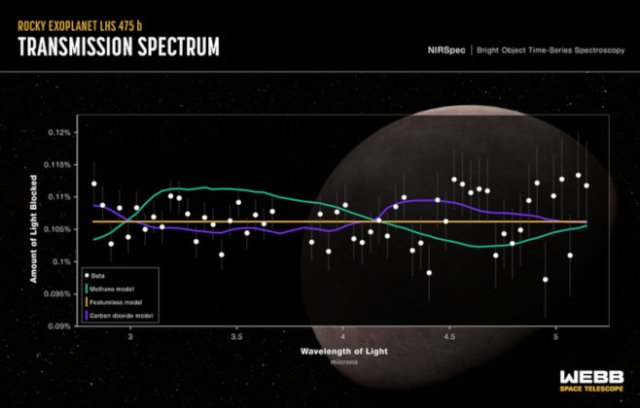
LHS 475 b: Methane, No; Carbon Dioxide, Maybe; Or Maybe No Atmosphere At All
JWST transmission spectrum of LHS 475 b. (August 31, 2022)
But LHS 475 b definitely is not Earth 2.0. It’s too hot, and may have no atmosphere.
But maybe it does.
Since the planet passes between its sun and us, JWST can measure how light from LHS 475 changes during the planet’s transits.
So far, the data says LHS 475 b doesn’t have a mainly-methane atmosphere. But it might have an atmosphere that’s mostly carbon dioxide. Or no atmosphere at all.
Either way, the planet is emphatically not suitable for life as we know it.
If the no air and tidally locked scenario is right, LHS 45 b’s dayside temperatures are hot enough to melt lead or zinc. At Earth’s sea-level pressure, and that’s another topic.5
Terrestrial, Telluric, Solid, or Rocky: There’s No Place Like Home
R. Hurt’s illustration: what potentially habitable planets might look like. (2022)
“Terrestrial planet” reminds me of Star Trek’s “Class M planet”: a world with surface conditions pretty much like southern California. A world like that would be terrestrial, but not all terrestrial planets are habitable.
What is, and isn’t, a terrestrial planet depends partly on who’s talking.
Earth, for example, is a terrestrial planet. So are the inner Solar System’s three other worlds: Mercury, Venus and Mars. All four are mostly metal and silicate rock.
That quartet are, according to the IAU, the International Astronomical Union, the Solar System’s only “terrestrial planets”.
But that’s not the only definition in play.
IUGS, the International Union of Geological Sciences, defines “terrestrial planet” so that Earth’s moon, Jupiter’s Io and maybe Europa, are also “terrestrial”. Along with asteroids Pallas and Vesta.
Other monikers for terrestrial planet are telluric planet, solid planet and rocky planet.
I’m not sure whether theoretical planet types like carbon and coreless planets would count as “terrestrial”.
The words telluric and terrestrial come from Latin words for Earth, Terra and Tellus; and I’m wandering off-topic.
Over the last few decades, we’ve been learning a very great deal about planets and planetary systems. So it’s no wonder that scientists haven’t settled on names and definitions for all the newly-discovered varieties.6
We still haven’t spotted anything quite like Star Trek’s “Class M planet”, or made contact with folks whose ancestors are from another world.
But like I said: we’re learning a great deal about how planets and stars form. And that helps make this a very exciting era. For me, that is:
Mardi Gras, Fat Tuesday: Meat, Cheese and New Orleans
Someday I may talk about the City of New Orleans’ Brobdingnagian block party, but not today.
But I will talk a little about mardi gras.
Mardi gras is “fat Tuesday” in French.
It’s the Tuesday before Ash Wednesday, when folks would eat the household’s “fat”. Not raw, of course. Back in the day, Lent was a time for not eating rich, fatty foods — like meat, eggs, milk and cheese.
Somewhere along the line, the common-sense custom of not letting perishable food go to waste turned into a massive bash.
I’ve gathered that the New Orleans Mardi Gras has — ah — indecorous elements. I figure that’s probably true. But verifying the assertions and putting them in context is more work than I think it’d be worth.
Besides, I’ve little to no interest in joining folks waving their moral outrage flags. In large part because I’ve gotten tired of natural disasters being blamed on a dyspeptic deity.2
So today I’ll take a quick look at Lent and what I’ll be doing for the next month and a half.
What I plan on doing, at any rate.
Lent: Pointing Myself Towards God
Lent is the Church calendar’s season when we get ready to celebrate the Resurrection, Easter: when our Lord stopped being dead. It’s a season of prayer, fasting and almsgiving.
Coming at it from another direction, it’s an exercise in self-discipline. I put a link and an excerpt near the end of this post.3
Lent is also a season of penance. (Catechism of the Catholic Church, 1438)
Penance is part of the conversion-penance-satisfaction process we need when we mess up our relationship with God. It’s a good idea. (Catechism, 1431-1470)
Doing stuff others can see might be useful, or not. What matters is what happens inside me, turning my thoughts and desires away from offenses against truth and reason. And toward God. (Catechism, 1430-1432)
I’m not doing all the ‘conversion’ work myself, happily. Part of the trick is cooperating with God. (Catechism, 1425-1439)
Today’s American culture doesn’t encourage self-denial. Not as an allegedly-pious practice, at any rate.
So why should I bother? And, for that matter, why should I think my relationship with God is messed up?
Original Sin: Living With Consequences
Ukrainians, liberated by Russian troops in Bucha, Ukraine. (April 2022)
I don’t live in a perfect world. And I’m not a perfect person. Although I haven’t done anything impressively bad, my track record isn’t flawless.
My problem, and humanity’s, is original sin. Which is not the notion that humanity is rotten to the core.
But we did get off to a bad start. The first of us decided that ‘what I want’ outvotes what God wants.
Then Adam firmly plants both feet in his mouth with this gem:
“The man replied, ‘The woman whom you put here with me – she gave me fruit from the tree, so I ate it.’” (Genesis 3:12)
They were already in big trouble, so what does Adam do? Tries blaming his wife and God. That interview did not end well.
Making sense of Adam, Eve, Genesis, and my erratic success with doing what’s right, means backing up a little. A lot, actually.
Wounded, But Still Basically Good
The universe is basically good. So are we — basically. (Genesis 1:26–27, 31; Catechism of the Catholic Church, 299, 364, 369, 374)
Humanity was made “in the divine image.” We still are. (Genesis 1:27; Catechism, 31, 355-361)
Each of us is a rational creature with free will. I can decide what I do or don’t do. I am also responsible for the consequences of my decisions. (Catechism, 1730-1742)
The first of us listened to Satan, ignoring what God had said. (Genesis 3:5–13)
We’ve been living with consequences of their decision ever since. (Catechism, 396-412)
That was a very, very long time ago.
The trouble started when an angel decided that God ‘wasn’t the boss of me’. A takeaway from the fall of the angels is that Satan is bad news. On the other hand, Satan is just a creature: powerful, but finite. (Catechism, 391-395)
And that’s another topic.
The account of our fall in Genesis 3 is figurative, “…but affirms a primeval event, a deed that took place at the beginning of the history of man….” (Catechism 390)
Ever since that really bad choice, we’ve seen God through fear-tinted glasses. (Catechism, 399)
Loving ourselves, others, and God, became a struggle. That’s because the harmony we had with ourselves and with the universe was broken. So was our friendship with God. (Catechism, 374-379, 397-406)
I’m not personally responsible for humanity’s bad start. But I am affected by consequences of that choice. (Catechism 388-412)
That’s the bad news.
The good news is that human nature is wounded: but not corrupted. We “…all need salvation and that salvation is offered to all through Christ….” (Catechism, 389, 405, 407-412, 1701-1707, 1949, 1811)
Since I’m a Catholic, I see the mess we’re in as consequences of an original sin. Here’s how the Catechism’s Glossary describes it:
“ORIGINAL SIN: The sin by which the first human beings disobeyed the commandment of God, choosing to follow their own will rather than God’s will. As a consequence they lost the grace of original holiness, and became subject to the law of death; sin became universally present in the world. Besides the personal sin of Adam and Eve, original sin describes the fallen state of human nature which affects every person born into the world, and from which Christ, the ‘new Adam,’ came to redeem us (396-412).” (Catechism, Glossary)
The Bible, Very Briefly
Otto Elliger’s “Jesus Cleanses the Temple”. (1700)
A point or two before moving on, about Genesis 3 being figurative and the Bible in general.
I’m a Catholic, so reading and understanding Sacred Scripture is vital. So is remembering that it’s poetry, history, prophecy and other literary forms. (Catechism, 101-133)
None of which were written by a literalist American.
Goals: Short- and Long-Term
A short-term Lenten goal is adding the rosary to my daily prayer routine.4 I’ve tried doing this before, and hope this time I’ll make it stick.
My long-term goal during Lent and every season should be seeking, knowing and loving God; and spending eternity with our Lord. (Catechism, 1, 540, 1023-1029, 1095)
Meanwhile, it’s like Philippians says. I’m ‘working out my salvation.’ Not that I could work or pray my way into Heaven:
“So then, my beloved, obedient as you have always been, not only when I am present but all the more now when I am absent, work out your salvation with fear and trembling. “For God is the one who, for his good purpose, works in you both to desire and to work.” (Philippians 2:12–13)
Simple, Yes; Easy, No
Praying matters.
So does what I do when I’m not praying. The rules are simple.
It’s been about 11 months since I decided to give up my weekly time at Sauk Centre’s Eucharistic Adoration Chapel.
I’d gotten sick in late January, probably with COVID-19, and over a month later was still running a fever. Bowing out made sense at the time, and still does.
Good news, I’m no longer running a fever; not-so-good news, I haven’t gotten back into a weekly routine at the chapel. I’m pretty much de-fogged, but still really up to par. Which, at my age, arguably isn’t surprising.
But I’m still researching and writing my weekly posts, and have a back burner project that’s nearly ready for getting moved toward the front. And that’s yet another topic.
A Reflection on Lenten Fasting, Rev. Daniel Merz (drawn in part from the writings of Alexander Schmemann, “Notes in Liturgical Theology,” St. Vladimir’s Seminary Quarterly, Vol. 3, No. 1, Winter 1959, pp. 2-9. Rev. Daniel Merz is a former Associate Director of the USCCB Divine Worship office)
What Is Lent? Wednesday, February 22, 2023 — Thursday, April 6, 2023 Liturgical Year, Prayer and Worship, USCCB (United States Conference of Catholic Bishops)
“Lent is a 40 day season of prayer, fasting, and almsgiving that begins on Ash Wednesday and ends at sundown on Holy Thursday. It’s a period of preparation to celebrate the Lord’s Resurrection at Easter. During Lent, we seek the Lord in prayer by reading Sacred Scripture; we serve by giving alms; and we practice self-control through fasting. We are called not only to abstain from luxuries during Lent, but to a true inner conversion of heart as we seek to follow Christ’s will more faithfully. We recall the waters of baptism in which we were also baptized into Christ’s death, died to sin and evil, and began new life in Christ.
“Many know of the tradition of abstaining from meat on Fridays during Lent, but we are also called to practice self-discipline and fast in other ways throughout the season…”
4 Getting started with the Rosary:
USCCB (United States Conference of Catholic Bishops)
A Reflection on Lenten Fasting, Rev. Daniel Merz (drawn in part from the writings of Alexander Schmemann, “Notes in Liturgical Theology,” St. Vladimir’s Seminary Quarterly, Vol. 3, No. 1, Winter 1959, pp. 2-9. Rev. Daniel Merz is a former Associate Director of the USCCB Divine Worship office)
That reminded me that it’s been some time since I talked about tools, evolution and how Age of Enlightenment aristocrats viewed different species. And why I don’t see a point in complaining about how this universe works.
So here’s what I wrote, divided into bite-sized chunks. That’s an awkward metaphor, but never mind:
Hand stencils made by Neanderthals in Maltravieso Cave, western Spain. (2018)
We’ve been systematically studying human evolution, how we’ve been changing, for two centuries, give or take.
That’s assuming that the process started with Carl Linnaeus, Jean-Baptiste Lamarck, Alfred Russel Wallace or Charles Darwin.
Take another sampling from humanity’s archives, and we’ve been working on the puzzle for two and a half millennia.
That’s giving Anaximander credit for first speculating that the universe hasn’t always been like it is now: and that we have our origins in animals.
But I’ll split the difference between Linnaeus/Lamarck and Wallace/Darwin, and say we’ve been studying human origins for about two centuries.
Two centuries sounds like a long time.
So how come all that studying hasn’t given us a full account of how we got to where we are now?
I figure there are at least two reasons.
First, the more we’ve learned, the more complicated our story has become.
Second, although we’ve been filling in the gaps, we’re still far from having found all the pages in humanity’s long story. Literally and metaphorically.
We’ve only been keeping written records for a few millennia, and that paper trail is very far from complete.
Piecing together what’s been happening before cuneiform and Zapotec script caught on is another matter. One that depends on analyzing physical evidence: ruins, traces of campfires, tools, along with the occasional (and often partial) skeleton.
That last is tricky, since very few critters of any sort get fossilized.
Since humans don’t (and very likely didn’t) prefer living in fossilization-friendly places like stagnant swamps: well, critters like us don’t leave many fossils.1
Next, tools and teeth.
Stone Tools and Humanity’s Family History
Stone tools found Nyayanga, used to cut, scrape and pound both animals and plants.
The oldest stone tools are, according to some sources I’ve seen, Oldowan.
Oldowan is a style or type — industry or technocomplex in archaeologist jargon — that dates from around 1,700,000 to 2,900,000 years back.
My guess is that ‘Oldowan first’ sources predate the 2011 discovery of Lomekwi tools near Kenya’s Lake Turkana.
Researchers had been heading for a spot where Kenyanthropus platyops fossils had been found. They took a wrong turn, decided to look around anyway, and found stone tools.
A year later, they came back for a thorough investigation at what they called the Lomekwi 3 archaeological site.
The picture with a white background shows tools they found.
They were made about 3,300,000 years before Ace Hardware opened their doors. One of the researchers called them Lomekwian tools.2
Whether or not the name’s caught on is another topic. But that’s what I’ll call them this week.
Who made the earliest stone tools is debatable and debated.
So, at least for a while, if my memory serves, was whether the oldest stone tools were really fabricated tools. Or whether they were just rocks that happened to look like tools and that could be used as tools.
I made a quick check before writing this, and found general agreement that Oldowan and Lomekwian tools aren’t random rocks. So looks like that debate’s over. Or I didn’t look in the right places.
I’ll grant that Lomekwian tools aren’t as obviously fabricated as arrowheads and spear points my grandfather found.
Then there’s the still-controversial Cerutti Mastodon site.
The Continuing Cerutti Site Debate, Oldowan Tools and Paranthropus Teeth
Researchers reproducing breakage patterns found at the Cerutti Mastodon site in California. (2017)
The Cerutti Mastodon site is in San Diego County, California. Paleontologist Richard Cerutti spotted it during road construction. The site’s status is still undecided.
It’s either a 130,000-year-old paleontological site, or it’s an archaeological site. If it’s an archaeological site, the Clovis First theory for how folks got to North America isn’t right.
Some researchers say the Cerutti site’s rocks are tools, and that it’s an archaeological site.
Others — including a Distinguished Professor of Anthropology, Religion, and Culture and Professor of Anthropology — say they’re just rocks that happen to look like tools. And that the mastodon bones just happen to look like they’ve been worked by the tools.
They may be right.
Anyway, getting back to those 3,300,000-year-old Lomekwian tools and the ‘who made them’ puzzle, scientists matched a Lomekwian flake to its core. So looks like someone made those tools on-site. Who the someone was is less certain:
“…The identity of the Lomekwi knappers is unknown. If stone tool manufacture is the exclusive purview of Homo, then Homo must have evolved far earlier than the fossil record currently indicates. A more plausible scenario, Harmand said, is that Australopithecus or another hominin, Kenyanthropus (found nearby)—both of which are known to have been around 3.3 million years ago–made the Lomekwi tools. Whether Kenyanthropus is in fact a distinct hominin lineage or part of Australopithecus is a matter of debate, however….” (“Archaeologists Take Wrong Turn, Find World’s Oldest Stone Tools [Update]“, Kate Wong, Observations, Scientific American (May 20, 2015))
Kenyanthropus, Australopithecus and Paranthropus are three genera of Hominidae. Unless, as Wong said, Kenyanthropus is part of the Australopithecus genus.
That’s a lot of five-dollar words, but since the topic’s taxonomy, that’s what I’m stuck with.
Recapping, Kenyanthropus probably made the Lomekwian tools, since their remains were near the tools. And Paranthropus probably made the Oldowan tools found in Nyayanga, Kenya, since researchers found two of their teeth nearby.
And I’m inclined to see all of the above as “human.” Even though they’re not currently classified as being in our Homo genus.3 And that brings me to (fairly) current events.
Taxonomy, Attitudes, Assumptions and the Age of Enlightenment
Lemonnier’s painting: Enlightenment-era folks reading Voltaire in Madame Geoffrin’s salon (1812))
I’d talk about how Paranthropus fits into humanity’s family tree. But I can’t.
Or, more accurately, I won’t.
Paranthropus is a genus of Hominidae that’s a cousin to our genus, along with Homo (that’s us), and pan (chimps and bonobos). Probably.
If that’s so, all three — Homo, Paranthropus and Pan — are in the Homini tribe.
In this context, families, subfamilies, tribes, and genera are taxonomic groups.
Taxonomy is the study of naming, defining and classifying living critters. And that’s yet another topic. One that I’ll mostly ignore for now.
The next taxonomic grouping down from genus is species.
How scientists define species keeps changing, as we learn more about how life, the universe and everything works.
And as we get over the Age of Enlightenment notion that “race” and “species” mean the same thing.4
I suspect that the current scientific definition of “species” is due for another revision. Whether or not that revision includes classifying Denisovans, Neanderthals and humanity’s current model as a single species? That, I don’t know.
I think it makes sense, for pretty much the same reasons I think that the Scots, black-haired Norwegians, the Irish, Germans and the English are all part of one species.
And that’s yet again another topic.
Accepting This Universe ‘As Is’
It’s been some time since I explained why I don’t have a problem with living in a huge and ancient universe. And don’t see a point in complaining about how it works.
So I’ll do a quick recap. And probably add some of this to my Science AND Religion pages.
I think God is large and in charge, creating a universe that follows knowable physical laws. (Catechism of the Catholic Church, 268, 279, 299, 301-305; “Gaudium et spes,” 5, 15, Second Vatican Council, Bl. Pope Paul VI (December 7, 1965))
This universe is changing: in a “state of journeying” toward perfection. (Catechism, 268, 279, 299, 301-308, 310)
Everything we observe reflects a facet of the Creator’s truth, according to its nature. (Catechism, 301-308)
Natural processes involve secondary causes: creatures acting in knowable ways, following laws woven into this creation. (I talked about secondary causes back in August of 2021: that link is in the usual ‘more stuff’ list, below)
Learning about this universe gives me more reasons to admire God’s work. Which seems obvious, since I believe that God creates everything, and that God is not a liar. (Catechism, 159, 214-217, 282-283, 294, 341)
Again, studying this world, learning what’s happened since it started, is a good idea. (Catechism, 282-289)
Here’s where it gets tricky, maybe.
Using My Brain
I think humans are rational animals. (Catechism, 1951)
Make that optionally rational.
We have free will, so using our brains is a choice, not a hardwired response. (Catechism, 1730, 1778, 1804, 1951, 2339)
Maybe one of these days I’ll talk about seeing myself as a rational animal, but not just an animal. But today is not that day.
Today I’ve been talking about evolution, among other things.
Here’s where I try to explain, briefly, why I don’t see a problem with thinking that we are formed from the the stuff of this world.
It’s something we’ve known for millennia.
“then the LORD God formed the man out of the dust of the ground and blew into his nostrils the breath of life, and the man became a living being.” (Genesis 2:7)
All that’s changed over the last couple centuries is how much we know about the “dust of the ground” we’re made from.
We’re still made “in the image of God”, with body AND soul. (Catechism, 355-373)
As for science and religion, faith and reason: I’m a Catholic, so I think faith and reason get along fine. (Catechism, 159)
Finally, there’s the issue of who I think is “human” and who isn’t.
Love, Neighbors and Being Human
The rules are simple. Not easy, but simple.
I should love God and my neighbors, and see everyone as my neighbor. That’s everyone. No exceptions. (Matthew 5:43–44, 7:12, 22:36–40, Mark 12:28–31; 10:25–27, 29–37; Catechism of the Catholic Church, 1789)
Applying those rules to everyone alive today: like I said, not always easy, but simple.
Happily, the branch of natural philosophy we call science has come around to seeing all of today’s humanity as a single species.
As for folks like Kenyanthropus? I don’t know. But it’s becoming increasingly obvious that although humanity’s early models didn’t look just like us, they acted like us. I’ll willingly assume that people who make and use tools, and keep them on hand, are — people.
There’s still the question of fire, and string, and that’s still more topics.
Comparison: Kepler-22 planetary system and inner Solar System. (2011)
It’s been a little over 10 years since scientists spotted Kepler-22 b. It was the first time we’d spotted a transiting exoplanet that’s in its sun’s habitable zone.
That may or may not mean that Kepler-22 b is habitable. The odds are good that the exoplanet is a water world: covered with an ocean far deeper than Earth’s.
Since then we’ve discovered quite a few water worlds. And, possibly because there’s a 1995 action film called “Waterworld”, they’re often called ocean worlds.1
This week I’ll talk about two (probably) ocean worlds, Kepler-138 c and d; discovered in 2014, they’re far to hot for life as we know it. But scientists recently published a new analysis of those two worlds. And that gave me something to talk about.
So did a proposed change in when taxpayer-funded research projects release data. It’s good news or bad news, depending on who’s talking. That’s this week’s first item.
I’ll also look at a very young planetary system’s dust disk, the odds for life on ocean planets, and assorted other topics:
“The managers of the James Webb Space Telescope are considering a big change in how its observations get shared, one that could have a major impact on the science that gets done — and on who gets to do it.
“As it stands now, if an astronomer makes a proposal for where to point this $10 billion space telescope, and the proposal gets accepted, that scientist usually has a year of exclusive access to the resulting observations.
“Now, though, with the federal government pushing for more taxpayer-funded research to be made public instantly, telescope managers are pondering whether all of the data collected by JWST should be available to everyone right away….”
“…with the federal government pushing…” apparently refers to a White House press release and a memo:
Ensuring Free, Immediate, and Equitable Access to Federally Funded Research – Memorandum for the Heads of Executive Departments and Agencies – Dr. Alondra Nelson, Deputy Assistant to the President and Deputy Director for Science and Society Performing the Duties of Director, Office of Science and Technology Policy (OSTP) (August 25, 2022)
On the whole, I like the idea of having access to information I’ve paid for: as soon as it’s in viewable or readable form, not a year of mofd later.
The pandemonium that passes for politics being what it is, an explanation may be in order.
Access to Information
I think having access to information is generally a good idea. After a quick glance at that memo, I think this change in the rules might make sense.
But that doesn’t mean that I think the memo is unquestionably right and just, simply because it came from someone in the current administration. And that anyone who doesn’t agree is a doo-doo-head.
On the other hand, I’m not absolutely sure it’s a good idea.
Which doesn’t mean I think the memo is an assault on all that is right and just — because, again, the memo was written by someone working for the current administration. And that anyone who exhibits insufficient revulsion is a traitor to the fatherland.
I’d be delighted of more folks would take a deep breath, consider the possibility that knee-jerk responses aren’t always reasonable: and think! And that’s another topic.
At any rate, some folks like the proposed new rules; and some don’t.
“…Proponents of open access say that sharing all of these space telescopes’ findings immediately could accelerate new discoveries and maximize the return from these powerful scientific assets.
“Critics, however, worry that this could exacerbate existing inequities in who gets to do astronomical research, and perhaps even result in shoddier science as scientists race to be first to find hidden gems in the data….” (Nell Greenfieldboyce“, NPR (February 7, 2023)
‘We’ve Never Done It This Way Before’
The “shoddier science” argument may have merit. But I’m not entirely convinced.
Scientists are human, and occasionally publish bogus results: intentionally or not.
Letting folks who aren’t insiders see fresh data would, I suspect, be at least as likely to disprove dubious analyses as it would be to inspire another Archaeoraptor SNAFU.2
And I also suspect that some protests come, consciously or not, from a perceived affront to cherished traditions.
“…Astronomers have turned their telescopes to the skies for hundreds of years. Traditionally, they decided how and when to share their records of what they’d seen.
“The data really were more or less owned by the person who came up with the idea to take the observations in the first place,” says Eric Smith, associate director for research at the astrophysics division of NASA’s science mission directorate in Washington, DC.
“An astronomer who used a ground telescope physically possessed their records.
“‘Originally it was just hand drawings, and then it became glass plates, and then it was film in some cases, and eventually it was magnetic tapes,’ explains Smith. ‘Whoever went to the observatory took those data home with them — and they just put them in their office or they put them in some university vault.’…” (Nell Greenfieldboyce, NPR (February 7, 2023))
My guess is that either now or later, observations from multinational projects like the Hubble and James Webb space telescopes will be distributed sooner than they are now.
That’s mainly because it strikes me that trends have been going that way for decades.
And maybe because I hope that I’ll get a look at data earlier than I could have before.
AU Microscopii’s Dusty Disk: A Close Look, in Infrared
JWST NIRCam images at 3.56 (blue) and 4.44 (red) microns. (August 1, 2004)
“New Webb Image Reveals Dusty Disk Like Never Seen Before“ Laura Betz, Claire Blome, Christine Pulliam, Madison Arnold; NASA’s Goddard Space Flight Center, Greenbelt, Maryland; Space Telescope Science Institute, Baltimore, Maryland; NASA (January 11, 2023)
“NASA’s James Webb Space Telescope has imaged the inner workings of a dusty disk surrounding a nearby red dwarf star. These observations represent the first time the previously known disk has been imaged at these infrared wavelengths of light. They also provide clues to the composition of the disk.
“The star system in question, AU Microscopii or AU Mic, is located 32 light-years away in the southern constellation Microscopium. It’s approximately 23 million years old, meaning that planet formation has ended since that process typically takes less than 10 million years. The star has two known planets, discovered by other telescopes. The dusty debris disk that remains is the result of collisions between leftover planetesimals – a more massive equivalent of the dust in our solar system that creates a phenomenon known as zodiacal light….”
AU Microscopii’s designation has little or nothing to do with it being small. It’s in the southern constellation Microscopium.
That patch of sky had been the rear hooves of Sagittarius until the early 1750s, when Nicolas-Louis de Lacaille mapped more than a dozen new constellations, including:
Antlia pneumatica (la Machine Pneumatique/the Pneumatic Machine)
Apparatus Sculptoris (the sculptor’s studio)
Circinus, Norma (compass)
Fornax chemical (chemical furnace)
Horologium (clock (lit. “an instrument for telling the hour”))
Microscopium (microscope)
Norma (carpenter’s square, set square or level)
Octanis/Octans (octant)
Pictor (painter)
Pyxis nautica (mariner’s compass)
Reticulus rhomboidalis (Reticulum) (the reticle in Lacaille’s telescope eyepiece)
Mons Menae (Mensa: originally Table Mountain, later Table)
Telescopium (telescope) (Source: Nicolas-Louis de Lacaille, Biographies, MacTutor History of Mathematics Archive, University of St. Andrews, Scotland; Wikipedia)
Many of them were named after scientific instruments, which were all the rage in the Age of Enlightenment, and I’m drifting off-topic.
AU Microscopii’s planetary system — it’s got two known planets, roughly 10 and 20 times Earth’s mass — is very new.3
All that dust probably is, as the NASA article said, from leftover planetesimals. But we may learn differently. That’s happened before, and I figure it’ll happen gain.
Take what we’re learning about the inner Solar System’s zodiacal light, for example.
A Zodiacal Digression
Zodiacal light is a cone of light barely visible before dawn and after sunset, near the sun.
It’s a very faint band of light running along the ecliptic.
A brighter bit, opposite the sun, is gegenschein or counterglow.
Which definition of zodiacal light is in play depends on who’s talking. In my experience, at any rate.
Scientists figure zodiacal light comes from a pancake-shaped dusty area surrounding the Solar System’s inner planets. Or maybe a really flat doughnut.
Either way, it’s called the zodiacal cloud or interplanetary dust cloud.
Where the dust comes from is debatable and debated. Particularly now that we’ve got data from a spacecraft that was looking for something else: Juno.
Before the Juno spacecraft headed for Jupiter, scientists generally figured that the dust was from asteroids and comets.
Juno’s mission didn’t include observing space-dust. But getting useful data from its magnetometer depended on the spacecraft knowing which way it was pointed.
That’s why Juno had four star trackers, cameras that took pictures every quarter-second, and a simple AI that compared the views with known stars and other objects.
Technical University of Denmark professor John Leif Jørgensen had programmed one of Juno’s four star trackers to send back a picture whenever an uncataloged object showed up more than once.
Jørgensen had hoped Juno would spot a previously-uncharted asteroid.
“…He didn’t expect to see much: Nearly all objects in the sky are accounted for in the star catalog. So when the camera started beaming down thousands of images of unidentifiable objects – streaks appearing then mysteriously disappearing – Jørgensen and his colleagues were baffled. ‘We were looking at the images and saying, ‘What could this be?”‘ he said.
“…It wasn’t until the researchers calculated the apparent size and velocity of the objects in the images that they finally realized something: Dust grains had smashed into Juno at about 10,000 miles (or 16,000 kilometers) per hour, chipping off submillimeter pieces of spacecraft. ‘Even though we’re talking about objects with only a tiny bit of mass, they pack a mean punch,’ said Jack Connerney, Juno’s magnetometer investigation lead and the mission’s deputy principal investigator, who’s based at NASA’s Goddard Space Flight Center in Greenbelt, Maryland….”
Long story short, Juno made it through the unexpected ‘dust storm’. Mainly because most of the impacts were on the comparatively rugged back side of the spacecraft’s solar panels.
The best fit for explaining all that dust was that it was coming from Mars. Some scientists figure the recent analysis is accurate. Others don’t.4 Which is about par for the course, when we find new data that doesn’t fit existing explanations.
A Dust Disk by Starlight: Polarized Light, Oscillations and Weird Ripples
Hubble image of AU Microscopii debris/dust disk (August 1, 2004)
At this point, I’d like to start sharing what the new images of AU Microscopii’s dust disk tell us about how stars and planets form, what causes the weird ripples — I’ll get back to that — and how it ties into our search for life on other worlds.
But I can’t. The most recent analysis I found said, basically, that we’ve been learning a great deal about how data like this should be analyzed.
They also said they’d found evidence of silicates like MgFeSiO4, carbon and tholins: organic compounds that happen when ultraviolet light or cosmic rays hit simpler compounds like carbon dioxide (CO2), methane, (CH4) or ethane (C2H6). Nitrogen (N2) or water (H2O) are part of the process, too, often enough.5
And that’s enough chemical geek-speak for now.
Here’s an excerpt from what scientists found in a new “snapshot” of AU Microscopii’s debris/dust disk.
“Hubble’s Snapshot of Debris Disk Around Young Star “ J. R. Graham and P. Kalas (University of California, Berkeley), and B. Matthews (Hertzberg Institute of Astrophysics); ESA/NASA; Images, Resource Gallery, HubbleSite (January 7, 2007)
“…The image shows the flattened disk, appearing like Saturn’s rings, but seen almost exactly edge-on. Normally, starlight would be so bright that the debris disk could not be seen. But astronomers used the coronagraph on Hubble’s Advanced Camera for Surveys, which blocked out most of the starlight. The black circle in the center of the image is the coronagraph’s occulting disk. The disk in this image extends to about 8 billion miles from the star, or three times farther than Neptune is from the Sun. In other observations, the disk has been traced to at least 11 billion miles.
“The only light seen is starlight reflected off dust in the debris disk. Astronomers used polarizing filters on the Advanced Camera to analyze the dust in the disk. The polarizing filters allowed astronomers to study how dust is reflecting the starlight. A polarizing filter lets through light vibrating in one orientation while blocking light oscillating in other directions. The white lines in the bottom image illustrate the direction a light wave is oscillating. The length of the line represents the degree to which all the light waves are oscillating in the same direction….”
I think a key word here is “oscillating.” AU Microscopii is close enough for us to get a good look at the star’s planetary system, dust included. And even get the occasional video.
These “mysterious ripples” are weird. Which, for scientists, is a very good thing.
“…The fast-moving, wave-like structures are unlike anything ever observed, or even predicted in a circumstellar disk, said researchers of a new analysis. This new, unexplained phenomenon may provide valuable clues about how planets form inside these star-surrounding disks….”
I’d be astounded if we don’t learn something from those ripples. Although I suspect “waves” or maybe “spurts” is a better term.
And I’m pretty sure that we’ll learn more from comparing the AU Microscopii system’s cloud to similar features in other systems.
Hot Jupiters, Planetary Migration: And Much More Left to Learn
AU Microscopii’s dust disk, with ripples traveling 22,000 miles per hour. (2010-2014) This phenomenon had not been observed before, and had not been predicted.
The nebular hypothesis is still the best, or least-unlikely, explanation for how our Solar System and other planetary systems take shape. But it’s still called a hypothesis.
How long it’ll take scientists to either confirm the nebular hypothesis, or show that it doesn’t work: that, I don’t know.
I’m pretty sure, though, that the process will take less time now. Before, we had only one planetary system to study. Now we have thousands.
Of those, dozens (at least) have dust disks. I’m not sure if that includes protoplanetary disks and proplyds: ionized protoplanetary disks.
The point is that we’ve gone from studying one example of a ‘finished’ planetary system, to studying thousands. Some of them are really weird, which gives scientists opportunities for learning something new.
Hot Jupiters, for example, encouraged — demanded? — new explanations for how planets end up where we find them.
Turns out that planets can and do move into new orbits, particularly when planetary systems are new. It’s called “planetary migration.”
The process is also complicated, and very likely explains how Earth’s Moon formed. I like to call it “playing bumper cars with planets”.
Finally, we’ve found dozens of planetary systems, at least, that are in very early stages of development: like AU Microscopii’s.6
As I’ve said before, and will again, there’s a great deal left to learn.
Zodiacs, Dust and Loose Ends
Now, mainly because I think it’s cool, here’s link to a NASA Goddard video with music by Vangellis. It talks about interplanetary dust, Mars and Jupiter.
Our Solar System’s zodiacal cloud isn’t unique. Astronomers have been spotting interplanetary dust clouds (“exozodiacal dust”) in other planetary systems.
Let’s see. What else?
The “zodiac” is a band of constellations running along the ecliptic. The ecliptic is Earth’s orbital plane, or the line where that plane meets the celestial sphere.
Steve Zodiac is the name of a character in the 1960s science fiction puppet show “Fireball XL5”, and guitarist and songwriter Stephen John Hepworth’s stage name. All of which are yet more topics.7
Kepler-138 c, d: “Water, Water Everywhere?”
Benoit Gougeon’s illustration: Earth (left) and Kepler-138 d (right). (2022)
“Two Exoplanets May Be Mostly Water, NASA’s Hubble and Spitzer Find“ Claire Andreoli, NASA’s Goddard Space Flight Center, Greenbelt, Maryland; Ray Villard, Space Telescope Science Institute, Baltimore, Maryland; Marie-Eve Naud, Trottier Institute for Research on Exoplanets, University of Montreal, Montreal, Canada; Caroline Piaulet, Trottier Institute for Research on Exoplanets, University of Montreal, Montreal, Canada; Björn Benneke, Trottier Institute for Research on Exoplanets, University of Montreal, Montreal, Canada; Editor Andrea Gianopoulos; Hubble; NASA (last updated December 15, 2022)
“A team led by researchers at the University of Montreal has found evidence that two exoplanets orbiting a red dwarf star are ‘water worlds,’ where water makes up a large fraction of the entire planet. These worlds, located in a planetary system 218 light-years away in the constellation Lyra, are unlike any planet found in our solar system.
“The team, led by Caroline Piaulet of the Trottier Institute for Research on Exoplanets at the University of Montreal, published a detailed study of this planetary system, known as Kepler-138, in the journal Nature Astronomy today….”
The article’s two exoplanets are Kepler-138 c and d. They’re both about 1.5 times Earth’s diameter, but only 2.3 (Kepler-138 c) and 2.1 (Kepler-139 d) times Earth’s mass: give or take a bit.
That means they’re a whole lot less dense than Earth. The scientists are pretty sure of their data, which includes observations with the Keck Observatory’s High Resolution Echelle Spectrometer. And if I go down that rabbit hole, I’ll never get this thing finished in time.
The Kepler-138 planetary system has at least one more planet, Kepler-138 b, and maybe a fourth: Kepler-138 e.
Kepler-138 b is a little over half Earth’s diameter and almost certainly a rocky world, like the Solar System’s inner planets.
Kepler-138 e may or may not be there. Its existence hasn’t been confirmed, but if it is, it’ll be near the inner edge of the system’s habitable zone.
The other three planets — b, c, and d — are between the habitable zone and their sun: too hot for life. As we know it, at any rate, and that’s yet again another topic.
More like Enceladus than Earth, But Not Quite Like Either
There aren’t any planets like Kepler-138 c and d in the Solar System. But some of the outer Solar System’s moons are similar.
Saturn’s Enceladus, for example, has an ocean that’s around 26 to 31 kilometers deep: 16 to 19 miles.
By comparison, Earth’s ocean has an average depth of 3.7 kilometers. Or 3,682 meters, if you’re into three-decimal-place accuracy. That’s on average.
Some parts of Earth’s ocean are more than 10,000 meters, 32808.4 feet deep. And its depth at the shore goes down to zero. Or would that be up to zero? Never mind.
Earth’s ocean is covered by ice around the north pole; and would be at the south pole, if Antarctica wasn’t there. Enceladus, on the other hand, is covered by a thickish ice crust: but not thick enough to keep geysers from happening at the south pole.
Kepler-138 c and d are too hot for an ice crust like Enceladus’, or ice caps like Earth’s.
They might, however, have very hot oceans under an atmosphere that’s mostly steam.8
This NASA video gives a pretty good — and, at 89 seconds, short — overview of why scientists think Kepler-138 c and d are “water worlds”, or ocean planets:
Life needs water, but water worlds or ocean planets may have too much of a good thing.
Then again, maybe not.
Life needs water, but it doesn’t just need water: besides an energy source, living critters need chemicals dissolved in water. In a sense, living critters are chemicals dissolved in water.
Rainwater falling on Earth’s land surfaces picks up elements and compounds, eventually delivering them to the ocean. With no land surfaces, an ocean planet might have too little stuff — particularly phosphorus — dissolved in its water to support life. Or get life started.
Besides having no rocky surface above water level, the liquid water of ocean planets might have no contact with the rocky surface below them. Water that’s at the ocean’s floor would be under extreme pressure.
At extreme pressures, water can turn to ice at very high temperatures. Weird ice, but quite solid enough to keep the rock below from dissolving.
And it gets worse, maybe. Some scientists crunched numbers, and found that an ocean planet’s rocky crust and mantle might be under so much pressure that the planet’s interior couldn’t get fluid enough to start geological process that recycle chemicals here on Earth
On the other hand, scientists from the University of Chicago and Penn State crunched other numbers: and got a fair number of virtual ocean planets that were life-friendly.
It’s far too early to tell whether ocean planets can be habitable. As far as I can tell, that is.
The consensus seems to be that we need more data. Which, happily, keeps coming in.9
Wolf 1069-b, Very Briefly
I’m forgetting something.
Let me think — Right! A planet.
Last week I mentioned Wolf 1069 b, an exoplanet orbiting Wolf 1069: which is also called GJ 1253 or Glies 1253.
Anyway, Wolf 1069 b is in its star’s habitable zone. Its minimum mass is about the same as Earth’s. It doesn’t cross its sun’s face from where we are, and it orbits a red dwarf star.
Wolf 1069 is in the north end of Cygnus, in the same general direction as Eta Cephei, but closer: a little over 31 light-years, compared to Eta Cephei’s 46 and a half.
That makes Wolf 1069 b the sixth-closest roughly-Earth-Mass exoplanet that’s inside a conservatively-defined habitable zone.10
Coming Attractions
I had more left to say about GJ 1002 b and c last week.
They’re maybe-habitable worlds orbiting a red dwarf that’s about 16 light-years away.
One of the points I was going to talk about was tidal locking: the situation that has Earth’s Moon always facing Earth, and Mercury rotating three times for every two revolutions/orbits around the Sun.
Meanwhile, I’ve found a recent article about Wolf 1069 b.11
After a little rummaging through my digital archives, I also found a paper from 2013 that discussed conditions on a hypothetical planet with an extensive ocean in a red dwarf’s habitable zone.
The 2013 paper shows how ocean currents and wind could cool a tidally-locked planet’s day side and warm the part where it’s always night. And the researchers’ analysis gave the hypothetical planet a vaguely lobster-shaped area of open water on the day side.
I’ll either talk about that next week, or give you a break and look at something besides exoplanets and our ongoing search for extraterrestrial life.
If you’ve got a preference one way or the other, feel free to say so in a comment.
No guarantees made or implied, though, 😉 since looking at something else depends on finding something else. That said, this bit of weirdness, a nearly-complete fossilized skeleton found in Germany, has possibilities:
“New Webb Image Reveals Dusty Disk Like Never Seen Before“ Laura Betz, Claire Blome, Christine Pulliam, Madison Arnold, NASA’s Goddard Space Flight Center, Greenbelt, Maryland; Space Telescope Science Institute, Baltimore, Maryland (January 11, 2023)
“Serendipitous Juno Detections Shatter Ideas About Origin of Zodiacal Light“ Lonnie Shekhtman, Rani Gran, NASA’s Goddard Space Flight Center, Greenbelt, Maryland; D. C. Agle, Jet Propulsion Laboratory, California Institute of Technology; Deb Schmid, Southwest Research Institute, San Antonio (March 9, 2021)
Nice model (a scenario for the dynamic evolution of the Solar System: named after the Côte d’Azur Observatory (where it was developed in 2005) in Nice, France)
“Evidence for the volatile-rich composition of a 1.5-Earth-radius planet“ Abstract; Caroline Piaulet, Björn Benneke, Jose M. Almenara, Diana Dragomir, Heather A. Knutson, Daniel Thorngren, Merrin S. Peterson, Ian J. M. Crossfield, Eliza M.-R. Kempton, Daria Kubyshkina, Andrew W. Howard, Ruth Angus, Howard Isaacson, Lauren M. Weiss, Charles A. Beichman, Jonathan J. Fortney, Luca Fossati, Helmut Lammer, P. R. McCullough, Caroline V. Morley, Ian Wong; Nature Astronomy (December 15, 2022)
NASA
Kepler-138, Exoplanet Archive, a service of NASA Exoplanet Science Institute, CalTech
Keep up with A Catholic Citizen in America: subscribe. (below) (Don't worry, I won't bug you. Check out my Privacy Policy.)
Weekly Schedule
Something new each Saturday.
Life, the universe and my circumstances permitting. I'm focusing on 'family stories' at the moment. ("A Change of Pace: Family Stories" (11/23/2024))
Blog - David Torkington
Spiritual theologian, author and speaker, specializing in prayer, Christian spirituality and mystical theology [the kind that makes sense-BHG]
I was born in 1951. I'm a husband, father and grandfather. One of the kids graduated from college in December, 2008, and is helping her husband run businesses and raise my granddaughter; another is a cartoonist and artist; #3 daughter is a writer; my son is developing a digital game with #3 and #1 daughters. I'm also a writer and artist.



 Since the Hubble Space Telescope image (above) shows NGC 1433 in ultraviolet, visible and infrared light, and the Webb image (right) shows three colors of infrared, this isn’t an apples-to-apples comparison.



 I’m not sure whether theoretical planet types like carbon and coreless planets would count as “terrestrial”.