Love, Hard and Dreadful

22nd Sunday in Ordinary Time, 2017:


22nd Sunday in Ordinary Time, 2017

By Deacon Lawrence N. Kaas September 3, 2017

One of the first books about Dorothy Day’s Catholic worker movement was entitled, “A Harsh and Dreadful Love.” The title refers to an episode in which a pious woman tells a holy man that she dreams of serving the poor as a Sister of Mercy. The wistful thought brings tears to her eyes, but the romance fades when she considers that the really poor may be ungrateful for her sacrifices. The holy man replies, “love in practice is a harsh and dreadful thing compared to the love that we dream.” This seems to sum up the message of today’s liturgy.

Today we see Jeremiah at his best while bordering on the blasphemous. He accuses God of seducing him into a life that brought him nothing but hardship and rejection. He never wanted to be a prophet, but he was enticed by God who spoke tenderly, saying “I formed you in the womb.” Then God promised: “I am with you to deliver you…I will put my words in your mouth.”

Jeremiah fell for it. He allowed God to work through him, and the people rejected him for proclaiming God’s word. Jeremiah was miserable because he shared God’s fate.

Jesus of all people could understand Jeremiah’s plight. As God’s beloved, He not only spoke God’s word, He lived and breathed the Father’s care. He gave of Himself as bread for the hungry and moved through life as God’s hand outstretched to the rejected and the needy. History and His own experience of being criticized, rejected and threatened assured him that the powerful would seek a way to do Him in.

We can assume that when Jesus talked about his impending suffering and death it was not to impress His disciples with His ability to tell the future. He was sharing His heart. He wanted them to know and understand what He had discerned about God’s will for Him.

When He said He must go to Jerusalem, he was saying that was the only way to be true to His vocation. The disciples were savvy enough that they weren’t surprised that going to Jerusalem would bring suffering to Jesus. What they didn’t understand, however, was why He would do it in the first place.

That was what Jesus had to teach them, He tried again and again. His primary way of teaching was through action – only after acting did He explain what he was doing.

Jesus had to go to Jerusalem because to avoid confronting the powers aligned against Him He would have to admit to the impotence of His own message. So, in essence, He said, “they’re going to unleash everything in their arsenal against me, and it is going to take my life. But, God will not let that be the end of the story.” He puts all His cards on the table: “If you believe in me, if you want to follow me, this is where the road is leading.” Jesus’ faith, at that moment, was greater than anything the disciples could imagine.

Jesus wasn’t courting death. He wasn’t even baiting His opponents. He was simply teaching His disciples that His integrity demanded that He not hide from danger. He had to decide between being true to His father’s message and saving His skin. He decided to leave the matter to God, trusting that His Father would also give Him the grace and strength to accomplish His will.

Unlike some of our brothers and sisters in places like Africa and the Middle East, few of us in the United States will ever have to face anything like the persecution Jesus and his disciples were confronted with. To those of us who don’t have to walk the road toward martyrdom, Paul offers a different and no less costly challenge. He’s not saying “run to the Coliseum to volunteer for a lion fight.” That is too easy, as a once and for all solution, a romantic hero’s role that we choose for ourselves. Paul calls us, instead, into a daily struggle for faithfulness: “do not conform yourselves to this age.”

This is the call to live with Christ-like integrity, to stand up for the values of the reign of God, no matter the cost. Ellie Wiesel, the Nobel Prize laureate who survived the Holocaust, is quoted as saying: “we must take sides. Neutrality helps the oppressor… Silence encourages the tormentor, never the tormented.” Our road to Jerusalem offers us glimpses of religious persecution, of refugees turning away from their shelters, and billboards advertising a philosophy that proclaims that we will make a better world by putting ourselves first. Disciples of Jesus do not remain silent. Such realities demand of us a gospel response.

Gospel love is indeed hard and dreadful. It can cost us everything. But, is there anything worth living for without it?

So you all be Good, be Holy preach the Gospel always and if necessary use words.


(‘Thank you’ to Deacon Kaas, for letting me post his reflection here — Brian H. Gill.)


Related posts:

Posted in Reflections | Tagged , , , , | Leave a comment

Firebase Earth

We are involved in a war which was raging when the current event, which we call the universe, began its existence. This war’s origins are in a place where space and time are not, and many of its soldiers are beings whose nature and mode of existence we can only infer from their dealings with us.

When the first humans walked Earth, they quickly became involved in this war. On the wrong side.

As a result, Earth is now on the front lines, and only one or two human beings have been born who were not scarred by it.

As I grew, I became aware of the war. First, noticing its effects, then slowly developing a dim understanding of why death and deception, malice and greed, were so much a part of life here.

Unlike most wars, this one has a distinct “right” and “wrong” side: assuming that one regards the agonizing death of humanity as “wrong.”

Quite recently there was a major turning point in the war. About twenty centuries ago, the leader of the side which does not seek humanity’s destruction intervened, personally.

Through a process we may never understand, a portion of the leader became fully human and walked among us. The crux of his mission here was an act which broke the enemy’s power over humanity.

He also set up a sort of command center. It maintains his presence, and protects and guides humanity in what appear to be the final phases of this conflict.

I had known about this command center for decades before understanding what it was. When I found out, I joined its ranks.

I am a Catholic.


© 2006, Brian H. Gill. I posted this story in 2009, when this blog was on Blogger.

More of how I see angels, Jesus, and being human:

Posted in Being Catholic, Series, Stories | Tagged , , | Leave a comment

Floods, Harvey, and Climate

Harvey is currently centered over Louisiana. It’s a big storm, so part of it is still over Texas. When Harvey was a hurricane, wind was a problem. Now it’s water.

At least 33 folks have died. Many drowned. (NPR, BBC News (August 30, 2017))

I’ll take a look at one of those deaths, a refreshingly non-hysterical Harvey-related “climate change” piece, and why some folks most likely couldn’t have evacuated. Not on their own.


Names and Suits

Folks have given tropical cyclones names for a long time. Centuries. The storms were often named after places they affected, like the Great Galveston Hurricane in 1900.

Clement Wragge systematically named hurricanes toward the end of the 19th century. We re-invented his system. Eventually.

I think it’s a good idea. Partly because folks remember names better than catalog numbers. Most of us, that is.

Wragge was a Queensland Government Meteorologist. From 1887 to 1907, he took names from letters of the Greek alphabet and Greco-Roman female names. Then the Australian government didn’t set up a federal weather bureau with him as director.

After that he named cyclones after politicos. He retired in 1907 and folks stopped using his system. I’d have to know more about the personalities, language, and cultures involved to be sure: but I think at least some folks didn’t like the idea of naming storms.

Sir Napier Shaw said Wragge’s system was like a “child naming waves” in his “Manual of Meteorology.”

Folks, including newspaper editors, didn’t forget Wragge’s system. Some said it was a good idea, and we should use it.

I’m inclined to agree. Making data easy to understand and remember is a good idea.

Naming storms systematically started, again, in the mid-20th century. But not willingly. Suits at the United States Weather Bureau said giving storms names was “not appropriate” when warning the American public about storms.

Maybe they thought it was more important to avoid panicking the public, by not using scary words like “hurricane” and “tornado.” (August 27, 2017)

Thousands of unnecessary deaths later, we learned what had been going on. That was in 1953. The policy changed a few weeks later. (August 11, 2017)

So did the Weather Bureau.

What we now call the Storm Prediction Center got moved from Washington, D.C., to Kansas City, Missouri, in 1954.

I gather that a lot of Americans were thoroughly fed up at that point. We get that way, occasionally, and that’s another topic.

Maybe a bit of ‘not invented here’ was behind the Weather Bureau’s refusal to name hurricanes. U.S. Army Air Forces forecasters had started naming typhoons after their wives and girlfriends in 1944.

The forecasters noticed that giving the storms names was a good way to reduce confusion while discussing maps. The U.S. Armed Services officially adopted a list of women’s names for Pacific typhoons in 1945.

Starting in 1947, the Miami Air Force Hurricane Office started using the Joint Army/Navy Phonetic Alphabet to name significant tropical cyclones in the North Atlantic Ocean.

Beecher, Michigan. June 9, 1953, following the June 8 tornado. From NOAA, used w/o permissionMaking sense to fellow-forecasters is one thing. Giving the public useful information is, perhaps, something else.

I’ll get back to that.

The Hurricane Office didn’t use those readily-remembered names in public bulletins, though. As I said, we were ‘protected’ by the feds until 1953.

My language has several names for the sort of storm that went through the Caribbean on its way to the American Gulf Coast.

When winds around their center are above 74 miles an hour, 119 kilometers an hour, they’re hurricanes.

Or cyclonic storms with an adjective, if they’re over parts of the Indian Ocean. Other places, they’re tropical cyclones or typhoons.1

When the winds fall below various values, they’re tropical depressions, deep depressions, or tropical disturbances.They’re all the same sort of storm. Wind, location, and history account for their names.

We may, eventually, develop a standardized system for the whole planet. Meanwhile, I’m glad that we live in an era when we often get told that one’s coming.

Still Learning


(From NOAA Central Library, Silver Spring, Maryland; via Wikimedia Commons; used w/o permission.)
(Surface weather, 1935 Labor Day hurricane.)

I think, hope, that government officials in the ‘good old days’ meant well.

There may even have been a time when “yeoman farmers,” “planters,” and the “plain folk” really were prone to panic and couldn’t handle scary words.

I appreciate the motives of folks who supported Jeffersonian democracy and others who recognized that people who aren’t wealthy matter, too.

But many of my ancestors were hewers of water and drawers of wood; or, rather, the other way around.

I don’t think we were any more delicate than the lords and ladies we worked for.

I’ll grant that my forebears had the get-up-and-go to get up and leave the old country. But that’s true of nearly all Americans, except for folks like some of my extended family.

America’s really old families started as immigrants, too.

They arrived on foot, back when the Bering Strait was land. I still think it’s hilarious, sort of, that many folks who fuss about newcomers are descendants of other immigrants. (February 27, 2017; January 22, 2017)

Some official reluctance to say “hurricane” may have come from uncertainty.

Natural philosophers had studied weather long before 1835.

Forecasting started being possible when The electric telegraph let them share weather data, fast, across a continent.

And, eventually, across the globe. Ocean floor mapping for transatlantic cables indirectly helped scientists learn about plate tectonics, and that’s yet another topic. (August 11, 2017; February 17, 2017)

Today’s tech helps meteorologists make increasingly accurate forecasts.

And ‘the weather forecast was wrong’ jokes are still around. As I keep saying, we’re learning: and have much more left to learn.

A Little Science


(From Kelvinsong, via Wikimedia Commons, used w/o permission.)
(“Diagram of a Northern hemisphere hurricane”
(Wikipedia))


(From From Jannev, via Wikimedia Commons, used w/o permission.)
(“Tropical cyclones exhibit an overturning circulation where air inflows at low levels near the surface, rises in thunderstorm clouds, and outflows at high levels….”
(Wikipedia))

No matter what they’re called, tropical storms all work the same way.2 Sunlight shining on Earth’s ocean heats the water.

Water near the equator gets particularly warm. Earth’s poles are tilted, so water north of the equator heats up more in that hemisphere’s summer, and the process repeats during southern hemisphere summers.

When the water’s warm enough, tropical storms form and occasionally become hurricanes, typhoons, or whatever.

Hurricanes don’t form over the equator. Folks there get thunderstorms and the occasional tornado or waterspout. But hurricanes need what’s called Coriolis force — an inertial effect, actually, not a force. (July 14, 2017)

Hurricanes form in the northern and southern tropics. Our planet isn’t perfectly symmetrical, so they’re more common north of the equator.

Americans mostly hear about tropical storms in the Atlantic, but they’re in the Pacific, too. The biggest ones generally form near Asia.

One called Sanvu is now a typhoon. It’ll likely affect folks living in Japan.

Bangladesh, Nepal, and India have had heavy weather recently, too.

Being Prepared, Helping Each Other


(From Reuters, via BBC News, used w/o permission.)
(“The coastguard has been among the rescuers working to help stranded residents.”
(BBC News))

Earlier this week, someone noted that although Minnesota’s weather is a little extreme, our storms don’t have names. That, he said, was something to be thankful for.

He’s got a point. I’ve lived in the upper Midwest most of my life, and we’ve never had to evacuate a city.

We’ve been learning that building in flood plains is a bad idea, but getting folks out of low-lying areas hasn’t been a major issue.

Like I said Wednesday, Our lively weather pretty much guarantees that folks who make it through their first year develop situational awareness. (August 30, 2017)

At least one professor at a regional university didn’t last that long. He arrived in autumn, learned about winter, and left.

I like it here, but I grew up near the Minnesota-North Dakota border. San Francisco weather was nice but — boring.

Folks living on the Gulf Coast don’t have our advantages. Any one spot in that part of the world may go years, decades, without a major hurricane. My guess is that it’s hard to remember that ‘not recently’ doesn’t mean ‘never.’

For whatever reason, buildings near the Gulf Coast don’t seem to be designed around maximum stress levels.

That’s no problem most years. Then a hurricane comes along, and places like Rockport are in national news.

Ideally, everything we need for emergencies would be on hand and ready for use. We don’t live in an ideal world. The good news is that many folks help each other.

Urban Evacuation: Getting the Job Done


(From Texas National Guard, via Wikimedia Commons, used w/o permission.)
(Someone getting help from the Texas National Guard near Houston. (August 27, 2017))


(From Nick Oxford/Reuters, used w/o permission.)
(“Evacuees are transported to the George R. Brown Convention Center in Houston.”
(Reuters))

Americans are also able to count on outfits like the National Guard to help. Again, it’s not a perfect system. But I think we do a pretty good job.

We’re also able, with varying degrees of competence, to improvise. I think the truck taking Houstonians to the George R. Brown Convention Center hauls garbage on most days. I haven’t confirmed that.

This photograph, with a caption that identified the truck’s everyday use, was removed from a BBC News article a few hours after it appeared.

Maybe someone complained, or was offended that Houston used a truck instead of providing limousine service. If I’d been in the back of that truck, I hope I’d have the sense to be glad I was alive, above water, and heading for a shelter.

Self-respect is okay,3 but being picky during an urban evacuation doesn’t make sense.

More of my take on Harvey:


1. The Child Lives


(From Angela Jacobs/KBMT, via 9news.com, used w/o permission.)

“Beaumont mom dies saving her infant daughter during Harvey flooding”
Mary Bowerman, 9news.com, USA Today/KBMT (August 30, 2017)

“A Texas mom died Tuesday while saving her infant daughter during Hurricane Harvey flooding in Beaumont, Texas, according to authorities….”

“Houston floods: Toddler found clinging to mother’s body”
BBC News (August 30, 2017)

“A toddler is in stable condition in Texas after she was found clinging to her drowned mother’s body in a flooded canal during Tropical Storm Harvey.

“The mother was seen trying to save her 18-month-old from a flooded parking lot when they were swept away into a ditch, a Beaumont fire-rescue official said.

“A police and fire-rescue team in a boat found the pair about half a mile downstream….”

The woman and infant hadn’t been publicly identified the last time I checked.

Authorities in Beaumont know who she is. They’re waiting until the child’s father gets back home. He’s in for a rough patch in his life.

A BBC News article fills in a few gaps in earlier accounts. Someone had seen the woman give up trying to drive along a flooded traffic lane, and turn into a parking lot: also flooded. From there, she tried walking out, carrying her daughter. That did not end well.

I don’t know the circumstances, other that what I’ve read.

With 20-20 hindsight, I could say that she shouldn’t have been driving in the first place.

Maybe if she’d stayed with her vehicle, someone would have been able to reach her and the infant before the flood killed them. Or maybe not. I prefer focusing on what she was doing: trying to get her daughter out of a dangerous place.

I’ll assume that she had a good reason for being out, didn’t realize that she and her daughter had been spotted and might be rescued, and thought their chances were better if she tried walking out.

As it turned out, that may not have been her best option. Life, and sometimes death, includes decisions that seemed reasonable at the time. We often survive these ‘had I but known’ situations. Sometimes we don’t.

Family is important, and parents have obligations. One of them is recognizing that each child is a person, due the respect and care we owe anyone. Particularly those who depend on us. (Catechism of the Catholic Church, 366, 1931, 2208, 2221-2231, 2273)

Knowing that she died trying — successfully — to save their child may be cold comfort to the surviving parent. When we lost our children, my wife survived. Barely, in one case. (October 9, 2016)

This man lacks that considerable comfort. I wish him well.


2. The Inevitable ‘Climate’ Angle


(From Getty Images, via BBC News, used w/o permission.)
(“The intensity of rain in the Houston area is being linked to rising global temperatures”
(BBC News))

“Hurricane Harvey: The link to climate change”
Matt McGrath, BBC News (August 29, 2017)

“When it comes to the causes of Hurricane Harvey, climate change is not a smoking gun.

“However, there are a few spent cartridge cases marked global warming in the immediate vicinity.

“Hurricanes are complex, naturally occurring beasts – extremely difficult to predict, with or without the backdrop of rising global temperatures.

“The scientific reality of attributing a role to climate change in worsening the impact of hurricanes is also hard to tease out simply because these are fairly rare events and there is not a huge amount of historical data….”

I read BBC ‘science’ news regularly. I like the range of topics they cover.

I’m not overly thrilled about their assumption that humans make Earth’s climate change, and that “climate change” causes bad storms. But I’m not surprised.

That assumption in a news service’s outlook is as unexpected as an ultra-right-wing group in 1950s America saying that communism is a menace.

On the other hand, I appreciate seeing phrases like “hard to tease out,” “fairly rare,” and “not a huge amount of historical data.” Someone at BBC News is thinking. That’s nice.

BBC News editors have their own viewpoints and assumptions, like anyone else.

But they also, to a remarkable extent, understand differences between fact, assertion, and opinion.

I also see evidence that someone on the staff knows how to use Google. Just as important, whoever it is takes a little time to fact-check assertions and opinions.

They do a good job of distinguishing between facts and opinions. But I don’t assume that everything on BBC News is therefore absolutely reliable.

They’ve got a discernible viewpoint. But someone there apparently realizes that ‘I feel that this is true’ isn’t necessarily the same as ‘this is true.’

Matt McGrath probably believes that global warming should be called “climate change” now, and that humans cause both.

As a writer, I appreciate his use of “smoking gun” and “a few spent cartridge cases.” That’s a good use of metaphor.

About hurricanes and “climate change,” I think he’s right. To an extent.

Science and Sense


(From Dragons flight, via Wikimedia Commons, used w/o permission.)

Let’s assume that Earth’s climate is changing. I think that’s a reasonable assumption.

Over the last few centuries, we’ve learned quite a bit about our planet. Some folks are still unwilling to believe that Earth is billions of years old.

I don’t “believe in” science. Not as an answer to questions like ‘why do we exist.’ But I’m willing to accept that facts and reality exist, and can be studied. I think using our brains is a good idea. (October 28, 2016; August 28, 2016; July 31, 2016)

More recently, we’ve been learning that Earth’s climate has changed. It’s changed a great deal. It would be astounding if it somehow stopped changing at this particular instant.

Folks who are fervently opposed to the notion that Earth is more than a few thousand years old apparently don’t like science. That’s understandable.

I could expect them to also assume that Earth is pretty much the same now as it was when it was new, and should stay that way. Some probably do.

Others acknowledge change, and have shown considerable imagination in making up stories that merge their assumptions about science and the Bible.

How well they manage the job depends, I think, on whether you view their work as fiction or scholarship.

I might enjoy less-verbose inheritors of the Thomas Hawkins tradition more, if painfully-religious folks accepted their alternative reality as fiction.

My appreciation of Hawkin’s florid prose may help explain my enjoyment of Lovecraft’s tales, even though I don’t share his apparent assumptions about science. (May 5, 2017; December 16, 2016)

Oddly enough, ‘Bible thumpers’ don’t seem to be going ballistic over climate change.

Folks who take the newspaper-headline version of science seriously apparently believe that Earth’s climate was exactly right at some point in the very recent past.

Maybe they’re thinking of the time between the years 400 and 600 AD. Or 1400 to 1600.

If ‘Sunday supplement science’ folks are going to be consistent, they could blame feudalism for the Medieval Warm Period. I suppose the Little Ice Age could be blamed on the Portugal’s ‘imperial oppression’ of Brazil. (May 26, 2017; January 20, 2017)

I don’t think either claim would make much sense.

But, like I said, I do think Earth’s climate is still changing.

We’re experiencing, at the moment, warmer weather — on average — than anything since the Medieval Warm Period.

What we should do with this knowledge is something I’ll talk about in another post.

Pursuing Knowledge

I’ll give ‘climate activists’ credit for taking their convictions seriously.
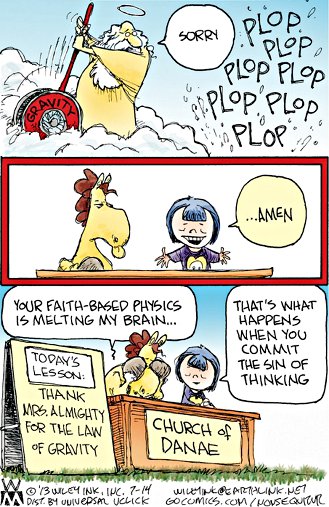
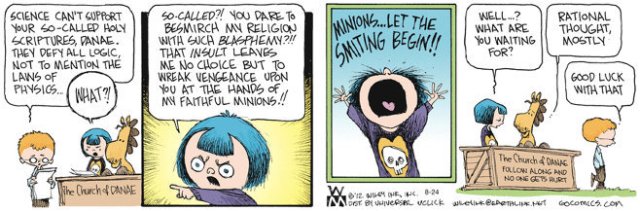
It’s hard to miss their fervent cries that Earth’s climate should remain even as it was before, and ever more should be forever and ever.

So sayeth the experts, may they ever remain anonymous and omniscient, even unto the end of the age, amen.

Oi. If this keeps up, I wonder how many folks will take religion or science seriously a generation from now.

I sympathize a bit with folks who assume that science deals with facts and logic, and that religious folks fear both. But I don’t agree. (May 7, 2017; March 31, 2017)

Sympathizing with folks who believe that science and technology will kill us all? I see their point, almost. But I think they’re also wrong. (May 26, 2017; October 30, 2016)

I’m a Catholic. I take God and faith very seriously.

I take science seriously, too. Real science, not political propaganda with allegedly-scientific trimmings or the weirdness called “creation science.”

Politics hasn’t had the same reputation since Machiavelli’s book hit the best-seller list, the Thirty Years’ War did no one any favors, and that’s yet again another topic. Topics. (July 14, 2017; August 4, 2017; October 28, 2016)

I’d probably be fascinated by science even if I’d never heard of Jesus. I love truth, and learning: including what we are learning about this universe.

I see the virtuous pagans in Thomas More’s Utopia as possible, if hypothetical, examples of what humanity can achieve.

Since I am a Christian, a Catholic, I see faith as a reasoned and conscious embrace of truth. All truth. (Catechism, 142-150, 283, 341)

Pursuing truth will lead me to God, if I’m doing it honestly. (Catechism, 27, 31-35, 74)

Given what I believe, fearing truth or the systematic pursuit of knowledge would be illogical. (May 7, 2017; October 28, 2016)


3. Reality and Options

(From BBC News, used w/o permission.)
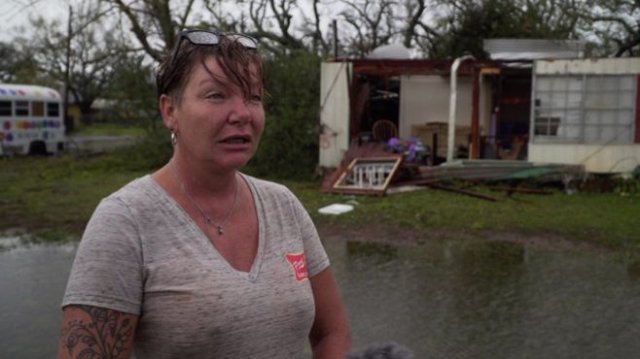
(“Judie McRae did not have the means to flee before the storm struck”
(BBC News))

“Harvey: Too poor to flee the hurricane”
James Cook, BBC News (August 27, 2017)

“In the detritus of Hurricane Harvey a splash of red, white and blue catches the eye.

“It is a rain-sodden American flag, half-hidden under the green leaves of fallen trees.

“A few paces away Judie McRae, 44, is inspecting the damage to her trailer home.

“Judie has lived more than half of her life here but she says this is her first hurricane. She spent it hunkered down in bed, unable to sleep.

“She does not want to see another one….”

This is a BBC News piece that I thought might not have been adequately fact-checked.

I remember the ‘good old days,’ when American culture was shifting from older “poor but honest” assumptions to the current ‘oppressed poor’ notion. I think old and new knee-jerk responses both fall short of reality.

About “poor but honest,” let’s think about it.

Why wouldn’t someone who is poor be more, or less, honest than someone who is rich?

I suspect that someone from an impoverished background would have excuses for dishonesty that didn’t match those of a person born into an affluent family. But they’d both have the same reasons for honoring truth. (Catechism, 2465-2492)

Whether an individual is aware of the underlying reasons for ethical standards is — still another topic.

I don’t have a problem with folks having, or not having, stuff. What matters, I think, is what we do with what we’ve got. (September 25, 2016)

Having lived on both sides of the 50th percentile probably helps.

In any case, money isn’t the problem. It’s love of money. Poverty isn’t a virtue. Detachment is. (1 Timothy 6:10; Hebrews 13:5; Catechism, 2540, 2544)

Where was I? Science, death, Lovecraft, history, truth. Right.

I didn’t dismiss the possibility that folks in this woman’s situation would have trouble evacuating. But I wasn’t going to accept a reporter’s assertion that it was not possible. There were enough facts in the article to get me started.

Comparisons


(From Google Maps, used w/o permission.)

Rockport, Texas, is about twice the size of the town where I live. It’s not a major city, but folks there have access to roads and a marina. It’s not exactly isolated.

Folks in Judie McRae’s neighborhood remind me of folks here. While the reporter was talking to her, someone stopped by. He was checking on one of her neighbors. The man hadn’t, apparently, heard from the neighbor since the storm: and was concerned.

Judie’s neighbor, happily, wasn’t under what was left of his home. Where he was, and whether he survived, I don’t know. I’m pretty sure that folks who know him have either found out by now, or are still searching. Humans can be persistent, if we see a need.

Rockport’s major land connections are paved roads: US-181 S and TX-35 N. The closest town is Taft. It’s a tad smaller than Sauk Centre. Nobody in Taft died when Harvey’s eye went by, but quite a few houses were severely damaged.

Let’s say, though, that someone in Judie’s neighborhood, with her resources, decided that evacuating to Taft was a good idea.

There’s a hurricane coming. If her neighbor has car, motorcycle, or even a bicycle, driving or riding to Taft wouldn’t be hard. During good weather. Taft is about 27.3 miles, 43.9 kilometers. By car, that’s a nice 29 minute trip.

Travel and Weather


(From AFP, via BBC News, used w/o permission.)
(“Rockport has not been destroyed by the storm but it is in bad shape”
(BBC News))

With a hurricane’s outer storm systems in operation, the trip might not be so nice. But it might be possible. In a car or truck.

On a motorcycle? Someone who was sufficiently young, male, and/or risk-loving might think it was worth a shot.

I think the trip would be exhilarating, while it lasted.

On a bicycle? I’m not sure how crazy or desperate someone would have to be.

Quite a bit of the Rockport-to-Taft route is through open country. It’s flat, with nothing but a few road signs to stop the wind.

Climate and proximity to the sea aside, it reminds me of the Red River of the North, where I grew up: good farmland, but breezy.

My guess is that on that sort of road, during a hurricane — being somewhere else would be the best option.

Someone at azcentral.com figured that someone in reasonably good health could walk 26 miles in six to 13 hours. In good weather.

Young and Crazy: But Not That Crazy

Rockport-to-Taft, at the ‘azcentral.com’ rate, would take around six hours and 20 minutes to 16 hours and 50 minutes. Again, in good weather.

That’s a lot of walking, but doable.

During a storm that may become a hurricane before I reach Taft? It’s still doable. Barely. For most folks. Not me. I’m in my mid-60s, with health issues.

Someone in good condition, with life-or-death motivation, and “death” as the most likely result of staying in Rockport, might start walking.

But even at the peak of my ‘young, male, and crazy’ youth, I might have thought taking a 27-mile stroll through open country — in weather that tosses SUVs around and shreds buildings — would be imprudent.

With no vehicle, and Harvey coming, I might think my odds were better in a trailer hunkered under something. Not good, but better.

Doing What We Can

This op-ed, in Monday’s Fortune magazine, made another point about ‘evacuate or stay’ decisions:

“…To evacuate, you also need to have a place to stay. People who do not have family or friends nearby with the space to shelter them and the disposable income to feed them will need to stay in a hotel or live in their cars. They will also need to buy and find a way to cook food, or pay to eat out for an indeterminate length of time….

“…Studies and surveys persistently show that almost half of Americans have not saved enough to cover a $1,000 unplanned emergency such as a hurricane evacuation. Only about 20% could use a credit card to pay for the emergency, and approximately 10% could borrow from friends or family….”
(A. Mechele Dickerson, Fortune (August 28, 2017))

I don’t know how valid the $1,000 cost for self-funded evacuation is. But the basic idea makes sense. Going someplace else takes money. Another factor is employment.

Some of my bosses were reasonable, some weren’t, and some simply couldn’t have kept my job open if I took an unscheduled trip. It’s not a matter of being “fair.” Employers have expenses, needs, and limitations too.

My household has a vehicle with a half-full fuel tank at the moment. We might be able to evacuate if we had to. Provided that our vehicle didn’t end up under a tree.

Someone in or near Rockport has a ton or so of scrap metal that had been a truck before Harvey.

I’ve had times when I was in Judie McRae’s situation:

“…’I had some problems getting out of town, a little broke and stuff, so I had to come home and, you know, tough it out,’ she says. ‘We’re all the working class people.

“‘We’re the ones who go to the restaurants and wait on you and pick up your trash and do all that work. We don’t have a lot of money.’…”
(James Cook, BBC News)

Some Americans have resources that let us build storm-hardened houses. Some of us don’t. Like Rockport and most if not all of America, trailer parks are part of many towns and cities here in Minnesota.

We may be a bit ahead of the game here, thanks in part to our lively weather. We’ve never had a hurricane, but there’s interesting weather in most years.

That encourages a certain situational awareness, and makes planning ahead a more obvious priority. Sometimes legislators get the memo, and do something sensible.

327C – 2016 Minnesota Statutes says, among other things, that trailer parks must have an evacuation plan or shelter. Just as important, the statute says that residents must receive a written copy of the evacuation or shelter procedures.

It’s not a perfect solution, but like I keep saying: this isn’t a perfect world. Not yet.

But we’re working on it. And that’s — another topic:


1 A storm by any other name:

2 Rotating tropical storms:

3 Make that healthy self-respect, the sort of humility that recognizes a person’s own dignity, and humanity’s transcendent dignity. (Catechism, 1700, 1730, 1780, 1929, 2407, 2559, 2546)

Some of my take on humility, dignity, and getting a grip:

Posted in Science News | Tagged , , , , , , | 2 Comments

Harvey Over Texas

Harvey’s in the news, a lot, and probably will be for days.

I noticed stuff piling up in my notes, and decided that getting part of my ‘Friday’ post done early was a good idea.


“Unprecedented?” Maybe


(From David J. Phillip/AP, via KXAN, used w/o permission.)
( “Residents are rescued from their homes surrounded by floodwaters from Tropical Storm Harvey Sunday, Aug. 27, 2017, in Houston, Texas.”
(KXAN))

News reporting generally uses more superlatives than I like.

“Unprecedented” seems to be particularly popular with BBC News editors at the moment.

I don’t mind things being biggest, smallest, newest, or whatever. But I’ve learned to be rationally skeptical when I read that something is the biggest, worst, or most devastating thing of its kind.

Reading that something’s the best is a nice change of pace. But I think being rationally skeptical on those rare occasions is also a good idea. “Good” I’ll readily believe. “Best?” That may be, but I like to learn why it’s considered top-of-the-top rate. Or the worst ever.

It’s not that I think pessimism is cool, or that enjoying stuff is wrong. Gloominess is not next to Godliness, cherophobia is not a virtue, and Carrie Nation did America no favors. My opinion. (July 31, 2016; July 10, 2016)

My memory’s pretty good for events of the last half-century, and I’ve spent some of that time studying history.

Some of the biggest things of their kind exist today. Some of our tech didn’t exist in any form when I was younger.

There are more of us around today than ever before, too. But humans are social critters, so we’ve lived in sizable groups for some time. What’s changing is the size of our groups.

Some of our cities have gotten pretty big. About 37,843,000 folks call Tokyo’s metropolitan area home. American cities aren’t in the top five largest. But New York City is among the top 10, with about 23,723,696 in that city’s urban area.

How many folks live in Houston depends on how you define where the city ends and where the rest of Texas starts.

2,489,558 folks live in the city, 6,490,180 in the Houston metropolitan area, and 4,944,332 in the urban area.

As I said Sunday, lots of folks who live in Texas — including Houston — got in Harvey’s way. So did many who live in nations in or near the Caribbean. (August 27, 2017)


1. Water Over the Dam


(From NOAA, via BBC News, used w/o permission.)

“Houston flood: Addicks dam begins overspill”
BBC News (August 29, 2017)

“A major dam outside Houston has begun spilling over as Storm Harvey pushes the reservoir past capacity, a Texas official says.

“Engineers have tried to prevent nearby communities from being inundated by releasing some of the water held by the Addicks dam.

“But flood control official Jeff Lindner says water levels are now over the height of the reservoir edge.

“Harvey has brought huge floods to Texas and is starting to affect Louisiana….”

Houston got started at Allen’s Landing. That’s where the Buffalo and White Oak Bayous meet. None of the city’s land was ever more than about 90 feet above Galveston Bay.1

Flooding isn’t a new issue for Houston.

That’s what Allen’s Landing looked like after Tropical Storm Allison, in 2001.

George W. Bush was president then.

My guess is that some folks said that dealing with Allison would have been done better if Al Gore had won the election. Others probably felt that Bush was doing a good job.

Many who weren’t being interviewed were most likely helping clean up after the storm. They probably had opinions about the recent election. But most probably realized that dealing with an emergency came before chewing over what might have been.

What’s special about this year is how much of Houston and other parts of Texas are under water. And how much more rain is coming.

Safety, Grandiloquence, Legacy


(From Kuru, USGS; via Wikimedia Commons; used w/o permission.)
(Buffalo Bayou watershed, Houston, Texas.)

The BBC article links to Jeff Linder’s Tweet: “Addicks pool is now at 108.01 ft or at the top of the N spillway,” and two hashtags.

Addicks pool is on Houston’s Buffalo Bayou, part of a water management and flood control system that started in 1938. Water’s being released from Barker Reservoir, too, another part of the system.

I’m pretty sure that someone’s going to complain about the folks in charge deciding let water go past the dams.

I think it’s almost certainly better than letting water spill over the top — and seeing how long it takes the dams to fail. Less dramatic, maybe. But also a great deal safer.

Mr. Linder is a Harris County Flood Control District meteorologist, not a politician. That, and Twitter’s character limit, may explain his terseness.

I think living in the 21st century helps.

Here’s where I could launch into a nostalgic eulogy for those days of yore, when speech was eloquent and exorbitant. Make that extravagant.

I’m not sure how long it would have taken to say that Addicks pool had topped the North spillway in 19th century America.

Even then, I suspect that many wouldn’t have wasted time with excessive verbosity.

My guess is that the most grandiloquent gentleman of the day would, if abruptly confronted with a conflagration of sufficient magnitude, have uttered a remark like “FIRE!”

He might, later, have pondered upon whether it would have been better to preface his remark with a soliloquy on the meaning of life.

Or maybe he’d have realize that erudite references to Prometheus, Hephaestus, and Longfellow’s “The Village Blacksmith” were best left for later.

I strongly suspect that most of us have more common sense than we often use.

I love language, and enjoy playing with arcane terms and convoluted syntax. But I also enjoy writing stuff that’s at least moderately readable.

Which reminds me, as after-dinner speakers say, of something entirely different.

An Oration, by the Honorable Edward Everett, entitled “The Battles of Gettysburg,” was the highlight of a dedication ceremony in 1863.

Everett’s fans weren’t disappointed. The Massachusetts politician, pastor, educator, diplomat, and orator kept going for two hours. More than 150 years later, we still have the text of his oration.

All 13,607 words of it.

The American president was there, too, and talked for about two minutes. Then he sat down. I don’t blame him.

Looking at what happened later, historians figure he was probably coming down with a mild case of smallpox.

What he said, the exact words, aren’t entirely certain.

We’re pretty sure about the first half-dozen: “Four score and seven years ago….”

The event’s program described it as “Dedicatory Remarks.”

Since then we’ve been calling it the Gettysburg Address, and that’s another topic.


2. Houston and America


(From Reuters, via Al Jazeera, used w/o permission.)
(“Some parts of the city of Houston, the fourth biggest US city, was[!] fully submerged in the flooding that followed the storm”
(Al Jazeera))

“Tropical storm Harvey displaces 30,000 in Texas”
Al Jazeera (August 28, 2017)

“More than 30,000 people are expected to be placed in temporary shelters in the US state of Texas due to widespread flooding caused by Tropical Storm Harvey, US officials said, with more rain expected in the coming days….

“…Al Jazeera’s Heidi Zhou-Castro, reporting from Houston, the largest city in Texas, said that in the last 48 hours, emergency agencies have received some 6,000 calls for help.

“She said that between 300 to 400 households are still waiting to be reached by rescuers as of 13:00 GMT on Monday.

“Our correspondent also said that the flooding is expected to rise in some parts of Houston, as authorities are expected to open dam and levies in the area, to ease pressure from continuous rain….”

The nine-county Greater Houston metropolitan area is the second-largest one in Texas, and the biggest metropolitan area on the American Gulf Coast. Small wonder that so much of America’s news is about Houston this week.

Even allowing for civic pride and the Houston Metropolitan Chamber of Commerce’s marketing efforts, Houston looks like a good place to live. Usually.

Right now, I’m not sure that anyone’s particularly thrilled about being there.

I don’t know which part of Houston’s skyline is in that photo’s background, or which part of the city’s roads it shows.

I’m also not sure what the two folks are in. It’s only about five pixels tall. That’s not enough to tell if it’s an improvised raft, or something else.

I’m guessing “something else,” since it seems to be powered, and leaving a wake. I’m also guessing that they’re heading for some of the road equipment, partially submerged nearby.

Something else I don’t know is how many the 30,000 or so folks who must move are from Houston. It’s a big city, but this is a big storm.

One more thing.

Al Jazeera’s Houston correspondent is Heidi Zhou-Castro. She’s an American broadcast journalist.

Her grandparents lived in Beijing, her husband is from Ecuador.

Her name, I think, shows an important facet of American society.

We have — slowly and imperfectly — grown from a collection of English colonies into a more cosmopolitan land. Many Americans today have ‘foreign’ names like O’Toole and Di Vincenzo, Pei and Chandrasekhar. And Zhou-Castro.

I like it, partly because I think we all come out ahead when folks with fresh ideas and enthusiasm move in. Knowing my family history helps. (April 2, 2017)


3. Monday Quarterbacks


(From AFP, via BBC News, used w/o permission.)
(“An estimated 30,000 people are in need of shelter”
(BBC News))

“Storm Harvey: Houston battles ‘unprecedented’ floods”
BBC News (August 28, 2017)

“The US city of Houston is in the grip of the biggest storm in the history of the state of Texas, officials say.

“A record 30in of rain (75cm) has fallen on the city in the wake of Hurricane Harvey, turning roads into rivers.

“The area is expected to have received a year’s rainfall within a week. Five people are reported dead. Helicopters have plucked victims from rooftops.

“With rescue services overstretched as the rain continues, many people are having to fend for themselves….”

“…A city in crisis – James Cook, BBC News, Houston…

“…In at least one neighbourhood facing severe flooding, people are angry that they were told to stay put only to realise, as night fell, that the waters were rising fast and they could not get out….”

My guess is that at least some folks living in neighborhoods that got isolated by flood waters are angry. That’s understandable. I’d probably be upset, too.

There may be a few preternaturally calm folks in Houston today.

I don’t think I’d be one of them. I’m a very emotional man. But being uncalm isn’t, I think, an excuse for handing executive control over to my emotions.

Philippians 4:4, 6–8 is good advice. Anxiety isn’t a good idea, rejoicing is.

We’ve got brains, and should use them. The trick is remembering that emotions happen — but what matters is what we think, decide, and do. (Catechism of the Catholic Church, 1767–1770, 1777–1782)

Faith depends on what I think, not how I feel. (Catechism, 30, 142–150, 156–159, 274, 1706)

Now, back to Houston. I live near the other end of the Mississippi basin, on a sandy ridge. We’ve even been having sunny days this week.

Being calm about what’s happening in Houston is pretty easy. For me.

That lets me stop, think, and do a little checking.

Sure enough, most folks in Houston were told to stay where they were. It’s quite possible that some of the millions of folks realized that it’s bad advice. For them.

But I’m not ready to heap abuse on Houston’s authorities.

Evacuations


(From AFP, Reuters, via BBC News, used w/o permission.)
(Texans and the Coast Guard dealing with Harvey.)

Let’s think about this. Imagine that Sunday afternoon, or Sunday evening, Houston’s mayor — or some other official — had said “evacuate the city.”

Even without an inspiring quote like “cowards die many times before their deaths; the valiant never taste of death but once;” I think some Houstonians wouldn’t have been complaining on Monday.

They’d be dead. Survivors would be furious. Or maybe icily calm. In the mayor’s position, I might worry most about the outwardly-calm ones.

America has pretty good roads, many of us own or have access to motorized vehicles. Putting many miles behind us in a few hours generally isn’t hard. Not when we’re doing it as individuals or small groups.

When a lot of us are trying to do the same thing, at the same time, on the same roads, it’s a different story.

Urban transportation networks are notoriously frustrating during rush hour.

The traffic snarls may have gotten less tangled after 2008, when American employment dropped from about 63% of the working-age population to a tad under 59%. Those good times, from a traffic congestion viewpoint, didn’t last. The percentage of employed folks is going back up.

That’s still only about thirds of the population who are on the road: mostly trying to get from one place in a city to somewhere else fairly nearby. On a road network designed to handle the daily commute.

Let’s say that an evacuation order came, and everyone in a city was trying to get out. At the same time. Over roads designed to handle smaller loads. Multiply that by the number of cities and towns in a region.

I think evacuations can work. I also think that they take very careful planning. Even under ideal conditions, it’s not going to be easy. Or, often, safe.

Remembering

In fairness, only about a hundred of the couple million folks trying to evacuate coastal Texas in 2005 died in the process.2

Hurricane Rita was coming, and authorities thought their evacuation plans were adequate. As it turns out, they were wrong.

Since they’d been told to flee, many folks were on the road: stuck in traffic, where gridlock and heat caught up with them.

Only a fraction of one percent of the evacuees died that way, but I don’t think many folks call the evacuation a success. I figure that folks running Texan cities have reviewed and revised their evacuation plans since then.

I’m also pretty sure that Houston authorities know what happened in 2005, and aren’t eager to make the same decisions.

Based on what I’ve read, and remember from past well-intentioned efforts, I’m inclined to agree with Dickerson’s and Marshall’s op-eds.

Given what they most likely knew at the time, the folks making decisions in Houston were making sense.

I don’t always agree with folks in authority. But I realize that we get things done better if there’s someone in charge. The trick has always been trying to find someone who’s good at the job, and working for the common good. (Catechism, 1897–1917, 1954–1960)


4. “…Ready to Save Neighbors….”


(From David J. Phillip, The Associated Press; via The Denver Post, used w/o permission.)
(“Residents wade through floodwaters from Tropical Storm Harvey Sunday, Aug. 27, 2017, in Houston, Texas.”
(The Denver Post))

“FEMA director says Harvey is probably the worst disaster in Texas history”
Joel Achenbach, Washington Post, via The Denver Post (August 27, 2017)

“…[FEMA director William ‘Brock’] Long has spoken of the need for a sea change in how the country prepares for disasters, noting that the federal government alone can’t always save the day. Ordinary citizens need to be prepared to be first responders, Long said. They need to have personal emergency plans. They need to be able to feed themselves for several days if disaster strikes. They need to be ready to save neighbors in harm’s way….”

I think director Long is right. We can’t count on ‘the government’ to do everything. I also think government agencies can and should do what they can to help folks recover from natural disasters. (August 27, 2017)

Folks who aren’t part of a government can help neighbors, too. I mentioned these outfits before:

Cooperation: A Small Example

The rural Minnesota town I call home isn’t perfect, but I think we’re a pretty good example of how folks can respond.

I’ll grant that Minnesota’s climate helps us.

We’ll occasionally get a year without a major winter or summer storm. But the lively weather here encourages us to build structures designed for high winds, heavy snow: pretty much anything short of a direct hit by a tornado.

Many of us also maintain equipment that helps us make do until snow plows or emergency crews get to where we live. A few folks in my neighborhood either maintain powered snow removal equipment, or know someone who does.

The city crews do a good job of digging the town services out after winter storms. But in a pinch we could do that, too.

Not that we get hurricane-level weather here. About the worst we’ve had recently was a summer storm in 2011.

Neighbors were cutting downed trees into truckload-size pieces and clearing debris, almost as soon as the sky cleared. We started hauling it away as soon as we heard where a municipal dump site had been set up.

Like I said, we’re not perfect. Not even close. But we do know how to cooperate, and help each other. I think most — make that nearly all — folks can, once we get the idea.

Folks living in a city of several million couldn’t act exactly as we do: and shouldn’t. Whether there’s a few thousand or a few million folks living nearby makes a difference.

But the basics: cooperation, being prepared, and keeping calm? That, I think, is possible anywhere.

It’s not always easy, but it is possible.

More of how I see living as if neighbors matter:


1 Houston:

2 2005:

Posted in Being a Citizen, Science News | Tagged , , , , , , , | 2 Comments

Hurricane Harvey

Harvey was still a tropical storm when it went over the eastern Caribbean. That was a little over a week ago.

Folks in Barbados were without power for a while. At least one house was destroyed, and more folks had to evacuate their homes.

Pretty much the same thing happened in Saint Vincent and the Grenadines. Suriname and Guyana had wind and rain: enough to kill at least one person, a woman whose house collapsed with her inside.

Harvey was a category 4 hurricane when it reached the Texas coast, between Port Aransas and Port O’Connor. That was around 10:00 p.m. Friday.

By noon Saturday, about 230,000 utility customers in Texas had no power.1

Harvey’s a tropical storm now, shedding water on Texas.

Folks between Corpus Christi, San Antonio, and Houston will probably get over 20 inches of rain in the next few days.

“…While Harvey’s winds are decreasing, life-threatening hazards will continue from heavy rainfall over much of southeastern Texas and from storm surge along portions of the Texas coast….”
(“Tropical Storm Harvey Forecast Discussion” National Hurricane Center, NOAA (4:00 p.m. CDT Saturday, August 26, 2017))

My guess is that most Texans are better able to deal with Harvey than many folks in the smaller Caribbean nations.

This storm won’t be easy on anyone who gets in its way.

Texas authorities confirmed that one person is dead. A man in Rockport, Texas, was not able to leave his house. It burned during the storm.

Other deaths may be confirmed, as teams sift through debris. Many folks survived, but have no place to live.

‘Lost everything’ is serious, no matter how much or how little someone has.

No pressure, but some will need help.

That’s true even in nice weather, and even in America.

There are a great many outfits working with folks who need help. And a few, sadly, out to make a quick buck from folks who feel charitable but aren’t careful.

CRS, Catholic Relief Services, isn’t the only legitimate philanthropic operation. But I think they’re worth mentioning:

CRS, by the way, helps anyone who needs it. As their mission statement says, their job is “to assist people on the basis of need, not creed, race or nationality.”

There’s more to charity than charitable giving, and that’s another topic. (Catechism of the Catholic Church, 1822–1829)

Storm News and Views


(From Hurricane Center, NOAA, used w/o permission.)
(Five-day wind speed forecast; Friday morning, August 25, 2017)

Most of American ‘storm’ news focuses on the Texas coast. That’s understandable. Texas is closer to home than Barbados or Suriname for most Americans. It’s home for a fair number of us.

Editorial styles vary, of course, since news outlets cater to a broad range of tastes. So does what they cover.

Some of storm-related entertainment news was remarkably trivial: for folks who aren’t “Game of Thrones” fans.

But I realize that life goes on, trivia and all. So, I think, does possibly-unintentional humor:

Atkin’s op-ed had another headline in New Republic. The N.R. headline Harvey “Scary and Unprecedented.” The Mother Jones headline is not entirely hyperbole.

Each tropical storm in the Atlantic has a unique history: just like Harvey. Atkin discusses some of Harvey’s highlights before approaching Texas.

A few tropical storms form in the southern Atlantic. Strong wind shear almost always keeps them from developing into hurricanes. There’s been one exception since we started keeping records of that area: Catrina in 2004.

Texas Disaster Declaration


(From Texas State Government, used w/o permission.)
(Texas counties declared disaster areas; August 25, 2017)

The United States is a big country, with quite a few states bordering the Gulf of Mexico and Atlantic. Hurricanes affect at least a few Americans every year. What’s unusual about Harvey is that it’s among the stronger hurricanes we’ve dealt with.

That’s probably one reason that Texas Governor Gregg Abbott sent a letter to the U.S. President and FEMA on Friday. I gather that it’s a formal request for help. He said that what’s coming “is beyond the capabilities of the state and affected local governments.”

This isn’t a ‘political’ blog, so I won’t say that he shouldn’t have asked for help. Or shouldn’t have sent the letter yet. Or didn’t send it soon enough. Or that he did the right thing, and anyone who says otherwise is stupid. Or worse.

I figure maybe he’s right. It’s a hard decision.

I’m also quite sure that local, state, and national governments should help folks recover from natural disasters. One of the reasons we have governments is to help folks who need it. It’s one way we can all work for the common good. (Catechism, 1899, 1903, 1905–1912)

Ideally, every state would have funds and equipment ready for every possible disaster. We don’t live in an ideal world. That, I think, is why the Texan governor asked for help.

I’m glad that America is big enough so that if a disaster hits one area, the rest will probably be able to pitch in. Very ideally, we’d have a system like that in place globally.

Meanwhile, like I said, there are outfits like Catholic Relief Services.

BBC News says the last hurricane this big and affecting a mainland state was Wilma in 2005. They have a point, although Katrina, the same year, was one of the five deadliest.2

Katrina wasn’t the worse in terms of death and destruction, though. That was the 1900 Galveston hurricane.

Learning, Sometimes the Hard Way


(From Library of Congress, via Wikimedia Commons, used w/o permission.)
(What was left of St. Lucas Terrace, left; and St. Patrick’s church, right; Galveston, 1900.)

We don’t know how many Americans died because of the September, 1900, hurricane.

Estimates range from 6,000 to 12,000. It’s still the worst natural disaster we’ve had since 1776, in terms of lives lost. The 1811-1812 New Madrid earthquakes were remarkable for other reasons.3

What we call the Great Galveston Hurricane was a tropical storm when the National Weather Service heard that a tropical storm was over Cuba and heading north. That was September 4, 1900.

The Washington, D.C., office told their Galveston office. The Galveston office didn’t issue a hurricane warning.

That’s partly because the Weather Bureau didn’t like using words like “tornado” or “hurricane” back then. They didn’t want to panic the public. The policy changed after we found out why so many folks died during the June 7-9, 1953, storms. (August 11, 2017)

Forecasters in Washington didn’t know which way the storm would go next. Weather forecasting was an emerging science in 1900. (August 11, 2017)

Washington officials figured it’d probably do what many storms do: head northeast, along the east coast. Cuban forecasters emphatically said their predictions showed the storm heading west.

A few folks in Galveston headed inland. Maybe they’d learned about the Cuban forecast, or had noticed growing swells. Or maybe they’d talked to sailors whose ships had weathered the storm. Rain clouds reached Galveston mid-morning, September 5.

Galveston’s weather office raised their Hurricane Flag on the morning of September 7.

The storm hit about 24 hours later.

The storm’s surge reached 15 feet, 4.6 meters. Galveston was built on an island that was at most 8 feet, 2.4 meters, tall.

Buildings collapsed, people died.

We don’t know what the maximum wind speed was. The Weather Bureau’s anemometer in Galveston recorded 100 mile an hour winds just before it was destroyed.

Survivors rebuilt Galveston: raising the island by 17 feet, 5.2 meters. With a seawall.

One reason I’m cautiously hopeful about humanity’s future is that we learn. Sometimes the hard way, and slowly. But we do learn. (July 21, 2017; July 14, 2017; October 16, 2016)

‘Let the Smiting Begin?!’

I see Non Sequitur’s ‘Church of Danae’ strips as occasionally-grim humor. I might be offended if I thought they were attacking my faith. (August 23, 2017)

But I’m a Christian, a Catholic. I recognize Danae’s theology as a facet of American culture, viewed in a fun house mirror.

It lampoons a sort of religious belief that many still cherish.

I like to think the ‘angry God’ folks are less influential these days. (August 25, 2017; March 5, 2017)

My guess is that someone who feels that sinners should be smited regularly — or is that smitten? Never mind.

Anyway, someone will likely claim that Harvey is a judgement of God upon sinful folks who aren’t like the speaker.

That happened back in 2005. “Katrina: God’s Judgment on America” was an anonymous bit of preaching on beliefnet.

The 2005 writer had a point, sort of. Gulf Coast America wasn’t what it had been in 1955.

Quite a few folks were probably offended by “the burgeoning Gulf Coast gambling industry.” They’d probably also disapprove of “the 34th Annual gay, lesbian and transgender Southern Decadence Labor Day gala.”

The notion that disaster and disease happen because God is upset with someone else works for some propaganda.

That doesn’t make it a good idea.

The notion that God is upset at something the audience likes probably lacks appeal, and that’s yet another topic.

Maybe the anonymous writer was right. Maybe “…Katrina was an act of God upon a sin-loving and rebellious nation….”

I don’t know. I don’t have inside information from God.

The ‘angry God’ scenario seems dubious, though.

Getting back to Hurricane Harvey, I don’t think folks living between Port Aransas and Port O’Connor were particularly wicked sinners.

On the other hand, pirates used the Port Aransas area in the early 1800s. I suppose someone could claim that God is finally getting around to punishing them — by hurting folks living in the same area, nearly two centuries later.

Or maybe they’re being whacked for something the Karankawa Indians did, before the pirates came.

No, I do not think so. The notion that God hold grudges, but procrastinates, is — silly, putting it mildly.

Maybe I shouldn’t joke about this. A fellow who’s been famous for being a particular sort of Christian made a similar claim about Haiti a few years back.

That sort of thing leaves an impression. Not a peasant one, I think.

I see Katrina, and Harvey, as natural disasters. I think folks affected by them need help. Or at least respectful sympathy. Not ‘judgment of God’ preaching.

One more thing, a bit of good sense I read on Twitter:

God bless Texas. #HurricaneHarvey pic.twitter.com/idl6MEB89a
— Judy Bowman (@tiberjudy) August 25, 2017

The Siloam Lesson

Don’t misunderstand me. I take God quite seriously. Folks who seem convinced that God promotes their personal views, not so much.

I see Jonathan Edwards wannabes and disciples of Ussher as embarrassing relics. I think they are sincere. But I can’t take their beliefs seriously, apart from the influence they still hold. (June 30, 2017; May 5, 2017; March 31, 2017; March 5, 2017)

I think sin exists, which does not mean that I think folks who do things I don’t enjoy are dreadful sinners.

When I deliberately do something that makes no sense, hurting myself or someone else, I offend reason and truth; and God. That’s a sin. (Catechism, 1849–1850)

I don’t consistently do what I know is good for me and avoid what’s bad, so I’m a sinner. (Catechism, 1706, 1776, 1955)

Sin is what happens whenever I don’t love God and my neighbor, and act as if everyone is my neighbor. (Matthew 5:43–44, 22:36–40; Mark 12:28–31; Luke 6:31 10:25–27, 29–37; Catechism, 1825)

I think sin is a bad idea, and that I should keep learning to avoid it.

Events like Hurricane Harvey can be useful reminders that I’ve got limited time to work out my salvation, as Philippians 2:12 says. Not that I can work or pray my way into Heaven. (April 9, 2017; December 4, 2016)

That doesn’t mean I think I’m a particularly wicked sinner, any more than I think folks in Texas irked an irritable God. I figure it’s like Jesus said:

“‘Or those eighteen people who were killed when the tower at Siloam fell on them—do you think they were more guilty than everyone else who lived in Jerusalem?'”
(Luke 13:4)

More, mostly about cautious optimism; and acting as if people aren’t perfect — but matter, anyway:


1 Harvey and a weather resource:

2 Hurricanes and America:

3 Assorted American disasters:

Posted in Being Catholic | Tagged , , , , , , | Leave a comment