Climate Change, Attitudes

I’ll be talking about Earth’s climate, China’s pollution problems, and icebergs: including one the size of Delaware. The big berg broke off from Antarctica this week.

The recent G20 meeting was mostly about economics, not climate change; but that didn’t deter the usual colorful protesters.

I’m not complaining about folks at the fancy-dress street party in Hamburg. If nothing else, they added a touch of human interest to an otherwise-dry international business meeting.

This week’s ‘science news’ post is even more — alternatively-linear? — than most. This list of headings may help you find what’s interesting. Or maybe not:


Global Warming, Climate Change, and Opportunities

If some of this month’s news seems familiar, maybe you’re remembering the 2015 United Nations Climate Change Conference in Paris.

This time around the event is a G20 meeting, but the bells and whistles are pretty much the same.

There’s a bit of overlap in the topics discussed. More about that later.

News coverage of the 2015 Paris conference ranged from the usual hysterics to comparatively calm reporting. This piece, from Reuters, even included some numbers:

EU ministers seek ambitious, binding deal at Paris climate talks: draft
Barbara Lewis, Reuters (June 25, 2015)

“European Union ministers are seeking an ambitious, durable and legally binding deal to curb global warming, enforced through five-yearly reviews, a draft of their position statement for U.N. climate talks shows….

“…It calls for five-yearly reviews to ensure temperature rises are capped at 2 degrees Celsius, the necessary limit according to scientists to prevent the most devastating climate change….”

For me, one of the more interesting things about the Reuters article was Barbara Lewis using the phrases “global warming” and “climate change.” Before then, I’m pretty sure that “global warming” would have been the crisis du jour’s sole moniker.

Updating the slogan is progress of a sort. I’d like to see an upgrade in assumptions otherwise-smart folks make about the issue: on both/all sides.

That sort of thing takes time; generations, sometimes. So I’ll use this as an opportunity to cultivate patience. And, of course, to talk about climate change, stewardship, and why I think using our brains makes sense.

About the “five-yearly reviews:” I think periodic monitoring of global conditions is a good idea.

If done sensibly, that should help us deal with existing issues, and keep new problems from getting out of hand.

Part of our job is ‘cultivating’ this world, keeping our home in good working order. (Genesis 1:2629, 2:15; Catechism of the Catholic Church, 339, 952, 24022405, 2456)

It’s not a new idea:

“The LORD God then took the man and settled him in the garden of Eden, to cultivate and care for it.”
(Genesis 2:15)

I’ve talked about Genesis, clay, and getting a grip, before. (July 15, 2016)

I am a Christian and realize that we’ve learned a bit in the thirty or so centuries since parts of the Bible were written. (March 31, 2017; August 28, 2016)

I don’t expect to find detailed ‘how to’ discussions of the Corex Process in Genesis, or whatever tech we’ll be using in the 52nd century. God gave us brains, pretty good ones. Using them makes sense. (June 16, 2017; November 18, 2016; August 5, 2016)

Again, monitoring Earth’s environment regularly is a good idea. Like it or not, we have been affecting conditions here.

Happily, systems like NASA’s GOES and ISRO’s environmental satellites make data collection practical. Even better, as I see it, we can get objective data — not official reports which may have been edited by local, regional, or national authorities.

Assuming that we can set Earth’s thermostat? I think we may develop that tech well before the 52nd century. Today? We’re not there yet.

Learning the Right Lessons

I was — impressed — at the European Union’s decision that Earth’s average temperature would rise no more than two degrees Celsius, presumably over a five-year period.

It’s likely enough that we’ll eventually regulate Earth’s temperature with that sort of precision.

We’ve learned a bit about how Earth’s weather and climate work. We’ve even learned how to affect storms.

I think experiments in the early 1970s suggest that we don’t know quite how to control storms. Not yet.

Affecting local and regional storm systems seems like a first step in global climate control. I think it’s very likely that we will, given time, develop technology that lets us fine-tune our home’s environment.

Human nature being what it is, I’m pretty sure that we will begin managing Earth’s climate wisely somewhat later.

We may also learn, again, why some field tests should be on a planet where folks aren’t living. I’ll grant that we’re still not sure about the Black Hills Flood of 1972. (May 26, 2017)

The lesson of disasters like the Great Famine of 1315-17, London’s 1666 fire, Aberfan, and Fukushima Daiichi system failures, is not that technology is evil.

I’m quite sure God didn’t intend humanity to live by gathering berries and stalking aardvarks and warthogs. Not permanently. I’m also sure that developing agriculture and antibiotics wasn’t a mistake.

Like anything else we do, growing crops works better when we think ahead. The same goes for building cities and nuclear reactors.

We’re rational creatures whose nature includes curiosity. We’re supposed to notice the world’s beauty and order, learn its laws, and use that knowledge: wisely. (Catechism, 16, 341, 373, 1704, 17301731, 2293)

We don’t own this world. We’re more like stewards or foremen. Managing this world is part of our job. Using its resources and preparing for future generations, within reason, is a good idea. (Catechism, 24152418, 2456)

Change Happens

About the 2015 Paris climate talks, I think they were a good idea. Basically.

I’d better explain that.

I think Earth’s climate is changing.

Believing that Earth’s climate hasn’t changed, never changes, and won’t change, doesn’t match what we’ve been learning. (June 30, 2017; May 19, 2017; January 20, 2017)

I don’t “believe in” climate change. Not in the sense that I put it at the top of my priorities, or see it as my reason for living. That would be a bad idea. (Catechism, 21122114)

I don’t “believe in” an unchanging climate, either; for the same reasons.

Some folks apparently don’t like the idea of a changing climate. I don’t think that alters the objective reality we’re in.

I’m no more impressed by liberals who act as if their education was based on the works of Ehrlich, as interpreted by disciples of Malthus. (May 12, 2017; January 20, 2017)

Youthful Ideals

I don’t doubt the sincerity of ‘save the whatever’ folks, or their ‘back to the good old days’ counterparts.

But I do not agree with them. Not entirely.

Ignoring both/all sides of the ‘climate change’ sound and fury isn’t an option. Even if I thought the issue was a complete fabrication, many folks take it seriously.

That makes it a factor in today’s world.

Contributing to the good of society and taking part in public life is part of my faith, even if I’d rather keep my distance. (Catechism, 1915, 2239)

Besides, I never lost youthful ideals I developed in the 60s. Or a strong preference for attitudes that make sense.

Holding ideals that make sense takes a little work, but I think it’s worth the effort.

‘Lords of Creation?’

Maybe the folks in those penguin costumes thought the Paris goals were too small.

Some other folks probably think they’re too big, and that the Paris talks were a waste of time: or worse.

I’ve decided to see the 2015 climate conference as mostly good news. It’ll be even better if the various national leaders follow through on their promises.

There’s some reason to hope that the rhetoric wasn’t entirely empty. There’s been progress in the last several decades.

European industry’s contribution to Earth’s atmospheric fug peaked in 1979, and has been declining since. Those are ‘good old days’ I certainly don’t yearn for.

The 2015 Reuters article said that Europe’s industrial pollution was about 10 percent of the world’s total. China was the world’s champ in that area, at 25 percent. That’s not an enviable distinction.

If everyone follows through, Earth’s air should be cleaner in a few decades. Like I said: good news.

Deciding that Earth’s temperature will go up no more than some set amount? That seems to involve some whacking great assumptions.

The biggest of the lot, I think, is that everything on this planet happens because humans are here: or at least everything that’s changing. That smacks of the old ‘lords of creation’ attitude that got us into this mess to begin with.

We’re pretty hot stuff: but we’re not that hot. (March 26, 2017; January 20, 2017)


1. Fancy Dress at G20


(From Getty Images, via BBC News, used w/o permission.)
(“Many of the protesters in Hamburg were demonstrating against Donald Trump’s position on climate change”
(BBC News))

G20 Hamburg: Leaders fail to bridge Trump climate chasm
BBC News (July 8, 2017)

Leaders of 19 nations at the G20 summit in Germany have renewed their pledge to implement the Paris deal on climate change, despite the US pulling out.

“Deadlock over the issue had held up the last day of talks in Hamburg but a final agreement was eventually reached.

“It acknowledges President Donald Trump’s withdrawal from the Paris climate agreement without undermining the commitment of other countries….”

I’m not sure why events like the 2015 climate talks and the 2017 G20 Hamburg summit inspire protests in fancy dress.

Maybe it’s a European thing.

Likely enough, the idea is to get a photographer’s attention.

The ‘coal kills” set got international coverage by dressing as angels at the Place de la République in 2015. I suppose there’s a certain publicity value in costumes.

There’s no small amount of theater involved in politics. A candidate drove a tractor into a political convention I was at, quite a few years back.

Nothing wrong with theater, provided that there’s substance, too.

Dancing Cigarette Packs

The (dancing?) globe performer in this year’s photo op was entertaining. I’m not sure how we’re supposed to respond.

Maybe there’s a slogan on the Pacific Ocean. Or maybe the point is to attract attention to the stage, and the message came later.

The demonstrator’s costume and pose reminded me of old ‘dancing objects’ commercials. I think that Old Gold carton and matchbook are from the 1950s.

We don’t see that sort of thing any more. Partly because the powers that be decided that cigarette and beer commercials are bad for us. Partly because advertising gimmicks change as years go by.

The G20 summit isn’t about climate change, by the way, or President Trump.

Sustainable Development and G20


(From BBC News, used w/o permission.)
(“Police and anti-summit protesters clashed for a second day”
(BBC News))

G20, or Group of 20, is a get-together of brass from the top 20 governments and banks.1

Folks who don’t like governments and banks generally show up to protest. I don’t know how they feel, getting upstaged by the ‘save us from Trump’ bunch.

Anyway, this time around G20 will be talking about inclusive growth. They’re for it, apparently. That makes sense to me. I figure anyone with business interests would want as many comparatively-wealthy customers, clients, and partners as possible.

G20 will also discuss how to make the 2030 Agenda for Sustainable Development work. That’s probably a ‘Trump’ connection. There’s a mess of other topics on the table, too.

About sustainable development, I see it as a basically good idea. Fossil fuel shortages aren’t a crisis yet, but we’re burning through a finite supply.

Besides, we’ve learned that combustion products are bothersome; or worse.

I could do with a great deal more common sense in sustainable development’s details. But the basic idea, acting as if future generations matter? That, to me, makes sense.


2. “We’ll Always Have Paris”


(From AFP, via BBC News, used w/o permission.)
(“How will Mrs Merkel manoeuvre around Mr Trump?”
(BBC News))

G20: Merkel’s mission is to co-opt Saudis and Russia to embarrass US
Roger Harrabin, op-ed, BBC News (July 7, 2017)

German Chancellor Angela Merkel is battling to prevent US President Donald Trump undermining the world leaders’ united front on climate change.

“At the Paris climate deal, all world leaders spoke in favour of limiting global temperature rise to 2 degrees but that was after a massive diplomatic effort by President Barack Obama made membership of the climate club a moral imperative.

“He and the French hosts created such an atmosphere that even the normally foot-dragging Russians and Saudis committed to the deal, despite their long history of slowing progress in climate negotiations behind the scenes.

“They own vast fossil fuel reserves of oil and gas and fear they will stand to lose if the world shifts away from fossil fuels.

“Many a UN climate conference has drawn to a semi-successful close, only for the chair to wearily announce ‘objection from Saudi Arabia’.

“The task for Chancellor Merkel and her allies is to bind these two nervous bedfellows into the great climate alliance between the EU and China, leaving the US looking out of touch….”

Even if the Paris climate deal2 is as successful in its way as “Casablanca,” I suspect it won’t be as well-remembered as the 1943 film.

On the other hand, the Paris deal has memorable elements.

Two American presidents involved, Obama and Trump, are both colorful.

That’ll help folks recognize the names in the 2090s. So will America’s role in today’s world. Like it or not, America is a major player these days.

Look at it this way: you may remember that Franklin D. Roosevelt was president in 1943. But unless you’re Bulgarian, you may not remember Simeon Sakskoburggotski. He’s the last Bulgarian Tsar.

His father, the second-to-last Tsar, was arrested a few days after Stalin declared war on Bulgaria. He was executed a few months later, along with quite a few other troublesome folks. That was in 1943. Simeon was six at the time. A referendum voted him out in 1946.

I suppose someone may have wondered about the 97% approval vote for Bulgaria’s new regime. But with the Soviet army hanging around, I’m not surprised at its acceptance.

Simeon went into exile, and became Cadet Rylski No. 6883 at Valley Forge Military Academy and College. After a few decades of assorted education and career moves, he returned to Bulgaria and served as Prime Minister from 2001 to 2005.

Simeon’s experiences make a dramatic story. But I’m guessing that most Americans know more about “Casablanca’s” plot than his biography.

That’s not a criticism of Americans. It does, I think, tell something about what gets remembered, and why.

Bulgarian Backgrounder

Bulgaria is currently one of those places that don’t often make the headlines.

This isn’t the heyday of the Odrysian kingdom. That was between Plato’s time and the Vikram Samvat’s first year.

Old Great Bulgaria was a big deal in its day, too, but few folks west of the Avar Khaganate — where today’s Hungary and Romania are, more or less — remember the great Kahns now.

The First and Second Bulgarian Empires lasted a bit over three and two centuries, respectively. That era ended around the time the Kalmar Union started, when Chaucer was writing “Canterbury Tales.”

A thousand years from now, Bulgaria could be as important as Indonesia is today. As I keep saying, change happens.

I’ve drifted off-topic again. Where was I? G20 summit, Barrak Obama, Bogart, Bulgaria. Right.

Opinions

Roger Harrabin’s op-ed credits President Obama with getting “all world leaders” to support “limiting global temperature rise to 2 degrees.”

That’s accurate, to an extent.

Mr. Harrabin may or may not be right about the German chancellor trying to keep President Trump from sullying President Obama’s “moral imperative.” I figure results of this G20 meeting will be praised, vilified, and — occasionally — discussed until the next meeting.

About Obama and the 2015 Paris talks, he was there. He probably affected the outcome. I’d be surprised if he hadn’t.

Quite a few top leaders said they’d keep Earth from getting more than two degrees Centigrade warmer. As I said before, I don’t see that as something to preen over.

I don’t know about “all,” but let’s say Mr. Harrabin meant ‘all the ones who matter.’ That agrees with what I’ve read.

The two degree declaration wasn’t the only result from Paris.

Europe’s leaders said they’d cut emissions by 40 percent — at least — compared to 1990 levels. Their target date was 2030. That was probably carbon dioxide emissions, but I figure dialing back any industrial effluvia is probably a good idea.

Carbon dioxide is one of the top four ‘greenhouse gasses’ Earth’s atmosphere. I talked about that, and laughing gas, last week. (July 7, 2017)

Water vapor is a greenhouse gas, too. Oddly enough, I haven’t read a thing about efforts to regulate it. That doesn’t bother me.

I figure we’ll be better off if we learn much more about how much carbon dioxide, water, and all the rest, “should” be in Earth’s atmosphere — before we start tinkering with the controls.


3. Chilling News


(From M.Hoppmann/AWI, via BBC News, used w/o permission.)
(“Iceberg names follow a convention that uses a letter followed by a number”
(BBC News))

Antarctic iceberg: Giant ‘white wanderer’ poised to break free
Jonathan Amos, BBC News (July 5, 2017)

Everybody is fascinated by icebergs. The idea that you can have blocks of frozen water the size of cities, and bigger, sparks our sense of wonder.

“British astronaut Tim Peake photographed one from orbit that would just about fit inside Central London’s ring road. But at 26km by 13km (16 miles by 8 miles), it was a tiddler compared with the berg that is about to break away from the eastern side of the Antarctic Peninsula.

“A rift has grown across the edge of the Larsen C Ice Shelf. A thin, 5km-long section of the floating shelf is now all that prevents a 6,000-sq-km berg from drifting away into the Weddell Sea….”

I’ve talked about the Larsen C Ice Shelf and the Halley VI research station before. (February 17, 2017; January 20, 2017)

The last I heard, Halley VI’s planned move ended in February.

Folks with the British Antarctic Survey, BAS, decided to wait until the Antarctic winter ends before moving back in. That’ll happen in November, barring unforeseen events.

The Larsen C Ice Shelf crack that’s been in the news lately started a long time ago. But it’s nobody’s fault.

That may not be what you’ve read in the papers.

A Silly Response to Silliness

Picking up bits and pieces I’ve seen here and there — naming no sources, I’m acting like a journalist for once. The more colorful sort, not one who bothers about fiddly facts.

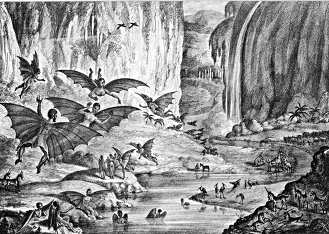
Now, in the tradition of the Great Moon Hoax and supermarket tabloids —

Atlantic ocean temperatures have been increasing since the late 1940s. Former president Franklin D. Roosevelt remains unavailable for comment.

Sources close to the White House confirm that President Harry S. Truman allowed development of thermonuclear weapons and continued use of coal-burning electric generators. Truman did not, however, authorize clean-running fusion power plants.

Keep going like that, and I might get an ‘impeach Truman’ initiative started. Some folks might forget that he died in 1953.

Or did he? Someone started the Harry S. Truman Scholarship in 1975. Suspicious!

Sorry about that. What’s sad is that the last few paragraphs aren’t all that different from what I see in the silly side of the news.

The point I had in mind is that the Larsen C crack has been growing for decades. What’s new is that a huge iceberg broke free as a result. That happened Wednesday, July 12, 2017.

As an NPR piece pointed out in January, bits of ice shelf have been breaking off for a long time. It’s a natural phenomenon.

For me, it’s also an opportunity to talk about icebergs.

Look Out Atlantic, Here It Comes!


(From NASA/SUOMI NPP/SIMON PROUD, via BBC News, used w/o permission.)
(“This view of the iceberg was taken by Nasa’s Suomi NPP satellite”
(BBC News))

Giant iceberg splits from Antarctic
Jonathan Amos, BBC News (July 12, 2017)

One of the biggest icebergs ever recorded has just broken away from Antarctica.

“The giant block is estimated to cover an area of roughly 6,000 sq km; that’s about a quarter the size of Wales….”

That’s a big bit of ice. Not the biggest ever, though, or even the biggest we know of.

“…The new Larsen berg is probably in the top 10 biggest ever recorded.

“The largest observed in the satellite era was an object called B-15. It came away from the Ross Ice Shelf in 2000 and measured some 11,000 sq km. Six years later, fragments of this super-berg still persisted and passed by New Zealand.

“In 1956, it was reported that a US Navy icebreaker had encountered an object of roughly 32,000 sq km. That is bigger than Belgium. Unfortunately, there were no satellites at the time to follow up and verify the observation….”
(Jonathan Amos, BBC News)

The Wikipedia page about Iceberg B-15 says “Iceberg B-15 was the world’s largest recorded iceberg….”

Astute readers will check Wikipedia’s footnote and see “…the largest iceberg recorded by satellite photography….”

The rest of the footnote mentions the 1956 sighting, and adds that since satellite photography wasn’t available then, estimates about the berg are “less reliable.”

Fair enough. And that’s why I read footnotes.3

About the Larsen-C iceberg — BBC is British, so they use British comparisons. This berg is about a quarter the size of Wales. Since I’m an American, I’ll say it’s roughly the size of Delaware. Either way, it’s big.

I gather that the berg’s official designation is iceberg A68. That’s not a particularly catchy name, so I’ll suggest a few: Big Bergy; Iceland South; Bergworld; South Delaware.

I don’t know how big iceberg tourism is around Antarctica. It’s a bit far from Earth’s biggest population centers. I found some academic discussion of the topic, which doesn’t connect all that much with the ‘climate and environment’ theme I’m doing this week.

I did find a pretty good iceberg FAQ, from Earth’s northern hemisphere. Newfoundland & Labrador Tourism’s IcebergFinder.com includes an Iceberg Facts page with background information. They discuss where icebergs come from and how they’re formed.

Since it’s a tourism site, they also answer this question: “How close can you get to an iceberg?” It boils down to ‘not very, if you plan on surviving.’

Icebergs, Growlers, and Bergy Bits


(From ESA, via BBC News, used w/o permission.)
(“The drift paths (red lines) of countless bergs have been tracked around the Antarctic continent (black). This collective history strongly suggests the Larsen block will head for the South Atlantic”
(BBC News))

Jonathan Amos, I’m back to the BBC News article now, says that bits of ice floating in the ocean aren’t all icebergs: only the ones covering 500 or more square meters.

Smaller than that, and they’re called “growlers” or “bergy bits.”

Icebergs have names, sort of.

Icebergs from the Larsen C Ice Shelf are “A” icebergs, followed by a sequence number. The “A” says that the iceberg comes from Antarctica’s “A” quadrant.

So how come it’s “Larsen C Ice shelf?” The “C” in the ice shelf’s name means that it’s the part between Larsen B and Larsen D. Larsen A is farthest from the mainland, Larsen D is closest.

The iceberg naming system’s run by the U.S. National Ice Center. The U.S. weather service and navy started working together in 1956. That outfit was renamed the National Ice Center in 1995, when the Coast Guard got involved.

All of the above started after the Titanic got up close and personal with an iceberg.4

Sliding Icebergs

We’ve learned quite a bit since then, and developed tech that lets us study icebergs and Earth’s ocean in fine detail. Finer than before, anyway.

One thing we learned was that sea level around Antarctica is a bit higher than it is elsewhere, by about a half-meter.

We figure it’s the winds whipping around Antarctica that’s pushing the water up.

The difference isn’t much. But when you’re looking at an iceberg nearly the size of Hawaii, it’s significant.

The big berg that’s broken off will slide ‘downhill.’ It won’t go straight north, since Earth is rotating. That brings the Coriolis force into play.

Gaspard-Gustave de Coriolis published a paper in 1835, describing this inertial effect in rotating systems. He had waterwheels in mind, but other scientists realized that the Coriolis force applied to weather systems, too.

Most of an iceberg, about 90%, is below water; so the lowest parts occasionally scrape along the seafloor. That makes ‘doodles’ like the one in that image, and makes predicting just where an iceberg will go more complicated.

Tracking icebergs is important, since shipping routes go through iceberg territory.

Passenger ships like the Titanic are a small fraction of the world’s vessels.

The British merchant navy was the biggest for centuries. They’re still one of the major players, but these days British ships account for about 3% of the world’s tonnage.

With so many folks directly or indirectly depending on ocean transport, avoiding a replay of the Titanic disaster with any sort of ship is a high priority.

Lessons Learned

One of the lessons learned from the 1912 Titanic incident is that having tech is only part of the picture.

Folks using the tech have to know what it’s for and how to use it.

Getting everyone involved on the same page also helps, I think. I’m no great fan of regulation, but realize that having rules can be a good idea.

The International Convention for the Safety of Life at Sea, SOLAS, treaty dates back to 1914. It defined minimum safety standards for construction, equipment, and operation. Folks signed off on a major revision in 1974.

It wasn’t the first set of rules for shipping. The Rhodian Sea Law, Nomos Rhodion Nautikos, for example, is well upwards of a dozen centuries old. The more recent Hanseatic League had rules, too; and that’s another topic.

I’d be astonished if everyone was happy about the SOLAS treaty, some because they resented ‘foreigners’ telling them what to do, others because it didn’t demand higher standards, still others for more reasons.

Accidents still happen. The steamer Taiping and freighter Chienyuan collided in 1949. We don’t know how many died. Estimates go up to about 1,500.

Most were folks trying to get out of China, before the current regime’s troops caught them. That most likely explains why something like twice the ship’s rated capacity were on board.

Cargo vessels can have trouble, too.

The April 16, 1947, Texas City disaster wasn’t, quite, a shipping accident. But it involved shipping, so I figure it counts.

The Grandcamp was getting loaded with about 2,200 tons, 2,100 metric tons, of ammonium nitrate.

The cargo was for farmers in Europe, part of the post-World-War-II recovery effort.

Ammonium nitrate is good fertilizer, and comparatively safe: if it’s carefully handled. Houston port authorities wouldn’t allow the stuff in their harbor, since folks aren’t always careful.

Someone had arranged for this load to get shipped at inappropriate temperatures, a lapse in judgment that let the stuff start heating up. Longshoremen reported that the bags were warm, but loading the Grandchamp proceeded. Another lapse in judgment.

After someone noticed smoke in the Grandchamp’s cargo hold, the captain had the hold steamed. That’s a good idea, if your cargo is stuff like wood or grain. Ammonium nitrate? Not so much.

The Grandchamp’s hatches blew off around 9:00 am. Yellow-orange smoke poured out. Someone noticed that seawater touching the Grandchamp’s hull was flashing into steam. Then the ship exploded.

That ignited ammonium nitrate that had been loaded onto the High Flyer, a ship docked about 600 feet, 200 meters, away. The blast also destroyed an onshore chemical plant, ignited refineries and storage tanks; and pretty much anything else flammable.

We’re not sure how many folks died. Recovery teams found 405 identifiable bodies. Unidentifiable parts indicate 63 more deaths. 113 folks simply disappeared.

The Texas City port was a busy place, and not everyone was on someone’s payroll or crew list. The death toll may have been higher. About 5,000 were injured, 500 homes destroyed. It was a mess.

I don’t think anyone’s rules will keep folks from making daft and deadly mistakes. But like I said, I think they help.


4. “Fish Gotta Swim and Birds Gotta Fly – – -“


(From Chongqing Liangjiang Voluntary Service Centre(?), via BBC News, used w/o permission.)
(Industrial pollution in Hebei province, found by the Chongqing Liangjiang Voluntary Service Centre.)

Chinese anger over ‘acid pollution’ images
Beijing bureau, China Blog, BBC News (April 26, 2017)

Recent aerial photographs of extensive pollution at industrial sites in northern China have caused a public outcry, and calls for action from the authorities.

“The images, taken by a drone, show a cluster of dark red and rust-coloured pits occupying a big patch of land in a village called Nanzhaofu in Hebei province.

“The NGO which broke the story, Chongqing Liangjiang Voluntary Service Centre, said preliminary tests it conducted showed the waste water in the pits was strongly acidic.

“The pollutants have been been there for years, it said, meaning the underground water might have been contaminated….”

This is an example of why I don’t mind folks who aren’t part of a government sharing what they’ve noticed.

It’s not that I think government officials are malevolent. But they’re human, and might miss something. I see not wanting awkward facts to get out as more selfish than actively destructive, but the effects can be bad.

It’s generally a good idea to have someone else take an occasional look.

The same principle applies with writing and proofreading. Proofreading my own work isn’t nearly as effective as having someone else look for errors.

I doubt very much that someone thought poisoning folks in Nanzhafu would be a good idea.

Maybe those waste pits seemed like an inexpensive way to get rid of industrial byproducts. The original intent might have been what Americans call saving tax dollars, or cutting overhead.

An official returning a personal favor may have deliberately overlooked the toxic waste. That sort of thing is a tradition — probably everywhere. I’m not saying it’s a good tradition.

Whatever decision-making process was in play — BBC News gave these translations of how some folks responded:

“…’Those photos are shocking, the authority has been doing nothing, I am so angry!’ one social media user said.

“‘My aunt is from that county in Hebei, she died from cancer two years ago. Her grandson is suffering from cancer and her mother in law has cancer too,’ said another.

“‘I thought it was just coincidence but now I don’t. The government has to provide us a safe environment.’…”
(Beijing bureau, China Blog, BBC News)

The problem here isn’t so much not having government standards. It’s not having the standards followed.

China’s Environment Minister, cited in the South China Morning Post, said 36.3% of samples from heavy polluting industrial land and surrounding soil didn’t meet existing standards.

This could become an even more serious issue, since some of that land is slated for urban development.

The good news is that it looks like folks who are supposed to be in charge are apparently aware of the problem. Even better, they say it’s a problem. That’s two steps toward cleaning up the mess.

My guess is that folks have had trouble with someone not taking out the garbage, or taking it out and putting it somewhere inappropriate, for as long as we’ve been around.

I’m pretty sure that folks who should have known better have tried lying their way out of trouble, too. With the usual results. Happily, that may not be the case here.

What’s been changing, rapidly, is what sort of ‘garbage’ we produce, and the tech we’re using.

But I doubt that anyone really hankers for the ‘good old days’ of frequent famines and plagues. (June 25, 2017; May 12, 2017; October 30, 2016)

And I’m certainly not anxious for a return to pre-NEPA/EPA America.

That didn’t solve all our problems, which reminds me: I don’t know what Flint, Michigan, officials were thinking. Maybe they really didn’t know or remember what they’d decided. And that’s yet another topic. (April 7, 2017)


5. “- – – But They Don’t Last Long if They Try”


(From Reuters, via BBC News, used w/o permission.)
(“Chinese officials said they were evaluating plans to deal with heavy air pollution in many cities”
(BBC News))

Beijing pollution: Police force to combat toxic smog
BBC News (January 8, 2017)

A new team of environmental police will try to reduce hazardous levels of toxic smog engulfing Beijing, the city’s acting mayor has said.

“The police will look for local sources of air pollution, including open-air barbecues and dusty roads, Cai Qi says, according to Xinhua state news agency.

“The mayor has also promised to reduce coal consumption by 30% this year.

“Many residents have been forced to stay in their homes for days at a time to avoid breathing the poisonous air.

“The public has been calling on the government to do more to address major sources of smog, including reducing China’s reliance on coal-fired power plants, the primary source of electricity in the country.

Officials say unfavourable weather conditions in the capital have prevented pollutants from dispersing….”

Conspiracy theory enthusiasts, take note.

Vitality, a Canadian company, is bottling air and selling it — mostly to folks in China, India and South Korea:

‘Obviously’ this is a capitalist plot to subvert — no, that won’t wash. South Korea and India aren’t workers’ paradises. Or would that be paradies? Paradees? Never mind.

Here’s another ‘plot’ idea: the bottled air isn’t from Canada, and it’s not air.

It’s hypno-gas, manufactured by space-alien shape-shifting lizard-men: part of their plot to enslave humanity. You know that’s true, since there’s no proof. This shows how cleverly they’re concealing their involvement.

More seriously, Vitality sells each eight-liter bottle of compressed Canadian air for about C$32 a bottle. The bottle includes a spray cap and mask, and provides about 160 breaths.

That could get expensive for folks who breathe regularly.

Cities, a Song, and a Smog Brick


(From Getty Images, via BBC News, used w/o permission.)

Maybe it seems like I’m picking on China. That’s not what I have in mind.

I think China is going through what places like England and America experienced over the last few centuries. On the whole, they’re going through the process faster than we did.

Beijing, for example, apparently skipped the manure crisis that threatened London in the 1890s, and is now dealing with their equivalent of London’s 1950s death fog.5

I’m talking about China’s situation because industrial and urban pollution is a very real and current issue for folks living there.

Besides, I’ve got these photos from 2015.

“A performance artist used a vacuum cleaner to suck up particles in super smoggy Beijing to make a brick of condensed pollution.

“Beijing has been swamped for days in a beige-gray miasma of smog, bringing coughs and rasping, hospitals crowded from respiratory ailments, a midday sky so dim that it could pass for evening, and head-shaking disgust from residents who had hoped the city was over the worst of its chronic pollution.

“But ‘Brother Nut,’ a performance artist, has something solid to show from the acrid soup in the air: a brick of condensed pollution.

“For 100 days, Brother Nut dragged a roaring, industrial-strength vacuum cleaner around the Chinese capital’s landmarks, sucking up dust from the atmosphere.

“He has mixed the accumulated gray gunk with red clay to create a small but potent symbol of the city’s air problems….”
(Chris Buckley, Adam Wu; The Seattle Times (December 1, 2015))

I think this sort of art may help, in the same way that the Tom Lehrer “Pollution” song helped folks stay focused on the issue. That’s where I got the “Fish Gotta Swim and Birds Gotta Fly” / “But They Don’t Last Long if They Try” headings.


“Imagine” and Assumptions


(From Wiley Miller’s Non Sequitur, used w/o permission.)

I spent my youth in the 1960s. I wasn’t the craziest of ‘those crazy kids,’ but I was no great fan of the status quo, either.

In a way, it’s a bit surprising that I didn’t opt out of Christianity.

Having sensible parents almost certainly helped. They took their mainstream Protestant beliefs seriously, and weren’t crackpots or jingoists.

But toxic versions of Christianity had morphed legitimate patriotic sentiments into something very ugly. (July 4, 2017)

‘End Times Bible Prophecies’ didn’t, and don’t, help. (August 7, 2016)

I eventually decided that religion was not necessarily a psychiatric disorder. But I sympathize with folks who didn’t have my opportunities, and arguably-obsessive research habits.

The crazy ones aren’t just ‘those people over there.’

I occasionally run into self-identified Catholics whose expressed beliefs are every bit as toxic and screwball as their rabid Protestant counterparts. I figure they’re sincere. But I’m sure they’re wrong. (November 15, 2016)

Don’t agree with sentiments like these, either, but think I understand what’s behind them:

“Sometimes I wish I was religious so I could have an excuse for hating people.”
(Seen on Twitter, 2015; traceable to reddit.com, December 28, 2011)

“…Imagine there’s no countries
It isn’t hard to do
Nothing to kill or die for
And no religion too
Imagine all the people
Living life in peace….”
John Lennon, “Imagine” (1971)
(posted oldielyrics.com)

I’ve sometimes felt that replacing the United States Congress with lava lamps would save money, and produce about as much good sense as what we have now.

I wouldn’t recommend it, though. We’d need someone to interpret what the blobs were ‘saying.’ That might be worse than the system we’ve got now.

It raises an interesting question, though: do we really need any government?

We do, but as usual I won’t leave it at that.

Machiavelli’s Book

Some scholars say that “politics” didn’t have sleazy connotations until folks started reading Machiavelli’s “Il Principe,” “The Prince.”

That’s likely enough, at least in post-Roman Europe.

A less-than-sunny view of politics is hardly new, though:

“…nam qui dabat olim imperium, fasces, legiones, omnia, nunc se continet atque duas tantum res anxius optat, panem et circenses….”
“…The people that once bestowed commands, consulships, legions, and all else, now meddles no more and longs eagerly for just two things — bread and circuses!…”
(“Satire X,” Juvenal, ca 100 AD, via thelatinlibrary.com and Wikiquote)

“Your princes are rebels and comrades of thieves; Each one of them loves a bribe and looks for gifts. The fatherless they defend not, and the widow’s plea does not reach them.”
(Isaiah 1:23)

An early version of “The Prince” existed somewhere around 1513. The printed book came out in 1532, a few years after Machiavelli’s death.

“Il Principe” is noteworthy as literature, partly because it was written in vernacular Italian; not Latin. Machiavelli wasn’t the first to do that. Dante finished his Divine Comedy in 1320,6 and other authors were writing in their native languages, too.

Machiavelli followed the traditional mirrors for princes style, familiar since the early Middle Ages.

Most ‘mirrors’ were intended as textbooks for young or inexperienced monarchs. Think of them as self-help books for kings.

Folks are still arguing whether Machiavelli wrote “Il Principe” as a serious ‘how to’ manual for ethics-free rulers, a satire, or something else.

There’s considerably more agreement on how much influence the book has had.

Quite a few European rulers read the book, or at least knew about it: including England’s Henry VIII. That may or may not have helped him decide to set himself up as a mini-pope.

Propaganda and Turf Wars

I think blaming Henry VIII, the Thirty Years’ War, Age of Enlightenment, and French Revolution on “Il Principe” gives the book too much credit.

There was a lot going on; including Gutenberg’s printing press, socioeconomic fallout from the Black Death, and serious imbalances between northern and southern Europe. (March 17, 2017; November 6, 2016; August 14, 2016)

I think folks who wanted a more egalitarian society and better-informed public were on the right track.

Assuming that science, education, and good healthcare will solve all our problems — and seeing religion as a problem? I don’t see faith and reason that way. (April 28, 2017; October 30, 2016)

The notion arguably took root in 18th century’s Enlightenment. I think I understand why folks who lived after the Thirty Years’ War assumed that religion brings death and destruction. I see it more as a massive turf war.

My generation is more likely to remember the Cold War. I’m not entirely unsympathetic with Russia’s rulers wanting direct access to the Atlantic. But I also see the viewpoint of folks who were and are ‘in the way.’

There were real social and ideological issues involved, some of which had a religious angle. But I think the ‘Satanic commies/angelic America’ attitude made about as much sense as enthusiasm for a ‘worker’s paradise.’

Small wonder John Lennon’s song is still so popular.

Obedience, Within Reason

I’ve talked Ur-Nammu’s law code and international law before. (October 30, 2016)

I don’t think either are perfect. But I think government, some sort of authority, is a good idea. That is a far cry from assuming that all governments are good governments.

That brings me back to whether or not government is really necessary.

Folks throughout history have consistently cobbled together some sort of government.

It hasn’t always been a “government” in the American sense, but I suspect that most humans won’t willingly live as completely isolated individuals.

We’re very ‘social’ critters. We seem to like each other’s company, and having some way to coordinate what we do and how we make decisions. Some of our decisions work out better than others. (March 19, 2017; February 17, 2017)

I think we need some sort of government. (Catechism, 1884, 1898)

That is not even close to thinking I should blindly follow any daft, destructive order given by my territory’s boss. Blind obedience is a bad idea, and I shouldn’t do it. Some things are wrong, even if the boss says ‘do it.’ (Catechism, 2313)

Acting as if God outranks a king is what got Thomas More and John Fisher killed. Doing what’s right isn’t necessarily a ‘success’ strategy. Not in the short term. (July 24, 2016)

The difference between a “good” government and the other sort is a matter of legitimate authority. (Catechism, 1897)

Natural Law, Twitchy Folks

I see a government as “good” to the extent that it follows natural law.

As long as folks with authority work for the common good, and everyone’s reasonably comfortable with the system, details in how we pick leaders is up to us. (Catechism, 18971917)

Natural law, ethical principles written into reality’s source code, don’t change. How we apply them does. (Catechism, 19541960)

At the moment, my civilization’s using variations of democracy. America’s been tweaking a system that I see as a representative democracy with a dash of meritocracy, plutocracy, and assorted other ‘-cracies.’

It’s not perfect, but it’s been working moderately well for something like two centuries. I don’t see the basics of our system changing in the next century or two. A few millennia from now, that’s another matter.

Western civilization is — twitchy — compared to some. I don’t see that as good or bad: it’s just the way we are. (July 24, 2016)

Take the last 26 centuries, for example; starting with Psamtik I re-unifying Egypt, and the Neo-Assyrian Empire dissolving. Corinth replaced their traditional hereditary priest-kings with tyrants around that time. Quite a few other Greek city-states followed suit.

That’s roughly when Japan’s Emperor Jimmu conquered Yamato.

Folks living along the Mediterranean’s north shore had trouble with some tyrants. Big trouble. The word still has unpleasant connotations. They tried quite a few other governing styles, including early versions of what America currently uses.

Rome’s Republic became an empire, which fragmented after about five centuries.

Then Charlemagne became Emperor of the Romans, starting the Carolingian dynasty. Four dynasties later, Saxons and Franks were emperors of the Holy Roman Empire. That lasted until 1809.

Henry VIII of England was, by act of Parliament, ‘imperial:’ but never an emperor.

A little over two centuries later, English colonists in North America got fed up with micromanagement, revolted, and set up a federal republic. Folks in a whole lot of other places did pretty much the same, with varying outcomes.

Our first version didn’t work, so we scrapped that and are currently tweaking our Constitution. A few more centuries, and we may try something else.

Like I said, twitchy.

Meanwhile, back in Japan, Akihito, of the dynasty Jimmu founded, is the world’s only emperor. It’s a largely ceremonial role at the moment, but that could change in the next millennium or two.

Folks aren’t all alike. We’re not supposed to be. And that’s yet again another topic.

More, mostly about Earth and stewardship:


1 Economics, climate, politics, and all that:

2 More climate stuff:

3 Footnotes and a big iceberg:

4 More icebergs, Saint Brendan of Clonfert, and a famous ship:

5 Pollution, China, and London’s death fog:

6 Machiavelli, mostly:

Posted in Being a Citizen, Science News | Tagged , , , , , , , , , | 5 Comments

Pythagorean Dribble Glasses

The diagram shows how a Pythagorean cup works. It’s a thinking person’s dribble glass, sort of. The cup, pan, and ladle in the photo is a yuza no ki. Both are gadgets used for teaching moderation.

The yuza no ki is in the Ashikaga District, 足利郡, in the Tochigi Prefecture. It hasn’t been since around 1896. Ashiga District, that is. Not officially.

The cup might be.

Again, it’s a learning tool. Empty, it’s tilted. Pour a little water in, and it goes upright. Pour in more, and it tilts again.

Pythagoras of Samos lived about 25 centuries back. Scholars seem to accept the idea that Pythagoras was a real person, although stories about him don’t add up any better than those about Homer. (July 7, 2017)

Pythagoras generally gets credit for showing how the Pythagorean theorem works. Or maybe it was someone in Mesopotamia, India, or China.

The Pythagorean theorem says the square of the hypotenuse equals the sum of the squares of the other two sides of a right triangle. Tweak it a bit, and it’ll describe similar relations in non-Euclidean space and n-dimensional solids.

Pythagorean Cups

Non-Euclidean geometry may have given H. P. Lovecraft fits, or not, and that’s another topic.

Depending on who’s talking, Pythagoras invented the Pythagorean cup as a practical joke, or to teach moderation.

I don’t see why he couldn’t have had both in mind, which reminds me of St. Philip Neri, and that’s yet another topic.

Apparently Hero of Alexandria used Pythagorean cups in his robotic systems.

That’s probably a reference to Heron’s fountain. Heron is another version of Hero’s name, yet again another topic.

Let’s try this again.

A Pythagorean cup is a dribble glass. It’s a cup with a column in the middle. The column is hollow, with a little pipe inside, and a hole near its base.

The cup works fine, as long as you don’t fill it past the top of the inside pipe. If you do, Pascal’s principle of communicating vessels kicks in, and the cup’s contents pour out the bottom.

Soren Sorensen Adams (re-)invented the dribble glass. His other contributions to Western civilization include the snake nut can and joy buzzer.

Pascal’s principle of communicating vessels is also called Pascal’s law. Pascal’s rule about binomial coefficients is something else. You probably don’t need, and may not want, to memorize all that stuff.

Blaise Pascal didn’t draft Pascal’s law the way Robert A. Taft and Fred A. Hartley, Jr., sponsored the Taft-Hartley Act. That’s — you guessed it, more topics. (March 24, 2017)

Now, finally, here’s the point of this post.

Moderation is a good idea.

3 There is nothing better for man than to eat and drink and provide himself with good things by his labors. Even this, I realized, is from the hand of God.
“For who can eat or drink apart from him?”
(Eccelsiastes 2:2425)

Enjoying Life: Within Reason

If that doesn’t sound “Biblical,” I’m not surprised.

Many of America’s assumptions and attitudes about faith tend toward the “Sinners in the Hands of an Angry God” style. The ones I run into, at any rate.

I’ve talked about Jonathan Edwards and Mark Twain before. Also Hippocrates and health. (May 12, 2017; March 5, 2017)

Temperance, the Catholic version, isn’t steadfastly refusing to enjoy life. “Blessed are the miserable, for they shall spread misery” is not in the Beatitudes. (July 10, 2016)

God creates a good world. Enjoying what’s here, within reason, is a good idea. The trick is remembering that ‘I want it’ doesn’t always mean ‘I should have it.’ We should think before acting. (Genesis 1:31; Catechism of the Catholic Church, 17621770, 1809)

Not-entirely-unrelated posts:

Posted in Being Catholic | Tagged , , , | 1 Comment

Misusing Opioids

AP photo via BBC News, used w/o permission“Crisis” or not, opioid overdose is a problem. A lethal one, sometimes.

We’ve used one opioid, opium, for millennia. Others have been developed during my lifetime. They’re all useful: and dangerous if misused.

An “opioid crisis” has been news for a few years now.

But folks have been using — and misusing — drugs for a long time. About two centuries back, nitrous oxide, “laughing gas,” was a party drug before being used as an anesthetic.


“Laughing Gas”


(From Wellcome Library, London, used w/o permission.)
(Inhaling nitrous oxide, 1807.)

There’s always a little nitrous oxide1 (N2O) in Earth’s atmosphere. About a third of it comes from human activity these days.

I’m not sure why I’ve read about the dangers of humanity’s nitrogen dioxide (NO2) pollution — but not the nitrous oxide we’re producing.

My guess is that someone figures nitrogen dioxide is more dangerous than nitrous oxide. Maybe part of the reason is where the gasses come from.

Some nitrogen dioxide comes from bacteria, volcanoes, and lightning. Some nitrous oxide comes from fertilizer and other organic sources. That might make it seem ‘greener.’

On the other hand, nitrous oxide is a greenhouse gas, the fourth most common. The top three are water vapor, carbon dioxide, and methane. Now that I think of it, methane comes from manure, rice fields, and assorted other ‘green’ sources.2

Anyway, Joseph Priestley synthesized the first phlogisticated nitrous air, his name for nitrous oxide, in 1772. I’ve talked about him, and phlogiston, before. (March 24, 2017)

Thomas Beddoes called nitrous oxide “factitious airs.” He and James Watt developed a machine for making the stuff. They published “Considerations on the Medical Use and on the Production of Factitious Airs” in 1794.

Thomas Beddoes figured tuberculosis and other lung diseases could be treated by inhalation of “factitious airs.” He also developed a “breathing apparatus” that let folks inhale substantial quantities of nitrous oxide.

Nitrous oxide won’t cure tuberculosis, but it makes a dandy anesthetic. It’s called “laughing gas,” since the stuff also makes folks feel really good.

Davy’s Dandy Hangover Cure


(From Wellcome Library, London, used w/o permission.)
(A cartoon from the early 19th century: another reason I don’t miss ‘the good old days.’)

Doctors knew about nitrous oxide’s painkilling properties; or should have, since Humphry Davy had noticed its anesthetic effect while working at the Pneumatic Institution.

He’d published his research in “Researches, chemical and philosophical-chiefly concerning nitrous oxide or dephlogisticated nitrous air, and its respiration.” That was in 1800. But doctors didn’t start using it as an anesthetic for decades.

Meanwhile, folks in the British upper crust were having a blast, using it as a recreational drug. Davy used nitrous oxide as a hangover cure, and became addicted to it.

Avoiding pain makes sense, usually. I’d be concerned about anyone who enjoys it.

Feeling pain is no great virtue, by itself. And there isn’t anything wrong with using painkillers. Within reason. (Catechism of the Catholic Church, 1431, 2279)

The perennial popularity of sickly Saints notwithstanding, there’s nothing particularly virtuous in being ill, either. Or being healthy, for that matter. And that’s another topic, for another post.

Health is a gift from God. Getting and staying healthy is a good idea. Again, within reason. (Catechism, 2288, 2289)

Misusing drugs is not good for my health. It’s also a bad idea. A very bad idea. (Catechism, 2291)

Coleridge and Laudanum

Not all ‘artistic’ folks are physically weak and a bit odd. But Samuel Taylor Coleridge fit that stereotype. He’s the poet who wrote “Kubla Kahn.”

Childhood illnesses left him with chronic ill health. He may have experienced bipolar disorder, but folks didn’t know about that at the time. He got married because 19th century society expected that sort of thing.

He and a friend started planning a pantisocracy in Pennsylvania.

It would have been one of the many 19th century utopian communities. What most of them had in common was the idea that communal living was a good idea.

Coleridge’s pantisocracy didn’t work out, and neither did his marriage. He also learned that laudanum wasn’t as risk-free as folks apparently assumed.

Laudanum is a tincture of opium. Coleridge said that he started using it to deal with chronic swelling in his knees. I figure that makes sense.3

We’ve learned quite a bit since then.


1. “Opioid Crisis”


(From AP, via BBC News, used w/o permission.)

Opioid crisis: The letter that started it all
BBC News (June 3, 2017)

Canadian researchers have traced the origins of the opioid crisis to one letter published almost 40 years ago.

“The letter, which said opioids were not addictive, was published in the New England Journal of Medicine (NEJM) in 1980.

“Dr David Juurlink says the journal’s prestige helped fuel the misguided belief that opioids were safe.

“His research found that the letter was cited more than 600 times, usually to argue that opioids were not addictive.

“On Wednesday, the NEJM published Dr Juurlink’s rebuttal to the 1980 letter, along with his team’s analysis of the number of times the letter was cited by other researchers….”

I’m not sure that a single letter, no matter how influential, is the only factor in what looks like a massive lapse in judgment. I’d like to think that medical research involves more than reading one journal.

“Opioid” is a newish term, and includes opiates, drugs that come from opium, and synthetic drugs that are chemically similar to the stuff. We’ve known about, and used, opium for millennia. Some opioids are quite new.

As I said before, they’re useful — or we can misuse them. Whether they’re ‘good’ or ‘bad’ for us is our decision.

Western academics say that knowledge of opium goes back to about 1500 BC. That’s when someone wrote about it. That bit of writing’s been preserved, so it’s evidence that opium was known at the time.

Fair enough. My academic training was in the Western tradition. I understand the value of written records.

I also think Indian scholars are probably right. Some of them say that oral traditions passed along for millennia were finally written down about 3,500 years back.

Oral Traditions

There’s a similar debate about whether or not Homer really existed. Oral traditions often describe him as a blind Ionian bard.

They don’t add up to a coherent narrative, and probably aren’t ‘accurate’ in the contemporary Western sense.

That’s not proof that Homer didn’t exist.

I figure it’s probably a situation like John Henry in my country’s traditions. Tales of his successful, but fatal, effort to out-perform a steam drill don’t all add up.

A scholar who found a reliable eyewitness thinks the story is, essentially, correct. Another scholar said that can’t be so, since the railroad records for that particular tunnel don’t mention a contest that ended in death.

I’m nearly half-Irish, which helps me believe the oral tradition. Or at least take it seriously. It’s not that we’re gullible or stupid, any more than most folks.

But some of my forebears were near the low end of society’s ladder, not that many generations back. It’s a good place to gain appreciation of distinctions between official records and reality. And that’s yet another topic.

Poppies

We think Papaver somniferum, the opium poppy, is native to lands around the eastern Mediterranean.

We’re not sure, though. Folks were growing it long before we made written records.

Since humans travel, a lot, and trade with others who also travel, stuff gets spread around pretty fast.

By the time we developed writing, we’d learned that poppy seeds are edible. We’d also found medicinal and other uses for the plants.

Latex from opium poppies is about 12% morphine. It’s an effective painkiller.

It’s also addictive and will, in large enough doses, kill a person.4 Nothing unusual about that. Folks have died from drinking too much water. That doesn’t make water, or morphine, bad. It’s another example of why we’re better off if we use our brains.

Folks with different cultures have used opium as a painkiller, in religious practices, and simply for fun.

Partly because I grew up in the 1960s, I don’t recoil in self-righteous horror from drugs I haven’t used. But my background also gives me a lively appreciation for how dangerous such things can be:


2. Prescribed, But Abused


(From Getty Images, via BBC News, used w/o permission.)
(“Abuse of prescription medications such as oxycontin is fuelling a rise in overdoses”
(BBC News))

Drug overdose deaths in the US reach record levels
(December 18, 2015)

More than 47,000 Americans died from drug overdoses in 2014 – the most ever recorded in one year, US officials say.

“The Centers for Disease Control and Prevention (CDC) released a report on Friday that showed overdose deaths jumped 7% from just one year earlier….”

This is year-before-last year’s news. I’d like to say that it was just that one year; or that it wasn’t a real problem.

But I can’t. More accurately, I must not. Embracing truth, all truth, is part of my faith. (Catechism, 142150)

Since I think truth is important, and I’ve been seeing ‘drug overdose’ and ‘opioid epidemic’ in the news, I figured a little research was in order.5

The mortality rate for humans is 100%, no matter what we do. Like someone said, ‘nobody gets out of life alive.’

What kills us varies from one person to another. The Centers for Disease Control says that more Americans die from cardiovascular disease than anything else. That’s followed by assorted diseases, accidents, and suicide.

Death by overdose doesn’t even make the top ten.6

But drug abuse makes some diseases worse, or more likely. I figure it’s involved in quite a few non-overdose deaths. Even when it’s not fatal, I don’t think it makes life better.


3. Dead Counselors


(From Chester County District Attorney, via BBC News, used w/o permission.)
(“Drug paraphernalia was found on a desk in one of the drug counsellors’ bedrooms”
(BBC News)

Addiction counsellors OD at Pennsylvania drug centre
(May 25, 2017)

Two drug counsellors at a US addiction centre have died after overdosing.

“The two live-in mentors were discovered unresponsive at the facility in south-eastern Pennsylvania on Monday.

“Six male recovering addicts who live at the facility discovered the unidentified pair in separate rooms.

“Paramedics pronounced both counsellors dead at the scene, despite residents administering a naloxone injection, which can reverse an overdose if administered immediately….”

Early tests showed heroin and fentanyl in the dead counselors’ bodies. American law lets doctors prescribe fentanyl as a painkiller, but not heroin.

That doesn’t make fentanyl “good” and heroin “evil.” All it means is that American legislators decided fentanyl is okay, but heroin isn’t.

If enough voters get worked up over fentanyl, politicos may outlaw it. Or not, if enough other voters get worked up over keeping the painkiller legal.

I figure fentanyl, heroin, opium, or pretty much anything else, can be used to help — or hurt — folks. How we use materials is up to us. (February 10, 2017)

Realities

There’s plenty of blame to go around.

The two dead counselors should have known better. In a sense, they decided to shorten their lives.

That’s assuming that these were accidental deaths, and there’s no indication otherwise.

I don’t see a point in heaping abuse on them, though. It won’t help them, and I have no idea what led them to this point.

I doubt their motive was putting their health and lives at risk.

Besides, I’m pretty sure that denouncing ‘those sinners’ makes about as much sense as pretending that bad behavior is okay. (June 18, 2017; July 10, 2016)

The odds are pretty good that this isn’t a case of death by prescribed medication. Not entirely. Small bags of heroin bags marked “Superman” and “Danger/Skull & Crossbones” were near the bodies.

I have no idea why the counselors took those drugs. It’s possible that the stress of dealing with recovering addicts became more than they could stand.

That doesn’t mean I blame the recovering addicts.

If stress contributed to these deaths, taking unauthorized painkillers to deal with it is still a bad idea. It would, though, most likely reduce the guilt of the dead counselors.

But ‘I couldn’t help it’ isn’t a good excuse. We’ve got brains, and free will. We’re responsible for our choices. And we’re affected by psychological and social factors which may be out of our control. (Catechism, 17301738, particularly 1735)

Good Health: Within Reason

I haven’t abused illegal drugs. But I have had opportunities to experience something like the physical stress recovering addicts deal with.

I am an addict myself. In a sense. That definitely needs clarification.

About 11 years ago I learned that I had been experiencing clinical depression, major depressive disorder. I’m pretty sure it started when I was 12.

That diagnosis explained a great deal of what I’d been going through over the roughly 43 years leading up to the diagnosis.

The knowledge didn’t sort out my neurochemical glitches, but did make treatment possible. There was just one problem.

The antidepressant which was my best option is addictive.

More precisely, once I started taking it, I would either keep taking it at regular intervals; or experience “discontinuation syndrome.”

That’s a technical term for a phenomenon which is nearly indistinguishable from drug withdrawal.7 I’ve gone through it a few times, while learning that relying on mail deliveries and a bureaucracy is not prudent.

I do not ever want to experience that again. It is very unpleasant.

I don’t think anyone’s ‘to blame.’ The antidepressant is a controlled substance, so the prescription must be re-authorized for every ‘refill.’

The authorization disappeared at the healthcare center, or got lost in the mail, a few times before I started hand-delivering it.

I now drive to a nearby town each month to pick up a legally-required document. This way I can be reasonably certain that it will arrive at the pharmacy. And I get a pleasant drive as a sort of bonus.

Just to make things interesting, the stuff isn’t always available. Sometimes I wait until a shipment arrives and gets processed, and that’s yet again another topic.

On the ‘up’ side, I now have personal experience which gave me some appreciation for the struggles of folks overcoming addictions. And I can, for the first time in decades, use my brain without fighting the controls.

Good health is a gift. Clinical depression is not a healthy condition, so dealing with it makes sense. Within reason.

My faith doesn’t demand medical procedures that are “burdensome, dangerous, extraordinary, or disproportionate to the expected outcome.” (Catechism, 2278)

But taking the prescribed antidepressants isn’t particularly troublesome. I knew the risks involved, and the potential benefits. I do not regret the decision I made, 11 years ago.

More of my take on dealing with reality:


1 Nitrous oxide:

2 A not-even-close-to-complete look at greenhouse gasses, climate change, and all that:

3 Coleridge and laudanum:

4 Poppy products:

5 Some new(ish) painkillers:

6 Getting a grip about drugs and death:

7 Risks and benefits:

Posted in Science News | Tagged , , , , | 6 Comments

Independence Day 2017

Today is American Independence Day. It’s also the anniversary of Alice’s Adventures in Wonderland’s inspiration, and Trois-Rivières founding day. Ashikaga Yoshiakira’s birthday, Pactum Sicardi, and whole bunch of other stuff make this day important, too.


(From Downtown Winnipeg BIZ, via BBC News, used w/o permission.)
(The “largest living maple leaf,” July 1, 2017, in Winnipeg, Canada.)

This whole year is special for folks in Canada. Canadians are celebrating their nation’s 150th anniversary with special events, including Winnipeg’s “largest living maple leaf.”

I’m mostly aware of July Fourth as my country’s Independence Day.

Patriotism Can be Cheesy

America!

Land of the free, home of the Patriotic Inflatable Drink Cooler, and — for a brief shining moment — a one-ton replica of Trumbull’s Declaration of Independence, made entirely of cheese and cooking oil.

I don’t mind the ‘commercialization’ of America’s Independence Day. Although I appreciate fine art, I also like just-for-fun kitsch like ‘patriotic’ bottles and — bow ties?

The 2008 Cheez-It sculpture was on display in New York City and Philadelphia before getting shipped back to Wisconsin. I’d tell you where you could see it now, but it’s long since been broken down and given to food pantries.

The ‘Good Old Days’ Weren’t

I like being an American, but realize that my country isn’t perfect: and never has been. On the whole, I think we’ve been getting better over the last 241 years.

I’ll admit to a bias.

I’m a Catholic, and like being allowed to live here. We’re even allowed to own property and vote. That’s a huge improvement over the ‘good old days’ in some parts.

I certainly don’t miss more recent ‘good old days’ when a disturbing fraction of red-white-and-blue-blooded Americans seemed convinced that Jesus was an American.

In fairness, I’ve never heard anyone actually say that. My guess is that even the most rabid radio preachers of my youth would, if they had calmed down a little, have realized that the Age of the Apostles did not end in 1954. (June 18, 2017)

Some folks still get their notion of patriotism confused with their religious beliefs. I think that attitude helped make “kill a commie for Christ” an anti-war slogan.

Sadly, Weege’s 1967 lithograph echoes America’s traditional anti-Catholic imagery, as well as contemporary political sentiments. I really don’t miss the ‘good old days.’1

Five Years of the Toleration Act

Maryland enjoys the distinction of being called the “birthplace of religious freedom in America.” (Wikipedia)

George Calvert founded the Province of Maryland for English Catholics.

Maryland was Calvert’s second North American colony. The first was Avalon, founded in 1621 and currently part of Newfoundland.

Calvert’s house in Avalon was the only one big enough for large groups, so both Catholics and Protestants held services there. That freaked out Erasmus Stourton, Avalon’s Anglican clergyman, with the usual results.

Maryland had troubles, too. Human nature pretty well guaranteed that. England’s 1642-1651 civil war led to Maryland’s 1644-1646 Plundering Time.

The 1649 Maryland Toleration Act, mandating religious tolerance for Trinitarian Christians, lasted until 1654. It’s the second ‘religious freedom’ law in American history. Rhode Island got the ball rolling in 1636, and that’s another topic.

Salem Witch Trials and — Psychedelic Pumpernickel???

Puritans set their “City upon a Hill” in John Winthrop’s 1628-1691 Massachusetts Bay Colony. That’s where Salem and Boston are now.

Massachusetts-bound Puritans were fleeing England in part because Charles I had married a Catholic.

They feared, not unreasonably, that their version of Henry VIII’s English church might succumb to — creeping Catholicism???

Starting around 1660, assorted English kings got interested in their North American colonies again. Maryland was reorganized as a dominion and a royal province before the American Revolution happened. Now it’s an American state with a colorful history.

Religious beliefs were a factor in the 1692-1693 Salem witch trials. But the last I heard we’re not sure exactly why those folks went nuts. One of the more imaginative ideas is that the lunacy started with a bad batch of rye bread.

The idea isn’t as crazy at it sounds. Claviceps purpurea infects rye and similar grains. It contains ergotamine. Ergotamine is a precursor of lysergic acid, which should ring a bell.

Albert Hofmann synthesized the first lysergic acid diethylamide in 1938, Timothy Leary popularized LSD three decades later, and that’s yet another topic.

The 1780 Constitution of Massachusetts guaranteed religious freedom: for some. Its declaration of rights included equality for “every denomination of Christians, demeaning themselves peaceably and as good subjects of the commonwealth.”

I’d like to think that Catholics were considered a “denomination of Christians” by then.

Patriot Dream

Being Catholic doesn’t keep me from being an American, but I don’t have to be an American to be Catholic.

I’m obliged to be a good citizen, no matter where I live.

Contributing to the good of society and taking part in public life is part of my faith. (Catechism of the Catholic Church, 1915, 2239)

Different cultures allow different kinds of participation, and that’s okay. (Catechism, 1915)

One of the issues I’m concerned about is religious freedom: which does not mean forcing everyone to agree with me. ‘Free to agree with me’ isn’t freedom.

As a Catholic, I must support religious freedom — for everybody. (Catechism, 21042109)

There’s more to being Catholic. But the ‘citizenship’ part boils down to loving God and my neighbor, and seeing everyone as my neighbor. (Matthew 5:4344, 7:12, 22:3640, Mark 12:2831; 10:2527, 2937; Catechism, 1789)

Like I said, America isn’t perfect. No society in humanity’s long story has been ideal. That’s why I can’t accept the status quo.

Yearning for days of yore isn’t an option, either. Even if I could, I wouldn’t try dragging America back to some imaged ‘golden age.’ My memory is too good to imagine that nostalgia is more than an occasionally-pleasant daydream.

That leaves one direction: forward.

“…O beautiful for patriot dream
That sees beyond the years
Thine alabaster cities gleam
Undimmed by human tears!…”
(“America the Beautiful,” Katharine Lee Bates, 1911 version, via Wikipedia)

I don’t imagine that humanity’s many problems will be solved in the next century, millennium, or ten millennia from now. As I’ve said before, we’re working through an enormous backlog.

But I am sure that we make something better than what we have today.

Part of my job is helping bring a greater degree of justice and charity, and respect for “the transcendent dignity of man,” to America; and the world. (Catechism, 19281942, 24192442)

I’m just one man, living in central Minnesota. There isn’t much I can do to change the world: apart from suggesting that loving our neighbors, all our neighbors, makes sense.

I think we can, if we work with all people of good will, build a better world. I am certain that we must try.

Acting as if love matters:


1 The ‘good old days:’

Posted in Being a Citizen, Being Catholic | Tagged , , , , , , | 3 Comments

Calling Us

13th Sunday in Ordinary Time, 2017:


13th Sunday in Ordinary Time, 2017

By Deacon Lawrence N. Kaas July 2, 2017

What a week this has been, a Deacons Retreat at the Abbey of the Hills, resulting in thoughts, reflections, and stories to share.

The Abbey is a former Benedictine Abbey located about 30 miles west of the border in South Dakota. It’s hard to count exactly, but we had something like 40 deacons in attendance and our retreat master being Father Knoblach. I really don’t know if I’m the one that makes this declaration, but to my estimation he is absolutely brilliant. His theme for the weekend became known as old books. Besides the Bible, obviously an old book, he spoke extensively on G.K. Chesterton, C.S. Lewis, and a bit on Tolkien. I’m sure not trying to tell you that I understood everything he said, for the reality is some of that what was said was over my head. Not saying that that is bad, but a reality to the point where taking notes was difficult to almost impossible for rear you would miss something that was being said.

You can well imagine that Chesterton piqued my imagination, because he wrote the Father Brown mysteries, that I just happened to be watching on Netflix. We know full well that Chesterton didn’t write all of these mysteries, but certainly they are written in the spirit of Chesterton. I’ll share with you only two of his quotes that are quite interesting, from the works he has titled “What’s Wrong With the World,” reflecting on Christianity, he said, “the Christian ideal has not been tried or found wanting; it has been found difficult and left untried.” Another time in response to a story from the London Times posing the question, “what’s wrong with the world today?” He answered, “dear Sirs: I am” Yours, G.K. Chesterton.

A quote from C.S. Lewis, from his work entitled “Mere Christianity.” “Humility is not thinking less of yourself, but thinking of yourself less.”

And one quote from Tolkien, titled, “Fellowship of the Ring, “Many that live deserve death. And some that die deserve life. Can you give it to them? Then do not be eager to deal out death and judgment. For even the very wise cannot see all ends.” Along with many typewritten pages of articles and quotes from old books.

The only sad part of the retreat was that I was not able to get back for the hundred year celebration at St. Alexius. Proof of which is that I do not bi-locate very well yet.

Then early in the week father Greg asked me to preach this weekend and now what?

As it turns out, I’m going to tell you a story: Tuesday of this week we had an optional Memorial for St. Cyril of Alexandria, by the way we did not celebrate. Why, I do not know; because not only was he an Archbishop and Doctor of the Church, he also was the presider at the Council of Ephesus. I’ve told this story before and if you’ve heard it before please remember what Father Statz would tell us, that good music, a good play, or a good homily, or a good story is worth retelling, so here’s what happened.

There was a Bishop Nestorius of Constantinople who taught his people that Mary could not be called the mother of God because she was simply the mother of a man. This so upset some of the people that finally they petition Rome to look into this question and give them an answer. It so happened that Cyril of Alexandria presided at the council at Ephesus in 431. The single topic to be looked at was this debate on whether Mary could be called a mother of God. Three times they asked Nestorius to come and plead his case, which he refused to do. So finally the Council declared emphatically that, “Mary was to be called the mother of God because she had given to Jesus everything and anything that any mother had given to any son.” Is the way they put it! The people, then overjoyed, raised in the streets a din, with drums and pots and pans and the women rattling their tongues, proclaiming Mary is the mother of God.

The story does not end there, because they ordered Nestorius to recant his teaching and he refused to do so. As time goes on, we find him sick abed, dying as worms were eating his tongue, that tongue that dared blaspheme the Blessed Virgin Mary. Now I want to take the liberty of putting words in Jesus’ mouth, He says, “you betrayed me, you scourged me, you crowned me with thorns, and you crucified me, but you do not mean mouth my mother!” This story not only gives proof of how much Jesus loves his mother and I declare to you, without hesitation, it is also proof how much he loves every mother! Remember too, that as a little boy Jesus grew up in a society that took very seriously any boy that should abuse or slap his mother, the penalty could be stoning.

Then Thursday of this week we celebrated the feast of Saints Peter and Paul. Simon to be called Peter was a married man and a fisherman, who Jesus called, rock, on whom he would build his church. Peter was called the chief of the Apostles and from the middle of the third century onwards documents show that the Bishop of Rome was recognized as the successor of Peter.

Paul an apostle to the Gentiles was born a Roam living in Tarsus and was educated as a Pharisee. From the time of his vision of Christ on the way to arrest Christians and bring them in for punishment, he heard Jesus say to him, “why are you persecuting me”, and was struck blind. The rest of the story is found in this old book, called the Bible.

Then we come to this weekend where we are encouraged to answer the call: today’s Gospel occurs after Jesus calls each of his disciples by name, and remember now, these are ordinary people who lead commonplace lives marked by birth, growing up, married, having children, working, and finally dying – much like our own lives. Jesus called these people out of their everyday existence to a spectacular purpose: working with him to bring about the kingdom of justice, peace, and love in this world and to prepare for the next.

And calling them and Him calling us, through the baptism that Paul refers to, Jesus affords each of us a dignity, a purpose, and a value unique to our gifts and our capacities.

Some of us may be called to welcome strangers or to listen with patience and openness to the prophets in our midst, no matter how unwelcome their Message might be. Or maybe we are simply called to respond to someone’s need for a cold cup of water to offset the heat of the blazing July 2nd sun.

So, you all be Good, be Holy, preach the Gospel always and if necessary use words!


(‘Thank you’ to Deacon Kaas, for letting me post his reflection here — Brian H. Gill.)


Related posts:


More:

Posted in Reflections | Tagged , , , , , , , | 1 Comment