Remembering Wisdom

I’m a Christian. So why, one might ask, am I not denouncing something most folks enjoy: like demon rum or Bingo? Or playing the Grinch for Halloween? (October 30, 2017; October 31, 2016; July 10, 2016)

Or enjoying a friendly pint with the boys, but adding my voice to the ensemble ‘prophesying’ the purported perils of fantasy and imagination? (July 16, 2017)

Or at least stalwartly refusing to learn anything we didn’t know before the 18th century.

Choices

The answer’s pretty simple. I’m not that sort of Christian. I’m a Catholic. By choice.

I signed up as an adult, a few decades back now. The decision meant changing a few opinions and assumptions, but not many.

I still enjoy science fiction and fantasy stories, and think jack o’lanterns are fun.

Thinking that they ward off evil spirits would be a bad idea. The jack o’lanterns, that is. I’ve yet to meet someone who sees them as anything other than holiday decorations, so I figure it’s a non-issue where I’ve lived.

My alcohol intake is nearly zero, but I don’t think Carrie Nation made sense. Drinking in moderation isn’t a problem. I wasn’t doing the “in moderation” part, and found that cutting out was easier than cutting down.

I’ve never had ‘Bingo fever.’ If that had been a problem, I hope I’d have had the sense to see that the problem was in me.

A reasonable solution would have been to stop spending so much time and money on Bingo, or whatever was out of balance in my life.

Ignoring family, work — and God — in a tireless crusade to stamp out Bingo? That’s a daft idea on several levels. And another topic. Topics.

Besides, I’ve said it before. Sin and Satan are real. But Holy Willie is a terrible role model, and “sin” isn’t what some folks seem to imagine. (December 4, 2016; November 21, 2016; November 13, 2016)

“God’s God” and Other Opinions

“God’s God, I’m not.” Neither is Aristotle. In the image of God is another matter. I’ll get to that later.

“God’s God, I’m not” is hardly an original idea. Many folks have said the same thing.

But it’s not the only possible opinion.

Shirley McClain said “I am God” back in 1987. That was in her “Out on a Limb” miniseries. I’ve got options galore for responding to that.

I could denounce mainstream entertainment. Or do a Dylan Thomas and rage against old ideas refurbished and reissued as New Age beliefs. Both seem like a waste of time and effort.

The way I see it, we’ve got a surplus of folks raging and ranting. Not so much supporting what they believe, as attacking what they don’t. I keep an eye out for nuggets of reason in the slurry, but that’s about it.

About Shirley McCain’s “I am God” thing, I don’t see myself that way. I hadn’t seen the mini-series, or read her earlier book. And don’t plan to. I did, however, see what someone who wasn’t ranting said about it.

My understanding is that she made her daft-sounding remark after realizing that folks should “assume responsibility for their own karmic destiny.”

Instead of going ballistic over “karmic,” I’ll remember that someone was talking about personal responsibility.

I can’t reasonably argue against that, so I won’t. Moving along.

Memento More, Carpe Diem, and Flying Saucers

I don’t see movies, television, opera, or one-act comedies as inherently evil. They can be fun, which I also don’t see as basically bad.

Pleasures, in moderation, are fine. What’s tricky is learning moderation. Tricky for me, anyway.

I see a measure of wisdom in memento mori and carpe diem. (October 8, 2017; November 11, 2016)

New Age isn’t all that new these days. As a major cultural influence, I think it’s going the way of enthusiasms for Velikovsky, ancient astronauts and flying saucers.

I have, however, briefly touched on New Age beliefs, along with swooning Saints and ham sandwiches. (July 2, 2017)

Wisdom

An eager Christian I knew in college told me that science fiction isn’t Christian.

Fair enough. “Pilgrim’s Progress” and “Brave New World” don’t have much in common, apart from having obvious messages. But that’s not what he meant.

He told me that Christians shouldn’t read science fiction.

Nobody should. According to him. I suppose he was trying to save my soul, since he knew about my eclectic interests.

I saw his point.

He quite correctly noted that many if not all science fiction tales depend on thinking that humans can decide what we do, and have considerable control over this world.

That, according to him, wasn’t “Christian.”

This was in the Swinging Sixties, when a great deal of published science fiction took the old ‘lords of creation’ attitude.

The ‘60s cultural thing doesn’t quite match the calendar decade. Kennedy’s assassination in 1963 is a plausible start, with 1974’s Watergate scandal as a grand finale. And that’s yet another topic.

The current ‘fear and tremble before Mother Nature’s might’ attitude isn’t much of an improvement. But quite a few folks saw that as more of a hippie tree-hugger thing in those days of yore.

Defenders of American values rebuked excessive love of nature and other newfangled ideas.

They had a point, and hid it well.

I think more folks would have taken them seriously, if they weren’t also preaching the perils of “Bewitched” and men growing beards.

I don’t recall anyone condemning the prevalence of polypropylene furniture. Odd, that.

The eager Christian was a ‘Bible believer.’ So am I, the Catholic variety.

My Bible includes books edited out of most American versions. I see that as a ‘plus’ for being Catholic. I also like having access to millennia of accumulated wisdom.

That doesn’t make me better than others. But I think it helps me see more than my culture’s outlook enhanced by my own opinions. (November 5, 2017; October 29, 2017; August 20, 2017)

One of the counter-cultural values we have, or should, is seeing knowledge and this universe as good things. (March 26, 2017)

Giving God credit for what we see, and our brains, makes sense. So does remembering that God sees this wonder-filled universe differently, and likes it.

“For he gave me sound knowledge of what exists, that I might know the structure of the universe and the force of its elements,”
(Wisdom 7:17)

“Indeed, before you the whole universe is like a grain from a balance, or a drop of morning dew come down upon the earth.
“But you have mercy on all, because you can do all things; and you overlook sins for the sake of repentance.
“For you love all things that are and loathe nothing that you have made; for you would not fashion what you hate.
“How could a thing remain, unless you willed it; or be preserved, had it not been called forth by you?”
(Wisdom 11:2225)

“Dominion” and Awesome Responsibilities

The most stalwart guardians of 19th century ideals were still defending the barricade when I finished high school.

But by the ’60s, most folks were at least starting to realize that the Victorian ‘lords of creation’ attitude left a huge mess.

The problem isn’t just environmental and ecological damage.

A fair number of folks assume that pillaging natural resources is a core Christian value.

I don’t agree, but see where they get the idea. It’s right there in Genesis. Sort of.

We’ve got “dominion” over this world. The problem, as I see it, is that too many Victorian Christians apparently read Genesis 1:26. Period.

“Then God said: Let us make human beings in our image, after our likeness. Let them have dominion over the fish of the sea, the birds of the air, the tame animals, all the wild animals, and all the creatures that crawl on the earth.
“God created mankind in his image; in the image of God he created them; male and female he created them.
“God blessed them and God said to them: Be fertile and multiply; fill the earth and subdue it. Have dominion over the fish of the sea, the birds of the air, and all the living things that crawl on the earth.”
(Genesis 1:2628)

What I see in the rest of Sacred Scripture doesn’t encourage smug self-satisfaction.

“God looked at everything he had made, and found it very good. Evening came, and morning followed—the sixth day.”
(Genesis 1:31)

“The LORD God then took the man and settled him in the garden of Eden, to cultivate and care for it.”
(Genesis 2:15)

“Speak to the Israelites and tell them: When you enter the land that I am giving you, let the land, too, keep a sabbath for the LORD.”
(Leviticus 24:2)

“Look, the heavens, even the highest heavens, belong to the LORD, your God, as well as the earth and everything on it.”
(Deuteronomy 10:14)

“What are humans that you are mindful of them, mere mortals that you care for them?
“Yet you have made them little less than a god, crowned them with glory and honor.”
(Psalms 8:56)

“A psalm of David. The earth is the LORD’s and all it holds, the world and those who dwell in it.”
(Psalms 24:1)

Taking Genesis 1:26 and Psalms 8:5-6 out of context, I could argue that Western Civilization’s upper crust had the God-given right to plunder this world’s resources.

Or that it doesn’t matter what we do to animals. Folks on any rung of the social ladder can get that wrong.

I can’t. Won’t, more accurately. I could, in principle, abandon facts and reason, along with Catechism of the Catholic Church 373, 1938, 2402 and 2415 through 2418.

I’d also be obliged to ignore the universal destination of goods. That’s the idea that private property is fine: if we remember that we share this world with everyone else. (Catechism, 1937-1938, 2211, 2213, 2237-2238, 2401–2406, 2415, 2456)

That doesn’t strike me as prudent.

I don’t know how many Victorian industrialists actually said that God gave them this world, or believed it. But the attitude was, I think, there. And almost impossible to miss.

Taking the mess left by that lot in light of Matthew 25:1430, I really don’t feel smug about humanity’s awesome power — and frightening responsibilities. Happily, using our brains is an option:

Posted in Being an Artist, Being Catholic | Tagged , , , , , , , , , , | 2 Comments

Chasing Butterflies and Truth

Which came first? The butterfly or the flower? And how did flowers happen at all?

The question hasn’t been answered yet, not quite. But scientists are closer to finding answers. Meanwhile, wondering whether chickens or eggs came first gives philosophers something to do.

Aristotle came up with an answer. So did Anaximander, who figured thunder and lightning were natural events: not evidence of divine anger issues. I’ll talk about those two, beetles, and Orlando Ferguson’s flat Earth map.

Also butterflies, flowers and why I think pursuing truth and seeking God work together.


Professor Ferguson’s Amazing “Bible Map of the World”


(Orlando Ferguson’s 1893 “Map of the Square and Stationary Earth.” The legend at top says, in part, “this … is the Bible Map of the World.”)

It could be worse. Christian bookstores where I grew up didn’t have entire sections devoted to earnest and well-illustrated defenses of a flat Earth.

They did, however sell a great many books condemning evil influences like evolution and the Catholic Church. Evil in their eyes, not mine.

It helps, maybe, that many folks in my civilization have realized Earth is round for millennia. We’ve had ‘flat Earth’ enthusiasts of various sorts, but they’re a colorful sideshow: not the main event. (November 5, 2017; May 19, 2017)

On the other hand, enough Christians have odd notions to keep stereotypes going.

I read a comment something like this several years back: ‘Christians? They think Earth is flat.’ That’s a paraphrase, but a close one. I wasn’t taking notes that time.

Seeing stuff like this isn’t an everyday thing for me.

But it happens, and I don’t like it. That’s almost inevitable, since I’m interested in science, among a great many other things.

I’m also a Christian and take my faith seriously. But I’m not the sort of Christian who dotes on shunning science and opposing Catholic influences. I’m a Catholic.

I was taking notes when someone made this request — “Please cite the Bible as your source, so that everyone can be keenly aware you have made no distinction between mythology and science….” (May 19, 2017)

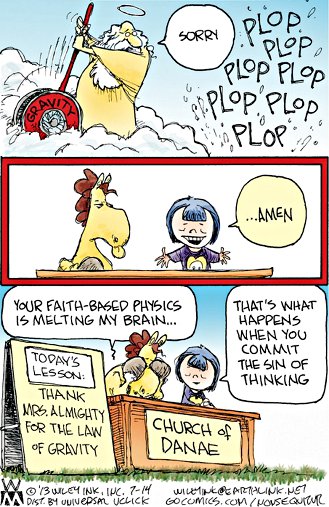
This is where I could imitate Non Sequitur’s Danae. I won’t.

Partly because I don’t have minions. Mostly because I’d much rather make sense.

Back to that “Bible Map.”

I give Orlando Ferguson’s variation on the flat Earth theme points for originality.

I don’t remember another anachronistic ‘Bible truth’ trying to accommodate reality by curving Earth’s northern hemisphere.

I did a little checking. “Prof. Orlando Ferguson” was from Hot Springs, South Dakota: as it says on his map.

He was a “professor,” too: a real estate developer by trade, professing his apparently-unique mix of Bible verses and science with a 92-page lecture.

He went on tour with his lecture and map, selling the maps for 25 cents a pop. At least one has survived: remarkable, considering the flimsy paper used.

I see its preservation as a good thing. A lot of work went into making it. It’s an attractive curio — and a nice showpiece of late-19th century culture.

Bible Bits and a Blood Moon

Orlando Ferguson’s map says he’s got 400 bits from the Bible “that Condemn the Globe Theory, or the Flying Earth, and None Sustain It.” That’s near the top.

I’m a Catholic, so taking the Bible seriously isn’t an option. It’s a requirement. I talk about that, and what we’ve been passing along for two millennia, fairly often. (August 18, 2017; July 30, 2017)

Basically, Catholicism isn’t a roll-your-own faith. (Catechism of the Catholic Church, 7495, 101133)

Taking Sacred Scripture, the Bible, seriously is one thing. Deciding that it means what I want it to mean is something else. Also a bad idea. (Catechism, 85, 890, 2033)

Back to Professor Ferguson’s amazing Bible Map. Again. An impressive number of Bible verses fills the lower left corner.

Each verse includes an excerpt: in “thus sayeth” and “hath laid” ye olde style English. I see a lot less of that these days, and that’s another topic.

Ferguson’s map listing leads with Exodus 17:12; Joshua 10:12-13 and Chronicles 16:30. He doesn’t say if that’s Chronicles 1 or 2. My guess is that he used a Hebrew Bible.

More Bible bits from Prof. Ferguson: Psalms 136:6-7; Isaiah 12:10, 11:12 14:7, 30:1, 38:8-9, 40:22, 52:5, 54:24 and 58:13. Plus Isaiah’s entire 29th chapter. Jeremiah 31:35-36 and Acts 2:20 wrap up Professor Ferguson’s Bible verse map listing.

I’ll give him credit for doing his Bible research. I’m not sure how Isaiah 29 supports his flat Earth idea. Prophecies and getting a grip are yet another topic, for another day.

His verse from Acts talks about the sun going dark and the moon turning to blood “before the coming of the great and splendid day of the Lord.” (Acts 2:20)

I talked about a “blood moon prophecy” and another fizzled ‘End Times’ prognostication last year. (August 23, 2017)

Like I said, it could be worse.

Mainstream American Protestant outfits were defending Christianity against the Copernican threat up to the early 20th century. I gather that the Missouri Synod started distancing themselves from those fervent faithful in 1902.1

Defending the Weak?

I like to think that many or most folks mean well. That includes those who say they’re defending impressionable minds from enticing but evil ideas.

Those defending others from religion may honestly believe that outfits like Pillar of Fire represented Christian values.

That lot were wacky even by 1920s conservative standards. Their ilk tend to be among the loudest voices. I think their enthusiasm is admirable. Not their beliefs. (September 22, 2017; August 13, 2017)

I don’t like seeing bad behavior by Christianity’s lunatic fringe getting so much attention. But I see no point in denying that it happens.

I’m more upset about less loony Christians who seem determined to defend others from science. Some may believe that science, particularly evolution, is evil because they think it’s responsible for moral decay, racism, and other social ills.

I’ll assume that they also mean well. But I think they unintentionally support the ‘faith demands ignorance’ stereotype.

Christians who see the Catholic Church as a threat may mean well well, too. Fulton Sheen got it right, I think:

“There are not a hundred people in America who hate the Catholic Church. There are millions of people who hate what they wrongly believe to be the Catholic Church — which is, of course, quite a different thing.”
(“Radio Replies Vol. 1,” Forward, page ix, Fulton J. Sheen (1938) via Wikiquote)

Bias, Being Human, and Aristotle

Ideally, researchers would never have biases. Or at least not let their flawed perceptions affect their work.

Like I keep saying, we don’t live in an ideal world. Scientists and scholars are human.

We’ve had a few outright fraudsters. Some may have honestly believed what they said.

Nott and Gliddon’s 1857 “Indigenous races of the earth” probably played well in the Victorian age. Its ‘white folks are better’ conclusions didn’t stand up to analysis.

F. Kupka’s iconic “caveman” Neanderthal rendering was another matter.

I don’t blame the artist. It’s taking scientists a long time to get used to evidence that Neanderthals may have been much more ‘human’ than the grunting brutes we imagined (March 10, 2017; September 23, 2016)

The problem isn’t just with science. Mistaking strong feelings and cultural quirks for truth and unchanging realities can affect anything we do. And sometimes does, sadly.

I’ve talked about ersatz science, published gibberish and the Thirty Years’ War before. (August 4, 2017; April 28, 2017; August 26, 2016)

Darwin’s “Origin of Species” came out a few years after the Nott and Gliddon book.

Darwin’s research was sound science. I suspect one reason it’s still such a hot-button item is that it doesn’t pander to what some folks want to believe is true.

Besides science, Darwin apparently knew some history. He added a history of evolutionary thought to later “Origin” editions, going back to Aristotle.

I think Aristotle was smart. He gave my civilization quite a few good ideas, and some that we’ve learned aren’t accurate.

Most of us have gotten over the shock of learning that Aristotle was wrong and Aristarchus of Samos was on the right track about Earth and our sun.

Strong evidence of that was accumulating about 475 years back. Copernicus was right, pretty much, and that’s yet again another topic. (April 28, 2017; March 24, 2017)

Maybe by the 2490s most of us will realize that accepting evolution won’t shatter an informed Christian faith. Provided we keep up today’s pace.

If I take Aristarchus-to-Copernicus as my ‘norm,’ reality won’t sink in for many until the early 4100s. (April 28, 2017; March 24, 2017)

Aristarchus, Anaximander, and Aristotle are among my favorite examples of smart folks who had good reasons for what they figured was true. But who turned out to be mistaken. At least in part.

Chickens and Cosmologies

Getting back to the “chicken or egg” causality dilemma, Aristotle saw chickens and eggs as an infinite sequence, with no true start. That was a good fit with Aristotelian cosmology, and his idea that species can’t change.

Many of Anaximander’s ideas were close to what we’ve learned recently.

His cosmology included a free-floating Earth and the possibility of multiple worlds. He thought lightning and thunder were what we call natural events: not evidence of divine anger.

Unlike Aristotle, he figured species can change. He suggested that we happened when critters had to adapt to dry land.2

Anaximander was right, basically. But he didn’t have much data to back up his speculation. Neither did Aristotle, although his Earth-centered cosmology may have seemed much more reasonable. Still does, to some.

Anaximander might have had more influence, sooner, if scholars had kept more of his work. As it is, much of what we know about him is what Aristotle wrote.

I see Aristotle’s logic as a huge factor in his later acceptance. I also see an impressive lack of logic in what some of his fans assumed. (November 5, 2017)

Nearly 24 centuries after Anaximander, some folks — Christians — still saw lightning as God’s thunderbolts.

Some still do, apparently. Seeing the Almighty as a sort of super-Zeus enjoys perennial popularity. I’m not sure why. (November 19, 2017; September 10, 2017; October 16, 2016)

Bombardier Beetles

J. B. S. Haldane’s observation that “God has an inordinate fondness for beetles” reflected his belief that God isn’t there.

I don’t agree with Haldane’s philosophical beliefs. But I like the quote.

I see it more as illustrating that Isaiah 55:89 is right. God’s thoughts aren’t ours.

Someone asked me about bombardier beetles and evolution in January of 2014. He’d read an assertion that the beetles couldn’t have survived evolution. The idea was that their explosive exhaust would have obliterated them before their ‘canon’ was complete.

A mental image of exploding beetles and more cerebral interests appealed to me. I started checking sources, and posted an answer. Scientific sources, not Leviticus 11:22 or Psalms 78:45. Today’s ‘flowers and butterflies’ post seems like a good time to bring beetles up again.

The story of how bombardier beetles got their unique defense mechanism is something we’re still learning. It’s a mystery in the sense that we haven’t found fossil or other hard evidence verifying a particular step-by-step sequence.

But scientists have enough pieces of the puzzle to show how it could have been done. That probably wouldn’t be enough to convince a dedicated disciple of Ussher or today’s creation science enthusiasts. I can’t imagine what would be.

Briefly, all animals produce the chemicals in bombardier beetle ‘boom juice.’ All insects have at least some of the bombardier beetle’s mechanisms. This critter isn’t as inexplicable as it seems.3

But it’s still weird. So are platypuses. Platypi? Those duck-billed Australian whatsits.

As usual, there’s more to say about beetles and other strange critters. But that’ll wait.


Floral Success Puzzle Answered: Maybe


(From Getty Images, via BBC News, used w/o permission.)
(“Angiosperms are the most diverse group of land plants, with hundreds of thousands of known species”
(BBC News))

How flowering plants conquered the world
Helen Briggs, BBC News (January 14, 2018)

Scientists think they have the answer to a puzzle that baffled even Charles Darwin: How flowers evolved and spread to become the dominant plants on Earth.

“Flowering plants, or angiosperms, make up about 90% of all living plant species, including most food crops.

“In the distant past, they outpaced plants such as conifers and ferns, which predate them, but how they did this has has been a mystery.

“New research suggests it is down to genome size – and small is better….”

I like that last sentence: saying “research suggests” instead of ‘scientists declare!’

I prefer science news written by someone who understands that scientists aren’t prophets or preachers. Some scientists may see themselves that way, and that’s still another topic.

We’ve known about cells for a few centuries now, and understand some of their functions. But there’s a lot we don’t know. Not yet. We’ve learned enough to make this research possible: and intriguing.4

Genomes and Pores


(Simonin, Adam B. Roddy; via PLOS Biology; used w/o permission.)
(Genome size in 393 land plant species.)

“Small is better” for plant cells, maybe, since smaller photosynthesizing cells can process more carbon dioxide per unit volume than bigger ones.

Smaller cells let plants get more cells for each bit of nutrients they absorb. Smaller cells mean smaller — and more — veins and pores on leaves. That’s another productivity boost.

That’s what these scientists say may be so. It makes sense. They’ve got statistical data to back up the suggestion. They could easily be on the right track.

Right now, this is a “research suggests” situation. I figure we’ll know more in a few years. Or decades. Probably both. Genetic analysis is a new field, and just one of many new research tools we’ve been developing.


Dawn of the Lepidoptera


(From Bas van de Schootbrugge, via BBC News, used w/o permission.)
(“One of the scales under the microscope”
(BBC News))

Meet the butterflies from 200 million years ago
Helen Briggs, BBC News (January 10, 2018)

Newly discovered fossils show that moths and butterflies have been on the planet for at least 200 million years.

“Scientists found fossilised butterfly scales the size of a speck of dust inside ancient rock from Germany.

“The find pushes back the date for the origins of the Lepidoptera, one of the most prized and studied insect groups.

“Researchers say they can learn more about the conservation of butterflies and moths by studying their early evolution….”

I’m pretty sure that this article’s first four paragraphs could spark heated discussions. Starting with whether or not butterflies need conservation and when the critters first showed up.

Using some criteria, butterflies didn’t exist until the Palaeocene, about 56,000,000 years back. That’s way before Ussher’s ‘first light’ in 4004 BC.

I’ll get to belief, reality, the universe and me after chasing a few butterflies.

Scientists found the oldest ‘Paleocene’ butterfly fossils in Denmark’s Fur Formation. The oldest known American butterfly is Prodryas persephone. Prodryas lived about 34,000,000 years back, where Colorado is now.

Post-dinosaur butterflies were more like current models than the critters these scientists studied. What’s really odd about the 200 million year old critters is that they had may have had structures like the ones butterflies use to get nectar from flowers.

That’s downright puzzling. Flower didn’t come until long after these early lepidopterans. Scientists had figured that butterfly mouths and flowers had evolved side-by-side. If that was so, nectar-adapted butterflies wouldn’t have shown up before flowers.

Maybe someone will say this proves that evolution is a lie, a vile religion of the Antichrist, or whatever seems like a catchy slogan.

I don’t think so. I think we’ve got a new puzzle to work on. A delightfully complicated one.

A Big Puzzle


(From Timo J. B. van Eldijk et al., via Science Advances, used w/o permission.)
(Fossil scales, up close. The black bars with each scale are 20 micrometers long. A micrometer, or micron, is one thousandth of a millimeter. That’s 0.000039 inch.)

About conserving butterflies and all that, I think Earth is where live. Taking reasonably good care of the place makes sense. Emphasis on reasonably. It’s also part of our job.

I see no point in jumping on the latest ‘we’re doomed’ bandwagon, or imagining that what we do doesn’t matter. (August 11, 2017)

Now, about these scales and the critters that grew them.

Some of these early lepidopterans lived in the Rhaetian, right before the Triassic–Jurassic extinction event. About half of Earth’s species didn’t survive that. But the rest did, including critters that would be ancestors of dinosaurs, butterflies — and us.

Don’t bother trying to remember those names. There won’t be a test. I’ve put a few links near the end of this post.5

Like I said, I expect lively debate about these scales: and how they fit into life’s story.

I’m pretty sure there won’t be much trouble establishing that they are from lepidoptera: critters like moths and butterflies. Scientists have gotten pretty good at classifying critters by looking at very tiny details in scales, hair, and the like.

A big puzzle involves flowers and nectar.

Hard Work Ahead

Some of those scales came from critters very much like, and presumably ancestors of, living insects with specialized nectar-drinking mouths.

It’s likely that the Rhaetian and Hettangian critters had similar mouths.

If that’s so, it’s pretty much a sure thing that they used the ‘nectar-adapted’ mouths for something else. Learning what that was should keep at least a few scientist busy for quite a while.

It’ll be hard work. Particularly since we’ve found very few fossilized lepidoptera.

That’s hardly surprising. Butterflies and moths generally doesn’t live where fossils easily form. On top of that, we’ve learned that one bunch migrated over open water: what’s now the North Sea. That was after dinosaurs and before the mesonyx heyday.

Mesonyx is another odd critter, by today’s standards. Was. Think a wolf. With hooves.

Back to butterflies. Scientists have been doing well to find fossilized bits and pieces: including these microscopic scales. Most of what we know comes from DNA analysis.

There’s more to say about butterflies, fossils, and strange critters.

But I said I’d talk about belief, reality, and why I see no problem with using my brain. I’ll get to that next.

After a tip of the hat to Leeuwenhoek, Mendel and the Human Genome Project.


Animalicules

European scholars were probably using magnifying glasses before Galileo got in trouble for dissing Aristotle. His personality didn’t help. (March 24, 2017; June 2, 2017)

Leeuwenhoek built his microscope a few decades later. He called tiny critters he saw “animalcules.”

Robert Hooke wrote about “cells” he’d seen in cork slices. That was in 1665. He figured what he was seeing wasn’t alive, which was true.

He’d seen and described cell walls: not the living cells. Maybe Hook’s descriptions are a reason Hook often gets credit for discovering cells.

Gregor Mendel studied inherited traits in peas during the late 1850s and early 1860s. Friedrich Miescher discovered nucleic acids in 1869. The Human Genome Project mapped the human genome on April 14, 2003. It’s been an eventful century-and-a-half.

I think we’ve just started getting answers from genetics research. And many new puzzles. (November 3, 2017; March 31, 2017; September 23, 2016)

Drinking May be Hazardous to Your Health

Aristotle didn’t say anything about cells. The Bible doesn’t mention them.

Not unless you count Psalms 139:13. On the other hand, I can imagine someone using Ezekiel 27 as a prophecy against believing that we don’t have any parts smaller than bones and sinews.

That wouldn’t, I think, make sense. But neither do some other fervently-held beliefs I’ve seen. I haven’t run across a tightly-wound Christian who won’t believe in cells because they’re not Biblical. I’m not sure why.

Maybe it’s because we’ve known about cells for a few centuries, and finally learned that drinking animalcules was a bad idea. On the other hand, some folks didn’t ‘believe in’ vaccinations in 1902, and still don’t. (July 21, 2017; August 21, 2016)

Changes

I don’t “believe in” cells or cell theory. Or evolution. Not in the sense that I expect any or all to answer the big questions.

But I’m quite sure cells exist and that some affect our health.

I’m also quite sure that critters have been changing for a very long time.

I talked about science, religion, and the Big Bang model last week. (January 12, 2018)

Recapping what I keep saying, the Bible isn’t a science textbook. Genesis wasn’t written by an American.

I don’t expect ‘just the facts’ from a book of poetry, or metaphorical flights of fancy from a paper on orbital mechanics. That said, I’ll start with “let there be LIGHT.”

Fast-forwarding from Genesis 1:3 to 1:11, the first plants appeared about a half-billion years back.

Later, if you don’t think of eukaryotic algae as plants.

Earlier, if you count cynaobacteria. Lots earlier. That’s looking at life on Earth through a scientist’s eyes.6

Metaphorically speaking.

I don’t think God gives us brains and has a snit when we use them. Or blundered by including curiosity in our motivational toolkit.

The problem Darwin had with flowering plants is that they showed up so abruptly.

His evolutionary theory involved gradual change of one species into another.

Not the sort of abrupt jump he’d found in the fossil record.

We’ve found many more fossils since then, and learned quite a bit about life’s long story. Darwin, it turns out, was wrong.

But not entirely. Evolution happens. Species change. Sometimes they change gradually. Sometimes the change is — apparently — abrupt.

We’ve learned about DNA. Genetic analysis is showing us relationships between critters we hadn’t seen before.

And another reason the ‘tree of life’ has been rearranged a few times. I think we’ll see quite a few more changes in how scientists define species, kingdoms, domains, and all that.

Folks who like everything to stay pretty much the way it was when they grew up won’t like that. I’m having a ball, trying to keep up with what we’re learning.

Living in a Post-Lagash World

I could believe that we live on a flat plate, no more than a few thousand miles across, with nothing but a dome between us and the cosmic ocean.

I might have, if I’d lived in Lagash when Urukagina was cleaning up a mess left by Lugalanda; or Ur when Enheduanna’s poetry was enriching Sumerian literature.

It’s a ‘Biblical’ cosmology, in the sense that Sacred Scripture includes poetic imagery from Mesopotamian culture.

I see that as resulting from folks who the Bible living in the western reaches of that civilization. The imagery would have been familiar to them.

I think the Bible is God’s word. I also think God decided to have human authors write Scripture. (Catechism, 101106)

Some living today may firmly believe that they live on a plate supported by pillars. Some of that fraction may also say they are Christians. If they are consciously following our Lord, doing God’s will as well as they can, I think they’re Christians.

But I also think they’re mistaken about the size and structure of God’s visible world.

Knowing what I do about post-Lagash developments, I couldn’t embrace ancient Mesopotamian cosmology and follow our Lord. Accepting truth is part of my faith.

In a State of Journeying

Since the notion that seeking knowledge offends God is rather well-entrenched in some circles, I’d better explain that.

And why I do not think acknowledging orderly change means believing that an orderly God cannot exist.

I’m a Catholic. I see faith as a willing and conscious “assent to the whole truth that God has revealed.” (Catechism, 142150)

Again, I think God’s revealed truth is in the Bible.

I also think God’s truth is in everything we can observe. If I’m paying attention, I’ll find God’s truth in the natural world’s order and beauty. Noticing, understanding, and appreciating this world’s wonders is a good idea. (Catechism, 32, 41, 74, 283, 341, 2500)

Or I can close my eyes, cover my ears, and hum real loud: stalwartly ignoring God’s work. That doesn’t strike me as a good way to show appreciation, so I won’t.

I think God could have made a world, a universe, that was perfect from the start: and couldn’t change. Maybe there are physical realities like that, not part of this space-time.

But the continuum we’re in changes. I’m okay with that. Not that my attitude could change God’s source code for this reality. God’s God, I’m not, and that’s a good thing.

I don’t know why God made this universe “in a state of journeying,” moving toward an ultimate perfection: but not there yet. (Catechism, 302)

My guess is that even if God somehow showed me the reasons, I wouldn’t understand. Not completely. It’s not possible for any creature.

God is the Almighty, infinite, eternal, beyond human understanding. Even so, wanting and trying to understand is a good idea. (Catechism, 27, 155, 202, 206209, 230)

So is using our brains. Noticing the order and beauty surrounding us is part of what we’re supposed to be doing. If we’re doing it right, we’ll learn something about God in the process. (Catechism, 3132, 3536, 301, 303306, 311, 319, 1704, 22932296)

“Wonderful Things”

Pursuing knowledge and seeking God both mean learning something new, at least occasionally. Sometimes that’s not easy, particularly if what’s new doesn’t fit neatly into old assumptions.

But I think it’s a good idea. And sometimes we find “wonderful things.”

“…Occasionally people ask me how I can be Catholic and a science journalist. The answer is simple: Truth does not contradict truth. Both science and religion are pursuit of truth. They’re after different aspects of truth, different layers of reality, but they’re still both fundamentally about truth….”
(Camille M. Carlisle, Sky and Telescope (June 2017))

“…faith must be there first, if one wishes to see God in Creation.”
(Brother Guy Consolmagno, Vatican Observatory, in a Zenit interview (May 2017))

“No matter where and how far we look, nowhere do we find a contradiction between religion and natural science. On the contrary, we find a complete concordance in the very points of decisive importance. Religion and natural science do not exclude each other…. They mutually supplement and condition each other.
Religion and natural science are fighting a joint battle in an incessant, never relaxing crusade against scepticism and against dogmatism, against disbelief and against superstition, and the rallying cry in this crusade has always been, and always will be: ‘On to God!’
(“Religion and Natural Science,” Lecture about the relationship between religion and science. Originally entitled Religion und Naturwissenschaft. (1937) Complete translation into English: “Max Planck: Scientific Autobiography and Other Papers” (1968); via Wikiquote [emphasis mine])

“…Even if the difficulty is after all not cleared up and the discrepancy seems to remain, the contest must not be abandoned; truth cannot contradict truth…”
(“Providentissimus Deus,” Pope Leo XIII (November 18, 1893))

Lord Carnarvon: “Can you see anything?”
Howard Carter: “Yes, wonderful things!”
(First look into Tutankhamen’s tomb (1922) via Wikipedia)

I think we’ve barely begun discovering “wonderful things:”


1 Dealing with reality, and other options:

2 Chickens, eggs, and philosophers:

  • “Symposiacs,” Book 2, Question 3
    Plutarch (1st century AD) From “The complete works of Plutarch: essays and miscellanies,” Thomas Y. Crowell (1909) via The University of Adelaide Library

3 Bombardier beetles, briefly:

4 Cells, science and flowers:

5 More than you need to know about lepidoptera:

6 Life and science:

Posted in Science News | Tagged , , , , , , , | 4 Comments

God Doesn’t Make Junk

*Micky’s photo: Minnesota in autumn.

We live in a material world. I like it, a lot. Quite a few folks have felt the same way.

“You adorn the year with your bounty; your paths drip with fruitful rain.
“The meadows of the wilderness also drip; the hills are robed with joy.”
(Psalms 65:1213)

Some get overly impressed. Others apparently think it’s icky.

Earnest folks have celebrated and condemned it. Not necessarily the same folks, and probably not at the same time. Not usually. That’d be a problem by itself.

Plato thought about the reality we live in, artists have been inspired by it.

That’s given us a theory of forms, George Harrison’s “Living in the Material World” and Madonna’s “Like a Virgin” albums, and the “Material World” 1990s sitcom.

Ideas

I think Plato gave my civilization quite a few good ideas.

And some that may look good on paper, not so much when applied. (October 16, 2016)

His Academy of Athens showed us what institutionalized education can do. That’s a topic or two by itself.

Two dozen centuries later, we’ve still got everything Plato wrote. Probably. And maybe a few “Plato” items he didn’t.

Scholars have seen to it that Plato’s documents get preserved. But the oldest copy we’ve still got was made more than a millennium after Plato died. There’s debate over what’s by Plato and what’s Platonic, but done by someone else.

I’d be surprised if folks are as familiar with George Harrison’s work in the early 4400s. And that’s another topic. Or maybe not so much.

Harrison’s credited with introducing the Beatles to the sitar and Hindu spiritual ideas. The good news, as I see it, is that he apparently looked at what folks who lived by Hindu ideas thought: not how upper-crust Westerners saw the ‘foreign’ ideas.

My understanding is that old-school Hinduism looks at life as a whole: wealth, desires, freedom, everything. Including what my culture calls ‘being spiritual.’ Integrating artha, kama and moksha — is yet another topic.

I think living as if what I believe matters makes sense. More than a recently-traditional Western attitude of keeping ‘real life’ and ‘being religious’ in airtight compartments.

Henry VIII’s and Thomas Huxley’s contributions didn’t help, I think. (October 28, 2016; August 14, 2016)

Plato’s Cave

Symbolism in Plato’s story about a cave is pretty obvious.

The cave is the world as we see it, ‘reality’ is outside, the wall and chains keeping prisoners from seeing reality are ignorance.

So far, so good.

I think there’s more to reality than what we can see, and that ignorance is no virtue. But I don’t think the visible world is an illusion.

My guess is that some folks realized there’s more to reality than what our senses show us long before Plato.

One of these days I’ll probably talk about Dualism: Mithraic, Gnostic, and otherwise. Not today. I’m running out of time, still a bit short on sleep, and that’s yet again another topic.

Basically, I think what our senses show us is a small fraction of physical reality. We’re developing new ‘windows’ into facets of this world. These reveal wonders that fascinate some, and apparently upset others.

Understanding

Folks have had trouble understanding our Lord since day one. I don’t think we ever will, not completely.

I certainly don’t. And I’m okay with that.

I follow the man who is God, who died and then stopped being dead: one person in the Trinity. Since I follow the Son, I follow the Trinity. They’re a package deal. Sort of.

Thoroughly understanding God isn’t possible. Wanting and trying to understand is a good idea. But God is infinite, eternal and the Almighty: “a mystery beyond words.” (Catechism of the Catholic Church, 27, 155, 202, 230)

We’ve been passing along what we understand and what we can’t for two millennia now. (Catechism, 74-95)

There’s been no shortage of folks ardently devoted to imaginative substitutes. Their alternatives have different names and unique details. But they fall into a few categories.

One of them is dualism: the idea that everything comes in two parts. Including good and bad. There’s a little truth to it. I see dualism as a particularly persistent and perturbing wrong idea. Maybe because I also see its appeal.

Dualism with Christian paint jobs says that our Lord isn’t, or isn’t quite, God and man. Books have been written about it. I’ll do what I can with a paragraph and move along.

I’ll grant that trying to understand how infinity and eternity can fit into a material being is frustrating. I can’t, but like I’ve said: God’s God, I’m not, and I’m okay with that. I’ll settle for believing and assuming that God can handle the details.

Being Human

I suspect some ardently-supported ideas started with a distaste for physical reality.

That may, I hope, come from distorted perceptions of what’s really real.

Angels are pure spirit, which makes them more powerful than material creatures.

But ‘powerful’ and ‘good’ aren’t the same thing. Satan’s a prime example that. (Catechism, 395)

Seeing immortal and unchanging spirit as ‘better’ in some senses doesn’t make what’s material and mutable bad. Just different. And temporary. I’m also okay with that.

Even if I wasn’t, I hope I’d have the sense to think God didn’t make a horrible mistake. The first chapter of Genesis tells us that God made everything: spiritual and material reality.

Genesis 1:27 says that we’re created “in the image of God.” We’re also male and female: a distinctly material quality.

The other creation account emphasizes the point, I think. Genesis 2:7 is pretty clear. We’re made from the stuff of this world and God’s breath: spirit.

Being body and soul, matter and spirit, isn’t a problem. The mess we’ve been in is — still another topic. (Catechism, 355-379)

And God Said “Oops??”

I’ll go with God’s assessment of reality: all of it, what we can see and are learning to observe; and what’s beyond.

“God looked at everything he had made, and found it very good. Evening came, and morning followed—the sixth day.”
(Genesis 1:31)

I like being a material and spiritual creature. I think the visible world is filled with marvels and wonders we’ve hardly begun to discover. And see nothing wrong with learning how this universe works.

That’s just as well, since we’re told that noticing beauty and order in this universe is a good idea. Learning its natural laws and using that knowledge wisely is part of our job. (Genesis 1:2627, 2:7; Catechism, 16, 341, 373, 1704, 1730-1731, 2293)

Noticing and studying the wonders and beauty surrounding us is part of what being human is. Or should be. Imagining that they’re gods doesn’t change that.

But it’s not a good idea. Putting anything where God should be in my heart and mind is a bad idea. (Catechism, 2112-2114)

Again, that doesn’t make the universe and natural wonders bad.

Experiencing joy in their beauty is a good thing. If we remember that God is “far more excellent:”

“Foolish by nature were all who were in ignorance of God, and who from the good things seen did not succeed in knowing the one who is, and from studying the works did not discern the artisan;
“Instead either fire, or wind, or the swift air, or the circuit of the stars, or the mighty water, or the luminaries of heaven, the governors of the world, they considered gods.
“Now if out of joy in their beauty they thought them gods, let them know how far more excellent is the Lord than these; for the original source of beauty fashioned them.”
(Wisdom 13:13)

Accepting God’s work as “very good,” and God as “more excellent” than anything we can see makes sense. To me, anyway:

Posted in Being Catholic | Tagged , , , , , , , | 5 Comments

Science and Religion

I’ve seen a few op-eds saying that science needn’t interfere with religious beliefs.

Some even said that science and religion, faith and reason, get along fine. Those were nearly always Catholic publications.

The one I saw this week was in Forbes, an American business magazine. That got my attention.


Seeking and Using Knowledge: an Ancient Tradition

Folks like Aristotle and Anaxagoras studied the natural world.

They were systematic about it, and tried to understand what it is and how it works. In that sense they were “scientists.”

But they weren’t “scientists” in today’s sense. More like natural philosophers.

“Science” is how the Latin word “scientia” sounds in my language.

Scientia means knowledge. Or it can express ideas like skill, expertness, awareness — depending on context.

Science, in that sense, predates the ancient Greeks by a very long time indeed.

So do practical uses of scientia. The earliest medical text I know of was written around the time Ahmose I ran Egypt.

It’s almost certainly copied from older texts. We’ve developed more effective medical technology since Egypt’s 18th dynasty, but haven’t found a better treatment for Dracunculiasis. (May 12, 2017)

Attitudes

Folks feeling edgy about studying nature isn’t new, either. It didn’t start with Christianity.

I could claim that Aristarchus was almost charged with impiety because he said the sun wasn’t divine.

That might have seemed “relevant” in my youth, or whatever’s the current term for ‘kinda now, kinda wow.’

A remarkable number of folks assume that religion, particularly Christianity, depends on ignorance.

A few Christians do, too, although they probably don’t think of their alternative reality as “ignorance.” (October 29, 2017)

Being “relevant,” or “Bible believing,” or whatever, isn’t an option for me.

I might like fitting in with a well-defined clique. But I like truth more. Much more.

I’d have to ignore what I know about a botched translation of Plutarch’s “On the Apparent Face in the Orb of the Moon.” (March 24, 2017)

Don’t get me wrong. I take the Bible, Sacred Scripture, very seriously. Also read it and think about it. That’s ‘being Catholic 101.’ Catechism 101133, actually.

Now, about that translation. Plutarch said that Cleanthes, who saw the sun as divine, jokingly told Aristarchus that he should be charged with impiety.

Gilles Ménage garbled Plutarch’s grammar, turning the joke into a flat-out accusation.

The Ménage translation went to press around 1600.

A Legend and Mr. Squibbs

Galileo’s and Bruno’s trials were fresh memories in the early 1600s. European politics were more volatile than usual.

Some folks seemed fearful of any new ideas. Others were arguably eager to embrace ideas because they were new. (June 2, 2017; March 17, 2017)

Imagination and selective memories inspired now-familiar tales of a legendary confrontation between scientists and the forces of ignorance and oppression.

It makes a good story. I think it’s about as reliable as some ‘based on actual events’ movies. (November 5, 2017)

Europeans recovered from the Thirty Years’ War, eventually.

The era gave us an enduring legacy of state-run religions, famines, plagues and witch hunts. Survivors had good reason for taking a long, hard look at old assumptions.

Enlightenment ideals — like a more egalitarian society and better-informed public — were, I think, reasonable. Some outcomes, not so much. (August 20, 2017; November 6, 2016)

I’ve never heard someone actually denounce “tampering with things man was not supposed to know,” as Mr. Squibbs put it. Not in those words.

But I’ve known a fair number who apparently had the attitude, or a close approximation.

Some were Christians, some weren’t, and all seemed badly rattled by what we’re learning.

I can understand that.

The ‘inevitability of progress’ idea was getting replaced by the currently-fashionable ‘we’re all gonna die’ outlook in my youth.

There’s something to be said for the old optimism, but I don’t think either attitude makes sense. (June 23, 2017; October 30, 2016)

We didn’t start calling a particular sort of natural philosophy “science” until a few centuries back.1

Calling them “scientists” is even newer, dating back to the 1830s. (March 31, 2017)

Albert: A Busy Friar


(From Chemical Heritage Foundation, via Wikimedia Commons, used w/o permission.
(1929 trading card.)

Albert of Lauingen’s studies earned the admiration of scholars.

They also inspired tales of wizardry and dark arts. And a Liebig’s Extract of Meat Company Trading Card.

Albert was a natural philosopher, among other things. But he wasn’t a scientist. Nobody was in the 1200s.

Folks speaking my language often know Albert as Albertus Magnus.

Those of us who are Catholic recognize him as a Saint. He’s a patron of natural sciences and scientists.

Also medical technicians, philosophers, students, and Cincinnati, Ohio.

Folks like him and St. Hildegard of Bingen helped lay groundwork for today’s sciences. (October 27, 2017)

I get the impression that Albertus Magnus kept busy. He was a Dominican friar and served as a bishop for three years. He studied Aristotle when he wasn’t doing his own research, and was the first European to comment on most of Aistotle’s work.

That helped make Aristotle available to other European academics. Other scholars, including St. Thomas Aquinas, thought Aristotle’s ideas made sense. Some of them took another step, looking at how Aristotle got his ideas.

That, I think, was a very good idea.

Others got overly excited about the ancient philosopher’s ideas. Grabbing Aristotle’s conclusions, they took off running. Right off the ragged edge of reason.

God: Large and In Charge

Some folks in Medieval Europe were ignorant and superstitious.

The same is true today.

But we knew Earth is round in the Middle Ages. Those of us who pay attention, and think about what we see.

I’ve talked about that, the (real) dark ages, Leo XIII and truth before. (November 5, 2017; July 23, 2017; July 15, 2016)

One of many topics of the mid-1200s was whether or not we were on the only world. The question made sense at the time.

Telescopes wouldn’t be invented for another few centuries.

Observations and analysis refined Aristitole’s cosmology epicycles and the like, but not the basic ideas. Our moon’s cyclic phases and occasional eclipses were another matter.

Basically, Aristotle said Earth, the world we stand on, was at the bottom of an otherwise-perfect and unchanging reality. I’m oversimplifying the idea something frightful.

Given what folks knew in Aristotle’s day, it made sense. So did what Aristarchus said. But Aristotle was more famous in his day. His model was my civilization’s default assumption until a half-millennium back.

Agreeing with Aristotle made sense in the 13th century.

A few scholars had reasons for thinking maybe ‘one mutable world at the bottom’ wasn’t the only possible model, but precious little data and less proof.

Observations and analysis confirmed post-Ptolemaic Aristotelian models pretty well.

That wasn’t enough to stop academic debate. Still isn’t for that matter. And that was no problem.

Then Aristotle’s fans said other worlds couldn’t exist: because Aristotle said so.

That’s a problem. I’ve mentioned Proposition 27/219 of 1277 before. It’s been rescinded, but the principle still holds.

God decides how reality works. We don’t. (Catechism of the Catholic Church, 268)

It’s not a new idea.

“Our God is in heaven; whatever God wills is done.”
(Psalms 115:3)

The way I see it, God is large and in charge. Part of my job is appreciating this universe. Not telling the Almighty how it should work.


Wonder How It Works? Ask!


(From Forbes, used w/o permission.)
(“The Earth at night, as viewed from the International Space Station….”
(Forbes))

Yes, Science Is For The Religious, Too
Ethan Siegel, Starts With a Bang contributor group, Forbes (January 9, 2018)

“If you want to figure out how the Universe works, you have to ask. Not by asking some authority figure, but by finding a way to ask the Universe itself: to theorize an idea and to test it, via thorough experiments, observations, and measurements. The ability to formulate an idea, to infer and calculate what the physical implications of that idea are, to gather data that tests those implications, and to then draw conclusions is the hallmark of scientific thinking.

“The scientific method insists on taking this steps in a rigorous, repeatable fashion, and teaches us the scientific answer to any question we’re clever enough to ask. Science is both the method of investigation and the full suite of knowledge we gain from asking such questions, with the joys and wonder of discovery open to everyone. Despite the widespread perception that science and religion conflict with each other, the overwhelming majority of people experience no such conflict. Anyone can learn how to investigate the world like a scientist, and a scientist can belong to any religion. Around the globe, this is exactly what the data shows….”

First off, I read this online. Subscribing to Forbes might be fun, but it’s beyond my budget. Far beyond.

I take the second-to-last sentence with a grain of salt.

I think the vast majority of folks can learn to ‘think like a scientist.’ If that means learning to see what’s fact and what’s not; and thinking about how facts fit together, not relying on what emotions they trigger.

Agreeing that a scientist can “belong to any religion” depends on how “religion” gets defined. The assertion makes sense, given what I’ve learned, if “religion” means one of the world’s more-or-less major belief groups.

I have no trouble imagining a scientist who grew up with and follows the beliefs and practices of, say, Islam.

Good grief, philosophers in Christian Europe learned by reading translations of work from what we call the Islamic Golden Age, about a thousand years back now.

I think Islam’s good times weren’t perfect. Neither were Europe’s Renaissance and other cultures’ high points.

I think we’re in one now, although it’ll probably take a few centuries for many to see it. Maybe a millennium or two.

We don’t have a perfect civilization either. But we’re learning. And, I think, correcting some faults. I’m glad to see more recognition of folks like Ibn al-Haytham and Al-Kindi in my branch of Western Civilization. (October 6, 2017; September 29, 2017)

Imagining scientists who believe and practice Hinduism, Buddhism, Judaism or Christianity isn’t hard, either.

Imagining a competent scientist who also follows the beliefs of a Christian outfit that demands rejecting science? Or at least the parts of reality they don’t like?

That might be possible, with great effort.

Folks of that ilk came up with “creation science” in the 1960s. What I’ve seen of it is imaginative and displays an admirable grasp of fun facts about this world.

I like that a whole lot more than the older distaste for physical realities.

Active rejection of what we’ve been learning in the several centuries? How physical reality works, how it all fits together? That strikes me as unreasonable. (July 23, 2017; March 31, 2017; December 16, 2016)

The Universe and Me


(From NASA/GSFC, via Forbes, used w/o permission.)
(“There is a large suite of scientific evidence that supports the picture of the expanding Universe and the Big Bang, but that does not necessitate a conflict between scientific conclusions and religious beliefs.”
(Forbes))

I was born during the Truman administration. Quite a bit’s happened since then.

A kindergarten teacher wisely let me spend available free time in a semicircular ‘book nook.’ There were, reconstructing images in my memory, maybe upwards of a dozen shelf feet of picture books there. Those were good times.

I’ve been — not so much an avid, as a nearly-constant — reader ever since. I’d read ingredients labels, textbooks, Agatha Christie mysteries, dictionaries. You get the idea.

Yeah, I’m one of those people.

We’ve learned a lot about how our brains work since Truman’s time.

Folks with non-standard neural circuitry often get caught early. (November 19, 2017; April 9, 2017; March 19, 2017)

I think efforts to prevent or cure people like me are well-intentioned. Usually. It might be a good idea, in some cases. (November 19, 2017)

That’s not what I was was talking about. Not quite. Where was I? Science, religion, Truman, breakfast cereal. Right. Belief and the Big Bang. Also Genesis and me.

Like I said, I was born during the Truman administration. Most science books I had access to in elementary and high school had been written quite a few years earlier.

That let me experience a sort of fast-forward look at current scientific knowledge from around 1900 to 1970. In a few years. I loved it, but I’m quite sure some wouldn’t. At all.

Let there be LIGHT

And that gets me to Genesis and the Big Bang.

“In the beginning, when God created the heavens and the earth—
“and the earth was without form or shape, with darkness over the abyss and a mighty wind sweeping over the waters—
“Then God said: Let there be light, and there was light.”
(Genesis 1:13)

I take the Bible seriously. That’s ‘Catholicism 101,’ like I said earlier.

I think the Bible is true. That needs explaining, given more-or-less recent silliness.

Taking Sacred Scripture seriously and thinking that it’s true isn’t even close to imagining it was written by an American. Or a Jacobean scholar with a taste for slightly-antique prose.

Or even someone with today’s Western attitudes, and a whacking great chasm where poetry and metaphor should be.

Style and Assumptions

Oddly enough, I’ve yet to see someone say the Bible can’t be true since religious folks say God is the author: and the Bible shows no stylistic consistency.

That’s hardly surprising, considering it includes poetry and prose from many centuries. Millennia, counting oral traditions. I think God is the author. And that God decided that humans would do the actual writing.

That’s why the Bible looks like it was written by many different folks, living in different eras. It was. And God inspired the human writers. (Catechism, 105107, 109111)

Expecting a contemporary Western worldview from folks living just west of the Fertile Crescent after the Late Bronze Age Collapse isn’t reasonable.

Never mind oral traditions that were likely enough ancient when Abram lived in Ur. More than just “ancient,” and that’s another topic.

Neither is imagining that they’d know what we’ve learned about this wonder-filled universe in the last few decades. Or what we’ll be learning when the 42nd century rolls by.

The Big Bang and Beyond

I grew up in 20th century America, and have been paying attention.

I understand why saying that the Big Bang model “does not necessitate a conflict between scientific conclusions and religious beliefs” makes sense.

But I think saying it “does not necessitate a conflict” is an understatement. From my viewpoint, anyway.

I can see the first chapter in Genesis as a wonderfully poetic description of what’s happened in this universe from the moment it began to “now.”

A scientist wouldn’t describe a point of infinite density and temperature as “without form and void.”

But a scientist didn’t write Genesis.

Besides, that sort of thing we can work out on our own. Have worked out. And we keep finding new puzzles.

Kvetching because Genesis 1 talks about days instead of eons or eras is an option, but not a reasonable one.

I figure God’s viewpoint and mine aren’t quite the same. On the other hand, I think conforming my will to God’s is a good idea. Kairos, chronos, and all that will wait for another day.

Siegel has more to say. I do, too.

Basically, I think his op-ed is worth reading. And not what I’ve gotten used to seeing. Particularly since he took the trouble to back up his opinions with facts. Nice touch.


Living in the Real World: Or Not

Being offended by Wiley Miller’s “Church of Danae” gags is an option, too.

So is calling upon those who hold dear their assumptions to mightily smite folks who like living in the real world.

But I don’t think it makes sense.

I might be offended by Non Sequitur’s take on Danae’s religion. If I thought it was attacking my faith.

As it is, I think real analogs to Danae and Captain Eddie, another Non Sequitur character, have a funny side. Not the people who cherish such beliefs. What they believe, and how they express it.

I suspect the ‘back to the days of yore’ fringes of American beliefs encourage more easily-found headlines. These two, from 2015, were near the top of my recent ‘science religion opinion’ Google search:

  • “Why Religion and Science are Mutually Incompatible”
  • “Science & Religion: A Centuries-old War Rages On”

Next, how I see autopsies and movies.

Skittish About Science and Autopsies

Quite a few folks are squeamish about autopsies. That’s understandable, I think. But I know they can be useful.

Elizabeth, our youngest child, died shortly before birth.2 After medicos were sure my wife would survive, a doctor asked me if we wanted an autopsy.

I wondered if it was likely to yield practical information. That seemed like the only reason for asking. And a good reason.

It’s not why the doctor asked. Seems some parents are concerned about details I think are irrelevant when someone’s dead. That’s yet another topic, for another day.

I said no. An autopsy seemed like an unnecessary complication. Religious scruples or superstitious fear had nothing to do with the decision. I’m pretty sure about that.

I could understand a recently-bereaved father feeling that an autopsy would offend God. But I wouldn’t agree.

Autopsies are legal these days, and not particularly controversial.

That could change, if we dig up and reanimate old-fashioned values. I don’t think it’d be a good idea.

Textbooks often said autopsies were illegal in Europe because Europeans were Christian. That was back in my ‘good old days.’ I don’t miss them.

There’s a little truth in it.

Many Europeans saw themselves as Christian. It wasn’t all that long ago that they were flat-out illegal in parts of “Christian” Europe. (June 16, 2017; March 31, 2017)

Autopsies, I mean. Not Europeans. Pronoun trouble.

I see the attitude more as Europe’s adoption of Roman imperial law and custom.3

The Church of Danae, Autopsies and Togas

Greco-Roman culture and beliefs didn’t allow autopsies.

That’s why Galenus studied monkeys. (July 15, 2016)

Squeamishness and ancient attitudes may help explain the lasting popularity of Shelley’s “Frankenstein” tale.

Mary, not Percy. It was Victor, actually, and I’m rambling again. (August 5, 2016)

Seeing aversion to autopsies as a plot by progress-hating clerics, feeding on the ignorance of a superstitious rabble might make a good story. But it’d fail fact checks. (October 30, 2016; July 15, 2016)

The European branch of Western civilization inherited much of the ancient Roman set of values and scruples, which had thoroughly pagan roots long before our Lord arrived.

Old Roman values aren’t particularly bad, but let’s get a grip: the Roman Senate did not write the Decalogue. I don’t have to wear a toga to be a Christian.

Studying the natural world is okay. Including our bodies. Worshiping nature would be idolatry, and a bad idea. (Catechism, 282283, 21122114)

Folks who understand what the Catholic Church says realize we can study nature without fear of offending ‘the spirits.’ We should, anyway.

Christianity’s attitude toward reason and the study of nature allows autopsies and makes other scientific research possible. The Catholic version, anyway.

On the other hand, mad scientists make such nifty heroes, antiheroes and villains.

Fiction: Like Frankenstein and Lovecraft’s Tales


(From Cornhill Publishing Company’s 1922 reprint of “Mary Wollstonecraft Shelley’s “Frankenstein…”, via Wikimedia Commons, used w/o permission.)
(Frankenstein’s do-it-yourself project, from a 1922 reprint of M. W. Shelley’s tale.)

I’ve enjoyed the occasional ‘mad scientist’ tale.

Their real-life counterparts are, happily, few and far between. And anything but entertaining. (November 11, 2016; October 16, 2016)

One of these days I may read Shelley’s “Frankenstein; or, The Modern Prometheus.” I understand that it’s more substantial than the seemingly-endless succession of ‘Frankenstein’ movies. Which wouldn’t take much, I’ll grant.

I have read Stevenson’s “Strange Case of Dr Jekyll and Mr Hyde.” We’ve learned quite a bit since 1886, so the Stevenson’s fictional science seems more fictional than it would have at the time.

But I think it’s still a good story, and suffers from an image issue similar to Mary Shelley’s Frankenstein.

Like I said, I enjoy some ‘mad scientist’ tales. I think they can be useful cautionary tales, making ideas like ‘consider risks before acting’ memorable.

But I see them mostly as entertainment. Which I think is okay, in moderation. I’ve talked about enjoying life, Ecclesiastes, and the Epic of Gilgamesh before. (October 8, 2017; November 11, 2016)

Expecting a science education from watching the likes of “The Devil Bat” isn’t reasonable. Not that someone’s likely to assume that’s the case.

Assuming that ignorance is a virtue isn’t particularly sensible either.

On the other hand, finding folks who act as if they agree with a Lovecraftian assumption about ignorance isn’t hard. Lovecraft’s “The Call of Cthulhu” says it’s the only defense we have against cosmic horrors.

I like some Lovecraft tales, don’t agree with his philosophy, and that’s yet again another topic. Topics. (March 31, 2017; December 16, 2016)

Movies and Attitudes

I doubt more than a few, if any, folks would think “The Brain That Wouldn’t Die” represented state-of-the art medical science of the late 1950s and early 60s.

But the ‘beware tampering with nature’ attitude that I see in the Sterling Productions movie is pretty common.

There’s a little wisdom in it. We’ll be cleaning up the mess from Industrial Revolution blunders for a long time.

Assuming that God gave us brains and we offend an irritable Almighty by using them? That doesn’t make more sense. Not to me.

The version of Christianity some folks have seems to have more in common with old-school beliefs, where tiptoeing around capricious spirits made sense. I’ve talked about that before. (November 5, 2017)

Also blaming Mother Nature for disasters, Edward II and the Little Ice Age, Ecclesiastes, Heraclitus and a defunct Packard factory. (November 17, 2017; September 10, 2017; August 4, 2017)

Had enough? If not, there’s more:


1 Origins of science and scientists:

2 I’d rather not go through that again. But I see no point in being miserable. Trouble happens, life doesn’t come with guarantees, and I’m looking ahead:

3 Remembering some of the ‘good old days:’

Posted in Science News | Tagged , , , , , , | 4 Comments

“Imagine All the People”

Someone’s ‘Tweet’ about sin and how someone else responded showed up in my Twitter feed Sunday. I noticed an unusually goofy item in my Google news feed that evening.

Instead of expressing outrage and (self?)-righteous indignation over either or both, I made a few notes and went on with my day.

That’s no great virtue on my part. I’m no fan of emotional outbursts. I like them even less when I’m the one melting down. Avoiding that sort of eruption is much easier now. I talked about that yesterday. (January 7, 2018)

But I haven’t talked about what I believe, how it affects what I write, and where I get most of my news. Not recently. Not much at all, about news and me.

Loathsome Insects, Fire, Hell, and Me

Jonathan Edwards inspired centuries of preachers and righteous writers with his ‘Angry God’ sermon.

“…every unconverted Man properly belongs to Hell….”
“…The God that holds you over the Pit of Hell, much as one holds a Spider, or some loathsome Insect, over the Fire, abhors you….”
“…you will be wholly lost and thrown away of God….”
(“Sinners in the Hands of an Angry God,” pp. 6, 9, 15, 18; Jonathan Edwards (July 8, 1741) (via Digital Commons@University of Nebraska-Lincoln))

It was effective rhetoric in 1741. It still is for a few folks.

Not me. I’m pretty sure others have pretty much had it with J. Edwards wannabes. My emotional response to tirades like that is closer to what Twain said. (March 5, 2017)

“I don’t like to commit myself about heaven and hell – you see, I have friends in both places.

“When I think of the number of disagreeable people that I know who have gone to a better world, I am sure hell won’t be so bad at all.”
(Mark Twain, p.377 of Evan Esar, “20,000 quips & quotes” (1968))

“[H]eaven for climate, Hell for society.”
(Samuel Clemens (Mark Twain), Speech to the Acorn Society (1901); via Wikiquote.org)

“I studied a minute, sort of holding my breath, and then says to myself: ‘All right, then I’ll go to Hell.”
(Mark Twain, Adventures of Huckleberry Finn (1885), via Bartlett’s Quotations, 16th ed.)

My emotional response is one thing. It’s not necessarily what I think.

I think sin is a bad idea and I shouldn’t do it, but I do not think God has anger management issues.

I’ve occasionally felt like God was using me for target practice to blow off steam.

That’s partly because no human could fully understand God, even under ideal conditions. (March 5, 2017)

We don’t live in ideal circumstances. Haven’t since the first of us made a really bad decision. It’s not that God made a defective creature, or that we’re now rotten to the core. We’re still basically good, just wounded. (July 23, 2017; April 23, 2017; November 6, 2016)

One reason that I don’t rant about ‘those sinners over there’ is that I’m one of them. That needs explaining.

Sin! Sinners! Oh! Those Wretched Sinners!

Sin is what happens when I don’t love God and my neighbor, or don’t see everyone as my neighbor. Everyone. No exceptions. (Matthew 5:4344, 22:3640, Mark 12:2831; Luke 10:2537; Catechism of the Catholic Church, 1706, 1776, 1825, 18491851, 1955)

It’s an offense against reason, truth and God. (Catechism, 18491850)

I don’t do what I know is good for me, and avoid what’s bad. Not consistently.

Whenever I decide to do something that hurts me or someone else, I offend reason and truth; and God. That’s a sin, so I’m a sinner. (Catechism, 18491850)

That’s one reason I’m not highly motivated to lambast wretched sinners. I’ve got a slew of psychological and psychiatric problems already, and don’t want more. Then there are theological and relational concerns, and my long-term goals, that’s another topic. Topics.

I was going somewhere with this. Let’s see. Twitter, news, Jonathan Edwards: got it!

“The Drunkard’s Progress,” Fabulous Fifties, and 2018

Nathaniel Currier’s 1846 “The Drunkard’s Progress” was popular. At least for folks who sympathized with America’s temperance movement. In the 1840s.

I’ve talked about that, Carrie Nation, “Reefer Madness,” and getting a grip before. (July 10, 2016)

What was effective social commentary — or propaganda, and that’s yet another topic — in the 1840s doesn’t, I think, have the same impact in the early 21st century.

Wailing and wringing my hands in anguish over the decline and fall of the America that was is an option. A daft one, I think.

We didn’t have a perfect society in the 1840s. We didn’t in the 1950s, and we don’t now.

We have, however, tried to correct some faults. And succeeded, in some cases. Not perfectly, but we’re still working on the issues.

I talk about that a lot. (October 30, 2017; September 25, 2016)

That brings me to a well-intentioned ‘Tweet.’

Personal Sin

I thought the Tweet’s basic idea made sense: that sin isn’t a strictly private matter.

I also think folks who thoroughly understand Catholic beliefs would understand. But I sympathize, a bit, with the person who disagreed.

Sin is a personal thing. But what I do will affect others. So sin is a social matter, too. (Catechism, 18461869, particularly 18681869)

That’s a colossal over-simplification, and the bit from the Catechism isn’t much more than an introduction to the ideas. It’s all I’ll say about it today, though.

Make that ‘almost all.’

One of my frustratingly-durable sins is gluttony. (June 18, 2017)

I could say that it only affects me, but that would mean ignoring how the resulting health issues affect my family. Among other things.

Imagine

John Lennon’s “Imagine” has been a highlight of New York City’s New Year’s Eve celebration in Times Square:

“…Imagine there’s no countries
It isn’t hard to do
Nothing to kill or die for
And no religion too
Imagine all the people
Living life in peace….”
John Lennon, “Imagine” (1971)
(posted oldielyrics.com)

I wasn’t a Catholic in 1971, and wouldn’t be for decades.

But I was a Christian and took my faith seriously. I still am, and I still do.

At the time I thought the “and no religion too” idea was wrong.

But I sympathized a bit with folks who felt that way. Particularly since I thought imagining “all the people living life in peace” made sense. I still do.

That didn’t change when I became a Catholic.

“…The answer to the fear which darkens human existence at the end of the twentieth century is the common effort to build the civilization of love, founded on the universal values of peace, solidarity, justice, and liberty….”
(“To the United Nations Organization,”1 Pope St. John Paul II (October 5, 1995))

I don’t, thankfully, run into quite as much of the malignant virtue1 permeating ‘Christian’ radio in my youth, or the ‘be like me or be damned’ attitude.

Some Christians still act as if they thought God agreed with them: instead of trying to agree with God. I hope they mean well, for their sake if nothing else. I strongly suspect they’re not so much numerous as noisy.

The ‘sin isn’t private’ thing on Twitter wasn’t malignant, but my guess is that the person who responded had gone through experiences not unlike mine. He (maybe she) said, in effect, ‘what you believe means nothing to me.’

And that is about as good a reason as any too not expound on the wretched sinfulness of something I think is a bad idea. That goes quintuple for ranting against someone whose life isn’t just like mine.

Even if I imagined that what I wrote would be read exclusively by folks with my ethnic, social, and cultural background — Holy Willie isn’t a good role model. (February 12, 2017; December 4, 2016)

I live in a world where too many folks have endured malignant virtue, sometimes worse than what I experienced. That sort of thing leaves an enduring mark.

That’s why I think saying why I believe what I do makes sense.

Just as important, I try to say it in a way that will make sense to folks who, like me, are living in 2018. Not in some rose-colored version of an earlier era.

And Now, the News

I check my Google news feed regularly, at least once a day. I ran into that ‘hit and run’ entry yesterday.

I tell myself that I’m keeping an eye out for something to write about, and seeing what nonsense may show up in my other feeds. That’s partly true, but I figure part of it’s simple curiosity.

That ‘Hit-and-run driver’ item showed up in Google news > U.S. > More Articles. The link got me to an item in The Sacramento Bee. The picture of President Trump may have come from an unrelated video on the newspaper’s website. I don’t know.

I’ve noticed that a great many ‘bad news’ items lead with a snapshot of the president: the sort tabloid photographers were getting by sneaking up on celebrities and yelling. Sometimes America’s chief executive is more-or-less involved in the issue.

If you’re bracing yourself for a diatribe against, or panegyric for, the current President: relax. I am reasonably certain that no president is or has been a Nazi, fascist, white supremacist, or the Antichrist. (November 8, 2016)

I’d think English-language news media’s continuing meltdown over the current officeholder was funny.

If so many folks weren’t apparently taking what the news says seriously.

Me? I think an American president affects America’s politics and economics. And has some influence over world affairs. But I don’t think the president is solely responsible for climate change, or is humanity’s last hope for survival.

Which reminds me, about ‘making America great again:’ I wasn’t aware that America ever stopped being great.

What my country has been a great example of keeps shifting, and we’re far from perfect. But on the whole I think we’re okay.

I take news, particularly political news, seriously: as a reflection of the mores of a particular subset of my civilization’s population. Also as a useful signal that something’s happening that I can check into.

I started recognizing emotional triggers used to grab and hold attention in the 1970s. A couple decades in marketing gave me opportunities to learn more.

That’s why I took my wife’s advice: stopped watching television news entirely, and do little more than scan headlines from most news outlets. Like I said, they’re a useful tool. But not the sort of thing I think is trustworthy.

I am pretty sure folks who write news — traditional, alternative, and satirical — believe what they write, or think their satire is based on reality. I’m inclined to think the satirists live a bit closer to the real world than many, and that’s yet again another topic.

I lean heavily on science news from BBC, since I like their style. And greatly appreciate their apparent willingness to check a few facts before publishing.

I do my own research, anyway. It’s fun, and I don’t assume BBC News never makes mistakes. Besides, they’ve got a distinct viewpoint that’s not mine.

Citizenship

Even if I wasn’t incurably curious, I’d find ways to stay more-or-less-current with (real) issues.

Being a good citizen means, among other things, balancing individual and community needs and respecting others. (Catechism, 19051912)

It means thinking — not supporting a party or candidate just because if feels good or ‘we’ve always done it.’ Family or cultural traditions sometimes should change. (October 1, 2016; September 25, 2016; October 1, 2016; July 24, 2016)

This is another election year, so I expect the usual hysteria will intensify.

I could join in the frenzy, I’m an very emotional man. But I don’t think that’s be a good idea. And that’s — you guessed it, another topic.

I think these posts are related. Your experience may vary:


1 I ran into “malignant virtue” in a Sayers mystery. It’s the earliest instance of the phrase I’ve found:

“There are times, Charles, when even the unimaginative decency of my brother and the malignant virtue of his wife appear to me admirable.”
(Lord Peter Wimsey, in “Murder Must Advertise,” Dorothy L. Sayers (1933))

Posted in Being a Citizen, Being Catholic | Tagged , , , , , | 3 Comments