Early Birds, Unisex Fish

We still don’t know exactly how birds got their wings. Literally and figuratively. But we’re learning more about when and how they started.

Scientists in Europe and China found fossils of birds that lived roughly 120,000,000 years ago.

Other scientists found genes with some ‘feather’ instructions in alligators. That’s old news. What’s new is that one team coaxed alligator embryo scales into growing into something like very simple feathers. Part of a simple feather, anyway.

I’ll be talking about those birds, alligator feathers, and why discovering something new doesn’t upset me. Also a chimp, the French Revolution, something Benjamin Franklin said and evolution.


Cool Hand Tommy?


(From AP, via BBC News, used w/o permission.)

There may be some comfort in knowing that things could be worse. Then again, maybe not. Imagining what might be “worse” seems distressing, too.

Either way, Tommy the chimp lost his bid for freedom when a New York State appeals court said he wasn’t human. (July 15, 2016)

More accurately, the Nonhuman Rights Project lost its case. They’d noted that chimps are a lot like humans, and said they deserve basic human rights.

I’ll agree with the first part. Chimps and humans are very much alike.

How I see the second point is a bit more more complicated. (February 2, 2018; January 14, 2018; March 10, 2017)

I think we’re obliged to treat animals humanely. That’s not a new idea. (Exodus 23:12; Deuteronomy 25:4; Proverbs 12:10; 1 Corinthians 9:9; 1 Timothy 5:18)

I also think we’re animals. And we’re people, made “in the image of God.” That comes with responsibilities. Loving animals the way we should love people is a bad idea. So is mistreating them. (Genesis 1:27; Catechism of the Catholic Church, 355, 361368, 17011709, 1951, 2418, 24152418)

But I think the New York State court’s decision was reasonable. Re-thinking our laws and customs about treating animals makes sense. Giving chimps human rights doesn’t.

Oddly enough, I’ve yet to hear of a court case involving animals and voting rights. I can see the campaign posters in my mind’s eye: “Fluffy for Senator.” And that’s another topic.

“Sapere Aude”


(From Bibliothèque nationale de France, via Wikimedia Commons, used w/o permission.)
(“Fête de la Raison/Festival of Reason” at Notre Dame, Paris, during the French Revolution)

I’ll give folks running the Cult of Reason credit. They knew how to put on a show. Nothing wrong with that, by itself. Deifying reason: that, I have a problem with.

Putting God at the head of priorities makes sense. Putting anyone or anything else there doesn’t. (Catechism, 21122114)

I’m not happy about Cult-related vandalism. Not that devotees of the goddess Reason saw it that way. Or Huguenots with their faith-based objections to “idolatry.” Most likely.

The Cult of Reason was mostly a 1790s thing in France. My guess is that it didn’t last long enough to make much impact on how folks see reason and faith today.

On the other hand, I think Age of Enlightenment ideas and attitudes are still with us. That’s not an entirely bad, or good, thing.

Kant said Horace’s “Sapere aude”/”dare to know” described the Age of Enlightenment. I think that makes sense. I get the impression that many Europeans were fed up with faith-themed propaganda of the Thirty Years War. (August 20, 2017; November 6, 2016)

Assumptions

“Liberté, égalité, fraternité” was revolutionary. Literally.

The basic ideas make sense. I take “freedom, equality, fraternity” seriously.

Partly because I thought they sounded good while growing up. Partly, mostly, because I’m now a Catholic.

The French Revolution didn’t, I think, live up to the slogan’s promise.

But I still think the three ideas make sense.

Respecting everyone’s dignity and recognizing human solidarity is a ‘must.’ So is supporting freedom, particularly religious freedom. Everyone’s freedom. (Catechism, 1915, 19281942, 21042109, 2239, 22842301)

Those are ‘Enlightenment’ ideals. But having “good news of great joy that will be for all the people” isn’t new. Neither is seeing “all the people” as “Parthians, Medes, and Elamites….” All people. (Luke 2:10; Acts 1:911; 2 Corinthians 2:17)

Some Christians have acted as if the “good news” mattered. Some haven’t. A few get recognized as Saints. Some go pretty far in the other direction. Why, I don’t know.

Noticing what they did is easy enough.

I can make educated guesses about motives and intent. But “judgment of persons” is God’s job. (February 4, 2018)

I see the Thirty Years War as a particularly nasty turf war. It ran from 1618 to 1648.

The Age of Enlightenment might have happened anyway.

What we call the scientific revolution started around the mid-1500s.

The Age of Enlightenment was more social and philosophical than “scientific.” But I think many Europeans were learning that reason makes sense. And that ‘business as usual’ might not be the best option.

Folks who had grown up on ‘God says kill them’ propaganda were leery of religion.1 I think that’s understandable.

Enlightenment ideals like encouraging knowledge and equal treatment still make sense. Assuming that religion is superstition and requires ignorance doesn’t. (January 12, 2018; April 28, 2017)

Attitudes

Valuing reason won’t do much good if it’s not matched with willingness to think.

Mindless optimism makes no more sense than unthinking pessimism. Not to me.

I’ve learned that “the common sense of most” isn’t all that reliable. But I still think Tennyson had the right idea.

I sympathize with Yeats, but see reasons for hope. In the long run. (December 3, 2017; October 5, 2016)

“…There the common sense of most shall hold a fretful realm in awe,
“And the kindly earth shall slumber, lapt in universal law….”
(“Locksley Hall,” Alfred, Lord Tennyson (1835))

“…Things fall apart; the centre cannot hold;
Mere anarchy is loosed upon the world….”
(“The Second Coming,” W. B. Yeats (1919))

Dreams of a science-fueled technotopia were fading in my youth. I run into more “the centre cannot hold” attitudes these days. How many folks really feel that way, I don’t know. And that’s yet another topic. (January 28, 2018; November 3, 2017)

What was I talking about? It wasn’t the Cult of Reason or poetry. Let’s see. Tommy the chimp. Chimps and humans. The Enlightenment. Knowledge. Religion. Right.

Seeing religion and science, faith and reason, as mutually exclusively didn’t really take hold until the 19th century. I’ve talked about English politics, muddled thinking — on all sides — faith and reason, before. (September 22, 2017; April 28, 2017)

Maybe folks like Huxley and others using evolution as a talking point in their political activism helped their cause.

I strongly suspect it also helped many see evolution as anti-establishment. And therefore dangerous. (October 28, 2016)

Evolution, particularly human evolution, is still a hot-button issue.

I don’t know why. Maybe because it’s closer to home than flat Earth beliefs.

I don’t have a problem with seeing myself as a person and an animal.

That’s partly because I’ve looked in mirrors and seen apes in zoos.

Not that I have trouble telling the difference between chimps and humans.

We’ve got less body hair and generally wear clothes, for one thing. We’re better at walking upright, too. Much better. And smarter. Much smarter.

Zoos started out as menageries, a sort of royal status symbol. They didn’t start morphing into zoological gardens until the 19th century. And that’s yet again another topic.

“Truth Will be Truth”

I’ve been around humans too long to think appealing to common sense always works.

But that doesn’t keep me from trying. Even though I think Emerson and Franklin were both right.

“Nothing astonishes men so much as common sense and plain dealing.”
(Ralph Waldo Emerson (1841)

“Mankind naturally and generally love to be flatter’d: Whatever sooths our Pride, and tends to exalt our Species above the rest of the Creation, we are pleas’d with and easily believe, when ungrateful Truths shall be with the utmost Indignation rejected. ‘What! bring ourselves down to an Equality with the Beasts of the Field! with the meanest part of the Creation! ‘Tis insufferable!’ But, (to use a Piece of common Sense) our Geese are but Geese tho’ we may think ’em Swans; and Truth will be Truth tho’ it sometimes prove mortifying and distasteful.”
(Benjamin Franklin (1725))

I suspect, but don’t know, that punctured pride accounts for at least some ‘religious’ rejection of evolution.

The way I see it, we’ve known we were made from the stuff of this world for a very long time. What’s new is how much we know about the “dust” God used. (January 14, 2018; July 23, 2017; February 3, 2017)


An Early Bird


(From Raúl Martín, via BBC News, used w/o permission.)
(“The baby bird may have had feathered plumage”
(BBC News))

Baby bird fossil is ‘rarest of the rare’
Helen Briggs, BBC News (February 5, 2018)

Scientists have unveiled one of the smallest bird fossils ever discovered.

“Fossils of birds from this time period are rare, with baby fossils seen as ‘the rarest of the rare’.

“Scientists say the discovery gives a peek into the lives of the ancient, long-extinct birds that lived between 250 and 66 million years ago….”

This little fossil is helping scientists learn how today’s birds got started.

We seem to be finding more small fossils these days. I figure that’s partly because scientists are learning what to look for, and developing new analysis tools. But no matter how much we learn, we can’t find something that’s not there.

I figure that’s one reason we find so many fossils of critters that lived in or near muddy water. (May 5, 2017)

The specimen, MPCM-LH-26189, was very well preserved, including fossilized soft tissue. They didn’t find evidence of feathers, or lack of feathers. MPCM-LH-26189 isn’t much of a name. I’ll take the “LH” and call it Louie.

Louie lived in what’s now the Las Hoyas formation near Cuenca, Spain.

That part of the world was an “inland lacustrine environment” in Louie’s day. Lake country, in other words.

That was about 127,000,000 years back. Pterosaurs were Earth’s biggest fliers. Flowering plants were new, on a geologic time scale. The climate was a bit warmer than today’s, with much more oxygen than we have.

Louie was small, about as long as your little finger. The scientists said it “might have been largely featherless when it died.” It was very young, so they’re not sure which Enantiornithes species it is. Maybe Concornis lacustris or Iberomesornis romerali.2

There won’t be a test on any of this, so try remembering those names only if you feel like it.

Genesis and Secondary Causes

Raúl Martín’s picture of Louie shows a critter that’s substantially cuter than the baby blue heron I mentioned last week.

I talked about Genesis, St. Thomas Aquinas and natural causes too. Basically, I think God creates everything. That includes physical laws whose effects we can observe and study.

Secondary causes, creatures following these laws and acting according to their nature, don’t bother me. Ignoring them doesn’t make sense. Partly because everything reflects some facet of God’s truth. (March 2, 2018)

But thinking everything reflects part of God’s truth doesn’t guarantee recognizing it. And that’s where I started talking about a baby blue heron and medieval bestiaries.

Feathers?


(From Getty Images, via BBC News, used w/o permission.)
(“Birds and alligators are closely related, both belonging to the Archosaur group”
(BBC News))

How dinosaur scales became bird feathers
Rory Galloway, BBC News (November 22, 2017)

The genes that caused scales to become feathers in the early ancestors of birds have been found by US scientists.

“By expressing these genes in embryo alligator skin, the researchers caused the reptiles’ scales to change in a way that may be similar to how the earliest feathers evolved.

“Feathers are highly complex natural structures and they’re key to the success of birds….”

“Closely related” is a relative term. Today’s alligators and crocodiles and critters which eventually became today’s birds had a common ancestor. That was something like a quarter-billion years back.

How long we’ve had birds depends on how you look at it. The last I checked, what is and what isn’t a “bird” was still getting sorted out. Dinosaurs with bird-like anatomy showed up about 165,000,000 years back.

When and how bird-like metabolism started is still a good question with no clear answer. I suspect that what we’re learning about alligator lungs is a clue. They’ve got the same high-efficiency one-way airflow that birds do.

More like Protofeathers


(From MBE, via BBC News, used w/o permission.)
(“Normal embryonic scales (L) compared with the elongated scales after genetic modification (R)”
(BBC News))

Inspired by this research, I suppose someone could write a ‘based on actual events’ screenplay. Something like RampageThe Alligator People and Alligator II: The Mutation meet Creature from the Black Lagoon.

Now that I think of it, that could make a good story. Think ‘Teenage Mutant Ninja Turtles.’

I’d say they just don’t make films like The Devil Bat any more. But Krrish 3 was released in 2013.

Someone, somewhere, may be enough like the fictional Mr. Squibbs to fear that mad scientists may unleash feathered alligators on an unsuspecting world.

Much more seriously, these scientists didn’t even come close to getting a GMO alligator with feathers. What they did get was little alligator scales shaped like part of a feather.

Feathers are enormously complicated structures. The modified alligator scales look much more like ‘protofeathers’ we’re finding on some dinosaur fossils.3

Another Early Bird


(From Science Photo Library, via BBC News, used w/o permission.)
(“Fossils of feathered dinosaurs help explain how flight evolved”
(BBC News))

New evidence on how birds took to the air
Helen Briggs, BBC News (October 9, 2017)

New fossil evidence has pushed back a key step in the evolution of bird flight by millions of years.

“Skeletal changes that helped birds take to the air happened 120 million years ago, during the hey day of dinosaurs, according to a specimen from China.

“Features such as fused bones were thought to be present only in relatively advanced birds, living just before the dinosaurs went extinct….”

This bird/dinosaur fossil may help us understand how avian flight evolved. What finding Pterygornis dapingfangensi did was redefine when bird-like wing/hand and pelvis structures showed up.

The PNAS paper describing Pterygornis dapingfangensi, the 120,000,000 year old bird, was submitted in May of 2017. I don’t know when the research was done, most likely 2016 or early 2017.

Pterygornis dapingfangensi likely enough was the earliest known bird with a fused pelvis and carpometacarpus. At the time the paper was written.

Pterygornis dapingfangensi lived about 40,000,000 years earlier than the previous record holder. Our knowledge of early Cretaceous critters in what’s now northeastern China is piling up fast these days.4


Amazon Mollies: Female-Only Fish


(From Reuters, via BBC News, used w/o permission.)
(“The Amazon molly is thought to be a hybrid of two different species”
(BBC News))

Amazon fish challenges mutation idea
Jonathan Ball, BBC News (February 13, 2018)

Evolutionary theory suggests that species favouring asexual reproduction will rapidly become extinct, as their genomes accumulate deadly mutations over time.

“But a study on an Amazon fish has cast doubt on the rapidity of this decline.

“Despite thousands of years of asexual reproduction, the genomes of the Amazon molly fish are remarkably stable….

“…Prof Manfred Schartl … said:’The theoretical predictions were that an asexual species would undergo genomic decay and accumulate many bad mutations and, being clonal, would not be able to rely on high genetic diversity to react to new parasites or other changes in the environment.

“‘There were theoretical predictions that an asexual organism would demise after around 20,000 generations.’…”

A dedicated creationist might pounce on this as proof that evolution is a lie. Maybe even a Satanic plot. It’s been a few years since I saw it described as “the religion of the antichrist,” and that’s still another topic. Or maybe not so much. More about science and faith later.

“Theoretical predictions” go back at least to 1932. The idea is that harmful mutations accumulate faster when critters don’t mix with each new generation. It makes sense, and helped explain why so many critters come as males and females.

But New Mexico whiptails are an all-female species. Parthenogenesis, starting the next generation asexually, seems to work for some critters. Not many, though.

Some species alternate between sexual and asexual reproduction. Others don’t use male genetic material, but need males to trigger reproduction.

Some snakes and lizards work that way, too. So do a few scorpions, aphids and bees.

Parthenogenesis and the Basle Trial

I’ve read, but not confirmed, that a rooster went on trial in Basle after laying an egg.

Apparently folks were concerned that the egg was spawned by Satan and would become a cockatrice.

The trial, or at least the story, may have more to do with European folklore than historic fact.

That said, female birds lay the occasional egg without a male bird’s involvement.

But not often, and the hatchlings generally aren’t healthy. They don’t live long either.

We’ve developed turkey breeds where the fatality rate isn’t quite so high. But that’s more about human ingenuity than natural process.5

All mammals, humans included, come as male and female. I could argue that it’s not just natural — it’s the only possible way for ‘higher’ animals to reproduce.

There’s almost certainly some reason why so many critters need males and females. Maybe it’s because the male/female pattern reshuffles the genetic deck for each generation. Or maybe there are other reasons we haven’t found yet.

What we’re learning about Amazon mollies at least hints that parthenogenesis can work pretty well. They’ve got very few harmful mutations in the gene pool. Maybe that’s because the ‘unlucky’ fish didn’t live long, or didn’t reproduce well.

Or maybe there’s another reason. Or reasons.


Life: Still Learning

We live in a world where large critters are either animals or plants. Mostly.

Animals move around, don’t have roots, and eat. Plants are sessile. They literally put down roots, ‘eating’ by slowly dissolving and absorbing stuff from rock and soil.

Except for sundews, pitcher plants and Venus flytraps. They supplement their diet with animals they catch in specialized leaves.

Some animals are sessile, like corals, sponges, barnacles, blue mussels, sea anemones and hydras. Mainly sessile. The last two don’t move much, and aren’t fast. But they can move.

Thinking of “life” as plants and animals, and not much else, works well enough for everyday life. And it’s accurate, as far as it goes.

But we’re learning that life is a whole lot more complicated. And interesting, I think.

Plants, Animals, and Speculation

Maybe the way life developed on Earth is the only possibility. Or maybe not.

That’s one reason I hope we find life elsewhere. We’re learning quite a bit about life in general by studying this one example.

We’d likely learn much more if we could compare what happened here with other instances.

I’ve wondered if animals moving around and plants staying put is a ‘universal’ part of development. It makes sense.

‘Eating’ soil and rock, using energy from sunlight to convert substances into living tissue and chemical ‘fuel,’ works with roots and leaves. It’s hard to imagine critters moving around and ‘taking root.’

But the eastern emerald elysia, Elysia chlorotica, looks like a swimming leaf. It’s a sea slug with chloroplasts it gets by eating algae. Imagining a critter like that growing its own chloroplasts isn’t hard. How and whether that would work, I don’t know.

Dictyostelium discoideum, a sort of amoeba, hatches from spores. When food runs out, the amoebae join to form a sort of slug. The slug moves before releasing spores. Most land vertebrates living in sunlight, including humans, synthesize a little vitamin D in our skin.

That doesn’t make us plants. Sea anemones look a bit like plants, but they’re animals. Their nerves and muscles aren’t all that different from ours.

And moving around hasn’t always been a typical animal lifestyle. A two-thirds majority of animals were sessile up to about a quarter-billion years back.

Today’s non-sessile animals are bilaterally symmetrical, with distinct left and right sides. Maybe that’s a ‘universal’ too. Even if it is, we’ve learned that today’s bilateral body plans aren’t the only possibilities. (October 13, 2017; December 23, 2016)

Pursuing Truth
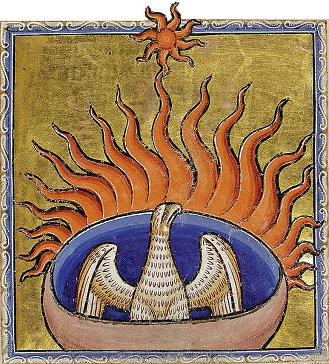
I’ve read that the Aberdeen Bestiary’s phoenix represents the Resurrection.

What the folks who made medieval bestiaries would have made of the New Mexico whiptail lizard, I don’t know.

Tales of the phoenix predate Europe’s Middle Ages by millennia.

Ancient Greeks associated the φοῖνιξ/phoînix, a bird that rises from its predecessor’s ashes, with the sun. Herodotus apparently wasn’t sure that the phoenix was real.

Ancient Egypt’s Bennu sounds phoenix-like. Whether Egyptians borrowed a Greek idea, or Greeks picked the tale up from Egypt is a good question. Or maybe they both heard about a unique and immortal bird from someone else.

I talked about Genesis, platitudes, perceptions and greeting cards last week. Since I think God creates everything we can observe, studying this universe isn’t a problem. Neither is accepting what we learn. (March 2, 2018)

I don’t “believe in” evolution or science. Or having fun. Not as a reason for living. Certainly not as a substitute for God.

But enjoying life’s pleasures is a good idea. Wanting something good isn’t a problem. Trouble starts when I let desires override reason. (Ecclesiastes 2:2425; Catechism, 1809, 2535)

Science and religion both pursue truth, or should.

Faith, the Catholic version, means accepting “the whole truth that God has revealed.” Including what we find in nature. When we learn something new, it’s an opportunity for “greater admiration” of God’s work. Catechism, 32, 41, 74, 142-150, 283, 341, 2500)

I say that a lot:


1 Several centuries on a steep learning curve:

2 Learning how an early bird grew:

3 Feathers, birds, and alligators:

4 Early birds and their world:

5 Still rethinking reproduction:

Posted in Science News | Tagged , , , , , , , , | 2 Comments

Being Evangelical

I’m a Christian. I take my faith seriously. That’s why I think part of my job is evangelizing. Which doesn’t necessarily mean I’m an evangelist.

For some folks, an evangelist is someone like Saints Mark, Luke and John. “The Evangelist” often gets added to their name. Saint Matthew is an evangelist, too. So are Saints like Augustine of Hippo, Francis of Assisi, Francis Xavier and Thérèse of Lisieux.1

“Evangelist” has quite a few meanings. Merriam-Webster says it’s a Protestant minister or someone who enthusiastically advocates something. Oxforddictionaries.com adds “…the writer of one of the four Gospels….”

I don’t know about the ‘enthusiastic’ part, but I think sharing what I believe is a good idea. (Matthew 28:1920; Catechism of the Catholic Church, 898907)

I’m evangelical in that sense. But I’m not “an evangelical.”

In my dialect of English, “evangelical” is a bit more specific. Dictionary.com says it refers to the ‘Bible-believing’ outfits. Apparently it’s what fundamentalists were called, starting in the late 1970s.

Evangelical” also means ‘from or about the Bible, particularly the Gospels. Or Christian teachings.’ My views are evangelical in that sense. But I’m not a Bible-thumper.

Evangelical

‘Bible-believers’ I’ve known had an admirable enthusiasm for memorizing select Bible verses.

A Bible verse associated with a particular idea is apparently called a proof verse or prooftext. Memorizing lots of prooftexts is impressive rote learning, demanding dedication and persistence.

I don’t imitate them. Not quite.

I read and believe the Bible. The whole Bible, not just excerpts. It’s part of being Catholic, or should be. I also realize that the Bible wasn’t written from a contemporary Western viewpoint. (Catechism, 101133, 390)

I think God authored the Bible. And that humans from many eras wrote the books. They used their talents, what they knew and how their culture worked; and wrote what God was ‘saying.’ In that sense, the Bible is “true.” (Catechism, 105108)

But Christianity, my sort, isn’t “a ‘religion of the book.'” (Catechism, 108)

It’s not ‘just the Bible, God and me.’ We have a living Tradition, from our Lord, passed along by the Apostles and their successors. That, the Bible, and the Magisterium, tell me what our Lord said, and why it matters in my life.2 (Catechism, 7595, 101133)

Tradition

Our Tradition is ancient.

But it’s not old-fashioned. Valuing our Tradition does not mean trying to act as if 1967, 1954 or 1848 never happened. (October 20, 2017; August 14, 2016)

I realize that rules and customs change. And must change as our cultures and needs change. Underlying ethical principles written into this universe? Those haven’t changed, and won’t. (Catechism, 19541960)

Sometimes changing obsolete customs means shelving traditions: lower case “t.”

My experience has been that what’s new sometimes doesn’t work very well. And change is seldom, if ever, comfortable. Particularly when it means giving up cherished customs. (November 5, 2017; June 18, 2017)

That may help explain why “traditional Catholics” apparently feel they’re the only ‘real’ Catholics left. It’s not, sadly, the only division in Christendom.

Some ‘evangelicals’ say Catholics aren’t ‘Bible-believing.’ And not Christian. I’ve run into some Catholics who say the same thing about ‘evangelicals.’ Minus the ‘Bible-believing’ bit.

The catchphrases differ, but I see their attitudes as facets of the same ‘only me and thee’ mindset. How I see folks whose beliefs aren’t just like mine is — complicated. (Catechism, 811856)

The Darwin Fish and Me

I’m not sure who made the first ichthys symbol, or “Jesus fish.”

Sometimes it’s just the two curves, sometimes “Jesus” is written inside.

I like the ichthys symbol.

It’s simple, easily recognized, and reminds me of jobs some Apostles had. There’s the loaves and fish incident too, and the working lunch described in Luke 24:3649. Jesus eventually convinced the Apostles that he’d stopped being dead, and that’s another topic.

I’ve got a bit in common with both the Bible-wielding chap and the one wearing a “Darwin fish” T-shirt.3

That may need some explaining.

A Wikipedia page calls creationism “a hallmark of American Christianity.”

The Darwin fish contrasts scientific theories and creationism. It’s not the only ichthys parody around. But it’s the only one I’ve seen, apart from that Wikipedia page.

I could start ranting about evolution, the evils of science, and all that. Or get enraged that someone thinks American Christians believe creationism. But that wouldn’t make sense.

I’m a Christian, and an American. I don’t see evolution, or science in general, as a threat to my faith. I certainly don’t have a problem with what we’re learning. And I’ve known too many American Christians who don’t like evolution. At all.

I call myself a Christian because I follow Jesus, the man who is God. Who was killed and stopped being dead. (October 8, 2017; June 18, 2017; April 16, 2017)

That’s why I try to love God and my neighbors, and see everyone as my neighbor. (Matthew 5:4344, 22:3640; Mark 12:2831; Luke 6:31 10:2527, 2937; Catechism, 1789)

I wouldn’t wear a Darwin fish T-shirt. But like I said, I don’t see science as a threat.

I see what we learn as opportunities for admiration of God’s work. Science and faith should get along fine. (Catechism, 159, 283, 341)

God’s Decisions

The fish with legs is a stylized picture of critters like Ichthyostega and Tiktaalik.

They’re a lot like fish, and a lot like the earliest known land tetrapods. “Tetrapod” is a fancy name for an animal with four limbs that lives at least partly on land.

I’m sure God could have made this universe along the lines of Mesopotamian cosmology: a plate under a bowl, supported by pillars. Or something like Aristotle’s spheres. Or a cosmos that started about six millennia before someone’s “now.”

Maybe God created another physical reality like one of those. Or several.

“Our God is in heaven; whatever God wills is done.”
(Psalms 115:3)

I sure won’t try telling the Almighty ‘you can’t do that.’ Or ‘you must do that.’ I figure my job, part of it, is admiring the wonders around us. Not second-guessing God’s decisions.

The Best News Ever

Kvetching about folks not knowing everything a few thousand years back isn’t, I’m sure, going to help me share the best news humanity’s ever had.

It’s what I said last week.

God loves us. And wants to adopt us. All of us. Each of us. (Romans 8:15; Ephesians 1:35; Peter 2:34; Catechism, 13, 2730, 52, 1825, 1996)

I don’t think trying for ‘most argumentative pest of the year’ would help me do that.

The ‘I’m right and you’re stupid if you don’t agree’ approach rubs me the wrong way. It’s likely enough true for most folks. And I’d worry about those who enjoy verbal abuse.

Besides, I’ve got the best news ever. Happiness is okay. Joy makes sense. Hope is an option. And we live in a universe filled with wonders:


1 Evangelical Saints:

2 Definitions (and see Catechism, 95, 113, 126, and 174):

BIBLE: Sacred Scripture: the books which contain the truth of God’s Revelation and were composed by human authors inspired by the Holy Spirit (105). The Bible contains both the forty-six books of the Old Testament and the twenty-seven books of the New Testament (120). See Old Testament; New Testament.”

MAGISTERIUM: The living, teaching office of the Church, whose task it is to give as authentic interpretation of the word of God, whether in its written form (Sacred Scripture), or in the form of Tradition. The Magisterium ensures the Church’s fidelity to the teaching of the Apostles in matters of faith and morals (85, 890, 2033).”

TRADITION: The living transmission of the message of the Gospel in the Church. The oral preaching of the Apostles, and the written message of salvation under the inspiration of the Holy Spirit (Bible), are conserved and handed on as the deposit of faith through the apostolic succession in the Church. Both the living Tradition and the written Scriptures have their common source in the revelation of God in Jesus Christ (7582). The theological, liturgical, disciplinary, and devotional traditions of the local churches both contain and can be distinguished from this apostolic Tradition (83).”
(Catechism of the Catholic Church, Glossary)

3 Cartoon by Rod Anderson, via Christian Post, used w/o permission

Posted in Being Catholic | Tagged , , , , , , , | 3 Comments

Art, Evolution and Aquinas

Someone left stenciled handprints on Maltravieso Cave wall. Quite a few ‘someones,’ apparently.

Marking a wall can leave adolescent graffiti or murals like Orozco’s “Omnisciencia.”

I think it’s a very “human” thing to do. So do scientists. That’s why most figured the folks who made cave paintings were like us: Homo Sapiens. That may be so, but it’s not what a new analysis shows.

If those stencils are as old as the research says they are, we’re going to be reevaluating what “human” means. That got me thinking about art, being human, and a new species of bird that really is new. They didn’t exist until a few decades back.


Abstract Art: Yujian to Cubism

James Thurber wrote “I don’t know much about Art, but I know what I like” as a caption for one of his 1939 cartoons. A whole mess of other folks said the same thing, pretty much.

My guess is that Thurber heard or read someone say “I don’t know…” — or something close to it. Someone said it first. I suspect the expression’s been around since long before we developed writing.

I’ve learned enough about art to see what’s well-made, even when I don’t like what I see. That doesn’t keep me from preferring “what I like,” or admitting that my likes and dislikes don’t reflect something’s quality. Not entirely. And that’s another topic.

Yujian created that landscape around the time European scholars were getting enthusiastic about Aristotle.

Too enthusiastic, in some cases. I’ve talked about 1277 and who’s in charge before. (November 5, 2017)

Some folks trace abstract art back to artists of the Song dynasty, like Yujian.

They’ve got a point, I think. I also think at least some cubist artists arguably got ideas from masks and other African art.

Quite a few folks were re-thinking Western attitudes about “primitive” folks around that time. That’s resulted in long-overdue reforms, along with equally-odd notions.

I’ve seen “abstract art” defined quite a few ways. Including the seemingly-inevitable efforts at finding psychiatric explanations for what happened.1

A definition I like places abstract art on a continuum, with photographic realism at one end and no contact with observable reality at the other.

I like some of what’s done near both ends, and some of what’s between them. I also think folks who say ‘it’s junk, my toddler can draw better than that’ occasionally have a point.

I don’t think all of what’s labeled “abstract art” is junk. Photorealistic, no. Imaginative, creative, and worth studying — yes. That said, some of what passes for “art” these days owes more to deep pockets, naive credibility and effective marketing. My opinion.

“Religious art” isn’t all masterpieces, either. Not by a long shot. (August 13, 2017)

What Is “Art?”

All representational art is, in a sense, a lie.

That’s what René Magritte’s “La trahison des images/The Treachery of Images says. It’s not a pipe. It’s an image of a pipe. That’s why he included “Ceci n’est pas une pipe./This is not a pipe” as a caption.

I don’t think all representational artists are headed for Hell because they’re liars. Partly because I think most folks can see differences between a pipe and a picture of a pipe.

On the other hand, some Christians seem to have made smashing statues an integral part of their faith. And that’s yet another topic.

I’m a Catholic, so I see art as something very ‘human.’ Art is “…a freely given superabundance of the human being’s inner riches….” It is a sort of practical wisdom: something we do, using talent given by God. (Catechism of the Catholic Church, 2501)


Interior Decorating, the Early Years


(From University of Kansas News, used w/o permission.)
(“In Maltravieso Cave, western Spain, Neanderthals stencilled their hands by blowing red paint over them”
(BBC News))

Neanderthals were capable of making art
Paul Rincon, BBC News (February 23, 2018)

Contrary to the traditional view of them as brutes, it turns out that Neanderthals were artists.

“A study in Science journal suggests they made cave drawings in Spain that pre-date the arrival of modern humans in Europe by 20,000 years.

“They also appear to have used painted sea shells as jewellery.

“Art was previously thought to be a behaviour unique to our species (Homo sapiens) and far beyond our evolutionary cousins.

“The cave paintings include stencilled impressions of Neanderthal hands, geometric patterns and red circles….”

I’m pretty sure this paper will spark discussion. Just about anything about Neanderthals, art, and “human” behavior will. Scientists have, happily, come a long way since 1829. That’s when Schmerling found part of a Neanderthal child’s skull.

William King said Neanderthals were a distinct species in 1864. He also said Neanderthals had likely been “incapable of moral and theistic conceptions.”

I think that made a lot more sense in the Victorian era than it does now. To most “civilized” folks, that is.

We’ve learned a lot since then. Including, maybe, a touch of caution about making assumptions:

“Symbolic behavior among Neandertals are obscure….”
(“U-Th dating of carbonate crusts reveals Neandertal origin of Iberian cave art,” Abstract, D. L. Hoffmann, C. D. Standish, et al.; Science (February 23, 2018))

We’re also not sure why folks left handprints on cave walls, or drew animals and people. Educated guesses include folks using them as educational aids or ceremonial images.

Science and Human Nature

These scientists used uranium-thorium dating on carbonate crusts in the caves.

It’s like radiocarbon dating, but compares the ratio of thorium to uranium.

Radiocarbon dating is good for organic stuff 50,000 years old or less. Uranium-thorium dating is good for a bit more than the most recent 500,000 years.

They figure the carbonate, and the marks, are more than 64,000 years old.

Humanity’s current model, Homo Sapiens, didn’t live near the caves until about 20,000 years later. That means someone else made them. Or at least a few folks of the Homo Sapiens sort arrived there earlier.

That’s what this team says.2

They may or may not be right about that.

I’m pretty sure that scientists will be discussing how accurate their uranium-thorium procedures were.

Another possibly-debatable point is whether or not the carbonate deposits and the paintings are associated. There’s also what they mean by “symbolic” and “behavior.”

There’s a considerable gap between those hand impressions and more recent paintings, like the ones in Lascaux cave. The last I heard, scientists still figured folks who looked like us made them.

More-or-less like us, that is.

Human nature being what it is, some scientist may say that the team’s uranium-thorium technique must be flawed.

Because it implies that Neanderthals made the paintings. And Neanderthals couldn’t have made anything that sophisticated.

Then again, maybe not.

That sort of circular reasoning may be more common in faculty lounge conversations than formal papers.

There’s also the matter of when Homo Sapiens moved out.

Teeth


(From Israel Hershkovitz, Tel Aviv University; via BBC News; used w/o permission.)
(“The teeth are in the upper size range of what’s seen in modern humans”
(BBC News))

Modern humans left Africa much earlier
Pallab Ghosh, BBC News (January 25, 2018)

Researchers have identified the remains of the earliest known modern humans to have left Africa.

“New dating of fossils from Israel indicates that our species (Homo sapiens) lived outside Africa around 185,000 years ago, some 80,000 years earlier than the previous evidence.

“Details appear in the journal Science.

“The co-lead researcher, Prof Israel Hershkovitz, told BBC News that the discovery would fundamentally alter ideas of recent human evolution.

“‘We have to rewrite the whole story of human evolution, not just for our own species but all the other species that lived outside of Africa at the time,’ the researcher, from Tel Aviv University, explained….”

Maybe not “the whole story of human evolution,” since our story goes back far beyond the folks who lived near Misliya Cave. But it looks like we’ll be taking another look at what’s happened since someone started making Mousterian stone tools.

I’m not surprised. We’ve learned a lot since Nicolas Steno studied fossils.

Leclerc got in trouble with the Sorbonne’s Faculty of Theology for saying that maybe Earth’s story wasn’t what they said it was. (March 10, 2017)

Lamarck published his natural history books from from 1815 to 1822. Miescher discovered nucleic acids in 1869, a decade after Darwin’s “Origin.” The Human Genome Project started publishing their research in 2001. (January 19, 2018)

This hasn’t been a comfortable era for folks with a distaste for new ideas.

Interactive Humans


(From Mina Weinstein-Evron, Haifa University; via BBC News; used w/o permission.)
(“Misliya Cave is located 90m above mean sea level”
(BBC News))

“…The new scientific dating evidence raises the possibility that modern humans interacted with other, now extinct, species of humans for tens of thousands of years. It also fits in with recent discoveries of remains and genetic studies that also indicate an earlier departure from Africa….”

This also isn’t a surprise, or shouldn’t be. Folks interact with each other a lot. The trick, from some viewpoints, is to keep us from interacting.

We routinely share tools and ideas. It’s generally done by trading what we’ve got for something we don’t.

That bothers a few folks, but not nearly as much as what happens when youngsters from different groups have kids. I don’t share that attitude. Partly because I know my family history. As one of my ancestors said of another, “he doesn’t have family, he’s Irish.”

Some human “species” may actually be extinct.

We’ve learned that others, like Neanderthals and Denisovans, are no more “extinct” than the víkingr and Na hÉireannaigh. No longer particularly distinct groups, yes. Gone without a trace, no. (June 16, 2017; January 13, 2017)

I’m also pretty sure that scientists will be revisiting what’s meant by “species.”

New Chapters

Up to a decade or so back, most of what we knew about humanity’s family story came from studying bones and durable tools.

Stone tools last a long time. Bones don’t, usually. Sometimes a bone gets fossilized, the original material replaced by minerals.

Conditions have to be just right for that to happen. That’s why we find so many fossils in rock strata that started as mud or silt.

Humans can live near muddy water. Sometimes we do. But most of us prefer living away from swamps and marshes.

Bones, fossilized and otherwise, last longer if they’re in a sheltered area. That’s why so many human remains are found in caves. We’re no more ‘at home’ in a cave than a swamp. But we’ll use them for shelter and storage.

Mapping the human genome unlocked whole new chapters in our story, which we’ve barely started reading. Metaphorically speaking.

We’d pieced together some of the puzzle by that time. (June 16, 2017)

Forensic techniques that let investigators reconstruct a victim’s face from a skull give scientists a look at folks from earlier times. It won’t tell us much about how they lived, but can show how closely they resembled folks living today. Or didn’t.3

Adding genetic information to the mix is answering some questions. As usual, we’re finding a great many new questions in the process.


Pioneering Plants


(From Paul Kenrick, via BBC News, used w/o permission.)
(“Early plants would have looked much like this lava field in Iceland”
(BBC News))

Origins of land plants pushed back in time
Helen Briggs, BBC News (February 20, 2018)

A seminal event in the Earth’s history – when plants appeared on land – may have happened 100 million years earlier than previously thought.

“Land plants evolved from ‘pond scum’ about 500 million years ago, according to new research.

“These early moss-like plants greened the continents, creating habitats for land animals.

“The study, based on analysing the genes of living plants, overturns theories based purely on fossil plant evidence….”

“Overturns” may be an overstatement. The new analysis does mean taking another look at how plants moved onto land. And that means reevaluating how land animals developed.

As long as they’ve got access to minerals, sunlight, water, and a bit of carbon dioxide, photosynthetic plants get along fine on their own.

Animals can’t eat rocks, bask in the sun, and stay alive. Not for very long. Animals eat plants that converted sunlight to chemical energy, or eat animals that eat plants. Either way, we get energy from plants. Minerals, too; in digestible compounds.

I suppose animals could eat water plants, then obligingly move onto land so other critters could eat them. We’re finding some intriguing symbiotic relations, but nothing like that. Not as far as I know.

Which, granted, doesn’t mean the research isn’t there. It’s been some time since one person could read everything that’s been written about everything. Never mind trying to keep up with what’s currently published.

Molecular Clocks

Studying life’s long story would be easier if all cells had a little chronometer, or at least a timestamped log of major changes.

It’s not that simple. Not quite.

About a half-century back, new tech let scientists isolate and study homologous proteins: proteins found in different but related critters.

Data from those studies, and new genetic knowledge, made measuring changes in proteins and genes possible.

Molecular clocks aren’t hardware. They’re a sort of analysis using known mutation rate per generation and the number of nucleotide differences between two sequences.

That probably sounds simpler than it is, but it’s a pretty good way to estimate when major changes happened.

Pretty good isn’t perfect — I figure scientists will be fine-tuning their analyses for quite a while. The new research raises many questions, including just how valid its results are. ‘Molecular clock’ times generally place events before what fossils show.4

That may mean we haven’t found the earliest examples of assorted critters. Or maybe the molecular clocks need resetting.

One of the research paper’s headings is “Implications for Hypotheses on the Coevolution of Land Plants and Climate.” Jennifer L. Morris and the other scientists take a quick look at Paleozoic carbon dioxide levels and other major climate changes.

If they’re right, timelines for climate changes a half-billion years back will need revision. And that’ll mean taking another look at probable cause-effect relations. Maybe “overturns” isn’t far from the mark, after all.

Darwin’s Finches Strike Again!


(From P. R. Grant, via BBC News, used w/o permission.)
(“This is an image of the Big Bird lineage, which arose through the breeding of two distinct parent species: G. fortis and G. conirostris”
(BBC News))

Galapagos finches caught in act of becoming new species
Rory Galloway, BBC News (November 23, 2017)

A population of finches on the Galapagos has been discovered in the process of becoming a new species.

“This is the first example of speciation that scientists have been able to observe directly in the field.

“Researchers followed the entire population of finches on a tiny Galapagos island called Daphne Major, for many years, and so they were able to watch the speciation in progress….”

Darwin’s evolutionary theory is at least partly an example of serendipity. He wasn’t much of a bird expert in 1831, when the HMS Beagle reached the Galápagos. There’s a story about how Darwin got on the ship, but that’ll wait for another day. Maybe.

His job was observing and recording geological features. He’d studied beetles back in England, but wasn’t a naturalist by any stretch of the imagination. That didn’t keep him from noticing and logging the occasional critter, and like they say: the rest is history.

We get the word “species” from a Latin translation of Aristotle. He defined species his way. Linnaeus added his thoughts, and we still don’t have a completely satisfactory definition.

Following Aristotle’s lead, we figured species didn’t change until a few centuries back.

We’re still not sure how new species start. Not exactly. Likely enough it’s not just one mechanism. We are fairly certain that a bunch of related critters being isolated is part of the process. That’s what makes the Galápagos so important.

The Big Bird Lineage


(From Movera, via Wikimedia Commons, used w/o permission.)
(Daphne Major, Galápagos Islands)

This new species started in 1981. Researchers noticed a large cactus finch arriving at Daphne Major. The newcomer and a female from the local medium ground finches produced fertile young. They were a bit like their parents, but not quite like either.

Males in new generations didn’t attract any finches from the island’s ‘established families.’ Most likely because their mating calls sounded — different. Their beaks weren’t the ‘right’ size and shape either. That matters to finches.

They could and did pair up with females from the original pair. That sort of inbreeding is why we don’t have Spanish Hapsburgs any more. In this case, though, the next generation grew up and hatched eggs of their own.

They’re bigger than the other Daphne Island finches. That helped them make their own ecological niche. Researchers dubbed them the Big Bird lineage. I don’t know if that name will be ‘official,’ but I like it.

Two generations after the first hybrid finches, researchers figured they were looking at a new species.

Fast-forward about four decades after the newcomer’s arrival, and we’ve got about 30 individuals that aren’t large cactus or medium ground finches. They’re surviving nicely, and keep producing new generations. Six so far. It looks like we’ve got a new species.5

I figure this will spark some lively discussion. Getting a new species in two generations shouldn’t be possible: if new species only happen through mutation. That’s not what happened here. The Big Bird lineage started with hybridization.

Even so, I suspect that scientists who think everything happens gradually may not like it. Scientists are human, so ‘like’ and ‘dislike’ matter. To individuals.

But facts and sound analysis outvote preference. Assuming that these researchers did their job, the Big Bird lineage shows that change can be fast. I’ll talk about catastrophism and uniformitarianism, again. Eventually. But not today.

Instead, I’ll look at how I see what we’re learning. And how finches fit into faith.


It’s (Not) Magic

I’ve seen what Pope Francis said in 2014 called “a significant rhetorical break with Catholic tradition.”6

That’s almost true.

I’ve known some Catholics who don’t like evolution. There may be some who don’t like Copernican ideas.

I can’t fault the commentator for seeing “Catholic tradition” as attitudes cherished by some ‘traditional Catholics.’

I certainly can’t blame him for not explaining that someone’s “traditions” aren’t “Tradition.” Quite a few Catholics don’t seem to understand the differences. (Catechism, 74-94)

Here’s what Pope Francis said, in part:

“…When we read the account of Creation in Genesis we risk imagining that God was a magician, complete with an all powerful magic wand. But that was not so. He created beings and he let them develop according to the internal laws with which He endowed each one, that they might develop, and reach their fullness. He gave autonomy to the beings of the universe at the same time in which He assured them of his continual presence, giving life to every reality….”
(“Plenary Session of the Pontifical Academy of Sciences; inauguration of the bust in honour of Pope Benedict XVI,” Pope Francis (October 27, 2014))

I don’t know how many Americans see Christianity and evolution as mutually exclusive. Or at least feel uneasy about what we’ve been learning in recent centuries.

Or, coming from another direction, think religion encourages ignorance. Folks in both, all, camps are often loud and zealous. Which doesn’t make them right.

I have no reason to reject our increasing knowledge of God’s creation, and good reasons for paying attention. That’s because I think God creates everything we can observe.

Thomas Aquinas had quite a bit to say about that. There isn’t an official patron Saint of nerds, as far as I know. But if there was, it could easily be St. Thomas Aquinas. And that’s yet again another topic.

Anyway, I’ve read that St. Thomas Aquinas coined “secondary causes.” In Latin, of course. There’s quite a bit about secondary causes in his “Summa.” Here’s something from his discussion of predestination and change. A very brief excerpt:

“…God’s immediate provision over everything does not exclude the action of secondary causes; which are the executors of His order, as was said above (Question [19], Articles 5, 8)….”
(First Part, Question 22, Article 3)
“…For the providence of God produces effects through the operation of secondary causes, as was above shown (Question [22], Article 5)….”
(First Part, Question 23, Article 5)
“…The fact that secondary causes are ordered to determinate effects is due to God; wherefore since God ordains other causes to certain effects He can also produce certain effects by Himself without any other cause….”
(First Part, Question 105, Article 1)
“…God fixed a certain order in things in such a way that at the same time He reserved to Himself whatever he intended to do otherwise than by a particular cause. So when He acts outside this order, He does not change….”
(First Part, Question 105, Article 6)
(“Summa Theologica,” Thomas Aquinas (ca. 1265-1274))

Backing up a bit, I think God creates everything.

I also think natural processes involve secondary causes, creatures acting in ways determined by their nature. God writes knowable physical laws into everything we can observe. (Catechism, 268, 279, 299, 301-305; “Gaudium et spes,” 5, 15, Second Vatican Council, Bl. Pope Paul VI (December 7, 1965))

Everything reflects a facet of the Creator’s truth. What it reflects comes from its nature. (Catechism, 301-308)

Since I believe that God creates everything, learning about this universe gives me more reasons to admire God’s work. (Catechism, 159, 214-217, 282-283, 294, 341)

Perceptions, Platitudes


(From Gallowboob, via Reddit, used w/o permission.)
(A baby blue heron)

Thinking that everything reflects some of God’s truth doesn’t guarantee recognizing it.

Medieval bestiaries were more like today’s coffee table books than science texts.

For one thing, what we call “science” was more like natural philosophy in those days.

For another, they were made mostly for show: something a wealthy patron could put on display. Or enjoy perusing.

From what I’ve seen, books written by or for medieval scholars weren’t overly decorative. (October 27, 2017)

I’m not sure how the moral lessons associated with each critter lined up with then-contemporary theology and ethics.

My guess is that the agreement was about as close as we see between today’s Hallmark cards and the Compendium of the Social Doctrine of the Church. Or Currier and Ives prints and Rerum Novarum.

Which brings me to that baby heron.

My wife said ‘that’s an ugly bird.’ I think she’s right. I’ve seen adult great blue herons. They’re majestic birds. I’ve seen photos of little blue herons, not the birds themselves. They’re bigger than a crow but smaller than a goose.

Blue herons, great and little, are attractive in their own way. As adults.

I’m quite sure the yellow-billed bundle of attitude and claws illustrates some aspect of God’s truth. What that truth is, I don’t know. Which won’t keep me from speculating.

The photo on Reddit came with a message: “Wonder what happened to the dinosaurs? This is a baby Blue Heron.” I agree. For theropod dinosaurs, anyway.

Maybe the obvious — to me — continuity between today’s birds and yesterday’s dinosaurs says that change happens.

Some birds are beautiful. Maybe the lesson is that obvious beauty can come from not-so-obvious sources. Or maybe something completely different.

Platitudes about ugly ducklings and rough diamonds come to mind. Or maybe the fable we call The Cat and the Mice. Or the Ant and the Chrysalis.

On the other hand, like someone said, sometimes ugly ducklings grow up to be ugly ducks. And maybe ducks, ugly or not, show us we can’t all be swans. Or mice.

I’d better stop now.

Life, the universe, and everything; my view:


1 Art, abstract and otherwise:

2 Early art:

3 Learning humanity’s story:

  • Wikipedia
  • The earliest modern humans outside Africa
    Israel Hershkovitz, Gerhard W. Weber, Rolf Quam, Mathieu Duval, Rainer Grün, Leslie Kinsley, Avner Ayalon, Miryam Bar-Matthews, Helene Valladas, Norbert Mercier, Juan Luis Arsuaga, María Martinón-Torres, José María Bermúdez de Castro, Cinzia Fornai, Laura Martín-Francés, Rachel Sarig, Hila May, Viktoria A. Krenn, Viviane Slon, Laura Rodríguez, Rebeca García, Carlos Lorenzo, Jose Miguel Carretero, Amos Frumkin, Ruth Shahack-Gross, Daniella E. Bar-Yosef Mayer, Yaming Cui, Xinzhi Wu, Natan Peled, Iris Groman-Yaroslavski, Lior Weissbrod, Reuven Yeshurun, Alexander Tsatskin, Yossi Zaidner, Mina Weinstein-Evron; Abstract; Science (January 26 2018)

4 Virtual clocks and life:

5 New birds:

6 An op ed and the Pope:

Posted in Science News | Tagged , , , , , , | 4 Comments

God, Love and Clouds

Today’s Gospel, Mark 9:2 through 10, describes the Transfiguration. I’ll be talking about that. Partly. Also Peter, perceptions, and laundry detergent.

It seems like a better idea than getting upset that not everybody calls the second Sunday in Lent “Transfiguration Sunday.”

Or that some folks read this part of the Gospel on a different Sunday. Or that we had a different second Sunday Gospel reading last year. Or that our Feast of the Transfiguration is August 6 this year. And is a Monday.

Occasions for angst abound. I’d rather look at what today’s Gospel says and what’s been said about it. Then think for a bit and see what happens.

Mountains

The second Sunday in Lent was March 12 last year. The Gospel reading was from Matthew that time around.

Public readings of Sacred Scripture predate Christianity by centuries. Like Ezra’s readings and explanations. That’s in Nehemiah 8.

We started doing the current three year cycle somewhere along the line. And that’s another topic, for another day.

Our Mass schedules aren’t exactly what they were two millennia back. That’s okay, since our cultures aren’t exactly what they were, either. (February 4, 2018; November 26, 2017; October 15, 2017)

One more thing before I get going. Matthew says the Transfiguration happened on a mountain, but doesn’t say which one.

I figure if saying which mountain was an important detail, it’d have been recorded.

That hasn’t kept folks from thinking about which particular mountain Matthew meant. Mounts Tabor and Hermon were early favorites. Or maybe it’s the Horns of Hattin, Gebel Germaq, El-Ahmar, Mount Nebo, or some other place.

Or maybe it’s no particular mountain, or the Apostles made the whole thing up.

That doesn’t seem likely.

Jones Very and Getting a Grip

Saying that Christianity is a failed coup attempt aimed at the Sanhedrin set, or maybe the Roman establishment, has been popular lately.

Fashionable, at any rate, in some circles.

Or maybe Jesus was a charismatic faith healer who started believing his own spiel.

It’s reasonable, in a ‘good enough for a story’ sense. But doesn’t explain why folks like Peter and others who knew Jesus preferred death to changing what they said.

Conspiracy theories can be fun, when presented as fiction. But they’re not particularly plausible. (July 21, 2017; May 14, 2017)

Folks saying ‘I’m Jesus’ aren’t as common as wannabe prophets with End Times Bible prophecies, but they happen. The claimants aren’t all alike.

Jones Very was a studious and eccentric poet. He may also be an example of why first cousins shouldn’t have kids. Francis Herman Pencovic called himself Krishna Venta, had his followers do good works, lost a child support suit, and got killed.

And that’s yet another topic.

I figure the Transfiguration happened. Not knowing exactly what mountain it happened on doesn’t bother me. I’ve talked about ‘need to know’ before. Mostly in the ‘coming End Times’ context. (August 20, 2017)

We also don’t know much about Rhoda. The excitable maid gets one mention, in Acts 12:1315. Come to think of it, we don’t know exactly how long Peter kept knocking at the door, waiting for someone to open it.

That wasn’t what I as talking about, though. Let’s see. The Transfiguration. Mountains. Speculations. A 1970s sitcom. Peter. Right.

Thinking, Meditating

There’s quite a bit going on here:

“After six days Jesus took Peter, James, and John and led them up a high mountain apart by themselves. And he was transfigured before them,
“and his clothes became dazzling white, such as no fuller on earth could bleach them.
“Then Elijah appeared to them along with Moses, and they were conversing with Jesus.
“Then Peter said to Jesus in reply, ‘Rabbi, it is good that we are here! Let us make three tents: one for you, one for Moses, and one for Elijah.’
“He hardly knew what to say, they were so terrified.
“Then a cloud came, casting a shadow over them; then from the cloud came a voice, ‘This is my beloved Son. Listen to him.’
“Suddenly, looking around, they no longer saw anyone but Jesus alone with them.

“As they were coming down from the mountain, he charged them not to relate what they had seen to anyone, except when the Son of Man had risen from the dead.
“So they kept the matter to themselves, questioning what rising from the dead meant.”
(Mark 9:210)

“Dazzling white” reminds me of laundry detergent commercials. I’m pretty sure, though, that this isn’t some sort of prophecy about 20th century broadcast marketing.

I’ve run into speculation that the Transfiguration wasn’t a miracle. Not in the usual sense. (August 13, 2017)

I won’t insist on this, but maybe the Transfiguration was a moment when the our Lord’s nature wasn’t toned down all the way. If that’s so, it’s when a miracle wasn’t happening.

Jesus is human on his mother’s side. Jesus is also the Son of God. One of three persons in the Trinity. Divine. (John 1:14, 3:17; Catechism of the Catholic Church, 232260, 456478)

And God is one.

I don’t understand how that works. Not on an operational level.

I think we stand a far better chance of reverse-engineering this reality’s source code than figuring out how the Almighty is one God and three Persons.

That hasn’t stopped us from thinking about it.1 And meditating on what it means from our viewpoint. (Catechism, 233; “Summa Theologica,” Thomas Aquinas, I, 31, 1)

About that last verse, Mark 9:10, I see it as another example of the Apostles realizing what they’d signed on for — after the Crucifixion and Resurrection. (November 26, 2017)

I think we understand a bit more today. The Transfiguration is a sort of sneak preview of God’s kingdom. And one of the Trinity’s public appearances. (Catechism, 554556)

“…the whole Trinity appears—the Father in the voice, the Son in the man, the Holy Ghost in the bright cloud…”
(“Summa Theologica,” Thomas Aquinas, III, 45, 4)

Clouds

Peter, James and John most likely had no trouble realizing that the voice from the cloud was God’s.

The Almighty had used a cloud to say ‘I’m here’ before. (Exodus 9:1335, 13:21, 20:20, 40:34; 1 Kings 8:10)

On the whole, I’d prefer living my life without needing a visible reminder that God is real, present, and paying attention. ‘Burning bush’ and ‘plagues of Egypt’ events make good cinematic spectacle. Up close and personal? That’s another matter.

The Transfiguration is in Matthew 17:18 and Luke 9:2836 too. John 1:14 has the same message: that Jesus is God’s son. But it’s not a ‘Transfiguration’ account.

Accounts of our Lord’s baptism have pretty much the same message: Matthew 3:1317; Mark 1:111; Luke 3:2123.

“Listen to him” strikes me as good advice:

“While he was still speaking, behold, a bright cloud cast a shadow over them, then from the cloud came a voice that said, ‘This is my beloved Son, with whom I am well pleased; listen to him.’
“When the disciples heard this, they fell prostrate and were very much afraid.
“But Jesus came and touched them, saying, ‘Rise, and do not be afraid.’
“And when the disciples raised their eyes, they saw no one else but Jesus alone.”
(Matthew 17:58)

Acting Like Love Matters

‘Mountaintop experiences’ are a big deal, apparently. I haven’t had one, and might not know what to do if I did. Or what to think of it.

Health issues being what they are, I’d reasonably wonder if my blood sugar levels needed attention. I’ve learned that noticing my emotions makes sense. Trusting them doesn’t. (October 8, 2017; July 2, 2017)

I’ll have all eternity, I hope and trust, to bask in God’s glory. Right now, there’s work to do.

Part of it, a big part, is passing along the best news humanity’s ever had.

God loves us. All of us. Each of us. And wants to adopt us. (Romans 8:15; Ephesians 1:35; Peter 2:34; Catechism, 13, 2730, 52, 1825, 1996)

I accepted God’s offer. What you decide is up to you.

I like being part of God’s family. It’s not the ‘king’s kid’ or ‘prosperity Gospel’ goofiness that keeps resurfacing. That’s yet again another topic.

The way I see it, just saying I’m part of the family won’t cut it. I should act like I accept the family values. (James 2:1719; Catechism, 18141816)

I should love God and my neighbors. All my neighbors. Everyone in the world. No exceptions. (Matthew 5:4344, 22:3640; Mark 12:2831; Luke 6:31 10:2527, 2937; Catechism, 1789)

That’s what I should do. What actually happens is another matter, far too often. But it’s still a good idea.

I’m not loving each neighbor if I see a neighbor in trouble and do nothing. Or ignore someone’s need.

Sometimes the only way I can help is by praying. There’s more to say about that. Lots more. (Catechism, 25582856)

I can also suggest that recognizing humanity’s “transcendent dignity” makes sense. It’s in each of us. But we’re not all alike. We’re not supposed to be. (Catechism, 1929, 19341938)

I think generosity, kindness, sharing and planning for future generations makes sense. (Catechism, 1937, 2415, 24192442)

Saying that is simple. Applying those principles isn’t. Neither is cobbling together something that’ll work long enough be be worthwhile.

I don’t expect to be around when what we’re doing today ‘pays off.’ Humanity has an enormous backlog of injustices and unresolved issues.

I see that as a good reason to keep seeking justice and practicing mercy.

Working together, with everyone who’s willing to help, I think we can build a better world. Meanwhile, as I keep saying, we’ve got good reasons for celebration:


1 The Transfiguration, a few resources:

Posted in Being Catholic | Tagged , , , , , , , , , | 7 Comments

Oxygen, Alien Life

We haven’t found extraterrestrial life. But we’re still finding planets circling other stars. Thousands of them.

Some of those planets couldn’t possibly support life as we know it. But some might.

Atomic oxygen may be a good biosignature: evidence of life. That’s what some scientists said in a recent paper. If they’re right, we may be a step closer to finding life in this universe.


Martians

Looking for extraterrestrial life seemed simpler a few generations back.

Frank R. Paul’s picture was an artist’s rendering of a science fiction editor’s thoughts on what Martians might look like.

The Gernsback/Paul Martian was less fanciful than many imagined space aliens.

As David S.Zodney put it, “…the Martian was actually based on some sort of logic, though very much of the schoolboy exercise book variety….”

But it was still more fiction than science.

Scientists didn’t “believe in” Martians back in the 1930s. I’ll get back to that. Serious speculation about life on Mars wasn’t nearly as colorful as Paul’s art.

We’ve known about Martian polar caps since the 1600s. We’d learned that the planet has seasons much like Earth’s by the 1800s.

Improved tech brought the planet’s other large surface features into focus. Barely.

The Vatican Observatory’s Fr. Pietro Angelo Secchi drew some of the first color maps of Mars. He described “channels” on the Martian surface in 1858. We call his “Canale Atlantico” “Syrtis Major Planum” these days.

“Channel” in Italian is “canali.” It means any sort of channel: natural or artificial. Channels on Earth have water in them, maybe that started scientists thinking about cause-effect links between Martian seasons, channels, and seasonal color changes.

I like Lowell’s speculative account of a Martian civilization’s desperate and doomed efforts to survive a little longer on a dying world:

“…On the earth the sea-bottoms still hold seas, on Mars they only nourish vegetation….
“…once fertile fields become deserts….
“…That it [a canal network] joins the surface from pole to pole and girdles it at the equator betrays a single purpose there at work. … Nations must have sunk their local patriotisms in a wider breadth of view and the planet be a unit to the general good….”
(“Mars as the abode of life,” Percival Lowell (1908))

It makes a good story. But Lowell’s Mars wasn’t a good match to his era’s science. Late 19th and early 20th century spectroscopy showed little to no water on Mars. Quite a few scientists were wondering if the channels/canals were really there.

We’ve learned quite a bit about Mars and optical illusions since then. (October 13, 2017; December 16, 2016)

Expectations

Most scientists thought extraterrestrial life would be very much like life on Earth. If it existed at all.

Biosignatures, indications that there’s life, seemed pretty obvious. We figured we’d find life on planets that are about Earth’s size and mass, with Earth’s temperature and oxygen in the atmosphere.

All life must, scientists thought, gets energy from the sun. Plants do it directly. Other critters eat plants, or eat the critters that eat plants, and all of them end up recycled by microcritters. With sunlight driving the whole food chain.

Plants produce oxygen, so oxygen in the air shows that life’s there. It seemed obvious.

Then we found critters living around hydrothermal vents, miles below the last rays of sunlight. They’re getting energy from the hot vents, not the sun. Other critters don’t need oxygen. Some die if exposed to the stuff. But they’re “life.”

Scientists found ways oxygen could get into a planet’s air without life being involved. We’ve found at least one planet with atmospheric oxygen that couldn’t possibly have life as we know it. It’s far too hot. (March 3, 2017; September 2, 2016)


Life and Oxygen Ions


(From NASA Ames/JPL-Caltech/T. Pyle, via NASA, used w/o permission.)
(From 2014, Tim Pyle’s idea of what Kepler-186f may look like.)

Charged oxygen in ionosphere may offer biomarker for exoplanets
Barbara Moran, Boston University, via Phys.org (February 19, 2018)

“On January 9, 1992, astronomers announced a momentous discovery: two planets orbiting a pulsar 2,300 light years from our sun. The two planets, later named Poltergeist and Draugr, were the first confirmed ‘exoplanets’—worlds outside our solar system, circling a distant star. Scientists now know of 3,728 (confirmed) exoplanets in 2,794 systems, each one begging the question: ‘Is anyone else out there?’

“‘What more important question could we ask? Are we alone?’ asks Boston University professor of astronomy Michael Mendillo. ‘I don’t know of any more fascinating question in science.’…”

If that picture looks familiar, I’m not surprised. Tim Pyle’s art has been used quite a bit since NASA/JPL released it in 2014, announcing Kepler-186f’s discovery.

Kepler-186f is the first roughly earth-size planet found in another star’s habitable zone. It might look like that picture. Maybe. Or maybe not. It’s one of five known planets orbiting Kepler 186.

Nearly three years later, we still don’t know much more about the Kepler-186 planetary system. It’s not for lack of interest.

The star isn’t particularly bright, and about 500 light-years away. That’s too far for us to study Kepler-186f’s atmosphere, or learn much of anything else about it.

I figure we’ll develop telescopes and other tech that’ll ‘reach’ that far. Eventually. But nothing we’ve got now or are developing will do the job.

Scientists have found quite a few more approximately Earth-size planets that may or may not be habitable. Data from Kepler has been particularly useful in the continuing search for ‘Earth 2.0.’

Kepler was still in operation, the last I heard. The spacecraft’s fuel supply will most likely run out later this year. But that won’t be the end of Kepler’s story. We’re still studying data it’s been sending back, and probably will be for years. Decades.

I won’t be checking on Moran’s numbers for how many confirmed exoplanets we’ve spotted. The number may have changed by Friday morning. Then there’s who confirmed them, and how. That’s a lot of work for a statistic that’ll soon be outdated.

I’m not sure whether the 3,728 count includes what Danish scientists announced:

This is not the world I grew up in. Discoveries of worlds circling other stars were mostly in science fiction magazines, not science journals and a business-oriented aviation tech website. We didn’t have websites either, for that matter.

A Pulsar and Dead Worlds

The first two confirmed exoplanets weren’t the first ones discovered. Not by several decades. They were also quite a surprise. We still haven’t quite figured out how a pulsar can have planets. Not quite.

Poltergeist and Draugr orbit PSR B1257+12. The star was designated PSR 1257+12 before its coordinates were updated. Except for catalogs where it was PSR J1300+1240.

The “B” in a pulsar’s designation means that its position in our sky was for the 1950.0 epoch.

Astronomers update coordinates every 50 years. The changes are small, but important when aiming telescopes.

Shakespeare’s “I am constant as the northern star” in “Julius Caesar” aside, the “northern star” isn’t particularly constant. Mainly because Earth’s axis precesses, moving along the surface of a cone. Slowly.

Tiān Qiāng sān, Theta Boötis, was the North Star when folks were setting menhirs where Carnac is today. Rukh, Delta Cygni, will be Earth’s North Star around the 113th century. (December 8, 2017; March 24, 2017; December 2, 2016)

We’re pretty sure about that, partly from studying old star catalogs. There’s debate over who noticed what first. We’ve got a mess of old sky catalogs, from cuneiform texts like The Three Stars Each and MUL.APIN to the SAO. And that’s another topic.

Newton said precession and gravity were linked. His ‘precession’ math wouldn’t work, but he had the right idea. Other mathematicians and scientists worked on the math. Then Einstein added relativistic effects to the mix. It’s been an interesting era.

PSR B1257+12 is a mouthful, even for astronomers, so the star’s been called Lich.

Lich is old English for “corpse.” That word’s been reanimated recently as a term in fantasy literature and role-playing games.

Draugr is what my Norse ancestors called one sort of walking corpse. Poltergeist means “noisy ghost” in German.

We’ve found a third planet in that system: Phobetor. The name is from Ovid’s Metamorphoses: nightmares personified.

Appropriate names, I think, for a dead-but-active star and its planets.

Besides being one of the first confirmed exoplanets, Draugr is the lightest of any we’ve found yet. It’s not quite twice our moon’s mass.

Lich is what’s left of a star that exploded between 1,000,000,000 and 3,000,000,000 years back. Or maybe two stars. The pulsar’s planets are almost certainly as dead as their names imply.

How a pulsar like Lich gets planets is a good question. Scientists figure the least-unlikely scenario is two white dwarfs merging into a pulsar, leaving a protoplanetary disk. Or maybe it was a weird supernova. Or a quark-nova.1

It’s one of the fascinating puzzles we haven’t solved. Yet.

Biosignature? Biomarker?

Michael Mendillo, Paul Withers and Paul A. Dalba say atomic oxygen ions may be a reliable biosignature. What they say makes sense. My opinion.

But “biomarker?”

A biomarker, for them, is something that “…can be used to identify a planet in orbit around a solar-type star where global-scale biological activity is present….” Fair enough.

I’ll use the term “biosignature” instead.

Other literature I’ve seen, and the National Institutes of Health, use “biomarker” when talking about “molecular or cellular events that link a specific environmental exposure to a health outcome.” It’s something used by medicos to diagnose cancer and other disorders.

“Biosignature” is something measurable that’s evidence of present or past life. I get the impression that quite a few folks see biomarkers as something for medial diagnosis. When many or most scientists are looking for life, they look for biosignatures.2

Oxygen and Solar Worlds

These scientists took a look at the one planet we know supports life, Earth, and other Solar worlds.

Not Mercury, though. There’s precious little atmosphere to study there.

Oxygen is part of many atmospheres. It’s usually part of a complex mix of gasses.

Earth’s atmosphere, down where we live, is pretty simple. It’s nearly 21% oxygen. The rest is nitrogen. Except for about one half of one percent that’s mostly carbon dioxide.

That’s not just simple. It’s a lot of oxygen.

The oxygen hasn’t always been there. Microcritters started converting sunlight to energy about two and a half billion years back, with oxygen as a byproduct. What little they produced promptly reacted with iron or organic debris.

Then, roughly 2,300,000,000 years back, all that changed. Likely enough, the microcritters got better at converting sunlight. Pretty soon, on a cosmic scale, there wasn’t enough stuff to absorb the oxygen they were dumping.

We’re still uncovering details, but the results are clear enough.

Oxygen levels rose. Not enough for our comfort, not then. But more than enough to kill critters that can’t tolerate the element. The Great Oxygenation Event set off at least one mass extinction. And, probably, the Hurorian glaciation. (April 14, 2017)

A Reliable Biosignature, Maybe

Earth’s atmosphere isn’t the same all the way up. From 90 to 150 kilometers, sunlight starts breaking molecular oxygen (O2) into oxygen atoms: ionized oxygen.

It’s why Earth’s day side lights up like a neon sign. In far ultraviolet.

That, Mendillo and the rest say, is unique in the Solar System. They’re probably right.

They also say that Earth’s bright oxygen ion dayglow should be unique: found only in the ionospheres of worlds with plants like ours. They may be right about that.

If so, it’ll make looking for ‘Earth 2.0’ easier. Not easy: easier. There’s still the matter of sorting out oxygen-generated dayglow from the planet’s sun.

I also figure scientists will be discussing this. The data seems straightforward enough. What’s debatable, probably, will be how the data gets analyzed.

Even if ionized oxygen isn’t a surefire biosignature, we’ll learn quite a bit from this research. And the research it encourages.


Enthusiasm


(From Rami Niemi, via Wired, used w/o permission.)

Nasa’s new telescope will give our hunt for alien life a major boost
Kai Staats, Wired (January 21, 2018)

“So far we have found over 550 exoplanets that could sustain life. Nasa’s Tess Telescope is about to dramatically increase that number

While we haven’t yet discovered life beyond planet Earth, our investigations into planets that orbit stars other than our Sun – known as extra-solar planets, or exoplanets – have only just begun. In 2018, we will discover the first exoplanet with atmospheric indications of life, thanks to the launch of Nasa’s new space telescope, the Transiting Exoplanet Survey Satellite (Tess), which will begin a two-year survey of more than 200,000 of the closest, brightest stars, in March….”

I’ll give Kai Staats points for enthusiasm and a positive attitude.

I’m not sure what happened with the first and second sentences after his article’s title and blurb. The first sentence is fine: “…we haven’t yet discovered life beyond planet Earth….”

The next one starts with “in 2018, we will discover the first … indications of life….”

Like I said, points for enthusiasm and optimism.

Logic, not so much. Unless he somehow knows that TESS will find a biosignature.

That would take some doing, because the satellite’s job is to detect planets. Not see what sort of atmosphere, if any, each has. Or probe beneath the ice of an Enceladus analog.

Maybe one or more of the stars it scans harbors life. If that’s so, we’ll find out. Later.

Maybe Staats wrote something else. And then an editor with a strong preference for emotional appeal over logical integrity ‘improved’ the article’s lead. Or something happened to the file, and it got auto-corrected. Or something entirely different.

Whatever the explanation, I enjoyed the article’s illustration and bubbly attitude.

Now, about TESS. Briefly.

NASA’s TESS


(From NASA, via Wikimedia Commons, used w/o permission.)
(TESS, Transiting Exoplanet Survey Satellite; Artist’s concept.)

NASA seems nearly as enthusiastic and optimistic about TESS as the Wired writer.

The Goddard Spaceflight Center’s TESS page says their satellite “…will discover thousands of exoplanets in orbit around the brightest stars in the sky….”

That may be a bit optimistic. It assumes, for starters, that the TESS mission won’t have science-stopping technical problems.

But as I said last week, we’ve learned a great deal since the 1950s. Ships almost never explode before reaching space.

And this isn’t the first time folks have looked for exoplanets.3

Even the detection method has been done before. What makes TESS special — is something I plan on talking about later. Maybe around April 15. That’s the earliest date planned for launch.

With upwards of 200,000 stars scheduled for observation and thousands of already-known exoplanets, I think NASA and MIT are justified in thinking they’ll detect at least a couple thousand new ones.

Many of those newly-discovered worlds may have atmospheres. At least one might harbor life. That’s something we’d learn after follow-up observations. As far as I can tell, TESS is designed to detect planets. That’s all.

That’s important. Data from TESS will help scientists pick which new worlds to focus on. Discovering what sorts of worlds they are? In detail? Like I said: that’ll come a little later.


Still Looking

We’re learning a great deal about planets in general. It’s not what we expected.

We’ll probably find planetary systems like ours, with small rocky planets near their sun and big gassy ones further out.

We may have spotted the ‘Jupiter’ of a Solar System analog.

HIP 11915 b is about 190 light-years out in the general direction of Dalim and Baten Kaitos/Tiān Cāng sì. The planet has around Jupiter’s mass and orbit.

There may be terrestrial planets in smaller orbits. The last I checked, we hadn’t found any. That doesn’t mean they’re not there. Just that we’ve got more to learn.

What we have found so far have been hot Jupiters, mini-Neptunes and super-Earths.

Those are the comparatively ‘normal’ planets.

Scientists, some of them, think we’ll be finding chthonian planets: gas giants that lost their hydrogen and helium from orbiting too close to their sun.

HD 209458 b may be on its way to becoming one. It orbits a star that’s a bit like ours, about 159 light-years out. HD 209458 b is about seven tenths as massive as Jupiter, but is closer to its sun than Mercury is to ours. It’s hot. Very hot.

Scientists using the Hubble Space Telescope Imaging Spectrograph found a huge extended atmosphere around HD 209458 b. The planet is shedding hydrogen, carbon and oxygen.

Like I said earlier, oxygen doesn’t mean life. The planet’s surface is around 1,000 Centigrade, 1,800 Fahrenheit. That wouldn’t melt iron. But lead would be a liquid. Life as we know it? We won’t find it there.

Unless we think building a refrigerated lander makes sense. Then we’ll be there. And that’s yet another topic.

We’ve found enough mini-Neptunes and super-Earths to have a statistically-meaningful sample.

Scientists have started revising how we figure planets form. (June 30, 2017)

What we haven’t found is life on another planet. I figure that’s because it’s not there. Or maybe we haven’t found it yet.

Either way, I think we’ll keep looking.

Beliefs

Someone could “believe in” Martians. Or nisse. And leave a bowl of milk out at the winter solstice.

The person might even be a scientist. But that’s quite a stretch, even for me.

Science is, or should be, a systematic study of how this universe works. That sort of thing vexes some folks. I talked about Aristotle, Anaxagoras and angst last month. (January 12, 2018)

I don’t believe in nisse. The Norwegian pixie analogs are part of my cultural heritage, but not part of the family’s current beliefs. On the other hand, it wasn’t that many generations back when one of my kinsmen was a bit too emphatic about not believing in such things.

I don’t believe in Martians, either. Not in the ‘flying saucer religion’ sense. Putting anything where God should be in my priorities is a bad idea. (Catechism of the Catholic Church, 21122114)

Given what we’ve been learning recently, I also don’t think we’ll find ruins of a Martian civilization. Tech left by travelers, maybe. But that’s not likely. And yet again another topic. Almost.

I’ve run into folks who seem convinced that someone can’t be a Christian and “believe in” extraterrestrial life. What they apparently mean is that being Christian and thinking there may be life elsewhere are mutually incompatible.

Some of them are smart, well-educated Catholics. Maybe they ran into someone who took ‘salvation by flying saucer’ beliefs seriously, and overreacted. I don’t know.

My own opinion about extraterrestrial life, and whether or not we’ve got neighbors in this universe, is pretty much what I read in a comic strip:

“I been readin’ ’bout how maybe they is planets peopled by folks with ad-vanced brains. On the other hand, maybe we got the most brains…maybe our intellects is the universe’s most ad-vanced. Either way, it’s a mighty soberin’ thought.”
(Porky Pine, in Walt Kelly’s Pogo (June 20, 1959) via Wikiquote)

Reality

My opinion about life in the universe won’t change reality. God’s God, I’m not, which suits me just fine.

Part of my job is admiring God’s work. Not telling the Almighty how it should have been designed. I say that a lot.

Maybe because strident foes of newfangled ideas sometimes justify their views with “religious” arguments. It’s embarrassing.

My youthful encounters with ‘Bible-based’ opposition to science in general and evolution in particular left a deep and regrettable impression.

It wasn’t all bad news, though. The rants sent me on a search that led me to become a Catholic. And that’s still another topic.

About ‘Bible-based,’ I take the Bible very seriously. Some of that’s my Protestant roots showing. But what was a preference is now an obligation. (Catechism, 101133)

Truth

Taking the Bible seriously is one thing. Thinking that folks knew everything there was to know when Genesis and Job were written is daft.

That’s my view. I’ll grant that I see no point in basing my faith on poetic metaphor rooted in Mesopotamian beliefs.

Or being upset that Aristotle was wrong about celestial spheres. Or that Newton got some of his math wrong. Or that Einstein didn’t see eye to eye with Bohr.

We didn’t know everything there is to know about this universe before the Late Bronze Age Collapse.

We’ve learned quite a bit since then. But we still don’t know everything. We may have more unanswered questions today. I see it as more fascinating puzzles to solve.

Which likely as not will unlock still more puzzles. For someone like me, it’s like living in a cosmos-size toy store. Fully stocked.

I can’t reasonably be upset that we’re learning more about this vast universe.

That’s because I’m a Catholic. For me, faith means willingly and consciously embracing “the whole truth that God has revealed.” (Catechism, 142150)

The whole truth. Not just what folks knew in the ‘good old days.’

I’ll find truth in the Bible. But it’s not ‘just the Bible and me.’ I’ve got the Bible, our Tradition, and the Magisterium. Tradition with a capital “T” isn’t trying to live in the past. At all. (Catechism, 7495, 105108)

I’ll also find truth in this universe. If I pay attention.

There’s truth in the natural world’s order and beauty. Noticing it and appreciating God’s work is a good idea. That’s because everything ultimately points back to God. (Catechism, 32, 41, 74, 283, 294, 341, 2500)

Finding Life

Getting back to Barbara Moran’s question, “Is anyone else out there?”

I’m quite sure that we’re alone. That in all this vast universe, life exists only on Earth.

Or that we’ll find life on other worlds. Single-celled life, but extraterrestrial just the same.

Or we’ll find life on other worlds. And learn that we have neighbors. Creatures like us, free-willed spirits with physical bodies. People, but not human.

It’s not my decision.

If God decides to do something, it’ll happen. It’s that simple. And I’m quite sure God can handle whatever’s out there.

“Our God is in heaven and does whatever he wills.”
(Psalms 115:3)

“Indeed, before you the whole universe is as a grain from a balance, or a drop of morning dew come down upon the earth.”
(Wisdom 11:22)

Whether or not we share this universe with others is a God-level decision. If we do, I’m pretty sure we’ll meet. Sooner or later. Or we’ll find traces they left. Meanwhile, I’m quite sure we’ll keep looking:


1 Pulsars, precession, and planets:

2 Oxygen ions and life:

3 Searching for and studying exoplanets:

Posted in Science News | Tagged , , , , , , , | 8 Comments