Ghosts?

Allied Artists: Vincent Price in 'House on Haunted Hill'. (1959)
Vincent Price in “House oh Haunted Hill”. (1959)

Whether or not I believe in ghosts depends on what’s meant by “believe in” and “ghosts.” And how I see myself, for that matter. I’ll be talking about ghosts and why I think seances are a bad idea. Also, briefly, superstition and metaphysics.

I don’t fear that an ancestral banshee might come to the new world and find me. Or think spirit photographers were selling pictures of ghosts. (April 11, 2018)

If that’s ‘believing in ghosts,’ then I don’t. On the other hand, I’m not a materialist. I think part of me won’t die, no matter what happens to my body.

It’s a Material World, Partly: Body AND Soul

I see the physical world — matter, energy, the structure of time and space — as part of reality. But not all of it. There’s more to me than the oxygen, carbon, hydrogen, nitrogen, calcium and phosphorus in my body.

I’d think there was more, even if I was a strict materialist.

Those six elements only account for about 99% of my mass. Another 0.85%, give or take a bit, is potassium, sulfur, sodium, chlorine, and magnesium.

Trace amounts of pretty much every other element complete the list.

All the more common elements in my body are also common on or near Earth’s surface. But not in quite the same proportions. Earth’s crust has bigger fractions of silicon, aluminum and iron.1

I could fret about Earth’s abundance ratios and Genesis 2:7 not quite matching. But I won’t. Oddly enough, I’ve yet to see a ‘Bible-based’ church denounce chemistry. Or geochemistry. Evolutionary theories have been among their favored foes since the mid-19th century. (February 9, 2018; September 22, 2017)

‘Biblical’ disapproval of post-Jenner medical tech may have been more popular in the 18th century, but it’s still an issue. And another topic. (July 21, 2017; October 16, 2016)

I think my body is part of me.

Like all other humans, I’m made of matter and spirit. This is not a problem. Matter isn’t basically bad. (Genesis 1:27, 31; Catechism of the Catholic Church, 285, 337–349, 355-373, 285, 1703)

My body will die. My soul can’t.

My soul, like every other human’s, is created by God, spiritual and immortal. I’m not more or less “spiritual” than anyone else. I can’t be. We’re equal, but not identical. We’re not supposed to be. (Catechism, 366, 872, 1703, 1880, 1934-1937)

We’re all creatures made from the stuff of this world and God’s ‘breath.’ Each of us is made in the image of God, with a body and “equally endowed with rational souls.” (Catechism, 355-379, 1703, 1934)

SOUL: The spiritual principle of human beings. The soul is the subject of human consciousness and freedom; soul and body together form one unique human nature. Each human soul is individual and immortal, immediately created by God. The soul does not die with the body, from which it is separated by death, and with which it will be reunited in the final resurrection (363, 366, cf. 1703).
(Catechism, Glossary)

Having a spiritual and material nature comes with being human. What I do with these gifts is up to me. (Catechism, 355, 1730-1731)

Death, Life and Being Human

When I die, I’ll still be a human: a dead one.

I won’t necessarily be better off as a disembodied soul. Or basically different.

I’ll be a human whose soul and body aren’t connected. It’s a temporary condition. My soul and resurrected body will be together, eventually, along with every other human’s: in time for the Last Judgment. (Catechism, 990, 1038-1050)

If I’ve got any sense, I’ll be in that “great multitude, which no one could count” Revelation 7:9 mentions. Opting out is an option. But not a good one. (March 11, 2018)

I like being a creature made of matter and spirit.

That’s just as well, since I’m human and always will be. Maybe that seems odd, coming from someone who says he’s a Christian.

I’ve run into interesting notions and assumptions, maybe folklore by now, about life, death and all that.

I’ll never be an angel. Angels are pure spirit, an entirely different sort of creature. Angels are the ones who are agents for God. They’ve got intelligence and will, like we do; so working for God is their choice. Or was. (Catechism, 328-336, 391-395)

They don’t exist in space-time, not the way we do, so my language’s verb tenses don’t quite fit their situation. I’ve got more to say about angels, artistic conventions, and Mycenaean Linear B, but that’s yet another topic, for another day.

It’s like the 1937 movie said: “You Only Live Once.” Reincarnation doesn’t happen. I get to go through this live once. Or need to, from another viewpoint. (Catechism, 1013, 1020-1050)

Logical Explanations and a Pulsing Tombstone

Uncle Deadly is one of my favorite Muppets. His recent Halloween appearance on The Muppets YouTube channel showcases his witty charm.

Both an actor and vocalist, Uncle Deadly’s interpretation of “Sheik of Araby” was unforgettable:

“…At night when you’re asleep
Into your tent I’ll creep….”
(“Sheik of Araby” lyrics (Fats Domino))

So, for me, was his title role in “Phantom of the Muppet Theater.”

The following “Phantom” dialog makes more sense with an explanation. Not much more, since this was The Muppet Show. Kermit, the Muppet Theater house manager, has been dealing with panicky Muppets.

After a false alarm, Kermit says “…there is no such thing as a phantom. That’s final, period, end of report!” Then Fozzie asks Kermit what’s behind him, and leaves the long-suffering frog:

Kermit “Uh, you will notice that I didn’t fall for their joke. And if it isn’t a joke – I mean, if there is someone or something behind me – there is no doubt a logical explanation for it. So I shall now just turn slowly around and see what is going on here.”
He turns around and faces Uncle Deadly.
Kermit Uh, pardon me, sir, but is there a logical explanation for your presence here?”
Uncle Deadly (cackles)
Kermit “Apparently, there is no logical explanation.”
He runs away screaming. Uncle Deadly cackles.
(The Muppet Show, Episode 121: Twiggy (1976))

I think Uncle Deadly’s response was more a ‘nya-ha-ha-ha‘ than a cackle, but that’s not my point. Kermit’s “apparently, there is no logical explanation” remark reflects both the frazzled frog’s inner spirit and a common perception of logic and reality.

Today’s notion that realty includes the material world and nothing else is part of the Enlightenment’s legacy. So is seeing logic and ‘spiritual’ perceptions as incompatible.

I don’t agree, but think generations of Post-Reformation state-run religions, turf wars, famines, plagues and witch hunts — fueled by faith-based propaganda — left a bad taste. (March 9, 2018)

Devoutly daft Christians don’t help.

Neither, I think, do “miraculous” products, apparently-Christian superstitions and folks who believe them. (August 13, 2017; July 23, 2017)

In a way, superstition is religious feeling gone wrong. If I believed that a prayer works if I say the right words with the right gestures, no matter what’s going on inside me — that’d be superstition, and a bad idea. (Catechism, 2110-2111)

Thinking that my soul can’t die doesn’t mean I think a local cemetery was haunted during the 20th century. I do, however, think a local story about the cemetery is true.

A particular tombstone pulsed with a pale radiance at every rising of the full moon: regular as clockwork, for years. I’ve seen the cemetery. Some of the older locals could have shown me the tombstone.

One of them told me how and why the tombstone pulsed with strange radiance at each clear rising of the full moon. And why the tombstone gleams no more in the gloaming.

The ‘haunting’ ended when a supper club on the south edge of town closed. The eldritch pulse was moonlight reflecting off the establishment’s rotating sign. When the sign stopped turning, the tombstone stopped pulsing.

“A Christmas Carol” and Metaphysics

I’ve never chatted with a ghost, or had the opportunity. Meeting a ghost, I probably wouldn’t say what Scrooge did. I’m a real American, living in 21st century Minnesota: not a fictional Englishman residing in 19th century London.

But I’d likely have Scrooge’s doubts about what my senses were telling me.

I think Marley’s questions made sense. So did Scrooge’s replies:

“…’You don’t believe in me,’ observed the Ghost.
‘I don’t,’ said Scrooge.
‘What evidence would you have of my reality beyond that of your senses?’
‘I don’t know,’ said Scrooge.
‘Why do you doubt your senses?’
‘Because,’ said Scrooge, ‘a little thing affects them. A slight disorder of the stomach makes them cheats. You may be an undigested bit of beef, a blot of mustard, a crumb of cheese, a fragment of an underdone potato. There’s more of gravy than of grave about you, whatever you are!’…”
(“A Christmas Carol,” Charles Dickens (1843) via Project Gutenberg)

Maybe “an undigested bit of beef” wouldn’t make someone see Marley. Our sensory organs and brain aren’t quite that unreliable. But hallucinations happen, Quite a lot can go wrong, and occasionally does.2

Scrooge and Marley were discussing what’s real and how we know about it: ontological and epistemological aspects of metaphysics. But without the obfuscatory grandiloquence that arguably gives metaphysics a regrettable reputation.

The Oxford Dictionary of Difficult Words” says that “metaphysics” and “metaphysical” can mean “abstract theory or talk with no basis in reality” and “based on abstract (often excessively abstract) reasoning.”

I don’t have a problem with abstract theory. The trick is remembering what’s real, and what isn’t.

I’m interested in — fascinated by — what’s in this universe and the rest of reality, and what might exist.

My interests encourage me to think about what’s real and what’s not, and how sure I can be about what I think I know. That’s metaphysics, but mostly I see it as common sense.

Getting back to Scrooge, Marley, and attitudes, I think Dickens said it best. Scrooge was “a squeezing, wrenching, grasping, scraping, clutching, covetous, old sinner.”

I’ve seen Scrooge called a materialist, the sort who thinks physical treasures are important and spiritual ones aren’t. That’s pretty obvious, after the first few paragraphs.

A few folks have said he’s a materialist of the metaphysical variety. I see their point, since Scrooge said he thought Marley might be an indigestion-induced hallucination.

But I suspect Scrooge’s metaphysical musings hadn’t been much deeper than “It’s humbug still! … I won’t believe it:”

“…They were succeeded by a clanking noise, deep down below; as if some person were dragging a heavy chain over the casks in the wine-merchant’s cellar. Scrooge then remembered to have heard that ghosts in haunted houses were described as dragging chains.

“…The cellar-door flew open with a booming sound, and then he heard the noise much louder, on the floors below; then coming up the stairs; then coming straight towards his door.

“‘It’s humbug still!’ said Scrooge. ‘I won’t believe it.’

“His colour changed though, when, without a pause, it came on through the heavy door, and passed into the room before his eyes. Upon its coming in, the dying flame leaped up, as though it cried, ‘I know him; Marley’s Ghost!’ and fell again….”
(“A Christmas Carol,” Charles Dickens (1843) via Project Gutenberg)

I take spiritual realities seriously and think our souls can’t die, so why wouldn’t I try contacting deceased friends and relatives? What could possibly go wrong?

The Endor Incident

Folks who say ‘it’s good to be king’ may be thinking of kings reigning in tranquil times. Or maybe don’t see leadership’s downside.

1 Samuel 28:319 opens with Samuel’s death. Philistine troops are about to attack King Saul’s territory.

“When Saul saw the Philistine camp, he grew afraid and lost heart completely.”
(Samuel 28:5)

I’ll give Saul credit for using proper, by his standards, methods first.

“He consulted the LORD; but the LORD gave no answer, neither in dreams nor by Urim nor through prophets.”
(Samuel 28:6)

That wasn’t the first time Saul had asked for advice and gotten no answer. Thinking about why God wasn’t returning his calls would have made sense. But fearful folks don’t make sense. Not consistently.

Saul, who should have known better, had a medium in Endor arrange an interview with Samuel. The deceased prophet was none too pleased. Understandably, since consulting ghosts and spirits is a bad idea. (Leviticus 19:31, Deuteronomy 18:1011; Catechism, 2116)

Saul got his question answered. Accurately, too; although I’m pretty sure Saul didn’t like what he learned.

I’ll grant that the medium could have staged Samuel’s appearance, or gotten the attention of someone who’s not one of God’s agents. Not all spiritual beings are ‘good guys.’ (Catechism, 329-330, 391-395, 414)

In this case, though, what Samuel allegedly said was consistent with what God and the prophets said before and after Saul’s time. Saul may have gotten who he asked for.

Three millennia later, folks who should know better still act like they don’t. Which gives me plenty to write about:


1 What we’re made of, material components:

2 Senses, perceptions, theories and a “myth:”

Posted in Being Catholic, Discursive Detours | Tagged , , , , , , , | 4 Comments

Still More Mass Murder

Fourteen high-profile murders are in the news. Four died at a Waffle House in Nashville, 10 were killed on Yonge Street in Toronto. The accused killers have been caught. I put links to BBC News and Wikipedia pages about the murders at the end of this post.1

I’ll mostly be saying why I think murder is a bad idea, and how I see being human and making sense — or not, in some cases.

I’m not personally involved in the incidents. Living in central Minnesota, far from either city, staying calm about what happened is comparatively easy.

“Calm” isn’t “apathetic.” I think there’s wisdom in this advice:

“Rejoice with those who rejoice, weep with those who weep.”
(Romans 12:15)

These deaths left a great many folks missing family and friends. I trust and hope they will get the support and well-expressed sympathy they need.

Human Life Matters

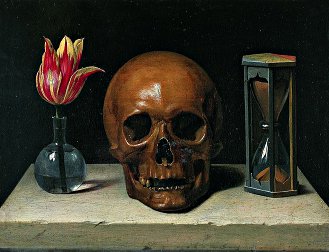
Philippe de Champaigne's 'Still-Life with a Skull', a vanitas painting. (c. 1671) left to right: life, death, and time.Murder is a bad idea. Folks with a remarkable number of different views agree on that, although what’s seen as “murder” has varied quite a bit over the millennia.

I’m a Christian and a Catholic, so I see murder as deliberately killing an innocent human being. (Catechism of the Catholic Church, 2261)

It’s wrong because human life is sacred, a gift from God. Each of our lives matters. Age or health isn’t a factor. Being human is. (Catechism, 2258, 22682283)

Feeling that someone who commits murder is still human isn’t easy, at least for me. But easy or not: I’m obliged to remember that we’re all human; no matter who we are, where we live, or how we act. (Catechism, 360, 17001706, 19321933, 1935)

Responses, Assumptions

News from Toronto, bad as it is, could be worse. Despite the incident being yet another van crime, I’ve yet to hear someone demanding tighter van laws.

One politico even said being calm was a good idea. I think that, and how folks responded to similar crimes in England last year, is good news.

Maybe Western civilization hasn’t gone completely bonkers. (June 25, 2017; June 4, 2017)

The Nashville and Toronto mass murders almost certainly aren’t connected. That’d make an entertaining — sort of — conspiracy theory, and that’s another topic. (August 11, 2017; July 21, 2017)

But the murders have some common elements. Both were committed in North America, by someone in the male 18-34 demographic. Both suspects probably have mostly-European ancestry.

Canadian and American culture and politics being what they are, I don’t think we’ll be discussing the wisdom of locking up all 18-24 Euro-American and Euro-Canadian men. Or at least requiring that these walking time bombs carry their identification papers.

I don’t think that’d make sense, but I’ve been one of “them.” By some wacky standards, that might make me a fellow-conspirator. I don’t miss the bygone days when political correctness was in bloom. Or McCarthyism.

Ideas

Folks had, and have acted on, crazy ideas long before the 20th century.

I see the Thirty Years War as northern European bosses wanting a piece of southern Europe’s wealth. Mostly.

Maybe some really believed their religion-themed propaganda. That, and embarrassments like the Popish Plot, arguably inspired the Enlightenment.

Attitudes like Sapere aude/dare to know seem reasonable. The Cult of Reason’s toga parties, not so much. (March 9, 2018; August 20, 2017; June 25, 2017)

Imagining a perfect world, filled with the light of reason and warmth of love, can be nice. As an occasional intellectual treat.

As mental junk food goes, it may be better than snarfing down six-packs of doom, gloom, Malthus and Yeats. Or adopting fashionable melancholy, which sounds more sophisticated. (August 11, 2017; October 22, 2017)

Blame

The criminologist in Monty Python’s ‘Piranha Brothers’ skit was, happily, fictional. So was his madcap parody of sadly-real attitudes. (March 19, 2018)

We didn’t stay in the 1960s. Most of us didn’t, anyway. Trendy slogans like “victim of society” became dated, occasionally resurfacing as corny comedy relief.

Some of today’s experts aren’t any more reasonable than their wacky predecessors. But quite a few are promoting different ideas. I get the impression that decriminalization is out and the blame game is in.

That’s an extreme oversimplification. And nothing new. McCarthyism had communists, political correctness had oppressors. What’s changed is who’s being blamed. Or what. (November 19, 2017; November 15, 2017)

It’s early days, but I suspect we’ll learn that the person accused of killing folks in Toronto had psychiatric issues. The Nashville suspect almost certainly did.

I think that should be considered during their trials. But I don’t think crazy people are a threat to us all. I’ll admit to a bias. I deal with an autism spectrum disorder, PTSD and depression. (March 19, 2017)

Acting Like Love Matters

I don’t indulge in daydreaming about a utopian world where we’ve solved all our problems. Not much, anyway, now that I’ve passed my early teens.

I certainly don’t think today’s world is ideal, or that we ever had a Golden Age.

I was dissatisfied with the status quo in the ’60s, and still am. I thought we could do better then, and still do. Changing the world, or even my country, is beyond my power. I don’t mind a bit. Having that much responsibility would be scary.

We’ll probably need to change laws, sooner or later. That’s an ongoing process, since how we live keeps changing.

We may need to change how we deal with folks who won’t or can’t follow rules. That’s a can of worms I’ll re-open another day.

The sort of murder that’s in the news is already illegal in both Canada and the United States. Making it ‘more illegal’ might seem appealing, but it may not be a good idea.

I think both murders happened because two people decided that killing others made sense. Or felt good. Some folks might feel that way no matter how the rest of us act.

But we can, I think, start acting as if we believe loving our neighbors is a good idea. Doing so might encourage more thought, less anger; and maybe more mutual respect.

I’ve talked about that sort of thing before:


1 Mass murders, recent and otherwise:

Posted in Being Catholic | Tagged , , | 3 Comments

Gnosticism

Some folks act as if they think physical reality is bad and having a body is icky. The notion’s ‘Biblical,’ sort of.

Galatians 5:19 through 21 call bad ideas like licentiousness, hatreds and idolatry “works of the flesh.” With a little paraphrasing, I could claim that 1 Corinthians 3:3 says jealousy and rivalry are “of the flesh.” Romans 8:3 mentions “sinful flesh.”

Taking those verses, ignoring Genesis 1:31, Psalms 84:3, Ecclesiastes 2:2425 and two millennia of Catholic teaching, and I might see loathing physical reality as an option. But not, I think, a reasonable one. (October 8, 2017)

“Spiritual” isn’t necessarily good or bad. Neither is having a body. What matters is what I decide, how I use my reason and will. (Catechism of the Catholic Church, 1704-1707, 1730, 1852-1869)
I see sin as acting against reason, truth, and right conscience. (Catechism, 1849-1850)

Any creature with free will can do that. (February 4, 2018; November 6, 2016)

Satan was and is pure spirit, with no body at all; which didn’t keep the spiritual creature from sinning on an epic scale. (Catechism, 328-330, 385-395)

Philosophers and Fame


(From Dustin Dewynne, via Wikimedia Commons, used w/o permission.)
(Seeing reality as two things, dualism. Or one thing, monism.)

Materialism/physicalism and idealism are, in a way, two sides of the same coin. Both beliefs see reality as basically one thing. Like quite a few other views, materialism and idealism go back at least to what Jaspers called the Axial Age. (April 15, 2018)

Idealism assumes that consciousness, or something else immaterial, is the most basic part of reality. Plato may be the best-known idealist philosopher. He wasn’t alone. Anaxagoras said that nous, intellect, came first. Aristotle had pretty much the same view.1

Time passed, Anaxagoras didn’t get noticed nearly as much as the other two, and some European scholars got overly-excited about Aristotle in the 1200s. (November 5, 2017)

Meanwhile, folks kept refurbishing and repackaging Plato’s and Aristotle’s ideas about ideals and forms.

Versions with a Christian spin started popping up during the first century AD. They’ve been endemic ever since.

One of the earliest headliners was Valentinus. He taught in Alexandria and set up a school in Rome. That was in the second century AD.

Saint Valentine is a different person and got killed for being a Christian. He wasn’t the first, or last, to decide truth is more important than this life.

Valentinus, the fellow with a school, enjoyed considerable success. So did Valnetinianism, an intriguing alternative to Christianity.

Valentinianism was a big deal in the 2nd century, not so much later.

St. Irenaeus called the Valentinian school “he legomene gnostike haeresis:” “the heresy called Learned (Gnostic),” “the sect called Learned,” or something like that.

Henry More coined the word “Gnosticism” in the 17th century. He was talking about a particular variation of Valentinus-style ideas. The name caught on as a handy label for that sort of anti-materialism.

“Gnosticism” comes from Ancient Greek γνωστικός/gnostikos, “having knowledge.” I think Gnostic beliefs were at least partly inspired by Plato’s theory of forms; but they’re not quite idealism, Platonic or otherwise.

Unlike idealism — and materialism — Gnosticism doesn’t necessarily say that everything’s basically one thing. I gather that a Gnostic might see physical reality as real: but not nice.

Each variation of Gnosticism was and is unique, but they agree in seeing physical reality as something to shun. That’s an enormous over-simplification.

Exclusivity Appeals

‘Secret knowledge’ seems to be another popular feature in Gnostic beliefs.2

I see the same exclusivity appeals in ‘learn ancient secrets’ advertisements. Saw, actually. It’s been a long time since I’ve run into that sort of thing in a magazine.

Selling the sizzle, not the steak, is effective advertising. I’ve heard that Elmer Wheeler said it in the 1920s. Advertising goes back at least to the Song Dynasty. And that’s another topic.

I suspect sizzle helps sell my culture’s chronic End Times prognostications. They arguably give believers opportunities to see themselves as part of the cognoscente.

I don’t take assorted ‘ancient knowledge’ and Rapture claims seriously.

Their effect on folks who believe them is another matter. So are impressions made on folks who see others getting duped. I think deliberately distorting truth is a serious violation of trust. (Catechism, Catechism, 2468, 2486)

Deliberately presenting fiction as fact is a problem. Presenting fiction as fiction — I’ll get back to that.

Gnostic notions and fizzling End Times predictions have been around for centuries. Millennia. Details vary, which isn’t surprising.

First century Rome, 11th century Paris and 21st century Los Angeles were and are centers of culture and influence. But they’re not identical.

Human nature doesn’t change. Not that I can see. Cultures are constantly changing. No competent publicist would ignore a target audience’s current perceptions.

I haven’t seen ‘ancient secrets’ ads in magazines recently. Maybe too many folks started thinking. Or maybe ‘truth in advertising’ regulations caught up with them. Or, more likely, I’m not browsing through the same sort of periodicals now.

‘Secret knowledge’ isn’t Gnosticism’s only attractive feature. I get the impression that denouncing physical reality is a cornerstone of faith for many folks, Gnostic and otherwise.

Being Human

I’ve encountered incandescent Christians of the fire and brimstone ilk raging against “works of the flesh.”

I don’t doubt that they’re sincere. The same goes for Carrie Nation and the “Reefer Madness” set. But I’m sure they’re wrong. (July 10, 2016)

Having a body isn’t a problem. How I decide to see my body, and how I act, can be. But being human, being a body and soul, is how God makes us. (Catechism, 362-379, 992, 2288-2291, 2331-2336)

I’m okay with that. Even if I wasn’t, I wouldn’t see complaining about God’s design aesthetic as a good idea. I hope I’d have that much sense.

The notion that being physical isn’t nice may play well to folks of fastidious spiritual tastes.

Maybe believing “the Word became flesh,” as John 1:14 says, doesn’t feel sufficiently ‘spiritual.’ But believing that the Son of God is human and divine comes with being a Catholic. (Catechism, 285, 456-478, 517)

So does acknowledging that I’m human. I like understanding things, but see wisdom in recognizing limits. How the Incarnation works is beyond me. God is infinite, transcending time and space. Fully understanding God won’t happen. Learning what I can? That’s a good idea. (February 25, 2018; August 20, 2017; June 16, 2017)

Christian-themed Gnosticism probably has roots in Judeo-Christian traditions, Platonism and Neoplatonism. Or Neopythagoreanism, Persian and Hindi traditions, Zurvanite and Zoroastrian beliefs, and Buddhism. Or maybe all of those. Or something else.

There’s not, putting it mildly, a consensus.3

Knowledge and Choice

“To follow knowledge like a sinking star…” is my Google Plus tagline. I might look like someone who’d become a Gnostic. Maybe I would. But it’s not likely.

I like knowledge, a lot. I also enjoy flights of fancy. But confusing what’s real and what’s a product of human imagination doesn’t make sense.

Neither does ignoring realities because I don’t like them, or believing that a figment of imagination is real.

I can continue being a Catholic. Or I can believe that Jesus isn’t or couldn’t be human. Not both. I have to pick one or the other. (Catechism, 285, 465)

I’ve got free will, so in principle I could change my mind about what I think is true. But deciding to stop being a Catholic is about as improbable as it gets. I like being a Catholic, know why I joined, and keep finding more reasons to stay with the Church.

Cool Names

Being a Catholic doesn’t keep me from seeing what’s appealing in Gnosticism. Appealing to someone with my tastes and interests, anyway.

Like that diagram. It’s from a book published in 1826, Jacques Matter’s “Histoire critique du Gnosticisme.”

It’s the Plérome de Valentin, showing how Valentinianism viewed reality.

Valentinian’s version of reality has entities with cool names like le Père, la Pensée and des éons.

If I was reading about it in English, they’d be the Father, the Thought and the Aeons.

If that sounds like some alternative liturgies you’ve run into, I’m not surprised. Like I said, Gnostic notions have been popping up for about two millennia: repackaged but recognizably Gnostic. The New Age4 brand was popular recently. Still is, in some circles.

I like cool names and imaginative alternate realities. But I don’t see a point in believing something because it’s cool, or because it’s kinda now and kinda wow.

Or impressively ancient.

And I know enough of what’s happened and what we’ve thought over the last few millennia to realize that many New Age ideas, for example, aren’t all that new. Some only go back a few centuries, at most. And that’s yet another topic.

Sub-Creation

I’ve known folks who don’t like fiction because “it’s not true.” Or dismiss myth for the same reason.

I wouldn’t try forcing them to read “Through the Looking Glass.”

Or avoid a tale of Líf and Lífþrasir riding out Ragnarök by hiding in Yggdrasil because it’s not science or history.

Avoiding stories because another person won’t or can’t enjoy products of our imaginations is possible. But doesn’t seem reasonable. (July 16, 2017)

Sharing a figment of imagination may not always be a bad idea. I see differences, significant ones, between a storyteller weaving a tale and a con artist selling a version of Victor Lustig’s “money-printing machine”

I also think Tolkien is right about at least one aspect of mythology:

“…This aspect of ‘mythology’ — sub-creation, rather than either representation or symbolic interpretation of the beauties and terrors of the world — is, I think, too little considered….”
(“J.R.R. Tolkien, On Fairy Stories,” via The Heritage Podcast)

And that’s yet again another topic, for another day.

Other posts that may or may not be related to this one:


1 Philosophers, “isms” and all that:

2 A Saint, A Gnostic, and two “isms:”

3 Gnosticism’s origins, maybe:

4 Mysticism isn’t the problem. Nescience can be:

Posted in Being Catholic, Discursive Detours | Tagged , , , , , , , | 5 Comments

Minnesota Spring Weather Continues

That’s what my webcam saw, a few minutes before 8:00 this morning.

It’s now about 10:15 am here in central Minnesota. The view is still much the same: a bit more light, off-and-on snow and wind.

Lighthearted poems about April showers bringing May flowers weren’t, I think, written by folks who lived in my part of the world. Taking a positive view of current reality, we’ve still got power and Internet connections — so I’m sitting back and enjoying the show God’s creation provides:

Posted in Discursive Detours | Tagged , , , | 2 Comments

Materialism, Robots and Attitudes

Robots are starting to look and act a lot like humans.

Wondering if robots can be people, or if humans are merely biological robots, involves assumptions about reality. I’ll look at one of those assumptions in this post and why I believe there’s more to me than chemicals.

Whether a robot could be a person is more of a philosophical question than a legal issue. So far. The question would be particularly interesting if a robot asked to be recognized as a person. Or disturbing, depending on how you look at it.

With today’s robotic tech and AI, my guess would be that a human had programmed the robot to sue for recognition.

Or provided data and analytic processes which pretty much guaranteed that it would ask to be seen as a person.

The question would still be interesting if humans demanded legal recognition of robotic “persons.” I haven’t heard of that happening yet, but think it’ll likely pop up in a few years.

We’ve had folks making similar demands for non-human animals. I think many ‘animals are people too’ folks mean well. I don’t think they’re right about chimps being people, but agree that humans should treat other creatures humanely.

That’s because I think Genesis 1:27 and Psalms 8:6 are right. We’re made “in the image of God” and “little less than a god” — with power and responsibilities to match.

Western civilization’s upper crust abused that power in recent centuries. “Little less than a god” isn’t “God.” Not even close. (January 21, 2018)

Folks misunderstanding or misusing Christian beliefs don’t make Christianity wrong. Genesis, Exodus, Deuteronomy and EU Directive 2010/63/EU tacitly agree that we’re in charge here. (August 11, 2017; November 18, 2016; July 15, 2016)

Christians acting badly were a problem long before the Thirty Years War. It still is. We’re human. Nothing wrong with that, but we’re carrying some very old baggage.

Humans didn’t start out being evil to the core, or ‘loathsome insects.’ We’re not like that now. We’re still good, basically: just wounded. (January 8, 2018; November 6, 2016)

And that’s not what I was talking about. Not quite. Let me think.

Robots. Humans. Assumptions. Animal rights. EU directives. Christians acting like humans. Right.

Programmable Tech: Ismail al-Jazari’s Automata, Pepper, and Looking Ahead


(From Wikipedia and Boston Dynamics, used w/o permission.)

About robots acting like humans, I’ve enjoyed Isaac Asimov’s ‘robot’ stories, and had some fun with the idea myself. Not that I’m in the Asimov league.

Today’s chatbots and tomorrow’s robotic receptionists don’t and won’t fracture my faith. But it’s probably just a matter of time before someone denounces them as works of Satan.

Or claims tax-exempt status for a robot-oriented church. “Church of the Holy Robot” has a nice ring to it. Weird, though.

Making tech that acts like humans is an old idea. “Automaton” comes to my language through Latin. Romans got it from a Greek word that means acting of one’s own will.

Automata in stories, like Talos, were more ‘robotic’ than tech built by Hero of Alexandria and Ktesibios. Ismail al-Jazari described and built programmable automata, and that’s another topic. The point is that programmable tech acting like a critter isn’t new.

What’s different about today’s robots is more a matter of degree than of kind. Their programming is much more complex than post-Renaissance clockwork automata.

We’re also learning more about how humans act and respond. That helps us design AI and robots.

Today’s humanoid robots, robots shaped more or less like us, can do much more than walk, sit, and kneel. They’re still not quite as light on their feet.

They can, however, dance and play soccer. Nao’s famous for doing both.

The folks who developed Nao, a humanoid robot, worked for Aldebaran Robotics. SoftBank Group acquired Aldebaran in 2015, but I think “Aldebaran Robotics” sounds cooler, so that’s what I’ll call them.

The Nao synchronized dance performance at the Shanghai Expo in 2010 made international headlines.

With different programming, Nao robots played in the RoboCup.

Although accomplished dancers and athletes, Nao robots weren’t much for conversation.

They could be programmed to understand spoken words and speak. They could even detect emotional cues and emote with gestures and body language. But I gather that they weren’t very bright.

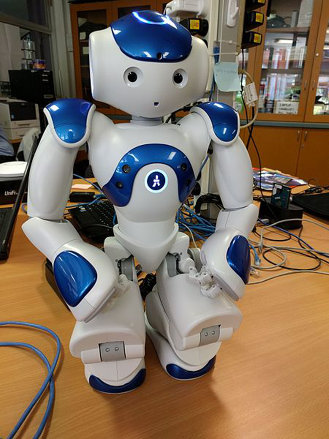
Which brings me to the robot in that photo, Pepper. Aldebaran Robotics says Pepper is “kindly, endearing and surprising.”

Among other things, Pepper is programmed to notice major human emotions, respond appropriately, learn how individuals act and change its behavior accordingly.

The robot may be better at noticing and responding appropriately to human emotions than I am.

Or maybe not. I’ve been developing the skill for decades. I’m pretty good at noticing and identifying emotions in others.

But I’ve been told that my affect display, verbal and non-verbal displays of emotion, is well off the norm. That’s not surprising.

Undiagnosed depression made dealing with also-undiagnosed PTSD, autism spectrum disorder and other quirks difficult.

My psychiatric oddities got identified a little over 11 years back.

I knew something was going wrong. So did my wife, who suggested I see a psychiatrist.

Being ‘cured’ won’t happen. But knowing what I deal with makes the job easier. Less difficult, at any rate. (January 7, 2018; December 17, 2017; March 19, 2017)

Being offended that Pepper and other robots may be better at acting like humans than I am is an option. But not a reasonable one, I think.

Fear and Frustrated Technicians

Neither is fearing rogue robots or homicidal homunculi. Although that sort of thing can make a rousing good tale.

Concerns that a robot will take my job might make sense if I worked on an assembly line. (March 16, 2018)

I think truck drivers and cabbies may be better off if they start exploring other lines of work now. Driverless vehicles are here, with more in development.

Recent high-profile accidents involving automated vehicles give developers a public relations problem.

Three fatal accidents, each involving Tesla systems, aren’t making automated vehicles seem safer. How much of a threat autonomous cars are, that I don’t know.

I haven’t compared accident and fatality rates with automated and human-operated vehicles in equivalent circumstances. I strongly suspect that human owners aren’t quite ready for today’s technology. Or don’t understand it.

My memory tells me that one crash happened because the operator/driver wasn’t paying attention. I’d have to research that to be sure. My guess is that the automated vehicle was smart, but not smart and wise enough to be unsupervised.

We may develop fully-automated, ‘set and forget’ automated vehicles. Adjusting to the new tech will take time. I think we’ll deal with change as well as we have since stone tools were new. Or as poorly.

My guess is that someone saw cooking fires as a deadly technology. Which they can be. I think tech is as safe or unsafe as whoever’s using it.

Robots have worked on assembly lines for years, and are very close to filling other jobs. I’d be surprised if robots didn’t start working at reception desks and in stock rooms.

But do I fear a robot apocalypse? No.

Skynet is still more fiction than science.

Economic, political or imperial ambitions strike me as more of a “human” thing.

Frustrated technicians dealing with a glitchy robot may lack the dramatic appeal of rampaging robot revolutionaries. But with today’s technology, it’s by far the more likely scenario. We’re still a long way from dealing with something like the HAL 9000 in “2001: A Space Odyssey” (March 16, 2018)

Mechanical Minions, Digital Despots and Being Human

Nothing I’ve seen go from the ‘explore, hypothesize and clarify’ to the ‘design, develop and test’ stage looks promising as a robot overlord.

I think “The Phantom Creeps,” where a human mastermind used a robot makes sense as a plausible threat. Plausible enough for a movie, that is.

Another entertaining scenario could be the usual evil computer seeking world domination.

With the fate of humanity hanging in the balance, when all seems lost, as Our Hero hangs helpless in the grip of its mechanical minions, the digital despot declares: “Fool! Nothing can withstand my FILE NOT FOUND!” (January 28, 2018)

I think robots will be increasingly good mimics of human behavior.

I think they’ll replace human workers in many jobs.

Replacing humans? That seems very unlikely at best.

My attitude comes partly from my experience as a human. I’ve been a delivery guy, computer operator and sales clerk. But that wasn’t “what I was,” except in a grammatical or economic sense. Certainly not “who I was” and am.

I see my jobs as what I’ve done, and “me” as the person who did the jobs. I see myself as a “who,” not a “what.”

That probably seems irrational to some folks. I am, after all, a Christian: and a Catholic to boot. We’re seen as unreasonable at best in some communities.

I’ll grant that some Christians, Catholics included, live up — or down — to the ‘ignorant and superstitious’ stereotype. It’s not, sadly, just the uneducated ones. (March 4, 2018; November 5, 2017)

If their ilk was all I’d seen of Christianity. I might feel that faith and reason, science and religion, get along about as well as cobra and mongoose.1 Folks taking spirit photographs and the like seriously don’t help. (April 11, 2018)

About robots, humans and being a “what” or a “who,” I’m quite certain that a robot couldn’t have a human soul. Robots aren’t, by most definitions, humans.

Whether a robot or other AI could have a soul of some other sort is another question. And a reasonable one:

In my considered opinion — my thoughts regarding theological implications of Artificial Intelligence will wait for another day.

It’s not merely a can of worms. It’s a 12-pack, at least.

“Kinda Now … Kinda Wow”

Materialism isn’t a new idea.

Folks have been inventing, and re-inventing, variations on that theme for about two dozen centuries.

We’ve traced it back to China, India, Persia, Judea and Greece during the 8th to the 3rd century BC.

Many ideas started then, apparently. Folks started noticing the coincidence in the 18th century. Karl Jaspers called it Achsenzeit, the Axial Age.2

I suspect the trail is much older. But we don’t have evidence backing up my hunch. Not yet.

I’m dubious about the new ideas being developed independently.

I grant that there’s little evidence of major cultural exchange. Bodhidharma’s an exception.

I strongly suspect that individuals might have information which most others in their area didn’t, and weren’t fussy about naming their sources. Or open, transparent, forthright: you get the idea.

About Bodhidharma, he’s credited with bringing Chan Buddhism to China. Folks in Japan call him Daruma, and that’s yet another topic. (April 2, 2017)

I think academics are starting to realize that folks travel. A lot. When we do, more often than not we also trade tech and ideas with folks we meet.

Some newcomers settle down, which leads to kids with different ancestry having kids of their own: making people like me possible. (March 2, 2018; May 19, 2017)

The current version of Western materialism popped up during the Enlightenment.

Someone puts a new paint job on it every few decades. Shiny new packaging gives folks something “kinda now … kinda wow” to fuss or gush over. Until the next metaphysical novelty item comes along.

A few ‘unprecedented paradigm shifts’ later, and it’s generally as well-remembered as the Charlie perfume 1973 jingle:

“There’s a fragrance that’s here today, and they call it — Charlie!
A different fragrance that thinks your way, and they call it — Charlie!
Kinda young, kinda now, Charlie!
Kinda free, kinda wow! Charlie!
The kind of fragrance that’s gonna stay, and it’s here now — Charlie!”
(Charlie by Revlon (1973),” Yesterday’s Perfume (July 19, 2010)

I could ‘act my age’ at this point, playing the cantankerous old coot.

Kvetching that history repeats itself and nobody ever learns may have a certain appeal. I’d much rather make sense.

Four Millennia After Sargon

We do learn. Eventually. Not all new ideas or observations have the profundity and lasting value of advertising jingles.

Sometimes we even learn how to make a new idea work. That takes effort and time. Lots of both.

I see cycles in history, like Western civilization’s empire-collapse-rebuild pattern. Sargon of Akkad started the first cycle, about 43 centuries back. (May 28, 2017)

The first that we know of, at any rate.

I don’t “believe in” Atlantis, Mu or Caprona. Which doesn’t keep me from enjoying some ‘lost civilization’ yarns.

I think Plato’s tale may be inspired by stories of the Late Bronze Age Collapse and Thera eruption. Even if that’s true, both events happened a millennium and more after Sargon’s day. (November 3, 2017; March 30, 2017; March 12, 2017)

Philosophically-inclined Europeans noticed the empire-collapse-rebuild cycle a few centuries back. “Decadence” got its current meaning then. (October 22, 2017)

Each failed effort was unique, but I think the events were cyclic. We started the most recent “empire” phase about five centuries back. That’s when European explorers started finding new places, and new routes to places they already knew.

Europe’s imperial bosses never managed to do more than form uneasy and temporary alliances with each other. That sparked a global conflict about a hundred years ago.

Trying Something New

Many of us survived. While clearing occasionally-radioactive rubble, some decided that enough was enough. (November 10, 2017)

A remarkable number of surviving bosses decided to write off what was left of their empires and try something else. That was a few years before I was born.

The United Nations is far from perfect. I don’t trust it any more than I trust America’s Congress. But as a possibly-viable alternative to another global war?

I’ll take what we’ve got and suggest that we can do better. Much better. (February 4, 2018; November 5, 2017; August 20, 2017)

I can understand feeling that it’s ‘the end of civilization as we know it.’

Folks near the start of each ‘rebuilding’ phase probably felt the same way. For me, it’s more like ‘it’s the end of civilization as we know it — and about time!’

We’ve tried getting stability or security of a sort with empires.

Empires don’t work. Not for more than a few centuries.

We’ve survived and rebuilt each time. But that’s no reason to keep hoping the next cycle won’t take us back to another ‘rebuild’ phase. (May 28, 2017)

Suggesting that trying something new makes more sense to me than trying the same failed strategy again. Or assuming that humanity is doomed. Although I think “the centre cannot hold” attitudes gave us some memorable poetry:

“…Things fall apart; the centre cannot hold;
Mere anarchy is loosed upon the world,
The blood-dimmed tide is loosed, and everywhere
The ceremony of innocence is drowned….”
(“The Second Coming,” William Butler Yeats (1920))

Beliefs

Western materialism — I’m back to that, finally — arguably makes more sense than feeling that God blundered by creating us with physical bodies. (January 14, 2018)

Christians who feel that way may be sincere. So, I hope, were those who tried merging materialism and religion. And who keep sharing End Times predictions. (September 29, 2017; March 24, 2017; August 13, 2017)

Small wonder some folks see faith and reason as polar opposites.

Materialism and idealism start with the idea that all reality is basically one thing. Philosophers call it monism. Materialism says that everything’s basically physical.

I’ll agree that physical reality exists. I think my body is ‘real’ in that sense.

Physically, I’m mostly oxygen, carbon, hydrogen, nitrogen, calcium and phosphorus with traces of other elements.3 Assuming that I’m nothing but the elements in my body and their chemical interactions is possible.

I could believe that my self-awareness is an illusion: probably caused by something in my brain. Or maybe it’s a conditioned response. Or some other physical phenomenon: something I could, in principle, detect and measure.

I think I have free will. (Catechism of the Catholic Church, 1730-1742)

I can decide to believe something is true when it’s not. But I won’t. I vastly prefer believing what I think is true.

That doesn’t stop me from acknowledging that other viewpoints are possible.

I think many folks have my preference for truth. Maybe most. We don’t all arrive at the same conclusions, and that’s yet again another topic. (October 22, 2017)

Believing that free will isn’t real could let me act on whatever daft impulse I liked without feeling guilty. In principle, anyway.

I might also have to believe that feeling guilty is an illusion caused by instinct, social conditioning or something similar.

Believing that I can’t help it might feel liberating.

Dodging consequences of my behavior might not. But I could decide that cleaning up the mess is tomorrow’s problem and ‘live in the moment.’

I’m sure not all materialists feel that way.

And I know that all Christians don’t fear ‘thinking too much.’ But some act as if they believe ‘blessed are the absurd, for they shall spread absurdity’ is a Beatitude.

That sort of thing makes ‘faith and reason are incompatible’ seem — reasonable.

My attitude may need some explaining.

I’m a Christian, a Catholic. I can’t be a Catholic and believe that reality starts and ends with the material world. Not if I take my faith seriously. (Catechism, 285, 2124-2125; To participants in the General Assembly of the members of the Pontifical Academy for Life,” 1 (2017); “Evangelium Vitae,” 23 (1995); “Populorum Progressio,” 18 (1967); “Gaudium et spes,” 10 (1965))

Using my brain isn’t an option. It’s an obligation. Faith, the Catholic sort, and reason work together. Faith is willing acceptance of God and all truth. Reason helps me live as if I accept God and truth. (Catechism, 35-37, 150, 154-159, 812; 1730, 1778)

I can’t be a materialist. Not if I’m going to be a Catholic and even remotely rational.

More; mostly what I think about robots, the universe and nifty photos:


1 Catholics don’t have to be scientists, but it’s an option:

2 Ideas and eras:

3 Views and ingredients:

Posted in Being Catholic, Discursive Detours | Tagged , , , , , , , , , , | 2 Comments