Edited Twins, Genetic Engineering and Bioethics

SPL (Science Photo Library)'s image: In vitrio fertilization light microscope. (2015) via BBC News, used w/o permission.

Gene-editing rules showed up in my news feed last Monday. So, indirectly, did genetically-edited twins who, as far as I know, are still alive.

If I’d known how little I’d be able to verify about Dr. He Jiankui’s famous (or infamous) twins, maybe I’d have picked another topic.

But I did find a fair amount of information about genetic editing technology, and a hint at why Dr. He’s science project produced twins:


Gene-Edited Twins

SPL (Science Photo Library)'s image: 'Gene editing has the potential to treat numerous inherited disorders.' (2023) via BBC News, used w/o permission.
Gene editing could treat many inherited disorders.

China’s new human gene-editing rules worry experts
Pallab Ghosh, BBC News (March 6, 2023)

New rules in China to regulate gene editing in humans don’t go far enough, a leading expert has warned scientists.

Dr Joy Zhang of Kent University, a global expert on the governance of gene editing in China, said authorities are susceptible to ‘regulatory negligence’….

“…China says the new laws are in line with international rules.

“They set requirements for ethical approval, supervision and inspection, but experts worry that they may not apply to the private sector.

“Dr Zhang, one of the main speakers at an international human genome-editing summit in London, told BBC News: ‘My biggest concern is that the new measures fail to cover a chronic and increasing problem in trying to deal with private ventures that are taking place outside of conventional scientific institutes.

“‘The new rules may struggle to keep up with the burgeoning innovation that is happening in China.’…”

On the ‘up’ side, China’s government says their new laws are up to international standards.

They may be right about that. There was a major stink back in 2018, when Professor He Jiankui told the world, in a series of YouTube videos, that he’d made two twin girls. And that, thanks to his genetic engineering, HIV couldn’t infect them.

Since HIV viruses are the ones that cause HIV/AID, Professor He’s engineered immunity sounded like a good idea.

A remarkable number of scientists didn’t agree.

I can see why, but suspect that the professor’s ‘YouTube first, published paper later’ strategy encouraged their “significant doubts”.

On the other hand, Professor He’s videos may have been a matter of making the best of a bad situation. Seems that the MIT Technology Review worked out what he’d been doing, based on a Chinese clinical trials registry.1

At Least Two “World’s First”

SPL (Science Photo Library)'s image: IVF embryo. (2015) via BBC News, used w/o permission.I gather that Professor He’s problems stem mainly from his tweaking the genes of healthy babies.

But his claim that he’d made “the world’s first genetically edited babies” arguably needs clarification.

For example, differences between his edited babies and the ones back in 2017. Aside from terminology, that is.

China baby gene editing claim ‘dubious’
Michelle Roberts, BBC News (November 26, 2018)

Significant doubts have emerged about claims from a Chinese scientist that he has helped make the world’s first genetically edited babies.

“Prof He Jiankui says the twin girls, born a few weeks ago, had their DNA altered as embryos to prevent them from contracting HIV.

“His claims, filmed by Associated Press, are unverified and have sparked outrage from other scientists, who have called the idea monstrous.

“Such work is banned in most countries….”

Human embryos edited to stop disease
James Gallagher, BBC News (August 2, 2017)

Scientists have, for the first time, successfully freed embryos of a piece of faulty DNA that causes deadly heart disease to run in families.

“It potentially opens the door to preventing 10,000 disorders that are passed down the generations.

“The US and South Korean team allowed the embryos to develop for five days before stopping the experiment.

“The study hints at the future of medicine, but also provokes deep questions about what is morally right….”

I think curing and preventing disease is a good idea, for reasons I’ll get into later.

Defining “First”

OHSU's image: genetically modified embryos. (2017) via BBC News, used w/o permission.At first glance, the BBC News articles of 2018 (first genetically edited babies) and 2017 (first human embryos freed of a disease) seem contradictory.

But, given my culture’s assumptions, they’re both right. The 2017 announcement involved genetically editing human “embryos”. He’s 2018 experiment was about the first human “babies”.

An ‘up’ side of the 2017 announcement was that the “embryos” were identified as human. But that didn’t keep the scientists from treating them as disposable lab materials:

“…The US and South Korean team allowed the embryos to develop for five days before stopping the experiment….”
(James Gallagher, BBC News (August 2, 2017) [emphasis mine]

My hat’s off to Professor He. For whatever reason, he didn’t kill his edited kids after demonstrating that he’d done something nifty.

Instead, he apparently worked with a couple: and allowed his experimental subjects to stay alive, at least for nine months or so. Given current values, and the trouble he got into later, that’s praiseworthy.2

That’s good news.

Not-So-Good News
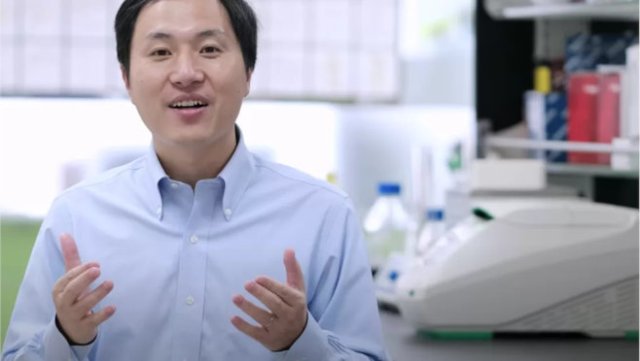
He JiankuiLab / Image's photo: 'Dr He Jiankui served a three-year prison sentence following claims that he created the world's first gene-edited children five years ago'. (March 6, 2023) BBC News)
Dr. He Jiankui: genetics pioneer, sentenced to three years in prison for improper pioneering.

I don’t know why so many “experts” have aimed so much ill will at Dr. He’s experiment. Although there’s enough dubiously-proper procedure in the professor’s activities to warrant a raised eyebrow or two:

New technologies may have already introduced genetic errors to the human gene pool. How long will they last? And how could they affect us?“, Zaria Gorvett, BBC Future (April 12, 2021)

“…He had broken laws, forged documents, misled the babies’ parents about any risks and failed to do adequate safety testing. The whole endeavour left many experts aghast — it was described as ‘monstrous’, ‘amateurish’ and ‘profoundly disturbing’ ….

“…However, arguably the biggest twist were the mistakes. It turns out that the babies involved, Lulu and Nana, have not been gifted with neatly edited genes after all. Not only are they not necessarily immune to HIV, they have been accidentally endowed with versions of CCR5 that are entirely made up – they likely do not exist in any other human genome on the planet. And yet, such changes are heritable – they could be passed on to their children, and children’s children, and so on….”
[emphasis mine]

An ‘up’ side in the current mess is that apparently misleading the parents of an experimental child is now regarded as not entirely proper.

That’s a big step forward from the good old days of 1977, when Louisa Joy Brown’s parents had been told that in vitro fertilization (IVF) was experimental.

But not that, if it worked, they’d have the first surviving IVF baby. And even then, there was talk of informed consent being important.

And a really big step or two from 1951, when a doctor noticed that I was defective. But didn’t tell my parents, since letting my glitch go untreated would give him grist he could grind into a learned paper. And that’s almost another topic. Which, again, I’ll go into later.

Under the circumstances, and granting that it’s still early days for Lulu and Nana, the edited babies seem to have been rather lucky. Not only are they apparently still alive, but they don’t seem to have been gifted with any spectacularly obvious surprises.3

CRISPR Technology and Surprisingly Long-Tongued Rabbits

Alamy's photo: a rabbit after gene editing, with an unexpectedly long tongue. via BBC Future, used w/o permission.There’s much more in that BBC Future article, but if I don’t move along I won’t get this thing ready by Saturday.

So I’ll settle for sharing this bit:

“…there have been no shortage of surprises in the field. From the rabbits altered to be leaner that inexplicably ended up with much longer tongues to the cattle tweaked to lack horns that were inadvertently endowed with a long stretch of bacterial DNA in their genomes (including some genes that confer antibiotic resistance, no less) — its past is riddled with errors and misunderstandings….”
New technologies may have already introduced genetic errors to the human gene pool. How long will they last? And how could they affect us?“, Zaria Gorvett, BBC Future (April 12, 2021) [emphasis mine]

Next, here’s an excerpt from another discussion of genetic editing:

“…It is rapidly becoming apparent that a wide variety of cardiovascular diseases may one day be curable using CRISPR-Cas9 or similar technology, including many that heretofore have been entirely untreatable. Germline genome editing promises to permanently resolve monogenic cardiovascular disorders for the offspring and subsequent generations of affected individuals. … this approach remains ethically controversial. … In addition, further technical matters will need to be more fully resolved, including those of long-term risks, off-target effects, mosaicism, and applicability to a wider variety of mutations and cardiovascular conditions….”
(“Therapeutic Genome Editing in Cardiovascular Diseases“, David M. German, MD, MPH; et al.; Journal of the American College of Cardiology/Basic to Translational Science (published online February 25, 2019) [emphasis mine]

I gather that “off-target effects” are surprises like long-tongued rabbits and possibly-antibiotic-resistant cattle.

Mosaicism, in this context, is what happens when some of an embryo’s cells get edited, while others don’t. As an adult, the “embryo” has one set of genetic instructions in some cells, another set in others.

We’ve known about mosaicism at least since 1929. Apart from recent experiments, it’s the result of natural phenomena, along with mutation and horizontal gene transfer.4

Procedures, Perspectives and People

MeloneGuru's diagram of the primary sequence of CCR5, a seven membrane spanning G protein, on the cell membrane. (July 5, 2016) via Wikipedia, used w/o permission.
MeloneGuru’s diagram of CCR5 on a cell membrane.

As I said before, there’s enough dubiously-proper behavior on Dr. He Jiankui’s part to warrant sanctions of some sort.

Seems that he forged ethical review papers, which helped him talk eight couples into going along with his experiment; raised his own funds instead of going through official channels; and even had foreigners working with him.

Small wonder Shenzhen’s Southern University of Science and Technology fired him.

I don’t know whether I’m impressed that his sentence included fines amounting to nearly a half-million U. S. dollars, plus three years in prison; or that his sentence was so comparatively light.

Getting back to the eight couples, two pregnancies, and twin girls: as I see it, that means there is at least one dead baby in the mix. Unless the twins spent their gestation in two separate individuals.

But I’m not an expert, so the powers that be in China and others have different perspectives on Dr. He Jiankui’s actions:

“…He had ‘deliberately evaded oversight’ with the intent of creating a gene-edited baby ‘for the purpose of reproduction’, according to the initial findings of an investigating team set up by the Health Commission of China in southern Guangdong province, Xinhua news agency reported….”

“…Many scholars pointed to a 2003 guideline that bans altered human embryos from being implanted for the purpose of reproduction, and says altered embryos cannot be developed for more than 14 days.…”
(“Chinese scientist who gene-edited babies fired by university” … Reuters (January 21, 2019)) [emphasis mine]

I figure that helps explain why 2017’s genetically edited kids were killed.

Keeping them alive for another nine days would likely have gotten the U. S./South Korea research team into trouble. Might even have raised suspicions that the researchers thought their “embryos” were people.5

CCR5Δ32, Recent History and Speculation
. Strickland Constable's illustration of 'low types'. (1899)
“Low types”, left and right; a person of the “superior races”, center (1899)

An angle to the ‘edited twins’ issue I haven’t seen discussed is the particular gene Dr He had been trying to add to their chromosomes: CCR5Δ32/CCR5 Delta32.

CCR5 is a protein that’s on the walls of white blood cells. It acts as a receptor for a particular sort of molecule, and is part of our immune system.

CCR5 genes come in several varieties, alleles in geek-speak. CCR5Δ32 is an allele of CCR5 that’s in maybe 1% of the genetic code of folks who are northwestern Europeans. Or, in my case, whose ancestors are from northwestern Europe. And those are pretty much the only folks who have it.

Now, I wouldn’t have a problem with someone who looks a bit like me having genes that are more common among folks whose ancestors are, say, Chinese.

But then, I wouldn’t.

By some standards, I’m a second-generation result of miscegenation.6 Or, as one of my ancestors said of an Irishman who’d taken an interest in the daughter of a decent American family, “He doesn’t have family: he’s Irish.”

Again, Dr. He Jiankui’s failure to fill out paperwork and generally play ball with a government bureaucracy would be sufficient to account for his fines and imprisonment.

But I could imagine that both working with foreigners, and knowingly polluting Chinese chromosomes with foreign genes, pretty much guaranteed that he’d land in the hoosegow.

Under the circumstances, I could be mildly surprised that he didn’t simply disappear.


Chromosomes, Science and Twins

National Institutes of Health's diagram: 'Epigenetic mechanisms are affected by several factors and processes....' (2015) via Wikipedia, used w/o permission.
Epigenetic Mechanisms: regulating gene expression, switching genes on or off.

Another aspect of the Chinese twins brouhaha was that the kids are twins. This is speculation, but I think maybe Dr. He’s team wanted twins — and kept the kids alive — so that they could see how their epigentic mechanisms developed.

Here’s where I’d like to geek out, but I’m running out of time. So you’re in luck, I’m keeping this short.

Chromosomes aren’t just DNA. Among other things, the DNA is wound around histones: which pack the DNA more compactly.

Histones also have molecular mechanisms that turn individual genes on or off. Identical twins have identical epigenetic mechanisms when they start out. But if they keep on being alive, their epigenetic mechanisms generally stop being identical.

So I figure Dr. He and company wanted to see how their edited twins changed as they grew.

About epigenetics and all that, I put links to ‘for more information’ stuff near the end of this post.7

TALEN and CRISPR: Repurposing Prokaryotic Molecules

Kazi1111's illustration: showing how TALE proteins are used for epigenome editing. (2014) via Wikipedia, used w/o permission
Epigenome editing, using TALE proteins.

A fair number of articles about Dr. He and the edited twins mention that the researchers used CRISPR gene editing tech.

Again, I’m running short on time: so I’ll keep this short(ish).

CRISPR stands for clustered regularly interspaced short palindromic repeats. It’s part of the prokaryotic molecular tool kit. Prokaryotes are single-celled critters that don’t have nuclei.

CRISPR gene editing tech is a simplified version of the prokaryotic CRISPR-Cas9 antiviral defense system.

TALEN, which stands for transcription activator-like effector nuclease. A TALEN is what we get when we fuse a TAL effector DNA-binding domain to a DNA cleavage domain. What can I say? It’s complicated.

TALEN isn’t in the news much these days. It’s not the hot item that CRISPR is, at any rate.

But TALEN is in today’s gene-editing toolbox. And we got these molecules from prokaryotes, too.8

A Genomic Revolution: New(ish) Territory

Francesco Veronesi from Italy's photo: a red junglefowl, Kaeng Krachan National Park, Thailand. (2013) via Wikipedia, used w/o permission.
A red junglefowl: one of the birds we used to make chickens.

If I look at where CRISPR and TALEN gene editing molecules come from, I could see them as natural. Or as natural as any part of this world that we’ve modified.

Or I could go all apocalyptic prophet of doom, denounce all technology developed after some arbitrary date, and hope that nobody remembers where chickens come from.9

Lobby card for Cahn and Siodmak's 'Creature with the Atom Brain.' (1955)But that strikes me as being right up there with warning against atomic Nazi zombies.

So I’ll note that we’re dealing with new technology, quote what someone said, and move on.

“…The births of Lulu and Nana have pushed the boundary of genomic revolution to include generation of genetically engineered babies. This act has been widely condemned as premature, dangerous, alarming and unethical. Given this development, we likely will be hearing of an increasing number of reports on genetically engineered babies in the future. Yet, another woman in China is expecting the birth of a child with genetic modifications. This is new territory.

“Like it or not, this development forces us to ask, where do we go from here?…”
(“Lulu and Nana open Pandora’s box far beyond Louise Brown“; Shiva M. Singh, PhD; Canadian Medical Association Journal (June 10, 2019) via PubMed Central, National Library of Medicine, National Institutes of Health)


Louise Joy Brown, HEK 293 and Me

An HEK 293 variant: 293FT cells.On the one hand, I’m glad that we’ve got rules about using people as lab animals. And that there’s even some discussion regarding reviewing the rules.

Like the one that says using very young humans is okay, as long as they don’t live more than 14 days.

“…The adoption of the 14-day rule in public policy is generally attributed to two major points of origin: in the USA, the 1979 report of the Ethics Advisory Board to the Department of Health, Education and Welfare (HEW) on embryo research and, in the UK, the report of the Warnock Committee of Inquiry into Human Fertilisation and Embryology. From these foundations, the rule has acquired widespread influence elsewhere: almost every country in which embryo research is specifically permitted by regulation, soft or hard, employs a version of the 14-day rule….”
How and Why to Replace the 14-Day Rule“, Sarah Chan, Current Stem Cell Reports (published online July 16, 2018) via PubMed Central, National Library of Medicine, National Institutes of Health

The 14-day rule makes sense, from some viewpoints, since very young humans lack the abilities many of us develop if we’re not killed.

But I can’t say that I’m okay with killing someone who’s too young to matter. That may take a bit of explaining.

Because I’m Catholic, I must see every human being as a real person.

The divine image is in each of us. We’re all people: no matter who we are, who our ancestors are, or what we’ve done. (Genesis 1:2627, 2:7; Catechism of the Catholic Church, 355-357, 361, 369-370, 1700, 1730, 2268-2269, 1929, 2273-2274, 2276-2279)

That means I think the girl whose designation was cell line HEK 293, the first person to survive in vitro fertilization, a convicted murderer, and someone who’s mentally ill are all people: each with a share in humanity’s transcendent dignity. (Catechism, 1928, 1934-1938)

Thinking that human beings — all human beings — are real people, and that we all matter, puts me at odds with assorted political positions. But it’s something I’m stuck with, if I’m going to take my faith seriously.

Responses to the first person to survive in vitro vertilization, Louise Joy Brown, ranged from all-too-familiar malignant virtue to Cardinal Albino Luciani’s “unexpected” application of Catholic beliefs to everyday life. And that’s another topic.10 Topics.

“…in August 1978, Cardinal Albino Luciani — shortly to become Pope John Paul I — unexpectedly refused to criticise Louise’s parents for using IVF, saying they had simply wanted to have a baby.

“‘It helped to counteract some of the negative things people were saying,’ Louise says.

“‘My mum got loads of letters from people. They were mostly positive, but there was some hate mail.

“‘They got an awful box from America which had a broken test-tube, fake blood and a pretend foetus inside. It came with a threat that the people who sent it were coming to see them.’…”
(“How has IVF developed since the first ‘test-tube baby’?“, Adam Eley, BBC News (July 23, 2015))

Making Sense: It’s an Option

'At the Sign of the UNHOLY THREE' cartoon, warning against fluoridated water, polio serum and mental hygiene. And 'communistic world government.' (1955)Maybe life would be easier for Catholics if we were told that any technology developed after 1928 was Satanic. That’s when polyester was patented, and that’s yet another topic.

Like I said, maybe life would be easier if being Catholic meant blindly believing nonsense like ‘polyester is Satanic’ or ‘QR codes are the mark of the beast’.

But that’s not how we work.

Okay. I’ve gone through this before, and will again, but here goes.

Starting with that time someone asked Jesus what the top commandment was —

“He said to him, ‘You shall love the Lord, your God, with all your heart, with all your soul, and with all your mind.
“This is the greatest and the first commandment.
“The second is like it: You shall love your neighbor as yourself.
“The whole law and the prophets depend on these two commandments.'”
(Matthew 22:3740)

That’s simple enough. I should love God and my neighbor. And see everybody as my neighbor. Everybody. No exceptions. (Matthew 5:4344, 22:3640; Mark 12:2831; Luke 10:2537; Catechism, 1706, 1776, 1789, 1825, 1849-1851, 1955)

But “simple” isn’t “easy”, and we’ve needed reminders about what terms like “love” and “neighbor” mean. And why we should treat folks like people: all folks.

Human life is sacred, because it involves God from the get-go. That’s all human life: no matter how young or old, healthy or sick we are. (Catechism, 2258, 2261, 2268-2283)

We are rational creatures, able to think and decide how we act. And we can think about whether what we do is a good idea: or not. God gives us brains. Using them is a good idea. (Genesis 1:2627, 2:7; Catechism, 1730, 1778, 1950-1960, 2292-2295)

Science and technology, studying this universe and using what we learn, is part of being human. It’s what we’re supposed to do. (Catechism, 2292-2296)

Getting and staying healthy is a good idea. Within reason. (Catechism, 2288-2291)

But putting science, technology, health — anything or anyone that’s not God — at the top of my priorities is a bad idea and I shouldn’t do it. (Catechism, 2112-2114)

Bioethics, From a Former Lab Rat’s Perspective

Willowbrook State School.It’s late Friday afternoon now, and I still haven’t said why I think curing and preventing disease is a good idea.

Sure, ‘because the Church says so’ is a reason. But I’ve got personal reasons for how I see medical practices and bioethics. I’ve talked about this before.

A doctor my parents initially trusted correctly diagnosed my congenital hip dysplasia almost immediately after I was born.

This was 1951. Options were limited back then, so maybe he figured I was a hopeless case, doomed to a defective life. Either way, he didn’t tell my parents.

USAF Staff Sgt Eric T. Sheler's photo: A two week-old's Phenylketonuria, or PKU, screening. (2007) via Wikipedia, use w/o permission.“…Instead, he had them bring me in at intervals to see what my hips were doing.

“He made notes about what happens when hip dysplasia isn’t treated. Then he wrote a learned paper on the subject. His paper was published in a medical journal. A copy of the journal wound up in a college library’s collection.

“That’s where my father read the doctor’s learned paper.

“My mother intercepted him before he reached the doctor. She said, ‘no, I will speak with him.’ Which she did. And never shared what they discussed.

“The doctor disappeared a few days later. Maybe it would have been more humane to have let an enraged Irishman conduct the interview….”
(“COVID-19, Cells, Viruses and mRNA Vaccines”, Trust and Prudence, (December 5, 2020))

Attempted non-surgical interventions including a body cast didn’t fix my defective hips, but an operation put me on my feet. And a second operation fixed an issue that’d cropped up after the first one.

Several decades later, swapping out both joints for metal-and-plastic replacements made walking without pain an option: so I’m a happy camper.

But knowing that I’d been used as a lab rat arguably accounts for me not being overly shocked and surprised at incidents like the Willowbrook State School, Tuskeegee, Auschwitz, Dachau and Unit 731 experiments.11

On the other hand, knowing that being healthy and using our brains is okay lets me think that research can be a good idea. And that ethics matter, whether we’re using old or new tech.

One more overly-long excerpt, and then the usual links:

“…As with all medical interventions on patients, one must uphold as licit procedures carried out on the human embryo which respect the life and integrity of the embryo and do not involve disproportionate risks for it but are directed towards its healing, the improvement of its condition of health, or its individual survival. Whatever the type of medical, surgical or other therapy, the free and informed consent of the parents is required, according to the deontological rules followed in the case of children. The application of this moral principle may call for delicate and particular precautions in the case of embryonic or foetal life. The legitimacy and criteria of such procedures have been clearly stated by Pope John Paul II: ‘A strictly therapeutic intervention whose explicit objective is the healing of various maladies such as those stemming from chromosomal defects will, in principle, be considered desirable, provided it is directed to the true promotion of the personal well-being of the individual without doing harm to his integrity or worsening his conditions of life. Such an intervention would indeed fall within the logic of the Christian moral tradition’….”
Instruction on Respect for Human Life in its Origin and on the Dignity of Procreation“, Congregation for the Doctrine of the Faith; quote from “Discourse to the Participants in the 35th General Assembly of the World Medical Association”, Pope St. John Paul II (October 29, 1983)) [emphasis mine]

I’ve talked about bioethics before, and probably will again:


1 Outing a research project:

2 Genetic and legal issues:

3 One of these times I’ll talk about the Hippocratic Oath, but not this week:

4 And one of these days I’ll probably talk about this:

5 Life, death and rules:

6 Science and reasons I don’t miss the ‘good old days’:

7 Genetics, it’s complicated:

8 You’re lucky; I didn’t have time to go over most of this stuff:

9 Artificial organisms, AKA domesticated plants and animals:

'I'd force peace right down their bloodthirsty throats.' Deacon Mushrat in Walk Kelly's Pogo. (1952)10 Modern medicine, making sense, malignant virtue and more:

11 Bad ideas, (some) lessons learned:

Posted in Discursive Detours, Journal, Science News | Tagged , , , , , , , | Leave a comment

Snow Cruiser, Moon Buggies, Mars Tractors

NASA/JPL-Caltech/MSSS's image: a Perseverance Mars rover selfie made from 62 individual images taken by a camera at the end of the rover's robotic arm, later stitched together. (April 6, 2021) from NASA, used w/o permission.
Perseverance on Mars. (April 6, 2021)

I started writing about the Antarctic Snow Cruiser, “one of the colossal engineering flops of history”. Or, my opinion, a basically good design that was rushed into service.

The Snow Cruiser and Little America III reminded me of imperial ambitions and a massive attitude adjustment, the Collier’s “Man Will Conquer Space Soon!” series, Moon buggies and Elon Musk.

Make that Moon buggies and looking ahead to permanent bases on the Moon and Mars. And why I think living in Minnesota is okay, even if humans aren’t “perfectly adapted” to my home state’s environment.


Designing for Antarctica, and a Little History

National Land Imaging Program 's (ca. 2014) From USGS, United States Geological Survey, used w/o permission.
Antarctica, the coldest place on Earth.)

Antarctica’s winters are colder than Minnesota’s. And its summers aren’t much better, with temperatures staying below freezing. Which is why Byrd’s Third Antarctic Expedition, or the Antarctic Service Expedition, took along the Snow Cruiser.

The Antarctic Snow Cruiser's crew. Left to right: diesel mechanic C. W. Griffith, commander Dr. Franklin Alton Wade, radio operator Felix L. Ferranto, Snow Cruiser airplane pilot Theodore Argyres Petras. (September 20, 1940) From United States Antarctic Program, via Wikipedia, used w/o permission.
Antarctic Snow Cruiser and its crew. (September 20, 1940)

The Snow Cruiser had been designed by the Armour Institute of Technology’s scientific research director, Dr. Thomas Poulter.

Poulter’s plans for a self-contained — and mobile — Antarctic base arguably began when he and two others rescued Richard Byrd during a 1934 Antarctic expedition.

By the time Poulter and the others got to Byrd, at a meteorological station a few hours from their base camp, he needed medical attention. More than the base camp could give.

Carbon monoxide was Byrd’s problem. Fixing the meteorological station’s heater didn’t take long, but airlifting Byrd out meant waiting two months.

I gather that Poulter started designing the Snow Cruiser shortly after he got back to Iowa.

Byrd’s Third Antarctic Expedition, AKA United States Antarctic Service Expedition, had the Snow Cruiser as part of its equipment. But the U. S. government didn’t earmark money for building the thing until six months before the departure date.

Departure for Little America III on the Ross Ice Shelf was in November of 1939, so by the time the Snow Cruiser was ready for testing, it was summer in North America. Poulter and the Armour Institute of Technology had no snow available for testing their Snow Cruiser

They did, however, have access to sandy land. They figured that sand might act like snow. Which it does, sort of. But sand is also a great deal denser than snow, and doesn’t act just like the stuff that’s about a foot and a half deep outside my window.1

Antarctic Snow Cruiser: Whipped Together in Six Months

Thomas Poulter's Snow Cruiser: a mobile research center, built near Chicago in 1939. AP image, via The Drive, used w/o permission.
The Snow Cruiser; built at the Pullman Company, Chicago. (1939)

I can see why someone called the Snow Cruiser “one of the colossal engineering flops of history”, since it slid off the road at least once on its way to Boston.

But I see it as a basically good design: and a case in point for not rushing through a new technology’s testing phase.

Although outfitting an Antarctic transport with treadless tires strikes me as daft, I also remember when we stopped using tire chains and started using snow tires. I checked, by the way: folks in Iowa, where Dr. Poulter was born, do get snow in the winter.

Tire chains, a sort of chain mesh wrapped around a tire, have been around at least since Harry D. Weed’s 1904 “grip-tread for pneumatic tires” patent. I haven’t tracked down who invented snow tires, or when that happened, and that’s another topic.

I suspect that the Snow Cruiser wouldn’t have been nearly so spectacularly unsuitable for its intended purpose, if Poulter and all had been given more than six months to turn a good idea into a service-ready Antarctic vehicle.2

Little America III and the Snow Cruiser, Briefly

Radio operator Sergeant Felix Ferranto thawing out the Antarctic Cruiser's wheelhub motors with a Primus blowtorch. (August 23, 1940) From United States Antarctic Program, via Wikipedia, used w/o permission.
Radio operator Sergeant Felix Ferranto thawing out the Antarctic Cruiser’s wheelhub. (August 23, 1940)

The Snow Cruiser’s story isn’t all bad news. It was loaded on the USCGC North Star, and only destroyed part of the ramp built by the United States Antarctic Service Expedition (USASE) while offloading the thing in Antarctica.

Nobody got killed while demonstrating that, even with extra tires and jury-rigged tire chains, the Snow Cruiser wouldn’t cruise. But it would back up. Slowly.

Despite the Snow Cruiser’s performance deficit — and learning that the expedition’s M2 Light Tank and T3E4 Carrier sank in snow — USASE got most of their jobs done.

There wasn’t a relief crew when they pulled out of Little America III in 1941, since World War II had started. But they did leave equipment and supplies behind, in case the two bases they’d set up could be used again.

Since then, the Snow Cruiser has been spotted twice: once in 1946, and again in 1958.

The ice sheet Little America III was on has cracked, forming several massive icebergs. Poulter’s Snow Cruiser might still be buried in ice and snow, but it’s probably now at the ocean’s bottom.

There’s more to the Snow Cruiser’s story, although I suspect many records are still in Chicago-area archives and scrapbooks. I recommend these resources:3

Learning From the Past: Halley VI

BAS/M.Krzysztofowicz's photo: Moving Halley Base (2016)
Moving one of Halley Research Station’s eight modules. (2007)
 BAS/P.Bucktrout's photo: Halley Base's hydraulic leg and ski system. (2016)
Fitting sheets under one of Halley Research Station’s hydraulic leg-and-ski system. (2007)
PAS photo: moving Halley Base central red module. (2016)
Moving Halley Research Station’s central module. (2007)

Poulter had a good idea with his Snow Cruiser. Working in Antarctica is less dangerous when you can bring your shelter along. That’s partly why the current British Antarctic Survey (BAS)’s Halley Research Station, Halley VI, is mobile and modular.

Like Halley I through V, it’s on the Brunt Ice Shelf.

Since the ice shelf is slowly moving toward the ocean, buildings set on the ice would eventually go adrift as debris on icebergs.

The buildings for Halley V had hydraulic legs that kept them above the snow. Halley VI’s design added skis to its modules’ hydraulic legs. The modules aren’t self-propelled, but tractors can pull them to new locations.

Halley VI and its tractors aren’t as fast as the Snow Cruiser. But the design works, and has been moved successfully since its official opening in 2013.4


Natural Resources, Naval Bases and Empires

Walter Crane's Map of the British Empire. (1886) Map of the British Empire, via Wikimedia Commons, used w/o permission.
The British Empire in 1886, allegory and all.

Before moving along, a little about why the USASE went to Antarctica. And what happened to Poulter’s idea of a mobile Antarctic base.

Ishvara7 at English Wikipedia's map: Empires of the world, 1910. (2007) via Wikipedia, used w/o permission.I haven’t verified it, but I’m pretty sure that the United States federal government wanted a slice of Antarctic territory.

Aside from abstract benefits, like status, folks had good reason for thinking that Antarctica had significant natural resources. Buried under a continent-wide glacier, but still valuable.

And there were strategic benefits to having naval bases in the far southern hemisphere.

Memorial service at Urakami Cathedral.So how come we’re not hearing political hissy fits over whether the Territory of Byrdland in Antarctica should be the State of Byrdland?

Basically, being imperial was what cool nations did when the 20th century began.

By 1945, when survivors were digging out from occasionally-radioactive rubble, a remarkable number of national leaders decided that maybe we should try something new.

And that’s yet another topic.5


Tractors Ho! The Moon and Mars

Detail, Chesley Bonestell's illustration: 'At end of two-week-long Lunar day, convoy of tractors....' Collier's, page 45 (October 25, 1952)
Chesley Bonestell’s illustration for ‘The Exploration’, Collier’s, page 45 (October 25, 1952)

From 1952 to 1954, Collier’s published their “Man Will Conquer Space Soon!” series: including Dr. Fred L. Whipple and Dr. Wernher von Braun’s “Man on the Moon: The Exploration” (October 25, 1952).

With their caterpillar tracks, the tractor-trailer rigs look more like today’s Antarctic vehicles than the 1939 Snow Cruiser. Apart from having pressurized cabins.

Maybe I should capitalize “caterpillar”, although I suspect that name has gone the way of the Zipper. And I’m wandering off-topic again.

Anyway, the Whipple/von Braun article’s moon tractors used cutting-edge-and-beyond technology: of the early 1950s.

“…tanklike cars equipped with caterpillar treads for mobility over the moon’s rough surface. The pressurize, cylindrical cabins hold seven men, two-way radio equipment, radar for measuring distances and depths, and a 12-hour hour supply of oxygen, food, water and fuel. Power is supplied by an enclosed turbine driven by a combination of hydrogen peroxide and fuel oil (oxygen escaping from the hydrogen peroxide enables the fuel oil to ignite)….”
(“Man on the Moon: The Exploration”; Dr. Fred L. Whipple, Dr. Wernher von Braun; illustration by Chesley Bonestell; Collier’s (October 25, 1952))

Seven decades later, I could make fun of the article’s hydrogen peroxide and fuel oil tractors rumbling across a craggy landscape lit by green Earthlight. But I won’t.

Shadows cast by Lunar mountains have sharp, crisp edges, and look rugged. Since there’s no air or liquid water on the moon, thinking that Lunar landscapes would have lots of sharp edges made sense.

Apollo 11's photo: Earth. (1969) via NASA Johnson Space Center, used w/o permission.Luna 2 didn’t reach the moon until 1959.

We didn’t get the first up-close images of Luna until Ranger 7 in 1964.

In 20-20 hindsight, maybe more scientists could have predicted that micrometeorite impacts will, given time, erode jagged peaks into the now-familiar undulating and undramatic Lunar landscapes.6 But they didn’t.

We didn’t realize how blue Earth looks, either.

Collier’s, 1954: Martian Tractors

Fred Freeman's illustration: 'Advance party, after landing on Martian in ski-equipped plane, prepares for trip to equator....' Collier's, page 28 (October 25, 1952)
Fred Freeman’s illustration for “Can We Get to Mars?”, Collier’s, page 45. (April 30, 1954)

NASA/JPL-Caltech/Perseverance: annotated image, showing the mission's first sample depot location: where the Mars rover will deposit a group of sample tubes for possible future return to Earth. The depot location is 'Three Forks' in Jezero Crater. (August 29, 2022)Fred Freeman’s illustrations for the Collier’s “Can We Get to Mars?” article were a pretty good match to pictures our robot explorers have been sending back.

That’s not terribly surprising, since Martian surface conditions aren’t quite as unearthly as Luna’s. Both planets have obvious atmospheres, for starters.

What the advance party in “Can We Get to Mars?” was doing is another matter.

“…The landing of the first plane will be made on the planet’s snow-covered polar cap — the only spot where there is any reasonable certainty of finding a smooth surface. Once down, the pioneer landing party will unload its tractors and supplies, inflate its balloonlike living quarters, and start on a 4,000-mile overland journey to the Martian equator, where the expedition’s main base will be set up. … At the equator, the advance party will construct a landing strip for the other two rocket planes. (The first landing craft will be abandoned at the pole.)…”
(“Can We Get to Mars?”, p. 28; Dr. Wernher von Braun, Cornelius Ryan; Colliers (April 30, 1954))

Again, I could make fun of von Braun and Ryan’s armada of 10 ships and three landers. But I won’t.

Back in the 1950s, assuming that the first folks landing on Mars would have limited or no information based on orbital surveys or robotic landers made sense.

Given extrapolations of that era’s technology, we could have sent a scouting mission to orbit Mars, collect data and return to Earth. And then send an expedition like the one described in Collier’s.

But that didn’t happen. And probably won’t.

JPL/NASA's Figure 6. Mars 2020 flight system in the Launch / Cruise Configuration. (2014-2017) used w/o permission.Maybe von Braun, Ryan and most of the other scientists realized that semi-autonomous robots could be exploring Mars within seven decades.

If so, they may also have seen convincing non-scientists that exploring Mars was possible — as a sufficiently massive job.

And that transitioning perceptions of robots from pulp magazine mechanical minions to real technology was a task best left untried.7


Luna, 1971-1972: Moon Buggies

Commander Dave Scott's photo: Apollo 15's Lunar Roving Vehicle after EVA 3. Near Hadley Rille and Montes Apenninus at the edge of the Mare Imbrium. (August 1, 1971)
Apollo 15’s moon buggy. (August 1, 1971)

About 19 years after the Collier’s “Man Will Conquer Space Soon!” series began, the Apollo 15 mission’s equipment included a Lunar Roving Vehicle (LRV). Which arguably sounds cooler that Moon buggy.

I’ll freely admit that Poulter’s Snow Cruiser and Collier’s pressurized tractors looked more impressive than the LRVs.

Apollo’s Moon buggies looked like a couple of lawn chairs strapped to a golf cart.

But — and I think this is an important point — the Moon buggies worked.8


Next Stop: Mars?

NASA/Pat Rawlings' artist's concept: 'long-range exploration on the surface of Mars using pressurized rovers.' (2007)
“Mobile Home”: pressurized Mars rover, imagined by NASA/Pat Rawlings. (2007)

Eugene A. Cernan's photo at the Taurus–Littrow landing site on the Moon. Harrison H. Schmitt standing near a boulder during Apollo 17's third extravehicular activity (EVA-3). (December 13, 1972) NASA Photo ID: AS17-140-21496Apollo 17’s Moon buggy carried Gene Cernan and Harrison Schmitt around the Taurus-Littrow valley in 1972.

Nobody’s gone to Luna since, although it looks like the Artemis program will get the ball rolling again.

Within a few years we may, finally, have a permanent base on another world.

That, in turn, will make sending crewed expeditions to Mars easier. I’d be astounded if we don’t establish permanent bases on Mars. And, eventually, spare folks the long Earth-Mars commute by letting them settle there. Maybe within the next century.

I think that makes sense. But some folks don’t.

Colonization Of Mars Practically Impossible, Says Greek-American Space Expert
Paula Tsoni, Greek Reporter (February 11, 2023)

“Greek-American space exploration scientist Dr Stamatios Krimigis told a TV interview on Thursday that the colonization of Mars is practically impossible, at least for the next 200 years.

“Speaking to journalist Nikos Chatzinikolaou on Greek private network Ant1 TV, Dr Krimigis opined that Elon Musk, a passionate advocate of the colonization of Mars, hasn’t realized the actual difficulties of such a venture….”

I think Dr. Krimigis has a point. Right now, we haven’t developed all the technology we’ll need for living on Mars.

The Mars 2020 mission’s MOXIE oxygen generator, for example, is just a prototype. It works, but must be scaled up: a lot.9

And there are other practical issues involved with living on Mars.

“…If they were to colonize Mars, humans would need shelters dug at least one metre underground to protect themselves from such events [solar flares and coronal mass ejections], he added. And while that could perhaps be feasible in 200 years from today, it will not be so ‘in Elon Musk’s era.’

“He does believe though that a manned mission to Mars could materialize in the next decade….”
(Paula Tsoni, Greek Reporter (February 11, 2023))

On the other hand, going underground isn’t the only option for protection from radiation.

“Actual Difficulties” and the Mars Ice Home

NASA/Clouds AO/SEArch's: Mars Ice Home concept; by NASA's Langley Research Center, Space Exploration Architecture, Clouds Architecture Office. (2017)
Mars Ice Home concept: Langley, Space Exploration Architecture and Clouds Architecture Office. (2017)

The Mars Ice Home would provide a “cozy” living area inside what’s essentially an ice/carbon dioxide tank.

“…after a hard day of work and back to their cozy (and highly shielded) Ice Home bunks…”
(“Ice Home Mars Habitat“, Document No. MIH.ConOps.001, Revision 1.20; Updated for the FY17 LaRC CIF Risk Reduction Study (December 21, 2017))

The design’s interior would probably feel “cozy”. Which reminds me of real estate agent descriptions like “fixer-upper” and “secluded”.

But I think it, or something like it, could work as a home on Mars.

I also think Dr. Krimigis’ assertion that Elon Musk “…hasn’t realized the actual difficulties…” is accurate.

The technology we’ll need to live on Mars is still being developed and tested.

The ‘Musk’ team has already found at least one “actual difficulty”, something that looked like a good idea — but wasn’t.

The SpaceX Starship design started with a very cool carbon composite fuel tank. Now it’s stainless steel. Because that’s more cost-effective, I gather. Stainless steel is also less apt to get damaged by radiation.10

Realizing that part of a new design doesn’t work, and making changes before heading out makes sense. Dithering over budget and then telling developers to rush a vehicle into operation six months before ‘go time’? Not so much.

Opinions, Attitudes and Constants

NASA/Clouds AO/SEArch's illustratinon: Mars Ice Home vertical cross-section. (2017)
Langley, SEA and Clouds Architecture Office’s Mars Ice Home cross-section. (2017)

Dr. Krimigis earned a Ph.D. in physics, studied under James Van Allen and was principle investigator for the Cassini-Huygens mission’s Magnetospheric Imaging Instrument (MIMI).11

I figure he’s right about folks living on Mars needing a meter of Martian soil or its equivalent between themselves and the worst of solar storms. And my hat’s off to him for realizing that it’s a technical issue, which can be dealt with.

Folks with, ah, philosophical objections to rich people and folks living where we aren’t “perfectly adapted “? Here’s an example from last year.

Human Beings Will Never Permanently Colonize Mars or Even the Moon
Billionaires are destroying Earth for a childish fantasy
Jared A. Brock, Surviving Tomorrow (August 8, 2022)

“Billionaires are the worst.

“They destroy jobs.

“They prey on the poor.

“They evade taxation.

“And the most delusional ones think human beings belong in uninhabitable space….

“…Humans don’t belong in uninhabitable space

“There, I said it.

“And I’ll say it again:

“Humans don’t belong in uninhabitable space.

“I believe in this outrageous notion that homo sapiens are perfectly adapted for the planet we affectionately call Earth. Homo sapiens are simply not adapted for lifelong space living, and never will be….”

There’s a lot going on here. I’ll start by admitting that, although not a billionaire myself, I lack a proper revulsion with regard to folks with more money than I’ll ever see.

And I’ve always wanted my boss to be at least wealthy enough to cover my paycheck.

Some Things Don’t Change

Jadrienc's digital matte painting 'across the park'.About money being “the root of all evils”, it’s love of money that’s a problem. (1 Timothy 6:10; Hebrews 13:5)

As for wealth and poverty, sickness and health? Stuff happens.

How much I own isn’t a sure sign of virtue or sin. Neither is being healthy or sick. What I do with what I’ve got: that’s what matters. (Catechism of the Catholic Church, 828, 1509, 2211, 2288-2291, 2292-2296, 2448, 2540, 2544)

And what I should do is the same, whether I live in Minnesota, on the Moon or Mars.

I should love God and my neighbor, and see everyone as my neighbor. Everyone. No exceptions. (Matthew 5:4344, 22:3640; Mark 12:2831; Luke 10:2537; Catechism, 1706, 1776, 1789, 1825, 1849-1851, 1955)

We’re not all alike. We’re not supposed to be. But we each have equal dignity. (Catechism, 361, 369-370, 1929, 1934-1938, 2393)

Wealthy individuals and nations can and should help folks dealing with poverty. Giving food and other resources can be a good idea. So is fixing economic and social problems. (Catechism, 1883, 1932, 2439-2441, 2449)

Loving God and neighbors was important two millennia back, it’s important now, and will be important when Sargon of Akkad, Julius Caesar and Dag Hammarskjöld seem like contemporaries.

“A Severe Strain on Credulity”

The New York Times editorial, 'His Plan is Not Original;' insisting that rockets need air to push against, so they can't possibly work in space. (January 13, 1920) via timesmachine.nytimes.comThe “Humans Will Never…” op-ed reminded me of other sage advice, from 1920:

“…His Plan Is Not Original

That Professor Goddard, with his ‘chair’ in Clark College and the countenancing of the Smithsonian Institution, does not know the relation of action to reaction, and of the need to have something better than a vacuum against which to react — to say that would be absurd. Of course he only seems to lack the knowledge ladled out daily in high schools.

But there are such things as intentional mistakes or oversights, and, as it happens, Jules Verne, who also knew a thing or two in assorted sciences — and had, besides, a surprising amount of prophetic power — deliberately seems to make the same mistake that Professor Goddard seems to make. For the Frenchman, having got his travelers to or toward the moon into the desperate fix riding a tiny satellite of the satellite, saved them from circling it forever by means of an explosion, rocket fashion, where an explosion would not have had in the slightest degree the effect of releasing them from their dreadful slavery. That was one of Verne’s few scientific slips, or else it was a deliberate step aside from scientific accuracy, pardonable enough of him in a romancer, but its like is not so easily explained when made by a savant who isn’t writing a novel of adventure.

All the same, if Professor Goddard’s rocket attains a sufficient speed before it passes out of our atmosphere–which is a thinkable possibility — and if its aiming takes into account all of the many deflective forces that will affect its flight, it may reach the moon. That the rocket could carry enough explosive to make on impact a flash large and bright enough to be seen from earth by the biggest of our telescope — that will be believed when it is done.”
(“A Severe Strain on Credulity”, The New York Times; page 12, column 5 (January 13, 1920) via Wikisource)

“…Humans Don’t Belong…”

Brian H. Gill's photo: South Ninth Street in Sauk Centre, Minnesota. (March 2, 2023)
The view from my front door, Thursday afternoon. (March 2, 2023)

The author of that “Human Beings Will Never…” op-ed has a point. We’re not “perfectly adapted” to living on Mars.

For that matter, we’re not “perfectly adapted” to living in Minnesota.

Right now, Friday afternoon, the temperature next to my skin is about 85° Fahrenheit.

That’s close to the current temperature in Nairobi, Kenya: 70° Fahrenheit. It’s midnight there, so conditions there were closer to my personal micro-environment during the equatorial day.

My ancestors left humanity’s homeland a very, very long time ago, but we’re still adapted to that part of Earth’s equatorial region.12 Apart from a congenital melanin deficiency we picked up relatively recently, and that’s yet again another topic.

I keep my immediate environment comfortable, and survivable, with tech we call clothing, a house and a furnace.

Outside, water is a mineral.

An unprotected human wouldn’t survive more than maybe a few hours. During Minnesota winters, we need — at a minimum — clothing and fire or its equivalent.

Mars isn’t just like Minnesota, but Minnesota isn’t just like equatorial Africa. I don’t see a point in fussing about humans living where we’re not “perfectly adapted” now. And I don’t see a point in declaring that Mars is off limits because it’s not just like Minnesota.

Then there’s the matter of wealthy folks having options I don’t have.

Take William Penn, for example. England’s king gave him development rights to a swath of land in North America: which even then was worth quite a bit.

This was a few centuries back, so Mr. Penn’s property was already in the possession of part of the Delaware tribe. Credit where credit is due, though. Penn seems to have negotiated with the folks.12 And that’s still more topics.

More of my stuff, mostly space exploration and Mars:


1 Climate and technology:

2 Snow Cruiser background:

Wikipedia 'This article needs additional citations for verification...' banner.3 More background, incluidng a Wikipedia page that “needs additional citations”:

4 Hello, Halley VI — or — lessons learned:

5 History and geology:

6 Technology, science and scientists:

7 Mars, mostly:

8 A little Lunar exploration:

9 The Moon and Mars:

10 Looking ahead:

11 Physics:

12 Science, history and being human:

Posted in Back to the Moon, Onward to Mars, Discursive Detours, Series | Tagged , , , | Leave a comment

Galaxies, Gravity and a Hot Terrestrial Planet

NASA, ESA, CSA, J. Lee (NOIRLab)'s image (processed by Alyssa Pagan (STScI)): galaxy NGC 1433, high resolution image from James Webb Space Telescope at 21 microns (blue), 11.3 microns (green), and 7.7 microns (red). (released February 16, 2023)
NGC 1433, image from JWST, at 21 microns (m.) (blue), 11.3 m. (green), and 7.7 m. (red). (February 2023)

NASA’s Webb Reveals Intricate Networks of Gas and Dust in Nearby Galaxies
Laura Betz, NASA’s Goddard Space Flight Center, Greenbelt, Maryland; Christine Pulliam, Hannah Braun, Space Telescope Science Institute, Baltimore, Maryland; Editor Jamie Adkins (February 16, 2023)

“Researchers using NASA’s James Webb Space Telescope are getting their first look at star formation, gas, and dust in nearby galaxies with unprecedented resolution at infrared wavelengths….”

“…’The clarity with which we are seeing the fine structure certainly caught us by surprise,’ said team member David Thilker of Johns Hopkins University in Baltimore, Maryland.

“‘We are directly seeing how the energy from the formation of young stars affects the gas around them, and it’s just remarkable,’ said team member Erik Rosolowsky of the University of Alberta, Canada….”

The Webb data had already been used in 21 research papers, back in February.

I’d prefer looking up a few of them, picking out one that sounded interesting, and talking about it. But I’ve had a distracted week. So today I’ll focus on some really cool pictures from the JWST/Webb telescope. Mostly.

(I gave the pictures links, so clicking on them takes you to the articles or resources I found them in.)

NGC 1433: Hubble Space Telescope’s View

 ESA/Hubble and NASA (D. Calzetti (UMass), the LEGUS (Legacy ExtraGalactic UV Survey) Team)'s image: NGC 1433, mixing ultraviolet, visible, and infrared light. (released July 7, 2014)
NGC 1433, image from Hubble Space Telescope, a mix of ultraviolet, visible and infrared light. (July 2014)

NASA, ESA, CSA, J. Lee (NOIRLab)'s image (processed by Alyssa Pagan (STScI)): NGC 1433, James Webb Space Telescope. (released February 16, 2023)Since the Hubble Space Telescope image (above) shows NGC 1433 in ultraviolet, visible and infrared light, and the Webb image (right) shows three colors of infrared, this isn’t an apples-to-apples comparison.

But it’s not apples-to-oranges, either. Maybe oranges-to-tangerines.

The point is that the Webb telescope shows NGC 1433 in somewhat higher resolution, and at different wavelengths; which lets scientists see new details. NGC 1433 is a bared spiral galaxy with a bright nucleus, the sort astronomers call a Seyfert galaxy.1

One more excerpt from that February 16, 2023 piece:

“…Webb’s powerful infrared capabilities can pierce through the dust to connect the missing puzzle pieces.

“For example, specific wavelengths observable by MIRI (7.7 and 11.3 microns) and Webb’s Near-Infrared Camera (3.3 microns) are sensitive to emission from polycyclic aromatic hydrocarbons, which play a critical role in the formation of stars and planets. These molecules were detected by Webb in the first observations by the PHANGS program.

“Studying these interactions at the finest scale can help provide insights into the larger picture of how galaxies have evolved over time….”
(“NASA’s Webb Reveals Intricate Networks of Gas and Dust in Nearby Galaxies
NASA’s Goddard Space Flight Center, Space Telescope Science Institute; Baltimore, Maryland (February 16, 2023))

Abell 2744, ‘Pandora’s Cluster’: Closer Look, New Details of Distant Galaxies

NASA, ESA, CSA, I. Labbe (Swinburne University of Technology), R. Bezanson (University of Pittsburgh)'s image (processed by Alyssa Pagan (STScI)): Abell 2744 ('Pandora's Cluster') from James Webb Space Telescope NIRCam; deep field image with the megacluster's gravitational lens magnifying distant galaxies. (released February 15, 2023)
‘Pandora’s Cluster’, Abell 2744, Hubble and JWST imagery.

NASA’s Webb Uncovers New Details in Pandora’s Cluster
Laura Betz, NASA’s Goddard Space Flight Center, Greenbelt, Maryland; Leah Ramsey, Christine Pulliam, Space Telescope Science Institute, Baltimore, Maryland; Editor Jamie Adkins (February 15, 2023)

“Astronomers have revealed the latest deep field image from NASA’s James Webb Space Telescope, featuring never-before-seen details in a region of space known as Pandora’s Cluster (Abell 2744). Webb’s view displays three clusters of galaxies – already massive – coming together to form a megacluster. The combined mass of the galaxy clusters creates a powerful gravitational lens, a natural magnification effect of gravity, allowing much more distant galaxies in the early universe to be observed by using the cluster like a magnifying glass….

“…’Pandora’s Cluster, as imaged by Webb, shows us a stronger, wider, deeper, better lens than we have ever seen before,’ [Swinburne University of Technology’s astronomer Ivo] Labbe said. ‘My first reaction to the image was that it was so beautiful, it looked like a galaxy formation simulation. We had to remind ourselves that this was real data, and we are working in a new era of astronomy now.’…”
[emphasis mine]

Abell 2744, nicknamed Pandora’s Cluster, is about 4,000,000,000 light-years out in the constellation Sculptor.

Scientists figure Abell 2744 happened when several smaller clusters collided. Its gas is so hot, it glows in the X-ray end of the spectrum. It’s also got a radio halo: all of which makes Abell 2744 something of a one-stop science resource.

About Abell 2744’s ‘Pandora’s Cluster’ nickname:

“…’The ancient myth of Pandora is about human curiosity and discoveries that delineate the past from the future, which I think is a fitting connection to the new realms of the universe Webb is opening up, including this deep-field image of Pandora’s Cluster,’ said astronomer Rachel Bezanson of the University of Pittsburgh in Pennsylvania, co-principal investigator on the ‘Ultradeep NIRSpec and NIRCam ObserVations before the Epoch of Reionization’ (UNCOVER) program to study the region.

‘When the images of Pandora’s Cluster first came in from Webb, we were honestly a little star struck,’ said Bezanson. ‘There was so much detail in the foreground cluster and so many distant lensed galaxies, I found myself getting lost in the image. Webb exceeded our expectations.’ The new view of Pandora’s Cluster stitches four Webb snapshots together into one panoramic image, displaying roughly 50,000 sources of near-infrared light….”
NASA’s Webb Uncovers New Details in Pandora’s Cluster
NASA’s Goddard Space Flight Center, Greenbelt, Space Telescope Science Institute; Baltimore, Maryland (February 15, 2023) [emphasis mine]

Now, about those “distant lensed galaxies”: All that mass in the Abell 2744 cluster bends light around it, magnifying even more distant galaxies.2

Galaxies, Gravity and More Galaxies
NASA, ESA, CSA, I. Labbe (Swinburne University of Technology), R. Bezanson (University of Pittsburgh)'s image (processed by Alyssa Pagan (STScI)): detail of James Webb Space Telescope NIRCam's Abell 2744 ('Pandora's Cluster') image; a gravitational lens magnifying distant galaxies. (February 15, 2023)
‘Pandora’s Cluster’, Abell 2744, Hubble and JWST imagery, detail: distant galaxies in a gravity lens.

This is a detail of the first ‘Pandora’s Cluster’ image: a closer look at the cluster of galaxies to the left of center.

Those streaky images in the upper right are galaxies beyond Abell 2744, magnified and distorted by the galaxy cluster’s gravity. I’m pretty sure about that, at any rate. They look like gravity-lensed-galaxies I’ve seen elsewhere.

Lensed Galaxies: Showing How Gravity Lenses Work
STScI's illustration (NASA Contract NAS5-26555): 'Illustration for gravitational lens. Bending light around a massive object from a distant source. The orange arrows show the apparent position of the background source. The white arrows show the path of the light from the true position of the source.' (July 2000)
Gravity lens illustration: magnified image (orange arrows), path of light from distant object (white arrows).

I’m hoping that “a picture is worth a thousand words”, since I don’t have time to talk about gravity, light, Einstein and cosmic magnifying glasses.3

Earth-Size, But Not Earth 2.0

NASA, ESA, CSA, L. Hustak (STScI), K. Stevenson, J. Lustig-Yaeger, E. May (Johns Hopkins University Applied Physics Laboratory), G. Fu (Johns Hopkins University), S. Moran (University of Arizona)'s illustration: 'A light curve from the NASA/ESA/CSA James Webb Space Telescope’s Near-Infrared Spectrograph (NIRSpec) shows the change in brightness from the LHS 475 star system over time as the planet transited the star on 31 August 2022.' (August 2022)
Transit light curve LHS 475 b, from JWST/Webb Telescope. (August 2022)

LHS 475 b is just like Earth, except for how it’s not.

It’s a terrestrial planet, like our Solar System’s inner four worlds. It orbits LHS 475, a red dwarf star about 40 light-years out, in the constellation Octans.

Octans is one of the dozen-plus constellations mapped and named by Lacaille. I talked about that earlier this month.

LHS 475 is very roughly 1/100th as bright as our star, but LHS 475 b whips around it once every two days. That puts it very close to its sun, so LHS 475 b is hot.

Its equilibrium temperature would be 313 °C, 595 °F; but since it’s almost certainly is tidally locked, with one side always facing its sun, the day side temperature could be around 475 °C; 887 °F.

That’s assuming LHS 475 b doesn’t have an atmosphere. Which is likely enough, considering how hot it is, and how close it is to its sun.

On the other hand, LHS 475 b is almost exactly the size of our planet, 99% Earth’s diameter, and apparently made out of rock and metal.4

LHS 475 b: Methane, No; Carbon Dioxide, Maybe; Or Maybe No Atmosphere At All
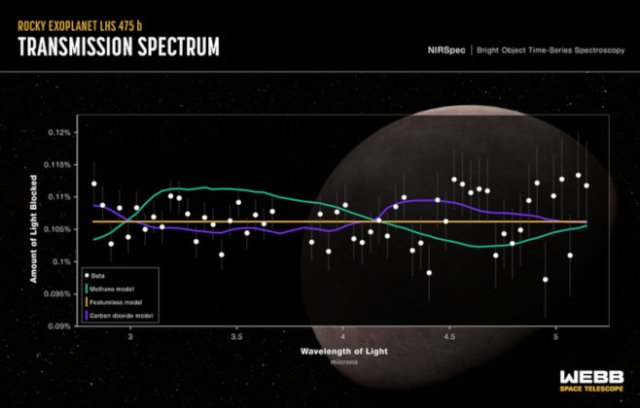
NASA, ESA, CSA, Leah Hustak (STScI) SCIENCE: Kevin B. Stevenson (APL), Jacob A. Lustig-Yaeger (APL), Erin M. May (APL), Guangwei Fu (JHU), Sarah E. Moran (University of Arizona)'s illustration: James Webb Space Telescope’s Near-Infrared Spectrograph (NIRSpec) transmission spectrum, made during transit of LHS 475 b. (August 31, 2022)
JWST transmission spectrum of LHS 475 b. (August 31, 2022)

But LHS 475 b definitely is not Earth 2.0. It’s too hot, and may have no atmosphere.

But maybe it does.

Since the planet passes between its sun and us, JWST can measure how light from LHS 475 changes during the planet’s transits.

So far, the data says LHS 475 b doesn’t have a mainly-methane atmosphere. But it might have an atmosphere that’s mostly carbon dioxide. Or no atmosphere at all.

Either way, the planet is emphatically not suitable for life as we know it.

If the no air and tidally locked scenario is right, LHS 45 b’s dayside temperatures are hot enough to melt lead or zinc. At Earth’s sea-level pressure, and that’s another topic.5

Terrestrial, Telluric, Solid, or Rocky: There’s No Place Like Home

NASA/JPL-Caltech/R. Hurt's artist's concept: how rocky, potentially habitable planets might appear. (April 13, 2022)
R. Hurt’s illustration: what potentially habitable planets might look like. (2022)

“Terrestrial planet” reminds me of Star Trek’s “Class M planet”: a world with surface conditions pretty much like southern California. A world like that would be terrestrial, but not all terrestrial planets are habitable.

What is, and isn’t, a terrestrial planet depends partly on who’s talking.

Earth, for example, is a terrestrial planet. So are the inner Solar System’s three other worlds: Mercury, Venus and Mars. All four are mostly metal and silicate rock.

That quartet are, according to the IAU, the International Astronomical Union, the Solar System’s only “terrestrial planets”.

But that’s not the only definition in play.

IUGS, the International Union of Geological Sciences, defines “terrestrial planet” so that Earth’s moon, Jupiter’s Io and maybe Europa, are also “terrestrial”. Along with asteroids Pallas and Vesta.

Other monikers for terrestrial planet are telluric planet, solid planet and rocky planet.

Natalie Batalha's and Wendy Stenzel's chart of exoplanet populations found with Kepler data. (2017) (NASA and Ames Research Center)I’m not sure whether theoretical planet types like carbon and coreless planets would count as “terrestrial”.

The words telluric and terrestrial come from Latin words for Earth, Terra and Tellus; and I’m wandering off-topic.

Over the last few decades, we’ve been learning a very great deal about planets and planetary systems. So it’s no wonder that scientists haven’t settled on names and definitions for all the newly-discovered varieties.6

We still haven’t spotted anything quite like Star Trek’s “Class M planet”, or made contact with folks whose ancestors are from another world.

But like I said: we’re learning a great deal about how planets and stars form. And that helps make this a very exciting era. For me, that is:


1 Galaxies and telescopes:

2 Abell 2744 and a little science:

3 Looking deeper into this universe:

4 Tiny sun, Earth-size planet:

5 Science stuff:

6 Several sorts of worlds, two science associations:

Posted in Science News | Tagged , , , , , , | Leave a comment

Lent 2023: Prayer and Prepping For Easter

Pieter Bruegel the Elder's 'The Fight Between Carnival and Lent', detail. (1559) Kunsthistorisches Museum, Vienna, via Wikipedia, used w/o permission.
Detail, Pieter Bruegel the Elder’s The Fight Between Carnival and Lent. (1559)

This post should be online just after midnight, on the morning of Ash Wednesday.

Meanwhile, New Orleans will have almost six hours of their Mardi Gras left.

There’s a reason for that, and it’s not that New Orleans Mardi Gras folks are ignoring Lent.

A Catholic Citizen in America is on UTC time, Greenwich Mean Time’s successor. Midnight, UTC, is 6:00 p.m. in New Orleans, Louisiana.1


Mardi Gras, Fat Tuesday: Meat, Cheese and New Orleans

Infrogmation's photo: Mardi Gras, New Orleans. (2019) via Wikipedia, used w/o permission.Someday I may talk about the City of New Orleans’ Brobdingnagian block party, but not today.

But I will talk a little about mardi gras.

Mardi gras is “fat Tuesday” in French.

It’s the Tuesday before Ash Wednesday, when folks would eat the household’s “fat”. Not raw, of course. Back in the day, Lent was a time for not eating rich, fatty foods — like meat, eggs, milk and cheese.

Somewhere along the line, the common-sense custom of not letting perishable food go to waste turned into a massive bash.

I’ve gathered that the New Orleans Mardi Gras has — ah — indecorous elements. I figure that’s probably true. But verifying the assertions and putting them in context is more work than I think it’d be worth.

Besides, I’ve little to no interest in joining folks waving their moral outrage flags. In large part because I’ve gotten tired of natural disasters being blamed on a dyspeptic deity.2

So today I’ll take a quick look at Lent and what I’ll be doing for the next month and a half.

What I plan on doing, at any rate.


Lent: Pointing Myself Towards God

Brian H. Gill's photo: Lenten Chaplet. (2017)

Lent is the Church calendar’s season when we get ready to celebrate the Resurrection, Easter: when our Lord stopped being dead. It’s a season of prayer, fasting and almsgiving.

Coming at it from another direction, it’s an exercise in self-discipline. I put a link and an excerpt near the end of this post.3

Lent is also a season of penance. (Catechism of the Catholic Church, 1438)

An anonymous artist's Book of Sirach, first chapter, German translation: 'Alle Weiſsheit ist bey Gott dem Herren...' (modern spelling: Alle Weisheit ist bei Gott dem Herrn) (1654)Penance is part of the conversion-penance-satisfaction process we need when we mess up our relationship with God. It’s a good idea. (Catechism, 1431-1470)

Doing stuff others can see might be useful, or not. What matters is what happens inside me, turning my thoughts and desires away from offenses against truth and reason. And toward God. (Catechism, 1430-1432)

I’m not doing all the ‘conversion’ work myself, happily. Part of the trick is cooperating with God. (Catechism, 1425-1439)

Today’s American culture doesn’t encourage self-denial. Not as an allegedly-pious practice, at any rate.

So why should I bother? And, for that matter, why should I think my relationship with God is messed up?

Original Sin: Living With Consequences

A frame from Ukraine's National News Agency's video showing aftermath of Russia's liberation of Bucha. (April 3, 2022) Ukrinform TV, via Wikimedia Commons, used w/o permission.
Ukrainians, liberated by Russian troops in Bucha, Ukraine. (April 2022)

I don’t live in a perfect world. And I’m not a perfect person. Although I haven’t done anything impressively bad, my track record isn’t flawless.

My problem, and humanity’s, is original sin. Which is not the notion that humanity is rotten to the core.

But we did get off to a bad start. The first of us decided that ‘what I want’ outvotes what God wants.

Then Adam firmly plants both feet in his mouth with this gem:

“The man replied, ‘The woman whom you put here with me – she gave me fruit from the tree, so I ate it.’”
(Genesis 3:12)

They were already in big trouble, so what does Adam do? Tries blaming his wife and God. That interview did not end well.

Making sense of Adam, Eve, Genesis, and my erratic success with doing what’s right, means backing up a little. A lot, actually.

Wounded, But Still Basically Good

Rosetta (ESA)'s 'Image of Earth acquired with Rosetta's narrow-angle camera from a distance of 633 000 kilometers (393,300 miles)....' (November 12, 2009)The universe is basically good. So are we — basically. (Genesis 1:2627, 31; Catechism of the Catholic Church, 299, 364, 369, 374)

Humanity was made “in the divine image.” We still are. (Genesis 1:27; Catechism, 31, 355-361)

Each of us is a rational creature with free will. I can decide what I do or don’t do. I am also responsible for the consequences of my decisions. (Catechism, 1730-1742)

The first of us listened to Satan, ignoring what God had said. (Genesis 3:513)

We’ve been living with consequences of their decision ever since. (Catechism, 396-412)

That was a very, very long time ago.

The trouble started when an angel decided that God ‘wasn’t the boss of me’. A takeaway from the fall of the angels is that Satan is bad news. On the other hand, Satan is just a creature: powerful, but finite. (Catechism, 391-395)

And that’s another topic.

The account of our fall in Genesis 3 is figurative, “…but affirms a primeval event, a deed that took place at the beginning of the history of man….” (Catechism 390)

Ever since that really bad choice, we’ve seen God through fear-tinted glasses. (Catechism, 399)

Loving ourselves, others, and God, became a struggle. That’s because the harmony we had with ourselves and with the universe was broken. So was our friendship with God. (Catechism, 374-379, 397-406)

I’m not personally responsible for humanity’s bad start. But I am affected by consequences of that choice. (Catechism 388-412)

That’s the bad news.

The good news is that human nature is wounded: but not corrupted. We “…all need salvation and that salvation is offered to all through Christ….” (Catechism, 389, 405, 407-412, 1701-1707, 1949, 1811)

Since I’m a Catholic, I see the mess we’re in as consequences of an original sin. Here’s how the Catechism’s Glossary describes it:

ORIGINAL SIN: The sin by which the first human beings disobeyed the commandment of God, choosing to follow their own will rather than God’s will. As a consequence they lost the grace of original holiness, and became subject to the law of death; sin became universally present in the world. Besides the personal sin of Adam and Eve, original sin describes the fallen state of human nature which affects every person born into the world, and from which Christ, the ‘new Adam,’ came to redeem us (396-412).”
(Catechism, Glossary)

The Bible, Very Briefly

'Jesus Cleanses the Temple,' Otto Elliger. (1700) from Pitts Theological Library, Candler School of Theology, Emory University, Atlanta (Georgia); used w/o permission.
Otto Elliger’s “Jesus Cleanses the Temple”. (1700)

A point or two before moving on, about Genesis 3 being figurative and the Bible in general.

I’m a Catholic, so reading and understanding Sacred Scripture is vital. So is remembering that it’s poetry, history, prophecy and other literary forms. (Catechism, 101-133)

None of which were written by a literalist American.

Goals: Short- and Long-Term

Brian H. Gill's 'Blue River'. (2016)A short-term Lenten goal is adding the rosary to my daily prayer routine.4 I’ve tried doing this before, and hope this time I’ll make it stick.

My long-term goal during Lent and every season should be seeking, knowing and loving God; and spending eternity with our Lord. (Catechism, 1, 540, 1023-1029, 1095)

Meanwhile, it’s like Philippians says. I’m ‘working out my salvation.’ Not that I could work or pray my way into Heaven:

“So then, my beloved, obedient as you have always been, not only when I am present but all the more now when I am absent, work out your salvation with fear and trembling.
“For God is the one who, for his good purpose, works in you both to desire and to work.”
(Philippians 2:1213)

Simple, Yes; Easy, No

Brian H. Gill's photo: Our Lady of the Angels, Sauk Centre, Minnesota: main entrance to worship area, showing space formerly occupied by a statue. (September 20, 2022)Praying matters.

So does what I do when I’m not praying. The rules are simple.

I should love God and my neighbors, and see everyone as my neighbor. Everyone. No exceptions. (Matthew 5:4344, 7:12, 22:3640, Mark 12:2831; 10:2527, 2937; Catechism, 1789)

It’s simple. And very, very hard to do.


Looking Back at Lent 2022

Brian H. Gill's photo of the Adoration chapel windows in Sauk Centre, Minnesota. (2017)It’s been about 11 months since I decided to give up my weekly time at Sauk Centre’s Eucharistic Adoration Chapel.

I’d gotten sick in late January, probably with COVID-19, and over a month later was still running a fever. Bowing out made sense at the time, and still does.

Good news, I’m no longer running a fever; not-so-good news, I haven’t gotten back into a weekly routine at the chapel. I’m pretty much de-fogged, but still really up to par. Which, at my age, arguably isn’t surprising.

But I’m still researching and writing my weekly posts, and have a back burner project that’s nearly ready for getting moved toward the front. And that’s yet another topic.

Today I’ve got two sets of ‘more stuff’ —

Mostly Lent:

What I was doing last year:


1 Time and time zones:

2 Fat Tuesday and a whacking great party:

3 Looking at Lent:

What Is Lent?
Wednesday, February 22, 2023 — Thursday, April 6, 2023
Liturgical Year, Prayer and Worship, USCCB (United States Conference of Catholic Bishops)

“Lent is a 40 day season of prayer, fasting, and almsgiving that begins on Ash Wednesday and ends at sundown on Holy Thursday. It’s a period of preparation to celebrate the Lord’s Resurrection at Easter. During Lent, we seek the Lord in prayer by reading Sacred Scripture; we serve by giving alms; and we practice self-control through fasting. We are called not only to abstain from luxuries during Lent, but to a true inner conversion of heart as we seek to follow Christ’s will more faithfully. We recall the waters of baptism in which we were also baptized into Christ’s death, died to sin and evil, and began new life in Christ.

“Many know of the tradition of abstaining from meat on Fridays during Lent, but we are also called to practice self-discipline and fast in other ways throughout the season…”

4 Getting started with the Rosary:

  • USCCB (United States Conference of Catholic Bishops)
    • How to Pray the Rosary (Includes Joyful, Sorrowful, Glorious and Luminous Mysteries
    • Prayers of the Rosary
    • Rosaries
      • A Reflection on Lenten Fasting, Rev. Daniel Merz (drawn in part from the writings of Alexander Schmemann, “Notes in Liturgical Theology,” St. Vladimir’s Seminary Quarterly, Vol. 3, No. 1, Winter 1959, pp. 2-9. Rev. Daniel Merz is a former Associate Director of the USCCB Divine Worship office)
Posted in Being Catholic, Journal | Tagged , , , | 3 Comments

Ancient Stone Tools: Hello, Fellow Humans?

Oldowan tools found in Kenya: 'The excavation site in Nyayanga where hundreds of stone tools dating to roughly 2.9 million years ago were found' (February 10, 2023) Text, BBC News; photo, Reuters
Researchers have been finding older Oldowan tools found in Nyayanga, Kenya. (2023)

Ancient stone tools found in Kenya made by early humans
BBC News (February 10, 2023)

Archaeologists in Kenya have dug up some of the oldest stone tools ever used by ancient humans, dating back around 2.9 million years.

“It is evidence that the tools were used by other branches of early humans, not just the ancestors of Homo Sapiens.

“The tools were used to butcher hippos and pound plant materials like tubers and fruit, the researchers said.

“Two big fossil teeth found at the site belong to an extinct human cousin, known as Paranthropus….”

One aspect of these discoveries, “…other branches of early humans, not just the ancestors of Homo Sapiens…”, has inspired headlines like these:

That reminded me that it’s been some time since I talked about tools, evolution and how Age of Enlightenment aristocrats viewed different species. And why I don’t see a point in complaining about how this universe works.

So here’s what I wrote, divided into bite-sized chunks. That’s an awkward metaphor, but never mind:


Learning Humanity’s Long Story

University of Kansas News photo: hand stencils made by Neanderthals in Maltravieso Cave, western Spain. (2018) via BBC News, used w/o permission
Hand stencils made by Neanderthals in Maltravieso Cave, western Spain. (2018)

We’ve been systematically studying human evolution, how we’ve been changing, for two centuries, give or take.

That’s assuming that the process started with Carl Linnaeus, Jean-Baptiste Lamarck, Alfred Russel Wallace or Charles Darwin.

Take another sampling from humanity’s archives, and we’ve been working on the puzzle for two and a half millennia.

That’s giving Anaximander credit for first speculating that the universe hasn’t always been like it is now: and that we have our origins in animals.

But I’ll split the difference between Linnaeus/Lamarck and Wallace/Darwin, and say we’ve been studying human origins for about two centuries.

USGS/Graham and Newman's geological time spiral: 'A path to the past.' (2008)Two centuries sounds like a long time.

So how come all that studying hasn’t given us a full account of how we got to where we are now?

I figure there are at least two reasons.

First, the more we’ve learned, the more complicated our story has become.

Second, although we’ve been filling in the gaps, we’re still far from having found all the pages in humanity’s long story. Literally and metaphorically.

We’ve only been keeping written records for a few millennia, and that paper trail is very far from complete.

Piecing together what’s been happening before cuneiform and Zapotec script caught on is another matter. One that depends on analyzing physical evidence: ruins, traces of campfires, tools, along with the occasional (and often partial) skeleton.

That last is tricky, since very few critters of any sort get fossilized.

Since humans don’t (and very likely didn’t) prefer living in fossilization-friendly places like stagnant swamps: well, critters like us don’t leave many fossils.1

Next, tools and teeth.


Stone Tools and Humanity’s Family History

Oldowan tools found in Kenya: 'The analysis of wear patterns on 30 of the stone tools found at the site showed that they had been used to cut, scrape and pound both animals and plants' (February 10, 2023) Text, BBC News; photo, Reuters
Stone tools found Nyayanga, used to cut, scrape and pound both animals and plants.

The oldest stone tools are, according to some sources I’ve seen, Oldowan.

Oldowan is a style or type — industry or technocomplex in archaeologist jargon — that dates from around 1,700,000 to 2,900,000 years back.

My guess is that ‘Oldowan first’ sources predate the 2011 discovery of Lomekwi tools near Kenya’s Lake Turkana.

Researchers had been heading for a spot where Kenyanthropus platyops fossils had been found. They took a wrong turn, decided to look around anyway, and found stone tools.

A year later, they came back for a thorough investigation at what they called the Lomekwi 3 archaeological site.

Stone tools found at the Lomekwi 3 archaeological site in West Turkana, Kenya. From '3.3-million-year-old stone tools from Lomekwi 3, West Turkana, Kenya' Sonia Harmand et al., Nature (May 2015) used w/o permission.The picture with a white background shows tools they found.

They were made about 3,300,000 years before Ace Hardware opened their doors. One of the researchers called them Lomekwian tools.2

Whether or not the name’s caught on is another topic. But that’s what I’ll call them this week.

Who made the earliest stone tools is debatable and debated.

So, at least for a while, if my memory serves, was whether the oldest stone tools were really fabricated tools. Or whether they were just rocks that happened to look like tools and that could be used as tools.

I made a quick check before writing this, and found general agreement that Oldowan and Lomekwian tools aren’t random rocks. So looks like that debate’s over. Or I didn’t look in the right places.

I’ll grant that Lomekwian tools aren’t as obviously fabricated as arrowheads and spear points my grandfather found.

Then there’s the still-controversial Cerutti Mastodon site.

The Continuing Cerutti Site Debate, Oldowan Tools and Paranthropus Teeth

Kate Johnson, San Diego NHM's photos at the Cerutti Mastodon site near San Diego CA: researchers could re-produce the same patterns seen at the Cerutti Mastodon site near San Diego CA. (2017) via BBC News, used w/o permission
Researchers reproducing breakage patterns found at the Cerutti Mastodon site in California. (2017)

The Cerutti Mastodon site is in San Diego County, California. Paleontologist Richard Cerutti spotted it during road construction. The site’s status is still undecided.

It’s either a 130,000-year-old paleontological site, or it’s an archaeological site. If it’s an archaeological site, the Clovis First theory for how folks got to North America isn’t right.

Some researchers say the Cerutti site’s rocks are tools, and that it’s an archaeological site.

Others — including a Distinguished Professor of Anthropology, Religion, and Culture and Professor of Anthropology — say they’re just rocks that happen to look like tools. And that the mastodon bones just happen to look like they’ve been worked by the tools.

They may be right.

Anyway, getting back to those 3,300,000-year-old Lomekwian tools and the ‘who made them’ puzzle, scientists matched a Lomekwian flake to its core. So looks like someone made those tools on-site. Who the someone was is less certain:

“…The identity of the Lomekwi knappers is unknown. If stone tool manufacture is the exclusive purview of Homo, then Homo must have evolved far earlier than the fossil record currently indicates. A more plausible scenario, Harmand said, is that Australopithecus or another hominin, Kenyanthropus (found nearby)—both of which are known to have been around 3.3 million years ago–made the Lomekwi tools. Whether Kenyanthropus is in fact a distinct hominin lineage or part of Australopithecus is a matter of debate, however….”
(“Archaeologists Take Wrong Turn, Find World’s Oldest Stone Tools [Update]“, Kate Wong, Observations, Scientific American (May 20, 2015))

Kenyanthropus, Australopithecus and Paranthropus are three genera of Hominidae. Unless, as Wong said, Kenyanthropus is part of the Australopithecus genus.

That’s a lot of five-dollar words, but since the topic’s taxonomy, that’s what I’m stuck with.

Recapping, Kenyanthropus probably made the Lomekwian tools, since their remains were near the tools. And Paranthropus probably made the Oldowan tools found in Nyayanga, Kenya, since researchers found two of their teeth nearby.

And I’m inclined to see all of the above as “human.” Even though they’re not currently classified as being in our Homo genus.3 And that brings me to (fairly) current events.


Taxonomy, Attitudes, Assumptions and the Age of Enlightenment

Anicet Charles Gabriel Lemonnier's 'Reading of Voltaire's L'Orphelin de la Chine' (a tragedy about Ghengis Khan and his sons, published in 1755), in the salon of Madame Geoffrin (Malmaison, 1812).
Lemonnier’s painting: Enlightenment-era folks reading Voltaire in Madame Geoffrin’s salon (1812))

I’d talk about how Paranthropus fits into humanity’s family tree. But I can’t.

Or, more accurately, I won’t.

Paranthropus is a genus of Hominidae that’s a cousin to our genus, along with Homo (that’s us), and pan (chimps and bonobos). Probably.

Gdr, Cescac, Dbachmann's 'Hominidae taxonomy'. From Wikipedia, used w/o permission.If that’s so, all three — Homo, Paranthropus and Pan — are in the Homini tribe.

In this context, families, subfamilies, tribes, and genera are taxonomic groups.

Taxonomy is the study of naming, defining and classifying living critters. And that’s yet another topic. One that I’ll mostly ignore for now.

The next taxonomic grouping down from genus is species.

Illustration from the H. Strickland Constable's 'Ireland from One or Two Neglected Points of View.' (1899) From H. Strickland Constable, via Wikimedia Commons, used w/o permission.How scientists define species keeps changing, as we learn more about how life, the universe and everything works.

And as we get over the Age of Enlightenment notion that “race” and “species” mean the same thing.4

I suspect that the current scientific definition of “species” is due for another revision. Whether or not that revision includes classifying Denisovans, Neanderthals and humanity’s current model as a single species? That, I don’t know.

I think it makes sense, for pretty much the same reasons I think that the Scots, black-haired Norwegians, the Irish, Germans and the English are all part of one species.

And that’s yet again another topic.


Accepting This Universe ‘As Is’

Efbrazil/Eric Fisk's illustration: a 'cosmic calendar'. This universe, so far: 13,800,000,000 years mapped onto a 12-month calendar. (2013) via Wikimedia Commons, used w/o permission.

It’s been some time since I explained why I don’t have a problem with living in a huge and ancient universe. And don’t see a point in complaining about how it works.

So I’ll do a quick recap. And probably add some of this to my Science AND Religion pages.

I think God is large and in charge, creating a universe that follows knowable physical laws. (Catechism of the Catholic Church, 268, 279, 299, 301-305; “Gaudium et spes,” 5, 15, Second Vatican Council, Bl. Pope Paul VI (December 7, 1965))

This universe is changing: in a “state of journeying” toward perfection. (Catechism, 268, 279, 299, 301-308, 310)

Everything we observe reflects a facet of the Creator’s truth, according to its nature. (Catechism, 301-308)

Natural processes involve secondary causes: creatures acting in knowable ways, following laws woven into this creation. (I talked about secondary causes back in August of 2021: that link is in the usual ‘more stuff’ list, below)

Learning about this universe gives me more reasons to admire God’s work. Which seems obvious, since I believe that God creates everything, and that God is not a liar. (Catechism, 159, 214-217, 282-283, 294, 341)

Again, studying this world, learning what’s happened since it started, is a good idea. (Catechism, 282-289)

Here’s where it gets tricky, maybe.

Using My Brain

'Man is but a Worm' cartoon, caricaturing Darwin's theory, from the Punch almanac for 1882. (1981)I think humans are rational animals. (Catechism, 1951)

Make that optionally rational.

We have free will, so using our brains is a choice, not a hardwired response. (Catechism, 1730, 1778, 1804, 1951, 2339)

Maybe one of these days I’ll talk about seeing myself as a rational animal, but not just an animal. But today is not that day.

Today I’ve been talking about evolution, among other things.

Here’s where I try to explain, briefly, why I don’t see a problem with thinking that we are formed from the the stuff of this world.

It’s something we’ve known for millennia.

“then the LORD God formed the man out of the dust of the ground and blew into his nostrils the breath of life, and the man became a living being.”
(Genesis 2:7)

All that’s changed over the last couple centuries is how much we know about the “dust of the ground” we’re made from.

We’re still made “in the image of God”, with body AND soul. (Catechism, 355-373)

As for science and religion, faith and reason: I’m a Catholic, so I think faith and reason get along fine. (Catechism, 159)

Finally, there’s the issue of who I think is “human” and who isn’t.

Love, Neighbors and Being Human

José-Manuel Benito Álvarez' drawing of a hand holding a hand axe. (2000) via WikiMedia Commons, used w/o permission.The rules are simple. Not easy, but simple.

I should love God and my neighbors, and see everyone as my neighbor. That’s everyone. No exceptions. (Matthew 5:4344, 7:12, 22:3640, Mark 12:2831; 10:2527, 2937; Catechism of the Catholic Church, 1789)

Applying those rules to everyone alive today: like I said, not always easy, but simple.

Happily, the branch of natural philosophy we call science has come around to seeing all of today’s humanity as a single species.

As for folks like Kenyanthropus? I don’t know. But it’s becoming increasingly obvious that although humanity’s early models didn’t look just like us, they acted like us. I’ll willingly assume that people who make and use tools, and keep them on hand, are — people.

There’s still the question of fire, and string, and that’s still more topics.

I’ve talked about some of this before:


1 Archaeology, paleontology, writing, fossils and all that:

2 Tools over time:

3 Fossils, tools and questions:

4 Apes and the Age of Enlightenment:

Posted in Discursive Detours, Science News | Tagged , , , , , | Leave a comment