Jesus and Expectations

Pip’s Christmas doesn’t have much to do with Christmas, or Advent, but I figured this post should have something that looks ‘seasonal.’

“…Blessed is the One Who Takes No Offense at Me”

We’ll be hearing Matthew 11:211 this morning. The readings still aren’t particularly ‘Christmassy.’

2 When John heard in prison 3 of the works of the Messiah, he sent his disciples to him
4 with this question, ‘Are you the one who is to come, or should we look for another?’
“Jesus said to them in reply, ‘Go and tell John what you hear and see:
5 the blind regain their sight, the lame walk, lepers are cleansed, the deaf hear, the dead are raised, and the poor have the good news proclaimed to them.
“And blessed is the one who takes no offense at me.’ ”
(Matthew 11:46)

Our Lord balanced that rebuke with a reminder of the Baptist’s great function in Matthew 11:715, and a complaint about folks who wouldn’t listen to John or Jesus.

That’s in Matthew 11:1619 — and perhaps a reminder that telling the truth can get a mixed response.

Which reminds me: John the Baptist got himself executed for pretty much the same reasons that got Saints Thomas More and John Fisher killed. I’ve talked about Henry VIII, laws, and Chickenman, before. (August 14, 2016)

John’s question makes sense, since he thought our Lord would be imposing fiery judgment. We heard about that last week, in Matthew 3:1012. My guess is that John was right about an impending fiery judgment, but wrong about its timing.

“the work of each will come to light, for the Day 7 will disclose it. It will be revealed with fire, and the fire (itself) will test the quality of each one’s work.”
(1 Corinthians 3:13)

I think the Final Judgment is ‘imminent’ — from the Almighty’s viewpoint. Like I’ve said, God thinks big.

4 Indeed, before you the whole universe is as a grain from a balance, or a drop of morning dew come down upon the earth.”
(Wisdom 11:22)

6 7 But do not ignore this one fact, beloved, that with the Lord one day is like a thousand years and a thousand years like one day.”
(2 Peter 3:8)

I’ll be getting back to that.

Comets, Normans, and Spaceships

Bible-thumping Christians aren’t the only folks who predict apocalyptic events that don’t happen.

Comets were a perennial favorite for doomsayers. Folks seeing something big and new moving across the sky figured it couldn’t possibly be good news.

Unless they were Normans, who saw a harbinger of doom, and maybe figured it was a good time to invade England, since someone’s kingdom would fall, and that’s another topic.

Edmond Halley wasn’t the only one tracking comets after Tycho Brahe demonstrated that they weren’t odd clouds. But he’s the one who noticed that comets observed in 1531, 1607, and 1682, followed pretty much the same track.

He figured it was the same comet, and worked out when it’d show up next. A bunch of other folks fine-tuned his math, and sure enough: Halley’s Comet showed up on December 25, 1758 — not quite when predicted, but close.

The European Space Agency sent a ship to fly by Halley’s Comet, landed another on 67P/C-G, and that’s yet another topic.

Then there was the Great Comet of 1556. Emperor Charles V saw it, said “By this dread sign my fates do summon me,” abdicated, and entered a monastery. Or maybe he quit because of gout.

These days we call the Great Comet of 1556 C/1556 D1. It might be the one seen in 1264, or maybe not. Like I keep saying, there’s lots more to learn.

Fast-forward to 1857. Someone, somewhere, said that the Charles V Comet was coming back: and would destroy Earth on June 13, 1857. That’s what the news said, anyway.

The story probably sold quite a few newspapers, gave at least one cartoonist something to work with, and nearly resulted in a suicide. The comet didn’t show up, we’re still here, journalists still file imaginative reports, and that’s yet again another topic.1

Fast-forward again, to the days of my youth — which I don’t miss. Mass starvation and assorted other catastrophes didn’t happen in the 1970s and ’80s, but the Ehrlichs’ reprise of Malthusian assumptions is still popular in some circles.

A Few Fizzled Judgment Day Predictions

Hippolytus of Rome said the Second Coming would happen in the year 500.

He died a martyr more than two centuries shy of his spurious Parousia. He’s Saint Hippolytus of Rome now. I gather that his feast day is some time in August.

Saints are canonized for their heroic virtue, not for being spot-on accurate. Preferring death to denying our Lord is a short, painful, way to display that virtue. (Catechism of the Catholic Church, 828, 2473)

A messy death doesn’t guarantee Sainthood, martyrdom still happens, many Saints died of natural causes, and that’s yet another bunch of topics, for another post or three.

Wikipedia has a (very) partial list of fizzled Judgment Day predictions. There was an impressive cluster around the year 1000: possibly, as Scott Adams suggested, because folks assume that God uses a base 10 counting system, and likes round numbers.

Emanuel Swedenborg was right about what we call the nebular hypothesis. I mentioned that Friday. (December 9, 2016)

Swedenborg also published “The Last Judgment and Babylon Destroyed….” in 1758: announcing that the Last Judgment had happened in 1757 — “in the spiritual world.”

I give him points for originality.

Being Prepared

All that does not, I think, show that Christianity is silly.

It does, I also think, show that humans don’t change much as the millennia roll by. Also that trying to second-guess God the Father is a waste of time, at best.

21 ‘But of that day and hour no one knows, neither the angels of heaven, nor the Son, 22 but the Father alone. …
“… So too, you also must be prepared, for at an hour you do not expect, the Son of Man will come.”
(Matthew 24:36, 44)

“Therefore, stay awake, 5 for you know neither the day nor the hour.”
(Matthew 25:13)

” ‘But of that day or hour, no one knows, neither the angels in heaven, nor the Son, but only the Father.
“Be watchful! Be alert! You do not know when the time will come.”
(Mark 13:3233)

8 ‘Gird your loins and light your lamps …
“… You also must be prepared, for at an hour you do not expect, the Son of Man will come.’ ”
(Luke 12:35, 40)

That works for me.

I’ve got my hands full, dealing with my own jobs, and am more than willing to let the top brass handle ‘big picture’ decisions. (November 8, 2016; August 7, 2016)

As far as I’m concerned, our orders haven’t changed, our Lord said that he’d be back, and we’ve still got work to do. If it had been anybody else, we would not still be waiting and working, two millennia later. But Jesus isn’t anybody else. (November 27, 2016)

Where was I? John the Baptist, Jesus, comets, predictions, getting a grip. Right.

I don’t remember what the book was about, or who wrote it, but one chapter included a simple timeline and this question —

‘Before you do something bad, consider this: How long do you plan to be dead?’

I’m pretty sure the author was making the usual carpe diem argument, which makes sense. So does memento mori. (November 11, 2016)

But I took the point differently. Here’s my version of the timeline:

“These Few Years Among the Days of Eternity”

For good or ill, I’ll never die: not permanently. I’ve got another few seconds, years, or decades. Then I’ll experience physical death, which I’m not looking forward to; and a final performance review we call the particular judgment. (Catechism, 10201022)

Then I’ll be with our Lord for eternity: or not. (Catechism, 10231050)

What happens is up to me: what I do now, and what I decide at my particular judgment.

Nobody’s dragged, kicking and screaming, into Heaven. If I decide that I’d rather not act like a rational creature, I can opt out of Heaven. It’s my decision. It’d be a daft one, but it is possible. (Catechism, 10211037)

“The sum of a man’s days is great if it reaches a hundred years:
“Like a drop of sea water, like a grain of sand, so are these few years among the days of eternity.
“That is why the LORD is patient with men and showers upon them his mercy.”
(Sirach 18:79)

More, mostly about living like love matters:


1 A Belgian newspaper, Tertio, interviewed Pope Francis recently. He talked about religious fundamentalism, the price of war, the Extraordinary Jubilee of Mercy, and his desire for a synodal Church. He also talked about communications media. What he actually said may not be what you’ll see in the headlines:

Posted in Being an Artist, Being Catholic | Tagged , , , , , , , , , , , , , , | 3 Comments

Tides and Our Moon’s Origin

Scientists have been wondering how our moon formed, and why its orbit isn’t over Earth’s equator.

It looks like our moon formed after something about the size of Mars hit Earth, roughly 4,500,000,000 years back.

But the giant-impact hypothesis didn’t explain why our moon orbits Earth only five degrees away from Earth’s orbital plane. The math had said that our moon would be orbiting pretty much over Earth’s equator.

  1. When Planets Go Splat!
  2. (Almost) “Tying Up All the Loose Ends”
  3. Looking Beyond Earth’s Moon

God is Large and In Charge

I occasionally wonder if I should keep explaining why reality doesn’t offend me, and why facts don’t threaten my faith.

Then I see something like that billboard. The photo, from a Reddit post, was taken on I-75 in Florida back in 2014.

Someone had pretty much the same display on I-94 near my town earlier this year. That billboard advertised ‘Heaven or Hell’ the last time I drove by, probably for the same group.

I appreciate their concern for the souls of travelers, but not their apparent insistence that salvation depends on rejecting what we’re learning about God’s creation.

I think that God is large and in charge, and creating a universe which follows knowable physical laws. This universe is changing: in a “state of journeying” toward perfection. (Catechism of the Catholic Church, 268, 279, 299, 301308)

I’ve talked about evolution, Ussher, and why I don’t cry out “let the smiting begin” before. (October 28, 2016; October 21, 2016; August 28, 2016; July 31, 2016)

We still don’t fully understand the mechanisms at work in life’s long and complex story. But we’ve known for generations that this world has changed, a lot, since it began.

Asking Questions

Faith and science get along fine, or should.

God gave us brains, pretty good ones. I am quite certain that using them does not offend God. (Catechism, 159)

The Catholic version of faith is a willing and conscious “assent to the whole truth that God has revealed.” (Catechism, 142150)

That’s pretty much the opposite of rejecting reality. Embracing truth is part of my faith.

A thirst for truth and happiness is written into each of us. Looking for truth and happiness should lead us to God. (Catechism, 27)

We’re created in the image of God, rational creatures whose nature includes curiosity. (Genesis 1:2627, 2:7; Catechism, 16, 341, 373, 1704, 17301731)

Wondering where we came from and where we’re going isn’t idle curiosity. We’re “called to a personal relationship with God,” and can learn something of God by studying God’s creation. (Catechism, 32, 282289, 299, 301)

This isn’t a new idea:

“Question the beauty of the earth, question the beauty of the sea, question the beauty of the air…. They all answer you, ‘Here we are, look; we’re beautiful.’…
“…So in this way they arrived at a knowledge of the god who made things, through the things which he made.”
(Sermon 241, St. Augustine of Hippo (ca. 411) (from www.vatican.va/spirit/documents/spirit_20000721_agostino_en.html (December 6, 2016))

We’ve been finding answers to some questions about this world — uncovering quite a few new questions in the process. I think accepting our increasing knowledge as opportunities for admiration of God’s work makes sense. (Catechism, 283, 341)

I think shouting for joy makes sense, too.

ISS007-E-10807 (21 July 2003) Earth's horizon, over the Pacific Ocean, taken by an Expedition 7 crewmember on the International Space Station.

“The heavens declare the glory of God; the sky proclaims its builder’s craft.
“One day to the next conveys that message; one night to the next imparts that knowledge.”
(Psalms 19:23)

“Shout with joy to the LORD, all the earth; break into song; sing praise.”
(Psalms 98:4)

Understanding and Stewardship

From ESA, via NASA, used w/o permission.

We can’t fully understand God.

The Creator is “…incomprehensible, almighty and ineffable … a mystery beyond words.” It’s like St. Augustine of Hippo said:1 “If you understood him, it would not be God.” (Catechism, 202, 230)

This universe may be another matter. Part of our job is taking care of this world. Learning about the universe, and applying that knowledge, is part of our job. (Genesis 1:28; Catechism, 339, 952, 22922295, 24022405, 24152418, 2456)

Our “dominion” isn’t ownership. We’re stewards, responsible for managing God’s world.2 I’ve been over that before. (November 18, 2016; August 5, 2016)

Living With Reality, and Loving It

We’ve known that the universe is big, old, and changeable, for millennia:

“Of old you laid the earth’s foundations; the heavens are the work of your hands.
“They perish, but you remain; they all wear out like a garment; Like clothing you change them and they are changed,
“but you are the same, your years have no end.”
(Psalms 102:2628)

4 Indeed, before you the whole universe is as a grain from a balance, or a drop of morning dew come down upon the earth.
“But you have mercy on all, because you can do all things; and you overlook the sins of men that they may repent.”
(Wisdom 11:2223)

We’re learning that it’s really big and old.

Folks like Hildegard of Bingen and Albertus Magnus, both Saints, were changing natural philosophy into science around the time merchants in Lübeck were setting up the Hanseatic League.

A few centuries later, folks like Copernicus and Nicolas Steno added to our knowledge of the universe. “De revolutionibus orbium coelestium” got mixed up in post-1517 European politics, and that’s another topic.3

Emanuel Swedenborg outlined a cosmology that included part of what we call the nebular hypothesis in “The Principia.” (1734)

Immanuel Kant published a more detailed speculation in 1755, and so did Pierre-Simon Laplace a few decades later. We don’t know exactly how the process works. But the nebular hypotheses is still the model that fits what we’ve been observing.

We’ve found molecular clouds, protostars, and protoplanetary disks; all of which look and act as predicted by Swedenborg, Kant, and all. Pretty much, anyway. We’ve fine-tuned the math a lot in the last few centuries.


1. When Planets Go Splat!


(From Robin Canup, SwRI; via Astronomy Now, used w/o permission.)
(“The giant-impact theory suggests that the Moon formed out of the debris left over from a collision between Earth and an astronomical body the size of Mars….”
(Astronomy Now))

Did early Earth spin on its side?
SETI Institute, Astronomy Now (November 1, 2016)

“New theoretical modelling of the ancient history of the Earth and the Moon suggests that the giant collision that spawned our natural satellite may have left Earth spinning very fast, and with its spin axis highly tilted.

“Computer simulations of what followed the collision, sometimes referred to as the ‘big whack,’ show that following this event, and as the young Moon’s orbit was getting bigger, the Earth lost much of its spin as well gained a nearly upright orientation with respect to the ecliptic. The simulations give new insight into the question of whether planets with big moons are more likely to have moderate climates and life.

” ‘Despite smart people working on this problem for fifty years, we’re still discovering surprisingly basic things about the earliest history of our world,’ says Matija Cuk a scientist at the SETI Institute and lead researcher for the simulations. ‘It’s quite humbling.’…”

We’ve personified the moon as Khonsu, Ay Ata, Phoebe, Chang’e, and that’s yet another topic.

Edmond Halley generally gets credit for drawing attention, in 1695, to a progressive change in predicted lunar eclipses.

Folks like Richard Dunthorne and Jérôme Lalande confirmed that something odd was happening. Laplace added to the mix, so did a bunch of other scientists, and the Lunar Laser Ranging experiment has been giving us more exact data since July 21, 1969.4

Researching this post, I learned that some folks don’t like what’s happening to Earth’s moon. Apparently they say it can’t be doing what it’s doing, because the Bible doesn’t say so. I’m sure they’re sincere. I’m also quite sure that they’re wrong.

Like I keep saying, I’m a Christian and a Catholic. I take the Bible, Sacred Scripture, very seriously. But I don’t assume that the Bible is a science textbook, and I do prefer taking reality ‘as is.’5

Tidal Acceleration and the Leap Second

It wasn’t until the mid-19th century that astronomers decided that their observations and math were right.

Earth’s days were getting slightly longer, our moon’s orbit was getting slightly larger, and the process had been going on for a very long time.

Wikipedia has a mercifully-math-free discussion of tidal acceleration.

The gist of it is that Earth’s rotation puts the ocean’s tidal bulge slightly ahead of the Earth-moon line. This transfers angular momentum — pulls on the moon — slowing Earth’s daily spin, and boosting the moon into a higher orbit.

The effects are negligible over a human lifetime, unless you’re one of the folks who maintain the UTC — there’s a story6 behind that acronym — clocks. Earth’s drift away from International Atomic Time is why they added the leap second in 1972.

Earth’s day and our moon’s orbital period would eventually be the same, with one side of Earth always facing the moon. If, that is, our sun wasn’t slowly getting warmer. And that’s yet again another topic.7


2. (Almost) “Tying Up All the Loose Ends”


(From Douglas Hamilton, via ScienceDaily, used w/o permission.)
(“In the ‘giant impact’ model of the moon’s formation, the young moon began its orbit within Earth’s equatorial plane. In the standard variant of this model (top panel), Earth’s tilt began near today’s value of 23.5 degrees. The moon would have moved outward smoothly along a path that slowly changed from the equatorial plane to the ‘ecliptic’ plane, defined by Earth’s orbit around the sun. If, however, Earth had a much larger tilt after the impact (~75 degrees, lower panel) then the transition between the equatorial and ecliptic planes would have been abrupt, resulting in large oscillations about the ecliptic. The second picture is consistent with the moon’s current 5-degree orbital tilt away from the ecliptic.”
(ScienceDaily)

New model explains the moon’s weird orbit
University of Maryland, Science Daily (November 1, 2016)

The moon, Earth’s closest neighbor, is among the strangest planetary bodies in the solar system. Its orbit lies unusually far away from Earth, with a surprisingly large orbital tilt. Planetary scientists have struggled to piece together a scenario that accounts for these and other related characteristics of the Earth-moon system.

“A new research paper, based on numerical models of the moon’s explosive formation and the evolution of the Earth-moon system, comes closer to tying up all the loose ends than any other previous explanation. The work, published in the October 31, 2016 Advance Online edition of the journal Nature, suggests that the impact that formed the moon also caused calamitous changes to Earth’s rotation and the tilt of its spin axis….

The U. of Maryland piece ends with Douglas Hamilton’s sensibly-cautious view of what the team accomplished:

“…’There are many potential paths from the moon’s formation to the Earth-moon system we see today. We’ve identified a few of them, but there are sure to be other possibilities,’ [University of Maryland’s Douglas] Hamilton said. ‘What we have now is a model that is more probable and works more cleanly than previous attempts. We think this is a significant improvement that gets us closer to what actually happened.’ ”
(University of Maryland, Science Daily)

We’ve come a long way since 1898, when George Darwin8 said that Earth and Earth’s moon might have started as a single rapidly-spinning body. Centrifugal force could have caused the Earth/Moon to split.

The idea made sense, and fit what scientists were learning about changes in our moon’s orbit. One of my high school textbooks included the ‘fission’ explanation for the moon’s formation, among others. It said the Pacific Ocean could be a scar left by the event.

George Darwin couldn’t get his math to bring the early moon back to Earth’s surface. But the fission idea, and suggestions that Earth captured the moon, looked better than many others until 1946.

That’s when Harvard’s Reginald Aldworth Daly produced math that said a whacking great impact could have resulted in today’s Earth and moon.

The Plot Thickens

The story gets a bit complicated at that point, partly because scientists have been on a steep learning curve over the last few decades.

Today’s models for planetary formation, based on what we’ve been observing, say that collisions of planet-size bodies were very likely in the early Solar System.9

I don’t know if I like, or dislike, the idea of the early Solar System playing bumper cars with planets. But what I think doesn’t matter.

As I’ve said before, often, my preferences don’t affect reality. Certainly not on that scale. Psalms 115:3 and all that. (November 25, 2016; September 23, 2016; August 28, 2016)


3. Looking Beyond Earth’s Moon


(From NASA, via UC Davis, used w/o permission.)
(“Earth and Moon formed following a massive collision billions of years ago. A new theory answers questions about their composition and the Moon’s orbit.”
(UC Davis))

New Theory Explains How the Moon Got There
Andy Fell, News, UC Davis (October 31, 2016)

“Earth’s moon is an unusual object in our solar system, and now there’s a new theory to explain how it got where it is, which puts some twists on the current ‘giant impact’ theory. The work is published Oct. 31 in the journal Nature

“The moon is relatively big compared to the planet it orbits, and it’s made of almost the same stuff, minus some more volatile compounds that evaporated long ago. That makes it distinct from every other major object in the solar system, said Sarah Stewart, professor of earth and planetary sciences at the University of California, Davis, and senior author on the paper….”

UC Davis is understandably pleased with Dr. Sarah T. Stewart’s achievement. She’s with their Earth and Planetary Sciences department. Back when I was doing time in academia, it’d have been called the geology department.

Back then, folks who ‘believed in’ flying saucers were making it hard for scientists to discuss what we call exobiology and astrobiology without getting labeled as crackpots.10

That was then, this is now, and the UC Davis piece says that Stewart’s former postdoctoral fellow, Matija Ćuk, is “now a scientist at the SETI Institute in Mountain View, California.”

About SETI, the search for extraterrestrial intelligence, I don’t ‘believe in’ extraterrestrial life, or extraterrestrial intelligence. As of this week, I don’t know whether or not we have neighbors. (September 16, 2016)

Many discussions of SETI assume that everybody uses radio for long-distance communication, and is as chatty as we are, and that’s still another topic. (September 18, 2016; September 16, 2016)

Getting back to Earth’s moon and oddness, our own planet is more than a little unusual. Earth is the densest planet in the Solar System, the only one with readily-observable liquid water on the surface, and still the only planet known to support life.11

That could change, though. Kepler-452b isn’t quite ‘Earth 2.0.’ We haven’t found an exact Earth analog yet.

But the NASA Exoplanet Archive’s list of 3,431 planets circling other stars include some intriguing places — like Kepler-62f, Gliese 667 Cc, and Proxima Centauri b. We’ve even found planetary systems that haven’t quite formed yet.

Finding “Wonderful Things”

Some protoplanetary disks, like HL Tauri’s, are close enough for astronomers to observe. HL Tauri’s disk is big, almost three times as large as Neptune’s orbit.

Scientists weren’t expecting to see evidence of planets forming in such a young star’s disk, so there’s more to learn: much more. (“eso1436,” ESO (November 6, 2014))

That’s fine by me. I’d be disappointed if it seemed that we finally had all the answers about this universe.

As it is, I think we’re in the process of learning what some of the questions are. We live in a universe filled with wonders, a cosmic puzzle collection that we’ve barely started solving.

What we learn over the next decade, century, millennium, and beyond, will almost certainly upset some folks. People are like that, but not all people. I’m pretty sure that those of us who want to know what’s over the horizon will keep looking: and finding “wonderful things:”


1That’s not exactly what St. Augustine said, of course. Augustine of Hippo lived about 16 centuries back, long before my language existed. Here’s what he said, in Latin, in ‘sermon 52,’ with what I think is a good-enough translation:

“Quid ergo dicamus, fratres, de Deo? Si enim quod vis dicere, si cepisti, non est Deus:…”

“What shall I say, brothers and sisters, of God? For if that which you want to say, if you understood him, it is not God….”
(St. Augustine of Hippo, via Si comprehendis non est Deus, Wikipedia (Italian))

2 Dominion and stewardship:

3 I’ve talked about scientists, Saints, and getting a grip, before:

4 More about Earth, our moon, and all that:

5 Some of what the Catholic Church says about the Bible (basically, it’s vitally important, that “ignorance of the Scriptures is ignorance of Christ.”):

  • Catechism of the Catholic Church, 101133
  • Dei Verbum
    Pope Blessed Paul VI (November 18, 1965

Some of my take on the Bible:

6 “UTC” stands for Coordinated Universal Time, temps universel coordonné in French. A person might think that we’d call it CUT, or TUC. But some folks who set it up spoke French, others spoke English, and there’s a history going back at least to the and Norman Conquest, and that’s — another topic.

Anyway, it’s abbreviated as UTC, instead of TUC or CUT, because English speakers originally proposed CUT, while French speakers said it should be TUC. Folks finally settled on UTC, an acronym which would be equally acceptable — or disliked — by both parties.

My opinion is that we should call it “ET,” for Earth Time, but it’s probably too early for that. Besides, quite a few folks probably still remember that movie and there’s that long-running television show.

Astronomers use Terrestrial Time, which I think is a step in the right direction.

UTC is based on International Atomic Time — we call it TAI, of all things — a time standard set by the weighted average of over 400 atomic clocks in more than 50 laboratories at various spots at or near Earth’s surface — coordinated by GPS and two-way satellite time and frequency transfer.

The International Telecommunication Union, a United Nations agency involved with information and communication technologies, recommended today’s UTC setup.

We’re still using leap seconds to keep UT1, the most commonly-used version of UTC, within 0.9 seconds of Solar time at a virtual point on Earth’s surface.

Eventually, Earth Time may be defined as something other than where the sun is, relative to a spot on an island off the European coast — or maybe not. Our current setup puts the International Date Line near the middle of this planet’s largest body of water: which is convenient.

7 If our current educated guesses are spot-on accurate, Earth’s oceans will start evaporating about 1,000,000,000 years from now. By then, we’ll have found out whether WR 104 is aimed at us, and probably will have deflected several ‘extinction event’ asteroids. I suspect there’ll be a lively debate about whether to move Earth, adjust our sun, or evacuate this planet. That’s assuming we’re still interested in such things. A billion years is a long time:

I’ve talked about my reasons for cautious optimism:

8 Charles Darwin might be more — or maybe less — famous, if he wasn’t Charles Darwin’s son:

9 The Solar System’s early years:

10 Life, people, and the universe — sense and occasionally-lethal nonsense:

11 Earth and Earth’s moon:

Posted in Science News | Tagged , , , , , , , | 3 Comments

Sin, Awareness, Repentance

Today’s reading from the Gospels, Matthew 3:112, doesn’t seem particularly Christmassy. Not in the ‘presents wrapped under the tree’ sense.

1 2 In those days John the Baptist appeared, preaching in the desert of Judea.
“(and) saying, ‘Repent, 3 for the kingdom of heaven is at hand!’ …

“…When he saw many of the Pharisees and Sadducees 7 coming to his baptism, he said to them, ‘You brood of vipers! Who warned you to flee from the coming wrath?
“Produce good fruit as evidence of your repentance…..”
(Matthew 3:12, 78)

We’ll be getting to the familiar “Christmas story” two weeks from now. That’ll be Matthew 1:1824, when Joseph learns that he’s involved in a very special mission. About that, apparently Joseph didn’t try to talk his way out of the assignment.

Moses, in the ‘burning bush’ interview, said “but” three times — Exodus 3:11, 13, and 4:1.

He said he wasn’t much of a talker in Exodus 4:10; and asked God to send someone, anyone, else in Exodus 4:13.

He got stuck with the job, anyway.

Isaiah wasn’t exactly thrilled at getting special attention, either. Jeremiah tried to talk his way out of being a prophet, and engaged in a frank discussion or two about his assignment later on; and that’s another topic. (Isaiah 6:5; Jeremiah 1:6; 20:718; 15:18)

Salvation and Vipers

John the Baptist is called “the Baptist” partly because he baptized Jesus. (Matthew 3:1317; Mark 1:911)

John balked when Jesus wanted to be baptized, and for good reason.

He knew who — and what — our Lord is. The Son of God did not need baptism for himself. Our Lord’s baptism was a gesture “to fulfill all righteousness.” (Matthew 3:1315; Catechism of the Catholic Church, 1224)

“Salvation comes from God alone,” but baptism is important, too. (Catechism, 169, 620, 1213-1274)

So is recognizing that I need to be saved, and that gets me back to St. John the Baptist and vipers. He wasn’t telling the “brood of vipers” to come back with baskets of produce. Folks were being baptized “as they acknowledged their sins.” (Matthew 3:6)

“The Whole Law and the Prophets”

A footnote explains that Pharisees were huge fans of the law. Scribes, experts in the law, were generally Pharisees.

The Sadducees were priestly aristocrats, mostly found in Jerusalem. They were gung ho about the law, too: but only what’s in the Pentateuch. They didn’t like the rest.

No wonder Pharisees and Sadducees freaked when Jesus showed up.

Our Lord boiled “the whole law and the prophets” down to ‘love God and your neighbor.’ We see that in Matthew 22:3540. Jesus didn’t show them the deference they’d gotten used to, either. (Matthew 16:14; Mark 12:17; Mark 12:24)

I’m guessing that not all Pharisees and Sadducees were clueless. Gamaliel showed good sense in Acts 5:3839, and that’s yet another topic.

Acting Like Truth Matters

Matthew 7 starts with pretty good advice:

1 2 “Stop judging, that you may not be judged.
“For as you judge, so will you be judged, and the measure with which you measure will be measured out to you.”
(Matthew 7:12)

Jesus talks about false prophets and fruit in Matthew 7:1520, winding up in Matthew 7:2127 by comparing the wisdom of building a house on a rock or on sand. That bit starts with this warning:

” ‘Not everyone who says to me, “Lord, Lord,” will enter the kingdom of heaven, 10 but only the one who does the will of my Father in heaven.”
(Matthew 7:21)

That make sense to me. I don’t see the point in believing something is true, unless I act as if it matters. It’s like James1 wrote:

“You believe that God is one. You do well. Even the demons believe that and tremble.
“Do you want proof, you ignoramus, that faith without works is useless?
“Was not Abraham our father justified by works when he offered his son Isaac upon the altar?
“You see that faith was active along with his works, and faith was completed by the works.”
(James 2:1922)

“Works” is what happens when I love God, and my neighbor, as I should; and see everyone as my neighbor. (Matthew 5:4344, 22:3640; Mark 12:2831; Luke 6:31, 10:2527, 2937; Catechism, 2196)

Sin and Holy Willie

When I do or think something in a way that offends reason, truth, and God; or fail to act or think with love; I sin. (Catechism, 1849-1851)

That happens more often than I like.

When it does, I could congratulate myself that I didn’t indulge in the “drinking bouts, orgies, and the like” cited in Galatians 5:21.

Or I could go full Holy Willie, asking God to smite folks I don’t like, while glossing over my own shortcomings. That sort of sanctimonious hypocrisy is a bad idea, and I shouldn’t do it. (Matthew 5:2122, 23:112; Catechism, 2262, 2468)

Instead, I figure acknowledging that I messed up makes sense. Happily, the Church recognizes that we’re all sinners. And, like it says in the Apostles Creed, I believe in the forgiveness of sins. (Catechism; Chapter Three, Article 2, The Credo; 827; 976-983)

Recognizing that I’ve sinned won’t do much good if I stop there.

“After John had been arrested, 8 Jesus came to Galilee proclaiming the gospel of God:

” ‘This is the time of fulfillment. The kingdom of God is at hand. Repent, and believe in the gospel.’ ”
(Mark 1:1415)

Ongoing Inner Conversion

God is merciful, and expects us to show mercy.

“Like a drop of sea water, like a grain of sand, so are these few years among the days of eternity.
“That is why the LORD is patient with men and showers upon them his mercy.”
(Sirach 18:89)

“Hear the word of the LORD, O people of Israel, for the LORD has a grievance against the inhabitants of the land: There is no fidelity, no mercy, no knowledge of God in the land.”
(Hosea 4:1)

“For the judgment is merciless to one who has not shown mercy; mercy triumphs over judgment.”
(James 2:13)

I’m not a particularly spectacular sinner. I haven’t robbed a bank, murdered someone, or anything like that. But my low-profile lapses in living as if love matters add up. I recognize my need for mercy.

Getting baptized was an important first step; in my case, done while I was an infant. What I’m doing now is an ongoing inner conversion. It’s not just navel-gazing. I’m expected to live as if my repentance is real. (Catechism, 1422-1470)

And that’s yet again another topic.

More; mostly about love, mercy, and getting ready:


1 This James is likely the one mentioned in Matthew 13:55 and Mark 6:3. (Introduction, James, New American Bible)

Posted in Being Catholic | Tagged , , , , , , , , , , | 5 Comments

KIC 8462852 and Strange Stars

KIC 8462852, Tabby’s Star, has been in the news recently. Scientists are pretty sure that something very large orbits the star, but haven’t worked out what it is.

A few scientists, looking at the data, say that it’s probably a really odd natural phenomenon: but that it might be something built by folks who aren’t human.

SETI, the Search for Extraterrestrial Intelligence, is still a science in search of a subject. But quite a few scientists are taking it seriously, which is why Berkeley SETI Research Center added few stars to the Automated Planet Finder’s observing queue.

  1. Tabby’s Star and Something Weird
  2. Strange Stars and the Rio Scale

What I say about SETI and science in general may take some explaining, if you’re new to this blog. Basically, I think God is large and in charge; and that part of my job is appreciating God’s work — not telling the Almighty how it should have been made.


Psalms and Ptolemy

The Bible generally reflects Mesopotamian cosmology: like pillars of the earth in 1 Samuel 2:8 and Job 9:6, and the dome of heaven in Psalms 150:1. (August 28, 2016)

On the other hand, I think that bit about the morning stars singing in Job 38:7 might reflect Pythagorean ideas applied to cosmology. The book was being written around the time Pythagoras noticed that music was mathematical.

Celestial spheres show up in Anaximander’s cosmology about two and a half centuries before Aristotle said that the universe is a set of concentric spheres with Earth at the center: or bottom, more accurately.

Ptolemy added his observations and analysis to Aristotle’s ideas, describing a universe of nested spheres in “Almagest.”

Ptolemy’s ‘nested spheres’ model matched observations pretty well for more than a millennium. It also reflects how we talk about the sun “setting” or “rising.” I like to believe that most folks realize that the sun’s apparent motion happens because Earth rotates.

On the other hand, a fervent Christian told me that the sun goes around Earth, ‘because the Bible says so.’ He had a point: given a completely figure-of-speech-free reading of Joshua 10:1213 and Job 9:7.

Small wonder folks like this Ph.D. in marine biology/neurophysiology, make goofy assumptions about Christianity:

Earth 2.0: Bad News for God
Jeff Schweitzer, Huffington Post (July 23, 2015)

“…Let us be clear that the Bible is unambiguous about creation: the earth is the center of the universe, only humans were made in the image of god, and all life was created in six days. All life in all the heavens. In six days….”

I’ve talked about “Earth 2.0,” Kepler-452b, ancient Mesopotamians, and getting a grip, before. (July 29, 2016)

Folks living north of the Alps lost track of Ptolemy’s work after Theoderic took over management of the Ostrogothic Kingdom — but not all knowledge, thanks in part to centers of learning like Gaelic Ireland, and that’s another topic.

Using Our Brains

From Wiley Miller, used w/o permission.

Ptolemy wrote “Μαθηματικὴ Σύνταξις,” “Mathēmatikē Syntaxis,” around the year 150. Folks speaking my language call it “Almagest,” “المجسطي” — “al-majisṭī” — because a 12th-century Latin translation was particularly famous in our culture’s history.

Ptolemy’s work replaced most earlier Greek studies of mathematical astronomy, and started being translated into Arabic in the 9th century.

Ptolmaic and Aristotelian ideas about a round Earth may have shaken the faith of some folks living in the Byzantine Empire, but Christianity kept going.

I’ll grant that Theodosius I had a hand in that. I’ve talked about Charlemagne and the Thirty Year’s War before. (November 6, 2016)

Where was I? Pillars of the earth, Ptolemy, getting a grip. Right.

As I said last week, my faith doesn’t depend on ignorance, or desperately clinging to long-outdated efforts to understand the universe. (November 25, 2016)

Scientific discoveries are invitations “to even greater admiration for the greatness of the Creator.” (Catechism of the Catholic Church, 283)

God created, and is creating, a good and ordered physical world: one that is changing, in a state of journeying toward an ultimate perfection. (Catechism, 282308)

Honest and methodical study of this astonishing creation cannot interfere with an informed faith, because “the things of the world and the things of faith derive from the same God.” (Catechism, 159)

God gave us brains. Using them is what we’re supposed to do. (Catechism, 35, 50, 159, 22922296)

Reading and understanding Sacred Scripture, the Bible, is very important. But it’s not all there is to my faith. Because I’m a Catholic, I follow our Lord, and can draw on two millennia — more, actually — of accumulated wisdom.1 (Catechism, 95, 101133, 174)

“…The Bible is a collection of 73 books written over the course of many centuries. The books include royal history, prophecy, poetry, challenging letters to struggling new faith communities, and believers’ accounts of the preaching and passion of Jesus….

“…Know what the Bible is – and what it isn’t. The Bible is the story of God’s relationship with the people he has called to himself. It is not intended to be read as history text, a science book, or a political manifesto. In the Bible, God teaches us the truths that we need for the sake of our salvation….”
(“Understanding the Bible,” Mary Elizabeth Sperry, USCCB)

God’s God, Aristotle’s Not

From Eric Gaba, via Wikimedia Commons, used w/o permission.Aristotle noticed that we can see stars in Egypt that aren’t visible in the Aegean, and that Earth always casts a circular shadow on our moon during an eclipse. This meant, he said, that Earth is a sphere.

He was right about that, but he also said Earth was the center of the universe because earth sinks in water, but air bubbles rise. I’m oversimplifying Aristotelian physics: but that’s pretty much the idea.

Aristotle also said that there’s only one world, the one we’re standing on; and that it has always existed. That makes sense, given his assumptions, but we’re learning that it’s not how reality works.

Starting around 1100, European scholars rediscovered Aristotle. Some of them got overly-enthusiastic, insisting that Earth was the only world: because Aristotle said so.

That’s when the Bishop of Paris, Stephen Tempier, issued the Condemnation of 1277. It was a rather lengthy list. Proposition 27/219 said, over-simplifying again, that if God decided there are other worlds, what Aristotle said won’t change the facts.

Basically: God’s God, Aristotle’s not.

The 219 Propositions of 1277 were later annulled, but not the principle that God decides what’s real.2 It’s not a new idea:

“Our God is in heaven; whatever God wills is done.”
(Psalms 115:3)

“A Mighty Soberin’ Thought”

I think Walt Kelly had it right:

“Thar’s only two possibilities: Thar is life out there in the universe which is smarter than we are, or we’re the most intelligent life in the universe. Either way, it’s a mighty soberin’ thought.”
(Porky Pine, in Walt Kelly’s Pogo; via Wikiquote)

I also think that if we learn that we have neighbors, some folks will be upset, some won’t care, and that’s a topic for another post. (September 18, 2016)

If we learn that we have neighbors in the universe, some Catholics may be surprised, even shocked. Others, not so much:

“…Why the Vatican is involved in Astrobiology?

“On the occasion of the International Year of Astronomy the Pontifical Academy of Sciences has organized a Study Week on Astrobiology.

“This is a quite appropriate topic for the Academy which has a multi-disciplinary membership, since it is a field which combines research in many disciplines, principally: astronomy, cosmology, biology, chemistry, geology and physics. This is not the first time that such a topic is subject of interest in the Vatican. In 2005 the Vatican Observatory conducted a Summer School on this topic and brought together as a faculty some of the most important researchers in this field.

“Although Astrobiology is an emerging field, and still a developing subject, the questions of life’s origins and of whether life exists elsewhere in the universe are very suitable and deserve serious consideration. These questions offer many philosophical and theological implications, however the meeting will be focused on the scientific perspective.

“Among the objectives of the Pontifical Academy of Sciences, the promotion of natural sciences and stimulation of interdisciplinary approach to scientific knowledge are counted; the Study Week on Astrobiology tries to accomplish these goals….”
(Conferenza Stampa di Presentazione della Settimana di Studio su “Astrobiology” (Press Conference for the Study Week Presentation of “Astrobiology”),
Casina Pio IV, Vatican (November 6-10, 2009))

Astrobiologists” study the origin, evolution, distribution, and future of life in the universe: on Earth, and extraterrestrial life. “Exobiology” is more specific. It’s the search for life beyond Earth, and learning how extraterrestrial environments affect living things. (Wikipedia)

We don’t know of life anywhere except Earth, but it’s becoming increasingly difficult to assume that life cannot exist anywhere else. The ‘jackpot’ discovery would be learning that life exists elsewhere, and that it includes people.

I don’t “believe in” extraterrestrial intelligence, but I won’t insist that we must be alone in the universe. It’s not my decision. (July 29, 2016)


1. Tabby’s Star and Something Weird


(From NRAO, via BBC News, used w/o permission.)
(“The Green Bank Telescope is located in a rural area of West Virginia”
(BBC News))

Dish to listen for ET around strange star
BBC News (October 27, 2016)

A $100m initiative to listen for signals from alien life is targeting a star with an unusual dimming pattern.

“The Breakthrough Listen project, backed by Prof Stephen Hawking, will train a US radio telescope on a target called Tabby’s Star.

“Tabby’s Star has been a subject of attention and controversy over its irregular dimming pattern.

“Some scientists have been puzzled by large dips in the star’s brightness.…”

Tabby’s Star, KIC 8462852, may or may not be “strange,” as the BBC News article put it. It’s a F-type main-sequence star about 1,480 light-years from us, in the general direction of Deneb, very roughly as far away as Sadr.

You’d pass Rukh, Delta Cygni, on your way there. Rukh will be Earth’s North Star around the 113th century, and that’s yet another topic.

Anyway, KIC 8462852 is about half again as massive as our sun, five times as bright, and unremarkable: except for one thing. It was one of the 150,000 or so stars observed by the Kepler spacecraft.

A team of scientists working with Tabetha S. Boyajian noticed something very odd about the star’s light curve. It’s flickering.

Every 750 days or so, KIC 8462852 gets up to 22% dimmer than usual. That’s a lot of dimming. Whatever’s coming between us and the star is big. A planet the size of Jupiter would only block 1% of the star’s light.

That’s assuming that the change in luminosity happens because something’s blocking the light. If the star itself is dimming like that — that’d be really weird.

Planet Hunters and Credibility


(From JohnPassos, via Wikimedia Commons, used w/o permission.)
(Light curve data from Kepler: March 5, 2011 to April 17, 2013.)

There’s no ‘extra’ infrared radiation near KIC 8462852; so whatever the stuff is, it’s not warm. That (probably) rules out a lumpy protoplanetary/accretion disk, or debris from a major collision of planets.

Maybe the whatsit is an irregular and unreasonably dense cluster of comets in a wide elliptical orbit.

Or — this is what’s getting in the news — maybe we’re looking at something artificial. Maybe. As Penn State University’s Jason Wright wrote:

“…My philosophy of SETI … is that you should reserve the alien hypothesis as a last resort. One of the reasons not stated in that link is analogous to Cochran’s Commandment to planet hunters prior to 51 Peg b’s discovery:

Thou shalt not embarrass thyself and thy colleagues by claiming false planets.

It would be such a big deal if true, it’s important that you be absolutely sure before claiming you’ve detected something, lest everybody lose credibility. Much more so for SETI….”
(Jason Wright (October 15, 2015))

Wright is an associate professor, young — by my standards — and a serious scientist. He and others don’t say that there is an alien megastructure orbiting Tabby’s Star.

They’re saying that we don’t know what’s happening there: and that something like a Dyson swarm might be a reasonable explanation.

Folks building something that big would be on their way to being a Type II civilization on the Kardashev scale. I talked about that before. (September 16, 2016)

On top of everything else, it looks like KIC 8462852 is getting dimmer, even when it’s not being eclipsed. Assuming that we’re not looking at a world-class string of instrument and analysis errors, there’s something really unexpected happening out there.3


2. Strange Stars and the Rio Scale


(From Oleg Alexandrov, via Wikimedia Commons/Tech Times, used w/o permission.)
(Automated Planet Finder: a robotic 2.4-meter optical telescope at Lick Observatory, Mount Hamilton, California.)

Evidence Of Alien Life? 2 Scientists Think Strange Signals From 234 Stars Are From ETI
Rhodi Lee, Tech Times (October 25, 2016)

“Two scientists claim they may have found evidence of intelligent alien life and published their findings in the journal Publications of the Astronomical Society of the Pacific.

“Astronomers Ermanno Borra and Eric Trottier, from the Université Laval in Quebec, examined the stars that were catalogued from the Sloan Digital Sky Survey. Out of more than 2 million surveyed stars, the scientists found 234 that exhibit spectral modulation.

“The stars exhibit rapid bursts of light. The spectral modulation also seems to be identical across many different stars. The scientists said that the signal from the stars is consistent with signals from an alien civilization sending extremely rapid optical pulses that was predicted in an earlier paper by Borra….”

Borra and Trottier have found something. It might be evidence of an extraterrestrial civilization, a previously-unknown natural phenomenon, or maybe a glitch in the data.

A quick read of their paper makes that last possibility unlikely. They’ve ‘done their homework,’ looking for errors either in the original observations or their math.

I think the folks at the Berkeley SETI Research Center are right. That paper doesn’t prove that we have neighbors.

“…The one in 10,000 objects with unusual spectra seen by Borra and Trottier are certainly worthy of additional study. However, extraordinary claims require extraordinary evidence….”
(seti.berkeley.edu (October 11, 2016))

The stars listed by Borra and Trottier are interesting enough to warrant another look, though, so they’ve added a few to the Automated Planet Finder’s observing queue.4

Berkeley SETI Research Center said that the Borra-Trottier results get a 0 to 1 rating on the Rio Scale. That’s ‘none’ to ‘insignificant.’

The Rio Scale goes back to October 2000, when Ivan Almar and Jill Tarter presented it as an attempt to assign numbers to the discovery of a signal from extraterrestrial intelligence. It includes how we’re likely to react, and is — my opinion — very speculative.

It’s better than nothing, though, and helps us discuss research like Borra and Trottier’s. It’s a zero-to-10 scale, with zero being no relevance and 10 being ‘extraordinary.’

My guess is that a “10” on this scale would be a spaceship landing on Washington DC’s National Mall: with an eviction notice.

A Natural Phenomenon: Probably

Borra and Trottier say that if light from their 234 stars includes artificial signals, someone’s trying to communicate with us.

They could be right.

My guess is that as we collect more data about these odd stars, we’ll learn that their odd behavior is a natural phenomenon.

That won’t stop me from indulging in a little speculation.

If they’ve detected artificial signals, and that’s a big “if,” I’m not at all convinced that they’re the interstellar equivalent of “CQ QRV” signals. The location of these stars suggests another (also quite unlikely) explanation.

The 234 ’emitting’ stars are in the Milky Way galaxy’s halo; a nearly-spherical region, home to population II stars, globular clusters, and dark matter.

Scientists looking for life in the universe have been concentrating on our galaxy’s disk and spiral arms, where stars like ours are more common. It’s where our star is. The odds seem pretty good that it’s where we’d find life: and neighbors.

The Milky Way’s disk is also more-or-less filled with stars, dust, gas, and molecular clouds. It’s not exactly opaque, but picking out objects that aren’t “close” by galactic standards can be difficult or impossible.

Maybe — and I think this is very unlikely — those 234 stars are navigation beacons, a pan-galactic civilization’s equivalent of lighthouses; set above the galaxy’s disk, where ships can spot them easily.

More about science, sense, and SETI:


1 Definitions:

  • BIBLE: Sacred Scripture: the books which contain the truth of God’s Revelation and were composed by human authors inspired by the Holy Spirit (105). The Bible contains both the forty-six books of the Old Testament and the twenty-seven books of the New Testament (120). See Old Testament; New Testament.”
  • MAGISTERIUM: The living, teaching office of the Church, whose task it is to give as authentic interpretation of the word of God, whether in its written form (Sacred Scripture), or in the form of Tradition. The Magisterium ensures the Church’s fidelity to the teaching of the Apostles in matters of faith and morals (85, 890, 2033).”
  • TRADITION: The living transmission of the message of the Gospel in the Church. The oral preaching of the Apostles, and the written message of salvation under the inspiration of the Holy Spirit (Bible), are conserved and handed on as the deposit of faith through the apostolic succession in the Church. Both the living Tradition and the written Scriptures have their common source in the revelation of God in Jesus Christ (7582). The theological, liturgical, disciplinary, and devotional traditions of the local churches both contain and can be distinguished from this apostolic Tradition (83).”

And see Catechism, 95, 113, 126, and 174.

2 Aristotle in perspective:

“…Beginning about 1100 a.d., text after text of the great Greek philosopher Aristotle reached the West, and Christians were suddenly confronted with a unified, well- constructed account of the universe, an account written by a pagan. Aristotle denied that there could be a plurality of worlds. Of course, if there could not be a plurality of worlds, then the question of extraterrestrials was moot.

“There were three reactions to Aristotles [!] purely natural, non-Christian philosophical account: vehement rejection (the radical Augustinians), careful embrace (St. Thomas), and passionate embrace (the radical Aristotelians).

“Around 1265 a conflict between the two radical wings began to heat up, resulting in the famous (or, for Thomists, infamous) 219 Propositions in 1277, issued by the bishop of Paris, Etienne Tempier. Proposition 27 condemns all who hold the Aristotelian position ‘that the first cause cannot make more than one world.’

“It should be stressed that the aim of this condemnation was not to affirm a plurality of worlds but to affirm Gods omnipotence against any account of nature that seemed to restrict Gods powers. Aristotles [!]insistence that there could only be one world accorded nicely with the Genesis account of creation, but it appeared to the radical Augustinians to make God the servant of natural necessity rather than its master. The remedy, so Bishop Tempier and his followers thought, was to assert that the first cause could indeed create a plurality of worlds (even if we know, by revelation, that He happened to make only one).

But the condemnation had an unforeseen effect. No sooner had the ink soaked into the vellum than speculation about a plurality of worlds began in earnest. By the beginning of the 15th century, that speculation had led some Christian thinkers to affirm the existence of extraterrestrial life. In his On Learned Ignorance (1440), Nicholas of Cusa argued that ‘life, as it exists here on earth in the form of men, animals and plants, is to be found, let us suppose, in a higher form in the solar and stellar region.’ Cusa then began to churn out a zoology….”
(“Alien Ideas Christianity and the Search for Extraterrestrial Life,” Benjamin D. Wiker, Crisis 20, no. 10 (November 2002))

3 That’s odd — KIC 8462852/Tabby’s Star/Boyajian’s Star; also EPIC 204278916:

4 More oddness:

Posted in Science News | Tagged , , , , , , , , | 5 Comments

Hate, Justice, Forgiveness

Islamic centers in California got hate mail recently. At least one of the letters was addressed “To the Children of Satan,” and started with “You muslims [!] are a vile and filthy people….”1 Details are new, but the attitude is all too familiar.

Hating Muslims, Hindus, Jews, Catholics, or other ‘outsiders’ may be easier than coming to terms with personal issues. I don’t know why those letters were sent.

I also don’t know why a Somali refugee drove into a crowd at Ohio State University and hurt some folks with a knife this morning.2 He had been a student there, and now he’s dead. I’m not happy about that, but I think he shouldn’t have attacked those folks.

I do not think we should deport all Somalis, lock up college students, or ban knives and automobiles. I’ll talk about what I think would make sense, after explaining why I’m not upset about Americans who don’t look and act exactly like me.

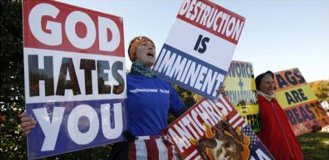
About the “God Hates You” photo: those folks were getting attention on Veterans Day, 2010. They’re with Fred Phelps’ Westboro Baptist Church, a bunch of Hard Shell Baptist Calvinists from Kansas. They’re not typical American Protestants.

Nativism: Here We Go Again


(From Bishop Alma White’s “The Ku Klux Klan In Prophecy,” 1925: published by the Pillar of Fire Church, Zarephath, New Jersey.)

Folks who fear foreigners don’t, I gather, think of themselves as nativists.

They apparently think they’re patriots: defending their nation against folks like my ancestors. I think it’s a silly attitude for any American who isn’t descended from those who arrived via the Bering Straight, some 20,000 years back.

Who is seen as a foreign threat, and who isn’t, has changed over the generations.

Many if not most Americans have decided the Irish aren’t all drunkards, prone to violence and illegal voting.

That wasn’t always the case.

Asked about the family connections of an unsuitable person who was sniffing around her daughter, one of my ancestors said “he doesn’t have family, he’s Irish.”

The kids got married anyway. That eventually resulted in my father, who married a five-foot-nothing black-haired Norwegian. I married a Dutch-German-English-Swiss-whatever woman, and that’s another topic. (August 5, 2016)

Knowing my family history helps me sympathize with Muslims and other ‘un-American’ Americans.

That’s a good thing, since welcoming folks “in search of the security and the means of livelihood” they couldn’t find in the old country is what we’re supposed to do. (Catechism of the Catholic Church, 2241)

Treating newcomers, or ‘outsiders’ who have been around for generations, as neighbors isn’t a new idea. (Exodus 23:9; Leviticus 19:3334; Matthew 25:35)

I don’t expect divisions that predate Western Civilization’s current iteration to disappear overnight. But I think it’s wise to remember the Abrahamic religions’ common origin.

The current mess started with a domestic dispute described in Genesis 16:112 and Genesis 21:214. The Late Bronze Age collapse happened a few centuries later, so documentation is a trifle spotty, and that’s yet another topic.

“…the plan of salvation also includes those who acknowledge the Creator. In the first place amongst these there are the Muslims, who, professing to hold the faith of Abraham, along with us adore the one and merciful God, who on the last day will judge mankind….”
(“Lumen Gentium,” Pope Bl. Paul VI (November 21, 1964))

I see humanity as a “unity.” (Catechism, 360361, 839845)

And, as I said yesterday — God loves us, and wants to adopt us. All of us. (Romans 8:15; Ephesians 1:35; Peter 2:34; Catechism, 13, 2730, 52, 1825, 1996)

Hate, Hymns, Forgiveness, and Justice

Nomader, via Wikimedia Commons, used w/o permission.
(“Picture I took from the crowd outside of the Charleston church shooting memorial service. As the church filled to capacity, people gathered outside, sung hymns, and listened to religious leaders talk.”
(Nomader, via Wikimedia Commons))

Someone, probably Dylann Roof, killed nine folks at a Bible study last summer. Mr. Roof apparently was part of a Lutheran congregation; but I don’t think we should register Lutherans, or keep more of them from entering America.

The Charleston church shootings are in the news again. I think we can learn from the example of folks who have forgiven Mr. Roof.3

That may need explaining.

Killing those folks was a bad thing, and should not have been done. Murder, deliberately killing an innocent person, is wrong. (Catechism, 22682269)

That’s because human life is sacred. Each of us is created in the image of God. The divine image is in each of us; no matter who we are, who our ancestors are, or what we’ve done. (Genesis 1:27; Catechism, 357, 361, 369370, 1700, 1730, 1929, 22732274, 22762279)

What we do with our life, and the lives of those around us, is up to us: for good or ill. (Catechism, 17011709, 2258)

All human life is sacred, but taking action which results in an attacker’s death can be legitimate defense. (Catechism, 22632267)

I’ve talked about that before. (July 9, 2016)

“So Hate Won’t Win”


(From BBC News, used w/o permission.)
(” ‘Everyone’s plea for your soul is proof that they lived in love and their legacies will live in love. So hate won’t win’, a relative of one victim told the suspect”
(BBC News))

Forgiving someone is a good idea: and not the same as pretending that an injustice never happened. That would be crazy. Respect for the “transcendent dignity” of humanity demands that we work for justice. The trick is hating the sin — not the sinner. (Catechism, 976980, 19291933, 2820)

I keep saying this. I’m expected to love God, love my neighbors, see everyone as my neighbor, and treat others as I’d like to be treated. (Matthew 5:4344, 7:12, 22:3640, Mark 12:2831; Luke 6:31 10:2527, 2937; Catechism, 1789)

It’s simple: and far from easy. We call the folks with the heroic virtue it takes to live as if those principles matter “Saints,” and that’s yet again another topic. (Catechism, 828)

The sort of love that’s required can’t be safely abstract. I must act as if love matters. My concern for justice, for example, can’t stop with my family or folks who look like me. Our Lord’s story about the Samaritan makes that clear. (Luke 10:3037)

Think!

Feeling angry about mass murder or hate mail is a natural reaction. But we’re supposed to think.

Letting anger build into a desire to harm or kill someone else is a very bad idea. (Catechism, 17621775, 23022303)

Controlling my actions isn’t easy. I think controlling what happens inside, in my heart, is harder: but that’s also required. (Matthew 5:2122, 15:1819)

Emotions happen. What matters is how I deal with them: how I use my will and reason. Feeling emotions is part of being human. So is using my brain, thinking before I act or speak. (Catechism, 1951, 1730, 17631767)

Emotions can indicate that something requires attention. After that, my job is using reason to decide what I should or should not do. (Catechism, 1763, 1765, 1767)

Now What?

As Paul wrote in Philippians 3:20, “…our citizenship is in heaven….” Meanwhile, I’m supposed to be a good citizen here in America: contributing “…to the good of society in a spirit of truth, justice, solidarity, and freedom….” (Catechism, 2239)

If I take loving my neighbors, all my neighbors, seriously, social justice is a priority. (Catechism, 19281942)

That starts within each of us, within me, with an ongoing “inner conversion.” (Catechism, 1888)

“…The answer to the fear which darkens human existence at the end of the twentieth century is the common effort to build the civilization of love, founded on the universal values of peace, solidarity, justice, and liberty….”
(“To the United Nations Organization,”4 Pope St. John Paul II (October 5, 1995))

That doesn’t mean forcing everyone into one cultural mold, or insisting one ‘correct’ form of government. We’re not supposed to be all alike. (Catechism, 1901, 18971917)

Building the “civilization of love” will take time, lots of time. But I think it makes sense. (November 27, 2016)

More of my take on acting like love matters:


1 The hate mail is international news:

California mosques targeted by hate mail
BBC News (November 27, 2016)

A US civil rights group has called for more police protection after several mosques in California received letters calling Muslims ‘vile and filthy’.

“…A police investigation was under under way into what was treated like a ‘hate-motivated incident,’ San Jose Police Department spokesman Sgt Enrique Garcia was quoted as saying by the Associated Press news agency.”

2 I’m pretty sure we’ll be seeing this in the news for days, at least:

3 Death at a Bible study, in the news:

Charleston shootings: Dylann Roof ‘fit’ to stand trial
(November 25, 2016)

A white man accused of shooting dead nine black people at a church in Charleston is competent to stand trial, a federal judge in the US state of South Carolina has ruled.

“A psychiatric review of 22-year-old Dylann Roof was performed after a request from his defence team.

“He is accused of killing the nine parishioners during their Bible study class in June 2015….”

Charleston relatives ‘forgive’ shooting suspect in court
BBC News (June 19, 2015)

Relatives of some of the nine churchgoers shot dead in South Carolina have addressed the suspected gunman in court and said they forgive him.

“Dylann Roof, 21, appeared in court in Charleston to face nine murder charges.

“He showed no emotion as relatives of the victims addressed him directly. ‘I forgive you’ said one victim’s daughter, fighting back tears….”

4 The civilization of love, background:

Posted in Being a Citizen, Being Catholic | Tagged , , , , , , , , , , , | 8 Comments