No More Sunspots?

Sunspots come and go in an 11-year cycle. Our sun has acted that way for centuries. With a few exceptions.

The sunspot cycle changed about 23 years back. I think we’ll learn a great deal by studying what’s happening, but at this point scientists aren’t quite sure what to make of the new ‘normal.’


The Story So Far

We’ve been studying the great light in our sky and the lesser lights for a very long time. Then, a few centuries back, natural philosophers became scientists.

We’re learning that what we had discovered is just part of a vast cosmos.

That seems to bother some folks. I’m not one of them. I like living in an era where much of what I learned in my youth is either outdated or simply wrong.

I’ll be talking about sunspots, stars, and what we’re learning about them. A great deal of that is being uncovered ‘now,’ in the years since I was born. But like I said, the basics we’ve known for much longer.

How long we’ve known about sunspots depends partly on where you look.

Folks in Korea and China may have observed dark spots on the sun about 28 centuries back. Some scholars think that’s how we can read what’s in I Ching.

How folks living before today’s filters and other tech would examine our sun’s surface with comparative safety, I don’t know. Maybe something along the lines of a camera obscura.

The trick with observing our sun isn’t getting an image big enough to see. It’s blocking most of the light so we can see without blinding ourselves.

Theophrastus recorded sunspot observations a few centuries later. He studied with Plato and then Aristotle.

Apparently Theophrastus was more into Aristotle’s preference for observation and less attached to Plato’s theory of forms. That may help explain why his works were standard references until the Renaissance.

Jumping ahead about a millennium, Adelmus noticed a sunspot, but thought it was Mercury crossing the sun’s face. That was in March of 807. I’m pretty sure he’s Athelm, a monk who was Archbishop of Canterbury. Or maybe someone else.

John of Worcester, another monk, made the first drawing we have of a sunspot in 1128.

Fast-forward to the 1600s. A bunch of folks observed sunspots during that century, too.

Galileo and Christoph Scheiner both said they saw them first. Both apparently missed that honor by a few millennia, but didn’t have today’s information storage and retrieval tech. If they’d read I Ching, I like to think they’d have claimed something else as an achievement.

Galileo argued that sunspots were on our sun’s surface in his 1613 Letters on Sunspots.

I suspect that helped inspired later accounts of the Church seeing science as a threat. I’ve talked about Galileo’s less-than-winsome personality and 17th century politics before.1

Also why I think this universe is billions, not thousands, of years old; Earth isn’t flat; Adam and Eve aren’t German; and thinking is not a sin. And that’s another topic. (September 23, 2016; August 28, 2016; July 22, 2016)


Our Inconstant Sun

A solar flare erupting on August 31, 2012; NASA Goddard Space Flight Center, via Wikimedia Commons, used w/o permission.
A solar flare erupting on August 31, 2012.

“Is the Sun Changing?“
Monica Broba, Sky and Telescope (January 2018)

“About 290 million years ago, a volcano erupted in what is now eastern Germany. The blast lifted trees straight out of the ground and coated them with liquid rock. Beneath this debris, an entire forest fossilized. Last year, scientists studied tree rings from these ancient trees — but not to learn about Earth. They wanted to learn about the Sun.

“To the naked eye, the Sun looks like a uniform whitish sphere. But the solar surface is often mottled with dark spots, like the peel of a ripe banana. These sunspots emerge, live for a few hours or days (or longer), and then decay. Occasionally, 150 or more spots dot the solar surface. During these times, we observe many eruptions of high-energy radiation and, sometimes, superheated material, which can blast through space and hit the planets. At other times, hardly any spots show up at all, and the Sun stays fairly quiet. The Sun smoothly cycles between these two states, ramping the number of sunspots up and down every 11 years….”

Those eruptions of superheated material hit earth’s magnetosphere on occasion. We started calling them coronal mass ejections, CMEs, recently.

They didn’t affect us directly, apart from lighting up the aurora. Not that we know of, anyway. That changed in 1859. Folks had started using telegraphs.

Electrical telegraphs made long-distance communication a whole lot faster than anything we’d had before.

Nearly-instantaneous data transmission helped turn meteorology from a study of past weather to a predictive science. (August 11, 2017)

Telegraphs used a growing web of telegraph lines. Wires and changing magnetic fields interact, and — I am not going to get distracted by the Biot–Savart and Ampère’s circuital laws. The point is that when a wire and/or magnetic field move, we get electrical current.

Science and Jobs For Humans

On September 1, 1859, astronomers noticed an unusually bright flare on our sun. Auroras that night were spectacular, and seen as far south as the Caribbean.

Scientists noticed a “magnetic crochet,” some telegraph operators got shocked and miners in the Rocky Mountains mistook the aurora for dawn.

Maxwell published a set of his differential equations around 1860. Röntgen won the 1901 Nobel Prize for discovering X-rays.

The Orbiting Solar Observatory 7’s SEC caught a 256 × 256 pixel image on December 14, 1971. A human, David Roberts, eventually noticed it. He figured it was a glitch. Then he saw another one, farther out.

Roberts was an electronics technician, so he had scientists look at the data. They confirmed that it wasn’t a glitch. Roberts had spotted the first clear evidence of a CME. (February 17, 2017)

Humans are pretty good at solving ‘what’s wrong with this picture’ puzzles. But AI is getting pretty good at that sort of thing, too. Some AI systems ‘look’ through the flood of data coming from today’s observing tech.

That doesn’t mean that folks like Roberts will become obsolete.

Their jobs may, but not the people. I think there’ll always be room in science and other fields for our sort of ‘smart.’

Robotic road vehicles recently moved from research and development to product design. And that’s yet another topic, for another post.

Our jobs, what we do to help others, will keep changing. Some will disappear, or become recreational options. We will keep changing, too: more slowly. But we’ll still be ‘human,’ with the kind of ‘smart’ that’s kept us alive during one of Earth’s ice ages.

I think the fellow was right.

‘Computers are designed to get correct answers based on huge amounts of information, all of which is right. Human brains are designed to get correct answers based on almost no information, most of which is wrong.’

Forests, Mountains, and Change

About that German volcano, another eruption won’t threaten Chemnitz.

My guess is that the Zeisigwald volcano was in a mountain range separating most of Europe from an equatorial ocean, but haven’t confirmed that.

The volcano is long since gone, along with the mountain range. The Pyrenees and Alps formed much more recently, and that’s yet again another topic.

Earth wasn’t quite the way it is today. The atmosphere had about 115% more oxygen. The Great Dying wouldn’t happen for another 39,000,000 or so years. Pangea wouldn’t break apart until tens of millions of years after that. (June 23, 2017)

The territory we call Germany, along with the rest of Europe, was in northern Pangea. Some critters living in the area, like Palaeohatteria, would have seemed familiar. It was about 60 centimeters, two feet, long and looked quite a bit like today’s lizards.

The forest itself had trees and undergrowth, like today’s woodlands. But forests have changed as the ages rolled past. A lot.2


A Spotless Sun

The spotless Sun of July 21, 2017; NASA/SDO/HMI, via Sky and Telescope, used w/o permission.
“The spotless Sun of July 21, 2017.” Sky and Telescope magazine.

“Is Our Sun Slowing Down in Its Middle Age?“
Monica Bobr, Sky and Telescope (July 21, 2017)

“The Sun, now halfway through its life, might be slowing its magnetic activity, researchers say, which could lead to permanent changes in the sunspots and auroras we see.

“The Sun has changed its figure, researchers say, and might keep it that way.

“The structure of the Sun’s surface, where sunspots live, appears to have changed markedly 23 years ago. That’s when solar magnetic activity might have started slowing down, Rachel Howe (University of Birmingham, UK, and Aarhaus University, Denmark) and collaborators speculate in paper to appear in the Monthly Notices of the Royal Astronomical Society (full text here)….”

I’m quite sure this isn’t a sign in the sky, portending End Times, a somewhat-tardy Mayan Apocalypse, or cancellation of next year’s Super Bowl. I figure it’s the start of another grand solar minimum, or something else. Right now we don’t know.

I also figure that “permanent” changes in sunspots aren’t likely. Permanent changes in how sunspots change, maybe.

Sunspots have disappeared before. Somewhere along the line we started calling that sort of thing Grand solar minima.

Grand solar minima happen at apparently-irregular intervals. I’m guessing that they’re not “random,” but have more complex cycles than the sine-wave-like 11 year maxima and minima we’re familiar with. But like I said, right now we don’t know.

Sunspots and Grand Solar Minima

We’ve noticed that Grand solar minima happen at about the same time as regional or global climate changes.

That could be a string of coincidences.

I’d be less surprised if we learn that solar activity affects Earth’s climate. It wouldn’t be the only factor. I’ve talked about science, climate change, attitudes, and getting a grip before; and probably will again. But not to day. Not so much.

I put links to a little background near the end of this post. In case you want to read about the the Oort, Wolf, Spörer, Maunder, and Dalton Minima; or Aristotelian physics.3

One of these days I’ll revisit why I think Earth’s climate changes and that we should find out more before monkeying with the controls. Not panicking seems like a very good idea — particularly since we’ve survived some fairly major changes already.4

We didn’t know about solar minima and maxima, Grand or otherwise, until fairly recently.

They’re not mentioned in the Bible, although I wouldn’t put it past someone to come up with a ‘Biblical’ reason for saying they’re not real. Maybe Ecclesiastes 1:10. Joel 2:10 might work, too; although that’s used more by ‘End Times Bible Prophecy’ folks.

I’ll get back to that, sort of.

I don’t see a point in saying that Grand solar minima can’t or shouldn’t exist. That makes about as much sense to me as believing other worlds can’t exist because Aristotle said so, or that we knew everything there is to know about this universe at some arbitrary date.

A Sense of Scale

I also don’t see a point in desperately trying to believe that a 17th-century Calvinist’s Bible study proved that this universe started in 4004 BC.

Some folks try, and seem to feel that it’s an indispensable aspect of Christian belief.

I think and hope they are sincere. But I am convinced they are wrong.

Even if I preferred a tidy little cosmos that was new when Tiān Qiāng sān was Earth’s north star, it wouldn’t change reality.

Like Psalms 115:3 says, God’s large and in charge. I’m okay with that.

Getting back to stars, science, and what we’re learning — Emanuel Swedenborg published “The Principia” in 1734.

His ideas about science, intuition, reason, and religion were colorful, putting it mildly. But he also got scientists thinking about what we now call the nebular hypothesis.

Immanuel Kant, Pierre-Simon Laplace and a whole mess of other folks added to the mix. The nebular hypotheses is still the model that best fits what we’ve been observing. (December 9, 2016)

Fast-forwarding to the mid-20th century, scientists were getting an increasingly-exact idea of when this universe started. Some scientists, anyway. Hoyle, who thought a steady-state universe made more sense, called Lemaître’s hypothèse de l’atome primitif a “big bang.”

There’s a story behind that, but I’m running short on time. I’ll leave it for another post.

How We Know What We Know

Big bang, 13,800,000,000 years later: mapped onto a 12-month calendar; Efbrazil, via Wikimedia Commons, used w/o permission.
Big bang, 13,800,000,000 years later: mapped onto a 12-month calendar.

We’ve been observing our sun and the stars for a long time: long in comparison America’s election cycle, anyway.

Looking at the time elapsed since this universe started as one year, it’s not so long. We didn’t show up until “today.”

Folks started building cities about 22 seconds back, Copernicus said Earth orbits our sun a second ago — and we’ve been studying stellar evolution for a fraction of a second.

I don’t think we’d have gotten far if our sun was the only star we could observe. Based on what we’ve seen over the last few centuries, we might conclude that our star didn’t change, apart from more-or-less-regular cycles.

Happily, we can see thousands of stars each night: given clear skies and no street lights. More recently we’ve started studying myriad upon myriad more distant stars. That, and a lot of analysis, lets scientists learn how stars form and change.

Quite recently we’ve started watching stars that aren’t stars yet. We’re even pretty sure we’ve spotted nascent planetary systems.

If I’m going to get this ready in time, I’ll have to put off most of what I wanted to say about stars in general, and ours in particular. Also how our star’s younger years may have affected life on Earth.


Seeking Truth

I said I’ll talk about reality, the Bible, and ‘End Times Bible Prophecy’ folks.

But like I said, I’m running late. I’ll mostly talk about the first two, and give the last a ‘once over lightly’ treatment.

I fine-tuned some of what I thought was so after becoming a Catholic. That’s an ongoing process.

But I didn’t change anything basic, including how I see truth and reality. For starters, I think reality is real. And that I’m not a figment of your imagination, or vice versa.

That may be hard-to-impossible to demonstrate.

In principle I could convince myself that every argument was an illusion. Or that I’m something you’re imagining, and you’re the one thinking my thoughts. Overly farfetched? Maybe, but I’ve seen some rather odd notions. (August 13, 2017; February 10, 2017)

Part of my job is seeking truth and God. Since all truth points toward God, preserving ignorance isn’t a virtue. (Catechism of the Catholic Church, 27, 31-35, 41, 74, 2500)

I’ll find truth in the Bible, sacred scriptures. That’s why reading the Bible often is one of my happier obligations. (Catechism, 101-133)

The Whole Truth

The Bible is important, but it’s not all that’s important. I’m a Catholic, so I think faith means willingly and consciously embracing “the whole truth that God has revealed.” (Catechism, 142-150)

The Bible has God’s revealed truth. So does everything we can observe. I’ll find truth in the natural world’s order and beauty, if I’m paying attention. Appreciating the world’s wonders is a good idea. (Catechism, 32, 41, 74, 283, 341, 2500)

I thought learning how this universe works was a good idea before I became a Catholic, and still do. An interest in science isn’t required for our faith, but it sure doesn’t hurt.

Each time we learn something new about this wonder-filled creation, it’s an opportunity for greater admiration of God’s work. (Catechism, 283, 341)

Doing My Job

Folks who seriously believe the “rapt-cha stuff” aren’t necessarily bumpkins like Non Sequitur’s Eddie.

I don’t know why otherwise-sensible folks occasionally fall for a current ‘End Times Bible Prophecy.’ They pop up fairly often, keep fizzling, and follow pretty much the same script. (August 23, 2017)

I think Jesus is coming back, and that we’ve got work to do in the meantime. Lots of work. (December 3, 2017)

I also take what Jesus said very seriously, including what our Lord said in Matthew 24:36–44, 25:13, and Mark 13:32–33.

The way I see it, the timetable for our Lord’s return is available on a ‘need to know’ basis. If Jesus didn’t need to know, I sure don’t.

I don’t mind. That sort of thing strikes me as being a very high-level command decision. I’ve got my hands full, just trying to do my job here; ‘working out my salvation.’ And that’s still another topic.

Some of what we’re learning about this wonder-filled universe:


1 Faith, science, and Galileo:

2 Paleontology and a little stellar physics:

3 Old physics, new knowledge:

4 Looking at facts, and thinking:

Posted in Science News | Tagged , , , , , , , | 6 Comments

Advent: Our Long Watch

‘Tis the season for frantic shopping, eye-popping light shows in suburban front yards, and Christmas television specials.

It’s also the start of Advent.

This is a season when we look back at ancient hopes for a Messiah, and our Lord’s first arrival. And look ahead to when Jesus will be back. (Catechism of the Catholic Church, 522–524, 668–674)

That should be near the top of my ‘to-do’ list, anyway.

Not that there’s anything wrong with Buckster Bunny’s real-world counterparts, holiday decorations, and enjoying life’s pleasures. Within reason. (July 9, 2017; July 10, 2016)

Today’s Gospel has some good advice:

“Jesus said to his disciples: ‘Be watchful! Be alert! You do not know when the time will come…. What I say to you, I say to all: “Watch!”‘”
(Mark 13:33–37)

As Long as It Takes

I think everyone matters.

Each of us has humanity’s “transcendent dignity.” (Catechism, 1929)

We all have “the same nature and the same origin,” but we’re not all alike. We’re not supposed to be. (Catechism, 1937)

This is a good thing, or should be. (Catechism, 1934–1938)

Some of us achieve “newspaper fame.” We recognize some for their “heroic virtue.” (Catechism, 828, 1723)

Those two categories overlap, and that’s another topic.

“Newspaper fame” can last longer than Andy Warhol’s “15 minutes of fame.” A few folks earn much more lasting recognition. Millennia after they lived and died, we remember Homer, Yan Ying and Himiko. Some of us, that is.

Then there’s Jesus. Two thousand years after he lived and died, a sizable fraction of humanity call him “Lord,” among other titles.1 I’m one of them.

I think what our Lord did is important.

That doesn’t explain why I review what we know about Jesus before each winter solstice. Along with well upward of a billion other folks.

And it sure doesn’t explain why we’re still watching and waiting for our Lord’s return.

After two millennia, we might have decided our Lord wasn’t coming back. Some have.

But like I keep saying, Jesus isn’t anyone else. (April 30, 2017; August 7, 2016)

I think John sums it up rather well:

“In the beginning was the Word, and the Word was with God, and the Word was God.”

“And the Word became flesh and made his dwelling among us, and we saw his glory, the glory as of the Father’s only Son, full of grace and truth.”
(John 1:1, 14)

I’ll be mostly talking about how I see our long watch, and why it’s more than just waiting.

There’s a short link list to Advent resources and homilies near the end of this post.2

Watching and Working

Our Lord’s return has been “imminent” for about two millennia now. (Catechism, 673)

Jesus said we should “be prepared,” since we didn’t know when that will be; and still don’t. (Matthew 24:44; Catechism, 673, 840, 1040, 2772)

That seems like good advice.

We’re not lacking for work to keep us busy during our long watch.

Part of our job is spreading the best news humanity’s ever had. (Matthew 28:16–20)

God loves us, and wants to adopt us. All of us. (Romans 8:15; Ephesians 1:3–5; Peter 2:3–4; Catechism, 1–3, 27–30, 52, 1825, 1996)

I’ve accepted the offer. That’s why I try to live as if the ‘family values’ matter.

Saying I believe in God, and that I’m a Christian, is fine. But it’s pointless unless my actions and words show it. (James 2:17–19; Catechism, 1814–1816)

Part of the Family

Being ‘part of the family’ includes accepting my part of a job that’s not even close to being finished.

Thanks to a bad decision we made when humanity began, we’ve been treating each other badly. (Catechism, 396–412, 1865–1869)

That’s given us an impressive backlog of issues: troubled relationships within families and communities, and between nations.

Our world is a mess, and so are we. But we’re still basically good. Our world is, too. I think cautious optimism makes sense. (May 28, 2017; April 23, 2017; March 5, 2017)

So does cultivating patience.

We have work to do. Lots of work. (Catechism, 668–670, 1928–1942)

My job starts with loving God and my neighbors, and seeing everybody as my neighbor. (Matthew 5:43–44, 22:36–40; Mark 12:28–31; Luke 6:31 10:25–27, 29–37; Catechism, 1789)

It’s simple, and very far from easy. But it’s a good idea.

Maybe it also sounds less grandiose than what I’ll talk about next.

Building the Civilization of Love


(From “Avenue Eos” by Owen Carson, used w/o permission.)

Building a better world starts within me, with an ongoing “inner conversion.” (Catechism, 1888)

Not that I expect to single-handedly change the course the history, establishing truth and justice throughout the world.

I’m just one man, living in central Minnesota, with very little influence on world affairs. But I can suggest that treating others with respect makes sense, and that working for a better future is an option.

That’s one reason I keep suggesting that generosity, kindness, and sharing make sense. So does planning for future generations. (Catechism, 1937, 2415, 2419–2442)

The job will take time, lots of time, since it involves radical ideas like peace, solidarity, justice, and liberty:3

“…We must overcome our fear of the future. But we will not be able to overcome it completely unless we do so together. The ‘answer’ to that fear is neither coercion nor repression, nor the imposition of one social ‘model’ on the entire world. The answer to the fear which darkens human existence at the end of the twentieth century is the common effort to build the civilization of love, founded on the universal values of peace, solidarity, justice, and liberty….”
(“To the United Nations Organization,” Pope St. John Paul II (October 5, 1995))

We haven’t made much progress in building his “civilization of love” in the 22 years since St. John Paul II said working together made sense.

That’s hardly surprising. I am quite sure this will take centuries. Millennia, more likely.

We’re further along, sharing the best news ever. Maybe it’s more accurate to say that we’re a bit further along.

Acting like love is a good idea is still hard. We’re far from convincing many, including ourselves, that we’re all neighbors. But I think we’ve made some progress in the last two millennia.

I also think we will be waiting, working, and sharing a message of hope and love for a very long time. And that it will be worth the time and effort.

How others see holiday shopping frenzies, Advent, and all that:


1 A (very) few of our Lord’s titles:

2 About Advent:

3 Building a better world, a little background:

Posted in Being Catholic | Tagged , , , , , , , , , | 2 Comments

Still Seeking Earth 2.0

We’ve known about 55 Cancri e since 2004.

It may have lakes and rivers of lava. But that’s probably not what keeps its night side hot enough to melt copper.

Ross 128 b, discovered this year, is a bit more massive than Earth, warm enough for liquid water, and too hot. It’s not quite ‘Earth 2.0,’ but it may support life.


Changing Views of Mercury


(From USGS, used w/o permission.)
(Topographic map of Mercury, USGS (2016))

Scientists making the topographic map used data from MESSENGER, the first spacecraft to orbit Mercury. The other map is Eugène Michael Antoniadi’s, published in 1934; based on what’s visible from Earth.

Antoniadi and other astronomers were pretty sure that Mercury always kept one face pointed toward our sun.

It made sense for Mercury to be tidally locked on the sun, as Earth’s moon is with our planet. Observations seemed to back up that assumption.

We can only see Mercury during twilight, and then only when it’s far from the sun in our sky. Telescopes let astronomers see Mercury’s surface, but not clearly. Not through our still-sunlit atmosphere.

At best, astronomers observing Mercury saw the sunlit part of a tiny, low-contrast disk. Each time it seemed to be have the same indistinct markings.

If Mercury ‘day’ side was always sunlit, its center would the hottest spot in the Solar System; apart from the Sun. The night side would be colder than Pluto.

Like I said, it made sense.

Then astronomers tried calibrating the Arecibo radio telescope by aiming it at Mercury’s night side. That was in 1965. Mercury’s night side was emitting much more radio energy than they’d expected.

Their equipment was functioning properly, so the data wasn’t a technical glitch.

Still Learning

We didn’t have all the answers in 1965, and still don’t. But we were and are learning.

Over the previous few centuries we had learned that Newtonian physics matched observations better than Aristotle’s ideas.

Then, about a century back, better tech and more precise measurements showed that Newtonian physics wasn’t the whole picture. (October 6, 2017; August 25, 2017)

Scientists are rapidly learning about quantum mechanics, Schrödinger’s cat, and — more to the point — planets.

One explanation for Mercury’s warm night side was that it had an atmosphere. Heat could be transferred by heat. That seemed unlikely, at best. Mercury is too small and too close to our sun to keep much air.

Arecibo data made much more sense in models that had Mercury rotating once every 59 days. Roughly. Our world’s 24 hour days, that is.

Starting Points

That analysis explained Mercury’s comparatively warm night side.

Instead of having a 1/1 spin-orbit resonance, like Earth’s moon, Mercury’s spin-orbit resonance would be 3:2.

It would rotate on its axis three times for each two orbits.

That would explain why astronomers kept seeing the same side in sunlight. A 3:2 spin-orbit resonance would make Mercury’s rotation period, its day, almost exactly half its synodic period for observers on Earth.

A synodic period is the time it takes for something to be return to the same position relative to our sun, from our viewpoint. Our moon’s synodic period is about 28 days: the time between one full moon and the next.

Synodic periods and synods of bishops don’t have a lot in common.

A synod of bishops is an advisory group for the Pope. “Synod” is what happened when two Greek words got used by folks speaking Latin and then picked up by folks speaking English. And that’s another topic.

Mercury’s 58-day rotation period was confirmed when Mariner 10 flybys gave us the first somewhat-detailed views of its surface. We started getting a close-up look at the planet again in 2011, when MESSENGER settled into orbit around Mercury.

Some conclusions Eugenios Antoniadi and others arrived at weren’t accurate. Some were. Their observations, and trains of thought they started, gave other scientists starting points for more study.1

I think what we’re learning about exoplanets is a bit like what we knew about other worlds in the Solar System a few generations back. Some of today’s conclusions probably won’t match later observations. But we are learning what to look for, and how to look for it.


New Research: 55 Cancre e


(From NASA/JPL-Caltech, via Jet Propulsion Laboratory, used w/o permission.)
(An artist’s concept of 55 Cancri e with an atmosphere.)

“Atmosphere, Not Lava Flows, for Exoplanet 55 Cancri e”
Monica Young, Sky and Telescope (November 27, 2017)

“Previous studies of 55 Cancri e haven’t been able to determine whether this super-Earth hosts an atmosphere. A new study settles the question.

“The exoplanet 55 Cancri e is a cipher. Astronomers have gone back and forth on its nature — waterworld, diamond world, or volcanic hellscape? Part of the riddle has been whether the planet is bare rock or has an atmosphere — previous studies have shown ambiguous results.

“Now, new research from Isabel Angelo and Renyu Hu (both at JPL-Caltech) published in the November 16th Astrophysical Journal (full text here) seems to have settled the question: 55 Cancri e probably does have an atmosphere and a substantial one at that….”

A key phrase here is “…seems to have settled….”

The latest study makes sense. The new analysis of data from NASA’s Spitzer Space Telescope confirms that 55 Cancri e’s hot spot is eastwards of the spot where 55 Cancri is straight overhead. Something is transferring heat.

Someone suggested that maybe constant flow in massive lava lakes and rivers account for the easterly shift. That might be happening, but lava wouldn’t flow fast enough to account for what’s observed. A “substantial atmosphere” would.

The scientists who published this study, Isabel Angelo and Renyu Hu, say 55 Cancri e’s surface pressure would be around 1.4 bar. A bar is 100 kilopascals, a little under Earth’s current sea level air pressure.

They may be right. Their analysis seems like a much better fit with what we know about 55 Cancri e than the ‘lava rivers’ scenario. But I won’t be surprised if we learn that something else accounts for what’s been observed so far.

We’ll know more after more analysis of data we’ve collected, and better technology lets us get a better look. My guess is that there will still be surprises, even after the first probes reach 55 Cancri e.

A Quick Look at 55 Cancri

55 Cancri is a double star, about 41 light-years away. It’s visible, barely, in our sky: for someone with good eyesight and very dark skies.

The five planets we’ve found there so far orbit 55 Cancri A, a star that’s a little smaller and cooler than ours.

55 Cancri B is a red dwarf, a thousand times further from 55 Cancri A than Earth is from our sun.

Technically, I should be calling 55 Cancri e “55 Cancri Ae.” But just about every resource I found says “55 Cancri e,” so that’s what I’ll do, too.

55 Cancri f is just inside the star’s habitable zone. It’s at least half as massive as Saturn, so it’s probably a gas giant. It might have a moon that’s roughly Earth-size, though.2

That wouldn’t be why folks sent a radio message toward the system in 2003. We didn’t know about it then.


Ross 128 b: Not Quite Earth 2.0?


(From ESO / M. Kornmesser , via BBC News, used w/o permission.)
(“Artwork: Ross 128 b might be a target in the search for extra-terrestrial life”
(BBC News))

“Nearby planet is ‘excellent’ target in search for life”
Paul Rincon, BBC News (November 15, 2017)

“Astronomers have found a cool, Earth-sized planet that’s relatively close to our Solar System.

“The properties of this newly discovered planet – called Ross 128 b – make it a prime target in the search for life elsewhere in the cosmos.

“At just 11 light-years away, it’s the second closest exoplanet of its kind to Earth.

“But the closest one, known as Proxima b, looks to be less hospitable for life….”

Scientists have had quite a few opinions about habitable planets and red dwarf stars.

I don’t know who first studied red dwarfs and habitability. Other than science fiction authors, who had varying degrees of concern regarding facts and plausibility.

We knew an Earth-like planet orbiting a red dwarf would have to be very close to its sun to have liquid water.

A red dwarf planetary system with life on a planet like ours would have to be on a scale more like Jupiter and its moons than the Solar System.

That made life around red dwarfs seem unlikely. Red dwarfs are less massive than our star, but they’re significantly more massive than Jupiter. Expecting their planets to have big orbits made sense.

Then we started finding lots of planets orbiting very close to red dwarfs.

Many were a great deal more massive than Earth, but early detection methods wouldn’t pick up Earth-mass worlds.

Scientists started thinking maybe life could exist with a red dwarf sun.

Or maybe not.

We were also learning that some, but not all, red dwarfs apparently have flares as strong as our star’s. Since an Earth-like planet orbiting a flaring red dwarf star would be very close to its sun, it might not be ‘habitable,’ by our standards, when its sun flared

Radiation wouldn’t be the only problem.

Some simulations showed that being that close to a flaring star might blow part or all of the planet’s atmosphere away. On the other hand, maybe Earth-like planets with sturdy magnetic fields would keep their air. Other simulations suggested that was true.

Ross 128 doesn’t flare, not that we’ve noticed, so it was and is on ‘might be life here’ lists. Except those kept by scientists who had other reasons for not expecting life on a red dwarf’s planets.

Weather and climate on a planet somewhat like ours, where it’s always ‘day’ on one side and ‘night’ on the other, would be — different. Just how different is yet another topic.

Even if we find life on Ross 128 b, I don’t see it as ‘Earth 2.0.’ Surface gravity would be higher than we like, for one thing. But it’s among the best bets we’ve found in our search for life outside the Solar System.

What We Know, and Don’t Know


(From ESO, IAU and Sky & Telescope; used w/o permission.)
(Ross 128 is at 11h 47m, +00° 48′, near Beta Virginis in our sky. It’s in that faint red circle.)

We’ve known about Ross 128 since the 1920s. It was unremarkable except for being among the nearer stars.

We don’t know much about Ross 128 b, apart from its mass and orbit.

It’s about 1.35 times as massive as Earth, with a year that’s roughly 9.9 days long. Our days, that is. Its orbit is a bit more eccentric than Earth has today, but not nearly as much as Mercury’s. Thinking it’s got a 1/1 spin-orbit resonance seems reasonable.

It’ll be warmer than Earth, but probably not too warm to support our sort of life. If it’s got an atmosphere like ours. Scientists haven’t measured Ross 128 b’s diameter directly.

We’ve been learning a great deal about planets outside the Solar System, enough to get a reasonable idea of what we can expect.

Some are familiar: small, rocky worlds like Earth and Mercury.

Others are pretty good matches for the Solar System’s outer worlds. And quite a few aren’t like anything we’d seen before. (June 30, 2017)

A planet with Ross 128 b’s mass is almost certainly like the Solar System’s inner planets, mostly rock and metal. It’s massive enough to keep an atmosphere.

But we won’t know if it does or not until slightly better tech gets finished. Telescopes like ESO’s Extremely Large Telescope and NASA’s James Webb Space Telescope will let scientist study Ross 128’s atmosphere. If it has one.3 (June 2, 2017)

The May 12, 2017, Arecibo signal

On May 12 of this year scientists at Arecibo detected broadband signals coming from Ross 128’s location in our sky.

They were unusual, apparently not random: very likely not a natural phenomenon.

I’d love to be writing about efforts to translate our first message from another civilization. That’s almost certainly not what the Arecibo observatory detected.

Ross 128 is very close to our ecliptic, and in the same plane as geosynchronous satellites. It looks like the signal was from one of humanity’s orbiting devices.

The May 12 signal wasn’t our first false alarm. I’m quite sure it won’t be our last. (December 16, 2016; September 16, 2016)


“Ludicrous,” “Absurd,” and Starshot’s Microprobes

Our first interstellar missions will most likely be to places like Proxima Centauri b and Luyten b.

Their stars are both fairly close. “Close” compared to most, that is.

We’re no more able to build interstellar probes today than folks in Antoniadi’s day could send robotic spaceships to Mercury.

But I suspect we’re no more than a few decades from launching the interstellar equivalent of the Pioneer and Luna probes. Maybe a century.

Not everyone thinks so, apparently. A recent headline dismissed Stephen Hawking’s Breakthrough Starshot initiative as “ludicrous.”

Starshot’s proposed nanocraft and a steerable ground-based gigawatt laser aren’t off-the-shelf tech. But the headline reminded me of a New York Times op-ed dismissing Goddard’s research as “absurd.” Less than five decades later, Apollo 11 reached Earth’s moon. (June 9, 2017)

I talked about Starshot’s plans earlier this year. (March 3, 2017)

Something like Starshot’s microprobes could reach Proxima Centauri b in two or three decades. We can make equipment that stays operational that long: the Voyager spacecraft, for example. Doing the same with microprobes seems challenging, not impossible.

At about 41 light-years, it’d take a bit upwards of two centuries for probes using Starshot’s technology to arrive at the 55 Cancri planetary system. My guess is that we’ll develop something faster before we start planning missions lasting that long.

Admiring God’s Work: Or Not

I’ll skip my usual explanation for why I don’t fear knowledge, and think learning about God’s creation is a good idea. (November 24, 2017; March 26, 2017)

About extraterrestrial life, I think we may find life elsewhere in this universe, or not.

Either way, it’s not up to me. Part of my job is admiring God’s work: not telling the Almighty what should and should not be real. (September 29, 2017; December 2, 2016)

“Our God is in heaven and does whatever he wills.”
(Psalms 115:3)

I’m also quite sure that we’ll eventually meet folks whose ancestors come from another world. Or at least find evidence that they exist. Or that we won’t. Again, it’s not up to me. (January 29, 2017; December 23, 2016)

I see SETI, the Search for ExtraTerrestrial Intellignece, as a reasonable branch of science. Some assumptions folks make about how SETI should work, not so much.4

Pulp Science Fiction and SETI

We knew enough about Mercury in the 1930s to realize that insect-monkey people couldn’t live there.

But folks creating pulp science fiction had few restraints other than their fervid imaginations and publication deadlines.

I enjoy some of those rip-roaring tales of derring-do. But they’re much more fiction than science.

I strongly suspect that if SETI succeeds, we’ll learn that our neighbors are a great deal more “alien” than that 1930s “Life on Mercury” illustration.

I don’t think anyone seriously thinks that people who aren’t human will look like Barsoomians or the “aliens” in most 1950s movies.

On the other hand, many SETI projects assume that non-human folks use technology we developed during the last century, and are as intensely social as we are.

I’ll grant that we’re more likely to find folks with our chatty dispositions.

But expecting a civilization whose ancestors may have used radio waves for communication when we were working the bugs out of stone tools? I’ve talked about that before, and probably will again. (December 16, 2016)

More; mostly how I see science, faith, and being human:


1 Mercury, from Antoniadi to MESSENGER:

2 Rocky worlds:

3 Ross 128 b:

4 Serious SETI:

Posted in Science News | Tagged , , , , , , , | 2 Comments

Seeing the Big Picture

Today’s Mass is something new, introduced by Pius XI in 1925. We’ve had it on the last Sunday in Ordinary Time since 1970.

Focusing on who and what our Lord is seems like a good way to wrap up the Church calendar. That’s how I see it.

Today’s Gospel reading is Matthew 25:31–46. That’s the one starting with “When the Son of Man comes in his glory, and all the angels with him….”

It’s an important part of the Gospels, and not what I’ll be talking about today. I’d better explain that.

I’m okay with what the Church says about Mass, including how the annual schedule works. I’m not a religious scofflaw, disdaining the laws of God and man. But I don’t try to coordinate these ‘Sunday’ posts with what happens in Mass.

I figure it’s not a problem, since I’m a Catholic layman — and you’re probably not here looking for a homily.1 Besides, I’ve been itching to talk about what we read on cycle B’s final Sunday. We’ll see it next year around this time.2

Pilate and Bacon

Cycle B’s Gospel for today is John 18:33b-37. It tells us about our Lord’s trial before Pilate.

I don’t see that anyone apart from Jesus came out looking good in that chapter.

Malchus, maybe. He seems to have been mostly guilty of being in the wrong place at the wrong time. Peter, too, for prompt response before our Lord told him to stand down.

Living two millennia later, knowing what’s happened since the Golgotha incident, Pilate’s decision was obviously a mistake. A miscarriage of justice, at any rate.

But looking at it from Pilate’s perspective? I don’t feel like giving him a posthumous tongue-lashing. Or would that be type-lashing, since this is a virtual printed document?

Tongue, type, or whatever: I won’t follow Francis Bacon’s lead, and talk about “jesting Pilate.” Bacon was quite a few things, including England’s Attorney General and Lord Chancellor. He also added this to my culture’s heritage:

“What is truth? said jesting Pilate, and would not stay for an answer….”
(“Of Truth,” Francis Bacon (1625) via Bartleby.com)

Bacon was a smart man, and had some — interesting — things to say about truth.

He wrote quite a bit, and maybe could have written Shakespeare, but I don’t think so. Delia Bacon popularized the ‘Bacon wrote Shakespeare’ notion in the 19th century.

The 19th and 20th centuries are among Western civilization’s more colorful, I’m glad they’re behind us — and that’s another topic.

More to the point, I don’t think Pilate was joking when he asked “are you the King of the Jews?” Let’s remember who Pilate was.

Pilate was one of the Equites. It was sort of like being a knight in late medieval Europe. He was a step above commoners, but below Patricians. Think of him as ‘middle management.’

And he was in a very uncomfortable spot.

A Prefect’s Perspective

When we meet him in John 18, Pontius Pīlātus is prefect of Judea. The job came with a little authority. Also responsibility. Lots of responsibility.

Judea was a strategically important Roman border province.

It helped keep Rome’s land route to Egypt’s agricultural resources secure, and was a buffer between the Roman and Parthian Empires.3

Like I said, Pilate was a prefect or maybe a procurator or promagistrate. Either way, he was in charge of a volatile border province. If — make that when — something went wrong, his bosses would want to know why.

On top of that, he didn’t have the authority and influence a Patrician would have had. Being a Roman aristocrat wasn’t all beer and skittles. Or wine and expulsim ludere. My guess is that Romans didn’t care much for the northern European brew.

I don’t know why Pilate focused on the third charge listed in Luke 23:2: that Jesus claimed kingship. Maybe it was the charge that might be important. From Pilate’s viewpoint.

It would have been a clear challenge to Roman authority, something Pilate couldn’t reasonably ignore.

Opposing Roman taxes, the second charge, was a challenge too. Of sorts. But the Empire didn’t get much from Judea. Pilate probably realized that nobody except tax collectors and the Roman Senate liked taxes. Times change, but they don’t change all that much.

About taxes and tax collectors, in Mark 2:14, Luke 19:1–8 I read that Jesus told Levi to leave his post, influenced Zaccheus — and I’m drifting off-topic.

Questions

Pilate’s interview with our Lord isn’t as random as it might seem.

‘Circuitous’ may feel ‘ambiguous,’ at least to an American. But it’s not. Not, I think, in this case.

“So Pilate went back into the praetorium and summoned Jesus and said to him, ‘Are you the King of the Jews?’
“Jesus answered, ‘Do you say this on your own or have others told you about me?’
“Pilate answered, ‘I am not a Jew, am I? Your own nation and the chief priests handed you over to me. What have you done?’
“Jesus answered, ‘My kingdom does not belong to this world. If my kingdom did belong to this world, my attendants [would] be fighting to keep me from being handed over to the Jews. But as it is, my kingdom is not here.'”
(John 18:33–36)

“Are you the King of the Jews?” was a reasonable question. So was our Lord’s response, although Pilate may not have seen it that way.

Different folks saw, and see, our Lord in different ways.

The Sanhedrin probably saw Jesus as a political threat: someone who wanted their political, social, and economic status.

Matthew 27:18 and common sense say that Pilate understood their motives.

I don’t know what he thought of his wife’s urgent warning. That’s in Matthew 27:19. Given his culture’s view of dreams, her warning may have encouraged Pilate to literally and figuratively wash his hands of charges against Jesus.

I’ve wondered if our Lord’s question, “do you say this on your own?” was giving Pilate an opportunity to see what was really going on. Maybe Pilate saw, maybe not.

“Another Kind of Kingship”

What Pilate did was state the obvious: that he wasn’t a Jew. He said that Jesus had been handed over to Imperial authority by “your own nation and the chief priests.”

I don’t know how reality looks from the Second Person of the Trinity’s viewpoint. But I ‘hear’ a trace of exasperation in our Lord’s response: “My kingdom does not belong to this world….” (John 18:36)

Think about it: Jesus had been accused of trying to be king of a smallish border province. It’s like asking the American president if he’s some sort of shift supervisor.

The Apostles weren’t all that quick on the uptake, either.

After our Lord had been executed, stopped being dead, and had finally convinced them that they weren’t seeing a ghost — they asked “Lord, are you at this time going to restore the kingdom to Israel?” (Acts1:6–8)

Even after the reality check that followed, it took two angels to get their attention focused on the job at hand. (November 27, 2016)

That was two millennia back now.

Some of humanity’s best minds have been looking at who and what Jesus is, and we’re a trifle less clueless.

Those of us who pay attention.

Jesus is a king, the king; but not a political leader. Nothing that penny ante. Our Lord’s kingship is what St. John Paul II called “another kind of kingship, a divine and spiritual kingship.”1

Our Lord’s kingdom is everybody “who belongs to the truth:” in Palestine; in the Roman, Parthian, Kushan, and Han empires: and beyond. (John 18:37)

We’ve been learning that there’s a whole lot of “beyond,” and that’s yet another topic.

We call today’s feast the Solemnity of Our Lord Jesus Christ, King of the Universe. I put a few ‘background’ links at the end of this post.4

Our Lord isn’t just king of this universe, though.

He’s part of a really big picture. (August 20, 2017; March 12, 2017; December 11, 2016)
Jesus, Truth, and the Best News Ever


(From Piero della Francesca, via Wikimedia Commons, used w/o permission.)

Recapping, Jesus was tortured, executed, and buried. A few days later our Lord stopped being dead. The 11 surviving apostles eventually realized they weren’t seeing a ghost. (John 20:26–27; Luke 24:30–43)

Then our Lord had a final meeting with the 11, gave them standing orders, and left. That’s in Matthew 28:18–20 and Acts 1:6–11.

They started spreading the best news humanity’s ever had.

God loves us, and wants to adopt us. All of us. (John 3:17; Ephesians 1:3–5; Catechism of the Catholic Church, 52, 1825)

I accepted God’s offer, so I try acting like I’m part of the family.

It’s pretty simple.

I should love God, love my neighbors, see everybody as my neighbor, and treat others as I want to be treated. (Matthew 5:43–44, 7:12, 22:36–40; Mark 12:28–31; Luke 6:31, 10:25–37; Catechism, 1789)

I said simple: not easy.

I also try to act like truth matters.

Our Lord’s mission was and is “to testify to the truth” — which brings me back to Pilate’s question in John 18:38: “What is truth?” An accurate answer would be not what is truth, but who is truth.

God is truth. God is also love. (John 14:6; 1 John 4:8–16; Catechism, 144, 214–221, 1814)

And more. As a Catholic, my faith is — should be — personal loyalty to God the Father, Son, and Holy Spirit: three persons, one God. It is “a free assent to the whole truth that God has revealed.” (Catechism, 150, 233, 238–248)

Okay, so I believe in God, and decide to follow our Lord. So what?

In the short run, the outlook is pretty close to Churchill’s “blood, toil, tears and sweat.”

“Then Jesus said to his disciples, ‘Whoever wishes to come after me must deny himself, take up his cross, and follow me….'”
(Matthew 16:24)

Martyrdom is Sainthood’s fast-track option. But missing that opportunity won’t disappoint me. We’ve got many options, none of them easy. (September 4, 2016; August 21, 2016)

In the long run, the outlook’s pretty good for those of us who take God seriously. (Matthew 16:25–27; 1 Corinthians 13:12; 1 John 3:2; Revelation 22:1–5)

That bit in Revelation 22:4, about having a name written on our foreheads, puts me in mind of an over-the-top college party: and that’s still another topic.

I’m looking forward to no more tears, death, mourning, wailing, or pain.

“Then I saw a new heaven and a new earth. The former heaven and the former earth had passed away, and the sea was no more.
“I also saw the holy city, a new Jerusalem, coming down out of heaven from God, prepared as a bride adorned for her husband.
“I heard a loud voice from the throne saying, ‘Behold, God’s dwelling is with the human race. He will dwell with them and they will be his people and God himself will always be with them (as their God).
“He will wipe every tear from their eyes, and there shall be no more death or mourning, wailing or pain, (for) the old order has passed away.'”
(Revelation 21:1–4)

Meanwhile, we have a big job.

Building a “Civilization of Love”

‘Really believing’ — thinking lovely thoughts, and doing nothing else — isn’t an option. Not a reasonable one. I must act as if what I believe matters.

“Do you want proof, you ignoramus, that faith without works is useless?
“Was not Abraham our father justified by works when he offered his son Isaac upon the altar?
“You see that faith was active along with his works, and faith was completed by the works.”
(James 2:20–22)

Part of my job involves truly respecting the “transcendent dignity” of humanity, and each person. It’s not easy. Neither is helping build a better world for future generations.

There’s not much I can do to abolish injustice, end hunger, or even make my nation’s leaders change their minds. But I can do something about me. My ongoing “inner conversion” isn’t easy, either. But it’s a good idea. (Catechism, 1888, 1928–1942)

I can also keep suggesting that preserving what is good, and changing what is not, makes sense. So does cooperating with everyone who thinks we can build a better world.

“…The answer to the fear which darkens human existence at the end of the twentieth century is the common effort to build the civilization of love, founded on the universal values of peace, solidarity, justice, and liberty….”
(“To the United Nations Organization,” St. John Paul II (October 5, 1995))

St. John Paul II’s speech is only a couple decades old. The idea that mercy and justice matter is ancient. (February 1, 2017; November 20, 2016)

I think building a rough approximation of St. John Paul II’s civilization of love will take centuries, probably millennia. But I think we can do it, and must try. We’ve made some progress over the last two millennia.

There’s a great deal of the job left for generations who will follow us. (November 5, 2017; August 14, 2017; May 28, 2017)
I suspect we’ll still be correcting injustices and promoting mercy when the 8.2 kiloyear event, Y2K, and Y10K are seen as roughly contemporary.

On the ‘up’ side, we’re already in “the last hour,” and have been for two thousand years. The war is over. We won. This world’s renewal is in progress, and nothing can stop it. (Matthew 16:18; Mark 16:6; Catechism, 638, 670)

More about why I take Jesus seriously:


1 Homilies for this solemnity:

2 Each liturgical year has two cycles: one for Sunday Mass, the other for Mass on weekdays. We’ve got three Sunday cycles and two weekday ones. Happily, I don’t have to keep it all straight:

3 Pilate’s world, a quick look:

4 Solemnity of Christ the King, background:

Posted in Being Catholic | Tagged , , , , , , , , , , | 2 Comments

Visitor from the Stars

Scientists thought ‘Oumuamua was a comet when they spotted it last month.

Follow-up observations showed it was more like an asteroid: and going too fast to be from the solar system.

‘Oumuamua is from interstellar space. It’s the first object of its kind we’ve seen.

What scientists are learning about ‘Oumuamua tells us a bit about other planetary systems, and raises intriguing new questions.


Pan-STARRS and Serendipity

Suggestions that watching for incoming asteroids is a good idea go back at least to the 1960s.

The idea started looking more important as we learned just how many asteroids whiz past each year.

That probably helped get systems like Pan-STARRS up and running. It’s a collection of astronomical cameras, telescopes, and computing equipment at Haleakala Observatory.

Pan-STARRS isn’t just an ‘asteroid spotter.’ Scientists use it to study objects they’ve already found, and expect it’ll help them discover variable stars in this and nearby galaxies.1

It also let them spot and study ‘Oumuamua. I’ll get back to that.

Pursuing Truth: or Not

‘Oumuamua isn’t quite like anything we’ve seen before. To me, that’s fascinating.

Not everyone shares my interest in what we’re learning about this wonder-filled universe. I wouldn’t expect that.

But I wouldn’t mind running into fewer who seem downright hostile to pretty much everything learned since Copernicus. And Darwin.

The latter seems particularly distressing to real-life analogs of Mr. Squibbs. He’s the ‘are you satisfied?‘ chap in that cartoon.

I’ve explained why I think using our brains doesn’t offend God. Fairly often. Basically, I figure we should seek truth and God. Also that truth, all truth, points toward God. (Catechism of the Catholic Church, 27, 31–35, 41, 74, 2500)

If we pay attention to this universe, we’ll learn things we didn’t know before. Sometimes we’ll learn that old assumptions weren’t accurate.

I like living in a world where much of the science I learned in high school is either outdated or simply wrong.

We’ve got free will, so that’s not the only option. We can try ignoring what’s new, or live in a make-believe world. (July 23, 2017)

I enjoy flights of imagination, and think they have value. But I also think dealing with reality makes more sense that denying it.

Some Catholics seem as ardently opposed to what we’ve been learning over the last few centuries as tightly-wound disciples of Ussher. I assume they’re sincere, but am sure they are wrong.

Scientific discoveries don’t threaten faith. They’re opportunities for greater admiration of God and God’s work. (Catechism, 283, 341)

Faith, the Catholic sort, embraces all truth. Not just the bits we we knew a few millennia back. (Catechism, 142–155, 159)


‘Oumuamua: ‘First’ in Several Categories


(From ESO/M. Kornmesser, via BBC News, used w/o permission.)
(“Artwork: ‘Oumuamua is now fading from the view of telescopes”
(BBC News)

“Bizarre shape of interstellar asteroid”
Paul Rincon, BBC News (November 20, 2017)

“An asteroid that visited us from interstellar space is one of the most elongated cosmic objects known to science, a study has shown.

“Discovered on 19 October, the object’s speed and trajectory strongly suggested it originated in a planetary system around another star.

“Astronomers have been scrambling to observe the unique space rock, known as ‘Oumuamua, before it fades from view.

“Their results so far suggest it is at least 10 times longer than it is wide.

“That ratio is more extreme than that of any asteroid or comet ever observed in our Solar System….”

ʻOumuamua is ‘first’ in several categories. It’s the first ‘comet’ re-designated as an asteroid, for starters.

Folks at Haleakala Observatory figured it was a comet when the Pan-STARRS team spotted it. Assuming it was a comet made sense at the time.

ʻOumuamua was crossing the ecliptic at a steep angle, fast. Comets from the Solar System’s distant fringes do that. Asteroids, not so much.

Astronomers standardized names — designations, actually — recently. Assuming it was a comet, they called it C/2017 U1.

A ‘next step’ was getting a closer look at C/2017 U1. And confirming that it was a comet.

Communication tech has improved a lot since my youth. That makes rapid response to objects like ʻOumuamua possible.

Astronomers at the European Southern Observatory’s Very Large Telescope had their system observe C/2017 U1 later the same day.

They couldn’t find any trace of stuff around C/2017 U1. It was already closer to our sun than Mars.

If C/2017 was a comet, it would have had a coma of gas and dust. It didn’t, so it was reclassified as an asteroid and renamed A/2017 U1.

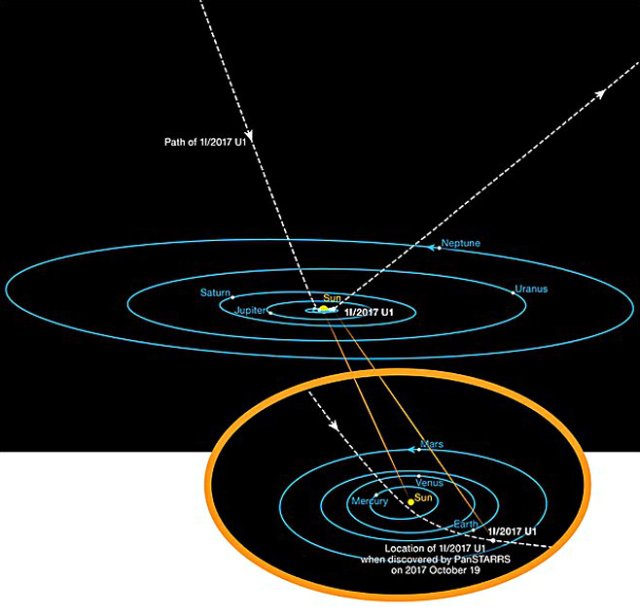
More observations showed that A/2017 U1 had been coming in really fast: around 30 kilometers a second. It had already made its closest approach to our sun, and was on its way back to the stars.

Giving A/2017 U1 a Name, and a New Designation

(From NASA/JPL-Caltech/IAU, via BBC News, used w/o permission.)
(“The object’s velocity and eccentric trajectory suggests it originated outside our Solar System”
(BBC News)

Astronomers figure ʻOumuamua was inbound at around 26.34 kilometers a second back in 1605. It was 2,300 Astronomical Units out at that point. That’s nearly a hundred times more distant than Neptune.

No known natural activity in the Solar System could give it that speed, that far out.

It didn’t come from our planetary system. More accurately, if it did — we’ll have to take a hard look at everything we’ve learned about physics since Newton’s day.

A/2017 U1 is now 1I: an object from interstellar space, the first of its kind we’ve spotted.

Folks at the International Astronomical Union haven’t finished working out a full set of rules for what to call stuff coming from outside the Solar System. I figure that’ll get fine-tuned as we learn more

The Pan-STARRS team picked 1I’s name: ʻOumuamua. It means “scout” in Hawaiian. Or maybe “messenger.” That language’s “ʻou” means “reach out for, with “mua” repeated for emphasis: since it’s the first of its kind we’ve seen.

ʻ, the first character, isn’t an apostrophe. It’s how my language’s Latin alphabet shows the phoneme ʻokina.2


Intriguing, and Puzzling, Data


(From ESO / K. Meech et al., via Sky and Telescope, used w/o permission.)
(‘Oumuamua’s brightness, measured in visible and near-infrared. Colored dots are from observations. The dotted line shows a light curve based on those observations: and assuming that ‘Oumuamua is a featureless ellipsoid, ten times as long as it is wide. The observations don’t match that ideal, so the object probably has dark and light patches. Or maybe pits and peaks.)

“Meet ‘Oumuamua, the Interstellar Cigar”
Kelly Beatty, Sky and Telescope (November 20, 2017)

“Rapid-response observations by major observatories shows that the first-known interstellar visitor is 10 times longer than it is wide.

“In Arthur C. Clarke’s 1973 science-fiction novel Rendezvous with Rama, Earthlings discover and then investigate an interstellar ‘asteroid’ that turns out to be a huge alien spaceship shaped like a long cylinder.

“Life, it seems, sometimes imitates art….”

Nobody, including Sky and Telescope’s Kelly Beatty, has said ‘Oumuamua might be a spaceship. Or anything else artificial. Not that I’ve seen or heard.

I can see how someone might imagine it’s not natural, though.

Asteroids and comets we’ve studied generally aren’t spherical.

Most are lumpy, irregular. Sort of like a potato. Or, as someone said about Philae, a rubber duck.

But they’re not as long and narrow as ‘Oumuamua seems to be.

I almost immediately thought “ship” when seeing ‘Oumuamua’s length to width ratio. That’s partly because I read science fiction. Everything from the top-grade ‘hard science’ sort to delightfully improbable space opera.

I’ve also lived most of my life near Minnesota’s lake country. Not noticing small-to-mid-size watercraft around here takes doing. Some folks manage it, and that’s another topic.

No matter what pushes or pulls them, vehicles that move through water work better if we pay attention to hydrodynamics. We knew that long before someone coined the word.

Length to Width Ratio and Perceptions

We were building ships ten millennia back. Maybe longer. Boats, anyway.

Designs have changed a bit since then, but not the physical realities we deal with.

We’ve learned that if we’re interested in stability and don’t care about moving fast, we’re better off with something about as wide as it is long.

Coracles are a familiar example. Maybe not so familiar, today, in this part of the world, now that I think of it.

We’ll make boats and ships longer when we want to go faster, and think we’ve worked out ways to stay more-or-less upright. Sometimes we make mistakes.

It’s been a bit over three and a half centuries since the Vasa made its first short, and spectacularly unsuccessful, voyage. I see that pride of the Swedish navy as a good example of why executives should let engineers do their job, and that’s yet another topic.

The point is that ‘Oumuamua’s length to width ratio is about what we see in the longest of today’s large freighters. That doesn’t mean it’s artificial. When we started building spaceships we learned that the rules are different with no atmosphere.

Major puzzles include where ‘Oumuamua is from, why it’s so narrow and how it formed.

Not From Around Here

Astronomers tracked ‘Oumuamua as it passed between Earth and the orbit of Mars. That let us work out where it had been before the Pan-STARRS team discovered it.

It came in from Vega’s general direction.

That star is fairly close, about 26 light-years away. Quite a few folks know about it.

That probably explains why several news outlets used Vega when describing where ‘Oumuamua came from.

Some reporters also pointed out that Vega, along with pretty much everything else in this galaxy, is moving. When ‘Oumuamua was that far away, Vega was somewhere else.

I think Kelly Beatty had the right idea, saying ‘Oumuamua came from somewhere in or near today’s constellation Lyra.

That’s assuming that it didn’t make any course corrections before astronomers noticed it. Like I said, that’s a reasonable assumption.

We still don’t know where it’s from, or how long it’s been traveling. Maybe it came directly from a young star, while the star’s planets were settling into comparatively stable orbits.

That’s probably not the case, though. What we’ve been learning about how stars form tell us that something ‘Oumuamua’s size, from a young planetary system, would be mostly volatile gasses and ice. In other words, it’d be a comet. It’s not.

Then there’s its shape. Something that long and narrow, rotating very roughly once every eight hours, wouldn’t hold together. Not if it’s like many asteroids: more like a gravel pile than a single rock.

But if it’s a single more-or-less-solid piece, explaining how it formed gets very tricky.

Someone suggested it might be a whole lot of smaller pieces, barely touching each other, strung in a line.

That won’t work, unless something other than its shape explains ‘Oumuamua’s cyclic brightening and dimming.

If ‘Oumuamua is as long and narrow as it seems, with a roughly eight-hour ‘day,’ the pieces couldn’t stay connected. What we call centrifugal force would have broken it up long ago.

Informed Speculation


(From ESO/K. Meech et al., via Wikimedia Commons, used w/o permission.)

The Honolulu Institute for Astronomy’s Karen Meech and other scientists have been studying ‘Oumuamua.

Many other scientists. This is a very intriguing set of puzzles.

We’ve got a pretty good idea what ‘Oumuamua is made of: the surface, anyway. Spectroscopic information, ‘Oumuamua’s color, is a pretty good match with fairly common sorts of asteroids: P- and D-type.3

Those don’t reflect much light. What they do reflect is reddish. Scientists figure their surfaces are mostly organic-rich and anhydrous silicates, and carbon.

“Organic” doesn’t mean “alive.” I’ve talked about that, vitalism and old movies, before. (September 9, 2016)

Knowing what’s on ‘Oumuamua’s surface tells us about how much light it reflects. Combining that with how its brightness varies gives us a rotation rate of very roughly eight hours and an approximate size and shape.

Like I said, its brightness varies a lot. Meech’s team figure the least-improbable shape and size is an ellipsoid about 400 meters long by maybe 50 meters wide.

That’s about a quarter-mile long, and a bit wider than the Titanic. We’ve built, and build, ships that size. But that’s not proof it’s artificial. Still, it’s an odd shape for an asteroid.

Other scientists using slightly different assumptions came up with about the same shape, but smaller: 180 by 30 by 30 meters, or 591 feet long by 98 feet across.

More speculation, and Looking Ahead

Someone on Meech’s team speculated that maybe when planet-size objects with molten cores collide, part of the cores could ‘freeze’ fast enough to be shaped like ‘Oumuamua.

Or maybe it got overly close to a supernova during its long journey.

Right now we have more questions than answers.

We gathered a fair amount of data while ‘Oumuamua was near Earth: only 30,000,000 kilometers, 19,000,000 miles, away when Pan-STARRS first spotted it. And we know what direction it’s taking on its way out.

Some outfits, including Initiative for Interstellar Studies, are looking at our best options for sending a probe after it. We don’t, quite, have the technology today. Not if we want the probe to stay near ‘Oumuamua long enough for a thorough look.

A few years or decades from now? That’s hopeful. And yet again another topic.

Recapping, we’re nearly certain that ‘Oumuamua is from somewhere beyond the Solar System. We’ve got a pretty good idea of its heading as it entered and is leaving our neighborhood. Where it started out, and where it’s going? That’s another matter.

Again, I’m quite sure that it’s a natural object. I figure scientists will eventually learn a great deal about it.


Using my Imagination

Denouncing imagination, or stoutly denying that I ever had an original thought, seems like a waste of effort.

And fairly ridiculous. I might as well claim that God’s decision to make a physical reality was a mistake.

Which is pretty close to what some Christians seem to believe.

There’s an element of truth in seeing “spiritual” as better than “material.” (Catechism, 330)

But what we can see is “very good.” Genesis 1:27–31 makes that clear enough. Or should. We’re not a mistake, either. (July 23, 2017; March 5, 2017)

All of which doesn’t explain that picture of a three-eyed whatsit apparently lecturing on astronomy. Or maybe asking for directions.

It’s from a 1930s pulp science fiction magazine, most likely replete with tales heavy on imagination and casual about facts.

Backing up a little, I think scientists are right. ‘Oumuamua is almost certainly a natural object. One with a very unusual shape, and not from the Solar System.

But let’s imagine that a probe launched a few decades from now catches up with ‘Oumuamua, sending back the first high-resolution images of the object.

Folks back on Earth see a quarter-mile long cylinder, coated with dust accumulated over uncounted ages.

A cluster of objects at one end look a great deal like rocket nozzles, each larger than the Florence Cathedral’s dome. A bowl only slightly smaller than the Astrodome sits at the end of a tower or mast near the cylinder’s midpoint.

It’s clearly artificial. Whoever built it used tech not far from what we developed just after the Industrial Age. And it is old. Very, very old indeed.

Then what?

Responses, Reasonable and Otherwise

My guess is that scientists would have ample funding for any research focused on ‘Oumuamua.

Some folks would start quirky religions around who they felt built it.

Others would call the whole thing a conspiracy, and the checkout-aisle press would have a field day.

Folks who embrace the Enlightenment’s silly side would assume that Thomas Paine was right.

I think the antics of some Christians encourage the notion that our faith will dry up and blow away in the light of whatever scientists are currently studying.

I don’t agree, but I’m a Catholic — and know something of our faith.

If I was writing a story using the idea that ‘Oumuamua is artificial, explaining its flight path might take the most work.

There aren’t any obviously-habitable worlds out in that direction. Not close, anyway.4

And that’s still another topic. An entertaining one.

Porky Pine and a Scientist-Monk

A bit more seriously, ‘first contact’ scenarios that were science fiction in my youth are getting serious attention today.

I’ve seen a few level-headed discussions of how we would and should respond to extraterrestrial contact.

One was written by a scientist-monk. Another appeared in a comic strip.

“…Frankly, if you think about it, any creatures on other planets, subject to the same laws of chemistry and physics as us, made of the same kinds of atoms, with an awareness and a will recognizably like ours would be at the very least our cousins in the cosmos. They would be so similar to us in all the essentials that I don’t think you’d even have the right to call them aliens.”
(“Brother Astronomer,” Chapter Three, Would You Baptize an Extraterrestrial? — Brother Guy Consolmagno (2000))

“I been readin’ ’bout how maybe they is planets peopled by folks with ad-vanced brains. On the other hand, maybe we got the most brains…maybe our intellects is the universe’s most ad-vanced. Either way, it’s a mighty soberin’ thought.”
(Porky Pine, in Walt Kelly’s Pogo (June 20, 1959) via Wikiquote)

More, mostly how I see what we’re learning – – –

– – – and why I don’t fear new knowledge:


1 Science and thinking ahead:

2 A bit about language:

3 Asteroids and something new:

4 Looking toward Vega, and beyond:

Posted in Science News | Tagged , , , , , , , | 7 Comments