You may not see this week’s ‘Sunday’ post as soon as you usually do.
I have been unable to reliably connect with this blog’s website for the last few days. I don’t know why, and continue to find both short-term and longer-term solutions to the issue.
Sorry about that.
Later
It’s now later on Saturday, March 17.
I’ll try to get this ‘technical issue’ statement visible, and delay the ‘Sunday’ post until another day. That’ll be a bit easier on my nerves. It should also help with the post’s quality. It still needs work.
“At least six people have been killed and nine others hurt after a footbridge collapsed near Florida International University in Miami.
“Police announced the deaths after rescuers spent the night searching for victims trapped beneath the structure.
“The 862-tonne, 174ft (53m) bridge fell over an eight-lane motorway on Thursday afternoon, crushing at least eight vehicles, police said.
“The bridge was erected on Saturday in just six hours….”
Monday morning quarterbacking has started. I’ll get back to that.
We don’t know how many folks died when that bridge fell. Four bodies had been recovered by yesterday evening. Two more bodies have been found since. We’re told that there are almost certainly more still under the wreckage.
Many or most of the fatalities apparently were in cars caught under the bridge. Folks in the cars had stopped for a red light.
Some Killed, Others Injured
(From BBC News, used w/o permission.)
(The bridge spanned Tamiami Trail, U.S. Route 41, west of Miami.)
Names of folks who were killed haven’t been officially released yet. At least one was a student at the university.
At least one person’s last known location was under the bridge. I understand that she was driving one of the crushed cars. She is almost certainly dead. I don’t know how many other folks are missing and possibly under the debris.
Some folks survived the collapse. I’ve seen nine given as the number. As usual in situations like this, priority is given to locating victims and sending survivors to hospitals. I expect we’ll see more exact numbers later, as rescuers and medics have a chance to file reports
Headlines, Assumptions and Memories
(From The Washington Post, via Grand Forks Herald, used w/o permission.)
(The structure would have been a cable-stayed bridge.)
The bridge was still under construction. If the job had gone smoothly, it would have been ready for use next year. Something, obviously, went wrong.
Some news outlets made headlines of safety violations that meant fines for at least one of the companies involved. I don’t know what the implication was supposed to be. A history of careless or deliberately sub-spec work, maybe. What the facts are, I have no idea.
Implied ‘shoddy construction’ struck a chord with me. The town I grew up in had badly-broken sidewalks for years after what I assume was the lowest bidder’s work got used.
The town’s specs for sidewalks said how deep the concrete should be. The new sidewalks were, in fact, that deep. And they were made of the right sort of concrete. After the job was done, we learned that inspectors had carefully measured depths of the forms: at the edges.
The contractor had cleverly added a slight bulge in the sand between the form edges. After it had been poured and set, the concrete looked fine. It was nicely leveled, and seemed to be ready for use.
The middle of the new sidewalks were mostly sand with a concrete veneer. They held together for several days. Several years later, the city had funds to pay for new sidewalks again. This time, apparently, measuring concrete depth all the way across.
My experience in an upper-Midwest town a half-century back is not proof that someone deliberately botched this construction project. I think it shows that folks can be dishonest, or daft. And that government inspections are only as good as the inspection procedures.
I think every detail of this project will be reviewed. Thoroughly.
As a Northeastern University professor said, this sort of thing isn’t supposed to happen. When it does, folks other than reporters and editors go to work, collecting and analyzing the evidence.
Sometimes they find a problem with a process that had seemed reasonable once, or had worked under other conditions. My experience is that far more often than not, procedures that don’t work as they should get changed. We do learn.1
Old Design, New Technique
The pedestrian walkway would have been a cable-stayed bridge.
The basic design goes back at least to 1595. It’s good for spans too short for cantilever bridges, but not long enough to need a suspension bridge.
Bridges aren’t the only long structures supported with a fan of cables from one or more towers.
Quite a few 19th century bridges were cable-stayed. Some of them still stand. The Florida International University pedestrian overpass wouldn’t have been a ’19th century bridge,’ obviously. We’ve changed and refined the tech considerably.
One of the newer construction methods is supposed to reduce traffic congestion while the bridge is being built. It’s called rapid bridge replacement or accelerated bridge construction. A span gets built near where it’ll be used, then moved into position.2
That’s what’s supposed to happen. The newly-installed span is not, obviously, supposed to fall on top of folks waiting at a red light.
I’m quite sure there’s going to be lively discussion about whether that technique should have been used, and how well it’s been tested. I hope at least some of the discussion is informed, using facts and analysis — not raw emotion.
A point mentioned but not explained in news that I’ve seen got my attention.
Apparently the collapsed span was in place, but not the cables which would have run between it and the support tower. I don’t know enough about the technology and construction methods to have an informed opinion about that.
Not unexpectedly, someone’s started talking about the possibility of legal action against someone in connection with the disaster. Maybe that’ll be justified, maybe not. Bad things happen, and sometimes it isn’t anybody’s fault.
I don’t see a point in playing a blame game. It’s a very human thing to do, though. (November 17, 2017)
It’s now late Friday evening here in central Minnesota. This blog is on UTC time, so it will have a “March 17, 2018” timestamp.
One final thought, and I’m done. Something from Luke:
“‘Or those eighteen people who were killed when the tower at Siloam fell on them—do you think they were more guilty than everyone else who lived in Jerusalem?'”
(Luke 13:4)
I’ve talked about disasters and making sense before:
(From Albert Robida, via Wikimedia Commons, used w/o permission.)
(After the opera in the year 2000, as imagined by Albert Robida in 1882.)
Seeing the late 19th and early-to-mid 20th centuries as optimistic and everything since as fatalistically despondent isn’t, I think, reasonable. Or realistic. The same could be said for how some optimists see ‘the future.’
Cars flew in many imagined futures. Flying cars have been invented several times, but haven’t caught on. Yet.
The year 2001 was ‘the future’ in my youth. Some folks figured we’d have orbital hotels and fledgling Lunar cities by then.
That didn’t happen. But neither did predictions of oceans filled with dead fish and radioactive skies ensuring that humanity’s final days would be short but agonizing.
I like living in ‘the future.’ The real one. I don’t think today’s fashionable melancholy is any more reasonable that seeing Progress as inevitably nifty. I’m optimistic. Cautiously.
The Victorian upper crust might have seen Progress with a capital “P” as nothing but good news. Or maybe not. Workers were getting uppity.
Robert Owen started giving his workers mere 10-hour shifts in 1810. He started pushing for general acceptance of an 8-hour shift in 1817. French workers demanded and got a 12-hour work day in 1848, an improvement on the longer hours they’d endured.
Polish-American workers in Wisconsin organized a strike in 1886. Dissatisfied with their lot in life, they wanted the short 8-hour shifts enjoyed by some federal workers.
That got some of them killed. But not many. Despite ‘shoot to kill’ orders, 250 National Guardsmen only scored seven kills among the 14,000 workers in Bay View.1
I prefer to think at least some deliberately missed. Slaughtering civilians may have struck many guardsmen as dubiously ethical. At best.
Sometimes refusing to do what someone who’s in charge says is a good idea. The trick is knowing when those in authority are behaving themselves and when they’re not.
I’m obliged to respect authority, and not blindly follow orders that are bad ideas. Everyone comes with a sense of what’s right and what’s not. Learning to use that sense takes effort. (Catechism of the Catholic Church, 1897–1917, 1954–1960, 2302–2317)
Robots and Time
Folks think of ‘the future’ in different ways.
Robots joined flying cars as features in many imagined utopias.
Other authors realized that some folks wouldn’t enjoy their newfound leisure. Or saw dramatic possibilities in the ‘robots took my job’ scenario.
Science fiction writers aren’t the only folks thinking about ‘the future.’
My guess is that pretty much everyone has some view of ‘the future’ in their mind.
For some, it’s simply the next ‘today.’
That might be another day of the same weary weekly trudge or progress toward a goal. ‘Just another day at work’ is rather close to seeing time as cyclic.
‘Life as a cycle’ has been called an eastern view, maybe because we know about Saṃsāra and the bhavachakra. How anyone can see staying on the wheel of life as a good thing is beyond me, and another topic.
The western view, presumably, is linear. I’m not convinced that anyone’s views are quite that simple. Jörmungandr, the Norse world serpent, sounds a lot like Ouroboros.
Ouroboros is “Western” in the sense that it got adopted by Renaissance magic. But we got it from ancient Greeks, who picked it up in Egypt. Ancient Egypt is “Western” in the sense that it’s west of India and Mesopotamia.
I see ancient Egypt as an important part of my civilization’s past, an arguably African civilization and that’s yet another topic.
Maybe seeing time as basically linear started in the Enlightenment.
Maybe so, but I’d picture the Old Testament’s “time” model as more of a helix. It’s cyclic in the sense that folks kept forgetting or ignoring God, finally realizing they’d made a mistake.
That started with the golden calf incident, maybe earlier.
But I see a bit of knowledge and wisdom added in each cycle, so it’s not quite ‘more of the same.’ I’d call the New Testament linear, except I see some of the same ‘oops, we goofed’ helix there, too.
We got the Idea of Progress somewhere between the Enlightenment and the Sixties. The old ‘things are always going to be better’ optimism was nice.
But not the uncritical assumption that new science and tech can’t do anything but make life better. I’ll get back to that. The currently-fashionable notion that Malthusian catastrophes are inevitable and we’re destroying Mother Nature — seems unbalanced too.
Our Choice
Earth got along fine for billions of years before our time. Now that we’re here, what we do matters.
Not that we ‘control the forces of nature.’
We’ve learned a great deal in the last few centuries. That helped many folks get out of the way before Mount St. Helens exploded. (March 26, 2017)
I see being curious, studying this wonder-filled universe, as part of being human. We can help or hurt each other. We can make this world a little better for future generations, or not. Science and technology don’t decide what’s done. How we use them is up to us. (December 29, 2017; August 11, 2017)
The old Idea of Progress was flawed, at best. But I don’t think we’re doomed. Building a better world is, I am convinced, possible. (December 3, 2017; October 30, 2016)
Living in ‘the Future’
(From nesnad, via Wikimedia Commons, used w/o permission.)
(Aldebaran Robotics’s Pepper, in Akihabara Japan. (2014))
I’ve read that Pepper’s mission in — life? — is having fun with people, making us happy, and generally enhancing the human experience.
I’d likely be worried if I saw gloominess as Godliness. Or saw pretty much everything as a conspiracy. I don’t, so I see Pepper as not quite as adorable as some Japanese robots. But not a harbinger of doom. Portent of peril. Ominous omen. You get the idea.
That’s partly because I’m not a youngster whose heart is set on becoming a receptionist. A few UK firms have replaced human receptionists with Pepper robots. Heartlessly, perhaps.
Or maybe they figured visitors might like seeing an indefatigably polite, if robotic, face now and then. Facial recognition lets Pepper identify visitors, alert meeting organizers and make arrangements for appropriate drinks.
It’s a chatty bot, apparently, satisfying the human taste for small talk. I never was good at that sort of thing, myself. Pepper’d probably be a better receptionist than me. Cuter, too.
And, I think, very far from uncanny valley: where robots aren’t exactly like humans, but too close for comfort. Our comfort, that is.
NAO, another Aldebaran bot, may not be as up-to-date as Pepper, but I don’t see Pepper having NAO’s talent for soccer. No legs.
Whether we see it as cyclic or linear, time does bring change. Aldebaran is SoftBank Robotics these days and SoftBank has case studies showing Pepper as a good host and promoter.2 I might be worried if my livelihood depended on a glad-handing job.
Or thought the Terminator movies were documentaries.
Frankenstein’s Monster, C-3PO – – –
Many of today’s movie robots aren’t the first homicidal homunculi. Neither were Karel Čapek’s squishy robots. “Robot” apparently comes from the Czech writer’s 1920 “R.U.R.” play.
Čapek’s robots were synthetic organisms, more like Victor Frankenstein’s monster and Philip K. Dick’s androids than R2-D2 and C-3PO.
There’s not much of the intelligent, articulate ‘monster’ of Mary Wollstonecraft Shelley’s “Frankenstein; Or, The Modern Prometheus” in movies like “Abbott and Costello Meet Frankenstein.” Oh, well.
“Colossus: The Forbin Project” (1970) and “I, Robot” (2004) followed the time-honored plot of scientists creating artificial intelligence — which tries, more-or-less-successfully, to destroy its creator and/or take over the world.
I enjoy the occasional ‘rogue robot’ tale. But don’t see a robot apocalypse in the offing. (January 28, 2018)
Maybe someone will make a movie where the wannabe evil robot overlord taunts the hero with “nothing can withstand my FILE NOT FOUND!” Or maybe not.
Today the Gridiron, Tomorrow the World?
(From Peter Stone, via BBC News, used w/o permission.)
(“The UTexas robot football squad uses AI in order to work as a team and make fast-moving decisions”
(BBC News))
“Researchers in Texas are developing robots that have minds of their own.
“The scientists are creating systems that can learn for themselves and be able to operate in the home, the workplace and even on the sports field.
“The University of Texas, Austin team is incorporating artificial intelligence into its machines so that they can deal with real-world situations.
“Among the systems are automated assistants that will carry out simple tasks in a working office….”
The “simple tasks” include finding a colleague or spotting and returning with a particular object. They’re simple. For a human.
Robots doing the same thing need to go past recognizing human speech and responding to particular phrases. They’ll need to understand our language. That means noticing what each word means in context, then getting meaningful information from statements.
The robot football squad doesn’t necessarily have good listening skills. They’re helping researchers get robots out of the factory another way.
Which reminds me, about “gridiron” and “football.” My English is American, mostly, so I’m not talking about cooking grills or association football.
Sort-of-Spheroids and Robots
I’ve read that footballs are prolated spheroids. That resource was probably talking about rugby footballs.
Rugby isn’t soccer, soccer is football but it’s not the game Americans call football. That illustration shows what a rugby football looks like.
American footballs would be prolated spheroids if they didn’t have pointed ends. Which they do.
It’s as if a prolated spheroid decided to be a spindle just after the last possible opportunity. Except that implies self-awareness and volition in what’s essentially an inanimate object.
Somebody said our countries are “separated by a common language.”
It could have been George Bernard Shaw. Maybe it was, but folks apparently can’t find the quote in Shaw’s published work. I figured it might be Churchill. Or someone else. It showed up in a 1940s magazine:
“The United States and Great Britain are two countries separated by a common language.”
(Reader’s Digest (November 1942))
And that’s yet again another topic. Now, about footballs and spheroids. Since you’re human, you’re able to take an anthropomorphic reference as something other than a literal description. Which brings me back to robots playing football.
The idea isn’t replacing human football players. It’s developing smarter robots. Board games like chess aren’t exactly easy, but players take turns. One player moves, the other player moves, and so on.
In games like football, every member of each team and the ball may be moving. And there isn’t time to plan the ‘next move.’
Curious Robots
(From Peter Stone, via BBC News, used w/o permission.)
(“Robot office assistants need to be self-learning to cope with the unpredictable environment”
(BBC News))
“…Science fiction films predicted that in the future we would have intelligent robots.
“In the Day the Earth Stood Still, we had the sinister Gort; in Forbidden Planet there was Robby; and in the TV series Lost In Space it was Zachary Smith’s nemesis, the Robot.
“It’s been more than 50 years since those fictional representations – so where are they?
“Although we have had robots in factories for decades, getting them to leave the shop-floor has been no easy task. In manufacturing plants, they carry out pre-ordained, repetitive tasks all day and night.
“But if they step outside, they are unable to deal with the chaos of the real world. It is a place where order and routine are gone. Even the simplest of tasks are complicated by the unpredictability and vagueness of human interaction….”
(Pallab Gosh, BBC News)
These Texas University researchers aren’t trying to write software that’ll understand our language. They figure AI, Artificial Intelligence, makes more sense. Their ‘office’ robots learn the way we do, more or less.
Humans often have the basics mastered by our first birthday. Very basic basics. Our vocabulary generally starts with words like “mama,” “dada,” and “uhoh.” We can understand more complex statements, like “come here.”
Humans learn language, our ‘cradle language’ anyway, by interacting with other humans. Mostly our parents, at first.3
We learn more by asking questions. We keep learning for years. A lifetime, if we’re doing it right. My opinion.
The Texas U. ‘office’ robots start with a few pre-programmed voice commands. They learn more by asking questions. Lots of questions. Sort of like a human toddler, but without our need for sleep.
Maybe the robots would have stopped asking questions, eventually. The humans ran out of patience first. Dr. Jesse Thomason, a linguist, reprogrammed the robots to ask up to five questions; and then stop.
Dr. Andrea Thomaz, another researcher, is helping the robots learn social skills. That includes waving at a human, then looking for movement or facial expressions that signal being ready to talk.
It’s the sort of thing that ‘just comes naturally’ to humans. Or so I’ve been told. Observing, analyzing and sending appropriate social cues is much more of a learned skill for me. It still takes conscious effort. (February 11, 2018; March 19, 2017)
Finally, about “the chaos of the real world.” I’ll agree that human behavior is a bit unpredictable and “vague.” But chaotic? Our behavior is complex, sometimes unpredicable, and occasionally ambiguous.
But very few of us are really chaotic in the ‘Daffy Duck on crack’ sense. My opinion.
Science, Technology and Mindsets
(From Yiu Yu Hoi/Getty Images, via Daily Intelligencer/New York Magazine used w/o permission.)
“Earlier this week, I went to a lecture given by Steven Pinker on his latest book, Enlightenment Now. I’m a huge and longtime fan of Pinker’s, and his book ‘The Blank Slate’ was, for me, a revelation. He’s become a deep and important critic of the visceral hostility to nature and science now so sadly prevalent on the left and right, a defender of reason and the Enlightenment against the ‘social justice’ movements on campus, and his new book is a near-relentless defense of modernity….”
About that last word, “modernity.” What it means depends partly on context, partly on who’s talking. (Wikipedia)
Modernity is a historical period, roughly 16th to 20th. Or maybe 21st. Some folks say it’s still in progress, others say we’re in a postmodern era now. Artists, architects, and soreheads all have their own definitions.
Some Catholics apparently see modernity and our faith as incompatible. If “modernity” gets defined as unquestioning rejection of anything other than strict materialism, they’ve got a point.
Wishing it was more like the 11th, or 1st, seems like a waste of time, at best.
Not that most ‘repeal Vatican II’ Catholics want a thousand-year rewind.
I get the impression that many folks who don’t approve of newfangled ideas see their youth or early adulthood as civilization’s last good years. Or maybe it’s the ‘good times’ their parents remembered.
That’s not just ‘traditional’ Catholics, and I don’t think yesteryearnings started in the late 20th century.
“Yesteryearning?” I haven’t seen the word in a dictionary, unless urbandictionary.com counts. The top entry there was from March of 2015, which in ‘Internet time’ is quite a long while ago.
Now, about what the op-ed said.
New York, New York
The first part of Sullivan’s op-ed is radically unlike what I often find in American periodicals. I thought it might be satire.
For all I knew, New York magazine might be as serious about news and views as The Onion.
Wikipedia says the current New York magazine started in 1963 as a Sunday supplement in the New York Herald Tribune newspaper.
It’s been separate magazine since 1968. The idea was giving folks a “brasher and less polite” alternative to the New Yorker.
The magazine’s website says it’s about “Politics, Entertainment, Fashion, Restaurants & NY.” From what I saw, that’s an accurate description.
I haven’t read “The Blank Slate” or Patrick J. Deneen’s “Why Liberalism Failed,” the next book Sullivan discussed. They’re probably worth perusing.
Today I’m talking about science and technology, attitudes and all that. Sullivan’s ‘compare and contrast’ gives me plenty to work with. Links in Sullivan’s op-ed take you to Amazon.com, if you’ve got time and leisure for more reading.
Pinker’s book apparently shows “irrefutable statistics showing human progress.” It’s an impressive list: declining violence, rising democracy, lowering poverty, better health and longer life.
I’m pretty sure finding statistics to refute the irrefutable wouldn’t take long. With so many sorts of violence, some subdivision almost certainly went up since the 1950s. Cyberbullying, for example, was unknown in my youth.
So was the Internet as we know it, but I could leave that detail out. I wouldn’t. More accurately, I shouldn’t. Distorting truth is a bad idea. (Ephesians 4:25–26; 1 Peter 2:1; Catechism of the Catholic Church, 2475–2487)
Attitudes
Pinker apparently sees today’s gloom as “entirely a function of our media and news diets.” If Sullivan’s right about that, I agree. As explanations go, it’s far too simple.
I’m not a fan of doomsayers or 24-hour angst. Being aware of problems seems reasonable. Seeing nothing but problems? Not so much. (February 2, 2018)
Seeing nothing but inevitable Progress? Optimism is nice. If it’s matched with reasoned awareness. Off-the-leash optimism let many believe they’d find happiness in a pill. That didn’t, as I recall, start with the 1960s. ‘Happy pill’ prescriptions — are still another topic.
The old ‘science and technology will solve all our problems’ attitude didn’t make sense. Neither does today’s ‘science and technology will destroy us all’ outlook. (June 23, 2017; October 30, 2016)
Muddling and Meaninglessness?
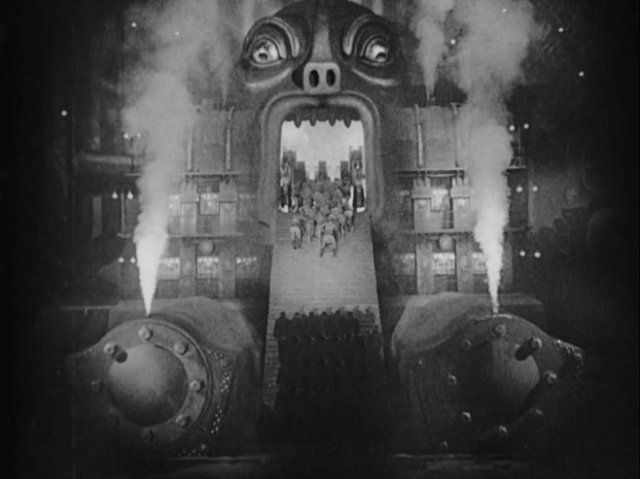
(From Fritz Lang’s “Metropolis” (1927), via Neflix, used w/o permission.)
(A big machine seen as Moloch, eating workers. The hero in “Metropolis” is hallucinating.)
Sullivan takes us back to familiar territory with Deneen’s “Why Liberalism Failed.”
“…as Deneen understands, we are where we are. There is no going back. For our civilization, God is dead. Meaning is meaningless outside the satisfaction of our material wants and can become, at its very best, merely a form of awe at meaninglessness. We have no common concept of human flourishing apart from materialism, and therefore we stand alone. Maybe we will muddle through this way indefinitely, and I sure hope we do….”
“…But I have never seen such an astonishingly rapid ascent without an equally sudden decline, a return to the mean….”
(Sullivan, New York)
I think Sullivan is right. Sort of. We could start over-using DDT again. Or cut down forests without replanting. Or routinely work 12-hour factory shifts, six days a week. Or have World War III.
I don’t think we will. We’ve stopped using many pesticides and are cleaning up after past mistakes. Tree farms are part of quite a few rural economies. And yes, the farmers replant after each harvest.
(From Minghong, via Wikimedia Commons, used w/o permission.)
(Happy Valley Racecourse, Hong Kong.)
I’d fear change if I thought we’d finally built a perfect world. Or gotten as close to that ideal as possible. Maybe someone, somewhere, thinks everything’s dandy. I sure don’t.
I’m not sure what “equally sudden decline” Sullivan has in mind. We’ve had massive disasters, like the Black Death pandemic about two-thirds of a millennium back now.
I’m far from convinced that it was the start of a “sudden decline.” Apart from the abrupt drop in population, of course. Change, yes. Decline, not really.
It was ‘the end of civilization as we know it,’ at least in Europe. Unless someone sees Medieval Europe as the only possible model for civilizations.
I see it as something that worked rather well while it lasted. And was admirable in some ways. But I don’t yearn for its return.
The Renaissance wasn’t, I think, a Golden Age. But I don’t see it as all bad news. Or, by any reasonable standard, an overall decline. I see today’s world pretty much the same way.
The only sudden decline I can think of that seems to match Sullivan’s expectations happened about 32 centuries back.
We don’t know what set off the Late Bronze Age Collapse. It was, for the survivors, the end of civilization as they knew it. Many left the devastated areas.
Some abandoned cities were never rebuilt. Others were. Eventually. Western civilization hasn’t been the same since. The ‘good old days’ when Troy was the Mediterranean’s New York City never returned.
(From Toru Yamanaka/AFP/Getty Images, via BBC News, used w/o permission.)
(“Super Monster Wolf strikes fear into the hearts of easily-fooled wild boar”
(BBC News))
“A robot wolf designed to protect farms has proved to be such a success in trials that it is going into mass production next month.
“The ‘Super Monster Wolf’ is a 65cm-long, 50cm-tall robot animal covered with realistic-looking fur, featuring huge white fangs and flashing red eyes, Asahi Television reports.
“It’s been designed to keep wild boar away from rice and chestnut crops, and was deployed on a trial basis near Kisarazu City in Japan’s eastern Chiba prefecture last July….”
I don’t know about the caption, “…easily-fooled….” Maybe wild boars are easily fooled. Tales I’ve heard and read show them as strong and determined. Brainy, not so much. That’s more of a ‘fox’ thing. In stories.
On the other hand, boars can’t be all that stupid. Various wild boar species have been thriving over the last couple million years.
I can’t see critters doing that by taking crazy chances. Like sticking around to see if a foot-and-a-half tall red-eyed — thing — can run as well as it howls.
Robowolf, Porky Pig and Perceptions
Humans might. Particularly males, from our teens to mid-20s. We’re arguably crazy, and that’s — you guessed it — another topic.
Easily-fooled or not, wild boars apparently give “super monster wolf” a wide berth: something like a kilometer.
Developers say it’s programmed with different howls. All lupine, I assume.
The robotic terror isn’t cheap.
Production models will run about 514,000 yen each. That’s $4,840 USD, £3,480. My guess is that quite a few farmers will see leasing as a better option.
Aside from cost and maybe scaring the daylights out of some folks, I don’t see a big ‘down’ side to this robot. It’ll affect the environment, like anything else humans do. Including planting crops and making scarecrows.
I suppose it’s just a matter of time before someone runs ‘save the boars’ up a flagpole. It might get limited support, provided promoters focus on the robo-wolf’s horrific face. Wild boars aren’t, I think, photogenic.
I’ll grant that artists can do wonders. Porky Pig’s so cute that nobody’s seemed to notice that he doesn’t wear pants. And that’s — a very weird topic.
AI: After a Half-Century, Still No HAL 9000
(From Jitze Couperus, via Wikimedia Commons, used w/o permission.)
(Control Data Corporation’s CDC 6600 supercomputer. World’s fastest, 1964-1969.)
AI like HAL in “2001: A Space Odyssey” seemed quite possible back in 1968.
We already had massively-powerful computers like ENIAC, EDVAC and ORDVAC. Integrated circuits were getting smaller and more complex.
My guess is that quite a few folks didn’t wonder if information systems would ever successfully imitate humans. The question was when it would happen.
Then we started trying to build AI that think like humans. Or at least could learn to open a door without falling over.
Don’t let that 2015 blooper reel fool you, by the way. A few robots not only got the door open, but even used a wrench. Successfully.
But even those exemplary robots were hardly ‘terminator’ material.
Maybe a system that ‘thinks like a human’ is out there. Or in development. The last I heard, though, that’s still ‘after next generation’ tech. At best.4
Cuddlesome Kirobo Mini and the Cuteness Gap
(From Toyota, used w/o permission.)
(Toyota’s Kirobo Mini.)
Toyota dealers in Japan released the company’s “compact and cuddlesome Kirobo Mini communication partner” last November. Toyota’s website says Kirobo Mine can:
“Engage in casual conversation, backed by gestures and the ability to respond to user emotions
“Learn and provide tailored companionship by remembering user preferences and past events
“Fit in the palm of your hand with a seated height of only 10 cm and be taken just about anywhere
“Enhance its conversational ability using information from the vehicle and home” (Newsroom, Toyota (November 22, 2017))
I’ve seen some reviewers rhetorically asking ‘what’s it good for?’ They’ve got a point. But I also think America is facing a serious cuteness gap.
Meanwhile, in America – – –
(From DARPA, via Wikimedia Commons, used w/o permission.)
(Boston Dynamic’s Legged Squad Support System, a robotic mule. 2012 prototype.)
Boston Dynamics’ SpotMini doesn’t exhibit human intelligence. It does, however, display great singleness of purpose in this demo video. And the human — is very ‘human.’
Maybe it’s just as well that robots like SpotMini don’t mimic human emotional responses. Or canine ones.
I don’t think Boston Dynamics’ SpotMini threatens the place dogs have in our hearts and homes.
On the other hand, I’m pretty sure it could fetch the mail without delivering a soggy mess. I don’t think Boston Dynamics has quite grasped the ‘cute and cuddly’ concept. Or, more likely, that’s not their goal.
The point of the SpotMini demo isn’t that a Boston Dynamics robot can open doors. It’s that their robot is quite good at dealing with unexpected circumstances. So is Atlas, one of their humanoid robots.
Robot Stock Clerks
(From Boston Dynamics, via Digital Trends, used w/o permission.)
(Boston Dynamics Atlas robots, showing how they’d work as stock clerks.)
Just as Pepper poses a threat to aspiring receptionists, coming generations of Atlas may thwart a new generation’s ambitions to someday become a stock clerk.
That dire day is not yet here, however. A skilled human handles crates about half again as fast as Atlas, and perhaps with fewer fumbles.
But I think the writing is on the wall, and woe betide those who dream of a lifetime’s service in warehouses. For their dreams shall be shattered. Maybe.
A bit more seriously, some folks may have little choice other than earning money by moving stuff from one spot to another. That sort of work is also, I think, valuable as ‘entry level’ employment. There have been times when I’d have welcomed such opportunities.
Besides, we’re not all alike. And aren’t supposed to be. I can do ‘assembly line’ work, but not at all well. And it starts driving me nuts after about five repetitions. Nuttier, actually.
My wife, in stark contrast, is good at that sort of thing and enjoys it. I figure it’s personality and talent, not ‘intelligence.’ She’s the one with a computer science degree, not me.
I don’t know exactly what’s coming in the next decade or so. I’m pretty sure we’ll see more robots. Some of them will be ‘taking our jobs.’ That will, I think, be hard for folks who can’t learn new skills, or don’t want to.
Some may miss ‘the good old days’ when they found fulfillment and purpose in stacking crates or greeting visitors. But I think most of us will adjust. Making those adjustments easier — is important, and a topic for another day.
Goodbye Blacksmith, Hello Body Shop
Briefly, I think we’ll adjust because we’ve done it before. It’s not so much if we’ll adjust, as how well we manage the changes.
Take blacksmiths, for example.
I live in a town of about 4,000 people. The next-larger town is about 25 miles down the road. But we don’t have a single blacksmith shop. I don’t know what folks whose horse threw a shoe do.
Folks with cars and trucks don’t have that sort of problem. We’ve got filling stations and several outfits that offer varying levels of automotive maintenance and repair services. I have yet to hear someone say the dearth of blacksmiths spells our doom.
I think today’s and tomorrow’s adjustments will be easier if we remember that science and technology is what humans do. So is helping each other.
I will live forever. Whether that’s good news or bad news is up to me.
I’d say ‘it depends on me,’ but that’s not quite true. What I decide and do matters. But having an unending life in God’s presence isn’t something I achieve.
Today’s Gospel reading, John 3:14–21, got me started. That’s part of our Lord’s conversation with Nicodemus. The fourth Sunday of Lent scrutinies Gospel for this year, John 9:1–41, tell the “a man blind from birth” account. It’s got a similar theme.
I’ll be talking about believing, doing and sinning. That last may need explaining.
The way I see it, sin doesn’t mean breaking the rules of a particular culture. It might, but not fitting in isn’t what’s sinful.
Scrutinies
I should be loving God and my neighbor, seeing everyone as my neighbor and acting like I believe it. (Matthew 5:43–44, 22:36–40; Mark 12:28–31; Luke 6:31, 10:25–37; Catechism of the Catholic Church, 1789)
Sin is what I do when I don’t act like I believe that. It’s offending reason, truth — and God. (Catechism, 1849-1851)
Knowing I should act and think like love matters is one thing. Following through on that knowledge is another.
If God demanded inhumanly perfect behavior, hope would be limited to delusional folks. That’s not, happily, what the Church says.
I’m a Catholic, so I think we’re all sinners. And that the Apostles Creed is right about forgiveness. (Catechism, 827, 976-983)
That’s where “scrutinies” come in. They’re mainly for the RCIA, Right of Christian Initiation of Adults. I suspect that sort of thing doesn’t hurt as a ‘refresher course’ for any Christian. Scrutinies are a way to look for and heal inner defects, glitches, and sins.
The Elect
There’s more about scrutinies, and other ‘what we believe’ stuff, in a Lenten parish bulletin from 2012.
The bulletin uses terms like “the elect.”
It’s a Catholic bulletin, so “the elect” doesn’t mean what many American Christians seem to think. It’s not a bunch of holier-than-though hypocrites.
That’s not what it’s supposed to mean, anyway. I’m not convinced that all American Catholics understand what the Church says about that sort of thing.
“The elect” are folks who live with our Lord. (Catechism, 1025)
God knows who “the elect” are. That does not mean some of us are damned no matter what we do. Or ‘saved.’
The Bible’s poetic imagery notwithstanding, God isn’t at some particular place in this universe. God knows who ends up where after this world’s closing ceremony because God is there ‘now.’
God isn’t ‘in’ this universe, and is “here” in every place and every time. God is also where time and space are not. I don’t understand exactly how that works, since I’m not God. (Catechism, 202, 300, 600)
I think predestination is interesting, but has little practical value. That hasn’t kept me from talking about God’s viewpoint, role models and decisions. (October 1, 2017)
I’ll find out if I’m one of “the elect” after my particular judgment. That’s the interview with our Lord that happens right after death. (Catechism, 1021-1025, 1031, 1344)
It’s my opportunity to opt out of Heaven. It’s a real option. A daft one, I think, but real.
Quick recap. The rules are simple. I should love God and my neighbor. Everyone is my neighbor, so I should love everybody. No exceptions.
It’s simple. Not easy.
When I don’t act like I believe the “love” rule, that’s a sin. It happens. So does forgiveness. But only if I notice that I need it, and use that knowledge constructively.
If I keep that up — I can still opt out of Heaven. It’s not, putting it mildly, my plan.
“The Light Came Into the World”
Today’s Gospel readings are both from John. Their ‘light and darkness’ imagery starts in John 1:1–5. Make that ‘is reintroduced.’ The light-darkness thing starts with Genesis 1:3–4. This is the non-scrutinies Gospel:
“For God so loved the world that he gave his only Son, so that everyone who believes in him might not perish but might have eternal life.
“For God did not send his Son into the world to condemn the world, but that the world might be saved through him.
“Whoever believes in him will not be condemned, but whoever does not believe has already been condemned, because he has not believed in the name of the only Son of God.
“And this is the verdict, that the light came into the world, but people preferred darkness to light, because their works were evil.
“For everyone who does wicked things hates the light and does not come toward the light, so that his works might not be exposed.
“But whoever lives the truth comes to the light, so that his works may be clearly seen as done in God.”
(John 3:16–21)
I’m about as sure as I can be that these verses aren’t about street lighting or cats. Light can be a sort of ‘here I am’ point of reference for the Holy Spirit or an image of “blessed communion with God and all who are in Christ.” (Catechism, 697, 1027)
Among other things. Like all Christians, part of my job is being a “light of the world.” (Matthew 5:14; Philippians 2:15; Catechism, 1243)
That doesn’t necessarily mean being all ‘sweetness and light.’ And it sure isn’t a mandate for nocturnal arson.
On the other hand, I suppose someone’s been convinced that they’re a ‘torch of God.’ It’s likely enough. Some folks have trouble sorting out their biases, unchanging realities, and that’s another topic. (January 19, 2018; February 1, 2017)
One of these days I’ll most likely talk about folklore, faith and Nietzsche. But not today.
Truthfulness
I could say that John 3:16–21 is all about ‘good’ people who enjoy good health because God likes what they’re doing. And that God smites ‘bad’ people with storms and afflictions.
That sort of thing appeals to some folks, unless human nature’s changed considerably. Which doesn’t seem likely.
Or I could pluck “whoever believes” out of the text and say that everybody’s saved because God loves us so much. That’d probably appeal to another audience.
None of that makes sense. Not to me. Besides, hypocrisy is a bad idea and I shouldn’t do it. Truthfulness in what I say and how I act is. (Catechism, 2468)
Working Out My Salvation
My long-term goal is spending eternity with our Lord.
What I do now makes a difference. ‘Working out my salvation,’ as Philippians 2:12 puts it, is important. But I can’t work or pray my way into Heaven.
I can’t just sit back and “believe” either. Thinking lovely thoughts won’t cut it.
“So also faith of itself, if it does not have works, is dead.
“Indeed someone might say, ‘You have faith and I have works.’ Demonstrate your faith to me without works, and I will demonstrate my faith to you from my works.
“You believe that God is one. You do well. Even the demons believe that and tremble.”
(James 2:17–19)
I rely on our Lord. It’s faith and works. (Catechism, 430-451, 1021-1022, 1038-1039, 1051, 1814-1816)
I figure I’ll do “works” if I take what I believe seriously. And that’s yet another topic. Topics:
Something new each Saturday.
Life, the universe and my circumstances permitting. I'm focusing on 'family stories' at the moment. ("A Change of Pace: Family Stories" (11/23/2024))
Blog - David Torkington
Spiritual theologian, author and speaker, specializing in prayer, Christian spirituality and mystical theology [the kind that makes sense-BHG]
I was born in 1951. I'm a husband, father and grandfather. One of the kids graduated from college in December, 2008, and is helping her husband run businesses and raise my granddaughter; another is a cartoonist and artist; #3 daughter is a writer; my son is developing a digital game with #3 and #1 daughters. I'm also a writer and artist.