Power and Climate

Pope Francis told oil company executives what he thinks about clean energy, climate change and social justice. What he said reminded me of London’s pea soup fog, horses, smog and why we have environmental laws.

I’ve seen several published reactions to the Pope’s ‘climate and energy’ remarks. None of which quite match mine, which isn’t surprising.


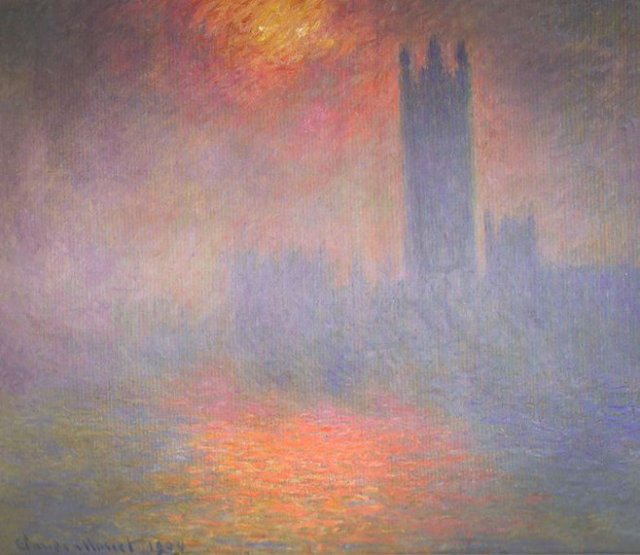
“A London Particular” — Monet’s View


(From Claude Monet , via Wikimedia Commons, used w/o permission.)
(Claude Monet’s “Trouée de soleil dans le brouillard,” 1904.)

Claude Monet was at St. Thomas’ Hospital in 1899. I don’t know why.

He started painting Westminster Palace, England’s Parliament building, while he was there.

A few years later he’d made well over a dozen ‘Parliament’ pictures.

Each showed Westminster as seen from St. Thomas’ Hospital, with different lighting and weather.

I’ve seen the “brouillard” in “Trouée de soleil dans le brouillard” called “smog.” I think Wikipedia’s “Sun Breaking Through the Fog” is more accurate. Or maybe “Sunlight in the fog.”

London air in 1904 wasn’t exactly fresh, but folks weren’t calling it “smog” yet. Dr. Henry Antoine Des Voeux’s used the word in his “Fog and Smoke” paper for London’s Public Health Congress in 1905.1

The city’s distinctive air had already earned colorful descriptions:

“…He was very obliging, and as he handed me into a fly after superintending the removal of my boxes, I asked him whether there was a great fire anywhere? For the streets were so full of dense brown smoke that scarcely anything was to be seen.
“‘Oh, dear no, miss,’ he said. ‘This is a London particular.’…”
(“Bleak House,” Chapter III, Charles Dickens (1853))

“…a fog as thick and as yellow as the pea-soup of the eating house….”
(“Annals of the fine arts,” John Sartain (1820) via Wikipedia)

“A Foggy Day in London Town”


(From The Illustrated London News; via Wellcome Library, The Guardian; used w/o permission.)
(“A London Fog. — Drawn by Duncan.” (1847))

London faced an energy crisis in the 13th century. Growing energy demands outstripped wood reserves. Londoners found an alternative resource: sea-coal. Smoke from the affordable but inefficient fuel became a serious problem.

Edward I became England’s king in 1272. He banned sea-coal burning in London. (February 17, 2017)

That probably cleared the air a little, at least for a while. But sea-coal remained an affordable fuel, and coal fires returned to London.

Folks in England weren’t the first to use coal. Theophrastus mentioned that workers heated metal with it. His treatise on mining probably discussed coal, too. But it got misplaced, hardly surprising after 23 centuries.

A 17th century amateur researcher noticed connections between London’s environment and health:

“I inclined to believe, that London now is more unhealthfull, then heretofore, partly for that it is more populous, but chiefly, because I have heard, that 60 years ago few Sea-Coals were burnt in London, which now are universally used. For I have heard, that Newcastle is more unhealthfull then other places, and that many People cannot at all endure the smoak of London, not onely for its unpleasantness, but for the suffocations which it causes…..”
(“Natural and political observations mentioned in a following index, and made upon the bills of mortality….,” John Graunt (1662) via Early English Books, University of Michigan Library)

We’ve learned quite a bit since 1662, including why breathing coal smoke is bad for us — and how to make coal fires somewhat less toxic.

I think that helps explain how we can get about 30% of our energy from coal without perishing in the smoke. An obvious solution to coal’s environmental and health downsides would be banning the stuff.2

A problem with outlawing coal is that we still don’t have an effective and affordable substitute power source. And we don’t just use energy. We need it.

Folks who don’t rely on coal for much of their energy are trying to become more dependent on power plants. Understandably, I think.

Most farms use metal implements, tools forged on an industrial scale. Processing, transporting and storing food takes more energy. So does nearly everything else we do.

Not Panicking


(From NASA; via BBC News, used w/o permission.)
(“Most of India is dark at night because there is little economic activity going on”
(BBC News))

Humans don’t actually need electricity and farm tools. We got along by hunting and gathering until about eight millennia back. An estimated 5,000,000 of us still do. That leaves about 7,595,000,000 who rely on agriculture and newer technologies.

I think humanity would survive losing almost a third of our energy supply. We’ve weathered far worse. But many of us might not. Dead bodies could be a public health concern for survivors.

Environmental protesters have a point. So, I think, do folks who see environment and climate activists as crackpots.

Getting energy from fossil fuels gives us some immediate problems, with many more coming in the next few generations if we don’t change our habits.

Folks who express their concern by wearing penguin suits may be quite sincere.

I think they would improve their image considerably, and help their cause, with more substance and fewer costumes. Remembering that Americans and Europeans aren’t the only ‘powered’ people might also help.

Americans aren’t at the world’s 50th percentile. We use more power per person than average. We also lowered per-person energy use 1990 between 2008. By only 2%, but it did go down.

Residential customers use 13% of our energy, commercial customers account for 7%. Around 26% went into transportation in 2012. That’s a bit lower than the 27.3% global average. But not by much.

Industry uses 54% of America’s energy. The global average for industrial use is 27.8%.

World energy consumption was far lower when our most advanced technology was flint knapping. But each of us needed a lot more room.

A 1966 Britannica “Hunting and Gathering” article gave seven square miles per human as a population density for folks who didn’t plant crops.

That’s not a maximum number. Folks living New Guinea have a ‘hunt and gather’ economy. They pack something like 40 people into each square kilometer. If I did the math right, that’s about 103 per square mile.

But the hunting part of their food budget comes from fishing. I don’t know if the high population density includes ‘land’ that’s in the ocean.3

Remembering why folks in India and elsewhere use energy and want more makes sense. So does making better use of Earth’s resources. And not panicking.

Miasma


(From William Heath, via Wikimedia Commons, used w/o permission.)
(William Heath’s imaginative view of London’s water quality, 1828.)

From one viewpoint, the 19th century was good for London.

The city’s population grew from about 1,000,000 to 6,700,000, making London the world’s largest city: a global political, financial and trading hub.

Major cholera epidemics started in 1831.

Only 6,536 folks died that time, a fraction of the city’s population. The one starting in 1848 killed about 14,137.

That’s still not a big fraction of the city.

But Londoners were concerned, with reason, about their health.

The 1858 “Great Stink” wasn’t a metaphor. The city’s air stank. London’s sewers dumped untreated industrial and human waste into the Thames. Hot summer days boosted the bouquet to almost unbearable levels.

Aside from being unpleasant, folks saw the stench as a health hazard. They were right about the results, but not the cause. Not entirely.

Miasma theory, the idea that foul-smelling air causes disease, still made sense to many doctors and scientists.

Informed and popular opinion agreed that London’s foul air caused cholera and other diseases. Folks who accepted miasma theory weren’t entirely wrong. Breathing air with the wrong stuff in it can hurt us, even if it’s germ-free.

Some researchers thought microscopic critters caused disease.

The idea goes back at least to the 1st century BC. Marcus Terentius Varro called them “animalcules.”

Thinking animalcules cause disease was one thing.

Showing that they exist and make folks sick took nearly two millennia.

John Snow’s analysis of the 1848 epidemic told him that cholera was probably spread through water, not air. Snow published his findings in 1849. The folks in charge promptly ignored his research.

Snow tracked the 1854 Broad Street cholera outbreak to one well. He took the well’s handle, making it unusable: documenting the drop in fatalities. This time the powers that be took notice.4 (July 21, 2017)

Equine Crisis, 1894-1898


(From Wikimedia Commons, used w/o permission.)

Horse-drawn vehicles sound like the ideal green transportation technology. Running on renewable resources, they produces virtually no carbon monoxide. Waste products are biodegradable. Besides all these advantages, literal horsepower is eminently scalable.

A single semi-autonomous unit powers a wide variety of personal vehicles.

Multi-unit configurations serve mass transit and freight applications.

There’s just one problem.

The solid and liquid biodegradable waste biodegrades. Fast.

That was a serious issue for cities in the late 19th and early 20th century.

More than 50,000 horses served London’s transit needs in 1900.

They pulled hansom cabs, buses, drays, wagons and carts. Besides hauling people and freight, each horse produced about two pints of urine and between 15 and 35 pounds of manure per day.

A Times report in 1894 said that if this kept up, every street in London would be under nine feet of manure by the end of 1903.

Disposing of dead horses was an issue, too. Horses usually live 30 or 40 years. Each of London’s lasted about three.

Horses often weigh around a half-ton. Draft horses are almost double that.

Knacker’s yards could recycle the carcasses, and often did. But hauling a half-ton carcass to the yard took time and labor.

I’ve read that street cleaners sometimes left dead horses near where they dropped. Purification made dismembering the bodies easier. It also added to London’s aroma, which should have been a concern for folks who accepted either miasma or germ theories.

London wasn’t the only city facing an equine crisis. An 1898 international urban planning conference did not find a solution.

Our cities, perhaps civilization itself, seemed doomed.

That would have been true if horse-drawn vehicles were the only practical transportation technology.

They weren’t. London’s Met, the world’s first underground railway, opened in 1863. It grew into the Underground. Other cities followed London’s lead.

Subterranean urban rapid transit’s name varies. It’s the Untergrundbahn in Germany, Tunnelbana in Sweden and metro in many English-speaking countries.5 I think of it as the subway.

Railways, above or below ground, have their own problems. But they’re part of many urban transit networks. And, I think, an improvement on horses and 1950s sedans.

New tech and rules won’t make cities perfect. But I think they can make our lives better. If we use our brains. (December 22, 2017)


Energy, Outrage and the Pope


(“The Pope has taken the business world to task on issues ranging from poverty to tax haven”
(BBC News))

Climate change: Pope urges action on clean energy
BBC News (June 9, 2018)

Pope Francis has said climate change is a challenge of ‘epochal proportions’ and that the world must convert to clean fuel.

“‘Civilisation requires energy, but energy use must not destroy civilisation,’ he said.

“He was speaking to a group of oil company executives at the end of a two-day conference in the Vatican.

“Firms present included ExxonMobil, BP, Royal Dutch Shell, Norway’s Equinor and Pemex of Mexico….”

The Energy Transition and Care for Our Common Home two-day conference ended June 9, 2018. I’ve seen the usual opinions about the conference and what Pope Francis said.

Some apparently don’t approve. I’ve read that the Pope doesn’t understand the situation, won’t listen to experts and told executives to stop destroying civilization. Others indulged in colorful commentary. One headline started with “Mammon Goes to the Vatican….”

Online outrage at the Pope’s latest ‘environmental’ statement has been remarkably mild. What I’ve seen of it. By today’s standards. One reason may be that it’s been overshadowed by other topics.

The comparative calm is almost enough to make me glad that American news media’s denunciations of the president and his policies is matched only by the fury of those with other views.

Making Sense

Almost, but not quite.

The good news is that most folks I meet online aren’t having emotional meltdowns.

Flinging epithets isn’t an ideal persuasive strategy. My opinion, and another topic.

Another bit of good news, for me, is that at least some of the wrath — on all sides — could easily come from feelings of wounded justice. (September 17, 2017)

Back to what Pope Francis said.

I’ve read “Laudato Si’, so I wasn’t surprised at his ‘clean energy’ statement. I wasn’t sure that the BBC News ‘climate change’ focus mirrored the Pope’s emphasis, so I found and read a transcript.6

When I hear that a Pope said something I don’t like or don’t understand, learning more makes sense. Assuming that I’m right and the Pope is wrong doesn’t. Neither does thinking that Popes never make mistakes. (August 11, 2017; July 30, 2017)

Pope Francis did talk about a challenge of “epochal proportions.” He also discussed “climate changes.” That’s from the English-language transcript. I’m not sure which of the five listed languages he used on June 9.

In the Pope’s position, I probably wouldn’t have said exactly what he did. I almost certainly would have come at the issues from a different direction. Quibbling over details is an option. Sometimes it’s important.

In this case, I’d rather look at the Pope’s central idea.

I think he’s right. “Civilization requires energy, but energy use must not destroy civilization!” And keeping future generations in mind is a good idea. I agree that we need energy and should keep looking for alternatives to burning fossil fuels.

Learning more about how Earth’s climate works is important too.

This is our home. Taking care of our home makes sense. So does acting like we think others, including future generations, matter as much as we do.


Predictions and Prudence

Letting each new apocalyptic prediction inspire frenzied action isn’t a good idea.

Many doomsayers turn out to be wrong.

Lord Kelvin predicted that we’d consume all Earth’s fossil fuels in 500 years. He also said we only had 400 years of oxygen left.

His math was right. So were his facts. But he didn’t have all the facts.

We’ve learned more about the oxygen cycle, among other things. Oxygen is a renewable resource. It’s getting renewed. We won’t suffocate in a few centuries.

Ignoring an unpleasant analysis isn’t a good idea either.

Kelvin was right, basically, about coal. Our fossil fuel supply won’t last forever. I’ve seen reasonable estimates of our deadline ranging from decades to a century or so.

Coal is, theoretically, a “renewable resource.”

Today’s supply mostly formed in the Carboniferous, about a third of a billion years back. We haven’t had swamp forests that big since, but Earth’s climate keeps changing. An era like the Carboniferous could happen again. A few million years after that, we’d have renewed coal deposits.

I think long-range planning makes sense. But not in this case. We have at most a few centuries of coal left. Theorizing is fun, but won’t solve our energy issue. Even if we knew exactly what will happen over the next several geological ages, we can’t wait that long.

Some predictions have been accurate.

The passenger pigeon filled North American skies in 1800.

Many folks had noticed the pigeons were in trouble by 1880. Legislators took action, passing laws that weren’t effective.

By the time we realized that ‘pigeon protection’ laws weren’t working, it was too late. The last known passenger pigeon died on September 1, 1914.

I think the lesson here is that the earlier we notice a problem, the easier it is to deal with. Also that good intentions don’t guarantee good results. We have, happily, learned a great deal about wildlife management since 1800.7

Understanding climate management is, I think, very much a work in progress. We didn’t even realize that Earth’s climate changes until a few centuries back.

Reviewing Our Rules


(From Dragons flight, via Wikimedia Commons, used w/o permission.)

I’ve seen global warming replace the coming ice age as a secular analog to American Christianity’s End Times Bible prophecies. I suspect that climate doomsayers appeal to a different demographic. And that’s yet another topic.

The current buzzword — buzzphrase? — is climate change. The term is accurate. Earth’s climate is changing. And has been for several billion years. It’ll probably keep changing.

That said, I think reviewing and revising our environmental laws makes sense.

So does developing cleaner and more efficient technologies.

We were doing both before the 1948 air quality disaster in Donora, London’s Great Smog of 1952 and New York City’s 1966 smog. The new rules and tech hadn’t solved all our problems, obviously.

The Donora incident killed about 20 folks. London’s 1952 Great Smog death toll was around 4,000. The 1966 New York City event killed 80. Or maybe 168. It’s been debated.

I don’t think anyone gets nostalgic over mid-20th century smog. Or yearns for that part of the ‘good old days.’

Air pollution is still an issue. Emission control laws weren’t and aren’t ideal. But I think they’re better than nothing, and an overall improvement on what they replaced. So is today’s tech.8

I think we’ll be cleaning up the Industrial Revolution’s mess for centuries.

Global Climate Control: Eventually

Exhaust from centuries of coal- and oil-fueled industry almost certainly boosted carbon dioxide levels.

That probably affected Earth’s climate.

But I doubt we can thank the Industrial Revolution’s exhaust alone for ending the Little Ice Age.

Assuming that we can affect climate seems reasonable. We’ve probably been doing so for a very long time — unintentionally.

I think we have the knowledge and technology to make deliberate changes.

I’m not at all sure that applying today’s knowledge to a global climate control experiment would be a good idea.

Learning much more about how Earth’s climate works before conducting field tests seems wiser. And safer.

It’s not that I think we can’t or shouldn’t start controlling our home’s climate. The benefits seem obvious. I certainly think cleaning up vehicle and industry emissions makes sense.

But let’s say that national leaders around the world decide that climate control is a top priority, and that implementation should start right now. What could possibly go wrong?

We might get it right on the first try.

Perhaps sunny skies with regularly-scheduled gentle rains would abolish famines, end poverty, usher in a Golden Age — and we’d live happily ever after.

Or, more likely, we’d have several opportunities to learn from our mistakes.

It’s happened before.

Weather control seemed like a good idea in my youth.

Meteorology was turning weather forecasting from guesswork to a somewhat-reliable science.

Scientists were learning what triggers rain and how storms work. Several experiments showed that they were on the right track.

We became much more cautious about testing weather control tech, for which I’m grateful.

Recent analysis suggests that a 1947 experiment didn’t make the Cape Sable Hurricane do a U-turn. Probably.

That storm only killed one person.

The Black Hills Flood of 1972 killed 238.

Survivors learned that scientists had used the storm for an experiment.

America’s courts decided that scientists couldn’t be held responsible for the storm. There wasn’t enough proof that their experiment enhanced the death and destruction.

Hopes that practical weather control was around the corner pretty much ended after that.

I still think learning to control Earth’s weather and climate is a good idea.

I’m quite convinced that we can control Earth’s climate, safely and effectively. Eventually. I think we should. It’s part of our job. And we should learn much more before starting large-scale field tests.9

Dominion and Leviticus 25:5

Some 19th century industrialists earned their reputation for environmental mismanagement and disregard for the lives and interests of their workers.

Careless waste management, appalling labor practices and the era’s Christian veneer left a bad impression.

But not an entirely accurate one.

Humanity’s “dominion” over this world does not give wealthy individuals and nations permission to plunder resources and exploit the poor.

God did, however, give all of us authority. Limited authority.

Our position is like a steward’s or foreman’s. We’re expected to look after our home: for our reasoned use and for future generations. (Genesis 1:2628; 2:58; Catechism of the Catholic Church, 16, 339, 356358, 2402, 24152418, 2456)

This isn’t a new idea:

“…we come together to take charge of this home which has been entrusted to us….”
(“Laudato si’,” Pope Francis (May 24, 2015))

“…Today the subject of development is also closely related to the duties arising from our relationship to the natural environment. The environment is God’s gift to everyone, and in our use of it we have a responsibility towards the poor, towards future generations and towards humanity as a whole….”
(“Caritas in veritate,” 48, Pope Benedict XVI (June 29, 2009))

“For six years you may sow your field, and for six years prune your vineyard, gathering in their produce.
“But during the seventh year the land shall have a sabbath of complete rest, a sabbath for the LORD, when you may neither sow your field nor prune your vineyard.
“The aftergrowth of your harvest you shall not reap, nor shall you pick the grapes of your untrimmed vines. It shall be a year of rest for the land.”
(Leviticus 25:35)

“The LORD God then took the man and settled him in the garden of Eden, to cultivate and care for it.”
(Genesis 2:5)

We have Work to Do

Lord Kelvin’s 1898 ‘fuel and oxygen’ prediction was right about one thing. There’s only so much coal. We can’t keep burning it indefinitely.

That’s why I think Pope Francis was right when he said “there is no time to lose….”

We need a reasonable alternative to fossil fuels. This is not the time to stop looking.

I’m quite sure the search will continue.

Scientists have been exploring several new technologies. Interest has, if anything, increased over the last few decades.

We’ve also had some disappointments.

Nuclear power looked very promising. So did biofuels and solar power. I think they’re useful, but each has its own problems. The same goes for wind power and other tech.

Fusion power research may be part of the solution, but it’s at best decades away from practical applications.

Dealing with climate change is urgent too, but not in the ‘New York minute’ sense.

We know more about how Earth’s weather and climate works than we did in 1947 and 1972. I’m convinced that we’ll keep learning more.

And, eventually, we will add controlling Earth’s climate — safely — to our tasks.

Meanwhile, there’s no shortage of work to be done:


1 Art and air quality:

2 Coal, health and history:

3 Power and people:

4 Miasma and microorganisms:

5 Horses and trains:

6 Climate and Popes:

7 Predictions and all that:

8 Attitudes, assumptions, and a few facts:

9 How I see weather, climate and being human:

Posted in Discursive Detours, Science News | Tagged , , , , , , , , , | 2 Comments

Job’s Friends

I could swap hard-luck stories with Job, but not for long. When it comes to misfortunes, I’m not in his league. On the other hand, looking over medical records before a recent checkup reminded me that my life hasn’t been perfect.

It could be worse. I might believe that God is smiting me because I’m predestined to a life of misery and eternity of torment. Or because I’ve committed some unspecified sin. Or have friends telling me that God only smites bad guys.

It could be better, too.

I deal with hypertension, diabetes and chronic kidney disease. Also autism spectrum disorder, depression and PTSD. I’m a mess. (March 19, 2018; December 31, 2017)

My psychiatric issues made and make parts of my life excessively interesting. So did being born with defective hips.

On the ‘up’ side, I’ve had many opportunities to think about abilities and their opposites. I’ve felt that ‘it’s not fair,’ but don’t remember believing it. Not for very long, anyway

A Work in Progress

Feeling that I don’t deserve my ailments, or that Christians shouldn’t have problems, wouldn’t do me much good.

Suffering, joy, any experience, can be a reason to pray and rejoice. (1 Thessalonians 5:1618; Catechism of the Catholic Church, 2648)

Remembering and believing that thanksgiving and joy matter when I’m in a rough patch is hard, at best. But it’s still a good idea.

Disabled or not, I’m a person, a human being: with dignity and responsibilities.1 (Genesis 1:27; Catechism, 357, 17311738)

Having disabilities doesn’t make me better or worse than folks who don’t. What’s different are the opportunities and limitations I deal with.

“…Disability is not a punishment; indeed it is a privilege, which God uses to manifest his love and crown all with the glory of the resurrection….”
(“Persons with disabilities: The Image of God and a Place of His Wonders,” Preparation for the Jubilee Day, The Preparatory Committee (March 2, 2000))

“…The lives of those who are handicapped are no less sacred than the lives of those who are not. I know that you share this conviction with me. At the same time, we are also aware that the quality of life of the handicapped is often not in keeping with their own inner worth….”
(“To members of the Very Special Arts International Organization,” St. John Paul II (December 5, 1987))

Thinking of myself as a person isn’t hard. Seeing my disabilities as a “privilege?” That’s a work in progress.

Accepting Life’s Ups, Downs and Nosedives

Job 1:15 says he “was a blameless and upright man” with seven sons, three daughters, a large household and more wealth than most.

He was like today’s Jeff Bezos or Bill Gates: pretty much the opposite of destitute.

Until the trouble started.

Several messengers came, telling Job that his financial empire was kaput. That was bad news. But at least he still had his family.

A fourth messenger arrived with more bad news. Job’s children were dead, killed by a freak storm. Then boils — painful sores — covered Job’s skin. All of it. Job was not having a good day.

By the time we get to Job 2:8, Job’s sitting on an ash heap, covered with boils and scraping himself with a potsherd. He gets his first bit of advice:

“Then his wife said to him, ‘Are you still holding to your innocence? Curse God and die!’
“But he said to her, ‘You speak as foolish women do. We accept good things from God; should we not accept evil?’ Through all this, Job did not sin in what he said.”
(Job 2:910)

With Friends Like These – – –

You know the rest of the story. Three friends show up with “sympathy and comfort” for Job. (Job 2:11)

All three told Job that he should repent. They figured God rewards good behavior and punishes folks who act badly. That meant Job’s financial and family losses must be his fault.

Job denied doing anything wrong, so they kept telling him.

I think Eliphaz was hitting his stride in the second and third speeches:

“The wicked is in torment all his days,
and limited years are in store for the ruthless;
“The sound of terrors is in his ears;
when all is prosperous, a spoiler comes upon him.”
(Job 15:2021)

“Is it because of your piety that he reproves you—
that he enters into judgment with you?
“Is not your wickedness great,
your iniquity endless?”
(Job 22:45)

Millennia later, some folks still agree with Eliphaz. I don’t.

Wealth and poverty, illness and health aren’t sure signs of virtue or sin. Stuff happens. What matters is what I do with what I’ve got. (1 Timothy 6:10; Hebrews 13:5; Catechism, 828, 1509, 2211, 22882291, 22922296, 2448, 2540, 2544)

Carrots, Sticks and Me

I think God is large and in charge, and that doing what’s right is a good idea. (Genesis 1:12:2; Psalms 115:3; Catechism, 268269, 279, 301, 1733)

Believing that God smites ‘bad guys’ and rewards ‘good guys’ promptly? Not such a good idea.

Simple ‘carrot and stick’ belief may be easy.

But it’s too close to upholding the moral superiority of the healthy and wealthy for my taste. Or circumstances.

Believing that God pays attention and will reward or punish me is one thing.

Doing ‘good works’ because I expect rewards, or avoiding ‘being bad’ because I fear punishment? That’d make me a mercenary or — as St. Basil put it — a slave. (Catechism, 1021, 1828)

There’s what our Lord said about the man born blind, too. And those folks killed when a tower in Siloam fell. (Luke 13:45; John 9:13)

The way I see it, God loves us and wants to adopt us. Each of us. (Romans 8:15; Ephesians 1:35; Peter 2:34; Catechism, 13, 2730, 52, 1825, 1996)

I accepted God’s offer. Since I’m ‘part of the family,’ loving God and acting like I mean it makes sense.

Expecting reward or punishment matters, to an extent. I let myself look forward to God’s ‘Creation 2.0,’ for example. But it’s not at the top of my list of ‘reasons why.’

That’s my opinion about disabilities and being human. Let’s see what a recent pope said:

“…The Psalmist, … is convinced that God will already reward the righteous in this life, giving them a happy old age, and that he will punish evildoers before long.
“Actually, as Job affirmed and Jesus was to teach, history can never be so clearly interpreted. Thus, the Psalmist’s vision becomes a plea to the just God ‘on high for ever’, to enter into the sequence of human events, to judge them and make good shine forth….”
(General Audience, St. John Paul II (September 3, 2003))

“…Job however challenges the truth of the principle that identifies suffering with punishment for sin. And he does this on the basis of his own opinion. For he is aware that he has not deserved such punishment, and in fact he speaks of the good that he has done during his life. In the end, God himself reproves Job’s friends for their accusations and recognizes that Job is not guilty. His suffering is the suffering of someone who is innocent and it must be accepted as a mystery, which the individual is unable to penetrate completely by his own intelligence….”
(“Salvifici Doloris,” St. John Paul II (February 11, 1984))

More of my view of life, death, health, choices and making sense:


1 Dignity, duties and being human:

Posted in Discursive Detours | Tagged , , , , | 4 Comments

Law, Immigrants and Romans 13

America’s Attorney General apparently said Americans should do what the government tells us to. That’s ‘dog bites man’ news. It’s what government officials do. ‘Man bites dog’ news would be an official telling us to go out and break laws.

This time around, the Attorney General was reminding us that our national government is protecting us from immigrants by taking kids from their families. And that Christian Americans should cooperate because Romans 13 says so. According to him:

Not all Americans think breaking up families is a good idea. Even if they are foreigners:

‘God Agrees With Me?’

The good news, for me, is that America isn’t the ‘Christian nation’ of my youth.

I suspect the Attorney General’s appeal to ‘Biblical’ authority won’t generate much support. Apart from some of America’s fuddy duddy fringe.

That hasn’t always been the case.

William Jennings Bryan’s “Cross of Gold” speech was effective rhetoric in 1896. His audience loved it so much they carried him around on their shoulders after the speech.

The response wasn’t universal. Judge, a satire magazine, showed the great orator standing on hallowed authority. Literally.

Time passed, the bimetallism crisis faded and politicos found new hot buttons to push.

Claiming that ‘God agrees with me’ isn’t new. Folks on all sides of America’s Civil War and Europe’s turf wars did it. (June 1, 2018; September 10, 2017; August 4, 2017)

My youthful memories include ‘good Christian Americans’ acting as if they thought Jesus is an American. And having meltdowns over newfangled ideas. Decades later, I still think they were wrong. But I may understand why they were so upset.

It was the Sixties. Devotion to old customs and beliefs was fading. Their world was crumbling around them. (May 12, 2018; December 31, 2017; July 4, 2017)

Legitimate Authority

Some changes haven’t turned out as well as I hoped. But I see many as long-overdue reforms.

That doesn’t make defenders of the status quo — or ‘those crazy kids’ — villains or heroes in the melodrama sense. Just folks who thought they were doing the right thing. (May 12, 2018; April 11, 2018)

Back to 21st century America and the Bible: Romans 13 talks about authority, among other things:

“Let every person be subordinate to the higher authorities, for there is no authority except from God, and those that exist have been established by God.”
(Romans 13:1)

I could stop reading there, say that every ruler’s wishes are “established by God” — and that everyone who doesn’t agree with me is a Satanic agent. I won’t. It’s not that simple.

Like it or not, human societies need authority. Legitimate authority. As a citizen, my responsibilities include respecting legitimate authority. (Catechism of the Catholic Church, 1897, 2238-2243)

Legitimate authority rests on principles established by God. The principles aren’t made up by whoever says they’re in charge. And they don’t change to suit current policies. (Matthew 20:2526; Catechism, 1897-1951, 1954-1960, 2235-2237)

Obeying legitimate authority isn’t blind obedience. “I was only following orders” isn’t a valid excuse. (Catechism, 2313)

“Family” is important, too. So is doing our part as parents and children. (Catechism, 2201-2233)

That doesn’t mean everyone should look and act like the fictional Cleavers. I’ve talked about family, Ephesians, diapers and all that before. (December 31, 2017; May 14, 2017)

Responsibilities

Defending folks is part of a government’s job, or should be. (Catechism, 2263-2267)

That doesn’t mean keeping immigrants out. Nations with room and resources should accept folks who are “in search of the security and the means of livelihood” they can’t find back home. (Catechism, 2241)

I’d be worried if folks stopped trying to settle in America. Particularly folks who come as families. Having a substantial fraction of “low types” as ancestors affects my views. America would be different without the Irish. But I’m not convinced that it’d be better. (April 2, 2017; November 29, 2016)

I don’t know what rationale the Department of Homeland Security has for breaking up some families who try coming to America. I’d like to think there’s a motive that includes concern for people.

Maybe it’s defending our nation’s youth from un-American influences. Or raising the foreign kids to be obedient little Americans. Or seeing foreigners with kids as a real and present danger to national security.

Whatever the motives, what’s happening seems less than wise. Bear in mind that I’m not a ‘regular American’ by some standards. My ancestry is decidedly un-English.

Even worse, I’m a Catholic. One who takes responsibility seriously. But who doesn’t think the United States Attorney General established the world’s unchanging principles.

And that’s another topic:

Posted in Discursive Detours | Tagged , , , , , , | 5 Comments

Apathy, Angst and Grenfell Tower

Opportunities for angst and anger abound. Just glance through the headlines. Take your pick from today’s top expert-endorsed, editor-approved crises —

Climate change threatens our cities, the oceans and life itself. Well-intentioned efforts to stop climate change threaten our jobs and our businesses. Lower employment and shuttered businesses would also threaten our cities: a detail that gets lost in the shouting.

If those don’t appeal, just glance through social media’s fringes. I’m pretty sure you’ll find something dreadful —

The Antichrist was elected President. The President is intolerance incarnate. Big burger makes us eat too much. Big government wants to ban burgers. ‘They’ control the newspapers. Or the banks. Or the Internet. Or all of the above.

Other headlines rekindle anger and angst over past tragedies like the Grenfell Tower fire. And, sometimes, reasoned responses.

Viewpoints

For some, our present seems futile and our future grim. That’s nothing new:

“…in ten years all important animal life in the sea will be extinct. Large areas of coastline will have to be evacuated because of the stench of dead fish….”
(Paul Ehrlich, on first Earth Day, (1970))

“…nations and governments have never learned anything from history, or acted upon any lessons they might have drawn from it.”
Lectures on the Philosophy of History,” Introduction, Georg Hegel (ca. 1830s) Trans. by H. B. Nisbet (1975))

“Ludit in humanis divina potentia rebus,
Et certam præsens vix habet hora fidem.”
“Heaven makes sport of human affairs, and the present hour gives no sure promise of the next.”
(“Epistolæ Ex Ponto,” Ovid, (ca.8-18 AD))

“Nos numerus sumus et fruges consumere nati.”
“We are but numbers, born to consume resources.”
(Epistles, Book I; Horace (20-14 BC))

Apathy starts looking pretty good on days when editors can’t seem to decide which crisis du jour tops the list.

I might be whipping out anguished laments or furious attacks, if I didn’t remember debacles of days gone by.

Not fervently yearning for some imagined ‘good old days’ helps, I think. So does knowing that we’ve had problems before. And occasionally learned from our mistakes. (May 12, 2018)

On the other hand, some of us keep repeating the same mistakes.

“…Time to ‘drop out,’ ‘turn on,’ and ‘tune in.’…”
(“Start your own Religion,” Timothy Leary (1967))

“…on the tenth day we reached the land of the Lotus-eaters…. I sent two of my company to see what manner of men the people of the place might be…. They started at once, and went about among the Lotus-eaters, who did them no hurt, but gave them to eat of the lotus, which was so delicious that those who ate of it left off caring about home, and did not even want to go back and say what had happened to them….”
(“The Odyssey,” Homer (8th century BC) Trans. by Samuel Butler)

Homer’s land of the Lotus-eaters may or may not be a real place. Either way, I figure the poet knew about narcotics and their effect on folks. (May 12, 2018; July 7, 2017)

About Leary’s advice — I didn’t “turn on” in the Sixties, or later when we got more cautious about popping pills: proscribed and prescription. (July 10, 2016)

That’s no great virtue on my part. The way my brain is wired, fluttering past different perspectives is easy. So is relentless pursuit of some random idea or fact.

Focusing on what I’m supposed to be doing: that’s another matter. Looking back, I don’t think a corporate ‘success track’ and someone like me would be a good match.

An academic career might have been nice. But that would have meant staying focused on a single facet of reality. And holding that focus for years.

Diagnosing my psychiatric issues a few decades earlier might have made a difference. Probably would have. But I’ve had an interesting life. (March 19, 2018; January 7, 2018; December 17, 2017)

And that’s not what I was talking about. Let’s see. Apathy. Angst. Attitudes. Right. I’m probably more prone to angst and anger than apathy.

Feeling anxious or angry isn’t good or bad by itself. Emotions happen. They’re a part of human nature. They connect “the life of the senses and the life of the mind.” (Catechism of the Catholic Church, 1764, 1767)

What matters is what I do about my emotions. That’s where reason takes over: or should. (Catechism, 17621770, 17771782)

Anger and Decisions

Last year’s Grenfell Tower fire is in the news again.

Partly, I think, because it’s about a year since the catastrophe: time for ‘what happened a year ago’ stories. Partly because an inquiry released their early reports.

I was, and am, angry about what I’ve learned. I’d be concerned if I wasn’t.

People died. Many might be alive if they’d ignored “stay put” notices. That lethal policy was just one of many possibly-criminal blunders leading to a record-breaking death toll.

Being angry won’t bring dead families back. Neither will fuming over the injustice of it all. But being angry tells me that something may warrant attention.

I can’t change what happened, or decide how folks in England will act. That’s a good thing, since I don’t have nearly enough information: and wouldn’t want the responsibility. But I can see if there’s something to be learned from the mess.

In a way, the Grenfell Tower fire wasn’t unusual. Or a uniquely English event. Fire hurts people every year. Sometimes people die in fires.

Fires broke out in about 364,300 American homes in 2016. 2,775 people died as a result. 6.6% of those fires started in the kitchen. I don’t like those facts, but they’re real. The trick is doing what’s possible to keep fires from starting. And keeping folks alive when they do.

When a fourth-floor kitchen fire kills residents on the 23rd floor, learning what went wrong matters. A lot.1

Just Another Tuesday in June: Until Midnight

June 13, 2017, wasn’t completely free of noteworthy events.

An accident blocked two London-bound lanes of M4. A three-meter tall Morph appeared outside Bristol Royal Hospital for Children. The Somerset County Council said they wanted to hear what folks thought about proposed road improvements on A358 at West Hatch and the M5.

But the 13th wasn’t much different from any other Tuesday in June. Many folks in London went to work, came home, ate and went to bed.

Someone living on the fourth floor of Grenfell Tower was awake a few minutes after midnight on June 14. He noticed and reported a fire.

Firefighters came and put out the kitchen fire. That took a few minutes, no more. The firefighters packed their gear and left.

At least one of them happened to look back. Fire was spreading up the tower’s side. Fast.

Firefighters returned and started dealing with the new problem.

Quite a few folks living in Grenfell Tower were awake for the pre-dawn meal of suhur, part of Ramadan observances. They started waking their neighbors, helping those who decided to try getting out.

That’s not what they were supposed to do.

The outfit running Grenfell Tower had advice for folks living there. In case of fire, stay put. Shut the door and wait. Many residents did as they’d been instructed. They stayed in their apartments. They waited. Then they died.

Some roasted, others died when smoke and fumes reached them.

Some residents who tried getting out died too. But others survived.

I’ll give emergency responders credit for having sense.

At some point they realized that the ‘stay put’ policy was lethal in something like Grenfell Tower.

They told folks who had been following the rules to get out.

That was the good news. The not-so-good news was that they had this epiphany after the tower was thoroughly ablaze.

Some folks made it out. Others didn’t. We’re still not sure how many died in the fire.

Authorities have their official figures. Folks with family and friends who disappeared during the fire say maybe the numbers aren’t quite right. Authorities say eight made fraudulent claims. Maybe that’s so. At least one was convicted.2

I think folks should be honest. But there’s a gap between “should be” and “is.” And that’s another topic.3

Basically Good Ideas


(From Google Maps, used w/o permission)
(Grenfell Tower and other buildings in Lancaster West Estate, North Kensington, London. As it was before the June 2017 fire, apparently.)

If Lancaster West Estate was in America, it’d be a housing development. It’s in England, so it’s a housing estate.

Today’s North Kensington is no Knightsbridge or Chelsea. But it’s no Victorian Spitalfields either. A former Prime Minister lives there. So do media personalities. Few if any of them lived in the housing estate. It’s mostly for working class folks.

Grenfell Tower’s design wasn’t state-of-the-art architecture in 1967. That wasn’t the goal. I gather that architects more interested in safety and affordable usefulness than good looks and innovative features.

Plans were approved in 1970. The building was finished in 1974. The working design was pretty much like the 1967 proposal. But there were some changes. It had more parking space, for example.

It would be safe. If builders used materials and equipment specified by the architects. And owners did routine maintenance.

Grenfell Tower was mostly concrete, moderately comfortable and affordable for folks who aren’t in society’s high end. It wasn’t the sort of thing you’ll see on a ‘beautiful buildings in England’ tour. But it wasn’t, I think, an eyesore. Bear in mind that I’ve got flexible tastes.

Fast-forward nearly four decades, to 2012. Styles and needs had changed. “Sustainability” was in. Automobiles weren’t as central to everyday routines.

Folks running the housing development decided it was time to upgrade the tower’s insulation, convert some parking spaces to business units, and spruce things up.

Occasionally-misapplied buzzwords like “sustainability” grate on my nerves.

But using resources efficiently seems like a good idea.

I see no problem with prudent design and attractive neighborhoods. Keeping costs down makes sense too. Within reason. Saving money by not recharging fire extinguishers and storing rubbish in escape routes instead of removing it seems imprudent. Or worse.

I haven’t kept up with who said what about the tower’s new cladding. The idea was to get better insulation and a more up-to-date look. That, and not spending more than necessary, seems reasonable. Cutting corners, not so much.

The last I heard, we don’t know exactly how the new cladding caught fire. Or why the fire spread so fast. Or whether architects, builders or bean counters picked the cladding. Or how information about failed safety tests disappeared.4

I’ve taken daft risks in my day. Mostly when I was in the male 16 to 26 demographic.

But even then I don’t think I’d have put pennies behind a fuse. It’s an old money-saving trick. It keeps a fuse from burning out during an overload. It seems thrifty. Until wires overheat and ignite the house.

Grenfell residents had been complaining about safety issues before the fire. It may be years before we get a clear picture of how so much went wrong.

There’s been no shortage of sturm und drang inspired by the Grenfell Tower fire. Some of it is understandable.

Responses, Reasonable and Otherwise


(From ChiralJon, via Wikimedia Commons, used w/o permission)
(Remembering Grenfell Tower fire victims: Bramley Road, London.)

That folks who survived the Grenfell Tower are upset is no surprise. At all. They lost their homes. Many lost family and friends. It wouldn’t seem fair.

November’s official death toll of 71 was raised to 72 in January.

That’s when Maria Del Pilar “Pily” Burton died. She and her husband lived in a 19th floor apartment. She couldn’t walk down the stairs, thanks to an illness. Her husband, 50, couldn’t carry her. So they stayed where they were until firefighters reached them.

We may never know how many died that night. Even without the suhur meal, several folks in a neighborhood that size might have had friends visiting.

Quite a few residents were first-generation immigrants. They may not have had their paperwork in order. Someone without the usual paper trail might have vanished without a trace.

Getting a body — and parts — count wouldn’t tell us how many died in the fire. Some of Grenfell Tower reached 1,000 degrees Celsius and stayed there for “some time,” as Metropolitan Police Deputy Commissioner Craig Mackey said.

Crematorium furnaces burn at between 870 and 980 Celsius. Many bodies in Grenfell Tower may have been reduced to gas, ash, and anonymous fragments.5

What’s impressive, I think, is how many victims have been identified.

I’m not, however, impressed there’s an investigation into what happened last June. Officials often decide they’d better ‘do something’ after a catastrophe.

That’s reasonable, I think.

The all-too-common custom of picking a suitable villain from society’s fringe? That’s not such a good idea.

After London’s big 1666 fire, the folks in charge found a dubiously-smart French watchmaker who claimed credit for torching Westminster. The watchmaker also said he was the Pope’s agent.

Setting Westminster ablaze would have made sense to a Popish terrorist. If the aristocratic neighborhood had burned. Which it hadn’t. Then the watchmaker said he’d torched the bakery in Pudding Lane.

Some folks wondered about his fitness to plead. He was convicted anyway, and executed. Inquiries continued. Someone discovered that the watchmaker had been on a boat in the North Sea when Pudding Lane burned.

Meanwhile, English patriots were looking for more terrorists. Understandably. The Second Anglo-Dutch War was in progress. France was a Dutch ally. I see the conflict as a turf war, and that’s another topic. (April 25, 2018; September 10, 2017; June 25, 2017)

I’m not surprised that folks said a foreigner started the Grenfell Tower conflagration. Many folks living there weren’t, or weren’t quite, English.

Behailu Kebede seemed like the ideal Grenfell scapegoat. He’s from Ethiopia. The fire started in his apartment. His own actions place him at the scene. He made the first call to emergency services. Then he started alerting his neighbors. But he didn’t put out the fire.

British authorities seem to have learned a bit since 1666.

Mr. Kebede was accused or implicated in news media, not English courts. Police took an interest in him, as an important witness. One who had reason to fear an extralegal execution. That’s why they said he should go into their witness protection program.6

Human Nature

I think human nature is the same now as it was in 1618 — when regents, counts and lords ended a meeting by tossing two regents and a secretary out the window. (March 17, 2017)

Or 1792 — when revolutionaries defended their ideals by killing an insane asylum’s inmates. (November 19, 2017)

Or 1914, when the war to end war — didn’t. (November 10, 2017)

Or 32 BC, when Rome’s Senate bungled its way into the Final War of the Roman Republic. Augustus sorted that mess out about a decade later. (May 26, 2017)

I might feel hopeless. But I don’t.

I think human nature hasn’t changed since Ur-Nammu and Hammurabi wrote their law codes. Or survivors of a global war signed the United Nations Charter.

We’re made in the image of God. We can decide to act as if that’s true. Or not. The first of us made a decision with consequences we’ve lived with ever since. But we’re not doomed to act badly. It’s still our choice. (Catechism, 396406, 17011709, 1730)

Still Learning


(From ChiralJon, via Wikimedia Commons, used w/o permission)
(Bramley Road, near Grenfell Tower: volunteers sorting donations for fire victims.)

Staying calm over the Grenfell Tower inquiry is easy. For me. I live in central Minnesota. London’s problems seem comfortably remote from the small rural town I call home.

That’s calm: not apathetic.

I care about the folks who lost their lives, their neighbors and their homes. But being angry about the situation won’t help.

More to the point, holding on to anger is a bad idea. I shouldn’t do it. I’m also obliged to care about those who apparently made decisions that turned a comparatively safe building into a deathtrap. (Matthew 5:22, 4348; Catechism, 361, 953, 2262, 2608)

Nobody said this was going to be easy.

I can’t do much to help survivors of the Grenfell Tower fire, or folks who are trying to learn what happened and who may be responsible.

What I can do is repeat what I’ve said before. We’re in this together. Mutual respect is a good idea. So is balancing individual and community needs. And acting like truth, justice, solidarity and freedom matter. (Catechism, 19051912, 1915, 2239)

We can’t change what’s been done. But we can keep learning from our mistakes. That, I think, is reason for cautious optimism:


1 Learning what went wrong:

2 Numbers and the news:

3 Our world is basically good, so are we, but it’s not perfect:

4 What should have happened, what did happen:

5 Remembering:

6 Responses, then and now:

Posted in Discursive Detours | Tagged , , , , , | Leave a comment

Spiritualism, Attitudes

I’ve read that spiritualism and spiritism started in the 18th or 19th centuries. Folks who take one or both seriously seem to think spiritism isn’t spiritualism. How the ‘isms’ are different depends on who’s talking.

Some say spiritualism is a religion, while spiritism is a social movement. Or spiritism is a science and spiritualism isn’t.1

I’ve seen “spiritualism” used to describe spiritism as practiced by English-speaking folks, particularly Americans. Maybe that’s a common use of the word.

Or maybe it’s just how it’s used in much of what I’ve read.

It’s what I mean by “spiritualism” and “spiritualist.” Usually. Often. Sometimes, anyway. I’m guessing there isn’t a definition that folks on all sides agree on.

I’ve seen several versions of where the beliefs began, too.

Some say they spread from upstate New York’s “burned-over district.” That’d be what started with two kids, an apple and some string. (May 25, 2018)

Whether central and western New York is “burned-over” is debatable. I see what happened as a spiritual hangover after a religious binge episode in the early 1800s. We call it the Second Great Awakening. I don’t know who first used that name or when it caught on.

I’ll be talking about writers and researchers, Salem’s infamous trials and why I think change can be a good idea:


Awakenings and the Morning After

America’s Second Great Awakening began around around 1790 in Kentucky, Tennessee and southern Ohio.

Preachers from assorted denominations affirmed feelings and rejected rationalism. They were enormously popular.

Revivalists revived, postmillennialists predicted the Second Coming. Folks got excited. Very excited. Fervor faded around 1840.

Believers noticed a distinct lack of either End Times or Golden Age.

Charles G. Finney thought folks in central and western New York were through with faith.

Finney, one of the revivalists, said the wild excitement and morning after left many feeling that religion was “a mere delusion.” He called central and western New York a “burnt district.” Maybe he was right. Or not.

Many academics thought he was, at least until recently.

A study published in 1984 said “burned-over district” folks weren’t any more or less religious than most Americans. That’s likely enough. My country had a third and fourth Great Awakening too, at least according to some. And that’s another topic.2

Roots

Folks looking at another slice of history say spiritualism’s beliefs started in Europe.

The idea makes sense, although I think the roots go far deeper.

I see my country’s Spiritualism as a homegrown ornamental, spread from imported cuttings. Sort of like kudzu.

Not exactly like kudzu, of course. Metaphors break down at some point. The trick is spotting the cracks before stepping on them. And that’s yet another topic.

Spiritualism and its European precursors strike me as my civilization’s versions of very ancient beliefs. Current forms started taking shape around the 18th century.


Lyttelton

George, 1st Baron Lyttelton, published his “Dialogues of the Dead” in 1760. He wrote a sequel, “Four New Dialogues of the Dead,” published in 1765.

The 50-something gentleman had been a Member of Parliament, written poetry and designed landscapes.

What I’ve read strongly suggests that Lyttelton’s political career enhanced his reputation as a poet and landscaper designer. By contrast, if nothing else.

He was raised to the peerage as Lord Lyttelton, Baron of Frankley in the County of Worcester in 1756. I don’t know why. Maybe it was a sort of “lifetime achievement” award.

Lyttelton’s “Dialogues” helped set the standard for later spiritism books. That may not be what Lyttelton had in mind. I’m guessing “not.”

I’m pretty sure Lord Lyttelton was thinking about history and human nature when he wrote “Dialogues.”

“…To the last Lord Lyttelton was poet enough to feel true fellowship with poets of his day….

“…Before Lord Lyttelton followed their example, ‘Dialogues of the Dead’ had been written by Lucian, and by Fenelon, and by Fontenelle…. This half-dramatic plan of presenting a man’s own thoughts upon the life of man and characters of men, and on the issues of men’s characters in shaping life, is a way of essay writing pleasant alike to the writer and the reader. Lord Lyttelton was at his best in it….”
(“Dialogues of the Dead,” Introduction; Lord Lyttelton, edited by Henry Morley; 1889 Cassell & Company edition (1889))

Or maybe the Lyttelton believed he was transcribing chats he’d had with spectral visitors. That doesn’t seem likely, since folks who knew him didn’t think he was delusional.

A century and more later, Lord Lyttelton’s “Dialogues” are still in print. I can see the appeal. The first one included celebrity spirits like Peter the Great and Pericles. He recorded chats with Plato, William Penn and a “A North American Savage.”

The names in Lyttelton’s “Dialogues” remind me of a talk-and-variety show’s guest list. Or Steve Allen’s “Meeting of Minds.”

Dialogues of one sort or another are ancient. Rigvedic dialogue hymns and Sumerian disputations predate Socratic dialogues by over a dozen centuries.3

Again, I think Lord Lyttelton saw “Dialogues” as his thoughts on history and humanity: not séance transcripts.

I’m also sure that he wasn’t trying to start a new religion. Lyttelton apparently was a Christian who had ‘done his homework’ after youthful spiritual roving:

“…He had, in the pride of juvenile confidence, with the help of corrupt conversation, entertained doubts of the truth of Christianity; but he thought the time now come when it was no longer fit to doubt or believe by chance, and applied himself seriously to the great question. His studies, being honest, ended in conviction. He found that religion was true….”
Lives of the Poets: Volume II,” Samuel Johnson (1825))

Folks like Franz Mesmer and Emanuel Swedenborg lived around the same time as Lyttelton. They’re probably much better-known than the British peer.

Mesmer

“Animal magnetism” is how Franz Mesmer’s lebensmagnetismus usually gets translated into English. Maybe “live magnetism” doesn’t have quite the right rhythm for my language.

Mesmer thought he’d found an invisible natural force made by all living beings.

It made more sense in the late 18th century. Humorism was Western medicine’s best theoretical model until well into the 19th century. (May 12, 2017; September 9, 2016)

If “invisible natural force” sounds familiar, it should:

“It’s an energy field created by all living things. It surrounds us and penetrates us. It binds the galaxy together….”
(Obi-Wan Kenobi, in “Star Wars” (1977))

Humorism and Mesmer’s updated hypothesis weren’t a good match with reality. 20-20 hindsight sees Wöhler’s 1828 research as a turning point. Maybe so, but vitalism and humorism were still working hypotheses for another century.

Mesmer’s clinical studies and (much) later studies didn’t support lebensmagnetismus theory. But researchers did learn how mesmerism works. Étienne Félix d’Henin de Cuvillers called it hypnotism 1820. We still do. It isn’t magnetic, but it’s effective.

Animal magnetism and all that also inspired parts of George du Maurier’s “Trilby” and Robert Wiene’s “The Cabinet of Dr. Caligari.” And many much-sillier tales. More ridiculous, at any rate. But occasionally entertaining.

Swedenborg

Emanuel Swedenborg’s father, Jesper Swedberg, impressed Sweden’s King, Charles XI, a lot.

Charles XI saw to it that Jesper became professor of theology at Uppsala University and Bishop of Skara.

Then Jesper got interested in Lutheran pietism. He criticized the state religion’s views. His “Book of Hymns” was banned. His belief that angels and spirits can and do interact with us hadn’t helped his reputation.

Emanuel Swedenborg learned a lot from his father. He wrapped up studies at Uppsala in 1709, toured Europe, and published an airship design in 1714.

He asked Charles XII — I think they’re up to Charles XV now — to build an observatory in 1716. The king gave him a job in Sweden’s mining board instead.

Swedenborg was mostly into natural science and engineering for the next two decades. Also anatomy, physiology, cosmology and philosophy. He was right, basically, about quite a bit; including neurons and the nebular hypothesis.

He tried merging philosophy and metallurgy in his 1735 “Opera philosophica et mineralis.” Or maybe it’s “Opera Philosophica et Mineralia.” I’ve seen both titles used for the three-volume set.

My point is that Swedenborg was very smart. Think Elon Musk, Steven Hawking and Ram Dass as one person.

Swedenborg started having strange dreams around 1744. He quit his government job in 1747 and started sharing what he thought about Heaven, Hell and points between. Also what’s arguably the most imaginative End Times story to date. (August 13, 2017)

Quite a few folks liked what he said. Maybe his reputation for being really smart helped. He apparently thought his dreams and subsequent visions were a divine revelation.

Swedenborg wasn’t, probably, trying to start a new religion. But that’s what happened. We’ve still got Swedenborgianism as a Christianity knockoff.4

Alias Allan Kardec

Hippolyte Léon Denizard Rivail was born in 1804. He earned degrees in science and medicine and learned several languages.

He’d been raised in a Catholic family and married in his late 20s.

He sounds a lot like me, except I became a Catholic as an adult and majored in history and English. With as much of everything else I could find on the side.

But I’m not nearly as multilingual as Rivail. And I don’t plan on starting a new religion.

Séances were popular entertainment when Rivail was 50-something.

He got curious, wrote a bunch of books about psychic phenomena and mediums, and got spritism started.

Probably. Quite a few folks say Rivail’s pen name is Allan Kardec.

Kardec apparently wrote “The Spirits Book,” “The Book on Mediums” and the other three books in the Spiritist Codification.5


Heritage and Legacy

I figure Swedenborg, Kardec and others used or were inspired by ideas from Western esotericsim, Christian legends, European folklore and Kabalah. All of which grew out of still older beliefs.

It’s complicated. That’s putting it mildly.6

There’s also a philosophical position called “spiritualism.” And a metaphysical belief.7

I’m a Christian and a Catholic, so I think spirit exists. That makes me a spiritualist in the metaphysical sense.

But I’m not a Spiritist or Spiritualist. I don’t do séances. I think Saul’s trip to Endor was a bad idea. (April 29, 2018)

Starting in the late 19th century, some spiritualists formed churches with well-defined beliefs and procedures. Embarrassments like the Seybert Commission report and Mumler’s fraud trial hadn’t helped their public image.8 (April 11, 2018)

Spiritualists weren’t alone.

“…Satanical Practices”


(From Michele Felice Cornè, via Wikimedia Commons, used w/o permission.)
(Cornè’s “Landing of the Pilgrims.” (ca.1805))

By the mid-19th century, the Puritan image was morphing from paragon of American nobility to fanatical killjoy.

Some truth lay behind both images.

Reality wasn’t, and isn’t, that simple.

“The Obferation of Christmas having been deemed a Sacrilege, the exchanging of Gifts and Greetings, dreffing in Fine Clothing, Feafting and similar Satanical Practices are hereby FORBIDDEN”
(Public notice deeming Christmas illegal. Boston (1659))

“What the Puritans gave the world was not thought, but action.”
(“The Pilgrims” speech, Wendell Phillips (1855))

“Puritanism: The haunting fear that someone, somewhere, may be happy.”
(“A Mencken Chrestomathy,” H. L. Menken (1949))

Folks in 17th century New England weren’t, I think, basically different from those living in today’s New York City, Charlemagne’s Aachen or Plato’s Athens.

I’d expect parents in any era to be concerned if their child had trouble breathing, shouted nonsense, or shook uncontrollably. Today’s New Englander might call a doctor or Poison Control Center.

Our ancestors might have consulted a shaman or herbalist. I figure we’re no more or less rational than they were. But we’ve learned a bit over the centuries. Most of us. Which, particularly for folks like me, is a good thing. (March 19, 2018; November 19, 2017)

Puritans in Salem Village didn’t have television, cable or otherwise, in 1691. But they did have books. Prophecy and fortunetelling seem to have been top topics for preteen and teen girls during the winter of 1691-1692.

Salem Village had earned a quarrelsome reputation by that time. They’d argue with each other and folks in Salem Town over property, grazing and church privileges.

They didn’t like Salem Town’s preacher, so they hired their own.

Three times, shortchanging each one. That made finding a fourth hard, which further frayed already-frazzled local nerves.

Reverend Samuel Parris took the job after Salem village added the parsonage and two acres of land to their offer. Then he went hunting for “iniquitous behavior.” And found it.

I gather that his habit of making upright church members do public penance for small infractions wasn’t appreciated.

The Salem Trials

Salem Village’s routine bickering boiled over in February of 1692.

The preacher’s daughter and a niece screamed. They also made strange sounds, threw stuff and crawled under furniture.

A doctor examined the kids. He didn’t find evidence of disease. Other kids started acting the same way.

What I’ve read sounds like kids having Olympic-class temper tantrums. Or getting at the wrong pills.

Or maybe funny fungi. I don’t know if psilocybin mushrooms grew around Salem. I’d expect hemp tea to have different effects, and that’s yet again another topic.

Folks in Salem Village assumed witchcraft was behind the tantrums, convulsions or whatever. Allegations, accusations and arrests followed.

Formal witchcraft trials started in Salem Town on June 2, 1692. Judges considered spectral and other evidence, followed due process and executed 20 people. A few more died while in custody. Some were pardoned, or found not guilty.

I’ll give the judges credit for giving landowners, beggars and servants equal justice.

Giles Corey, an elderly landowner, didn’t survive pre-trial interrogation.

George Burroughs was convicted of practicing witchcraft and conspiring with Satan. Burroughs was one of the shortchanged pastors, and the only minister executed for witchcraft.

John Willard was a constable who stopped fetching accused witches. That’s not what got him killed. Not officially. Willard was hung for using witchcraft to kill someone’s wife and make another villager sick.

The Salem witch trials and executions were unusual, even for the 1690s.9

They were still landmarks in American history when I was in school. Mostly as something we should never let happen again.

The last I heard, we still aren’t sure what went horribly wrong.

I figure the accusations, trials and hangings were what happens when politics, personal grievances and community frictions run amok. Or maybe the “witchcraft” started in a bad batch of pumpernickel. (July 4, 2017)

Human Nature

A few folks may still think the 1692-93 trials were justified.

I’d like to believe that’s not possible.

But I remember McCarthyism, political correctness and Pizzagate. I suspect spotting crazy ideas is easier when it’s someone else’s panic. (September 10, 2017; July 21, 2017)

Some folks apparently believe that the Antichrist held or holds public office, and may see themselves as the only ‘real’ Christians left.

Others believe that Christianity preaches hate and religion kills people. Some truth is behind today’s perceptions, sadly.

But reality isn’t any simpler now than it was during American puritanism’s heyday. And human nature hasn’t changed.

Sometimes we make dubious choices. Like Saul’s incognito trip to Endor and Emperor Wuzong’s confiscation of temple properties. Some are lethal, like the Jonestown deaths and Heaven’s Gate mass suicide.

But sometimes we make lastingly-useful decisions: like Hammurabi’s law code, the Twelve Tables, and Emperor Gaozu’s and Taizong’s Tang Code.10

I could look at humanity’s blunders and decide that we never learn. I prefer remembering that we’ve occasionally reviewed what’s been done — and decided that we can do better. (May 12, 2018)

We can also rely on at least some folks staunchly supporting attitudes that helped make Salem’s famous trials possible.

Slavery, Spiritualism and Satan: 1865


(From Alfred Gales, via Library of Congress, used w/o permission.)
(Alfred Gale’s “Pictorial Illustration of the Cause of the Great Rebellion” and “Pictorial Illustration of Abolitionism.” (ca. 1865))

“…Abolitionism made the war by electing a sectional President on a Sectional Platform. Its avowed object was to take away the rights of the Slave-States expressly guaranteed to them by the Constitution.
“LIBERTY, EQUALITY AND FRATERNITY!…”
(“Pictorial History of the Cause of the Great Rebellion,” Vol. II, Alfred Gale (1865))

Alfred Gale, the chap who published those 1865 broadsides, didn’t like abolitionism. Obviously.

I don’t know why. Maybe because it polarized politics and religion. Or maybe he thought slavery’s legality should be left to state legislators. Or he thought slavery was a fundamental right. My guess is that states’ rights were his main concern.

Maybe he really thought abolitionism was a Satanic conspiracy. I don’t.

Most Americans living north of the Mason-Dixon line call Alfred Gale’s “Great Rebellion” the American Civil War. In large part, I think, because the Union won.

Calling it the War Between the States or Second American Revolution might be more accurate.

I’m pretty sure it’s still a hot-button issue, particularly for folks whose towns and states suffered from the Union’s “total war” policy and post-war carpetbaggers.

The war didn’t settle the states’ rights issue. America is still divided over how to balance state, federal and local rights. I’m not surprised.

About a third of a billion folks live in my country. We’re not particularly conformist. We probably couldn’t agree on anything: even which ice cream flavor is “best.”

State sovereignty wasn’t the only reason the Confederate States of America joined forces in 1861. Americans were divided over technology, tariffs, territorial control — and slavery.11

The Confederacy lost, the Union won, and a century later we were still cleaning up the mess. We still are. What impresses me isn’t so much that slavery was banned: but that it’s become unfashionable. (February 18, 2018)

Alfred Gale’s heavy-handed appeals to traditional American beliefs suggests that he was a Christian. Or was trying to influence Christians.

I don’t know why he apparently believed state rights were more important than human freedom. That isn’t an option for me. Not if I’m going to take my faith seriously.


“Right Reason”

I think slavery is a bad idea: whether it’s legal or not. The same goes for genocide. A few things are just plain wrong. And a few things are always right. (Catechism of the Catholic Church, 19541960, 2313, 2414)

Universal law, “right reason” that doesn’t change, isn’t a new idea. Or uniquely Catholic.

“Right is right if nobody is right, and wrong is wrong if everybody is wrong.”
(“Life Is Worth Living” (1951-1957), Program 19, The Venerable Fulton J. Sheen, via Wikiquotes)

“…True law is right reason conformable to nature, universal, unchangeable, eternal, whose commands urge us to duty, and whose prohibitions restrain us from evil. … This law cannot be contradicted by any other law, and is not liable either to derogation or abrogation. Neither the senate nor the people can give us any dispensation for not obeying this universal law of justice. It needs no other expositor and interpreter than our own conscience. It is not one thing at Rome, and another at Athens; one thing to-day, and another to-morrow; but in all times and nations this universal law must forever reign, eternal and imperishable….”
(“The Tusculan Disputations,” Cicero (ca. 45 BC) Book V, p. 153; translated chiefly by C. D. Yonge (1877) [emphasis mine)

“Allergic to Change”

“Humans are allergic to change. They love to say, ‘We’ve always done it this way.’ I try to fight that. That’s why I have a clock on my wall that runs counter-clockwise.”
(Grace Hopper; quoted in “The Wit and Wisdom of Grace Hopper,” Philip Schieber, OCLC Newsletter (March/April 1987))

“Change is not made without inconvenience, even from worse to better.”
(Richard Hooker, quoted in Samuel Johnson’s “A Dictionary of the English Language” (1755))

I don’t see a problem with having pet peeves and personal penchants. I’ve got at least my share of both. But I see wisdom in remembering that my preferences may not be “universal law … eternal and imperishable.”

Learning to agree with God makes sense. Imagining that God agrees with me, not so much. (Romans 12:2; Catechism, 562, 1783, 2085, 2745)

If I believed today’s America was perfect, I’d resist any threat to the status quo.

My memory’s too good to believe that.

‘The good old days’ before 1965 — weren’t. They’re not coming back. For which I’m duly grateful.

Nostalgic daydreams aside, we’ve never had a Golden Age. Not since the first of us decided to let “I want” overrule “I should.” We’ve been dealing with consequences of that decision ever since. (February 4, 2018)

Getting off to a bad start hasn’t kept us from remembering that we can do better. Or trying, with varying success, to live up to our potential: instead of down to our worst urges. (May 12, 2018; February 18, 2018)

Our societies, our world, this universe are all “in a state of journeying,” moving toward an ultimate perfection. But we’re not there yet. (Catechism, 302)

Part of our job is keeping what’s right in our societies, and changing what’s not. (Catechism, 1917, 19281942, 1825, 1996, 2415; “Laudato si’;” “Gaudium et spes“)

Make that my job. I must work for justice — “as far as possible.” That includes respecting humanity’s “transcendent dignity.” My ongoing inner conversion is important too. (Catechism, 976980, 1888, 1915, 19291933, 2820)

I think Richard Hooker is right: change is inconvenient.

It’s also the only way we will get closer to that ideal society we keep hoping for.

I can’t change the world, or even my nation.

But I can try acting as if I love God and my neighbors. And see everyone my neighbor. Everyone. No exceptions. (Matthew 5:4344, 22:3640; Mark 12:2831; Luke 6:31 10:2527, 2937; Catechism, 1789)

It’s simple, and very far from easy. Believing it with all my heart is harder. But I think it’s worth the effort.

So is learning from past progress. And blunders. And that’s still another topic:


1 Distinctions:

2 Awakenings:

3 Dialogs and an author:

4 Research, ideas and dreams:

5 Miscellaneous background:

6 Old ideas:

7 More distinctions:

8 Image and scrutiny, late 1800s:

9 Remembering Salem, 1692-1693:

10 Ideas and efforts, good and otherwise:

11 War and aftermath:

Posted in Discursive Detours | Tagged , , , , , , , | 4 Comments