Love, Neighbors, and Voting

I have no great enthusiasm for November’s election, but I plan to vote with whatever prudence and wisdom I can muster.

Being a good citizen, contributing to the good of society and taking part in public life, is part of being Catholic: or should be. (Catechism of the Catholic Church, 1915, 2239)

In my country, that includes voting intelligently: thinking about issues and candidates, voting for whoever and whatever is best; or likely to do the least damage, in some cases.

This isn’t a ‘political’ blog, so I won’t be claiming that one candidate walks on water, or that another is a spawn of Satan; or claim that God votes a party ticket.

I occasionally share what I think about immigrants, private property, and other “political” issues. Depending on what part of which post you look at, I could be pegged as conservative or liberal.

I’m neither, and I’m certainly not moderate. Not in the ‘I try to please everybody’ sense.

So what am I?

My father-in law has been asked, from time to time, if he’s conservative — or liberal. His answer: “I’m Catholic.”

I’d give the same answer.

Catholic teachings are quite definite, so it’s possible to peg them on the American political spectrum. That’s a topic for another post.

Today, I’ll settle for putting a few quotes and a link list of resources at the end of this post1 — and suggesting that loving God, loving my neighbor, and seeing everyone as my neighbor, is a good idea. (Matthew 5:4344, 22:3640; Mark 12:2831; Luke 6:31, 10:2527, 2937; Catechism, 2196)

Treating others as I want them to treat me, too: which I see as a logical extension of ‘love my neighbor.’ (Matthew 7:12; Luke 6:31; Catechism, 1789)

One more thing — That love can’t be safely abstract. I’ve expected to act as if loving God, and my neighbors, matters. It’s not easy, like the time when someone stole the parish church’s Gospel book. But it’s important.

More about what I think, and why:


1 About getting involved:

“…Perhaps the leader is a sinner, as David was. I have to work with others, with my opinion, with my words, to help amend: I do not agree for this reason or for that. We need to participate for the common good. Sometimes we hear: a good Catholic is not interested in politics. This is not true: good Catholics immerse themselves in politics by offering the best of themselves so that the leader can govern….”
(“Pray for politicians that they govern us well ,” Pope Francis, via L’Osservatore Romano (September 16, 2013))

“…Charity is at the heart of the Church’s social doctrine. Every responsibility and every commitment spelt out by that doctrine is derived from charity which, according to the teaching of Jesus, is the synthesis of the entire Law (cf. Mt 22:3640)….”
(“Caritas in Veritate,” Pope Benedict XVI (June 29, 2009))

“…This council exhorts Christians, as citizens of two cities, to strive to discharge their earthly duties conscientiously and in response to the Gospel spirit. They are mistaken who, knowing that we have here no abiding city but seek one which is to come,(13) think that they may therefore shirk their earthly responsibilities. For they are forgetting that by the faith itself they are more obliged than ever to measure up to these duties, each according to his proper vocation.(14)…”
(13) Cf. 2 Corninthians 5:10
(14) Cf. Wisdom 1:13, 2:2324; Romans 5:21, 6:23; James 1:15)

(“Gaudium et Spes,” 43, Pope Paul VI (December 7, 1965))

From the USCCB (United States Conference of Catholic Bishops):

Posted in Being a Citizen, Being Catholic | Tagged , , , | 6 Comments

Europa, Mars, and Someday the Stars

Scientists think they’ve detected more plumes of water, shooting up from near Europa’s south pole. It’s early days, but we may have found a comparatively easy way to collect samples from the Jovian moon’s subsurface ocean.

Stephen Hawking says humanity needs to keep exploring space. I agree, although not quite for the reasons he gave.

SpaceX tested an engine they plan to use on their Mars transport, and Gaia’s data seems to have raised as many questions as it answers.

  1. Water Jets on Europa?
  2. Humanity’s Future: Looking Up
  3. Tech for the Earth-Mars Run
  4. An Expanding Universe: New Data, More questions

I’m cautiously optimistic about our future, partly because I know a bit about our past.


“Wonderful Things”

I don’t know why some folks associate ‘being religious’ with moping around, brooding on the futility of it all and acting as if their pet canary died.

I understand dragging through most days; feeling tired and guilty. Decades of undiagnosed major depression saw to that, and that’s another topic.

But we’re in a universe filled with wonders: a beautiful, ordered cosmos; unfolding in accord with physical laws which we are beginning to understand. (Catechism of the Catholic Church, 32)

No matter where we look, we can see “wonderful things.”1 The trick is learning to notice them.

Science and technology aren’t transgressions: they’re tools that we’re expected to use wisely. Being curious, studying the universe, is what we’re supposed to be doing. (Catechism, 3536, 301, 303306, 311, 1704, 22932296)

I keep saying this —

Thinking is not a sin. It’s faith and reason. We are rational creatures, and expected to use our brains. (“Fides et Ratio,” John Paul II (September 14, 1998); Catechism, 35, 32, 154159, 299)

Survivors

I’m focusing on humanity’s next few centuries today, but figure it won’t hurt to briefly review Earth’s last 252,000,000 years.

We still don’t know what caused the Permian-Triassic extinction event, or Great Dying, about a quarter-billion years back.

Earth’s gone through quite a few extinction events since then, but that’s the most drastic one we’ve discovered.

When it was over, up to 96% of all marine species were gone, along with 70% of terrestrial vertebrate species — and it’s the only known mass extinction of insects.

Not everything died, obviously. Scorpions showed up more than a hundred million years before the Great Dying. The last oversized Pulmonoscorpius had been dead for 94,700,000 years by then, but other scorpions were scuttling around, and still are.

Ancestors of today’s cockroaches survived, too. We’ve found 300,000,000-year-old cockroach wings in the Mazon Creek fossil_beds.

Scorpions, Cockroaches, Rats, and Us

The Great Dying wasn’t Earth’s first extinction event. The first we know of is the Oxygen Catastrophe, 2,300,000,000 years back, give or take.

That’s when cyanobacteria started dumping significant amounts of oxygen into Earth’s atmosphere: good news for us; lethally bad news for obligate anaerobes, critters that die when exposed to oxygen.

Another extinction event, about 201,300,000 years ago, killed off at least half of Earth’s species; which left room for dinosaurs.

Non-avian dinosaurs didn’t survive when something at least 10 kilometers across made the Chicxulub crater, 66,000,000 years back. That happened while eruptions were pouring a mile-deep-plus layer of lava where the Deccan Traps are today.

The Chicxulub and Boltysh impacts may have been nearly simultaneous, and Earth’s sea level was remarkably low. It was a really bad time to be living on Earth.

But life went on. Avian dinosaurs — ancestors of today’s birds — mammals, and ants, flourished. So, apparently, did mound-building termites — and, for a geologically brief time, Titanoboa and Gigantophis, oversized snakes.

Rats are newcomers, showing up somewhere between 6,000,000 and 3,5000,000 years back. Scientists are still working on the exact timetable, and that’s yet another topic.

Someone was making stone tools in humanity’s homeland 3,300,000 years ago. I talked about that last week. (September 23, 2016)

The point is that we’ve endured for upwards of three million years, including 2,580,000 years of the Quaternary glaciation, horrific plagues throughout Eurasia and part of Africa (165-180 AD and 1346-1350), and assorted disasters in other times and places.

I don’t think blind complacency makes sense, but I also think we’ll prove to be at least as durable as rats: and, given time, scorpions.


1. Water Jets on Europa?


(From NASA/ESA/W. Sparks (STScI)/USGS, via BBC News, used w/o permission.)
(“This composite image shows suspected plumes of water vapour erupting at the 7 o’clock position”
(BBC News))

Europa moon ‘spewing water jets’
Jonathan Amos, BBC News (September 26, 2016)

Further evidence has been obtained to show that Jupiter’s icy moon Europa throws jets of water out into space.

“Scientists first reported the behaviour in 2013 using the Hubble telescope, but have now made a follow-up sighting.

“It is significant because Europa, with its huge subsurface ocean of liquid water, is one of the most likely places to find microbial life beyond Earth.

“Flying through the jets with an instrumented spacecraft would be an effective way to test the possibility….”

We’re quite sure that there’s a large body of water, an ocean, under Europa’s crust and above the moon’s solid core.

The Galileo spacecraft’s instruments detected a significant magnetic field around Europa. The most reasonable explanation is that there’s a layer of highly conductive material inside the moon. The layer is almost certainly seawater.2

“Seawater” doesn’t guarantee “life,” but its presence makes life much more likely. Over the last few decades we’ve learned that life thrives around hydrothermal vents on Earth’s seabed, miles below the sunlit surface.2

Worth Another Look

Scientists at the Southwest Research Institute observed plumes over the same part of Europa in December 2012. Analyzing ultraviolet light from the area showed oxygen and hydrogen, most likely from water.

The 2012 observations, reported in 2013, and the ones released this week, tell scientists that there’s something interesting going on around Europa’s south pole — interesting enough to warrant another look.

One of our spacecraft, Juno, started settling into Jupiter orbit earlier this year. We’re getting good data and pictures from it, including the best look we’ve had to date of Jupiter’s poles. (September 9, 2016; July 29, 2016)

But Juno “has no life-detection equipment onboard,” as Jonathan Amos put it, and won’t be going close enough to Europa to collect samples. That will wait until later NASA and ESA missions.

Upcoming Missions


(From NASA/JPL-Caltech/SETI Institute, used w/o permission.)
(“This reprojection of the official USGS Europa basemap is centered at the estimated source region for potential plumes … The black region near the south pole results from gaps in imaging coverage.”
(NASA))

“…Scientists may use the infrared vision of NASA’s James Webb Space Telescope, which is scheduled to launch in 2018, to confirm venting or plume activity on Europa. NASA also is formulating a mission to Europa with a payload that could confirm the presence of plumes and study them from close range during multiple flybys….”
(NASA press release (September 26, 2016))

Collecting and analyzing samples from those plumes will be tricky, partly because they’re intermittent: that’s assuming that they’re not some other sort of phenomenon. The latest observations picked them on three out of 10 occasions.

The 2012 observations only detected them when Europa was farthest from Jupiter, which may help mission planners.

Ice covering Europa’s subsurface ocean may be only a kilometer or so thick. Maybe. It looks like the ice is more like 10 to 30 kilometers, six to 19 miles, thick.2

That’s a lot of ice. Folks have developed pretty good drilling tech: including the Uralmash series rigs used at the Kola Superdeep Borehole. That project’s deepest borehole went down 12.262 kilometers, a tad over 7.6 miles. It’s still the deepest anyone’s drilled.

Developing an automated drilling rig that could go that deep or deeper in Europa’s granite-hard icy crust would be — challenging. Particularly if the idea was landing at Europa’s south pole, where it’s 50 K at the surface: -220 °C, -370 °F.

That’s cold enough to freeze oxygen at Earth’s sea level pressures.

In any case, sampling the plumes would sidestep the risk of contaminating whatever’s on, and in, Europa. If there is life there, I’m sure scientists would prefer being fairly certain that it didn’t arrive on an insufficiently-clean probe.


2. Humanity’s Future: Looking Up


(From Frank Augstein/AP, via Time, used w/o permission.)
(“Stephen Hawking strongly believes in the potential of commercial space travel, both for exploration and the preservation of humanity”
(Time))

Stephen Hawking Says The Human Race Has No Future If It Doesn’t Go To Space
Kate Samuelson, Time (September 26, 2016)

The physicist believes this world could be destroyed by nuclear war or a man-made virus

“When he was offered a seat on Richard Branson’s Virgin Galactic SpaceShipTwo vehicle, Stephen Hawking immediately said yes….

“…’I believe that life on Earth is at an ever-increasing risk of being wiped out by a disaster,’ Hawking writes, giving the examples of a sudden nuclear war or a genetically engineered virus.

” ‘I think the human race has no future if it doesn’t go to space. We need to inspire the next generation to become engaged in space and in science in general, to ask questions: What will we find when we go to space? Is there alien life, or are we alone? What will a sunset on Mars look like?’…”

I agree with Professor Hawking: humans need to keep asking questions, wondering what we will find over the next hill; or, these days, on the next planet. More accurately, I think we will keep asking questions: some of us, at least. It’s in our nature.

I don’t, quite, agree with the idea that we should be afraid of global catastrophe. Thoughtfully prudent, yes. Afraid, no.

The last I checked, we’re still not quite sure how strong emotions affect our decisions.3

My guess is that our “fear” responses work pretty well in situations like unexpectedly stepping on a badger — but not so much when making global policy decisions.

I’ve talked about environmental issues and what I think about dire predictions before. (August 12, 2016)

On the Move: 1,900,000 Years and Counting

Folks who look a bit like you and me showed up about 200,000 years back. Some did what folks have been doing for at least 1,900,000 years: going over the horizon and settling there, then repeating the process.

The current model met descendants of earlier explorers and colonists, most likely shocking the daylights out of neophobes by raising ‘mixed’ families, and were eventually living on every continent except Antarctica.

Make that living and raising families. Antarctica’s population is about 1,000 during winter, 4,000 during summer: technicians and scientists at research stations there, plus a few summer tourists. We haven’t “settled” Antarctica. Not yet.

Our most distant semi-permanent outpost so far is the International Space Station: in continuous operation since November 2, 2000. As I’ve said before, we’re curious, and move around. A lot.4

That may have helped ensure our survival.

Toba and the Next Planet

A volcano erupted where Lake Toba is today, 75,000 years ago — give or take 900 or so. The Sunda, Australian, and Burma plates are sliding past each other near there, so volcanic eruptions are fairly common.

The one 75,000 years back wasn’t the biggest ever. That’s arguably the Fish Canyon eruption, nearly 28 million years back now.

The Yellowstone hotspot is due for another big one “soon,” geologically speaking. The last eruption there was only 630,000 years ago, or thereabouts.

Where was I? Curiosity, being human, exploding mountains. Right.

The most recent big Toba eruption was — big. Whatever was living near the event disappeared under a pyrocaustic flow that covered about 20,000 square kilometers, 7,722 square miles.

Ash near the vent was up to 600 meters deep. There may have been survivors in parts of south Asia, but I suspect not many. Six meters of ash covered one place in southern India, and parts of Malaysia were nine meters deep in ash.

Folks who look sort of like me had learned how to make flint tools from Neanderthals by then, or maybe the other way around. My guess is that we learned burial customs from our Neanderthal cousins by then, although scientists are still debating that point.

There may or may not have been a “population bottleneck” at that point, with only 1,000 or so folks on Earth; which may or may not have been caused by the Toba eruption. What’s more certain is that south Asia was essentially depopulated.

That was then, this is now. Some of the folks who had been living east and west of the devastated area moved in. Today about 1,749,000,000 folks, a quarter of Earth’s population, are in south Asia.

If we’d all been there when Toba exploded: well, I’m glad we weren’t.

I don’t think another extinction event is imminent: but spreading out a bit more, as our technology allows it, couldn’t hurt.

Besides, I think quite a few of us are curious about what’s on the next planet.


3. Tech for the Earth-Mars Run


(From SpaceX, via BBC News, used w/o permission.)
(“The Raptor engine was fired at SpaceX’s test facility in McGregor, Texas”
(BBC News))

SpaceX ‘Mars’ rocket engine tested
BBC News (September 26, 2016)

Private firm SpaceX has carried out its first test of the Raptor rocket engine, designed to send humans to Mars.

SpaceX founder Elon Musk announced that the engine had been fired at the company’s facility in McGregor, Texas.

“If his vision is realised, it could power a super-heavy launch vehicle that would transport people to the Red Planet in coming decades.

“But sending astronauts on round trips to our neighbour remains a formidable challenge….”

I strongly suspect that calling round trips to Mars “a formidable challenge” is an understatement.

We’ve learned quite a bit about building spaceships and space stations since 1951, when Harper & Brothers (I think that’s right) published Arthur C. Clarke’s “The Exploration of Space.”

We’ve also learned quite a bit about Mars: much of it discouraging.

Better telescopes helped scientists of the early 19th century learn more about Mars.

Schiaperelli’s canali were debatable and debated. Pierre Janssen, William Huggins, Hermann Carl Vogel, and Edward Walter Maunder, thought they’d detected water vapor in the Martian atmosphere.

“Because They Can”

A great many astronomers had noticed seasonal changes sweep across the planet’s surface.
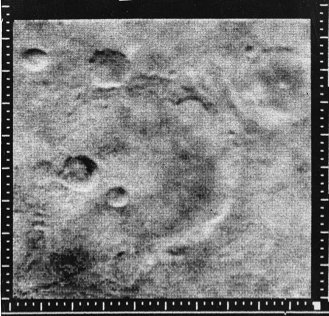
The odds of finding life on Mars seemed pretty good — until 1965, when Mariner 4 sent back images of craters, detected no planetary magnetic field, and surface atmospheric pressure of 4.1 to 7.0 millibars, 410 to 700 pascals.

Earth’s atmospheric pressure at sea level is right around 101,325 pascals.

Orbiters found river channels and evidence that water once flowed on Mars. But that was a long, long time ago. Some water is still there, in the polar ice caps, and maybe deep underground.

Data from the Mars Odyssey orbiter shows that radiation on the Martian surface is about two and a half times higher than at the International Space Station. That’s not surprising, with the planet’s thin atmosphere and virtually nonexistent magnetic field.

Astronauts could visit Mars in the 2030s, if NASA’s plans hold up. Other nations have have plans for Mars: including India, whose Mangalyaan orbiter started surveying Mars September 24, 2014.

We’ll still be a long way, I think, from permanent Martian settlements.

But much of the tech developed for the first human missions should serve as prototypes for Martian habitat systems.

I think Jeffrey A. Hoffman and Elon Musk are right. The question isn’t if some of us move to Mars: it’s when we start.5

These Are The 2 Big Hurdles To Setting Up A Mars Colony
Jessica Orwig, Business Insider (January 15, 2015)

“Mars is a frozen wasteland devoid of life, liquid water, and breathable atmosphere. So why are companies like SpaceX and Mars One so bent on colonizing such unfriendly territory?

” ‘Human beings have always looked to expand the territory that we can live in,’ former NASA astronaut Jeffrey A. Hoffman told Business Insider. We spoke with Hoffman at BBC FUTURE’s World-Changing Ideas Summit about what it will take to colonize Mars. ‘You’ll find people who are willing to go and live there because they can.’…”

Huge Mars Colony Eyed by SpaceX Founder
Seeker.com (December 13, 2012)

“…He also estimated that of the eight billion humans that will be living on Earth by the time the colony is possible, perhaps one in 100,000 would be prepared to go. That equates to potentially 80,000 migrants….

“…’Some money has to be spent on establishing a base on Mars. It’s about getting the basic fundamentals in place,’ Musk said. ‘That was true of the English colonies [in the Americas]; it took a significant expense to get things started. But once there are regular Mars flights, you can get the cost down to half a million dollars for someone to move to Mars. Then I think there are enough people who would buy that to have it be a reasonable business case.’…”

4. An Expanding Universe: New Data, More questions


(From NASA/ESA, via BBC News, used w/o permission.)
(“Galaxy UGC 9391: We still have much to learn about the ‘dark’ components of the Universe”
(BBC News))

Gaia clocks speedy cosmic expansion
Jonathan Amos, BBC News (September 23, 2016)

Europe’s Gaia space telescope has been used to clock the expansion rate of the Universe and – once again – it has produced some head-scratching.

“The reason? The speed is faster than what one would expect from measurements of the cosmos shortly after the Big Bang.

“Some other telescopes have found this same problem, too.

“But Gaia’s contribution is particularly significant because the precision of its observations is unprecedented….”

I knew a Christian who said our sun goes around Earth, not the other way around, because ‘the Bible says so.’ He had a point, given a completely poetry-free reading of Joshua 10:1213.

“The pillars of the earth” and “the mighty dome of heaven” are “Biblical,” too. But oddly enough, I’ve yet to meet a Christian who insists that we live under a big dome, on a flat plate supported by pillars. (1 Samuel 2:8; Job 9:67; Psalms 150:1)

Folks living around the Mediterranean’s east end thought of our home as flat at least 10 millennia back now. So did folks living in India, and that’s yet again another topic.

Somewhere between 26 and 24 centuries ago, Greek philosophers realized that their data made more sense if they assumed Earth was a sphere.

Aristotle gets credit for demonstrating that Earth is spherical, and a five-element theoretical model that held up until the 17th century, when Hennig Brand and Robert Boyle independently isolated phosphorus.

Quite a few folks in Europe were still reeling from the shock of discovering that Aristotle didn’t know everything, coming to conclusions which didn’t always make sense. I’ve talked about Albertus Magnus, Copernicus, and getting a grip, before. (July 29, 2016)

Around that time, Johannes Kepler came to the same conclusion that Thomas Digges had, back in the 1500s; and I’m getting ahead of myself.

Dark Sky Paradox and an Infinite Universe

On a clear night, folks can see lots of stars: and a whole lot more dark between stars.

That’s impossible: if stars are infinitely old, and distributed evenly through an infinite universe. No matter where we look, we’d be looking at the surface of a star.

Since there’s more dark than star in Earth’s night sky, there’s something wrong with that picture.

Olber’s paradox is named after Heinrich Wilhelm Matthias Olbers, who described the dark sky paradox in 1823.

I’d be surprised if the Lambda-CDM model of the Big Bang theory is the definitive, spot-on-accurate, final word in how this universe works; but right now it’s the best we’ve got.

Some physicists say what we’re observing at sub-atomic scales makes more sense if we assume that there’s more than one universe, and that’s still another topic.

A Cosmos Loaded with Puzzles


(From University of Virginia, via BBC News, used w/o permission.)

  • “As the Earth goes around the Sun, relatively nearby stars appear to move against the ‘fixed’ stars that are even further away
  • “Because we know the Sun-Earth distance, we can use the parallax angle to work out the distance to the target star
  • “But such angles are very small – less than one arcsecond for the nearest stars, or 0.05% of the full Moon’s diameter
  • “Gaia will make repeat observations to reduce measurement errors down to seven micro-arcseconds for the very brightest stars
  • “Parallaxes are used to anchor other, more indirect techniques on the ‘ladder’ deployed to measure the most far-flung distances”

(Jonathan Amos, BBC News)

My hat’s off to Jonathan Amos for that explanation of how astronomers measure parallax. I talked about the first map from Gaia data two weeks ago. (September 16, 2016)

Where was I? Cosmology, Aristotle, parallax. Right. These scientists have been fine-tuning parallax measurements for Cepheid variables:

Cepheid variables are stars that pulse, which isn’t unusual by itself. Our star goes through an 11-year, or 22-year, cycle, depending on what you’re measuring.

Make that an approximately 11 or 22 year cycle. The cycles aren’t always the same length, there was the Maunder Minimum, and I’m wandering off-topic.

What makes Cepheid variable special is that they pulse very regularly, and the rate of their pulse is closely linked to their brightness. That makes them dandy for measuring distances. I put an unnecessarily-long link list near the end of this post.6

If these scientists are right, this universe isn’t 13,799,000,000 years old — plus or minus 21,000,000 years.

It may be 100,000,000 or so years younger.

That doesn’t affect my daily routine at all, but it’s important to scientists who are trying to work out exactly how fast this universe is expanding, why the rate of expansion seems to be increasing, and what’s powering the expansion.

What we know and can guess about dark matter, dark energy, and the rest of observable reality, is almost certainly nowhere near the complete picture.

It’s as if God created a cosmos loaded with puzzle games for us to solve.

Somewhat-related posts:


1 On 26 November 1922, archeologist Howard Carter made a small hole in a sealed doorway and looked through, using a candle for illumination. His patron, Lord Carnarvon, asked “Can you see anything?” Carter replied — “Yes, wonderful things!”

More:

2 Europa, Jupiter’s moon; Enceladus, Saturn’s moon; life; and science:

3 Emotion and reason:

4 Being human, background and outlook:

5 Looking up and ahead:

6 More about measuring the universe:

Posted in Science News | Tagged , , , , , , , , , , | 6 Comments

Amos and Social Justice

I think social justice is a good idea.

I’d better explain that.

I think acting as if people matter is a good idea: all people, not just the ‘right’ ones.

I’ll be talking about “the poor of the land,” private property, the universal destination of goods, and a job that’s not even close to being done.

There’s nothing wrong with prosperity, by itself. As 1 Timothy 6:10 and Hebrews 13:5 say, it’s love of money that gets us in trouble.

Some Saints, like Francis1 and Claire, both of Assisi, were poor. Others, like Elizabeth of Hungary and Sir Thomas More, were anything but.

What makes them Saints is that they “practiced heroic virtue and lived in fidelity to God’s grace.” (Catechism of the Catholic Church, 828)

They had their priorities straight — God first, everything else second. (Luke 10:27; Catechism, 2083)

Differences

Personal wealth or poverty don’t matter, apart from providing different opportunities and obstacles. What matters is how we decide to use what we’ve got.

We’re all different: rich, poor, strong, weak, smart, not-so-smart. That’s a good thing, or should be.

Our “talents” are different, so we can share with others who need our wealth, skill, openness, or other qualities. (Catechism, 1936-1937)

Amos 6:1A, 47 and Amos 8:47 led off readings at Mass last week and today. Today’s ends with Luke 16:1931, our Lord’s story about Lazarus and the rich man.

Destroying the Poor, the Rat Race, and Me

Adad-nirari III’s death was bad news or good news: depending on whether you’re looking at the Neo-Assyrian Empire’s ambitions, or prosperity in places like Urartu, Judah, and Israel.

Like I said earlier, prosperity isn’t bad. What matters is how we deal with good times, which brings me to last week’s rant from Amos.

“Hear this, you who trample upon the needy and destroy the poor of the land!

1 ‘When will the new moon be over,’ you ask, ‘that we may sell our grain, and the sabbath, that we may display the wheat? We will diminish the ephah, add to the shekel, and fix our scales for cheating!

“We will buy the lowly man for silver, and the poor man for a pair of sandals; even the refuse of the wheat we will sell!’

2 The LORD has sworn by the pride of Jacob: Never will I forget a thing they have done!”
(Amos 8:47)

Quite a bit’s changed in the 27-plus centuries since Amos lived: but some folks still put gaining and keeping wealth at the top of their priorities list.

It was a bad idea then, and still is.

Many Americans enjoyed the seemingly-secure middle class lives of the Cleavers and Andersons while I was growing up.

My parents remembered that there’s more to life than wealth: so I never considered running away to a commune.

On the other hand — I didn’t, and don’t, have the horror that some older folks had for places like Drop City.

I think I understand why some kids from affluent families decided that buying stuff you don’t need with money you don’t have to impress people you don’t like — made no sense at all.

I came to the same conclusion, and opted out of the rat race.

‘Those crazy kids,’ with their ‘un-American’ talk about peace, love, and brotherhood, seemed to take at least some of our Lord’s values seriously — a sharp contrast with venom-spitting radio preachers of the day.

Their tirades against commies, Catholicism, and rock music, helped me learn to love rock ‘n roll, eventually helped me become a Catholic, and that’s another topic.

The Universal Destination of Goods

Communal living isn’t a new idea:

“All who believed were together and had all things in common;

“they would sell their property and possessions and divide them among all according to each one’s need.”
(Acts 2:4445)

Forsaking worldly goods and living apart is an option, not a requirement. But there’s a long tradition of monks and hermits who took that path. The vowed, folks in religious orders, chose one of the three kinds of vocation. (Catechism, 871-873)

Most of us are part of the lay faithful: folks who “…participate in their own way in the priestly, prophetic, and kingly functions of Christ….” (Catechism, Glossary)

Ownership of private property should be part of our life. (Catechism, 2211)

Private property is a good idea: it helps maintain our freedom and dignity, and gives a measure of security. But the right to private ownership isn’t absolute.

That’s because this world is God’s gift to humanity: all of us, not just whoever has the biggest club, or owns the most corporate stock. (Genesis 1:2731; Catechism, 2402-2404)

“The universal destination of goods” is what we call the idea that God gave humanity stewardship of this world’s resources: for our reasoned use. (Catechism, 2401-406)

Divvying up those resources gives each of us a particular job: managing what we have, for ourselves and others; including future generations. (Catechism, 2402-2406, 2415)

That’s where justice and charity come in — or should. Differences in abilities and wealth aren’t the problem: misusing these differences is. (Catechism, 1937-1938)

Social Justice

In a perfect world, social justice wouldn’t be an issue. Everyone would help maintain “the fair and just relation between the individual and society.” (Wikipedia)

This isn’t a perfect world; so achieving that balance, let alone maintaining some approximation of balance, has been a challenge: and still is.

Philosophers like Plato and Aristotle generally get credit for first discussing justice, rights, and society, about two dozen centuries back.

But leaders like Hammurabi started writing law codes more than a thousand years before Plato and Aristotle.

Babylonian law defined justice as balancing an offense with an equally-severe punishment: by Babylonian standards. Law #22 in the Code of Hammurabi balanced robbery with the death penalty.

That may seem harsh — partly, I think, because we’ve made some progress in the last 3,700 years toward building truly just societies.

And we have a great deal more work to do in that direction.

The phrase “social justice” apparently comes from Catholics like Luigi Taparelli — in the 1840s.

Taparelli’s “Civiltà Cattolica” says that capitalist and socialist theories don’t pay enough attention to ethics. I’m inclined to agree with him.

One of my happy surprises after becoming a Catholic was discovering that social justice, Catholic style, makes sense.

Catechism of the Catholic Church, 1928-1942, is a pretty good place to start learning about the Church’s social teachings. I put links to more resources at the end of this post.2

I keep saying this — I should love God, love my neighbors, see everybody as my neighbor, and treat others as I want to be treated. (Matthew 5:4344, 7:12, 22:3640, Mark 12:2831; Luke 6:31 10:2527, 2937)

I’ve mentioned why I take our Lord seriously before, too. (September 11, 2016; August 14, 2016)

If I thought a perfect society existed in 1950s or 1860s America, or 11th century Europe, I’d demand the suppression of comics, a return to bustles, or the re-union of England, Daneland, Norge, and part of today’s Sweden.

We’ve had ups and downs in the 52 centuries since folks started keeping records in Sumer, but even the best eras weren’t a “golden age.”

Besides, we can’t turn back the clock. The only direction we can go is forward.

And that’s okay.

Real Progress and Taking the Long View


(“Coppernia city,” Jaime Jasso, used w/o permission.)

Like I keep saying; the Catholic Church is catholic, καθολικός, universal, not tied to one era or one culture.

For two millennia, we’ve been passing along the same message: God loves us, and wants to adopt us. All of us. (Ephesians 1:35; John 3:17; Catechism, 52, 1825)

Part of our job is building a better world, one with a greater degree of justice and charity: and respect for “the transcendent dignity of man.” (Catechism, 1928-1942, 2419-2442)

That includes freedom to worship: freedom for everyone. I can hardly expect others to respect my right to worship, if I try forcing them to agree with me: or heap abuse on those who are not just like me. (Catechism, 1738, 2104-2109, 2357-2359)

If we help others keep what is good and just in our society, change what is not, and act as if we really believe that loving our neighbors makes sense: we can make a difference.

It will be a long, hard job. Folks can’t be forced to embrace truth: particularly when it means giving up some cherished injustice, or long-established privileges. We must be patient.

But truth wins — eventually. Slavery, for example, had been a way of life for millennia. Laws regarding slaves show up in the law codes of Ur-Nammu and Hammurabi, and Roman law.

Treating a neighbor as property is wrong. So is genocide and torture. Using God as an excuse makes the offense worse. Lots worse. (Catechism, 2148, 2297-2298, 2313, 2414)

After two millennia of passing along principles like “love God, love your neighbor, everybody’s our neighbor,” slavery became illegal in several countries. More remarkably, I think, it became unpopular — or at least unfashionable.

A few generations later, the United Nations made genocide illegal. It’s a step in the right direction.

Some Christians behaved abhorrently, and some folks who aren’t Christians are helping end slavery and genocide.

The point is that after two millennia, we’re making real progress toward ending two ancient social evils.

Maybe, if we keep working with all people of good will, somewhere around the 42nd century we’ll have an “international authority with the necessary competence and power” to resolve conflicts without war. (Catechism, 2307–2317; “Gaudium et Spes,” 79 § 4)

And we’ll still have work to do. Humanity has a huge backlog of unresolved issues.

Some of my take on why love should matter:


1 St. Francis of Assisi was poor, but he didn’t write about it much:

2 More about social justice:

Posted in Being Catholic | Tagged , , , , , , , , , | 6 Comments

The Minden Monster, What Killed Lucy

The ‘Minden Monster,’ a whacking great carnivore that lived about a hundred million years before T. Rex, is in the news again. Studying it will help scientists work out details of megalosaur development.

I’m fascinated by that sort of thing. Your experience may vary.

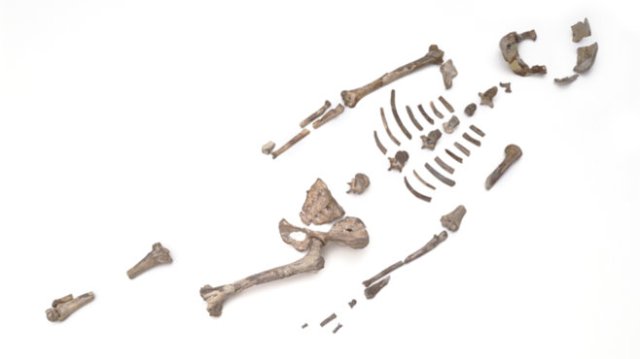
Other scientists think they know what killed Lucy, our name for a famous Australopithecus afarensis skeleton. It looks like Australopithecus afarensis was a little more at home in trees than we are.

  1. The Minden Monster
  2. What Killed Lucy?

But first, (quite) a few words about Adam, Eve, and getting a grip.


Adam and Eve aren’t German

We are created in the image of God, male and female. Each of us is a person: not something, but someone; made from the stuff of this world, and filled with God’s ‘breath:’ matter and spirit, body and soul. (Genesis 2:7; Catechism of the Catholic Church, 355, 357, 362368)

That doesn’t mean that the first of us looked pretty much like Albrecht Dürer’s 1504 engraving.

I read Genesis 1:12:4 and 2:425 as an explanation of God’s role in our existence: among other things. As far as I’m concerned, all that’s changed in the last few centuries is how much we know about the “clay” God used.

A Great Deal Left to Learn

Humanity’s family history is nowhere near as simple as folks figured when Carl Linnaeus published “Systema Naturae” in 1735.

I learned about hominids when that term didn’t mean quite what it does today, and didn’t run into “hominin” until fairly recently.

Around the 1960s, when I was in high school, scientists were rethinking primate taxonomy: again.

Carl Linnaeus set up a taxonomic system that’s still in use — with considerable tweaking. Taxonomy is what we call classifying organisms: and by extension, anything else that’ll sort out in a nested hierarchy.

Folks like Anaximander and Empedocles speculated that today’s critters — humans included — had changed since the world’s beginning. Folks like Pierre Louis Maupertuis and Louis Leclerc, Comte de Buffon wrote about more-or-less-systematic change in the 1700s.

Comte de Buffon also used experimental data to estimate Earth’s age. He was wrong by several orders of magnitude: but in the 1700s it was a good educated guess. (August 28, 2016)

Charles Darwin didn’t single-handedly start the idea that organisms change in a rational way: but his “On the Origin of Species” (1859) was an important contribution to evolutionary theory. It also dropped “evolution” into popular culture.

We’ve learned quite a bit since then, much of it in my lifetime: and there’s a great deal left to learn.

“Even Greater Admiration”

Like I said, over the last few centuries we’ve learned that Earth — and the universe — is much older than we’d thought.

I’m okay with that, and even if I wasn’t: it wouldn’t matter.

“Our God is in heaven; whatever God wills is done.”
(Psalms 115:3)

As my father once told me, ‘at a certain level of authority, argument becomes pointless.’

I figure my job is appreciating God’s handiwork: not telling the Almighty how it should have been designed.

That’s because there is not an 11th Commandment against using the brains God gave us.

Science and technology, studying this wonder-filled universe and using what we learn to develop new tools, is okay. (Catechism, 22932295)

Scientific discoveries are invitations “to even greater admiration for the greatness of the Creator.” (Catechism, 283)

Honest and methodical study of this wonder-filled creation cannot interfere with an informed faith, because “the things of the world and the things of faith derive from the same God.” (Catechism, 159)

What we learn sometimes obliges us to reexamine preconceived notions: but I’m okay with that.

Faith isn’t reason: but it’s reasonable, and certainly not against an honest search for truth. (Catechism, 3135, 159)

“Ontogeny Recapitulates Phylogeny” — Almost, Sort Of


(From G. J. Romanes, via Wikimedia Commons, used w/o permission.)
(G. J. Romanes’ 1892 copy of Ernst Haeckel’s ‘recapitulation’ illustration.)

Some of my high school science textbooks talked about Haeckel’s “ontogeny recapitulates phylogeny” theory. It’s the idea that an embryo goes through the critter’s entire evolutionary history. It’s not quite accurate, but there’s some truth to it.

Every tetrapod, for example, has pharyngeal arches as an embryo. Tetrapods are vertebrates with four limbs: amphibians, birds, mammals, and reptiles.

Fish are vertebrates, but not tetrapods. Their pectoral and pelvic fins correspond to our arms/wings/forelimbs and back legs.

Depending on how you look at them, Sarcopterygii, lobe-finned fish, are a clade of fish; or a really early model of tetrapod. The only lobe-finned fish around these days are coelacanths and lungfish.

Getting back to pharyngeal arches, I had them when I was about four weeks old. By the time I was born the first arch had developed into my upper and lower jaws and hard palate. In fish, pharyngeal arches become branchial/gill arches.

Apparently Haeckel was trying to combine Jean-Baptiste Lamarck’s idea that critters pass traits they picked up to their offspring1 and Goethe’s Romantische Naturphilosophie with Darwin’s theory.

Folks like Karl Ernst von Baer and Wilhelm His, Sr., didn’t believe Haeckel’s theory, and thought his drawings weren’t accurate.

Turns out that they were right.

“Intricate and Quirky”


(From Ernst Haeckel, via Wikimedia Commons, used w/o permission.)
(Ernst Haeckel’s 1868 illustration in “Natürliche Schöpfungsgeschichte,” showing similarities between embryos of a dog (hund) and human (mensch).)

Haeckel’s illustrations are more nearly accurate than Percival Lowell’s maps of Mars: but Haeckel apparently de-emphasized features that didn’t agree with his theory — while his critics emphasized those features in their drawings.

I figure Haeckel believed that he was drawing what he was observing, and compensating for limitations of available technology: a reflecting microscope.

Haeckel could, in principle, have used micrography for his research. But let’s remember that this was the 19th century.

Alfred Donné took the first photomicrographs in 1839, using the daguerrotype technique. The microscope ‘photo-électrique’ was available by 1845: but it was still an emerging technology.2

Haeckel was right, too, but we’ve learned that life is a whole lot more “intricate and quirky:”

“…Embryos do reflect the course of evolution, but that course is far more intricate and quirky than Haeckel claimed. Different parts of the same embryo can even evolve in different directions. As a result, the Biogenetic Law was abandoned, and its fall freed scientists to appreciate the full range of embryonic changes that evolution can produce — an appreciation that has yielded spectacular results in recent years as scientists have discovered some of the specific genes that control development.”
(“Early Evolution and Development: Ernst Haeckel,” The History of Evolutionary Thought, Understanding Evolution, U. C. Berkeley)


1. The Minden Monster


(From Joschua Knüppe, via Phys.org, used w/o permission.)
(“Artist’s impression of W. albati. The dinosaur is shown together with other organisms whose fossil remains were recovered in the same locality.”
(Phys.org))

A Middle Jurassic monster put in its taxonomic place
Phys.org (September 1, 2016)

An analysis of the fossil known as the Minden Monster has enabled paleontologists to assign the largest predatory dinosaur ever found in Germany to a previously unknown genus, among a group that underwent rapid diversification in the Middle Jurassic.

“This huge dinosaur dates to about 163 million years ago, in the Middle Jurassic. And it is not only the first carnivorous dinosaur from this period to be unearthed in Germany, it is also the largest ever found in the country: Based on the remains so far recovered, the specimen is estimated to have been between 8 and 10 meters in length. In comparison with other carnivorous dinosaurs, the animal was very sturdily built, weighed more than 2 tons – and was probably not fully grown when it died.

“…The first fossilized bones and teeth were discovered in 1999 during a routine surface survey in an abandoned quarry in the Wiehengebirge, a range of low hills south of Minden. Although the fossil clearly represents a terrestrial form, the remains were embedded in marine sediments. It is however known that, in the Middle Jurassic, large areas of what is now Central Europe lay below sea level, and the shallow waters of this sea were dotted with islands….”


(From I. West, R. Gallois, R. Blakey, used w/o permission.)
(Much of Europe was an archipelago during the Middle Jurassic.)

Earth has changed quite a bit since it formed, which still upsets some folks.

Pangea, our name for a continent that formed some 300,000,000 years back, was splitting into Laurasia (north) and Gondwana (south) during the Middle Jurassic. Ichthyosaurs had been joined by pliosaurs.

Cynodonts were skittering around, sharing territory with dinosaurs — don’t bother trying to memorize those names, there won’t be a test on this.

Das Monster von Minden, “the Minden Monster,” is probably easier to remember than Wiehenvenator. That’s the predatory megalosaurid theropod dinosaur from the article.

Theropods are still around, but a whole lot smaller than in their heyday. The biggest living theropod is the ostrich.

Megalosaurs showed up in the Middle Jurassic. They’re not as famous as Tyrannosaurus Rex, but many were as big or bigger than T. Rex — which flourished about a hundred million years later.

We still don’t know why so many carnivores were so much larger then.

The Minden Monster is a big deal to scientists because dinosaurs like it were rapidly diversifying during the Middle Jurassic.

Part of the article I didn’t quote mentions phylogenetic analysis, which isn’t just about genetics. Phylogenetics studies how critters are related to each other: sort of like an evolutionary family tree. That’s probably why a phylogeny is called a phylogenetic tree.

Phylogenetics is a fairly new discipline. The word goes back to 1866, when Ernst Haeckel wrote about “Phylogenie” and his recapitulation theory; and I talked about that earlier.

I put links to more ‘Minden Monster’ information near the end of this post.3


2. What Killed Lucy?


(From Science Photo Library, via BBC News, used w/o permission.)
(“Lucy is one of the oldest and most complete fossils of any human ancestor”
(BBC News))

Early human ancestor Lucy ‘died falling out of a tree’
Jonathan Webb, BBC News (August 29, 2016)

New evidence suggests that the famous fossilised human ancestor dubbed “Lucy” by scientists died falling from a great height – probably out of a tree.

“CT scans have shown injuries to her bones similar to those suffered by modern humans in similar falls.

“The 3.2 million-year-old hominin was found on a treed flood plain, making a branch her most likely final perch.

“It bolsters the view that her species – Australopithecus afarensis – spent at least some of its life in the trees….”

Australopithecus afarensis is our name for a hominin species — I talked about taxonomy earlier, and put a mess of resource links near the end of this post.4 They lived in eastern Africa between 3,900,000 and 2,900,000 years ago.

Or maybe it’s who lived: I don’t think we can tell whether Lucy was a critter who looked a lot like us, or a person who’d have a terrible time trying to fit in today.

We’ve been learning that life is very modular on the sub-cellular level, which makes horizontal gene transfer possible, and that’s another topic.

We’ve also learned that there’s less than a 2% difference between human and chimpanzee genes. That doesn’t make us chimps, or chimps human, though. The chimp-human genetic difference is about 20 times the difference between any two humans.

Scientists have found 23 genes in our genome that aren’t in any other primate: including SRGAP2C.

This particular genetic module apparently goes back about 3,4000,000 years: and it’s one of 23 that are uniquely human.

We’re Wired Differently

Anatomically modern humans, humanity’s current model, don’t just have an oversized brain. Our version of the SRGAP2 gene helps determine how our brains are wired. Among other things, it boosts the density of dendritic spines.

We’re wired differently: which I think helps explain why we’re so good at making flint arrowheads, steam engines, and cochlear implants.

All mammals have the SRGAP2 gene. Our version’s prototype showed up some 3,400,000 years back: very roughly 200,000 years before Lucy lived and died. Does that make her “human,” a person? I don’t know.

Fall From a Height


(From John Kappelman, UT Austin, via BBC News, used w/o permission.)
(“The team reconstructed how the various injuries could have occurred”
(BBC News))

“…’We weren’t there – we didn’t see it – but the subset of fractures that we’ve identified are fully consistent with what’s reported in a voluminous orthopaedic surgical literature about fall victims who have come down from height,” said lead author John Kappelman from the University of Texas at Austin.

” ‘It’s tested every day in emergency rooms all around the planet.’

“Discovered in Ethiopia’s Afar region in 1974, Lucy’s 40%-complete skeleton is one of the world’s best known fossils. She was around 1.1m (3ft 7in) tall and is thought to have been a young adult when she died.

“Her species, Australopithecus afarensis, shows signs of having walked upright on the ground and had lost her ancestors’ ape-like, grasping feet – but also had an upper body well-suited to climbing….”Jonathan Webb, BBC News)

My knee-jerk reaction to “…an upper body well-suited to climbing…” was the thought that whoever wrote it hadn’t seen, or didn’t remember, kids on a jungle gym.

Humans spend most of our time on the ground: but we can climb pretty well.

Then I did a little checking. Sure enough, Australopithecus afarensis had longish arms, compared to today’s model; and their shoulder joints were mounted higher than ours. Both features would make climbing trees easier.

On top of that, scans show that their bony labyrinth, housing their semicircular canals, wasn’t optimized for walking upright. They most likely were more at home in trees than we can be, and maybe a bit less steady on their feet.

Tools and Being Human


(From The Earth Institute, Columbia University, used w/o permission.)
(Anatomically modern humans at the Lomekwi dig in Kenya holding 3,300,000 year old tools made by someone else.)

We’ve been learning that quite a few non-human animals use tools, but it’s still a very “human” thing.

Someone was using stone tools in Lucy’s part of the world about 3,300,000 years ago: roughly 100,000 years before her day.

They weren’t particularly efficient tools, certainly not up to the standard we expect to see in Lowe’s: but that “human brain” gene had been around a hundred thousand years by then. My guess is that they were used by someone: not something.

On the other hand, we’ve changed in the 3,200,000 years since Lucy lived.

Brains and Speculation

As I said earlier, she’d have a terrible time trying to fit in today.

For starters, she was 1.1 meters, three feet, seven inches, tall.

She’d be looking up at just about everyone, since her eyes would be only slightly above the top of your typical cummerbund.

The view would be — strange. Our heads, compared to her family’s, have ‘too much’ forehead and nowhere near enough face.

‘Human brain’ gene or not, her head had room for about a third of the neural circuitry we use. There’s more to intelligence than brain size: but my guess is that she’d have trouble passing the ACT or SAT.

Scientists are still wrapping their minds around the idea that Neanderthals may have buried their dead with as much care as the British.5 We know much less about the folks whose bones were interred, or just happened to end up, in Rising Star Cave. I won’t be surprised if we learn that burial customs go further back than folks who look like us.

That might explain why there’s only one mark on her bones from a carnivore’s tooth. That’s not typical of a body left in the open.

If Lucy’s people were people, and even remotely like us, they’d have noticed when she didn’t return from whatever errand she was on. As the University of Texas at Austin’s John Kappelman said — “We weren’t there – we didn’t see it….” But I suspect that we found so many of Lucy’s bones because someone found her body, and brought it home for burial.

Then again, maybe not. We don’t know.

More of our continuing search for knowledge, and why I think that’s okay:


1 Maybe you’ve read that August Weismann and 68 white mice finally demonstrated that Lamarckism didn’t work. Folks have pointed out that amputating a mouse’s tail is hardly a case of “disuse,” but we’ve learned that Gregor Mendel was on the right track.

2 Background:

3 Stuff you don’t need to know about:

4 Australopithecus afarensis, human evolution, and all that:

5 Neanderthal burial practices are still debated. Some scientists say evidence of flowers buried with the Shanidar IV skeleton indicate ritual burial. Others insist that it can’t be so, since the evidence might have been planted by rodents. I think we’re still not certain: but that Neanderthals have been looking more ‘human,’ the more we learn about them.

I suspect we’re still getting over the old “caveman” image:

“Neanderthal reconstruction by F. Kupka, Illustrated London News, 1909. This reconstruction has practically become iconic as an example of the bias of early-twentieth-century understanding of Neanderthals.”
(Caption for František Kupka’s illustration, “Seven Skeletons: The Evolution of the World’s Most Famous Human Fossils,” p. 32, Lydia V. Pyne (2016) via Google Books.)

Posted in Science News | Tagged , , , , | 12 Comments

Shopping Center Attack: Why I Care

Saturday night’s attack in a St. Cloud shopping center was uncomfortably close to home. Crossroads Mall is about an hour down the road from where I live, and a place I’ve enjoyed visiting.

Only one person died, the attacker: a 22 year old St. Cloud-area student.

  1. Death in a Shopping Center
  2. “Let’s Spread Love, not Hate”

Caring About Human Life

The incident hasn’t exactly been headline international news, but the attention it’s gotten is impressive, considering what else has been going on:

Getting back to what happened in St. Cloud, I’m still upset about the attack: and sorry that the attacker is dead. That, I’d better explain.

I believe that human life is sacred: all human life. Each of us has equal dignity: no matter where we are, who we are, or how we act. (Catechism of the Catholic Church, 360, 17001706, 19321933, 1935, 2258)

Murder, deliberately killing an innocent person, is wrong. (Catechism, 22682269)

Maybe the young man didn’t really mean to kill anyone: but what he was doing with a knife apparently looked like murderous attacks. I can’t say that I am sorry that his attacks were stopped.

But I do regret that he is dead.

His actions disturbed his community, which is uncomfortably close to mine. If he had lived, it’s possible that he could have made some reparation, “paying” in some way for his actions; and helping to heal his community.

One of these days I’ll talk about justice, the common good, and all that. But not today. (Catechism, 19051912)

Why should I care? Like I keep saying: I should love God, love my neighbor, see everybody as my neighbor, and treat others as I’d like to be treated. (Matthew 5:4344, 7:12, 22:3640, Mark 12:2831; Luke 6:31, 10:2527, 2937; Catechism, 1789)

Somali-Americans and Leviticus

He was a Somali-American, born in Kenya. There’s been a civil war in Somalia since around 1990, which encouraged many families to get out while they were still alive. Many of them came to America — mostly Minnesota.

Some will probably decide to move back, when and if things settle down in the old country. I hope some decide to stay: if for no other reason than that I haven’t had a chance to try their coffee yet.

Part of my attitude toward Somali-Americans comes from my family background and personal experience. But even if I wasn’t inclined to accept folks who don’t look and act exactly like me: I’d be obliged to cultivate that acceptance:

“The more prosperous nations are obliged, to the extent they are able, to welcome the foreigner in search of the security and the means of livelihood which he cannot find in his country of origin. Public authorities should see to it that the natural right is respected that places a guest under the protection of those who receive him.

“Political authorities, for the sake of the common good for which they are responsible, may make the exercise of the right to immigrate subject to various juridical conditions, especially with regard to the immigrants’ duties toward their country of adoption. Immigrants are obliged to respect with gratitude the material and spiritual heritage of the country that receives them, to obey its laws and to assist in carrying civic burdens.”

(Catechism, 2241)

An ‘open door’ immigration is not a new idea:

“You shall not oppress an alien; you well know how it feels to be an alien, since you were once aliens yourselves in the land of Egypt.”
(Exodus 23:9)

” ‘When an alien resides with you in your land, do not molest him.

“You shall treat the alien who resides with you no differently than the natives born among you; have the same love for him as for yourself; for you too were once aliens in the land of Egypt. I, the LORD, am your God.”
(Leviticus 19:3334)

“For I was hungry and you gave me food, I was thirsty and you gave me drink, a stranger and you welcomed me,”
(Matthew 25:35)

About Catechism, 22682269, and the newcomer’s obligation “to obey its laws and to assist in carrying civic burdens” — it looks like many Somali-Americans in St. Cloud are as upset about the young man’s actions as I am.

More so, since they’re still at the stage my ancestors were, just a few generations back: trying to convince ‘regular Americans’ that they’re new neighbors, not threats. More of that below, under “Let’s Spread Love, not Hate”.


1. Death in a Shopping Center


(From AFP, via BBC News, used w/o permission.)
(“Dahir A Adan had been in the US for 15 years, his father said”
(BBC News))

Minnesota mall knifeman was student, says father
BBC News (September 19, 2016)

A knifeman who stabbed nine people at a Minnesota shopping centre at the weekend has been identified by his father as a 22-year-old student.

“Dahir A Adan is a Kenyan-born ethnic Somali who had been in the US for 15 years, his father told the Minneapolis Star Tribune.

“He said he had ‘no suspicion’ that his son was involved in extremist activity….

“…The Islamic State group claimed responsibility. Rasd, a news agency linked to the group, claimed on Sunday the Minnesota attacker was a ‘soldier of the Islamic State’.

“The attacker, who was dressed in a security uniform and carrying what appeared to be a kitchen knife, reportedly made at least one reference to Allah and asked a victim if he or she was Muslim before attacking, said police.

“Adan had been working as a security guard for the mall’s Electrolux Home Products store, according a company spokeswoman….”

We still don’t, as far as I’ve read, know why Dahir1 A Adan decided to attack those folks. What does seem clear is that he cut or stabbed several people at a shopping mall, and was killed by an off-duty police officer.

I’m sorry that those folks got hurt, and that young Mr. Adan is dead. But I’m not going to denounce Crossroad Mall for inciting violence against shoppers, or call for stronger anti-knife legislation.

There’s been enough craziness this year:

“The Least Force Necessary”

I went over legitimate defense on September 11, 2016.

I’m allowed to avoid or resist the attack; using the least force necessary. The same principle applies to groups of people. (22632267, 23072317)

Ideally, someone would have found a way to restrain Dahir A Adan, not kill him. But everything I’ve read says that he started this mess, attacking folks with a knife.

I’m not going to criticize someone for protecting innocent shoppers: particularly since a knife, even a “kitchen knife,” can be a lethal weapon. It’s a wonder that more folks didn’t end up hospitalized.

Non-lethal weapons have been moving out of pulp science fiction and into research and development. But even those are controversial, and that’s another topic.


2. “Let’s Spread Love, not Hate”


(From Jared Goyette, via The Guardian, used w/o permission.)
(“Somali-American leaders hold a press conference in St Cloud, Minnesota, to address the mass stabbing attack of Saturday night.”
(The Guardian))

Somali-American leaders speak out in press conference
Ben Rodgers, St. Cloud Times (September 18, 2016)
(Includes video)

A group of St. Cloud Somali-American leaders, as well as other community leaders, spoke out in a nationally televised press conference on Sunday afternoon at Lake George.

“The press conference came after an incident Sunday night involving a stabbing attack at the Crossroads Center in St. Cloud. The community leaders used it as an opportunity to stress the attack was perpetrated by a single individual, that it does not represent the Somali-American and Muslim community and to express support for the victims….

“…Mohamoud Mohamed, executive director of the St. Cloud Area Somali Salvation Association: ‘They are minorities in our faith that are misusing the credibility of our faith. Islam is peace.’

Lul Hersi, member of the St. Cloud Somali-American community: ‘Let’s unite as one Minnesota. Let’s take love instead of hate. Let’s preach the good of us, not the bad that happens just once in a while. … I said last night, not in St. Cloud. That is what I told my kids, not in St. Cloud. I hope my neighbors, my co-workers, my friends, my community member, my elders and other take this to heart. Let’s spread love, not hate.’

The Rev. Randy Johnson, pastor at First United Methodist Church: ‘As Christian leaders we have come to gather with our brothers and sisters who are Muslims on this day to say the work will continue. That peace is our goal and we will continue together to make this a community that is known throughout this nation as a community that never quits working for peace.’…”

The press conference isn’t the highest-profile item around, no surprise considering how much else has been happening, but it’s getting a bit of attention:

Some of the bad news is good news, sort of, from the ‘you’re known by the enemies you make’ viewpoint —

“…Jaylani Hussein, the executive director for the Minnesota chapter of the Council of American-Islamic Relations, said central Minnesota has a history of anti-Muslim organizing. He pointed to a string of incidents dating back years, including visits by well-known anti-Muslim speakers and a recent billboard, eventually removed, that read ‘Catholic Charities Resettles Islamists, Evil or Insanity.’…”
(Associated press, via ABC News)

I don’t know which “Catholic Charities” the billboard folks had in mind. There’s Catholic Charities of the Diocese of St. Cloud and of St. Paul and Minneapolis, among others.

According to the Minneapolis Star-Tribune, it was a complaint by the St. Cloud Catholic Charities that encouraged Franklin Outdoor to take the message down.

There’s an interesting conflict between freedom of expression, civic responsibility, and common sense involved: but I can’t say that I’m sorry to see that particular bit of anti-Catholic xenophobia gone.

Tolerance and Hope

Over the centuries, America’s government and has showed an increased tolerance of non-English, non-Protestant Americans.

I see that as a good thing, partly because many of my ancestors are of ‘low type.’2 I’m nearly half Irish.

Most Americans eventually realized that many if not most Irishmen were not violent drunkards with criminal tendencies.

I’m pretty sure that a century from now most of us will have gotten used to the descendants of today’s immigrants. And, most likely, a few will be upset about some other bunch of newcomers.

My hope is that folks with get-up-and-go will keep getting up and going: to America. I think we all benefit when folks add new ideas and fresh enthusiasm to America’s mix.

More of my take on:


(Image from Daniel Schwen, via Wikimedia Commons, used w/o permission.)


1 On a poignant note — apparently the name Dahir, or Daahir, comes from a Somali word meaning “pure” or “religiously pure.”

My native culture was more apt to give girls names like Chastity or Katherine — which may or may not be from Αικατερινη. Tohar, טוֹהַר, apparently means “pure,” but I’ve never run into someone with that name.

2 I really do not miss the ‘good old days:’


(From The New York Times, via Wikimedia Commons, used w/o permission.)
((Some) help-wanted ad in The New York Times, 1854.)


(From H. Strickland Constable, via Wikimedia Commons, used w/o permission.)
(Allegedly-scientific reason for keeping ‘low types’ in our place.)

“The Iberians are believed to have been originally an African race, who thousands of years ago spread themselves through Spain over Western Europe. Their remains are found in the barrows, or burying places, in sundry parts of these countries. The skulls are of low prognathous type. They came to Ireland and mixed with the natives of the South and West, who themselves are supposed to have been of low type and descendants of savages of the Stone Age, who, in consequence of isolation from the rest of the world, had never been out-competed in the healthy struggle of life, and thus made way, according to the laws of nature, for superior races.”
(From “Ireland from One or Two Neglected Points of View,” H. Strickland Constable, 1899)

I used the Constable illustration last month. (August 26, 2016)

Posted in Being a Citizen, Being Catholic | Tagged , , , , , , | 9 Comments