Who is My Neighbor?

Folks were hanging around after an evening prayer service Sunday, when someone came into the building and started shooting. 19 of the 50-plus folks there were injured, five hospitalized in critical condition. Six are now dead:

  • Ibrahima Barry
  • Mamadou Tanou Barry
  • Khaled Belkacemi
  • Abdelkrim Hassane
  • Azzeddine Soufiane
  • Aboubaker Thabti

They were fathers, a grocer, a professor, civil servants, an IT worker: and like I said, now they’re dead.

I am not happy about that, at all.

This week’s news hasn’t been all bad. A GoFundMe page raising funds for the Islamic Center of Victoria, Texas, that burned last Saturday has collected upwards of $900,000 so far.1

I’ve never met the men who died Sunday night, I don’t know their families. The same goes for folks affected by Saturday’s fire. Why should I care what happens to them?

I’ve got reasons: some involving enlightened self-interest.

Love and the Samaritan

Between associating with tax collectors and other “sinners,” and making sense about what God had been saying, Jesus gave at least some of the Pharisees and Sadducees fits. One of our Lord’s run-ins with those pillars of the community shows up in Matthew 22:1546.

That’s when a scholar of the law asked Jesus for the greatest commandment, and our Lord gave two:

“He said to him, 22 ‘You shall love the Lord, your God, with all your heart, with all your soul, and with all your mind.
“This is the greatest and the first commandment.
“The second is like it: 23 You shall love your neighbor as yourself.
24 The whole law and the prophets depend on these two commandments.'”
(Matthew 22:3740)

Those two ‘first’ Commandments show up in Luke 10:2528, too. That time, the conversation is followed by the ‘good Samaritan’ story.

The Samaritan: An Unexpected ‘Good Guy’
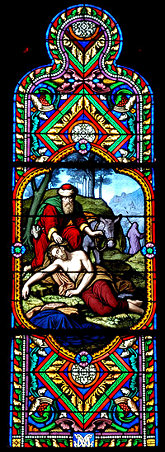
Two millennia later, the shock of a Samaritan being the ‘good guy’ in this sort of story has worn off. Jews and Samaritans did not get along: at all.

These days, it’d be like telling a story in a redneck bar: where a coal miner, poor farmer, and truck driver wouldn’t help the accident victim; but a Muslim immigrant did.

“Love your neighbor” wasn’t a new idea:

1 Take no revenge and cherish no grudge against your fellow countrymen. You shall love your neighbor as yourself. I am the LORD.”
(Leviticus 19:18)

Jesus wasn’t redefining “neighbor.” Our Lord was reminding anyone who would listen that principles outlined in Exodus 23:9 and Leviticus 19:3334 still matter.

Humanity is a single — sadly dysfunctional — family.

Again, that’s not a new idea. Genesis 10:132 describes folks known by the ancient Israelites as descendants of Noah.

My ancestors aren’t included in the list: most likely. My family records don’t go back that far. Not nearly. That doesn’t mean I don’t exist, or that I’m a Cimmerian.

It’s another example of the Bible having been written by folks who didn’t have knowledge we’ve gathered so far: or will have when the 30th, 40th, and following centuries roll past.

When Genesis 10 was being transferred into writing, some 29 centuries back, my forebears were almost certainly living somewhere well north and west of the Ashkenaz. Where they were before settling in and near places later called Hibernia and Ánslo, I can’t be sure.

I’ve explained why I think Adam and Eve aren’t German, Earth isn’t flat, and all that, before. (September 23, 2016; August 28, 2016)

I also keep saying that since I take Jesus seriously, I think loving God, loving my neighbor, and seeing everybody as my neighbor, makes sense. (Matthew 22:3640, Mark 12:2831; Matthew 5:4344; Mark 12:2831; Luke 10:2530; Catechism of the Catholic Church, 1825)

“Everybody” means everybody. No exceptions.

Weeping With Those Who Weep


(From Getty Images, via BBC News, used w/o permission.)
(“Khaled El Kacemi, vice-president of the Islamic Cultural Center of Quebec, grieves during a news conference”
(BBC News)

6 Bless those who persecute (you), bless and do not curse them.
“Rejoice with those who rejoice, weep with those who weep.”
(Romans 12:1415)

I haven’t been persecuted by folks in Quebec City. But I think it’s okay to weep with them, anyway; and rejoice that the folks in Victoria, Texas, are getting help rebuilding.

I also weep for Alexandre Bissonnette, the young man who apparently killed those folks.2

I think what he’s accused of doing is very wrong, but like I keep saying, “everybody” means “everybody.” (January 11, 2017; November 15, 2016; September 20, 2016)

I shouldn’t pick and choose who I see as a real person. The divine image is in each of us; no matter who we are, who our ancestors are, or what we’ve done. (Genesis 1:27; Catechism, 357, 361, 369370, 1700, 1730, 22682269, 1929, 22732274, 22762279)

Apparently Mr. Bissonnette has been studying political science and anthropology, and plays chess.

I don’t think that’s a good reason to hate political science majors and anthropologists, or outlaw chess.

Hating any person is a bad idea, and I shouldn’t do it.

I can’t love my neighbor and hate my neighbor. That doesn’t mean I need to like what my neighbor does.

Forgiving is a good idea, pretending that an injustice never happened would be crazy, and I’ve talked about that before. Also respecting the “transcendent dignity” of humanity and working for justice. (Catechism, 976980, 19291933, 2820)

Indulging in the verbal equivalent of leaving a pig’s head on someone’s front steps3 — is a bad idea on several levels.

So would be letting myself start hating folks who indulge in vandalism and similar acts of self-expression at Catholic Churches.4

On the ‘up’ side, it could be worse. Father James Coyle‘s execution in 1921 was, by some standards, justified. Hours before his death, he had performed a wedding between a Ku Klux Klan member’s son and a Puerto Rican.

I don’t see a problem with ‘mixed marriages’ like that: but I’m about half Irish: and that’s another topic. (January 13, 2017)

Why the Rights of Muslims Matter to This Catholic

The Catholic Church teaches that freedom of religion is important. (Catechism, 21042109)

That’s religious freedom for everybody. (Catechism, 2106)

Defending the rights of non-dominant folks to practice religion as they see fit is the right thing to do. It’s also, I think, simple self-interest.

Although there are over a billion Catholics in today’s world, here in America my faith makes me part of a religious minority. Some Americans apparently feel that what America needs is fewer Catholics: and none in “their” country.

I don’t think that all Protestants share the Pillar of Fire Church’s view of Catholics. (January 22, 2017)

I also don’t think that all Muslims are terrorists.

I’ve heard and read some fairly wild claims about ‘those Muslims over there.’

They remind me of what radio preachers and others were saying about ‘those Catholics over there’ in my youth.

Vendors of malignant virtue5 indirectly helped me become a Catholic, and that’s yet another topic.

Defending the rights of others as a way to defend one’s own rights is a point made in “First They Came….”

Martin Niemöller, a German pastor, is credited with writing the poem: or speech, depending on which version you’re reading.

Over the decades I’ve seen rewrites of “First they Came” that were politically correct, some reflecting a conservative viewpoint.

The more imaginative versions I read a few years back aren’t online any more. I figure that folks who put them up changed their minds and deleted that page, or lost interest and closed their site. But more — colorful? — explanations are possible.6

All versions have the same basic message.

“First they came for the Socialists, and I did not speak out—
Because I was not a Socialist.
Then they came for the Trade Unionists, and I did not speak out—
Because I was not a Trade Unionist.
Then they came for the Jews, and I did not speak out—
Because I was not a Jew.
Then they came for me—and there was no one left to speak for me.”
(Martin Niemöller: “First They Came for the Socialists…”, United States Holocaust Memorial Museum)

“There were no minutes or copy of what I said, and it may be that I formulated it differently. But the idea was anyhow: The communists, we still let that happen calmly; and the trade unions, we also let that happen; and we even let the Social Democrats happen. All of that was not our affair. The Church did not concern itself with politics at all at that time, and it shouldn’t have anything do with them either. In the Confessing Church we didn’t want to represent any political resistance per se, but we wanted to determine for the Church that that was not right, and that it should not become right in the Church, that’s why already in ’33, when we created the pastors’ emergency federation (Pfarrernotbund), we put as the 4th point in the founding charter: If an offensive is made against ministers and they are simply ousted as ministers, because they are of Jewish lineage (Judenstämmlinge) or something like that, then we can only say as a Church: No. And that was then the 4th point in the obligation, and that was probably the first contra-anti-antisemitic pronouncement coming from the Protestant Church.”
(The Martin-Niemöller-Foundation “classical” version of a 1976 speech, via Wikipedia)

“When Pastor Niemöller was put in a concentration camp we wrote the year 1937; when the concentration camp was opened we wrote the year 1933, and the people who were put in the camps then were Communists. Who cared about them? We knew it, it was printed in the newspapers.
“Who raised their voice, maybe the Confessing Church? We thought: Communists, those opponents of religion, those enemies of Christians – ‘should I be my brother’s keeper?’
“Then they got rid of the sick, the so-called incurables. – I remember a conversation I had with a person who claimed to be a Christian. He said: Perhaps it’s right, these incurably sick people just cost the state money, they are just a burden to themselves and to others. Isn’t it best for all concerned if they are taken out of the middle [of society]? — Only then did the church as such take note. Then we started talking, until our voices were again silenced in public. Can we say, we aren’t guilty/responsible? The persecution of the Jews, the way we treated the occupied countries, or the things in Greece, in Poland, in Czechoslovakia or in Holland, that were written in the newspapers.
“I believe, we Confessing-Church-Christians have every reason to say: mea culpa, mea culpa! We can talk ourselves out of it with the excuse that it would have cost me my head if I had spoken out.”
(Partial translation of Niemöller’s speech for the Confessing Church in Frankfurt on 6 January 1946, via Wikipedia)

Catholics in America probably won’t be herded into internment camps in the immediate future, or fined if we try to hold office. But I think history strongly suggests that ‘my end of the boat isn’t sinking’ isn’t a reasonable position.

Uniting in Prayer

I’m a Catholic, and take my faith seriously. That’s why I must recognize the “goodness and truth” in all religions that search for God. (Catechism, 3943, 839845)

It’s also why the Pope’s urging us to unite in prayer with our Muslim neighbors isn’t a surprise, or shouldn’t be:

“…Pope Francis stressed the importance of for all, Christians and Muslims, to be united in prayer….
“…The full text of the telegram, written in French, is provided below in an English translation…

“Most Eminent Cardinal Gérald Cyprien LaCroix
“Having learned of the attack which occurred in Quebec in a prayer room of the Islamic Cultural Centre, which claimed many victims, His Holiness Pope Francis entrusts to the mercy of God the persons who lost their lives and he associates himself through prayer with the pain of their relatives. He expresses his profound sympathy for the wounded and their families, and to all who contributed to their aid, asking the Lord to bring them comfort and consolation in the ordeal. The Holy Father again strongly condemns the violence that engenders such suffering; and, imploring God for the gift of mutual respect and peace, he invokes upon the sorely tried families, and upon all persons touched by this tragedy, as well as upon all Quebecers, the benefits of the divine Blessing.
“Cardinal Pietro Parolin
“Secretary of State of His Holiness”

(from Vatican Radio)

Asking “for the gift of mutual respect and peace” makes sense to me — particularly considering the alternative.

Somewhat-related posts:


1 This week:

2 The accused:

3 Last year, a pig’s head:

4 From last year’s news:

5 From a fictional discussion of dope runners and their victims:

“There are times, Charles, when even the unimaginative decency of my brother and the malignant virtue of his wife appear to me admirable.”
(Lord Peter Wimsey, in Murder Must Advertise, Dorothy L. Sayers (1933))

6 Conspiracy stories can be entertaining, in fiction, but are a poor substitute for reality:

Posted in Being a Citizen, Being Catholic | Tagged , , , , , , , | 3 Comments

Making a Universe: Why Bother?

“The heavens declare the glory of God; the sky proclaims its builder’s craft.”
(Psalms 19:2)

Okay, so who is this message proclaimed to?

Us, apparently.

One of the ways we can learn about God is by noticing order and beauty in the universe. (Catechism of the Catholic Church, 3132, 319)

St. Bonaventure said that the universe communicates God’s glory, St. Thomas Aquinas said that the Almighty creates because God is good and loving. (Catechism, 293)

I think they’re right.

God creates the universe, and humanity, because God loves us and wants to adopt us; all of us. It’s that simple. (Matthew 5:45; John 1:1214, 3:17; Romans 8:1417; Peter 1:34; Catechism, 1, 2730, 52, 1825, 1996)

Paying Attention

It’s not simple, too.

For one thing, neither of the Genesis creation narratives mentions angels. Not specifically, anyway. (Genesis 1:12, 3, 2, 42, 25)

Thomas Aquinas had something to say about that. (“Summa Theologica,” First Part, Question 61, via dhspriory.org)

Then there’s the possibility that we have neighbors; people with bodies, like us, but not human. Or maybe we don’t. Either way, as Walt Kelly’s Porky Pine said, “it’s a mighty sobering thought.” (December 2, 2016)

Some physicists say quantum mechanics makes more sense if we’re not, or not quite, living in the only universe.

Multiverse hypotheses, Schrödinger’s cat, and quantum gears are topics for another post.

We’ve learned a bit since the Psalms were written, about two dozen centuries back, give or take a quarter-millennium.

Living in a universe that’s immensely bigger and older than Ussher’s tidy little version of a Mesopotamian model upsets some folks.

I’m not among them. I figure part of my job is appreciating God’s creation: not telling the Almighty how it should work. (September 23, 2016)

No matter where we look, God’s creation is filled with beauty and wonders that we’re just beginning to understand.

Paying attention to God’s work can’t hurt an informed faith.

Truth cannot contradict truth, we’re supposed to be curious, and scientific discoveries are opportunities for greater admiration of God’s creation. (Catechism, 159, 214217, 283, 294, 341)

Everything and everyone ultimately points back to God. (1 Corinthians 15:2728; Catechism, 294)

I’ve talked about faith, reason, science, and getting a grip, before. Often. (January 27, 2017; December 23, 2016; October 28, 2016; July 29, 2016)

Developing a Sense of Scale

4 Indeed, before you the whole universe is as a grain from a balance, or a drop of morning dew come down upon the earth.
“But you have mercy on all, because you can do all things; and you overlook the sins of men that they may repent.
“For you love all things that are and loathe nothing that you have made; for what you hated, you would not have fashioned.
“And how could a thing remain, unless you willed it; or be preserved, had it not been called forth by you?”
(Wisdom 11:2225)

God isn’t merely big and strong. God is “…infinite … almighty and ineffable … infinitely greater than all his works….” (Catechism, 202, 300)

What we’re learning about the scale of this universe doesn’t, I think, make God ‘more infinite.’ But I think it adds emphasis to verses like these:

“When I see your heavens, the work of your fingers, the moon and stars that you set in place –
4What are humans that you are mindful of them, mere mortals that you care for them?
5Yet you have made them little less than a god, crowned them with glory and honor.”
(Psalms 8:46)

I also think remembering who and what we are is important. And that’s another topic.

More about faith and paying attention:

Posted in Being Catholic | Tagged , , | 1 Comment

Gems, Metal, and Earth’s Core

The Fire of Australia, a whacking great chunk of opal, isn’t particularly interesting from a ‘science’ viewpoint.

But I’m human, which is probably why anything big and shiny gets my attention: including that rock.

Wrenching myself back on-topic, scientists found a stream of liquid metal flowing at the edge of Earth’s core. Studying it may help us learn why Earth’s magnetic field flip-flops at apparently-irregular intervals. What we’ll learn is beyond me: we didn’t know much about geomagnetic reversal when I started school.

We still don’t, for that matter. As I keep saying, there is a very great deal left to learn.

  1. The Fire of Australia Changes Hands
  2. Iron ‘Jet Stream’
  3. Earth’s Core: Halley, Pellucidar, and Reality
  4. Diamonds From Liquid Metal

‘Once it Was Believed, Now We Know’

Back in my ‘good old days,’ scientists were getting past the notion that Neanderthals were “cavemen,” and I’ve talked about that before. (January 13, 2017; September 23, 2016)

I don’t know how often the “once it was believed, now we know” phrase popped up; but the science-related stuff I read often had a triumphalist tone. That was morphing into the currently-fashionable ‘and we’re all gonna die’ attitude during my youth, which was well-established the last time I did time in academia.

I think both assumptions make about as much sense as believing that using the brains God gave us offends the Almighty.

Recapping what I’ve said before: acting like humans is okay.

We’re supposed to be curious. A thirst for truth and happiness is written into each of us. If we’re doing our job right, the search will lead us to God. (Catechism of the Catholic Church, 27)

Seeking the Almighty and studying this wonder-filled universe is part of being human. (Catechism, 35, 50, 159, 22922296)

So is keeping this world in good working order. (Genesis 1:2629, 2:15; Catechism, 339, 952, 24022405, 2456)

I talked about that last week. (January 20, 2017)

Learning That There’s More to Learn

Maybe I could endear myself to some folks by claiming that Earth has always been pretty much the way it is today: unchanged since the universe popped into existence at nightfall on 22 October 4004 BC.

That seems unreasonable. (July 31, 2016)

So does having hysterics over an impending environmental apocalypse. Some folks still apparently take Ehrlich’s prognostications seriously. I don’t. (August 12, 2016 )

I do think Earth’s climate is changing: and has been ever since our home formed, some 4,540,000,000 years back; give or take 50,000,000. I’d be astonished if it stopped changing during my lifetime.

I also think what we’ve been doing for the last 11,500 years has had an increasingly noticeable effect, at least on a regional level.

Developing industrial processes made a difference. I showed a global map of nitrogen dioxide levels last week.

But I don’t think this is a good time to try taking control of Earth’s climate. Not on a global level.

In my considered opinion, we don’t know nearly enough to do that safely. Not yet. (January 20, 2017)

Good grief: a few centuries back, it looked like the universe might be no more than a few thousand years old. Nobody suspect that the Solar wind existed until 1859, and the jury’s still out on exactly how Solar activity affects Earth’s climate.

We didn’t know for sure that Earth’s continents have been moving around until I was an adult. That may have helped the current ice age get started: but again, we’re not really sure. Not yet.

It’s not that I think Earth never changes, or that we’re helpless to do anything about our home’s environment. But experimenting with geoengineering should probably wait until we know what we’re doing.


1. The Fire of Australia Changes Hands


(From South Australian Museum, via BBC News, used w/o permission.)
(“The Fire of Australia is now on display in South Australia”
(BBC News))

Fire of Australia: The return of the world’s finest uncut opal
BBC News (January 23, 2017)

The world’s finest uncut opal has mostly been kept in a safe deposit box since it was unearthed from the South Australian outback with a pick and shovel 70 years ago.

“Walter Bartram was prospecting in dusty terrain in Coober Pedy, about 750km (466 miles) north of Adelaide, in 1946 when he staked a claim to what became called the Fire of Australia.

“Although his family achieved success in opal trading, their greatest discovery has been seen rarely by the public.

“That has just changed.

“The 998g (35.2oz) opal, valued at nearly A$900,000 (£550,000; $680,000), is now on display in Adelaide’s South Australian Museum….”

Folks who care about such things call opal a mineraloid, not a mineral, since it’s an amorphous solid, not crystalline. It’s a hydrated amorphous form of silica, with water content from 3 to 21% by weight — generally between 6 and 10%.

Don’t bother trying to remember that. There will not be a test on this.

Opals are good for looking at. My language’s word for the stone, “opal,” comes from Latin “opalus.” Romans got that word from Sanskrit “úpala,” probably.

“Opalus” might have come from Ops, the wife of Saturn and goddess of fertility. Part of the Roman Saturnalia — think a major spring break blowout for adults — devoted to Ops was called “Opalia.” Again, you won’t be tested on this.

Maybe “opalus” came from ancient Greek “opallios.” That word meant something like “seeing,” which is where we get “opaque”; it also meant “other” as in “alias” and “alter.” The ancient Greek origin isn’t likely, academics say; but a Sanskrit origin is.

That sort of thing fascinates me. Your experience may vary.

Getting a Grip About Opals and Luck


(From Photo by Ray Bartram/the Bartram family, via The Jewellery Editor, used w/o permission.)
(“The Fire of Australia, discovered by the Bertram family in 1946, is the most valuable piece of rough light opal of its size in the world, weighing approximately 5,000 carats.”
(The Jewellery Editor))

Folks have enjoyed looking at opal for millennia, particularly after giving the rocks a nice polish. Opals were considered lucky — good and bad, depending on which tradition you dip into.

Sir Walter Scott’s “Anne of Geierstein” featured a magic opal with lethal properties. That tale apparently cut the sale of opals in the English-speaking world in half for something like two decades.1

About opals, lucky/unlucky stones, and such things — I have an agate, a geode, a half-dozen California Raisins from a Hardee’s promotion on my desk. They’re there because I think they look nice.

If I thought they magically help me write, or guard my computer’s hard drive, or something like that, I’d have a problem.

Superstition and magic are bad ideas. I don’t mean ‘take a rabbit out of my hat’ stage magic. That’s about as “magical” as me making letters appear on a glowing screen, by twiddling my fingers over a keyboard.

Now that I think of it, maybe that helps explain why some folks are scared of computers, and that’s another topic.

Superstition feels a bit like religion. It can affect worship if someone gets the idea that prayer, for example, depends on ‘going through the motions.’ It’s a bad idea. So is trying to tame occult powers or thinking ‘magic’ charms make sense. (Catechism, 21102111, 2117)


2. Iron ‘Jet Stream’


(From ESA, via BBC News, used w/o permission.)
(“Artwork: A depiction of where the jet is moving – in the outer core. The Swarm satellites fly a few hundred km above the planet and sense its magnetic field”
(BBC News))

Iron ‘jet stream’ detected in Earth’s outer core
Jonathan Amos, BBC News (December 19, 2016)

Scientists say they have identified a remarkable new feature in Earth’s molten outer core.

“They describe it as a kind of ‘jet stream’ – a fast-flowing river of liquid iron that is surging westwards under Alaska and Siberia.

The moving mass of metal has been inferred from measurements made by Europe’s Swarm satellites.

“This trio of spacecraft are currently mapping Earth’s magnetic field to try to understand its fundamental workings….”

Magnetic north, the point on Earth’s surface where the planet’s magnetic field lines are vertical, was near the rotational pole when Thales of Miletus noticed that lodestones attract iron.

Folks started using lodestones for navigation during the Song Dynasty, about a thousand years back. Being able to navigate between ports is important, so folks have been keeping track of magnetic declination ever since.

We learned that the magnetic pole moves around. It’s been drifting west since about 1400. It had been drifting eastward for about four centuries before that. We call the drift “secular variation, which brings me back to the satellites and those scientists.

A “Jet of Liquid Iron,” Krakatoa, and Jet Streams

“Fast-flowing” is a relative term.

“…’This jet of liquid iron is moving at about fifty kilometres per year,’ explained Dr Chris Finlay from the National Space Institute at the Technical University of Denmark (DTU Space).

“‘That might not sound like a lot to you on Earth’s surface, but you have to remember this a very dense liquid metal and it takes a huge amount of energy to move this thing around…’….”
(Jonathan Amos, BBC News)

About jet streams, Wiley Post often gets credit for discovering Earth’s jet streams, since he noticed his ground speed was higher than the air speed in certain places. The story is a bit more complicated, though.

Folks noticed an “equatorial smoke stream” after the 1883 Krakatoa eruption.

Wasaburo Oishi’s reports from 1926 to 1944 are recognized as evidence of jet streams today. Wasaburo tried making his research available to folks living outside Japan by publishing in Esperanto.

Heinrich Seilkopf called the phenomena Strahlströmung, or “jet flow,” in 1939.

L. L. Zamenhof put Esperanto together in the 1870s and 1880s. Having a common world language is, I think, a good idea. Mandarin would be a pretty good choice these days, except just about everyone who understands it lives in China.

Inventing one and then trying to get folks who aren’t language geeks to go along with the idea — didn’t work out so well. And that’s yet another topic.

Where was I? Thales of Miletus, lodestones, jet streams, Esperanto. Right.

Moving Metal and Questions

These scientists figure that the moving metal stream is about 420 kilometers, 261 miles, wide; and wraps halfway around the planet. How deep it is — is a good question.

They figure it’s the boundary between two parts of Earth’s core. If they’re right, liquid iron approaching the boundary from both sides gets squeezed out sideways; forming the jet, which moves along the tube-shaped boundary.

They don’t have enough data to be sure, but their math suggests that the tube could extend all the way through to the core’s other side, in Earth’s southern hemisphere.

Learning more about this ‘jet stream’ and the rest of Earth’s core should help us understand how Earth’s magnetic field works.2 That, I think, could be very important.

Now, a scary headline from days gone by.

Magnetic Field Reversals


(From NASA, via Wikimedia Commons, used w/o permission.)
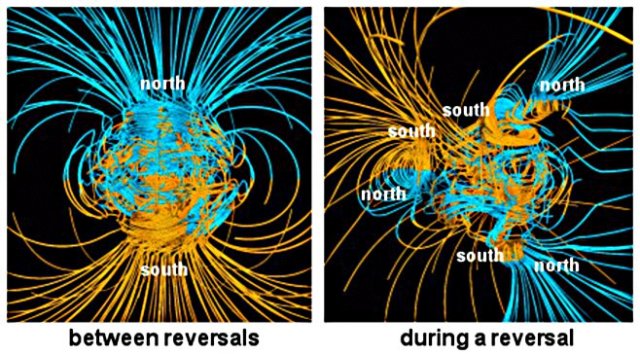
(“NASA computer simulation … The tubes represent magnetic field lines, blue when the field points towards the center and yellow when away. The rotation axis of the Earth is centered and vertical. The dense clusters of lines are within the Earth’s core.”
(Wikipedia))

Earth’s magnetic field ‘could flip in the space of 100 years’, scientists warn
Rob Waugh, Metro.co.uk (October 21, 2014)

Earth’s magnetic field can flip far faster than previously thought – unleashing a force which Mayan apocalypse believers thought might destroy our planet in 2012.…”

Breathless ‘and-we’re-all-gonna-die’ journalistic enthusiasm aside, I probably won’t live to see Earth’s magnetic field flip over: but you might.

The science behind that Metro.co.uk piece is solid enough, but nowhere near as dramatic:

It’s been about a century since scientists like Motonori Matuyama started finding evidence that “magnetic north” wasn’t always near the north pole. Other scientists didn’t get the memo, or weren’t interested.

Then folks mapping Earth’s seafloors in the 1950s and 1960s noticed alternating magnetic stripes running parallel to Earth’s mid-ocean ridges.

Lawrence Morley eventually got credit for his explanation of seafloor spreading, but editors working for Nature and Journal of Geophysical Research hadn’t felt like publishing it at the time.

Geomagnetic Reversal, Magnetoreception: Still Learning

The magnetic stripes form when particles in iron-rich rock welling up at mid-ocean ridges ‘freezes’ in line with Earth’s magnetic field.

This gives scientists a pretty good record of field reversals for the last 180,000,000 years. That’s the age of Earth’s oldest existing seafloor. The rest has long since been recycled back into the interior.

I’ve read that Earth’s magnetic field reversals happen at “random” intervals. My guess is that there’s a pattern to Earth’s magnetic field reversals, but scientists haven’t found it yet.

How much time passes between reversals has changed: a lot.

Field reversals started coming closer together a bit upwards of 80,000,000 years back, after a long comparatively-stable patch. There was another fast-changing period about 120,000,000 to 160,000,000 years ago.

A few times 10,000,000 years have gone by with no reversals. Earth’s field flip-flopped five times in a million years about 72,000,000 years back, and the Laschamp event, some 41,400 years back — give or take 2,000 ‐ only lasted a few centuries.

Something causes those reversals, and scientists have come up with a few explanations: but none that match available data.3

The idea that mass extinctions happened during field reversals looked good: except there isn’t a particularly good correlation between the two phenomena.

The reversals probably affect critters that use magnetic fields for navigation, like homing pigeons. How magnetoreception works another mystery.4

On the other hand, considering that we didn’t know about that sense just a few decades back: we’re not doing too badly.


3. Earth’s Core: Halley, Pellucidar, and Reality


(From Science Photo Library, via BBC News, used w/o permission.)
(“This study suggests silicon exists in the Earth’s inner core with iron and nickel”
(BBC News))

New candidate for ‘missing element’ in Earth’s core
Rebecca Morelle, BBC News (January 10, 2017)

Japanese scientists believe they have established the identity of a ‘missing element’ within the Earth’s core.

“They have been searching for the element for decades, believing it makes up a significant proportion of our planet’s centre, after iron and nickel.

“Now by recreating the high temperatures and pressures found in the deep interior, experiments suggest the most likely candidate is silicon.

“The discovery could help us to better understand how our world formed….”

We’ve learned quite a bit since Edmond Halley read Sir Isaac Newton’s 1687 Philosophiæ Naturalis Principia Mathematica.

One of those two got the numbers wrong for Earth and our moon’s density.

Assuming that Earth is much less dense than our moon — it’s not — Halley said Earth could be hollow shell about 500 miles thick, with two more shells inside.

He used the diameters of Venus, Mars, and Mercury to define the inner shells, which makes a nifty picture. There’s a sort of elegance to the notion of nested shells inside Earth, whose diameters match other Solar planets.

But it’s not how reality works.

Maybe because a hollow Earth figures in folklore and mythologies, the idea hasn’t gone away.

Ludvig Holberg’s 1741 novel, “Nicolai Klimii iter subterraneum/Niels Klim’s Underground Travels,” has been followed by Burroughs’s Pellucidar tales, Gears of War, and folks who think Earth really is hollow.

There’s More to Learn

At the moment, the world’s deepest mine is four kilometers deep. The deepest borehole is still the Kola Superdeep Borehole, reaching 12.262 kilometers below Earth’s surface in 1989. That’s part-way through Earth’s crust.

Folks are still trying to get samples of material from the next layer under Earth’s crust, the mantle:

Given humanity’s seemingly-insatiable curiosity, my guess is that we’ll succeed before this century is over.

Meanwhile, studying seismic waves, stuff brought up by volcanoes, and Earth’s gravitational and magnetic fields, help scientists figure out what’s inside.

Technology like diamond anvil cells and laser-driven shock tubes developed over the last century lets scientists approximate extreme pressures and temperatures in Earth’s inner regions. Some inertial confinement fusion devices use similar laser tech, and controlled nuclear fusion is yet again another topic.

The last I heard, opinion is divided on whether Earth’s inner core is solid, or plasma that’s dense as a solid. It’s possible — this is even less certain and more debatable — that our planet’s core is a single huge iron crystal.5

This is not the world I grew up in. It’s a great deal more interesting. For the most part I like living in ‘the future,’ and that’s still another topic.


4. Diamonds From Liquid Metal


(From Nemesis International DMCC/Donald Woodrow photographer, via Science, used w/o permission.)
(“Tiny blobs of material trapped inside large, clear diamonds (such as this one) as they formed suggest the gems formed within pockets of liquid metal deep within Earth.”
(Science))

Earth’s rarest diamonds formed in pockets of liquid metal
Sid Perkins Science (Decenber 15, 2016)

“Some of the most prized diamonds on Earth are unusually clear, exceedingly rare, and often extraordinarily large. Researchers have long wondered how such gems formed, but they’ve been hard to study because they’ve typically ended up on ring fingers rather than under a microscope. Now, a new analysis of imperfections trapped within the diamonds provides the first direct evidence that they were forged within blobs of liquid metal hundreds of kilometers below Earth’s surface….”

Hundreds of kilometers down is still a long way from Earth’s core, but it’s closer than hat borehole: and these are actual samples from Earth’s interior, not laboratory approximations.6

This research helps scientists learn Earth’s internal chemistry.

It’s also, I think, interesting because diamonds are comparatively rare and sparkly; and have inspired a lot of colorful tales.7

More, mostly about using our brains:


1 Opals and a partly-underground town:

2 Earth’s newly-discovered iron ‘jet stream:’

3 Earth’s changing magnetic field:

4 Earth’s magnetic field and critters:

5 Some of what we know, and what we don’t:

6 Diamonds, science, and people:

7 Diamond stories, and a little more science:

Posted in Diamonds and Gems, Science News, Series | Tagged , , , , , , , , | 2 Comments

Fan or Follower of Jesus?

Third Sunday in Ordinary Time, 2017:


Third Sunday in Ordinary Time, 2017

By Deacon Lawrence N. Kaas January 22, 2017

I found a story that I wish to share with you today because it poses a question, fans or followers?

A man by the name of Kyle Idelman, wrote an article where he posed the statement, “why I’m not a ‘fan’ of Jesus.” He began by noting that, according to recent surveys, something like over 75% of the people in our country call themselves Christian. Really? He stated, three out of four people are followers of Christ? Bringing the number of Christians in our country in the neighborhood of 233 million.

He goes on to write, that the numbers just don’t add up. If 75% of Americans are Christians… Then why are there more than 120 thousand children waiting to be adopted? Further he claims that 35 million people in America go to bed hungry each night which includes 13 million children?

He poses a comparison, as he speaks of the new “vegetarians.” One of them explains to him that she was a vegetarian but she likes to eat bacon. (And so she eats it.) Now claiming themselves to be Flexitarians.

“A Christian,” continue Idelman, “by definition, is a follower of Christ. So I’m thinking that may help make sense of the 233 million number as a new word to describe people who identify themselves as Christians but have little interest in actually following the teachings of Jesus. Perhaps instead of followers, it would be more accurate to call them fans.

The word fan is most simply defined as, an enthusiastic admirer. And I think Jesus has lots of fans these days. Some fans may even get dressed up for church on Sunday and make their ring tone a worship song. They like being associated with Jesus. Fans want to be close enough to Jesus to get the benefits, but not so close that it requires anything from them. They want a no strings attached, relationship with Jesus. So a fan says, I like Jesus but don’t ask me to serve the poor. I like Jesus, but I’m not going to give money to the people who are in need. I like Jesus, but don’t ask me to forgive the person who hurts me. I like Jesus, but don’t talk to me about money or sex that’s off-limits. Fans like Jesus, but they don’t want to give up the bacon.

Today’s reading from Matthew’s Gospel is about four men who were called by Jesus to be his Disciples. They were not called to be fans of Jesus, but followers. Their names were Simon Peter, Andrew, James and John, four fishermen, but really, this reading is also about you and me, because we have been called to be disciples as well. We also have been called to be followers and not fans. I’ll let you decide which group you belong. But first let’s ask, what does it mean to be a disciple of Jesus Christ?

Notice, first of all how ordinary these four men were they had no formal education that we know of. Neither did they possess any particular personal attractiveness or extraordinary talent of which we are aware. They were just ordinary fishermen. We often make the mistake of assuming that God calls only the most impressive, the most gifted, the most talented people. Indeed that seems to be the exact opposite of what God does!

God comes to Moses with a summons to go tell Pharaoh to “let my people go.” Moses responds, “who am I that I could go to Pharaoh?” Later Moses protests that he’s too slow of speech to carry out such a mission, we all know the outcome.

God comes to Gideon who would later be a great leader of God’s people, but Gideon responds.” “My clan is the weakest in Manasseh, and I am the least in my family.”

Even the most successful of all Israel’s Kings, David, was flabbergasted by God’s call. “I’m only a poor man and little known,” replies David.

St. Paul tells us in first Corinthians, first chapter, that God has deliberately chosen what the world considers foolish.

You realize he’s talking about you and me. God chooses ordinary people to do his work so that they would all depend on his power and not their own for this reason says, St. Paul, that no one will be able “to boast in the presence of God.”

In the play, Green Pastures, God asks Gabriel to recruit a leader and Gabriel asked in return, “do you want the brainiest or do you want the holiest?” God answers, “get me the holiest, I’ll make him the brainiest.”

Each year at the beginning of ordinary time I pose the question, what is so ordinary about ordinary time? Today I have received my answer, it is a time in which ordinary people respond to the call of God in extraordinary ways.

So maybe Mr. Adelman needs to look more deeply into the ordinary lives of ordinary Christians, who make ordinary time into an extra ordinary response to the call of God! Someone posed the question to me the other day about stewardship and my response simply was, love God, love your neighbor, and do as you will. Once again supporting the statement of ordinary people responding in an extraordinary way to the call of God!

By the way maybe Mr. Idleman wasn’t a fan but a follower!

So you all be Good, be Holy, Preach the Gospel, always and if necessary use words.


(‘Thank you’ to Deacon Kaas, for letting me post his reflection here — Brian H. Gill.)


Posted in Reflections | Tagged , , , , | 3 Comments

Conservative? Liberal? No: Catholic

Brian H. Gill's '2000 Years and Counting' collage.My father-in-law has been asked if he’s conservative — or liberal.

His answer: “I’m Catholic.”

I’d give the same answer.

Catholic teachings are quite definite, so it’s possible to peg them on the American political spectrum — as long as you don’t look at the big picture.

Taking bits and pieces of Catholic beliefs, and the history of Catholics in America, I could claim that the Catholic Church is conservative or liberal. That would be as big a mistake as seeing all conservatives as hate-fueled foes of diversity, or all liberals as irresponsible lunatics.

Sex, Death, and Immigrants

sporki's photo: World Youth Day, Rome. (2000) via Wikipedia, used w/o permission.
World Youth Day, Rome. (2000)

The Church might seem liberal because we’re told that sex is a good thing, social justice is important, and the death penalty should be a last resort. (Genesis 1:27, 31; Catechism of the Catholic Church, 1928-1942, 2267, 2331-2391)

We’re also told that extra- and non-marital sex is a bad idea, private property is a good idea, and both abortion and euthanasia are wrong. That isn’t far from many conservative viewpoints. (Catechism, 2270-2279, 2348-2356, 2380-2381, 2401-2406)

I see immigrants as neighbors I haven’t met yet; folks who are doing pretty much the same thing my ancestors did, not long ago. That makes me a Catholic who takes our faith seriously: not a liberal. (Catechism, 2241)

The Catholic view of immigrants isn’t new, which doesn’t make it “conservative:”

“You shall not oppress an alien; you well know how it feels to be an alien, since you were once aliens yourselves in the land of Egypt.”
(Exodus 23:9)

“‘When an alien resides with you in your land, do not molest him.
“You shall treat the alien who resides with you no differently than the natives born among you; have the same love for him as for yourself; for you too were once aliens in the land of Egypt. I, the LORD, am your God.”
(Leviticus 19:3334)

“For I was hungry and you gave me food, I was thirsty and you gave me drink, a stranger and you welcomed me,”
(Matthew 25:35)

As a Catholic, my knee-jerk reaction is — irrelevant, except maybe to me. Let’s see what the Church says about defending my life, and the lives of others.

Hawk? Dove?

detail, Aaron 'tango' Tang's photo: Shortly after 2013 Boston marathon bombing, people helping others. (April 15, 2013) via Wikipedia, used w/o permmission.Defending myself from a lethal attack is okay; even if my action results in my attacker’s death. But I must use the least possible force. (Catechism, 2263-2267)

That’s because my life is precious, and so is my attacker’s. My intent should be saving my own life, not killing another person: even if that is the unintended effect of my action. (Catechism, 2258, 2263-2269; “Summa Theologica,” Thomas Aquinas, II-II,64,7)

The same principle applies to decisions national leaders face. War kills people and breaks things, so avoiding war is a good idea.

But sometimes being nice and reasonable won’t keep innocent folks alive. That’s why leaders are allowed to use force when defending the lives they’re supposed to protect. (Catechism, 2307-2317)

“…As long as the danger of war remains and there is no competent and sufficiently powerful authority at the international level, governments cannot be denied the right to legitimate defense once every means of peaceful settlement has been exhausted….”
(“Gaudium et Spes,” Pope Bl. Paul VI (December 7, 1965))

I could edit Catholic teaching to make my beliefs fit — or shun — pigeonholes like ‘hawk,’ ‘dove,’ ‘bleeding heart liberal’ or ‘heartless conservative.’ But that doesn’t seem prudent.

Fear and Politics

Rev. Branford Clarke's cartoon, 'SHALL HE BE ALLOWED TO RULE AMERICA?'; from 'Guardians of Liberty', Published by the Pillar of Fire Church in Zarephath, NJ. (1943) via Wikipedia, used w/o permission.I can see why ‘real Americans’ might fear ‘those Catholics.’ Many of us don’t have English ancestors, for starters.

I’m an American, and speak English. But that doesn’t mean I agree with Alma Birdwell White or her Pillar of Fire Church. The outfit’s called Pillar of Fire International these days.

Catholics lived in the thirteen colonies and other parts of today’s United States long before 1776, but we didn’t start arriving in disturbing numbers until the 19th century.

Catholic immigrants from Germany, Ireland, Italy, and other foreign parts were mostly working-class folks. Not surprisingly, most Catholics voted Democrat: 70% overall, 80% of the Irish Catholics.

That changed, of course. Children or descendants of the immigrants became white-collar workers, developing voting and other habits that were closer to the American norm.1

Blending in with the crowd isn’t necessarily a good thing. I’ve talked about ‘going native’ before. (August 14, 2016)

It’s like Fulton Sheen said:

“Right is right if nobody is right, and wrong is wrong if everybody is wrong.”
(“Life Is Worth Living” (1951-1957), Program 19, The Venerable Fulton J. Sheen, via Wikiquotes)

Why Bother?

Vatican's photo: Saint Peter's Square, photo used in connection with the Extraordinary Jubilee of Mercy. (December 2015) see http://www.im.va/content/gdm/en.html - used w/o permission.
Saint Peter’s Square.

Taking an active part in public life is part of being a Catholic. That starts with my personal responsibilities: in my family, at work, in my community. (Catechism, 1913-1917)

The “at work” part of my life is over now, so I’ve got more time for family and other activity: like researching and writing these posts.

I enjoy learning and sharing what I find, but that’s not why I keep doing all this.

I’m passing along, in my own way, the best news humanity’s ever had.2

God loves us, and wants to adopt us. All of us. (Matthew 5:45; John 1:1214, 3:17; Romans 8:1417; Peter 1:34; Catechism, 1, 27-30, 52, 1825, 1996)

Our Lord said loving my neighbor, and seeing everyone as my neighbor, is the source for “the whole law and the prophets.” (Matthew 5:4344, 22:3640; Mark 12:2831; Luke 6:31, 10:2527, 2937; Catechism, 2196)

Over the last two millennia, folks like Saints Austine of Hippo, Teresa of Ávila, Thomas Aquinas, Hildegard of Bingen, Catherine of Siena, and Thérèse of Lisieux, have thought about what Jesus meant.

It still boils down to love and hope.

I think that makes sense. What you decide is up to you.

More about acting as if God and love matter:


1 Catholics living in America, politics and attitudes:

2 Anyone who tries to do good and avoid evil is on the right track. I became a Catholic after learning who currently holds the authority our Lord gave Peter. (Matthew 16:1719; Catechism, 551-553, 781-801, 874-896)

Posted in Being a Citizen, Being Catholic | Tagged , , , , , , , , , , | 13 Comments