Values and Ichthyosaurs

A nation’s schools are returning to traditional values. Whether that’s good or bad news depends partly on how you see what we’ve learned since about 1859.

I think we’ve learned more about how the universe works, and that this is good news. We haven’t consistently made good use of the knowledge, but that’s our problem.

We’ve made good and bad use of everything we’ve learned, from using fire to writing blogs. Whether it’s good or bad depends on us, not fire or the Internet. And that’s another topic.

Two scientists studied an ichthyosaur that had been used as a wall decoration. What they learned adds to what we’re learning about those critters. I think that’s worthwhile.


NLMH 106234 — or — Giving This Ichthyosaur a Name
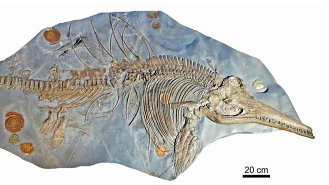
What scientists said about the fossilized ichthyosaur probably won’t please folks who like absolute certainty.

“Estimate,” “estimated,” “estimation,” and “estimates” show up a lot in their Acta Palaeontologica Polonica paper.

It doesn’t have a name, as far as I know. Its official label is NLMH 106234, which isn’t particularly catchy.

My guess is that it’s the specimen’s accession number. That’s a code libraries, art galleries, museums and archives use to keep track of individual items. It’s often assigned when the thing first gets into the collection’s cataloging system.

The fossil was found near Williton, Somerset. Doniford village and St Decumans hamlet are near there.

Williton sounds a little like Willie, so I’ll call NLMH 106234 “Willie.”

Willie’s not all there, which is why the scientists estimated some details.

Informed Faith

If I was a dedicated creationist, I might ignore some of what we’ve learned over the last few centuries; and denounce the parts I like the least.

Throw in famous hoaxes like Piltdown Man and the Cardiff Giant, quote bits from the King James Bible, and I’d have the start of a colorful rant against Godless scientists and their Satanic cult, evolution.

That style of avoiding post-Georgian knowledge may be showing signs of wear.

I’m not sure how many ‘Bible-believing’ Christians adopted ‘creation science’ as their method of choice. (July 23, 2017)

I think they make about as much sense as their counterparts in the ‘science or faith’ wrangle. I don’t see a point in claiming that critters mustn’t change because God exists: or that God can’t exist because critters have been changing.

Pretending that neither viewpoint matters might be tempting, but a remarkable number of folks lean one way or another.

I think God exists, and matters. I also think informed faith and truth get along fine. The ‘science threatens Christianity’ notion didn’t quite start in the Victorian era, and I’ve talked about that before. (April 28, 2017; March 10, 2017; November 6, 2016; October 28, 2016)


1. Turkey Returning to Traditional Values


(From AFP, Getty Images, via BBC News, used w/o permission.)
(Folks in Turkey protesting the new ‘traditional’ curriculum, and a banner with President Erdogan’s portrait.)

Turkey’s new school year: Jihad in, evolution out
Öykü Altuntaş, BBC News (September 18, 2017)

Turkey’s schools have begun the new academic year with a controversial curriculum that leaves out the theory of evolution and brings in the concept of jihad.

“For Turkey’s Islamist-rooted government, the idea is for a new ‘education of values’.

“Critics have denounced new textbooks as ‘sexist’ and ‘anti-scientific’, and complain of a major blow to secular education….

“…Opponents have accused President Recep Tayyip Erdogan’s ruling Justice and Development Party (AKP) of replacing the secular foundations of the Turkish republic with Islamic and conservative values….”


Passions flare as Turkey excludes evolution from textbooks
Selin Girit, BBC News (June 24, 2017)

‘This is bigotry, this is all about being a fanatic. How are they going to teach biology now? How are they going to talk about science?’

“On an online forum about the government’s decision to exclude the theory of evolution from the national curriculum, a passionate discussion is under way….

“…’Turkey will be the second country after Saudi Arabia that excludes theory of evolution from its curriculum,’ says Feray Aytekin Aydogan, the head of Egitim-Sen – a teachers’ union representing over 100,000 members across the country.

“‘Even in Iran, there are 60 hours of lessons on evolution and 11 hours on Darwin himself,’ she adds….”

I don’t know enough about what’s happening in Turkey, or the new curriculum, to have an informed opinion about their situation.

The current dispute reminds me of America’s creation-evolution hubbub. Today’s details are different, but I see the same conflict between new and old assumptions.

This week’s BBC News article’s attention-grabbing headline and scary words like “jihad” are to be expected. It’s news, and the BBC follows some journalistic conventions.

Öykü Altuntaş also gave a little information about what was in the new curriculum. Sharing information is a journalistic convention I’d like to see more of.

“…Jihad is defined as ‘religious war’ by the dictionary of the Institute of Turkish Language. But education ministry officials say the concept of jihad has been exploited by jihadist groups such as so-called Islamic State (IS).

“The education minister says the concept should be introduced as part of Islam in the context of ‘loving a nation’….
(Öykü Altuntaş, BBC News (September 18, 2017))

What I have read doesn’t fill me with dread and foreboding.

But I am concerned about exactly what terms like “loving a nation” mean in Turkey’s cultural and intellectual context.

That’s concerned, not in a blind panic.

Knowing that some folks in Turkey are upset by the new curriculum is interesting, but hardly surprising. I wouldn’t expect everyone in Turkey, or anywhere else, to be comfortable with changes in their status quo.

Turkey’s government deciding to teach kids conservative values reminded me of late 20th century America’s “family values” slogan.

I think quite a few Americans still feel that we should start living as if the 1960s never happened. I’m not one of them.

America’s customs and institutions were overdue for an overhaul in my ‘good old days.’ What we have today isn’t ideal, either.

But if we’re going to move, the direction is forward: not back.

“Loving a Nation”

About “loving a nation,” I think that can be a good idea. (July 4, 2017; July 24, 2016)

I even think “conservative values” may be okay. “Liberal values” may be okay.

What matters is how closely they match natural law: ethical standards written into reality. (Catechism of the Catholic Church, 1952-1960)

Then there’s The Good Citizen magazine, The Pillar of Fire church monthly. That’s their July 1926 cover.

Under Bishop Alma White’s leadership, it declared the importance of being white, praised the Ku Klux Klan, and warned against what she saw as the looming menace of Catholicism.

I gather that the Pillar of Fire Church was a bit wacky even by 1920s conservative standards.

Many Americans kept moving toward greater tolerance. I see that as a good thing.

That’s just as well, since recognizing humanity’s transcendent dignity, and our solidarity, is an obligation. (Catechism, 1928-1942)

Traditions, Tradition, and Truth

I don’t know how many Catholics believe that our faith depends on denouncing evolution.1

That attitude makes sense, sort of, for some American churches.

For Catholics, not so much.

If you haven’t read my stuff before, my views of culture, tradition, and science may seem strange. Particularly if Catholics you know apparently feel that being Catholic requires upholding conservative values: or dedication to liberal causes.

Feel free to skip down to Sea Dragons if you know what I’ll be saying.

I keep running into American Catholics who act as if they’ve embraced America’s Calvinist traditions, and added Catholic trimmings. That’s not what our Tradition is about.

I must respect and follow Tradition, with a capital T. It’s the living transmission of faith, carried out by the Holy Spirit. (Catechism, 77-78)

Following my culture’s traditions is not “Tradition.” Cultural traditions change. Sometimes being Catholic means not following a culture’s tradition.

America’s spiritual traditions include a respect for the Bible.

This is, basically, a good idea. But it’s not just ‘the Bible and God and me.’ (Catechism, 83-87, 101-133)

And I’m sure not supposed to follow the lead of folks like Alma White. Those are “traditional values,” but they were bad ideas at the time. That’s still true.

Unthinking devotion to old habits may be easier than learning new ideas. That doesn’t make it a good idea. “New” isn’t always bad, “old” isn’t always good.

New knowledge isn’t a problem.

Making daft assumptions about knowledge, old or new? That’s a problem.

I’m not obliged to find science interesting.

But valuing truth is required. That includes truth we find in the natural world. (Catechism, 32, 41, 74, 2500)

Faith is willingly embracing all truth. (Catechism, 142-150)

Insisting that scientists have been lying since the mid-19th century and that America’s far-from-Catholic conservative churches have been upholding the banner of truth doesn’t make sense. Not to me. (March 31, 2017; March 26, 2017; December 9, 2016)

Who’s In Charge?

I’m pretty sure that most Christians, Catholic and otherwise, do not think Earth is flat.

Discrepancies between what we’ve learned about our world’s size and shape over the last two dozen centuries don’t seem to be a major part of the ‘faith versus science’ issue.

On the other hand, I won’t insist that God had to create a universe where planets are round. Or that we live in the only creation God’s running.

For all I know, folks in another cosmos may live a flat plate supported by pillars.

If we somehow learn that the Almighty maintains other universes with different physical laws than ours, I won’t say ‘you can’t do that.’

Aside from being pointless, that attitude strikes me as a bit less than respectful. God’s God, I’m not.

God is large and in charge. I figure part of my job is admiring God’s work. (Catechism, 268, 283, 341)

Other universes might be perfect from the start, and changeless.

The reality we’re in isn’t like that. This universe is “in a state of journeying,” “in statu viae,” toward an ultimate perfection. But it’s not there yet. (Catechism, 302-305)

I think God is creating a universe which follows knowable physical laws. (Catechism, 279, 299, 301)

Again, I’m okay with that.

Scopes and Anti-Evolution Leagues

I certainly don’t see a problem with learning more about this universe.

Since I think God creates this universe, anything we learn will be true.

That may not be immediately obvious, particularly if someone assumes that what we thought was true a few thousand years back must be spot-on accurate.

But I’m pretty sure that ancient Mesopotamian astrologers didn’t know all the answers. Neither do we.

Some of us have been paying attention, and wondering how this universe works.

That’s given a few folks conniptions. But not me. I don’t see a problem with knowledge: including what we’re currently learning.

If we keep learning, we’ll discover that scientific truths we’re uncovering and truths of faith harmonize. We’ll learn more about God in the process. Faith and science get along. (Catechism, 31-32, 35-36, 159, 319, 1704)

I strongly suspect that learning takes more work than steadfastly ignoring knowledge.

I think it makes more sense.

Not everyone sees faith, science, and reality the same way — obviously.

I think a few folks can be relied on to be jittery about anything they didn’t learn as children.

Creationists and atheists often seem to agree that we have a choice of either learning more about God’s creation or following God. The assumption is “traditional” in the sense that it’s a few centuries old.

There’s a sad history behind that.

Quite a few educated Europeans got fed up with religious propaganda during and after the Thirty Years’ War. I don’t blame them.

Their decision to re-evaluate assumptions about authority and business-as-usual made sense. Seeing faith as a destructive influence, not so much. (November 6, 2016)

Uneasiness about studying nature is much older. (July 15, 2016)

Centuries before the Thirty Years’ War, some grass roots folks thought Albert of Lauingen was too curious about nature.

The Church didn’t think so. Albertus Magnus is now patron Saint of scientists. (June 23, 2017)

Today’s craziness got help from Victorian politics.

England’s religious establishment had a tight grip on the nation’s schools. Thomas Huxley didn’t like that. He might have defended Darwin’s theory anyway. But his politics probably encouraged greater enthusiasm. (October 28, 2016)

That wouldn’t have endeared science to Englishmen who liked their nation’s official church and school just the way they were.

Preferring the status quo isn’t limited to Brits. To this day, some Americans have trouble dealing with an increasingly non-English America. Back in the 19th century, the ‘Americans are English’ attitude probably had wider appeal.

Time passed. Scientists kept studying reality, some folks kept trying to ignore newfangled ideas.

Someone founded the Anti-Evolution League of Minnesota. That grew into the Anti-Evolution League of America, with headquarters in Kentucky. Tennessee’s legislature defended traditional values — their version — with the 1925 Butler Act.

That promptly led to the Scopes Monkey Trial.

The trial, particularly William Jennings Bryan’s testimony, encouraged folks at both ends.

Some saw it as proof that Christianity demands ignorance. Some continued their impassioned defense of a long-dead Calvinist’s timetable.

Those are extremes. Some folks aren’t born-again atheists or Bible thumpers, but maintain allegiance to similar beliefs.

I don’t see that ending soon. But I don’t have to take either side. I’d much rather praise God and admire this wonder-filled universe.


2. Sea Dragons


(From Joschua Knüppe, Dean Lomax; via BBC News, used w/o permission.)
(Joschua Knüppe’s illustration of NLMH 106234 and the ichthyosaur’s skeleton.)

‘Sea dragon’ fossil is ‘largest on record’
Helen Briggs, BBC News (Augsut 28, 2017)

The fossil of a marine reptile ‘re-discovered’ in a museum is the largest of its kind on record, say scientists.

“The ‘sea dragon’ belongs to a group that swam the world’s oceans 200 million years ago, while dinosaurs walked the land.

“The specimen is the largest Ichthyosaurus to be described, at more than three metres long….”

This is the ichthyosaur I talked about earlier. Like I said, I’ll call it “Willie.”

Willie isn’t an it, it’s a she. This is the third ichthyosaur we’ve found so far that was fossilized along with its unborn offspring. All three had only one little ichthyosaur inside. Probably.

Scientists found traces of one little ichthyosaur in each, but might have missed something. The ‘single embryo’ specimens might have had other, currently-unknown, embryos.

Whether that means that ichthyosaur births were always single is a good question. With only three examples, it’s possible, even likely: but not certain.

Willie spent the last 195,000,000 to 200,000,000 years in England’s Blue Lias formation. England wasn’t there most of the time, of course.

Land that would become Somerset’s Blue Lias formation was a mix of shallow sea and islands in Willie’s day.

Joschua Knüppe’s illustration shows Willie swimming with ammonites. That’s accurate, or not, depending on what you call the ammonites living then.

Some scientists call ammonite species living after the Triassic neoammonites. It’s a significant distinction, but I’ll keep calling them all ammonites for now.

Change and Willie’s Travels


(From Ron Blakey, NAU Geology, used w/o permission)

Earth wasn’t like it is today when Willie was alive. The air had about seven times as much carbon dioxide as it did before the Industrial Age, and 130% the oxygen. It was warmer, too, by about three degrees centigrade.

Like I said earlier, Willie isn’t all there. The fossil isn’t quite complete. A forefin is mostly a plaster reconstruction. There’s a break in the specimen’s middle. The original display’s tail wasn’t Willie’s.

This isn’t a hoax, though. Scientists and technicians kept records of what they were doing. We know which bits are original and which are there to make it a good museum display.

That’s pretty much standard practice for museums. Part of their job is education. That’s easier if you show folks what would have been there, if we had complete specimens.

We’ve been getting a lot better at clearly labeling displays, so that visitors can tell which bits are reconstructions.

Peter Langham found Willie at Doniford Bay, Watchet, Somerset, in the mid-1990s. He prepped the fossil for display. Like I said, part of a museum’s job is education. He added the tail of a smaller ichthyosaur and some ammonites to make a good display.

He’s also professional fossil collector, so he kept records of what he did.

Willie didn’t stay put. Siber + Siber bought the fossil. The Swiss company deals in minerals, rocks and fossils. They sold it to Ernst Schwitters, a Hanover-based art collector. He used it as a wall decoration in his living room.

Ernst Schwitters died a bit later. Making up a ‘curse of the ichthyosaur’ tale might be fun, but someone might believe it. Besides, it isn’t Halloween yet: and that’s yet another topic.

The Kurt & Ernst Schwitters Foundation was the next owner. Willie went on loan to the Lower Saxony State Museum in 2005. They put the fossil on display in December of 2007, after removing a wood frame and preparing it for public viewing.

That’s where Willie was when two scientists noticed the fossil and decided to take a closer look.2

Mary Anning


(From Dean Lomax, via BBC News, used w/o permission.)
(Willie and ammonites.)

Aside from size, Willie stands out as being the only ichthyosaur whose embryo has been identified to the ‘species’ level. The third row of Willie’s hindfin is unusual, too; which probably interests scientists more than most folks.

This year’s research was, I think, useful. We know a bit more about ichthyosaurs than we did before. But it’s newsworthy mainly because Willie is so big, and so complete.

Who gets credit for finding the first ichthyosaur fossil has changed since the early 19th century. I figure somebody found an ichthyosaur fossil first.

Who that was and when it happened is a good question. Right now, we don’t know who; and can’t.

Folks have been living where Somerset is now for a half-million years or so. My guess is that quite a few folks have noticed fossils in the area, including ichthyosaur remains.

But the ‘first’ credit has gone to various British subjects. I’m pretty sure it was someone in the Anning family.

A few folks say Mary Anning’s brother Joseph spotted the first complete ichthyosaur skull in 1811. They’re probably right. But he doesn’t get credit as the ichthyosaur discoverer these days.

Mary Anning found the 1811 specimen’s torso in 1812. That makes her the discoverer by current standards.

Mary Anning’s father was a cabinetmaker who collected and sold fossils on the side. I gather that the Annings were not of the aristocracy. That, and her culture’s values, often gave “gentlemen geologists” credit for her work.

The good news is that some men realized that she was smart and capable. My experience has been that a fair number of men and women have their wits about them. They’re not always the ones in charge, and that’s yet again another topic.

That was then, this is now. Joseph Anning may have done more than be Mary Anning’s brother who just happened to find a skull. Maybe he’ll be more famous when the year 2223 rolls around. Then again, maybe not.

Good Sense and Talent


(From Henry Thomas de la Beche, via Wellcome Library/Wikimedia Commons, used w/o permission.)
(Geologist and paleontologist Henry De la Beche’s 1830 cartoon.)

Sir Henry De la Beche was one of the men who recognized Mary Anning’s abilities. He drew that cartoon and sold lithographs of it in 1830, helping her make ends meet.

I see it as an example of a scientist having good sense: and a fair degree of artistic talent. Also a sense of humor.

We’ve learned quite a bit about ichthyosaurs since 1811.

Scientists thought they laid eggs and did so on land, like today’s sea turtles. That made sense, since they’re a lot like reptiles.

Joseph Chaning Pearce found the first pregnant ichthyosaur in 1845. Scientists realized that the critters probably couldn’t go ashore even if they tried.

Data, research, and discussion led to the conclusion that ichthyosaurs lived, died, and gave birth in the water. That was around 1880.

The Ichthyosaur Story

There’s quite a bit we still don’t know about ichthyosaurs. A big question is how they became ichthyosaurs.3

They’re shaped a bit like today’s whales and dolphins. It’s very likely that ichthyosaurs descended from land-living animals with four legs.

That illustration doesn’t show a ‘proto-ichtyosaur.’ The critter is Ambulocetus, “walking whale.” We figure it’s an early version of today’s whales. (June 23, 2017)

Despite the name, scientists have decided that “walking whale” didn’t actually walk. The critter was probably completely aquatic.

We don’t have that sort of transitional form for ichthyosaurs. That doesn’t necessarily mean it didn’t exist.

Scientists have been filling in the ichthyosaur story’s early chapters, though.

Cartorhynchus may have played a part. It lived before ichthyosaurs looked the way they did in Willie’s day. It was a bit like ichthyosaurs in some ways, not much like them in others. It was aquatic, but its paddles would have let it move on land.

Hupehsuchia was probably related to Cartorhynchus. Or ichthyosaurs. Or both, or neither. That critter was fully aquatic, and we have a great deal left to learn about it.


Faith and Science

My salvation does not depend on knowing how ichthyosaurs developed.

It isn’t threatened by thinking they exist, or wondering about how they fit into Earth’s long story.

I’m a Christian. My salvation depends on our Lord, Jesus.

Some Christians seem convinced that evolution threatens faith, although details have shifted a little. ‘Bible science’ started inspiring folks in the 1960s, and gives cartoonists opportunities for humor. (March 31, 2017)

I take my faith, the Bible, and God seriously.

But I don’t think that requires assuming that a Calvinist’s study of the Bible, published in 1650, proves that God created the universe in 4004 BC.

Or that Ussher’s chronology is more scientifically accurate than what scientists have been publishing since then.

Christians with similar views have made their own assumptions over the centuries, apparently with a conviction that their version of the Bible upholds their preferences.

I’m a Catholic. I’m encouraged to see scientific discoveries as opportunities for greater admiration for God’s creation. Curiosity and science are part of being human. (Catechism, 159, 214-217, 283, 294, 341, 2293)

I certainly don’t see a problem with learning about science by reading what scientists say about their research.

When a scientist says something about my faith that makes sense, I figure the scientist is sincere. When a scientist says something about my faith that’s nonsense, I also think the scientist is sincere. But I won’t agree.

I certainly wouldn’t assume that what a scientist says about theology should be taken any more seriously than the opinion of a plumber or electrician.

Being smart doesn’t guarantee accuracy. Particularly when someone who is smart deals with a subject outside that person’s field.

I’m even less likely to take what a movie star says about theology, or science, seriously. And that’s still another topic.

Wonderful Things

Scientific knowledge won’t force someone to become a Catholic.

Not being up to speed with what we knew in the 1st, 11th, or 21st centuries didn’t and doesn’t interfere with our faith.

As I said before, knowledge and faith work together; or should.

I don’t expect everyone to share my enthusiasm for humanity’s increasing knowledge. But I’ll keep learning and sharing what I find, as long as I can.

We live in a universe filled with “wonderful things.” I see this as a reason for appreciation and admiration.

From Dr. Robert J. Kurland’s Reflections of a Catholic Scientist:

My views of our growing knowledge:


1 Dealing with new knowledge:

2 Ammonites, ichthyosaurs, and England:

3 Yet more ichtyhyosaurs:

Posted in Science News | Tagged , , , , , , , , , | 2 Comments

Second Collections

The neighborhood parish took a second collection again today. This week’s was to help folks hit by Hurricane Irma. The one before that was for those affected by Harvey.

Folks in the Caribbean, Gulf Coast, and Florida weren’t the only ones dealing with disaster recently:

Quite a few folks in quite a few places are doing what they can to help others.

For some, that’s prayer. Others help with “tea and kindness:”

I think prayer and helping folks near the front door are both good ideas. So is helping outfits like CRS, Catholic Relief Services.

These folks will help anyone who needs it, and are global:

I think responding with prayer and charity makes more sense than assuming that Mother Nature is having conniptions. (September 10, 2017; August 27, 2017)

I’ve talked about disasters and how folks react to them fairly often in the last few weeks:

Posted in Being Catholic | Tagged , , , , | Leave a comment

“Raving Politics”

Quite a few parts of the Bible don’t talk about forgiveness. But quite a few do, and they’re not just in the New Testament.

This morning’s second reading doesn’t mention forgiveness directly, but the verse right after it does.

They all say why forgiving is a good idea.

It’s enlightened self-interest, in the long run:

“Wrath and anger, these also are abominations,
yet a sinner holds on to them.
“The vengeful will face the Lord’s vengeance;
indeed he remembers their sins in detail.
“Forgive your neighbor the wrong done to you;
then when you pray, your own sins will be forgiven.
“Does anyone nourish anger against another
and expect healing from the LORD?”
(Sirach 27:3028:3)

“Why then do you judge your brother? Or you, why do you look down on your brother? For we shall all stand before the judgment seat of God;”
(Romans 14:10)

“Then Peter approaching asked him, ‘Lord, if my brother sins against me, how often must I forgive him? As many as seven times?'”
(Matthew 18:21)

The parable of the unforgiving servant starts after Matthew 18:22.1

Our Lord seems to like parables.2

Two millennia after Jesus was here, some details take a little explaining. Folks in 21st century Minnesota don’t live and work quite like the Apostles did. That’s one reason I appreciate footnotes.

Forgiving “seventy seven times” is probably a reference to Genesis 4:24, where Lamach talks about vengeance.

It doesn’t mean if I forgive 77 times I can stay angry the 78th time. A footnote to Matthew 18:22 says it means I should forgive an unlimited number of times.

I think that makes sense. But it’s not easy. Not for me.

Doing What I Can

It’s easier now than it was. That’s partly, I think, because I’m older and may have learned a bit along the way.

Getting neural glitches treated helps, too. A lot. (July 7, 2017; July 2, 2017)

That’s made managing my emotions easier. Possible, sometimes.

I’m a very emotional man.

That hasn’t changed, although it seems like they’re less extreme these days. Maybe because thinking is easier now. Faster, too. That helps me head off runaway feelings.

There’s nothing wrong with emotions. They’re a normal part of being human. (Catechism of the Catholic Church, 17621770)

Feelings aren’t good or bad by themselves. Love, joy, fear, anger: they’re all useful. (Catechism, 1765)

What matters is how I use them. Ideally, I’d always love what’s good, fear what’s bad, and think before acting. (Catechism, 17651770)

I don’t live in an ideal world, and I’m not perfect. Nothing unusual there. I don’t always do what’s right. But I can try. (April 23, 2017; October 5, 2016)

That includes forgiving others. And myself, and that’s another topic.

Remembering Love

There’s a little truth to the “forgive and forget” motto. But it falls well short of telling the whole story.

I can’t perfectly forget when something bad has been done to me. Not if I knew about it, and the harm was serious enough.

That doesn’t bother me.

Even if I could, I think “forgetting” would be a bad idea. The same situation might happen again.

We’re called to holiness, not gullibility.

Truth matters. So does justice. (Catechism, 1807, 2468)

I’m quite sure that ignoring either would not be prudent.

Forgiveness doesn’t mean pretending that something harmful is okay. Like I said, truth and justice matter.

So does love.

I should love God. I should also love others: all others, no exceptions. (Matthew 5:4344, 22:3640; Mark 12:2831; Luke 6:31 10:2527, 2937; Catechism, 1789)

“Love” isn’t “approval.” I should be able to love someone and see something they do as a bad idea. (November 21, 2016; October 28, 2016; September 11, 2016)

Seeing some of what I do as a bad idea matters, too. I’m still working on that.

Outrage and Politics

I don’t know why folks get so upset over politics. Maybe it’s at least partly an outraged sense of justice.

That isn’t an entirely bad thing. Like I said, justice is important.

However, what I see in some online communities is not good.

For starters, I’m quite sure that no American president has been the antichrist. (November 29, 2016)

Maybe some really believed it. That doesn’t make them right.

Other folks, with different views, hurl other insults. That’s nothing new.

Details change. Attitudes? Not so much.

“Nazi” and “fascist” may be on their way out. “White supremacist” seems to be a popular label this year.

There really are fascists and white supremacists.

But not agreeing with me doesn’t make someone the antichrist or a fascist. Again, ‘really believing’ doesn’t make something true.

Nazism isn’t entirely gone. But the movement is pretty much history. The attitude that race, sex, or belief make one bunch better than anyone else? That’s still around, sadly.

Using “fascist” or “white supremacist” to express anger doesn’t make sense. Not to me. Particularly when the labels aren’t accurate.

I’d better explain that.

I care about justice.

Caring about justice won’t let me ignore politics.

But I don’t see a point in hurling insults at folks who aren’t just like me.

That probably wouldn’t make me seem reasonable. Yet more topics.

Politics and Perspective

Part of my job is knowing and loving God, and encouraging others to do the same. (Matthew 28:1920; Catechism, 13)

Learning about this wonder-filled universe and appreciating God’s work seems reasonable. (Sirach 17:114; Catechism, 283, 341)

I think putting current events in perspective makes sense too.

“Many a hearth upon our dark globe sighs after many a vanish’d face,
“Many a planet by many a sun may roll with a dust of a vanish’d race.

“Raving politics, never at rest—as this poor earth’s pale history runs,—
“What is it all but a trouble of ants in the gleam of a million million of suns?…”
(“Vastness,” Tennyson, via Bartleby.com)

What I say and how I act matter.

So does taking the long view:


1 September 17, 2017, readings:

2 Telling stories to make a point:

Posted in Being a Citizen, Being Catholic | Tagged , , , , , , , , , | 2 Comments

Cassini-Huygens Mission

The Cassini-Huygens mission ends this week, after 13 years in orbit around Saturn. Scientists found answers to some questions they had, and uncovered new questions.

I think they’ll be studying Cassini’s and Huygens’ data for years. Decades.

I’ll take a quick look at what we’ve learned, and why scientists want follow-up missions to the Saturn system.

The Enceladan subsurface ocean wasn’t a complete surprise.

Theoretical work based on images and data from the Voyager flybys and Galileo Jupiter mission suggested that liquid water lay under Europa’s crust.

Cassini ‘saw’ geysers at the moon’s south pole in 2005. Their water is salty, with some organic matter.

“Organic” doesn’t mean “living.” But scientists think there could be life in the Enceladan ocean. That’s a major reason for having Cassini dive into Saturn’s atmosphere.

The spacecraft is running out of fuel. Left in orbit around Saturn, it might drift into an orbit that ended with an impact on Enceladus. That would complicate any study of possible Enceladan life.


Science and Imagination


(From NASA/Jet Propulsion Laboratory-Cal Tech, used w/o permission.)
(“Inspiration for this retro poster came from the famous 1963 diptych by Roy Lichtenstein titled Whaam
(NASA/JPL))

Until the last decades of the 20th century, we didn’t know much about the moons of Jupiter, Saturn, and the other outer planets.

Astronomers could tell how far from their planet the moons were, had a pretty good idea of how big they were, and could make educated guesses about what they were made of: but that was about it.

Scientists were limited to facts, and what they could extrapolate from those facts.

Writers and artists could stay ‘in the box,’ or let their imaginations off the leash: which they frequently did.

Then we started sending robot spaceships to the outer Solar System.

Some moons looked a bit like ours, crater-covered desolate spheres. Others are — different.

Nodding Mimas


(FromNASA/JPL-Caltech/Space Science Institute, used w/o permission.)
(Mimas, with Saturn’s rings in the background, image from Cassini. October 23, 2016.)
(Tony Greicius, NASA))

Most moons in the Solar System, including Earth’s, are in a 1:1 spin-orbit resonance. One side always faces the planet. Pretty much.

The moons, including ours, nod and wobble. “Libration” is what astronomers call this rocking motion.

Depending on who you read, the word comes from a Latin word meaning balance, or swinging, or something else.

You can call it non-uniform rotational motion or oscillations about an equilibrium. But “nodding” is shorter, and they all describe the same thing. More or less.

Mimas moves more than our moon. A point on its surface moves back and forth by as much as six kilometers. That’s a sizable fraction of the moon’s 396 kilometer diameter.

By measuring Mimas’s motions, scientists can learn what sort of material is under its surface. More accurately, they will: after they figure out why it nods so much.

Scientists figured Mimas would nod. Data from Cassini’s Image Science Subsystem, ISS for short, shows it has twice the expected wobble.

It’s a near-certainty that the extra wobble comes from something odd inside Mimas, but scientists haven’t worked out the details. Not yet.

One model that fits the data is a subsurface ocean, a deep one.

A problem there is that tidal stresses would make Mimas at least as tectonically active as Europa. That would give Mimas surface features like Europa’s cracks, which it doesn’t have. Or maybe the Mimantean crust is really thick and strong.

Another model that also fits is a lopsided core. Some scientists agree that the ocean is unlikely, but that a lopsided core isn’t the best explanation.

They say it’s more likely that something denser than its surroundings is under the crater Herschel.

That’s the big crater that gives this moon its “Death Star” moniker.

That discussion was still going on the last time I checked.

I figure we’ll find an answer, probably after collecting more data. Probes with seismometers on Mimas would help.

I don’t know when that will happen.

A joint NASA-ESA Titan Saturn System Mission would have launched in 2020, arriving at Saturn in 2029. It’s been postponed, but not canceled.

NASA and ESA are working on the Laplace Mission now. That mission’s focus will be the Jupiter system, particularly Europa. Japan’s JAXA, Russia’s Roscosmos, and probably other outfits will probably contribute, too.1

I’m quite sure someone will send explorers, robotic and otherwise, to the Saturn system. The question is when.

We’ve been wondering what’s over the horizon for a very long time. All that’s been changing is how far away our horizons are.


1. Cassini: Final Hours


(From NASA/JPL-CalTech/SSI, via BBC News, used w/o permission.)
(“Just returned from Cassini: An image of Titan and its northern seas of liquid methane”
(BBC News))

Cassini conducts last picture show
Jonathan Amos, BBC News (September 14, 2017)

Engineers now have a precise expectation of when they will lose contact with the Cassini probe.

“The spacecraft is being ditched in the atmosphere of Saturn on Friday, bringing to an end 13 amazing years of discovery at the ringed planet.

“The team hopes to receive a signal for as long as possible while the satellite plummets into the giant world.

“But the radio will likely go dead at about 6 seconds after 04:55 local time here at mission control in California.

“That is 11:55:06 GMT (12:55:06 BST). This is the time that antennas on Earth lose contact.

“Because of the finite speed of light and the 1.4 billion km distance to Saturn, the event in space will actually have occurred 83 minutes earlier….”

The Tidbinbilla Deep Space Tracking Station’s big antenna near Canberra, Australia, will be picking up Cassini’s final signals: along with several backup receivers.

Cassini’s systems can’t work fast enough to let scientists get pictures during the probe’s last moments.

Before Cassini stops taking and processing images, scientists are having it ‘look’ at Titan and Enceladus, and Saturn’s dark side. The Saturn night side images will be in infrared and ultraviolet.

Cassini’s magnetic and chemical sensors will be sending data directly to Earth during the last probe’s three hours. Cassini usually stored data in its onboard solid state memory before transmitting it back to Earth. There won’t be time for that as the probe enters Saturn’s atmosphere.

I expect that we’ll learn more about Saturn from Cassini’s last transmissions. We’ve already learned a great deal.


2. Saturn: 13 Years of Science


(From NASA/JPL-CalTech/SSI, via BBC News, used w/o permission.)
(“Cassini began its study of the ringed planet in 2004”
(BBC News))

Cassini: Saturn probe turns towards its death plunge
Jonathan Amos, BBC News (September 12, 2017)

The international Cassini spacecraft at Saturn has executed the course correction that will send it to destruction at the end of the week.

“The probe flew within 120,000km of the giant moon Titan on Monday – an encounter that bent its trajectory just enough to put it on a collision path with the ringed planet.

“Nothing can now stop the death plunge in Saturn’s atmosphere on Friday….”

Folks from 17 countries designed and built the tech, and have been working on the Cassini-Huygens mission.

The project’s named after Giovanni Domenico Cassini and Christiaan Huygens. Huygens discovered Titan in 1655.

Cassini discovered some of Saturn’s moons — Iapetus and Rhea in 1671 and 1672, Tethys and Dione in 1684.

He also spotted divisions in Saturn’s rings. The Cassini divisions are named after him. So is an asteroid, 24101 Cassini, and craters on Earth’s Moon and Mars.

Huygens has namesakes, too: asteroid 2801 Huygens, a Lunar mountain and a Martian crater.

The Cassini-Huygens mission started in 1982, when the European Science Foundation and American National Academy of Sciences formally looked at cooperative efforts.

Folks at the Jet Propulsion Laboratory built the Cassini orbiter. Alcatel Alenia Space built the Huygens lander. The combined spacecraft left Cape Canaveral’s Launch Complex 40 on October 15, 1997.

Two fly-by passes of Venus, one of Earth, and finally one by Jupiter, sent the Cassini-Huygens probes toward Saturn.

Statistics and Silliness

The Earth fly-by was on August 18, 1999; accompanied by the usual ‘something causes cancer’ articles and protests.

There was a little truth to them. Folks running the mission had crunched numbers and done a risk assessment.2

If everything that could possibly wrong had gone wrong — in the worst possible way — Cassini’s plutonium power source would have burned up, along with the rest of the spacecraft, in Earth’s atmosphere.

And then, we were told by ardent defenders of humanity, 500,000 innocent victims would die from cancer.

Their angst may have been real. Their statistics weren’t. That doesn’t mean that activists were lying.

The numbers they used may have started as a transcription error. Hypertrophied fear of radiation — and new tech in general — could have taken over at that point.

There really was a risk. But not much of a one.

The risk assessment’s worst-case scenario might have been detectable. But not, I think, particularly significant.

Cancer would kill 0.0005 per cent more folks — if Cassini dove into Earth’s atmosphere at exactly the wrong angle. Eventually. In a worst-case scenario.

That would have been around 5,000 additional deaths from cancer, over a typical human lifespan. I value human life, including folks I don’t know. (June 4, 2017; August 14, 2016)

But I’d seen the assessment results, and have some understanding of statistics.

Personally, I’m more frightened of walking down a flight of stairs. Some real-life Mr. Squibbs analogs got their 15 minutes of fame, and that’s another topic. (July 28, 2017; May 21, 2017; October 16, 2016)

Back to Saturn and science.

Cassini-Huygens started orbiting Saturn on July 1, 2004. Cassini has been collecting and sending data ever since.

Huygens reached Titan’s surface on January 14, 2005.

Huygens sent back data for about 90 minutes after landing. The data included 700 images. Or would have.

A design glitch kept one of the lander’s communications channels from working. We lost 350 images that way, along with Doppler radio measurements between Cassini and Huygens.

That’s the bad news. The good news is that we got data from the Huygens accelerometers and other instruments: plus that 90 minutes of data from the surface.

The probe’s designers had focused on keeping the lander working during descent, gathering data about Titan’s atmosphere.

When they designed Huygens, they were pretty sure it would touch down in a mountain range. Or maybe a flat plain. On the other hand, maybe it would splash into a Titanian ocean, or onto some other sort of surface.

Since they didn’t know what Huygens would land on, I think they did a good job.


3. Titan, Mostly


(From NASA/JPL-Caltech, used w/o permission.)
(“This illustration shows Cassini diving through the Enceladus plume in 2015. New ocean world discoveries from Cassini and Hubble will help inform future exploration and the broader search for life beyond Earth.”
(NASA/JPL))

Nine Ways Cassini Matters: No. 1
NASA/JPL (September 11, 2017)

NASA’s Cassini spacecraft and ESA’s Huygens probe expanded our understanding of the kinds of worlds where life might exist.

“With discoveries at Saturn’s moons Enceladus and Titan, Cassini and Huygens made exploring ‘ocean worlds’ a major focus of planetary science. Insights from the mission also help us look for potentially habitable planets—and moons—beyond our solar system.

“Life as we know it is thought to be possible in stable environments that offer liquid water, essential chemical elements, and a source of energy (from sunlight or chemical reactions). Before Cassini launched in 1997, it wasn’t clear that any place in the icy outer solar system (that is, beyond Mars) might have this mix of ingredients. By the next year, NASA’s Galileo mission revealed that Jupiter’s moon Europa likely has a global ocean that could be habitable. Since its 2004 arrival at Saturn, Cassini has shown that Europa isn’t an oddball: Potentially habitable ocean worlds exist even in the Saturn system—10 times farther from the sun than Earth….”

Christiaan Huygens spotted Titan in 1655.

Josep Comas i Solà noticed that Titan’s edge was unusually dark in 1903. He said the moon might have an atmosphere.

That was enough to let science fiction writers imagine life on Titan.

Frank R. Paul’s illustration for “Golden City of Titan” was far more fiction than science, which is appropriate for the November 1941 Amazing Stories back cover.

I suspect tales like “Sojarr of Titan” and “The Puppet Masters” fueled interest in space exploration, and discouraged some folks from taking science seriously.

I’d like to think many realized that pulp fiction was entertainment: and not particularly educational.

Meanwhile, scientists were studying the real Saturnian moon.

Gerard P. Kuiper used a spectroscope to confirm that in 1944. He figured the pressure might be around 10 kPa. Earth’s sea level pressure is around 101 kPa. That would have made Titan’s atmosphere significant, but much lower than our planet’s.

Still, a moon with an atmosphere was remarkable. Still is.

By the 1970s, we’d learned that Titan’s atmosphere had a lot more methane than Kuiper detected; and was a great deal thicker. The 1980 Voyager 1 flyby showed that Titan’s surface pressure was about half again as high as Earth’s.3

Life As We Don’t Know It?

Titan and Earth are the only places in the Solar System with thick, nitrogen-rich atmospheres. That makes Titan Earth-like, but not very.

“…Life as we know it is thought to be possible in stable environments that offer liquid water, essential chemical elements, and a source of energy (from sunlight or chemical reactions). Before Cassini launched in 1997, it wasn’t clear that any place in the icy outer solar system (that is, beyond Mars) might have this mix of ingredients. By the next year, NASA’s Galileo mission revealed that Jupiter’s moon Europa likely has a global ocean that could be habitable. Since its 2004 arrival at Saturn, Cassini has shown that Europa isn’t an oddball: Potentially habitable ocean worlds exist even in the Saturn system—10 times farther from the sun than Earth….

“…Saturn’s largest moon, Titan, offered tantalizing hints that it, too, could help us understand whether life could have evolved elsewhere. Cassini and ESA’s Huygens probe (which landed on Titan’s surface) found clear evidence for a global ocean of water beneath Titan’s thick, icy crust and an atmosphere teeming with prebiotic chemicals. Based on modeling studies, some researchers think Titan, too, may have hydrothermal chemistry in its ocean that could provide energy for life. On its frigid surface, which hosts vast seas of liquid hydrocarbons, scientists wonder, could Titan be home to exotic forms of life ‘as we don’t know it’?”
(NASA/JPL)

Reinforcing Aristotelian biases with unflagging devotion to Ussher’s chronology, I could decide that life can’t possibly exist anywhere except Earth: because it’s ‘not in the Bible.’ (June 30, 2017; June 16, 2017; December 2, 2016)

That seems imprudent, since I think I live in Minnesota.

My part of the world isn’t mentioned in the Bible. But I’m quite certain that the town I live in exists. Even if it’s not ‘Biblical.’

I’ve known a few dedicated ‘Bible-believing’ Christians, but none who told me that Minnesota isn’t here. (July 23, 2017; April 21, 2017)

As I keep saying, I take the Bible, Sacred Scripture, very seriously. (Catechism of the Catholic Church, 101133)

I’m not, however, obliged to try believing that science is poetry: or that the Bible reflects a contemporary Western viewpoint. (August 20, 2017; May 7, 2017; March 17, 2017)

I certainly do not have to choose either faith or reason.

Faith, reason, and an honest search for truth get along fine. Or should, for Catholics who understand our faith. (Catechism, 3135, 159; “Fides et Ratio;” “Gaudium et Spes,” 36)

Organic Chemistry

Tholins are what we can get when ultraviolet light shines on organic compounds like methane or ethane.

Scientists think tholins on Earth may have helped life get started here. They’re not around now, and haven’t been since the Great Oxygenation Event. (May 19, 2017)

Tholins won’t form naturally on Earth these days, but there’s enough sunlight — ultraviolet included — in the outer Solar System to make tholins there.

Scientists figure Titan’s orange-red atmosphere and haze get their color at least partly from tholins.

Knowing that tholins could form in Titan’s atmosphere is one thing. Proving that they’re there is another.

What sort of chemistry is happening over Titan is something I think we’ll learn, most likely after more robotic explorers visit the Saturn system.

We may not find life on Titan. If we do, it may be organic: but wouldn’t quite be “life as we know it.”

Scientists have worked out hypothetical biochemistries using Titan’s liquid hydrocarbons the way we use water.

The critters would breathe H2 instead of O2 and acetylene instead of glucose, producing methane instead of carbon dioxide. It’s far from impossible. Earth’s methanogens have similar metabolisms.

If we do find critters living on Titan, one of the big questions will be how they got there.

There’s a chance that microbes hitched a ride in the Huygens lander.

Apparently COSPAR, the Committee on Space Research, decided that Titan was so cold that we didn’t need to be particularly careful.

Life as we know it wouldn’t have evolved there, probably. COSPAR said the moon’s freezing temperatures would kill microorganisms from Earth. That was the idea, anyway.

We’ve learned a bit more about extremophiles since then. I expect some lively scientific debates, if we find life on Titan.

If that happens, I expect even louder debates along much less scientific lines.

Some folks may decide that life can’t be on Titan because it’s not in the Bible. Others may say that God can’t exist because we found critters on Titan. We’ve been through this sort of thing before.

Looking at how the post-Darwin ‘science versus religion’ brouhaha developed, my guess is that ‘Bible-believers’ will inadvertently lend credence to the “God doesn’t exist’ folks.

I don’t see the ‘are we alone’ question that way, and I’ll get back to that.

Answers and New Questions

(From NASA/JPL-Caltech/ASI/Cornell, used w/o permission.)
(Ligeia Mare, second largest body of liquid on Titan, near the north pole.)

Titan’s seas, lakes and rivers look much like Earth’s; at least in images from Cassini’s mapping sensors.

That’s natural enough, since they’re probably formed by similar processes. Either that, or some other process just happens to produce something like Earth’s drainage networks.

Earth’s rivers hold water. Something else fills Titan’s.

Titan is so cold that water is a mineral, at least on the surface. The ‘water’ there would be liquid hydrocarbons: methane or a methane-ethane mix, probably.

Whatever Titan’s solid surface is made of, it’s almost certainly not the sort of rock we see on Earth. Scientists have several ideas about what it is, but right now that’s another unanswered question.

Titan may have liquid water. It could be a water-ammonia mix, deep underground.

We’re more certain about Saturn’s moon Enceladus, and Jupiter’s Europa and Ganymede. Scientists found strong evidence of liquid water on these moons.

More accurately, in the moons. This was a surprise, raising new questions.

Liquid water doesn’t necessarily mean life. But it’s getting increasingly difficult to rule out that possibility in Enceladus, Europa, and Ganymede.

Many New Questions


(From NASA/JPL, used w/o permission.)
(“This graphic summarizes Cassini’s 13 years orbiting Saturn, with moon flybys grouped into columns for each phase of the mission. The Grand Finale orbits appear as Saturn flybys in 2017. This list of icy satellite flybys includes three additional close encounters (Phoebe, Helene and Epimetheus) not included in the official tally of 12 ‘targeted’ flybys. At bottom, Saturn’s northern hemisphere seasons are indicated from 2004 to 2017.”
(NASA/JPL))

Scientists looked forward to learning quite a bit during the Cassini-Huygens mission.

Instruments on the spacecraft were designed to help them learn more about Saturn’s rings, the planet’s atmosphere down to cloud level and its magnetosphere.

They’d be looking at Saturn’s moons, too. For one thing, we knew that Iapetus was much darker on its leading hemisphere, but not what the surface on that side was.

We’d known that Titan has an atmosphere, but not much about it and even less about its surface.

We got answers, learning that subsurface oceans might support life: which raises more questions. Lots more questions.

We also got weather data for very roughly half of a Saturnian year.

The NASA/JPL website says more about what we’ve learned, and are learning:


God’s Executive Decisions

Thinking that God gave us brains and isn’t offended when we use them makes sense to me. But being comfortable with both faith and science is a tad countercultural at the moment, so I’ll explain why knowledge doesn’t threaten my faith. Again.

We’ve known that Earth is roughly spherical for a long time.

European scholars of the 11th century didn’t think Earth is flat. Some of them were, however, overly-enthusiastic about Aristotle.

The idea that Earth might not be the only world was discussed, again, around that time. Some figured that Anaximander had been on the right track, and that we’d find other worlds.

Some of Aristotle’s fans said that Earth had to be the only world: because Aristotle said so.

That’s when the Bishop of Paris stepped in. I’ve talked about 1277 and making sense before. (December 2, 2016; May 5, 2017)

Basically, God’s God, Aristotle’s not. God’s executive decisions are not subject to expert review.

That works for me. So does learning more about how this universe works.

I think God exists, and sustains this universe. (Catechism, 300310)

I think that humans are rational creatures. Because I am human, I can use by brain. Or not. We have free will. (Catechism, 311, 1704, 17301731)

Whether or not I use my brain is up to me. I’ve learned that it’s better if I think. Acting on impulse is easy, but can lead to suboptimal outcomes. Often did, in my case. And that’s yet another topic.

Truth, Beauty, and Secondary Causes

I think truth and beauty are important.

Both can point me toward God. They’re expressed in words and in the visible world: “the rational expression of the knowledge;” “the order and harmony of the cosmos,” “the greatness and beauty of created things.” (Catechism, 32, 41, 74, 2500)

I keep saying this.

Studying this world, learning what’s happened since it started, is a good idea. (Catechism, 282289)

Fearing knowledge is irrational.

As Leo XIII wrote, “truth cannot contradict truth.” (Catechism, 159, 214217; “Providentissimus Deus“)

That includes knowledge we’ve been uncovering over the last few dozen millennia.

Ancient Mesopotamians did not have all the answers. Neither do we. But we’re learning. And that’s a good thing.

I’m a Catholic, so I think faith is a willing and conscious “assent to the whole truth that God has revealed.” (Catechism, 142150)

What we think is true about how the universe works has changed. That seems to upset some folks, but not me.

I figure God gave us brains, and curiosity, and lets us figure some things out on our own.

I won’t insist on this, but I think we see God’s willingness to let us act like humans in Genesis 2:19. Naming animals isn’t what got us in trouble, and that’s yet again another topic. (July 23, 2017; March 5, 2017)

We’ve known about fire for a long time, and wondered how it works.

Empedocles figured everything was made from four basic elements: earth, air, fire, and water.

That made sense at the time, but wasn’t entirely accurate. It looks like some “elements” are more like processes or states of matter than substances. (May 12, 2017; September 9, 2016)

Phlogiston was a 15th century effort to refine our model for the “fire” element. (March 24, 2017)

We’ve learned a bit more about the physics and chemistry of fire since then.

I’d be surprised if we’ve learned everything there is not know about it. But I think we’re closer to having the full picture.

I also think that understanding God’s creation a bit better is okay.

Thinking that a fire’s light and heat involve electron transitions certainly doesn’t cause a crisis of faith.

Everything we observe reflects a facet of the Creator’s truth, according to its nature. (Catechism, 301308)

All natural processes involve secondary causes: creatures acting in knowable ways, following laws woven into this creation.

Since I believe that God creates everything, and that God is not a liar: learning about this universe gives me more reasons to admire God’s work. (Catechism, 159, 214217, 282283, 294, 341)

Looking For Life


(From NASA, via BBC News, used w/o permission.)

I am quite sure that life exists elsewhere in this universe: or not.

We may find life in the moons of Saturn and Jupiter. Or maybe we will still be looking for extraterrestrial life when our descendants have examined every planet, moon, asteroid, and comet in this galaxy.

By then, some “extraterrestrial life” will almost certainly have been planted by us. It’s hard to imagine folks settling anywhere without planting crops and raising ornamental plants.

Either way, whether or not life started elsewhere is up to God. Part of our job is looking around this universe, learning what’s here and how it works.

The best- or worst-case scenario, depending on viewpoint, is learning that we have neighbors: free-willed beings with bodies. People, but not human. (September 8, 2017)

If we do meet folks who are people, but whose “clay” is on another world,4 I’m quite sure that some of us will panic. Others will react in equally-irrational ways. Thinking takes effort, which may help explain why so many apparently don’t.

Again, I don’t know if we have neighbors or not. If we do, I’m quite sure we will learn that God’s creation is much more interesting than we imagined. (December 23, 2016)

Some of the most clear-headed thinking I’ve seen about extraterrestrial intelligence is this:

“I been readin’ ’bout how maybe they is planets peopled by folks with ad-vanced brains. On the other hand, maybe we got the most brains…maybe our intellects is the universe’s most ad-vanced. Either way, it’s a mighty soberin’ thought.”
(Porky Pine, in Walt Kelly’s Pogo (June 20, 1959) via Wikiquote

More, mostly about life, the universe, and being human:


1 The Saturn system, briefly:

2 Cassini-Huygens:

3 Titan and life:

4 About clay, creation, and all that:

Posted in Science News | Tagged , , , , , , , , | 2 Comments

More Disasters

The good news is that folks on the Gulf Coast probably won’t be affected by Hurricane Irma. Not directly.

Cleanup and rebuilding there is taking a back seat to news of this weekend’s hurricane and Mexico’s major earthquake.

I’ll be talking about this week’s disasters, and how folks deal with them. Also faith, reasonable and otherwise, and a little science:

Before I get started, here’s a link to reality checks from FEMA, and NOAA’s National Hurricane Center:

American news services have been focusing on how folks in Florida are getting ready for Irma. Folks there will be experiencing the storm soon, and any nation’s news is likely to focus on that nation. The storm has already made a mess of places in the Caribbean.

I don’t know how many folks have died so far, either because of the storm or earthquake.

Known death tolls are still going up as survivors dig out and other folks search debris. It’s already bad news. Dozens died in the earthquake, and well over 20 when Irma went over.

We may learn that at least some folks would have survived if buildings had been sturdier, or they’d made different decisions.

I think reviewing what happened and why makes sense. That’s how we learn what we should keep doing, and what we should change.

Sometimes we learn that someone who should have known better acted badly. Truth and justice are important. The same goes for mercy and helping each other. (Catechism of the Catholic Church, 2447, 2472, 24752487)

Looking for someone to blame during a crisis? Not so much.


(From AFP, via BBC News; used w/o permission.)
(“The tremor was strong enough to bring down buildings near Mexico City”
(BBC News))


(From EPA, via BBC News; used w/o permission.)
(“A collapsed building in the town of Matias Romero in Oaxaca state”
(BBC News))

Blaming a superhuman entity for disasters isn’t new. What changes with time and fashion is who’s supposed to be in a divine snit, and what we presumably did to vex a surly spirit.

I’ve been noticing Mother Nature getting the credit for recent disasters.

Apparently the Earth goddess is peeved at folks who pollute. Or litter. Or maybe it’s how some voted. I’m not sure about details, and I’m pretty sure folks who play the blame game are mistaken.

It’s been a few years since a high-profile American Christian said something daft about natural disasters and sinners. I haven’t noticed it, anyway. I can’t say that I miss ‘the good old days.’

“Sin,” by the way, isn’t doing something that I don’t enjoy, can’t afford, or couldn’t do if I wanted to.

It’s what happens when I don’t love God and my neighbor — or don’t see everyone as my neighbor. No exceptions. (Matthew 5:4344, 22:3640, Mark 12:2831; Luke 10:2537; Catechism, 1706, 1776, 1825, 18491851, 1955)

It’s an offense against reason, truth, and God. (Catechism, 18491851)

That happens a lot more often than I like. But I’m working on it. (August 27, 2017; December 4, 2016)

Sinners in the Hands of an Uptight God?

Dipping a little deeper into the well of the past, folks in England were told that the Great Storm of 1703 was God’s way of smiting them for the sins of their nation.

English pastors were dredging that up in moralizing sermons into the 19th century.

Daniel Defoe opined that the English hadn’t sufficiently smited — smote? smitten? — Catholics in the War of the Spanish Succession.

On the ‘up’ side, Europe’s seemingly-interminable turf wars did eventually encourage a little clear thinking. Also, arguably, the French Revolution. Oh, well.

I like to think that we’re learning. A little. Slowly. (June 25, 2017; July 14, 2017; November 6, 2016; October 30, 2016)

Here’s a short list of wacky notions:

I’ll give Jennifer Lawrence the benefit of the doubt. Her attitude may be at least partly well-played publicity for her current movie. Show business seems to have its own rules.

Folks with a particular style of spirituality give cartoonists like Wiley Miller opportunities for humor. I might be offended if I thought his “Church of Danae” was attacking my faith. (August 27, 2017; August 23, 2017)

But I’m a Christian and a Catholic. I recognize the sort of faith Mr. Miller reflects in his “Church of Danae” gags.

It has little to do with mine.

“There are not a hundred people in America who hate the Catholic Church. There are millions of people who hate what they wrongly believe to be the Catholic Church — which is, of course, quite a different thing.”
(“Radio Replies Vol. 1,” Forward, page ix, Fulton J. Sheen (1938) via Wikiquote)

Venom-spitting apostles of anger are still with us. But I think the ‘Angry God’ brand of Christianity is less influential these days. Happily.

I don’t think any of this shows that Christianity is stupid, that environmental awareness causes craziness, or that movie makers are bad.

I do think that natural disasters happen, and that they’re just that: natural disasters.

When they happen, part of our job may be to clean up the mess and rebuild. Some of us may be able to help folks who are doing that.

No pressure, but the Red Cross isn’t the only organization that steps in with disaster relief. I think CRS, Catholic Relief Services, is worth mentioning.

As the name implies, they’re Catholic. They’ll help anyone who needs it.

Their mission statement says their job is “to assist people on the basis of need, not creed, race or nationality.”

About Mother Nature and all that, I take environmental concerns seriously. But I don’t assume that a contemporary remake of Gaia or Phra Mae Thorani deserves special attention. (Catechism, 337344, 21122114, 2402, 24152418)

God’s God, everyone and everything else isn’t. Remembering that makes sense.

Disasters happen, but it’s not because God has anger management issues. Seeing God as irritable, or worse, is our problem: not God’s. We’ve had a warped image of God for a very long time. (Catechism, 399)

We also have trouble dealing ourselves, and with each other, and that’s another topic. (July 23, 2017; March 5, 2017; November 6, 2016)

Mexican Earthquake


(From AFP, via BBC News; used w/o permission.)
(“Soldiers stood guard after a hotel collapsed in the town of Matias Romero, Oaxaca state”
(BBC News))


(From BBC News, used w/o permission.)

Mexico’s strongest quake in century strikes off southern coast
BBC News (September 8, 2017)

An earthquake described by Mexico’s president as the country’s strongest in a century has struck off the southern coast, killing at least 33 people.

“The quake, which President Enrique Peña Nieto said measured 8.2, struck in the Pacific, about 87km (54 miles) south-west of Pijijiapan.

“Severe damage has been reported in Oaxaca and Chiapas states.

“A tsunami warning was initially issued for Mexico and other nearby countries, but later lifted.

“The quake, which struck at 23:50 local time on Thursday (04:50 GMT Friday), was felt hundreds of miles away in Mexico City, with buildings swaying and people running into the street. The tremors there were reported to have lasted up to a minute….”

BBC News is better than most at letting reporters get facts — and publishing them, along with (generally) common-sense analysis. (September 1, 2017)

A quake the size of the one off Mexico’s coast isn’t unusual. It’s ‘news’ in America partly because it’s fairly close.

“…This is the biggest quake experienced anywhere in 2017. Going on the statistics, you would expect at least one magnitude 8 to occur somewhere on the planet each year.

“It occurred where the Pacific ocean floor is drawn under Mexico and Guatemala. A great slab of rock, known as the Cocos tectonic plate, is driving towards the coast at a rate of 75mm per year. As it jerks downwards into the Earth’s interior, about 200km offshore, large tremors are the inevitable outcome….”
(Jonathan Amos, BBC News (September 8, 2017))

I think we will probably learn to predict earthquakes about as well as we predict weather today, eventually.

Right now, we’re learning what causes them and where they’re most common. We’ve found some answers and uncovered new questions, which is par for the course.

Prediction is pretty much limited to knowing roughly how much time passes between quakes in any one spot: on average. (July 28, 2017)

Earthquake science may be about where we were with meteorology and weather forecasting about a century ago.

Until fairly recently, folks in North America’s Tornado Alley knew that a tornado might hit; but not when it would. Not until we saw spinning clouds with bits of buildings inside, that is.

The earliest recorded earthquake I know of is the Mount Tai earthquake, about four millennia back. We don’t hear much about the 62 Pompeii earthquake, maybe because it wasn’t as destructive as the eruption of Mount Vesuvius in 79.

We know more about earthquakes that happened recently.

At first glance, it could look like earthquakes happen more often now than in the past.

Maybe someone’s plotted the numbers and said that Earth will explode at some point from all the shaking.

Calling that unlikely would be a world-class understatement. I haven’t researched and proven this, but I’m quite sure quakes have been happening at roughly the same rate, on average, for the last several millennia.

They’re recorded more often now because we’re getting better at making, keeping, and correlating records.

Knowing more about events like the 2001 Geiyo earthquake than the 464 BC Sparta earthquake isn’t surprising.

We’ve learned a bit over the last two dozen centuries. We know more about what to look for, and how to gather and record data.

Our largest social units are bigger too, on average. (March 19, 2017)

I think that helps us cope with disasters. It may also help explain why we know so little about some ancient civilizations. (March 12, 2017; March 30, 2017)

Caribbean Hurricanes


(From Dutch military, via BBC News; used w/o permission.)
(“The Dutch military released aerial pictures showing the devastation on Sint-Maarten”
(BBC News))


(From AFP, via BBC News, used w/o permission.)
(“Hurricane Irma has destroyed homes and businesses across the Caribbean. This is the scene on one street in Saint-Martin”
(BBC News))

Hurricane Jose: ‘Barely habitable’ Barbuda residents flee
BBC News (September 8, 2017)

The entire population of Barbuda, the small Caribbean island devastated by Hurricane Irma, has been evacuated as a second powerful storm, Hurricane Jose, is expected to hit the region on Saturday.

“The Prime Minister of Antigua and Barbuda, Gaston Browne, said Barbuda had been left ‘barely habitable’ with 95% of its building structures destroyed by Irma….”

Barbuda sounds a bit like Barbados or — sort of — Bermuda. All three are somewhat close to North America, with weather that’s not much like Minnesota’s.

About 1,600 or so folks live on Barbuda. The island is not particularly large. It’s mostly coral limestone, and mostly flat. The highest parts of the eastern highlands are 125 feet, 38 meters, above sea level.

Evacuating folks on Barbuda to Antigua seems to make sense, since another hurricane is coming.

Antigua is larger, higher, and — I hope — better equipped to shelter folks.

I don’t know how many folks living on Barbuda died during the storm.

One, a teenage surfer, was out riding waves stirred up by Irma. He died after falling off his board and hitting a reef. (BBC Newsbeat)

I’ve read of one other death on Barbuda, an infant. (BBC News)

Golfers of the Apocalypse?


(From David Simon (@AoDespair), Twitter, used w/o permission.)
(“In the pantheon of visual metaphors for America today, this is the money shot.”
(David Simon, journalist, on Twitter))

Apocalyptic Thoughts Amid Nature’s Chaos? You Could Be Forgiven.
Henry Fountain, The New York Times (September 8, 2017)

“Vicious hurricanes all in a row, one having swamped Houston and another about to buzz through Florida after ripping up the Caribbean.

“Wildfires bursting out all over the West after a season of scorching hot temperatures and years of dryness.

“And late Thursday night, off the coast of Mexico, a monster of an earthquake.

“You could be forgiven for thinking apocalyptic thoughts, like the science fiction writer John Scalzi ….

“…Or the street corner preacher in Harlem overheard earlier this week ranting about Harvey, Irma and Kim Jong Un, in no particular order.

“Or the tens of thousands who retweeted this image of golfers playing against a raging inferno of a wildfire in Oregon….”

That photo reminded me of a gag poster, or maybe bumper sticker, from a half-century back. It read “APATHY IS RAMPANT, BUT WHO CARES?”

I care plenty, but don’t see a point in hand-wringing angst.

Part of my job is contributing to the common good and getting involved as best I can. (Catechism, 1915, 2239)

I don’t see pessimism as piety, and the ‘gloominess is next to Godliness’ attitude seems silly. Or worse.

Decades of living with undiagnosed depression gave me little reason to imagine that melancholy was somehow admirable, and that’s yet another topic. (May 12, 2017; October 14, 2016)

Where was I? Storms, earthquakes, movies, comics, golfing through the Apocalypse. Right.

A bit after talking about golfers and an Oregon inferno, Henry Fountain mentions the recent eclipse and said that “all the recent ruin seems deeply, darkly not coincidental.”

I kept reading, and saw this bit of good sense: “…As any scientist will tell you, nature doesn’t work that way….”

He went on to talk about hurricanes, earthquakes, wildfires, and history. Pretty much what I do, when explaining why I didn’t jump on the latest ‘end of the world’ bandwagon. (August 23, 2017; January 20, 2017)

I can see how someone in their teens or early adulthood might believe that End Times are nigh, or that the crisis du jour is but a prelude to humanity’s demise.

Wannabe prophets, spiritual and secular, can be quite persuasive. Appealing, at any rate. I think that’s partly due to imminent doom’s dramatic appeal. It’s the sort of thing that sells tickets to disaster movies.

Films like “Geostorm” and “2012” may be entertaining. But I think their science is about as reliable as the theology in “Hell Baby” and “The Seventh Sign.”

I see disasters like the ones making headlines this weekend as natural events. Doing what we can to prepare for them, within reason, makes sense. So does helping folks who are affected, when we can.

Fretting about whether End Times are Upon Us, or imagining that Mother Nature is vexed? That seems like a waste of time and effort. At least.

I can use suffering, joy, any experience, as a reason to pray and rejoice. (1 Thessalonians 5:1618; Catechism, 2648)

But that doesn’t mean I should seek suffering, or try to get sick. That’s not being Saintly. That’s being daft. (August 18, 2017; July 21, 2017)

I think disasters, illness, any of the routine rough spots we experience, can be good reminders that I’m working out my salvation. (Philippians 2:12)

Also that I’ve got limited time, like everyone else. (August 27, 2017; April 9, 2017; December 4, 2016)

Weather Modification Experiments

We keep learning that technology isn’t foolproof safe. That doesn’t make tech, or us, bad.

It means that using our brains is important. (February 10, 2017; November 18, 2016)

I think the old ‘lords of creation’ and today’s ‘be very afraid’ attitudes are unreasonable. (August 11, 2017; July 14, 2017)

My guess is that many or most folks realize that humans aren’t all-powerful these days.

There’s some wisdom in seeing that we’re not all-powerful, and that doing whatever we want with this world occasionally has unpleasant results. Going to the other extreme? I’ll get back to that.

Suffering and illness can be a good reality check for hubris. They’re reminders that we’re limited, finite, powerless. (Catechism, 1500)

Compared to God, anyway. Forgetting that is a really bad idea. So, I think, is forgetting who and what we are. (July 23, 2017; November 13, 2016)

This is a big universe.

I think we’ll never run out of scientific puzzles to solve, or learn ‘too much.’ We do not and will not have infinite knowledge or power. (August 20, 2017; March 26, 2017)

On the other hand, I don’t think we’re utterly helpless.

I certainly don’t think we offended an irascible God by making lightning rods and eradicating smallpox. (October 16, 2016)

God gives us brains, a thirst for knowledge, and a knack for using what we learn to develop new tools. This is a good thing. Science and technology are part of being human. They’re what we’re supposed to be doing. (Catechism, 159, 214217, 283, 294, 341, 22922295)

That makes sense, since part of our job is taking care of this world. We’re stewards, responsible for its maintenance. We can and should use its resources: wisely, keeping future generations in mind. (Catechism, 24152418, 2456)

We’ve been learning how weather works, including hurricanes.

Again, I don’t see this as a problem. ‘Blessed are the ignorant, for they shall remain clueless’ is not one of the Beatitudes.

We even know how to modify weather.

That’s hasn’t worked out as well as we hoped. Not yet.

Serious cloud seeding research was happening in the 1960s. By the early 1970s, weather control tech was being field tested. It looked like just a matter of time before we could decide when, where, and how much it rains.

Results of field testing were inconclusive.

That was a good thing for one team of scientists. A storm they modified grew, a lot, before reaching the Rapid City area.

The 1972 Black Hills flood caused 238 deaths and 3,057 injuries, and destroyed over a thousand homes. It didn’t take survivors long to learn who had been tweaking the storm a little earlier.

American courts eventually decided they didn’t have enough evidence to hold the Institute of Atmospheric Sciences liable for the death and destruction.

As I recall, public discussion of weather modification stopped rather abruptly after that. (May 26, 2017)

I think we’ll eventually know how to modify weather: safely. But I think today’s caution is probably a good idea.

In 1947, scientists seeded a hurricane east of Jacksonville, Florida. That may or may not be why the storm abruptly turned around and hit Georgia.

America’s government changed the rules after that, banning modification of storms with a 10% or better chance of reaching land in 48 hours.

Scientists tried quenching a hurricane again in 1969. They seeded Hurricane Debbie twice. Winds dropped each time: temporarily.

We’ve learned that hurricanes recycle their eyewalls fast. The 1947 and 1969 experiments may not have been as successful, or disastrous, as we thought.

That’s not terribly surprising. Tropical cyclones are huge storms. A hurricane releases roughly 70 times as much energy as we use: all seven-billion-plus of us.1

Learning how to control that, safely, will take more than we know today. Probably a lot more. But I don’t think it’s impossible, and am quite sure that we’ll figure out how. Eventually.

Other Catholic views of life, prayer, and making sense:

Dealing with disaster, my views:


1 What we’re learning, who we are:

Posted in Being Catholic | Tagged , , , , , , , , , , | 2 Comments