A Poem and a Picture: Pip’s Christmas

Brian H. Gill's 'Pip's Christmas.' (2009)

I’m working on a “Christmas” post that should be ready by tomorrow morning. But in case it’s not, here’s something seasonal and slightly silly.

Pip’s Christmas

‘Twas the night before Christmas, and all through the shop
Nothing was stirring, you could hear a pin drop.
The sleigh was not ready, the toys were not packed,
Santa was fuming, quite lacking in tact.

“Pip!” he called out to the foreman on duty,
Where is your crew? And don’t act so snooty!
Pip’s feelings were hurt, but he wondered the same
Were they lost? Had they left? Were they playing a game?

“Never mind!” thundered Santa, while grabbing his sack,
“We’ll do it ourselves: There are toys in the back.”
So into the warehouse like madmen they flew.
Santa and Pip had much packing to do.

And then, down a corridor seldom in use,
They heard something like an hysterical goose.
But no, there were words in that hideous shriek,
It was music: now Santa was prone to critique.

Santa strode to the source of that hideous din,
Closely followed by Pip, who beheld with chagrin:
Three elves and four bottles and, there on a chair,
A boom box whose music was filling the air.

Santa stood for a moment, transfixed by the sight
Then he bellowed so loudly that Pip shook with fright.
“You! Chuckles! And Bubbles! And you, mister Suds!”
Why are you carousing while in your work duds?”

The fate of that threesome Pip would not relate,
Except to recall that the hour was late:
And Santa was anxious to fly in his sleigh,
And dealt with loose ends on the following day.

(© Brian H. Gill (2009))

Allen McGregor's photo of a window display, Bay department store, Downtown Toronto, Ontario. (24 November 24, 2007) via Wikimedia Commons, used w/o permission.And now, the usual links to more stuff:

Posted in Creativity, Poems, Series | Tagged , , , | Leave a comment

Big Planet, Wide Orbit, Unsolved Mystery: b Centauri(AB)b

J.L. Dauvergne/G. Hüdepohl/ESO's photo of Paranal Observatory's four VLTs and ATs, and the VST (foreground); VISTA (background) (2009) from ESO, via Wikimedia Commons, used w/o permission.Scientists in Sweden, taking part in 2019’s BEAST program that used SPHERE on the VLT discovered an ‘it might be an exoplanet.’

In 2021, they got confirmation. They’d spotted an exoplanet.

And SPHERE on the VLT1 has an picture of the newly-discovered world.

I’d planned on talking about BEAST, SPHERE, VLT; comparing ground-based and space observatories; and whatever else came to mind. Then, on Tuesday, I started running a fever. It was of the ‘nothing serious’ variety, but quite enough to slow me down.

After that, the household got a brief visit from number-two daughter, son-in law and granddaughter: a happy occasion. Which also didn’t help me do what I’d planned.

So I trimmed my plans back to what was possible, and this is the result.

b Centauri(AB)b, AKA HD 129116 b: Big Bright Stars and a Big Mystery Planet

ESO/Janson et al.'s image of b Centauri (AB) and the binary star's exoplanet.
(From ESO, used w/o permission.)
(Binary star HD 129116 and HD 129116 b, its huge exoplanet.)

Giant Planet Imaged Around Massive Stars
Monica Young, Sky and Telescope (December 8, 2021)

“Astronomers have imaged a giant planet around a massive pair of stars known as b Centauri. While Jupiter’s orbit around the Sun is five times wider than Earth’s, this planet is 100 times farther out, circling its star at 560 times the average Earth-Sun distance….

“…Markus Janson (Stockholm University, Sweden) and colleagues discovered the planet in observations taken in 2019 as part of the B-star Exoplanet Abundance Study (BEAST), using the SPHERE instrument on the European Southern Observatory’s Very Large Telescope in Chile. Follow up in 2021 confirmed the planet’s existence. The real kicker, though, was an observation taken two decades earlier as part of a different project. The planet was visible back then but discarded for being too faint. Including the earlier observation enabled the researchers to trace the object’s orbit and confirm that not only is it moving with the b Centauri system, it’s actually orbiting the central stars….”

Monica Young’s Sky and Telescope article doesn’t mention the planet’s designation. She calls the planet’s star b Centauri. That’s the designation European Southern Observatory’s announcement used.

I called b Centauri’s planet HD 129116 b partly because Wikipedia’s page on the star uses the “HD” or Henry Draper Catalogue designation.

And partly because the “b Centauri” designation invites confusion in my language.

b Centauri is a legitimate Bayer Designation. But it also ‘reads’ as Beta Centauri. Maybe Beta Centauri has planets, but if so we haven’t spotted them yet.2

Awkward Designations, Pondering “Fred”

Jim Cornmell's sky chart of Caldwell Objects (September 3, 2006)) via Wikipedia, used w/o permission.The Sky and Telescope article calls b Centauri’s planet b Centauri(AB)b: an accurate of not euphonious designation. I’ve called it HD 129116 b, but I haven’t seen that designation used.

But whether I call it HD 129116 b or b Centauri(AB)b, the designation’s awkward. For me, at any rate.

If I need to refer to it often, then I may start calling it “Fred.” Or maybe not.

I talked about names, stars, catalog designations and alphanumeric gibberish last month.3

HD 129116 b, Beta Pictoris b and More: We See You!

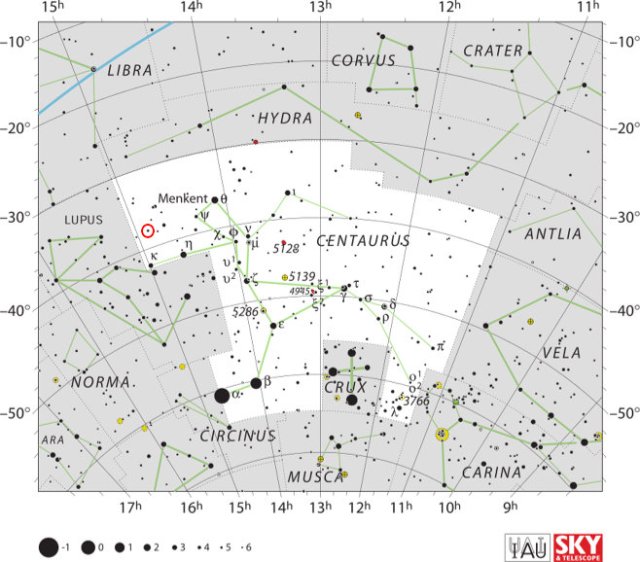
Sky and Telescope's IAU Centaurus chart. (2011) position of b Centauri/HD 129116/HIP 71865 circled in red
(From IAU, Sky & Telescope magazine/Roger Sinnott & Rick Fienberg; used w/o permission.)
(Location of b Centauri (AB)b/HD 129116 circled.)

HD 129116 b isn’t the first exoplanet that astronomers have seen directly. That’d be Beta Pictoris b, imaged in 2008. Or ROXs 42Bb in 2013. Or maybe some other planet.

We’ve been finding a great many exoplanets, and who’s found what and when — to say nothing about what’s being learned and how — hasn’t been tidied up into well-organized lists yet.

On the other hand, today’s information technology helps scientists share, analyze and organize information — and lets someone like me stay more-or-less up to date with what humanity’s learning about this wonder-packed universe.

Which reminds me — b Centauri(AB)b is being presented as “a planet that shouldn’t exist:”

“Shouldn’t exist” headlines get attention, which is what headlines are supposed to do. I wouldn’t call them clickbait, since b Centauri(AB)b is hard to explain.4

Incomplete and Growing Knowledge

B. Saxton (NRAO/AUI/NSF)/ALMA (ESO/NAOJ/NRAO)'s images of dust disks around nine young stars, from SPHERE instrument on ESO's Very Large Telescope. (April 2018)
(From ESO/H. Avenhaus et al./E. Sissa et al./DARTT-S and SHINE collaborations, via Wikimedia Commons, used w/o permission.)
(SPHERE/VLT’s images of dusty discs surrounding nearby young stars.)

B. Saxton (NRAO/AUI/NSF)/ALMA (ESO/NAOJ/NRAO)'s infrared image of Elias 2-27's protoplanetary diak.The nebular hypothesis is still a hypothesis.

Immanuel Kant, possibly developing an idea of Emanuel Swedenborg’s, said that the Solar System could have formed when a nebula collapsed into a rotating disk which then became our star and planets.

That was in 1755.

Pierre-Simon Laplace came up with a similar model in 1796.

We’ve learned a great deal since then. And over the last few decades we’ve found collapsing nebulae and protoplanetary disks.5

Assuming that they’re similar phenomena, seen at different times during their development, is an assumption. A reasonable one.

But we don’t know that’s how our Solar System formed. Not the way we know that Abraham Lincoln gave the Gettysburg address.

That sort of knowledge may have to wait until we’ve been making and recording observations of collapsing interstellar clouds for a few million years.

Meanwhile, scientists have been baffled by the conundrum of planetary formation.

Or, looking at it from another angle, they’ve been fine-tuning the nebular hypothesis and uncovering new questions.

It’s There, But How?

Natalie Batalha's and Wendy Stenzel's chart of exoplanet populations found with Kepler data. (NASA and Ames Research Center)One of these new questions is how “a planet that shouldn’t exist” formed.

Based on what we’ve learned so far, scientists figure that most planets when a protoplanetary disk’s dust grains stick together.

Then the dust clump collides with other grains and clumps, eventually getting as big as a planet. Meanwhile, the protoplanetary disk’s gas and ice will have been falling one the growing planet.

That model, along with what we’re learning about how gravity, growing planets and protoplanetary disks interact, looks like a good fit with the Solar System’s planets. And with planets we’ve been finding around other stars.6

Informed Speculations

NASA/Ames Research Center/JPL-Caltech/R. Hurt's 'Assembly Line of Planets' illustration. (June 19, 2017) via NASA, used w/o permissionExcept for b Centauri(AB)b.

It’s huge, roughly 11 times as massive as Jupiter. Maybe it formed closer to b Centauri(AB) and then was flung out to its current orbit.

A problem with that idea is that, although b Centauri(AB) b’s orbit is a bit eccentric — 0.4, give or take a bit — it’s not nearly as eccentric is it should be, in the ‘flung outward’ scenario.

Or maybe b Centauri(AB) b formed where it is now, through gravitational instability. If that’s what happened, part of the b Centauri(AB)’s protoplanetary disk became so dense that the denser part’s gravity pulled into the exoplanet.

A problem with the gravitational collapse model is that our models say that it’s far more likely to work when there’s enough mass in the lump to make a star.

Since astronomers have been finding a fair number of oversize planets in big orbits around massive stars, whatever process or processes are at work: they’re not rare.7

That’s all I have time for this week. Well, almost all.

Living With Reality: And Loving It

Since at least some folks see religion and science as incompatible: and, some of them, apparently think that science real and religion requires intellectual blinders. Then there are ‘religious’ folks who seem determined to encourage the notion.

I’ve explained why reality doesn’t threaten my faith, and why I think seeking truth is a good idea. Often.

So, instead of repeating that sort of thing, I’m developing a Science AND Religion section on A Catholic Citizen in America.

Finally, the usual links to more-or-less related stuff I’ve written.


1 ESO, VLT, and other deferred topics:

2 Designations and a catalog:

3 More (or less) of the same:

4 Images of other worlds:

5 Learning how planetary systems form:

6 Planetary system formation, more detail:

7 Instability, eccentricity, and all that:

Posted in Exoplanets and Aliens, Science News, Series | Tagged , , , | 4 Comments

The Immaculate Conception and a Legacy of Valor

Thomas Cole's 'Expulsion from the Garden of Eden.' (1828) Museum of Fine Arts, Boston.
(From Thomas Cole, via Museum of Fine Arts, Boston & Wikimedia Commons, used w/o permission.)
(“Expulsion from the Garden of Eden,” Thomas Cole. (1828))

We celebrated the Solemnity of the Immaculate Conception of the Blessed Virgin Mary this Wednesday.

It’s a big deal — a Holy Day of Obligation — because Mary is our Lord’s mother.

And because Mary is the only one of us born without original sin.

Original sin is not the notion that humans are utterly depraved, bad to the core. We’re still “very good” and made “in the image of God.” (Genesis 1:27, 31)

So, how come we don’t always act as if we’re “very good?”

Basically, we got off to a bad start.

We decided that ‘what I want at this moment’ was more important than ‘what God says.’ I’m not personally responsible for that decision, and neither are you. But we’re both living in a world that was affected by it, and we’re dealing with its consequences. (Catechism of the Catholic Church, 385-412)

If that bit about a decision and consequences sounds familiar, it should. I talked about it last week.

Getting back to this week’s celebration of the Immaculate Conception, the first reading was Genesis 3:9-15, 20. It includes this dialog, where Adam tries blaming his wife. And God.

“Then God asked: Who told you that you were naked? Have you eaten from the tree of which I had forbidden you to eat?
“The man replied, ‘The woman whom you put here with me—she gave me fruit from the tree, so I ate it.'”
(Genesis 3:1112)

As I’ve said before, the interview did not end well.

Our Lord’s Family History

Gustave Dore's 'Deborah Praises Jael.' (1866) from Dore's English Bible, via Wikimedia Commons, used w/o permission.Time passed. Abram left Ur, changing his name to Abraham. He had two sons: Ishmael and Isaac.

Hagar’s son Ishmael was, I gather, legitimate by laws and customs of the day. But that didn’t soothe subsequent Hagar-Sarah tensions.

Later, Sarah’s son Isaac inadvertently passed the first son’s blessing to Jacob. (Genesis 15:116:16, 21:121, 25:1927:45)

What can I say? The family had issues.

Moving along.

When Deborah was a judge of Israel, she told Barak that his victory against Jabin’s army was a sure thing. (Judges 4:17)

Barak refused to go unless Deborah came with him. Which she did. Barak’s forces won, but God and Deborah got credit for the victory. Sisera, Jabin’s general, fled: but died when Jael, wife of Heber the Kenite nailed his head to the floor.1 (Judges 4:822)

Judith and Editors

Artemisia Gentileschi's 'Judith and her Maidservant.' (ca. 1623-1625) from Artemisia Gentileschi & Detroit Institute of Arts, via Wikimedia Commons, used w/o permission.Then there’s Judith, who walked into an Assyrian siege camp with her maid, talked her way into the general’s quarters, and removed the general’s head.

Then the two women calmly walked out of the camp. With the general’s head in a bag. (Judith 10:1118:20)

The Book of Judith says the Assyrian general’s name was Holofernes, and that he was sent by Nebuchadnezzar.

That’d be Nebuchadnezzar II, second king of the Neo-Babylonian Empire: or the Chaldean Empire, or Assyrians. It depends on who’s talking. That was around 630 BC, give or take a few decades.

Nebuchadnessar II’s territory had been what we call the Neo-Assyrian Empire up to around 610 BC, give or take a few years. I strongly suspect that’s why the book of Judith’s author called his people’s enemy “Assyrians.”

The Book of Judith is in my Bible. But if you’re an American, odds are that it isn’t in yours.

I’m a Catholic.

Folks like Jonathan Edwards set the religious tone of my homeland.

So Tobit, Judith, Baruch, Sirach, first and second Maccabees and Wisdom are edited out of most American Bibles.2

Editors had their reasons for deleting the Book of Judith.

Jerome, Assumptions, and Missing Records

The Aristotelian Constitution of Athens, only extant copy of the nearly complete text. Currently at the British Library
(From The British Library, via Wikimedia Commons, used w/o permission.)
(Copy of “Constitution of the Athenians,” found in a garbage dump.)

Jerome says he translated Judith from an Aramaic manuscript. But we haven’t found any ancient Aramaic or Hebrew copies of Judith.

Besides: Judith, Arphaxad and a town called Bethulia aren’t mentioned anywhere except in the Book of Judith. We have several different versions of the book, but the oldest bit of text is on a third century A.D. potsherd.

I’ll willingly see the Book of Judith as something written maybe 100 BC, compressing five centuries of history into a single narrative. If it was written that recently, then many of the events in it happened roughly a half-millennium before the author’s birth.

Its anachronisms don’t bother me nearly as much as they might. I’m an historian by training, and see value in researching and verifying sources. But I’ve also spent my life surrounded by non-historians, who aren’t nearly as meticulous — or nitpicking — as I am.

And I know that records get lost.

Let’s say that the Holofernes incident happened in 630 BC, 2,651 years ago. Now imagine that another 2,651 years have passed. It’s the year 4642. We might still have stories about some of modern America’s high-profile folks. Like Wanda Gág.

But I’d like to think that scholars in the fifth millennium wouldn’t assume a story is fiction, even if it was the only surviving text mentioning New Ulm, Minnesota. And made reference to “Russia,” instead of “Soviet Union.”3

Fast-forward again, this time about six centuries.

Mary and Moses: Contrasts

John William Waterhouse's 'The Annunciation.' (1914) via Wikimedia Commons, used w/o permission.We’ll be celebrating the Annunciation, when Gabriel had that famous interview with Mary, again in March.

You’ve probably read how it went. Gabriel shows up, tells Mary of Nazareth to stay calm: and that she’s been picked to be the mother of Jesus, Son of the Most High, who will rule over the house of Jacob forever.

Mary of Nazareth asks one practical question.

“But Mary said to the angel, ‘How can this be, since I have no relations with a man?’
“And the angel said to her in reply, ‘The holy Spirit will come upon you, and the power of the Most High will overshadow you. Therefore the child to be born will be called holy, the Son of God.
(Luke 1:34, 35)

Then she accepts the assignment.

“Mary said, ‘Behold, I am the handmaid of the Lord. May it be done to me according to your word.’ Then the angel departed from her.”
(Luke 1:34, Luke 1:38)

“But – But – But – Send Someone Else!”

John Martin's 'Seventh Plague of Egypt.' (1823) Leona R. Beal Gallery, via Wikimedia Commons, used w/o permission.Let’s contrast that with Moses’ response to God’s ‘go to Pharaoh’ order.

“But Moses said to God, ‘Who am I that I should go to Pharaoh and bring the Israelites out of Egypt?'”

“‘But,’ said Moses to God, ‘if I go to the Israelites and say to them, “The God of your ancestors has sent me to you,” and they ask me, “What is his name?” what do I tell them?’

“‘But,’ objected Moses, ‘suppose they do not believe me or listen to me? For they may say, “The LORD did not appear to you.”‘”

“Moses, however, said to the LORD, ‘If you please, my Lord, I have never been eloquent, neither in the past nor now that you have spoken to your servant; but I am slow of speech and tongue.'”

“But he said, ‘If you please, my Lord, send someone else!'”
(Exodus 3:11, 13, 4:1, 10, 13)

That’s three “buts” and one “send someone else” – – – in my language, at any rate.

I get the impression that Moses was trying to talk himself out of the assignment.

Can’t say that I blame him, since he’d been told to confront a major world leader. And might be facing a murder charge. (Exodus 2:1215)

Even so, Mary’s assignment was no walk in the park.

But after being assured that “impossible” doesn’t apply to God, Mary accepted her mission. (Luke 1:3738)

Unique Circumstances, Remarkable Courage

Giovanni Battista Tiepolo's 'The Immaculate Conception.' (1767-1768) from Museo del Prado via Wikipedia, used w/o permission.Joseph, husband of Mary, didn’t have a cushy job, either.

But his story will wait for another day.

Getting back, finally, to Mary’s Immaculate Conception.

“…An essential part of God’s plan for the mother of his Son was that she be conceived free from Original Sin. ‘Through the centuries the Church became ever more aware that Mary, “full of grace” through God, was redeemed from the moment of her conception’ (CCC, no. 491).
“In anticipation that she was to bear the Son of God, Mary was preserved from the time of her conception from Original Sin….”
(Mary’s Immaculate Conception, Advent, Liturgical Year, USCCB)

So Mary’s child, Son of the Most High, had a unique mother. No surprises there.

I’ve suspected that being shielded from original sin helped Mary think straight during her talk with Gabriel. But I suspect that she also inherited the courage shown by folks like Deborah, Judith, Esther and Ruth.

These days we know her as Mary: Mother of Compassion, Full of Grace, Comforter of the Afflicted, Intercessor and Advocate.4

But two millennia back? She started out as an unmarried woman with a child on the way, lived as a refugee in Egypt, and saw her only child publicly executed. And didn’t crack. Granted, she had help. But like I said: I see courage in her decisions.

More, from previous Advent seasons:


1 More-or-less-well-remembered folks:

2 Assumptions, Assyria, and J. Edwards:

3 Historical perspective:

4 Remembering a remarkable woman:

Posted in Discursive Detours | Tagged , , , , , , | 3 Comments

Advent 2021: Another Year of Our Long Watch

Eastern Mediterranean, seen from the ISS. (May 20, 2005) International Space Station program/JSC Earth Science-Remote Sensing Unit, ARES Division, Exploration Integration Science Directorate; via NASA, used w/o permission.

It’s that time of year. Daily reminders of how many shopping days remain before Christmas fill some with dread, others with relief. Folks enjoy, endure or try to ignore another season of “Jingle Bells,” “Santa Baby” and “Frosty the Snowman.”

Some of my neighbors have deployed their Christmas displays. So have we, thanks to my son. It’s part of our Advent preparations.

We’re getting ready for Christmas, looking back at the first time Jesus came; and ahead to when our Lord returns.

James E. Scarborough's and Trekkie4christ's liturgical year pie chart. (2014) via Wikimedia Commons, used w/o permission.Since I’m a Catholic, I’ll be seeing purple during Mass. Or violet. The color’s name depends on who’s talking. Then, on the third Sunday of Advent, we’ll see rose instead of purple.

I gather that Pope Innocent III standardized those colors, just over eight centuries back.

Then the Council of Trent updated the rules in 1570, and that’s another topic.

Purple’s been a ‘royal’ color for at least two millennia, and that brings me to why Advent is a big deal.1

Need-to-Know

Wiley Miller's 'Non Sequitur,' Eddie and the rapture. (June 13, 2011) via GoComics.com, used w/o permissionAgain, during Advent we’re getting ready for Christmas.

We’re looking back about two millennia, to when the Son of God became one of us. And we’re looking ahead to when Jesus will come back.

About that, this isn’t another of those ‘End Times Bible Prophecies.’

We’ve known that our Lord is returning ever since he left. (Acts 1:11)

And some of us have tried second-guessing God the Father.

I don’t see the point, myself.

“‘But of that day or hour, no one knows, neither the angels in heaven, nor the Son, but only the Father….”
(Matthew 25:13)

“‘But of that day or hour, no one knows, neither the angels in heaven, nor the Son, but only the Father….'”
(Mark 13:3233)

I get the strong impression that information regarding the Second Coming is available on a need-to-know basis. And if the Son of God didn’t need to know, I certainly don’t.

Moving along.

Celebrating

John William Waterhouse's 'The Annunciation.' (1914) via Wikimedia Commons, used w/o permission.

Recapping, Advent is a big deal because it’s when we prepare for Christmas.

Christmas is a big deal because it’s when we celebrate the birth of Jesus.

And that’s a big deal because Jesus is the Son of God:

“…God from God, Light from Light,
true God from true God,
begotten, not made, consubstantial with the Father….”
(What We Believe, Nicene creed, USCCB)

I’ve seen “consubstantial” translated as “one in Being.” Either way, the idea is that Jesus really is human and really is God. (Catechism of the Catholic Church, 456-460)

The Second Person of the Trinity became human so that we could know God’s love. And so that we could be saved. (Catechism, 456-478)

Mission to a Wounded World

Earth, seen from Rosetta spacecraft. (2015)If we were perfectly perfect people living in a perfectly perfect world, then we wouldn’t need saving.

But we’re not and we don’t, so we do.

I’d better explain that.

We’re not perfect, and neither is our world. But we’re not utterly depraved and this is not the worst of all possible worlds.

This universe is “very good.” But it’s also in a “state of journeying” — in statu viae. (Genesis 1:31; Catechism, 302)

We’re “very good” too, but we’re wounded. We’re dealing with consequences made by the first of us. We lost the harmony between ourselves, this world and God. But we didn’t stop being human. (Catechism, 385-412)

Letting ‘what I want’ outvote ‘what God says’ was a bad idea.

Along with the rest of humanity, I’ve inherited a world that got off to a bad start. But I’m not personally responsible for that bad decision, neither are you, and humanity is not rotten to the core. (Catechism, 405)

We did and do, however, need help. None of us can lift ourselves into Heaven by our bootstraps. (Catechism, 406)

That’s why Jesus came. Our nature has been wounded. We have fallen. We are, in a sense, dead. Jesus came to heal us, raise us and restore our life. (Catechism, 457)

Offhand, I’d say that celebrating the start of our Lord’s mission makes sense.

So does remembering our standing orders.

“…Be Prepared….”

NGC 4848 and other galaxies, image by Hubble/ESA.

We’re sitting on the best news humanity’s ever had. (Matthew 28:1620)

God loves us. All of us. Each of us. And God wants to adopt us. (Romans 8:15; Ephesians 1:3-5; 2 Peter 2:34; Catechism, 1-3, 27-30, 52, 1825, 1996)

One part of our job is sharing what we know with anyone who will listen. (Mark 16:1516)

Another part is being ready for our Lord’s return: no matter when that is. (Matthew 24:44; Catechism, 673, 840, 1040, 2772)

“‘Gird your loins and light your lamps and be like servants who await their master’s return from a wedding, ready to open immediately when he comes and knocks….
“…You also must be prepared, for at an hour you do not expect, the Son of Man will come.'”
(Luke 12:3540)

“He answered them, ‘It is not for you to know the times or seasons that the Father has established by his own authority.
“But you will receive power when the holy Spirit comes upon you, and you will be my witnesses in Jerusalem, throughout Judea and Samaria, and to the ends of the earth.'”
(Acts 1:78)

Our Lord’s return has been “imminent” for two millennia. (Catechism, 673)

So, how long should we wait? As I see it, as long as it takes.

Still Watching and Working

Brian H. Gill's 'Watching.' (2014)I’m an American, so two minutes can seem like a long time.

But I’m also a Catholic whose interests include history and cosmology. That’s helped me develop a sense of scale.

I willingly accept that, from God’s viewpoint, there’s little difference between a minute, a day and a millennium.

“But do not ignore this one fact, beloved, that with the Lord one day is like a thousand years and a thousand years like one day.”
(2 Peter 3:8)

“A thousand years in your eyes
are merely a day gone by,
Before a watch passes in the night,”
(Psalms 90:4))

We’re still passing along what Jesus told us. And we’re still waiting for our Lord’s return.

I’ve talked about this before. And probably will again.

Like I said, it’s a big deal.


1 ‘Tis the season:

Posted in Being Catholic | Tagged , , , , , | 3 Comments

Thanksgiving Weekend 2021: Puritans, Pandemic and Me

Brian H. Gill's 'Thanks, but I'm Stuf---' for Thanksgiving 2021.

Americans celebrated Thanksgiving this week. Well, most Americans.

Some folks in New England lamented injustices committed over the last few centuries.

And, although those who weren’t killed during a parade in Waukesha, Wisconsin, may enjoy not being dead, my guess is that none of them feel giddy with thanks.

Pre-Thanksgiving Checkup: Good News, On Average

Brian H. Gill's 'We survived Thanksgiving...?' (2017)As for me, my routine checkup this week was a mixed bag. I’m still dealing with diabetes and blood pressure issues. I weigh too much, so neither is a surprise.

And I now have names for aches in two fingers of my left hand and pain in my right shoulder: arthritis and rotator cuff — tendinitis, I think it was.

Knowing their names doesn’t make either go away. But the knowledge does help me learn more, and the after-visit report included exercises I can do. So I’ll say the visit was good news, on average.

Health Issues, Uncertainty and 1 Corinthians 1:9

Otto Elliger's 'Jesus Cleanses the Temple.' (1700) from Pitts Theological Library, Candler School of Theology, Emory University, Atlanta (Georgia); used w/o permission.On the other hand, “good news, on average” still leaves me with serious health issues.

Which brings me to today’s Gospel reading: Luke 17:1119. That’s the bit where Jesus heals 10 lepers, but only one turns around and thanks God. And the 10th leper was a Samaritan, no less.

If Jesus could cure those lepers, then how come I haven’t experienced miraculous healing? And, yes: I asked about my glitchy hips, years back. That prayer’s answer was, apparently, “no.”

Or maybe getting both hip joints replaced with no major complications was a low-profile answered prayer. I don’t know.

At any rate, there’s more to life than health issues and uncertainty. Thanksgiving Day’s second reading, for example. It ends with this:

“God is faithful, and by him you were called to fellowship with his Son, Jesus Christ our Lord.”
(1 Corinthians 1:9)

God, Love and a Prayer

Dik Browne's 'Hagar the Horrible:' 'It may be the end of civilization as we know it.' (February 25, 1973)

Being “called to fellowship” by Jesus is part of the best news humanity’s ever had.

God loves us. All of us. Each of us. And wants to adopt us. (Romans 8:15; Ephesians 1:35; Peter 2:34; Catechism of the Catholic Church, 1-3, 27-30, 52, 1825, 1996)

I think taking God up on that offer makes sense, so accepting God’s family values seems like a good idea. They’re very simple, basically.

I should love God, love my neighbor, and see everyone as my neighbor. Everyone. No exceptions, no excuses. (Matthew 5:4344, 22:3640; Mark 12:2831; Luke 6:31 10:2527, 2937; Catechism, 1789)

I said they were simple, not easy.

Before I forget, here’s a “Thanksgiving Day Prayer,” from the USCCB’s website:

“Lord, we thank you
for the goodness of our people
and for the spirit of justice
that fills this nation.
We thank you for the beauty and fullness of the
land and the challenge of the cities.
“We thank you for our work and our rest,
for one another, and for our homes.
We thank you, Lord:
accept our thanksgiving on this day.
We pray and give thanks through Jesus Christ our Lord.
“Amen.”

There are days — weeks, months — when I have trouble seeing that “spirit of justice.” And that’s another topic, for another day.

Assorted First Thanksgivings

Jennie A. Brownscombe's 'The First Thanksgiving at Plymouth.' (1914) from Stedelijk Museum De Lakenhal, via Wikimedia Commons, used w/o permission.

My country’s Thanksgiving Day started in December of 1619, when immigrants were dropped on the banks of the James River, where Charles City County, Virginia, is now.

Or maybe America’s first Thanksgiving was in 1621.

That’s when the Plymouth Colony’s 53 Pilgrims celebrated their survival with a three-day party. They’d had the good sense to honor a treaty with Massasoit.

And they paid attention to Tisquantum, a diplomat/advisor who showed them how to plant crops that wouldn’t die before harvest.

I haven’t found an explanation for that three-day Pilgrim party. Aside, that is, from the obvious ‘we’re not dead!’ elation.

The Mayflower and Speedwell Pilgrims were English Puritans who’d moved to Holland before heading across the Atlantic.

Meanwhile, back in England, Henry VIII’s Church of England had cut annual Church non-Sunday holidays from 95 to 27.

Boston's public notice, banning the celebrations of Christmas. (1659)That was still 27 too many for English Puritans, who apparently didn’t see a point in rejoicing on days that weren’t Sabbaths.

Maybe Pilgrim Puritans weren’t as anti-holiday as their counterparts in England.

Or maybe having gone from 150 colonists to 53 in one year seemed like a reason to set principles aside and celebrate with a three-day holiday.

The Plymouth and James River celebrations are the earliest documented events connecting our current ‘turkey day’ with England’s 13 North American colonies.

But Spaniards had harvest-time festivals in what’s now St. Augustine, Florida (1565) and San Elizario, Texas (1598).1

Being Thankful for Another Harvest

BennyWikipedian's 'Pongal Festival/Tamilar Thirunaal' illustration. (2009) via Wikimedia Commons, used w/o permission.So, is America’s Thanksgiving Day a Puritan, Catholic or simply secular holiday?

Depends, I’d say, on who you listen to.

Spanish Thanksgiving Day origins would make it a Catholic holiday.

The Plymouth Puritan version is probably still my country’s default origin story.

I’m not sure about the James River folks.

But since a 17th-century London-based company sponsored them, I’m pretty sure they weren’t Catholic.

Canada’s Thanksgiving is just like my country’s, except for how it’s different.

Both look like England’s Harvest Home celebration. And all of the above resemble other European harvest festivals. Make that harvest festivals around the world. I talked about that, briefly, a couple years back.2

‘Tis the Season

Collage from globalnews.ca's coverage of Macy's Thanksgiving Day Parade. (November 25, 2021)

Nothing says “Christmas is coming” like giant bowling pins, a floating baby Yoda, marching imperial stormtroopers and Papa Smurf.

Some things may say it better. But I like Macy’s Thanksgiving Day parade anyway.

That said, bewailing Black Friday’s baneful impact on the hearts an minds of my fellow-Americans is an option. So is deploring Cyber Black Friday’s and Cyber Monday’s dread shadow falling upon this fair land.

I could, but I won’t.

For one thing, I like glitz. For another, we’re still dealing with the COVID-19 pandemic.3 It’s not fun, and I see no problem with a little color and glitter. Within reason, of course.

Coming: Another COVID-19 Christmas

Minnesota Department of Health's COVID-19 case overview, March 5, 2020-November 23, 2021. (November 26, 2021)

Compared to last year’s Thanksgiving weekend, not as many Minnesotans have COVID-19. But it looks like we’ve got another ‘holiday season’ peak.3

That’s not exactly good news, but as the old Minnesota saying says: it could be worse.

Finally, tomorrow is the First Sunday of Advent. It’s a time to look back and ahead, and that’s yet another topic.

Stuff that’s not entirely unrelated:


1 Thanksgiving’s history, in (very) brief:

2 Celebrating the harvest and an English company, a far-from complete overview:

3 Holiday shopping season:

4 Dealing with COVID-19:

Posted in Discursive Detours, Journal | Tagged , , , , , , , , | Leave a comment