Here in central Minnesota, palm fronds are part of our Palm Sunday Mass.
We generally take them home, fold them into the shape of a cross while they’re still green and pliable, and put them somewhere in the home where they’ll be visible.
Before next year’s Lent, we’ll return them to the parish church, where they’re burned to make ashes for Ash Wednesday. That’s the idea, at any rate. Some years, including this one, I forget about bringing last year’s back. Letting that upset me is an option. But not, I think, a reasonable one. And that’s another topic.
Last weekend, my now-grown son asked my wife about the palm fronds he’d brought home from Mass. That reminded me that it’s been 11 years since I made a short (4:27) video, and 10 since I’ve shared it online. It’s a how-2, showing how we fold our fronds.
Lanyards and a Video
My father-in-law worked as a cowboy at one point. That’s when he learned how to fold four strips of leather into a lanyard. Or would that be weave four strips? Anyway, the lanyard-making technique works with palm fronds, too.
I enjoy remembering where we learned this technique.
I also like the way it produces something like a St. Andrew’s Cross. That’s the saltire, or X-shape, that’s one of European heraldry’s symbols.
St. Andrew may or may not have been executed on an X-shaped cross. That incident happened in 60 A.D., but accounts that talk about a saltire-shaped cross only go back to around the 14th century.1
Anyway, folding palm fronds can be fun. But the parish church doesn’t provide take-home fronds to encourage arts and crafts activities. We’re remembering what happened when Jesus entered Jerusalem and got a royal welcome. (Matthew 21:1–11 and John 12:12–15)
Today is Palm Sunday, the start of Holy Week. Lent is almost over.
At Mass this morning, we walked through our Lord’s last days in Jerusalem, starting with the first century equivalent of a ticker tape parade.
Jesus was top of the charts, wildly popular.
Many folks apparently thought they’d finally met their messianic king. And they had, although Jesus wasn’t the secular messiah they’d been expecting.
Grass roots opinion apparently was that Jesus looked like someone who’d finally end the Roman occupation.
The powers that be had the same idea. And it scared them.
I can see their viewpoint. If this Jesus person said ‘I’m the king,’ and made it stick, then they’d be out of a job. After that, the Roman governor would send in troops and they’d lose everything else.
So they arrested Jesus, tried and convicted him in a kangaroo court and pressured the Roman governor to enforce the death penalty.
Then, after a really bad night, our Lord was nailed to a cross and died.
One Apostle committed suicide.
The rest kept a low profile.
If our Lord was the national hero that folks had been expecting, then that first Holy Week would have ended in a tragic fiasco. But Jesus wasn’t, and it didn’t.
Two millennia later, we’re still celebrating. That sounds crazy, at best.
But it’s not.
A few days after his messy death, Jesus stopped being dead. And that’s another topic.
It’s been one of those weeks, so today’s post is a slightly-abbreviated version of what I did for Palm Sunday, 2021:
TRAPPIST-1 exoplanets: (left) infrared observations from the Spitzer Space Telescope IRAC’ (right) illustration of the TRAPPIST-1 planetary system’s orbits. (NASA/JPL-Caltech/et al. 2017)
The TRAPPIST-1 planetary system is news again, this time because we’ve taken the innermost planet’s temperature.
That, by itself, isn’t newsworthy. We’ve been using infrared observations to learn how hot exoplanets are at least since 2006.1
What makes the latest observations special is that they’re the first time scientists have measured a comparatively small, cool exoplanet’s temperature.
That’s what I’ll be talking about this week, along with whatever else comes to mind.
TRAPPIST-1 planetary system, enlarged 25x, and inner Solar System. Green areas are the two star’s habitable zones, where liquid water could exist on an Earth-like planet.
This week’s news is a big deal partly because it involves the TRAPPIST-1 planetary system. Only two planetary systems have more planets than TRAPPIST-1.2
Solar System
One of them is our Solar System, with eight confirmed planets. We’ve got 10, if you count Ceres and Pluto.
Ceres was called a planet after its discovery in 1801, partly because it was where Johann Bode said a planet should be.
By the 1860s, astronomers had spotted Pallas and other asteroids — Herschell coined “asteroid”, “star-like”, as a generic term — and they’d decided that asteroids weren’t like the other planets.
Then the IAU (International Astronomical Union) defined “planet” as something that orbits the Sun, is massive enough to be nearly round, and has “cleared the neighborhood” around its orbit.
That was in 2006. The IAU definition reclassified Ceres and Pluto as dwarf planets.
The IAU’s definition intentionally doesn’t include exoplanets, but the IUGS (International Union of Geological Sciences) definitions do. There’s no IUGS official definition of planet. They’ve got several unofficial ones, plus the IAU definition.
Complicated? Yes. And I’m pretty sure we’re nowhere near the end of these discussions.
Now, back to TRAPPIST-1’s planetary system. Three or four of TRAPPIST-1’s planets lie in its habitable zone: e, f and g; or maybe d, e, f and g.
I’ve read that using very optimistic definitions, and applying them to limited parts of the planets, all seven might have liquid water and air somewhere on or near their surfaces.
The Solar System’s habitable zone includes one to four planets, depending on which definitions are in play: Earth, or Venus, Earth, Mars and Ceres.3
Kepler-90 Planetary System, Upsilon Andromedae d and back to TRAPPIST-1
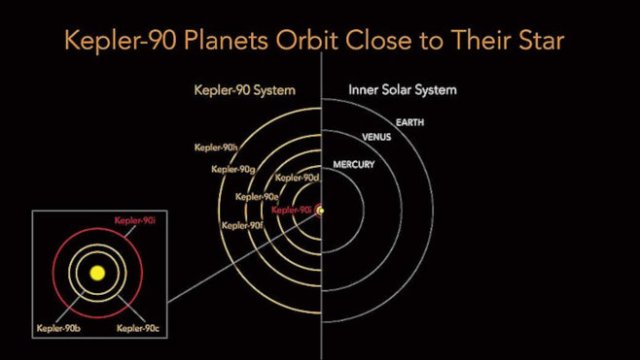
Wendy Stenzel’s illustration, comparing Kepler-90 and Solar System orbits. (2017)Wendy Stenzel’s illustration, comparing Kepler-90 and Solar System planet sizes. (2017)
The other planetary system with eight confirmed planets is Kepler-90’s.
Kepler-90 is a main-sequence G or F star that’s about 2,550 or 2,800 light-years out, in the general direction of Gamma Draconis and Kappa Cygni.
Its distance depends on who’s talking, which may account for some sources saying it’s spectral class G and others class F. Kepler-90’s surface temperature is just over 6,000 K, the dividing line between spectral class G and F stars.
The Kepler-90 planetary system is just like the Solar System, except for how it’s different. The inner Kepler-90 worlds are small and presumably rocky, with gas giants farther out. On the other hand, all eight Kepler-90 planets have orbits smaller than Earth’s.
The star’s outermost known planet, Kepler-90 h, is in the system’s habitable zone. But since it’s a gas giant, with a mass and diameter a bit bigger than Jupiter’s, it’s not a place where we’ll be looking for life.
If Kepler-90 h has a large, rocky moon; that’s another story. Some scientists figure an exomoon might share a magnetic field with its planet, like Earth’s moon did at one point.
Then there’s Upsilon Andromedae d, a super-Jupiter in an odd-but-maybe-habitable orbit. And that’s another topic.
Getting back to TRAPPIST-1 and its planets, the inner worlds (b, c and d) may not be as habitable as they seemed at first glance.
In 2017, some scientists said that TRAPPIST-1’s magnetic field might set up induction heating in the three innermost worlds.4
In any case, they’re on the starside of the the habitable zone, and that finally brings me back to TRAPPIST-1 and this week’s news.
Taking TRAPPIST-1 b’s Temperature With Webb’s MIRI
J. Olmsted (STScI)’s illustration, showing TRAPPIST-1b’s dayside temperature. (2023)
Calling TRAPPIST-1b “small and … cool” is accurate, since they’re both comparative terms.
TRAPPIST-1b is smaller and cooler than hot gas giants like KELT-9b and WASP-39b, and much cooler than WD 1145+017 b, a planet that’s being vaporized by its star.5
“NASA’s Webb Measures the Temperature of a Rocky Exoplanet“ Laura Betz, NASA’s Goddard Space Flight Center; Margaret Carruthers, Christine Pulliam, Space Telescope Science Institute(STSI); Solar System and Beyond, NASA (March 27, 2023)
“An international team of researchers has used NASA’s James Webb Space Telescope to measure the temperature of the rocky exoplanet TRAPPIST-1 b. The measurement is based on the planet’s thermal emission: heat energy given off in the form of infrared light detected by Webb’s Mid-Infrared Instrument (MIRI). The result indicates that the planet’s dayside has a temperature of about 500 kelvins (roughly 450 degrees Fahrenheit) and suggests that it has no significant atmosphere.
This is the first detection of any form of light emitted by an exoplanet as small and as cool as the rocky planets in our own solar system. The result marks an important step in determining whether planets orbiting small active stars like TRAPPIST-1 can sustain atmospheres needed to support life. It also bodes well for Webb’s ability to characterize temperate, Earth-sized exoplanets using MIRI…. [emphasis mine]
“…The team used a technique called secondary eclipse photometry, in which MIRI measured the change in brightness from the system as the planet moved behind the star….”
TRAPPIST-1 b is the system’s innermost planet: orbiting only 1,726,000 kilometers 1,072,500 miles, from TRAPPIST-1. Although TRAPPIST-1 is a very cool star, nobody expected the inner planet to be Earth-like in terms of temperature.
It’s quite Earth-like in other ways, though. Its diameter is around 1⅛ times our world’s, with a mass of about 1.37 Earths and about 110% Earth’s surface gravity.
But even before the new Webb data, we knew TRAPPIST-1 b wasn’t going to be Earth 2.0. An old equilibrium temperature estimate for the planet was 397 kelvins, 256° Fahrenheit.
I’m not sure how the newly-measured dayside temperature, around 500 kelvins, 227° Centigrade, 450° Fahrenheit, fits with the 2017 induction heating model. It’s hot, but not as hot as Mercury’s high temperature: 700 kelvins, 427° Centigrade, 800° F.
A couple more points before I start talking about stars, art and traffic lights.
① This phrase, “…as cool as the rocky planets in our own solar system…”, jumped out at me as an example of how much we’ve learned in the last few decades. It hasn’t been all that long since Mercury and Venus ranked as very hot planets.
② If TRAPPIST-1 b had a significant atmosphere, more than the wisp that Mercury has, it’d have winds: which would carry heat to its nightside, cooling the daylight part. Since that’s not (apparently) happening, the odds are very good that TRAPPIST-1 b is airless.6
Blackbody Radiation, Red Stars and Astronomical Art
Artist’s illustration of TRAPPIST-1 b, orbiting an ultra-cool red dwarf star.
“Blackbody radiation” shows up pretty often when scientists talk about something that’s very hot.
The term makes sense, sort of, since it’s the spectral radiance curve of thermal radiation emitted by a black body. A black body, in this context, is an ideal object that perfectly absorbs all electromagnetic radiation.
And this makes sense???
Look, it’s Friday as I write this: it’s getting late, and here’s a sample of the academese I’m trying to translate into English:
“…The specific (radiative) intensity is a quantity that describes the rate of radiative transfer of energy at P1, a point of space with coordinates x, at time t. It is a scalar-valued function of four variables, customarily written as I (x, t ; r1, ν)…” (Spectral radiance, Wikipedia)
Please bear with me. This actually does relate to TRAPPIST-1 and space art.
Thermal Radiation and the Ultraviolet Catastrophe!
Blackbody radiation and black bodies, the sort physicists talk about, don’t really exist.
A black body perfectly absorbs all electromagnetic radiation.
Electromagnetic radiation is what physics buffs call waves in an electromagnetic field: from low-end radio wavelengths measured in megameters to gamma rays with wavelengths of about a picometer. I’ll call it Em radiation to save space.
A helium atom is about 62 picometers across, a megameter is a thousand kilometers. We’re talking about extremes here.
Thermal radiation is Em radiation that stuff emits when it’s above absolute zero.
The hotter something is, the more thermal radiation it emits; and the shorter the peak of its spectral radiance curve.
Knew I forgot something. A spectral radiance curve is what you get when you put a continuous spectrum on a graph with intensity along one axis and wavelength on another.
Back in 1900, someone using classical physics crunched numbers for thermal radiation. The numbers showed that something that’s as hot as the sun would emit an infinite amount of energy in the shorter wavelengths.
We’re still here, so obviously there was something off about classical physics.
Theoretical physicist Paul Ehrenfest called this doesn’t-match-observations thing the “ultraviolet catastrophe” in 1911.
“Ultraviolet Catastrophe” might make a dandy title for a disaster film, if more folks knew their history and science. And that’s yet another topic.
Classical physics is still a pretty close fit with reality for many everyday phenomena.
Folks like Ehrenfest, Plank and others you don’t hear about every day developed quantum mechanics,7 and I’d better start talking about heat, colors and stars.
Star Light, Star Not-So-Bright
T. Pyle (IPAC)’s illustration, showing what TRAPPIST-1f’s surface might look like. (2017)Bhutajata’s illustration: colors emitted by a black body, from 800 to 12,200 kelvins. (2015)
Red dwarf stars are main sequence stars with surface temperatures between 2,400 and 3,700 kelvins.
That’s a lot cooler than our star’s 5,770 kelvins, so red dwarfs emit much of their energy in the infrared.
And they would look redder than our sun. Redder? More reddish? Never mind.
But I’m not convinced that even an ultra-cool red dwarf like TRAPPIST-1 — 2,566 kelvins at its surface, give or take 26 — would have the stoplight-red color its given in some astronomical art.
Some illustrations of TRAPPIST-1’s planetary system have the star looking like a traffic light, while others give it the color of a low-watt incandescent light bulb. Why? That, I don’t know.
Maybe the ‘cosmic traffic light’ illustrations happened because someone told the artist to make sure that the star looks red: so that viewers will realize it’s a “red” dwarf star.
Given a choice, I’d show TRAPPIST-1 the way it would look to someone standing on one of its planets, or in a visiting ship. Something like T. Pyle’s 2017 illustration.
We don’t know whether there’s an atmosphere or water on any of the planets. But we do know that TRAPPIST-1 is about as hot as a slightly-dim incandescent bulb’s filament.8
I figure it’d have about the same color.
Coming Next Week: Possible Interiors of TRAPPIST-1’s Planets
And that’s all I have time for this week.
One thing I’d meant to cover was informed speculation about what TRAPPIST-1’s planets are made of.
So unless something major comes up (yes, I have been reading headlines: but don’t have anything new to say about the usual mess), I’ll probably have another ‘TRAPPIST-1’ post ready for next week.
That’s the plan, anyway. Meanwhile, here’s the usual set of links:
“NASA’s Webb Measures the Temperature of a Rocky Exoplanet“ Laura Betz, NASA’s Goddard Space Flight Center, Greenbelt, Maryland; Margaret Carruthers, Christine Pulliam, Space Telescope Science Institute(STSI), Baltimore, Maryland; Solar System and Beyond, NASA (March 27, 2023)
Observing Venus: Five Millennia in About 700 Words.
We’ve known about the planet Venus for a very long time.
Most of the lights in Earth’s sky stay put, relative to each other, and they all spin around the celestial sphere’s poles.
Seven — Venus, Mercury, Mars, Jupiter, Saturn, the moon and the sun — don’t.
Venus never gets very far from the sun, so it’s only seen in the morning or evening sky.
Some folks, like the ancient Greeks, had one name for Venus when it was a morning star and another for the evening star.
Those names go back at least to Hesiod’s day, two and three quarters millennia back.
But before that, around the time construction started on Stonehenge, folks in what we call Mesopotamia had a single name for Venus: Inanna. That was around 3000 B.C., during what archaeology buffs call the Jemdet Nasr period.
We know about the 3000 B.C. Venus observations, thanks to a cylinder seal found near today’s Jalibah, Iraq.
The next Venus-related record I know of is what we call the Venus tablet of Ammisaduqa.
Ammisaduqa was Babylon’s king around the time Egypt’s Thirteenth Dynasty was winding down, when the Late Bronze Age Collapse was still four centuries in the future.
The last I heard, academics still haven’t decided whether Homer’s epics were based on actual events, but for some reason there’s a consensus that the Late Bronze Age Collapse was real.1 And that’s another topic.
Telescopic Views
Next — skipping lightly over Aristotle, Gan De, Ptolemy, Abd al-Rahman al Sufi and Copernicus — in 1761, Mikhail Lomonosov noticed that Venus has an atmosphere.
I gather that he saw a fuzzy arc during the 1761 transit of Venus, and that academics were debating what he actually saw until at least 2012.
Lomonosov used a telescope. So did Giovanni Domenico Cassini, Johann Hieronymus Schröter and Chester Lyman. Not the same telescope, of course.
Cassini and Schröter figured that a day on Venus lasted about 24 hours, based on markings they saw. Or thought they saw.
Until the mid to late 19th century, when John Draper and others began taking photographs through telescopes, astronomers made observations by patiently looking through their telescopes, sometimes for hours.
The human brain is very good at pattern recognition. So good that sometimes it shows us patterns that aren’t really there. Pareidolia is a five-dollar word for the sort of perception that lets us see the Man in the Moon, happy electrical outlets and Martian canals.
Although I haven’t confirmed it, I’m guessing that Cassini and Schröter observed something akin to Schiaparelli’s canali. All we can see of Venus in visible light is a nearly-featureless crescent or disk, depending on where it is in its orbit.
Starting in the 1920s, we could pick up a few cloud features by observing with ultraviolet-sensitive cameras.2
Pulp Fiction and the Radar Astronomers
Meanwhile, pulp science fiction magazines were entertaining and inspiring America’s youth with tales that I’d call reality-based. But not realistic.
“…About the only thing that astronomers knew about Venus in the ’30s was that it was smaller than Earth, had a a bit more carbon dioxide in the atmosphere, and a heck of a lot of clouds. In pure run-with-it logic the clouds meant lot of water and the CO2 meant an atmosphere like prehistoric Earth. Conclusion: Carboniferous swamps over the whole planet inhabited by dinosaurs. Also Munchkin villages….” (Venus, Tales of Future Past, David S. Zondy)
Getting back to the non-fiction planet, Schiaparelli said he’d seen a few features on Venus. His best estimate was that it rotated once every 224.7 days, same as its orbital period.
Percival Lowell said pretty much the same thing. Then, from November 1902 to March 1903, Vesto Slipher collected spectrograms of Venus, looking for Doppler shift. He’d been working at the Lowell Observatory.
Lowell said that Slipher’s analysis confirmed his and Schiaparelli’s conclusion. Slipher was more cautious. He said he found “no evidence that Venus has a short period of rotation,” and that “so fast a spin as 24 hours could not have escaped detection.”3
Another big step in Venus studies was radar astronomy. It’s like radio astronomy, except that it bounces radio waves off places like the moon and Venus.
In 1944, Zoltán Lajos Bay started testing a radar telescope at the Research Laboratory of the United Incandescent Lamp and Electrical Co. Ltd., (“Tungsram”), Ujpest.
Ujpest is a district in Budapest. But more to the point, World War II was in progress. So it wasn’t until 1946 that they bounced a signal off the moon. By the 1960s, we’d learned that Venus turns on its axis more slowly than it goes around the sun.
Scientists got radar images of Venus in the 1970s, using the Arecibo Observatory’s thousand-foot dish. They found three bright patches: Alpha and Beta Regio in 1964 and Maxwell Montes in 1967.4
Missions to Venus
The first successful interplanetary mission, Mariner 2, flew by Venus in 1962.
The Venera 4 lander stopped transmitting when atmospheric pressure rose to 22 times Earth’s. That was in 1967. Venera 7’s lander made it all the way to the surface in 1970.
Mariner 4 did a flyby of Venus on its way to Mercury, the Venera 9 lander sent back the first pictures from the surface of Venus. In 1978, the Pioneer Venus Orbiter began mapping the Venusian surface.5
SAR, Science and Magellan
Cool SAR stuff: using polarized microwaves to ‘see’ what’s on a surface. (NASA)
And that, finally, brings me to the Venus Orbiting Imaging Radar mission.
A 1978 study said that Synthetic Aperture Radar, SAR, would give resolution down to 200 meters.
Then budget problems and the Challenger disaster happened. Venus Orbiting Imaging Radar became Magellan, and was carried to low Earth orbit on the Space Shuttle Atlantis in 1989.
When I showed my oldest daughter an illustration of how SAR works, she said “MATH!“, so I’ll skip the “Synthetic Aperture LSA=BetaR0” stuff. Besides, I’m better with words than with numbers.
Basically, radar resolution depends on the ratio of the wavelength used to the length of the radar’s antenna.
For example, to get 10 meter resolution with a wavelength of around 5 centimeters, you’d need a radar antenna about 4,250 meters long. That’s just shy of two and two thirds miles, which isn’t even close to being practical. Not for a spacecraft.
Magellan’s SAR used 12.6 centimeter radar pulses, but — MATH!
The point is that by collecting several signals as a satellite moves — say, from point X1 to point X2 on that diagram — SAR radar gets resolution that’s as good as it would be if it was using one antenna that’s as long as X1-X2.
From September 1990 to October 1994, Magellan gathered data and sent it back to Earth.6 That’s a whole mess of data, and scientists are still sifting through it.
Active(?) Volcano on Venus: Maat Mons
One hemisphere of Venus, with Maat Mons area outlined. (NASA/JPL-Caltech)
One big plus of data from orbiters, Magellan included, is that they can show what an area looks like at different times.
They’ve also let scientists know that the amount of sulfur dioxide and methane in the Venusian atmosphere varies considerably. That’s been a metaphorical smoking gun, evidence that volcanoes might be active on Venus.
But there’s considerable distance between “might be” and “is”.
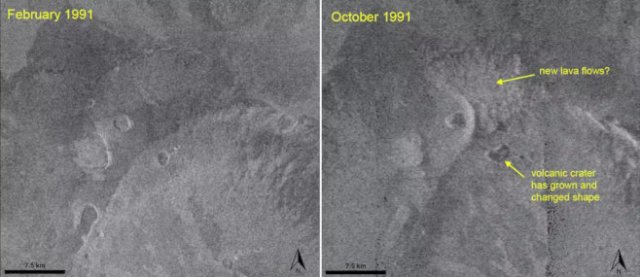
It took three decades for someone to notice Magellan’s ‘before and after’ SAR snapshots of volcanic vents on Maat Mons.
That seems like a long time. But Magellan sent back a lot of data. Plus, Venus is nearly as large as Earth: so I figure it’s small wonder spotting the two images took time.
Maat Mons is the second-highest mountain and highest volcano on Venus.7 It’s also one of the planet’s volcanoes that scientists thought might still be active. And now we have what looks like solid evidence of a recent eruption.
“Researchers scouring decades-old spacecraft data have found clear signs of recent volcanic activity on Venus. The findings, published in the journal Science, reveal not only that the planet’s surface is currently a turbulent place, but offer insights into its geological past and future.
“By any measure, Venus is a hellscape: crushing pressures, a toxic atmosphere, and surface temperatures hot enough to melt lead. It’s like a scene lifted straight from Dante’s Inferno.
“It’s ‘my favorite planet,’ says Robert Herrick, a planetary scientist at the University of Alaska Fairbanks….”
From the Magellan Archives: a Changing Volcanic Vent —
Figure 1: the study area in Alta Regio, Venus. The black rectangle shows Figure 2’s area. (March 2023)Figure 2: Close look at Maat Mons, scanned by Magellan: first (A) from the east, then (B) from the west. Dotted yellow lines in (B) are new, bright lava flows. Black box in (C) shows extent of images (A) and (B). (C) and (D) show match points (purple dots) used to get elevations (overlaid in color) (March 2023)
“I would have written a shorter letter, but I did not have the time.“ Blaise Pascal, Provincial Letters: Letter XVI (4 December 1656) via Wikiquote, unknown translator
I’m not in Pascal’s class, which is why I skipped over Synthetic Aperture LSA=BetaR0 and talked about wavelengths and distance.
But I’ve got the same issue with time and writing. Ideally, I’d boil down the following “…differences in imaging geometry…posteruptive vent…” excerpt. But I spent more time than I might have on that five-millennia ‘watching Venus’ summary.
So give this excerpt from the “Surface changes…” article in the Science journal, I’ll show a couple more “before and after” images, taken eight months apart in 1991, and move along.
Abstract “Venus has a geologically young surface, but it is unknown whether it has ongoing active volcanism. From 1990 to 1992, the Magellan spacecraft imaged the planet’s surface, using synthetic aperture radar. We examined volcanic areas on Venus that were imaged two or three times by Magellan and identified an ~2.2-square-kilometer volcanic vent that changed shape in the 8-month interval between two radar images. Additional volcanic flows downhill from the vent are visible in the second-epoch images, although we cannot rule out that they were present but invisible in the first epoch because of differences in imaging geometry. We interpret these results as evidence of ongoing volcanic activity on Venus.”
“…An active vent in Atla Regio “Figure 1 shows gridded Magellan altimetry overlain on Magellan cycle 1 SAR images of an area in Atla Regio, Venus, which extends from 9°S, 170°W to 6.25°N, 151°W, covering ~3.2 × 10⁶ km2. This area contains two of the planet’s largest volcanoes, Ozza Mons and Maat Mons, which have previously been hypothesized to be locations of active volcanism). Magellan observed this area with east-looking images in cycle 1 (incidence angle 45°) and west-looking images in cycle 2 (incidence angle 25°). This area has not been imaged by Earth-based radar, nor was it imaged during the earlier Venera 15 and Venera 16 missions to Venus….”
“We identified a volcanic vent at 1.363°N, 165.359°W that changed shape and expanded ([Figure 2]) in the 8-month interval between the Magellan imaging in cycle 1 and 2 (February to October 1991). The vent is located on the north side of a domed shield volcano that is part of the larger Maat Mons volcano. In the east-looking cycle 1 image, the vent appears near-circular (1.5 × 1.8 km, area 2.2 km2) with steep interior slopes. We speculate that it was a drained posteruptive vent. In the west-looking cycle 2 image, the vent has become larger (4.0 km2) and irregular in shape. In cycle 2, the vent wall, identifiable as bright pixels on the vent’s west side (an east-facing slope) and dark pixels on its east side (west-facing slope), is narrow, so the vent interior and exterior are separated by only a few pixels in the 75 m/pixel radar mosaic. We interpret this narrowness as being due to short vent walls, perhaps only tens of meters high, which implies that the vent is nearly filled to its rim in the cycle 2 image. We speculate that a lava lake formed in the vent interior during the 8-month gap between images….” (Figure 1, 2: emphasis mine)
— And New Lava Flows, Maybe
Maat Mons: possible new lava flows and a volcanic crater’s growth. (February and October 1991)
That pair of NASA/JPL Magellan SAR radar images, from an article in The Conversation, look a bit like part of Herrick and Hensley’s Figure 3, but I haven’t managed to find the NASA/JPL document they’re from.
The scientists figured that, since the February 1991 image was taken from a different angle than the October 1991 one, differences between the two in how the one crater looks might come from something in the image processing.
So they ran simulated SAR data of a virtual crater, seen from east and west, and came up with a crater that looked round, both ways.
Odds are very good that the crater on Maat Mons grew during those eight months, and was bean-shaped in late 1991. If follow-up work confirms what they’ve said, Herrick and Hensley have spotted the first known active volcano on Venus.
On the other hand, we’ve had other ‘firsts’ in the search for Venusian volcanoes.
Hot Spots, Sulfur Dioxide, Venusian Volcanoes and Acronyms
The ESA’s Venus Express orbited Venus from 2006 to 2015.
The spacecraft’s main job was studying the Venusian atmosphere. Its Venus Monitoring Camera, VMC, worked in ultraviolet, visible and near-infrared.
And it carried three spectrometers: including the Visible and Infrared Thermal Imaging Spectrometer, VIRTIS and SPectroscopy for Investigation of Characteristics of the Atmosphere of Venus, SPICAV.
In 2010, scientists published a study that connected hot spots with areas on Venus that looked like fresh lava flows.
Two years later, another study tracked a spike in sulfur dioxide in the planet’s upper atmosphere, followed by a slower decline. The decline looked like a similar drop in sulfur dioxide seen by Pioneer when it arrived at Venus.
Hot spots on ground that look like lava flows strongly suggests recent volcanic activity, but I’m guessing someone came up with another possible explanation.
Sulfur dioxide in the upper atmosphere must have come up from below: recently. It breaks down in a matter of days when exposed to sunlight.
Was that poof that volcanoes were erupting? Maybe not.8
“…’A volcanic eruption could act like a piston to blast sulphur dioxide up to these levels, but peculiarities in the circulation of the planet that we don’t yet fully understand could also mix the gas to reproduce the same result,’ adds co-author Dr Jean-Loup Bertaux, Principal Investigator for the instrument on Venus Express [SPICAV] that made the detections….” “Have Venusian volcanoes been caught in the act?“, Venus Express, ESA (March 12, 2021) [emphasis mine]
Maps, Missions, Maat Mons and More
NASA-Ames/USGS/MIT Venus map, from Pioneer data. (March 1981)
Two more excessively-wordy excerpts, and I’ll talk about Venusian maps and mountains.
First, what got this month’s study started:
“…Scientists study active volcanoes to understand how a planet’s interior can shape its crust, drive its evolution, and affect its habitability. One of NASA’s new missions to Venus will do just that. Led by the agency’s Jet Propulsion Laboratory in Southern California, VERITAS – short for Venus Emissivity, Radio science, InSAR, Topography, And Spectroscopy – will launch within a decade. The orbiter will study Venus from surface to core to understand how a rocky planet about the same size as Earth took a very different path, developing into a world covered in volcanic plains and deformed terrain hidden beneath a thick, hot, toxic atmosphere.
“‘NASA’s selection of the VERITAS mission inspired me to look for recent volcanic activity in Magellan data,’ said Robert Herrick, a research professor at the University of Alaska Fairbanks and member of the VERITAS science team, who led the search of the archival data. ‘I didn’t really expect to be successful, but after about 200 hours of manually comparing the images of different Magellan orbits, I saw two images of the same region taken eight months apart exhibiting telltale geological changes caused by an eruption.’…” “NASA’s Magellan Data Reveals Volcanic Activity on Venus “‘ Ian J. O’Neill (JPL), Karen Fox/Alana Johnson (NASA), Rod Boyce (University of Alaska Fairbanks Geophysical Institute); Jet Propulsion Laboratory, Caltech (March 15, 2023) [emphasis mine]
Next, what Herrick and Hensley have shown, and what they figure they haven’t:
“…On the basis of only one changed feature, we cannot determine how common currently active volcanism is on Venus. We draw a distinction between identifying recent volcanism on a planet and demonstrating that it is currently volcanically active. For example, Mars has lava flows with estimated ages of less than a few million years, but no volcanic activity has been identified over multiple decades of continuous observation. Only one changed feature has been identified in our survey of the Magellan data, and none have been found in kilometer-scale radar observations from Earth that covered ~25% of Venus’ surface. The low detection rate indicates that Venus is less volcanically active than Jupiter’s moon Io, for which over 100 active spots have been imaged. We estimate that our search of the Magellan data has examined ~1.5% of Venus’ surface area….” “Surface changes observed on a Venusian volcano during the Magellan mission“; Robert R. Herrick, Scott Hensley; Science (March 15, 2023) [emphasis mine]
(Acronym time: LPI is the Lunar and Planetary Institute, USRA stands for Universities Space Research Association.)
Those maps were high-resolution, detailed, and included text in sidebars. But they were a tad too high-resolution for this blog. When I scaled the global projection down to something that would fit on this screen, most of the lettering was blurry. At best.
So I got the “Altimetry of Venus” map, designed for low-resolution displays, here:
Pioneer Venus Orbiter Map of Venus Venus Galleries, Solar System Exploration, NASA/Ames/U.S. Geological Survey/Massachusetts Institute of Technology
Then I downloaded the LPI | Resources “Altimetric and Shaded Relief Map of Venus” and clipped out the east end of Aphrodite Terra and marked Maat Mons’ location. It’s under “Greater Admiration”, the next heading.
Again, Maat Mons is the mountain Herrick and Hensley studied.
Now, about those names. Briefly, for me.
A terra is a landmass, or would be if Venus had an ocean. More than one terra are terrae.
A mons is a mountain, more than one are montes.
Montes and terrae are words from Latin, which we use because today’s naming conventions got started when Latin was a common language for European scholars.
Detail, USGS Altimetric and Shaded Map of Venus. (1981) Maat Mons marked with red “+”.
I had, and still have, more to say about Venus.
But I’ve run out of time this week, so that’ll wait.
I’ll wrap this up by repeating something I haven’t said in a while.
We live in a universe that’s packed with wonders, beauty and harmony.
These wonders and beauty include, I think, places like Venus: which aren’t obviously beautiful in the picture-postcard sense.
Maybe it’s the nerd in me, but I see a sort of beauty in the way physical laws produce so many different — yet similar — landscapes and weather on other worlds.
That strikes me as a reason for “greater admiration” of God’s work. And since I see reflections of God’s beauty — and might — in this world, learning more about God’s creation inspires greater respect for God. It also reminds me that God’s God and I’m not. (Catechism of the Catholic Church, 268ff, 283, 341)
“Vesto Melvin Slipher, 1875-1969“ A Biographical Memoir by William Graves Hoyt, National Academy of Sciences (1980) via nasonline.org
“On the Rotation Time of the Planet Venus“ Professor G. V. Schiaparelli, Publications of the Astronomical Society of the Pacific (September 1890) via The SAO/NASA Astrophysics Data System
“Sulfur dioxide at the Venus cloud tops, 1978 – 1986.“ L. W. Esposito, M. Copley, R. Eckert, L. Gates, A. I. F.Stewart, H. Worden; Abstract, Journal of Geophysical Research (May 1988) via The SAO/NASA Astrophysics Data System
H. Raab’s photos of Orion: February 22, 2012 (left); February 21, 2020 (right)
Betelgeuse, the bright red star in Orion’s right shoulder, is a semiregular variable star, with small periods of 185 days and 2,100 days and a main period of around 400 days.
It will explode at any moment, and we’re right next door.
If I had any sense, from one viewpoint, I’d talk about the ozone hole, denounce forever chemicals and promote a ‘Save the Panda’ fund I’d set up.
Or maybe indulge in free association inspired by Revelation and Gematria, and slip in hints that your only hope is to give me money.
Yeah. That kind of trouble I don’t need. Besides, I suspect the weird mix of numerology and Bible trivia that infested ‘Christian’ radio during my youth is no longer in vogue.1
So instead, I’ll look at the last two times Betelgeuse was newsworthy. Then I’ll talk about cosmic scale, stars and whatever else comes to mind.
But I wouldn’t mind if journalists could dial the angst back a bit. And convince their editors that wasting time on a quick Google search wasn’t really wasted time.
That said, coverage of the last two times Betelgeuse threatened our fair planet could have been worse.2 Some was downright informative.
Betelgeuse in near-infrared, stellar disk and asymmetric extended atmosphere. ESO, P. Kervella (July 2009)
The 2009-2012 headlines got started when Townes, Wishnow, Hale and Walp said that they’d observed a change in Betelgeuse’s apparent diameter.
At one wavelength — 11.15 microns — the visible disk of Betelgeuse had shrunk by 15% in 15 years: 1993-2009. They were right about that.
But other scientists, measuring the star’s diameter at other wavelengths, found that Betelgeuse had gotten a tad bigger.
The last I checked, the consensus is that Betelgeuse’s envelope — a sort of extended atmosphere around the star — has changed.
Someone, I don’t know who, apparently mentioned that Betelgeuse will eventually become a supernova; and that stars shrink before exploding.
I only found one Betelgeuse-Mayan Apocalypse article, with Star Wars for extra flavor. And that one was comparatively low-key. Maybe the more creative journalistic outfits don’t regard their online content as evergreen, and that’s another topic.
Now, assuming that current models of how stars work are somewhat accurate, Betelgeuse will explode very soon. On a cosmic scale.
Estimates, based on various criteria, say that the the Betelgeuse supernova will happen somewhere between 100,000 and 1,000,000 years from now.
Compared to the 13,780,000,000 years, give or take, that this universe has been around; that’s very soon. Measured against the 24-hour news cycle, not so much.
As for being close, Betelgeuse isn’t in our back yard. But it’s arguably in our neighborhood.
Betelgeuse is between about 500 and 600 light-years away. Stepping back a little, it’s about 26,000 light-years to our galaxy’s center — in the general direction of Delta Sagittarii — and 2,500,000 light-years to the next Milky Way-sized galaxy.3
So on a cosmic scale, I’d say Betelgeuse is several doors down the block.
Distances, Safe and Otherwise
The Crab Nebula in optical, radio, infrared, ultraviolet, and X-ray wavelengths.
Light from a supernova that was roughly 6,400 light-years away reached Earth in the year 1054, when Edmund the Old was king of Sweden.
We know about it because Chinese astronomers recorded it as a “guest star”.
An English astronomer spotted the supernova’s remnant in 1731. In 1921, an American astronomer noticed that the Crab Nebula is expanding. Eventually, that let scientists work out when it had started billowing out; and that lined up with the 1054 guest star.
Right now, the Crab Nebula is about five and a half light-years across. If we’d been as close to it as we are to Alpha Centuari, it’d be more than an astronomical object of interest.4
Estimates and an Example
If Betelgeuse was closer, say 50 light-years away, and reached the supernova point in its development this year, then folks who’d invested in sun block could celebrate.
Seems that 50 light-years is where a supernova’s particles and radiation would start seriously affecting our ozone layer. That could be bad news for phytoplankton: and, indirectly, us.
Bad news, but not necessarily catastrophic. Supernovae happen. Some have happened near Earth. Most recently, very likely, about 2,600,000 years back. Give or take a few hundred thousand.
That’s right around the end-of-Pliocene mass extinction.
At the time, Oldowan tools were standard equipment for many folks.
Acheulean tech was around 900 millennia in the future, and the data storage technology we call writing was uncounted ages beyond that. So we don’t know what folks thought about the bright new star in their sky.
Now, about the mass extinction. By journalistic standards, it was an “unprecedented” catastrophe. Some plankton and mollusks died. So did megalodons. But for the most part, life went on.
The supernova may have been part of the Scorpius-Centaurus association of stars. That’s the nearest bunch of huge stars that haven’t exploded yet.
At the moment, the Scorpius-Centaurus association is about 420 light-years out, roughly in the direction of Alpha Lupi and Theta Centauri. Back when the supernova went off, it was closer: about 130 light-years.
That’s well outside the 50 light-year danger zone.
Or maybe it’s 25 light-years. Some scientists say that a supernova closer than that could do serious damage to Earth’s upper atmosphere. But we aren’t sure about the safe distance.5 Not yet.
Looking Ahead, Looking Back
Sooner or later, there’ll be another uncomfortably-close supernova.
Based on past experience, life will go on after that. So, I think, will we.
Partly because the end-of-Pliocene mass extinction didn’t end us.
Granted, we looked a bit different then.
Or, from another viewpoint, we look different now: taller, with too much forehead and not nearly enough face.6 And that’s yet another topic.
Betelgeuse, The Great Dimming and After
ESO’s SPHERE photos: Betelgeuse (January 2019, December 2019, January 2020, March 2020)
Maybe it’s just as well that news media was in full cry with the COVID-19 pandemic and political pandemonium in 2020.
It wouldn’t have taken a great leap of imagination to transform this expression of scientific interest into a shocking revelation. Maybe something like ‘mad scientists seek to doom us all!’
“The scientists who are hoping for a supernova“ If star on Orion’s shoulder goes supernova, Fermilab experiment will collect data bonanza uchicago news, adapted from a story by Scott Hershberger originally posted by Fermilab (October 14, 2020)
“In late 2019, Betelgeuse, the star that forms the left shoulder of the constellation Orion, began to noticeably dim, prompting speculation of an imminent supernova. If it exploded, this cosmic neighbor a mere 700 light-years from Earth would be visible in the daytime for weeks. Yet 99% of the energy of the explosion would be carried not by light, but by neutrinos, ghost-like particles that rarely interact with other matter.
“If Betelgeuse does go supernova soon, detecting the emitted neutrinos would ‘dramatically enhance our understanding of what’s going on deep inside the core of a supernova,’ said Sam McDermott, a theorist with the Fermi National Accelerator Laboratory….”
Then again, maybe not.
I like to think that even the most desperate news editor, having received his science education during late-night mad scientist marathons, would realize that we can’t make stars go boom.
I’d also like to say that they don’t make films like these any more:
Terror of Mechagodzilla (1975)
Frankenstein Meets the Spacemonster (1965)
X: The Man with the X-Ray Eyes (1963)
But cultural content, including film reviews, shows up in my news feeds, and that’s yet again another topic.
As it turned out, the 2019-2020 dimming of Betelgeuse wasn’t the prelude to a supernova.7 Probably.
“…By piecing together data from a slew of telescopes, including the Hubble Space Telescope, [Center for Astrophysics, Harvard & Smithsonian’s Andrea] Dupree is pointing the finger at an event called a Surface Mass Ejection (SME). Our own Sun regularly burps material from its corona, ejecting a billion tonnes of solar material — about the mass of Mount Everest. But Betelgeuse’s SME spit out 400 billion times more material, equivalent to several times more mass than the Moon. As the ejected material cooled, it formed a cloud of dust that partially blocked, and thus dimmed, our view of Betelgeuse….
“…The event seems to have had a profound effect on Betelgeuse’s more regular pulsations. Astronomers have observed the star for centuries and noticed that it goes through cycles of brightness variations with a period of 400 days. This pattern seems to have completely disappeared since The Great Dimming, perhaps as result of a reshuffling of material in the star’s interior. ‘Betelgeuse continues doing some very unusual things right now,’ Dupree says….”
On the other hand, maybe that stellar megaburp was but a prelude to a nearby supernova. My guess is that it’s not.
But if it is, then scientists around the world are going to be scrambling to get as much data as they can.
And the rest of us can either ignore the new light in our sky, fill the pockets of ‘Sam’s SuperSafe Supernova SuperShelter’ hucksters — or, if it’s summer, set up the lawn chairs, get popcorn and lemonade; and enjoy the show.
A Variable’s Variable Etymology
Like a great many other stars, Betelgeuse got its name from Arabic: bat al-jawzā’ or maybe Yad al-Jauzā’, or something else.
Between transliterating from one writing system into another, a misreading, and maybe more glitches; by the time the star’s name got to my language it was Betelgeuse.
But we do know what it means: Giant’s Shoulder, or Hand of the Central One, or maybe Armpit of the Central One.
“The Pliocene marine megafauna extinction and its impact on functional diversity“ Catalina Pimiento, John N Griffin, Christopher F Clements, Daniele Silvestro, Sara Varela, Mark D Uhen, Carlos Jaramillo; Nature Ecology and Evolution (August 2017) via PubMed Central, National Library of Medicine, National Institutes of Health
Something new each Saturday.
Life, the universe and my circumstances permitting. I'm focusing on 'family stories' at the moment. ("A Change of Pace: Family Stories" (11/23/2024))
Blog - David Torkington
Spiritual theologian, author and speaker, specializing in prayer, Christian spirituality and mystical theology [the kind that makes sense-BHG]
I was born in 1951. I'm a husband, father and grandfather. One of the kids graduated from college in December, 2008, and is helping her husband run businesses and raise my granddaughter; another is a cartoonist and artist; #3 daughter is a writer; my son is developing a digital game with #3 and #1 daughters. I'm also a writer and artist.

 Here in central Minnesota, palm fronds are part of our Palm Sunday Mass.


![NASA/JPL-Caltech/M. Gillon (Univ. of Lige, Belgium), Animator Amy Moran (GST) [Lead]'s image: TRAPPIST-1 planetary system and infrared observations from the Spitzer Space Telescope IRAC. (released March 22, 2017)](https://i0.wp.com/brendans-island.com/blogsource/20230103ff/20230329-ssc2017-01e_print-658.jpg?w=640&ssl=1)




![Frank R. Paul's 'The Man From Venus', Fantastic Adventures back cover. (July 1939) via David S. Zondy's Tales of Future Past [http://davidszondy.com/futurepast/man-from-venus.html], used w/o permission](https://i0.wp.com/brendans-island.com/blogsource/20160719ff/ManfromVenus-329.jpg?w=640&ssl=1)
![Frank R. Paul's 'A City on Venus', Amazing Stories back cover. (January 1941) via David S. Zondy's Tales of Future Past [davidszondy.com/futurepast/venus.html], used w/o permission](https://i0.wp.com/brendans-island.com/blogsource/20170908ff/Venus02-329.jpg?w=640&ssl=1)