Climate Change Continues

Climate change is still in the news. So is a growing crack in an Antarctic ice sheet, and a Ladybird Book co-authored by England’s Prince Charles.

The book, “Climate Change,” is a Ladybird Expert Book: written with adults in mind.

  1. A Cracking Ice Shelf
  2. Brunt Breakup
  3. A New Book by Prince Charles

This post has an afterword, mostly my take on climate change and being human:


The Coming Ice Age

I remember when the coming ice age was a hot topic: for science geeks, anyway.

Growing glaciers, miles deep, would spread from Earth’s arctic regions.

Grinding southward, they would obliterate cities and civilization in their inexorable advance.

It made for interesting conversation, forgettable science fiction potboilers, and at least one bit of cover art that I liked. The tale’s premise was that a city on whacking great tractor treads was trundling southward. I can’t remember the title or author.

More serious stories assumed that we didn’t survive, or had to start over in the tropics.

That was the late 1950s and early 1960s. Some folks were talking about “global cooling” in the 1970s, based on a cooling trend from the 40s to early 70s.1

These days, “climate change” has replaced “global warming” as a political slogan, and it’s easy to assume that the whole ball of wax is a bunch of hooey.

Reality isn’t quite what’s in the headlines, and that’s another topic.

“Last” Glacial Maximum?


(From Hansen et al./NASA, used w/o permission.)

If someone asked if I “believe in” climate change, I’d have answer yes — and no.

I don’t “believe in” climate change in the sense that I think it explains my existence, provides a reason for living, or belongs at the top of my priorities list.

On the other hand, I think Earth’s climate is changing. I am also quite sure that the universe is billions, not thousands, of years old; Earth isn’t flat; Adam and Eve aren’t German; and thinking is not a sin. (September 23, 2016; August 28, 2016; July 22, 2016)


(From Robert A. Rohde, via Wikimedia Commons, used w/o permission.)
(A reconstruction of recent temperatures, from tree rings and other data.)

I’m also reasonably certain that Earth has getting warmer, on average, since about 1910. It’s certainly warmer now than it was during the Little Ice Age.

We’re enjoying, on average, temperatures Earth hasn’t experienced since the Medieval Warm Period.

It’s certainly warmer now than about 26,500 years back, when glaciers covered my ancestral homelands; and most of today’s Minnesota.

We call it the Last Glacial Maximum, since it’s the most recent. But there’s no guarantee that continental ice sheets won’t come back. Given what we’re learning, it’s likely that the current interglacial period will end ‘soon,’ by geologic standards.2

Let’s put that in perspective.

Milutin Milanković: (Almost) Right


(From Lisiecki and Raymo (2005), via Wikimedia Commons; under GNU Free Documentation License, Version 1.2 or any later; used w/o permission.)

That graph shows average temperatures at Vostok Station in Antarctica — based on analysis of an oxygen isotope in deep-sea ocean sediments. It’s almost certainly not spot-on accurate: but my guess is that it’s pretty close to what actually happened.

More about Earth’s most recent five million years of climate change:

The graph’s “41 kyr cycle” is a Milankovitch cycle: variations in how far Earth’s rotational axis wanders.

Milutin Milanković noticed correlation between these changes and Earth’s climate in the 1920s. His theory wasn’t popular in my youth, but data collected since the ’60s shows that he was on the right track. Earth’s climate changed the way he said it did — almost.

The “100 kyr cycle” is another cyclic variation in Earth’s axis: and an issue for folks trying to make sense of Milanković cycles.

Earth’s equator is tilted 23.44 degrees from the ecliptic today. It tilts up to 24.5 degrees, and is on its way to the 22.1 degree minimum at the moment. The cycle takes about 41,000 years: hence the “41 kyr (kiloyear)” name.

So — once we know everything there is to know about Earth’s last five million years, we’ll fully understand climate change? Probably not.

Our home is much older: and hasn’t been the same since the dinosaurs died.

Climate Change After the Dinosaurs


(From Robert A. Rohde, via Wikimedia Commons, used w/o permission.)

Again, this graph comes from analysis of deep-sea sediments. It probably isn’t an exact fit with reality: but I think it’s reasonably accurate.

Earth’s current ice age started about 2,600,000 years back. The Isthmus of Panama’s closing was probably one of the triggering events.

So was the Tibetan plateau getting higher: maybe.

Continental glaciers have been spreading, melting, and spreading again ever since. Scientists figure positive and negative feedback processes have been keeping the cycle going. Exactly what those processes are is something we’re still learning.

Vastly oversimplifying the matter, we get more snow near the poles when Earth’s oceans are warmer. Sometimes the snow doesn’t entirely melt during summer. Snow and ice build up until we get glaciers scraping toward the equator.

Much of Earth’s water is tied up in glaciers by then, so sea level is lower. Between a slightly smaller ocean and colder climate, there isn’t as much snow falling: which slows down glacier production.

Somehow or other, Earth warms up and the cycle starts again. I gather that scientists still aren’t sure about what warms things up.

There’s evidence that it didn’t warm up once, more than 650,000,000 years ago.3 One of the problems scientists have with Snowball Earth is that they aren’t at all sure how Earth could have warmed up again.

It did, obviously, and I’ll get back to that.

It’s hardly surprising that we don’t fully understand ice ages.

The first inkling we had that they existed goes back to 1742, when Pierre Martel listened to what folks living in the Alps said about boulders of one sort of rock sitting on a different kind of rock.

I suspect we’re learning how much we don’t know almost as fast as we’re solving existing puzzles these days. The good news is that we’re learning: a lot, very fast.

One more graph, and I’ll get this week’s science news; and the new climate change book.

A Half-Billion Years of Climate Change


(From Dragons flight, via Wikimedia Commons, used w/o permission.)

Once again, that’s a pretty good estimate of Earth’s average temperature, based on analysis of oxygen isotopes.

The Phaerozoic is what scientists call Earth’s current geologic eon. It started 541,000,000 years ago, give or take 1,000,000, when critters like trilobites and reef-building archaeocyathans appeared.

Earth in humanity’s day is colder than it’s been since the Andean-Saharan glaciation, 460,000,000 to 430,000,000 years ago — when Earth’s second-largest cluster of extinction events happened.

The big one happened about a quarter-billion years later. (September 30, 2016)

We’re accustomed to a world where a mile-deep glacier covers most of Greenland, which isn’t normal for this planet.

Earth has been colder than it is today, but not by much: apart from that Snowball Earth thing I mentioned. The last I heard, scientists still aren’t sure if we’re in an interglacial period: or if the Quaternary glaciation is finally over.

One of the most sensible things I’ve read about Earth and climate change is what Oregon State University’s Christo Buizert said, discussing a polar climate cycle: “We still don’t know….” (BBC News (May 5, 2015))


1. A Cracking Ice Shelf


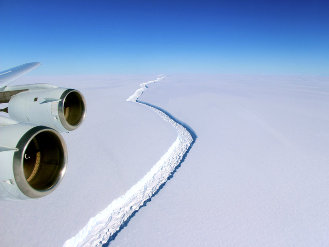
(From John Sonntag/NASA , via NPR, used w/o permission.)
(“A NASA scientist with project IceBridge took this photo of the crack in November.”
(NPR))

An Ice Shelf Is Cracking In Antarctica, But Not For The Reason You Think
Rae Ellen Bichell, NPR (January 16, 2017)

“A group of scientists is gathering today in the U.K. to discuss a slab of ice that’s cracking in Antarctica. The crack could soon split off a frozen chunk the size of Delaware….

“…The ice shelf Sevestre was studying is called Larsen C, and it now has a massive 90-mile crack running through it.

“‘The big rift is slicing the ice shelf from top to bottom,’ Sevestre says. It’s now a third of a mile deep, and as wide across as 25 highway lanes.

“But this is not just another sad climate change story. It’s more complicated….”

Folks wrote about an antarctic region long before 1820. That’s when a folks on a ship spotted the continent.

Which ship was first depends on who’s talking. It was one captained by von Bellingshausen, Imperial Russian Navy, Edward Bransfield, England’s Royal Navy; or Nathaniel Palmer, a sealer out of Stonington, Connecticut.

I’d like to think Vikings got that far, and didn’t bother to file a report with the North Sea Empire. That’s unlikely, though, and yet another topic.

Anyway, Aristotle mentioned an antarctic region in his Meteorology.

Marinus of Tyre invented equirectangular projection, gets credit for being the first to assign latitude longitude to each spot on his map. He also gave us the term “Antarctic,” the Arctic Circle’s opposite.4

My hat’s off to Rae Ellen Bichell and NPR, for this sentence: “It’s more complicated.”

I suspect that reality is, in a sense, very simple. For example, we keep finding close approximations to circles, spheres, and logarithmic spirals. Physicists keep getting closer to a working theory of everything, and that’s yet again another topic.

We’re also learning that reality is, in another sense, very complex: and interrelated.

“When we try to pick out anything by itself, we find it hitched to everything else in the universe.”
(“My First Summer in the Sierra,” John Muir (1869) via Wikiquote)

“Simply a Natural Event”


(From Jeremy Harbeck/NASA, via NPR, used w/o permission.)
(“Calving is a natural process that produces icebergs, as seen here with the Getz Ice Shelf in West Antarctica.”
(NPR))

“…’A lot of things are going on deep inside the ice,’ says Adrian Luckman, a glaciologist at Swansea University in the U.K. He’s also leading a project to track changes in the ice shelf.

“Luckman says climate change is certainly influencing this region. Larsen C used to have two neighbors to the north, Larsen A and Larsen B. As the air and water warmed, those ice shelves started melting and then splintered into shards in 1995 and 2002.

“But the crack in Larsen C seems to have happened on its own, for different reasons.

“‘This is probably not directly attributable to any warming in the region, although of course the warming won’t have helped,’ says Luckman. ‘It’s probably just simply a natural event that’s just been waiting around to happen.’…”
(Rae Ellen Bichell, NPR)

The odds are very good that at least part of this ice shelf will break off in the next few months, years, or decades. It won’t be the first time something like this happened, and almost certainly won’t be the last.

Quite a few glaciers and ice sheets eventually meet open water. As their edges get pushed out, bits and pieces crack off. The process is called ice calving. Scientists study ice calving, tourists watch it, and surfers ride the waves kicked up by falling ice.

Calving on an epic scale happened during October 1998, when a Delaware-size chunk of the Filchner-Ronne Ice Shelf broke off. It’s (remotely) possible that part or all of the West Antarctic Ice Sheet could break off.5

Maybe we’ll see a movie based on that idea. Think “Absolute Zero: The Day After 2012.”

Then the stars could testify before Congress, lending their wisdom to climate change talks. Or maybe not.

The Larsen Ice Shelf is part of the Wenddel Sea’s northwest coast, more-or-less across from the Brunt Ice Shelf. The Brunt Shelf is cracking, too.


2. Brunt Breakup


(From British Antarctic Survey, used w/o permission.)
(“Graphic showing Halley’s current site in relation to its new site further inland”
(British Antarctic Survey))

Ice crack to put UK Antarctic base in shut-down
Jonathan Amos, BBC News (January 16, 2017)

The British Antarctic Survey is to pull all staff out of its space-age Halley base in March for safety reasons.

“The highly unusual move is necessary because the Brunt Ice Shelf on which the research station sits has developed a big new crack.

“BAS officials say neither staff nor the base are in any immediate danger but believe it would be prudent to withdraw while the situation is assessed.

“The plan would be to go back once the Antarctic winter is over, in November….”

Halley Research Station got started with wooden hut built in 1956, part of a Royal Society expedition during the International Geophysical Year.

Snow eventually buried Halley I through IV, obliging researchers to move into newly-built quarters.

Halley V was designed to get lifted above each year’s snow accumulation, lasting until Halley VI was ready. Each of the current Halley Research Station modules stands on skis, so the station can be relocated as needed.6

The “Halloween Crack”


(From BAS, via BBC, used w/o permission.)
(“Aurora: Halley base has become a centre for the study of space weather”
(BBC News))

“…BAS is in the process of conducting such a move right now. The relocation is all but complete, with the last pod currently in the final stage of being shifted 23km to the new site.

“The move was necessitated by a chasm that had opened up in the shelf and which threatened to cut off Halley. But this huge fissure to the west of the station is not the cause of the temporary closure.

“Rather, it is another break in the ice some 17km to the north and east of the new base position. It has been dubbed the ‘Halloween Crack’ because it was discovered on 31 October….”
(Jonathan Amos, BBC News)

The British Antarctic Survey (BAS) folks don’t think part of the Brunt Ice Shelf is going to break off during the Antarctic winter.

But they can’t be sure, and don’t want folks on the ice if it does. A 19-hour power outage during the 2014 winter may have encouraged this common-sense move:

Power-down at British Antarctic Survey Halley Research Station – Statement
BAS Press Office (August 6, 2014)

“British Antarctic Survey (BAS) is dealing with a serious operational incident at its Halley Research Station. On Wednesday 30 July 2014 a major technical issue resulted in the station losing its electrical and heating supply for 19 hours. All 13 station staff are safe and in good health….”

With nobody around to keep an eye on equipment, BAS will be deciding whether to leave some of the experiments running and hope for the best, or shut the whole thing down until winter’s end.

It’s not an easy decision, since Halley VI collects data on Earth’s atmosphere, and beyond.7


3. A New Book by Prince Charles


(From Penguin, via BBC News, used w/o permission.)
(“The cover of the book was based on an image of flooding in Uckfield, East Sussex”
(BBC News))

Prince Charles co-authors Ladybird climate change book
(January 15, 2017)

Prince Charles has co-authored a Ladybird book on the challenges and possible solutions to climate change.

“It is part of a series for adults written in the style of the well-known children’s books that aims to clearly explain complicated subjects.

“The 52-page guide has been co-authored by former Friends of the Earth director Tony Juniper and climate scientist Emily Shuckburgh.

“Mr Juniper said he hoped the book would ‘stand the test of time’….”

Fear not! Uckfield in East Sussex is not sinking beneath the waves. Not yet, anyway.

The Prince Charles climate change book might become a collectors item, like first edition copies of “Bunnikin’s Picnic Party.”

I suppose anything “royal” has added value in some circles.

I was glad to see that marketing for this book isn’t entirely hysterical, although there’s the usual fear appeal.

“…You’ll learn about the causes and consequences of climate disruption; heatwaves, floods and other extreme weather; disappearing wildlife; acid oceans; the benefits of limiting warming; sustainable farming, new clean technologies and the circular economy….”
(“Climate Change (A Ladybird Expert Book) (The Ladybird Expert Series),” Amazon.com)

The hardcover book, available January 26, 2017, is already a #1 ‘meteorology’ bestseller on Amazon.com.

“Heatwaves, Floods … Disappearing Wildlife; Acid oceans”

It could be worse.

The cover illustration could show Cobb Bakers and Uckfield Pharmacy dissolving in an acid ocean as Godzilla and Hedorah battle on the skyline.

I found listings for several pharmacies in Uckfield, incidentally, but no “Uckfield Pharmacy.” I’m pretty sure both businesses are fictional.

I’m also sure that developing cleaner industrial technologies is a good idea, and that recycling makes sense.

That said, I’m not jumping on the “acid oceans” bandwagon. I’ve seen enough fizzled doomsday predictions, religious and otherwise, to be a bit cautious:

“…in ten years all important animal life in the sea will be extinct. Large areas of coastline will have to be evacuated because of the stench of dead fish….”
(Paul Ehrlich, on first Earth Day, (1970))

“…By the year 2000 the United Kingdom will be simply a small group of impoverished islands, inhabited by some 70 million hungry people….”
(Paul Ehrlich, Speech at British Institute For Biology (September 1971))

I’ve talked about Ehrlich, Yeats, and preacher-prognosticators, before. (August 12, 2016; August 7, 2016)

On the other hand, despite ‘is not/is so’ claims flying like fewmets in a lively primate house debate, climate change is real.


Stewardship: Part of Our Job


(From the European Space Agency, used w/o permission.)
(Nitrogen dioxide (NO2) in Earth’s troposphere, between January 2003 and June 2004.)

As I keep saying, our “dominion” over this world isn’t ownership. We’re more like stewards, responsible for God’s property. (August 12, 2016)

Seeing this universe as beautiful, good, and our responsibility, isn’t an option. It’s a requirement.

Keeping this world in good working order is part of our job. (Genesis 1:2629, 2:15; Catechism of the Catholic Church, 339, 952, 24022405, 2456)

The question isn’t whether or not we can change Earth’s climate. There’s good reason to believe we’ve been doing it, at least regionally, ever since folks started planting crops.

But our croplands and factories aren’t the only forces at work.

Mount Tambora’s eruption probably helped set off the Year Without a Summer.

Krakatoa’s 1883 eruption had a similar effect.

That’s Mount Redoubt in the photo, during its 1989–1990 eruption. It didn’t cause a volcanic winter, but did clog all four engines of a KLM airliner someone flew through its ash cloud.

Earth’s climate was changing long before humanity arrived. It’s changed a lot over the last few billion years.

Learning Wisdom, not Fear

We’re pretty hot stuff:

4 What are humans that you are mindful of them, mere mortals that you care for them?
5 Yet you have made them little less than a god, crowned them with glory and honor.”
(Psalms 8:46)

But “little less than a god” isn’t “God.”

I’ve talked about hubris, humility, and getting a grip, before. (November 18, 2016; July 31, 2016)

The responsibility that comes with our power is scary. Scary or not, though, we’ve got a job to do: taking care of the world’s resources for our reasoned use, and for future generations. (Catechism, 339, 2402, 2415)

If we’re going to do that job, we must keep studying the universe: and developing new tools using that knowledge. (Catechism, 22932295)

I am pretty sure that we know enough today to deliberately change Earth’s climate. I am also quite sure that we do not know enough to do so safely. Not yet.

In the short run, we should keep doing what we’re doing: reducing industrial pollution, and learning more about long-term climate changes. In the long run — that’s still another topic.

Meanwhile, being scared silly won’t help. That makes about as much sense as a shop foreman being scared of power tools.

More about Earth and being human:


1 Global cooling and all that:

2 Living in an ice age:

3 It’s starting to look like we had at least two “Snowball Earth” events: one about 650,000,000 years back, and another upwards of two billion years ago. Most ice ages weren’t that severe:

4 Antarctica, mostly:

5 Glaciers and ice shelves:

6 Britain’s Antarctic research:

7 More about Britain’s Antarctic research:

Posted in Science News | Tagged , , , , , , , , | 3 Comments

Life, Death, and Choices

Last week’s Gospel reading, Matthew 2:112, ends with a sort of cliffhanger. “Magi from the east” arrived in Bethlehem, found our Lord’s house, and paid their respects:

“They were overjoyed at seeing the star,
5 and on entering the house they saw the child with Mary his mother. They prostrated themselves and did him homage. Then they opened their treasures and offered him gifts of gold, frankincense, and myrrh.
“And having been warned in a dream not to return to Herod, they departed for their country by another way.”
(Matthew 2:1012)

Or maybe not so much — we read Matthew 2:1318 on December 28. I don’t suppose we’ll see the massacre of the innocents1 in an animated Christmas special any time soon. It’s far from the most cheerful parts of the Bible.

That didn’t keep folks in Coventry from including it in their Shearmen and Tailors’ Pageant. We got “Coventry Carol” from that mystery play.2

Rachel Wept

Herod the Great3 liked being in charge, even if it was as a Roman vassal. He wasn’t about to let some upstart take the job.

“When Herod realized that he had been deceived by the magi, he became furious. He ordered the massacre of all the boys in Bethlehem and its vicinity two years old and under, in accordance with the time he had ascertained from the magi.
“Then was fulfilled what had been said through Jeremiah the prophet:
9 ‘A voice was heard in Ramah, sobbing and loud lamentation; Rachel weeping for her children, and she would not be consoled, since they were no more.'”
(Matthew 2:1618)

Herod’s massacre most likely wasn’t a large-scale slaughter, like what happened in and around Srebrenica in 1995. Only about 1,000 folks called Bethlehem home in his day. There wouldn’t have been more than maybe 20 boys age two or under.

That’s still a lot of dead kids, particularly from the parents’ viewpoint.

Their deaths didn’t make it into Herodian records. Herod the Great had so many “important” folks killed, I’m not surprised that taking out a few low-status boys in a Podunk town got lost in the shuffle.4

Our Lord had left Bethlehem by then. An angel ordered Joseph to get Mary and Jesus to Egypt ASAP: which he did. (Matthew 2:1314)

Like I said, this probably wasn’t how Joseph imagined family life, back when he and Mary got betrothed. (December 25, 2016)

Shepherds, Magi, and Herod

I get the impression that folks generally weren’t apathetic about our Lord.

The shepherds glorified and praised God for what they’d seen heard and seen. (Luke 2:20)

The magi “…prostrated themselves and did him homage. Then … offered him gifts of gold, frankincense, and myrrh….” Herod had Bethlehem’s youngest boys killed. (Matthew 2:11, 16)

Let’s look at who — and what — Jesus is.

1 For a child is born to us, a son is given us; upon his shoulder dominion rests. They name him Wonder-Counselor, God-Hero, Father-Forever, Prince of Peace.”
(Isaiah 9:5)

5 Rejoice heartily, O daughter Zion, shout for joy, O daughter Jerusalem! See, your king shall come to you; a just savior is he, Meek, and riding on an ass, on a colt, the foal of an ass.”
(Zechariah 9:9)

24 Jesus said to them, ‘Amen, amen, I say to you, before Abraham came to be, I AM.'”
(John 8:58)

The shepherds and magi didn’t see the big picture. Neither do I, for that matter.

God’s God, I’m not. I can’t fully understand the Almighty and our Lord’s decisions. (Catechism of the Catholic Church, 230, 268274)

I suppose Herod could have seen the “newborn king” as the Messiah, and started planning for an early retirement. Instead, he decided to commit mass murder.

That’s a bad idea, by the way, no matter who the victims are. (January 11, 2017)

Free Will, Toy Monkeys

We could have hardwired responses to God’s presence, like toy monkeys that celebrate at the flip of a switch.

Instead, we’ve got a desire for God — a ‘God-shaped hole’ — in our hearts. We can try filling the hole by pursuing truth. If we do it right, that’ll lead us to God. We can also try ignoring it, which is a bad idea. (Catechism, 2738)

Either way, we decide what we do.

We are rational creatures, made “in the divine image.” (Genesis 1:27; Catechism, 355357, 1702, 1738)

We can make reasoned choices. Or we can decide to let our emotions and whims guide us: which is also a decision. Either way, we make choices; and are responsible for the consequences. (Catechism, 17301742, 1778, 1784, 1790)

We can decide that our career, entertainment, or some other short-term goal, is more important than eternal happiness with God. That’s a really bad idea, but it is an option. (Catechism, 10201037)

Humanity’s been making decisions — good, bad, and disastrous — for a long time, so thinking straight sometimes isn’t easy. And that’s another topic. (Catechism, 385412, 1735, 17901793)

The Light Still Shines in the Darkness

Jesus, Joseph, and Mary, stayed in Egypt until Herod the Great died.

Mary’s home town, Nazareth, seemed safer than Judea, so they settled there. (Matthew 2:1923)

Our Lord grew up, ran into trouble with Jerusalem’s elite, again, was executed and buried in a borrowed tomb.

Jesus stopped being dead few days later.

And that’s yet another topic.

3 All things came to be through him, and without him nothing came to be. What came to be
“through him was life, and this life was the light of the human race;
4 the light shines in the darkness, and the darkness has not overcome it.”
(John 1:35)

More about life, death, love, and all that:


1 Following the Prince of Peace isn’t easy:

2 Wikimedia Commons has an excellent recording of the U.S. Army Band singing “Coventry Carol:” wikimedia.org/… U.S._Army_Band_-_Coventry_Carol.ogg.

3 Ken Spino called Herod the Great “a madman who murdered his own family and a great many rabbis.” (2010) Herod apparently didn’t kill off the entire family, since two sons took over after his death. The name got recycled a several times:

4 Herod’s legacy:

Posted in Being Catholic | Tagged , , , , , , , | Leave a comment

Urban Evolution and Big Brains

Life, and evolution, has been happening for quite a while. Cities are new, but the same processes happen there; with slightly different results. We’re learning how urban environments affect critters, and are piecing together more of humanity’s story.

  1. Evolution in Cities
  2. Big Brains and DNA

Reality and Faith

I occasionally run into someone who feels that religion is silly and science isn’t, or the other way around. I grew up in this country, so I recognize the ‘religion is against science’ attitude.

But I’m a Catholic; so rejecting reality, avoiding truth, isn’t part of my faith.

Faith, the Catholic version, is a willing and conscious “assent to the whole truth that God has revealed.” (Catechism of the Catholic Church, 142150)

Truth is important, and beautiful — whether it’s expressed in words, “the rational expression of the knowledge of created and uncreated reality;” or “the order and harmony of the cosmos;” or in other ways. (Catechism, Prologue, 27, 74, 2500, more under Truth in the index)

“Truth or truthfulness is the virtue which consists in showing oneself true in deeds and truthful in words, and guarding against duplicity, dissimulation, and hypocrisy.”
(Catechism, 2505)

We can learn a little about God by noticing God’s infinite beauty reflected in “the world’s order and beauty.” (Catechism, 3132, 341)

A thirst for truth and happiness is written into each of us. If we’re doing our job right, it’ll lead us to God. (Catechism, 27)

Using the brains God gave us is okay. Seeking the Almighty and studying this wonder-filled universe is what we’re supposed to do. (Catechism, 35, 50, 159, 22922296)

That’s one reason I like Thomas. He asked questions, and wanted evidence. That earned him the “doubting Thomas” nickname. He also knew when to accept reality.1

I enjoy understanding things, and learning how to understand more. But fully understanding God is beyond me. The Almighty is “…incomprehensible, almighty and ineffable … a mystery beyond words.” (Catechism, 202, 230)

This universe is another matter.

Secondary Causes

I see no problem with believing that God is creating a universe that’s following knowable physical laws. That’s just as well, since it’s what we’re told to believe. (Catechism, 268, 279, 299, 301, 302305)

We’ve been learning a bit about God, and this universe, over the millennia.

For starters, God really is “the Almighty.” But God’s power isn’t arbitrary in the sense of capricious. (Catechism, 270271)

Some facet of the Creator’s truth is in everything we observe. (Catechism, 300310)

Natural processes, like fire and gravity, involve secondary causes: creatures changing in knowable ways, following laws woven into this creation. (Catechism, 301308, 339)

Scientists are assuming that evolution is like fire and gravity: something that’s real, and follows knowable rules. I think they’re right.

A big difference between evolution and gravity is that we we weren’t sure that evolution was real until quite recently. And that brings me to Anaximander.

A Changing World: Not a New Idea

Folks like Anaximander and Empedocles speculated that today’s critters — humans included — had changed since the world’s beginning.

Fast-forwarding over the Roman Republic, Empire and upwards of a millennium of European history, Pierre Louis Maupertuis and Louis Leclerc, Comte de Buffon wrote about more-or-less-systematic change in the 1700s.

Comte de Buffon also used experimental data to estimate Earth’s age. He was wrong by several orders of magnitude: but in the 1700s it was a pretty good estimate, based on his data. (August 28, 2016)

Charles Darwin didn’t single-handedly start the idea that organisms change in a rational way: but his “On the Origin of Species” (1859) was an important contribution to evolutionary theory. It also dropped “evolution” into popular culture.

We’ve learned quite a bit since then, much of it in my lifetime: and there’s a great deal left to learn.

God, Neanderthals, and DNA

I could get upset that God didn’t take a 17th century Englishman’s beliefs into account when designing the universe, but that doesn’t make sense. Not to me.

“Our God is in heaven; whatever God wills is done.”
(Psalms 115:3)

I would much rather take reality ‘as is.’ (October 28, 2016; August 28, 2016)

Scientists still call Neanderthals, Denisovans, and Red Deer Cave people different “species” or “subspecies.”

We don’t have Red Deer Cave DNA yet, but most folks living today have some Neanderthal or Denisovan ancestors. I’m guessing that Red Deer Cave people are no less “human” than the rest of us.

I’ll admit to a bias, since my ancestors are from northwestern Europe, Neanderthal country. I don’t think our profuse body hair and Neanderthal DNA make us less “human” than folks from other parts of the world. But I’m one of ‘them,’ so like I said: I’m biased.2

Ainu apparently aren’t genetically similar to Europeans, although I’m not clear on which Europeans Sforza, Menozzi, and Piazza, used for comparison.

The more we learn about life on Earth, the more scientists revise the old Linnaean taxonomy. And that’s another topic.

Large and In Charge

As I’ve said before, I figure God is large and in charge. Part of my job is noticing this astounding creation, and admiring the Creator’s work.

“The heavens declare the glory of God; the sky proclaims its builder’s craft.
“One day to the next conveys that message; one night to the next imparts that knowledge.”
(Psalms 19:23)

“Shout with joy to the LORD, all the earth; break into song; sing praise.”
(Psalms 98:4)

“Of old you laid the earth’s foundations; the heavens are the work of your hands.
“They perish, but you remain; they all wear out like a garment; Like clothing you change them and they are changed,
“but you are the same, your years have no end.”
(Psalms 102:2628)

4 Indeed, before you the whole universe is as a grain from a balance, or a drop of morning dew come down upon the earth.
“But you have mercy on all, because you can do all things; and you overlook the sins of men that they may repent.”
(Wisdom 11:2223)


1. Evolution in Cities


(From BBC News, used w/o permission.)
(“For the first time, researchers say they have identified urbanisation’s signature in evolution”
(BBC News))

Urbanisation signal detected in evolution, study shows
Mark Kinver, BBC News (January 7, 2017)

A ‘clear signal’ of urbanisation has been identified in the evolution of organisms, which has implications for sustainability and human well-being.

“In analysis of more than 1,600 cases around the globe, researchers said the changes could affect ecosystem services important to humans.

“More than half of the world’s human populations now live in urban areas, and this proportion is set to grow….

“…’We found that there is a clear urban signal of phenotypic change, and also greater phenotypic change in urbanising systems compared to natural or non-urban anthropogenic systems,’ said co-author Marina Alberti from the University of Washington’s Department of Urban Design and Planning.

“‘So urbanisation, globally, is clearly affecting things.’

“Phenotypic change refers to change in an organism’s observable traits, such as it morphology, physiology, phenology, or behaviour….”

I’m a recovering English teacher, so here’s a vocabulary review. A phenotype is how a critter looks and acts. Genotype is the genetic code in its cells. Anthropogenic is what we’ve started calling stuff that happens or exists because we’re here and acting like humans.

The researchers looked at “habitat modification, biotic interaction, heterogeneity, novel disturbance, and social interaction.”

Taking that one at a time — Habitat modification is turning a forest into a mosaic of parks, buildings, and streets; a meadow into a parking ramp; or a swamp into a housing development. That sort of thing.

Biotic or biological interaction is the effect critters have on each other. Heterogeneity is the degree to which one spot differs from another.

Novel disturbance doesn’t have anything to do with book-length fictional narratives. I gather that it’s stuff that hasn’t happened before.

Social interaction is an interesting one. Cities can bring critters together that wouldn’t have met otherwise.

Changes


(Background from NASA, 2012; data points and legend by Marina Alberti et al; used w/o permission.)

Crepis sancta, hawksbeard, looks like dandelions; and spreads its seeds the same way, on the wind. Hawksbeard in urban areas have bigger, heavier, seeds.

That most likely increases the odds that a seed will land on soil near the parent plant, instead of landing on asphalt or concrete.

I’m not particularly surprised, or upset, that many humans live in cities; that cities are growing; and that cities aren’t like wilderness. I also think learning more about how cities affect critters is a good idea.

That’s partly because I live on Earth. What happens here affects how my family and I live.

“…Prof Alberti and colleagues suggested that these changes meant that the alteration in the functions performed by the species, such as food production or the prevention of the spread of infectious diseases, would also be modified.

“‘There have been a lot of studies on individual cities but there had been no studies that considered the global picture to identify a global urbanisation influence on evolution,’ she added.

“‘We live on an urban planet already. This is a change that has implications for where we are heading in the future.

“‘We are changing the evolution of Earth and urbanisation has a role, a significant role, in that.'”
(Mark Kinver, BBC News)

Doing Our Job


(The U.S. Bank Center in Milwaukee. Peregrine falcons use part of the 41st floor.)

I remember when we were learning that DDT isn’t particularly good for humans, and downright dangerous for some birds.

I think part of the reason we’ve been a bit slow on the uptake where environmental hazards are involved has to do with our biology.

We’re not as spectacularly hard to kill as cockroaches or scorpions, but the Black Death didn’t do more than slow us down, and that’s another yet another topic. (November 6, 2016; September 30, 2016)

As I’ve said before, part of our job is managing this world. (Catechism, 339, 952, 24022405, 2456)

A half-century later, we’re more careful about pesticides; and are developing reasonable alternatives. Somewhere along the line, we noticed that peregrine falcons will nest in the artificial cliffs we’ve been building in central North America.

Since we like the birds, and don’t mind their habit of hunting urban critters that bother us, some of us have set aside parts of our taller buildings for their use. I see it as win-win situation.3

Sometimes managing this world means not feeding deer.

CWD, chronic wasting disease, a particularly nasty affliction, showed up in two more deer recently. It gets passed from deer to deer when they touch noses. That happens more often when the critters gather at feeding stations, so the Minnesota Department of Natural Resources added more counties to a feeding ban.


2. Big Brains and DNA


(From Science Photo Library, via BBC News, used w/o permission.)

DNA clue to how humans evolved big brains
Helen Briggs, BBC News (December 7, 2016)

Humans may in part owe their big brains to a DNA ‘typo’ in their genetic code, research suggests.

“The mutation was also present in our evolutionary ‘cousins’ – the Neanderthals and Denisovans.

“However, it is not found in humans’ closest living relatives, the chimpanzees.

“As early humans evolved, they developed larger and more complex brains, which can process and store a lot of information.

“Last year, scientists pinpointed a human gene that they think was behind the expansion of a key brain region known as the neocortex.

“They believe the gene arose about five or six million years ago, after the human line had split off from chimpanzees….”

This gene’s name is ArhGAP11B, which I tend to ‘hear’ as “argap-eleven-b.” It’s a truncated version of ArhGAP11A, a gene that’s “found throughout the animal kingdom,” as Wikipedia put it.

ArhGAP11B is in every human living today, plus folks we call Neanderthals and Denisovans. Depending on who you read, those folks are two “extinct” species or subspecies of the genus Homo.

Interestingly, it’s found only in humans. A team headed by the Max Planck Institute of Molecular Cell Biology and Genetics’ Wieland Huttner identified it about two years back.

We’re not sure exactly how ArhGAP11B works, but it’s involved in making our neocortex fold and grow.4 I’ve talked about another human-specific ‘brain gene,’ SRGAP2, before. (September 23, 2016)

About Neanderthals and Denisovans being “extinct,” I think that’s about as accurate as saying that víkingr and the Na hÉireannaigh are “extinct.”

Guess Who Came to Dinner

We seem to be getting over the notion that Neanderthals are “cavemen,” brutish half-apes with no appreciation for afternoon tea.

I’m not surprised that we’re learning that Neanderthals “interbred” with folks who look more like me.

The term is accurate, but I don’t like it. I know too much about my more-recent ancestors. From some viewpoints, I’m the result of “miscegenation,” another word for “interracial marriage.”

The daughter of a respectable family caught the eye of an Irishman a couple generations back — to the great dismay of her parents.

As one of my ancestors said, “he doesn’t have family, he’s Irish.”

The youngsters got married anyway, which made me possible. I’ve talked about immigrants, nativism, and English Bulldogs, before. (November 29, 2016; August 5, 2016)

The respectable family coped, most Americans no longer see the Irish as a threat, miscegenation hasn’t been a felony here since 1967, and I am heartily glad that the ‘good old days’ aren’t coming back.

Being Human


(From Captain Blood at de.wikipedia, via Wikimedia Commons, used w/o permission.)
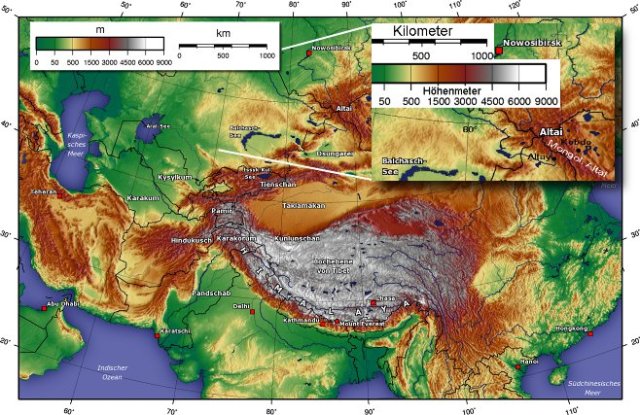
(Topographic map of Central Asia, including the Altai mountains.)

Denisovans lived in or near the Altai mountains about 41,000 years before we started playing baseball. We don’t know what they called themselves. Our name comes from where we found their remains: the Denisova Cave

We don’t know much about Denisovans yet, apart from a bit of finger bone, two teeth, and a toe bone. It’s not much to work with: but scientists found intact DNA — enough to trace Denisovan descendants among Melanesians and Aboriginal Australians.

Many or most folks in southern and southeast Asia probably have Denisovan ancestors.

I’ll grant that this might be a hoax, like Piltdown Man, the Cardiff giant, and Archaeoraptor: but I don’t think so. Too many scientists agree that Denisovan DNA is about 41,000 years old, is distinctly different, and shows up in folks living today.

Denisovans seem to have been as open-minded in one way as some of my ancestors were. About 17% the Denisovan DNA we found is from local Neanderthal populations: and some is from another variety of human we didn’t know about before.

Acting Like Humans


(From Rick Potts, Susan Antón and Leslie Aiello; via the Smithsonian, used w/o permission.)
(One of humanity’s many migrations.)

Denisovans not preserving ‘racial purity’ doesn’t surprise me. As I see it, they were people acting like humans.

We’ve moved around, a lot, over the last few million years. Each time we do, some of the newcomers’ younger generation generally takes a lively interest in local lads and lasses: to the occasional horror of ‘proper’ parents.

Given the attitude some of my ancestors had toward another set of my forebears, I’m not inclined to be upset at the thought of folks not emulating the Hapsburgs, and that’s yet again another topic. (August 5, 2016)

More, mostly about evolution using our brains:


1 After our Lord stopped being dead, Thomas wouldn’t believe what other disciples were telling him. (John 20:25)

I can’t say that I blame him.

“Then he said to Thomas, ‘Put your finger here and see my hands, and bring your hand and put it into my side, and do not be unbelieving, but believe.’

17 Thomas answered and said to him, ‘My Lord and my God!’

18 Jesus said to him, ‘Have you come to believe because you have seen me? Blessed are those who have not seen and have believed.’ ”
(John 20:2729)

I didn’t demand that sort of proof. But nearly two millennia later, I had a whole lot more evidence than hearsay from a few badly-rattled folks to work with.

2 Part of my take on humanity, humility, and getting a grip:

3 Stewardship, practical and theoretical:

4 Two uniquely-human genes:

Posted in Science News | Tagged , , , , , , , | 6 Comments

Deciding Who Dies

Death at a Bible study back in 2015, and at Fort Lauderdale airport last week, has been in the news.

It’s probably not as exciting as what glitterati were wearing and saying at the Golden Globe Awards; but I figured now would be a good time to talk about those deaths, and decisions:


Fort Lauderdale Airport: Death and Luggage

Death happens. I’m not looking forward to it, or the final performance review that follows, but it is inevitable. (Catechism of the Catholic Church, 1007, 1022)

Death isn’t the end, since in another sense I can’t die; so being prepared is a good idea.1 (Catechism, 1014, 1022, 1682)

I don’t think morbid preoccupation with death and life’s comparative brevity makes sense. But neither does forgetting that death can happen anywhere: even at an airport’s baggage claim area.

Five folks were killed at Fort Lauderdale airport last Friday. Four have been publicly identified so far:

  • Michael Oehme
  • Olga Woltering
  • Shirley Timmons
  • Terry Andres
  • Unknown
    (Wikipedia)

A half-dozen more were injured by Esteban Santiago-Ruiz, three of them were sent to intensive care units. Several dozen more got hurt while getting to comparatively safe areas.

The last I heard, some 20,000 pieces of luggage and their owners are still getting sorted out. That’s non-trivial for folks who were going through airport security at the time, or whose medication is still in their luggage.

Until the mess is cleared up they don’t have personal identification; shoes; or, in some cases, meds that have been keeping them comparatively healthy.

Death at a Bible Study

Dylann Roof sat down with a Bible study group on June 17, 2015. About an hour later, he started killing people.

Some were later identified by their jobs or what they did in the church — a speech therapist and track coach, a member of the church choir, a pastor, a state senator.

One of the dead was a grandnephew of the choir member, another a sister of a state senator who apparently wasn’t at the Bible study:

  • Clementa C. Pinckney
  • Cynthia Marie Graham Hurd
  • Daniel Simmons
  • Depayne Middleton-Doctor
  • Ethel Lee Lance
  • Myra Thompson
  • Sharonda Coleman-Singleton
  • Susie Jackson
  • Tywanza Sanders
    (Wikipedia)

News media and resources like Wikipedia pay more attention to “important” folks like senators, pastors, and coaches. That’s understandable, since their actions effect us in more obvious ways than what “ordinary” folks do.

Some of the jobs held by folks at the Bible study may be more vital to economic and civic affairs in Charleston and South Carolina than most. But that doesn’t make them more or less important as people.

A Good Reason to Care and Think

From Nomader, via Wikimedia Commons, used w/o permission.
(The memorial service for victims of the Charleston church shooting filled a church to capacity, with more folks gathered outside.
(Picture from Nomader, via Wikimedia Commons))

My family, friends, and acquaintances, get more of my attention than total strangers; and I’m more aware of folks who get their names in the news than those who don’t.

But I realize that God doesn’t have me and my family on a celestial A-list.

Humanity, all of us, male and female, are made “in the divine image;” with equal dignity. (Genesis 1:27; Catechism, 1700, 1934)

Human life, each human life, is sacred: no matter who we are. (Catechism, 2258)

That is a good reason to care about and grieve for the lives ended that day, and at Fort Lauderdale airport last Friday.

It’s also a good reason to think about the people who are on trial for causing those deaths.


1. Murder at Fort Lauderdale Airport


(From Getty Images, via BBC News; and ABC News; used w/o permission.)

Florida airport shooting suspect appears in court
BBC News (January 9, 2017)

A 26-year-old Iraq war veteran suspected of opening fire in a crowded Florida airport last week has appeared in court to hear charges against him.

“A 26-year-old Iraq war veteran suspected of opening fire in a crowded Florida airport last week has appeared in court to hear charges against him.

“Esteban Ruiz Santiago is accused of murdering five people at the Fort Lauderdale-Hollywood International airport on Friday.

“During a 15-minute court appearance on Monday he was told by the judge that he may face the death penalty….

“…Authorities say they have not ruled out terrorism as a motive, and that they are investigating whether mental illness may have played a role in the attack.

“In November 2016, Santiago visited an FBI building in Anchorage to tell agents he was hearing voices and believed that US spies were trying to control his mind….”

It’s easy, with 20-20 hindsight, to say that that someone should have done something other than what they did.

Most of the news/op-ed seems to be focusing on the weapon used, but some folks are talking about whether Esteban Ruiz Santiago should have been forced to get evaluation and treatment.

From what I’ve read, it sounds like he was under a lot of stress; and may have real psychiatric problems. Since he killed five folks for no good reason, restraining him seems like a good idea.

Forcing him to get evaluated for psychiatric disorders may be a good idea, too.

Or maybe not. I’m old enough to remember when locking up folks with the “wrong” way of looking at things was easier.2

Since I’m one of ‘those people’ who aren’t squarely on the 50th percentile,3 I’m not particularly motivated to institutionalize folks who “aren’t normal.”

2. “Nothing Wrong With Me”


(From BBC News, used w/o permission.)
(“Six of the victims, clockwise from top left: Rev Clementa Pinckney, Susie Jackson, Rev Sharonda Singleton, Tywanza Sanders, Rev Daniel Simmons, Depayne Middleton-Doctor”
(BBC News)

Charleston church gunman Dylann Roof: Nothing wrong with me
BBC News (January 5, 2017)

The man convicted of killing nine worshippers at a South Carolina church has addressed the jury for the first time to deny he is mentally ill.

“‘There is nothing wrong with me psychologically,’ Dylann Roof, 22, told jurors considering a death penalty.

“The white supremacist did not ask to have his life spared, and said he would not present any evidence or witnesses….

“…Earlier on Wednesday prosecutors read other excerpts from a journal that was discovered in his jail cell six weeks after his arrest.

“‘I am not sorry. I have not shed a tear for the innocent people I killed,’ he wrote at the time, leading prosecutors to argue that a death penalty was justified….”

Dylan Roof might not qualify for an “insanity defense” under today’s law. What’s legally crazy4 and what’s not has changed in the English-speaking world since Daniel M’Naghten shot the Prime Minister’s private secretary in 1843.

I do, however, see a problem with Mr. Roof’s reason for rejecting mental health evaluations and testimony:

“…According to a handwritten motion Roof filed, he said he would not call mental health experts to testify at his trial because he is sceptical of psychology.

“‘It is a Jewish invention and does nothing but invent diseases and tell people they have problems when they don’t,’ he wrote separately in a journal….”
(BBC News (January 5, 2017))

I’m not surprised that someone who managed to get labeled as a “white supremacist” would be skeptical of a “Jewish invention.”

I know too much of my family history to see racial or ethnic prejudice as anything but a problem.

I look ‘Anglo,’ but am nearly half-Irish: which is not, by some standards, “white.” I think that’s crazy, in more ways than one, and that’s another topic. (November 29, 2016)

Getting back to insanity, law, and justice; I think there’s a sort of ‘insanity defense’ in Hammurabi’s law code. Punishments for assault were significantly reduced if the accused could say “I struck him without intent:”

“…206. If a man strike another man in a quarrel and wound him, he shall swear: ‘I struck him without intent,’ and he shall be responsible for the physician.
“207. If (he) die as a result of the stroke, he shall swear (as above), and if he be a man, he shall pay one-half mana of silver.
“208. If (he) be a freeman, he shall pay one-third mana of silver….”
(The Code of Hammurabi (Harper translation), via Wikisource)

On the other hand, Hammurabi’s law code assigned the death penalty to crimes that didn’t result in death. (September 25, 2016)

Nearly 38 centuries later, we still have laws; and folks who break the laws.


Justice and the Death Penalty


(Today’s decisions have lasting consequences.)

Killing an innocent person is wrong. That’s because human life is sacred. The divine image is in each of us; no matter who we are, who our ancestors are, or what we’ve done. (Genesis 1:27; Catechism, 357, 361, 369370, 1700, 1730, 22682269, 1929, 22732274, 22762279)

What we do with our life, and the lives of those around us, is up to each of us: for good or ill. (Catechism, 17011709, 2258)

Everyone’s life is precious, including mine: and yours. That’s why defending myself, using the least force necessary, is okay: even if that action results in my attacker’s death. (Catechism, 22632267)

I don’t think that makes ‘I thought he was going to hit me, so I killed him’ a legitimate defense. And it sure wouldn’t make it okay for me to kill someone I’d tied up: no matter how angry or insecure I felt.

Killing a prisoner is allowed, if that really is the only way that innocent people can be protected. (Catechism, 2267)

I do not doubt that and Esteban Santiago-Ruiz and Dylann Roof are guilty of murder.

I also think that letting either of them go free would put innocent lives in peril.

But I do not think that the United States of America is so desperately poor or weak that we must kill these two men in self-defense.

And killing them to appease a visceral desire for more death doesn’t make sense.

Not Trusting My Feelings


(From BBC News, used w/o permission.)
(“‘Everyone’s plea for your soul is proof that they lived in love and their legacies will live in love. So hate won’t win’, a relative of one victim told the suspect”
(BBC News))

I keep saying this. I’m expected to love God, love my neighbors, see everyone as my neighbor, and treat others as I’d like to be treated. (Matthew 5:4344, 7:12, 22:3640, Mark 12:2831; Luke 6:31 10:2527, 2937; Catechism, 1789)

“Everyone” means everyone: no exceptions. (Catechism, 604605, 1465, 2608, 2844)

Feeling angry about mass murder is a natural reaction. But we’re supposed to think.

Emotions happen. It’s part of being human. So is using my brain, thinking before I act or speak. (Catechism, 1951, 1730, 17631767)

Emotions may show that something requires attention. After that, my job is using reason to decide what I should or should not do. (Catechism, 1763, 1765, 1767)

Controlling what happens inside, in my heart, is harder: but that’s also required. (Matthew 5:2222, 15:1819)

Letting anger build into a desire to harm or kill someone else is a very bad idea. (Catechism, 17621775, 23022303)

Forgiving someone who has done something very wrong isn’t easy. But it is a good idea: and not the same as pretending that an injustice never happened. Respecting the “transcendent dignity” of humanity means that we work for justice. The trick is hating the sin — not the sinner. (Catechism, 976980, 19291933, 2820)

I’ve talked about this before:


1 St. Joseph is the patron Saint of a happy death, among other things. I know: “happy death” seems like a contradiction in terms, but it makes sense if you look at if from St. Alphonsus Ligouri’s viewpoint —

“Since we all must die, we should cherish a special devotion to St. Joseph, that he may obtain for us a happy death.”
(St. Alphonsus Liguori)

That’s at the top of the third page of this resource:

2 More:

3 The inside of my head isn’t a nice place, but it’s what I have to work with. I’ve talked about this before:

4 A quick look at insanity and American law:

  • Insanity defense
    Wex, Legal Information Institute, Cornell University Law School, Last Updated in July of 2016 by Emanuel Francone

Some of my take on law, history, and being human:

Posted in Being a Citizen, Being Catholic | Tagged , , , , , , , | 10 Comments

Epiphany Sunday

Statues1 of Caspar, Melchior, and Balthazar started near the clock in our living room. I took those pictures of them on Wednesday. Their trip to the nativity scene ended today, Epiphany Sunday.

We read about “magi from the east” in today’s Gospel: Matthew 2:1 through 12:

1 When Jesus was born in Bethlehem of Judea, in the days of King Herod, 2 behold, magi from the east arrived in Jerusalem,
“saying, ‘Where is the newborn king of the Jews? We saw his star 3 at its rising and have come to do him homage.'”
(Matthew 2:12)

“Magi” is how μάγοι, mágoi, looks in my native language. That’s the Greek version of an Old Persian word that would sound something like “magus” if I tried pronouncing it. “Magus” is from Avestan “magauno,” the the religious caste Zoroaster was born into; and don’t bother trying to remember all that.

The point is that magi were astrologers, which didn’t mean what it does today.

Seeking Truth

Folks thought that what happens in the sky affects what happens on Earth back when the Hittite empire was a major Mediterranean power.

That belief, and the very practical need for accurate calendars, made researchers who studied the stars and planets very important. I suppose today’s equivalent might be scientists from CERN.

The point is that when our Lord was born, astrologers had a reputation for having detailed knowledge of things that most folks had barely heard of.

Astronomy and astrology were pretty much the same thing until the last few centuries.2

Albertus Magnus, patron Saint of scientists, studied astrology around the time Pope Honorius III approved the Dominican and Franciscan Orders, and Batu Khan ran the Golden Horde.

Some correspondences between what we see in the sky and what happens on Earth are fairly obvious, like the tides and our moon’s position. Looking for more subtle connections seemed reasonable.

It wasn’t until the last few centuries that more data, increasingly precise timekeeping tech, and a whole lot of analysis showed that astrology’s predictive value was pretty much nil.

Astrology makes a short list of bad ideas under the ‘divination’ heading these days. (Catechism of the Catholic Church, 2116)

Astronomy, the scientific study of what’s in Earth’s sky, is a good idea. Studying this universe, and using that knowledge, is part of being human. (Catechism of the Catholic Church, 22932295)

Like I keep saying, truth can’t contradict truth, and we’re supposed to be curious. This universe is filled with opportunities for greater admiration of God’s creation. (Catechism, 159, 214217, 283, 341)

“For You Gentiles”

Epiphany is a big deal for folks like me.

The reason I celebrate the Messiah’s birth, death, and resurrection, is that Jesus came for all nations. (Matthew 28:19; Mark 13:10; Romans 16:2526)

I’m a gentile, descended from folks in northwestern Europe.

We’re mentioned in the other New Testament reading today: Ephesians 3:23a, 56. Here’s a longer excerpt from that chapter in Ephesians:

1 Because of this, I, Paul, a prisoner of Christ 2 (Jesus) for you Gentiles –

“if, as I suppose, you have heard of the stewardship 3 of God’s grace that was given to me for your benefit,

“(namely, that) the mystery 4 was made known to me by revelation, as I have written briefly earlier.

“When you read this you can understand my insight into the mystery of Christ,

“which was not made known to human beings in other generations as it has now been revealed to his holy apostles and prophets by the Spirit,

“that the Gentiles are coheirs, members of the same body, and copartners in the promise in Christ Jesus through the gospel.”
(Ephesians 3:23a)

That’s why Epiphany and the magi3 are a big deal for me.

I keep saying this, too: the Catholic Church is pretty much the opposite of an exclusive club. We’re literally catholic, καθολικός, universal: a united and diverse people, embracing all cultures and all times.

We’re doing what our Lord told us to do, just before leaving. That’s in Matthew 28:1920 and Acts 1:1011.

At the end of all things, I hope I’ll be in the “great multitude, which no one could count, from every nation, race, people, and tongue.” (Revelation 7:9)

“…The Magi represent the peoples of the whole earth who, in the light of the Lord’s birth, set out on the way leading to Jesus and, in a certain sense, are the first to receive that salvation inaugurated by the Saviour’s birth and brought to fulfilment in the paschal mystery of his Death and Resurrection.
“When they reached Bethlehem, the Magi adored the divine Child and offered him symbolic gifts, becoming forerunners of the peoples and nations which down the centuries never cease to seek and meet Christ….”
(“Epiphany of the Lord,” Pope Saint John Paul II (January 6, 1997))

More:


1 Catholics generally aren’t as jittery about visual aids as the more tightly-wound Christian outfits. We’re told that creating and enjoying art is part of being human. Like anything else we do, art can be misused: but it’s a basically good thing. (July 17, 2016)

We don’t worship statues, pictures, Mary, or anyone other than God: the Father, Son, and Holy Spirit. (Catechism of the Catholic Church, 21122114)

We do, however, recognize that some of us have done a remarkably good job of following our Lord:

VENERATION (OF SAINTS): Showing devotion and respect to Mary, the Apostles, and the martyrs, who were viewed as faithful witnesses to faith in Jesus Christ. Later, veneration was given to those who led a life of prayer and self–denial in giving witness to Christ, whose virtues were recognized and publicly proclaimed in their canonization as saints (828). Such veneration is often extended to the relics or remains of those recognized as saints; indeed, to many sacred objects and images. Veneration must be clearly distinguished from adoration and worship, which are due to God alone (1154, 1674, 2132).”
(Catechism, Glossary)

2 A bit about astrology, astronomy, and science:

3 More about our Lord, Epiphany and the Magi:

Posted in Being Catholic | Tagged , , , , , , , , , | 6 Comments