 It’s been a month for space exploration ‘firsts,’ and a ‘farthest.’
Ultima Thule became the most distant object visited by a probe on January 1, with the New Horizons flyby.
A few days later, China’s Chang’e-4 mission landed in the von Kármán crater, part of the moon that’s not visible from Earth. It’s the first lunar farside landing, and the first time plants sprouted on the moon.
- Sources
- In the news
- Science and admiration
Viewpoints

(From Camille Flammarion, “L’Atmosphère: Météorologie Populaire;” via Wikimedia Commons, used w/o permission.)
It’s been years since I saw that picture used as an example of medieval beliefs. Maybe word got around that the illustration can’t be traced back further than Camille Flammarion’s 1888 “L’Atmosphère: Météorologie Populaire.”
I’ll grant that the Flammarion picture seems to show ‘Biblical’ cosmology. Particularly “the mighty dome of heaven” in Psalms 150:1. The first Genesis creation story tells where the dome fits into God’s creation:
“Then God said: Let there be a dome in the middle of the waters, to separate one body of water from the other.
“God made the dome, and it separated the water below the dome from the water above the dome. And so it happened.
“God called the dome ‘sky.’ Evening came, and morning followed—the second day.”
(Genesis 1:6–8)
It sounds a lot like part of a Sumerian creation story. 19th century Scholars uncovered that shocker when they started translating the Epic of Gilgamesh.
I could get upset that parts of Genesis might seem familiar to folks who knew about Nammu and An, Enlil and Enki. Or troubled, at least.
Some folks apparently are, judging from a few items I found online. I’m not.
 The domes in Genesis and Psalms, pillars of the earth in 1 Samuel 2:8 and Job 9:6, and the ‘Biblical’ cosmology’s surrounding waters look like elements in Sumerian beliefs and literature.
That shouldn’t be surprising. Later Mesopotamian civilizations had their own names for Sumerian deities and ideas, adding or changing them while keeping the underlying imagery.
Hebrews lived in that part of the world. It’d be odd if they hadn’t been aware of the regional culture.
I see “the mighty dome of heaven” and “pillars of the earth” in 1 Samuel as poetic imagery. Not evidence that the Bible is basically Sumerian.1 (January 19, 2018; March 24, 2017)
I’m not sure where Flammarion got his picture’s caption:
“A medieval missionary tells that he has found the point where heaven and Earth meet…”
(From Flammarion’s “L’atmosphère: météorologie populaire,” p. 163 (1888) (Translation via Wikipedia))
It fits the idea that a “medieval missionary” might go looking for earth’s edge. And might help explain Ernst Zinner’s 1957 statement that it came from the German Renaissance.
Imagining that medieval Europeans thought Earth is flat made sense, sort of, in the 18th through mid-20th centuries.
 Seeing the millennium separating the Roman Empire and Renaissance as a dark age got traction during the Enlightenment. The occasional Flat Earth enthusiasm probably helped.2
So, arguably, did post-Darwin faith-based meltdowns. Belief that faith and reason, religion and science, are mutually exclusive is still popular in some circles. (January 19, 2018; August 13, 2017; October 28, 2016)
I figure folks who are convinced that using our God-given brains upsets an irritable Almighty are sincere. So, most likely, are folks who seem to view religion, Christianity in particular, as nonsense.
Since I’m a Catholic, using reason isn’t an option. It’s a requirement. So is reading and understanding the Bible. (Catechism of the Catholic Church, 154–155, 101–133)
It’s not ‘just the Bible and me.’ My faith is an individual thing, in the sense that it’s my personal relationship with God. In another sense, It’s about me being part of a community. A big one. (Catechism, 299, 751–770, 954–959)
Getting back to the Bible, Catholicism isn’t a roll-your-own faith. The Bible is important. But I’ve also got the accumulated wisdom of millennia for guidance. (Catechism, 74–95, 890, 2033)
“Truth Cannot Contradict Truth”

We’ve been learning that this universe isn’t nearly as small and new as some folks thought.
How someone sees humanity’s growing knowledge depends, I think, on attitude.
I like living in an era when much of we know is new knowledge: having been been uncovered during the decades that have passed since my youth.
That’s just as well, since I’m supposed to willingly embrace all truth. Including truth we find in the natural world. (Catechism, 32, 41, 74, 142–150, 2500)
I don’t have a problem with that, since I think all truth comes from God. (Catechism, 215–217)
Embracing all truth is one thing. Understanding it is another. Sometimes we need time to figure out how what’s being discovered fits with what we’ve known before.
I think Pope Leo XIII was right:
“…Even if the difficulty is after all not cleared up and the discrepancy seems to remain, the contest must not be abandoned; truth cannot contradict truth….”
(“Providentissimus Deus,” Pope Leo XIII (November 18, 1893))
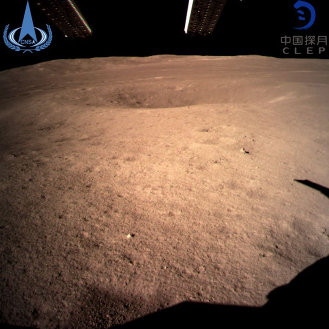
Chang’e-4 Landing

(From CNSA/CLEP, via The Planetary Society, used w/o permission.)
(Chang’e-4 on Earth’s moon: January 3, 2019; before the rover’s deployment ramps (at top) were lowered.)
“Chang’e-4 deploys rover on far side of the Moon”
Jason Davis, The Planetary Society (January 3, 2018)
“Following an historic first landing on the far side of the Moon earlier today, China’s Chang’e-4 spacecraft is already hard at work. The lander’s first order of business was deploying its rover, which is named Yutu-2, China’s space agency announced. The rover rolled down its ramp at 14:22 UTC to begin exploring Von Kármán crater….”
China’s lunar exploration program is named after Chang’e, a moon goddess.
That’s arguably more appropriate than naming America’s moon program after Apollo.
The Olympian deity’s portfolio included music, poetry, arts, oracles, archery, herds and flocks. Also diseases, healing, light, sun, knowledge and protection of young. The moon, not so much.
Maybe the program’s public relations folks figured Apollo sounded better than Artemis, Luna or Selene.3 And lacked Luna’s mockery potential.
Symbolism and Fifties Fears
 I’ve read that Chinese mission planners picked Von Kármán crater for at least two reasons, aside from being a fairly flat place to land.
Scientists figure the crater’s rock and soil will tell them more about what’s inside Earth’s moon.
There’s also a symbolic reason for picking Von Kármán crater.
It’s named after Theodore von Kármán,4 Qian Xuesen’s PhD advisor. Qian founded his homeland’s space program in the mid-20th century, retiring in 1991.
I don’t know what Qian would have done here in America, if he’d been allowed to keep working at the Jet Propulsion Laboratory (JPL).
JPL’s origins go back to the 1930s, when Qian and other California Institute of Technology (Caltech) graduate students tested an alcohol-fueled rocket.
Along with Theodore von Kármán, they set up what would become the JPL.
The group got its current name in 1943, when it became an Army facility run by the university.
Someone, somewhere, said Qian was a communist. US Army Intelligence knew about the claim, but didn’t suspend his security clearance.
 Time passed. Anti-communist enthusiasm grew, getting presidential approval in 1947.
In 1950, someone in America’s national government said Qian was a communist sympathizer. His security clearances were promptly suspended.
His colleagues at JPL tried, unsuccessfully, to convince the feds that he wasn’t a threat.
With no reasonable hope of finding professional work in America, Qian decided to go home. That resulted in his being detained for about five years. Then, being useful as a hostage, he was allowed to leave America.5
Small wonder Qian isn’t particularly famous on this side of the Pacific. Or fond of my country’s government.
That wasn’t among America’s shining hours. Or the only time folks let views hamper judgement. I’ve talked about political correctness, the Popish Plot and blame games before. (June 1, 2018; November 17, 2017; June 25, 2017)
Von Kármán Crater: Science

(From NASA/JPL-Caltech/S. Miljkovic, used w/o permission.)
(Lunar crust thickness, from NASA’s GRAIL data.)
Earth’s moon keeps one face pointed toward us as it orbits.
Pretty much, anyway. Librations, science-speak for wobbles, let astronomers get glimpses of about 18% of the far side.
I don’t think anyone seriously expected spectacularly different terrain on the unseen 38%. Certainly not something along the lines of Burroughs’ habitable moon.6
We got our first, fuzzy, look at the lunar farside from the Soviet Union’s Luna 3 in 1959. America’s Lunar Orbiter missions filled in some details from 1966 to 1967.
Folks at the IAU have assigned names to the major landmarks and many smaller features.
I have mixed feelings about that. Colorful names, like “Dracula Planet” for TrES-2B, probably won’t get approved. But I’ll grant that having one name for something is easier than remembering that the Charles V comet and Great Comet of 1556 are the same thing: C/1556 D1. (October 13, 2017)
Which reminds me, about the NASA map’s KREEP Terraine. The acronym comes from K, potassium’s atomic symbol; and REE, for rare-earth elements.
 Now, back to why landing in Von Kármán crater makes sense.
Samples from the Apollo missions strongly suggest that asteroid impacts spiked, from 4,100,000,000 to 3,800,000,000 years back. Some scientists started calling it the Late Heavy Bombardment or LHB.
Others aren’t convinced that the LHB happened. Or say maybe it happened, but only in our part of the Solar System. They may be right. Evidence for the LHB comes mostly from Earth’s moon.
The Kármán crater is in the South Pole-Aitken basin. The basin is one of the Solar System’s biggest craters, made by something hitting Earth’s moon roughly 4,000,000,000 years ago. That’d be early in the LHB.
Evidence in Von Kármán crater supporting LHB models, or lack of evidence, will help settle the debate.7
China’s Lunar Communications Network

(From Loren Roberts for The Planetary Society, via Wikimedia Commons, used w/o permission.)
The lunar farside doesn’t have as many broad, flat areas as the part visible from Earth. But aside from that, landing on either side is about as safe. Or risky.
Getting signals back from a lander is another matter. That’s why China launched the Quèqiáo communications satellite last year.
Quèqiáo is circling Earth-Moon’s L2, the Lagrange point above the farside’s center. It’s both the Chang’e-4’s link to Earth and the first communication satellite in that location. The first that I know of, anyway.
Two Longjiang microsatellites were launched with Quèqiáo. One of them is in lunar orbit, making very low frequency observations.
The Longjiang satellite probably has at least one radio-astronomy experiment on it. Maybe something for observing the solar corona, too.8
Postcards from the Moon

(From CLEP, via BBC News, used w/o permission.)
(“A picture of the lander taken by the rover’s panoramic camera (PCAM)”
(BBC News))

(From CLEP, via BBC News, used w/o permission.)
(“An image of the rover taken with the lander’s terrain camera (TCAM)”
(BBC News))
“Best Photos From China’s Far Side Moon Landing”
Paul Rincon, BBC News (January 11, 2019)
“A Chinese rover and lander have taken images of each other on the Moon’s surface.
“The Chinese space agency says the spacecraft are in good working order after touching down on the lunar far side on 3 January.
“Also released are new panoramic images of the landing site, along with video of the vehicles touching down….”
The BBC News article includes at least part of the panorama and a 360-degree azimuth projection from one of the lander’s cameras.
The article also explains why first images from Chang’e-4 showed a reddish lunar surface. What we were seeing were raw images from the lander. Friday’s have been color-corrected.
Or maybe it’s part of a vast conspiracy. Maybe Chang’e-4 really landed on Mars. Or the landing was staged in the America southwest. Or something even more imaginative.
I don’t know why conspiracy theories pop up, or why some folks believe them. They happen often enough for at least one statistical analysis, and that’s another topic.9 (January 5, 2018; September 29, 2017; December 23, 2016)
Looking Ahead

(From CNSA/CLEP, via Smithsonian Magazine, used w/o permission.)
(Yutu-2 on the lunar farside.)
“Best Photos From China’s Far Side Moon Landing”
Jason Daley, Smithsonian Magazine (January 7, 2019)
“China’s Chang’e-4 lander reached the Von Kármán crater near the moon’s South Pole on Wednesday, marking the first time a human craft has visited the lunar far side….
“…Because the far side of the moon is shielded from the radio signals coming from Earth, Chang’e-4 will conduct low frequency radio experiments using a new technique. Astronomers plan to connect a radio instrument on the landing craft with one aboard the Queqiao satellite and use the dual-system as a radio telescope—free from noisy radio interference that is common closer to Earth, reports Michael Greshko at National Geographic.
“‘This will allow us for the first time to do radio observation at low frequencies that are not possible from Earth, from close to the moon and on the moon,’ Radboud University astronomer Marc Klein Wolt, who leads the project, tells Greshko. ‘This will pave the way for a future large radio facility on the moon to study the very early universe in the period before the first stars were formed.’…”

(From CLEP, via BBC News, used w/o permission.)
(“Cotton sprouts seen close-up under a protective cover on board the Moon lander”
(BBC News))
“China’s Moon mission sees first seeds sprout”
BBC News (January 15, 2019)
“Seeds taken up to the Moon by China’s Chang’e-4 mission have sprouted, says China National Space Administration.”
“It marks the first time any biological matter has grown on the Moon, and is being seen as a significant step towards long-term space exploration….
“…Plants have been grown on the International Space Station before but never on the Moon.
“The ability to grow plants on the Moon will be integral for long-term space missions, like a trip to Mars which would take about two-and-a-half years.
“It would mean that astronauts could potentially harvest their own food in space, reducing the need to come back down to Earth to resupply….”
“China Focus: Moon sees first cotton-seed sprout”
Yu Fei, Gu Xun, Gao Shan; Xinhua (January 15, 2019) via xinhuanet.com; : ZX, editor
“…After Chang’e-4 landed on the far side of the moon on Jan. 3, the ground control center instructed the probe to water the plants to start the growing process. A tube directs natural light on the surface of the moon into the canister to allow the plants to grow….
“…The experiment has ended. The organisms will gradually decompose in the totally enclosed canister, and will not affect the lunar environment, said the China National Space Administration (CNSA)….”
Those cotton sprouts are the first grown on Earth’s moon. That’s a big deal.
As Chongqing University’s Professor Xie Gengxin, the experiment’s chief designer, said: “We had no such experience before. And we could not simulate the lunar environment, such as microgravity and cosmic radiation, on Earth.” (Xinhua)
He also hopes that his plant experiment will get young folks interested in space exploration and popularize science.
 The Chang’e-4 cotton sprouts are the first grown on Earth’s moon, but not the first off-Earth plants.
Scientists have grown Chinese cabbage, lettuce, radishes, sunflower and a zinnia on the ISS. Experiments on the Tiangong-2 space lab grew rice and Arabidopsis.
The low Earth orbit experiments brought plants through their full growth cycle. Some of the ISS crops included a harvest, giving the astronauts fresh produce.10
I’m not sure why the Chang’e-4 plant experiment ended soon after sprouting. Maybe we’ll read about that later. Or maybe not.
Folks running China’s space program don’t seem overly anxious to let outsiders know the details of what their vehicles carry.
That’s a bit frustrating. But Chinese leadership’s exaggerated — my viewpoint — ‘privacy’ concerns make writing this post easier. Now that I think about it, maybe ‘privacy’ isn’t the right word. Since it’s a government policy, maybe they’re ‘national security’ concerns. And that’s another topic. Topics.
We do have some information, though. Those remarkable images, for starters. Also Chang’e-4’s hoped-for low frequency radio wave and cosmic ray observations.
I hope they’ll release at least some data. The photos are fascinating, and tell us quite a bit about the lunar surface. But scientists can learn quite a bit from what the mission’s other instruments detect.
The Chang’e-4 radio astronomy experiment(s) may answer some questions about cosmic background radiation. And maybe raise new questions.
My guess is that this won’t be the last bit of radio astronomy done on or over the lunar farside. The advantages are obvious.
Earth’s noisy in radio wavelengths. Human activity accounts for some. The rest comes from natural sources like lightning and the Solar wind meeting Earth’s magnetic field.
Setting up radio and other observatories on the moon won’t be easy. But I’d be surprised if someone doesn’t decide it’s worth the effort, eventually.11
New Horizons: Ultima Thule

(From JHUAPL, used w/o permission.)
(New Horizons approaching Ultima Thule, December 31, 2018.)
“NASA Spacecraft Reaches Most Distant Target in History”
Johns Hopkins University Applied Physics Laboratory, NASA News (January 1, 2018)
“NASA’s New Horizons spacecraft flew past Ultima Thule in the early hours of New Year’s Day, ushering in the era of exploration from the enigmatic Kuiper Belt, a region of primordial objects that holds keys to understanding the origins of the solar system….
“…Images taken during the spacecraft’s approach — which brought New Horizons to within just 2,200 miles (3,500 kilometers) of Ultima at 12:33 a.m. EST — revealed that the Kuiper Belt object may have a shape similar to a bowling pin, spinning end over end, with dimensions of approximately 20 by 10 miles (32 by 16 kilometers). Another possibility is Ultima could be two objects orbiting each other. Flyby data have already solved one of Ultima’s mysteries, showing that the Kuiper Belt object is spinning like a propeller with the axis pointing approximately toward New Horizons. This explains why, in earlier images taken before Ultima was resolved, its brightness didn’t appear to vary as it rotated. The team has still not determined the rotation period….”
Compared to what Chang’e-4 has been sending back, images from the New Horizons Ultima Thule flyby have been underwhelming. I’m hoping that we’ll see more detailed images later. Scientists figure it’ll be late 2020 before they receive all the flyby data.
 Even so, they’re better than our first looks at Ultima Thule; like that NASA/JHUAPL/SwRI animation made from images taken 70 and 85 minutes apart, a day before flyby.
New Horizons was about 1,200,000 miles from Ultima Thule at the time — roughly four times the distance between Earth and our moon. On top of that, the probe’s transmitter strength is a dozen watts. No wonder they’re low-resolution.12
Sunlight on Ultima Thule is dim, too.
I don’t think that’s as big a factor, though. Apparently daylight on Ultima Thule is nearly as bright as lighting in most American living rooms.
The name, “Ultima Thule,” isn’t official yet. Even its designation, (486958) 2014 MU69, is the Minor Planet Center’s provisional tag.
I’ve read that the New Horizons team will suggest an official name after they know more about Ultima Thule. Then the IAU will decide if it’s okay.
I doubt they’ll suggest “Frosty.” Or “Tenpin,” as a nostalgic nod to early estimates of Ultima Thule’s shape.13
I’d be satisfied with Ultima Thule, which didn’t stop me from suggesting a few unlikely names. Like “Yeti,” the Nepalese abominable snowman. “Isaac” could be a double nod to Newton the astronomer and Snowman the artist.
For those who like classic names, there’s Khione/Chione: which won’t work, since the name’s been used: 6261 Chione.
Ultima Thule Flyby

(From NASA/Bill Ingalls, used w/o permission.)
(New Horizons okay, Ultima Thule flyby data successfully collected. January 1, 2019.)

(From James Tuttle Keane/NASA/JHUAPL/SwRI, used w/o permission.)
(At right, an educated guess on its shape — based on pre-flyby images.)
“NASA Spacecraft Reaches Most Distant Target in History”
Johns Hopkins University Applied Physics Laboratory, NASA News (January 1, 2018)
“NASA’s New Horizons spacecraft flew past Ultima Thule in the early hours of New Year’s Day, ushering in the era of exploration from the enigmatic Kuiper Belt, a region of primordial objects that holds keys to understanding the origins of the solar system….”
Combining two images from the Long-Range Reconnaissance Imager (LORRI) gave scientists a higher-resolution look at Ultima Thule.
They figured it might be shaped like a bowling pin. Or it might be two lumps, probably touching each other.
A day later, we got better look at the Kuiper Belt object.
‘Frosty’ Shape, Reddish Color

(From NASA/JHU-APL/SWRI, via BBC News, used w/o permission.)

(From NASA/JHU-APL/SWRI, via BBC News, used w/o permission.)
(“One of the probe’s instruments recorded the colour (L) of Ultima Thule. This has been laid over the high-resolution B&W image (C) to produce a combination (R)”
(BBC News))
“Nasa’s New Horizons: ‘Snowman’ shape of distant Ultima Thule revealed”
Jonathan Amos, BBC News (January 2, 2019)
“The small, icy world known as Ultima Thule has finally been revealed.
“A new picture returned from Nasa’s New Horizons spacecraft shows it to be two objects joined together – to give a look like a ‘snowman’….
“…The new data from Nasa’s spacecraft also shows just how dark the object is. Its brightest areas reflect just 13% of the light falling on them; the darkest, just 6%. That’s similar to potting soil, said Cathy Olkin, the mission’s deputy project scientist from the Southwest Research Institute (SwRI).
“It has a tinge of colour, however. ‘We had a rough colour from Hubble but now we can definitely say that Ultima Thule is red,’ added colleague Carly Howett, also from SwRI.
“‘Our current theory as to why Ultima Thule is red is the irradiation of exotic ices.’ Essentially, its surface has been ‘burnt’ over the eons by the high-energy cosmic rays and X-rays that flood space….”
 I like the “potting soil” comparison. It gives me a better impression of Ultima Thule’s appearance than numbers. It’s easier to imagine, at any rate.
I’m not sure that Ultima Thule would seem as bright as those images. Potting soil isn’t very light-colored.
But Earth’s moon looks bright in large part because we mostly see it in the night sky. It reflects about as much light as Ultima Thule, on average; more when it’s a full moon.
On the other hand, Ultima Thule is much farther from our sun than we are.14
With sunlight about as bright as interior lighting, my guess is that Ultima Thule would seem about the color of unusually iron-rich potting soil. Not that its surface is rusty.
Scientists think Ultima Thule is made of stuff that’s liquid or gas at Terrestrial temperatures, like methane, ammonia and water. That seems reasonable, but we won’t be sure until New Horizons transmits more data.
Outward Bound, Looking Back

(From JHU-APL, used w/o permission.)
(New Horizons’ position before the Ultima Thule flyby, and other Kuiper Belt objects.)
New Horizons will be traveling through the Kuiper Belt until the late 2020s, sending back observations until at least April of 2021. That’s when current funding runs out.
Scientists are looking for another Kuiper Belt object, one that’s not far from the probe’s current path.
The probe’s nuclear battery should last until 2030. Maybe longer. How long its propulsion system’s fuel supply holds out depends on how much gets used while turning the spacecraft and changing course.
With or without a second Kuiper flyby, data from New Horizons will tell us more about the heliosphere: a sort of bubble blown by our star’s solar wind.
 The last image planned for the LORRI camera is more of a snapshot than a scientific observation.
New Horizons will take a picture of Earth, like Voyager 1’s 1990 Pale Blue Dot.
That’s if all goes well.
If not — that’s why the ‘I can see my house from here’ photo op comes last on LORRI’s task list.
A slight error could put the sun in the field of view would very likely burn out the camera.
New Horizons’ snapshot will, for a time, be our most distant view of Earth.
There’s no science-related reason for getting it. Nothing worth the effort and risk.
But I think it’s a very ‘human’ thing to do. Echoing Mallory’s “because it’s there,” LORRI specialist Andy Cheng said: “It’s just such a great thing to try.”15
Kuiper Belt and Beyond: Charting Solar Borderlands

(From WilyD at English Wikipedia, used w/o permission.)
(Positions for some known Solar System objects on January 1, 2015.)
Clyde Tombaugh’s 1930 discovery of Pluto started speculation that we’d find more trans-Neptunian objects. (TNOs) The area’s named after Gerard Kuiper, one of the scientists who wrote about TNOs.
The “Kuiper belt” name is a bit controversial. Some think it should be the Edgeworth-Kuiper belt. Or maybe the Whipple zone.
What Kuiper belt objects should be called is debatable too. Tombaugh suggested kuiperoids. Trans-Neptunian object is another recommended label. I like kuiperoids, myself. I’m not sure why.
We’ve found and charted several thousand Kuiper belt objects so far. Or whatever they end up being called. We’ll probably find around 100,000 that are 100 or more kilometers across, and billions smaller objects a kilometer across or larger.
 They’re most likely stuff left over from the Solar System’s formation.
Since they’ve been in cold storage ever since, knowing what they’re made of should tell us more about how our planetary system’s development.
The Kuiper belt, distant as it is, isn’t at the Solar System’s edge. It overlaps the scattered disc’s inner reaches.
Beyond both, scientists are pretty sure we’ll find billions of comets-in-waiting.
The Oort cloud is still theoretical, but is the best explanation we’ve got for where some comets come from. The odds are good that we’ll find more bits and pieces of frozen stuff scattered through interstellar space.16
Seeking Knowledge

Sound and fury over religion and science, what I’ve encountered, focuses mostly on evolution and whether Ussher’s chronology is Christianity’s firm foundation. Maybe, when that uproar loses steam, tight-collar folks will dust off Copernican angst. Or maybe not.
In any case, a fair number of folks seem to think someone can either be interested in science or be Christian. Real science, that is, not the post-Sixties “creation science” weirdness. (October 18, 2018; March 31, 2017)
I didn’t see a problem with admiring and studying God’s creation before I became a Catholic. I still don’t.
 What’s changed is how much I know about why it’s okay.
God is large and in charge, creating a good, ordered and beautiful universe. (Genesis 1:31; Psalms 115:3; Catechism, 268, 279, 295)
This universe follows knowable physical laws. (Catechism, 32, 299, 301–305; “Gaudium et spes,” 15; Bl. Pope Paul VI (December 7, 1965))
We’re born with a thirst for knowledge. Studying God’s creation can tell us a little about God. (Catechism, 282–289, 299, 301)
Seeking knowledge, studying this universe and developing new tools, are part of being human. (Catechism, 2292–2295)
 Knowing that this universe is far more vast and ancient than some of us imagined doesn’t bother me.
I see what we’re learning as new opportunities to admire God’s work. (Catechism, 283, 341)
“The heavens declare the glory of God;
“the firmament proclaims the works of his hands.”
(Psalms 19:2)
“Indeed, before you the whole universe is like a grain from a balance,
or a drop of morning dew come down upon the earth.
“But you have mercy on all, because you can do all things;
and you overlook sins for the sake of repentance.
“For you love all things that are
and loathe nothing that you have made;
for you would not fashion what you hate.”
(Wisdom 11:22–24)
“What are mortals? What are they worth?
What is good in them, and what is evil?
“The number of their days seems great
if it reaches a hundred years.
“Like a drop of water from the sea and a grain of sand,
so are these few years among the days of eternity.
“That is why the Lord is patient with them
and pours out his mercy on them.”
(Sirach 18:8–11)
Opportunities for admiration:
1 Imagery, literature, assumptions, and Flammarion’s effect on gas mask sales:
2 More assumptions:
3 Names from an earlier time:
4 Newer names:
5 Technology, science and politics:
- Wikiepdia
- Tsien
Encyclopedia Astronautica, via Internet Archive Wayback Machine
6 Burroughs’ moon:
- Wikipedia
- “The Moon Maid”
Edgar Rice Burroughs (1923-1926) via Project Gutenberg Australia
7 Earth’s moon:
8 Exploring the lunar farside:
9 Some conspiracies have been real, which gave one physicist data to work with:
10 New harvests:
11 Radio astronomy, background:
12 More about New Horizons:
- Wikipedia
- NASA, The Johns Hopkins University Applied Physics Laboratory (JHU-APL)
13 Names and minor planets:
14 Vision and perceptions:
15 Science, technology and being human:
16 The Solar System and beyond:

 Jolo’s Our Lady of Mount Carmel parish lost 15 of its members Sunday morning. They stopped living when a bomb shredded part of the cathedral.
 Jolo is the capital of Sulu province, home to around 125,500 folks, and one of many municipalities not covered by Street View on Google Maps.
 From my viewpoint, killing folks at Our Lady of Mount Carmel is “senseless.”
 There’s something oddly appealing about conspiracy theories. I find them appealing, sometimes, in stories. What’s odd, maybe, is how many folks take them seriously. And that’s another topic.3
 Frothing radio preachers denouncing the ‘whore of Babylon’ helped me become a Catholic. Decades later, I may understand their viewpoint a little better; and even have a sort of sympathy for them.
 On the other hand, I’m not all that surprised either.










 I occasionally run into someone with an attitude like Pogo’s Deacon Mushrat.