Easter Sunday is a very big deal.
It’s “the greatest of all Sundays,” since it’s when we celebrate our Lord’s resurrection.
Begin celebrating, actually. The Easter season lasts until Pentecost Sunday: not quite two months from now.
Maybe “our Lord’s resurrection” sounds routine, familiar, two millennia after that post-Passover surprise.
But let’s remember that the 12 Apostles, make that 11 after Judas Iscariot killed himself, and everyone else close to Jesus expected him to stay dead.
Mary of Magdala, “the other Mary,” Peter, John: everyone who had been traveling with Jesus knew that he was dead. He’d been tortured, crucified, and given a postmortem poke with a lance. (Matthew 27:45–61; Mark 15:33–47 … John 19:34)
I gather that folks had seen Jesus as a king of the military and political sort: someone who would lead them in victory to freedom from Roman rule.1
Which accounts for the triumphal entry we celebrated last week. And the Sanhedrin having conniptions, imagining how Roman forces might react to a popular revolt.
The Sanhedrin’s concerns were, I think, valid: from a political viewpoint, anyway. And if I assumed that Jesus of Nazareth was the grassroots rabble-rouser they feared.
Which I don’t. But I’m living in an era that’s two millennia in their future, which gives me a better look at the big picture.
Jerusalem Riots of 66, Masada: Looking Back
 Jewish beliefs and culture weren’t a good match with either Hellenization — Greek culture was the era’s Disney and Coca-Cola, impossible to ignore — or Roman law.
Then, three decades after Jesus had been executed, Greek-Jewish tensions and tax protests boiled over in Jerusalem.
Gessius Florus, Roman procurator of Judea, couldn’t restore the status quo. Extracting what he said were back taxes from the Temple treasury hadn’t helped.
After that, Gaius Cestius Gallus, Rome’s Syrian Legate, marched in and led his forces to defeat.
Then Vespasian waded in.
Seven years later, the revolt’s last heroes, or fanatics, depending on who’s talking, regrouped in Masada: a fortified plateau that might have been invincible if the besiegers hadn’t been Romans. But they were.
After turning several thousand tons of rock and dirt into a ramp giving access to the plateau, Roman forces entered Masada: and found pretty much everyone dead.
Or something like that. The incident is still controversial.
Someone said that a contemporary account doesn’t line up with what other Roman forces did in other places.
And it seems that after two millennia, there’s not much forensic evidence left at the scene. So, according to at least one academic perspective, the mass suicide probably didn’t happen. Or can’t be verified.2
I recognize the value of physical evidence, and the wisdom of taking testimony with a grain of salt. Which may be why Thomas is one of my favorite Apostles.
“I Have Seen the Lord”
 Recapping, Jesus of Nazareth had been held by the authorities.
He had been questioned, tortured and finally nailed to a cross on Golgotha.
Then he died.
It was a very public death.
After that, he was buried.
“They took the body of Jesus and bound it with burial cloths along with the spices, according to the Jewish burial custom.
“Now in the place where he had been crucified there was a garden, and in the garden a new tomb, in which no one had yet been buried.
“So they laid Jesus there because of the Jewish preparation day; for the tomb was close by.”
(John 19:40–42)
Friday night and Saturday passed.
Sunday morning, Mary of Magdala and maybe others noticed that the tomb’s stone had been rolled away.
She ran to tell Peter and “the other disciple” what she saw.
They returned, finding an empty tomb.
Make that almost empty. Mary of Magdala stayed behind, weeping. When she looked into the tomb, she saw two angels.
After a short Q & A with the angels, she saw, but didn’t at first recognize, Jesus. Then she told the other disciples what and who she had seen.
Later, Jesus showed up — in a locked room — which I figure helped many disciples believe that Mary of Magdala hadn’t been having hallucinations.
But at least one of them, Thomas, hadn’t been there. (John 20:1–23)
Testimony, Evidence and Belief
 Small wonder Thomas wasn’t taking “I have seen the Lord” statements as absolute proof.
Again, at least some of the folks who had been following Jesus had seen him die.
And they all knew that dead is dead. Particularly when crucifixion was the cause of death.
So Thomas wouldn’t believe that Jesus had stopped being dead.
Not unless he had physical evidence.
“Thomas, called Didymus, one of the Twelve, was not with them when Jesus came.
“So the other disciples said to him, ‘We have seen the Lord.’ But he said to them, ‘Unless I see the mark of the nails in his hands and put my finger into the nailmarks and put my hand into his side, I will not believe.’
“Now a week later his disciples were again inside and Thomas was with them. Jesus came, although the doors were locked, and stood in their midst and said, ‘Peace be with you.’
“Then he said to Thomas, ‘Put your finger here and see my hands, and bring your hand and put it into my side, and do not be unbelieving, but believe.’
“Thomas answered and said to him, ‘My Lord and my God!’
“Jesus said to him, ‘Have you come to believe because you have seen me? Blessed are those who have not seen and have believed.'”
(John 20:24–28)
His insistence on evidence inspired the “Doubting Thomas” nickname.
Which I gather dates back to around the 17th century.3
Granted, Jesus said that folks who believed without physical evidence are blessed.
But I think remembering that Jesus showed up for Thomas is prudent. And that Thomas, given the evidence he’d said he needed — believed.
I like Thomas, partly because he asked a reasonable question: and accepted the answer.
And partly because of something I’ll get back to.
“…In the Easter Parade….”

(U.S. Bureau of Public Roads, via Wikimedia Commons, used w/o permission.)
“In your Easter bonnet
With all the frills upon it
You’ll be the grandest lady
In the Easter parade….”
(“Easter Parade,” Irving Berlin (1933) via family-friendly-movies.com)
Easter parades aren’t new. They go back, arguably, to our Lord’s triumphal entry into Jerusalem and his trek to Golgotha.
Parades of one sort or another go back to festival and funeral processions in ancient Egypt. And almost certainly earlier, since that’s about as far back as our records go.
Processions can be for advertising, entertainment, showing power or solidarity, or marking the start or end of events.
Catholic processions, from carrying the Gospel Book at the start of Mass to the Lord of Miracles procession in Lima, Peru, are part of our worship.
In a sense, they advertise, entertain and share other aspects with secular processions.
Which doesn’t bother me, since I see worship as part of living: not an airtight compartment, unrelated to the rest of my existence.
 And I enjoy non-religious parades, including Macy’s Thanksgiving Day Parade.4
Even though my culture’s ‘shop till you drop’ winter solstice celebration and Christmas overlap.
That’s partly because the Macy’s procession is on America’s Thanksgiving day. And, although our harvest festival has religious aspects, I see it as mainly a secular celebration.
America’s traditional Easter parades are another matter.
Sunday Best, Symbolism and a Fashion Extravaganza

(From Smithsonian American Art Museum, used w/o permission.)
(America’s Easter parade, as imagined by Adolf Dehn. (ca.1940-1949))
My ‘Sunday best’ wardrobe is a subset of my ‘out of the house’ clothes. But some other men in the parish wear my culture’s conventional business suite during Mass.
And that’s okay, I figure, since my ‘Sunday best’ shirt and slacks are clean, unpatched and less informal than what I’ll occasionally wear around the house.
I can see how wearing new clothes for Easter symbolizes new life, which is appropriate for celebrating our Lord’s resurrection.
On the other hand, warding off bad luck by wearing new homespun isn’t an option.
Mainly because that’s being superstitious, and acting on superstitions is a bad idea. (Catechism of the Catholic Church, 2110-2111)
I’m not convinced that America’s traditional Easter Day parade started in New York City, and that it set the tone for American Easter celebrations from from the 1880s to 1950s; but digging out the fashion extravaganza’s roots would take more time than I like.
However, cultural references like the 1948 Fred Astaire and Judy Garland “Easter Parade” movie, Irving Berlin’s song, and a charming children’s book whose title I forget strongly suggest that Easter parades were a big deal in my country.5
Make that had been a big deal, before I started noticing national-level current events.
Spring Fashions, Easter and Ecclesiastes
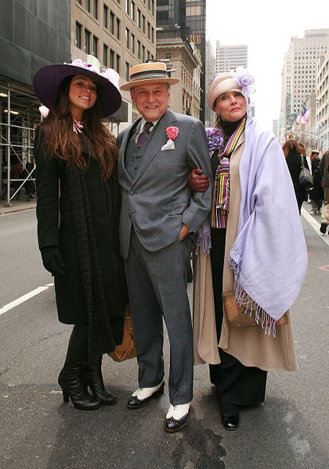 I’ll indulge in nostalgia now and again, but I remember ‘the good old days;’ and they weren’t nearly as idyllic as rose-colored memory filters might suggest.
That photo of Easter Day parade participants, taken in 2007, suggests that the event has become at least partly a nostalgic tradition.
Which can be okay.
I don’t see ‘traditional’ as automatically good or bad. It’s just something that we’ve been doing for a while, or had been doing.
Some traditions are worth keeping, some aren’t, traditions aren’t Tradition, capital “T,” and that’s another topic.
Parading down New York City’s streets in the latest — or yesteryear’s — spring fashions may not be intrinsically wrong, and probably isn’t.
But I’m not entirely comfortable with that fine old American tradition.
Maybe because I’ve read Ecclesiastes.
“The words of David’s son, Qoheleth, king in Jerusalem:
“Vanity of vanities, says Qoheleth,
vanity of vanities! All things are vanity!”
(Ecclesiastes 1:1–2)
I’ve paraphrased the book as “I’ve had everything, I’ve done everything, I’ve been everything: add it all up, and what have I got? NOTHING!”
That’s not quite an accurate reflection of the wisdom book.
“There is nothing better for mortals than to eat and drink and provide themselves with good things from their toil. Even this, I saw, is from the hand of God.
“For who can eat or drink apart from God?”
(Ecclesiastes 2:24–25)
Enjoying “good things,” within reason, is a good idea. (Catechism, 1809)
Wearing nice new clothes for Easter strikes me as being within reason. For folks who can afford doing so, at any rate.
Sashaying down New York City’s streets in nifty spring fashions?
Again, maybe it’s not a problem.
“…The Photographers Will Snap Us….”

(From George Grantham Bain Collection, via Wikimedia Commons, used w/o permission.)
(Easter bonnets on New York City’s Fifth Avenue. (1908))
“…On the avenue, Fifth Avenue
The photographers will snap us
And you’ll find that you’re
In the rotogravure….”
(“Easter Parade,” Irving Berlin (1933) via family-friendly-movies.com)“…Start on a leisurely stroll up Fifth Avenue,
There is where with haughty air
You’ll see them as they walk!
With velvets and laces and sables enfolding them….”
(“The Streets of New York,” ) Henry Blossom, Victor Herbert (1906) via RagPiano.com)
America’s traditional Easter parade may not be my country’s upper crust showing off their wealth, but seeing it that way takes little effort.
And that’s too close to encouraging pride and envy for my comfort.
Pride — self-esteem run amok, not my share in humanity’s transcendent dignity — and envy are both bad ideas. They’re in the list of capital sins: “capital,” because they’re bad ideas that lead to more bad ideas. (Catechism, 1700ff, 1866, 1929, Glossary)
I don’t know why folks in New York City started adding a fashion parade to their Easter Sunday routine. Maybe it was nothing more than an exuberant expression of happiness that summer was coming, enhanced by the Easter Sunday celebration.
So I won’t denounce America’s traditional Easter parade.
But having it on Easter Sunday, a high point of our year? I’m not comfortable with that.
And that’s why I won’t mind if America’s Easter parade transitions from a nostalgic big-city tradition to a quaint custom of days gone by.
Eggs, Ancient and Otherwise

(Diego Delso, delso.photo, License CC-BY-SA; via Wikimedia Commons, used w/o permission.)
(Pisanica: Easter eggs, Croatian style. Big ones. Photo by Diego Delso. (2014))
 Folks in places like Bosnia, Croatia, Poland and Ukraine were decorating eggs before they heard of Jesus.
After becoming Christians, they could have abandoned their egg-decorating crafts.
Instead, they kept writing their intricate designs on chicken eggs, applying their ‘pagan’ craft and symbolism to the Christian celebration.
I could let that bother me. But I won’t, since it makes about as much sense to me as having conniptions about Christmas trees and candles.
Christians in or around Persia may have been the first to decorate eggs as part of their Easter celebrations. Like folks in Slavic cultures, they were applying a pre-Christian craft and art form to Christian celebration and worship.
And again, I could let that upset me. But I won’t.
The earliest decorated eggs we’ve found so far are are ostrich eggshells from the Diepkloof Rock Shelter in Africa. They’re about 60 millennia old, were apparently used as water flasks, and I’m drifting off-topic.
As Christian symbols, Easter eggs can represent new life and our Lord’s empty tomb.6
They’re also colorful, decorative, and something I enjoyed making with the kids when they were young.
Attitudes and Assumptions, Peter and Thomas

“So then Jesus said to them clearly, ‘Lazarus has died.
“And I am glad for you that I was not there, that you may believe. Let us go to him.’
“So Thomas, called Didymus, said to his fellow disciples, ‘Let us also go to die with him.'”
(John 11:14–16)
Jesus the Nazarene did not maintain a low profile after starting his public life. Take the time he told Lazarus of Bethany to stop being dead, for example.
The only record of the incident is in John’s Gospel. It doesn’t fit neatly into the other Gospels.
The lack of conformity to post-Enlightenment Western attitudes has given assorted academics something to write about since the early 1800s, and that’s yet another topic.
Instead of diving down a selection of the higher criticism rabbit holes, I’ll talk about another reason Thomas is one of my favorite Apostles. Briefly, since I’m running short on time this week. Again.
The important part of the raising of Lazarus account is, well, the raising of Lazarus; but I’ll focus on Thomas and his “Let us also go to die with him” remark.
I’ve seen it described as despairing.7
“…Moulton says these words reveal love, but they are ‘the language of despair and vanished hope. This is the end of all — death, not Messianic kingdom.’…”
(The Pulpit Commentary, Volume 7;” Joseph S. Exell, Henry Donald Maurice Spence-Jones; Delmarva Publication (2013))
Maybe so, and I’m glad to see that Moulton also saw love in those words.
What I see in “Let us also go to die with him” is more like grim determination.
Despair? or Grim Determination?
 Jesus had been attracting huge crowds and offending the powers that be. And, as I said before, giving the Sanhedrin conniptions.
Thomas and the other Apostles must have realized how much potentially-lethal attention Jesus was getting.
Attention which they’d share, when someone with clout finally snapped.
I figure that awareness, and sincere concern for our Lord’s welfare, was behind Peter’s “God forbid, Lord! No such thing shall ever happen to you.”
It was a very human response. Problem is, what our Lord had in mind was a God-level operation. (Matthew 16:21–23)
Which brings me back to ‘let’s go die with him’ and perceptions.
Maybe Thomas was feeling despair.
But for the time being, I’ll stick with my ‘grim determination’ opinion.
What Thomas said, as recorded in John 11, reminds me of the way someone characterized an old-school Norse attitude: ‘the gods are doomed, I stand with the gods.’
I’d say where I read that, but I haven’t been able to track down the quote.
The Man Who Defeated Death

As I said, Thomas is one of my favorite Apostles. Maybe because of the attitude I see in his ‘let’s go die with him’ remark.
But I don’t follow Thomas, or Peter, or John, or any of the other remarkable folks who have decided to follow our Lord.
I follow Jesus because I am convinced that he is who he said he is: the Son of God.
I think that he is human on his mother’s side, came here to save us, and — this is best news ever — defeated death. For all of us. (John 1:1–5, 14, 3:17, 8:58–59; Acts 2:24; Philippians 2:6–8; Catechism, 232-260, 456-478, 529, 631-655, 988-1019)
All of us who are willing to accept his offer of adoption, and that’s yet again another topic.
If this sounds familiar, I’m not surprised. I’ve talked about it before:
- “Jesus, Human on His Mother’s Side: the Incarnation”
(December 25, 2021) - “Jesus, the Ultimate Alpha: a Personal View”
(April 4, 2021) - “Holy Week: Top of the Charts to Lethal Fiasco”
(March 28, 2021) - “Something Wonderful”
(April 9, 2020) - “Jesus Didn’t Stay Dead”
(April 21, 2019)
- Wikipedia
- What is Easter?
April 17, 2022 — June 5, 2022
Prayer & Worship, USCCB (United States Conference of Catholic Bishops) - General Audience
Pope Francis (April8, 2020) - Homily of the Pope John Paul II
Palm Sunday (March 23, 1997)
- Wikipedia
- “Masada: A heroic last stand against Rome”
Jodi Magness, Princeton University Press (June 17, 2020) - Periodization: The Second Temple Period
Michael Zank, Professor of Religion, Boston University
- Wikipedia
- doubting thomas
US English, Oxford English Dictionary, Lexico.com
4 Processions, from ancient Egypt to New York City:
- Wikipedia
- Festivals in ancient Egypt
Digital Egypt for Universities, UCL, London’s Global University - Processional Routes and Festivals
Digital Karnkak, UC Santa Cruz - Procession
UCLA Encyclopedia of Egyptology - Procession, Proclamation of the Gospel
Archdiocese of Baltimore
- Wikipedia
- Untitled (Easter Parade)
Adolf Dehn (ca. 1940-1949) Smithsonian American Art Museum - Spring Fashions and Parades on Easter Sunday
UC Press Blog (March 20, 2016)
- Wikipedia
- “Egg Cetera #6: Hunting for the world’s oldest decorated eggs”
Brian Stewart, News, University of Cambridge (April 10, 2012) text & video
7 Lazarus and Thomas, a little background:
- Wikipedia
- “The Pulpit Commentary, Volume 7”
Joseph S. Exell, Henry Donald Maurice Spence-Jones; Delmarva Publication (2013) via Google Books