Supernova Remnant Cassiopeia A: Cool Images of Hot Gas

Detail. JWST (NASA, ESA, CSA, STScI, D. Milisavljevic (Purdue University), T. Temim (Princeton University), I. De Looze (University of Gent))'s NIRCam image: Cassiopeia A (Cas A) in in near-infrared light. Red, green, and blue were assigned to 4.4, 3.56, and 1.62 microns. (image released December 10, 2023)
Part of Cassiopeia A, image from James Webb Space Telescope’s NIRCam. (December 10, 2023)

That’s more than just a pretty picture. Well, part of a pretty picture.

It’s our latest look at the Cassiopeia A supernova remnant. Webb’s high-resolution cameras are showing details that scientists have never seen before.

James Webb Telescope Captures Image of Supernova That ‘Absolutely Shattered’ a Star
Will Sullivan, Smithsonian Magazine (December 13, 2023)

“…In April of this year, Webb imaged the stellar remains in mid-infrared light. Now, the newly released snapshot shows Cas A’s colorful, orb-like wisps captured using Webb’s Near-Infrared Camera (NIRCam).

“‘With NIRCam’s resolution, we can now see how the dying star absolutely shattered when it exploded, leaving filaments akin to tiny shards of glass behind,’ Danny Milisavljevic, an astronomer at Purdue University who led the research, says in a statement from NASA. ‘It’s really unbelievable after all these years studying Cas A to now resolve those details, which are providing us with transformational insight into how this star exploded.’…”
[emphasis mine]

NASA’s Webb Stuns With New High-Definition Look at Exploded Star
Hannah Braun, Christine Pulliam, Danny Milisavljevic (Purdue University), Ilse De Looze (UGent), Tea Temim (Princeton University); Webb Space Telescope (December 10, 2023)

“…Webb’s NIRCam (Near-Infrared Camera) view of Cas A displays this stellar explosion at a resolution previously unreachable at these wavelengths. This high-resolution look unveils intricate details of the expanding shell of material slamming into the gas shed by the star before it exploded….”

That’s what I started talking about this week.

But the Cassiopeia A supernova’s underwhelming appearance, or maybe non-appearance, reminded me of famines, coffeehouses, and other malign menaces.

So here’s what I had, Friday afternoon:


Spotting an Invisible Supernova, Coffeehouses, — [disconnecting]

JWST (NASA, ESA, CSA, STScI, D. Milisavljevic (Purdue University), T. Temim (Princeton University), I. De Looze (University of Gent))'s NIRCam image: Cassiopeia A (Cas A) in in near-infrared light. Red, green, and blue were assigned to 4.4, 3.56, and 1.62 microns. (image released December 10, 2023)
Cassiopeia A: a near-infrared image from James Webb Space Telescope’s NIRCam. (December 10, 2023)

Around the time folks living in lands between the Mediterranean, Caspian, and the Persian Gulf, were turning wild critters into domestic sheep, a massive star exploded.

Light from the explosion should have reached Earth in the 1690s. Maybe it did. But if so, nobody noticed. Nobody wrote about a new star, at any rate.

Folks near the Baltic Sea, in France, and in Scotland, might have been preoccupied with famines; but there’s nothing on record elsewhere, either. Odd, that. Not the famines. Nobody noticing.

Maybe it was the prevalence of coffeehouses.

Fred Barnard's 'Discussing the War in a Paris Cafe,' Illustrated London News. (September 17, 1870) via Wikipedia, used w/o permission.A few generations earlier, when the Dutch East India Company opened for business, coffeehouses in Mecca were giving serious-minded folks there fits.

Seems that there were entirely too many ideas being discussed.

I haven’t, by the way, seen the Dutch East India Company blamed for either coffee or coffeehouses.

Anyway, coffeehouses caught on in Europe. Serious-minded folks there were, arguably, just as alarmed as their counterparts back in Mecca had been.1

“…In 1675 King Charles II made an attempt to shut down coffeehouses with an edict. King Charles II stated that coffeehouses ‘have produced very evil and dangerous effects,’ and were also a ‘disturbance of the peace and quiet realm,’….

“….The Licensing of coffeehouses was not just to procure revenue for the crown, but also to regulate social discipline within the communities that the houses served. London’s elite viewed all public houses as having the potential for public nuisance, and needed close attention and control. Not only did keepers have to demonstrate that they paid duties on the goods they sold, but they also had to demonstrate that they were loyal subjects….”
(“The Coffeehouse Culture“; Erin Burg, Sarah Brady, Maddie Thomas, Peter Schottenfeld, Lili Bishop, Hilary Lamb; British Literature Wiki; University of Delaware)

[reconnecting] — Flamsteed’s Star, and Another Supernova

Tycho Brahe's De nova stella title page, a facsimile reprint (1901)of the original edition (1573).Or maybe someone did see the Cassiopeia A supernova (Cas A), after all.

Nobody’s been able to spot John Flamsteed’s just-barely-visible-star, 3 Cassiopeiae, since he recorded its position in August of 1680.

It would be pretty close to where Cassiopeia A is, so maybe someone did record the supernova, after all.

Unlike Flamsteed’s dim and disappearing 3 Cassiopeiae, Tycho’s Supernova (1572-1574) got the attention of a whole mess of folks, including the Wanli Emperor’s administration; and that’s another topic.

These days, the star that flared and died in our skies from November 1572 to early 1574 has a standardized designation: SN 1572. But “Tycho’s Supernova” is still in play as a tip of the hat to Tycho Brahe’s massive analysis of the phenomenon: “De nova et nullius aevi memoria prius visa stella”.

If Cassiopeia A had been as bright as Tycho’s Supernova — but it wasn’t.

Flamsteed’s 3 Cassiopeiae was, at its brightest, barely visible. Tycho’s Supernova got as bright as, or brighter than, Venus at its brightest.

No matter whose report was more accurate, SN 1572 was bright.

Interestingly, Tycho’s Supernova was in Cassiopeia, too: and roughly the same distance from Earth.2

So how come one supernova was a shining beacon in Earth’s sky for years, while the other was — at best — a transient flicker?

That’s a good question.

I’d talk about how and why two whacking great explosions, going off practically next to each other and at nearly the same time — on a cosmic scale — produced a spectacular new star in one case: and a barely-noticeable blip in the other.

But I can’t.

Mainly because scientists haven’t figure that puzzle out. Not yet.

Four Ways Stars Explode: a NASA/JPL (very) Short Video

I can, however, and will, skip lightly over what we’ve learned since Tycho’s Supernova lit up Earth’s sky.

For starters, that was the first well-documented sky phenomenon which had obviously and spectacularly changed on time scale that humans notice easily.

Before that, stuff we see in the sky, other than the sun, moon, planets, comets and clouds, seemed to never change. And don’t, not appreciably, not over the span of a human lifetime.

Aristotle figured comets — and meteors, forgot about them — were a sort of atmospheric thing, like clouds, and I am not going to dive down that rabbit hole.

Again, Tycho’s Supernova showed that stars can and do change. At the time, that was an important new idea. Which is another rabbit hole I’ll ignore this week.

Basically, folks had been noticing and jotting down notes about new stars for millennia.

I figure Tycho’s Supernova happened at the right time, when natural philosophers were realizing that Aristotle’s cosmology wasn’t the best fit with observations.

Anyway, 19th century telescopes let astronomers get more exact data. Since then, we’ve worked out how stars convert mass into energy: which let scientists develop mathematical models that show how some stars explode.

I’d planned in geeking out over electron degeneracy pressure — electrons can be degenerate, who knew? — core collapse scenarios, stellar evolution, and exploding stars.

But you’re in luck. I’ve been a bit distracted this week, and that’s not going to happen.

Instead, I looked up a pretty good — and short, one minute 37 seconds — video put out by NASA and JPL. It’s the one embedded a few paragraphs back.3

We don’t know for sure what process produced the Cassiopeia A supernova remnant.

Cassiopeia A: Might have been a FELT

NASA, ESA, A. Feild (STScI)'s illustration: 'Model for the Creation of a Fast-Evolving Luminous Transient' - A proposed model for a Fast-Evolving Luminous Transient (FELT). Left panel: an aging red giant star loses mass via a stellar wind, ballooning into a huge gaseous shell around the star. Center panel: the massive star's core implodes, triggering a supernova explosion. Right panel: the supernova shockwave hits the outer shell, converting the kinetic energy from the explosion into a brilliant burst of light. The flash of radiation lasts for only a few days: one-tenth the duration of a typical supernova explosion.
A. Feild’s “Scenario for a Fast-Evolving Luminous Transient” (FELT). (2018) via NASA, ESA

But it’s likely, or at least possible, that the Cassiopeia A supernova was what we call a FELT: a Fast-Evolving Luminous Transient.

If that’s so, it would have been a very massive red giant that ‘burped’ before exploding.

A little before its core collapsed, it would have blown off a fair amount of stuff: like our star’s solar wind, only on a Brobdingnagian scale.

Then, when its core collapsed — triggering a series of fusion reactions that produce elements we’re made of — there’d be this shell of cooler gas and dust between the exploding star and the rest of the universe.

When light — and a little later, leftover star-stuff — hit that shell, the stellar burb-bubble would light up. Briefly. But it wouldn’t produce the cosmic beacon that we’ve come to expect from supernovae.4

Transposing the Invisible: Infrared Astronomy

NASA, ESA, CSA, STScI, Danny Milisavljevic (Purdue University), Ilse De Looze (UGent), Tea Temim (Princeton University)'s images: supernova remnant Cassiopeia A (Cas A) as captured by NASA's James Webb Space Telescope's (left) NIRCam (Near-Infrared Camera) and (right) MIRI (Mid-Infrared Instrument). (December 10, 2023)
Cassiopeia A images from NIRCAM, MIRI. (2023)

It’s not just different colors that make those two images different. The James Webb Space Telescope’s NIRCam and MIRI show us that Cassiopeia A’s light is brighter in different places, depending on what “colors” of infrared light we pick.

Black body radiation curve, Astronomy Education at the University of Nebraska-Lincoln.My hat’s off to NASA, ESA, and all the Webb Telescope folks; for discussing why different images taken of things like Cassiopeia A look — well, look different.

Infrared Astronomy
NASA, A. Feild [STScI]; Webb Space Telescope

“…Infrared light is important to astronomy in three major ways.

“First, some objects are just better observed in infrared wavelengths. Some bodies of matter that are cool and do not emit much energy or visible brightness, like people or a young planet, still radiate in the infrared. Humans perceive this as heat, while some other animals, like snakes, are able to ‘see’ infrared energy.

Visible light’s short, tight wavelengths are prone to bouncing off dust particles, making it hard for visible light to escape from a dense nebula or protoplanetary cloud of gas and dust. The longer wavelengths of infrared light slip past dust more easily, and therefore instruments that detect infrared light—like those on Webb—are able to see the objects that emitted that light inside a dusty cloud. Low-energy brown dwarfs and young protostars forming in the midst of a nebula are among the difficult-to-observe cosmic objects that Webb can study. In this way, Webb will reveal a ‘hidden’ universe of star and planet formation that is literally not visible….”
[emphasis mine]

There’s more, but I’m running late. So I’ll put some links in the footnotes, and plan on talking about infrared astronomy another time.5

Cosmic Scale and a 15-inch Telescope

Charles Betts, Adam Block, NOAO, AURA, NSF's image: Cassiopeia A supernova remnant
Cassiopeia A, seen in visible light. Charles Betts, Adam Block, NOAO, AURA, NSF.

Stellarium's sky chart, showing Cassiopeia A position (2018). Via Bob King, Sky and Telescope. (November 28, 2018)Someone with a good 15 inch telescope, very good sky conditions, and a degree of patience, can see Cassiopeia A.

It’s not nearly as spectacular as the latest Webb Space Telescope images: but observing it is the sort of thing amateur astronomers set as a goal.

And, once they’ve succeeded, write about. Some of them, anyway.

Seeking Cas A, the Ghostly Remains of a Mysterious Supernova
Bob King, Sky and Telescope (November 28, 2018)

“One night not long ago, I drove to dark sky with my 15-inch telescope to see if I could find the faint supernova remnant Cassiopeia A, or simply Cas A. I had always considered this remnant impossibly faint and off-limits for my scope, but read of others seeing it, so I put it on my list for a dark night when Cassiopeia arced high in the northern sky.

Located 11,000 light-years away within the Milky Way, the remnant formed in the aftermath of a Type IIb supernova, when a red supergiant with some 16 times the mass of the Sun reached the end of its life. After shedding its hydrogen envelope, the star’s core collapsed and then rebounded, sending a shock wave through its outer layers that resulted in a massive explosion, blowing it to bits.

“In its wake, a knotted arc of former star-stuff has been expanding outward from the explosion site ever since. Based on the speed of the ejecta, astronomers estimate the event occurred about 330 years ago, making Cas A one of the youngest supernovae known in the Milky Way….”
[emphasis mine]

I recommend Bob King’s article, which includes a sketch he made of Cas A.

However, “the event” did not occur about 330 years ago. That explosion was 11,000 light-years away, so what happened around 330 years back was light from the blast washing past the Solar System.

I’m not faulting Bob King for saying it “occurred about 330 years ago”. He’s following an convention I’ve noticed in astronomy articles. The time of events like supernovae are placed at when their light reaches us.

It makes sense, since ‘time-observed’ is generally known and verifiable; while defining when an event actually occurred depends on our knowing how far away it was.

And we still don’t know distances — not exactly — for some fairly well-known objects, like the Spaghetti Nebula.6


“…To Follow Knowledge like a Sinking Star….”

Brian H. Gill's 'All Experience is an Arch'. (2016)

Ulysses
Alfred, Lord Tennyson (1833)

“…this gray spirit yearning in desire
To follow knowledge like a sinking star,
Beyond the utmost bound of human thought….

“…my purpose holds
To sail beyond the sunset, and the baths
of all the western stars, until I die….”

Shylaja B's Figure 3 - uploaded by Shylaja B - The chart for SN 1572; notice the proximity to β Cas. From 'HISTORICAL NOTES Records of supernovae from India'; Shylaja B; Current Science, Published by Current Science Association (April 2019) via ResearchGate.netSpeaking of distances: I mentioned that Tycho’s Supernova happened near (on a cosmic scale) the supernova that left us the Cassiopeia A remnant.

Cas A is roughly 11,000 light-years out, in the general direction of Beta Cassiopeiae. We’re pretty sure about that distance, although one news release listed its distance as 11,000 and 10,000 light-years.

I haven’t found a resource that gives details on uncertainty for Cas A’s distance, but there’s a good consensus that it’s 11,000 light-years out.

Tycho’s Supernova’s remnant is a bit closer: between 8,000 and 9,800 light-years away, also in the general direction of Beta Cassiopeiae. But a probe heading there would be tacking a bit toward Earth’s current north star, Polaris.

Odds are that we’ll send a probe to Beta Cassiopeiae before setting sights on either of those supernova remnants. Beta Cassiopeiae — Caph, a name confirmed by the IAU — would be worth checking out; although Altair, Denebola, and Vega, are much closer. And that’s yet another topic.

Point is that Caph is about 54 and a half light- years away. Tycho’s Supernova remnant and Cas A are something like 200 times farther away, and are fairly near each other. On a cosmic scale.

Which I think is cool. And may be scientifically significant, since that puts them in the Perseus Arm, the next spiral arm out from our neighborhood in the Orion Arm.7


“On to God!” — “Truth Cannot Contradict Truth”

NGC 4848 and other galaxies, image by Hubble/ESA.
NGC 4848 and other galaxies.

I was going to talk about why I don’t see a problem with paying attention to those parts of God’s creation we can see. Even if doing so means readjusting our assumptions about stars, starfish, or whatever.

But it’s late Friday afternoon. And, like I said, I’ve had a distracted week. What I was going to say, and a couple cartoons, will wait.

Basically, I figure that since science and religion both seek truth; honest research can’t interfere with an informed faith.

“…Religion and natural science are fighting a joint battle in an incessant, never relaxing crusade against scepticism and against dogmatism, against disbelief and against superstition, and the rallying cry in this crusade has always been, and always will be: ‘On to God!'”
(Religion and Natural Science, a lecture delivered in May, 1937, originally titled Religion und Naturwissenschaft. Complete translation into English: “Scientific Autobiography and Other Papers“, Max Planck (1968); via archive.org)

“…Even if the difficulty is after all not cleared up and the discrepancy seems to remain, the contest must not be abandoned; truth cannot contradict truth….”
(“Providentissimus Deus,” Pope Leo XIII (November 18, 1893))

Now, the usual links:


1 Recent(ish) famines. Climate change, the early years (Pleistocene, Holocene, and agriculture’s start). Coffeehouses — also a supernova remnant:

2 A constellation, an ex-star, two astronomers, a politician and an empoeror:

3 Science and one of Aristotle’s books:

4 FELTs — or — giant burping stars:

5 Light, invisible and otherwise:

6 That’s right; the Spaghetti Nebula:

7 Stars and galaxies:

Posted in Discursive Detours, Science News | Tagged , , , , , , | Leave a comment

Advent Sunday: Kyrie, Then Death

Provincial Government of Lanao Del Sur's photo, via Al Jazeera/Facebook: Mindanao State University's gymnasium in Marawi, after a bomb exploded during a First Sunday of Advent Mass. (December 3, 2023)
First Sunday of Advent Mass in Marawi: interrupted by an explosion. (December 3, 2023)

Several dozen students in the Islamic City of Marawi were allowed to start their First Sunday of Advent Mass in a university gymnasium.

Then, when they got to the “Lord, have mercy” part, a bomb went off.

Four of them died. Many — I’ve seen both 42 and 72 reported — were injured.

I’ll talk about that, along with whatever else comes to mind. I’ve been running a fever, so this week’s post may be — interesting.

Well, of course. It’s supposed to be interesting. But — you get the idea. I hope.


Mass in a Gymnasium

Provincial Government of Lanao Del Sur's photo: Mamintal Adiong Jr., Lanao Del Sur's Governor, visits scene of explosion in Marawi City. (December 3, 2023) via BBC News.
Lanao Del Sur’s Governor at gymnasium, after the explosion.

Bad as the Advent Sunday attack in Marawi was, it could have been worse. Some of the injured students didn’t need hospitalization.

They weren’t celebrating Mass at Saint Mary’s Cathedral, because that building isn’t there any more. After being seized and torched back in 2017, it was torn down: along with quite a few other places in the city.

Since I’m not feeling up to par, here’s an excerpt from a pretty good regional news source. I’ve highlighted — or should that be bolded? — some of it.

From Google Maps: Marawi City - Cobato City, Philippines. (2023)My stuff starts again after the Rebuilding: Eventually heading.

Cardinal Quevedo: ‘massacre during Sunday mass is a crime that cries out to heaven’ but urges people to ‘let peace begin with our hearts’
Carolyn O. Arguillas, MindaNews (December 3, 2023)

“…’Voices will cry for revenge. But the law of Christ is not one of retaliation, but a law of love – love and pray for your enemies,’ he [Mindanao’s lone Cardinal, Orlando B. Quevedo, OMI] said….

“…’For the victims and for their families, my deep personal condolences and prayers. Let peace begin in our hearts,’ the former Archbishop of Cotabato, a key figure in the Bangsamoro peace process, said….

“…Quevdo himself had celebrated a mass that was disrupted by a blast in a lechon house just across the Immaculate Conception Cathedral in Cotabato City on July 5, 2009, killing four persons and injuring 32 others….

“…The first Sunday of Advent mass, celebrated by Fr. Benigno Flores Jr. of the Order of Franciscan Minor had just started when what initially seemed like firecrackers, exploded.

“MindaNews sought Fr. Jun [short for ‘Junior] but as of 4:30 p.m. he could not be reached. His friends told MindaNews ‘Jun is safe and unharmed’ and described the explosion as one that ‘sounded like firecrackers at first.’

“The explosion happened ‘just after the Kyrie’ where the mass-goers say ‘Lord, have mercy. Christ, have mercy. Lord, have mercy.’…

“…There is no church inside the MSU campus.

“Violeta Gloria, a graduate of MSU, explained that Catholic students ‘go to a tiny chapel for everyday Eucharistic prayer’ but during Sundays, they hold mass in the gymnasium ‘except when it’s not available for use.’ If the gym is not available, ‘they do Sunday morning praise’ in the golf course.’…”
[emphasis mine]

What makes a church a cathedral, by the way, is its cathedra: a ‘throne’, as some resources put it, where the bishop sits. A cathedral is the bishop’s church in a diocese. Some, like Notre Dame in Paris, are big and fancy. Others, not so much.1

Rebuilding: Eventually

Provincial Government of Lanao Del Sur's photo: Mamintal Adiong Jr., Lanao Del Sur's Governor, visits scene of explosion in Marawi City. (December 3, 2023) via BBC News.
Marawi City, Mindanao, Philippines: Google Maps.

Marawi, and Mindanao, have a long and complicated history.

The Spanish called the site Dansalan: from the Maranao word dansal, which has a mess of meanings, mostly having to do with being a place where boats can be brought ashore. My guess is that “landing” wouldn’t be too far from the mark.

Delirium333's map: Sultanate of Maguindanao in 1521. (August 31, 2023) via Wikipedia, used w/o permissionDansalan was part of the Sultanate of Maguindanao for a few centuries.

Then the Spanish came back, followed by Americans — who did not make all the right decisions — after which Japanese occupation forces set up shop — in a way, it’s a wonder the place isn’t more of a mess.

Anyway, the Philippine Senate relabeled Dansalan as Marawi City in 1956.

The name comes either from a river or a “martyred hero”. Which language or languages are in play there; that, I don’t know.

Marawi’s city council redesignated it “Islamic City of Marawi” in 1980. The new name sort of makes sense, since most folks in that part of the Philippines are Muslims. Maybe the idea was to make the place look more attractive to potential investors in the Middle East.

Anyway, the last I heard, Catholics in Marawi have plans to rebuild their cathedral. Eventually.

The 2017 effort to free the city from oppressors, infidels, or whatever, left a great many damaged and destroyed buildings. And, arguably more important, that particular jihad uprooted about 200,000 folks. The vast majority of them Muslims.

Marawi cathedral rebuild on hold until mosques fixed
“Work in Philippine city will wait in deference to Muslim neighbors, local church leaders say”
Bong Sarmiento, Marawi City; Union of Catholic Asian News (June 14, 2019)

“…Brother Reynaldo Barnido, executive director of the non-government Duyog Marawi group said Catholics would have to wait until the damaged mosques are reconstructed.

“‘In deference to our Muslim brothers and sisters, we will wait until the destroyed mosques are restored before we reconstruct St. Mary’s Cathedral,’ Barnido said.

“Bishop Edwin dela Pena of the Prelature of Marawi has also said that the cathedral will be rebuilt, but only after the Muslims have rebuilt their city and their Masjids….”

ISIS — self-described global caliphate and (alleged) ruler of all Muslims everywhere — said ‘we did this’.2 Maybe they’re right. About responsibility for bombing last Sunday’s Mass, that is.

Prayer and Neighbors

Photo from Vatican News: Muslims in Manila, Philippines, pray as they gather in solidarity with victims of the attack in Marawi. (December 4, 2023)
Muslims in Manila, praying: in solidarity with victims of the attack in Marawi.

An article in Vatican News made some good points.

Pope prays for victims of attack during Mass in Philippines
Joseph Tulloch, Vatican News (December 3, 2023)

“…Pope Francis concluded his message with ‘prayers that Christ the Prince of Peace will grant to all the strength to turn from violence and overcome every evil with good’, and imparting his blessing ‘as a pledge of strength and consolation in the Lord.’…

“…Photos released by news agencies show Filipino Muslims gathering in solidarity with the victims of the attack, praying for them and condemning the blast.
[emphasis mine]

I think that turning “from violence and overcoming every evil with good” makes sense.

I also think that remembering the many Muslims who have been praying for those college kids is a good idea.

This is where I’d have started talking about the Abrahamic religions and a domestic dispute that’s been causing trouble since before the Late Bronze Age collapse. (Genesis 1216; Catechism, 839-845)

But this has been an interesting week — I’ll get back to that — so I’ll make this a ten-cent tour and move along.

An Abrahamic Aside

The Troy Excavation Archive, Canakkale's photo: bronze seal with Luwian hieroglyphs. Found in Troy VI. (1995)
(A bronze seal with Luwian writing, found in the ruins of Troy.)

A tradition that was ancient when the Roman Republic started unraveling said that Abraham was born in the 19th century B.C. — give or take a few centuries.

I gather that around the mid-20th (A.D.) century, serious historians said that Abraham is like Paul Bunyan: a character in folklore.

They’ve got a point. We’ve found no historical documents mentioning him, apart from Sacred Scripture, and no archaeological evidence that confirms what we know about him.

I’m not surprised that archives like the Library of Ashurbanipal (7th century B.C.) lack documentation of Abraham.

For one thing, his descendants through Isaac weren’t all that important to folks running places like the Assyrian Empire. And when they did cross paths with major powers, the incidents tended to be not the sort of thing that makes good press releases.

For another, Abraham, Isaac, and all, were living not far from ground zero of the Late Bronze Age collapse. We haven’t had a disaster like that since, happily. And we very nearly forgot that it happened.

I remember when the Trojan War was supposed to be a fictional event that Homer made up: and that Homer was a fictional poet who never existed.

Then archaeologists started finding Trojan artifacts in the ruins of Troy. And what some called a “destruction layer” in assorted spots around the eastern Mediterranean: unburied bodies, abandoned cities —

The last I checked, there’s a consensus that something very bad happened: something academics call the Late Bronze Age collapse. (ca. 1200-1150 B.C.)

After the dust settled, literacy became a luxury, survivors focused on surviving; and we may eventually learn just what did go so terribly wrong.3

Under the Circumstances….
Finn Bjørklid's (?) map showing the Bronze Age collapse.
Late Bronze Age Collapse: yes, what’s on the evening news could be worse.

All that death and destruction came several centuries after “folklore” says Abraham lived.

Under the circumstances, I’m impressed that we know as much about him as we do.

Getting a Grip — or — Seeing Humanity as “Us”: not “Me” and “Them”

Image fro Google Street View: Marawi, Suklat Road; near Mindanao State University - Lanao (August 2022)
Marawi, Suklat Road; near Mindanao State University – Lanao. (Google Street View August 2022)

I was running a fever earlier this week. If I don’t stay sick, a routine medical situation will occupy most of my Friday. Either way, getting something ready by Saturday has been a bit less easy than usual.

I’d like to say something profound, pithy, or perceptive.

But all I’ve got is what I think is — or should be — obvious.

Not all Muslims are terrorists. Not all Christians support the KKK. And shape-shifting space-alien lizard-men are not — good grief. Considering the hooey that’s occasionally taken seriously, I’d better say it: I WAS KIDDING ABOUT THE SHAPE-SHIFTING LIZARD-MEN.

Hold on. I’d better check. — — Good news, my fever’s down a bit.

Like I said, this has been an interesting week.

A few loose ends, addenda, whatever —

The Mystery of the Missing Domain — and Something Serious

I was checking out Marawi on Google Maps Monday morning, and noticed that there were maybe a half-dozen churches marked: mostly around the university. I was back Monday afternoon, planning to copy that image — and the church locations were gone.

Several possibilities came to mind: including but not limited to my pushing the wrong buttons. Or maybe someone at Google Maps decided that pinpointing targets for more bombings wasn’t smart.

Either way, that information wasn’t available. Frustrating, but not very.

Then I tried logging onto my blog. It wasn’t there. Neither was the “Brendan’s Island” domain. That got my attention, particularly considering what I’d been ‘Googling’.

However, “Brendan’s Island” was back after I rebooted my computer, so I’m guessing that the Mystery of the Missing Domain’s solution was a computer glitch.

Finally (apart from the seemingly-inevitable links), here’s a prayer that’s been part of my daily routine:

Eternal rest grant unto them, o Lord;
and let perpetual light shine upon them.
May the souls of all the faithful departed,
through the mercy of God, rest in peace. Amen.

Seemed appropriate for this week’s post.

Now, those links:


1 The basics and excerpts from the news:

Philippines Identifies Suspects After Bombing At Sunday Mass
Voice of America News (December 4, 2023)

“Philippine police have identified at least two suspects in the bombing of a Catholic Mass that killed four people, a regional police chief said on Monday, vowing to hunt down those behind the blast, which was claimed by Islamic State militants.

“The bomb went off on Sunday during a service at a university gymnasium in Marawi, a city left in ruins in 2017 by a five-month military campaign to end a bloody occupation by Islamic State loyalists that had triggered alarm across Asia.

“‘(We have persons) of interest, but the investigation is still ongoing. In order not to preempt the investigation, we will not divulge the names,’ regional police chief Allan Nobleza told GMA News, adding that one of the suspects was linked to a local militant group….”

ISIL claims responsibility for bombing at Catholic mass in Philippines
Al Jazeera (December 4, 2023)

“The ISIL (ISIS) group has claimed responsibility for the bombing of a Catholic mass service in the southern Philippines that killed at least four people and injured dozens more.

“The explosion on Sunday ripped through a gymnasium at Mindanao State University in Marawi City, where pro-ISIL fighters led a five-month siege in 2017 that killed more than 1,000 people.

“‘The soldiers of the caliphate detonated an explosive device on a large gathering of Christians … in the city of Marawi,’ ISIL said in a statement on Telegram.

“Philippine President Ferdinand Marcos Jr earlier condemned ‘the senseless and most heinous acts perpetrated by foreign terrorists’….”

Bombing attack on Catholic mass in Philippines kills four
“Philippine President Ferdinand Marcos Jr condemns ‘senseless and most heinous acts’.”
Al Jazeera (December 3, 2023)

“A bombing attack on a university gymnasium in the southern Philippines has killed four people and wounded several others.

“The explosion ripped through a gymnasium at Mindanao State University in Marawi City during a Catholic mass service on Sunday morning.

“Philippine President Ferdinand Marcos Jr condemned the attack and said he had instructed the police and armed forces to ensure the safety of the public.

“‘I condemn in the strongest possible terms the senseless and most heinous acts perpetrated by foreign terrorists,’ Marcos said.

“‘Extremists who wield violence against the innocent will always be regarded as enemies to our society.’…”

2 More than you may want or need to know about:

3 History, archaology, and a catastrophe we nearly forgot:

Posted in Discursive Detours, Journal | Tagged , , , , , , | 3 Comments

Snowflake: a Safe Substitute Symbol, I Hope

Herb Block political cartoon: 'Say, what ever happened to 'freedom-from-fear'?' (August 13, 1951, during McCarthyism) published in Washington Post; see https://www.loc.gov/exhibits/herblocks-history/fire.htmlText characters, the ones used online at any rate, include symbols that aren’t letters of the alphabet, punctuation, or numbers.

So far, so obvious.

I was replying to comments this afternoon, and figured I’d use the emoji/dingbat/whatever “okay” hand sign. It seemed like a good idea at the time.

But I also figured that, since folks who don’t live in my part of the world read this, I’d better do a little research.

A gesture that means ‘I’m leaving now and had a good time’ in one culture can, I’ve gathered, mean ‘I reject you’ in another, and I’m wandering off-topic.

Anyway, I did a quick Google search to see if there were cross-cultural landmines hidden in that touch-the-thumb-and-index-finger gesture.

And, wouldn’t you know it, there are. Sort of.

It’s a good thing I didn’t use Unicode character 128076. Seems that it’s now perceived as a white supremacist symbol.

Strickland Constable's illustration of 'low types'. (1899)Although I’m not “white” by some standards, which haven’t been current for several generations now, I’m definitely melanin-deficient.

So finding some symbol which wouldn’t be quite so likely to inspire alarm and revulsion seemed prudent. Since we had a (very) little snow earlier this afternoon — and because I like the shape — I used a snowflake (❄) instead of that (divisive?) gesture.

I talked about perceptions, labels, fear, and making sense last month:

Posted in Being a Writer, Discursive Detours, Journal | Tagged , , | Leave a comment

Advent: Remembering, Being Vigilant, Doing My Job

Photo taken by a member of the ISS Expedition 53 crew: '...the sweep of the coastline of the eastern Mediterranean Sea. The cluster of lights at image center includes the major population centers of the Levant. The brightest lights are the cities of Tel Aviv in Israel, Amman in Jordan, and Beirut in Lebanon.....' (September 28, 2017)
City lights by the eastern Mediterranean Sea. Photo from the ISS. (2017)

Quite a bit has changed over the last couple millennia. And some things haven’t.

One of the things that hasn’t changed is human nature: which is good news and bad news, depending on how I look at it.

I’d started writing about that, when my oldest daughter and I ran into an all-to-common opinion about religion.

The narrator of a video we were watching said that religion was silly. Then he said something like ‘isn’t that an unforgivable sin?’

The phrase is fairly common in English-speaking cultures. It’s “Biblical” in the sense that it refers to a sentence in Matthew.

Since I’m a Catholic, I do not think the unforgivable sin is using the wrong fork at a formal dinner. I’ll get back to that.

At any rate, here’s my shorter-than-planned review of (comparatively) recent events, along with how I see sin (original, unforgivable and otherwise); and why Advent matters:


Politics, Ideas, and Technology: 20 Centuries in 138 Words

Giuseppe Becchetti's drawing of the Roman Forum. (1893) colorized, via Dan's Roman History, Facebook, used w/o permission.
Giuseppe Becchetti’s “The Roman Forum”. (1893) Colorized.

The Roman Empire had two pretty good centuries, coasted along for a while, crumbled, and became a nostalgic memory.

Europe’s warlords eventually stopped trying to reconstruct the Roman Empire.

Anonymous engraving from Hector Fleischmann's 'La Guillotine en 1793' (1908): Girondins being executed during the French Revolution. via Wikimedia Commons, used w/o permission.Upper crust western Europeans said they were really smart, and came up with some good ideas. Applying those ideas produced mixed results.

A remarkable number of us survived the 20th century’s global wars: or, as I suspect historians may call it in another century or so, the Colonial War.

That’s mainly political stuff.

At least as important, I think, we’ve been developing technologies that let most of us spend time doing something other than collecting enough food to survive the next winter.

I see that, and medical practice finally catching up with what folks like Hildegard of Bingen had been doing a thousand years back, as a good thing.1


After the Sixth Day: Still “Very Good”

Earth seen from the Rosetta spacecraft. From  ESA (MPS for OSIRIS Team), MPS/UPD/LAM/IAA/RSSD/INTA/UPM/DASP/IDA (November 23, 2009) used w/o permission.
Earth, seen from the Rosetta spacecraft. (2009)

USGS/Graham and Newman's geological time spiral: 'A path to the past.' (2008)On a cosmic scale, two millennia barely register as a moment in time.

On the other hand, it’s quite long enough for us to notice cycles and changes.

Europe enjoyed about three centuries of really nice weather.

Then the Little Ice Age made ice skating on Rotterdam’s main canal and frost fairs on the Thames possible.

North America’s crust is still rebounding from the weight of the most recent glacial period’s ice sheet.

At the moment, we’re either in an interglacial period, or maybe at the end of a cyclic ice age that started around two and a half million years back. I’ve seen informed opinions on that going both ways over the last few decades.

At any rate, right now Earth has, on average, been getting warmer. I live in central Minnesota, and haven’t invested in housing built on Florida’s sand bars, so I’m not nearly as panicked at the idea as I might be.

Let’s see. What else has been changing. Or cycling, at least. Our sun. Right.

Our star’s activity cycle has been chugging along: with occasional odd spots, like the Maunder Minimum.

We’re learning that our sun’s activity affects conditions on Earth. But I’ve yet to see someone claim that the Maunder Minimum caused the Age of Enlightenment.

Even though the timing invites “post hoc ergo propter hoc” illogic. Still, being Latin, it sounds cool; and I’m wandering off-topic again.2

Human Nature: Good News, Bad News, and Original Sin

Jean-Léon Gérôme's 'The Death of Caesar.' (ca. 1859-1867) via Wikipedia, used w/o permission.
“The Death of Caesar” in the Theatre of Pompey, as imagined by Jean-Léon Gérôme. (ca. 1859-1867)

Human nature hasn’t changed. Which is, actually, good news.

I’ve been going over this a lot lately, but I think it bears repeating.

“God created mankind in his image;
in the image of God he created them;
male and female he created them.”
(Genesis 1:27)

“then the LORD God formed the man out of the dust of the ground and blew into his nostrils the breath of life, and the man became a living being.”
(Genesis 2:7)

“What is man that you are mindful of him,
and a son of man that you care for him?
“Yet you have made him little less than a god,
crowned him with glory and honor.”
(Psalms 8:56)

We’re made “in the image of God”, “little less than a god”: pretty hot stuff.

But “little less than a god” isn’t “God”: not even close.

And we’ve got problems.

Even so, we’re not garbage.

This universe was basically good. It still is. We were basically good. We still are. (Genesis 1:31; Catechism of the Catholic Church, 299, 337-344, 355-379)

Humanity was made “in the divine image”. We still are. (Genesis 1:27; Catechism, 31, 355-361)

So: if we’re such hot stuff, and basically good, why isn’t life just one big bowl of cherries?

This is among the most lucid answers I’ve run across in recent years:

Kevin: “Yes, why does there have to be evil?”
Supreme Being: “I think it has something to do with free will.”
(“Time Bandits”, Monty Python (1981) via imdb.com)

Living With Consequences

Gustave Doré's illustration for Dante's 'Divine Comedy', 'Inferno', Canto XXXIV. (Illustration created 1860s, Dante's 'Inferno' written ca. 1320) via Wikimedia Commons, used w/o permission.The trouble started when an angel decided that ‘my way’ outvotes ‘God’s way’.

Which reminds me: I haven’t talked about angels for a while.

Angels are people, but they’re not human. They have intelligence and will, but they’re spirits with no physical bodies. (Catechism, 328-330)

We’re creatures with intelligence and will, too. But we’re made of spirit and physical bodies. (Catechism, 355-373, 1730)

Demons are angels who made a really bad decision. Satan, or the devil, is our name for the angel who decided that preferring ‘my way’ to God’s was okay. (Catechism, 391-395)

Now, about what went wrong with us. The account Genesis 3 is figurative, “…but affirms a primeval event, a deed that took place at the beginning of the history of man….” (Catechism 390)

The first of us decided that ‘I want’ mattered more than God’s ‘you should’. I’m not personally responsible for that bad decision, and human nature did not become all bad. But, like everyone else, I’m living with consequences of humanity’s bad start. (Catechism, 396-406)

That’s why we “…all need salvation and that salvation is offered to all through Christ….” (Catechism, 389, 405, 407-412, 1701-1707, 1949, 1811)

I’ll take that as good news.

Now, what the Catholic Church says “original sin” means:

ORIGINAL SIN: The sin by which the first human beings disobeyed the commandment of God, choosing to follow their own will rather than God’s will. As a consequence they lost the grace of original holiness, and became subject to the law of death; sin became universally present in the world. Besides the personal sin of Adam and Eve, original sin describes the fallen state of human nature which affects every person born into the world, and from which Christ, the ‘new Adam,’ came to redeem us (396-412).”
(Catechism, Glossary)


Sin and Options

Sporki~commonswiki's (?) photo taken during World Youth Day, Rome. (2000) via Wikimedia Commons, used w/o permissionWhich reminds me: I should love God, love my neighbor, and see everybody as my neighbor. (Matthew 5:4344, 22:3640; Mark 12:2831; Luke 6:31, 10:2537; Catechism, 1789)

Sin happens when I don’t do that.

Sin offends reason, truth, “right conscience”, and God. It gets in the way of healthy relationships. Sin is focusing on someone or something inappropriately, and failing to love God and neighbors. (Catechism, 1849-1851)

There’s no such thing as a good sin, but some are worse than others. (Catechism, 1789, 1854-1864)

Then there’s the “unforgivable sin”.

“Therefore, I say to you, every sin and blasphemy will be forgiven people, but blasphemy against the Spirit will not be forgiven.”
(Matthew 12:31)

I could fret over that Bible bit, and obsess over exactly which sin is unforgivable. I’ve got free will, so that is an option. But it’s not a smart one.

Anxiety over table etiquette isn’t, I gather, a major issue these days. So I figure the odds are slim to none that someone’s preaching that the unforgivable sin is using a salad fork during a meal’s main course.

I’m no theologian, but I’m about as sure as I can be that improper table etiquette isn’t a mortal sin.

MORTAL SIN: A grave infraction of the law of God that destroys the divine life in the soul of the sinner (sanctifying grace), constituting a turn away from God. For a sin to be mortal, three conditions must be present: grave matter, full knowledge of the evil of the act, and full consent of the will (1855, 1857).
(Catechism, Glossary)

On the other hand — no. I’m running late, and don’t have time for such speculation.

Besides, folks can have very real concerns over acts which may feel unforgivable.

Bottom line, I could have committed an egregious sin: and, since I’m still breathing, forgiveness is an option.

There’s nothing special about me, so the same applies in your case. I’ve put a few links in the footnotes which may or may not help.3

So, if that, whatever “that” is, isn’t the “unforgivable sin”, what is?

It’s pretty simple, actually.

It’s saying “no” to God, without the option of changing my mind.

Here’s how it works.

Accepting God’s Mercy: Or Not

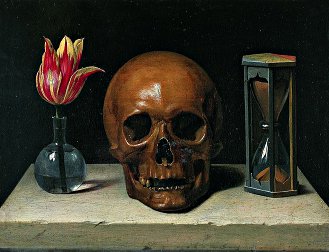
Pieter Claesz's 'Vanitas Still Life.' (1630)Right now I’m alive.

But that won’t last. Death happens. (Catechism, 1021)

Here’s where it gets interesting.

Death happens, and I will live forever.

Depending on what I’ve done, and what I decide, and — this is important — by the grace and mercy of God, that can be very good news indeed. (Catechism, 1020-1032)

But there’s a catch of sorts. I must say “okay” to accepting God’s mercy.

Right after I die, I get an interview with our Lord: my particular judgment. It’s the ultimate performance review. (Catechism, 1021-1022)

The good news is that accepting God’s mercy is an option. So is refusing God’s mercy, although that’s not a good option. At all. (Catechism, 1020-1041)

And that, I’ve gathered, is the unforgivable sin: telling God ‘you aren’t the boss of me’, at a point where changing my mind later is not an option.4


Advent: Getting, and Staying, Ready

NASA, ESA, and the Hubble Heritage (STScI/AURA)-ESA/Hubble Collaboration's image: part of the Veil Nebula, a composite of many separate exposures made by the WFPC2 (Wide Field and Planetary Camera 2) instrument on the Hubble Space Telescope. The assigned colors are: F502N ([O III]) blue, F656N (Halpha) green, F673N ([S II]) red. (exposures taken November 1994, August 1997)
The Veil Nebula, seen with Hubble’s Wide Field and Planetary Camera 2.

“O come, Desire of nations, bind
All peoples in one heart and mind;
Bid envy, strife and quarrels cease;
Fill the whole world with heaven’s peace.
Rejoice! Rejoice! Emmanuel
Shall come to thee, O Israel.”
(“O Come, O Come, Emmanuel“, additional verse; translated by Henry Sloane Coffin (1916))

It’s Friday afternoon as I’m writing this, so most of what I was going to say about the first two millennia of our long watch will wait.

This excerpt from the USCCB website says what Advent’s about:

What is Advent?
Sunday, December 3, 2023 — Sunday, December 24, 2023

“Beginning the Church’s liturgical year, Advent (from, ‘ad-venire’ in Latin or ‘to come to’) is the season encompassing the four Sundays (and weekdays) leading up to the celebration of Christmas.

“The Advent season is a time of preparation that directs our hearts and minds to Christ’s second coming at the end of time and to the anniversary of Our Lord’s birth on Christmas. From the earliest days of the Church, people have been fascinated by Jesus’ promise to come back. But the scripture readings during Advent tell us not to waste our time with predictions. Advent is not about speculation. Our Advent readings call us to be alert and ready, not weighted down and distracted by the cares of this world (Lk 21:34-36)….”
(Prayer and Worship, Liturgical Year, Advent; USCCB)

I’m a Christian, and a Catholic: so I occasionally think about our Lord’s first coming, and about his assurance that he’ll come back.

As for when Jesus will return, making that go-time decision is up to God the Father.(Catechism, 1040)

“But of that day and hour no one knows, neither the angels of heaven, nor the Son, but the Father alone.”
(Matthew 24:36)

If the Son of God didn’t need to know, I sure don’t.

Meanwhile, we’ve got our standing orders, outlined in Matthew 28:1820. So part of my job is — well, doing my job, paying attention, and praying.

“‘Beware that your hearts do not become drowsy from carousing and drunkenness and the anxieties of daily life, and that day catch you by surprise like a trap. For that day will assault everyone who lives on the face of the earth. Be vigilant at all times and pray that you have the strength to escape the tribulations that are imminent and to stand before the Son of Man.'”
(Luke 21:3436)

I’ve talked about this sort of thing before. Often. Including:


Anicet Charles Gabriel Lemonnier's 'Reading of Voltaire's L'Orphelin de la Chine' (a tragedy about Ghengis Khan and his sons, published in 1755), in the salon of Madame Geoffrin (Malmaison, 1812).1 Two millennia, a very quick review:

2 Changes, cycles:

3 A few links, regarding a specific issue; I think extrapolating to other specific issues may be valid:

4 Taking the Holy Spirit seriously
— or — why blasphemy against the Holy Spirit is a bad idea:

Posted in Being Catholic, Discursive Detours | Tagged , , , , , , , , , , , | Leave a comment

Holiday Season 2023: Here We Go Again

John Hambrock's The Brilliant Mind Of Edison Lee: Buckster Bunny and shoppers. (November 26, 2017)
“Deck the aisles with panicked shoppers….”

Advent doesn’t start for another week, but my country’s Christmas season is already off to a running start.

I’ve mentioned Macy’s Thanksgiving Day Parade, Buckster Bunny and “I Yust Go Nuts at Christmas” before.

Maybe I will again, but not this week. This is another ‘clip post’: excerpts from stuff I’ve posted before.

Macy's Thanksgiving Day Parade, New York City, 2020: collage from Verizon's telecast.
Macy’s Thanksgiving Day Parade: 2020.

Our Lord’s Family History

Gustave Dore's 'Deborah Praises Jael.' (1866) from Dore's English Bible, via Wikimedia Commons, used w/o permission.…Abram left Ur, changing his name to Abraham. He had two sons: Ishmael and Isaac.

Hagar’s son Ishmael was, I gather, legitimate by laws and customs of the day. But that didn’t soothe subsequent Hagar-Sarah tensions.

Later, Sarah’s son Isaac inadvertently passed the first son’s blessing to Jacob. (Genesis 15:116:16, 21:121, 25:1927:45)

What can I say? The family had issues.

Moving along.

When Deborah was a judge of Israel, she told Barak that his victory against Jabin’s army was a sure thing. (Judges 4:17)

Barak refused to go unless Deborah came with him. Which she did. Barak’s forces won, but God and Deborah got credit for the victory. Sisera, Jabin’s general, fled: but died when Jael, wife of Heber the Kenite nailed his head to the floor.1 (Judges 4:822)

Judith and Editors

Artemisia Gentileschi's 'Judith and her Maidservant.' (ca. 1623-1625) from Artemisia Gentileschi & Detroit Institute of Arts, via Wikimedia Commons, used w/o permission.Then there’s Judith, who walked into an Assyrian siege camp with her maid, talked her way into the general’s quarters, and removed the general’s head.

Then the two women calmly walked out of the camp. With the general’s head in a bag. (Judith 10:1118:20)

The Book of Judith says the Assyrian general’s name was Holofernes, and that he was sent by Nebuchadnezzar.

That’d be Nebuchadnezzar II, second king of the Neo-Babylonian Empire: or the Chaldean Empire, or Assyrians. It depends on who’s talking. That was around 630 BC, give or take a few decades.

Nebuchadnessar II’s territory had been what we call the Neo-Assyrian Empire up to around 610 BC, give or take a few years. I strongly suspect that’s why the book of Judith’s author called his people’s enemy “Assyrians.”

The Book of Judith is in my Bible. But if you’re an American, odds are that it isn’t in yours.

I’m a Catholic.

Folks like Jonathan Edwards set the religious tone of my homeland.

So Tobit, Judith, Baruch, Sirach, first and second Maccabees and Wisdom are edited out of most American Bibles.2

Editors had their reasons for deleting the Book of Judith.

Examination of Conscience: Getting Ready for Reconciliation

Since I’m human, I have within me an ember of the fire that forged the universe. We all do.

That sounds like the Victorian ‘lords of the universe’ attitude that made a mess we’ll be cleaning up for centuries. But it’s not.

Being made in the image of God means I have dominion over, and responsibility for, my share of this world. And for how I treat folks around me. That’s scary.

That’s also why my parish’s Advent Companion booklet has an examination of conscience before a DYI Advent wreath blessing.

The booklet’s ‘examination’ is an eight-point list that starts with —

“For the times when I forget that I need a Savior, and arrogantly conceive of myself as sufficient to myself.”
(“The Magnificat® Advent Companion”)

Each item ends with “Come, Lord Jesus!”

Examinations of conscience aren’t just an ‘Advent’ thing.

They are, or should be, how I get ready for the Sacrament of Penance and Reconciliation: what my culture calls Confession. (Catechism of the Catholic Church, 1422-1484)

I don’t enjoy reviewing my thoughts and actions, looking for misdeeds. Sins. But it’s like flossing and brushing my teeth. I’m better off if I do it than if I don’t. Happily, there’s a mess of resources out there; including these.

Failing to Love

“Sins?” I’d better clarify that.

Some actions are wrong, regardless of circumstances. Like murder, deliberately killing an innocent person. (Catechism, 1447)

Others, like sticking out my tongue, may be right during a dental exam, maybe-wrong when talking to someone, and quite often neutral.

And, although no sin is a good idea, some sins are worse than others; which is why we talk about venial and mortal sin. We also sort them out by what we misuse, how we misuse things — it’s complicated. (Catechism, 1846-1869)

But in another way, it’s simple.

Sin is a failure to love. When I don’t love God and my neighbor, and see everyone as my neighbor, that’s when I sin. And “my neighbor” includes everyone. No exceptions. (Matthew 5:4344, 22:3640, Mark 12:2831; Luke 10:2537; Catechism, 1706, 1776, 1825, 1849-1851, 1955)

Sin is an offense against reason, truth and God. (Catechism, 1849-1850)

And, as long as I am alive, seeking forgiveness is an option. (Catechism, 827, 976-983, 1021-1037, 1042-1050)

That’s all I’ll do for this week. Here are the usual links:


1 More-or-less-well-remembered folks:

2 Assumptions, Assyria, and J. Edwards:

Posted in Being Catholic, Discursive Detours | Tagged , , , , | 2 Comments