Polio, Zika, and Using Our Brains

Polio is back in Nigeria: only two cases that we know of; which isn’t particularly comforting, since most folks with polio have no symptoms.

The good news is that vaccines are available: and may get to most of those who need them before the disease does.

Zika, another viral disease, is still in the news, this time a case in Texas that affected a baby.

On a happier note, researchers are making progress on a brain-machine interface that could help folks walk again.

  1. Polio: It’s Back
  2. Zika
  3. Learning to Use a Powered Exoskeleton

Saints: Sickly and Otherwise

Dominic Savio grew up in northern Italy when Tivoli Gardens was new. He enjoyed praying, was a good student, and when he was 14 — you guessed it, got sick.

A doctor agreed with his parents that Dominic was sick: and applied an old-fashioned medical procedure1 called bloodletting.

Dominic would likely have died anyway, the symptoms sound like pleurisy, but getting his arm cut 10 times over the next four days probably speeded things up.

The doctor assured Dominic’s parents that he’d recover. But when Dominic asked for the parish priest, so he could receive the sacrament of reconciliation and the Eucharist, his parents went along with his request.

After the priest had seen him, Dominic asked his father to read him prayers for the Exercise of a Happy Death from a book of devotions.

A little later, Dominic’s last words (translated) were:

“Goodbye, Dad, goodbye . . . what was it the parish priest suggested to me … I don’t seem to remember . . . Oh, what wonderful things I see …”
(From John Bosco’s “Three Lives: The Life of Dominic Savio,” chapter 24, via Wikipedia)

Dominic Savio isn’t the youngest Saint: there’s Paulus Lang Fu, for example, who was nine when he died.2

I suspect that some “lives of the Saints” books focus on folks like Dominic Savio, Damien of Molokai, and Maximilian Kolbe because we like sentiment and drama.

However, sainthood isn’t restricted to folks who experienced a messy martyrdom, or died of some horrible disease: smiling all the way.

Some fit that profile, but the Venerable Bede and Jane Frances de Chantal died peacefully, in their 60s.

They’re Saints because they “practiced heroic virtue and lived in fidelity to God’s grace” during their lives. (Catechism of the Catholic Church, 823)3

Getting and Staying Healthy: Within Reason
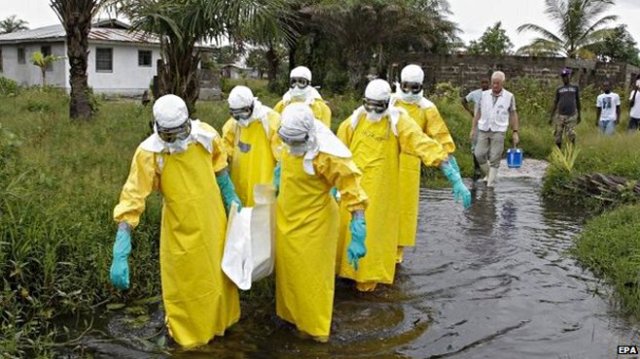

(From EPA, via BBC News, used w/o permission.)

I’ll be talking about polio, Zika fever, and brain-machine interface technology: but won’t claim that dealing with disease and disability offends God.

Given some traditional assumptions about faith, science, and dealing with reality; I’d better explain why I think using my brain is okay.

You saw the ardent Mr. Squibbs a couple weeks ago, although I didn’t introduce him at the time. He’s a mad scientist’s assistant whose brain had been replaced with that of a flying squirrel — and that’s another topic. (August 5, 2016)

Getting back to my brain and why using it doesn’t make me cringe with guilt and shame — I’m a Catholic, so I believe that God exists: the Father, Son, and Holy Spirit.4 (Catechism, 1)

I depend on God for salvation, and for my continued existence. (Catechism, 301, 1949)

But God made a world where the creatures in it, including me, play a role in making things happen. (Catechism, 41, 306-308)

Thinking, making decisions based on reason, is part of being human: but it’s option, not a requirement. I can use my brain, or decide to let whim and emotion guide me. (Catechism, 154-159, 311, 1730, 1778, 1804, 2339)

Let’s back up a little, and ask another question — “is being healthy okay?”

The short answer is yes; life and health are good things, “precious gifts entrusted to us by God:”

“Life and physical health are precious gifts entrusted to us by God. We must take reasonable care of them, taking into account the needs of others and the common good….”
(Catechism, 2288)

Taking care of my body is okay, but it’s wrong “…to sacrifice everything for it’s sake, to idolize physical perfection and success at sports…..” (Catechism, 2289)

It’s okay to help sick people get better, too, and find new ways to cure disease. It’s even okay to transplant organs, providing we don’t kill or maim one person to help another. (Catechism, 2292-2296)

Even if a disease or injury would eventually kill me, medical treatments — including painkillers — are okay: within reason. (Catechism, 2276-2279)

That seems clear enough. Being healthy is okay, staying healthy is okay: within reason.

I’m forgetting something. No, don’t tell me, let me think: Saints. Mad scientists. Guilt, shame, and getting a grip. Right.

I accept the idea that my continuing existence depends on God, and that God made a world where the creatures in it — including me — help make things happen. (Catechism, 301, 306-308)

Thinking, making decisions based on reason, is part of being human. So is deciding whether or not I let whim and emotion guide me, or use my brain, and I said that before.

That’s why I think that I’m expected to keep myself healthy: within reason. (Catechism, 2288-2289)

Fear, Facts, and “a Precious Discovery”


(From James Gillray, H. Humphrey, Anti-Vaccine Society; via Wikimedia Commons; used w/o permission.)
The Cow-Pock—or—the Wonderful Effects of the New Inoculation!

About two centuries back now, James Gillray warned the British public against a controversial medical technology: inoculation.

Vaccination against disease goes back at least five centuries, when folks in China practiced a sort of variolation — I’m putting a resource list near the end of this post5 — which involved inhaling powdered material made from the scabs of someone with mild smallpox.

Disgusting, I know, which may help explain why Martin Lister didn’t follow up on reports he’d read about the procedure.

Finally, a 1714 letter published in the Philosophical Transactions got attention in Europe and America; leading to Lady Mary Wortley Montagu’s experiment with prisoners on Newgate Prison’s death row.

Edward Jenner survived a variolation procedure that included bloodletting and starvation, and made the connection between cowpox and smallpox a few decades later.

Experiments like Lady Montagu’s and Jenner’s triggered strong reactions, sensible and otherwise:

“for a man to infect a family in the morning with smallpox and to pray to God in the evening against the disease is blasphemy; that the smallpox is a judgment of God on the sins of people, and that to avert it is but to provoke him more; that inoculation is an encroachment on the prerogatives of Jehovah, whose right it is to wound and smite.
(Contemporary reaction to inoculation experiments by American physician Dr. Zabdiel Boylston, circa 1720)

“Smallpox is a visitation from God; but the cowpox is produced by presumptuous man; the former was what Heaven ordained, the latter is, perhaps, a daring violation our of holy religion.”
(A physician’s reaction to Dr. Edward Jenner’s experiments in developing a vaccine for smallpox, (1796) via Psychological Sciences, Vanderbilt University)

Fear that God will smite anyone who uses the brains God gave us may account for what looks like a copy of Nicolas Poussin’sAdoration of the Golden Calf” on the back wall in that “Cow-Pock” cartoon.

The golden calf incident happened while Moses was on Mount Sinai. It was a major violation of the Decalogue, and they really should have known better. (Exodus 20:46, 32:135)

Idolatry, putting anything ahead of God in my priorities, divinizing what is not God, is still a very bad idea. (Catechism, 2112-2114)

Inoculation wasn’t a ‘scientists against preachers’ thing, though. Cotton Mather, a Puritan minister, teamed up with Zabdiel Boylston5; having decided that preventing disease wasn’t evil.

Let’s see what other folks said about the newfangled sort of medicine:

“…In contrast, many village priests in Italy, Germany, Switzerland, and England not only urged parishioners to seek the preventative treatment, they became wholesale vaccinators themselves. Pastors in Bohemia charged parents with responsibility ‘before God for neglecting the vaccination of their children.’ In 1814, the Pope himself endorsed vaccination as ‘a precious discovery which ought to be a new motive for human gratitude to Omnipotence.’…”
(“Deliberate extinction: Whether to Destroy the Last Smallpox Virus,” pp. 19-20, David A. Koplow, Georgetown University Law Center (2004))

That would have been Pius VII who said vaccination was “a precious discovery which ought to be a new motive for human gratitude to Omnipotence.”

I’m inclined to think he was right.


1. Polio: It’s Back


(From AFP, via BBC News, used w/o permission.)
(“Polio can only be prevented through immunisation”
(BBC News))

Nigeria to start emergency polio campaign
BBC News (August 12, 2016)

Nigeria has announced an emergency mass polio vaccination campaign in the north-east after two new cases emerged.

“They were the first incidences of the highly infectious disease in Africa for two years.

“The government said polio paralysed two children in Borno state, a part of Nigeria where Boko Haram militants have hindered health campaigns.

“The development is seen as a major setback for Nigeria, which was on track to be declared polio free in 2017.

“The cases were confirmed exactly two years after Africa’s last previous case – in the Puntland region of Somalia, on 11 August 2014….”

Polio, poliomyelitis, infantile paralysis, hasn’t been a major problem in my country for decades. That hasn’t always been the case.

The disease goes back at least to the days when Egypt was a superpower. That’s a reasonable assumption, anyway, given the appearance of that chap, pictured on a stele made during Egypt’s 18th Dynasty, upwards of three millennia back.

Polio is caused by poliovirus, an RNA genome wrapped in a protein shell. It’s small, even for a virus, 30 nanometers across; and comes in three serotypes — a distinction that’s important to biologists and pharmaceutical researchers, but don’t bother trying to memorize the term. There will not be a test on this.

Michael Underwood identified polio as a particular disease, “a debility of the lower extremities,” in 1789.

By the 20th century, polio was probably the most-feared childhood disease in Europe and America. I’ll get back to that.

Iron Lungs and Statistics


(From CDC/GHO/Mary Hilpertshauser, CDC, and GHO; via Wikimedia Commons, used w/o permission.)
(Mr. Barton Hebert of Covington, Louisiana, lived in this iron lung from the late 1950s until his death in 2003.)

Polio epidemics didn’t happen before the 20th century, and there weren’t many times when more than one person got sick.

Between eight and 10 cases of infantile paralysis got recorded in the 1841 parish of West Feliciana parish, Louisiana, outbreak. In 1893, 26 folks in Boston got polio. Rutland and Proctor, Vermont had 132 cases in 1894.

The big trouble started in 1907:

Granted, 125 deaths in New York doesn’t seem like much: but that was just the first wave. Some 27,000 Americans got polio in 1916, more than 6,000 of us died — 2,000 in New York City.

That’s scary, particularly since folks didn’t know exactly how the disease spread.

Some of the folks who didn’t die spent part or all of the rest of their lives in an iron lung, like those folks in the Rancho Los Amigos Rehab Center’s polio ward. That photo is from the 1950s, and represents yet another reason I sincerely do not yearn for the ‘good old days.’

The iron lung’s basic design goes back to theoretical work done in 1670 by John Mayow.

Various folks built working prototypes in the 1800s, a “Drinker respirator” saved an eight-year-old polio victim’s life on October 12, 1928, and I’m running late — so check out the link list at the end of this section, or not. Your choice.

In the 1930s, each iron lung cost around $1,500 — roughly the same as an average home. The Both respirators cost a lot less, good news for folks who couldn’t breathe on their own.

Life in an iron lung is arguably better than suffocating, and surviving with a withered leg is fairly manageable. Not getting polio at all would be even better, which is why so many folks studied the disease.

Karl Landsteiner spotted the poliovirus in in 1908, and Jonas Salk announced successful tests of a vaccine in 1955.

The first few polio shots I got were Salk’s polio vaccine. Albert Sabin’s oral polio vaccine came out in 1961, and I didn’t mind switching from injections to taking a sugar cube with vaccine in it.

We’re still studying polio. Scientists developed a type of transgenic mouse back in 1990-91 that can catch the disease. I talked about transgenic mice and ethics earlier this month. (August 5, 2016)

Most folks who catch polio wouldn’t know it unless it showed up in a blood test. The disease has no symptoms in almost three quarters of all cases.

The other 28% of folks with polio get a sore throat and fever; nausea, vomiting, and other gastric troubles; or something that acts like influenza.

Here’s what happens when folks get polio:

    • No symptoms
      72%
    • Minor illness
      24%
    • Nonparalytic aseptic meningitis
      1–5%
    • Paralytic poliomyelitis
      0.1–0.5%

      • — Spinal polio
        79% of paralytic cases
      • — Bulbospinal polio
        19% of paralytic cases
      • — Bulbar polio
        2% of paralytic cases

(Source: “Poliomyelitis” Epidemiology and Prevention of Vaccine-Preventable Diseases (The Pink Book); Atkinson W, Hamborsky J, McIntyre L, Wolfe S, eds. (2009); Public Health Foundation; via Wikipedia)

About 1% of all polio infections get into the central nervous system. This can be bad news, really bad news, or worse: headaches, pain in assorted places, and paralysis. The virus doesn’t make its way into the brain very often, happily.

Getting back to Nigeria, I hope they get enough kids immunized to head off a major outbreak there.

I also hope that more Americans don’t decide that vaccinations either aren’t necessary or are harmful. The good news is that as of 2013, a hefty percentage of American kids age 19-35 months get immunized:

  • Diphtheria, Tetanus, Pertussis (4+ doses DTP, DT, or DTaP)
    84.2%
  • Polio (3+ doses)
    93.3%
  • Measles, Mumps, Rubella (MMR) (1+ doses)
    91.5%
  • Haemophilus influenzae type b (Hib) (primary series + booster dose)
    82.0%
  • Hepatitis B (Hep B) (3+ doses)
    91.6%
  • Chickenpox (Varicella) (1+ doses)
    91.0%
  • Pneumococcal conjugate vaccine (PCV) (4+ doses)
    82.9%
  • Combined 7-vaccine series
    71.6%
    (Source: CDC)

Like I said earlier, being healthy is okay, and so is using our brains.

More:


2. Zika


(From Getty Images, via BBC News, used w/o permission.)
(“The Zika virus can be transmitted via mosquitoes”
(BBC News))

Texas baby dies from Zika-linked defect
BBC News (August 9, 2016)

A baby born in Texas with the Zika-linked birth defect microcephaly has died, health officials say.

“The baby was infected in the womb while the mother was travelling in Latin America, though state officials have not identified where.

“The defect causes abnormally small heads and other developmental damage.

“Florida Governor Rick Scott also announced four more people had contracted the Zika virus, bringing the state’s total to 21 cases.

“Harris County, where the baby was born, now has two reported cases of babies born with microcephaly.

“The case is the first Zika-related death reported in Texas.

“The Zika virus, frequently transmitted by mosquitoes, often causes no symptoms, but is particularly dangerous for pregnant women….”

Zika fever is another disease that folks can have without knowing it.

I’m a bit more personally interested in this article, since I live on the same continent, live in Minnesota, and mosquitoes spread Zika. The mosquito isn’t the state bird, that’s the loon, but we get a mess of the little bloodsuckers each summer.

The CDC says that there’s “growing evidence of a link between Zika and microcephaly.” (Medscape.com)

I’ve got more to say about this, but that will wait for another post.

More:


3. Learning to Use a Powered Exoskeleton


(From AASDAP/Lente Viva Filmes, via BBC News, used w/o permission.)
(“Patients first learned to control the legs of an avatar in virtual reality”
(BBC News))

Brain-robot training triggers improvement in paralysis
Jonathan Webb, BBC News (August 11, 2016)

In a surprise result, eight paraplegic people have regained some sensation and movement after a one-year training programme that was supposed to teach them to walk inside a robotic exoskeleton.

“The regime included controlling the legs of a virtual avatar via a skull cap, and learning to manipulate the exoskeleton in the same way.

“Researchers believe the treatment is reawakening the brain’s control over surviving nerves in the spine.

“The work appears in Scientific Reports.

“The eight subjects had been paralysed for three to 13 years before the rehabilitation programme began. Chronic cases of paralysis such as these are the most resistant to treatment. …”

I was going to wax eloquent on this brain-machine interface research, but household schedules and a string of technical issues have given me — wonderful opportunities for practicing patience.

Next week may, or may not, be less interesting: so I’ll just say that this research looks promising, and let it go at that. For now.

Somewhat-related post:


1 Bloodletting was a standard medical procedure for some two millennia. The idea is that draining controlled amounts of blood will balance the humors: what folks following Hippocrates called blood, yellow bile, black bile, and phlegm; or sanguis, kholé, melaina kholé, and phlégma.

The four humors reflected the four elements: blood, air; yellow bile, fire; black bile, earth; phlegm, fire. Folks like Theophrastus figured that having too much blood made us sanguine; folks with excess phlegm were phlegmatic; excess yellow bile, choleric; and too much black bile made us melancholic.

Medicine based on humorism, or humoralism, didn’t always result in bloodletting. Some physicians prescribed changes in diet, for example.

Bloodletting stayed popular, though, even after most researchers started looking for alternatives to humorism: maybe because doing something feels better than doing nothing. There’s the placebo effect, too.

We eventually found a connection between Leeuwenhoek’s “animalcules” and disease, developed antibiotics and fNIR, and that’s yet another topic.

More:

2Paulus Lang Fu was the youngest of at least 52 martyrs in one batch killed with Jesuit missionaries in the Militia United in Righteousness/Society for Justice and Harmony hit the Diocese of Xianxian.

3 More about Saints:

CANONIZATION: The solemn declaration by the Pope that a deceased member of the faithful may be proposed as a model and intercessor to the Christian faithful and venerated as a saint on the basis of the fact that the person lived a life of heroic virtue or remained faithful to God through martyrdom (828; cf. 957).”

SAINT: The ‘holy one’ who leads a life in union with God through the grace of Christ and receives the reward of eternal life. The Church is called the communion of saints, of the holy ones (823, 946; cf. 828). See Canonization.”
(Glossary, Catechism of the Catholic Church)

4 The Trinity is not like Bruce Wayne or Kal-El/Clark Kent, one person with multiple identities.

God is one. (Exodus 3:1314; Exodus 20:3; Isaiah 45:5)

God is also three Persons, and all three were at our Lord’s baptism. (Matthew 3:1617)

Matthew 28:19 tells us to baptize “in the name of the Father, and of the Son, and of the holy Spirit.” That isn’t a grammatical error. It’s a straightforward declaration of the Trinity. (Catechism, 233)

God the Son reveals God the Father, God the Holy Spirit reveals God the Father and Son, and there’s a lot more to say about the Trinity. (Catechism, 232-260)

5 Vaccination; background:

Posted in Science News | Tagged , , , , , , , , | 5 Comments

Not Going Native

On the whole, I like being an American: which is just as well, since being a good citizen is part of being a Catholic. (July 24, 2016)

So — as long as I follow my culture’s laws and customs, I’m okay; right?

It’s not that simple.

For starter’s there’s that ‘in the world but not of the world’ thing. The idea shows up in John 15:1819 and 17:1416, and Romans 12:2.

Joining a cloistered outfit like the Order of Cistercians of the Strict Observance (Trappists) is an option: they’re part of the Benedictine family, contemplative monks and nuns.

Their website, www.ocso.org, gives a pretty good look at who they are and what they do. The FAQ page is a pretty good place to start; no pressure, of course.

But it didn’t take months of prayerful discernment for me to know that signing up as a monk isn’t my vocation. I realized that getting married and raising a family was what I wanted long before I became a Catholic.

When Catholics who speak my version of English something like “please pray for vocations,” they mean “please pray that young adults will decide try out for monastic life or the clergy.” Clergy and holy orders are vocations: but so is being married, or single. Everybody’s got a vocation.

VOCATION: The calling or destiny we have in this life and hereafter. God has created the human person to love and serve him; the fulfillment of this vocation is eternal happiness (1, 358, 1700). Christ calls the faithful to the perfection of holiness (825). The vocation of the laity consists in seeking the Kingdom of God by engaging in temporal affairs and directing them according to God’s will (898). Priestly and religious vocations are dedicated to the service of the Church as the universal sacrament of salvation (cf. 873; 931).”
(Catechism of the Catholic Church, Glossary)

I’m in the laity, so part of my job is “…engaging in temporal affairs and directing them according to God’s will….” (Catechism, 898)

Love, Not the Status Quo

That doesn’t mean trying to drag America back to the ‘good old days’ before 1954, or 1848, or some other bygone day.

I can’t accept the status quo, either. I’ll get back to that.

The Catholic Church is catholic: καθολικός, universal, not tied to one era or one culture.

We’ve been passing along the same message for two millennia: God loves us, and wants to adopt us. All of us. (Ephesians 1:35; John 3:17; Catechism, 52, 1825)

That’s why Jesus, the Son of God, became one of us, died on Golgotha, and then stopped being dead. (Catechism, 430655, 2669)

There’s more to my faith, of course.

I should love God, love my neighbor, see everybody as my neighbor, and treat others as I’d like to be treated. (Matthew 5:4344, 7:12, 22:3640, Mark 12:2831; Luke 6:31, 10:2527, 2937; Catechism, 1789)

Acting as if God the Father, Son, and Holy Spirit — and what Our Lord taught — matter is what applying God’s will to temporal affairs is about. (July 27, 2014)

The Nicene Creed is a pretty good summary of our faith. “…We look for the resurrection of the dead, and the life of the world to come” — but this isn’t a “pie in the sky by and bye” faith.

Crime and/or Evil

As one of ‘those crazy kids,’ I enjoyed the campy humor of Chickenman’s radio adventures.

The fantastic fowl’s comedic battle against “crime and/or evil” contained a (tiny) element of truth.

Sometimes what’s legal is not right.

If I thought the perfect society existed in 1st century Rome, or American suburbia in the 1950s, I’d be doing what I can to restore that way of life.

But like I keep saying, we haven’t had a golden age.

We don’t have a truly just society today, either, so accepting the status quo isn’t an option.

I’m supposed to be a good citizen here in America: contributing “…to the good of society in a spirit of truth, justice, solidarity, and freedom….” (Catechism, 2239)

But as Paul wrote to the Philippians, “…our citizenship is in heaven….” (Philippians 3:20)

As a Catholic, I must submit to the authority of whoever runs the territory I’m in: unless doing what they say would violate the ‘love God, love your neighbor, everyone’s your neighbor’ principle. (Catechism, 2239, 2242)

That’s what got Thomas More and John Fisher killed. Their king wanted a male heir, understandably.

He wasn’t having any luck with his wife, so he told Pope Clement VII to annul the marriage. The Pope wouldn’t, so Henry VIII of England set up a state church, with Henry as Supreme Head of the Church of England.

Thomas More and John Fisher wouldn’t play along, so they were convicted of treason and killed. Quite a few wives, executions, and pillaged monasteries, later — Henry died. To his credit, by that time he had a legitimate son.

That got messy about six years later: and yes, this is a huge oversimplification.

Legal, but Not Right

Where was I? Trappist monks, Chickenman, Henry VIII. Right.

I’d have to refuse an order to commit genocide, for example, even if the full authority of the United States Congress and Supreme Court was behind it. (Catechism, 2313)

Even the most strident anti-immigrant American politicos have stopped short of campaigning for genocide, though: happily.

On the other hand, back in in 1927 the U.S. Supreme Court okayed a state’s right to remove “defectives” from the gene pool. Eugenics was quite popular — among ‘superior’ folks, at any rate.

I’m no fan of genocide or eugenics, partly because many of my ancestors are of an ‘inferior race,’ I’m rather close to being Lebensunwertes Leben, and that’s several more topics.

Seeing what state-sponsored eugenic programs did dampened enthusiasm after World War II, but forced sterilizations for “therapeutic” reasons, or as a punishment, still happen in my country.

Since the 1960s and 1980s, killing innocent people has been decriminalized in quite a few states: as long as it’s done when they’re under an arbitrary age; or are sick enough.

I think this is wrong. More to the point, the Church says it’s not right — because human life is sacred and murder is wrong, even if it’s legal. (Catechism, 2258, 22702279)

“Two Coats of Paint,” Truth, and Money

‘Going native,’1 adopting the lifestyle of the locals, is easy: but it’s not necessarily a good idea.

Pope Francis talked about that sort of thing:

“…In essence, Francis explained, they are ‘worldly Christians, Christians in name, with two or three Christian attributes, but nothing more’. They are ‘pagan Christians’. The have ‘a Christian name, but a pagan life’ or, to put it another way, ‘pagans painted with two coats of Christianity: thus they appear as Christians, but they are pagans’….”
(Two coats of Paint,” Pope Francis, Morning Meditation in the Chapel of the Domus Sanctae Marthae (November 7, 2014) via L’Osservatore Romano, Weekly edition in English, n. 46, (November 14, 2014))

It’s not ‘those people over there.’ Anybody can slide away from Truth. The trick is paying attention to what’s important:

“…The signs to understand what we are moving toward, the Pope said, ‘are in your heart: if you love and are attached to money, to vanity and pride, you are on that bad path; if you seek to love God, to serve others, if you are gentle, if you are humble, if you serve others, you are on the good path’. And thus, ‘your identity card is good: it’s from Heaven’. The other, however, is ‘a citizenship that will bring you harm’….”
(Two coats of Paint,” Pope Francis, Morning Meditation in the Chapel of the Domus Sanctae Marthae (November 7, 2014)…)

One more thing — money is okay. It’s love of money that gets us in trouble. (1 Timothy 6:10; Hebrews 13:5; Catechism, 2544)

Humility isn’t delusion, it’s accepting reality; and I’m drifting off-topic again.

Taking Love Seriously

Going with the flow, even if it’s wrong, isn’t an option. Neither is desperately clinging to the way things were: or the way I’d like things to have been.

Both are a ‘two coats of paint’ superficial Christianity: different colors, but the same lack of depth.

My “identity card” is, or should be, from Heaven. But I’m not there yet; and if I take loving my neighbors, all my neighbors, seriously — social justice is a priority.

That doesn’t mean forcing everyone into one cultural mold, or insisting one ‘correct’ form of government. We’re not supposed to be all alike. (Catechism, 1901, 18971917, 19281942)

I’m just one man living in central Minnesota: so I don’t expect to end world hunger, broker a lasting peace in the Middle East, and cure the common cold.

I can, however, act as if God matters and work at conforming my will to God’s.

I can also suggest that we all work with what we have, doing what we can to correct what is unjust and support what is right. (Catechism, 19361938, 24012449)

I think we can build a better world. I am sure that we must try.

It won’t be easy. As someone2 said, “humans are allergic to change.” And that’s yet another topic.

Background:

Somewhat-related posts:


1 I haven’t run into the term “going native” for quite a while:

go native (of a settler) to adopt the lifestyle of the local population, esp when it appears less civilized”
(the Free Online Dictionary)

Go native is an expression meaning ‘to adopt the lifestyle or outlook of local inhabitants’.”
(Wikipedia)

“to go native (third-person singular simple present goes native, present participle going native, simple past went native, past participle gone native)

  1. (idiomatic) To adopt the lifestyle or outlook of local inhabitants, especially when dwelling in a colonial region; to become less refined under the influence of a less cultured, more primitive, or simpler social environment.
  2. (idiomatic) Of a contractor or consultant, to begin working directly as an employee for a company and cease to work through a contracting firm or agency.”

(Wiktionary)

2 “Allergic to change:”

“Humans are allergic to change. They love to say, ‘We’ve always done it this way.’ I try to fight that. That’s why I have a clock on my wall that runs counter-clockwise.”
(Grace Hopper, developer of the first compiler for a computer programming language, U.S. Naval officer)

Posted in Being a Citizen, Being Catholic | Tagged , , , , , , | 10 Comments

Earth Overshoot Day and Pollinators

Australia’s Earth Overshoot Day happened earlier this week.

It used to be called Ecological Debt Day, involves a lot of math, and assumes that Earth’s glaciers, deserts, and oceans, are pretty much all the same thing.

The basic idea, that we shouldn’t waste resources, isn’t silly, and I’ll get back to that.

Some other scientists say that we should pay attention to pollinators. I think they’re right.

  1. Global Footprint Network’s Earth Overshoot Day
  2. Pollinator Peril — or — the Bats and the Bees

Ehrlich, Yeats, and Me

Taking the Bible seriously, including Revelation 6:48, isn’t even close to thinking I can second-guess God the Father; and I talked about that last Sunday. (August 7, 2016)

Tightly-wound preacher-prognosticators aren’t the only folks with doomsday predictions and dire forebodings:

“…in ten years all important animal life in the sea will be extinct. Large areas of coastline will have to be evacuated because of the stench of dead fish….”
(Paul Ehrlich, on first Earth Day, (1970))

“…By the year 2000 the United Kingdom will be simply a small group of impoverished islands, inhabited by some 70 million hungry people….”
(Paul Ehrlich, Speech at British Institute For Biology (September 1971))

“Turning and turning in the widening gyre
The falcon cannot hear the falconer;
Things fall apart; the centre cannot hold;
Mere anarchy is loosed upon the world,
The blood-dimmed tide is loosed, and everywhere
The ceremony of innocence is drowned;
The best lack all conviction, while the worst
Are full of passionate intensity….”
(“The Second Coming,” William Butler Yeats (1920))

In fairness, William Butler Yeats (1865 – 1939) lived in a particularly unsettled chapter of humanity’s story. I’ll get back to Yeats, Lovecraft, and getting a grip: but not today.

Ehrlich’s “The Population Bomb” came out while I was in high school, and Earth Day started about the same time I entered college. I took environmental concerns seriously then, and I still do. The latest crisis du jour, not so much.

I do, however, realize that the boy who cried wolf could be right. Occasionally.

Painfully-pious crepe hangers notwithstanding, gloominess is not next to Godliness. We’re supposed to desire happiness, and hope is a virtue. (Catechism of the Catholic Church, 33, 1718, 1817)

I suspect that some doom and gloom has roots in the fashionable melancholy that’s been “…an indispensable adjunct to all those with artistic or intellectual pretentions…” off and on for the last five centuries.1 And that’s another topic.

Hydraulic Mining


(from the United States Library of Congress, via Wikipedia, used w/o permission)
“The Monitor.” Hydraulic mining for gold in California. (The Century Magazine; 1883 Jan., p. 325)

Romans called their hydraulic mining tech “ruina montium,” “the collapse of the mountains,” or “wrecking of mountains.” Two millennia later, Las Médulas is a UNESCO World Heritage Site, and we’ve learned to be a bit more careful.

By the 1860s, the California Gold Rush was in progress. Folks were reducing hills to slurry with high-pressure water jets, extracting gold, and sending the rest downstream.

It was very profitable, until folks living and farming in the Sacramento Valley hired lawyers.

Several lawsuits and an act of Congress later, Americans had a new set of rules that allowed hydraulic mining — under better-controlled conditions. We’re still fine-tuning our environmental rules and policies, and expect that the process will continue as long as this country is around.

Northumbria’s Environmental Activist: St. Cuthbert

St. Cuthbert lived around the time Li Yuan became Emperor Gaozu of Tang and Harsha reunited a sizable fraction of the Gupta Empire.

Cuthbert lived in the Kingdom of Northumbria, that’s now part of southeastern Scotland and northeastern England.

His connection to this ‘environmental’ post is that he set up laws protecting the breeding grounds of various birds on the Farne Islands. That’s about 13 and a half centuries back now.

The birds are still there, and the eider duck is called the cuddy duck to this day in Northumberland.2

Comets, Malthus, and the Green Revolution

There’s good reason for keeping track of comets and asteroids.

Impact events occasionally coincide with an extinction event like the one that killed non-avian dinosaurs, but scientists still don’t have enough evidence to show cause-and-effect.

Even so, if a 10-kilometer-wide hunk of rock hit Earth today, it would do considerably more than disrupt the Rio Olympics.

Stuff like the Chelyabinsk meteor and the whatsit that knocked down trees near Tunguska happens much more often, but isn’t nearly as disruptive.

The 1857 ‘destroyer’ comet in that caricature might have been 6P/d’Arrest — or maybe not. Either way, Earth was still around in 1858, and wasn’t fazed by Hally’s Comet in 1910.

Our planet passed through the comet’s tail, that time, with the usual results:

“…The 1910 pass of Earth was especially close and, thanks to expansive newspaper coverage, eagerly anticipated by the general public. In fact, Earth’s orbit carried it through the end of the comet’s 24-million-mile-long tail for six hours on May 19, earning the story the day’s banner headline in The New York Times.

“While most reporters of the day turned to astronomers to get the facts straight, the yellow press chose to pursue the story in more fanciful ways, helping to fuel the fears of the impressionable that the end of the world was nigh. Despite some published reports leading up to the event, the comet’s tail did not contain poisonous gases, and there was never any danger of a celestial collision, either….”
(“May 19, 1910: Halley’s Comet Brushes Earth With Its Tail,” By Tony Long, Wired (May 19, 2009))

Today’s “yellow press” is the sort of “FBI CAPTURES BAT CHILD!” thing you’ll see in supermarket checkouts: and it’s as fanciful as ever. My opinion.

An — imaginative? — approach to science shows up in serious journalism, too. Happily, I’m not a reporter. I don’t have an editor telling me which stories to cover and how to cover them, and I’ve wandered off-topic.

Decades before Ehrlich’s famous book, “The Population Bomb,” hit the shelves; Fairfield Osborn, Jr. wrote “Our Plundered Planet;” and Thomas Malthus beat them both by 150 years: 2

“The power of population is indefinitely greater than the power in the earth to produce subsistence for man.”
(“An Essay on the Principle of Population,” Thomas Malthus (1798))

About 1,000,000,000 folks were alive then, many of them none-too-well-fed. Japan was recovering from the Great Tenmei famine, India’s Chalisa famine was over, with the Doji bara famine on its way.

Meanwhile, rinderpest was killing about 90% of Ethiopia’s cattle, while locusts were eating their crops, and cholera — they were not having a good time.

As of March 2016, I had about 7,400,000,000 neighbors.

Why didn’t we all die horribly of starvation and/or disease around 1800, or in Ehrlich’s environmental apocalypse?

Basically, because folks kept acting like humans. We developed new technology: the 20th century Green Revolution, for example.3

Like I keep saying, science and technology aren’t transgressions; they’re tools We’re supposed to use our brains, learn about the universe, and use that knowledge. (Catechism, 154159, 22922296)

Sane Environmentalism

I don’t miss the ‘good old days:’ seeing house-size gobs of suds floating down the Mississippi; and a year when my eyes stung, except on Sundays, when the city’s air cleared up.

I was already concerned about pollution, wildlife management, and other environmental issues, by the early 1970s.

At the time, I was glad that environmental awareness was spreading; and thought that some ‘environmentalists’ had more enthusiasm than good sense. I’m still glad that more folks started ‘thinking green;’ and think that Captain Planet helped make environmentalism look silly.

Sadly, some folks still seem to have learned their facts about science and ecology by watching Indiana Jones and the Kingdom of the Crystal Skull, Tentacles, and The Swarm.

The good news is that some scientists have apparently realized that an ecosystem that’s survived at least 3,700,000,000 years is hardly “fragile.”

A run of some 3,700,000,000 years, give or take a few hundred million, isn’t bad for life on a planet orbiting a slightly variable star: despite occasional comet and asteroid impacts, regional volcanic activity, and epochs of continental glaciation.

Other scientists, however, seem to be taking their cues from Revenge of the Creature and C.H.U.D.:

“Environmentalism is undergoing a radical transformation. New science has shown how long-held notions about trying to ‘save the planet’ and preserve the life we have today no longer apply.

“Instead, a growing chorus of senior scientists refer to the Earth with metaphors such as ‘the wakened giant’ and ‘the ornery beast’, a planet that is ‘fighting back’ and seeking ‘revenge’, and a new era of ‘angry summers’ and ‘death spirals’….”
(Clive Hamilton, The Conversation (May 27, 2014))

I appreciate that sort of enthusiasm, and think that (some) environmental concerns are sensible. Fearing the wrath of an angry planet: not so much.

God’s Property, Our Responsibility

As a Catholic, concern about the environment isn’t an option: it’s required. Seeing this universe as beautiful, good, and our responsibility, is part of my faith:

The world doesn’t belong to humanity. It’s God’s property: we’re just stewards, responsible for managing the place. (Catechism, 339, 952, 24022405, 2456)

That responsibility includes using this world’s resources wisely, showing concern for our neighbors and future generations. (Catechism, 2415)


1. Global Footprint Network’s Earth Overshoot Day


(From ESA, via NASA, used w/o permission.)
(Earth, seen from the European Space Agency’s Rosetta spacecraft. (November 12, 2009))

It’s official: We’re wasting our natural resources faster than ever before
Gavin Fernando, news.com.au (August 9, 2016)

HAVE you heard of ‘Earth Overshoot Day’? Spoiler alert: it was yesterday.

“No, this isn’t an event that warrants celebration. To the contrary, the closer to the beginning of the year this day occurs, the more concerned we should be.

“Its timing in 2016 has environmental scientists worried about the consequences of how fast we’re burning through the planet’s natural resources.

WHAT’S GOING ON WITH THE PLANET?

“Earth Overshoot Day marks the point in the year where we run out of our ‘allocated’ supply of natural resources.

“The Global Footprint Network (GFN), an organisation partnered with the World Wide Fund for Nature, produced the results.

“To calculate the date for Earth Overshoot Day, it crunched United Nations data on thousands of economic sectors such as fisheries, forestry, transport and energy production….”

Each Australian uses 9.3 hectares of Earth’s surface: according to the Global Footprint Network, or GFN. As for the GFN’s assertion being “official:” the outfit’s listed as a charitable non-profit think tank in the United States, Belgium and Switzerland.

I assume that the folks who run the GFN are sincere, and really want to help:

“We are an international think tank that provides Ecological Footprint accounting tools to drive informed policy decisions in a resource-constrained world. We work with local and national governments, investors, and opinion leaders to ensure all people live well, within the means of one planet.”
(Global Footprint Network)

Let’s look at those numbers.

Gavin Fernando’s article included that ‘how many Earths’ infographic, and GFN’s assertions about how big a piece of Earth’s resources folks in these countries consume each year:

  • China
    4.8 billion global hectares
  • United States
    2.6 billion global hectares
  • Australia and Iran
    210 million global hectares each

A hectare is 10,000 square meters, 1/100th of a square kilometer. That’s roughly the size of an international rugby pitch, Trafalgar Square, or a square centered on the Statue of Liberty‘s base.

“…But on a per capita basis, Australia’s contribution to the problem is much more dire.

Australia has one of the world’s largest ecological footprints per capita, requiring 9.3 global hectares per person. The only country worse than ours is Luxembourg. China came in at 52nd….”
(Gavin Fernando, news.com.au)

Earth is a pretty big place, with 510,072,000 square kilometers/196,940,000 square miles: 29.2% land and 70.8% water.

That’s 51,007,200,000 hectares total: 14,894,000,000 land and 36,113,200,000 water.

I’m assuming that Mr. Fernando’s “billion” is 1,000,000,000, not the long scale billion, and that’s yet another topic.

Hectares, Global and Otherwise


(From Ali Zifan, with data from CIA World Factbook, via Wikimedia Commons, used w/o permission.)
(World population, 2014)

GFN says Americans use the equivalent of 2,600,000,000 global hectares each year.

Since Earth only has 51,007,200,000 hectares total and my country’s 323,425,550 population is only about 4% of the world’s 7,343,330,000 current residents, I figured that means we consume about 5% of the world’s resources.

That doesn’t seem so bad, but the GFN’s global hectare isn’t your ordinary hectare.

It’s “… a measurement unit for quantifying both the ecological footprint of people or activities as well as the biocapacity of the earth or its regions. … Examples of biologically productive areas include cropland, forests, and fishing grounds; they do not include deserts, glaciers, and the open ocean….” (Wikipedia)

By their standards, Earth has around 11,300,000,000 billion global hectares: roughly 1.8 global hectares per person in 2004.

Again by their standards, the 4% who live in my country use roughly 23% of our planet’s resources.2 That sounds like a problem.

Earth has Oceans


(From CIA World Factbook, via Wikimedia Commons, used w/o permission.)
(Earth’s Pacific, Atlantic, an Indian Oceans)

On the other hand, I’m a tad dubious when experts ignore the 70.8% of my planet that’s under water.

Very few humans live on the “open ocean,” but it is far from being a desert.

The Food and Agriculture Organization (FAO) says that marine fisheries caught 90,064,000 tonnes of assorted fish, molluscs, and other critters, in 2007; compared to the 10,035,000 tonnes caught from inland fisheries.2

A growing fraction of that catch is from aquaculture: “farming” fish and other critters. We’ve been doing it for millennia, and have been getting much more efficient lately.1


2. Pollinator Peril — or — the Bats and the Bees


(From Brian Cutting, via BBC News, used w/o permission.)
(“Pollinators are under threat at a global scale”
(BBC News))

Action needed to ‘future-proof’ pollinators
Helen Briggs, BBC News (August 9, 2016)

International scientists are calling for action to ‘future-proof’ the prosperity of pollinating insects, birds and mammals.

They say agricultural expansion, new pesticides and emerging viruses present the biggest risks in coming decades.

And the bats that pollinate plants in tropical and desert climates need legal protection, they report in PeerJ.

Some 35% of global crop production and more than 85% of wild flowering plants rely to some degree on pollination.

The research took a horizon-scanning approach to identify future issues of concern over the next three decades…..”

I’ve heard and read that bees were going extinct for years.

I’ve also heard and read that phencyclidine (PCP) and formaldehyde are the same thing, and that we should wear tin foil hats to keep the CIA from reading our minds. Then there’s “Reefer Madness,” and I talked about that last month. (July 10, 2016)

Where was I? Pollinators, PCP, tin foil hats. Right.

Having noticed the four horsemen’s marked disinclination to mount up; despite decades of periodic predicted apocalypses (yes, it’s a real word), faith-based and secular — try saying that fast, five times — I figured the recurring ‘dead bees’ story might or might not be real.

But I decided to not fret about it.

Then I learned that professional apiarists, beekeepers, were having trouble keeping their hives alive.3

That’s a problem for apiarists, and anyone who likes honey.

The good news is that we know a great deal more than we did a few decades ago, and may be able to do something about the situation before it becomes a huge crisis.

It’s Thursday evening as I write this, so I’ll just put links to a few resources at the end of this post,4 and skip lightly over what I think are common-sense ‘to-do’ items.

The seven species of honey bees are the apiarists’ traditional source of honey, but they’re by no means the only pollinators.

Since a great many folks like honey, I figure that studying honey bees with a view to making them more disease-resistant, and developing other honey-making insects into effective commercial producers makes sense.

So, I think, does remembering that bees aren’t the only pollinators around. A remarkable number of birds and mammals carry pollen, including some fruit bats. The latter can be pests, since they eat fruit that we want: but maybe that’s worth the annoyance, if they also pollinate the trees.

I’ve written about animals, being human, and using our brains, before:


1 From “The Elizabethan Malady: Melancholy in Elizabeth and Jacobean portraiture,” Roy Strong; via Melancholia, Art movement. (Wikipedia)

2 St. Cuthbert, Malthusianism, and all that:

3 Pollinators, background:

4 Earth Overshoot Day and related topics:

Posted in Science News | Tagged , , , , , | 18 Comments

Last Judgment: Still Pending

You’ve heard this one before.

At the Vatican, a Cardinal’s secretary bursts into a meeting. “Your Eminence! He’s here! Jesus! He landed in St Peter’s Square! What do we do?!” The Cardinal runs to the Pope’s office, repeats the news and question. The Pope says, “look busy.”

It’s pretty good advice, actually, which brings me to this morning’s Gospel reading: Luke 12:3248 — or Luke 12:3540, which covers the main idea:

8 ‘Gird your loins and light your lamps …
“… You also must be prepared, for at an hour you do not expect, the Son of Man will come.’ ”
(Luke 12:35, 40)

Fizzled Predictions Through the Ages

It’s been about five years since Harold Camping and the silly side of American Christianity gave reporters and cartoonists something to work with.

He’d been wrong earlier, about September 6, 1994 being Judgment Day.

Undeterred, he recalculated, collected money, and advertised our Lord’s impending arrival on May 21, 2011. That didn’t happen, neither did the obligatory fire and brimstone, and the world was still around after October 21, 2011.

I figure we’re due for another high-profile End Times Bible Prophecy any time now. Or maybe not. But I’d be surprised if someone doesn’t trot out another ‘Biblical’ prognostication in the next few decades: and have Camping’s success at publicizing it.

Fizzled predictions of that sort are nothing new. Wikipedia has a partial list that runs from the triple header around the year 500 to Tipler’s assertion that the big day will be in 2057. We had another cluster around the year 1000.

My favorite one, in terms of originality, is Swedenborg’s. His “The Heavenly Doctrine,” published in 1758, said that the Last Judgment had already happened: in 1757.

Interestingly, European architects went into overdrive and started designing Gothic cathedrals a couple centuries after the thousand-year apocalypses didn’t happen. I won’t claim that it’s cause-and-effect, but think that their patrons might have realized that we could have a long wait ahead.

The Last Judgment

As described, the Last Judgment will make Shanghai’s Word Expo 2010 look like a cozy little rural gathering:

14 ‘When the Son of Man comes in his glory, and all the angels with him, he will sit upon his glorious throne, and all the nations 15 will be assembled before him. And he will separate them one from another, as a shepherd separates the sheep from the goats.
(Matthew 25:3132)

Just getting the 7,000,000,000 or so folks alive today together in one place would be spectacular. Add everybody who’s lived and died? Just finding a venue big enough might qualify as a miracle.

The Last Judgment is part of the four last things: death, judgment, Heaven and Hell.1

It’s when everyone who died will be resurrected — that’s a topic for another post — our Lord returns, and we see what’s happened: and why. (Catechism of the Catholic Church, 10381038)

As for when that happens, that information seems to be given on a ‘need to know’ basis. Our Lord didn’t know, so I sure don’t expect to get inside information. I’ll get back to that.

Folks in Thessalonica, it’s often called Thessaloniki, is named after Thessalonike of Macedon, half-sister of Alexander the Great, and wife of Cassander, king of Macedonia, who had been named after Cassander, brother of Antipater — where was I?

Harold Camping, Swedenborg, the Last Judgment, getting a grip. Right.

The Big Picture and Me

Paul’s advice to the Thessalonians still applies, I think:

1 We ask you, brothers, with regard to the coming of our Lord Jesus Christ and our assembling with him,
“not to be shaken out of your minds suddenly, or to be alarmed either by a ‘spirit,’ 2 or by an oral statement, or by a letter allegedly from us to the effect that the day of the Lord is at hand.”
(2 Thessalonians 2:12)

Like I said, our Lord didn’t know when the big day would be — and recommended being ready, no matter when it comes:

21 ‘But of that day and hour no one knows, neither the angels of heaven, nor the Son, 22 but the Father alone. …
“… So too, you also must be prepared, for at an hour you do not expect, the Son of Man will come.”
(Matthew 24:36, 44)

“Therefore, stay awake, 5 for you know neither the day nor the hour.”
(Matthew 25:13)

” ‘But of that day or hour, no one knows, neither the angels in heaven, nor the Son, but only the Father.
“Be watchful! Be alert! You do not know when the time will come.”
(Mark 13:3233)

It’s been two millennia now, our Lord still hasn’t returned, and folks are still second-guessing God the Father. If it had been anyone else, we’d have given up long ago; but our Lord isn’t anyone else.

Me? I’m quite content to leave the ‘big picture’ decisions up to God. I’ve got my hands full, ‘working out my salvation,’ as Philippians 2:12 puts it. and that’s yet another topic.


Background:
1 Where to start reading about the four last things in Catechism of the Catholic Church:

Posted in Being Catholic | Tagged , , , , | 5 Comments

Bulldogs, Transgenics, and a Robot

English Bulldogs aren’t what they used to be: which is a problem for folks who want the breed to survive. A team of scientists says that the British mascot’s bloodline is more than a bit too pure.

Other scientists developed MouSensor, mutant mice with open slots for plug and play genetic code.

Finally, a tiny robot with rat muscles that swims like a fish.

  1. English Bulldogs: Pedigree and Survival
  2. Mutant Mice and Transgenics
  3. A Rat-Powered Robotic Ray

Using Our Brains

Despite a youthful habit of watching more-or-less-dreadful B-movie ‘mad scientist’ films, my first impulse, on learning that we’ve discovered something new, is not fearing that we’ll offend God by using our brains.

Giving writers and directors of “Revenge of the Zombies,” “The Brain That Wouldn’t Die,” and the like, credit: their mad scientists were, arguably, crazy enough to animate powerful creatures — and then engage in shockingly inadequate safety protocols.

Or demand unswerving obedience without realizing that something/someone that’s smart enough to understand the orders is sharp enough to get upset.

Now that I think of it, scientists learned why “tickling the dragon’s tail” is a bad idea back in 1946. Taking crazy chances happens.

They weren’t the first to die while studying something new. Georg Wilhelm Richmann, for example, learned how an insulated rod reacts to a nearby thunderstorm. More accurately, other scientists did — by examining what was left of Herr Richmann.

However, like I keep saying, thinking is not a sin. (July 22, 2016)

Part of our job is learning about the universe, and using that knowledge. (Catechism of the Catholic Church, 154159, 22922296)

Where was I? Scientists, mad and otherwise, using our brains, doing our job. Right.

Frankenstein and Free Will

Victor Frankenstein‘s do-it-yourself alchemy project didn’t end well, Shelly’s story was a great deal more thoughtful than “Abbott and Costello Meet Frankenstein,” and I’m wandering off-topic.

H. G. Wells called “The Island of Doctor Moreau” “an exercise in youthful blasphemy.” I see his point, since Dr. Moreau was slicing and dicing live animals in an effort to make them human.

I’m an animal: as a Catholic, that’s something I must believe. I also must believe that I’m able to think, and can decide what I do. (Genesis 1:27; Catechism, 3538, 17041709, 17491754, 1804, 1951)

Genesis 1:2729 says that we’re made “in the divine image,” which doesn’t mean that we’re ‘lords of creation,’ free to commit any daft act we like.

We can, actually, since we’ve got free will; but we shouldn’t. I’ll get back to that.

“Tampering With Things Man Was Not Supposed to Know”

There’s a (very) old story about an elderly lady on an airliner, clearly uneasy about flying. “We should all doing what God intended,” she told her fellow-passenger, “staying home and watching television.”

Over the decades, I’ve heard ardently-expressed denunciations of new tech, like telephones: ‘kids don’t communicate any more, they spend all day talking on the telephone.’ (I am not making that up.)

On the other hand, we seem to have accepted an 18th century ‘affront’ to the Almighty: “metalline conductors,” lightning rods:

“I have read in the Philosophical Transactions the account of the effects of lightning on St. Bride’s steeple. ‘Tis amazing to me, that after the full demonstration you had given, of the identity of lightning and of electricity, and the power of metalline conductors, they should ever think of repairing that steeple without such conductors. How astonishing is the force of prejudice even in an age of so much knowledge and free enquiry!”
(Letter, To Benjamin Franklin from John Winthrop, 6 January 1768, via founders.archives.gov)

The basic question is whether humans should “…intervene in the created order, perhaps even modifying some of its aspects?”1

About 600 words later, the Pontifical Academy for Life finished explaining why following the orders given in Genesis 1:28 is okay.

Our “dominion” isn’t the sort of ‘we can do what we please’ attitude that made the London death fog and hydraulic mining possible.

For example, we can use animals for food or clothing, put them to work or enjoy their company — within reason. But we shouldn’t let them needlessly experience pain, or lavish attention on them at the expense of our fellow-humans. (Catechism, 24152418)

Our world is God’s property. We live here, and part of our job is taking care of the place. It’s sort of like being shop foreman or steward: with the power, authority, and frightening responsibilities that go with the position. (Catechism, 339, 952, 24022405, 2456)

The Hapsburg Disaster

Most — I suspect all — cultures practice a mix of exogamy and endogamy: marrying outside one group, but within another group.

The culture I grew up in, for example, thought marrying anyone closer than a second cousin was a bad idea. We’d gotten used to the Irish by then, and were getting around to repealing anti-miscegenation laws.

Can’t say that I miss the ‘good old days.’

Then there were the Habsburgs. They were an up-and-coming aristocratic family a thousand years back.

Somewhere along the line they started marrying their first cousins, or having an uncle marry a niece. On the ‘up’ side, they kept outsiders from getting control of Habsburg holdings.

On the ‘down’ side, all that inbreeding gave recessive genes a chance at self-expression — which may help explain why Charles II of Spain earned the nickname el Hechizado, the Bewitched.

He managed to not die for nearly 39 years; despite an impressive collection of physical, intellectual, and emotional disabilities.

He was the last of the Spanish Hapsburgs. Descendants of the family’s Austrian branch are still around: Otto von Habsburg had seven children, 22 grandchildren and two great-grandchildren by the time he died in 2011.


1. English Bulldogs: Pedigree and Survival


(From Getty Images, via BBC News, used w/o permission.)
(“English Bulldogs are loving family dogs. But as a breed they suffer from health problems”
(BBC News))

English Bulldog health problems prompt cross-breeding call
Paul Rincon, BBC News (July 29, 2016)

Crossing the English Bulldog with another breed is the best way to ensure its survival, scientists have argued.

“Due to centuries of selective breeding for physical traits, the Bulldog has become so inbred it cannot be returned to health without an infusion of new bloodlines, a genetic study suggests.

“The US researchers say the Olde English Bulldogge, a related breed from America, is a viable candidate….”

Don’t let the name fool you. The “Olde English Bulldogge” is the Leavitt Bulldog, and didn’t exist before the 1970s.

David Leavitt crossed English and American Bulldogs to get a breed that looks like the 1820s version, with the currently-preferred friendly temperament.

That’s a good thing, at least for folks who want to keep the British mascot around.

Predictably, some folks don’t like the notion of polluting the bloodline — and others are a tad more interested in keeping the breed alive.

“…Breeders differ widely on what should be done to tackle the illnesses. Some argue that any deviation from the breed’s standards would no longer make it an English Bulldog.

“Others argue that the English Bulldog has constantly evolved over the centuries and favour the introduction of new genetic material, known as outcrossing….”
(Paul Rincon, BBC News)

My attitude comes partly from knowing my family history. One of my ancestors, asked about the family connections of an unsuitable person who was sniffing around her daughter, replied “he doesn’t have family, he’s Irish.”

The kids got married anyway, which eventually resulted in my father, who married a five-foot-nothing black-haired Norwegian.

I married a Dutch-German-English-Swiss-whatever woman, so by now we’re close to reverse-engineering the Celts, and that’s another topic.

Bulldogs, Brexit, and the Munchkin Cat

Bulldogs go back at least five centuries, when they were called Bondogges or Bolddogges. Today’s Bulldogs wouldn’t be much good for bull-baiting; which doesn’t matter, at least in England, since it’s been illegal since the Cruelty to Animals Act 1835 passed.

New York Province’s first English Governor used Bulldogs for a more practical job: a citywide roundup of wild bulls. The dogs were trained to hold a bull’s nose long enough for humans to get a rope around the critter’s neck.

Today’s English Bulldogs aren’t quite in the Spanish Hapsburg’s position: but they’re getting there. They couldn’t get an effective grip on a bull’s nose with those excessively-short jaws — which doesn’t matter any more.

But that short snout, broad-based tongue, and oversize palate, makes it hard for them to cool off, which can be a problem. Chondrodysplasia, a cartilage disorder that interferes with bone growth, is part of the English Bulldog’s heritage, too.

My personal preference in dogs, cats, and pets in general, is for those whose ancestry is like mine: mixed. That said, I understand that some folks are passionately dedicated to the purity of their pet Pug‘s pedigree. Or Bulldog’s, in this case.

I’ve met a few Bulldogs, like their combination of tough looks and laid-back attitude, and hope that the breed’s handlers decide that fixing its health problems is more important than strict adherence to a 20th-century look.

“…The feelings of individual English bulldog breeders about the health of their breed and what if anything should be done about it may ultimately be taken out of their hands. English bulldog breeders across the world must take seriously constitutional amendments on the rights of animals. The European Union has recently updated their rules on animal welfare in 2015.21 Although it was written specifically for farm animals; it holds that ‘animals’ have rights of ‘freedom from discomfort’ and ‘freedom from pain, injury and disease.’…”
(“A genetic assessment of the English bulldog” (2016))

That was written before Brexit passed, in June of this year. Whatever the legal issues are now, the practical one of keeping the breed alive is still in play.

Researching this post, I ran into dachshunds and Munchkin cats. As far as I know, nobody’s up in arms because low-slung dachshunds get more than their share of back problems. The Munchkin cat is another matter.

The Fédération Internationale Féline won’t recognize the breed, and says that the critters have a “genetic disease.” The Governing Council of the Cat Fancy says they’ve got “abnormal structure or development.”

That’s technically accurate, on both counts, but their short legs don’t seem to bother Munchkin cats. I didn’t dig into why they don’t balk at cats like the Sphynx, and that’s yet another topic.

More:


2. Mutant Mice and Transgenics


(From SPL (Science Photo Library), via BBC News, used w/o permission.)

Mutant mice become ‘super sniffers’
Helen Briggs, BBC News (July 8, 2016)

US scientists have mutated mice to turn them into ‘super sniffers’.

“The aim is to create a new generation of rodents that can sniff out drugs or explosives, with the scientists saying the experiment is a proof of concept.

“In the future, rats, mice, and perhaps dogs, could be genetically altered to track down certain scents, they report in the scientific journal Cell Reports….”

Mice already seem to be pretty good sniffers. They’ve got 1,035 protein-coding olfactory receptor genes, while we get by with only 387 — many of which we share with mice, which is why this research should help us understand how we smell.

Life is very modular on the sub-cellular level, so scientists can plug human ‘sniffer’ genes into the new MouSensor tech.

Since we’re not in the Animaniacs world, I don’t fear mousy plots to take over the world.

I do, however, need to think about the ethics of mixing human and non-human genetic coding.

Taking a line through movies like The Fly, Island of Lost Souls (1932 film), and The Island of Dr. Moreau, I could assume that MouSensor will inevitably lead to pain, death, and perturbed puma-women.

Since I’m a Catholic, I looked at recent discussions of bioethics and transgenics — specifically, putting human genes in non-human animals. Since the mice involved in this case will still be unequivocally mice, my main concerns will be for their welfare.2

More:


3. A Rat-Powered Robotic Ray


(From Harvard, via BBC News, used w/o permission.)

Artificial stingray is ‘living robot’
Wilko Duprez, BBC News (July 8, 2016)

Scientists have designed a robotic stingray that could help our understanding of the human heart.

“The miniature robot, one-tenth the scale of the actual fish, moves using heart cells taken from a rat.

“Researchers hope the robotic ray will give new insight into the heart’s ability to pump blood and its potential implications in heart disease….

“The research is published in the journal, Science….

“…’It turns out the musculature in the stingray has to do the same thing as the heart does: it has to move fluids,’ said lead researcher, Prof Kevin Kit Parker of Harvard University, US.

The scientists reverse-engineered the marine animal to understand how it glides in liquid environments.

They then built a robotic prototype, which contains a gold skeleton and a single layer of 200,000 cardiac cells wrapped in a gel-like material similar to the gel used for breast implants….”

The robotic ray is tiny: 16 millimeters, about 5/8ths of an inch, long; takes an hour to move 9 meters, 29½ feet; and is not particularly maneuverable.

It’s not smart, either. Instead of a nervous system, scientists added an optogenetic molecular switch to the muscles. Shining a blue light makes it go, changing the light’s frequency slows it or speeds it up, more light on one side or the other makes it turn.

What they’ve got so far is a prototype that’s not so much remarkable for what it can do, as the fact that it works at all.

Studying it, and more advanced biological robots like it, may help scientists understand how our hearts work — and maybe grow replacement hearts, instead of waiting for a donor.

Meanwhile:

“…Parker regards his team’s miniature ray robot as a piece of art as well as technology: ‘Everyone is going to see something different’ in it, he says. ‘I’m looking at it and I’m trying to understand the heart—and impress my 7-year-old daughter.’ ”
(Elizabeth Pennisi, Science)

More:

More of my take on life, tech, and being human:


1 From “Prospects for Xenotransplantation – Scientific Aspects and Ethical Considerations;” Part Two – Anthropological and Ethical Aspects, Preliminary issues; Pontifical Academy for Life (September 29, 2001)

2 Since the modified mice are still, basically, mice, my ethical concerns involve the critters; and possible environmental impacts:

  1. Concern for the well-being of genetically modified animals should be guaranteed so that the effect of the transgene’s expression, possible modification of the anatomical, physiological and/or behavioural aspects of the animal may be assessed, all the while limiting the levels of stress and pain, suffering and anxiety experienced by the animal
  2. The effects on the offspring and possible repercussions for the environment should be considered
  3. Such animals should be kept under tight control and should not be released into the general environment
  4. The number of animals used in experiments should be kept to a bare minimum
  5. The removal of organs and/or tissues must take place during a single surgical operation
  6. Every experimental protocol on animals must be evaluated by a competent ethics committee
    (Source: “Prospects for Xenotransplantation – Scientific Aspects and Ethical Considerations;”Bioethical Issues, 15 (Pontifical Academy for Life (September 29, 2001))

Background:

Posted in Science News | Tagged , , , , , , | 10 Comments