Right-Handedness and Evolving Jaws

At least one Homo habilis was right-handed, about 1,800,000 years ago. It’s the earliest evidence of handedness in humanity’s history. So far.

Our jaws may have started out as armor plate, not gill arches. Paleontologists found a second Silurian placoderm species with surprisingly familiar jaws.

  1. Using Our Brains: Also Teeth
  2. Jaw Evolution, 2016
  3. Fish Face, 2013

Before talking about Homo habilis, and new evidence showing how jaws evolved, I’ll do my usual explanation of why science doesn’t upset me.


Evolution

“Christian” bookstores where I grew up generally sold quite a few books attacking evolution, along with grim warnings against the Catholic Church and other threats to their preferred reality.

I’m a Christian, and a Catholic, and that’s another topic.1

Since a remarkable number of folks, including some Catholics, seem to think someone can either be Christian or acknowledge that we live in a vast, ancient, and changing, cosmos; I’ll be talking about Darwin, Ussher, and Anaximander.

Also the Bible, science, and getting a grip.

Taking the Bible seriously isn’t an option for me. It’s a requirement. (Catechism of the Catholic Church, 101133)

So is “frequent reading of the divine Scriptures” and using my brain. (Catechism, 35, 133, 154)

That’s not even close to believing that the universe is literally a dewdrop:

“Behold, the nations count as a drop in the bucket, as dust on the scales; the coastlands weigh no more than powder.”
(Isaiah 40:15)

4 Indeed, before you the whole universe is as a grain from a balance, or a drop of morning dew come down upon the earth.”
(Wisdom 11:22)

Truth and Questions

Truth is very important. (Catechism, Prologue, 27, 74, more under Truth in the index)

“Truth or truthfulness is the virtue which consists in showing oneself true in deeds and truthful in words, and guarding against duplicity, dissimulation, and hypocrisy.”
(Catechism, 2505)

Truth is beautiful: whether it’s expressed in words, “the rational expression of the knowledge of created and uncreated reality;” or “the order and harmony of the cosmos;” or in other ways. (Catechism, 2500)

We can learn a bit about God by noticing “the world’s order and beauty,” which reflects God’s infinite beauty. (Catechism, 3132, 341)

A thirst for truth and happiness is written into each of us, which should lead us to God. (Catechism, 27)

Faith, the Catholic version, is a willing and conscious “assent to the whole truth that God has revealed.” (Catechism, 142150)

Using the brains God gave us, seeking the Almighty and studying this wonder-filled universe, is fine. It’s what we’re supposed to do. (Catechism, 35, 50, 159, 22922296)

That’s one reason I like Thomas. He asked questions, and wanted evidence, which earned him the “doubting Thomas” nickname. But he knew when to accept reality.2

Knowable Physical Laws

Seeing human evolution as a “march of progress” made more sense when when Time-Life published “Early Man.”

But despite what’s occasionally in the news, evolution isn’t “random.” Unpredictable, maybe.3

I see no problem with believing that God is creating a universe that’s following knowable physical laws. That’s just as well, since it’s what we’re told to believe. (Catechism, 268, 279, 299, 301, 302305)

I enjoy understanding things, and learning how to understand more. But fully understanding God is beyond me. The Almighty is “…incomprehensible, almighty and ineffable … a mystery beyond words.” (Catechism, 202, 230)

We have, however, been learning a bit about God over the millennia.

For starters, God really is “the Almighty.” But God’s power isn’t arbitrary in the sense of capricious. (Catechism, 270271)

Everything we observe reflects some facet of the Creator’s truth, according to its nature. (Catechism, 300310)

Natural processes, like fire and gravity, involve secondary causes: creatures changing in knowable ways, following laws woven into this creation. (Catechism, 301308, 339)

Scientists are assuming that evolution is like fire and gravity: something that’s real, and follows knowable rules. I think they’re right.

A big difference between evolution and gravity is that we we weren’t sure that evolution was real until quite recently. And that brings me to Anaximander.

Emerging From a Mist


(From Thomas Hawkins; via The Online Books Page, University of Pennsylvania; used w/o permission.)
(Front piece of “The Book of the Great Sea-Dragons, Ichthyosauri and Plesiosauri…,” Thomas Hawkins (1840))

Thomas Hawkins’ florid prose may have influenced H. P. Lovecraft, and that’s yet another topic. Where was I? Book stores, truth, secondary causes. Right.

Anaximander lived around the time of Sappho, Psamtik I, and Zhou Kuang Wang.

His “Περὶ φύσεως,” “On Nature,” poem suggested that life emerged from a mist; and that animals — humans included — developed from fish.

He wasn’t a scientist. That branch of natural philosophy wouldn’t take off until about four centuries back.

Carl Linnaeus wasn’t the first natural philosopher to sort out differences and similarities between critters.

Aristotle wasn’t, either, but his idea that species don’t change had a lot of fans; and still does. Various folks had figured species could change, no matter what Aristotle thought. Jean-Baptiste Lamarck published his evolutionary theory in the early 1800s.

Charles Darwin and Alfred Russel Wallace published another evolutionary theory in 1858. Darwin’s “On the Origin of Species” explained the theory in more detail, and that’s where it gets interesting.

“The Contest Must Not be Abandoned”

I don’t think it helps that Darwin’s theory got mixed up in 19th century English politics.

Inheritors of Henry VIII’s Church of England attacked ideas they hadn’t invented. Liberal Anglicans attacked the establishment’s position, and folks like Thomas Huxley defended Darwin’s theory — in part, maybe — because it helped pry England’s schools out of the religious establishment’s grip.

I’m oversimplifying things a lot, but I think you get the idea.4

I’m forgetting something. Make that someone: James Ussher, England’s Calvinist boss of Ireland from 1625 to 1656.

His “Annales veteris testamenti, a prima mundi origine deducti” was pretty good scholarship in 1650.

But I’m quite sure he was wrong about the universe starting at nightfall on Saturday, October 22, 4004 BC.

I don’t think Ussher was wrong about 4004 BC because he was a Calvinist. I think he’s wrong because data gathered and analyzed in the following centuries shows that the universe is a whole lot older. (August 28, 2016)

I’m not upset that the world is older than some folks thought, or that we didn’t have all the answers in the 17th century.

And I’m certainly not afraid of honest research. Since I believe that God is Truth,5 and is creating the universe, fearing knowledge of God’s world would be — illogical.

“…God, the Creator and Ruler of all things, is also the Author of the Scriptures – and that therefore nothing can be proved either by physical science or archaeology which can really contradict the Scriptures. … Even if the difficulty is after all not cleared up and the discrepancy seems to remain, the contest must not be abandoned; truth cannot contradict truth….”
(“Providentissimus Deus,” Pope Leo XIII (November 18, 1893) [emphasis mine])


1. Using Our Brains: Also Teeth


(From David W. Frayer, et al, via Journal of Human Evolution, used w/o permission.)
(“…Depicted here is a right-hander pulling with the left and cutting with the right….”
(David W. Frayer, et al))

Scientists find evidence that human ancestors were right-handed
Jayson MacLean, cantech letter (October 21, 2016)

“New research published in the Journal of Human Evolution has found that an ancestral relative of modern-day humans may have been right-handed, providing further evidence that the division of cognitive labour between the two halves of the brain, otherwise known as brain lateralization, likely occurred early on in human evolution, at least 1.8 million years ago.

“Researchers studying the fossil remains of OH-65, a specimen of Homo habilis retrieved from the Olduvai Gorge in Tanzania, discovered minute cuts and ridges in the ancient human relative’s upper front teeth which were likely produced from OH-65’s use of a stone tool to cut meat….”

OH 65 stands for Olduvai Hominid specimen 65. The specimen’s mentioned in the Spanish Wikipedia page on Homo habilis, but not the English one. Not yet, anyway. It’s an upper jaw with most of the teeth, found by Amy Cushing and Agustino Venance in 1995.

Homo habilis is the current name for folks who lived from about 2,100,000 to 1,500,000 years back.

I’m strongly inclined to call them “folks,” since the human ‘brain gene,’ SRGAP2, showed up about 3,200,000 years ago: 1,600,000 years before whoever OH 65 comes from lived. I talked about that last month. (September 23, 2016)

I gather that there’s still discussion about what Homo habilis should be called, and exactly how they fit into our family tree, and that’s yet again another topic. I am not going to get sidetracked by taxonomy if I can help it. Not today.

The Homo habilis version of humanity looked more like us than Australopithecus afarensis, “Lucy’s” immediate kin, but they were still on the short side: 1.3 meters, four feet three inches, tall on average. Their heads had more room for brains than Australopithecus afarensis, very roughly half as much as ours.

Like “Lucy,” they’d have a terrible time blending into a crowd these days.

The Homo habilis hand, though, was probably about as good as ours for making and using tools. A strong precision grip showed up in Australopithecus afarensis.

Research published last year ran existing data through a new sort of analysis, looking at trabecular bone in a new way. That’s spongy bone that changes quickly: sometimes responding to what the individual does.

“…The distinctly human ability for forceful precision (e.g. when turning a key) and power ‘squeeze’ gripping (e.g. when using a hammer) is linked to two key evolutionary transitions in hand use: a reduction in arboreal climbing and the manufacture and use of stone tools….”
(University of Kent, via ScienceDaily (January 22, 2015))

On the whole, I think it was a good trade-off. Scrambling around in trees, or jungle gyms, is fun: and arguably an important part of childhood. But making and using tools? That’s important, too.6


2. Jaw Evolution, 2016


(From Dinghua Yang, via Nature, used w/o permission.)
(“An artist’s impression of the newly described ancient fish Qilinyu rostrata.”
(Nature))

Fish fossil upends scientists’ view of jaw evolution
“Specimen suggests that people and ancient fish have more in common than previously thought.”
Anna Nowogrodzki, Nature (October 20, 2016)

“A fossil fish found in Yunnan, China, has filled in a gaping hole in how researchers thought the vertebrate jaw evolved.

The 423-million-year-old specimen, dubbed Qilinyu rostrata, is part of an ancient group of armoured fish called placoderms. The fossil is the oldest ever found with a modern three-part jaw, which includes two bones in the upper jaw and one in the lower jaw. Researchers reported their find on 20 October in Science.

Scientists had thought that placoderm jaws were only very distantly related to the three-part jaw found in modern bony fish and land vertebrates, including people. This was because the bones in placoderm jaws generally sit further inside the animals’ mouths than do human jawbones, and they don’t contribute to the outer structure of the face, says Per Ahlberg, a palaeontologist at Uppsala University in Sweden and a co-author of the study….”

This research is a big deal, but it’s hardly a “Shocking Discovery,” as Nature World News put it. Interesting, certainly, but not “shocking” in the “causing intense surprise” sense.

Surprising news about jaws came about three years back, when scientists found Entelognathus.

Up to that point, many scientists figured that vertebrate jaws evolved from the first two pharyngeal arches; starting as gill arches and getting re-purposed as supports for the mouth.7

It made sense, and the first two pharangeal arches in vertebrate embryos do morph into our jaws; among other things. Except for Agnatha, vertebrates without jaws, and that’s still another topic.

The point is that we’d figured jaws started as part of an internal structure. Now it looks like they may have started on the outside.

Numbers, Science, and Admiration

About the critter’s age: I don’t have access to the original Science paper, published October 21, 2016, but just about everyone’s saying it’s around 423,000,000 years old.

The fish, I mean. Not the paper.

Oddly, the Wikipedia Qilinyu page says it’s 419,000,000 years old — and from the Ludlow epoch of the Silurian, 427,400,000 to 423,000,000 years back, give or take two or three million.

Something doesn’t add up here. My guess is that we’re looking at a typo in the (quite new) Qilinyu page.

About geochronology, scientists are getting pretty good at determining the age of rocks.

And folks who don’t like science are still pretty good at not believing facts they don’t like.

Me? I see scientific discoveries as opportunities for “even greater admiration for the greatness of the Creator.” (Catechism, 283)


3. Fish Face, 2013


(From asdfasdf, via asdfasdf, used w/o permission.)
(“The newly described armoured fish showed in this reconstruction lived 419 million years ago but already had the bony jaw seen in modern fish and most other vertebrates.”
(Nature))

Ancient fish face shows roots of modern jaw
“Primitive vertebrate’s sophisticated mandible rewrites evolutionary tree.”
Eliot Barford, Nature (September 25, 2013)

“It may be hard to see, but you seem to share a family resemblance with Entelognathus primordialis. The fish, which lived 419 million years ago in an area that is now part of China, is the earliest known species with a modern jaw.

“Entelognathus primordialis is a new addition to the placoderms, a class of armour-plated fishes that lived from about 430 million to 360 million years ago. Like most vertebrates, including mammals, placoderms had a bony skull and jaw, but most of them had simple beak-like jaws built out of bone plates. Palaeontologists have traditionally believed that the fishes’ features bore no relation to ours….”

Qilinyu and Entelognathus were both placoderms, a class of armored fish that lived between 430,000,000 and 360,000,000 years ago.

Most were predators, including the Dunkleosteus — a genus that included D. terrelli, a one-ton, six meter, 20 foot, fish. Size isn’t everything, but it’s impressive. Another placoderm, Materpiscis, is the oldest known viviparous vertebrate.

Lindsay Hatcher found the first, and so far only, fossil Materpiscis in 2005: a female with a probably-near-full-term embryo/juvenile inside, complete with umbilical cord.

Puzzle Pieces

Placoderms didn’t survive the Late Devonian extinction, one of Earth’s five biggest known extinction events.

Scientists are still sorting out what caused it. Several extinction pulses hit over a span of a few million years, how many and exactly when isn’t certain yet.

Discovering two placoderm species with jaws that look like today’s vertebrate jaws doesn’t, I think, “upend” what scientists thought about jaw evolution.

Not the way evidence that jaws started as, say, vertebrae would.

It’s fascinating, though. We have more pieces to the puzzle of how life has been developing, and they’re not quite what was expected.

It’s a bit like discovering that the pieces of a jigsaw puzzle we thought were part of a sailboat actually go on the captain’s cap.

The 2013 article ends on a sensibly-cautious note:

“…the authors revise the family tree of jawed vertebrates, showing that there is a serious possibility that the modern bony visage originated with E. primordialis’s ancestors. This would mean that humans look more like the last common ancestor of living jawed vertebrates than we thought, and that sharks are less primitive than palaeontologists assumed, having done away with their bones as an adaptation.

However, the rearranged family tree is not yet quite conclusive, write the authors of a related News & Views article. There remains a chance that E. primordialis evolved its jaw independently from the bony fish, so that we did not inherit it, and the resemblance is an illusion.”
(Eliot Barford, Nature (September 25, 2013))

Both E. primordialis and Qilinyu rostrata might ‘just happen’ to have jaws like ours. But it’s looking more like we’ll need to revise our ideas of how vertebrates developed. Again.

Potpourri and Phyaryngeal Jaws

Jaws in mammals are fairly simple: a lower jaw fitting into what’s left of the upper set with little or no cranial kinesis — a five-dollar term for what snakes and some other critters do.

About 30,000 fish species have another variation: phyaryngeal jaws, a ‘second set’ of jaws, sometimes complete with teeth, in the throat.

Moray eels feature phyaryngeal jaws with a difference. Theirs are rigged to move into the mouth, grasp food, and pull it back into the throat.

That’s good for morays, since their heads are too narrow to manage the usual piscine ‘suck and swallow’ routine.

Giant morays are also the only fish to cooperate with another species in hunting. They team up with roving coralgroupers.

I suspect that their reputation for viciousness comes in part from how they react to anything entering their burrows — and the human habit of sticking hands into burrows.

The Wikipedia page on phyaryngeal jaws say that the moray’s phyaryngeal mobility was discovered in 2007 by UC Davis scientists. That seems to be based on a 2007 piece in The New York Times.
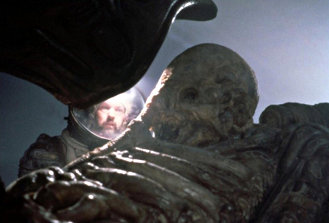
It’s likely enough. But I suspect that someone, possibly a non-scientist who spent time around morays, had noticed them earlier; and passed that knowledge on to folks designing the feature creature in “Alien.”

Have a safe and happy Halloween, and use caution while exploring deserted alien spaceships.

More about science, faith, and getting a grip:


1 I’m a Christian. I accept Jesus as our Lord. (John 1:15; Catechism, 430451)

I’m a Catholic because I insist that what I believe must make sense, no matter how I’m feeling. As John C. Wright said, “… If Vulcans had a church, they’d be Catholics.” (johncwright.livejournal.com (March 21 2008))

2 After our Lord stopped being dead, Thomas wouldn’t believe what other disciples were telling him. (John 20:25)

I can’t say that I blame him.

“Then he said to Thomas, ‘Put your finger here and see my hands, and bring your hand and put it into my side, and do not be unbelieving, but believe.’

17 Thomas answered and said to him, ‘My Lord and my God!’

18 Jesus said to him, ‘Have you come to believe because you have seen me? Blessed are those who have not seen and have believed.’ ”
(John 20:2729)

I didn’t demand that sort of proof. But nearly two millennia later, I had a whole lot more evidence than hearsay from a few badly-rattled folks to work with.

3 Evolution is not random: not in the sense of having no specific pattern. I suspect that quite a few folks say or write “random” when they mean “complex,” or “not fully understood.” In math, “random” is a probability distribution where all outcomes are equally likely.

If evolution had no specific pattern, scientists who study it wouldn’t be scientists. They’d be scorekeepers, recording meaningless trivia about “random” events.

4 A little more about creationism, evolution, and getting a grip:

5 Among other attributes, God is truth. (Catechism, 214217)

“Thomas said to him, ‘Master, we do not know where you are going; how can we know the way?’

“Jesus said to him, ‘I am the way and the truth 5 and the life. No one comes to the Father except through me.

“If you know me, then you will also know my Father. 6 From now on you do know him and have seen him.’ ”
(John 13:57)

6 Teeth and brains:

7 About jaws, mostly:

Posted in Science News | Tagged , , , , , , , | 10 Comments

The Virtue Trap

I generally identify with the tax collector in today’s Gospel reading: Luke 18:914.

That’s okay, since emulating “those who were convinced of their own righteousness,” despising everyone else, is a bad idea.

The problem wasn’t what the Pharisee was doing.

Fasting, within reason, is a good idea. It can be part of penance. (Catechism of the Catholic Church, 1434, 1438, 2043)

Along with tithing, it’s part of being a Catholic. (Catechism, 1387, 1969)

It’s part of being a Catholic for most of us, that is. Code of Canon Law, IV, III, II, II, 1251 says it’s part of being Catholic for folks age 15 through 59, and there are some other exceptions.1

Like I said, what the Pharisee was doing wasn’t the problem.

It was his attitude.

“…The pharisee is the very icon of a corrupt person who pretends to pray, but only manages to strut in front of a mirror. He is corrupt and he is pretending to pray. Thus, in life whoever believes himself to be just and criticises others and despises them, is corrupt and a hypocrite. Pride compromises every good deed, empties prayer, creates distance from God and from others….”
(“Humble prayer obtains mercy,” General Audience, Pope Francis (June 1, 2016))

Truth Matters

Truth is very important, and hypocrisy is a bad idea. (Catechism, Prologue, 27, 74, 1847, 2468, more under “Truth” in the index)

I’m expected to live as if I think truth matters. (Catechism, 2464-2503)

I’m also expected to use common sense.

“Discuss your case with your neighbor, but another man’s secret do not disclose;
“Lest, hearing it, he reproach you, and your ill repute cease not.”
(Proverbs 25:910)

“…No one is bound to reveal the truth to someone who does not have the right to know it.”
(Catechism, 2489)

Humility is putting God in first place: being thankful for what is good, and having the good sense to seek forgiveness when I mess up.2 (Catechism, 299, 2559)

That happens more often than I like. Messing up, I mean. I can’t make Tobit’s claim, that I “have walked all the days of my life on the paths of truth and righteousness.” (Tobit 1:3)

That’s what “confession,” the sacrament of reconciliation is for: in part. I’m still ‘working out’ my salvation, and that’s another topic. (Philippians 2:12; Catechism, 1422-1470)

Uriah Heep and The Screwtape Letters

Not bragging about how virtuous I am is a good idea, but I think acting like the tax collector could be a problem, too: if it’s just “acting.”

I strongly suspect that’s at least partly what the “delighting in self-abasement” mentioned in Colossians 2:18 is about.

Uriah Heep is a terrible role model, and I’ve been over that before. (July 31, 2016)

Not bragging about my humility seems prudent: even if it’s just to myself.

“…All virtues are less formidable to us once the man is aware that he has them, but this is specially true of humility. Catch him at the moment when he is really poor in spirit and smuggle into his mind the gratifying reflection, ‘By jove! I’m being humble’, and almost immediately pride—pride at his own humility—will appear….”
(“The Screwtape Letters,” XIV, C. S. Lewis (1942) via Project Gutenberg)

Real-life analogs to the fictional Screwtape and Wormwood exist, are best left alone, and that’s yet another topic.3

Vaguely-related posts:


1 Fasting and common sense:

“…Those that are excused from fast and abstinence outside the age limits include the physically or mentally ill including individuals suffering from chronic illnesses such as diabetes. Also excluded are pregnant or nursing women. In all cases, common sense should prevail, and ill persons should not further jeopardize their health by fasting.”
(Questions and Answers about Lent and Lenten Practices, USCCB)

2 ‘Messing up,’ sinning, is what happens when I don’t love God, love my neighbors, and see everybody as my neighbor. (Matthew 5:4344, 7:12, 22:3640, Mark 12:2831; Luke 10:2527, 2937)

Like I said, it happens more often than I like.

I should treat others as I want to be treated, too. (Matthew 7:12, Luke 6:31)

3 Demons, devils, angels who rejected God, are most emphatically not safe to be around. Satan, however, is not God’s ‘evil twin.’ (Catechism, 391-395, 397, 2851)

“…He is only a creature, powerful from the fact that he is pure spirit, but still a creature. He cannot prevent the building up of God’s reign….”
(Catechism, 395)

C. S. Lewis was right about “two equal and opposite errors,” I think:

“…There are two equal and opposite errors into which our race can fall about the devils. One is to disbelieve in their existence. The other is to believe, and to feel an excessive and unhealthy interest in them. They themselves are equally pleased by both errors and hail a materialist or a magician with the same delight….”
The Screwtape Letters,” Preface, C. S. Lewis (1942) via Project Gutenberg)

Posted in Being Catholic | Tagged , , , | 5 Comments

Sweet Potatoes, Genes, and Long Life

One woman decided to take a road trip after learning she had a terminal illness. Another switched careers. Both choices make sense, given the circumstances.

This year’s World Food Prize goes to a team who developed a new sweet potato, scientists found a virus with spider genes, and there’s a lively difference of opinion regarding human life span.

We’ve learned a lot since my youth, and there’s a great deal left to learn.

  1. World Food Prize: Sweet (Potato)
  2. A Virus With Spider Genes
  3. Mutations, Deadly and Otherwise
  4. Human Life Spans
  5. “The Best of the Best”

Admiration

I’ll mostly be talking about genetics, food, and folks with long lives.

But since one of the ‘genetic news’ items reminded me of it, I figure this is a good place to talk about evolution, too.

Also Genesis, the Sumerian King List, and scientific journals.

Like I said last month, I’m quite sure Adam and Eve aren’t German. The month before that, I talked about reading the Bible and using our brains: which we’re supposed to do. (September 23, 2016; August 28, 2016)

I take the Bible, Sacred Scripture, very seriously; and believe that it is true. (Catechism of the Catholic Church, 101133)

I also realize that the Bible wasn’t written by Americans.

The authors used “…modes of feeling, speaking and narrating then current….” (Catechism, 108114)

Expecting to find the sort of data we see in today’s vital records or scientific journals in the Bible isn’t, I think, reasonable. At all.

That’s why I do not assume that Adam’s and Methuselah’s ages, mentioned in Genesis 5:5 and 5:27, are useful data points in scientific studies of human lifespans.

My guess is that the enormous numbers may reflect their importance — sort of like improbably-long reigns in the Sumerian King List, and that’s another topic.

Creation In Progress

I believe that God is creating a good and ordered physical world: one that is changing, in a state of journeying toward an ultimate perfection. (Catechism, 282308)

This isn’t a new idea. From Genesis to Revelation, the Bible shows a world which has been changing and has not yet reached its goal.

We’re learning that the age of this universe doesn’t line up with a 17th century British Calvinist’s timetable, not even close; and its scale is — cosmic.

This doesn’t bother me a bit.

I see scientific discoveries as invitations “to greater admiration for the greatness of the Creator.” (Catechism, 283)

Honest research cannot interfere with an informed faith, since “…the things of the world and the things of faith derive from the same God….”(Catechism, 159)

We have a thirst for truth and for God. Made “in the image of God,” we can observe the world’s order and beauty — studying how things work, and learning a bit more about God. (Genesis 1:26, 2:7; Catechism, 27, 3135, 282289, 355361)

Or we can do our best to ignore this astounding universe. That seems silly, at best.


1. World Food Prize: Sweet (Potato)


(From S.Quinn/CIP, via BBC News, used w/o permission.)
(“The orange-fleshed sweet potato provide a valuable source of calories and nutrients for millions of people”
(BBC News))

Sweet potato Vitamin A research wins World Food Prize
Mark Kinver, BBC News (October 13, 2016)

Four scientists have been awarded the 2016 World Food Prize for enriching sweet potatoes, which resulted in health benefits for millions of people.

“They won the prize for the single most successful example of biofortification, resulting in Vitamin A-boosted crops.

“Since 1986, the World Food Prize aims to recognise efforts to increase the quality and quantity of available food.

“The researchers received their US $250,000 (£203,000) prize at a ceremony in Iowa, US, on Thursday….”

The ‘sweet potato’ laureates went to CIGAR International Potato Center’s Maria Andrade, Robert Mwanga and Jan Low.

The fourth World Food Prize winner was Howard Bouis, recognizing his quarter-century of work, making sure biofortification became an international plant breeding strategy.

Helping folks who are hungry seems like a good idea. (Matthew 25:35; Catechism, 1039, 2447)

But it’ll take more than one variety of improved sweet potato to end hunger. The annual Global Hunger Index report has discussed several issues that tend to make getting enough of the right sort of food difficult: like rising and volatile food prices; and armed conflict.

A few years back there was the usual kvetching — about the new seed, or the outfit developing it, maybe both.1

New ideas can be scary, and I’ve talked about that before. Often. (October 16, 2016; August 28, 2016; August 21, 2016)

10 Millennia of ‘Artificial’ Organisms

I’m not particularly overwhelmed with angst at the thought of an ‘unnatural’ sweet potato.

I’ve eaten unmodified food — wild raspberries, my father’s name for a berry growing in Minnesota — but my diet is almost entirely from “artificial” plants and animals. So is yours, unless you rely on hunting and gathering for food.

We’ve applied our knowledge of inherited traits for upwards of 10 millennia.2 I’ve talked about dogs, wolves, and Laban’s sheep, before, too. (July 22, 2016)


2. A Virus With Spider Genes


(From Science Photo Library, via BBC News, used w/o permission.)
(“The WO virus appears to have pinched poison genes from black widow spiders”
(BBC News))

Virus stole poison genes from black widow spider
Paul Rincon, BBC News (October 12, 2016)

In a very unusual case of genetic theft, a virus has been caught with a gene that codes for the poison of black widow spiders.

“The chunks of arachnid DNA were probably stolen by the virus to help it punch through animal cells.

“But its target is not the animal itself – the ‘WO’ virus only infects bacteria living within insects and spiders.

“It was a surprise because bacterial viruses were generally thought to steal DNA only from bacteria….”

It’s a nitpicking detail, but I think “stole poison genes” and “gene theft” implies a sort of intentionality that’s impossible for a virus.

More to the point, WO bacteriophage’s taking genetic code from the Wolbachia bacteria’s host spider may help show how horizontal gene transfer works between domains.

A bacteriaphage is a virus that infects bacteria, Wolbarchia is a bacteria that makes spiders sick, and don’t bother trying to remember all those terms. Or check out a resource link list I put near the end of this post.3

This particular example of horizontal gene transfer lets the virus make latrotoxin, a neurotoxin that may help the virus pass through bacterial cell walls.

What we’ve been learning about horizontal gene transfer makes reconstructing evolution by studying genetic code more complicated.

I strongly suspect it will also help us understand how life has been developing over the last four billion years, give or take.


3. Mutations, Deadly and Otherwise


(From Darren Hopes, via Nature, used w/o permission.)

A radical revision of human genetics
Erika Check Hayden, Nature (October 12, 2016)

“Lurking in the genes of the average person are about 54 mutations that look as if they should sicken or even kill their bearer. But they don’t. Sonia Vallabh hoped that D178N was one such mutation.

“In 2010, Vallabh had watched her mother die from a mysterious illness called fatal familial insomnia, in which misfolded prion proteins cluster together and destroy the brain. The following year, Sonia was tested and found that she had a copy of the prion-protein gene, PRNP, with the same genetic glitch — D178N — that had probably caused her mother’s illness….

“…The fast pace of genomic research since the start of the twenty-first century has packed the literature with thousands of gene mutations associated with disease and disability. Many such associations are solid, but scores of mutations once suggested to be dangerous or even lethal are turning out to be innocuous. These sheep in wolves’ clothing are being unmasked thanks to one of the largest genetics studies ever conducted: the Exome Aggregation Consortium, or ExAC….”

Sonia Vallabh was 26 when she learned that she carried a glitchy PRNP gene. She and her husband, Eric Minikel, switched their careers from law and transportation consulting to studying biology as graduate students.

One of their top priorities was learning how the D178N mutation related to fatal familial insomnia.

Meanwhile, Daniel MacArthur got ExAC started. We didn’t have a standardized database of human genome sequences from folks with — and without — genetic disorders. Not one large enough for his research, anyway.

Around the same time, Mark DePristo’s GATK (Genome Analysis Toolkit) team at the Broad Institute had new software designed in part to help analyze data on the scale MacArthur’s research needed.4

“A New Way of Working”

“… By looking more closely at the frequency of mutations in different populations, researchers can gain insight into what many genes do and how their protein products function.

“ExAC has turned human genetics upside down, says geneticist David Goldstein of Columbia University in New York City. Instead of starting with a disease or trait and working backwards to find its genetic underpinnings, researchers can start with mutations that look like they should have an interesting effect and investigate what might be happening in the people who harbour them. ‘This really is a new way of working,’ he says….”
(Erika Check Hayden, Nature)

If this was a feel-good movie, the folks at ExAC might have teamed up with Massachusetts General Hospital and Mayo Clinic, discovered a sure-fire cure to fatal familial insomnia, and everyone lives happily ever after.

This is the real world, so Vallabh and her husband learned that there’s a very close link between D178N and various diseases.

“…’All along the way was gradual confirmation of what we were assuming anyway,’ Minikel says. ‘There wasn’t any moment where we said, “Ah, this is the worst news.” We’d already gotten the worst news.’…”
(Erika Check Hayden, Nature)

The somewhat-good news is that Vallabh is now 32, two decades younger than her mother was when she died. Her story might still have a Hollywood ending.

In her position, I would appreciate knowing that I’m facing an earlier-than-average death — and might keep helping others learn how it might be avoided, even if I thought I’d die before a cure was ready.

I hope I’d have the good sense to do so, anyway.

As of two years ago, ExAC had exomes from 60,706 individuals. They’re from various ethnic groups, and met requirements for health and consent.

The ethnic angle is important. Humanity’s family tree is a whole lot bigger than the European/Euro-American branch that my recent ancestors are on.

This sort of research is already saving lives:

Ethics, Genetic Tests, and Autism Spectrum Disorders

The “ethical questions” are legitimate.

I think genetic testing is a good idea, and that some folks will find ways for misusing it.

The benefits, I think, are obvious.

A delivery-room DNA profile, like today’s heel prick test for potentially-serious diseases, could help parents deal with their children’s genetic glitches.

On the down side, decision-makers might get the bright idea that some of us are genetically doomed to become criminals.

It’s not an entirely unrealistic concern. There may, or may not, be a connection between autism spectrum disorders and criminal behavior — and autism spectrum disorders may, or may not, be caused at least in part by genetic glitches.5

I’ve got a personal stake in this, since I’ve been diagnosed with an autism spectrum disorder: among other things. I won’t rant about being misunderstood, though. That seems a bit counter-productive.

I think we’ll need social and legal controls over how we use the information, and who gets to know which parts.

I’m confident that those controls will cause at least some problems of their own. Like I keep saying, this isn’t a perfect world. But I think making it better is an option, and that’s a yet another topic.


4. Human Life Spans


(From Alamy, via BBC News, used w/o permission.)
(Jeanne Calment: born February 21, 1875; died August 4, 1997; met Vincent van Gogh; and has the longest confirmed life. So far.)

Limit to human life may be 115 (ish)
James Gallagher, BBC News (October 5, 2016)

Human life spans may be limited to a maximum of about 115 years, claim US scientists.

“Their conclusions, published in the journal Nature, were made by analysing decades of data on human longevity.

“They said a rare few may live longer, but the odds were so poor you’d have to scour 10,000 planet Earths to find just one 125-year-old.

“But while some scientists have praised the study, others have labelled it a dismal travesty….”

I won’t call the conclusions a “dismal travesty,” but I don’t have James Vaupel’s expertise.

I think he’s got a point, though.

The study looked at data from the Human Mortality Database; and information about folks in France, Japan, the United Kingdom, and America, who lived more than a hundred years.

A quick look at their study, and the Database, told me that their study covers a very small sample.6

The Human Mortality Database includes data from 38 countries: most of it from the later parts of the 20th century.

The United States data includes exposure-to-risk and death rate data from 1833 to 1984.

The other information from my country runs from 1933 to 2014. That’s a span of 181 years: very roughly 48% longer than more than the longest verified human lifespan.

Comparisons

The Database is an impressive research tool, but it’s a small sample of humanity.

I like comparisons, so let’s look at Drosophila melanogaster — fruit flies, those little critters scientists use when they’re studying genetics and other ‘generational’ facets of life.

These fruit flies live about 30 days at 29 °C, 84 °F. An Oxford Journals paper from 2004 talked about a variety with average lifespans of 60 to 80 days for males.

Let’s say the longest fruit fly life is 90 days, and the longest human life is 122 years. Adding 48% to 90 gives me 133.2 days as the fruit fly equivalent of (122 x 1.48) 181 human years. That’s something like four and a half months.

Studying a selection of fruit flies for four and a half months could tell us something about fruit flies. But it might not show everything about them.

Getting back to James Vaupel’s somewhat incandescent reaction to that research, and why I think we’ve got more to learn – – –

James Vaupel’s Opinion and ‘Immortal’ Chicken Cells


(From ONS, via BBC News, used w/o permission.)

“…He described the study as a dismal travesty and said scientists had in the past claimed the limit was 65, 85 and 105 only to be proven wrong over and over again.

“He said: ‘In this sorry saga, those convinced that there are looming limits did not apply demography and statistics to test hypotheses about lifespan limits—instead they exploited rhetoric, deficient methods and pretty graphics to attempt to prove their gut feelings.

” ‘[This study] adds nothing to scientific knowledge about how long we will live.’…”
(James Gallagher, BBC News)

I should have said why James Vaupel’s opinion matters. He’s founding director of the Max Planck Institute for Demographic Research; and a scientist who’s been studying aging and biodemography.

He’s also pretty sure that we can increase human longevity, which may help explain why he said what he did.

Longevity isn’t necessarily the same as life expectancy. It can mean ‘how long someone could live,’ where life expectancy means ‘how long someone is likely to live.’

James Vaupel is right, about life expectancy going up over the last several generations; for the most part, anyway.

We’ve been learning a lot about health and aging, much of it in my lifetime. We’re even starting to understand why some organisms, like hydras, don’t age. Not the way we do.7

I haven’t heard of the ‘immortal chicken heart’ for quite a while, probably because scientists found problems with Alexis Carrel’s research about a half-century back.

It didn’t help, I think, that he promoted eugenics before Germany’s government tried purging Europe’s gene pool. He died before standing trial for collaboration with the Nazis.

What I think is intriguing is that he kept a culture of cells from a young chicken’s heart alive from 1912 until his death in 1944.

The last of Carrel’s tissue cultures was discarded in 1946, still alive, two years after his death.8

5. “The Best of the Best”


(From Ramie Liddle, via BBC News, used w/o permission.)
(“Life on the open road”
(BBC News))

Dying woman picks road trip over chemotherapy
BBC News (October 3, 2016)

When 90-year-old Norma Bauerschmidt was diagnosed with terminal cancer, her immediate instinct was to refuse treatment and instead find a more positive way to spend her final days.

“So she embarked on the road trip of lifetime and unwittingly became an internet hit along the way, when the Facebook page about her travels started attracting more than 440,000 followers.

“Mrs Bauerschmidt, from Michigan, spent just over a year on the road with her son Tim and his wife, Ramie Liddle, in their motor home, before her death last week….”

My hat’s off Norma Bauerschmidt — and the Liddels — for making good use of her last year-plus-a-few-days.

As I’ve said before, taking reasonably good care of our health is a good idea. (Catechism, 22882290)

But extreme medical procedures aren’t required. Not if expected results are “disproportionate to the expected outcome.” (Catechism, 2278)

Something I verified a few years back, as my father was dying, is when and how painkillers are okay. When my clock starts running out, common-sense pain management is okay: even if it’ll probably shorten my life a bit. (Catechsim, 2279)

Norma Bauerschmidt stayed in one place for a day, or a month, depending on how she and her family felt.

They covered quite a bit of the country, from Washington — the state — to Yellowstone National Park and the Massachusetts coast.

I like the way her daughter-in-law summed it up: “In the last year, we have seen the best of the best of the people in this country.” (BBC News)

More of what I think about using our brains:


1 ‘Artificial’ organisms aren’t new, but some of our tech is:

2 10 millennia of agriculture:

3 Gene transfer, and more stuff you probably don’t need to know:

4 Genetic research, old and new:

5 A reasonably calm look at autism spectrum disorders and crime:

6 It’s a start:

7 Studying life and death:

8 Alexis Carrel, chickens, and the “immortal” chicken cells:

Posted in Science News | Tagged , , , , , , , , | 10 Comments

Alchemy, Science, Life, and Health


(“I find that nothing’s ever exactly like you expect….”
(Professor Richard Lazarus, “The Lazarus Experiment,” BBC))

A mad scientist’s lot is not a happy one. All he wants is to redefine being human: and the next thing you know, he’s eating guests at his victory celebration.

Doctor Who’s The Lazarus Experiment doesn’t have much to do with The Devil Bat and The Brain That Wouldn’t Die, apart from featuring a mad scientist — and science gone horribly wrong.

Some movies, like Fantastic Voyage and Things to Come, present science and technology as useful.

But “tampering with things man was not supposed to know,” as Mr. Squibbs put it, keeps the plot going for quite a few; like Altered Species, They Saved Hitler’s Brain, and Island of Lost Souls.

Reticence, reasonable and otherwise, regarding new ideas isn’t new. (August 21, 2016)

“Smallpox is a visitation from God; but the cowpox is produced by presumptuous man; the former was what Heaven ordained, the latter is, perhaps, a daring violation our of holy religion.”
(A physician’s reaction to Dr. Edward Jenner’s experiments in developing a vaccine for smallpox, (1796) via Psychological Sciences, Vanderbilt University)

“I have read in the Philosophical Transactions the account of the effects of lightning on St. Bride’s steeple. ‘Tis amazing to me, that after the full demonstration you had given, of the identity of lightning and of electricity, and the power of metalline conductors, they should ever think of repairing that steeple without such conductors. How astonishing is the force of prejudice even in an age of so much knowledge and free enquiry!”
(Letter, To Benjamin Franklin from John Winthrop, 6 January 1768, via founders.archives.gov)

Learning: Sometimes the Hard Way

Metalline conductors, we call them lightning rods these days, were new technology in 1768.

Folks were learning about electricity, sometimes the hard way.

Georg Wilhelm Richmann was measuring an insulated rod’s interaction with a thunderstorm in 1753 when something resembling ball lightning interacted with him: lethally.

He’s probably the first person to die while conducting electrical experiments.

The lesson isn’t, I think, that movies make folks fear science, or that God smites those who study thunderstorms.

Ideally, Richmann’s death would have impressed scientists throughout all generations that following safety protocols makes sense.

We don’t live in an ideal world: so less than two centuries later Harry Daghlian and Louis Slotin died after working with a mass of plutonium, subsequently dubbed the “demon core.”1

Mad Scientists and Seeking Knowledge


(From Phil & Kaja Foglio, used w/o permission.)
(Finally! A mad scientist gets it right: Girl Genius, July 10, 2013.)

Let’s give B-movie ‘mad scientist’ film writers credit.

Their fictional meddlers with “more than heavenly power permits”2 were probably crazy enough to demand unswerving obedience without realizing that something/someone that’s smart enough to understand the orders is sharp enough to get upset.

I was going somewhere with this. Let me think.

Unexpected results; mad scientists; lightning rods; more scientists, mad and otherwise.

Right.

Loudly-religious analogs of Mr. Squibbs notwithstanding, seeking knowledge and developing new tech isn’t a sin.

Science and technology, studying the universe and using what we learn, is part of being human. (Catechism of the Catholic Church, 22922296)

Ethics matter, just as they do for everything else we do. (Catechism, 2294)

Faith isn’t reason — but isn’t opposed to reason. Science and faith, the Catholic variety, get along. (Catechism, 154159)

We do, however, need to remember that our preconceived notions may not accurately reflect reality.

“…God, the Creator and Ruler of all things, is also the Author of the Scriptures – and that therefore nothing can be proved either by physical science or archaeology which can really contradict the Scriptures. … Even if the difficulty is after all not cleared up and the discrepancy seems to remain, the contest must not be abandoned; truth cannot contradict truth….”
(“Providentissimus Deus,” Pope Leo XIII (November 18, 1893) [emphasis mine])

Wanting Health and Long Life

Scientists occasionally act as if curiosity justifies whatever they’re doing; which reminds me of Johann Conrad Dippel, a colorful fellow born at Castle Frankenstein3 in 1673.

He studied alchemy around the time serious researchers started calling what they did “chemistry” in a desperate — and eventually successful — attempt to distinguish their work from folks hawking elixirs and panaceas.

Anyway: Dippel had trouble managing money; invented Dipple’s oil, useful as an animal and insect repellent; and was accused of grave robbing, presumably for his alleged soul-transfer experiments.

Like I said: a colorful fellow.

He wrote that he’d invented an elixir that’d keep him alive until he was 135 years old, and died a few months short of his 61st birthday.

Dippel’s interest in an elixir of life was hardly unique. That, and the philosopher’s stone, had been an alchemical El Dorado for centuries. Interestingly, we can transmute lead into gold these days; but the process costs more than the gold is worth.

We’re also getting better at extending human life and maintaining public health. This is a good thing. (Catechism, 2211, 22882291)

Here’s where it gets tricky.

Culling the Unfit

Plato said that the state should control human reproduction.

Human nature being what it is, and was, citizens below philosopher king rank would be fooled into cooperating.

His “Republic” described a rigged lottery. Folks with high scores would be ‘randomly’ paired: but Plato realized that his “gold soul” couples could produce “bronze soul” kids.

Infanticide, killing defective or unwanted kids, had been routine long before Plato; and still is, with varying degrees of acceptance.

Different cultures had different approaches. Table IV of the Roman Twelve Tables required the pater familias to kill any deformed child. The Spartan Gerousia, a council of elders, decided if a child would live or die.4

Since I think all human life is precious, I can’t see culling the unfit as a good idea. (Catechism, 2258, 2268)

I’ll grant that I’m biased.

Enjoying Life and Health: Reasonably

I’m taking medications to control mental and physical issues. (October 14, 2016)

On top of that, I have artificial hips, both hands were re-engineered, my teeth are mostly metal or ceramic, and I keep a set of clip-on lenses in front of my eyes.

Sometimes I feel as if life’s not worth living, but that could easily be attitudes stored in my implicit memory during the decades before learning that depression’s symptoms aren’t normal for adolescents and adults.

On the whole, I think being alive is a good idea: even if I’m not enjoying a “quality lifestyle” by some standards.

I’m not, arguably, “as God made me,” and haven’t been since early childhood. Surgery corrected, more or less, congenital hip dysplasia before I started kindergarten.

Another surgeon repaired part of my lower GI tract a decade or so back, which probably saved my life. He also removed my appendix and Meckel’s diverticulum, in an abundance of caution. I mentioned other modifications earlier.

I don’t feel guilty about any of that, since life and health are a “precious gift” from God. I’m expected to take reasonable care of mine. (Catechism, 2288, 2278)

What’s changed during my lifetime — and is changing — is how many previously-inescapable health problems can be treated.

The mad scientist’s dream of indefinitely extending life, or removing unwanted parts of human nature — without the distressing side effects encountered by Dr. Jekyll5 — may be just a dream. But it’s getting serious attention again.

I’ll be talking about that in another post.

More about science and being human:


1 Why “twisting the dragon’s tail” is a bad idea:

2 Doctor Faustus, or, picking the wrong research assistant:

3 Mary Shelley’s Frankenstein may have been inspired partly by Dipple’s reputation:

4 Eugenics and all that:

5 ‘It seemed like a good idea at the time:’

</h4″>

Posted in Being Catholic | Tagged , , , , , , , | 8 Comments

Elastic Brains and New Tech

Maybe ‘you can’t teach an old dog new tricks,’ but apparently the adult brain isn’t nearly as rigid as scientists thought.

I’ll be looking at neuroplasticity, the idea that brains can change; research that may lead to better neural interfaces; and ‘brain training’ games.

  1. Teen Brains, Old Dogs, New Science
  2. Memristors and Neural Interfaces
  3. Games, yes; Training Solutions, Debatable

We’ve been learning a great deal about the human brain and how it works. That’s a good thing for me, since I have maintenance issues with mine.


Suicide: No Future In It

As I said last week, undiagnosed depression and something probably on the autism spectrum has been part of my life for decades. (October 5, 2016)

The first time I felt like killing myself was in my teens. At the time, I decided that I could last longer than the pain.

I was right.

That’s no great virtue on my part. I’m very stubborn, and could apply what I’d learned about enduring physical pain to the psychological version.

When I became a Catholic, I learned more about why suicide is a bad idea.

I’m responsible for my life. It’s a gift from God. I don’t have the authority to end it. Besides, it’s not just about me. Other folks might be affected, too. (Catechism of the Catholic Church, 22802282)

However, if someone tells you that your child/spouse/relative/friend is in Hell because he or she committed suicide: that is not what the Church says:

“We should not despair of the eternal salvation of persons who have taken their own lives. By ways known to him alone, God can provide the opportunity for salutary repentance. The Church prays for persons who have taken their own lives.”
(Catechism, 2283)

There’s help available for those of us with suicidal thoughts these days: like the National Suicide Prevention Lifeline.

That’s 800-273-TALK (8255) / 800-273-8255 — a free, 24/7 service that can provide suicidal persons or those around them with support, information and local resources. (National Suicide Prevention Lifeline / www.suicidepreventionlifeline.org)

An Irritable Life, But a Short One?1

Major depressive disorder probably isn’t lethal, by itself. On average, though, folks with this disorder have shorter lives — partly because we’re much more likely than most to kill ourselves.

We’re also more likely to drop dead from heart disease and assorted other illnesses.

Meanwhile, feeling hopeless or irritable most of the time doesn’t help us concentrate.

Neither does our inadequate supply neurotransmitters: serotonin, norepinephrine, and dopamine. Quite a few of us wind up homeless; but again, that doesn’t always happen.

Nerves in the peripheral nervous system handle signals to the diaphragm, heart, and other vital systems.

These nerves use dopamine, a neurotransmitter that’s in short supply in folks with major depression. I’d be surprised if glitchy control circuits didn’t eventually kill us.

Praise the Lord and Pass the Prescriptions


(Image from ISS program and the JSC Earth Science & Remote Sensing Unit, ARES Division, Exploration Integration Science Directorate, used w/o permission.)

I learned this sort of thing as a child:

4 Even when I walk through a dark valley, I fear no harm for you are at my side; your rod and staff give me courage.”
(Psalms 23:4)

“You are my hope, Lord; my trust, GOD, from my youth.”
(Psalms 71:5)

“Praise the LORD, my soul; I shall praise the LORD all my life, sing praise to my God while I live.”
(Psalms 146:2)

Remembering it while stumbling though a dark valley: that’s not easy, but I think it’s important.

So is remembering this sort of thing:

“The soul of the sluggard craves in vain, but the diligent soul is amply satisfied.”
(Proverbs 13:4)

Folks who don’t believe in medicine, assuming that ‘God will provide,’ occasionally hit the news when one of their number drops dead of a treatable condition.

‘Relying on the Lord’ is a very nice notion, and appropriate. Within reason.

I believe that God constantly sustains my existence — and makes a world where the creatures in it, myself included, have a role in making things happen. (Catechism, 301, 306)

I’ve got hands and a brain. I figure God expects me to do something with them.

My life and health are “precious gifts” from God. Taking “reasonable care” of them is part of my job. (Catechism, 2288)

That includes taking methylphenidate, one of the psychoactive drugs that lets me think without constantly fighting the machinery in my brain.

I could try ‘rising above’ my brain’s lack of neurotransmitters, continuing a decades-long struggle to focus on each hour’s tasks. I could also try turning my metal-and-plastic hip joints into flesh-and-blood ones with the power of my mind.

That doesn’t seem reasonable.

Genetics and Responsibility

Feeling sad and hopeless is part of major depressive disorder — but this “depression” isn’t just a mood or a bout of the blues.

It’s probably a “weakness,” in the sense that something in my genes may have made me more susceptible than others.2

It could have been worse. Some folks are susceptible to things like Chron’s disease.

I do not think “depression” is a sign of weak moral character, or feel guilty because I can’t think myself into good health.

Some folks who enjoy good health seem convinced that it’s due to their moral and mental strength.

I’ll grant that good behavior generally helps me stay healthier.

I don’t think depression and whatever else is wrong with my brain’s circuitry gives me an excuse for misbehaving. (Catechism, 387)

I can decide to act, or not act; and am responsible for my actions. (Catechism,17301738)

But I don’t think God will blame me for experiencing the effects of illness, mental or otherwise. (Catechism, 1735)


1. Teen Brains, Old Dogs, New Science


(From Harry Campbell, via The New York Times, used w/o permission.)

Return to the Teenage Brain
Richard A. Friedman, op-ed, The New York Times (October 8, 2016)

“There’s a reason adults don’t pick up Japanese or learn how to kite surf. It’s ridiculously hard. In stark contrast, young people can learn the most difficult things relatively easily. Polynomials, Chinese, skateboarding — no problem!

“Neuroplasticity — the brain’s ability to form new neural connections and be influenced by the environment — is greatest in childhood and adolescence, when the brain is still a work in progress. But this window of opportunity is finite. Eventually it slams shut. Or so we thought.

“Until recently, the conventional wisdom within the fields of neuroscience and psychiatry has been that development is a one-way street, and once a person has passed through his formative years, experiences and abilities are very hard, if not impossible, to change….”

The best, or easiest, time for learning is when we’re very young. But ‘you can’t teach an old dog new tricks’ isn’t always true. Not for humans, anyway.

Researchers found that giving adults valproic acid, Valproate, helps adults learn perfect pitch; and I learned that it’s called “absolute pitch.”

It looks like histone deacetylase, a substance that affects DNA, is involved in making our brains more open to rewiring. I put a list of resources near the end of this post.3

Mr. Friedman ends his op-ed with this:

“…You … can’t be sure that opening a new sensitive period won’t leave you worse off than the first one did. You might find it easier to pick up Chinese, but you might also remember more acutely all the disappointments and traumas that you’d prefer to forget.

“Finally, our very identity is enmeshed in these neural circuits. Do we really want to tamper with them at the risk of altering who we are?

“But the allure of recapturing neuroplasticity, with its potential to treat diseases like Alzheimer’s and autism, as well as to repair early psychological trauma, will be very hard to resist.”
(Richard A. Friedman, op-ed, The New York Times)

I’m not convinced that we should “resist” developing medical technology that could enhance neuroplasticity, treat degenerative diseases, and help folks like me repair our minds.

Taking time to think about how we should use new technology — seems reasonable. I talked about new tech and rational reflection last week.4 (October 7, 2016)

Learning How Our Brains Work

My high school science textbooks said that adult brains were static, unchanging. The assumption was that our brains don’t change, once we get past youth: no new neurons, no new connections between neurons.

I’m not sure how that belief took hold, or why the idea that adult brains aren’t hardwired took so long to catch on. The fancy term for the brain’s ability to change is neuroplasticity.5

Michele Vicenzo Malacarne’s 1793 research suggested that training makes an animal’s cerebellum grow. William James apparently raised the idea that adult brains aren’t rigid in his 1890 book, “The Principles of Psychology.”

Karl Lashley’s 1923 research with Rhesus monkeys showed neural connections in their brains changing through adulthood.

I suspect it helps that we’ve got functional neuroimaging tech now, like Single-photon emission computed tomography and magnetoencephalography.

Scientists have known that electrical impulses happen in brains since around 1860, and we’ve learned a very great deal about how the brain works in the last few decades.

We don’t have science fiction’s ‘brain scanners’ yet. But tech like Functional magnetic resonance imaging (fMRI) is getting close.

My guess is that we’ll learn a very great deal more in the next few generations.

There’s more about medical imaging and other technology near the end of this post.6


2. Memristors and Neural Interfaces


(From University of Southampton, via The Atlantic, used w/o permission.)

Memristors Could Be a Boon to Brain-to-Prosthesis Communication
Andrew Silver, IEEE Spectrum (October 4, 2016)

“Inside the brain, many neurons fire so that the body will perform a single action like picking up a cup or kicking a ball. Unfortunately for amputees with missing limbs, this brain activity is for naught. Now, engineers at the University of Southampton say they’ve shown that low-power devices known as memristors might be more energy efficient than today’s experimental neural interfaces that help relay signals from the brain to prosthetic limbs.

“Themis Prodromakis, who studies nanoelectronics at the University of Southampton, in England, is exploring one of the building blocks of brain and computer interfaces for medical applications. His early research supports the development of special neuronal brain-chips: neural implants that communicate with prosthetic limbs when neurons fire….”

As of this week, Wikipedia’s Memristor page says it’s “a hypothetical non-linear passive two-terminal electrical component,” and says “there are … some serious doubts as to whether the memristor can actually exist in physical reality….”

Rational caution is a good idea; which is why scientists tried replicating cold fusion results back in 1989, instead of uncritically accepting the claims.

Maybe that’s the reason for the “serious doubts.” Or maybe this is like the Koch-Pasteur rivalry. Sometimes personal and political issues slosh into acceptance of new ideas.

In this case, since a different team also got positive results from a titanium oxide film — my guess is that memristors may be more than “hypothetical.”

Even if this memristor research leads to practical hardware, I think it’ll be years — at least — before neural implants using the new tech join existing commercial brain-computer interfaces like Emotive’s EPOC+.7


3. Games, yes; Training Solutions, Debatable


(From Edgar Su/Reuters, via The Atlantic, used w/o permission.)

The Weak Evidence Behind Brain-Training Games
Ed Yong, The Atlantic (October 3, 2016)

“Seven psychologists reviewed every single scientific paper put forward to support these products—and found them wanting.

“If you repeat a specific mental task—say, memorizing a string of numbers—you’ll obviously get better at it. But what if your recollection improved more generally? What if, by spending a few minutes a day on that simple task, you could also become better at remembering phone numbers, or recalling facts ahead of an exam, or bringing faces to mind?

“This is the seductive logic of the brain-training industry….

“…People are certainly buying the hype—and the games. According to one set of estimates, consumers spent $715 million on these games in 2013, and are set to spend $3.38 billion by 2020.

“And they might be wasting their money….”

$715 million a year sounds like a lot of money, and it is. I figured learning how much one person might “waste” on a game might give me a better idea of what we’re looking at.

A one-year subscription to BrainHQ costs $96. That’s more than I pay for Sky and Telescope, but doesn’t seem exorbitant for an entertainment expense.

Another outfit, Cogmed, says “Cogmed solutions help consumers, professionals, and schools address attention problems.”

That got my attention, particularly since I couldn’t find a price listing. I’ve learned to associate profuse self-praise and no visible price with “if you have to ask, you can’t afford it” products and services.

Cogmed’s claim to have practical benefits makes their offer something other than entertainment

Patent Medicines for the Information Age?

My quick look at ‘brain game’ marketing backs up what the seven psychologists said:

Do ‘Brain-Training’ Programs Work?
Daniel J. Simons, Walter R. Boot, Neil Charness, Susan E. Gathercole, Christopher F. Chabris, David Z. Hambrick, Elizabeth A. L. Stine-Morrow; Psychological Science in the Public Interest, via Sage Journals (October 2016)

“…As a rule, brain-training companies promote the efficacy of their products for a very wide range of conditions and outcomes, from specific genetic, neurological, and mental diagnoses (e.g., Turner syndrome, age-related cognitive impairment, schizophrenia), to sports performance, general cognitive ability, everyday memory for names and locations, and driving ability….”

Hamlin's Wizard Oil advertising poster. (ca. 1890)I expect a certain amount of puffery in advertising: exaggerations that no reasonable person would believe, like polar bears drinking Coca-Cola.

I don’t see a problem with marketing a product, maybe because I spent two decades in that field.

But presenting a product or service’s benefits is one thing. Emulating patent medicine advertising like Hamlin’s Wizard Oil’s is something else.

American patent medicine makers flourished in the later 19th century because so many folks didn’t trust doctors, and the Pure Food and Drug Act wasn’t around yet.

Fear of 19th-century medical practice wasn’t unreasonable. Bloodletting, emetics, and laxatives, were routine medical procedures.8

The Pure Food and Drug Act wasn’t a cure-all. Radium 226 and 228 in Bailey Radium Laboratories’ “Perpetual Sunshine,” Radithor, eventually put Eben Byers in a lead-lined coffin, decades after the FDA’s launch.

I’d be astonished if any of today’s ‘brain game’ software is lethal. But I think it’s probably more entertainment, and less “solution” to anyone’s problems.

More of my views on faith, science, and being human:


1 Bartholomew Roberts (1682-1722) apparently decided that he was better off as a pirate: ” ‘…no, a merry life and a short one shall be my motto.’ ” (Wikipedia))

I see his point, since as a Welsh commoner in the British merchant navy he could look forward to earning “less than £3 per month and … no chance of promotion to captaincy.” (Wikipedia)

That doesn’t justify making piracy/theft a career, but I think his situation shows why paying just wages and promoting qualified folks makes sense. (Catechism, 24082409, 24332434)

2 Depression, background:

3 Neuroplasticity, genes, and what we experience:

4 ‘Because we can’ isn’t a good reason:

“…what is technically possible is not for that very reason morally admissible. Rational reflection on the fundamental values of life and of human procreation is therefore indispensable for formulating a moral evaluation of such technological interventions on a human being from the first stages of his development….”
(“Instruction Dignitas Personae on Certain Bioethical Questions,” William Cardinal Levada, Prefect; Luis F. Ladaria, S.I., Titular Archbishop of Thibica, Secretary; Congregation for the Doctrine of the Faith (September 8, 2008)) [Emphasis mine]

5 Neuroplasticity and all that:

6 Medical imaging and other monitoring tech:

7 Brain-computer interfaces, commercial and otherwise:

8 More reasons for not missing the ‘good old days:’

Posted in Science News | Tagged , , , , , , , , , | 3 Comments