Mercy: Still Practicing

From Calendar of Major Events, Jubilee of Mercy, 2015; used w/o permission.

The Extraordinary Jubilee of Mercy ends today. Some Catholics celebrated the year’s start in Rome. I didn’t. Like most of us, I’ve been participating in my own way, where I live.

The biggest change in routine for me has been during Mass. We’ve been receiving the Eucharist under both forms: our Lord’s body and blood.

If you think that’s sounds gory and repulsive, you’re not alone.

“Do you also want to leave?”

Following our Lord has involved public relations issues from the start:

“Whoever eats 19 my flesh and drinks my blood has eternal life, and I will raise him on the last day.
“Jesus then said to the Twelve, ‘Do you also want to leave?’
“Simon Peter answered him, ‘Master, to whom shall we go? You have the words of eternal life.
“We have come to believe and are convinced that you are the Holy One of God.'”
(John 6:54, John 6:6769)

Receiving under both kinds has been a big deal for this parish, since our bishop had to sign off on the procedure, and we needed more servers. I hope we can continue after the Year of Mercy. But we’ll see what happens.

I like what we’ve been doing, particularly since receiving our Lord under both forms is closer to what happened at the Last Supper.

But I know “…that … the true Sacrament, is received even under only one species, and … those who receive under only one species are not deprived of any of the grace that is necessary for salvation….”1

And since, like Peter, I am convinced that Jesus has “the words of eternal life;” following our Lord is my only reasonable option.

The Meaning of Our Mission

It’s the Extraordinary Jubilee of Mercy that’s ending today, not mercy. That’s part of a mission we’ve been on, ever since our Lord stopped being dead.

“…This is a time for the Church to rediscover the meaning of the mission entrusted to her by the Lord on the day of Easter: to be a sign and an instrument of the Father’s mercy (cf. John 20:2123)….”
(“Celebration of First Vespers of Divine Mercy Sunday,” Pope Francis (April 11, 2015))

“(Jesus) said to them again, ‘Peace be with you. As the Father has sent me, so I send you.’
“And when he had said this, he breathed on them and said to them, ‘Receive the holy Spirit.
“Whose sins you forgive are forgiven them, and whose sins you retain are retained.'”
(John 20:2123)

Mercy doesn’t make sense without some idea of what sin is.

Sin is an act or thought, or a failure to act, which offends reason, truth, and God. (Catechism of the Catholic Church, 1849-1851)

It is what happens when I don’t love God, and my neighbor, as I should; and do not see everyone as my neighbor. (Matthew 5:4344, 22:3640; Mark 12:2831; Luke 6:31, 10:2527, 2937; Catechism, 2196)

Sins by the Bushel

Sins aren’t all alike. There’s a sort of laundry list in Galatians 5:1921, enumerating “works of the flesh.” Next comes Galatians 5:2223, with a “fruit of the Spirit.” (Catechism, 1852-1853)

I could take those verses, ignore Genesis 1:31 and two millennia of Catholic teaching, claim that physical reality is icky; and I talked about that in Friday’s post. (November 18, 2016)

There’s a whole mess of ways I can sort sin into categories.

I can pigeonhole sins by their object, the virtues each opposes, and by excess or defect. Coming from other directions; I’ve got spiritual and carnal sins; sins against God, neighbor, or myself; or “…sins in thought, word, deed, or omission….” (Catechism, 1853)

What they’ve got in common is that each is something I can chose to do. Or I can decide that practicing charity is a good idea. The choice is mine, so are the consequences, and that’s another topic. (Catechism, 1730-1825, 1853)

I don’t go to the “drinking bouts, orgies, and the like” mentioned in Galatians 5:21 puts it; so I could decide that I’m so stinking holy that I’ll get a front-row seat in Heaven. That would be a really bad decision, which brings me to another way to sort sins.

Venial and Mortal Sin

There’s no such thing as a “good” sin, but some are worse than others — and the Catholic viewpoint on which is which isn’t what you might expect.

Dante Alighieri’sDivine Comedy” is an epic poem, great literature, but not an official Catholic document. The poet does, however, show a pretty good understanding of what the Church has been saying.

Dante puts punishments for lust about as far from Hell’s frozen center as possible.

It’s no Caribbean resort. There’s an eternal hurricane in progress:

“…The blast of hell that never rests from whirling
Harries the spirits along in the sweep of its swath,
And vexes them, for ever beating and hurling….”
“…Into this torment carnal sinners are thrust,
So I was told, — the sinners who make their reason
Bond thrall under the yoke of their lust….”
(“The Divine Comedy: Inferno,” Canto V, Dante Alighieri, Dorothy Sayers translation)

Lust is a “disordered desire for or inordinate enjoyment of sexual pleasure.” It’s a bad idea and I shouldn’t do it. (Catechism, 2351)

It’s a violation of temperance, which does not mean that cherophobia is a virtue, and I’ve been over that before. (July 10, 2016)

Being human, feeling urges to experience pleasure, isn’t the problem. Forgetting that we’re human, letting those urges override our reason — that’s what gets us in trouble. Gets me in trouble. (Catechism, 1730-1738, 1809)

Committing a venial sin hurts us, but doesn’t destroy our charity. It involves “a disordered affection for created goods.” “Venial sin weakens charity … it impedes the soul’s progress in the exercise of the virtues….” (Catechism, 1855, 1863)

Mortal sin destroys charity. It’s not something I’m likely to do ‘by accident.’ Sin is mortal when — if — what I’m doing is a serious offense, something I know is wrong: and I do it anyway. (Catechism, 1857)
I put definitions near the end of this post.2

Mercy, Justice, and Me

Sometimes our need for mercy is as obvious as the the woman’s in John 8:111. Sometimes not so much.

I’m still learning moderation, among other virtues; so I’m a lot more interested in mercy than “justice.”

There’s more to say, much more, about love, mercy, and getting a grip; but today I’ll settle for a few more quotes.

“If you forgive others their transgressions, your heavenly Father will forgive you.
“But if you do not forgive others, neither will your Father forgive your transgressions.”
(Matthew 6:1415)

1 2 ‘Stop judging, that you may not be judged.
“For as you judge, so will you be judged, and the measure with which you measure will be measured out to you.”
(Matthew 7:12)

“Be merciful, just as (also) your Father is merciful.
“‘Stop judging and you will not be judged. Stop condemning and you will not be condemned. Forgive and you will be forgiven.
“Give and gifts will be given to you; a good measure, packed together, shaken down, and overflowing, will be poured into your lap. For the measure with which you measure will in return be measured out to you.’ ”
(Luke 6:3638)

“Therefore, you are without excuse, every one of you who passes judgment. For by the standard by which you judge another you condemn yourself, since you, the judge, do the very same things. … There is no partiality with God.”
(Romans 2:111)

More:

Mostly my take on living as if love matters:


1 More about Mass:

2 Charity, mortal sin, mercy, sin, venial sin, works of mercy; definitions:

CHARITY: The theological virtue by which we love God above all things for his own sake, and out neighbor as ourselves for the love of God (1822).

MORTAL SIN: A grave infraction of the law of God that destroys the divine life in the soul of the sinner (sanctifying grace), constituting a turn away from God. For a sin to be mortal, three conditions must be present: grave matter, full knowledge of the evil of the act, and full consent of the will (1855, 1857).

MERCY: The loving kindness, compassion, or forbearance shown to one who offends (e.g., the mercy of God to us sinners) (1422, 1829). See Works of Mercy.

SIN: An offense against as well as a fault against reason, truth, and right conscience. Sin is a deliberate thought, word, deed, or omission contrary to the eternal law of God. In judging the gravity of sin, it is customary to distinguish between mortal and venial sins (1849, 1853, 1854).

VENIAL SIN: Sin which does not destroy the divine life in the soul, as does mortal sin, though it diminishes and wounds it (1855). Venial sin is the failure to observe necessary moderation, in lesser matters of the moral law, or in grave matters acting without full knowledge or complete consent (1862).

WORKS OF MERCY: Charitable actions by which we come to the aid of our neighbors in their bodily and spiritual needs (2447). The spiritual works of mercy include instructing, advising, consoling, comforting, forgiving, and patiently forbearing. Corporal works of mercy include feeding the hungry, clothing the naked, vising the sick and imprisoned, sheltering the homeless, and burying the dead (2447).”
(Catechism of the Catholic Church, Glossary)

Posted in Being Catholic | Tagged , , , , , , | 1 Comment

Brain Implants and Rewired Monkeys

Someone from the Netherlands gained a small measure of freedom after learning to use a prototype computer-brain interface.

I see that, and experiments with rhesus monkeys, as a good thing.

  1. Communication, Compassion, and a Computer-Brain Interface
  2. Rewiring Paralyzed Monkeys
  3. Bee Brains and Being Human

As usual, I’ll also talk about why I don’t think God is offended when we help folks.


God Doesn’t Make Junk

I think Johnny Cash was right: being so heavenly minded that I’m no earthly good doesn’t make sense.

I’ll mostly be talking about new medical tech and brains. What I have to say about that — or is it those? — ties in with why God’s creation doesn’t offend me.

Not that it would matter if it did. God’s God, I’m not, and I’m okay with that.

We’ve known that the universe is a tent, a garment, something temporary, for millennia.

“Of old you laid the earth’s foundations; the heavens are the work of your hands.
“They perish, but you remain; they all wear out like a garment; Like clothing you change them and they are changed,
“but you are the same, your years have no end.”
(Psalms 102:2628)

“He sits enthroned above the vault of the earth, and its inhabitants are like grasshoppers; He stretches out the heavens like a veil, spreads them out like a tent to dwell in.”
(Isaiah 40:22)

However, that does not make the material world bad. God makes this universe, God is good: and God doesn’t make junk. (Genesis 1:31; Catechism of the Catholic Church, 295301, 337349, 1955)

As for the idea that ‘spiritual is good, physical is bad:’ Satan, a fallen angel, is pure spirit; and hardly a poster child for ‘goodness.’ That brings up free will, and that’s another topic. (Catechism, 311, 328336, 391395)


1. Communication, Compassion, and a Computer-Brain Interface


(From UMC Utrecht, via CNN, used w/o permission.)
(“De Bruijne now uses a brain-computer interface to communicate.”
(CNN))

Brain Implant Eases Communication by Late-Stage A.L.S. Patient
Meera Senthilingam, CNN (November 12, 2016)

“In 2008, mother of three Hanneke de Bruijne was diagnosed with amyotrophic lateral sclerosis (ALS), also known as Lou Gehrig’s disease.

“Over the next eight years, her life would change significantly as the nerves controlling her bodily movements degenerated. She would lose the ability to move her legs, arms, fingers and eventually even her face, leaving her locked inside her body, barely able to communicate with those around her. Breathing would require a mechanical ventilator.

“But in 2015, she received a brain implant that would change her life, bringing back the ability to communicate wherever she was in the world.

” ‘The implant gives me freedom, independence and safety,’ de Bruijne wrote in an email composed on a tablet linked to her implant. ‘It enables me to enjoy my garden and going outdoors in nature.’…”

I agree with Larry D: “This is cool – a perfect marriage of technology and compassion….”1

Amyotrophic lateral sclerosis, ALS, “Lou Gehrig’s disease,” is probably rare. It affects about 2.2 people per 100,000 per year in Europe. Over 1.87 per 100,000 per year are diagnosed in America, and we don’t have accurate numbers for much of the world.

It’s also incurable, so far. Not knowing what causes it in most cases is a problem there. Scientists found a genetic glitch in 5% to 10% of cases.

ALS isn’t the only cause of locked-in syndrome. A remarkable number of things can go wrong with the brain’s connections to the body, and leave our brain’s upper circuits undamaged.

Looking Past the Prototype


(From Brain Center, University Medical Center, Utrecht; via CNN, used w/o permission.)

“…The technology, known as a brain-computer interface, was implanted in Dutch-born de Bruijne, now 59, in October 2015 and has given her accurate and independent control of a computer typing program to put messages together, based solely on her brain activity….

“…’This is a world first,’ said Nick Ramsey, professor of neuroscience at the Brain Center Rudolf Magnus, part of University Medical School Utrecht. ‘It’s a fully implantable system that works at home without need for any experts to make it work.’…”
(Meera Senthilingam, CNN)

My guess is that being internal, apart from the tablet she uses to select letters and display words, makes the system’s interface with her brain more accurate than a conventional scalp EEG setup.

The University Medical Center, Utrecht’s, computer-brain interface is a prototype; with four electrode strips on de Bruijne’s motor cortex. It took her about 28 weeks to learn how to use the system.2

“…De Bruijne is able to communicate at a rate of two letters per minute, which is slower than with her eye tracker, but Ramsey says he plans to make his implant faster and more sophisticated.

” ‘Now, we can start working on systems that have 30 or 60 electrodes to decode sign language … or internal speech,’ he said. ‘Then you could spell the way a deaf person would spell. That’s the goal.’…”
(Meera Senthilingam, CNN)

“It’s for science” doesn’t make everything okay, but this research looks like a good idea. (Catechism, 22922295)

Tests with rhesus monkeys may lead to implants giving paralysis victims at least limited control of their bodies. I’ll get back to that.


2. Rewiring Paralyzed Monkeys


(From Nature, via BBC News, used w/o permission.)

‘Brain wi-fi’ reverses leg paralysis in primate first
James Gallagher, BBC News (November 10, 2016)

An implant that beams instructions out of the brain has been used to restore movement in paralysed primates for the first time, say scientists.

“Rhesus monkeys were paralysed in one leg due to a damaged spinal cord.

“The team at the Swiss Federal Institute of Technology bypassed the injury by sending the instructions straight from the brain to the nerves controlling leg movement.

“Experts said the technology could be ready for human trials within a decade….”

Spinal cord injury isn’t necessarily fatal, not right away. But it’s very serious, so spinal cord injury research seems like a good idea. The Swiss Federal Institute of Technology team is working on one of the engineering approaches.

My guess is that we’ll also find ways for coaxing the body’s own systems into regenerating damaged spinal circuits. We’re getting close to that sort of treatment.

Darek Fidyka regained limited control of his legs after doctors replaced parts of his severed spinal cord with olfactory ensheathing cells from his nasal cavity. (BBC News (October 21, 2014)

Medical research generally includes animal testing at some point. computer simulations can be useful.

But data for their programming has to come from somewhere, so we’re back to using animals. Or people. Or deciding that curing disease and treating injuries isn’t worth it.

“Dominion,” not Ownership

From the International Space Station program and the JSC Earth Science & Remote Sensing Unit, ARES Division, Exploration Integration Science Directorate. ISS007-E-10807 (21 July 2003) - This view of Earth's horizon as the sunsets over the Pacific Ocean was taken by an Expedition 7 crewmember onboard the International Space Station (ISS).Let’s back up a little, and look at what’s involved in being human.

For starters, we’re pretty hot stuff.

“God blessed them, saying: ‘Be fertile and multiply; fill the earth and subdue it. Have dominion over the fish of the sea, the birds of the air, and all the living things that move on the earth.’ ”
(Genesis 1:28)

4 What are humans that you are mindful of them, mere mortals that you care for them?
5 Yet you have made them little less than a god, crowned them with glory and honor.”
(Psalms 8:56)

“Dominion,” “little less than a god” — a few more cherry-picked verses like that, and I might forget that “little less than a god” isn’t “God.”

Then again, maybe not. I grew up when the results of hubris getting loose were becoming obvious.3

Victorian England’s reputation for religious enthusiasm, plus memories of the London death fog and hydraulic mining, may encourage the notion that a ‘we can do what we like’ attitude is part of Christianity.

I’ve talked about that before. (August 12, 2016; August 5, 2016)

I don’t doubt that at least some Christians acted as if they thought God ordained laissez-faire capitalism. ‘Going native,’ taking on the local lifestyle, is easy. It’s also not necessarily a good idea, and I’ve talked about that before, too. (August 14, 2016)

We have “dominion,” so we can plunder and pillage this world. That doesn’t make it a good idea. I talked about free will and consequences last Sunday. (November 13, 2016)

As I keep saying, I take the Bible, sacred scripture, very seriously. (Catechism, 101133)

But it’s not ‘just the Bible and me,’ and that’s yet another topic.4

When I read about our “dominion,” and nature that’s “little less than a god,” I also remember the parable of talents in Matthew 25:1430. Also what our Lord said about expectations:

“…Much will be required of the person entrusted with much, and still more will be demanded of the person entrusted with more.”
(Luke 12:48)

Our dominion is a stewardship of God’s world: for our reasonable use, and for future generations. (Catechism, 216, 373, 24022406, 2415)

We live in a vast, ancient, and incredibly precious world; and we’re in charge. That sort of responsibility shouldn’t encourage smug complacency.

Exodus, Deuteronomy, and EU Directive 2010/63/EU

Human nature being what it is, folks sometimes need to be told what’s reasonable, and what’s not. Sometimes we act badly, anyway. (November 6, 2016)

” ‘For six days you may do your work, but on the seventh day you must rest, that your ox and your ass may also have rest, and that the son of your maidservant and the alien may be refreshed.”
(Exodus 23:12)

2 ‘You shall not muzzle an ox when it is treading out grain.”
(Deuteronomy 25:4)

William Hogarth’sThe Four Stages of Cruelty” didn’t stop cruelty to animals in 1751, but may have helped get the Cruel Treatment of Cattle Act 1822 past Parliament.

More laws followed, including the Cruelty to Animals Act 1835, Cruelty to Animals Act 1876, and — eventually — Animals (Scientific Procedures) Act 1986, Animal Welfare Act 2006, and EU Directive 2010/63/EU.

On my side of the Atlantic, the Animal Welfare Act of 1966 is still the only Federal law in the United States regulating the treatment of animals in research and exhibition.

Some folks think it’s too restrictive, some think it doesn’t do enough. I think it’s not perfect, and that it’s a step in the right direction.

I love animals, and that’s okay. But if I started loving animals the way I love my wife — that’d be wrong on several levels. (Catechism, 24152418)

About using animals for medical research, I think that’s reasonable. Letting them suffer or die needlessly isn’t. Being human, “little less than a god,” comes with responsibilities. (Catechism, 24172418)


3. Bee Brains and Being Human


(From Getty Images, via BBC, used w/o permission.)
(“Bees may be stuck in the present, with no concept of future or past”
(BBC Future))

When it comes to brainpower, we humans think our minds are the bees’ knees – but are we really much smarter than other animals?
David Robson, BBC Future (November 9, 2016)

“The guests lining up outside a Brisbane gallery were not your typical culture vultures; in fact, until recently they’d never seen a painting in their life. But with just a little training, they developed their own artistic taste, showing a clear preference for Picasso’s crystalline constructions or Monet’s dreamy soft focus as they wandered lazily through the different rooms.

“It’s little wonder that their talents created such a buzz, considering that they were working with a brain smaller than a pin head: these bona fide art critics were your common or garden honey bees, trained to find a syrupy surprise behind one or other of the artists’ work….”

The bee study’s online abstract didn’t say how, or whether, researchers kept bees from smelling the “syrupy surprise.” I didn’t have access to the study itself,5 but assume that they adequately removed variables like odor from the experiment.

About the question in David Robson’s title, “…are we really much smarter than other animals?” — his answer, briefly, is “yes.”

He points to language, what I’ll call collective memory, and our knack of remembering what’s happened before and imagining what could be.

I’ll grant that over the last few decades scientists have been learning that quite a few non-human critters have language of a sort, and act as if they remember what they’ve experienced. Some, like the veined octopus he mentioned, may also plan ahead.6

Genesis, Plato’s Cave, and God’s Assessment

That shouldn’t be surprising. Genesis 2:7 tells us we’re made from the stuff of this world — “clay,” which is a play on words: adam, “man;” and adama, “ground.” Humor in the Bible, which also shouldn’t be surprising, and that’s yet again another topic.

Humans are animals, but not just animals. (Catechism, 1951)

I’m not sure why some folks act as if being an animal is — well, beastly.

The notion that ‘spiritual’ is good and ‘material’ is bad goes back at least to Plato’s theory of forms. That’s the assertion that the highest reality is the realm of ideas, not the changing material world. Plato’s cave is probably the idea’s best-known illustration.

Grabbing that bit of reality and running in a particular direction, I could assume that spirit and matter aren’t the same (true); and that they’re at war (not so much).

That’s not what the Church says. (Catechism, 285)

Yes, there’s more to reality than what we can see, touch, or measure. Humans are creatures made of matter and spirit. (Catechism, 360367)

Gnosticism, I’m over-simplifying here, embraces the idea that physical reality is bad: so we should all be “spiritual.” It could have roots in the Platonic Academy, Buddhism, Zoroastrianism, or ‘all of the above.’

I’ll go with God’s assessment of “everything he had made.” It is “very good.” (Genesis 1:31)

I’m human, so I’m an animal. I’m also a person; someone can think, and decide what I do. (Genesis 1:27; Catechism, 3538, 17041709, 17491754, 1804, 1951)

I say about once a month. (September 18, 2016; August 5, 2016; July 15, 2016)

Where was I? Bees, brains, Plato’s cave. Right.

David Robson touches on another question: “Are Big Brains a Waste of Space?

Big Brains and Percentages

The answer was a no-brainer for many when I was growing up. Quite a few folks figured that using our brains, developing better gadgets, would inevitably lead to a better tomorrow.

Hand-wringing over doom, destruction, and the imminent extinction of cute animals is more fashionable these days, and I’ve talked about that before. (October 30, 2016; August 12, 2016)

Robson points out that about 20% of the body’s energy budget goes into running our brains. That’s a lot of power for something like 2% of our weight.

Maybe you’ve read that it’s 25%. I did a little checking, and learned that our brains burn about 25% of our glucose, 20% of our oxygen, and take about 15% of our heart’s output. I figure 20% is still a pretty good number for net energy consumption.7

Anyway, Robson points out that bigger brains let critters ‘work smarter, not harder.’ He didn’t put it that way. I think he’s right, though.

Collecting, processing, storing, and retrieving data should help critters find food and avoid being eaten more efficiently.

Having big brains is one thing. Using them wisely and well: is still another topic.

More of my take on life, the universe, and being human:


1 A tip of the hat to Larry D:

2 More:

3 I suspect that hubris, self-confidence above and beyond the call of reason, contributed to atrocities like the Auschwitz, Dachau, Unit 731, Tuskegee, and Willowbrook experiments. (November 11, 2016; October 7, 2016; July 31, 2016)

The problem, as I see it, isn’t science. We’ve got brains and are expected to use them: wisely. (Catechism, 22922296)

4 The Bible, Magisterium, and Tradition with a capital “T:”

  • BIBLE: Sacred Scripture: the books which contain the truth of God’s Revelation and were composed by human authors inspired by the Holy Spirit (105). The Bible contains both the forty-six books of the Old Testament and the twenty-seven books of the New Testament (120). See Old Testament; New Testament.”
  • MAGISTERIUM: The living, teaching office of the Church, whose task it is to give as authentic interpretation of the word of God, whether in its written form (Sacred Scripture), or in the form of Tradition. The Magisterium ensures the Church’s fidelity to the teaching of the Apostles in matters of faith and morals (85, 890, 2033).”
  • TRADITION: The living transmission of the message of the Gospel in the Church. The oral preaching of the Apostles, and the written message of salvation under the inspiration of the Holy Spirit (Bible), are conserved and handed on as the deposit of faith through the apostolic succession in the Church. Both the living Tradition and the written Scriptures have their common source in the revelation of God in Jesus Christ (7582). The theological, liturgical, disciplinary, and devotional traditions of the local churches both contain and can be distinguished from this apostolic Tradition (83).”

And see Catechism, 95, 113, 174, and 126.

5 Brains, memory, and all that:

6 Smart octopi:

7 Analyzing brains:

Posted in Science News | Tagged , , , , , , , , | 4 Comments

Hating People: Not an Option

World Youth Day 2000, Rome, from sporki, via Wikimedia Commons, used w/o permission.

This showed up in today’s news:

Twitter finds new ways to put hate speech on mute
(CNET)

Twitter Adds New Ways to Curb Abuse and Hate Speech
(The New York Times)

CNET’s piece quoted part of this Twitter blog post:

Progress on addressing online abuse
(November 15, 2016)

“…The amount of abuse, bullying, and harassment we’ve seen across the Internet has risen sharply over the past few years. These behaviors inhibit people from participating on Twitter, or anywhere….”

The Twitter post includes a link to their “Hateful conduct policy,” and I think both are worth reading. CNET’s article focused on what Twitter was doing. The New York Times followed its editorial policy in their fifth paragraph:

“…Many of Mr. Trump’s supporters also relied on a series of images — some anti-Semitic and others quietly coded as racist — to circulate hate speech on Twitter….”
(The New York Times)

Given the tone of the campaign, I don’t doubt that some folks who voted for Trump expressed themselves that way.

I am sincerely glad that the election is over, and hope that folks on all sides take a deep breath and remember what one candidate said: “Clinton expresses regret for saying ‘half’ of Trump supporters are ‘deplorables’.” (CNN)

“An Excuse for Hating People”

All that reminded me of a familiar sentiment I saw on Twitter last year:

“Sometimes I wish I was religious so I could have an excuse for hating people.”

Instead of seething with anger, I did a quick Google search.

The phrase, with exactly those words, showed up about 60 times back then. A bot had posted the earliest example I found on reddit.com, December 28, 2011.

Today I found nine results. Without the quotes, I got roughly 105,000,000 matches.

That’s a lot of folks discussing religion and hate. Some agreed with the “excuse for hating people” quote, some didn’t, and some discussed something completely different.

Last year’s “excuse for hating” quote hadn’t been directed at me, and came from an account that Tweets a lot of platitudes and quotations. Instead of firing back a response, I wrote a post that was like this one, only longer.

Imagine Love

I sympathize, a little, with folks who assume that religion and hate are inseparable — or that faith is for the addlepated.

As a teen, I tried listening to ‘Christian’ radio. The steady drip feed of guilt, interspersed with rants against commies and rock music, drove me to an all-rock station.

I learned to love rock and roll, eventually become a Catholic, and that’s another topic.

I haven’t run into quite the same weird mix of Bible trivia, divination, and numerology, since the 1960s. But ‘End Times Bible Prophecies’ are still part of American culture. (August 7, 2016)

I suspect that the strident ‘kill a commie for Christ’ crowd helped make John Lennon’s “Imagine” the best-selling single of his career:

“…Imagine there’s no countries
It isn’t hard to do
Nothing to kill or die for
And no religion too
Imagine all the people
Living life in peace….”
John Lennon, “Imagine” (1971)
(posted oldielyrics.com)

Some Catholics sound and act like their ‘agree with me or be damned’ Protestant counterparts. That’s not, or shouldn’t be, what our faith is about. For two millennia, the Church has been passing along a message of hope and love.

Love: NO EXCEPTIONS

Jubilee of Mercy, Rome, from the Vatican, used w/o permission.

I’m “religious,” in the sense that I take my faith seriously.

But when I noticed myself hating American politicians, British musicians, or anyone else: my job is rooting out that hate, not expressing it.

God doesn’t hate me, or you.

God loves us, and wants to adopt us. All of us. (John 1:1214, 3:17; Romans 8:1417; Peter 1:34; Catechism of the Catholic Church, 2730, 52, 1825, 1996)

I take God’s love seriously, so I try to love God, love my neighbor, see everybody as my neighbor, and treat others as I’d like to be treated.1 Our Lord said it is important:

6 ‘Do to others whatever you would have them do to you. This is the law and the prophets.”
(Matthew 7:12)

” ‘Teacher, 21 which commandment in the law is the greatest?’
“He said to him, 22 ‘You shall love the Lord, your God, with all your heart, with all your soul, and with all your mind.
“This is the greatest and the first commandment.
“The second is like it: 23 You shall love your neighbor as yourself.
24 The whole law and the prophets depend on these two commandments.’ ”
(Matthew 22:3640)

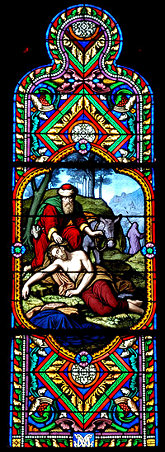
Seeing everybody as my neighbor means everybody. No exceptions. I’ll talk about the Samaritan one of these days, but not today. You’ll find that story in Luke 10:3037.

Reason and Love, Briefly

I don’t feel “loving” all that often. Happily, I don’t have to.

Feelings, emotions, are part of being human. But what counts is what I decide to do about them. (Catechism, 17621770)

Making rational decisions is easier when my emotions and reason are in sync, and that’s yet another topic. (Catechism, 1775)

Where was I? Twitter, post-election news, the Beatles. Right.

I think humanity is made in the image of the God. (Genesis 1:27; Catechism, 356361, 17011709)

Each of us is someone, not something; a person — able to reason, and decide how we act — and in these ways like God. (Catechism, 357, 17001706)

If I say that I love God, loving my neighbor — all my neighbors — seems reasonable.

Our track record for using our reason and freedom is far from perfect. (Catechism, 17071709)

And that’s yet again another topic:


1 Love God, love my neighbor, see everybody as my neighbor: it’s simple, but not easy. (Matthew 5:4344, 7:12, 22:3640; Mark 12:2831; Luke 6:31 10:2527, 2937; Catechism, 1789)

The principle of reciprocity we call the Golden Rule isn’t, quite, unique to Christianity, and that’s still another topic.

Posted in Being Catholic | Tagged , , , , | 7 Comments

Satan Didn’t Make Me Do It

Gustave Doré illustration for Canto XXXIV of Divine Comedy, Inferno, by Dante Alighieri; via Wikimedia Commons, used w/o permission.

Depending on who you listen to, Satan prowls Earth’s surface, lives in the White House, lurks in Hell, or doesn’t exist.

About Satan and devils in general, I think C. S. Lewis made a good point:

“…There are two equal and opposite errors into which our race can fall about the devils. One is to disbelieve in their existence. The other is to believe, and to feel an excessive and unhealthy interest in them. They themselves are equally pleased by both errors and hail a materialist or a magician with the same delight….”
(“The Screwtape Letters,” Preface, C. S. Lewis (1942))

I like most of Gustave Doré’s work. That’s his illustration for Canto XXXIV of Dante’sDivine Comedy,” Inferno.

Pictures, Symbols, and Reality

I also like some ‘religious’ art. But Bernhard Plockhorst’s “Guardian Angel,” and Bernini’s statue on the Ponte Sant’Angelo, don’t show angels the way they really are.

The first angels in Christian art we’ve found so far are in the Catacomb of Priscilla, in use from the late 2nd to the 4th century.

In art, they started looking like young men with wings. By the 19th century they looked like young women with wings.

They all look a bit like the Winged Victory of Samothrace and Nunut as shown on Tut’s pectoral plaque.

‘None of the above’ show what Satan or angels look like. No picture can. It’s a point René Magritte made in his “The Treachery of Images.” It is not a pipe. It’s a symbol, a realistic picture of a pipe. (July 17, 2016)

Angels are “spiritual, non-corporeal beings” with “intelligence and will,” persons who are as real as we are; but with no bodies. (Catechism of the Catholic Church, 328-336)

Our word for them, “angel,” comes from Old English engel and Old French angele.

Those languages got it from Late Latin angelus, “messenger;” and that comes from Late Greek ἄγγελος, ángelos. The word goes back at least to Mycenaean Linear B, where it’s pronounced a-ke-ro; or thereabouts.

“Angel” is their job. They’re messengers, agents, for God. By nature, they’re spirits. (Catechism, 329)

“Your Mind Couldn’t Grasp It”

Tissot’s “Abraham and the Three Angels” shows pretty much what Abraham saw: three men. (Genesis 18:2)

One of them was God. The other two show up a little later, in Genesis 19:1, they’re identified as angels, and that’s another topic.

As for why the Almighty looked like one of three men: I suspect part of the reason is what George Burn’s character said in “Oh, God!”

“I don’t like to brag, but if I appeared to you just as God—how I really am, what I really am—, your mind couldn’t grasp it.”
(God, in “Oh, God!” (1977) via Wikiquote)

More seriously — I think part of 1 Corinthians’ discussion of love says how well we see ‘big picture’ realities at this point:

“At present we see indistinctly, as in a mirror, but then face to face. At present I know partially; then I shall know fully, as I am fully known.”
(1 Corinthians 13:12)

Folks had mirrors when 1 Corinthians was written; dark pools of still water for most, mirrors made from metal, glass, or stone if they could afford it. Glass-coated mirrors were an emerging technology then.

Stone and metal mirrors were far from perfect. As a Wikipedia page put it, “…they often produced warped or blurred images….” And that’s yet another topic.

Getting a Grip About “Sin”

In my experience, folks can mean quite a few things when they say “sin.”

When I’ve got my head screwed on straight, I mean an act which offends reason, truth, and God. (Catechism, 1849-1851)

Having a good, or bad, feeling about something may mean that it’s good or evil: or not. Emotions are part of human nature. They’re not good or bad by themselves. What matters is what we do about them, how we use our reason and will. (Catechism, 1765-1770)

I try to avoid (self-)righteous outrage about whatever’s upsetting me at the moment.

When I succeed, it’s no great virtue. I’ve played Dungeons & Dragons, still enjoy rock music, became a Catholic, and that’s yet again another topic.

The point is that I’ve been on the receiving end of moral panic too often to assume it’s necessarily reasonable or justified.

Knowing history helps.

That picture, from Martyrs Mirror, shows a November 13, 1554 execution. Ursula Werdum and her sister Mary Beckum were killed for being Mennonites. There was a war going on at the time, with the usual tensions.

As I keep saying, I do not miss the ‘good old days.’ (November 6, 2016)

Free Will and Options

Satan is not God’s evil twin. God’s God, everything and everyone else is a created being. (Genesis 1:1; Catechism, 279, 285)

God is the Almighty, infinitely good, and “a mystery beyond words;” (Catechism, 230) beyond time and space, and “here” in all places and all times. I do not fully understand God. I cannot. (Catechism, 206, 230, 268, 284, 300, 385, 639, 647-648, 2779)

God created Satan and all demons, which brings me to the downside of free will.

I can decide what I do or don’t do. I can accept or refuse truth. That freedom includes responsibility for consequences of my decisions. (Catechism, 144, 150, 1730-1742)

As long as I am alive, I can change my mind: repent after I have refused truth or chosen a wrong action. After I’m dead, my options are limited. I can choose life with God, or — not. (Catechism, 393, 1021-1022)

I’m not sure what “repenting” virtue would be called. In my considered opinion, that’d be daft. But the choice is possible.

Satan Has Limits

John Martin's Pandemonium, 1841, Web Gallery of Art, via Wikimedia Commons, used w/o permission.

Satan and other demons are angels who said “no” to God’s will. The choice was/is theirs: willingly serve God, or willingly reject truth and their intended roles. Once they decided, their choice was irrevocable. (Catechism, 391-395, 414)

The problem isn’t “a defect in the infinite divine mercy.” It’s tied in with the nature of their existence.1 (Catechism, 393)

This should be obvious, but trying to make deals with or control demons is a very bad idea and we shouldn’t to it. (Catechism, 2116-2117)

Demons want us to get involved in their revolt against God. (Catechism, 414)

I don’t see a reason to oblige them, though.

Satan is powerful — but is only a creature, and has limits. “He cannot prevent the building up of God’s reign.” (Catechism, 394-395)

Flip Wilson made “the devil made me do it” a national catchphrase in the ’70s, but didn’t invent the idea. I mentioned Genesis 3:12 last week. (November 6, 2016)

The whole meltdown is in Genesis 3:1213. You know how it goes: Adam blames his wife and God, Eve blames the serpent, and we lose the lease to Eden.

Human nature hasn’t changed all that much, and we still try blaming others for our own faults. That’s probably what made Flip Wilson’s line so funny.

Psychological projection,2 conspiracy theories, and scapegoating; not so much. But I’ll leave that can of worms for another day.

More about faith, facts, and making sense:


1 St. John of Damascus, about Satan and demons:

2 Giambattista Vico apparently identified what we now call psychological projection in 1841, Ludwig Feuerbach said we made God in our image, and Sigmund Freud related projection to his psychoanalytic theory. That’s a vast oversimplification, and still another topic.

Posted in Being Catholic | Tagged , , , , , , , , | 4 Comments

Remembering Armistice Day

From Lx 121, via Wikimedia Commons, used w/o permission.

Today is Armistice Day. Over the decades it’s been called Poppy or Remembrance Day, and now Americans call it Veteran’s Day.

Some of the most sensible words I’ve read that apply to this holiday come from a comic strip character, and an American president:

“Y’know, it seems to be me this is all backwards….We, Ever’body, ought to keep our big mouths shut all the whole year long so’s we’d have time to think of two minutes worth of somethin. to say on the eleventh day of November.”
(Porky Pine, in Pogo; Walt Kelly (1953))

“Human nature will not change. In any future great national trial, compared to the men of this, we shall have as weak and as strong, as silly and as wise, as bad and as good.”
(Abraham Lincoln, Response to a serenade (November 10, 1864))

The day was originally named after the Armistice of 11 November 1918, signed at 11:00 a.m. Paris time: the 11th hour of the 11th day of the 11th month of 1918. We’ve endured quite a few wars after “the war to end all wars,” and that’s another topic:

Posted in Being a Citizen, Being Catholic | Tagged , , | 2 Comments