Navel-Gazing in August

Someone said “write what you know.” It was definitely Mark Twain, Ernest Hemingway, Nathan Englander, or somebody else.

I’ve mostly seen the quote applied to writing fiction.

Apparently some folks assume that it means authors should only write stories about events they’ve experienced. That may help explain why fantasy and science fiction stories aren’t taken seriously in some circles, entirely too seriously in others, and that’s another topic.

Others, including John Briggs, Diablo Cody/Brook Busey-Maurio and Jason Gots, say it means using the author’s emotional memories when telling stories. They’re professional writers, so I figure they know what they’re talking about.

Graveyard Shifts, Ephesians, and Family

I called that picture Desk Duty. If I wrote a story to go with it, using that title, knowing how night shifts feel would help.

I’ve never worked in a place like the one in Desk Duty. But some of my jobs were graveyard shifts with nothing but equipment for company.

Around the time our first child was born, I kept a manufacturing company’s mainframe company while most folks were sleeping. I had the building to myself, and little to do besides tend the printers, swap out data tapes, and push a few buttons. It was pretty much the opposite of exciting.

But I knew that the company’s operations, and keeping my job, depended on my actions. That helped me stay focused. So did knowing that my wife and newborn depended on my pay for food and shelter.

The keyboard I used was in a clerical area facing the hospital where they were staying. Both buildings were taller than most, so I could see my family’s temporary residence while at work.

Sometimes I’d stop by the hospital on my way home to see if those two were awake. I was a radio disk jockey the following year, on another graveyard shift.

The jobs were satisfactory. Working alone is, for me, pleasantly serene. More important, doing my tasks helped me fulfill my duties as a husband and father. That doesn’t mean I think the Bible says men should earn money by sitting at desks.

When men and women marry, we both have duties to each other and to our children. I’m not more, or less, important than my wife. (Proverbs 31:1031; Ephesians 5:2125; Colossians 3:1821; Catechism of the Catholic Church, 1645, 22212231)

Circadian Rhythms and Coal Gas

Our circadian rhythm takes time to settle into its adult pattern, so I had a chance to chat fairly often after that computer operator job.

Oddly enough, the human circadian rhythm may not be 24 hours long. Not when our bodies use internal ‘clocks’ instead of a day/night cycle to keep track of time.

Research I’ve read suggests that our natural rhythm is generally between 25 and 27 hours, with a statistical peak around 25 hours. There’s also a whole lot of individual differences, which doesn’t surprise me.

The NIGMS/National Institutes of Health has a pretty good Circadian Rhythms Factsheet. I think it’s at least as informative, and a great deal less hysterical, than some ‘street lighting and health’ news I’ve seen.

We’re learning that how much and when we sleep affects our health, and vice versa.

I’ve noticed that falling asleep is generally easier in a dark room, and that my blood sugar went down after I lined up my wake-sleep cycle with daylight.

The latter might be a coincidence, since I started walking a bit more around the same time.

But I don’t think humanity is doomed because we started replacing linkboys with street lights around 1800.

We’ve endured glacial periods, the Late Bronze Age Collapse, and Disco.

I don’t think street lamps even slowed us down. (August 4, 2017; August 4, 2017; June 2, 2017; May 26, 2017)

Folks felt safer with well-lit streets, except right after gas explosions. Maybe that helped justify the cost of installing electric lights like the Yablochkov candle.

Lately we’ve been learning that sodium lamps give the most light per power unit. Our eyes work better with ‘white light,’ so we’ll probably switch to LED lighting next.

I was going somewhere with this. Let me think. “Write what you know,” fantasy, family, circadian rhythms — not cicadas — street lighting. Right.

Eclectic Interests

This post started after I’d replied to a comment on Friday-before-last’s ‘Fukushima‘ post.

Someone wondered if I was an engineer. It was a good question, considering what I’d been saying about the Fukushima power plant’s astonishingly poor design.

I’m not an engineer, or a scientist.

By the time I’d finished doing time in academia, I’d picked up undergraduate degrees in history and English. Along the way I did a year of postgraduate library science, plus two years of computer science. General studies requirements and my eclectic interests led me to art history and a grab bag of other topics.

I’m fascinated by science, engineering, architecture, and related fields. But I’m much better at handling language than math, which affected my choices.

My interests are nowhere near narrow enough to encourage a conventional career. I may have glitchy neurochemistry to thank for that, but on the whole it’s been a good ride. I can’t complain. Not reasonably. (March 19, 2017)

Polymaths, folks recognized as experts in several fields, aren’t limited to the Renaissance. We don’t get many Leonardo da Vincis, but polymaths still happen. These days, at least, they seem to focus on one exceptional ability.

John von Neumann worked in many fields, all involving off-the-chart mathematical talents. Rabindranath Tagore used non-mathematical talents.

Arnold Schwarzenegger and Stephen Fry are following similarly-varied career paths. They’ve been called polymaths. I figure we’ll have a clearer picture in a century to two.

My assortment of jobs doesn’t make me a polymath. I’m arguably more like an intellectual jack of all trades. And that gets me back to “write what you know,” and my ‘science’ posts.

But first, some of my favorite lines of poetry from Tennyson’s “Ulysses:”

“…To follow knowledge, like a sinking star,
Beyond the utmost bound of human thought….”
(“Ulysses,” Tennyson (1833))

Alaric’s Tomb and Humanity’s Story

I take my family obligations seriously, so I won’t set off on a voyage of discovery.

Happily, I live in an era where a pretty good Internet connection and excellent research skills let me pursue knowledge from my desk.

Those skills, and a knack for writing, are what carried me through the history degree.

I wasn’t particularly good at the rote memorization needed for tests. Term papers and noticing connections were another matter.

I think it helped that I sympathized with instructors who read the things, and tried to make mine mildly entertaining as well as informative.

That’s not being “humble” in the self-depreciating sense. But creative talents and extreme language skills are part of the kit God gave me. Acknowledging that makes sense. My contribution was deciding to do something with them. (July 31, 2016)

I never quite lost my childhood interests in dinosaurs and space travel. I’ve added more over the decades.

A history professor’s History 101 class introduced me to humanity’s unfolding story. One of his talents was showing that history is more than a tiresome catalog of names and dates.

My favorite memory from his class is an account of Alaric’s burial.

He was the first Visigoth king, and led the Sack of Rome in 410.

The Roman capital was in Ravenna at the time, after a stopover in Mediolanum.

Alaric’s successful raid was politically significant for what was left of the Roman Empire, and an important part of Alaric’s plans for Italy. Those plans didn’t work out.

Odoacer ruled Italy and parts of the eastern Adriatic coast until Theodoric killed him. I’ve talked about those two, natural law, Charlemagne, and why I don’t miss the ‘good old days,’ before. (July 30, 2017; July 21, 2017; July 14, 2017; April 28, 2017)

Alaric died while his forces were still in Italy. That much is known. What’s more debatable is where and how he was buried.

His people’s customs required burial with the best of his treasures. Alaric’s forces didn’t want their leader’s tomb looted, obviously. They couldn’t transport his body home, and staying where they were to guard the site wasn’t an option.

The story is that they diverted the Busento river, buried Alaric in the temporarily-dry riverbed, and then returned the river to its normal course.

Documentation is apparently spotty, but whatever they did was very effective. We still don’t know exactly where Alaric’s tomb is.

Completely accurate or not, it is a good story. And that, for me, is what history is: a continuing story spanning millennia, with new chapters still being written. I very strongly suspect that some of the most interesting parts are still ahead.

I like stories as much as anyone else, and enjoy retelling them. That may not be quite what folks mean by “write what you know,” but I think it’s close.

I also enjoy sharing what I’m learning about the puzzles scientists are solving, and those they discover while finding answers to other questions.

A Sense of Wonder

I don’t have a scientist’s understanding of natural phenomena. That takes math skills I never developed.

But I do occasionally experience a sense of wonder at this amazing universe. I try sharing that, and my enthusiasm for our expanding knowledge.

I see faith as a willing and conscious embrace of “the whole truth that God has revealed.” (Catechism, 142150)

We can find truth in the natural world’s order and beauty. Appreciating this world’s wonders is a good idea. (Catechism, 32, 41, 74, 341, 2500)

I’m certainly not bothered that the universe is much larger and older than some imagined, a few centuries back. If anything that adds emphasis to these verses:

“When I see your heavens, the work of your fingers, the moon and stars that you set in place –
“What are humans that you are mindful of them, mere mortals that you care for them?
“Yet you have made them little less than a god, crowned them with glory and honor.”
(Psalms 8:46)

“Indeed, before you the whole universe is as a grain from a balance, or a drop of morning dew come down upon the earth.”
(Wisdom 11:21)

More posts, introspective and otherwise:

Posted in Being a Writer, Being Catholic, Creativity | Tagged , , , , , , | 4 Comments

A Mixed Bag

I picked a mix from ‘science news’ this week: tardigrade genes, fertility fears, and what is probably the world’s oldest living culture.

Folks in Western civilization have known about our neighbors in Australia for about four centuries.

Understanding their beliefs became easier, I think, when some of us realized that respecting them makes sense.


Understanding “Dreamtime”


(From Tourism NT, via Wikimedia Commons, used w/o permission.)

References to “dreamtime” in today’s popular culture may be less common than then they were in the 1970s. Or maybe television series I watched then were more likely than most to have a “dreamtime” episode.

I liked American entertainment media’s greater respect for other cultures. The less-than-accurate portrayals, not so much.

On the ‘up’ side, disconnects between what we’re learning about alcheringa and television-series “dreamtime” may help me understand distortions of Christianity. Paraphrasing something my father said, ‘never ascribe to malice what can be explained by ignorance.’

I haven’t dug into the history of our early mistranslations of alcheringa. Not deeply. Most of what I’ve learned is from a Wikipedia page, and one of its references.1

Apparently Western researchers heard the Arandan word alcheringa and its root, altjira.

When locals explained the concept, the Westerners figured they meant something like our words for dreams, imagination, or fantasy. Given that understanding, “Dreamtime” is a reasonable translation of alcheringa.

Since then, other researchers went back and learned more about alcheringa, the folks who use the word, and how they see the world.

We don’t, quite, have a widely-understood word in English for the ideas mis-translated as “Dreamtime.” It’s not dream or fantasy.

Folks who were living in Australia when Europeans showed up apparently saw alcheringa as “time out of time” or “everywhen.”

I use words like eternity for similar ideas. But they’re quite specific, and refer to how Catholics view realities we can’t see, taste, or touch. Or how we should view these realities. (Catechism of the Catholic Church, 202, 325327, 330, 771)

Some of us have a very imperfect knowledge of our faith.

I think it’s quite possible that translating alcheringa as “Dreamtime” happened partly because of what had been going on back in Europe. Acknowledging realities that aren’t strictly material was becoming unfashionable.

Assumptions

We’re not sure exactly when the first Europeans reached Australia.

Binot Paulmier de Gonneville said he landed somewhere “east of the Cape of Good Hope” in 1504. We’ve learned that he landed on the Brazilian coast, northwest of the Cape of Good Hope.

There’s been informed speculation, based on physical evidence, that someone from Portugal got there in the 1520s.

First documented contact with folks in Australia happened during Willem Janszoon’s expedition in 1606. It did not end well.

He was working for the Vereenigde Oostindische Compagnie, the Dutch East India Company. Janszoon’s report of contact with the Keerweer doesn’t match local accounts.2

That doesn’t surprise me.

The Keerweer remember a shipload of Europeans who asked permission to build a city. They agreed, and let the newcomers dig a well and build huts.

The newcomers seemed friendly. The Kerweer accepted tobacco, but not flour or soap. Then the outsiders attacked, killing many Kerweer.

Janszoon reported “savage, cruel black barbarians who slew some of our sailors.”

I don’t think folks on either side were lying. Not in the sense of deliberating saying something that’s not true.

My guess is that we’re looking at how each side perceived the events.

The lesson, I think, is not that Europeans are killers and shouldn’t be trusted. Or that Kerweer are cruel. Not more so than folks anywhere.

I think learning how folks from other cultures live and think, and how they perceive our actions, is a really good idea. Preferably before someone makes a lethal mistake.

Back to “Dreamtime.”

The Janszoon fiasco happened in 1606.

Baldwin Spencer Gillen mentioned the Alcheringa in 1896.

In 1899 he published “Native Tribes of Central Australia.” He described the Alcheringa as a time in the distant past. Five years later Europeans were calling it “the dream times.”

As I said earlier, I haven’t dug deeply into why Baldwin Spencer Gillen translated Alcheringa as “a time in the distant past.” I also don’t know how or why that morphed into “the dream times.”

I think Western civilization’s changing view of — and attitudes toward — spiritual realities was an important factor.

The Enlightenment began more two centuries before Gillen wrote his “Native Tribes” book. Europeans were re-thinking old assumptions about authority and belief.

I think that was, and is, a good idea. Some Enlightenment ideas were, I think, less than prudent. (June 2, 2017; November 6, 2016)

My guess is that by the mid-19th century, quite a few educated Europeans simply didn’t realize, or want to admit, that non-physical realities are possible.

And that spiritual realities aren’t a sort of fantasy. I’ll admit that of some today’s notions about ‘being spiritual’ are quite silly, and that’s another topic.

I see the Enlightenment as a response to decades of destruction, disease, and death.

Propaganda and Perceptions

The Thirty Years’ War ran from 1618 to 1648. There was probably some religious motivation, at least in the earlier conflicts.

I see it mainly as a turf war between northern and southern European leaders.

Northern bosses wanted a bigger piece of global trade.

Southern bosses, understandably, liked the status quo: where much of the trade went through their ports.

All sides took advantage of religious sentiments and the Reformation in their propaganda. Europe’s leaders finally ran out of cannon fodder and useful targets around 1648. Those reasons for calling a halt to Europe’s self-destruction is my admittedly-biased view of their decisions and actions.

Upwards of 7,500,000 folks were dead by then. Some were killed in the fighting; many others in famines, disease, and witch hunts sparked by the war.

After decades of ‘God is on our side’ propaganda, it’s no wonder that some survivors assumed that religion had caused the war.

Some also felt that it was time to stop believing leaders, and start thinking. Louis XIV’s later spin on the divine right of kings didn’t help.

I don’t think any one thing caused the Enlightenment. But I think propaganda from the Thirty Years’ War helped many see religion as harmful and unreasonable. (July 14, 2017)

I don’t see religion as a threat. That’s partly because I’m a Christian, and partly because I learned the difference between propaganda and facts. Folks who seem convinced that God belongs to their social club or political party? They can be trouble.

I don’t miss the rabid mix of jingoism and cultural preferences on ‘Christian radio’ in the 1960s. Looking at the lasting popularity of John Lennon’s “Imagine,” I’m guessing that others felt the same way. And still do. (July 4, 2017; November 15, 2016)


1. Tiny Tough Tardigrades


(From SPL, via BBC News, used w/o permission.)

Secrets of the world’s toughest creatures revealed
Sarah Gabbott, BBC News (July 28, 2017)

Genetic analyses of tardigrades has revealed some of the secrets of their incredible survival abilities.

“These tiny creatures, sometimes called water bears, can survive radiation, freezing, extreme dehydration and even the vacuum of space.

“Researchers have now decoded the DNA of two species of tardigrade and uncovered the genes that allow them to be revived after desiccation….”

As Sarah Gabbott’s lead paragraph said, scientists found some previously-unknown explanations for tardigrade durability. There’s a whole lot about these tiny animals we still don’t understand.

We’re also closer to learning how closely they’re related to insects. My guess is that the question isn’t settled yet. If anything, what scientists are finding seems more likely to heat up the debate. For now.

But I’m reasonably sure that new data will I let us find answers. And new questions.

Despite their appearance, they’re more like nematodes than insects or spiders, genetically. Tardigrades, that is, not the scientists.

One clue in where tardigrades fit into our classifications of critters is in their hox genes. Those genes control how a critter develops along its head-to-tail axis. Even animals without heads or tails in their adult form, like starfish, have them.3

Hox genes don’t change much as critters evolve. All insects, for example, have eight hox genes. Most animals have somewhere around ten.

Nematodes have five, and so do tardigrades. That strongly suggests that tardigrades are more like nematodes than insects. If that’s so, tardigrades are still protostomes: critters like arthropods, molluscs, and rotifera.

Humans are deutersomes; along with other vertebrates and similar critters, echinoderms, and hemichordes. Acorn worms are hemichordes, too, and none of this makes much difference unless you’re a scientist or science geek.4

It’s in the Genes

Tardigrades will survive in a vacuum or pressure upwards of 1,000 time Earth’s sea-level air pressure, high or low temperatures, radiation that’d kill another animal, and dehydration.

Their radiation resistance is probably due to DNA that’s unusually good at self-repair.

These scientists say their resistance to dehydration is genetic, too.

When a tardigrade loses enough water, its genes start producing proteins that replace the missing water in its cells. The proteins won’t do what water does in the cells, but they will keep the cells and the tardigrade alive for a long time.

A dormant but living tardigrade can’t eat or drink. But that won’t keep water from seeping into it. When the tardigrade gets sufficiently soggy, the proteins dissolve and the critter will be more obviously ‘alive’ again.


2. Sperm Count Decline


(From Juergen Berger/Science Photo Library, via BBC News, used w/o permission.)

Sperm count drop ‘could make humans extinct’
Pallab Ghosh, BBC News (July 25, 2017)

Humans could become extinct if sperm counts in men continue to fall at current rates, a doctor has warned.

“Researchers assessing the results of nearly 200 studies say sperm counts among men from North America, Europe, Australia, and New Zealand, seem to have halved in less than 40 years….”

In a way, this research is a bit like the work of historians. Instead of performing their own experiments or observing phenomena, this team used statistical analysis to sift through the results of research done by other scientists.

The new and improved word for research like this is meta-analysis. It was coined recently by statistician Gene V. Glass — or maybe someone else. I eventually stopped trying to dig back to the term’s origin. I learned a few things along the way, though.

Meta-analysis is a new term, but the idea goes back at least to 17th century. That’s when Blaise Pascal’s recently-developed statistical math gave scientists a tool to sift through data and analysis by other scientists.

Pascal’s statistics had started in correspondence with some friends, who developed a way to predict how games of chance would end.

It’s anyone’s guess what Pascal would have done for mathematics if he hadn’t had a religious conversion around 1654. He pretty well gave up on math after that. But not entirely. He became a Jansenist.

That’s a sort of Catholic splinter group that started in the mid-1600s. Their beliefs sound a lot like Calvinism. Jansenism was a big hit for a while.

I gather that they were very into guilt and humanity’s alleged total depravity.5 Focusing on sin and humanity’s ickyness still appeals to some folks. I’m not sure why.

We Can Deal With This

I take this research, and infertility, seriously. I’m also interested in an issue that apparently affects the area I live in: North America.

I’d be more concerned if humanity was an endangered species found only in Europe, Australia, New Zealand, and North America. We’re not.

For one thing, humans don’t have the giant panda’s limited range, diet, or 36-hours-per-year reproductive window.

We’re opportunistic omnivores living on very continent except Antarctica.6

That’s our current range. We’ve recently built year-round research bases in Antarctica, and one in low Earth orbit. We’re developing tech for settlements on Mars. (June 9, 2017)

I suspect we’re more like scorpions and cockroaches than Tasmanian devils in terms of our prospects for long-term survival. (February 17, 2017; September 30, 2016)

Individuals and families can have problems, though. So do a significant fraction of men in Western Civilization. Maybe.

These researchers say they took factors like selection bias into account. Pallab Ghosh apparently found other scientists who’d read the paper, and thought differently.

My guess is that researchers would have to be very thorough indeed to figure out average fertility, based on research that often focused on folks seeking help with infertility.

On the other hand, maybe more folks in the English-speaking world aren’t able to have kids these days. If so, it’s an issue we can probably deal with. We’ve been learning a great deal about how the human body is supposed to work, and how we can improve health.

Getting healthier won’t be easy, I think. Americans have gotten used to living like kings: particularly England’s Henry VIII.

“The King’s Great Matter”

Henry VIII went through several wives and mistresses. He eventually had at least one illegitimate son and a male heir.

The King’s great matter” didn’t always end with an execution and remarriage.

Henry VIII annulled his marriages to Catherine of Aragon and Anne of Cleves.

Anne Boleyn, wife #2, was convicted of adultery and incest. Possibly to make room for #3. Either way, she lost her head.

Jane Seymour, Henry’s third wife, died of an infection, about 10 days after giving birth to England’s next king.

Childbirth in civilized countries got a great deal less dangerous after doctors started washing their hands. And that’s yet another topic. (October 30, 2016)

Maybe Henry didn’t realize that Edward would survive. Or didn’t want to take the risk.

Whatever his motives, he remarried. Catherine Howard was convicted and executed for adultery. He didn’t like Anne of Cleves, who kept her head. Catherine Parr outlived him.

Charges against Anne Boleyn and Catherine Howard may or may not have been true.

Henry’s own behavior wasn’t exactly monogamous. But he was king and this was England, so that wasn’t an issue. Not legally. Not at the time.

He did acknowledge that Elizabeth Blount’s son Henry FitzRoy was his. How many other children he had that weren’t on the official record may eventually be traced through genetic analysis. Or not.

Henry VIII’s obesity and fevers almost certainly killed him when he was 55. What other diseases, genetic and acquired, he may have had is an ongoing debate.

Logical Consequences

Quite a few diseases and genetic disorders can leave folks with fertility issues.

Sometimes, in about 20% of cases where American couples start getting medical help, we simply don’t know why they can’t have children.

An old-school explanation might have been that they’d offended one of the spirits.

A more recent notion, that a vengeful God is smiting them for something they or an ancestor had done, isn’t much of an improvement.

I see it as the old ‘offending a fairy’ explanation with a Christian paint job.

Some sexually transmitted diseases hurt a person’s chances of having kids. But so do other infections, diabetes, genetic glitches, and some toxins.

Some of my health problems are self-inflicted, but God isn’t smiting me. I’m experiencing logical consequences of illogical acts. They’re “temporal punishments,” and helpful if I use good sense. (Catechism, 1472, 1863, 1964)

I commit a sin when I do something stupid, and know that it’s stupid when I do it. Sin is an offense against reason and truth: and God. (Catechism, 18491851)

My obesity and, most likely, diabetes, are the logical consequences of illogical acts. I don’t know why Henry VIII got so fat.

In my case, obesity is a pretty obvious result of my gluttony. I finally admitted that, and am working at reversing consequences of my disordered behavior. (June 18, 2017)

Don’t Panic


(From Albert duce, via Wikimedia Commons, used w/o permission.)
(What’s left of the Packard factory in Detroit. (2009))

If what’s happening today doesn’t change, parts of America will be depopulated.

But don’t panic. Change happens. That’s not just my opinion.

“Everything changes and nothing stands still.”
(Heraclitus (c. 535 BC-475 BC))

“The universe is transformation: life is opinion.”
(“Meditations,” Book IV, Marcus Aurelius (c. 161-180 AD))

“There is an appointed time for everything,
and a time for every affair under the heavens.”
(Ecclesiastes 3:1 (c. 5th-2nd century BC))

Population of the Great Plains, for example, started dropping around 1900. That’s just west of where I live.

Folks in North America’s vast prairies and grasslands aren’t facing extinction.

We’re human, and have been doing what humans often do: moving somewhere else.

Families and individuals had different reasons for moving: crop failures during the Dust Bowl, not enough customers to keep the gas station open, better jobs elsewhere.

Pretty much the same thing has been happening in some American cities over the last half-century, particularly in the Rust Belt.

I figure that’ll change too, even if Fernando Palazuelo’s plans don’t work out. He’s the Peruvian developer who bought what had been the Packard factory. The last I heard, cleanup will start there in August of this year.

I trust that whoever rebuilds America’s partially-depopulated cities will successfully decontaminate the sites. Places like the Packard plant were in operation for a long time before we started getting smart about environmental damage.

I’m pretty sure toxins in the soil, water, and air aren’t our only problem.

The typical American diet and lifestyle isn’t particularly healthy.7 Many folks here have picked up Henry VIII’s habits.

His disinclination to eat enough fruits and vegetables probably wasn’t the only cause of his heath issues, but it wouldn’t have helped. And that’s yet again another topic. Topics.


3. Australia’s First Settlers


(From Dominic O Brien/Gundjeihmi Aboriginal Corporation, via BBC News, used w/o permission.)
(“The discovery was made in a rock shelter in the Northern Territory”
(BBC News))

Australia human history ‘rewritten by rock find’
BBC News (July 20, 2017)

Archaeologists have found the first evidence to suggest that Aboriginal people have been in Australia for at least 65,000 years.

“The discovery indicates their arrival on the continent was up to 18,000 years earlier than previously thought.

“It was made after sophisticated artefacts were excavated from a rock shelter in the Northern Territory.

“Researchers unearthed what they say are the world’s oldest stone axes and ochre crayons, thought to be used for art….”

One sentence in this article speaks volumes about a very long-overdue change in Western civilization’s view of folks whose ancestors weren’t living in Europe:

“…Australian Aborigines are believed to be the world’s oldest continuous civilisation….”
(“BBC News)

I’m not, however, sure that “civilization,” is quite the right word for the culture of folks like the Anangu, Awabakal and Yamatji.

As far as I know, our neighbors in Australia never got around to building cities. Not on the scale of what we’ve done in Africa, western and eastern Eurasia, and the Americas.

“Civilization” is my language’s word for a culture with urban development, symbolic communication, some control over the environment, and different levels of status.

Since urban development is part of our definition of civilization, I’m not sure that’s quite the right word to describe what they have.

But respect for cultures that aren’t European or rooted in European traditions is a nice change of pace.

Civilization

We got “civilization” — the word, not being civilized — from 16th-century French civilisé, “civilized.”

That’s from Latin civilis. It’s related to civis, “citizen;” and civitas, “city.”

My language doesn’t seem to have a commonly-understood word meaning “having a rich cultural heritage but not urban development.”

Maybe we’ll expand “civilization’s” definition. I think the term could be refined a bit.

Some “civilized” traits, like control over the environment and social strata, seem like part of being human.

In a way, it’s what folks at different levels wear and use that make social strata “civilized.” I’ve read that ceremonial scepters and maces started out as practical weapons.

Maces were among the most powerful general-purpose weapons, and one of the few effective against armor.8

In the ‘good old days,’ when folks were rebuilding after Roman times, holding a mace would be a good way of reminding folks who was boss. Also, I suspect, sometimes useful for restoring order to an unruly meeting.

If we have to rebuild again, rulers of a following era might hold something recognizable as a decorative and impractical machine gun.

On the whole, I think developing an alternative to the old empire-collapse-rebuild cycle is a better option. (May 28, 2017)

Being Human

I have trouble imagining a group where everyone has the same role and status. Not unless we organized ourselves that way.

Good grief, we’ve been learning that chimps and other primates have hierarchies. So do other social animals.

Social animals? I’d better explain that.

I’m a human, a primate, and an animal. I have more in common, physically, with a chimp or orangutan — or a fish — than a fungus.

Because I’m human, I could reject that knowledge. But being offended by God’s work doesn’t make sense. Not to me. Neither does ignoring reality. (July 23, 2017; May 19, 2017; September 23, 2016)

Strictly-accurate or not, calling folks with a very different heritage “civilized” seems a whole lot better than some older attitudes. (August 26, 2016)

My branch of humanity’s huge family is famous, or notorious, for developing new technology and learning how to handle it safely later.

We’ve also tried quite a few different forms of government while Japan kept the same imperial dynasty. (July 24, 2016)

Whether we’re seen as innovative or unstable depends, I think, on a person’s attitudes toward change. I see change as occasionally uncomfortable, and a whole lot of fun. Technophilia runs in the family, which may affect my outlook.

Either way, I won’t say that our culture makes us better or worse than other folks. It’s not just my ’60s roots showing.

Seeing humanity as a huge and diverse family is part of being Catholic. Or should be. So is reasoned respect for everyone. (Genesis 10:132; Catechism, 19291933, 22842301; “Gaudium et spes,” Blessed Pope Paul VI (December 7, 1965))

I take the Bible seriously, and think acting as if love matters makes sense. But I don’t think an American wrote Genesis. (July 23, 2017; May 7, 2017; February 1, 2017)

Technology


(From Chris Clarkson, via BBC News, used w/o permission.)
(“Ground-edge stone axes were unearthed during the excavation”
(BBC News))

We’ve been making and using stone tools for at least 2,600,000 years. I strongly suspect that some current kitchen utensils, like the mezzaluna, are the latest version of Oldowan choppers; the most recent of a long succession of upgrades. (June 16, 2017; May 19, 2017; May 5, 2017)

Clarifying the BBC News article’s mention of “…the world’s oldest stone axes and ochre crayons, thought to be used for art….” — “oldest” refers to the ochre crayons.9

The stone tools are comparatively recent models. Folks in Australia likely enough learned about the tech through trade with other cultures. (June 16, 2017)

The paper talks about “…elaborate lithic technology, ochre ‘crayons’ and other pigments—including one of the oldest known examples in the world of the use of reflective (micaceous) pigment….”

Ancestors of today’s older Australian families may have learned about ochre pigments through trade. Or we may learn that the rest of us learned about that creative tech from them. Either way, there’s a great deal left to learn about these folks. And all of us.

Our Changing Home


(From Ray, N. and J. M. Adams/Internet Archaeology 11; via Wikimedia Commons)

Earth was not always as we know it today. Some changes, minor ones, have happened during my life.

A habit of enjoying wherever I am at the moment let me notice progressive changes in what was a lake during my youth. (July 2, 2017)

The lake is in Minnesota, on a route I’ve traveled at intervals over the last half-century. It’s now a pond or two in a meadow. The meadow could be a marsh. We have an abundance of both in Minnesota. Sometimes a meadow will be waterlogged one year, dry the next.

My schedule, customs, and a fence, kept me about a quarter-mile from the pond that had been a lake. I am quite sure that the lake has been filling in: which is not a crisis. That’s what happens to lakes.

We had droughts in North America during the 1980s. That was almost a crisis: a temporary one. Minnesota is not becoming a desert. We’ve also had years with a regrettable overabundance of rain.

Oddly enough, my language doesn’t have a common word for periods when fields stay wet. The idea is often expressed with phrases including “water” or “flood.” Minnesota’s weather is not boring, and that’s still another topic.

Or maybe not. I grew up in Moorhead, across the river from Fargo, North Dakota. That town, now a small city, is on remarkably flat land. The area was at the bottom of Lake Agassiz several millennia back. Its farmland these days.

Lake Agassiz was gone by the time my ancestors arrived. Today’s lakes Winnipeg and Manitoba will most likely disappear, too. Eventually.

Lake Agassiz formed during the current ice age’s most recent glacial period.

I don’t remember reading any claims that our remote ancestors are to blame for the Quaternary glaciation.

That’s almost surprising, since we passed a developmental milestone around that point.10

Humanity’s current model showed up more recently. We probably started moving out of our homeland about 200,000 years back.

My ancestors, most of them, headed generally north and west. Other folks moved east, eventually reaching Australia.

Australia’s interior wasn’t particularly hospitable at the time. But these folks found tropical grasslands where the Arafura Sea and Gulf of Carpentaria are now. Like I said, Earth was not always as we know it today.

Settlement and Seasickness

Genetic analysis is a new tool letting us trace humanity’s family history. It’s giving scientists a better picture of how folks settled Australia.

The first explorers and settlers moved along Australia’s coastal lands quite quickly.

Some of them apparently liked parts of the newly-found land a lot, and settled in.

Their descendants, for the most part, stayed close to the originally settled areas. Their love of the land is apparently a long tradition.

My guess is that there’s a great deal more to learn about the Australian branch of our family tree. And ours. There’s already an interesting debate about exactly how old the recently-discovered stone tools are.

My recorded family history runs back a few centuries, and is nowhere near as stable.

Each ancestral root made one long trip across the Atlantic, followed by several intermediate stops before settling for the last several decades in central North America.

Access to contemporary transportation tech made the transatlantic jump practical. Economic hardship, religious suppression, and — in one case — helping a friend were obvious motives.

We may eventually learn that different parts of humanity’s family have different degrees of wanderlust. Serious studies of such things must most likely wait until my civilization gets over the ersatz science of a recent era.11

I have seasickness to thank for my existence. Someone in my father’s family didn’t plan on staying in the new country. She’d come over to keep someone company, got violently seasick, and wouldn’t risk a return trip. And that’s — another topic

More, mostly how I see life, love, and being human:


1 Dreamtime and Australia’s oldest families:

2 How not to open diplomatic relations:

3 More than you probably need to know about:

4 Even more superfluous information:

5 Pascal, meta-analysis, and being human:

6 Research and why I’m not in a panic:

7 Packard’s fate is not humanity’s:

8 Regalia and blunt instruments:

9 Interesting, if you like this sort of thing:

  • Human occupation of northern Australia by 65,000 years ago
    Chris Clarkson, Zenobia Jacobs, Ben Marwick, Richard Fullagar, Lynley Wallis, Mike Smith, Richard G. Roberts, Elspeth Hayes, Kelsey Lowe, Xavier Carah, S. Anna Florin, Jessica McNeil, Delyth Cox, Lee J. Arnold, Quan Hua, Jillian Huntley, Helen E. A. Brand, Tiina Manne, Andrew Fairbairn, James Shulmeister, Lindsey Lyle, Makiah Salinas, Mara Page, Kate Connell, Gayoung Park, Kasih Norman, Tessa Murphy, Colin Pardoe; Nature (July 20, 2017)

10 Tools, a brain gene and an ice age:

11 Science, bogus and otherwise; bulldogs, and a little family history:

Posted in Science News | Tagged , , , , , , , , , , | 4 Comments

Dealing With Cystic Fibrosis

A “Benefit for Teri (Sanden) Starkey” notice was on the Our Lady of Angels bulletin board this Sunday.

The event was Saturday, July 29, and in Litchfield; a town south and a bit east of here, about an hour and half away.

I saw the notice a day late to do anything by Saturday, but figure I could pass along what I learned.

She has cystic fibrosis, and needs new lungs. The clinic in her area wouldn’t or couldn’t do the procedure.

The good news is that an outfit in North Carolina will. However, getting a chance to keep her alive means raising money to move her to North Carolina, plus her two kids and husband. That’s something like a thousand miles away.

My guess is that the family has above-average medical expenses, too.

That’s pretty much all I know. A little additional information clipped to the notice helped me find these links:

I didn’t know about the Lungs4Life Foundation before today, and haven’t learned anything more than what’s on part of their website. It looks like a good idea, though. No pressure.

Cystic Fibrosis

Cystic fibrosis doesn’t kill folks, not exactly. Folks affected by it often die from infections or other trouble in their lungs.

It’s a genetic glitch that probably showed up about five millennia back.

Scientists started noticing connections between not-obviously-related disorders and deaths in the 19th century.

Dorothy Hasine Anderson put the pieces together and described it in 1938.

We can’t cure cystic fibrosis yet. There’s some promising gene therapy research in progress, but that won’t help folks who need new lungs now.1 Happily, we’ve been getting better at organ transplants. It’s not ‘just routine,’ though.

“Risky Double Lung Transplant” in the News


(From AlexiusHoratius, via Wikimedia Commons, used w/o permission.)
(Delano, Minnesota.)

Minnesota woman moving to North Carolina for risky double lung transplant
Paul Blume, KMSP/Fox9 News (July 4, 2017)

“A Delano, Minnesota woman with cystic fibrosis is fighting for her life. And with options running out, she’s set to move her family more than 1,000 miles.

“Teri Starkey needs a double lung transplant, and if that’s not risky enough, she has a condition that could attack the new organs.

“‘It’s like when you have the flu,’ Teri said. ‘You are knocked out for a week, and you think you are dying. That’s a good portion of my life.’…”

Transplanted lungs or other organs will be affected by biochemical effects of the defective gene in other parts of the body.

But a transplant can give folks with cystic fibrosis, like Teri, a few more years of life.

I see that as a good idea. (July 21, 2017; March 31, 2017; February 24, 2017)

Life and health are both gifts from God. Taking good care of them is a good idea, within reason. Making either my highest goal would not. (Catechism of the Catholic Church, 2288, 2289)

Organ transplants are ‘within reason,’ if expected benefits outweigh the risks. We’re told that donating organs after death “…is a noble and meritorious act…” We’re also told that killing someone and breaking them down for parts is a bad idea, and we shouldn’t do it. (Catechism, 2296)

That makes sense to me.

Other ‘health’ posts:


1 More:

Posted in Being Catholic | Tagged , , , | 5 Comments

Infallibility?

The “most disturbing image” gag in Wiley Miller’s Non Sequitur comic depends on a fairly common misunderstanding of Catholic belief. The important word in that sentence is misunderstanding. Papal infallibility doesn’t mean that.

I’m none too pleased that Catholic beliefs are misunderstood by non-Catholics: and by some Catholics. But I can’t fault a cartoonist for poking fun at cultural quirks I see as silly. Not reasonably.

Besides, strips featuring the Church of Danae’s “so-called holy scriptures” have given me pretty good illustrations of what I don’t believe. (March 31, 2017)

The Magisterium

A few of the world’s Catholics may believe that a pope is infallible about everything: that popes can’t ever make mistakes.

Like I said, some of us don’t know or remember what we’ve been taught.

Infallibility isn’t limited to popes. It’s a characteristic of the Church. (Catechism of the Catholic Church, 889)

I could stop right there, but that’d be a bad idea.

We’re also told that not everything the Magisterium does is infallible. Although when the Magisterium clarifies some aspect of our faith, I’m obliged to take it seriously. (Catechism, 892)

“Magisterium” isn’t a fancy word for “Pope.” It’s the position of authority held by the Church. The Magisterium’s job is explaining the Bible and Tradition — capital “T.” (Catechism, 85, 890, 2033)

I take Tradition very seriously. I must, if I’m going to be a Catholic. That’s not even close to trying to live as if 1954 never happened. (June 18, 2017; June 4, 2017)

Where was I? Comics, infallibility, the Magisterium. Right.

Terms and Conditions

Infallibility is strictly limited to a particular sort of formal declaration.

It applies when the Pope, acting as the Pope, officially declares a doctrine of faith or morals “by definitive act.” (Code of Canon Law, Book III, 749 §1)

“Morals” in this case isn’t limited to the zipper issues you see in tabloids. It’s pretty much the same as “ethics.”

The College of Bishops can do the same sort of thing, with similar requirements.

When they declare a “doctrine of faith or morals is to be held definitively,” it’s infallible. (Code of Canon Law, Book III, 749 §2)

That happens when they exercise the Magisterium in an ecumenical council, working with the Pope. After that, the doctrine applies to everyone in the Church. All those conditions must be obviously met. (Code of Canon Law, Book III, 749 §2, 749 §3)

The idea of papal infallibility is old, even by Catholic standards. As a dogma it’s a fairly recent development. The First Vatican Council defined it in “Pastor Aeternus,” issued July 18, 1870. Predictably, some folks didn’t like it.1

I had an interesting discussion with a Catholic who seemed convinced that the Church hadn’t been really “Catholic” since the Council of Trent.

He had a firm grasp of some historical details. That, I appreciate. His assumption that we went wrong around the time Elizabeth Tudor got sprung from the Tower of London? I am quite sure he was mistaken.

My guess is that a few Catholics will have similar attitudes about post-1870 developments during the mid-25th century.

I get the impression that ‘the Pope isn’t Catholic’ folks are also upset each time they hear that Canon Law has changed.

I’m not, but that’s no great virtue.

Long before I became a Catholic, I knew that ad hoc rules aren’t the same as unchanging ethical principles.

I don’t expect rules that worked in the 1st or 11th centuries to be practical in the 21st or 41st. (July 14, 2017; February 5, 2017; June 4, 2017)

Judging from the nitpicking I occasionally see, some folks won’t think the conditions for infallibility are met unless the Pope starts agreeing with them.

“Divine Assistance”

Rules like the Code of Canon Law are important, and serve to define how the Catholic Church works.

But I don’t think any set of rules could keep humans from mismanaging an organization into oblivion, given time.

We’ve had two millennia, and ample opportunities, to do just that.

But the Church has endured major social, political, and economic upheavals — including the Roman Empire’s dissolution and Renaissance.

Human institutions don’t do that.

After two millennia of wildly improbable survival, I’m inclined to believe what the Church says about what keeps us going.

We’ve had help. (June 4, 2017)

“Divine assistance” is what holds up the Church. It’s also what makes papal infallibility work. (Catechism, 888-892)

That’s an extreme claim. But it explains how the Church survived Popes like Benedict IX. I’ll get back to him.

The terms we use to describe this assistance have changed over the millennia. But we’ve known we wouldn’t be on our own ever since our Lord left. Before, actually. (Matthew 28:1820; John 14:1518)

Reasoned Obedience

The notion that we blindly do whatever the Pope says may be a root of papaphobia. It’s a real word.

I probably wouldn’t have become a Catholic if it meant unthinking conformity. Happily, that’s not required: or recommended.

Obedience to legitimate authority, including the Pope’s, is part of my faith.

Turning my brain off isn’t. (Catechism, 1778, 1951, 2217)

Faith and reason should get along. (Catechism, 35, 154-159)

The Catholic version of faith is a willing and reasoned obedience to God’s will. (Catechism, 143-152)

Our number one role model for this obedience is Mary. (Catechism, 148-149)

She was obedient, and asked a reasonable question. Zachariah, not so much. And that’s yet another topic. (December 18, 2016)

I’ll grant that much of the Catechism’s discussion of obedience and using our brains deals with everyday examples: like children and parents, citizens and secular authorities.

My guess is that for most Catholics, those are generally the situations where we have to think about whether rules make sense.

Between living in an era that’s far from serene, and growing up as a non-Catholic in a very non-Catholic culture, I’ve had to think about what Popes say pretty often.

But when I hear or read that the Pope said something that doesn’t make obvious sense, my first impulse is not to assume I’m right and the Pope must be wrong.

Instead, I start learning what the Pope actually said and how it relates to faith and my life. And that’s yet again another topic.

Perfect Popes? No Such Thing

Some Popes are recognized Saints, including two in the 20th century. Some were pretty much the opposite.

My favorite ‘poster child’ for appalling Papal role models is Benedict IX.

Nothing wrong with the name “Benedict,” by the way. The first Pope Benedict lived about a half-millennium before number nine. We’re up to Benedict XVI now.

We don’t know much about Benedict I. Being Pope after Theodoric’s successors lost the Gothic War may explain that.

The Goths and their Ostrogothic Kingdom had been maintaining a semblance of order in Italy and lands east of the Adriatic. Italy was a mess after the war. The other side didn’t exactly win, either. Those were interesting times. (April 28, 2017)

Anyway, Benedict IX was pope three times between October 1032 and July 1048. He was kicked out twice, and sold the papacy once. Maybe.

The sale isn’t well-documented, for obvious reasons. Even during the worst of our rough patches, and we’ve had some doozies, I don’t think anybody would want a receipt for that.

About 28 years and a half-dozen Popes after Benedict IX, we got Pope Gregory VII and the Gregorian Reform.2

My guess is that the Gregorian Reform upset some folks as much as Vatican II did. Does.

Living in an era of good and occasionally-Saintly popes helped me take the Church seriously. But I didn’t join because I liked the good popes.

Oddly enough, it was the monumentally bad Popes who helped convince me that our “divine assistance” was real. That wasn’t my only reason for conversion.

I decided to become a Catholic, grudgingly, after finding the Church’s logic impeccable: and learning who held the authority our Lord gave Peter. At that point, I had a choice: but only one viable option.

It’s like Simon Peter said in John 6:68: “to whom shall we go?”

Part of my take on authority, obedience, and building a civilization of love:


1 Councils, rules, and a few documents:

2 A few successors to Peter, and a little history:

Posted in Being Catholic | Tagged , , , , , | 3 Comments

Fukushima, Six Years Later

The Fukushima Daiichi nuclear disaster could have been much worse. But it may have been avoidable.

Meltdowns and non-nuclear explosions at the power plant didn’t directly kill anyone.

More than 40 patients who were evacuated from a nearby hospital died later. They had been critically ill. Getting rushed away from a nuclear incident in progress wouldn’t have been good for their health.

Three former power company executives now face criminal charges.

The earthquake, tsunami, and meltdowns in 2011 killed nearly 16,000 folks and left many others homeless. Many folks still can’t return to their homes. Quakes happen. This one was nobody’s fault.

What happened in Fukushima is another matter. I’ll be looking at the disaster, what’s happened since, and why questioning authority can be a good idea.


Earthquake and Tsunami: March 2011

Earth’s mantle is sinking near Japan’s east coast, pulling part of the crust under the Okhotsk Plate. But not smoothly.

On Friday, March 11, 2011, about 32 kilometers below the surface, Earth’s crust moved abruptly.

About 31 seconds later, the Japan Meteorological Agency’s detectors had sensed the event and broadcast warnings to several million folks. That probably saved many lives.

Japan is now up to 2.4 meters, 7 feet 10 inches, closer to North America.

The 2011 Tōhoku earthquake and tsunami destroyed about 45,700 buildings and damaged about 144,300 more.

It’s stronger than any other recorded in Japan during the last 16 centuries, and the fourth strongest recorded anywhere on Earth since 1900.1

Tsunami: Over the Wall and Into the Generator Room

(From Shigeru23, via Wikimedia Commons, used w/o permission.)
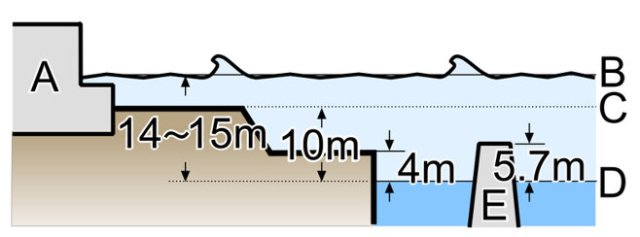
(Diagram of the #1 Fukushima reactor building and seawall. A – Plant building, B – Tsunami’s peak height, C – Ground level of site, D – Average sea level.)

TEPCO’s Fukushima Daiichi Nuclear Power Plant is the famous, or infamous, one.

The crew of its sister plant, Fukushima Daini, were what my culture calls ‘lucky.’ Most of them. One person, trapped at a console during the quake, died later.

The tsunami flooded Fukushima Daini’s standby generators, too. The 2,000 folks working there still had one remaining high-voltage power line connecting the plant to Japan’s power grid. That kept the plant’s control systems online.

Part of the crew remained at the plant while others assembled a nine-kilometer emergency power connection. Each 200-meter section of cable weighed over a ton.2

Meanwhile, folks at the Daiichi facility were dealing with their own disaster.

The Fukushima Reactors 1, 2, and 3 automatically shut down immediately after the earthquake.

They’re supposed to do that.

If a reactor’s going to be shaken, it should be comparatively inactive and cooling.

Reactors 4, 5, and 6 were already shut down and cooling. They were due for refueling.

During normal operation, these reactors provided power for their own cooling systems. Reactors stay hot for a long time after shutting down, so the cooling systems must keep running.

Diesel-powered generators started normally and were providing power to the cooling systems when the tsunami hit.

The tsunami was about 13 to 15-meters, 43 to 49 feet, high. It reached the Fukushima Daiichi Nuclear Power Plant about 50 seconds after the earthquake started. The plant’s seawall was 5.7 meters, 19 feet, tall.

The tsunami went over the wall and kept going.

The diesel generators were in a low-lying room. They promptly flooded, and failed shortly after submersion. That cut power to cooling systems for reactors 1, 2, and 3.

Temperatures rose inside the reactors.

Water, instead of cooling the reactor reactor cores, circulating through radiators, and returning to to the cores, stayed in the reactors’ containment vessels. It turned to steam.

Explosions

Pressure began rising in the reactors’ containment vessels.

By about 6:50 Saturday morning, reactor one’s core had completely melted, dripping to the reactor pressure vessel’s base.

Something exploded inside reactor one’s building at 3:36 Saturday afternoon. The concrete building collapsed. By that time, folks near Fukushima reactors one or two were being evacuated.

The explosion was non-nuclear.

It’s a near-certainty that very hot steam reacting with the zircaloy fuel assembly cladding produced hydrogen. This wouldn’t normally happen, but this was not a normal day.

The containment vessel wasn’t designed to hold hydrogen, and was already under excessively high pressure.

Hydrogen — again, almost certainly — leaked into the the rest of the building. It rose to the top of the building, mixing with oxygen. Eventually the hydrogen-oxygen mix reached something hot, and exploded.

That was Saturday morning, March 12.

Pretty much the same thing happened in the reactor three building on Monday, March 14. Nobody died, but 11 folks were injured. A vent pipe connected buildings holding the number two and three reactors, letting hydrogen flow into the reactor two building.

An explosion in the number two reactor’s building on Monday caused more damage.

Japanese and world nuclear authorities may have been trying to reassure folks and prevent panic. During a March 15 news conference, the IAEA’s director general, Yukiya Amano, said that there was a “possibility of core damage” at Unit 2 of less than 5%.

That may have been an accurate estimate, based on valid data. But it was an estimate. Radiation levels near most of the damaged reactors were too high for humans. Even wearing hazmat suits.

The good news is that fires at the Fukushima power plant didn’t last as long as the Chernobyl blaze. Nowhere near as much radioactive material leaked out.

But folks responsible for the plant’s design should have known that the seawall wasn’t nearly high enough. Given the circumstances, putting the generator room below what would be sea level was also a regrettable decision.3


1. Radiation, Bacteria, and a Robot


(From AFP, via BBC News, used w/o permission.)
(“Lava-like rocks were spotted underneath one of the damaged reactors”
(BBC News))

Fukushima disaster: Robot finds possible melted nuclear fuel
(July 23, 2017)

An underwater robot has captured what is believed to be the first images of melted nuclear fuel deposits inside Japan’s stricken Fukushima nuclear plant, its operator Tepco says.

“Large amounts of solidified lava-like rocks and lumps in layers were seen underneath its unit three reactor.

“If confirmed, it would be a major milestone in the clear-up operation.

“The power plant was hit by a tsunami in 2011, causing the most serious nuclear accident since Chernobyl….”

A few bacteria, like Deinococcus radiodurans, thrive inside nuclear reactors. It’s no place for most critters, though.

That’s why researchers working with Toshiba developed the “little sunfish” submersible robot.

It looks like a high-tech loaf of bread, and is about the same size, trailing a cable. “Little sunfish” carries two cameras, a dosimeter, and uses tail propellers to maneuver.

Folks recently sent the submersible robot into what’s left of the Fukushima’s unit 3 reactor. The melted and re-solidified stuff they found looks a bit like icicles and layered lumps.

It’s probably from the reactor’s core: melted fuel and metal that dripped to the containment vessel’s base and burned through, ending near the bottom of the vessel’s concrete pedestal. We’ll know more as the investigation continues.

Why Design Matters


(From Japan Atomic Industry Forum, Tepco; © British Broadcasting Corporation; used w/o permission.)
(“How Japan managed to get Fukushima’s reactors stable during the disaster”
(BBC News))

What happened at Fukushima could have been worse. I think folks who were at the plant, working with the equipment, deserve credit for dealing with the disaster.

Higher-ups who decided where the equipment was, and what tasks the crew was allowed to do — not so much.

Nuclear reactors always produce heat when they’re active. That’s part of what makes them such good energy sources for power plants.

Once a nuclear reactor becomes active, it stays hot for a long time: even after it’s shut down. The ‘up’ side of this is that nuclear reactors can make a great deal of very steady heat for a long time.

When their cooling and safety systems aren’t well-designed, carefully maintained, or regularly tested, we’ve got problems.

Happily, competent folks with an interest in public safety took control of what was left of the Fukushima Daiichi power plant after the meltdowns started. Thanks to past disasters, we’re getting better at containing broken reactors and cleaning up afterward.4


2. Ignorance?


(From AFP, via BBC News, used w/o permission.)
(“Tsunehisa Katsumata (L), Ichiro Takekuro and Sakae Muto all deny the accusations”
(BBC News))

Fukushima nuclear disaster: Tepco executives on trial
(June 30, 2017)

“Three former power company executives have gone on trial in Japan on charges linked to the Fukushima disaster.

“It is the first criminal trial over the 2011 meltdown at the nuclear plant.

“The meltdown, triggered by an earthquake which caused a massive tsunami, was the world’s worst nuclear accident since Chernobyl in 1986.

“All three have pleaded not guilty to professional negligence resulting in death and injury of patients evacuated from a hospital near the plant….”

The former TEPCO chairman and two vice-presidents could get up to five years in prison.

Maybe that doesn’t sound like much, but it’s still much more than a ‘slap on the wrist.’ Particularly since they seem to be around my age. Five years is a good-size chunk of how much time I’ve got left.

I don’t know whether to be sympathetic or not.

On the one hand, they were old enough to know better when they made their decisions. ‘Boys will be boys’ isn’t an excuse for some behavior, but youthful inexperience helps explain some daft things we do.

On the other hand, They’re probably around my age. They might not have had opportunities to stay informed about what’s happened over the last half-century.

That’s be a lousy defense, I think, since they were responsible for nuclear power plants.

Ignorant managers and executives make good characters in comics and stories. In real life, they’re somewhere on a continuum between ‘annoying’ and ‘dangerous.’

I have no idea what motivated them or how much they knew. For their sake, I hope they really did not understand the risks they were taking with lives and health.


3. Fears, Reasonable and Otherwise


(From Reuters, via BBC News, used w/o permission.)
(“Tens of thousands of families were forced to leave their homes as the reactors melted down”
(BBC News))

Fukushima: Japan court finds government liable for nuclear disaster
(March 17, 2017)

A Japanese court has ruled for the first time that the government bears partial responsibility for the 2011 Fukushima nuclear disaster.

“The court was responding to a case brought by a group of evacuees who had been forced to flee their homes.

“It ruled that the disaster could have been averted if government regulators had ordered plant operator Tepco to take preventive safety measures.

“The government and Tepco were both ordered to compensate the evacuees….”

International news is focusing how folks are coping with the Fukushima Daiichi disaster’s lasting effects. So am I.

But let’s remember that the quake and tsunami caused severe damage along much of eastern Japan, and indirectly affected the entire country.

The worse of it was along a 670-kilometer, 420-mile, section of Japan’s coast: from Erimo, Hokkaido, to Ōarai, Ibaraki. Well over 100,000 folks are still homeless.5

This court’s ruling, holding both Japan’s government and TPECO responsible for not planning ahead, seems reasonable. Nobody involved in decisions that led to the Fukushima meltdowns came out looking good.

Some harm is obvious. About 80,000 folks had to abandon their homes. Many would have been well-advised to leave anyway, since a tidal wave set off this SNAFU. Concerns about radiation were legitimate, too.

However, this isn’t a “Beginning of the End,” “It Came from Beneath the Sea,” or “Creature with the Atom Brain” scenario, where radioactive monsters attack a city. Most folks, happily, realize that atomic grasshoppers, octopi, or zombies, are make-believe.

I think we’re still working on reasoned caution where radiation is involved.

Radiophobia

“Radiophobia,” obsessive fear of ionizing radiation, isn’t new. The term goes back to “Radio-phobia and radio-mania,” a 1903 paper by Dr Albert Soiland.6

Some folks had unreasonable fears of radio broadcasting and receiving technology.

Their fears were slightly fact-based.

Sticking my head in an active microwave oven wouldn’t be healthy. That’s why we’ve got safety switches that cut power when we open the door. Usually.

Opening the door while the oven is working will, occasionally, release a very short burst of microwaves. It’s not enough to hurt anyone.

The microwaves are, however, strong enough to register on a radio telescope’s receiver.

A hastily-opened microwave oven ‘sounds’ a lot like a Fast Radio Burst, or FRB. But not not quite.

Astronomers at the Parkes, Australia, observatory eventually realized that some odd FRBs were from their break room: not from still-unknown sources beyond our galaxy. And that’s another topic.7

My guess is that Dr. Soiland’s “radio-mania” described folks who were entirely too willing to use ‘cures’ like Bonnore’s Electro Magnetic Bathing Fluid. One chap, an eager imbiber of Radithor, “Perpetual Sunshine,” wound up buried in a lead-lined coffin. (October 14, 2016)

Feeling Stressed

Getting back to sorting out the Fukushima mess, I strongly suspect that psychological and emotional disorders will account for some compensation. I’d better explain that.

I think “intentional infliction of emotional distress” is a form of assault, and a legitimate legal accusation.

I also think that ‘you made me feel bad, give me money’ can turn into a legal scam, if judges and juries trust their feelings more than their reason.

Many folks who lived near Fukushima are ‘stressed out’ because they can’t go back home and get on with their lives.

That’s understandable. Folks who lived near Chernobyl felt the same way. What’s happened to them since suggests that at least some Fukushima evacuees will develop serious psychosomatic disorders.

Technically, it’s ‘all in their heads:’ like posttraumatic stress disorder. Or brain cancer.

We’re learning, sometimes the hard way, that psychological disorders can be as real as physical ones.8

Unlike what happened at Chernobyl, radiation exposure didn’t kill anyone at Fukushima. Not yet, anyway.

Folks living in the area may eventually have a higher than average risk of developing cancer. Their exposure was and remains very slight. We simply don’t know for sure.

No wonder they’re feeling a bit stressed.

What a few ‘experts’ said didn’t help, I think.

Safety Protocols and “Tickling the Dragon’s Tail”

Folks living in Japan have more reason than most to understand why being careful with nuclear energy is a good idea.

Aside from radiation burns, ionizing radiation can damage DNA and other molecular machinery in our cells.

Some damaged cells become cancerous, malfunction in other ways, or simply die.

Ignoring safety protocols is a bad idea for folks using any technology, from campfires to nuclear devices.

Some researchers at a Los Alamos laboratory in 1946, and added “tickling the dragon’s tail” to my culture’s vocabulary.

Reasonable caution is one thing. Publishing bogus research is — less than helpful. So, I think, are overly-eager news reports. More about that in the next section.

Perhaps someday more reporters will write as if they have a basic understanding of what they’re covering. Editors showing more interest in factual articles might help, too.

I also hope that someday we will have a competent international authority that will deal with conflicts before they become wars. I’m not sure which hope may be realized first.

Understanding Statistics

Some facts about Fukushima aftermath are, by themselves, alarming.

In 2013, for example, the World Health Organization reported that “…for thyroid cancer, the estimated lifetime risk increases by up to around 70% over baseline rates in females exposed as infants….”

Scary, right? I could use that excerpt to ‘prove’ that WHO is trying to scare folks — or that we should all be scared silly.

Instead, I’ll quote the next sentence from that report:

“These percentages represent estimated relative increases over the baseline rates and are not absolute risks for developing such cancers….”
(“Health Risk Assessment from the nuclear accident after the 2011 Great East Japan Earthquake and Tsunami based on a preliminary dose estimation,” Executive Summary, World Health Organization (2013))

Women who live near Fukushima should probably make sure they get tested for thyroid cancer a bit more often than average. But the odds are very good that something else will kill them first. Like old age.

The WHO report goes on to say that the baseline lifetime risk of thyroid cancer in women is just three quarters of one percent. Being exposed to Fukushima-level radiation over a lifetime raises that by one half of one percent. One half of one percent is not much.

Fast-forward to October of 2015. Someone at Okayama University got his 15 minutes of fame by publishing research that inspired headlines like “Experts Link Higher Incidence of Children’s Cancer to Fukushima Radiation.”

Children, cancer, and the biggest nuclear disaster since Chernobyl: now that’s news!9

Epidemiologists, professional ones, pointed out that the fellow’s numbers were accurate. Sort of. But his conclusions were misleading, at best. He’d done an ‘apples to oranges’ comparison.

His Fukushima data was real enough. It was the result of careful screening of kids — using advanced ultrasound tech. He compared those results to exam results from old-school clinical exams: the sort I might have had back in the ‘good old days.’

Careful screening with the latest diagnostic tech actually did show thyroid “cancer” in an alarming number of kids living in the Fukushima area. Again, this is with cutting-edge tech; used by folks looking for this sort of thing.

Even if the numbers really were more than might be expected, publishing an illogical conclusion is not the way to get attention.

More accurately, it’s not how to get the right sort of attention for situations like this.

Following the usual ‘cancer — experts — radiation’ line and getting creative with a carefully-chosen excerpt, I could ‘reveal’ that a third of all adults have thyroid cancer:

“…close inspection of the thyroid by sonographic imaging shows that as many as one-third of women and one-fifth of men have small nodules in their glands….”
(Goiter & Thyroid Nodules, University of California San Francisco)

With or without all-caps and exclamation marks, that sort of thing gets attention.

But don’t rush out and demand that your doctor remove your thyroid.

Those nodules are “cancer” only in the sense that they’re abnormal growths. At least we think they are. We may learn that they’re normal but unusual. Or simply normal and previously-unnoticed.10

Getting Attention, Making Sense

We’ve been learning a lot recently, partly thanks to new imaging technology.

Low-resolution ultrasound imaging tech goes back to 1939 or 1940, depending on whose work you count.

The first medical use of industrial ultrasound tech was in 1941. That was apparently quite experimental, and didn’t catch on. Someone tried again in 1953, again using industrial testing tech.

Again, it didn’t catch on. But medicos kept trying. A contact scanner designed specifically for medical imaging was tried in the early 1960s. That, finally, caught on. Slowly.

Much more recently, we’ve developed high-resolution scanners.11

Just as important, I think, we’ve started using the tech around the world: and are learning to understand what we see.

When specialists look very carefully at high-resolution scans, they find that about a third of all women and a fifth of all men have small nodules on their thyroid glands.

The growths are, technically, “cancerous.” But they don’t do much except grow, slowly, as we age and die of unrelated causes.

Without careful examination with a specialist using advanced tech — most of us will never know we’ve got the growths. Or care. They don’t hurt us. But I suppose ‘relax, we’re okay’ wouldn’t be an exciting headline.

I think the World Health Organization got it right. That outfit said a 2013 thyroid ultrasound screening program uncovered an unexpected number of thyroid growths. But did not say we should panic.


4. Question Authority: Wisely


(From Digital Globe, via BBC News, used w/o permission.)

Japan panel: Fukushima nuclear disaster ‘man-made’
(July 5, 2012)

The crisis at the Fukushima nuclear plant was ‘a profoundly man-made disaster’, a Japanese parliamentary panel has said in a report.

“The disaster ‘could and should have been foreseen and prevented’ and its effects ‘mitigated by a more effective human response’, it said.

“The report catalogued serious deficiencies in both the government and plant operator Tepco’s response.

“It also blamed cultural conventions and a reluctance to question authority….”

I don’t know enough about Japanese culture to have a well-informed opinion on their conventions or general willingness to question authority.

My guess is that all countries have cultural conventions that could use review and revision. Or, occasionally, replacement.

I do remember the 1960s, when American culture was going through a major sea change.

Timothy Leary-style ‘question authority’ made more sense at the time. Even then, though, I thought it took skepticism well past reasonable limits:

“…To think for yourself you must question authority and learn how to put yourself in a state of vulnerable open-mindedness, chaotic, confused vulnerability to inform yourself….”
(Timothy Leary, as quoted in “Cosmic Trigger I: The Final Secret of the Illuminati,” p. 170, Robert Anton Wilson(1977) via Wikiquote)

I also think Benjamin Franklin had a point:

“Distrust & caution are the parents of security.”
(“Poor Richard’s Almanack,” Benjamin Franklin, (1733))

Respect for authority comes with being a Catholic. So does obedience. Within reason.

Two Saints and a King

Rational respect for authority is important.

Communities work better if someone’s coordinating things. How we choose our leaders is up to us. There isn’t one ‘correct’ method. What matters is how closely we pattern what we do on natural law.12 (Catechism of the Catholic Church, 18971917, 19541960)

Ideally, secular law would always follow natural law and promote the common good. (Catechism, 19511960)

We don’t live in an ideal world. That’s why unthinking obedience is a bad idea. No king, president, or other boss, is above the natural law. (Catechism, 1902, 1960, 2155, 22422243, 2267, 2313, 2414)

When someone in charge forgets that, we have trouble. Folks who think God outranks any secular leader sometimes get killed. That’s what happened to Thomas More and John Fisher.

A bit shy of five centuries later, they’re recognized as Saints. England’s Henry VIII is often remembered chiefly for his many wives. I think they made the right decision. Not an easy one, though.

Hindsight and Preparing for the Next One

Some ‘I told you so’ claims that TEPCO and Japanese official ignored obvious dangers may come from frustration and anger.

Even adjusting for 20-20 hindsight, I strongly suspect that TEPCO’s Fukushima Daiichi power plant could and should have been much less vulnerable to disaster.

What I don’t know is how much information TEPCO executives had, and when they received it.

And how much of it they understood.

Geologists have been learning that earthquakes are sometimes periodic, with major ones happening at fairly regular intervals in a given area.

The Tōkai earthquakes, for example, come every 100 to 150 years: roughly. The last one was in 1854.

It’s not a question of whether there will be another. It’s when it’ll happen. It’s already due. Maybe a bit past due. The Japan Meteorological Agency is trying to predict just how much time folks in cities like Nagoya have to get ready.

The 2011 Tōhoku earthquake gave them more data, but it’s not exactly reassuring. There’s a good chance that the next big quake near Japan will be another in the Tōkai series.13

Putting a nuclear power plant near the coast makes sense. For one thing, there are precious few places in Japan that aren’t near the ocean. I am pretty sure there are good logistic and technical reasons for the plant’s location, too.

However, building a seawall that was so dramatically inadequate seems shortsighted. So does putting generators in a low-lying part of the plant. Again, with 20-20 hindsight.

It’s starting to look like TEPCO leadership knew, or should have known, that what happened in 2011 was likely: sooner or later.

If they knew, and did not act on that knowledge, that’s a problem.

If they weren’t told because someone was too in awe of their authority to say that their plant was badly designed, that’s also a problem.

If government officials or inspectors wouldn’t act for similar reasons: more problems.

That’s all speculation, of course. My point is that respect for authority is a good idea: but only within reason.

Authority: Three Quotes

Context counts.

Timothy Leary’s ‘question authority’ remark came as America was recovering from McCarthyism. I quoted him earlier.

More accurately, I quoted someone who quoted him. That’s as close to the original as I got.

I remember when quite a few Americans acted as if patriotism and unthinking support of their views were the same thing. That attitude still colors my perceptions. Not positively.

Now, about the folks I’ll quote next.

Albert Einstein was writing about an editor’s rejection of a young Einstein’s criticism of the editor’s electron theory of metals. The editor apparently hadn’t bothered to read, or think about, Einstein’s critique.

Hin-mah-too-yah-lat-kekt delivered his Lincoln Hall speech while negotiating for his people’s right to settle near their homeland. The powers that be apparently respected him. But they went along with what ‘civilized’ folks who had taken over the territory wanted.

Claudius Claudianus wrote in the days of Flavius Honorius Augustus, an emperor with the dubious honor of being in charge during the first sack of Rome. He composed many of his poems for either the Emperor or the Emperor’s chief general.

“Autoritätsdusel ist der größte Feind der Wahrheit.
“Unthinking respect for authority is the greatest enemy of truth.”
(Albert Einstein, from “The Private Lives of Albert Einstein,” quoting a letter to Jost Winteler (1901))

“I have asked some of the Great White Chiefs where they get their authority to say to the Indian that he shall stay in one place, while he sees white men going where they please. They cannot tell me.”
(Hin-mah-too-yah-lat-kekt, “Chief Joseph;” Lincoln Hall Speech (1879)

“…Peragit tranquilla potestas
quod violenta nequit; mandataque fortius urget
imperiosa quies….”
“…Quiet authority accomplishes what violence cannot, and that mandate compels more which comes from a commanding calm….”
(Panegyricus dictus Manlio Theodoro consuli, lines 239-241; Claudius Claudianus, Claudian (lived c. 370 – 404))

My reasoned respect for authority includes the Pope’s authority. That doesn’t mean I think popes never make mistakes, and that’s yet another topic.


Dangerous Technology

Anti-nuclear protests have been a recurring news item for decades.

Oddly enough, despite the obvious dangers of using fire, and disasters like the 2009 Beijing Television Cultural Center fire or the recent incident in London, I’ve yet to hear or read of folks protesting another dangerous technology: fire.

Fire-related disasters, particularly the avoidable ones, produce protests often enough. Particularly when folks feel that nobody’s trying to fix the problem.

But I don’t think we’ll see protesters chanting “freeze fire now” or “ban the burn.” I suspect that’s partly because we’ve been controlling exothermic chemical reactions for a very long time. Cooking and camp fires don’t seem artificial.

More exotic or indirect applications, like coal-burning power plants, seem to be perceived apart from their underlying fire tech. But the simplest cooking fires are technology, practical application of knowledge to a practical use. (oxforddictionaries.com)

What’s changed recently is how much energy we use. I don’t see that as a problem.

Not using our brains? That’s as potentially lethal as it ever was.

The Chernobyl and Fukushima disasters both involved explosions. Neither were nuclear explosions.

The Chernobyl explosion happened when too much steam formed in the reactor’s pressure vessel. Prototypes of Denis Papin’s steam digester had the same problem, on a smaller scale. That’s why today’s steam cookers have safety values.

Descriptions of the Chernobyl disaster generally use more technical language, but the blast was basically a boiler explosion.

That photo shows the results of a boiler explosion in Strømmen, Norway, around 1889.

We learned that using redundant valves, pumps, and instrumentation, was worth the additional expense.

I think we’re on a similar learning curve with the newer tech.

The steam explosion at Chernobyl started fires that burned for about nine days, producing updrafts that spread about as much fallout as the original explosion. That helped make the 1986 Chernobyl disaster the worst nuclear accident we’ve had.

The Chernobyl disaster happened after a late-night test of reactor number four’s safety systems.

Periodic testing is a necessary safety procedure. So is making sure folks running the tests know how the equipment should be run.

The lesson from Chernobyl and Fukushima is not, I think, that technology is evil. I’ll get back to that.

It’s certainly not that periodic safety tests are Satanic plots, or that reactors should never be assigned the number four.

What we should learn, I think, is that any technology can be useful: or harmful. What matters is how we use it, and whether we use our brains.

Power Plants and Pedal Power

Most power plants generate electricity by converting kinetic energy into electricity by spinning magnets inside closed loops of conductive material.

It doesn’t matter what’s spinning the magnets. Interaction of moving magnetic fields in the loops is what counts.

It’s the same principle that runs a bicycle’s ‘light generator.’ That’s the little gizmo often mounted near the rear wheel.

Water running downhill can provide the power. The Hoover Dam generators work that way. It takes a lot of water, so hydroelectric power plants can’t be built anywhere.

Chemical fuels like coal will burn anywhere we live, so coal burning power plants were an obvious choice for most places.

Burning coal produces its own problems, like London’s death fog. That’s why we’re looking for alternatives.

I’m a little surprised that someone hasn’t insisted that we generate electricity by making everyone sit on bicycle generators and pedal until they produce their quota.

My guess is that too many folks know about Northern Arizona University’s Bicycle Generator Project. Or something like it. It’s a good learning tool for high school students.

The project takes a modified bicycle, belt, scooter motor serving as a generator, battery, display, and peripherals like a phone charger.

Folks get hands-on experience, learning how much energy it takes to power gadgets like a light bulb or leaf blower. Feet-on, actually.

Living in Tomorrow’s Yesterday

Like I said, technology isn’t our problem.

It’s whether we use our brains while using it. Learning about this universe and using that knowledge is part of being human. (Catechism, 22922295)

Most Americans probably wouldn’t be like the inventor’s neighbor, “…a local clergyman in a state of considerable distress who had mistaken his carriage …. for the devil….” (February 5, 2017)

Steam engines are now nostalgic technology, symbols of a bygone era.

A few centuries from now, some may daydream about ‘simpler times,’ when many a horizon was graced by the gentle curves of a power plant’s cooling towers.

This photo’s of the Ohaaki Power Station, by the way. Its generators are run with geothermal power, and that’s yet again another topic.

Vaguely-related posts:


1 About earthquakes:

2 Two Fukushima power plants and TEPCO:

3 Fukushima Daiichi disaster:

4 Reactors and a little history:

5 The March 2011 quake:

6 When radio was new:

7 (March 17, 2017) The Parkes Observatory break room and all that:

8 Risks, physical and psychological:

9 Radiation, informed-and-otherwise news, a WHO report, and my opinions:

10 Goiter nodules:

11 New tech:

12 Natural law, ethical principles written into reality’s source code:

13 Looking back and ahead:

Posted in Science News | Tagged , , , , , , , | 7 Comments