The Dream

He woke, heart racing, breathless, wet with sweat, in the starlit time before dawn. He shuddered when something touched his arm. It was his wife.

“Again?” she asked, rolling her belly onto him. Soon she would bear his first child.

“Again,” he gasped. He waited until his breath came more easily. “The same thing. It was awful.”

She waited. He would talk soon. Perhaps then he would sleep.

“There were people everywhere,” he said. “I couldn’t walk twenty paces without passing another’s camp. Too many people. I walked and walked, and finally came to open land.”

She shifted, making room for the baby. Ord was talking now. He would tell her about his dream: the same one he had each night, now. Then he would relax, and she could sleep again.

“It was a meadow, but not a real meadow. All the plants were the same, in rows.” Ord frowned. “Somehow I knew that people had put the plants there, and would eat them later.”

“I walked through the meadow, and through another, then another. I never saw another hunter. But there was a camp nearby. More than just a camp.

The people had made huts, like we do in winter, but huge. And there were more huts than we saw when the Clan gathered.”

“They couldn’t live like that!

There were too many people, too little land, and no one was hunting! I might be able to support me, and you, on that land, but even then it would be hard. Game wouldn’t like those strange meadows.

And with so many people, all in one place, there would be war soon over who would walk out and bring back food for his people. Then they would starve.”

“I kept walking.”

“Finally I came to another cluster of camps. It was even more crowded than the first one. I walked to the center of the camps.”

“People were busy there, but they were not hunting and not gathering food. They were moving little sheets of something like birch bark around, fiddling with complicated things I couldn’t understand.”

“And there were so many of them. All together. All in that one place.

And somehow I knew that this cluster of camps was just one of many, many clusters.

More clusters than I could count, and many of the clusters were much larger than the one I was in.”

“Only a few even knew how to hunt. And to them hunting was something they did for pleasure. Think! A world where only a few know the joy of the hunt.”

“And then I woke up.”

His wife made a sympathetic sound and put a hand on his arm. He lay quiet until she was asleep.

Then Ord, hunter, warrior, mighty with club and spear, soundlessly arose and walked to the brow of the hill where they camped. Below, in the twilight before dawn, he could see a strange meadow someone had cut out of the valley. All the plants were the same in that little meadow. He had talked with the hunter who lived there.

It didn’t seem natural to him, tied to a plot of land so that one could be sure of a few bits of seed and berry. It seemed even less natural after those dreams.

The sun was up now. His wife was stirring. Ord threw down the stone spear tips he had exchanged for a pile of furs. Fire-sharpened spears had been good enough for his father, and his father before him.

Ord knew better now. He would have perhaps one more child, then no more.

His descendants would never be tempted, or forced, to crowd together as the people in his dream. They would never make those strange meadows.

They would never spend their lives away from the hunting grounds.

Ord turned his back on the valley and the strange meadow, and returned to the forest.

(Text © Brian H. Gill 2001)


Not My Usual ‘Being a Catholic’ Sunday Post

I’ve posted this in the “being a writer,” “being Catholic” and “narrative” categories. The “being Catholic” one may want some explaining.

There’s a ‘message’ in “The Dream,” but not the secret code stuff some folks indulge in.

I was trying to show some of what I think about change, new ideas, and how folks sometimes respond. Among other things. It’s a portmanteau story.

I think Ord’s concerns reflect how many folks see tech they didn’t grow up with. His decision to turn his back on new ways reflects an attitude I run into.

It’s not an attitude I share. I don’t see what we’re learning, and how we use that knowledge, the way Ord does.

But I try to remember that today’s Ords may often think they have good reasons for shunning stone spear tips. Metaphorically speaking, of course.

I don’t see knowledge, old or new, as a problem. What we do with it is another topic.

Using What I Have

I talked about faith, writing, Elizabethan English, vocations and natural law back in July:

Also Deuteronomy 5:19, steampunk, Hammurabi’s law code #125 and Nebuchadnezzar II.

The post wasn’t particularly linear.

That’s not unusual for me, and it’s happening with this post, too.

Let’s see. I was talking about writing and being Catholic.

Briefly, #3 daughter and I are both Catholics. We both write.

But as she said, we’re Catholics who write, not “Catholic writers.” Neither of us write “lives of the Saints” or prayer books. Nothing wrong with those genres.

My reading includes both. I also read about history, science — it’s a long list.

I enjoy sharing what I find, how things connect, and why paying attention makes sense. I don’t see a problem with that.

The kit God gave me includes an insatiable thirst for knowledge and freakishly enhanced language skills.

I figure using those qualities makes sense. Provided that I express truth, that is.

Not that I think “The Dream” describes specific folks who were in a particular valley.

Truth, Beauty, and Borogoves

One of these days I may talk about fiction, reality, and why some folks enjoy stories. Even though they’re ‘not true.’ And how fiction, good fiction, is true. In a way.

But not today.

It’s long past brilling, the toves have ceased their gyres and gimbles and mome raths are nowhere to be seen.

Not that I’d expect to see either. We don’t have a wabe, and there’s several inches of snow on the ground.

Alas! Poor borogove! Thy feathers are so shabby!

I have got to get more sleep.

The Church says that knowledge is a gift of the Holy Spirit. Also that truth and beauty are good things. “…Truth is beautiful in itself….” Using language and visual arts to express knowledge is part of being human. (Catechism of the Catholic Church, 1831, 2500-2501)

Not that everyone must be a writer and/or an artist. And that’s yet another topic.

It’s been an — interesting — week. I’ll probably talk about that someday. Then again, maybe not.

How I see life, the universe, and everything; but mostly being human:

Posted in Being a Writer, Being Catholic, Series, Stories | Tagged , , | 4 Comments

Veterans Day 2017

Tomorrow is Veterans Day in my country. It’s a national holiday, related to Armistice Day, Remembrance Day and Volkstrauertag.

I’ll be talking mostly about what’s happened since 1914, why I don’t fear the future, and what I think we can achieve if we use our brains.

It’s mostly history, with a little science. This isn’t the usual “science news” post:


Remembering

It’s been an eventful century.

Those photos show what was left of Pozières in 1916. The top one is a view of the village’s main street.

What happened there wasn’t all bad news.

Someone returned to the Pozières site.

The place was habitable, and inhabited. After folks filled in many of the craters, re-built the road and streets, and restored enough topsoil to make agriculture possible.

That’s good. But Pozières wasn’t just the way it was.

That’s inevitable. Change is among the few constants in this universe. In this case, folks made some good choices over the next century.

I hope that at least some of the folks living in Pozières could get out. But they, or someone else, did what humans do: recovered, rebuilt, and tried to avoid doing what went wrong last time.

ANZAC Day is another war-related holiday, in April.1

I think this ANZAC Day quote applies to the autumn remembrances, too:

“They shall grow not old, as we that are left grow old;
Age shall not weary them, nor the years condemn.
At the going down of the sun and in the morning
We will remember them.”
(ANZAC Day Commemoration Committee)

Nearly a century later, some still remember. Considering what’s happened since, that’s not doing badly at all.

That image, taken from Google Maps, shows Pozières in the early 21st century.

Aside from a few architectural details and signage, it reminds me of many small towns where I grew up.

Land near Pozières isn’t nearly as level as what I was used to. And paved roads in the Red River Valley of the North are almost always raised, with deep ditches. It helps keep them clear after light snow, and helps us find them after heavier snowfall.

And that’s another topic. Back to the 20th century.

Hostilities ceased on the Western Front of the “War to End All Wars” at the “eleventh hour of the eleventh day of the eleventh month” of 1918.

World War I may or may not be the most destructive war ever. It depends on which statistics you look at. By any reasonable standard, though, it was bad.

What with assorted genocides and impressively deadly weapons, about 6,000,000 civilians had been killed. I gather that the problem was, partly, less-than-precise weapons delivery tech. Smart these weapons weren’t.

Small wonder that some folks thought it was the end of civilization as they knew it.

“…Things fall apart; the centre cannot hold;
Mere anarchy is loosed upon the world….”
(“The Second Coming,” W. B. Yeats (1919))

They were right.

The European and Euro-American glory days of the 19th century were gone. For good.

But we had a few good times during the 20th century. Happily, we also grew a little wiser. Enough of us to make a difference, anyway.

We survived another global war — or, in my view, the second phase of a conflict that started in 1914.

The mess started long before Archduke Franz Ferdinand’s assassination set off a cascade reaction in Europe’s interlocking treaties. That’s a definite milestone, though.

Ironically, the treaties had been intended to prevent war.

Using Our Brains — Wisely

European leaders apparently thought they could avoid war by making the next one more cataclysmic than usual.

That’s why they crafted a web of treaties.

By the time they finished, pretty much all European countries would defend or attack each other if anyone started the sequence.

The idea goes back at least to 1870. We tried it again, after 1945; and got lucky. Or maybe enough leaders realized that they were on the front lines, like everyone else. Or meant what they said about wanting peace.

The 1870 theory was sound. In a ‘mutual assured destruction’ system, no rational leader would attack if the action would result in retaliation from other nations.

It would have worked in the early 1900s.

In a world where all leaders were completely rational.

That’s not what our world is like. Not even early-20th-century Europe.

There was more going on, of course. I’ve yet to run across a truly simple situation in humanity’s long story.

Since very strange notions about logic and faith, reason and religion get taken seriously, I keep repeating pretty much the same thing.

Using our brains is a good idea.

That’s not just my opinion. I’m a Catholic, so using my brain is a requirement.

That may take some explanation.

Because I’m human, I can think and decide what I do. (Catechism of the Catholic Church, 50, 1704, 17301731, 1778)

I could decide to not think, acting on whatever daft impulse comes along.

I’ve found that it’s easier than thinking, in the short run. It can even result in enjoyable experiences.

Long-term results are less than satisfactory.

Basically, each of us has a brain. We’re expected to think. (Catechism, 17621775, 1776)

I’ve talked about reason, emotions, and why it’s so hard to act reasonably. Even when we try. (March 5, 2017; March 5, 2017; October 5, 2016)

The “Peace to End Peace”

That’s what Wesel looked like in 1945. Another reason I don’t miss the ‘good old days.’

Names change as “now” moves through time. So do attitudes, often more slowly.

Somewhere in the 20th century folks in my culture started calling the 1914 through 1918 sequence of battles the World War, Great War, or War to End All Wars.

None of those names stuck, partly because chapter two of the “war to end all wars” started in 1939.

These days I mostly hear the 1914-1918 sequence called World War One or the First World War.

The “First World War” moniker dates to September 1914, when biologist and philosopher Ernst Haeckel discussed what was happening in Europe.

He said it would become humanity’s first global conflict: the “First World War.”

He was right.

Calling it the “War to End All Wars” made slightly more sense when H. G. Wells wrote “The War That Will End War.” The book was published in 1914.

Wells blamed Europe’s Central Powers for starting the war. He had a solution, too: crush German militarism. That’s pretty much what the Allies tried, when the Central Powers ran out of things to be broken and people to be killed.

The ‘blame Germany’ strategy worked pretty well for maybe a decade. Longer, depending on what you look at. And how you define “worked.”

Not everyone agreed with Mr. Wells, or thought that punishing folks when their leaders lost a war made sense.

Even in 1914, a fair number knew enough about history and humans to realize that one conflict is ‘the war to end war’ only until the next one. Some even thought post-war punishments should be vaguely reasonable.

Someone, somewhere, may still call World War One the War to End All Wars without being cynical, sarcastic, or worse.

I think a British staff officer was closer to the mark in how he saw what the Allies were doing at Paris, and called it the “Peace to end Peace.”

Apparently quite a few experts still say that the Treaty of Versailles was pretty much a good idea.

France, the story goes, was ever so lenient and restrained in how Germans were punished for losing the war. Not that experts put it quite that way, of course.

I don’t think anyone who was involved came out Versailles smelling like a rose. Particularly the folks running that show.

One of these days I’ll dig into just how restrictions on German industry, research, and related activities affected that country.

I don’t think it helped that 15.1% Germany’s active male population was dead when Versailles was signed.

A severe global economic downturn my nation calls the Great Depression started about a decade later. It affected everyone, not just Germany.

Americans generally saw it mostly from our country’s viewpoint. So did many Germans.

Germans had a few more reasons to complain.

Some, not all, felt an understandable — my opinion — lack of appreciation for what had been done to their country’s economy by the winners.

I’d better clarify that.

I can see how Germans might not appreciate being forced to pay exorbitant tribute — what we call “reparations” these days — while being forbidden to make ‘bad’ things, or seek ‘forbidden’ knowledge.

Particularly, in the latter case, when the folks who demanded tribute saw no reason to stop building the same tech while pursuing ‘forbidden’ knowledge.

Being upset in circumstances like that is, I think, reasonable. But not all possible reactions make sense. Or are, by any reasonable standard, good ideas.

By the early 1930s, Germans were feeling economic hardships, like almost everyone else.

Add that to already-potent resentment of Versailles restrictions, stir vigorously with a highly effective orator, and you get Nationalsozialismus. That’s a vast oversimplification, and yet again another topic.2

Or maybe not so much.

What I think about it is — a bit complicated. I’ll talk about that another day.

Learning: Slowly

The decades since 1945 haven’t been exactly peaceful.

They could have been much worse, though. Many national leaders have acted as if they don’t want to start World War III.

We’ve endured lots of little wars. Most of which were probably avoidable. But nothing even close to the sort of thing popularized in “The Day the Earth Caught Fire” and “Dr. Strangelove.”

I’m not sure how many folks took melodramatic romps — with or without atomic zombies and giant mutant frogs — and their more dignified siblings seriously. Still more topics.

The last 72 years haven’t been perfect, but we seem to have learned a little.

European nations have refrained from slaughtering each other’s civilians for decades. That’s very remarkable, given the region’s history.

Government-level shenanigans have stayed pretty much the same, I think. At least in America.

The details are different, of course. I haven’t heard “communist menace” or “creeping socialism” for years. Now it’s climate change and gun control.

It’s like the song says: “You Say ‘Tomato’, I say ‘Tomato’…” Sort of. The Astaire-Kelley duet is in a YouTube video, about five and a half minutes long. Song and dance on roller skates: loads of fun.

We survived both phases of the 20th century global conflict.

And we’ve learned a bit.

The Allies didn’t, quite, repeat the blunder they’d committed after phase one.

Germany ended up in two pieces. But folks in the western half weren’t punished to the point where they’d flee to the east.

Also, happily, many or most Germans were horrified by their government’s efforts to purge Lebensunwertes Leben from humanity’s gene pool. Among other things.

I get the impression that nobody except a few crackpots yearn for those days of yesteryear. Or will admit it, at any rate.

Eugenics’ public relations problems affected my country, too. It took several decades for folks who want a better — by their standards — humanity to rehabilitate their goals.

Repackaging their efforts to purge the world of folks like me as supporting ‘quality of life’ was, I think, brilliant marketing.

I don’t approve, partly because I’d probably be culled soon after the first few categories of defectives were processed. And that’s — you guessed it — another topic.

The good news, as I see it, is that it’s been such a struggle to re-establish eugenic ideals. Having pretty much the same thing resurface with new slogans, not so good.

But I think there’s reason to hope that more folks are learning that all humans are people.

My country’s ruling class losing their former control of what we can learn helped. My opinion. I don’t miss the days when most saw the world through traditional information channels, or not at all.

As I keep saying, folks learn. Slowly, but we do learn.

Some of us even developed an alternative to the old empire-collapse-rebuild cycle. It’s been working, far from perfectly, since 1945. (October 30, 2016)

Science and Wisdom

Scientists have been learning a great deal. And, I think, developing a little wisdom.

And it’s not the “wisdom” to turn away from science and suchlike wickedness, lest an irritable Almighty smite us mightily.

The ‘science is bad’ attitude, adapted to a groovier outlook on life, got more traction in the 1960s.

That’s another attitude I can understand, but do not share.

I never considered emulating the ‘hippie’ philosophy and way of life.

On the other hand, many of their concerns and hopes made sense to me. And still do.

Maybe it seems odd, a Christian saying that peace, love, and cherishing nature is anything but a Satanic snare or commie plot.

The explanation is pretty simple. I’m a Christian who eventually became a Catholic. I’m still Christian: and signed up with an outfit that’s not tied to one culture or era. The Catholic Church really is καθολικός. (October 30, 2016; July 24, 2016)

Our version of respecting nature, recognizing humanity’s “transcendent dignity,” and working for social justice, makes sense. (Catechism, 373, 19281942, 2402)

We’re not told that God has anger management issues and values ignorance.

Which brings me to an example of that wisdom I mentioned.

In my youth, prospects for large-scale weather control looked very hopeful. We may have the technology now.

One reason we don’t prevent weather disasters is that field tests stopped in the early 1970s. As far as I know.

I think that was prudent. Not because I fear the folly of “tampering with things man was not supposed to know.” (June 23, 2017)

Scientific research is a good idea — provided that we don’t chuck ethics because ‘it’s for science!’

We’re supposed to keep learning how this universe works.

I’ve said it before, and probably will again. Science and religion get along fine. At last for Catholics who understand our faith. (Catechism of the Catholic Church, 159, 214217, 283, 294, 341)

Like I said, We may already be able to change weather on a local-to-regional scale.

Precision control is a serious issue. And not yet resolved.

Safety protocols for experiments involving hurricanes changed after a scary coincidence in 1947. An altered hurricane made a U-turn.

Then it hit parts of Florida, Georgia and South Carolina. Property damage was only $3,260,000. The death toll was incredibly low: one person.

I think it helped that scientists saw where it was headed.

Also an increasing government awareness that the hoi polli aren’t particularly prone to panic. (September 1, 2017; August 11, 2017)

Later analysis of the 1947 experiment suggests that the hurricane turning around wasn’t entirely due to human actions. Scientists kept the new protocols, anyway. Just in case.

The next major scare came a few decades later. American courts finally decided that scientists who had modified a storm in South Dakota weren’t legally responsible for the death and destruction which followed.

There wasn’t enough evidence. ‘After that therefore because of that’ isn’t enough to convict. Usually. American scientists were even more careful after the 1972 incident. (September 10, 2017)


Let’s Not Do That Again

I can’t see World War I as all good or all bad. Or even necessary, in 20-20 hindsight.

That doesn’t make me a dove. Or hawk. (January 22, 2017)

Happily, a remarkable number of folks survived both global phases of the 20th century’s wars.

We even had enough survivors to rebuild most of what had been destroyed. A few generations after 1945, most of the physical damage has been repaired.

Both/all sides had somehow failed to obliterate quite a few libraries, museums, and culturally-significant structures.

That’s good news.

So was what some survivors, digging out of occasionally-radioactive rubble, thought about going through the same thing. Again.

Many decided that they’d had enough of humanity’s empire-collapse-rebuild cycle.

I think preserving a remarkable number of documents during the post-Ancient ‘rebuild’ phase helped. Knowing about past mistakes, and successes, can help folks make better decisions. If we pay attention. (May 28, 2017)

Good Ideas

I also think some Enlightenment-era ideas made sense. Basically.

Seeking knowledge and avoiding state-sponsored religions makes sense.

Other ideas don’t. I can sympathize with the still-fashionable notion that religion and superstition are the same thing. But I don’t agree. (October 27, 2017)

I think today’s situation looks a bit like the Enlightenment. Back then, surviving Europeans were recovering from the Thirty Years War.

Today we’ve repaired most of the physical destruction from the previous century’s global wars. Or war, as I suspect historians will eventually see the 1914-1918 conflict and its 1939-1945 continuation.

We’re still dealing with psychological and social issues triggered by the war. With mixed success. My opinion.

Many Enlightenment-era folks thought going through something like the Thirty Years War again would be a bad idea. I think they were right. (November 6, 2016)

‘More of the same’ wasn’t an acceptable option.

It’s just shy of 370 years since the Thirty Years War ended. I don’t know when we started using that name. Not exactly.

Like I said, names change. Folks living 370 years after the end what we call World War II will almost certainly have another name for it. I don’t know what it’ll be.

Maybe some will call the 1914-1945 conflict the Colonial War when 2315 rolls past.

I’m not the first person to call it that. My father suggested the name, somewhere around 1970. His interests, habits and quirky mental processes were much like mine, so likely enough he’d run across the idea somewhere. Or its component pieces.

Maybe he noticed the probable motives behind both phases — merging an adjective and noun to get a new name.

Taking the Long View

A half-century after I first read them, these lines by Tennyson are still among my favorite bits of poetry:

“…For I dipt into the future, far as human eye could see,
“Saw the vision of the world, and all the wonder that would be;…
“…Till the war-drum throbbed no longer, and the battle-flags were furl’d
“In the Parliament of man, the Federation of the world.
“There the common sense of most shall hold a fretful realm in awe,
“And the kindly earth shall slumber, lapt in universal law….”
(“Locksley Hall,” Alfred, Lord Tennyson)

I’ve since realized that “the common sense of most” still needs improvement. Or encouragement. How I see being “lapt in universal law” — is complicated.

But I haven’t stopped thinking that we can build a better world than today’s. And that wistfully imagining a return to some illusory Golden Age isn’t practical. Neither is grimly clinging to the status quo. Change will happen.

Which direction it takes us largely up to us.

We can decide to try building a better world.

It’s a huge job. It means cooperating with everyone who will keep what has worked in the past: and change what hasn’t. Everyone. Not just ‘folks like me.’

Our efforts also, I am convinced, won’t see significant results for centuries, probably millennia. I see that as something to accept, and keep working anyway. It’ll be worth it. In the long run.

Building a Civilization of Love

We’ve made some progress over the last few millennia. I think the Code of Hammurabi and United Nations Charter were improvements on what we’d had before.

And I am convinced that they’re not perfect.

Whatever we’ve cobbled together by the time those documents seem roughly contemporary won’t be perfect, either.

But I think we can build a world that’s better than today. I am convinced that we must try.

I think St. John Paul II is right. The future looks — hopeful. If enough of us decide that peace, solidarity, justice, and liberty make sense. And we’re willing to do something about what we believe.

“…In this sense the future belongs to you young people, just as it once belonged to the generation of those who are now adults…. …To you belongs responsibility for what will one day become reality together with yourselves, but which still lies in the future….”
(“Dilecti Amici,” St. John Paul II (March 21, 1985))

“…The answer to the fear which darkens human existence at the end of the twentieth century is the common effort to build the civilization of love, founded on the universal values of peace, solidarity, justice, and liberty….”
(“To the United Nations Organization,” St. John Paul II (October 5, 1995))

Somewhat-related posts, my opinion; your experience may vary:


1 “We will remember them:”

2 We’ll learn from the past, I hope:

Posted in Being a Citizen, Being Catholic | Tagged , , , , , , , , | 2 Comments

Murder — Again — Still

That’s Devin Patrick Kelley, and First Baptist Church in Sutherland Springs, Texas.

We’re still not sure why he opened fire on the folks gathered for worship yesterday morning. At the moment, it looks like he was in a snit because he’d been arguing with his former wife and in-laws.

That doesn’t mean I think we should ban marriage because it leads to mass murder. That makes about as much sense as my SADIST proposal. (November 6, 2017)

On the other hand, I’m already reading sloganeering for — I’ll talk about that another day.

Whatever his goal, Mr. Kelley killed 26, wounded 20, before deciding to leave the church.

Death and Lost Hopes

Sutherland Springs is an unincorporated community approximately 21 miles, 34 kilometers, east of downtown San Antonio, Texas. It was home for 362 folks in 2000. Given its location and status, the population is probably still close to that value.

The youngest victim was 18 months old. The oldest 77 years.

I weep for their surviving friends and family — which in places like Sutherland Springs is most of the town. It’s possible that they ‘weren’t important,’ and would have made little obvious impact on world affairs.

But now the dead adults cannot support their community, passing along what experience and wisdom they’ve gained.

A few of them might have made an obvious contribution to their state, nation, or world.

The dead children will not continue their family’s and neighbor’s work.

One of them might have become the man or woman remembered a thousand years from now as the the United American States’ first coordinator.

We don’t know, and now we never will.

It’s even possible that Devin Patrick Kelley would have contributed something: apart from being another example of how not to use our freedom.

He’s dead now, too.

If Sutherland Springs is like small communities in my part of the world, folks living there weren’t expecting a lethal attack Sunday morning.

That may explain how Mr. Kelley managed to get into his car by the time a few folks who hadn’t been in the church responded.

It is possible that his death was self-inflicted, or the result of excessive speed and inadequate control of his car.

However, Mr. Kelley used his personal telephone to contact his father. He reported that he had been shot by someone, and was probably going to die.

That seems quite likely, since at least some of the citizens responding to the incident had heard shots fired.

Ideally, perhaps, they would have stopped to verify that the vehicle speeding away through their town was connected with the bloodbath.

At that point, again ideally, they would have communicated with the nearest available law enforcement personnel, and turned further action over to duly-appointed officials.

That’s not what happened. Sutherland Springs is a small town. I haven’t learned details of their town’s government services.

My experience with similar communities here in the upper Midwest suggests that the local government might be quite small.

They might have someone employed at least part time to handle the inevitable state and national paperwork.

It is possible that they have someone serving as the local police department, but maybe not. That wouldn’t mean that they’re “lawless.” Just not big enough to support the massive government agencies my country’s major cities have.

My guess is that most of the folks are related to most of their neighbors.

The place I call home is roughly ten times the size of Sutherland Springs. But I was related to about half the folks here when we moved back to my wife’s home town.

She was part of one of the two families living here. Big extended families. Times change.

Quite a few new families moved in since then. I don’t mind. Maybe some do, but I figure most of us think it’s okay. Or, in my case, a good thing. I think new neighbors bring new ideas: maybe better than what we had before.

Making Sense

As it was, some folks in Sutherland Springs heard shots fired.

They saw a car speeding away from dead and dying bodies. They returned fire, from their viewpoint.

My guess is that when officials sort out witness testimony and physical evidence, they’ll learn that at least one of the first responders fatally wounded Mr. Kelley. [It now appears that the murderer committed suicide. It’s complicated. See Updated, below.]

Ideally — we don’t live in an ideal world.

Folks in Sutherland were dealing with about a twelfth of their kin and neighbors dead or dying, and someone fleeing the scene.

The fool may even have shot at them. At least one report said that.

Killing a twelfth a community and getting spotted is bad enough.

Doing it in a small Texas town is pretty close to suicidal.

Shooting at folks who weren’t even wounded, and missing — — —

That’s stark, raving, mad. Unless one’s goal is getting killed.

I do not think, given what I’ve read, that folks returning fire acted with excessive force.

It’s possible that Mr. Kelley had achieved his goals, and planned on relaxing for the rest of the day.

It’s also possible that whoever killed him saved the lives of many more folks.

I don’t know which direction Mr. Kelley was going, but San Antonio was nearby. “Nearby” by my standards. I grew up on the Minnesota-North Dakota border, so anywhere less than about an hour away is “close.”

Sorrow, Not Sympathy

I am sorry that Mr. Kelley is dead. I’d better explain that.

I don’t feel sorry for him, at all.

I am still angry about his decision to murder more that two dozen folks.

No matter how upset he was, or how noble he thought he was being, there is no excuse for murder.

Murder is a bad idea and we shouldn’t do it. I’ve got more than anger and sadness as my reasons for thinking that’s true.

Human life is sacred. Each of us is created in the image of God. The divine image is in each of us; no matter who we are, who our ancestors are, or what we’ve done. (Genesis 1:27; Catechism of the Catholic Church, 357, 361, 369370, 1700, 1730, 1929, 22732274, 22762279)

Murder, deliberately killing an innocent person, is wrong. (Catechism, 22682269)

Maybe Mr. Kelley was legally insane. That doesn’t make murder okay. It may affect what we decide to do with a person who commits murder.

But taking an innocent human life is still wrong. Always.

Thinking that’s true doesn’t mean I’m judgmental.

I’m human, so there’d be something wrong if I didn’t try to tell the difference between good and evil behavior.

What I do after I have reached an (I hope) reasoned conclusion: that’s something else.

Judgment, Love, and Reason

Judging whether an act is good or bad is a basic requirement for being human. It’s part of using my conscience. I’m even expected to think about the actions of others. (Catechism, 1778, 24012449)

Sin isn’t just about me and God. I’m not loving my neighbor if I see nothing wrong with someone hurting my neighbor. (Catechism, 2196)

The trick is hating the sin, loving the sinner: and leaving the judging of persons to God. (Catechism, 1861)

What I do with my life, and the lives of those around me, is up to me: for good or ill. (Catechism, 17011709, 2258)

All human life is sacred, but taking action which results in an attacker’s death can be legitimate defense. (Catechism, 22632267)

‘I thought he was going to kill me, so I killed him first’ is not how legitimate defense works. (January 22, 2017)

There’s a lot left in my notes. Partly what happened in Texas, partly how folks are reacting, and partly about Hammurabi’s law code.

I’ll get to that, probably. At the moment, I’ve got our granddaughter visiting. #2 daughter and son-in-law, too. Also the evening meal is coming up.

This may not be a good place to stop, but it’s where I will.


Update (10:05 p.m. November 6 in Minnesota/ 2017-11-07T04:05 UTC)

A regional (Texas) news outlet reported additional information about the Sunday morning incident.

The overall situation is still the same. More than two dozen people are dead, including the murderer who killed the others.

It turns out that reporters who said that the murderer had been shot, and that his death was self-induced were both correct.

Here’s some of what I found in a ‘what we know so far’ piece in The Austin American-Statesman. There’s a link to the article at the end of this summary.

Stephen Willeford is the “bystander” who exchanged gunfire with the killer. Or fired at an armed, armored, and dangerous murderer. That’s still being sorted out.

Considering the carnage that had recently been committed, I think trying to stop the murderer from continuing with his planned Sunday activities was a reasonable decision.

Willeford had heard shots fired, but it was his daughter who drove to the church to get additional information. She returned, telling her father that there was a shooting in progress at the church.

Willeford then removed an AR-15 from a safe, grabbed ammunition, and ran — barefoot — to the church.

He exchanged fire with the murderer, who left after a bullet detached his body armor’s front and back sections. Several of the murder’s wounds were from that confrontation. The fatal injury was self-inflicted later.

Details of what happened from the time someone murdered a couple dozen Baptists and the murderer’s own death have not been officially confirmed. Or sorted out.

It’s a very complex situation. Folks in Sutherland Springs were most likely focusing more on making life-or-death decisions, than taking detailed notes for the benefit of reporters and/or campaigners for some daft cause.

One of the details which has apparently not yet been settled is whether or not the murderer fired at Mr. Willeford.

The killer’s body has been transferred to another county for autopsy. The pathologist has not yet filed an official ruling. Preliminary results indicate that he killed himself.

Confrontations with the murderer were probably more complicated.

One account says that after an armed confrontation at the church, another citizen had chased the fleeing killer — probably on foot — until passing a parked car.

At that point the pursuer informed the car’s driver of the situation, recommending that the driver continue pursuit.

Additional reports say that more shots were fired at the killer’s vehicle after that point.

As I said earlier, only a fool or someone determined to be killed would consider attacking folks at a small town church in Texas. Not on foot, not without assembling fire teams first.

What reason, if any, the murder had for his actions is still unknown. It still seems likely that he was upset after an argument with his ex-wife and in-laws. This may have led him to attack the church.

It is plausible, given the irrationally self-centered mindset sometimes implied in similar actions. But it is speculation.

What is fact is that a great many people are now dead, who were alive Sunday morning.

We’re learning more about the dead worshipers.

Some families died together.

Quite a few dead children were under their equally-dead parents. A reasonable assumption is that the parents had been trying to protect their children with the only shield available: their bodies. I think they died well.

One of the bodies in the church had been a woman. Her not-yet-born child is dead, too, of course. I don’t know if that child will be included in the official death list. My nation is still learning that all humans are people. But we are, I think, learning. Slowly.

Late Monday morning, six of the 20 wounded were in stable condition. Four were still listed in serious condition. 10 more were in critical condition.

The murderer had been in the U.S. Air Force. He was court-martialed in 2012 for assaulting his wife and child. He later earned a bad conduct discharge.


As I said earlier, telling the difference between good and evil should be part of being human. I am quite certain that murdering those folks was a bad thing to do.

I do not know what happens to the murderer now. He is dead, beyond the jurisdiction of American courts. It is nearly certain that he killed himself, although he might have required medical treatment after encountering still-active neighbors of his victims.

I discussed a similar situation after the killings in Las Vegas. (October 2, 2017)

I am quite certain that murder is something we should not do.

Committing suicide is also very far from being a good idea.

However, declaring the damnation of someone who committed suicide is pointless, at best.

My rap sheet is uncomfortably long as it is. Telling God how someone else should be judged would not be prudent. I’ve read Matthew 6:14157:15. And that’s another topic.


Posts I thought of while writing this:

Posted in Being a Citizen, Being Catholic | Tagged , , , , , | 2 Comments

Daylight Saving Time: A Modest Proposal

Perhaps I should remember my station, and be respectfully silent before the weekend’s mighty display of power and glory.

I am, after all, but one of those who live neither in the Northeast megalopolis nor the shining lands of San Francisco and Los Angeles.

Daylight Saving Time — Again — Still

Enough of that ‘umble posturing.

If you live in America, there’s a pretty good chance that you remembered to set your clock back an hour during the weekend. We’ve gone through this routine every year for — too long, I think.

This is where I usually start talking about when this nonsense started, why we did it, and why it’s still a twice-yearly ritual.

Oddly enough, it’s not a spiritual discipline. Not as far as I can tell.

Maybe some folks yank their schedules around to attain enlightenment, achieve oneness with the universe, or inflict pain and suffering on themselves because they’re into that sort of thing.

But that’s not the official reason here, and I’ve yet to meet someone who enjoys self-inflicted jet lag.

Still, it’s a big world. And some folks are strange, even by my standards.

If your life just simply won’t be complete unless you read what assorted government agencies say is going on, or read a Wikipedia page or two, here’s a short list:

The Open Heart paper in PubMed’s online resource may be the most interesting of the lot.

The odds are pretty good that you didn’t enjoy the benefits of a DST-induced acute myocardial infarction last spring.

My guess is that we’re not absolutely, positively sure that the DST jump causes the increase in acute myocardial infarction.

Pinning down the exact metabolic, neurological, and probably psychological and behavioral causes is another set of tasks. I suspect that there must be an iron-clad case before national leaders will consider changing this hallowed custom.

Myocardial infarction is geek-speak for heart attack. Despite the scary name, quite a few folks merely experience pain, nausea, and the occasional loss of consciousness. Long-term consequences can be another matter.

The heart often starts beating again, sometimes before parts of the brain die when the oxygen and nutrients supply runs out.

Properly, or weirdly, considered, it’s an opportunity to skip work. Sometimes permanently.

Death and Election Years

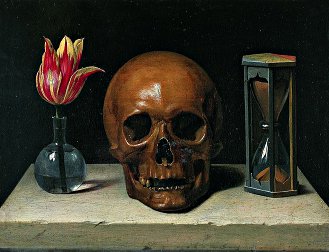
Philippe de Champaigne's 'Still-Life with a Skull', a vanitas painting. (c. 1671) left to right: life, death, and time.From that viewpoint, death is an even better outcome. No more Daylight Saving Time lunacy, no more election-time angst.

I don’t see it that way, but I’ve learned to live in a sub-optimum society.

I don’t like it, though, and think we could do better. I talk about that a lot.

Some of humanity’s problems may take generations, centuries, to sort out.

I’m pretty sure that Daylight Saving time can be ended pretty fast. The trick will be figuring out what our leaders think they’re doing, and strongly suggest that they stop tormenting us with this particular nonsense.

On the other hand, I read somewhere that having our sleeping schedules yanked around twice a year saves energy. That could be, and saving energy, no matter what the cost, is a belief ardently held in some circles.

Or maybe Daylight Saving Time is all that stands between us and global famine.

It may be even worse. Perhaps ending DST will kill all the cute critters, and cause the seas to rise until Mount Rushmore’s George Washington sinks beneath the waves.

I’m guessing “not.”

I’m pretty sure that the slight reduction in heart attack rates after the fall DST switch doesn’t really balance out spring’s increase.

Of course, I’m a mere layman.

I think avoiding the spring increase in disability and death is a good idea.

Even if it’s just half the year that we’re at higher risk. Maybe I’m missing some subtle point.

But I don’t think so. Death is pretty unsubtle.

On the ‘up’ side, those of us who can’t afford those annual jaunts to Aspen or Cannes get to experience jet lag twice a year.

That’d be a nifty campaign slogan, maybe. “Jet lag to the masses.”

It even makes sense, almost.

Daylight Saving Time: How SADIST Could Make it Worse

Now, my modest proposal; something I first suggested in spring of 2007. I figure it’s time to run this up the flagpole again.

With any luck, someone will think I’m serious — and suggest something that makes more sense. Like dropping DST.

Sure, some other countries have their own versions. But I suspect ‘everyone’s doing it’ isn’t a particularly good excuse.

Enough preamble. Here it is.

Three more ways that changing the clock (and, while we’re at it, the calendar) that could CHANGE OUR QUALITY OF LIFE:

1. Set clocks back 12 hours during August. Keeping people quiet during the day could save enormous amounts of energy that would otherwise be wasted on air conditioning stores and offices.

2. Set clocks back ten hours and forty minutes at noon on April 15. This 10:40 time shift would remind those who wait until the last minute to file tax returns by the date.

It’d also give them more than a full business-day’s-worth of additional time to get their forms in.

Ten hours and forty minutes is a large time shift, so clocks should be set forward one hour and twenty minutes at 2:00 a.m. — For eight days — April 8, 9, 10, 11, 12, 13, 14, and 15.

The reason should be obvious: to minimize psychological stress.

Although this stress-relieving measure might not save significant amounts of energy, the psychological effects could make a significant difference in quality of life.

“Quality of life” is such a nifty-sounding phrase: you know it’s gotta be a good idea

3. Finally, replace the evening of December 31 with Substance Abuse and Drug Interaction Study Time. The acronym should be easy to remember: SADIST.

SADIST: If At First You don’t Succeed, Threaten

Instead of over-indulging during New Year’s Eve parties, citizens would be encouraged to learn about substance abuse, dangers of mixing prescription drugs and alcohol.

This should reduce deaths in drunk-driving accidents, alleviate the need for expensive security measures in places like New York’s Times Square, and promote sober, healthy lifestyles among the general public.

And if you don’t agree, SADIST activists could say that those who oppose them promote drunkenness, debauchery, and delinquency. Or say they’re drug pushers.

Or terrorists bent on killing billions on New Year’s Eve.

Never mind that there are fewer than eight billion folks living on the planet, most of us nowhere near New York City.

Politics: It Could be Better, But It’s Been Worse

I’ve gotten the impression that logic has very little to do with politics, and even less with real-world analogs to SADIST.

Can’t say that I blame folks running the show for using raw emotion and discouraging logic.

Encouraging the masses to start thinking might — — — actually, I think that’d be a good thing.

It might disrupt ‘business as usual.’ I think that could be a very good thing indeed.

The status quo isn’t particularly peachy these days. I think a growing number of Americans are realizing that.

Experience suggests that hard times aren’t nearly as bad for folks, in our hearts, as ‘good times’ like the late 1940s and 1950s.

I like being an American, mostly, but realize that this isn’t a perfect country.

Wasn’t in my youth, either. What we’ve got now is, in some ways, an improvement.

You see, I remember the ‘good old days.’ And am glad they’re gone. (August 20, 2017)

Getting back to SADIST and irrational appeals, be honest: if you follow political news, you’ve run across something that’s pretty much as sensible as SADIST.

It’s not just ‘those people.’

I’ve still got a few politically-inclined folks in my social media feeds, on several sides. Some of them get pretty vehement. To be polite.

It’s nothing new.

But it’s no incentive for me to wade into that particular sewage lagoon.

Then there’s the French Revolution’s calendar, and that’s another topic, for another day.

More, mostly how I see life and death, health, pleasure and moderation, and getting a grip:

Posted in Being a Citizen | Tagged , , , , , | 4 Comments

Science, Faith, and Me

This universe is bigger and older than some folks thought, a few centuries back.

I don’t mind, at all. Besides, it’s hardly new information. We’ve known that we live in a big world for a long time.

“Indeed, before you the whole universe is like a grain from a balance, or a drop of morning dew come down upon the earth.”
(Wisdom 11:22)

If that bit from Wisdom doesn’t sound familiar, I’m not surprised. It’s not in the Bibles many Americans have. The one I read and study frequently is an unexpurgated version.

What’s new, in the Euro-American branch of Western Civilization, is that we’re getting some idea of just how big and old.

I gather that Hindus never lost track of our home’s size and age. And that’s another topic.

Getting conniptions over new ideas isn’t new. Neither is imagining that ‘God agrees with me.’ But I don’t think “old” means “good.” Not always.

Some ancient ideas still make sense, and always will.

Maybe thinking that the universe is older than a few thousand years is scary.

Thinking we don’t live on a nice little plate, safely under a protective dome — may be downright terrifying.

To some. Not me.

I figure God can handle the parts of this creation we’re discovering: and whatever else we haven’t found yet.

Being Catholic, and knowing a bit about our faith, helps.

Then there’s the old chestnut about folks thinking Earth was flat in the Middle Ages.

Some Europeans may have thought Earth is flat in the Middle Ages. Christians, a few, may cherish that bit of Mesopotamian cosmology.

I don’t. I haven’t met a Christian who does.

Aristotle and Fanboys

Several decades back a young Christian told me that our sun goes around Earth, because ‘The Bible Says So.’

He wasn’t Catholic.

The Catholic Church told Aristotelian fanboys that Aristotle’s ideas do not carry the same weight as God’s.

That was in 1277.

Bottom line? Thinking Aristotle is a smart guy is okay.

Getting him and God confused isn’t.

A few centuries later, Copernicus delayed publication of his theories because he didn’t want to be hounded by “babblers.”

What happened isn’t the story I grew up with — which is a whopping good one, and very slightly accurate.

“De revolutionibus…” was on the Index Librorum Prohibitorum: from 1616 to 1960. But not banned. The issue was a few proofing errors. (April 28, 2017)

I like living in an era where much of the natural philosophy I learned in my youth turned out to be incomplete. Or, in some cases, simply wrong. We started calling it “science” a few centuries back.

“…To follow knowledge, like a sinking star,
“Beyond the utmost bound of human thought….”
(“Ulysses” , Tennyson (1833))

“…nothing can be proved either by physical science or archaeology which can really contradict the Scriptures.…”
(“Providentissimus Deus” , Pope Leo XIII (November 18, 1893) [emphasis mine])

“…the Holy Spirit aids people with the gift of Knowledge. It is this gift which helps them to value things correctly in their essential dependence on the Creator. Thanks to it, as St Thomas writes, man does not esteem creatures more than they are worth and does not place in them the end of his life, but in God (ct. “Summa Theol.”. II-II, q. 9, a. 4)….”
(“Knowledge” , Regina Coeli, Pope St. John Paul II (April 23, 1989))

Basically, I think ignorance isn’t a virtue. And that using our brains is a very good idea.

‘I’m Dreaming of a White — Thanksgiving.’

That’s the view through my webcam, just after I woke up this morning. More or less.

It was definitely this morning, 10 minutes before 10:00. I’m still not convinced that I was “awake.”

I’d gone from ‘sleep’ mode to having a few of the circuits I use for conscious awareness in operation: barely. This is going to be an interesting day.

It’s been an interesting week, for that matter. What with one thing and another, I finished the ‘Friday’ post several hours late. Sleep has been elusive, too. Like I said, “interesting.”

Instead of chugging several more cups of the quadruple-strength coffee I like, and hoping for the best, I’ll put off what I’d planned for today. I’m in no condition for the precision work that’d take.

Instead, I’ll let slip the dogs of memory: in the general direction of why I’m a Christian and a Catholic and write so much about science.

Real science. The sort scientists do. Not the bizarre mutations you’ll run into near various ragged edges of reality.

I chugged the über-strength coffee, anyway. With — interesting — results.

You have been warned.

Living in a Big World

It’s been a few decades since I read something science-related whose author said that picture shows the moment when Europeans realized that they lived in a big world.

Maybe that’s what it illustrated in Flammarion’s “L’atmosphère : météorologie populaire.” Or maybe not.

But word seems to be getting around that it’s an engraving most likely made in the 1880s.

It reflects old styles, including medieval Europe’s fondness for zoomorphic elements and their botanical analogs. But medieval it’s not.

Some Europeans were ignorant and superstitious after the Roman Empire stopped making life interesting in my ancestral homelands. Some probably still are.

So are some Americans, I strongly suspect.

Current superstitions sometimes have old roots.

Others, reflected in angsty prophecies uttered by anonymous scientists, are new. Newish, anyway. Maybe more like retreads of old ‘don’t offend the spirits’ lore.

A few non-anonymous scientists make memorably-odd remarks when prophesying doom instead of analyzing facts. My opinion, and that’s still another topic.

Some Christians, including some Catholics, are almost certainly superstitious. There’s a whole lot of us, about a billion living today. It’d be nothing short of incredible if at least a few of a diverse bunch that size didn’t have at least a few screws loose.

But superstitious, homicidally psychotic, or profoundly ignorant Catholics aren’t evidence that the Catholic Church advocates mass murder. Or uses ignorance to control the mindless minions of megalomaniacal masterminds.

MUAHAAHA!!!! THE FOOLS!!!!!!!!

Hey, I like stories like that. Some of them.

Superstition, Ignorance, and Getting a Grip

I’ll grant that faith, Christian and otherwise, can coexist with superstition and ignorance.

But Christianity won’t disappear if by some miracle most folks decide that ignorance and superstitions are bad ideas.

Believing that superstition makes sense, or acting as if it does, is one of the few things the Catholic Church says are always bad ideas. No exceptions.

Also slavery , murder, and genocide. (Catechism of the Catholic Church, 2110-2111, 2261, 2313, 2414)

Some Catholics act like rules-obsessed killjoys and/or say murder is okay if you really feel like it or think it’s convenient.

But they don’t speak for the Church.

They’ll probably say otherwise, or say that it doesn’t matter because they feel that it should be Catholic teaching. And besides, that’s what they want to be so.

I’m aware that some Catholics have been slavers, murders, and occasionally mass murderers. We’ve been around for two millennia. One of the original Apostles was a traitor, and a few of our Popes have been nothing to brag about.

We’re not a restricted-membership society of perfect people.

Through two millennia good popes, not-so-good popes, a few downright bad popes and some Saintly ones — I forgot was I was saying.

The Church has never said “go and sin some more” or “if it feels good, do it.”

Our Lord’s outfit has also been notably reticent about making the streets run red with the blood of oppressors.

Like I said, some Catholics have behaved badly. They’ve got company, some of them emphatically non-Catholic religious leaders.

I won’t cry out for God to damn them. That kind of trouble I don’t need.

Holy Willie is a terrible role model.

I’ve wandered off-topic again. Or maybe not so much.

Wrenching myself back to superstition and getting a grip: some sects would develop membership retention issues, if superstition and ignorance disappear.

You guessed it: more topics. A sackful. Wagon load. Lots and lots.

Fu Manchu and Executive Order 9066

Catholics, at least, aren’t kept in superstitious ignorance by machinations of Western-style Fu Manchu clones.

On the other hand, that sort of thing makes a flaming good story.

And has.

Also a running gag in at least one comic strip.

Despite my predilection for some potboiler fiction, I’m not fond of Fu Manchu spinoffs. They’re uncomfortably dependent on attitudes that spawned fears of the “yellow peril.”

I haven’t read the original Sax Rohmer stories, but suspect that they respected then-current acceptable attitudes.

That version of xenophobia isn’t nearly as well-supported as it was in my youth.

Which is another reason I don’t yearn for the ‘good old days.’

The good news is that America’s national government finally got around to making token efforts to correct injustices like Executive Order 9066.

That isn’t the most deeply-shameful bad idea to come out of Washington. Not as I see it. That’s a topic for a post written after I calm down a bit. A lot. So is discussing some yellow peril retreads currently plaguing my nation

I’m under no illusions about this being “as a city upon a hill.” That played well for John Winthrop’s audience in 1930.

It’s been an effective marketing/political slogan for Americans off and on since then.

I’m not sure how well it’ll work over the next few centuries.

My country changed a lot after the 1960s.

I’m not happy about the direction some reforms took.

But I am still convinced that the reforms were needed. And long-overdue, in many cases.

We Can Do Better

Some folks, including some Catholics, bewail their imagined Golden Age.

They yearn for the glorious days when America was a shining beacon to the wicked world, a Christian nation nobly forcing American values down the throats of those wretched heathens.

By force, when necessary.

I really do not miss the ‘good old days.’

I remember their trailing edge, and was one of ‘those crazy kids’ who thought we could do better. Much better.

We’re not a “shining city upon a hill”, and never have been.

If we’d honored truth and justice, we’d have honored at least a few of the treaties made with nations west of the Appalachians. Miscommunication, blunders, and errors made might for right up to and after 1776 aren’t entirely our fault.

England overran some folks living east of those mountains, or seized territory conquered by other Europeans. Then some Americans got fed up with mismanagement, and revolted.

In retrospect, letting colonists get experience managing their own affairs can be seen as a mistake on England’s part. The colonists got pretty good at it. Better, in some ways, than the old-school lot running jolly old England. Which wouldn’t take much, in some cases.

I like being an American, on the whole, and think my homeland’s leadership occasionally tries to rule with justice and concern for the common good.

But like I said, we’re not an ideal nation.

On the other hand, we’re among humanity’s better approximations to date.

We’re not there yet. Not even close. But we’re still trying. And we’re not the only ones experimenting with new approaches to ancient ideas.

The E. U. and U. N. are promising first efforts.

But don’t hold your breath, waiting for a reasonable facsimile of St. John Paul II’s “civilization of love.”

Better yet, don’t wait. Do whatever you can to work with others who think we can build a better world. And don’t let the prospect of dying centuries before before we start seeing significant progress get you down.

Millennia, more likely.

Longer, for efforts that last long enough to be worth emulating later.

Trying Something New — and Ancient

I’d like to see a “Parliament of man … Federation of the world” in my lifetime. That’s not gonna happen. There are too many unresolved issues, too many pending reforms.

This may be among humanity’s most challenging jobs. But I think we can do it, and that it’ll be worth the effort. We certainly must try.

As it is, I am content — delighted — to live when humanity is trying a viable alternative to the empire-collapse-rebuild cycle we’ve used in the 43 centuries since Sargon of Akkad.

Reasonably hopeful days like ours generally don’t come more than once every few millennia. On the other hand, we’ve very recently developed tech that could shave at least a few centuries off how long it’ll take us to reach the next one.

If we use it with wisdom.

We’ll have to decide that loving our neighbor is worth the trouble. That won’t be easy. Never has been. (June 18, 2017; February 5, 2017; February 1, 2017)

Disappointed, Not Surprised

‘Faith and reason, religion and science, are incompatible.’ That’s been a cherished traditional belief in some of my civilization’s circles for a few centuries.

Variations play well in Christianity’s more painfully-pious and novophobic peripheries.

I’m not surprised that I keep seeing the assumption that smart folks freed Western civilization from the tramming shackles of superstition, ignorance, and suchlike stuff in the Renaissance.

And that religion, particularly Christianity, is a major foe of science and logic.

Disappointed, but not surprised.

The ‘scientists against the forces of darkness’ thing is a whacking good story, full of noble heroes, evil minions, and a wonderfully colorful master villain: the big, bad, Catholic Church.

It’s almost based on reality. In spots.

Some Christians, including the occasional Catholic, act as if they believe that thinking too much leads to eternal damnation.

I don’t agree, at all. But like I said earlier: I know a bit about my faith.

I signed up with our Lord’s outfit partly because it was logical.

Among my favorite quips about science and religion is what an atheist-turned-Catholic writer said:

“… If Vulcans had a church, they’d be Catholics.”
(John C. Wright, johncwright.livejournal.com (March 21 2008))

Conan and Me

I enjoy drama, myself: including blood-and-thunder stuff like the Schwarzenegger “Conan” movies.

There was meat of the intellectual sort in them, too. I’m not a fan of beefcake, and that’s yet another topic.

Novophobia isn’t in any dictionary I’ve found. By some standards it isn’t a “real” word. Not yet. I didn’t coin it. Someone did, probably no more than a few decades back.

No word in my language is particularly old. Not compared to the current duration of my civilization’s post-LBAC phase. LBAC? Late Bronze Age Collapse. The last really major speed bump my civilization’s experienced. My opinion.

A few others, including the Black Death and Roman Empire’s breakup, were pretty serious. The latter nowhere near as big a setback as many think. It wasn’t good news for upper-crust Romans and folks working in trans-regional trade. Yet again more topics.

Where was I? Snowfall in Minnesota, quadruple-strength coffee, noble scientists versus popish plotters, Conan the Barbarian. Right.

Earth, this Universe, and Beyond

Like I said, there’s a little truth to the ‘science frees us from religion’s oppressive shackles’ theme. Very little, but enough for rousing good stories.

Think “Things to Come” and it’s less well-thought-through love children.

In fairness, most folks probably don’t remember that the Catholic Church told Aristotle’s overly-zealous fans that if God says there are other worlds — there are other worlds. So stop saying there can’t be other worlds, since Aristotle said so.

That particular rule has been rescinded, but not the underlying principle.

God’s God. Aristotle’s not.

Turns out that there are other worlds.

We’ve found thousands in the last few decades, and have barely started charting systems in the rest of this galaxy.

Aristotle was smart, and got some things right. But we’ve learned a bit since his days. Quite a bit of that in my lifetime.

I think praying more fervently for the salvation of folks who aren’t just the self-described ‘good Christians’ is more popular these days.

It’s a nice change from the frightful faith proclaimed by some radio preachers of my youth. Their apparent delight at the impending damnation of folks who weren’t like them was impressive.

So were their portrayals of the accursed souls writing in eternal torment and the faithful few whooping with holy(?) exultation as “the smoke of their torment ascendeth up for ever and ever.”

It was an impressive display. But not favorable. I like to think they were sincere, and didn’t listen to what they were saying. Didn’t think about it, anyway.

Honestly, did they really believe their favorite verses from the King James Book of Revelation were all there was in Holy Writ?

Yea, verily I say unto thee: THINK, lest thy dasheth thy foot upon a stone. And no: that’s not in the Bible. Not all of it. Verily. Forsooth.

About Revelation 13:11, the mark of the beast, and all that, I think Psalms 91:11 is comforting, and true.

But it doesn’t strike me as a guarantee that being a Christian means a life free from unpleasantness.

I also avoid dabbling in numerology, divination, and Bible trivia in an effort to second-guess God the Father.

If Jesus didn’t need to know when Ragnarök was coming, I sure don’t. (August 25, 2017; November 15, 2016; November 8, 2016)

Not Ragnarök. Final Judgment. (April 16, 2017)

On the other hand, Ragnarök is oddly reminiscent of what we’re told about the Final Judgment. It’s also remarkably final. Not much like the ‘endless cycles’ in many traditions.

Scholars may never settle how much, if any, of the Norse account was influenced by Christian beliefs.

Explaining how the Bible proves that evolution is evil and Armageddon is nigh were also favorite topics among the ‘blessed are the ranters’ lot.

Their Armageddon lore included some — interesting — notions.

The Soviet Union was Satan’s pawn, naturally.

It also goes without saying that America would be at the very head of God’s army, hacking and slashing its way to a holy victory. According to them. Not me.

One chap even said that a particular bit of ordinance was prophesied — maybe in Joel 2, or Ezekiel. Somesuch place in the Bible. It was a credible effort.

Credible to folks who bought his brand of faith, anyway. I thought he was as colorful as some science fiction writers, but nowhere near as believable.

Now that I think of it, I think I may be remembering Ezekiel because another chap did an equally-credible job of proving that Ezekiel had seen a spaceship.

Extraterrestrial, of course. And no, I don’t think he was right. Sincere, maybe. Not right.

He wasn’t a Bible thumper so much as an advocate of ‘ancient astronaut’ beliefs. Or maybe a savvy author who knew a lucrative market when he saw one.

On the ‘up’ side, those radio ranters started me running down a path that eventually led me to deciding religion isn’t necessarily a psychiatric condition.

Later, I realized the Catholic Church had been logical for two millennia, and signed up. Learning who currently holds the authority our Lord gave Peter was factor, too. A huge one. Pivotal.

The inevitable links to more stuff, allegedly-related; in a slightly nonstandard format:

Posted in Being a Citizen, Being Catholic | Tagged , , , , , , , , , , , , , , , , , , | 4 Comments