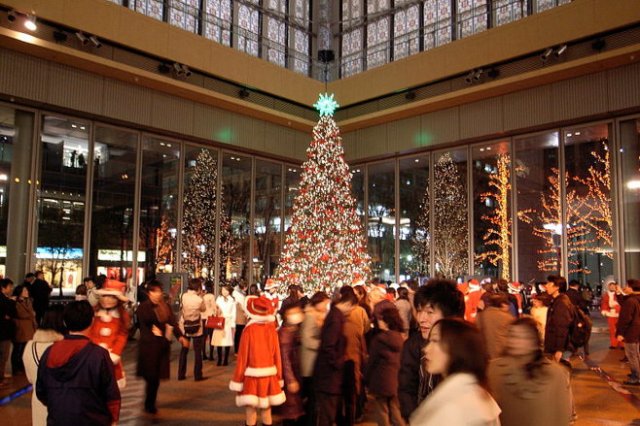
Christmas, Octaves and History

The American holiday and Christmas seasons overlap, with fuzzy terminuses. Termini. Beginnings and endings.

For some, Christmas starts with the Macy’s Thanksgiving Day Parade.

That fine old American tradition has been joined by Cyber Monday.

Oddly enough, I haven’t noticed anguished laments over that newfangled technology and Macy’s inflated cartoon characters.

Or a deluge of dismay at rampant commercialism and unseemly frivolity.

Maybe I haven’t been looking hard enough. Or in the right places. “Right” for that particular Puritan perspective. (December 24, 2019; June 1, 2018)

For many of us, the American Christmas season ends a day or so after the 25th.

It makes sense, from at least one viewpoint.

With New Year’s Eve less than a week away, Christmassy decorations must give way to streamers and confetti. And, of course, the traditional party horns.

But our household’s Christmas tree is still up and decorated.

That’s partly because of this family’s lifestyle. We’re not party people. Except maybe for me. I’ve often watched live video of New York City’s Times Square celebration. And called it a day shortly after the Waterford Crystal ball dropped.

Where was I? Holiday seasons. Christmas. Comics. Times Square. Right.

Christmas celebrations have been a big deal for traditionally Christian countries. No surprises there.

They’re also a big deal in some countries where most folks aren’t Christians. Like Japan, where folks put up Christmas trees, exchange gifts and get together on Christmas Eve. And, apparently thanks to a 1970s ad campaign, eat at Kentucky Fried Chicken.1

Minnesota’s Snow


(Our Lady of Angels, Sauk Centre, Minnesota, Saturday afternoon. (January 2, 2015))

Here in central Minnesota, folks with Christmas yard displays usually set them up shortly after Thanksgiving.

I figure that’s because this is Minnesota.

Winter’s snow can come early. The earliest snowfall recorded by the National Weather Service was August 31, 1949, in Duluth. Or September 14, 1964 in International Falls.

Which you pick depends on how you define “snowfall.” Duluth’s was a trace. International Falls got a third of an inch: one centimeter.

Both cities are in northern Minnesota, a bit over 200 miles north of Sauk Centre.

The earliest recorded snow here was the snowstorm of September 24-26, 1942. Then there was the October 1880 blizzard, and that’s another topic.2

Christmas Lights and a Calendar


(From L’Osservatore Romano, via Catholic News Agency, used w/o permission.)
(St. Peter’s Square, December 7, 2019: lighting the tree and Nativity scene.)

I haven’t kept track of when most folks turn on their displays. It’s probably around the start of Advent.

When the lights go off varies. For some, it’s soon after Christmas. Others keep their displays lit for another week or so. Or longer.

I think that makes sense. Partly because it’s my family’s custom.

And partly because our my family’s custom comes from the liturgical calendar.

Advent and Octaves

Advent starts on the fourth Sunday before Christmas, the Sunday closest to St. Andrew’s day. Except when Christmas day is a Monday — it’s complicated.

Whenever Advent starts, Christmas is December 25. I mentioned that on Christmas Eve. (December 24, 2019)

Christmastide starts toward the end of Christmas Eve and runs 12 days. It’s pretty much the same as Twelvetide.

New Year’s Day is the Octave of Christmas.

“Octave” in this context is what happened to “octava dies” after passing through French and landing in England.

I don’t know what would have happened if duodecimus dies had taken the same route. Maybe we’d be saying Duodechetide instead of Twelvetide. I don’t know nearly enough philology to work that out.

Emperor Constantine I gets credit for making eight-day celebrations part of Christian worship. Or celebrations on the eighth day after another celebration. That was early in the fourth century.

Fast-forward to the seventh century. European Christians started adding octave celebrations to Saints’ feast days: one extra celebration, eight days after the Saint’s day.

Fast-forward again, this time to the 16th century. The Reformation and Counter-Reformation were in progress, the Council of Trent had wrapped up a few years previously, and Europe’s religion-themed wars had begun.

Pope Pius V cut back the number of liturgical octaves.

I think it’s likely that some 16th century folks were upset by having fewer official octaves. And blamed Pius V and/or the Council of Trent for destroying the Catholic Church.

Skipping ahead to Popes Leo XIII and St. Pius X.

They changed octaves again. That was in the late 19th and early 20th century.3

And the Catholic Church is still here. (July 30, 2017)

The Octave of Christmas

Which brings me to the octave of Christmas, January 1.

It’s also the Solemnity of Mary, the Holy Mother of God.

And a Holy Day of Obligation, which makes getting to Mass a priority.

I don’t have a problem with that. I follow Jesus of Nazareth, son of God, who is human on his mother’s side.

Showing respect toward my Lord’s mother makes sense. (May 14, 2017)

Happy New Year!

I’ve got more to say about Christmas traditions, Tradition, Twelvetide and “The Twelve Days of Christmas.”

But I’m running out of 2019, so that’ll wait for another day.

More posts, related and otherwise:


1 Celebrations:

2 Minnesota records:

3 History and celebrations:

Posted in Being Catholic, Discursive Detours | Tagged , , , , , | 2 Comments

New on Blogroll+ — Word on Fire Catholic Ministries

I finished reading “Letter to a Suffering Church” this weekend. It’s Bishop Robert Barron’s discussion of the sexual abuse scandal that’s been momentarily eclipsed by election-year sturm und drang. And that’s a topic for another day. Topics.

There's nothing quite so lovely as a brightly burning book, 'The Pogo Papers,' Walt Kelly (1952, 1953)The book’s publisher is Word on Fire.

Which, oddly enough, has nothing to do with Walt Kelly’s Pogo books or book burning. And that’s yet another topic.

Anyway, the book’s publisher is part of Word on Fire Catholic Ministries, “a nonprofit global media apostolate that supports the work of Bishop Robert Barron and reaches millions of people to draw them into— or back to— the Catholic faith.”

That quote’s from Word on Fire Catholic Ministries’ “About Word on Fire” page.

Their website has a great many resources: some free, some you could buy. Or not. That’s up to you. The site and its content seemed interesting enough for my Blogroll+, so now there’s a new item in the “Media” section.

More (or less) of the same, on A Catholic Citizen in America:

Posted in Being Catholic | Tagged , | Leave a comment

Another Death in the Family

A family get-together was supposed to be happening at our house today.

It’s been canceled or rescheduled. I don’t know which.

That’s probably just as well. There’s a winter weather advisory here, and a winter storm warning over the county line north and west. Which here in Sauk Centre is about a mile and eight miles, respectively.

We’re expecting between a hundredth and a tenth of an inch of ice and maybe three inches of snow. And sleet in Sunday’s early hours. This is why I prefer sincerely cold weather. And that’s another topic.

Noon, Christmas Eve

What threw a spanner in the works, scotched, disrupted and discombobulated our plans was a death in the family.

Around noon (we’re in the UTC -6 time zone) on Christmas Eve, my wife’s brother’s wife had a heart attack.

They were both at their home. He applied CPR, an ambulance took her to a hospital, and she died.

My wife got a call from a kinswoman a couple hours later.

When the conversation was over, my wife made more calls. By that evening, I figure everyone who was near their telephone or online connection knew what had happened. Our family’s grapevine is fairly efficient.

One of my brothers-in-law was with the now-widower by the time this household got the news. For that, I’m glad. He, the widower, is and will be grieving. A lot.

This will affect family plans for the next week or so, probably beyond. How, I’ve no idea. Nobody does, likely enough.

Oddly enough, I’m not experiencing emotional responses to my sister-in-law’s death. Apart from part of a holiday song playing on a loop in my head. And insomnia. Experience suggests that the feelings will come when my brain’s failsafes go back to standby mode.

As I said, this is going to be interesting.

Death Happens

People die. That’s been an inescapable fact throughout history.

Folks have learned to be resigned to death, we’ve learned how to delay death.

But somehow, it just doesn’t feel right.

And small wonder, since we’re made “in the image of God.”

And that’s almost another topic. (Genesis 1:2628; Catechism of the Catholic Church, 355379, 10061014; “Gaudium et Spes,” 18)

I don’t look forward to my death, or anyone else’s. It’s a bit like the feelings I had about finals week, back in my college days.

Like everyone else, I’ll experience my particular judgment after I die: a sort of final evaluation. (Catechism, 10211037, 10421050)

I’ve talked about that before. (September 30, 2018 ; March 11, 2018)

Grief and Hope

I have no idea why my sister-in-law — I think that’s the right term — died on Christmas Eve.

It feels monumentally unfair.

But as I’ve said in another context, God’s God, I’m not, and I’m okay with that. Grudgingly, sometimes, and that’s yet another topic.

I also don’t know how I’d provide support or comfort to my brother-in-law, or if I’ll have the opportunity.

There’s more to say, but I’m not up to sorting out ideas and arranging words on that topic. Those topics. Not today.

Maybe these quotes will do for now. Or maybe not.

“…The centre of every man’s existence is a dream. Death, disease, insanity, are merely material accidents, like toothache or a twisted ankle. That these brutal forces always besiege and often capture the citadel does not prove that they are the citadel….”
(“Twelve Types,” G. K. Chesterton (1906) via Google Books)

“Life is eternal; and love is immortal; and death is only a horizon; and a horizon is nothing save the limit of our sight.”
(From Carly Simon, Fr. Bede Jarrett, William Penn, or Rossiter W. Raymond.1)

Or these, from St. Augustine of Hippo and the Bible.

“Of necessity we must be sorrowful when those whom we love leave us in death. Although we know that they have not left us behind forever but only gone ahead of us, still when death seizes our loved one, our loving hearts are saddened by death itself. … Our weakness weights us down, but faith bears us up. We sorrow over the human condition, but find our healing in the divine promise.”
(Sermon 172, St. Augustine of Hippo (ca. 400) via Universe of Faith)

“Do not avoid those who weep,
but mourn with those who mourn.”
(Sirach 7:35)

“The number of their days seems great
if it reaches a hundred years.
“Like a drop of water from the sea and a grain of sand,
so are these few years among the days of eternity.
“That is why the Lord is patient with them
and pours out his mercy on them.”
(Sirach 18:911)

“But as it is written:
‘What eye has not seen, and ear has not heard,
and what has not entered the human heart,
what God has prepared for those who love him,'”
(1 Corinthians 2:9)

“I heard a loud voice from the throne saying, ‘Behold, God’s dwelling is with the human race. He will dwell with them and they will be his people and God himself will always be with them [as their God].
“He will wipe every tear from their eyes, and there shall be no more death or mourning, wailing or pain, [for] the old order has passed away.'”
(Revelation 21:34)

Related posts:


1 “Life is eternal…” is from the fourth track of the Have You Seen Me Lately Carly Simon album and a poem by Fr. Bede Jarrett; which he said he copied from something William Penn wrote. Or it’s from Rossiter W. Raymond’s “Death is Only an Horizon.”

Posted in Being Catholic, Family Stories, Journal, Series | Tagged , , , | 4 Comments

Christmas: Still Celebrating

Allen McGregor's photo of a window display, Bay department store, Downtown Toronto, Ontario. (24 November 24, 2007) via Wikimedia Commons, used w/o permission.

Christmas comes but once a year. It’s a time for exchanging gifts, family get-togethers and awkward office parties.

December is a time for joyous preparation, frazzled shopping and holiday-themed music. It’s “Santa’s big scene.”

Children see their first Christmas window display. Parents remember when the windows seemed higher and displays more dazzling.

Seasonal traditions

Faucher-Gudin's drawing, hand-enhancing a damaged bas-relief found in Nineveh.Some of our Christmas traditions are new, some are anything but. We’ve lost track of when and where some started.

Some, like holly and mistletoe, almost certainly predate Europe’s Christianization.

I’m pretty sure celebrating Christmas near the winter solstice has even older roots.


Attitudes and Questions

Joy? No Problem

I’m no fan of maxed-out credit cards and vapid holiday specials.

But on the whole, I like the glitz and glitter. In moderation.

Not everyone feels that way. For some, Christmas is the season for deploring.

Traditional targets include rampant commercialism and Christmas specials.

I see echoes of America’s Puritan past in “rampant commercialism” rants, and that’s another topic. (June 1, 2018)

“The Obferation of Christmas having been deemed a Sacrilege, the exchanging of Gifts and Greetings, dreffing in Fine Clothing, Feafting and similar Satanical Practices are hereby FORBIDDEN”
(Public notice deeming Christmas illegal, Boston (1659))

New England Puritans apparently saw Christmas celebrations as unbiblical, pagan, idolatrous and Catholic.

They had a point. Sort of. I know of no Biblical reference to holly, mistletoe or Yule logs.

And Catholics do have a long history of commemorating our Lord’s birth by celebrating.

I don’t see a problem with acting as if the Messiah’s birth was a joyful occasion. I’m also not bothered by holiday traditions with roots in pre-Christian Europe. Or troubled that a Holy Day of Obligation falls so close to the winter solstice.1

Oddly enough, Puritans didn’t seem to mind that December 25 — or thereabouts — is Christmas Day. And has been since Roman times.

Why December 25th?

Why we celebrate Christmas on the 25th day of the 12th month day depends on who’s talking.

Maybe it’s because Christians hijacked Emperor Aurelian’s Sol Invictus festival.

Sol Invictus was Rome’s Sol, a sun god. Or maybe Elagabal, a Syrian import. Or something else.

Sextus Julius Africanus said Christmas is December 25th because Jesus of Nazareth was conceived on March 25th.

The current Western calendar started back when Rome had kings. Somewhere along the line, December — the 10th month — became the 12th month. Probably.

That’s what the Romans said. But their accounts don’t quite add up, and records got lost. Including Licinius Macer’s history.2

If that’s not enough to give the jittery demographic conniptions, here’s a winter solstice celebration, Mesopotamian style.


It’s Beginning to Look a Lot Like Zagmuk

Merry Zagmuk?

Faucher-Gudin's drawing, hand-enhancing a damaged bas-relief found in Nineveh. From 'Monuments of Nineveh, Second Series' plate 5, London, J. Murray (1853) It showed either a chaos monster and sun god, Tiamat and Markduk, Anzu and Ninurta, some monster and a king, or something else.
(From L. Gruner, via Wikimedia Commons, used w/o permission.)
(Bas relief from Nineveh: sun god attacking chaos monster.)

Backing up a little, Sargon of Akkad ruthlessly crushed the sovereign rights of Sumerian city-states. Or brought them a measure of peace and stability. Again, it would depend on who’s talking.

His Akkadian Empire lasted a couple centuries, and started a cycle that’s lasted four millennia. I think we may be developing a viable alternative to the empire-collapse-rebuild tradition, and that’s yet another topic. (December 24, 2018)

Babylon was a small town on the Euphrates during the Akkadian Empire’s heyday. It endured the Gutian dynasty of Sumer and what we call the 4.2 kiloyear event. Babylon grew, occasionally prospered and is currently an archaeological site south of Baghdad.

Where was I? Christmas specials, Puritans, Elagabal, Sargon of Akkad and Babylon. Right.

Folks living in Mesopotamia’s ‘good old days’ celebrated Zagmuk this time of year.

In Babylon, the festivities include a reenactment of Marduk’s 12-day battle with Chaos. The king played Marduk’s part, winning each year.

That, and what we euphemistically call a sacred marriage, sounds like fun for the king. Getting killed after the 12 days, so he could battle at Marduk’s side? Not so much. I gather that the king often had a stand-in for the 12 days of Zagmuk.

Zagmuk sounds a lot like Christmas: a mid-winter festival celebrating light and life’s triumph over chaos — and, arguably, evil — lasting 12 days.

What we know about Zagmuk comes partly from documents like Enûma Eliš. Copies of Enûma Eliš, more precisely.

The original text was probably written around Hammurabi’s day, give or take a few centuries. A particularly famous copy of Enûma Eliš was found in a royal library built a thousand years after Hammurabi enacted his law code.3

Ashurbanipal, Assyria and Epic Sibling Rivalry


(From Austen Henry Layard, James Fergusson; via Wikimedia Commons, used w/o permission.)
(Austen Henry Layard and James Fergusson’s “The Palaces at Nimrud Restored.” (1853))

Ashurbanipal ruled the world’s largest empire, Assyria, from the world’s largest city, Nineveh.

He and his older brother, Shamash-shum-ukin, jointly inherited the Assyrian throne.

Before long, Ashurbanipal was running Assyria. His brother was king of Babylon.

Ashurbanipal? Shamash-shum-ukin? Don’t bother trying to remember these names. There won’t be a test on this.

Anyway, being a king of Babylon meant playing second fiddle to the Assyrian empire’s ruler. The one we call the Neo-Assyrian Empire.

Shamash-shum-ukin’s dissatisfaction started a three-year civil war.

He’d assembled an impressive coalition of anti-Assyria rulers, including Elamites. When the dust settled, Ashurbanipal was still running Assyria, Shamash-shum-ukin was dead and Elam was an unpopulated wasteland.

If Ashurbanipal had lived today, he’d probably have faced charges of war crimes, genocide and crimes against humanity.

But the International Criminal Court was 26½ centuries in his future.

We’re learning, slowly, to see foreigners as neighbors. And that war is far from an ideal method for resolving conflicts. (January 1, 2019)

Ashurbanipal wasn’t just a hard-nosed military commander who knew the value of a reputation for cruelty.4

The Library of Ashurbanipal

While an apprentice scribe, Ashurbanipal mastered Akkadian and Sumerian.

As a ruler, he sent scribes throughout his empire, looking for ancient texts. “Ancient” from his viewpoint.

Collecting them was probably facilitated by his reputation for cruelty above and beyond his era’s norm.

The Library of Ashurbanipal was the world’s first systematically organized library. First that we know of, that is.

I gather that Ashurbanipal saw the library as his greatest accomplishment.

I think he may have been right.

About 19 years after Ashurbanipal died, a coalition of Babylonians, Scythians and Medes reached Nineveh and torched the palace.

Including the library. Or, maybe, libraries. The anti-Assyria forces were very thorough.

On the other hand, some scholars say the Library of Ashurbanipal was in use in Alexander the Great’s day. Maybe someone extracted part of the collection before or during the fire.

I’m assuming that the anti-Assyrians incinerated the palace, library or libraries included.

The fire obliterated anything written on wood, wax, leather or papyri. But the intense heat partly baked the library’s clay tables. That may have helped preserve them.

Centuries and millennia passed. Empires rose and fell. Then, about a century and a half back, someone found what was left of the Library of Ashurbanipal.

Fitting bits of broken clay tablets together took time. So did translating them.5

Enûma Eliš, the Epic of Gilgamesh and Assumptions

Enûma Eliš and the Epic of Gilgamesh may be the best-known documents from the Library of Ashurbanipal.

I suspect that the documents upset many 19th century folks.

The era was a bit like ours. Some Europeans and Euro-Americans were studying this world’s processes and evidence we’ve left as millennia passed.

What they learned didn’t always match their culture’s “Biblical” assumptions.

I suspect that politics fuels zealots on all sides of the ongoing science-religion-evolution-education brouhaha. (February 9, 2018; September 22, 2017)

“Truth Cannot Contradict Truth”

Scholars had known about ancient parallels to the Bible’s creation and flood stories. But the extra-Biblical parallels often postdated their Biblical equivalent.

Enûma Eliš and the Epic of Gilgamesh’s creation stories and flood myth looked like their Biblical counterparts.

And were probably written before Hebrews finalized Genesis. Worse, from one viewpoint, it looked like they were likely based on even older documents.6

Brooding because the Bible wasn’t the source of ancient stories was definitely an option. So was accepting what we’ve been learning, and thinking.

I think Pope Leo XIII was right.

“…God, the Creator and Ruler of all things, is also the Author of the Scriptures – and that therefore nothing can be proved either by physical science or archaeology which can really contradict the Scriptures. … Even if the difficulty is after all not cleared up and the discrepancy seems to remain, the contest must not be abandoned; truth cannot contradict truth…”
(“Providentissimus Deus,” Pope Leo XIII (November 18, 1893))


Celebrating Hope and Light

A Light for Revelation to the Gentiles

I figure winter solstice celebrations are so common in non-equatorial cultures because it’s when the sun starts returning.7

It’s a time to celebrate the visible hope that light and life will go on, that winter won’t last forever.

And for two millennia, it’s been a time to celebrate “good news of great joy:” the moment in history when “a light for revelation to the Gentiles” was born.

“The angel said to them, ‘Do not be afraid; for behold, I proclaim to you good news of great joy that will be for all the people.
“For today in the city of David a savior has been born for you who is Messiah and Lord….'”
(Luke 2:10)

“‘Now, Master, you may let your servant go in peace, according to your word,
“for my eyes have seen your salvation,
“which you prepared in sight of all the peoples,
“light for revelation to the Gentiles, and glory for your people Israel.'”
(Luke 2: 2932)

The Light Still Shines


(From Silar, Wikimedia Commons, used w/o permission.)
(Nativity scene at the Christ the King Church in Sanok, Poland, 2010.)

You know what happened after the angel told shepherds to “not be afraid….”

They hightailed it to Bethlehem, found the promised Messiah in a feeding trough, with his mother, father and livestock. (Luke 2:1520)

Make that foster-father. I’ve talked about Joseph, Mary and their awkward circumstances before. (December 18, 2016)

“In the beginning was the Word, and the Word was with God, and the Word was God.
“He was in the beginning with God.”
“the light shines in the darkness and the darkness has not overcome it.”
“And the Word became flesh and made his dwelling among us, and we saw his glory, the glory as of the Father’s only Son, full of grace and truth.”
(John 1:12, 5, 14)

Reactions to our Lord’s arrival was mixed.

The shepherds and Magi saw our Lord’s arrival as good news.

Herod saw a threat, which is why Joseph, Mary and Jesus took off for Egypt and stayed there until Herod died.

Jesus grew up, worked miracles, made sense: and reactions were mixed again.

The Pharisees and Sadducees didn’t agree on much, but they both saw Jesus as a threat. Grass roots sentiment turned from making our Lord’s arrival in Jerusalem into a parade to shouting “Crucify him!”

Which is what happened.

A few days later, Jesus stopped being dead. We’re still celebrating, two millennia later. And that’s yet again another topic.

Christmas and Advent posts:


1 Christmassy traditions:

Holy Days of Obligation?

HOLY DAYS OF OBLIGATION: Principle feast days on which, in addition to Sundays, Catholics are obliged by Church law to participate in the Eucharist; a precept of the Church. (2043, 2180)
(Catechism of the Catholic Church, Glossary)

2 A matter of time:

3 Four millennia, briefly:

4 An empire’s best years:

5 Ashurbanipal’s legacy:

6 History, archaeology and attitudes:

7 Winter solstice celebrations:

Posted in Discursive Detours | Tagged , , , , | 4 Comments

Enjoying Another Christmas

It’s been two months since I wrote this blog’s first “journal” entry: sharing what I’m doing or what I’ve done.

It seemed like a good idea, at the time.

Particularly since this blog’s tagline is “Following Catholic beliefs and practices in America: one man’s experience.”

I still think it’s a good idea. But I’m learning that reporting my routines isn’t easy. No, that’s not entirely accurate.

It’s easy enough.

All I’d have to do is write “woke up, made coffee, sat down, drank coffee, read online comics, made more coffee” — and keep going until I got to “signing off for the night.”

Easy, yes. Interesting, no.

Not even to me, and I’m as egocentric as most folks. Maybe more so, since I spend time and effort on writing: time I could use for reading more comics, playing solitaire and sharing cat memes on social media.

So, instead of a tiresome recount — or is that account? — of my daily routine, I’ll pick a few events that seem worth sharing. In my opinion. Your experience may vary.

Weirdness and 2018, Mostly

Even my annual ‘getting weird’ zenith isn’t particularly exceptional. Maybe “nadir” is a more appropriate word.

But this year’s isn’t nearly as bad as year-before-last. At least not that I’ve noticed. On the other hand, interrupted sleep is still an issue. (January 7, 2018)

I suspect that I’m getting over 2018.

That was an interesting year. Particularly the last few months.

I experienced a transient ischemic attack, or something like it, in August. It’s a stroke, but without lasting effects. About that, I’m not complaining. Then, in mid-September, my father-in-law died. That was, and is, a major loss for me, the family and community. (September 19, 2018; August 12, 2018)

This year, in comparison, was uneventful. Mostly.

The local/regional healthcare outfit wants folks my age to have a Health Care Directive. It’s one of those ‘you don’t have to but you should’ things.

Filling that out was an interesting experience. (November 24, 2019)

Brooding and Books, Death and Depression


(From Gustave Doré, via Library of Congress, used w/o permission.)
(Gustave Doré’s illustration for Poe’s “The Raven.” (1884))

There’s a line, somewhere, with rational acceptance of physical death on one side. And morbid brooding on the other.

I prefer the rational side, although staying there is harder than I like.

Not that I’m as far gone as Poe’s star-crossed scholar. Raven-crossed, actually. I’m still impressed he saw letting a nocturnal tapper inside as a good idea.

That said, I see a little of myself in that nameless young doofus.

I often react to stress by experiencing insomnia and seeking “surcease of sorrow” in books and today’s analogs of “many a quaint and curious volume.”

“…Eagerly I wished the morrow; — vainly I had sought to borrow
From my books surcease of sorrow — sorrow for the lost Lenore —
For the rare and radiant maiden whom the angels name Lenore — Nameless here for evermore….”
(“The Raven,” E. A. Poe, from Richmond Semi-Weekly Examiner (Richmond, VA), vol. II, no. 93 (September 25, 1849) via eapoe.org)

It’s not an entirely satisfactory approach, but arguably better than diving into denial. And certainly preferable to sinking into the shadow of a “pallid bust of Pallas.” (April 8, 2018)

I don’t like living with autism spectrum disorder, PTSD and depression. But accepting reality, and dealing with it, makes sense. And that’s another topic. (June 24, 2018; December 17, 2017)

And Now for Something Completely Different

Getting weird or not, I enjoy the Advent-Christmas season.

Our kitty corner neighbors have their array of lights and glowing decorations deployed.

My son has put up the household’s understated Christmas lights and creche.

Holiday-themed songs abound on the radio. Mostly of the “It’s Beginning to Look a Lot Like Mommy Kissing the Red-Nosed Reindeer” and “Grandma Got Run Over by the Twelve Days of Christmas” variety.

And as the days grow shorter, my mind wanders back to memories of childhood; recalling the wonder of a department store’s Christmas window and my first encounter with Walt Kelly’s “Deck Us All With Boston Charlie.” And that’s yet another topic.

Allegedly-related posts:

Posted in Journal | Tagged , , , , | 2 Comments