Pope Francis addressing the Roman Curia at the Vatican. (December 22, 2022)
When I saw “Vatican” and “elegant demon” in my news feeds, I cringed. Just a little.
But not because I feared that the four horsemen of the Apocalypse were saddling up and the Antichrist was running rampant.
Lurking Demons in the News, and a Pleasant Surprise
The self-described “Christian” radio of my youth left me with low expectations.
And some sympathy for folks who apparently believe that religion is a psychiatric disorder, and that Christians are ignorant and easily led — which is almost another topic.
So, between youthful experience and more recent encounters with clueless reporting of “religious news,” I was pleasantly surprised.
The AP and a couple other secular news media sources apparently understood what Pope Francis had said. So did Vatican News, but that wasn’t unexpected.
I checked, and Holy See > Pope Francis > Speeches > December 2022 has his “To the employees of Vatican City State for the exchange of Christmas greetings (22 December 2022)” — in Italian.
Previous experience suggests that an English translation will be available in a few days or maybe a week or two. The Vatican isn’t nearly as massively-staffed as my culture’s folklore suggests, and that’s yet another topic.
Meanwhile, CNA, Catholic News Agency, did a pretty good summary of today’s speech. Yesterday’s, actually, by the time I post this.
“Elegant Demons” and a Lurking Evil
Video at the Vatican, Pope Francis reminding that evil is still a problem. (December 22, 2022)
“Pope Francis warned the Roman Curia on Thursday that they need to be vigilant in the face of temptation by elegant demons and ‘the evil that quietly lurks among us.’
“In his annual Christmas address to the cardinals who work in Vatican offices on Dec. 22, the pope said that there is a temptation for those who serve ‘at the heart of the Church’ to think that they are ‘better than others, no longer in need of conversion.’
“‘Yet we are in greater danger than all others, because we are beset by the “elegant demon,” who does not make a loud entrance, but comes with flowers in his hand,’ Pope Francis said.
“The pope underlined that ‘it is not enough to condemn evil, including the evil that quietly lurks among us.’
“‘We need to respond by choosing to be converted,’ he said.
“‘Mere condemnation can give the illusion that we have solved the problem, whereas what really counts is making the changes that will ensure that we no longer allow ourselves to be imprisoned by evil ways of thinking, which are often those of this world.’
“Pope Francis added that one of the most helpful virtues to aid in temptation is ‘the virtue of vigilance.’…”
There’s more of what Pope Francis said in that CNA article. It’s a tad under 500 words, maybe a two-minute read, and worth the time. My opinion.
Part of “the virtue of vigilance,” the Pope said, is a daily examination of conscience.
That sounds like a good idea to me, but not one that I actually follow through on. So looks like that’s something I should add to my daily schedule.
A parish priest gave me, along with the rest of the household, an “Examination of Conscience for Adults and Teens” from The Fathers of Mercy (www.fathersofmercy.com).
It’s been sitting near my keyboard and mouse pad, so all that’s left is for me to actually start going through the thing. Which, again, strikes me as a good idea.
This particular “Examination of Conscience” is the first one that ‘clicked’ for me, probably because it had a modestly extensive checklist. And included short explanations of what specific virtues and vices are, in operational terms.
I’d suggest getting a copy from The Fathers of Mercy (Home > Store > Examinations) but they sell them in lots of 100, 500 and 1,000 — as a parish resource, I gather. So I don’t know if you’d think doing so made sense, or even if you’d be interested.
That’s about all I’ve got for the moment, apart from a list of allegedly-related posts.
“Oh, I yust go nuts at Christmas On that yolly holiday I’ll go in the red like a knucklehead ‘Cause I’ll squander all my pay “Oh, I yust go nuts at Christmas Shopping sure drives me berserk On the day before, I rush in a store Like a pure bewildered yerk….” (“I Yust Go Nuts at Christmas,” Yogi Yorgesson (1949) via JioSaavn.com)
On the whole, I like the season’s glitz and plastic pomp. Possibly because I haven’t bought into the ‘shop til you drop’ norm.
But I also think C. S. Lewis made a good point or two about “the commercial racket.”
“Three things go by the name of Christmas. One is a religious festival. … The second (it has complex historical connections with the first, but we needn’t go into them) is a popular holiday, an occasion for merry-making and hospitality. If it were my business too have a ‘view’ on this, I should say that I much approve of merry-making. But what I approve of much more is everybody minding his own business.… But the third thing called Christmas is unfortunately everyone’s business. “I mean of course the commercial racket.…” (“What Christmas Means to Me,” C. S. Lewis (1957) via The Trustees of the Estate of C.S. Lewis and Tim Collinses/University of Rochester [emphasis mine])
I don’t see a problem with many traditions, like decorating Christmas trees. But some traditions I’d gleefully do without.
That’s why I’m not following my country’s old traditions by denouncing “…the exchanging of Gifts and Greetings … and similar Satanical Practices….”
Or conforming to our new ones: like protesting The [redacted] Village in Philadelphia.
Or complaining about [redacted] wreaths on New York City’s Holland Tunnel. Although, in fairness, the Tunnel trouble was more about spelling that seasonal celebrations.
Which brings me to the problem of sorting cause-effect relationships from things that happen around the same time but aren’t connected.
Folks working in emergency departments, for example, deal with a great many more patients around Christmas and New Year. And a whole lot of dead-on-arrival patients.
There are almost certainly cause-effect relationships involved.
One study, for example, showed holiday spikes in deaths due to substance abuse and “external factors.” External factors being events like accidents, homicides, and suicides.
I’m not sure why we don’t see op-eds calling for tougher holiday control laws, or a reboot of America’s 1920 to 1933 Prohibition experiment.1
Condo Killings: Murders, Motives, Maledictions and Making Sense
Another nonstarter, so far, is outrage over deadly attacks on condo board and block committee members.
“Vaughan condo shooting: Three victims were on condo board“ Nadine Yousif, BBC News (December 19, 2022) “The man who went on a shooting spree at a Canada apartment complex killed five of his neighbours, including members of the building’s board, police said. “The 73-year-old suspect went from apartment to apartment looking for his victims, though police have not disclosed his motive. “The alleged gunman, a longtime resident of the building, was shot and killed by police….”
“Italy shooting: Three women shot dead in Rome cafe“ (December 12, 2022) “…Those inside were meeting as part of a local block’s residents’ committee…. “A suspect, 57, is in custody. He has a history of disputes with some of the committee’s board, reports say….”
I figured BBC News has the good sense to realize that it’s early days to start guessing what sparked the Vaughn condo killings. Although one explanation seems likely.
“Victims of shooting at apartments in Vaughan, Canada, named“ (December 21, 2022) “Canadian police have identified all five people killed at an Ontario apartment complex in an attack that appears to have been sparked by a dispute with the block’s board. “Three of the victims in Vaughan, Ontario, had worked for the board…. “…According to court documents, the suspect had filed several lawsuits against the building’s condominium corporation that a judge later described as ‘frivolous’….”
“Vaughan shooting: Gunman had long-running feud with condo board“ (December 20, 2022) “…The board had also asked a judge to find Villi in contempt for violating a previous order not to contact them, according to the Toronto Star newspaper. “Court documents show the building corporation filed a restraining order against the suspect in November 2018, due to his ‘threatening, abusive, intimidating and harassing behaviour’….”
I haven’t, again so far, seen an editorial call for better laws against “threatening, abusive, intimidating and harassing behaviour.”
On the other hand, I have been seeing the culturally-normative maledictions directed at a particular technology. And that’s another topic.
I’ll be glad that, despite both mass-murders happening during Advent: there isn’t a “Save Lives, Abolish Advent” campaign in progress. Not that I’ve seen, at any rate.
About murder, mass- and otherwise, I think it’s a bad idea and we shouldn’t do it. (Catechism of the Catholic Church, 2268-2279)
That’s partly because I think my life matters. But it’s not all about me.
Since I’m a Catholic, I must see all human life as special: sacred, a gift from God. I must see everyone as a real person, a neighbor, someone who matters. Someone who’s created in the image of God. And someone I must love. No exceptions. (Genesis 1:27; Matthew 5:43–44, 22:36–40; Mark 12:28–31; Luke 6:31, 10:25–37; Catechism, 1789, 2258, 2260)
As ideas go, it’s pretty simple. And incredibly hard to do. Consistently, anyway.
But I still think it’s a good idea.
And now for something completely different: a 2016 “Modern Nativity” scene.
Hipster Nativity: Trendily Non-Traditional in 2016
(O trendy night? Casey and Corey Wright’s “Modern Nativity” scene. (2016))
I can almost see why some folks apparently saw the magi on Segways was “sacrilegious.”
But I can also see why Boston’s better sort saw dressing up for Christmas and exchanging greetings as “Satanical Practices.”
Making educated guesses about perceptions and attitudes is one thing. Accepting them as my own doesn’t strike me as reasonable. Not in this case.
Granted, the “Modern Nativity” may fall short of displaying the Holy Family with dignity. But to my eyes, it’s better than some seasonal ‘Jesus junk’ that hasn’t been denounced.
Besides, I think The Catholic League’s Bill Donohue was right.
“…Those who want a new twist on the traditional crèche can buy a 10-piece Hipster Nativity scene that features Joseph sporting a lumberjack beard taking a selfie; baby Jesus and a peace-flashing Mary, holding a Starbucks cup, are included. The three wise men show up on Segways holding Amazon boxes full of presents; there is also a cow draped in a sweater with a ‘100% Organic’ seal on it. “This depiction is more trendy than it is offensive….” (“Hijacking Christmas Turns Ugly,” Bill Donohue, The Catholic League for Religious and Civil Rights (2016))
Ordinary Folks, Unique Events
Lotto painted “The Nativity” in 1523.
That’s when he signed and dated “Adoration of the Christ Child,” at any rate.
Maybe he called it “Adoration of the Christ Child,” maybe not.
I don’t know where “Adoration…” came from; although it’s probably related to “Adorazione,” Francesco Colalucci’s moniker for the painting.
Colalucci discussed what another scholar called a “mousetrap.” It’s in the painting’s lower right corner. He said the “mousetrap” isn’t a mousetrap, and so it isn’t an anti-demon talisman.
According to Colalucci, it’s a mortised hunk of wood. Which makes sense, since Joseph was a carpenter.
Mousetrap or not, “The Nativity” is a fairly conventional nativity scene. The infant Jesus is in a wooden box. Mary and Joseph kneel nearby.
But there’s something odd in the background of Lotto’s “The Nativity,” over Joseph’s shoulder: a crucifix.
I don’t have a problem with that. Or with the chap carrying a (spear? fishing pole?) back on the hillside.
Artists have considerable leeway in what’s appropriate in a Nativity scene. My guess is that there’s an informal consensus that the picture’s tone should be dignified, with Jesus, Mary and Joseph front and center.
Canon law says Christmas and Epiphany are feast days, but I haven’t found rules about what must and must not be in Nativity scenes.
Which doesn’t mean such rules don’t exist.
Anyway, what about that crucifix?
It’s a reminder of our Lord’s messy and painful death. As such, it clashes both with contemporary culture’s opulently festive holiday spirit, and with the conventionally cute winged trio singing and winging overhead.
The tiny trio near the top, by the way, are putti: ancient artistic conventions rebooted in the Renaissance. Donatello’s generally given credit for European religious art’s tradition of depicting cherubim as putti: pudgy little boys with wings.2
Artists and Art, Telling a Story
“You are the rock….” Print from Catholic University of Peking. (1925-1952)
Lotto’s two adults — I’m back to “The Nativity” now — are wearing colorful outfits and all three look European.
So do the folks in most religious art I see.
I don’t have a problem with that.
Partly because my recentish ancestors came from Europe. And partly because most folks where I live look a little like me.
Besides, I think religious art, nativity pictures included, are illustrations. Their job is telling a story, or showing readers and viewers what the text is about.
Late medieval and Renaissance artists almost certainly knew that folks living around the eastern Mediterranean didn’t look Germanic. Or even French.
But they made the Holy Family look like their neighbors and patrons, anyway. Or enough like them to seem familiar. That’s because Advent and Christmas stories involve ordinary folks and anything-but-ordinary events.
One way to illustrate that contrast is having the ordinary folks look, well, ordinary.
For artists living in Europe, that means showing Jesus, Mary, Joseph and all with European features. And, sometimes, wearing contemporary clothes in familiar settings.
At least some illustrators at the other end of Eurasia have our Lord looking like someone who’s not overly out of place in their neighborhood.3 Most likely for the same reason that Jesus looks European in European religious art.
Again, I think Mary and Joseph are holy people. And Jesus is unique. But they’re also ordinary folks: ordinary on everyday economic and social scales.
Zachariah
Then there’s Zachariah. We hear about him in Saturday morning’s Mass readings.
“Then Zechariah his father, filled with the holy Spirit, prophesied, saying: “‘Blessed be the Lord, the God of Israel, for he has visited and brought redemption to his people….'” (Luke 1:67–79)
Zachariah’s a few steps up from Joseph and Mary of Nazareth on his era’s social scale.
He’s “a priest named Zechariah of the priestly division of Abijah; his wife was from the daughters of Aaron, and her name was Elizabeth.” (Luke 1:5)
Zachariah hadn’t talked since his interview with Gabriel:
“Then Zechariah said to the angel, ‘How shall I know this? For I am an old man, and my wife is advanced in years.’ “And the angel said to him in reply, ‘I am Gabriel, who stand before God. I was sent to speak to you and to announce to you this good news. “But now you will be speechless and unable to talk until the day these things take place, because you did not believe my words, which will be fulfilled at their proper time.'” (Luke 1:19–20)
Well, Zechariah had asked “How shall I know this….”
And Gabriel gave him a explanation, along something to remind him of just who he’d been talking to.
This is the fourth and last week in Advent, so we’ve been getting into what my culture thinks of as the Christmas story: Matthew 1:18–24; Luke 1:5–25, Luke 1:26–38; and so on.
That bit from Matthew’s Gospel is where Joseph learns that he’s involved in a very special mission.
All things considered, he took the news rather well. Certainly better than Moses had.
Moses tried to talk his way out of his job in the ‘burning bush’ interview. By my count (and in the current New American Bible), he said “but” four times and finally pleaded with God to send someone else. (Exodus 3:11, 13, 4:1, 4:10, and 4:13)
He hadn’t said “but,” obviously. Today’s version of English was millennia in his future, and that’s yet another topic.
Joseph’s Decision
Joseph had at least as much reason to balk as Moses did.
“Now this is how the birth of Jesus Christ came about. When his mother Mary was betrothed to Joseph but before they lived together, she was found with child through the holy Spirit. “Joseph her husband, since he was a righteous man, yet unwilling to expose her to shame, decided to divorce her quietly. (Matthew 1:18–19)
Footnotes explain that a betrothed man and woman were considered husband and wife.
Look at the situation from Joseph’s viewpoint. Here he was, betrothed to someone he thought was a fine young woman: and she’s pregnant. Infidelity at this point was adultery, which could mean death by stoning.
If Mary hadn’t been pregnant, the betrothal would probably have lasted a few months, after which she would move into Joseph’s home.
I suspect, but haven’t researched this, that Mary could still have moved in with Joseph. Folks would simply have assumed that the couple got impatient.
But Joseph knows he’s not the father, which must have hurt. He had reason to think Mary was lacking in good sense, or had Gomer’s habits. (Hoseah 1:2–3)
That sort of thing doesn’t get a person permanently blacklisted, though.
Rahab was a prostitute. We meet her in Joshua 2:1. She met someone named Salmon, settled down, had a son named Boaz, and all three show up in our Lord’s family tree. Like it says in James 2:25, what we do matters: and she did good. (Matthew 1:5)
“A Righteous Man”
Okay. Joseph was “a righteous man,” devoutly observing the Mosaic law: uncomfortable about Mary’s apparent infidelity and unwilling to let her get killed.
Let’s see how Joseph’s plans for resolving his awkward situation worked out.
“Such was his intention when, behold, the angel of the Lord appeared to him in a dream and said, ‘Joseph, son of David, do not be afraid to take Mary your wife into your home. For it is through the holy Spirit that this child has been conceived in her.…’ “…When Joseph awoke, he did as the angel of the Lord had commanded him and took his wife into his home.” (Matthew 1:20, 24) [emphasis mine]
Let that sink in: “For it is through the holy Spirit that this child has been conceived in her.”
The ‘other man’ was — God.
Maybe Joseph didn’t argue because the angel showed up in a dream. Maybe he feared that the Almighty would get angry if he didn’t go through with the rest of the marriage.
Or maybe he saw orders from God the way Mary did.
And knew that trusting God made sense in the long run. Let’s remember that there’s more to the Old Testament than ‘thou shalt not’ and death by stoning —
“But you, LORD, are my Lord, deal kindly with me for your name’s sake; in your great mercy rescue me.” (Psalms 109:21)
“But you have mercy on all, because you can do all things; and you overlook sins for the sake of repentance.” (Wisdom 11:23)
“You that fear the Lord, wait for his mercy, do not stray lest you fall.” (Sirach 2:7)
Sometimes waiting for God’s mercy means waiting a long time.
“Azariah stood up in the midst of the fire and prayed aloud: “‘Blessed are you, and praiseworthy, Lord, the God of our ancestors, and glorious forever is your name. “For you are just in all you have done; “all your deeds are faultless, all your ways right, and all your judgments proper…. “…Do not take away your mercy from us, for the sake of Abraham, your beloved, Isaac your servant, and Israel your holy one, “To whom you promised to multiply their offspring like the stars of heaven, or the sand on the shore of the sea.” (Daniel 3:25–Daniel 3:36)
Azariah’s Babylonian name in that bit from Daniel is Abednego.
He, along with Shadrach and Meshach, had decided that not bowing to a king’s statue was a good idea. I think they were right.
And Azariah’s prayer was answered. Eventually, when Cyrus the Great okayed a return to Jerusalem. (Ezra 1:1–6:22)
Now, finally, I’ll talk about Mary.
Mary
John Waterhouse’s “The Annunciation.” (1914)
I don’t know why Zachariah asked a question and got silenced, while Mary asked a question and didn’t.
“But Mary said to the angel, ‘How can this be, since I have no relations with a man?’ “And the angel said to her in reply, ‘The holy Spirit will come upon you, and the power of the Most High will overshadow you. Therefore the child to be born will be called holy, the Son of God.’ “And behold, Elizabeth, your relative, has also conceived a son in her old age, and this is the sixth month for her who was called barren; “for nothing will be impossible for God.’ “Mary said, ‘Behold, I am the handmaid of the Lord. May it be done to me according to your word.’ Then the angel departed from her.” (Luke 1:24–38)
I suspect Zachariah’s and Mary’s attitudes, and how they phrased their questions, made a difference.
And so, maybe, did Gabriel’s knowledge that Mary would shortly be his boss: “Queen over all things.” (Catechism, 966)
Angles aren’t human, not even close, but they’re people. (Catechism, 328-336)
And that’s yet again another topic.
Anyway, after Gabriel outlined how she could have a son:
“Mary said, ‘Behold, I am the handmaid of the Lord. May it be done to me according to your word.’ Then the angel departed from her.” (Luke 1:38)
No “buts,” no “what ifs,” just “may it be done to me according to your word.”
Mary was probably in her teens at the time.
She lived in a society that was unsympathetic toward women in her position, at best.
She would have known the risks she would face.
Her “may it be done to me” was “submissive,” since she submitted to God’s authority.
But I do not think she was “submissive” in the sense of being passive or servile.4
Recognizing competent authority is one thing. Mindlessly doing what I’m told would be a bad idea for anybody. (Catechism-, 85-87, 156, 1897-1904, 2256)
I think Mary’s “may it be done to me” took guts and grit: qualities she’d need, a third of a century later.
But I’m getting ahead of the story.
The Best News Ever
I still haven’t talked about that crucifix in Lotto’s painting.
Many Nativity scenes get along without a reminder of our Lord’s exquisitely unpleasant death.
Displaying a dead body clashes with my culture’s traditional “mistletoe and holly” holiday theme.
“Oh, by gosh, by golly It’s time for mistletoe and holly Tasty pheasants, Christmas presents Countrysides covered with snow….” (“Mistletoe and Holly,” Dok Stanford, Hank Sanicola, Frank Sinatra (1957))
Make that clashes with contemporary culture’s holiday theme. Holly, at least, dovetails nicely with both Christmas and crucifixes. And I still haven’t discussed symbolism and Druids. (December 12, 2020)
The opening essay in “The Magnificat® Advent Companion” (2020) discusses Lotto’s “The Nativity” crucifix.
“…The shadow of the cross colors each chapter of the Christmas mystery. The joyful event of the Incarnation brings sorrow to Saint Joseph….” (Christmas and the Cross, James Monti in “The Magnificat® Advent Companion” (2020))
Two millennia after our Lord’s birth, seeing the Incarnation and associated events as joyful is easy. Fairly easy. We know what happened after our Lord stopped being dead.
But two millennia back, in Judea?
The world was about to be changed.
Because Mary said “let it be done.”
And because Joseph did his job.
“Do Not Be Afraid….”
And most of all because our Lord carried a cross to Golgotha, died and — but I’m getting ahead of the story again.
Starting this Sunday, we’ll be celebrating our Lord’s arrival.
“The angel of the Lord appeared to them and the glory of the Lord shone around them, and they were struck with great fear. “The angel said to them, ‘Do not be afraid; for behold, I proclaim to you good news of great joy that will be for all the people. “For today in the city of David a savior has been born for you who is Messiah and Lord.” (Luke 2:9–11)
That, and what happened later, is the best news humanity’s ever had.
I’ve talked about that before. So has my late father-in-law:
“Distinctive Xinxiang Series of Biblical Illustrations“ Hye-jin Juhn, East Asian Studies Librarian; Rare Books & Special Collections (RBSC) at Notre Dame; Notre Dame University, Notre Dame, Indiana (March 25, 2019)
4 Cultural norms, words, and me:
I remember the ‘good old days,’ when folks who acted as if they’d read Ephesians 5:22, but not Ephesians 5:21-30, were taken more seriously. I do not miss the ‘good old days.’ Men and women have equal dignity, and I’m expected to love my wife as Jesus loved the Church. (Catechism, 1601-1617, 2331-2336)
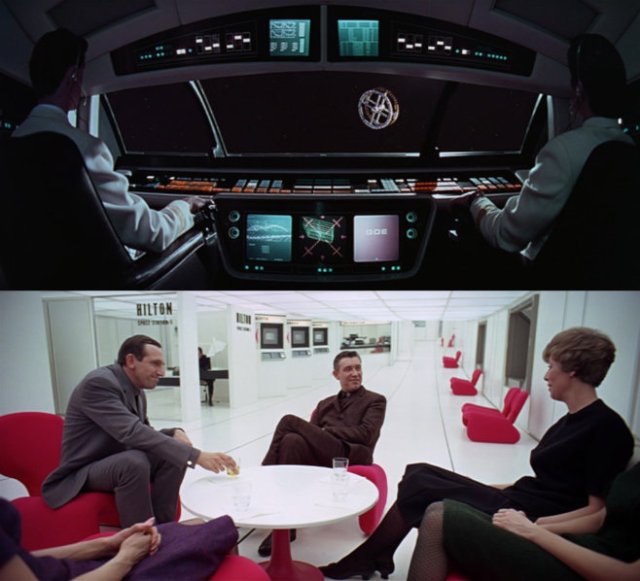
Shuttle flight deck, top; space station interior, bottom. “2001: A Space Odyssey” (1968)
A tip of the hat to Anthony Stevens, whose recent op-ed started me thinking about this week’s topics.
“NoMoNASA“ Anthony Stevens, Anthony Stevens’ Weblog (November 25, 2022)
I’ll be talking about ideas that didn’t work out, or haven’t yet; three cool single-stage-to-orbit vehicles, including one that flew; and, finally, looking back and ahead. Or, rather, the other way around.
Plus, I’ve included short videos showing Skylon, the VentureStar, and a test flight of the McDonnell Douglas DC-X Delta Clipper prototype.
Watching the news during a meal. “2001: A Space Odyssey” (1968)
Stanley Kubrick may not have known more about technology than the average film director, but he had the good sense to ask folks who did. I gather that’s why so much tech in his “2001: A Space Odyssey” (1968) looks familiar.
On the other hand, today’s chatbots aren’t nearly as smart as the film’s HAL 9000.
In the late 1960s, when “2001” was made, many computer scientists figured that we’d have human-like artificial intelligence within a few decades. Then they tried developing systems with human-like artificial intelligence, and that’s another topic.1
One reason we don’t have spaceships like the ones in “2001” is, arguably, because we’ve found unexpected technical problems along the way.
But I’m pretty sure we could have had equivalents of the film’s fully-reusable Orion shuttle by now. Along with at least one thriving boom town on Earth’s moon, and nuclear powered interplanetary ships like Discovery One.
We could, that is, if our world’s history had been different during the last 54 years.
“…Technology, however, does not proceed in isolated fashion, separated from the surrounding social, cultural, and economic environment….” (“The Path to the Space Shuttle: The Evolution of Lifting Reentry Technology,” Introduction, Dr. Richard P. Hallion, (November 21, 1983) An AFFTC Historical Monograph, History Office; Air Force Flight Test Center)
I’d add “political” to Dr. Hallion’s list, although that’s arguably covered in his social and cultural categories.
A Fictional Spaceplane and Silbervogel, a Proposed Long-Range Bomber
Orion III spaceplane riding booster stage “2001: A Space Odyssey” (1968)
The “2001: A Space Odyssey” spaceplane looks a lot like Eugen Sänger and Irene Bredt’s Silbervogel long-range bomber concept. To me, at any rate.
Silbervogel (Silverbird) concept sketch. (1944)
If that’s so, I don’t blame Kubrick and the folks publicizing “2001” for not highlighting where the filmmakers got their ideas for the shuttle.
The Silbervogel — “Silverbird” in German — had been part of Nazi Germany’s Amerikabomber program. That sort of publicity Metro-Goldwyn-Mayer didn’t need.
The Silbervogel would have been launched from a three kilometer long rail, just shy of two miles, accelerated to about 1,930 kilometers per hour by a sled drive. Then its rocket engine would take it to an altitude of 145 kilometers, 90 miles.
At that point, the Silbervogel would be going about 21,800 kilometers an hour.
That’s not quite orbital velocity, so the aircraft would drop back to the stratosphere, bouncing off our atmosphere’s denser layers. Then the Silbervogel would arc along until it hit the stratosphere again.
Its the same basic principle used in stone skipping.
A prototype Silbervogel was never built.
Which is probably just as well.
Seems that Sänger and Bredt’s mathematical model for reentry was a bit off.
As designed, the aircraft’s heat shield, along with the airframe, would have melted during its first reentry.
Correcting that problem would have let the heat shield — and the Silbervogel — survive. But the added weight would have made it dubiously useful as a bomber.2
Skip Entry
Graph showing Apollo and Orion altitude/range reentry paths. NASA (2021)
If skip entry — non-ballistic entry in geek-speak — sounds familiar, maybe you read about it in coverage of Artemis I’s return last Sunday.
It’s what Orion, the Artemis crew capsule, uses to reduce stress during reentry.
The Silbervogel’s skip entry would have given it a range of between 9,000 and 24,000 kilometers, 12,000 to 15,000 miles.
That’s enough to carry it halfway around the world. Or would have been, once the aircraft’s heat shield was beefed up, and new technologies developed.3
But that didn’t happen.
Backing up a bit, the Silbervogel wasn’t the first proposed hypersonic vehicle.
Max Valier and the 1920s
Max Valier was born in Tyrol, Austria, Austria-Hungary, and Italy. Take your pick. That particular bit of real estate has changed hands and names a few times since 1895. I think it’s currently part of Italy.
Anyway, Max Valier was a technician, scientist, publicist or science fiction writer. Which of his many hats gets attention depends on who’s talking.
Or, my view, he was all of the above.
He also had what I see as a very good idea.
Along with some that were impractical for all but a few applications. Although his rocket-propelled cars might have helped raise interest, and funding, for his rocket-propelled transatlantic aircraft.
Valier’s idea was to design and built a series of aircraft, starting with what in the 1920s would have been cutting-edge propeller driven airliners with auxiliary rocket engines.
Then, step-by-step, each new version would get more of its power from rockets and have faster cruising speeds. Eventually, the airliners would be entirely rocket-propelled. And have top speeds that would make going into orbit an option.
That was Mas Valier’s idea.
I think it made sense. Back in the 1920s, demand for fast transatlantic passenger service was on the horizon.
Funding research and development with profits from Valier rocketliner passenger services might have been practical. After the Great Depression, anyway.
That didn’t happen, either. Max Valier stopped living, abruptly, in 1930. He had been a bit too close to an exploding rocket engine.
Instead, we got World War II, the Cold War and the Space Race. The latter fast-tracked a series of crewed expeditions to Earth’s moon.4
I don’t think the Apollo program was a mistake. Given the circumstances, it made sense.
But it did mean skipping over development of economically viable launch vehicles.
Hopes, Dreams and Weather Satellites
Max Valier’s incremental development of suborbital and low Earth orbit rocketliners wasn’t entirely forgotten, however.
In R. A. Heinlein’s “Rocket Ship Galileo” (1947), for example, a professor and his youthful assistants refit a mail rocket with a thorium nuclear pile. Then, using zinc as propellant, they fly to the moon.
Heinlein was often careful when it came to science and technology in his stories, so I figure his novel’s vehicle might have reached the moon.
But I doubt that more than a very few folks could afford a DIY nuclear spaceship. And I am about as certain as I can be that leaving a trail of radioactive zinc would have broken several laws: by the time the technology became available, at least.
Even so, it was a good story.
Now, going back what we got instead of Max Valier’s gradual development of low Earth orbit passenger and freight service.
The Space Shuttles, while the fleet was in service, were partially re-usable; which made lofting equipment and people into space a trifle less ruinously expensive.
But there weren’t enough Shuttles to satisfy demand for launch services.
In the 1980s there weren’t as many communications, navigation, weather and other Earth observation satellites as there are today. But we’d learned how useful they could be.
That warranted development of single-use launch vehicles ranging from Japan’s SS-520 to America’s Saturn V.
And standardized miniature satellites like CubeSats — are yet another topic.
As for the hopes and dreams of folks like Max Valier and stories like “Rocket Ship Galileo,” I see significant connections between science fiction and the history of aerospace tech.5
Single-Stage-to-Orbit: Two That Never Flew, One That Did
From a summary of scramjet technology in development. NASA (2006)
We still don’t have an equivalent of Max Valier’s rocketliner. But we’re getting closer to a single-stage-to-orbit spaceplane’s test flights.
I’ll be taking a quick look at two of my favorites. And the McDonnell Douglas DC-X: which isn’t a spaceplane, but did make several test flights.6
Skylon
(video, music 6:45)
Reaction Engine Limited’s Skylon hasn’t been the only only air-breathing single-stage-to-orbit spaceplane that made it past concept art.
But it’s the only one I’ve been following that’s still in development. I think it helps that Reaction Engines Ltd. offers products and services that are available today.
The basic idea behind Skylon and other air-breathing spaceplanes is using oxygen in Earth’s atmosphere for the first few minutes of flight. Then, in Skylon’s case, at Mach 5 or so the spaceplane’s engines switch over to oxygen stored in its tanks.
That means less oxygen for Skylon to carry onboard, and more payload/cargo capacity.
It’s smart, efficient, and requires technology we don’t have yet. The last I heard, Reaction Engines Ltd. is still developing Skylon’s SABRE engines.7
Venturestar and X-33
(video, music 9:13)
Linear Aerospike XRS-2200 engines being tested at Stennis Space Center, Mississippi. (2001)
I like the The Lockheed Martin VentureStar. A lot.
It looks cool, and its linear aerospike rocket engine is cool technology. Or will be, once it’s out of the research and development stage.
I figure that’ll happen, eventually. A linear aerospike rocket engine is a close cousin to the aerospike or plug nozzle rocket engine.
In both cases, instead of burning fuel and oxidizer inside a roughly bell-shaped tube, aerospike rocket engines do their combustion on the outside of a roughly cone-shaped spike. Or, for a linear aerospike, on either side of a tapered bar.
Maybe that sounds crazy, but it works.
Or did, at any rate, when the folks at NASA mounted half of an X-33 lifting body mockup with a linear aerospike on an SR-71 Blackbird. That was in 1998.8
Nozzle Shapes, Ideal and otherwise
The ideal shape for a rocket engine’s nozzle changes as air pressure changes.
Eventually someone may develop a bell nozzle rocket engine that changes shape as air pressure changes.
How, I’ve no idea, since we keep today’s engine nozzles from melting by running comparatively cool fluid through them. The plumbing’s complicated as it is.
Aerospikes would be the right shape at all altitudes and pressures, since the outer wall of the combustion chamber is the burning fuel-oxidizer mix. And, while in at atmosphere, the surrounding air.
Keeping the aerospike from melting can be tricky. I gather that’s one reason the Lockheed Martin and NASA folks decided to go with the X33/VentureStar linear aerospike.
The McDonnell Douglas DC-X, the prototype test model for its Delta Clipper, had the elegant lines of a pallet tank.
The roar of its engines would have given noise abatement activists conniptions.
I think it was the closest we’ve come to a commercially viable single-stage-to-orbit vehicle.
McDonnell Douglas saw the Delta Clipper as a cargo carrier. Which is a good thing, since it would have reentered Earth’s atmosphere nose-first: leaving passengers hanging head-down, barring a rotating passenger section.
The DC-X and Delta Clipper needed no next-generation technology.
The DC-X test vehicle flew, landed and was prepped for its next flight by a crew of 38; operating out of a 40-foot trailer. Turnaround time was around 26 hours.
The idea was to develop a workhorse cargo ship, and show that operating a freight run to low Earth orbit could be as straightforward as any other long-distance freight service.
Then, thanks at least in part to NASA’s increasing role in DC-X development, the prototype was refitted with new technologies.
The DC-XA, renamed the Clipper Graham, flew four more times.
On its fourth and final flight, July 31, 1996, the Clipper Graham took off and flew perfectly. But only three of the craft’s landing legs deployed.
That wasn’t enough to keep the DC-XA upright. So when the engines stopped it fell over, caught fire and was destroyed.
One version of what happened was that NASA’s demands for new technology and paperwork hadn’t set well with the DC-XA crew. Neither had on-again/off-again funding and threats of cancellation. And that was the end of the Delta Clipper.
But not the end of folks having a shot at turning cargo and passenger service to low Earth orbit into an extension of our existing transportation network.10
Our Moon, Mars and Someday the Stars
(Spaceport America, southern New Mexico. (2017))
A few decades after Max Valier’s shared his dreams of transatlantic rocketliners, passenger and freight air service between Europe and Americas was routine.
A century later, air travel isn’t newsworthy unless something goes spectacularly wrong.
Assuming that the 2020s are pretty much like the 1920s, I could also assume that a few decades from now we’ll have routine spaceline flights on the Earth-Luna run. And that a century from now the first expeditions will be returning from the Alpha Centauri system.
That, I am quite sure, won’t happen. Not over the next century.
I figure that transatlantic air service of the 1930s was possible because there were already comparatively wealthy countries on both sides of the ocean.
Right now, there’s nobody living on Earth’s moon. That will very probably change in a decade or so.
But Lunar settlements NASA and other space agencies are planning sound like today’s Antarctic bases. I think we’re a long way from settlements that will grow into cities like Boston and Charleston. More than a few decades, anyway.
That said, I think that we will keep visiting our moon, follow robotic pathfinders like Perseverance and New Horizons, and find reasons for settling down on or at least near other worlds.
And that some of us will look at this wonder-filled universe and remember wisdom we’ve been passing along through the millennia.
“What are humans that you are mindful of them, mere mortals that you care for them? “Yet you have made them little less than a god, crowned them with glory and honor.” (Psalms 8:5–6)
“Terrible and awesome are you, stronger than the ancient mountains.” (Psalms 76:5)
“Yours are the heavens, yours the earth; you founded the world and everything in it.” (Psalms 89:12)
“Indeed, before you the whole universe is like a grain from a balance, or a drop of morning dew come down upon the earth.” (Wisdom 11:22)
Historical Perspective, Technology and the Kardashians
“The Bosses of the Senate” cartoon by Joseph Keppler. (1889)
I think the folks at McDonnell Douglas had the right idea, keeping their Delta Clipper’s tech simple. And letting flight and ground crews concentrate on doing their jobs.
But I can see the NASA brass viewpoint, too. Part of NASA’s job is developing new technology, so tricking out the DC-X probably made sense to them.
As for demanding paperwork (apparently) above and beyond the call of reason? NASA is part of a bureaucracy. A government bureaucracy, at that. Paperwork is inevitable.
So, maybe, was cancellation of both the DC-X and X-33/VentureStar programs.
The first because it was far too straightforward for NASA at the time.
The second because developing linear aerospike technology involved more cost and time than NASA could afford. Or sweet-talk Congress into supporting.
The good news, as I see it, is that folks like Elon Musk are still allowed to try using what’s already been invented, develop new technology, and — eventually — make the Earth-to-orbit run as routine as transpacific flights are today.
That, again as I see it, is a good reason for letting individuals earn more wealth than I’ll ever see.
Although putting up with ‘Kardashian’ headlines is an annoyance.
But if it also means that we get individuals like Andrew Carnegie, Jacques Cousteau and Elon Musk? That, arguably, is worth the annoyance.
On the other hand, I know why we changed the rules, back when folks were getting fed up with train wrecks and exploding boilers. And with those 19th-century American businessmen who acted as if America’s Congress was on their payroll.11
I think both laissez faire capitalism and no-hold-barred socialism look good on paper. And that neither is a good idea.
I’ve talked about that, technology, spaceships and being human before. Often:
“The Problem of Space Travel: The Rocket Motor,” Hermann Noordung (Herman Potocnik) (1929); Edited by Ernst Stuhlinger, J. D. Hunley, Jennifer Garland; Translation from German to English of “Das Problem der Befahrung des Weltraums, Der Raketen-Motor” by SCITRAN Santa Barbara, California; The NASA History Series (1995)
“Lockheed Martin X-33“ Monroe Conner, NASA (February 17, 2016; Last Updated: Aug 6, 2017)
NTRS — NASA Technical Reports Server
“Overview of NATO Background on Scramjet Technology;” Philip Drummond (NASA Langley Research Center Hampton, VA, United States), Marc Bouchez (MBDA Bourges, France), Charles R. McClinton (NASA Langley Research Center Hampton, VA, United States)(2006)
Jupiter, its rings and two moons: Amalthea and Adrastea. Image from JWST’s NIRCam.
The James Webb Space Telescope (JWST) took that image of Jupiter, its rings and moons, a few months back. Aside from being, as one of my daughter’s noted, “shiny,” the picture gives scientists a new look at the Solar System’s largest planet’s cloud-tops.
It also gives them more data than they’d expected, which is mostly good news; but not entirely. I’ll get back to that.
…’We hadn’t really expected it to be this good, to be honest,’ said planetary astronomer Imke de Pater, professor emerita of the University of California, Berkeley. De Pater led the observations of Jupiter with Thierry Fouchet, a professor at the Paris Observatory, as part of an international collaboration for Webb’s Early Release Science program. Webb itself is an international mission led by NASA with its partners ESA (European Space Agency) and CSA (Canadian Space Agency). ‘It’s really remarkable that we can see details on Jupiter together with its rings, tiny satellites, and even galaxies in one image,’ she said….” (“Webb’s Jupiter Images Showcase Auroras, Hazes,” Alise Fisher, James Webb Space Telescope, NASA Blogs (August 22, 2022))
I stayed slightly-focused this week, which is slightly surprising. Considering what’s been going on. I talk about that under And Now for Something Completely Different:
JWST and Infrared Light: Making the Invisible Visible
The Webb Telescope team and full scale model of the James Webb Space Telescope. (September 2005)
Jupiter doesn’t really look like that, not to our eyes.
But it really is a picture of Jupiter: not a frozen pizza or sausage slice. I talked about a slice of choizo, a “top scientist” and consequences of posting during cocktail hour a few months back. (August 7, 2022)
Jupiter looks the way it does in that NIRCam picture because JWST used two of NIRCam’s 29 filters: F212N and F335M.
F212N lets infrared light from about 2.1 to 2.15 microns through to the imager.
F335N lets light from around 3.15 to 4 microns through.
Some folks say “microns,” some say “micrometers;” they both mean μm: 1×10⁻⁶ meter, and it’s a very short distance. But even so, infrared wavelengths are longer than those of light we see directly with our eyes.
Richard Hueso of UPV/EHU, Judy Schmidt and the folks at NASA and ESA made the JWST Jupiter images visible by assigning data from the two filtered images to colors we can see.
They showed F212N data as orange and F335M as cyan.
Now, about those acronyms. UPV/EHU stands for University of the Basque Country, ESA is the European Space Agency and NASA is the National Aeronautics and Space Administration.
NIRCam isn’t quite an acronym. It’s the what folks call the JWST’s Near Infrared Camera. It sees wavelengths from 0.6 to 5 microns.1
HIP 65426 b: First Exoplanet Imaged by JWST
Exoplanet HIP 65426 b, in several infrared ‘colors. “☆” marks the star HIP 65426’s position.
The star HIP 65426 is very roughly twice as massive as our sun. It’s one and three-quarters times as large.
Putting it another way, HIP 65426 is a bit less massive but as big, as Sirius, and a bit cooler.
HIP 65426 is a main sequence A2 star, Sirius is a main sequence A0.
That’s Sirius A. Sirius B is a white dwarf star, with about our sun’s mass packed into a sphere about Earth’s size: 12,000 kilometers, 7,500 miles. Sirius is the brightest star in our night sky because it’s fairly close, 8.6 light-years.
HIP 65426 is about 356 light-years away, in the general neighborhood of Zeta and Xi2 Centauri, so we can’t see it without a telescope.
HIP 65426 b is about half again as big as Jupiter, with eight or nine times Jupiter’s mass. It’s very roughly as far from HIP 65426 as Eris is from our sun.
The JWST images up there were taken by NIRCam, I talked about that before; and MIRI. MIRI, Mid-Infrared Instrument, that sees wavelengths from five to 28 microns.
HIP 65426 b looks like three longish blobs in NIRCam images because of oddities in NIRCam’s system. The planet’s almost certainly roughly spherical.
Apart from that, it’s early days to say anything definite about HIP 65426 b, although we’ve known a little about it since 2017. JWST images and spectral analysis have given scientists a great deal more data. And that, in a way, is a problem.
What we do know is that HIP 65426 b doesn’t fit today’s models of how giant planets form. What we don’t know includes just what to make of JWST’s detailed spectra.2
WASP-69 b and “Exquisite Data” — in Huge Quantities
JWST spectra of WASP-96 b, showing water in the giant planet’s atmosphere.
“Good science takes time.
“That’s not a popular refrain in our 24-hours news cycle — especially when there’s a new space telescope returning crystal-clear views of the infrared universe nearly every day. But for astronomers drinking from the firehose that’s coming from the James Webb Space Telescope, time is exactly what they need.
“Webb’s Early Science Release program has been delivering exquisite data on a variety of celestial targets. Some of the most anticipated of these are the spectra of exoplanets. But a study in Nature Astronomy urges caution in interpreting these chemical fingerprints of alien worlds….” (“Webb’s Exoplanet Data Are Almost Too Good,” Monica Young, Sky and Telescope (September 20, 2022))
We know that WASP-96 b’s atmosphere contains water, along with hydrogen, helium and a little sodium. What we don’t know is exactly how much of each substance is there.
WASP-96, WASP-69b’s sun, is a K5 main sequence star. It’s a little smaller and cooler than ours and a tad richer in heavy elements.
WASP-96 b has about as much mass as Saturn, but is just a little smaller than Jupiter. That’s very likely because it’s so close to its sun, completing an orbit in about 94 hours.
Scientists figure WASP-96 b is losing mass, but not fast: about half an Earth-mass every billion years. But so far, they haven’t spotted a comet-like tail streaming from the planet.3
WASP-39 b: a Hot Jupiter and/or Saturn
Three light curves, showing change in brightness as WASP-39 b passes in front of its star.
WASP-39 is about 750 light years away, give or take. It’s a main sequence G8 yellow dwarf. Our sun is spectral class G2.
It’s in the general direction of Phi Virginis, but more than five times more distant. WASP-39, I mean, obviously. Our star is right next door.
I’ve seen WASP-39 b called a hot Jupiter and a hot Saturn. Both labels make sense, since the planet’s about as big as Jupiter and has roughly the same mass as Saturn.
But it’s hotter than either.
WASP-39 b is about 4,517,650 miles from its sun, compared to 43,317,410 miles for Mercury’s distance from our sun.
WASP-39 is a tad cooler than our star: 5,400 K to old Sol’s 5,770 K. That makes WASP-39 b hot, around 1100 K: or 1,600 degrees Fahrenheit, 900 degrees Celsius.
“K” in this context is geek-speak for degrees Kelvin. That’s the International System of Units temperature unit, starting at absolute zero. K temperatures used to be related to the Celsius scale, where zero degrees is water’s freezing point. But since 2019, it’s been —
“…defined by fixing the Boltzmann constant k to be exactly 1.380649×10⁻²³ J⋅K−1. Hence, one kelvin is equal to a change in the thermodynamic temperature T that results in a change of thermal energy kT by 1.380649×10⁻²³ J….” (Kelvin, Wikipedia)
— none of which makes much difference in my daily routines.
Fahrenheit, the temperature scale my country uses, defines zero degrees as the freezing point of brine made from water, ice, and ammonium chloride. Probably.
I gather that there are a few versions of how the Fahrenheit scale started.
At any rate, WASP-39 b is a hot gas giant, whipping around its star every about 98 hours or so, with water, carbon dioxide, sodium and sulfur dioxide in its atmosphere.4
Two ‘Firsts’ — Carbon Dioxide; and Sulfur Dioxide, Evidence of Photochemistry
WASP-39 b: “first clear evidence for carbon dioxide in a planet outside the solar system.”
I’m running out of time, again, for reasons I’ll get back to: so instead of rehashing my source material, I’ll just slap down a few excerpts and move along.
“…Early Release Science Programs for Solar System Science Early Release Science (ERS) programs were developed by STScI and the JWST Advisory Committee to showcase the capabilities of JWST and help familiarize the broader scientific community with the functionality and data products of the spacecraft’s instrument suite. These observations are scheduled to take place during the first five months of JWST science operations. The ERS programs have no proprietary period, ensuring timely dissemination and analysis of results….” (“JWST — Solar System Science ,” Astrochemistry Laboratory/Code 691, JWSTSSS, Science and Exploration Directorate, NASA (Last Updated: November 30, 2022))
Basically, folks running the JWST and STScI (Space Telescope Science Institute) are trying something new. Fairly new, anyway.
Instead of hanging onto data for a while, only letting a few privileged individuals and groups see what’s new, JWST and STCcI have been releasing new observations as they come in from the JWST.
I think that’s a good idea, partly because my personal experiences haven’t encouraged admiration for ‘good old boy’ networks.
On the other hand, I haven’t learned just how many folks get early access. Looks like there is an “early release list” of sorts, probably limited to scientists who’ve demonstrated both interest and ability in analyzing this sort of data.
“…A group of exoplanet experts won a coveted spot on the early release list, and the five studies on WASP-39b are part of that effort. Astronomers had already observed WASP-39b with several ground- and space-based telescopes, and it was visible at the start of science operations, making it a perfect target for immediate observation.
“The studies focus on WASP-39b’s atmosphere. JWST observed this planet at near-infrared wavelengths using three instruments — one camera, one spectrograph, and one instrument that’s a combination of the two.
“The first study was released in August 2022, reporting carbon dioxide in the planet’s atmosphere. The Spitzer Space Telescope had previously hinted at the gas’s presence, but JWST’s Near Infrared Spectrograph saw a much clearer signature, verifying the detection for the first time on an exoplanet.
“In other papers, the astronomers note sulfur dioxide in the atmosphere, which is evidence that radiation from the host star is interacting with the molecules in the atmosphere. This is the first time such photochemistry has been observed outside the solar system….” (“Webb Telescope Surveys a Hot Saturn,” Arwen Rimmer, Sky and Telescope (December 2, 2022))
A couple more points.
Carbon dioxide in a planet’s atmosphere isn’t unheard of. But this is the first time it’s been detected in an exoplanet’s atmosphere.
And sulfur dioxide in WASP-39 b’s atmosphere very strongly suggests that photochemical reactions are happening there.5
Part of the trick now will be learning how much of each substance is in WASP-39 b’s atmosphere, and that’s another topic. One I’ll leave for another time.
TOI-3757 b: The Incredible Marshmallow Planet
TOI-3757 b is a super-puff planet, with a mass not much more than Earth’s, but a radius greater than Neptune’s. What I take to be reliable numbers say its density is 0.27 grams per cubic centimeter.
That, I gather, is about as dense, on average, as a marshmallow.
I’m also not entirely sure that TOI 3757 b really is the least-dense exoplanet we’ve spotted.
Some sources gave its density in terms of grams per cubic feet, which struck me as at best an odd mix of measurement systems.
We’ve spotted other super-puff planets: WASP-17 b and Kepler-51 b, c, and d, for example.
Since I don’t have time this week to both find and conform numbers and ‘do the math,’ I’ll accept the assertion that TOI 3757 b is about as dense as a marshmallow. Which is pretty cool.
Or, more accurately, hot. Probably 759 K, if scientists’ calculations are right. That’s 486 Celsius, 906 Fahrenheit. That’s hot enough to melt either lead or zinc.
TOI-3757 b is around 580 or 590 light-years out, in the general direction of Delta Aurigae. It has roughly Saturn’s Mass, but is a little bigger than Jupiter. The planet’s year less than 82 hours long, putting it about 3,574,150 away from its sun.
NASA says its star, TOI-3757, is spectral class K. Which makes sense, since the surface temperature of class K stars is between 3,900 and 5,300 K. The Extrasolar Planets Encyclopaedia, Exoplanet.eu, says TOI-3757’s temperature is 3913 K.6
A Little Science
I really will get back to why I’m scurrying this week.
But first, what scientists are doing when they look at data from the JWST. Well, part of what they’re doing.
Spectroscopy or spectroscopic analysis sounds very scientific and technical. And it is.
But it’s not all that different from what we do every day when we look at something and decide that it’s water, or concrete, or chocolate milk.
Different sorts of stuff reflect or absorb light differently. Chocolate milk, for example, reflects more low-frequency visible light than the higher frequencies. Not that we think of it that way. When we talk about it at all, we generally say ‘it’s brown.’
The same principles apply to studying light — visible, infrared or otherwise — from exoplanets, although spectroscopy involves numbers, where our built-in visual system seems to just work.
A Hubble press release included a pretty good description of what scientists and the JWST do when they’re learning what’s in distant atmospheres.
“…To determine what’s in the atmosphere of an exoplanet, astronomers watch the planet pass in front of its host star and look at which wavelengths of light are transmitted and which are partially absorbed….” (“Hubble Traces Subtle Signals of Water on Hazy Worlds,” Rob Garner, Hubble, Goddard Spaceflight Center, NASA (December 3, 2013; Last Updated August 7, 2017))
Oddly enough, studying the spectra of light that’s been transmitted through a substance is called absorption spectroscopy, not transmission spectroscopy.7
And Now for Something Completely Different
And now, finally, I’ll talk about why I’ve been scurrying this week.
Maybe “scurrying” isn’t the right word. Jittering, maybe? Distracted? Preoccupied? Never mind.
I’ve talked about what’s behind what’s been happening before.
So feel free to skip down to the inevitable links, take a walk, or do whatever.
First, the good news. Some of my health — physical and mental — issues are more manageable now than they would have been back in the ‘good old days.’ Some of my mental health issues involve physical health, and that’s yet another topic.
The point is that my ‘what’s wrong with me’ list is mildly extensive. Details vary over time and, I suspect, updates to the DSM, but items have included:
ADHD: Attention deficit hyperactivity disorder, inattentive type
ASD: Autism spectrum disorder
Cluster A personality disorder
GAD: Generalized anxiety disorder
PDD: Persistent depressive disorder
PTSD: Post traumatic stress disorder
The not-so-good news is that my disorders are real, and inconvenient. Putting it mildly. And, I nearly forgot, this week’s checkup’s followup includes another blood test next week.
I’m not looking forward to that, but realize that it’s a good idea.
Back to good news, this isn’t the 1960s. Treatments for ADHD, for example, are available.
But some of the treatments have a bit of not-so-good news as part of the package.
Doing What I Can
Depression, as shown by Spooner and Van Gogh.
I’d prefer having problems that could be resolved with a nice chat, followed by deciding that everything will be just fine.
If it was that easy, I’d have been perfectly perfect in my teens.
It isn’t, I wasn’t, and I’m still not.
So, quite a few years back, after trying other alternatives, a psychiatrist suggested that I consider methylphenidate.8 It’s a central nervous system stimulant that can help folks like me deal with ADHD.
It’s also arguably over-prescribed, and definitely addictive.
I knew that once I started taking it, stopping would be unpleasant. At the time, I knew the risks and thought that the benefit/risk balance favored starting the medication.
I hadn’t realized how often I’d experience withdrawal as a result.
Methylphenidate, you see, is a controlled substance. Federal rules being what they are, I need a new authorization each moth for the next month’s supply.
Sometimes the authorization gets lost in the mangle. Sometimes, more recently, local pharmacies can’t get the medication. That’s been happening more often, apparently due to pandemic-related supply chain SNAFUs.
But I still think the benefit/risk balance is favorable. I like being able to use my brain without metaphorically fighting the machinery.
Dealing With the Occasional SNAFU
This month, I hit the jackpot. The pharmacy tried requesting authorization four times before getting the paperwork.
And then they didn’t have methyphenidate in stock. Or any of many related medications. I don’t envy them.
When I realized that an authorization snarl was in progress, I put myself on half-doses. I’ve been taking only the ‘morning’ methylphenidate tablet this week.
That way, I could keep going until Monday before running out, and withdrawal would be somewhat less unpleasant.
Finally, good news. When I checked, Friday afternoon, on the pharmacy’s shipment status: they had received the medication I need. I’ll be picking it up shortly.
Okay. I’m back.
Cultural assumptions being what they are, I’d better explain why I’m not ‘trusting God.’ And/or not writhing in agony over my presumed guilt for not being perfectly healthy.
Basically, it’s because life is a ‘precious gift’ from God. So is health. Getting and staying healthy is a good idea. Within reason. Even taking painkillers is okay. Again, within reason. (Catechism, 1506-1510, 2279, 2288-2289, 2292)
“Probing the atmosphere of WASP-69 b with low- and high-resolution transmission spectroscopy“ S. Khalafinejad, K. Molaverdikhani, J. Blecic, M. Mallonn, L. Nortmann, J. A. Caballero, H. Rahmati, A. Kaminski, S. Sadegi, E. Nagel, L. Carone, P. J. Amado, M. Azzaro, F. F. Bauer, N. Casasayas-Barris, S. Czesla, C. von Essen, L. Fossati, M. Güdel, Th. Henning, M. López-Puertas, M. Lendl, T. Lüftinger, D. Montes, M. Oshagh, E. Pallé, A. Quirrenbach, S. Reffert, A. Reiners, I. Ribas, S. Stock, F. Yan, M. R. Zapatero Osorio, M. Zechmeister6; article A142; Astronomy and Astrophysics; (Received April 27 2021; Accepted August 24, 2021; December 2021 issue) via EDP Sciences
“TOI-3757 b: A Low-density Gas Giant Orbiting a Solar-metallicity M Dwarf“ Shubham Kanodia, Jessica Libby-Roberts, Caleb I. Cañas, Joe P. Ninan, Suvrath Mahadevan, Gudmundur Stefansson, Andrea S. J. Lin, Sinclaire Jones, Andrew Monson, Brock A. Parker, Henry A. Kobulnicky, Tera N. Swaby, Luke Powers, Corey Beard, Chad F. Bender, Cullen H. Blake, William D. Cochran, Jiayin Dong, Scott A. Diddams, Connor Fredrick, Arvind F. Gupta, Samuel Halverson, Fred Hearty, Sarah E. Logsdon, Andrew J. Metcalf, Michael W. McElwain, Caroline Morley, Jayadev Rajagopal, Lawrence W. Ramsey, Paul Robertson, Arpita Roy, Christian Schwab, Ryan C. Terrien, John Wisniewski, Jason T. Wright; The Astronomical Journal, Volume 164, Number 3 (August 5, 2022) via IOP.org
“Grams per cubic foot??” I’m hoping at least some will have fixed this by the time you check
The Webb Telescope team and full scale model of the James Webb Space Telescope. (September 2005)
NASA launched the James Webb Space Telescope (JWST) December 25, 2021.
By July of 2022, the JWST had settled into position at the Sun-Earth L2 Lagrange point: about 1,500,000 kilometers, 930,000 miles from Earth.
Then, after deploying its heat shields and mirrors, the JWST started sending back remarkable images.1
And, even more remarkable, it was still called the James Webb Space Telescope. I’ve no idea why NASA didn’t admit their mistake and submit an acceptable name. Particularly when ‘everybody knows’ that James Webb was one of THOSE people:
Then, last month, NASA admitted that James Webb had been a federal employee during the late 1940s to early 1950s lavender scare. And that he’d tried to limit Congressional access to the Department of State’s personnel records.2
McCarthyism — and Why I Don’t Miss the ‘Good Old Days’
Considering what had been happening to insufficiently anti-communist Americans during McCarthyism’s heyday, I’m mildly surprised that James Webb hadn’t been blacklisted as a communist agent. Or a fifth columnist, fellow traveler or maybe even a card-carrying communist!
Lack of zealous cooperation with outfits like the House Un-American Activities Committee wasn’t prudent back then.
But NASA couldn’t find evidence that James Webb had plotted against LGBTQI+ in general or GS-14 budget analyst Clifford J. Norton in particular.
On the other hand, he had been NASA’s administrator from February 14, 1961, to October 7, 1968.
And Clifford J. Norton had been fired from NASA in 1963, after he’d been arrested by Washington, D.C., police for making a “homosexual advance.” That arrest, and the investigation which followed, was enough to get Norton fired.3
Yesteryear’s Attitudes
Cultural mores, U.S. Civil Service rules and Cold War jitters of 1963 made due process irrelevant: my opinion.
This excerpt from a 1969-70 analysis of the Clifford J. Norton situation isn’t easy reading, but arguably shows a bit of what life was like in early 1960s America.
“…In a recent policy statement, the [United States Civil Service] Commission stated: ‘Persons about whom there is evidence that they have engaged in or solicited others to engage in homosexual or sexually perverted acts with them, without evidence of rehabilitation, are not suitable for Federal employment.’… “…The Commission’s position appears to reflect the sentiments of Congress for, as the Subcommittee on Investigations of the Senate Committee on Expenditures in the Executive Departments has stated, ‘homosexuals and other sex perverts are not proper persons to be employed in Government for two reasons; first, they are generally unsuitable, and second, they constitute security risks.‘…” (“Federal Employment of Homosexuals: Narrowing the Efficiency Standard;” Catholic University Law Review, 19 Cath. U. L. Rev. 267 (1970)) [emphasis mine]
Oi. A brief digression about “security,” real and imagined.
There were, I think, real threats to national security in the 1960s. That said, by the 1970s, I’d become weary of hearing “national security” invoked: seemingly whenever some bigwig was either having having a snit, or pushing some pet project.
I see the same thing happening today, with different slogans.
Now back to that Norton thing.
“…The primary questions presented for review by the appellant were whether he was afforded procedural fairness, and whether the evidence was sufficient to sustain the agency’s charges. The appellant also questioned the inference that his removal would promote the efficiency of the service. The court ignored the appellant’s primary questions and concerned itself with the issue of whether the appellant’s presumed homosexual advance and personality traits constituted such cause for removal as would promote the efficiency of the service….” (“Federal Employment of Homosexuals: Narrowing the Efficiency Standard;” Catholic University Law Review, 19 Cath. U. L. Rev. 267 (1970)) [emphasis mine]
Ideally, I suppose the administrator of NASA would have known each employee and been fully aware of why a particular employee was hired or fired. And been able to successfully defy both civil service policy as it was in 1963, and Congressional attitudes.
I don’t know how many folks worked for NASA at the time. This year’s headcount was 17,960; in 1963 the Space Race was in progress, so I’d be surprised if NASA staff was much smaller back then.
Maybe James Webb knew all about C. J. Norton’s firing, and either couldn’t or wouldn’t defy the United States Civil Service Commission and Congress to keep the GS-14 budget analyst at NASA.
Or maybe details regarding the discharge of a GS-14 budget analyst didn’t make it all the way to the top administrator’s desk.
NASA’s recent statement may end the ‘erase James Webb’ efforts.
But if enough proper people embrace the “no smoke without fire” attitude,4 this could go on for years.
Free to Agree With Me — Then and Now
Who’s proper and who’s not has changed since my youth.
In some ways, but not in others.
During my youth, America’s self-described defenders of freedom and liberty, some of them, were coming to grips with the idea that commies might not be lurking behind every door.
But I still suspect that many couldn’t quite wrap their minds around the notion that freedom of expression should extend to folks they didn’t agree with.
That was “the establishment” of my youth.
They stalwartly eroded whatever confidence they’d earned, and lost their positions of influence and authority.
Today’s self-described defenders of freedom and liberty, those who have risen to positions of influence and authority since my youth, warn against different fearsome foes.
But I don’t see much difference where it comes to feeling that freedom of expression should extend to folks who disagree with them. Or recognizing that “moral panic” isn’t just something that happens to those with unsanctioned views.5
The ‘good old days’ aren’t something I miss. During my youth, I wasn’t any more on the same page as the powers that be than I am today.
And that reminds me of a few points I haven’t talked about lately. And some that I have.
Authority, Love, and Neighbors
Growing up in the 1960s left me with an attitude: several attitudes, actually.
Among them was the notion that I had little regard for authority.
That attitude hasn’t changed, but how I understand it has. Some time ago, my wife told me that I had no problem with authority: legitimate authority.
She was right. I willingly respect authority. It’s pompous nitwits with delusions of legitimate authority that bother me.
Since I’m now a Catholic, respecting authority is important. So is using my brain. Here’s where it gets tricky.
Catholics can work with any political system; as long as the local regime supports the common good, and citizens are okay with how their country’s authorities act. (Catechism of the Catholic Church, 1897-1917, 1901, 1905-1912; “Gaudium et spes,” 28, 42, Pope Saint Paul VI (December 7, 1965))
Part of my job is working with secular authorities. Usually. Some things aren’t an option for me: like doing something bad, but with good intentions. And, like it or not, some actions are always bad ideas. (Catechism, 1750-1756, 1789, 2238-2246)
I’m being vague. I’ll explain why later.
Respect for competent authority is a good idea. Blind obedience isn’t. (Catechism, 1900, 1951, 2155, 2242-2243, 2267)
So, if loving my neighbor is important, how come I don’t agree with everything my neighbor says?
A few reasons. First, everybody’s my neighbor. Second, some of my neighbors profoundly don’t agree with other neighbors. Finally, for now,”love” isn’t “approval.” And that last is a topic that deserves more time than I’ve got this week.
Changing Fashions in Denunciation
I’d prefer living in a country where I hadn’t grown up hearing radio preachers denouncing communism and Catholicism. When they weren’t shilling the latest End Times Bible Prophecy.
Time passed. Mores and manners changed. Human nature, not so much.
I’m not fond of today’s denunciations of alleged bigots and ‘raging homophobes,’ either. An up side in the James Webb case is that he’s dead, and so his career isn’t threatened.
By the same token, I can’t yearn for the days when ranting against homosexuals and/or communists was fashionable.
Not reasonably. That’s partly because I’m not normal. I’ve talked about this before.
Eccentric, Nerd, Geek, Oddball: Take Your Pick
One of my daughters, having been asked to describe me in three words, said that I’m eccentric, scholarly and eclectic. The second term might have been “academic,” or something of the sort.
My eccentricity may or may not be occasionally entertaining: depending on who’s opinion is in play.
But it didn’t help me get jobs, not the sort that were available back in the 1970s.
Being one of the 99-plus of a hundred or so applicants who didn’t get the job each time didn’t help, either.
At any rate, a job counselor I’d been working with asked me if I was homosexual. In context, the question made sense. During the 1970s in the Upper Midwest, at any rate. Bias against homosexuals was real enough to make — I think it was still called affirmative action — an option.
And I fit the profile. I’m male, creative, articulate and not obsessed with sports.
Some four decades later, I’m not sure about “articulate” being the word used. But talking as if I had some smarts was part of the reason I fit the homosexual profile.
Maybe attitudes have shifted, and men needn’t dial their brains back in order to fit the ‘regular guy’ mold.
About my opportunity to jump-start a career, I didn’t qualify. I’m not homosexual, which is no great virtue. I’ve got issues, lots of issues: but not that particular one.
The job counselor’s question did, however, help explain a few otherwise-puzzling interactions I’d had with nice, normal folks.
Living in a Changing America
Some Americans have been imprisoned for having the ‘wrong’ ancestors, and faith-based mass murders happen.
But I don’t think the Presidency should be abolished, and I don’t see a point in labeling religious people as enemies of the state.
And, knowing a bit about Executive Order 9066, the execution of Father James Coyle, and recent mass murders: I realize that distinguishing between deadly threats to America and folks who simply aren’t quite the right sort can be difficult.
So, not surprisingly, is spotting and stopping mass murderers before they kill.
Father James Coyle’s death, by the way, was classified as murder even at the time. Although an understanding court didn’t convict the regular American who performed the private-sector execution.
Father Coyle’s crime had been performing a marriage between the son of a decent American family and a Puerto Rican woman. This was in 1921.6
I really don’t miss the ‘good old days.’
Respect, Compassion and Making Sense
America has changed in the century since Father Coyle’s death.
Much of that change happened during the half-century since my youth.
Some, I think, has been change for the better. Some hasn’t.
But human nature hasn’t changed. Certainly not in the few millennia since we started keeping records. Not as far as I can tell.
How much of that’s good news, and how much is not-so-good news, is a topic I’ll leave for another time.
Today, I’ll explain why I’m not on the ‘defame James Webb’ bandwagon. And why I’m not shrieking epithets at the anti-anti-LGBTQ+ folks.
Maybe “LGBTQ+” offends someone. If so, sorry about that. It’s the alphabet soup label NASA used, and is close to some similar terms. My intent is communication, not offense.
Anyway, I’m a Catholic. So I think human sexuality is a good thing. Basically. And that sexual actions, like anything else we do, involve ethical standards. (Catechism, 2331-2391)
I also think everyone deserves respect and reasoned compassion, not unjust discrimination. And that homosexual acts are a bad idea. (Catechism, 2357-2359)
“The number of men and women who have deep-seated homosexual tendencies is not negligible. This inclination, which is objectively disordered, constitutes for most of them a trial. They must be accepted with respect, compassion, and sensitivity. Every sign of unjust discrimination in their regard should be avoided. These persons are called to fulfill God’s will in their lives and, if they are Christians, to unite to the sacrifice of the Lord’s Cross the difficulties they may encounter from their condition.” (Catechism, 2358)
That’s homosexual acts: not experiencing such urges.
I deal with different temptations, and see no point in lashing out at folks because they’re not just like me.
I do, however, think that love is a good idea. So is acting like love matters.
Now, a quick explanation for why I’m not talking about exciting data from the James Webb Space Telescope.
Exoplanets and a Blood Test
Transit of WASP-39 b. (July 10, 2022)
I’d been looking up what we’re learning about WASP-39 b and another exoplanet that’s about as dense as a marshmallow, when I ran into discussions of why the James Webb Space Telescope’s name was naughty.
That distracted me, and was a reminder that it had been some time since I talked about why I think respect makes sense. And why I’m not on neither the alphabet-soup-sexuality bandwagon, nor in the anti-alphabet-soup camp.
Now, in an abundance of caution, a sensitive-content warning. I’ll be talking about health.
A routine blood test’s results, earlier this week, led to a second blood test. That both took time, and didn’t help me concentrate on looking up nerdy details.
Happily, my potassium level has gone down a bit since earlier this week. And it hadn’t gotten to ‘immediate treatment needed’ levels. I’ll be talking to a doctor about it next week.
So that’s why I’ve put off what we’re learning about WASP-39 b and TOI-3757 b until next week: assuming I don’t get distracted again.
Finally, the usual links:
“James Webb Space Telescope Early Results“ (Rings, Spokes and Explanations A Galaxy of a Different Color Mid-Infrared: Cool Astrophotos: More Than Pretty Pictures The Cartwheel Galaxy Group as We Might See It) (August 6, 2022)
“Taking People, Pride and Dignity Seriously: June 2022“ (Dignity, Good Intentions and Bad Ideas Acting Like Love Matters: A Good Idea Not Easy, But a Good Idea Odd Urges and Malignant Virtue “Respect, Compassion, and Sensitivity” — Makes Sense to Me) (June 11, 2022)
“I’m Not as Crazy as You Think I Moose!“ (Looking Forward to Judgment Day? The Last Judgment’s Go Time, Doomsayers: and Something from Sirach I’m Not Normal: ADHD And All That Depression and Something I Don’t Remember Taking my Medicine) (April 9, 2022)
“Evolution: Science, Religion, Opinions and Me“ (Politics and Perceptions “…Truth will be Truth….” Taking the Bible Seriously Ideology, Evolution and Demographics Seeking Knowledge, Appreciating God’s Work) (August 28, 2021)
“Atlanta Spa Shootings: Remembering Dignity“ (First Assumption: Hate Crime Second Assumption: False Flag Close Encounters of the Conspiracy Kind Next Stop: Florida? Love, Respect: and Really Bad Ideas) (March 18, 2021)
Something new each Saturday.
Life, the universe and my circumstances permitting. I'm focusing on 'family stories' at the moment. ("A Change of Pace: Family Stories" (11/23/2024))
Blog - David Torkington
Spiritual theologian, author and speaker, specializing in prayer, Christian spirituality and mystical theology [the kind that makes sense-BHG]
I was born in 1951. I'm a husband, father and grandfather. One of the kids graduated from college in December, 2008, and is helping her husband run businesses and raise my granddaughter; another is a cartoonist and artist; #3 daughter is a writer; my son is developing a digital game with #3 and #1 daughters. I'm also a writer and artist.


 The self-described “Christian” radio of my youth left me with low expectations.


![Great Seal of the United States, 'Annuit coeptis Novus ordo seclorum' 'He favors/has favored [our] undertakings - New order of the ages' (2008) rendered by Ipankonin, via Wikipedia, used w/o permission.](https://i0.wp.com/brendans-island.com/blogsource/20170721ff/20170720-Great_Seal_of_the_United_States_reverse-329.jpg?w=640&ssl=1)