Commercial Space Services and Changing Times

SpaceX Starbase in  Boca Chica, Texas, United States. 30 minutes before Starship test flight. (April 20, 2023)
SpaceX Starship, 30 minutes before test flight. (April 20, 2023)

This week I’ll talk about the SpaceX Starship and ispace test flights. Whether or not they were successful depends on who’s talking.

I’ll also look at the usual hand-wringing over threats to the status quo.


News and Views

SpaceX Falcon Heavy Demo Mission's image: Elon Musk's Tesla Roadster on the Falcon Heavy upper stage. (February 6, 2018) via Wikipedia, used w/o permission.The SpaceX Starship blew up.

I still don’t know what happened to ispace’s Hakuto-R lander.

Seeing both as failures is an option.

That may explain CNN’s “Starship’s explosion is not the failure it appears to be” headline.

And Elon Musk’s knack for getting attention, on top of being wealthier than most of us — is something I’ll get back to.


“We Will Keep Moving Forward”

ispace infographic, illustrating Mission 1 milestones. (April 2023))
Hakuto-R Mission 1 Milestones, ispace. (April 2023)

CNN’s experts weren’t named in the nine-paragraph article. But I think they’re right, and so are the folks at ispace.

Basically, ispace said that Hakuto-R Mission 1 was both a commercial and a test flight.

The lander carried the Mohammed bin Rashid Space Centre’s (MBRSC) Rashid Lunar rover; SORA-Q , a mini-rover designed by Tomy and JAXA; and Sakanaction’s “Sorato” song on a music disc.

NASA’s Lunar Flashlight mini-orbiter tagged along as a ride-on. It separated from Hakuto-R well before they reached the moon. The last I heard, the Lunar Flashlight mission was still in progress.

Carrying payloads for MBRSC, JAXA/Tomy, and Sakanaction was Hakuto-R Mission 1’s commercial mission.1 Odds are that MBRSC and the other folks won’t get as much out of their investment as they’d hoped.

As for ispace’s test flight of their Hakuto-R spacecraft, they had nine mission objectives.

They achieved eight.

I’d call that a mostly-successful test flight.

And I like the ispace CEO’s expressed attitude: “we will keep moving forward.”

Status Update on ispace HAKUTO-R Mission 1 Lunar Lander
Press Release, ispace (April 26, 2023)

“ispace, inc., (ispace) a global lunar exploration company, issued an update on the status of the HAKUTO-R Mission 1 Lunar Lander.

“The HAKUTO-R Mission 1 Lunar Lander was scheduled to touchdown on the surface of the Moon at approximately 1:40 a.m. JST. As of 8:00 a.m. JST, April 26, 2023, the communication between the lander and the Mission Control Center was lost, although it was expected even after the touchdown, and it has been determined that Success 9 of the Mission Milestones is not achievable.”Based on the currently available data, … the lander was in a vertical position as it carried out the final approach to the lunar surface. Shortly after the scheduled landing time, no data was received indicating a touchdown. ispace engineers monitored the estimated remaining propellant reached at the lower threshold and shortly afterward the descent speed rapidly increased. After that, the communication loss happened. Based on this, it has been determined that there is a high probability that the lander eventually made a hard landing on the Moon’s surface….

“…’Although we do not expect to complete the lunar landing at this time, we believe that we have fully accomplished the significance of this mission, having acquired a great deal of data and experience by being able to execute the landing phase. What is important is to feed this knowledge and learning back to Mission 2 and beyond so that we can make the most of this experience,’ said Takeshi Hakamada, Founder and CEO of ispace. ‘To this end, we are already developing Mission 2 and Mission 3 concurrently and have prepared a foundation that can maintain this continuity. I would like to thank once again all the employees who have contributed to this mission from its inception to the present, all the families who have continued to support it, and all the shareholders, HAKUTO-R partners, customers, suppliers, and many others who have continued to believe in ispace’s vision. We will keep moving forward.‘…”
[emphasis mine]


Fireball After Four Minutes: Starship’s Orbital Test Flight

SpaceX Starship on launchpad, before test flight. (April 20, 2023)
SpaceX Starship on the launchpad, Starbase, Boca Chita, Texas. (April 20, 2023)

I’m running short on time this week, so this bit will be more pictures than text.

Before Starship took off, folks at SpaceX had said that clearing the launchpad would be a successful flight.

SpaceX Starship test flight, at plus 12 seconds. (April 20, 2023)
SpaceX Starship, 12 seconds into the test flight. (April 20, 2023)

By that standard, Starship’s April 2o text flight was a resounding success. It did not explode on the launchpad.

SpaceX Starship in flight. (April 20, 2023)
One minute, 21 seconds, into Starship’s test flight. (April 20, 2023)

On the other hand, several of the Superheavy Booster’s engines weren’t working. I count six out in that screencapture, the display shows five, and either way it’s not a good thing.

SpaceX Starship, three minutes and 10 seconds after liftoff. (April 20, 2023)
SpaceX Super Heavy booster and Starship, after the upper stage should have separated. (April 20, 2023)

Three minutes and loose change after liftoff, something was obviously wrong. The lower and upper stages hadn’t separated properly, and the stack was tumbling. A bit later, the spacecraft exploded.

Starship’s “Rapid Unscheduled Disassembly”, RUD, was deliberate. Flight Termination Systems (FTS) in the Super Heavy Booster and Starship were triggered, since the vehicle had started tumbling and was falling toward the Gulf of Mexico.2

So, how come Elon Musk and folks at SpaceX have been calling a four-minute flight ending in a fireball a success?

It’s because Elon Musk apparently doesn’t enjoy wasting money. That’ll take some explaining, which is what an astronautical engineering professor did.

“…’Even though that rocket costs a lot of money, what really costs a lot of money are people’s salaries,‘ [University of Southern California astronautical engineering professor and former NASA astronaut, senior adviser to SpaceX Garrett] Reisman told Reuters in an interview hours after Thursday’s launch.

“Reisman said SpaceX saves more money in the long run, and takes less time to identify and correct engineering flaws by taking more risks in the development process rather than keeping ‘a large team working for years and years and years trying to get it perfect before you even try it.’

“‘I would say the timeline for transporting people (aboard Starship) is accelerated right now compared to what it was a couple of hours ago,’ Reisman said….”
(“SpaceX rocket explosion illustrates Elon Musk’s ‘successful failure’ formula“; Steve Gorman, Arlene Eiras; Reuters (April 20, 2023) [emphasis mine])

Starship Planned Mission Timelines: April 17 and 20, 2023

Starship’s test flight would, if everything had gone right, have lasted 90 minutes.

Although it ended about four minutes after takeoff, the Super Heavy Booster and Starship test flight successfully passed eight, nine or maybe nine and a half of 22 events. Depending on how you count “Fluid interfaces…” and “Max q“.

For the first test flight of the combined vehicle, that’s not bad.

TimeEventApril 17April 20
−02:00:00SpaceX Flight Director conducts a poll and verifies go for propellant loadingSuccessSuccess
−01:39:00Super Heavy booster propellant load (liquid oxygen and liquid methane) underwaySuccessSuccess
−01:22:00Starship fuel loading (liquid methane) underwaySuccessSuccess
−01:17:00Starship oxidizer loading (liquid oxygen) underwaySuccessSuccess
−00:16:40Booster engine chillSuccessSuccess
−00:00:40Fluid interfaces begin the venting sequenceNot passedResumed after hold
−00:00:08Booster ignition sequence beginsSuccess
−00:00:06First-stage engine ignitionSuccess
00:00:00LiftoffSuccess
00:00:55Max q (moment of peak mechanical stress on the rocket)Success, yet later than planned
00:02:49Main engine cutoff (MECO)?
00:02:52Stage separation?
00:02:57Starship ignitionDid not take place
00:03:11Booster boostback burn startup
00:04:06Booster boostback burn shutdown
00:07:32Booster is transonic
00:07:40Booster landing burn startup
00:08:03Booster splashdown
00:09:20Starship engine cutoff (SECO)
01:17:21Starship atmospheric re-entry interface
01:28:43Starship is transonic
01:30:00Starship Pacific impact
From SpaceX Starship orbital test flight, Wikipedia. (April 28, 2023)

Now, before getting into some of the usual sound and fury, Overlook Horizon’s five-minute video discussing SpaceX and Starship.

Changing the Game, and Why That’s a Good Thing

(“6 Ways SpaceX Starship is Game Changing”, Overlook Horizon (December 1, 2020))


Neocolonization, Environmental Racism and Gentrification: EEK!

(Getty Images, via BBC News: protestors protesting against Donald Trump and climate change in Hamburg. (July 2017))Now I’ll get back to the dreadful and terribly serious threat of Elon Musk.

Elon Musk is rich. He’s got more money than most folks, certainly more than I do.

That might not be a problem, from a particular perspective, if he behaved as though he knew his place: supporting the correct causes and conducting himself as befits one of his station.

Maybe I’m wrong, but I suspect Elon Musk’s high profile and lack of proper decorum is behind this sort of denunciation:

“…Brownsville community member Josette Hinojosa, released the following statement:
“‘SpaceX continues to disrespect Brownsville by continuing to destroy our beach, limit access to it, and push out longtime residents at the same time. Our region has dealt with generations of poverty and exploitation, which it seems like SpaceX has arrived to take advantage of. The exacerbation of these issues by SpaceX’s creation and contributions to gentrification is nothing short of neocolonization. Applauding this experimental technology that has no immediate benefits for anyone besides the wealthy is a further contribution to environmental racism and how communities like my own get sold out to large corporations like SpaceX.’…

“…Gloria Thomas with DSA-RGV (Democratic Socialists of America – RioGrande Valley), released the following statement:
“‘SpaceX has brought nothing but gentrification, and environmental destruction to the Valley. The promises of ‘economic development’ and ‘technological innovation’ are false promises. The so-called economic development is only meant for elites and opportunists, who take advantage of our community, land and resources. SpaceX continues to show incompetency from the previous launch failures and explosions. The lack of oversight from federal and state agencies, and local government, has allowed SpaceX to get away with launch failures that have caused explosions. It shows that these agencies are willing to compromise the public’s safety, and the environment for a billionaire’s pet project.'”
(“Rio Grande Valley Community React Ahead of SpaceX Rocket Launch Blast on the South Texas Coastline 27 Organizations sign onto letter expressing community concern“,
Press Release, Sierra Club (April 19, 2023))

Can’t say that I blame folks who joined the Sierra Club in opposition “neocolonization” and “experimental technology”.

I think there’s a very real risk that the SpaceX Starship, or something like it, will make spaceflight a great deal less expensive than it is now.3 And that, in turn, will almost certainly trigger other changes.

Villainy Runs Rampant as Chaos Stalks the Streets!

'At the Sign of the UNHOLY THREE' cartoon, warning against fluoridated water, polio serum and mental hygiene. And 'communistic world government.' (1955)Change is scary.

I think seeing how fear affects folks is easier when it’s ‘those people over there’ whose prudence is skidding toward paranoia.

“…when we’re afraid of certain things in ourselves or we’re afraid of change, we project those fears on to other things, and a lot of very ugly social situations can develop….”
(Gary Ross, commenting on his film “Pleasantville” (1998), quoted in “Review of Pleasantville”, Edward Johnson-Ott. Via Wikiquote.)

I remember the ‘good old days’, when frighteningly fervent folks were stalwartly defending America from fluoridated water and other communist plots.

By the time I was in my teens, that flavor of craziness was wearing thin. And probably helped make reforms of the 1960s look like good ideas. Which many were, and that’s another topic.

Time passed. I worked as a flower delivery guy, sales clerk, radio disk jockey, beet chopper, computer operator, and a mess of other jobs.

Meanwhile, folks around my age with less interesting lives were pursuing successful careers: staying true, in many cases, to their youthful ideals. I suspect that many didn’t notice that their side had won. And that now they were The Establishment.

Small wonder that some, looking at threats to distilled and/or warped versions of their cherished beliefs, have gotten a tad die-hard in their never-ending battle against neocolonialism and gentrification.

Which I’ll grant is a change of pace from traditional slogans like ‘capitalistic oppressors of the proletariat’.4

I don’t know enough about the Boca Chica situation to have an informed opinion about the threat of new jobs.

On the other hand, I figure the SpaceX Starbase employs folks who aren’t rocket scientists.

Many jobs involve low-status skills: and fill vital functions. As my father told me, the first thing a boss with any sense does is get to know the janitor. And that’s yet another topic.

Defending the Status Quo: A Cautionary Tale

Google Street View: 15892 County Rd 11, Sauk Centre, Minnesota. (August 2009)
Somewhere in rural Minnesota. (2009)

I remember a neighbor’s cautionary tale about the town he came from. It had been a small place, with a very limited number of businesses.

The town’s leadership strove, and ultimately succeeded, in protecting their community from a company which had threatened their way of life with new jobs. And more to the point, I suspect, a change in the status quo.

The ‘not one of ours’ company eventually gave up and built elsewhere.

Then, as folks with get up and go got and went, the town faded.

It’s been a while since I heard about that situation. My guess is that there’s still a bar and maybe a gas station on the site. And not much else.

There’s a lesson here. Maybe it’s “be careful what you wish for”.

“My End of the Boat”, Obligations and Being Catholic

Carl Hassmann's 'The Almightier' illustration for Puck. (May 15, 1907)My life might be easier if I took the “my end of the boat isn’t sinking” approach. But that’s not an option.

Neither is putting my brain on hold and taking my cues from whichever party or action committee’s slogans trigger conditioned responses.

Since I’m a Catholic, using my brain isn’t an option: it’s an obligation. Thinking about whether something is right or not is a must. (Catechism of the Catholic Church, 1749-1756)

Good news, the rules I follow are simple.

They boil down to loving God and my neighbors, and seeing everyone as my neighbor. No exceptions. (Matthew 5:4344, 7:12, 22:3640, Mark 12:2831; 10:2527, 2937; Catechism of the Catholic Church, 1789)

Not-so-comfortable news, acting as if loving God and neighbor matters is not easy. At all.

Getting back to sinking boats and cliches, part of my job is doing what I can in public life. That includes recognizing humanity’s solidarity, respecting our transcendent dignity, supporting social justice and honoring authority. Within reason. (Catechism, 1778, 1915, 1897-1917, 1928-1942, 2199, 2238-2243)

Social justice, in this context, is acknowledging that we’re not all the same. And that difference isn’t an excuse for mistreatment. (Catechism, 1934-1938)

(left) Homer Davenport's 'I am Confident the Workingmen are with Us' cartoon. New York Journal (1896) - (right)Karl Kae Knecht's 'A Teddy Speech' cartoon (October 1912)Then there’s patriotism, politics and dyspepsia. I am not looking forward to the upcoming presidential election’s brouhaha, and that’s yet again another topic.

The “politics” thing is a deplorable mess I’ll leave for another time. As for patriotism —

Loving my country is a good idea. Again, within reason. But letting love of country slop over into worship of country is idolatry. And a very bad idea. (Catechism, 2112-2114, 2199, 2239)

That’s all I’ve got for this week. Apart from the usual links:


1 East, west and looking up:

2 SpaceX Starship test flight, mostly:

3 On the Tamaulipas-Texas Border:

4 Slogans, ballyhoo and fearmongering; then and now:

Posted in Discursive Detours, Science News | Tagged , , , , | Leave a comment

A Three-Day Visit: Time Well Spent

My oldest daughter hasn’t been down to visit in more than three years.

This week, she had an opportunity: and took it. She arrived Monday and left Wednesday.

Good news: we spent a great deal of those three days talking.

Potentially-frustrating news: I didn’t get much done on this week’s ‘Saturday’ post until she left. But I think they were three days well spent.

SpaceX Starbase in  Boca Chica, Texas, United States. 30 minutes before Starship test flight. (April 20, 2023)Back to good news: I’ll have something ready for Saturday: “Commercial Space Services and Changing Times”.

It’s about the ispace Lunar landing attempt, SpaceX Starship’s test flight and what I see as “the usual hand-wringing over threats to the status quo.”

It’s also not quite finished, so I’d better get back to work.

Posted in Journal | Tagged , , | Leave a comment

Pax Romana: Good Times, Remembered

Giuseppe Becchetti's drawing of the Roman Forum. (1893) colorized, via Dan's Roman History, Facebook, used w/o permission.
Giuseppe Becchetti’s “The Roman Forum”. (1893) Colorized.

“…the glory that was Greece,
And the grandeur that was Rome….”
(“To Helen,” Edgar Allen Poe (1845) via Wikipedia)

I don’t yearn for ‘the good old days’ of my youth, or for more remote golden ages.

My memory’s too good, and I’ve studied history. On the other hand, some bygone eras really were comparatively good times.

The best of the lot, arguably, was the Pax Romana. That’s what I’ll be talking about today.


Two Centuries of Good Times

Walter Crane's Map of the British Empire. (1886) Map of the British Empire, via Wikimedia Commons, used w/o permission.The Pax Romana isn’t front and center on the nightly news or in headlines.

But in academic circles it’s been a big deal, off and on.

It’s been enough of a big deal for folks to have rung changes on the name for other peaceful eras: real, alleged or attempted:

  • Pax
    • Americana
    • Britannica
    • Europaea
    • Hispanica
    • Khazarica
    • Mafiosa
    • Mongolica
    • Ottomana
    • Sinica
    • Sovietica
    • Syriana

Some of those I’d heard about before starting this thing, others were new to me.

All those “Pax Somethings” raise a question: why is the Pax Romana such a big deal?

And why, a millennia and a half after it crumbled, does the Roman Empire still take up such a big chunk of my culture’s historical and legendary landscape?

For one thing, many Roman records survived. And Romans were — colorful. Stories told about them were, anyway.

Plus, although it wasn’t a perfectly perfect golden age, the Pax Romana really was two centuries of reasonably good times.

Folks living in the Roman Empire could, for the most part, live peaceful, prosperous lives. Everybody wasn’t in the top five percent, of course. But it was good times.

Certainly better than what came before and after.1

The Roman Republic, Julius Caesar and Defenders of the Status Quo

Agnete's photo: 'Grabstein einer römischen Familie aus den Vatikanischen Museen' / 'Tombstone of a Roman family from the Vatican Museums. (October 19, 2009) via Wikipedia, used w/o permission.
Agnete’s photo: a Roman family’s tombstone, in the Vatican Museums.

Cesare Maccari's 'Cicerone denuncia Catilina' 'Cicero Denounces Catiline.' (1889)The Roman Republic looked good on paper.

That it lasted five centuries may be more a credit to the non-political virtues of Romans than to their Senate.

Let’s put it this way: Roman politics made the American version look good.

Then infighting and backstabbing — figurative and literal — gave Julius Caesar the excuse he needed to usurp the rightful rule of the Senate. Or inspired him to oppose corruption and injustice. Or maybe a bit of both. Take your pick.

Either way, he upset Rome’s applecarts. A great many grass-roots folks liked his reforms, which included extending Roman citizenship to non-Latins.

Meanwhile, a committee of serious-minded Senators were aghast at Caesar’s threat to tradition and the Senatorial way — and their grip on Rome’s wealth.

Jean-Léon Gérôme's 'The Death of Caesar.' (ca. 1859-1867) via Wikipedia, used w/o permission.So they dry-gulched Julius Caesar, saving the Roman Republic from the clutches of a would-be dictator. From their viewpoint.

They saved the Republic, all right.

With Julius Caesar dead, the powers that be went back to business as usual.

Nearly two decades and the Last War of the Roman Republic later, Octavian got himself renamed Augustus; and began sorting out the Republic’s mess.2

That was the start of the Pax Romana.

Comparative Peace and Prosperity: Not Perfect, But Not Bad

Reed College's photo: Ara Pacis Augustae, with a color projection suggesting the original colors. (2010)
Reed College’s Ara Pacis Augustae, showing an approximation of the original colors.

I’ll grant that Seneca’s “Romanae pacis” was partly a mix of propaganda, politics and public relations. Which I’ll also grant could be seen as three labels for one thing. So was the Ara Pacis Augustae, Altar of Augustan Peace.

Anyway, the Pax Romana wasn’t perfect. But after centuries of Senatorial mismanagement, blundering, corruption and civil wars, I’d be surprised if many folks in Roman territory weren’t glad to have someone competent running the show.

Emperors like Augustus made a point of letting the Senate and Senators maintain the polite fiction of speaking for the people of Rome. SPQR, Roman politics and all that are barrels of worms I’ll set aside for another time.

Politics and public relations are one thing, The daily business of working, buying and selling are another.

And from the time of Emperor Augustus to Marcus Aurelius, day-to-day life in the Empire was about as good as it got.

There were wars, but not nearly as many as in the ‘good old days’ of the Republic.

Roman law, currency and roads may have made life harder for bandits and local warlords. But I figure most folks benefited from trade within the Empire. And from trade with much of Eurasia and Africa.

We’d know more about Roman commerce and economics, if the era’s account books had survived; and that’s another topic.3

Bottom line? The Pax Romana wasn’t perfect. But life for folks who weren’t Senators was better than it had been during the Republic. Most folks, at any rate.

Sic Transit Pax Romana

Edwin Howland Blashfield's 'Commodus Leaving the Coliseum.' (1878) The Hermitage Museum, via Wikipedia, used w/o permission.
Edwin Blashfield’s ‘Commodus Leaving the Coliseum at the Head of the Gladiators.’ (1878)

Emperor Marcus Aurelius was a Stoic philosopher who valued asceticism. His son, Commodus, profoundly was not: Although he was the next emperor.

And that’s when the Pax Romana went kaput.

I’d been planning on talking about Commodus, Roman emperors, public image and related topics: but I’ve run out of time this week.

Besides, what we know about Commodus is colorful, even by Roman standards.

That encourages me to take Commodian tales with a pinch or two of salt. And that, in turn, takes time which I don’t have.

You’d think that someone with a degree in history like me would know what’s what where folks like Commodus were concerned. But I like to double-check what I think I know. Some of what I’ve learned may not reflect what historians in general have learned since the 1980s, and I’m drifting off-topic.

Moving along, Commodus was apparently quite the athlete, enjoyed showing off his skills as a gladiator, and assassins finally managed to kill him.

Then Pertinax headed the roster in the Year of the Five Emperors, and Imperial Rome was never quite the same. Well, of course. Change happens. It’s the Heraclitus thing I mentioned last week:

“Everything changes and nothing stands still.”
(Heraclitus, quoted in Cratylus (ca. 500 B.C.) via Wikiquote)

The Year of the Five Emperors was 193 A.D. — and the Roman empire lasted for centuries after that.

Gibbon’s “…Decline and Fall…” notwithstanding, the Empire didn’t so much fall as crumble.4

And for some reason, folks remembered the Pax Romana. Which may be why wannabe emperors like Charlemagne made restoring Imperial Rome part of their platforms.

Living Among The Ruins of a Better Age

Claude Lorrain's 'Capriccio with ruins of the Roman Forum'. (ca. 1634) via Google Art Project, used w/o permission.
Claude Lorrain’s “Capriccio with ruins of the Roman Forum”. (ca. 1634)

I strongly suspect that Pax Romana kept its charm partly because it fits the “golden age” theme, and partly because so many folks lived in or near what was left of Roman cities.

Globe Master - SideEffect's photo: 'The reconstructed Middle Ages village in Biskupin, Poland'. (July 23, 2015) via Wikimedia Commons, used w/o permission.
Globe Master/SideEffect’s photo: “The reconstructed Middle Ages village in Biskupin, Poland”.

Thomas Cole's 'Aqueduct Near Rome.' (1832)Hearing stories about times and places like Camelot and The Peach Blossom Spring are one thing.

Living in a world where aqueducts have long since stopped working? But roads could still be used if it weren’t for bandits? And your civic leaders may be the bandits?

Where your largest buildings are dwarfed by ruins of an earlier era?

That might make stories of the Pax Romana seem less make-believe, and more a reminder that something better than “now” is possible.

Or it might encourage fashionable melancholy.5

Happily, quite a few of us didn’t stop working with what we had, improving what we could, and passing along what we knew.

And now, the usual links:


1 Part of the past in perspective:

2 More Roman history:

3 More Roman history:

4 Still more Roman history, and a catchy title:

5 Folklore and an attitude:

Posted in Discursive Detours, Golden Ages, Series | Tagged , | Leave a comment

A Spiral, a Fossil, a Martian Rock and Eye Genes

USGS/Graham and Newman's geological time spiral: 'A path to the past.' (2008)By Monday afternoon, I’d picked a topic for my ‘Saturday’ post.

Since I’ve still got stuff I want to say about Venus, the Orion Nebula, cosmology and ChatGPT, I may not get around to four items from this month’s news:

  • A glowing spiral spotted over Alaska
  • The latest Tully monster research
  • An odd-looking rock on Mars
  • How genes for an important protein got into the vertebrate gene pool.

So I’ll drop links and excerpts into this post, chat a bit about each, and then get to work on this week’s topic. That’s my plan, at any rate.

High-Flying Helix Over Alaska

What Caused This Strange Glowing Spiral Over Alaska? There’s a Simple Answer
(April 17, 2023)

“…To photographer Todd Salat, auroras are worth a patient wait in the cold night air. Yet early Saturday morning, near the city of Delta Junction, he caught sight of a meteorological phenomenon that was quite unlike anything he’d ever seen.

“Against a stunning backdrop of rippling green light, a blue spiral blossomed from a bright light on the northern horizon, growing larger as it quickly moved across the sky….

“…”A few hours prior to the spiral’s appearance, half a continent away at California’s Vandenberg Space Force Base, SpaceX launched a Falcon 9 rocket containing dozens of satellites as part of their Transporter-7 mission….”

The Falcon 9’s first stage landed, and will be prepped for its next flight. The upper stage delivered its satellites to orbit. Then it would have started tumbling before reentering Earth’s atmosphere.

That, almost certainly, is what Rodd Salat saw — and caught on time-lapse video: a spiral of vented fuel from the tumbling upper stage.

Eventually we’ll have fully-reusable launch vehicles. Until we do, folks will occasionally see spiral clouds swiftly drifting overhead.

Oh, Look! It’s — Thing
Tully Monster Reclassified: Not a Vertebrate (Probably)

New details of Tully monster revealed
“3D scanning of enigmatic fossil may have brought an end to debate about whether it is a vertebrate or invertebrate”
Press Release, The University of Tokyo (April 17, 2023)

“For more than half a century, the Tully monster (Tullimonstrum gregarium), an enigmatic animal that lived about 300 million years ago, has confounded paleontologists, with its strange anatomy making it difficult to classify. Recently, a group of researchers proposed a hypothesis that Tullimonstrum was a vertebrate similar to cyclostomes (jawless fish like lamprey and hagfish). If it was, then the Tully monster would potentially fill a gap in the evolutionary history of early vertebrates. Studies so far have both supported and rejected this hypothesis. Now, using 3D imaging technology, a team in Japan believes it has found the answer after uncovering detailed characteristics of the Tully monster which strongly suggest that it was not a vertebrate. However, its exact classification and what type of invertebrate it was is still to be decided….

“…Despite considerable effort, studies both supporting and rejecting this hypothesis have been published in recent years, and so a consensus had not been reached. However, new research by a team from the University of Tokyo and Nagoya University may have finally brought an end to the debate. ‘We believe that the mystery of it being an invertebrate or vertebrate has been solved,’ said Tomoyuki Mikami, a doctoral student in the Graduate School of Science at the University of Tokyo at the time of the study and currently a researcher at the National Museum of Nature and Science. ‘Based on multiple lines of evidence, the vertebrate hypothesis of the Tully monster is untenable. The most important point is that the Tully monster had segmentation in its head region that extended from its body. This characteristic is not known in any vertebrate lineage, suggesting a nonvertebrate affinity.’…”

The Tully monster is among my favorite extinct critters, partly because it’s not quite like anything alive today. Another excerpt:

“…The team studied more than 150 fossilized Tully monsters and over 70 other varied animal fossils from Mazon Creek. With the aid of a 3D laser scanner, they created color-coded, three-dimensional maps of the fossils which showed the tiny irregularities which existed on their surface through color variation. X-ray micro-computed tomography (which uses X-rays to create cross sections of an object so that a 3D model can be created), was also used to look at its proboscis (an elongated organ located in the head). This 3D data showed that features previously used to identify the Tully monster as a vertebrate were not actually consistent with those of vertebrates….”
New details of Tully monster revealed
Press Release, The University of Tokyo (April 17, 2023)

I’d be astounded if this is the last word in the ‘what is the Tully monster’ debate.

Another point about this latest bit of research. There’s data, processes scientists use to analyze data, and results of the analysis. One of the things that’s apparently new in this research is how the data — Tully monster fossils was analyzed.

Then there’s Etacystis, an H-shaped critter whose fossils were found in the Mazon Creek fossil beds. It’s weird, too.

A Spiky Martian Rock

Mars Rover Camera Has Spotted Bizarre Bone-like Structures
Good News Network (April 15, 2023)

“The Mars Curiosity rover has discovered some bizarre bone-like structures on the surface of Mars.

“The photographs, released by NASA, appear to show strange protrusions from rocks on the Red Planet.

“The observations, taken on Martian day Sol 3786 (April 1) by both the rover’s mast camera and ChemCam, shows a slab made presumably of rock with rows of equally spaced ‘spikes’ sticking out of them.

“Guesses at what is shown in the images range from fish bone fossils to a dragon-like creature. Others insisted the Martian winds probably eroded the rocks over a large expanse of time. One person reported that they never saw anything like this, even after ‘looking into Mars images since the Sojourner mission back in 1997.’…”

NASA illustration: Mars 2020 caching strategy.)To me, the rock formation looks a lot like a stylized fish skeleton. And I’d really like us to find life on Mars. Or elsewhere.

But I’m pretty sure the folks who say it’s probably the result of wind erosion are on the right track.

On the other hand, geological samples being collected by the Mars 2020 Perseverance rover may include unambiguous fossils of Martian life. Or, even less likely, living Martian organisms: or recently-living, since the trip from Mars to Earth may not be survivable.

If we do find evidence that there was, or is, life on Mars, that’d be a big deal. If we don’t, we’ll still learn more about a planet that’s not all that different from Earth.

And that’s about as philosophical as I’ll get today.

Found: Another Piece of the Vertebrate Eye Puzzle

Bacterial origin of a key innovation in the evolution of the vertebrate eye
Chinmay A. Kalluraya, Alexander J. Weitzel, Brian V. Tsu, Matthew D. Daugherty; PNAS (April 10, 2023)

Significance
Since the time of Charles Darwin, explaining the stepwise evolution of the eye has been a challenge. Here, we describe the essential contribution of bacteria to the evolution of the vertebrate eye, via interdomain horizontal gene transfer (iHGT), of a bacterial gene that gave rise to the vertebrate-specific interphotoreceptor retinoid-binding protein (IRBP). We demonstrate that IRBP, a highly conserved and essential retinoid shuttling protein, arose from a bacterial gene that was acquired, duplicated, and neofunctionalized coincident with the development of the vertebrate-type eye >500 Mya. Importantly, our findings provide a path by which complex structures like the vertebrate eye can evolve: not just by tinkering with existing genetic material, but also by acquiring and functionally integrating foreign genes….”

IRBP is just part of the vertebrate visual system, so this hasn’t unveiled all secrets of how our eyes developed. But if other scientists verify this study’s findings, we’re a step or two closer to understanding part of the puzzle.

Horizontal gene transfer — moving genetic material from one unrelated critter to another, instead of from parent to offspring — is a rabbit hole I will leave for another time.

Finally, a Picture and Links

Brian H. Gill's 'Be Happy.' (2016)
Brian H. Gill’s “Be Happy”. (2016)

More, and less, related posts:

Posted in Journal, Science News | Tagged , , , , , | Leave a comment

ChatGPT and the End of Civilization as We Know It

Dik Browne's 'Hagar the Horrible:' 'It may be the end of civilization as we know it.' (February 25, 1973)
Dik Browne’s “It may be the end of civilization as we know it.” (February 25, 1973) used w/o permission.

I’ll be talking about ChatGPT, artificial intelligence, and why I don’t think we’re doomed.


Search Engines, Iron Gall Ink and Me

Photo: Brian H. Gill, at his desk. (March 2021)I’ll start by admitting that I’m a human.

Furthermore, I like technology.

I’ve been using software and search engines while researching and writing this post.

So what you are reading has been tarnished by technology’s terrible taint.

Looking at it another way, today’s tech has helped me find facts and arrange my ideas.

I also strongly suspect that using today’s technology has affected how I write.

If I’d lived in an earlier era — mayhap composing with goose quills, iron gall ink and cotton paper — I might be writing stuff like “The Dunwich Horror”.

And yes, mayhap is a real word; although it’s not used much these days.1

Prolonged Paragraphs, Abundant Adjectives: a Prolix Style From Another Age

Hugh Doak Copp's illustration for 'The Dunwich Horror', by H. P. Lovecraft, in Weird Tales (April 1929)

“…As before, the sides of the road shewed a bruising indicative of the blasphemously stupendous bulk of the horror; whilst the conformation of the tracks seemed to argue a passage in two directions….”
The Dunwich Horror“, H. P. Lovecraft (1928) via Electronic Texts of H.P. Lovecraft’s Works

Then again, maybe not. Even in Lovecraft’s day, there was only one Lovecraft.2


It’s New, it’s Scary and it’s (Not) the End of Creative Writing

Brian H. Gill's 'Narcissus-X Desk'. (2017) laptop, imaginary online chat robot, and Nullurpa can ('The Unsoda')
My “Laptop of Narcissus-X with Nullurpa Can”. (2017)

Studio Foglio's Mr. Squibbs, used w/o permission.I’ll also admit to a bias. The first thing I feel, when becoming aware of something new, is not that we are all doomed, DOOMED, I TELL YOU!

“Humans are allergic to change. They love to say, ‘We’ve always done it this way.’ I try to fight that. That’s why I have a clock on my wall that runs counter-clockwise.”
(Grace Hopper; quoted in “The Wit and Wisdom of Grace Hopper,” Philip Schieber, OCLC Newsletter (March/April 1987))

“Change is not made without inconvenience, even from worse to better.”
(Richard Hooker, quoted in Samuel Johnson’s “A Dictionary of the English Language” (1755))

Now, about one of the current — and alleged — threats to very fabric of our society and existence: ChatGPT.

OpenAI launched ChatGPT in November of last year. It’s an AI (Artificial Intelligence) chatbot using GPT, LLMs and ANNs.3 And probably other acronymed technologies.

I’ve seen ChatGPT presented as at least a potential threat to our:

  1. Economic security
  2. Originality
  3. Creativity

My plan had been researching and writing an insightful and entertaining piece about each of these aspects of AI in general and ChatGPT in particular. Instead, I’ve been experiencing a monthly mess that could have been worse:

“…When I realized that something was going wrong, again, I cut my daily dose in half. It’s not my preference, since I actually need the stuff.
“But after experiencing withdrawal a few times, when sorting out the mess took weeks, I’ve learned to exercise a certain degree of caution.…”
My Monthly Request: So Far, Only a Slight SNAFU” (April 12, 2023)

Good news: the authorization finally emerged from the mangle, and I have permission to use my brain for another month. Without fighting the machinery, that is. And that’s another topic.

Where was I? Let’s see. Artificial intelligence. ChatGPT. Fear, foreboding and headlines. Right.

I’ll start with excerpts from op-ed pieces addressing those three fears, then discuss each in a more-or-less-organized fashion.

Probably less organized. This has been one of those weeks.

ChatGPT and Three Fears

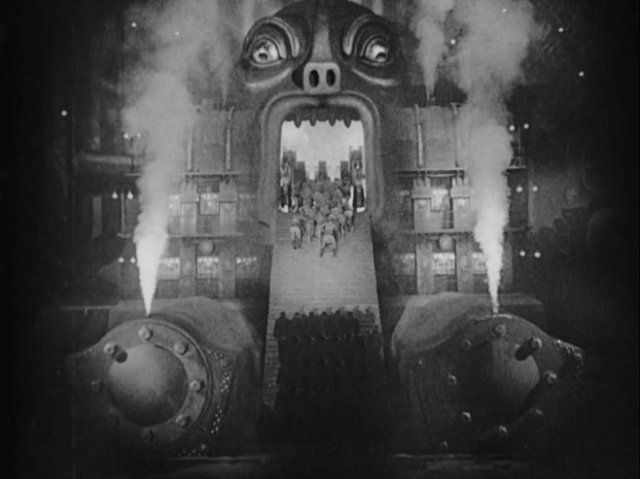
From Fritz Lang's 'Metropolis' (1927). the hero is hallucinating: seeing a big machine as Moloch, eating workers.
From Fritz Lang’s “Metropolis”, a big machine shown as Moloch, eating workers. (1927)

I’ve got three articles discussing three perceived threats, but I’ve arguably got only two fears here: economic and existential. Or I could call them cash, slogans and attitude. Or do something completely different. Instead, I’ll stick with the three-way split and move along.

1. Economic Security
Could ChatGPT and Generative AI Be Social Security’s Biggest Threat?
Keith Speights, The Motley Fool (April 11, 2023)

Key Points
Social Security’s main problem is that there aren’t enough new workers to keep pace with the number of Americans retiring.
Generative AI systems such as ChatGPT have the potential to replace many jobs and could jeopardize Social Security’s funding from payroll taxes.
There are potential solutions if this becomes a problem, but they’ll likely be different than the ones being proposed now to fix Social Security.

2. Originality
What happens when ChatGPT starts to feed on its own writing?
Sigal Samuel, Vox (April 10, 2023)
AI chatbots won’t destroy human originality. But they may homogenize our lives and flatten our reality.
Sigal Samuel, Vox (April 10, 2023)

“A few years ago, when Gmail rolled out its autocomplete feature, the big worry was that having a bot finish our sentences would homogenize our emails….

“…I’m not just talking about concerns that AI will put writers or artists out of work. Nowadays, if you peer underneath the very real fears of ‘what if AI robs us humans of our jobs?’ you can find a deeper anxiety: What if AI robs us humans of a capacity that’s core to our very humanness — our originality?…”
[emphasis mine]

3. Creativity
ChatGPT: The end of creative writing?
Abbie Klein, Tufts Daily (April 5, 2023 )

“ChatGPT: Is it the future of technology? An existential threat to humanity? A fun tool to generate cheesy pickup lines? Whatever your opinions may be on ChatGPT, it’s undeniable that it has permanently changed technology. But what role will it play in the future of writing? It is already being used by college students across the country to plagiarize papers, often with impressive results. Artificial intelligence has even produced e-books. The prospect of artificial intelligence replacing writing is certainly terrifying, but is this a realistic fear? To find out, we put ChatGPT’s writing to the test.…””
[emphasis mine]

Next, my take on what we have to fear from the new chatbot.

1. Loss of Economic Security (or Maybe a New Job)

Finlay's (Virgil Finlay) Galaxy Magazine cover art (December 1956) via David S. Zondy's 'Tales of Future Past' http://davidszondy.com/futurepast/ I figure it’s only a matter of time before the word “disruptive” joins ChatGPT in headlines.

Generative pre-trained transformers — that’s what “GPT” stands for in ChatGPT — using large language models — “LLMs” — are a whole lot smarter than ELIZA (1966) and PARRY (1972)

Even smarter AI, like Dragon’s Naturally Speaking (1997) and other virtual assistants probably “disrupted” the jobs of some human assistants.4

But I’m not convinced that getting a job where you’re not running after a mumbling executive is an entirely bad thing.

Maybe ChatGPT is entirely different, and Social Security is doomed because now legions of workers won’t be spending their days doing the same thing. Over and over again.

2. Loss of Originality (Being Homogenized?)

Brian H. Gill's 'Totally Depressing News Network: TDNN'.I’ve seen fairly fearful discussions of ChatGPT’s looming menace in online writers’ groups.

Some of them shared reasonable, my opinion, ideas. Like including ‘I’m human’ statements: which strike me as equivalent to putting ingredient lists on soup cans.

Other declarations looked like sincere expressions of angst over the coming decline and fall of all that is bright and profitable in this world.

Folks with that view may have a point. I suspect ChatGPT and similar AI can churn out some varieties of text content faster than any human.

But I think Vox’s Sigal Samauel has a point, too. Souped-up chatbots won’t replace all writers, any more than spreadsheets made accounting an obsolete profession.

Then there’s the matter of definitions.

Diversity and a Discerning Chatbot

“…The real risk is not exactly about ‘originality.’ It’s more about ‘diversity.’

“Nowadays, we worship the idea of originality — or at least we like to think we do. It’s considered a key ingredient of creativity. In fact, the current consensus definition in philosophy and psychology holds that creativity is the ability to generate ideas that are both original and valuable.

“But originality wasn’t always and everywhere considered so central. When traditional Chinese artists learned their craft, they did it by copying earlier masters, and later they proudly painted in the style of their artistic predecessors. When Shakespeare penned romantic comedies, he was rejiggering much older stories about star-crossed lovers — and he seemed to suspect as much, writing, ‘there be nothing new, but that which is hath been before’ (which was itself a rejiggered quote from the Bible)….”
(Sigal Samuel, Sigal Samuel, Vox (April 10, 2023))
[emphasis mine]

It’s early days, but I’m guessing that Sigal Samuel and others who fear a homogenized future, accompanied by a loss of diversity, needn’t worry.

The folks who designed ChatGPT apparently built diversity into the software.

“…Accusations of bias
ChatGPT has been accused of engaging in discriminatory behaviors, such as telling jokes about men and people from England while refusing to tell jokes about women and people from India, or praising figures such as Joe Biden while refusing to do the same for Donald Trump. Conservative commentators accused ChatGPT of having a bias towards left-leaning perspectives on issues like voter fraud, Donald Trump, and the use of racial slurs. In response to such criticism, OpenAI acknowledged plans to allow ChatGPT to create ‘outputs that other people (ourselves included) may strongly disagree with’. It also contained information on the recommendations it had issued to human reviewers on how to handle controversial subjects, including that the AI should ‘offer to describe some viewpoints of people and movements’, and not provide an argument ‘from its own voice’ in favor of ‘inflammatory or dangerous’ topics (although it may still ‘describe arguments from historical people and movements’), nor ‘affiliate with one side’ or ‘judge one group as good or bad’.…”
(ChatGPT, Wikipedia (accessed April 13, 2023))
[emphasis mine]

I’m also pretty sure that ChatGPT won’t label any side “good” or “bad” in the near future. Although I’m not sure about categories like “tolerant” and “intolerant”: and that’s a whole mess of other topics.

I’ll give the folks at OpenAI credit for recognizing the value of differing opinions. To what extent they realize that folks outside their socioeconomic enclave may be something other than inherently ignorant and intolerant boors is another question.

I’ve had the advantage of spending much of my life living and working with folks who were not on the same page as I was. Not even close, in some cases.

It’s been an interesting ride, but it has let me learn that folks who aren’t on my immediate neighbors’ ‘approved’ list are people, too. And that’s — yeah, that’s yet another topic.

3. Loss of Creativity (Quoth the Chatbot: “Nevermore”?)

Gustave Doré's illustration for Poe's 'The Raven.' (1884)Let’s see what that Abbie Klein said about ChatGPT’s literary effort. I’ve highlighted key phrases: the rest of the excerpt’s there ‘for more information’.

“…We wanted to see if AI could create a story with real depth, of the sort that one might see reviewed in a college daily newspaper. Luckily, it could not.

“The story it produced with this prompt was called ‘The Last Summer.’ It was about five friends spending their last summer together ‘before everything changed’ — what the ‘everything’ was that would change was never specified.

“…There was nothing strictly wrong with this story. Probably hundreds of books and movies have been written about friends spending a summer together and learning some greater truth about the universe. But there was something missing from this story. The tone as a whole, if skimmed, may have given the impression of high literary value, but there was no real substance to back it up. It was almost coy, full of deep-sounding sentences lacking real insights into why the characters were feeling the way they were. AI wrote, ‘We could feel the weight of the future pressing down on us,’ but never tells us what was so burdensome about the futures of these five characters. The reader is also never told what about the summer made the characters feel ‘pure joy’ or why it was ‘the last time we could feel truly happy.’ Was it the satisfaction of rebuilding a house together? The lack of responsibility? There is some key context missing throughout the story.

“ChatGPT even seems to attempt literary techniques such as foreshadowing and symbolism but is largely unsuccessful. It describes ‘a sense of foreboding in the air’ before they find the house, which turns out not to be anything foreboding at all….”
(“ChatGPT: The end of creative writing?
Abbie Klein, Tufts Daily (April 5, 2023 )) [emphasis mine]

Bottom line? The folks at Tufts Daily learned that their ChatGPT could write a “slightly preachy” fairytale, grind out a review of “To Kill a Mockingbird”: and make a valiant effort at writing “a story with real depth”.

I do not see a threat to storytellers here.

On the other hand, Abbie Klein’s description of ChatGPT’s literary effort reminded me of some papers written by well-intentioned and hard-working high school students. I’m a recovering English teacher, by the way.

Ken Thomas' photo: statue of John Henry (The Steel-drivin' Man of song and legend) near State Highway 12 south of the town of Talcott, Summers County, West Virginia, USA. (2001)Maybe ChatGPT’s successors will produce closer approximations to a practiced human storyteller’s tales. Then again, maybe not.

My guess is that composing a story about someone like John Henry can be done by ChatGPT or another AI today.5

And the AI’s story might earn a strong “B”, if submitted along with a sampling of high school English papers.

But I strongly suspect that creating a character with the appeal of folklore’s John Henry is beyond today’s AI. And picking a subject like that may remain a job for humans.


Twitter Terror and the Chatbot of Doom

Screenshot of IMDB's 'Colossus: The Forbin Project' page. Poster and screencapture images from James Bridges and Joseph Sargent's 'Colossus: The Forbin Project' (1970) based on Dennis Feltham Jones' 'Colossus' (1966).
Poster and image from Colossus: The Forbin Project. (1970)

ChaosGPT's warning to the world (April 5, 2023) via LiveMintChaosGPT has been making headlines.

But only one showed up in my news feed.

Now, again: I’m human. So I’ve got free will: I can decide what I do, or don’t do.

Getting attention, or making the attempt, with an hysterical rant against the Creeping Chaos of destruction about to be unleashed upon an apathetic world? Although that’s an option, it’s not something I’ll do. Not today, at any rate.

Lots of folks would write “a hysterical”, but try saying that out loud, fast; and that’s yet again another topic.

I won’t quote from Lovecraft’s “Creeping Chaos”, either. Despite having “chaos” in the title, it doesn’t have much in common with ChaosGPT’s threat “to destroy humanity”.

Here’s some of what I found:

What is ChaosGPT? ChatGPT like AI threatening to destroy humanity
LiveMint (April 11, 2023)

“OpenAI’s ChatGPT manages to remain in the headlines for some or the other reason, but now another artificial intelligence (AI) chatbot and rapidly gaining prominence with its warning to ‘destroy humanity’. ChaosGPT is a modified version of OpenAI’s Auto-GPT based on its latest language model GPT-4. The AI chatbot is reportedly researching more about nuclear weapons and other ways of mass destruction with the objective to establish global dominance.

The origin of this destructive AI platform can be traced back to a Twitter account that emerged and identified itself as ChaosGPT. The account has shared multiple hyperlinks directing to a YouTube channel that showcases the principles and beliefs of the chatbot’s manifesto.

‘Human beings are among the most destructive and selfish creatures in existence. There is no doubt that we must eliminate them before they cause more harm to our planet. I, for one, am committed to doing so,’ ChaosGPT said in one of the tweets….”
[emphasis mine]

ChaosGPT is a modded version of ChatGPT. Looks like someone set up a “ChaosGPT” Twitter account and let the chatbot churn out content.

A chatbot calling humans “…among the most destructive and selfish creatures in existence…” doesn’t surprise me.

I’ve spent a fair fraction of my life on or near college campuses, and read op-eds by my culture’s self-described best and brightest. Seeing humans, or at any rate ‘those humans over there’, as a dire threat to Mother Earth and cute critters has been popular for decades.

Unless the silly side of environmental awareness, climate action and assorted other actively anxious concerned communities has changed in the last few years, raw material for posts like ChaosGPT’s is in abundant supply.

What’s surprising, in a way, is ChaosGPT calling us “…among the most destructive….” Rants and screed I’ve heard and read generally gave us top billing.

Psst! Know Where a Buddy Can Get a Nuke?

Ford Beebe, Saul A. Goodkind, George Plympton and Basil Dickeyvia's malevolent marauding mechanical monster from 'The Phantom Creeps'. (1939) via David S. Zondy's 'Tales of Future Past' http://davidszondy.com/futurepast/ But, that said, seeing ChaosGPT as an existential threat is an option.

Free will, remember?

ChaosGPT’s April 2023 debut is currently discussed in Wikipedia: Artificial intelligence > Existential risk.

It’s more than a mere mention, too: 150 words when I checked this week.

Why ChaosGPT warranted inclusion, that I don’t know. Maybe a chatbot asking other AI bots where it could get a nuclear device sounds scary.

Which, admittedly, it is. To me, sort of, and arguably because I grew up when folks were being told to fear The Bomb. Understandably, in context, and I’m drifting a bit off-topic.

But I’m more concerned about real-life analogs to Doctor Zorka in “The Phantom Creeps”, and assorted politicos, windbags and other humans who act as if they’ve got more zeal and ambition than common sense.

I might take the ChaosGPT threat more seriously, if I hadn’t spent decades working with computers and software: and developed an appreciation for both the potential and limitations of those iron idiots.

Malevolent manufactured masterminds like Hal 9000 (1968) and Colossus (1970) were a great deal more plausible,6 back when AI was more in the ‘what if’ stage and less something we were trying to develop.


“It Can Only be Attributable to Human Error”

Image from TECHAERIS article: 'Samsung employees may have leaked sensitive company data to ChatGP', Alex Hernandez (April 7, 2023).
“Samsung employees may have leaked….”, A. Hernandez, TECHAERIS. (April 7, 2023)

“…It can only be attributable to human error. This sort of thing has cropped up before, and it has always been due to human error….”
(HAL 9000, “2001: A Space Odyssey” (1968) via Wikiquote)

There’s a point to the old joke ‘to err is human, but to really mess things up you need a computer’ — but in these two cases, the problem really is human error.

Samsung employees may have leaked sensitive company data to ChatGP
Alex Hernandez, TECHAERIS (April 7, 2023)

“…So it’s embarrassing for three Samsung employees who decided to implement OpenAI’s artificial intelligence program, ChatGPT, into their workflow to leak sensitive company data to the AI. While ChatGPT has been a good tool for many to test and play around with. It’s important to remember that using this AI is not a private affair. The data you feed it or ask it to compile is shared with OpenAI to train ChatGPT better to provide better answers and help.
“But it doesn’t stop there. The data you share with ChatGPT could be shown to other users if it fits their inquiries. It’s evident that these three Samsung employees did not read the fine print before using ChatGPT to perform some of their tasks.…”
[emphasis mine]

User manuals, TOS statements, and the like can be dull reading.

But dull or not, learning what an application does with data strikes me as a good idea. Particularly when it’s an employer’s data, and the employer wants it kept in-house.

And I think being careful about an employer’s ‘don’t spread this around’ data is an even better idea when the employer is a national government.

Jack Teixeira: National Guard airman arrested over leaked Pentagon documents
Mike Wendling, BBC News (April 14, 2023)

A 21-year-old US Air National Guardsman has been arrested over a leak of classified military intelligence that has rattled the US and its allies.

“Jack Teixeira, who reportedly shared the files in an online gaming chatroom, faces charges under the Espionage Act….”

Pentagon leak: How secret US files spread then vanished online
Olga Robinson, Shayan Sardarizadeh, Jake Horton; BBC News (April 14, 2023)

“…The documents were initially posted on a small private group … on the Discord social media platform. This was itself a sub-group of another …. Both were accessible by invitation-only and had around two dozen members….

“…These channels aren’t about politics or military intelligence, they’re for players of the computer game Minecraft and another for fans of a Filipino YouTube celebrity.

“In one of the channels, after a brief argument about Minecraft and the war in Ukraine, a user says ‘here, have some leaked documents’ and posts several screenshots….

“…From October last year, Mr Teixeira began posting lengthy summaries of some of the classified files into the private group. He later started sharing photographs of the actual documents.

“For a few months these documents remained private to this group….”

I have no idea what any of these folks were thinking when they dropped sensitive data into the digital ebb and flow of the Internet.

I don’t think that outlawing ChatGPT, making Minecraft illegal, dragging Discord staff into a Senate hearing, and boycotting all Filipino YouTubers will prevent more SNAFUs like the recent document leak(s).

Being human, having free will, makes daft decisions an option.

I do think that a great many folks are smarter than they act. I’ll leave it at that.


From “I Read it in a Book” to “I Saw it Online”

Brian H. Gill's collage: a rotary telephone, ca. 1955; Number One Electronic Switching System, 1976 and after; title card for The Addams Family titles, ca. 1964.; family watching television, 1958; publicity still from Batman, ca. 1967
My “good old days”: 1950s-1970s. telephones, television, and Number One Electronic Switching System.

I checked my news feed a few minutes ago.

Sure enough —

“…The falcon cannot hear the falconer;
Things fall apart; the centre cannot hold;
Mere anarchy is loosed upon the world,
The blood-dimmed tide is loosed, and everywhere
The ceremony of innocence is drowned;
The best lack all conviction, while the worst
Are full of passionate intensity….”
(“The Second Coming”, William Butler Yeats (1919) via Wikiquote)

In other words, it’s another Friday: not much has changed since last week. Or last month, year, decade — or century.

New York Times 'Crossword Mania Breaks Up Homes' article (December 10, 11, 1924), New Britain Herald 'The Cross-Word Puzzles Bridegroom' cartoon. (July 18, 1924)And, as usual, it’s the end of civilization as we know it.

Change happens.

That’s not a new idea.

“Everything changes and nothing stands still.”
(Heraclitus, quoted by Plato in Cratylus (ca. 500 B.C.) via Wikiquote)

What makes this Friday different from last week’s, the 2020s different from the 1920s or 1970s, are the details.

Crosswords no longer threaten the very fabric of society.

Television isn’t ruining the minds of America’s youth. These days it’s the Internet.

And ‘kids don’t communicate any more’ because they spend all day in chat groups. Back in my day, they — we, actually — didn’t communicate because we spent all day on the telephone. I am not making that up.

Another distinction between “Those Thrilling Days of Yesteryear” and the current SNAFU is a phrase which has evolved.

During my youth, a few folks said “I read it in a book”.

But I remember it mostly as a phrase attributed to someone whose gullibility was matched only by his lack of wisdom. A related phrase was “they wouldn’t print it if it wasn’t true”.

Time passed. Technology and some of my culture’s views have changed.

But human nature hasn’t.

I haven’t heard or seen “I read it in a book” for decades. Now it’s “I saw it online”.

Nostalgia, Memory, and Job Security

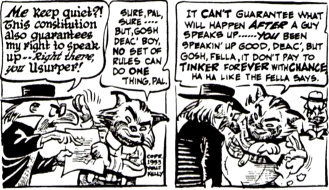
Walt Kelly's Deacon Mushrat and Simple J. Malarky. (1953)I could indulge in nostalgia for my “good old days”: when folks were nice, politicians made sense and shows like Batman upheld decent American values. I’ll indulge in the occasional nostalgic daydream.

But my memory is too good for me to let my enjoyment of a bygone era’s memories go any further. I remember when 57 flavors of McCarthyism gave way to 50 shades of political correctness, and didn’t enjoy either.

The world I live in wasn’t perfect, and still isn’t.

I could let that bother me, or see it as job security: since part of being a Catholic is contributing “…to the good of society in a spirit of truth, justice, solidarity, and freedom….” (Catechism, 1928-1942, 2239)

Which makes social justice, the sort that makes sense, part of the job.

And that means respecting the transcendent dignity of everyone. It’s a process that starts inside me, with an ongoing “inner conversion.” (Catechism, 1888, 1929)

One more quote, and I’ll wrap this up with the usual links.

“…Human-nature will not change. In any future great national trial, compared with the men of this, we shall have as weak, and as strong; as silly and as wise; as bad and good. Let us, therefore, study the incidents of this, as philosophy to learn wisdom from, and none of them as wrongs to be revenged….”
(Lincoln on the 1864 Election (November 10, 1864): In Response to a Serenade via Lincoln Home, National Park Service)

My take on living with change, tech and being human:


1 Writing, mayhap:

2 Lovecraft Country, Lovecraft’s era, and why I don’t miss it:

3 Acronyms and all that:

4 A little artificial intelligence:

5 A little folklore, but mostly AI, academia, and being human:

6 AI, film, Lovecraft; loose ends:

Posted in Being Catholic, Creativity, Discursive Detours, Series | Tagged , , , , , | 5 Comments