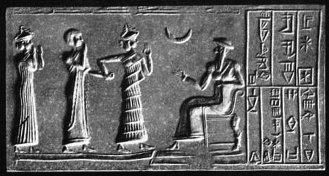
Happy Halloween!

Showing this picture to a few online groups, I learned that Halloween, our version, is a somewhat “American” holiday.

Today is also the feast day of St. Wolfgang of Regensberg, AKA The Almoner. He had a good reason for throwing his ax into a thicket, and that’s another topic.

In the (Roman Catholic) liturgical year, Allhallowtide starts today. It’s a three-day thing: All Saints’ Eve (Halloween), All Saints’ Day (All Hallows’) and All Souls’ Day.

I’m not sure why some folks get upset over this holiday. Maybe it’s the scary, and occasionally disturbing, costumes. Or the arguably-unhealthy opportunities to eat too much candy. Or maybe it’s where some Halloween traditions apparently came from.

I don’t doubt that my Gaelic ancestors, and their Welsh neighbors, brought some of their pre-Christian customs over here. It’d be odd if they didn’t. The autumnal equinox is important to quite a few folks, my ancestors included.

Some seasonal traditions, like divination games, are not good ideas. “Game” isn’t the problem. “Divination” is, no mater what day it is. (Catechism of the Catholic Church, 2116)

I’ve seen ‘adult’ costumes that are in dubious taste, and that’s a topic for another post.

But getting upset over jack-o’-lanterns, Christmas trees, or Easter eggs? I don’t see a point to that. On consideration, I could complain that my Norwegian ancestors are disrespected, because lefse isn’t part of the traditional Thanksgiving menu, but that would be silly.

Then there’s the notion that evil runs rampant tonight. More than usual, that is.

I’m not happy about destructive behavior on any day, but found this interesting:

“No fear, crime stays normal on Halloween”
Elizabeth Rembert, The Daily Nebraskan (October 28, 2016)

“Despite what some may think of Halloween’s relation to increased criminal activity, University of Nebraska-Lincoln police department’s daily crime logs from the past 10 years show that crime on the last day of October is actually below average.

“Oct. 31 has an average of 4.7 reported crimes, a number hovering just below the daily average of 5.2 in the same amount of time.

“UNLPD Captain Jerry Plessel said while daily averages of all crimes may be lacking on Halloween, statistics do indicate an increase in intoxicated persons and minor in possession charges….”

Back to Halloween here in central Minnesota — I can’t, or shouldn’t, eat candy these days. But I can enjoy seeing families having fun this evening, and I rather like the look of most jack-o-lanterns.

I hope you enjoy Halloween, too.

More of how I see faith, culture, and getting a grip:

Posted in Being an Artist, Being Catholic | Tagged , , , | Leave a comment

The Rosary

Thirty-first Sunday in Ordinary Time, 2016:


Rosary Homily

By Deacon Lawrence N. Kaas October 30, 2016

Reverend. father, brothers and sisters in Christ. For those of you who noticed things like this, I was not with you a couple weeks ago because I took a few days off and went on a private retreat to West Bend, Iowa. I’m sure you would all agree that when you go on retreat there should be a purpose, at least a theme to make any retreat profitable. In my case, the theme was, “to know Jesus better, through the eyes of His Mother Mary,” while praying the Rosary and meditating on the Mysteries. This I will share with you a little later but first some background.

This to give us a reason to reflect on what father Greg has shared with us this month on stewardship. With what’s going on in our world today all that would have to happen is that good people stop praying. Proof of your willingness to pray is the fact that you are here today celebrating Mass with our Priest. I have been convinced for a long time that the most beneficial happening of the day for our world, our parish, and each one of us individually is to be able to celebrate Mass with our Priest, for sure, on weekends and daily if possible. According to the little handout the father gave us, number one on the list of stewardship is the Mass. This is the preeminent prayer of the church.

I would like you to consider that the Most Holy Rosary of the Blessed Virgin Mary is second to the Mass as a most powerful, reflective Prayer.

To back up a little bit: when I was a little boy a priest came here to preach on the value of the Rosary, also to pray for the conversion of Russia. His name is father Peyton. I don’t remember the exact date but it must’ve been some where between 1943 in 1950. If any of you remember exactly let me know and I will add it to my notes. I became so enamored at what he preached and taught about the Rosary that the Rosary has been a daily prayer for me, virtually ever since. It is rare that I would miss praying the Rosary each day.

I remember too: that one evening praying the rosary with my family, kneeling at the end of the couch, and wondering to myself, what Mary had to do with all of this. She spoke to me as clearly, as if she was speaking right into my head, “my role is to bring you to my son.” I am convinced that she has been doing exactly that.

There are stories to support the power that the rosary has: for example, the battle of the Lapinto where an invasion by the enemy was eminent and the people were asked to pray the Rosary. The Rosary was given credit for turning back this invasion force, so that it never happened. Another story, of the recent past, where an Easter Right Bishop had a vision of Christ. Christ was handing him a sword, and you know how that’s done with the handle first. When the Bishop reached out for the sword it was a rosary. To say that the rosary is a Sword in the hands of Christians, is almost an understatement because this sword is a two edge sword. Prayer works. The prayer of the rosary works.

Again a long time ago: my mother was telling us of how they prayed the rosary in German, up in Bluffton. She said that as they prayed the Hail Mary they would put a little insert in the prayer after the word of Jesus, to reflect the Ministry that they were praying. This to I was gradually able to do, rather gradually as I learned the mysteries the rosary. One day I reminded mother of this, and she said, ah, I never did! But I know she did, and I shall continue to give her credit for that.

As a matter of fact: in the last days Pope Francis said,, “the Rosary is the prayer that always accompanies my life, it is also the prayer of simple people and Saints … It is prayer of my heart,” he said. He also explains that the rosary is “a synthesis of Divine Mercy.”

I have used this insert idea, while praying the rosary for many many years. Some of you may well say, how can you keep your mind on the ministry while praying the rosary, while saying words? As a matter of fact sometimes we’re are accused of just saying a lot of words, I assure you it is a lot more than that.

You remember when you would holler at the kids to turn off the music and gift your studying done, and they would respond by saying I am studying! Maybe this will work with the rosary as well as you say the words of the Hail Mary that becoming quite automatic, by this time, maybe meditating on the mystery could really work!

So here’s how it works: for example, you would be praying, Hail Mary full of grace the Lord is with you blessed are you among women blessed is the fruit of your womb Jesus, this is where you would put a little insert but let us say today you are paying the Joyful Mysteries, the first of the Joyful Mysteries is the Annunciation. So you would say Jesus, who was Announced, Holy Mary mother of God pray for us sinners know and at the hour of our death, Amen. And you would say this Hail Mary with the insert for each one of the Hail Mary’s in that Mystery.

Let’s do a few more so that you get the idea: the second of the Joyful Mysteries is the Visitation. So you would say, Hail Mary full of grace the Lord is with the blessed are, women and blessed is the fruit of thy womb Jesus, who Visited, Holy Mary mother of God pray for us sinners now and at the hour of our death. Amen. To finish that rosary, you would say, Who was born into the world, Who was presented, Who was found in the Temple.

Every ministry of the complete Rosary can be said in this way even the new five mysteries of the Rosary of Light.

This is what I found myself doing on my retreat. I was so crazy tired that I just laid on my bed and prayed rosary after rosary in this fashion and as I reminded you earlier to get to know Jesus through the eyes of His Mother. And taking notes for this Homily.

You can even use this meditation while praying the Rosary in common and I am convinced that you will find there is so much more to the Rosary than just the multiplication of words.

So you be Good, be Holy, preached the Gospel always using Words if necessary!


(‘Thank you’ to Deacon Kaas, for letting me post his reflection here — Brian H. Gill.)


Posted in Being Catholic, Guest Posts, Reflections, Series | Tagged , , , , , | 2 Comments

Authority, Superstition, Progress

Authority, superstition, and misapplied technophilia (it’s a real word) rate at least one post each: but that’ll wait until another day. Days.

This time I’ll take a quick look at all three, and then say why I don’t believe in Progress with a capital P — and don’t yearn for the ‘good old days.’

My attitude toward authority, real and imagined, hasn’t changed much since the ’60s. But as my wife showed me a few years back, it’s not authority I dislike.

It’s pompous nitwits with delusions of competent authority that set my teeth on edge.

I must respect authority, but must not indulge in blind obedience. (Catechism of the Catholic Church, 1900, 1951, 2155, 2242-2243, 2267)

That’s gotten folks killed, like Thomas More and John Fisher, and I’ve talked about that before. (August 14, 2016)

Superstition is a bad idea and we shouldn’t do it. It feels a bit like religion; and can affect worship if someone gets the idea that prayer, for example, depends on ‘going through the motions.’ (Catechism, 2110-2111)

I’ll grant that some Catholics are superstitious: and incredibly gullible.

The tale that you can boost your property’s value by burying a statue of a particular saint was current in 2007, it popped up again in 2015, and still appears in ‘advice’ forums. It’s supposed to work like a charm: which is also a bad idea. (Catechism, 2117)

Progress, Imagined

The ‘science and technology will make the future wonderful’ attitude was fading in my youth.

I think it’s no more sensible than the ‘science and technology will destroy us all’ attitude that’s been fashionable more recently.

Like I keep saying, science and technology, studying the universe and applying our new knowledge, are part of being human. What counts is how we decide to use them. (Catechism, 2292-2296)

Giving science, technology, or anything else, the priority God deserves is a bad idea. (Catechism, 2112-2114)

That’s why I don’t ‘believe in’ Progress as the answer to our problems and the source of our hope.

I do, however, think that progress, lower case, happens: on average, given time. Lots of time.

Sumerian Renaissance, Roman Law

Ur-Nammu brought a measure of prosperity and stability to folks from Akshyak to Eridu, although some probably yearned for the ‘good old days’ of the Akkadian Empire or Gutian rule.

His law code seems a bit harsh in spots. Robbery carried a death penalty, for example. Other parts seem familiar, like monetary penalties for causing injury.

The Code of Ur-Nammu reflected the Sumerian Renaissance two-tier society: lu, free men and women; and arad or geme, male or female slaves. A slave could be freed, a slave and a free person could marry, but slavery is a bad idea. (Catechism, 2414)

Ur-Nammu’s Sumeria wasn’t a perfect society.

Two millennia later, Rome was building roads which tied their empire together. The roads, like my country’s Interstate highways, had military uses.

But they also helped folks travel and trade with each other.

Roman law was more complex than Ur-Nammu’s code, and arguably an improvement. Slavery, however, was still legal; but folks could still change their status. We get a look at that in Acts 22:25–29.

Watermills let folks process materials like grain, ore, or wood, without having people or livestock providing power. Locks on Necho’s Canal made moving bulk cargo a lot easier.

Rome’s wasn’t a perfect society.

Radioactive Rubble and Law

Another two millennia, and slavery still exists. But it’s illegal in several countries.

Even more remarkable, I think: it’s becoming unfashionable.

That’s progress. Agonizingly slow progress, but progress nonetheless.

We’ve made some other major changes over the last few centuries. I think that’s a good thing, but some folks don’t.

International law in the sense of agreements between rulers, predates nations; but didn’t get traction until the First Geneva Convention. That was 152 years back now.

The Articles of Confederation was, arguably, an early effort at supranational law: a form of international law, based on sovereign nations giving some of their rights to a supranational authority.

The Articles of Confederation didn’t work, but the United States Constitution has held up for about 227 years, with only one major internal war. We’re still tweaking it, but I think it’s a good effort.

While digging out from World War II’s rubble — some of it radioactive — many folks decided that enough was enough. Some still act as if they prefer slaughtering each other in wholesale lots as a conflict resolution strategy.

I don’t.

I also don’t trust the United Nations1 any more than I do America’s Congress: but I’m pretty sure that it’s better than the alternative.

And I’m quite sure that we can do better.

Looking Back


(From D. Gordon E. Robertson, via Wikimedia Commons, used w/o permission.)

Folks who thought science and technology, and better education, would solve all our problems were overly-optimistic. I’m oversimplifying the Idea of Progress something fearful, and I think they had a point.

I’m living in “the future,” which isn’t nearly as good — or bad — as folks hoped or feared in my youth. On the whole, I like it: partly because I remember ‘the good old days,’ and what came before.

The McCormick Reaper, patented in 1837, didn’t end world hunger.

But it was part of a process that arguably started about a dozen centuries back. Around the mid-17th century, rapidly-changing technology and economic systems streamlined growing and distributing food.

Food still isn’t getting to all the folks who need it: but I think it’s a distribution issue.

Oliver Wendel Holmes Sr. published “The Contagiousness of puerperal fever” in 1843.

Ignaz Semmelweis also noticed that fewer women died after childbirth when doctors washed their hands. That was 1847. Quite a few doctors didn’t like the idea of personal hygiene, but many years and unnecessary deaths later they started washing.

I’m not at all sorry to see more women get back into the healing arts, and that’s another topic.2

Thomas Beddoes and James Watt developed a machine that produced “Factitious Airs,” nitrous oxide; publishing their results in 1794.

“Laughing gas” was a moderately popular recreational drug for the upper crust by the early 1800s. Humphry Davy was a nitrous oxide addict, and used it as a hangover cure. Several decades later, doctors started using it as an anesthetic.

We’ve gotten a lot better at pain management since then. I can use, or endure, pain. But controlling it is okay, and can be a good idea. (Catechism, 1431-1490, 2279)

Francis Ronalds developed an electric telegraph in 1816. The British Admiralty promptly rejected it as “wholly unnecessary,” but wireless telegraph eventually caught on.

The RMS Carpathia’s wireless operator learned that the Titanic needed help, a bit late, and the Radio Act of 1912 required ships to continuously listen for radio distress signals.

Working for Future Generations


(From Diliff, via Wikimedia Commons, used w/o permission.)

Today’s world doesn’t have any perfect societies: mine included, although I like being an American, on the whole. I also like being Catholic: part of an outfit that’s literally catholic, καθολικός, universal, not tied to one era or culture.

We’ve been passing along the same message for two millennia: God loves us, and wants to adopt us. All of us. (Ephesians 1:3–5; John 3:17; Catechism, 52, 1825)

We’re helping build a better world, one with a greater degree of justice and charity, and respect for “the transcendent dignity of man.” (Catechism, 1928-1942, 2419-2442)

More accurately, that’s what we should be doing. Some of us don’t act as if it’s true, but that doesn’t change our ‘to-do’ list.

Building a better world for future generations is a reasonable extension of a few basic ideas: that each of us should love God, love our neighbor, and see everyone as our neighbor.3

If we help others keep what is good and just in our societies, change what is not, and act as if we really believe that loving our neighbors makes sense: I think we can make a difference. We must be patient, though.

Folks can’t be forced to embrace truth: particularly when it means giving up some cherished injustice, or long-established privileges. But I am convinced that truth wins — eventually.

Maybe, if we keep working at it, two millennia from now we’ll have an “international authority with the necessary competence and power” to resolve conflicts without war. (Catechism, 2307-2317; “Gaudium et Spes,” 79 § 4)


(Cityscape, Inlakechh/Marco Bauriedel, used w/o permission.)

And two millennia after that, we’ll still have social ills.4 Humanity has an enormous backlog of unresolved issues. But like I said: we’re making progress. Slowly.

Posts that aren’t entirely unrelated:


1 Groundwork for the European Union got started the same year, 1945, but the EU’s launch was 1958. I have no idea how long it will last, but think the basic idea is a good one. Certainly better than more-or-less-constant warfare.

2 Happily, we’re recovering (my viewpoint) some measure of wisdom. One of my sisters-in-law is a radiologist; and my wife a self-taught expert on how to find and prepare healthy food, and appropriate use of herbs.

I haven’t researched this, but it seems to me that the wounded hero in old stories would get help from a woman who knew where to find useful plants. The old coot next door might be useful for other reasons.

I don’t know what went so hideously wrong in the millennium since Saint Hildegard of Bingen wrote “Physica” and “Causae et Curae.” She’s credited with starting scientific natural history in Germany. She studied healing uses for various plants, stones, fish, reptiles, and animals.

This is a good idea. (Catechism, 2288)

Trying to force spirits to cure disease is not allowed, for pretty much the same reason that divination is a bad idea. (Catechism, 2116-2117)

3 I say that a lot. (Matthew 5:43–44, 22:36–40; Mark 12:28–31; Luke 6:31, 10:25–27, 29–37; Catechism, 2196)

4 It’s possible that our Lord will return before the 61st century. But as I’ve said before, I’ll leave the ‘big picture’ decisions up to God:

My guess, and it’s just a guess, is that our long watch has barely begun; and that’s yet another topic.

Posted in Being Catholic | Tagged , , , , , , , , , , , , | 15 Comments

Right-Handedness and Evolving Jaws

At least one Homo habilis was right-handed, about 1,800,000 years ago. It’s the earliest evidence of handedness in humanity’s history. So far.

Our jaws may have started out as armor plate, not gill arches. Paleontologists found a second Silurian placoderm species with surprisingly familiar jaws.

  1. Using Our Brains: Also Teeth
  2. Jaw Evolution, 2016
  3. Fish Face, 2013

Before talking about Homo habilis, and new evidence showing how jaws evolved, I’ll do my usual explanation of why science doesn’t upset me.


Evolution

“Christian” bookstores where I grew up generally sold quite a few books attacking evolution, along with grim warnings against the Catholic Church and other threats to their preferred reality.

I’m a Christian, and a Catholic, and that’s another topic.1

Since a remarkable number of folks, including some Catholics, seem to think someone can either be Christian or acknowledge that we live in a vast, ancient, and changing, cosmos; I’ll be talking about Darwin, Ussher, and Anaximander.

Also the Bible, science, and getting a grip.

Taking the Bible seriously isn’t an option for me. It’s a requirement. (Catechism of the Catholic Church, 101–133)

So is “frequent reading of the divine Scriptures” and using my brain. (Catechism, 35, 133, 154)

That’s not even close to believing that the universe is literally a dewdrop:

“Behold, the nations count as a drop in the bucket, as dust on the scales; the coastlands weigh no more than powder.”
(Isaiah 40:15)

“4 Indeed, before you the whole universe is as a grain from a balance, or a drop of morning dew come down upon the earth.”
(Wisdom 11:22)

Truth and Questions

Truth is very important. (Catechism, Prologue, 27, 74, more under Truth in the index)

“Truth or truthfulness is the virtue which consists in showing oneself true in deeds and truthful in words, and guarding against duplicity, dissimulation, and hypocrisy.”
(Catechism, 2505)

Truth is beautiful: whether it’s expressed in words, “the rational expression of the knowledge of created and uncreated reality;” or “the order and harmony of the cosmos;” or in other ways. (Catechism, 2500)

We can learn a bit about God by noticing “the world’s order and beauty,” which reflects God’s infinite beauty. (Catechism, 31–32, 341)

A thirst for truth and happiness is written into each of us, which should lead us to God. (Catechism, 27)

Faith, the Catholic version, is a willing and conscious “assent to the whole truth that God has revealed.” (Catechism, 142–150)

Using the brains God gave us, seeking the Almighty and studying this wonder-filled universe, is fine. It’s what we’re supposed to do. (Catechism, 35, 50, 159, 2292–2296)

That’s one reason I like Thomas. He asked questions, and wanted evidence, which earned him the “doubting Thomas” nickname. But he knew when to accept reality.2

Knowable Physical Laws

Seeing human evolution as a “march of progress” made more sense when when Time-Life published “Early Man.”

But despite what’s occasionally in the news, evolution isn’t “random.” Unpredictable, maybe.3

I see no problem with believing that God is creating a universe that’s following knowable physical laws. That’s just as well, since it’s what we’re told to believe. (Catechism, 268, 279, 299, 301, 302–305)

I enjoy understanding things, and learning how to understand more. But fully understanding God is beyond me. The Almighty is “…incomprehensible, almighty and ineffable … a mystery beyond words.” (Catechism, 202, 230)

We have, however, been learning a bit about God over the millennia.

For starters, God really is “the Almighty.” But God’s power isn’t arbitrary in the sense of capricious. (Catechism, 270–271)

Everything we observe reflects some facet of the Creator’s truth, according to its nature. (Catechism, 300–310)

Natural processes, like fire and gravity, involve secondary causes: creatures changing in knowable ways, following laws woven into this creation. (Catechism, 301–308, 339)

Scientists are assuming that evolution is like fire and gravity: something that’s real, and follows knowable rules. I think they’re right.

A big difference between evolution and gravity is that we we weren’t sure that evolution was real until quite recently. And that brings me to Anaximander.

Emerging From a Mist


(From Thomas Hawkins; via The Online Books Page, University of Pennsylvania; used w/o permission.)
(Front piece of “The Book of the Great Sea-Dragons, Ichthyosauri and Plesiosauri…,” Thomas Hawkins (1840))

Thomas Hawkins’ florid prose may have influenced H. P. Lovecraft, and that’s yet another topic. Where was I? Book stores, truth, secondary causes. Right.

Anaximander lived around the time of Sappho, Psamtik I, and Zhou Kuang Wang.

His “Περὶ φύσεως,” “On Nature,” poem suggested that life emerged from a mist; and that animals — humans included — developed from fish.

He wasn’t a scientist. That branch of natural philosophy wouldn’t take off until about four centuries back.

Carl Linnaeus wasn’t the first natural philosopher to sort out differences and similarities between critters.

Aristotle wasn’t, either, but his idea that species don’t change had a lot of fans; and still does. Various folks had figured species could change, no matter what Aristotle thought. Jean-Baptiste Lamarck published his evolutionary theory in the early 1800s.

Charles Darwin and Alfred Russel Wallace published another evolutionary theory in 1858. Darwin’s “On the Origin of Species” explained the theory in more detail, and that’s where it gets interesting.

“The Contest Must Not be Abandoned”

I don’t think it helps that Darwin’s theory got mixed up in 19th century English politics.

Inheritors of Henry VIII’s Church of England attacked ideas they hadn’t invented. Liberal Anglicans attacked the establishment’s position, and folks like Thomas Huxley defended Darwin’s theory — in part, maybe — because it helped pry England’s schools out of the religious establishment’s grip.

I’m oversimplifying things a lot, but I think you get the idea.4

I’m forgetting something. Make that someone: James Ussher, England’s Calvinist boss of Ireland from 1625 to 1656.

His “Annales veteris testamenti, a prima mundi origine deducti” was pretty good scholarship in 1650.

But I’m quite sure he was wrong about the universe starting at nightfall on Saturday, October 22, 4004 BC.

I don’t think Ussher was wrong about 4004 BC because he was a Calvinist. I think he’s wrong because data gathered and analyzed in the following centuries shows that the universe is a whole lot older. (August 28, 2016)

I’m not upset that the world is older than some folks thought, or that we didn’t have all the answers in the 17th century.

And I’m certainly not afraid of honest research. Since I believe that God is Truth,5 and is creating the universe, fearing knowledge of God’s world would be — illogical.

“…God, the Creator and Ruler of all things, is also the Author of the Scriptures – and that therefore nothing can be proved either by physical science or archaeology which can really contradict the Scriptures. … Even if the difficulty is after all not cleared up and the discrepancy seems to remain, the contest must not be abandoned; truth cannot contradict truth….”
(“Providentissimus Deus,” Pope Leo XIII (November 18, 1893) [emphasis mine])


1. Using Our Brains: Also Teeth


(From David W. Frayer, et al, via Journal of Human Evolution, used w/o permission.)
(“…Depicted here is a right-hander pulling with the left and cutting with the right….”
(David W. Frayer, et al))

“Scientists find evidence that human ancestors were right-handed”
Jayson MacLean, cantech letter (October 21, 2016)

“New research published in the Journal of Human Evolution has found that an ancestral relative of modern-day humans may have been right-handed, providing further evidence that the division of cognitive labour between the two halves of the brain, otherwise known as brain lateralization, likely occurred early on in human evolution, at least 1.8 million years ago.

“Researchers studying the fossil remains of OH-65, a specimen of Homo habilis retrieved from the Olduvai Gorge in Tanzania, discovered minute cuts and ridges in the ancient human relative’s upper front teeth which were likely produced from OH-65’s use of a stone tool to cut meat….”

OH 65 stands for Olduvai Hominid specimen 65. The specimen’s mentioned in the Spanish Wikipedia page on Homo habilis, but not the English one. Not yet, anyway. It’s an upper jaw with most of the teeth, found by Amy Cushing and Agustino Venance in 1995.

Homo habilis is the current name for folks who lived from about 2,100,000 to 1,500,000 years back.

I’m strongly inclined to call them “folks,” since the human ‘brain gene,’ SRGAP2, showed up about 3,200,000 years ago: 1,600,000 years before whoever OH 65 comes from lived. I talked about that last month. (September 23, 2016)

I gather that there’s still discussion about what Homo habilis should be called, and exactly how they fit into our family tree, and that’s yet again another topic. I am not going to get sidetracked by taxonomy if I can help it. Not today.

The Homo habilis version of humanity looked more like us than Australopithecus afarensis, “Lucy’s” immediate kin, but they were still on the short side: 1.3 meters, four feet three inches, tall on average. Their heads had more room for brains than Australopithecus afarensis, very roughly half as much as ours.

Like “Lucy,” they’d have a terrible time blending into a crowd these days.

The Homo habilis hand, though, was probably about as good as ours for making and using tools. A strong precision grip showed up in Australopithecus afarensis.

Research published last year ran existing data through a new sort of analysis, looking at trabecular bone in a new way. That’s spongy bone that changes quickly: sometimes responding to what the individual does.

“…The distinctly human ability for forceful precision (e.g. when turning a key) and power ‘squeeze’ gripping (e.g. when using a hammer) is linked to two key evolutionary transitions in hand use: a reduction in arboreal climbing and the manufacture and use of stone tools….”
(University of Kent, via ScienceDaily (January 22, 2015))

On the whole, I think it was a good trade-off. Scrambling around in trees, or jungle gyms, is fun: and arguably an important part of childhood. But making and using tools? That’s important, too.6


2. Jaw Evolution, 2016


(From Dinghua Yang, via Nature, used w/o permission.)
(“An artist’s impression of the newly described ancient fish Qilinyu rostrata.”
(Nature))

“Fish fossil upends scientists’ view of jaw evolution”
“Specimen suggests that people and ancient fish have more in common than previously thought.”
Anna Nowogrodzki, Nature (October 20, 2016)

“A fossil fish found in Yunnan, China, has filled in a gaping hole in how researchers thought the vertebrate jaw evolved.

The 423-million-year-old specimen, dubbed Qilinyu rostrata, is part of an ancient group of armoured fish called placoderms. The fossil is the oldest ever found with a modern three-part jaw, which includes two bones in the upper jaw and one in the lower jaw. Researchers reported their find on 20 October in Science.

Scientists had thought that placoderm jaws were only very distantly related to the three-part jaw found in modern bony fish and land vertebrates, including people. This was because the bones in placoderm jaws generally sit further inside the animals’ mouths than do human jawbones, and they don’t contribute to the outer structure of the face, says Per Ahlberg, a palaeontologist at Uppsala University in Sweden and a co-author of the study….”

This research is a big deal, but it’s hardly a “Shocking Discovery,” as Nature World News put it. Interesting, certainly, but not “shocking” in the “causing intense surprise” sense.

Surprising news about jaws came about three years back, when scientists found Entelognathus.

Up to that point, many scientists figured that vertebrate jaws evolved from the first two pharyngeal arches; starting as gill arches and getting re-purposed as supports for the mouth.7

It made sense, and the first two pharangeal arches in vertebrate embryos do morph into our jaws; among other things. Except for Agnatha, vertebrates without jaws, and that’s still another topic.

The point is that we’d figured jaws started as part of an internal structure. Now it looks like they may have started on the outside.

Numbers, Science, and Admiration

About the critter’s age: I don’t have access to the original Science paper, published October 21, 2016, but just about everyone’s saying it’s around 423,000,000 years old.

The fish, I mean. Not the paper.

Oddly, the Wikipedia Qilinyu page says it’s 419,000,000 years old — and from the Ludlow epoch of the Silurian, 427,400,000 to 423,000,000 years back, give or take two or three million.

Something doesn’t add up here. My guess is that we’re looking at a typo in the (quite new) Qilinyu page.

About geochronology, scientists are getting pretty good at determining the age of rocks.

And folks who don’t like science are still pretty good at not believing facts they don’t like.

Me? I see scientific discoveries as opportunities for “even greater admiration for the greatness of the Creator.” (Catechism, 283)


3. Fish Face, 2013


(From asdfasdf, via asdfasdf, used w/o permission.)
(“The newly described armoured fish showed in this reconstruction lived 419 million years ago but already had the bony jaw seen in modern fish and most other vertebrates.”
(Nature))

“Ancient fish face shows roots of modern jaw”
“Primitive vertebrate’s sophisticated mandible rewrites evolutionary tree.”
Eliot Barford, Nature (September 25, 2013)

“It may be hard to see, but you seem to share a family resemblance with Entelognathus primordialis. The fish, which lived 419 million years ago in an area that is now part of China, is the earliest known species with a modern jaw.

“Entelognathus primordialis is a new addition to the placoderms, a class of armour-plated fishes that lived from about 430 million to 360 million years ago. Like most vertebrates, including mammals, placoderms had a bony skull and jaw, but most of them had simple beak-like jaws built out of bone plates. Palaeontologists have traditionally believed that the fishes’ features bore no relation to ours….”

Qilinyu and Entelognathus were both placoderms, a class of armored fish that lived between 430,000,000 and 360,000,000 years ago.

Most were predators, including the Dunkleosteus — a genus that included D. terrelli, a one-ton, six meter, 20 foot, fish. Size isn’t everything, but it’s impressive. Another placoderm, Materpiscis, is the oldest known viviparous vertebrate.

Lindsay Hatcher found the first, and so far only, fossil Materpiscis in 2005: a female with a probably-near-full-term embryo/juvenile inside, complete with umbilical cord.

Puzzle Pieces

Placoderms didn’t survive the Late Devonian extinction, one of Earth’s five biggest known extinction events.

Scientists are still sorting out what caused it. Several extinction pulses hit over a span of a few million years, how many and exactly when isn’t certain yet.

Discovering two placoderm species with jaws that look like today’s vertebrate jaws doesn’t, I think, “upend” what scientists thought about jaw evolution.

Not the way evidence that jaws started as, say, vertebrae would.

It’s fascinating, though. We have more pieces to the puzzle of how life has been developing, and they’re not quite what was expected.

It’s a bit like discovering that the pieces of a jigsaw puzzle we thought were part of a sailboat actually go on the captain’s cap.

The 2013 article ends on a sensibly-cautious note:

“…the authors revise the family tree of jawed vertebrates, showing that there is a serious possibility that the modern bony visage originated with E. primordialis’s ancestors. This would mean that humans look more like the last common ancestor of living jawed vertebrates than we thought, and that sharks are less primitive than palaeontologists assumed, having done away with their bones as an adaptation.

However, the rearranged family tree is not yet quite conclusive, write the authors of a related News & Views article. There remains a chance that E. primordialis evolved its jaw independently from the bony fish, so that we did not inherit it, and the resemblance is an illusion.”
(Eliot Barford, Nature (September 25, 2013))

Both E. primordialis and Qilinyu rostrata might ‘just happen’ to have jaws like ours. But it’s looking more like we’ll need to revise our ideas of how vertebrates developed. Again.

Potpourri and Phyaryngeal Jaws

Jaws in mammals are fairly simple: a lower jaw fitting into what’s left of the upper set with little or no cranial kinesis — a five-dollar term for what snakes and some other critters do.

About 30,000 fish species have another variation: phyaryngeal jaws, a ‘second set’ of jaws, sometimes complete with teeth, in the throat.

Moray eels feature phyaryngeal jaws with a difference. Theirs are rigged to move into the mouth, grasp food, and pull it back into the throat.

That’s good for morays, since their heads are too narrow to manage the usual piscine ‘suck and swallow’ routine.

Giant morays are also the only fish to cooperate with another species in hunting. They team up with roving coralgroupers.

I suspect that their reputation for viciousness comes in part from how they react to anything entering their burrows — and the human habit of sticking hands into burrows.

The Wikipedia page on phyaryngeal jaws say that the moray’s phyaryngeal mobility was discovered in 2007 by UC Davis scientists. That seems to be based on a 2007 piece in The New York Times.
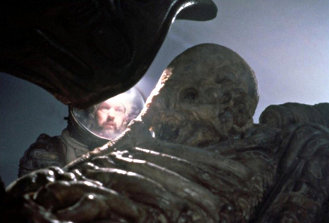
It’s likely enough. But I suspect that someone, possibly a non-scientist who spent time around morays, had noticed them earlier; and passed that knowledge on to folks designing the feature creature in “Alien.”

Have a safe and happy Halloween, and use caution while exploring deserted alien spaceships.

More about science, faith, and getting a grip:


1 I’m a Christian. I accept Jesus as our Lord. (John 1:1–5; Catechism, 430–451)

I’m a Catholic because I insist that what I believe must make sense, no matter how I’m feeling. As John C. Wright said, “… If Vulcans had a church, they’d be Catholics.” (johncwright.livejournal.com (March 21 2008))

2 After our Lord stopped being dead, Thomas wouldn’t believe what other disciples were telling him. (John 20:25)

I can’t say that I blame him.

“Then he said to Thomas, ‘Put your finger here and see my hands, and bring your hand and put it into my side, and do not be unbelieving, but believe.’

“17 Thomas answered and said to him, ‘My Lord and my God!’

“18 Jesus said to him, ‘Have you come to believe because you have seen me? Blessed are those who have not seen and have believed.’ ”
(John 20:27–29)

I didn’t demand that sort of proof. But nearly two millennia later, I had a whole lot more evidence than hearsay from a few badly-rattled folks to work with.

3 Evolution is not random: not in the sense of having no specific pattern. I suspect that quite a few folks say or write “random” when they mean “complex,” or “not fully understood.” In math, “random” is a probability distribution where all outcomes are equally likely.

If evolution had no specific pattern, scientists who study it wouldn’t be scientists. They’d be scorekeepers, recording meaningless trivia about “random” events.

4 A little more about creationism, evolution, and getting a grip:

5 Among other attributes, God is truth. (Catechism, 214–217)

“Thomas said to him, ‘Master, we do not know where you are going; how can we know the way?’

“Jesus said to him, ‘I am the way and the truth 5 and the life. No one comes to the Father except through me.

“If you know me, then you will also know my Father. 6 From now on you do know him and have seen him.’ ”
(John 13:5–7)

6 Teeth and brains:

7 About jaws, mostly:

Posted in Science News | Tagged , , , , , , , | 10 Comments

The Virtue Trap

I generally identify with the tax collector in today’s Gospel reading: Luke 18:9–14.

That’s okay, since emulating “those who were convinced of their own righteousness,” despising everyone else, is a bad idea.

The problem wasn’t what the Pharisee was doing.

Fasting, within reason, is a good idea. It can be part of penance. (Catechism of the Catholic Church, 1434, 1438, 2043)

Along with tithing, it’s part of being a Catholic. (Catechism, 1387, 1969)

It’s part of being a Catholic for most of us, that is. Code of Canon Law, IV, III, II, II, 1251 says it’s part of being Catholic for folks age 15 through 59, and there are some other exceptions.1

Like I said, what the Pharisee was doing wasn’t the problem.

It was his attitude.

“…The pharisee is the very icon of a corrupt person who pretends to pray, but only manages to strut in front of a mirror. He is corrupt and he is pretending to pray. Thus, in life whoever believes himself to be just and criticises others and despises them, is corrupt and a hypocrite. Pride compromises every good deed, empties prayer, creates distance from God and from others….”
(“Humble prayer obtains mercy,” General Audience, Pope Francis (June 1, 2016))

Truth Matters

Truth is very important, and hypocrisy is a bad idea. (Catechism, Prologue, 27, 74, 1847, 2468, more under “Truth” in the index)

I’m expected to live as if I think truth matters. (Catechism, 2464-2503)

I’m also expected to use common sense.

“Discuss your case with your neighbor, but another man’s secret do not disclose;
“Lest, hearing it, he reproach you, and your ill repute cease not.”
(Proverbs 25:9–10)

“…No one is bound to reveal the truth to someone who does not have the right to know it.”
(Catechism, 2489)

Humility is putting God in first place: being thankful for what is good, and having the good sense to seek forgiveness when I mess up.2 (Catechism, 299, 2559)

That happens more often than I like. Messing up, I mean. I can’t make Tobit’s claim, that I “have walked all the days of my life on the paths of truth and righteousness.” (Tobit 1:3)

That’s what “confession,” the sacrament of reconciliation is for: in part. I’m still ‘working out’ my salvation, and that’s another topic. (Philippians 2:12; Catechism, 1422-1470)

Uriah Heep and The Screwtape Letters

Not bragging about how virtuous I am is a good idea, but I think acting like the tax collector could be a problem, too: if it’s just “acting.”

I strongly suspect that’s at least partly what the “delighting in self-abasement” mentioned in Colossians 2:18 is about.

Uriah Heep is a terrible role model, and I’ve been over that before. (July 31, 2016)

Not bragging about my humility seems prudent: even if it’s just to myself.

“…All virtues are less formidable to us once the man is aware that he has them, but this is specially true of humility. Catch him at the moment when he is really poor in spirit and smuggle into his mind the gratifying reflection, ‘By jove! I’m being humble’, and almost immediately pride—pride at his own humility—will appear….”
(“The Screwtape Letters,” XIV, C. S. Lewis (1942) via Project Gutenberg)

Real-life analogs to the fictional Screwtape and Wormwood exist, are best left alone, and that’s yet another topic.3

Vaguely-related posts:


1 Fasting and common sense:

“…Those that are excused from fast and abstinence outside the age limits include the physically or mentally ill including individuals suffering from chronic illnesses such as diabetes. Also excluded are pregnant or nursing women. In all cases, common sense should prevail, and ill persons should not further jeopardize their health by fasting.”
(Questions and Answers about Lent and Lenten Practices, USCCB)

2 ‘Messing up,’ sinning, is what happens when I don’t love God, love my neighbors, and see everybody as my neighbor. (Matthew 5:43–44, 7:12, 22:36–40, Mark 12:28–31; Luke 10:25–27, 29–37)

Like I said, it happens more often than I like.

I should treat others as I want to be treated, too. (Matthew 7:12, Luke 6:31)

3 Demons, devils, angels who rejected God, are most emphatically not safe to be around. Satan, however, is not God’s ‘evil twin.’ (Catechism, 391-395, 397, 2851)

“…He is only a creature, powerful from the fact that he is pure spirit, but still a creature. He cannot prevent the building up of God’s reign….”
(Catechism, 395)

C. S. Lewis was right about “two equal and opposite errors,” I think:

“…There are two equal and opposite errors into which our race can fall about the devils. One is to disbelieve in their existence. The other is to believe, and to feel an excessive and unhealthy interest in them. They themselves are equally pleased by both errors and hail a materialist or a magician with the same delight….”
“The Screwtape Letters,” Preface, C. S. Lewis (1942) via Project Gutenberg)

Posted in Being Catholic | Tagged , , , | 5 Comments