The Eighth Day: Two Millennia and Counting

Easter is when we celebrate “the crowning truth of our faith in Christ.” (Catechism of the Catholic Church, 638)

It’s among the top major events so far. Depending on how you count them, there have been only three to six: the creation of this universe; humanity’s creation and fall; and our Lord’s arrival, execution, and resurrection.

There’s another big one coming, eventually: the Last Judgment.1 I take Matthew 24:36, 44; Matthew 25:13; Mark 13:3233 quite seriously, so I don’t try second-guessing God the Father. (December 11, 2016; August 7, 2016)

The idea that the Son of God was human and divine has seemed insufficiently ‘spiritual’ to some folks for two millennia now. But like John 1:14 says,2 “…the Word became flesh….”

The crucifixion, and what happened later, wouldn’t mean much otherwise. (Catechism, 457, 461463)

Cosmic Scale

We’ve known that God’s creation was big and old, and been impressed, for a long time. Over the last few centuries, we’ve learned that it’s immensely bigger and older than we thought.

“The heavens declare the glory of God; the sky proclaims its builder’s craft.”
(Psalms 19:2)

3 Terrible and awesome are you, stronger than the ancient mountains.”
(Psalms 76:5)

3 Raise your eyes to the heavens, and look at the earth below; Though the heavens grow thin like smoke, the earth wears out like a garment and its inhabitants die like flies, My salvation shall remain forever and my justice shall never be dismayed.”
(Isaiah 51:6)

4 Indeed, before you the whole universe is as a grain from a balance, or a drop of morning dew come down upon the earth.”
(Wisdom 11:2225)

Turns out that the “ancient mountains” aren’t all that old. Not on a cosmic scale.

I don’t see a problem with that.

Even if I did; I hope I’d have the sense to figure that God’s God, I’m not, and that my job doesn’t include telling God how the universe should work.

I believe that God is infinite and eternal, almighty and ineffable: beyond our power to describe or understand. (Catechism, 202, 230)

Understanding how this universe works may be another matter, and that’s another topic. (December 9, 2016)

As I see it, what we’re learning about the cosmic scale of this creation is cause for greater admiration of God’s work, and that’s yet another topic. (October 28, 2016; September 23, 2016; July 15, 2016)

Wounded, but Basically Good

I’ve said this before: God doesn’t make junk. The universe is basically good. So are we — basically. (Genesis 1:2627, 31; Catechism, 31, 299)

The first of us — Adam and Eve aren’t German — listened to Satan, ignoring what God had said.

Then Adam tried blaming his wife, and God; which did not end well. (Genesis 3:513)

That happened a very, very long time ago. We’ve been living with the disastrous consequences of their decision ever since. (Catechism, 396412)

But humanity is still made “in the divine image.” (Genesis 1:27)

Loving ourselves, others, and God is a struggle because the harmony we had with ourselves and with the universe is broken. Our nature is wounded: but not corrupted. (Catechism, 355361, 374379, 398, 400, 405, 17011707, 1949)

True God and True Man

About two thousand years ago, our Lord arrived:

“For God so loved the world that he gave 7 his only Son, so that everyone who believes in him might not perish but might have eternal life.

“For God did not send his Son into the world to condemn 8 the world, but that the world might be saved through him.”
(John 3:1617)

Jesus was born in Bethlehem. Reactions at the time were mixed.

Shepherds and Magi thought it was good news, Herod didn’t, and that’s yet again another topic. (January 15, 2017)

Like I said earlier, the Word had become Flesh, true God and true man. (John 1:14; Catechism, 456478)

Anguish, Betrayal, Blood, and Death

We reviewed Mathew’s account of our Lord’s final Passover meal last week; and kept reading until Matthew 27:66, where guards sealed Christ’s tomb.

Friday’s Gospel, John 18:119:42, was similarly uncheerful:

1 2 When he had said this, Jesus went out with his disciples across the Kidron valley to where there was a garden, into which he and his disciples entered.”

“So they laid Jesus there because of the Jewish preparation day; for the tomb was close by.”
(John 18:1, 19:42)

All four Gospels agree on what happened next, although the accounts don’t quite match up: by American standards.3

1 2 3 On the first day of the week, Mary of Magdala came to the tomb early in the morning, while it was still dark, and saw the stone removed from the tomb.”
(John 20:1)

Our Lord had stopped being dead. (December 25, 2016; November 27, 2016)

That’s where it gets interesting.

The Eighth Day: Life, Death – – –

Two millennia later, we’re still celebrating.

Pope St. John Paul II called the Resurrection of Jesus “the fundamental event upon which Christian faith rests … the fulcrum of history.”4

Death, physical death, happens: but it is not the end. (Catechism, 1007, 10101014, 1022, 1682)

7 8 But now Christ has been raised from the dead, the firstfruits of those who have fallen asleep.

9 For since death came through a human being, the resurrection of the dead came also through a human being.

“For just as in Adam all die, so too in Christ shall all be brought to life,”
(1 Corinthians 15:2022)

What happens next depends on whether or not we decide to accept or reject God’s grace. What we’ve done with our life matters, too. (John 14:15; 2 Timothy 1:910; James 2:1419; Catechism, 10211022, 19872016)

What our Lord expects is simple, but not easy.

I should love God, love my neighbor, see everyone as my neighbor, treat others as I want to be treated. (Matthew 7:12, Matthew 22:3640, Mark 12:2831; Matthew 5:4344; Mark 12:2831; Luke 10:2530; Catechism, 1825)

I try to love God and neighbor because I follow the Man who is God.

Jesus died in my place; descended to the abode of the dead; rose from the tomb; and lives today and forever. (Matthew 28:110; Mark 16:111; 1 Peter 4:6; Catechism, 631635, 638655)

By any reasonable standard, that’s a big deal.

– – – and Beyond

We are living in the eighth day of creation: and have been for two millennia. It is a day of life and hope. (Catechism, 349, 1166, 2174)

There’s more to being a Christian than celebrating and waiting for our Lord’s return. I’m expected to live as if loving my neighbors and loving God matter.

Truly respecting the “transcendent dignity” of humanity, and each person, isn’t easy: but it’s something I must do. (Catechism, 1929)

Part of our job is also building a better world for future generations. It starts within each of us, in me, with an ongoing “inner conversion.” (Catechism, 1888, 19281942)

We’ve made some progress: and have a very great deal left to do.

Like I keep saying, my guess is that we’ll still be waiting and working when the 8.2 kiloyear event, Y2K, and Y10K are seen as roughly contemporary. (February 5, 2017; November 27, 2016; October 30, 2016)

But the war is over. We won. We’re already in “the last hour,” and have been for two thousand years. This world’s renewal is in progress, and nothing can stop it. (Matthew 16:18; Mark 16:6; Catechism, 638, 670)

More of my take on the best news ever:


1 Our Lord’s return, and the Final Judgment, will happen: and is the next major event. As for when it’s coming — I have enough on my plate, without trying to outguess God.


(From Wiley Miller’s Non Sequitur, used w/o permission.)

More of my take on Final Judgment and getting a grip:

2 Reading the Bible is a very Catholic thing:

“The Church ‘forcefully and specifically exhorts all the Christian faithful. . . to learn the surpassing knowledge of Jesus Christ, by frequent reading of the divine Scriptures. Ignorance of the Scriptures is ignorance of Christ.112
(Catechism of the Catholic Church, 133)

It’s literally ‘Catholicism 101:’

3 As I keep saying, Sacred Scripture wasn’t written from a contemporary Western viewpoint:

4 From Pope Saint John Paul II’s “Dies Domini” (Day of the Lord):

“…The Resurrection of Jesus is the fundamental event upon which Christian faith rests (cf. 1 Cor 15:14). It is an astonishing reality, fully grasped in the light of faith, yet historically attested to by those who were privileged to see the Risen Lord. It is a wondrous event which is not only absolutely unique in human history, but which lies at the very heart of the mystery of time. In fact, ‘all time belongs to [Christ] and all the ages’, as the evocative liturgy of the Easter Vigil recalls in preparing the Paschal Candle. Therefore, in commemorating the day of Christ’s Resurrection not just once a year but every Sunday, the Church seeks to indicate to every generation the true fulcrum of history, to which the mystery of the world’s origin and its final destiny leads….”
(“Dies Domini,” Pope Saint John Paul II (Pentecost, May 31, 1998))

More about the Resurrection:

Posted in Being Catholic | Tagged , , , , , , , , | Leave a comment

Mars: Leaky Red Planet

What we’re learning about Mars, and a new type of really small spacecraft, reminded me of earth, air and kilts.

Also pharaohs, Thomas Paine, and Lord Kelvin. By then I was running out of time to write something more tightly-organized.

I figured you might be interested in some of what I have written. On the other hand, maybe not. So I added links to my ramblings before and after what I said more-or-less about the science news, and figure you can decide what’s interesting and what’s not.


Earth, Air, and Kilts: Also Lord Kelvin

Earth’s atmosphere is roughly 78% nitrogen, 21% oxygen, 1% argon, 0.04% carbon dioxide; plus traces of neon, helium, and methane.

That’s not including water vapor. Depending on where you are and what time you take the sample, that varies from 0.001% to 5%.

Sometimes it feels like the air is about 125% water, and that’s another topic.

Many folks are more concerned these days about Earth’s atmosphere than in my youth.

We’ve learned quite a bit since 1898, when Lord Kelvin told a reporter that if we kept going through coal and wood at the late-19th-century’s rate, we’d have burned all Earth’s fuel in 500 years.1

That wasn’t the bad news.

According to the British peer, we were using up Earth’s oxygen so fast that we’d run out in 400 years.

And you thought global warming/climate change was bad!

Lord Kelvin’s math was accurate. His assumptions weren’t, entirely. For one thing, we’ve learned about Earth’s oxygen cycle since then.

I still think developing more efficient gadgets, and looking for the next practical energy source, makes sense.

Outlawing ‘scary’ technology, or deciding that there are too many humans, not so much. (February 17, 2017; February 10, 2017; August 12, 2016)

I’ll admit to a bias. I’m human, and arguably among those who are not sufficiently useful and fit to deserve life. ‘Improving’ humanity has been tried, with regrettable results, and that’s yet anther topic. (August 14, 2016)

In fairness, some tech really is dangerous; or too hard to dispose of safely. I’ve talked about PCBs before, but not asbestos. (February 17, 2017)

Maximilian I apparently thought wheellocks were too dangerous to let Austrians own them; and King George II defended England by banning tartans and kilts in Scotland. That law was repealed, finally, in 1782.

On the other hand, Bhutan’s government passed the Driglam namzha laws in 1989, making traditional Bhutanese dress compulsory in some settings. And that’s yet again another topic.

Change Happens, and Early Planetary Atmospheres

Earth’s atmosphere hasn’t always been like it is now.

We’ve learned a great deal since the 1700s, when some natural philosophers suggested that the Solar System might have started as a rotating cloud of gas and dust.

It wasn’t until after my youth that observations and better math made the nebular hypothesis the preferred model. Getting decent images of ‘nearby’ protoplanetary disks helped.

I think the one around Beta Pictoris was the first, in 1984. That’s an infrared image of the one around HL Tauri, taken by the Atacama Large Millimeter Array. (December 23, 2016; December 9, 2016)

We’re pretty sure that our Solar System’s planets all started with hydrogen atmospheres.

Mostly hydrogen, that is. Water vapor, ammonia, and methane, among other chemicals, would have been in the mix. Big, distant, worlds like Jupiter and Saturn stayed old enough to keep most of their original gasses. Earth didn’t.

Earth was gassy, early on. Volcanoes, and — probably — volatile-rich asteroids gave our home its ‘second atmosphere.’ We’re still not sure about the Late Heavy Bombardment.

Comets have been falling from the sky at odd intervals, too; which may or may not be where much of Earth’s water came from. “Not” is the prevailing opinion, but that could change as we learn more.

The current mix started forming as plate tectonics kicked in, and critters started making changes. That caused Earth’s first environmental crisis, although I’m the only one who I know of who calls it that.

Cyanobacteria , or critters like them, started dumping oxygen some 2,300,000,000 years back, give or take. The Great Oxygen Event was great for us, eventually, but lethally bad for obligate anaerobes. (September 30, 2016; September 2, 2016)

I’ll be calling it the GOE; mainly because that’s shorter, and I like acronyms.

After the Great (For Us) Oxygen Event

We’re not entirely sure what set off the GOE. Photosynthesizing microcritters almost certainly were major players, quite possibly helped along by a variety of processes we didn’t know about until recently.

Besides setting off an extinction event, the newly-present oxygen would have reacted with methane, producing carbon dioxide and water. Carbon dioxide isn’t as effective a greenhouse gas as methane, which helps explain why the Hurorian glaciation started.

That was the longest ice age we know of, and apparently set off another extinction event, or kept the oxygen-sparked one going.

We didn’t know that extinction happened until the 1700s — according to a Forbes article by David Bressan. That’s when folks putting together facts and speculations about fossils started thinking about why some of the critters weren’t around now.

One of the fossils was a set of outsize antlers, found in Ireland. An Irish priest, Bressan said, Thomas Molyneux, figured big antlers were from a critter that didn’t live in Ireland any more. But molyneux thought the critter was probably still around somewhere else.

That made sense back in 1695, when Europeans were learning how much of Earth they hadn’t known about. Later, when European explorers were running of unknown new lands, not so much.

Bressan’s Irish priest sounds like Thomas Molyneux, an Irish doctor born in 1661.

He’s also credited with publishing the first scientific description of the Irish elk. That critter’s binomial name is Megaloceros giganteus, and I’ve talked about Linnaeus before. (September 23, 2016)

T. Molyneux is the chap folks at the California Museum of Paleontology think identified the Irish elk, and helped get scientists thinking about evolution. Dr. M. didn’t get everything right, though:

“…In the words of Dr. Thomas Molyneux, the first scientist to describe the Irish elk:

“That no real species of living creatures is so utterly extinct, as to be lost entirely out of the World, since it was first created, is the opinion of many naturalists; and ’tis grounded on so good a principle of Providence taking care in general of all its animal productions, that it deserves our assent.”

“Molyneux erroneously identified the Irish elk with the American moose…”
(California Museum of Paleontology)

William Molyneux, an Irish priest, was born in 1685. That would make him about 10 years old in 1695: a bit young to be writing about extinct critters, and that’s still another topic.

In 1796 French naturalist George Cuvier said that a newly described species of elephant was an extinct creature, unlike any living species.

He had evidence to back it up. Johann Friedrich Blumenbach called the critter Elephas primigenius. Most folks call it the wooly mammoth.

But mammoths aren’t mentioned much, since the last ones died around the time Thutmose was taking territory back from Nubia and Carchemish on the Euphrates.

Recent Changes, and More Than You Need To Know About Pharaohs


(Hatshepsut’s temple, refurbished and currently maintained as an historic site.)

Maybe Nubia’s king thought it was a good time to reclaim land earlier Pharaohs had taken. He was wrong about that, fatally, another Nubian effort failed with pretty much the same result a few years later.

I haven’t learned the name of that Nubian King. My guess is that most of the records we have of him are from official Egyptian archives, which weren’t particularly interested in whoever wasn’t in charge at the moment.

My word for Egypt’s top leaders, pharaoh, is what happened to the Egyptian word (par-ʕoʔ, probably) after passing through Greek (Φερων) and Hebrew (פרעה), Greek again (φαραώ, this time), Late Latin (pharaō), and English (pharao).

England’s King James put the Hebrew “h” back in, and that’s where we are today. A few millennia from now, I suspect my language will still be around. If it is, I’m quite sure it will have changed.

Although history usually gets presented as a succession of wars, I gather that most of the time Nubians and Egyptians got along about as well as neighbors anywhere.

Hence trade, cultural exchange, and intermarriage among Nubians and Egyptians; punctuated by intermittent warfare.

My civilization didn’t start realizing that Africa had a significant history until my lifetime, so we haven’t put many of the pieces together yet. Better late than never, I think.

My guess is that Egypt of the pharaohs is more of an African civilization than the ‘Western’ folks centered on the Indus and Mesopotamian regions.

The Kush Kingdom lasted a little longer than ancient Egypt.

That’s Mentuhotep III, not Thutmose.

We don’t know much about Mentuhotep I, who lived during one of Egypt’s major speed bumps. If I was taking a History test, I’d say it was the First Intermediate Period, about 41 centuries back.

There was another one, 36 centuries back, give or take a few.

The third happened when the Late Bronze Age collapse reached Egypt. Egypt ended up as part of the Achaemenid Empire.

Egyptians who weren’t part of the Achaemenid system were happy to see Alexander the Great take over.

Alexander the Great died before tying his empire together. Ptolemy I Soter, one of Alexander’s generals, pulled Egypt out of that mess, and was accepted as a pharaoh.

My guess is that pharaonic Egypt would have recovered and be around today, if another major power hadn’t been around. The Roman Republic was built on what I think are good ideas. Like every other effort, it wasn’t perfect. But for nearly five centuries it brought a measure of peace and prosperity to much of the Mediterranean basin.

My the time our Lord showed up — I’ll be talking about that elsewhere — the Roman Senate had schemed and assassinated themselves into a corner.

They named one of their members “dictator perpetuo,” hoping that Julius Caesar would solve their problems. He was doing that when some well-meaning, or disgruntled, Senators killed him.

The Final War of the Roman Republic rolled over Egypt around 30 BC. The Republic became an empire, which lasted a little over five centuries. We haven’t had that level of stability since. Stability isn’t everything, but it can be a good idea.

Some developments over the last century are hopeful, I think. And that’s — what else? — another topic. (October 30, 2016; September 25, 2016)


1. Martian Air
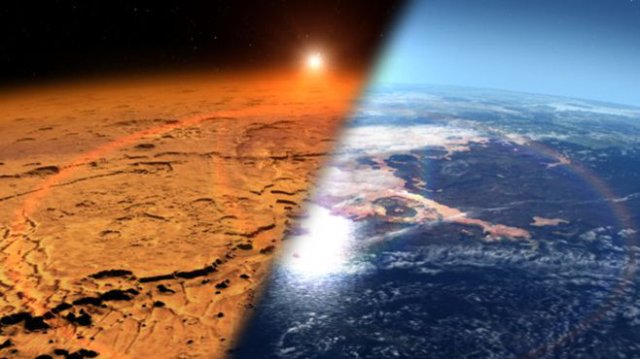

(From NASA, via BBC News, used w/o permission.)
(“Artwork: Mars today is cold and dry (L) but it have been very different billions of years ago (R)”
(BBC News))

Most of Mars’ air was ‘lost to space’
Jonathan Amos, BBC News (March 31, 2017)

It is clear now that a big fraction of the atmosphere of Mars was stripped away to space early in its history.

“A new analysis, combining measurements by the Maven satellite in orbit around the Red Planet and the Curiosity rover on its surface, indicate there was probably once a shroud of gases to rival even what we see on Earth today.

“The composition would have been very different, however.

“The early Martian air, most likely, had a significant volume of carbon dioxide.

“That would have been important for the climate, as the greenhouse gas might have been able to warm conditions sufficiently to support nascent lifeforms….”

Let’s say we find life on Mars: or learn that there was life there. What would that mean?

I’m pretty sure that would depend on who’s talking. I’d most likely be fascinated, excited, eager to learn more; and recognize the discovery as another opportunity for greater admiration of God’s work. (Catechism of the Catholic Church, 283)

But I’m a Christian and a Catholic who isn’t upset that whoever wrote Joshua and Job didn’t know about Kepler’s work. I’ve talked about Psalms, Ptolemy, and getting a grip, before. (December 2, 2016; July 29, 2016)

Others might decide that Thomas Paine was right. (December 23, 2016)

Paine has been called an English-American activist, philosopher, political theorist, and revolutionary; and a rabble-rousing troublemaker. Again, it depends on who’s talking.

Christopher Hitchens’ “Thomas Paine’s ‘Rights of Man’: A Biography” recognizes that folks often think and write as if they’re living in the era they’re living in.

That shouldn’t be surprising, but like I said: I’m not upset that the Old Testament isn’t written from a 20th-century scientist’s viewpoint.

Or 34th-century philosopher’s, for that matter.

Anyway, here’s what Hitchens wrote about Paine:

“…Paine was an engineer and amateur scientist, and stood on tiptoe to see as far as he could over the existing horizon. He half-understood the concept of infinity and the infinite plurality of possible other galaxies, but he could not leave hold of the idea that this made the terrestrial much more unique, rather than quite possibly less….”
(“Thomas Paine’s ‘Rights of Man’,” Hitchens, p. 133, via Google Books)

I’m not surprised at Paine’s views. He was born on January 29, 1736 or February 9, 1737, depending on which calendar you use. (March 24, 2017)

His father was a Quaker, his mother an Anglican.

Jonathan Edwards’ “Sinners in the Hands of an Angry God” came out in 1741. Thomas was about four at the time, and living with his parents in Norfolk, England; so I’m pretty sure he didn’t read it at the time.

Edward’s sermon left a lasting impression, though, so I’m sure Paine ran into Edward’s version of Calvinism. That mix of ideas is still echoing in America’s religious assumptions. (March 5, 2017)

The first part of Paine’s “Age of Reason” came out about 53 years after Edward’s “God … abhors you” bestseller. Paine’s “…Reason” was a bestseller, too; and echoes of it’s ideas are, if anything, a bit easier to hear these days.

Thomas Paine

Paine spends part of two sections in “…Reason,” Part First, saying that Christianity actively suppressed scientific progress. I think I understand how he came to that conclusion, but I don’t agree.

I’ve talked about Saints Hildegard of Bingen and Albertus Magnus, autopsies, and H. P. Lovecraft, before. (March 31, 2017; December 16, 2016; July 15, 2016)

Paine starts the next section starts by saying that someone can either take Christianity seriously, or accept what folks were learning about the universe. That’s an oversimplification:

“…the story of Eve and the apple, and the counterpart of that story, the death of the Son of God, that to believe otherwise, that is, to believe that God created a plurality of worlds, at least as numerous as what we call stars, renders the Christian system of faith at once little and ridiculous, and scatters it in the mind like feathers in the air. The two beliefs cannot be held together in the same mind, and he who thinks that he believes both, has thought but little of either….”
(“Age of Reason,” Part First, Section 12, Thomas Paine (1794) via ushistory.org)

I don’t blame Paine for seeing Christianity that way.

He grew up in a country whose ruler had kicked over the traces two and a half centuries before, setting up a national church; and Europe was recovering from the Thirty Years War. (November 6, 2016; October 28, 2016)

About two centuries after Paine, some — not all — Christians had conniptions about evolution. We’re dealing with the same weirdness in the second decade of the 21st century.(October 28, 2016; August 14, 2016)

Life, the Universe, and Doing Our Job

I don’t think that life emerged on Mars, or that Mars never harbored life. Like I keep saying, we don’t know. Not yet.

The odds have been looking much better in recent years, from a low point after 1965. That’s when when Mariner 4 sent back images of craters, detected no planetary magnetic field, and surface atmospheric pressure well below ‘best case’ estimates. We’ve learned quite a bit since then. (September 30, 2016)

We still don’t know about life on Mars, but it’s become increasingly difficult to say there can’t have been life there.

And if we don’t find Life on Mars, we’ve found favorable locations in and beyond the Solar System’s asteroid belt.

We’ve also started charting promising destinations around other stars. (March 3, 2017; September 30, 2016; September 2, 2016; July 29, 2016)

I think it’s very likely that we’ll find life somewhere beyond Earth. But I won’t say that there must, or must not, be life elsewhere in the universe. That’s up to God. Part of our job is learning what’s out there. (Catechism, 159, 282286, 341, 22922296)

I’ve talked about God, Aristotle, 1277, and getting a grip, before. (December 16, 2016; December 2, 2016)


2. The Lost Ocean of Mars: Maybe


(From Science Photo Library, via BBC News, used w/o permission.)
(“Did early Mars have a vast northern ocean?”
(BBC News))

Impact crater linked to Martian tsunamis
Paul Rincon, BBC News (March 26, 2017)

Scientists have located an impact crater linked to powerful tsunamis that swept across part of ancient Mars.

“The team believe an asteroid triggered 150m-high waves when it plunged into an ocean thought to have existed on northern Mars three billion years ago.

“Lomonosov crater in the planet’s northern plains fits the bill as the source of tsunami deposits identified on the surface….”

A Martian ocean isn’t news. Evidence of a tsunami is literally last year’s news. Scientists reported landforms in the Ismenius Lacus quadrangle where the simplest explanation was that at least two whacking great waves rearranged boulders. That was in May of 2016.

Finding a probable impact point where the tsunamis started, that’s news.

About the Martian ocean: We’re still not absolutely sure, but robots like Curiosity have been finding rocks that form in water.

Scientists have worked out some variously-improbable scenarios where water isn’t involved, or where there’s only enough water to form a molecule-thick film.

My guess is that the simpler explanations are more likely: and that Mars once had water. Which may still be there. That would make self-sustaining outposts there much easier to set up. (September 30, 2016)

We also don’t know for sure if Mars had enough water to make an ocean. But again, explanations for what’s being found are simpler with water.

There are possible non-water explanations for the river channels and deltas we’re finding, but it does look like they’re what’s left of rivers flowing to lakes and an ocean.

Whether or not the Mars ocean hypothesis is eventually proven, we’ve got names for it: the Paleo-Ocean and Oceanus Borealis. Either way, it would have filled the basin Vastitas Borealis in the Martian northern hemisphere.

If there was a Martian ocean, it was most likely drying up between 4,000,000,000 and 3,800,000,000 years ago. Give or take.

If life got started on Mars, and developed at anything like the speed it did here on Earth, there wasn’t time for Barsoomians to appear. (December 16, 2016)

We might, however, find traces of microbes. Or we may find that life on Earth isn’t particularly close to the 50th percentile. (March 3, 2017)

Changing Air

Like I said earlier, Earth’s atmosphere is about 78% nitrogen, 21% oxygen, 1% argon, 0.04% carbon dioxide; plus traces of other gasses. That’s not including water vapor, anything from around 0.001% to 5%.

Our home’s air wasn’t always like that.

Like everything else we’re finding, it’s been changing. I could kvetch that “it’s not in the Bible,” but that doesn’t make sense, not to me. Accepting that the creation we’re in is in a “state of journeying” does. (Catechism, 302)

We think of 21% oxygen as “normal.” But again, that’s been changing. Atmospheric oxygen was almost non-existent Before the GOE, and has fluctuated since. A lot.

After photosynthesizing microcritters started dumping oxygen in Earth’s ocean, killing anaerobic life — I talked about that earlier — there still was precious little in the air. Most of the oxygen was getting absorbed by the ocean’s water and rock.

Then, from around 1,850,000,000 to 850,000,000 years back, it looks like the ocean and seabed got saturated enough for oxygen to start escaping into Earth’s atmosphere.

It still wasn’t accumulating there, since exposed rocks were getting oxidized as fast as oxygen reached them.2

If you haven’t noticed the hue and cry over carbon dioxide, you probably don’t read or listen to the news.3

“Hue and cry” apparently started with Edward I of England’s 1285 Statute of Winchester, making lots of folks responsible for theft or robbery. American law discourages folks from shielding burglars and robbers, and I’m drifting off-topic again.

Carbon dioxide is a “greenhouse gas” produced by volcanoes, fermenting bread, and leaky fire extinguishers. There’s more in Earth’s atmosphere now than there was before the industrial revolution. I’ll get back to that.


3. Smaller Can Be Better


(From NASA, via BBC News, used w/o permission.)
(“The IceCube smallsat was designed to study Earth, but upcoming missions would be despatched to other planetary bodies”
(BBC News))

Nasa ‘smallsats’ open up new planetary frontier
Paul Rincon, BBC News (March 22, 2017)

Nasa is planning a series of small satellite missions that could open up new ways of exploring the Solar System.

“James Green, head of planetary science at Nasa, told BBC News that the agency was investing in the technology and looking at how best it could be used.

“Scientists studying these “smallsats” believe they have now proven their utility for cutting edge science.

“They could be deployed from larger spacecraft to carry out targeted investigations, Dr Green explained….”

Satellites and probes have been, mostly, getting bigger. Sputnik 1 was about the size of a beach ball; 58 centimeters, 23 inches across — not counting antennae.

The Hubble Space Telescope is 13.2 by 4.2 meters, 43.3 by 13.8 feet; and the International Space Station is 72.8 meters, 239 feet, long.

I’m pretty sure we’ll keep building large spaceships: when that’s the most reasonable design for a mission. But we’ve been getting better at making equipment smaller.

I’m most impressed by what’s happened in electronics. I remember when vacuum tubes were pretty much the high end of electronics tech. We’ve recently made circuitry small, and low-powered, enough to fit inside people. Also monkeys. (November 18, 2016 )


Carbon Dioxide isn’t Carbon Monoxide

I’m not surprised that there’s more carbon dioxide in Earth’s atmosphere than the ‘good old days’ of no steam locomotives and cholera epidemics.

We’ve been learning that there’s been less carbon dioxide in Earth’s atmosphere, and a whole lot more than today. The same goes for oxygen.

I’m also not surprised that the crisis du jure is now called “climate change.” My guess is that too many folks started remembering the coming ice age, and began actually looking at available data. (January 20, 2017)

I don’t deny that Earth’s climate is changing. I’d be astonishing if it stopped changing. I also think we should “do something” about conditions here.

But I sincerely hope that decisions are made rationally, based on data: not feelings.(January 20, 2017; November 18, 2016 )

Earth’s carbon monoxide isn’t quite the same as carbon dioxide. It comes mostly from sunlight hitting the atmosphere.

It also comes from volcanoes, forest fires, and faulty stoves. The stuff binds with hemoglobin, but the way it kills critters like us is a lot more complicated. It’s toxic in more than trace amounts, though, which is why it’s a good idea to fix stoves.

Aristotle didn’t know about the biochemistry of carbon monoxide poisoning, but did notice that toxic fumes come from burning coals.

Killing folks convicted of crimes by putting them in a bathing room with smoldering coals is another reason I don’t miss the ‘good old days.’ (January 22, 2017; January 11, 2017; November 21, 2016)

Supereons, Eons, and Eras

As scientists started realizing that Earth a whole lot more than a few thousand years old, they coined words to make talking about different amounts of ‘a really long time’ easier.

This sort of thing fascinates me, your experience may vary.

Eons are units on the geologic time scale between supereons and eras. The Phanerozoic eon is the current one, when critters like trilobites and reef-building archaeocyathans appeared. That’s about 541,000,000 years ago, give or take 1,000,000.

The next one back is the Proterozoic, and don’t bother memorizing these names. There won’t be a test on this stuff.

Quite a bit happened before the Phanerozoic and Proterozoic. That’s January through September, more or less, on the ‘cosmic calendar’ up there.

Stewardship

There’s a kernel of truth behind all the chaff of “climate change” hype.

It’s nearly certain that we’ve been altering climate, at least regionally, ever since folks started planting crops.

Like it or not, we’re hot stuff:

4 What are humans that you are mindful of them, mere mortals that you care for them?
5 Yet you have made them little less than a god, crowned them with glory and honor.
(Psalms 8:46)

But “little less than a god” isn’t God.

Earth got along fine before we showed up.

Now that we’re here, we have “dominion;” which doesn’t mean we can do whatever we please. (March 26, 2017; January 20, 2017; November 18, 2016)

We can, actually, we have free will. But it would be a very bad idea. Our dominion is not ownership.

We’re more like stewards, responsible for God’s property. Using resources is okay. That’s part of our job: using and managing resources; for our reasoned use, and for future generations. (Genesis 1:2629, 2:15; Catechism, 339, 952, 24022405, 2415, 2456)

Our croplands and factories aren’t the only forces at work. I’ve talked about stewardship, eruptions of Mount Tambora, Krakatoa, and Mount Redoubt, before. (January 20, 2017)

Climate Change and Thinking Ahead

Earth’s climate was changing long before humanity arrived. It’s changed a lot over the last few billion years.

I think we have serious decisions to make over the next few centuries. I also think that we have centuries, millennia, and longer; and should be planning with that in mind.

I also think that we will prove as durable as rats, cockroaches, and — eventually — scorpions. (September 30, 2016)

Still learning about Earth and the universe:


1 Baron Kelvin, science, and sense:

2 Atmospheres:

3 I’ve talked about Ehrlich and fizzled forecasts before:

Posted in Science News | Tagged , , , , , , , , , , , , , , , | Leave a comment

The Speckled Axe

I’m a perfectionist, a frustrated one. Somewhere between childhood and adolescence, I felt that if adequacy had a numeric value, it’d be greater than two and less than one; or something equally impossible.

More accurately, I felt as if that was the standard imposed on me. I realized that it wasn’t possible, and that there was no point in trying to reach it. Like I said, frustrated.

That goes a long way to explain, I think, why results from aptitude and intelligence tests showed that I should be getting stellar grades: and I wasn’t.

Autism Meets Perfectionism

Academics interested me, and I was paying attention. I just didn’t see a point in “good grades.” Besides, there was a whole universe full of things not being covered at any particular moment: including some inside the classroom.

I remember spending a sizable fraction of a class period, watching the shadow cast by a window frame travel across the floor.

That was an interesting confirmation that what I’d read recently about Earth’s rotation was essentially accurate.

Folks like me aren’t a good fit in most circles of society. Happily, my civilization had left terms like “soulless mass of flesh possessed by the devil” behind by then. Some psychologists were discussing Asperger’s paper on ‘autistic psychopaths.’

“Autistic psychopathy” is now part of the “autism spectrum disorder.” I think that sounds less scary. I also think it may be just as well that my brain’s — odd — wiring wasn’t spotted until recently.

I’ve described myself as “brilliant, talented, and on medication.” And that’s another topic. (March 19, 2017; October 21, 2016; July 31, 2016; Brian H. Gill’s Shop on DeviantArt.com)

Happily, most of my elementary school teachers were very patient and understanding. One, not so much. I understand she left teaching and entered some sort of asylum after having me in her class.

My mostly-good experience with instructors lasted through high school and college: with a few exceptions. Very few.

Books with titles like ‘How To Be Rich And Famous Like Me’ sometimes say that perfectionism is a good thing.

Assuming that the authors have at least one foot in reality, I figure they’re thinking of having high standards. And that the standards are determined rationally, achievable, and measured in a quantifiable way.

I think Dr. Adrian Furnham is right. Being a perfectionist is good news and bad news.

The good news is that, properly managed, perfectionism can help someone be organized. That, plus effort, lets the perfectionist finish tasks on time and at or above expectations, and succeed in business or sports.

The bad news is that perfection, improperly managed, easily leads to the opposite of the ‘good news’ results.

There’s a religious angle to it, and I’ll get back to that.

The Speckled Axe Story

I think my parents had the same struggles with perfectionism that I experience.

Somewhere in late childhood, my father and I were in the garage.

We’d been doing something that turned our attention to a wall-mounted tool grinder.

It was a little like the one in that photo. Not as fancy, though, as I recall. That one’s a Luther Best Maide #51, on an old antique farm tools” page, along with wood & brass levels and a Federal Tool syrup pitcher.

“Old antique” seems redundant, but some antiques are older than others. Laurel Leaf Farm’s home page shows a much dressier selection of old stuff.

I like living in an era where old folks like me remember the days when downlinks needed dishes 18, 20 feet across. Kids these days grew up with fancy-schmancy little things you could hang a coat on. And that’s yet another topic.

Back to the garage. My dad could probably have sharpened his tools faster without my help, but I’m glad he didn’t.

I’d turn the crank, gears multiplied the handle’s revolutions, and I got an upper-body workout. Also time with my dad. I liked the sound it made, and the sparks that flew while sharpening tools. The grinder, that is. My dad was loud, but his noises were different.

Those were good times. Come to think of it, I’m loud. Anyway, I can’t remember the exact words my father used, but I remember the story he told.

A father and son were getting ready to chop wood. This was in the days when you sharpened an axe by turning a stone wheel by hand and holding the axe blade against it.

The son didn’t want to have a speckled axe when they were done. He wanted to get the axe perfectly sharpened and polished, with no rust left at all.

The father agreed, on the condition that the son turn the wheel. After a while the son got tired and said, “Dad, I think a speckled axe is okay.”

A Community of Perfect People?

Depending on who’s talking, perfectionism is a key to success, a psychological disorder waiting to happen, or “any of various doctrines holding that religious, moral, social, or political perfection is attainable.” (dictionary.com)

Some perfectionists have set up their own communities, like John Humphrey Noyes’s Oneida Community.

The original Oneida Community started in 1848, east of Lenox, New York. Oneida merged with Lenox later that year, was un-merged in 1896, and incorporated as the City of Oneida in 1901. The town, that is.

The Oneida Community caught on: setting up branches in or near Wallingford, Connecticut; Newark, New Jersey; Putney and Cambridge, Vermont. The 1800s was boom times for uptopian communities in America, and that’s anther topic.

Boom times don’t last. By 1878 the one in Wallingford was the only one left. It got hit by a tornado that year. They dissolved in 1881 — the community, I mean, not the people. This wasn’t a Jonestown scenario, happily.

I’m not clear on details, but the — Oneidians??? — moved on, forming the Oneida Limited silverware company in 1881.

Folks in the Oneida Community thought our Lord had come back in 70 AD. It’s an interesting variation on millennial predictions.

They also believed that our Lord return made it possible for them to be free of sin and perfect in this world. They also thought they’d bring about Jesus’s millennial kingdom themselves. I’m sure they were sincere, and that they were mistaken.

The thirst for truth that’s written into each of us should lead us to God. Because I think seeking truth is vital, I support religious freedom — for everyone, not just folks who agree with me. (Catechism of the Catholic Church, 21042107)

I’m also expected to recognize that other religious “…frequently ‘reflect a ray of that truth which enlightens all men’….” (Catechism, 2104, 21082109)

That doesn’t mean I think everybody’s right. I’ve talked about that, “love” not always being “approval,” an allegedly-illegal surname, and getting a grip, before. (April 2, 2017; November 21, 2016; October 28, 2016)

An End Times Prediction of Distinction

The Oneida Community’s 1st-century Second Coming was a bit unusual, but I still think Swedenborg gets top place for — originality, I suppose.

Swedenborg published “The Last Judgment and Babylon Destroyed…” in 1758, and it wasn’t just another End Times Bible Prophecy. Swedenborg announced that the Last Judgment had happened in 1757 — “in the spiritual world.”

High points for originality, zero for accuracy. And that’s nothing new. (December 11, 2016; August 7, 2016)

We’ve been on standby alert for two millennia, we’ve got plenty of work to do, and I’ve said that before. Basically, I take our Lord and Matthew 25:13, Matthew 24:36, 44, and Mark 13:3233 very seriously. Wannabe prophets, not so much. (November 27, 2016; October 2, 2016; August 7, 2016)

Surprise! It’s Saturday

There’s more to say about perfectionism, but I noticed that it’s late Saturday; not late Friday night. It’s been that sort of a week.

If I’m going to wrap this up, get some must-do tasks done, and get a plausible simulation of a good night’s sleep, what I was going to say must wait until next week.

Or maybe the week after. Next Sunday is Easter Sunday, and I’ve got a few things to say about what happened after our Lord was tortured, executed, and buried.

About being perfect, I don’t expect that in the here and now, but I’ll keep pushing toward that goal. Happily, being perfect isn’t required. ‘Working out my salvation’ is. (Philippians 2:12)

I can’t work, or pray, my way into Heaven. I rely on our Lord. It’s faith and works. (Catechism, 430451, 10211022, 10381039, 1051, 18141816)

At the top of my ‘to do’ list is loving God and my neighbor. Also seeing everyone as my neighbor. No exceptions. (Matthew 22:3640, Mark 12:2831; Matthew 5:4344; Mark 12:2831; Luke 10:2530; Catechism, 1825)

That’s simple, not easy, and I’ve got dishes waiting for me in and near the sink.

Good night, and may God bless.

Vaguely related posts, and some that probably aren’t:

Posted in Being Catholic, Family Stories, Series | Tagged , , , , , , , , | Leave a comment

A Different “Friday” Post

I had about half of the planned “Friday” post done, when I noticed a news item about pesticides in some American city water. That got my attention, so did what the scientists said. By the time I stopped writing ‘a few notes,’ I had much of a post written.

It wasn’t the one I had in mind, and the format was a bit unusual, but it was about science. Besides, there was no way I’d get the planned one done in time.

So this week’s ‘science’ post is “Pesticides in the Water.” I may get “Mars: Leaky Red Planet,” the one I’d originally been writing, done before Friday’s done. Or maybe not.

Now, I’ve got dishes to wash and a few other tasks. Then I really could use sleep.


Update, Friday, April 8, 2017.

“Mars: Leaky Red Planet” will have a different title when I post it. I’ll also be talking about the discovery of an atmosphere around an Earth-like planet. That’s a “first.”

Scientists in Fred Lawrence Whipple Observatory’s MEarth Project detected an atmosphere around Gliese 1132 b, a (somewhat) Earth-like planet: a bit larger that Earth, almost certainly rocky like our home, but hotter than Venus.

It’s about 39 light-years away, in the general direction of Mu Velorum; but closer: about 39 light-years, very roughly a third of the way to Mu Velorum. Gliese 1132 b’s star, Gliese 1132, is a red dwarf; too dim to see from Earth. Unless you have a telescope.

Mu Velorum is another story. It’s a binary, the larger and brighter puts out about 107 times as much light as our star. The Mu Velorum B is smaller and fainter; and scientists aren’t sure about its statistics. Not yet, and that’s another topic. Topics.

The scientists studying Gliese 1132 b were using a telescope array at the Cerro Tololo Inter-American Observatory’s (CTIO) telescopes.

Those telescopes are about 80 kilometers east of of La Serena, Chile. The MEarth Project has another robotic observing site just south of Tucson, Arizona. Controls for both sets are in Cambridge, MA.

With sites in both of Earth’s hemispheres, they get a look at the entire sky.

I assume that’s where at least some of the scientists live and work, but they could be anywhere that has good Internet connectivity.

Like I said, “Mars: Leaky Red Planet” will have a different title. What we know, and what we don’t, about Gliese 1132 b’s atmosphere ties in with what I’ve written. I’ll have more to say about both ready — before next Friday, I hope.

Posted in Being a Writer | Tagged , | Leave a comment

Pesticides in the Water

I live on Earth, so caring about what happens here makes sense. I’ve talked about enlightened self-interest, Yeats, Ehrlich, and getting a grip, before. Often, actually. (February 17, 2017; January 20, 2017; September 16, 2016; August 12, 2016)

A news item about scientists finding a particular sort of pesticide in America’s drinking water got my attention. So did what they said about it: which made sense.

Whether or not this becomes a hot news item, like the “Flint Water Crisis,” depends partly on how badly editors need something to angst over. My opinion.

What happened in Flint, Michigan, was real enough. There’s a pretty good Wikipedia page on it. Briefly, Flint’s drinking water was okay until the city started drawing from the Flint River instead of Lake Huron and the Detroit River.

I might see that as a problem, if I had my ancestral attitude about ‘offending the spirits.’ (December 16, 2016; July 22, 2016; July 15, 2016)

I’ll get back to that.

Folks running that territory should have put corrosion inhibitors in water from the Flint River. Or, better yet, made the river itself safer. I’ll get back to that, too.

Improperly treated water running through past-replacement-date pipes put lead in the city’s drinking water. From there, it got into the city’s people.

There’s nothing basically evil about lead, or anything else in the universe. It’s almost as easy to work as gold, and a great deal easier to find. We’ve been smelting it for something like nine millennia.

It’s not particularly pretty, so lead mining may have happened mostly because of our interest in silver, and that’s another topic.

Folks made beads from lead, Egyptians used it in cosmetics, the Xia dynasty’s royalty used it as a stimulant, for currency, and as a contraceptive.

Folks in what we call the Indus Valley civilization and Mesoamericans made amulets with the stuff, and folks in eastern and southern Africa made wire drawings with lead.

Lead: Tastes Good, is Bad For You


(From MM, via Wikimedia Commons, used w/o permission.)
(Parts of the Appian Way, Via Appia, from Rome to southern Italy, are still in use.)

Romans were top-notch engineers, not theorists. That, and a habit of building permanent structures that have been remarkably durable, made their roads famous.

We’d still be using more of the Roman transportation network, if Roman engineers had realized we’d be driving multi-ton vehicles on them at speeds seldom attained birds. And had a numbering system that made math easier.

About Romans and math, try dividing LXIV by VIII, and you’ll see what I mean.

Like I said, Romans were very capable engineers. But they didn’t invent cement, a sort of artificial rock made by binding sand with lime or something similar. It’s arguably a better binding material than the bitumen Assyrians and Babylonians used.

Credit for inventing cement goes to Egyptians, Minoans, Macedonians, or someone else. Greeks, perhaps unaware of the irony, used solidified ash from Thera in making cement. I talked about Minoans and Plato last month. (March 12, 2017)

Roman engineers thought cement was practical, and started using cement in what we might call industrial quantities.

They thought the same about lead. They called it plumbum, and installed lead pipes throughout the Roman Empire, which is where we get our word plumbing.

Folks like Cato the Elder, Columella, and Pliny the Elder, noticed that using lead or lead-coated vessels while preparing sweeteners and other food or wine additives gave a pleasant taste.

They were right about that. The taste is certainly better than you’re likely to get from bronze or copper vessels.

Vitruvius noticed connections between lead and health problems. He recommended switching to clay- or masonry-lined tech for water transport and storage.

He was right, that was a good idea, and we kept using lead pipes anyway.

Lead pipes and lead-laced food didn’t help Rome’s public health, but I seriously doubt that it’s responsible for the Roman Empire’s collapse.

Fountains and Theoderic


(From Diliff, via Wikimedia Commons, used w/o permission.)

For one thing, folks in Rome went through water at a per capita rate close to today’s New Yorkers. Rome’s water came through a system of aqueducts, including 14 serving Rome. Roman Legions built them, slaves maintained them.

Slavery isn’t a good idea, but after two millennia we finally convinced quite a few folks that it’s not nice. Another few millennia, and we may get close to removing another societal ill; like maybe war as a conflict-resolution method.

I’ve talked about that before. (January 22, 2017; October 30, 2016; September 25, 2016)

Romans weren’t the first to make fountains. But like pretty near everything else, they built fountains on a massive scale.

Water flowed from assorted sources, through aqueducts, out from fountains and other outlets, and from there into Rome’s equally-massive sanitation system.

Some of it went through Romans on its way to the sea, but any given unit of water almost certainly didn’t spend enough time in any part of the system to absorb lead. Not in significant quantities.

Sextus Julius Frontinus said that Rome had 39 monumental fountains, 591 public basins, plus waterworks in the Imperial household, private villas, and — of course — baths. Frontinus said each major fountain connected to two different aqueducts, which allowed maintenance of the system.

Even Roman engineering requires maintenance, which is why much of their aqueduct system stopped being useful about 15 centuries back.

As we’ve done during and after each speed bump in our civilization’s long history, we survived and tried again. We started repairing and upgrading parts of the Roman aqueduct system about a millennium after Theoderic killed Odoacer. Colorful chap, Theoderic.

Back to Flint

Folks responsible for running Flint’s water supply knew, or should have known, why Vitruvius was right.

That photo is from a news item that got me started writing this. It’s about water, but doesn’t involve Flint.

Nicander had noticed health problems associated with lead a century or so before Vitruvius, Dioscorides did the same about a century after.

Fast-forward to the 1950s, when Herbert Needleman did the same thing as Nicander, Vitruvius, and Dioscorides. We’d developed better analytic tech and math by then.

Needleman eventually convinced the powers that be that phasing out lead from plumbing, paint, and other tech, was a good idea.

I gather that Clair Cameron Patterson’s interest in lead was more geochemical than biology-related.

But by then a remarkable number of folks had realized that eating, drinking, and inhaling lead was a really bad idea; so his work led to getting lead-free gasoline.

Once in our system, lead has a nasty way of binding with sulfhydryl groups in many enzymes. On average, only about 15% of inorganic lead gets absorbed this way, but that’s an average. In children and pregnant women, the percentage is higher.

Lead in teeth, hair, and bones apparently doesn’t do much harm, not immediately; but it plays havoc when it gets in neurons. Lead-laced neurons lose their myelin sheaths, don’t grow normally, and don’t produce enough neurotransmitters.

Studies with animals suggests that lead makes neurons die faster, and happily nobody has gotten the bright idea of testing that with humans. Not as far as I know, anyway.

Lead doesn’t stay in the body indefinitely. The half-life for blood is on the order of weeks, months for soft tissues, and years for bone.

The half-life for bone is probably 20 to 30 years. My guess is that we’d know more about that if we lived more than something like 120 to 130 years, max, and that’s yet another topic.

Like I said, lead in bones doesn’t seem to do much harm while it’s there. The problem is, lead goes into our blood and soft tissues after it leaves our bones. Once there, we’re back to serious health issues.

Again, those numbers are averages. Human children don’t have quite the same metabolism as adults, so lead affects — hurts — them more.

Basically, letting lead get into us is pretty much the opposite of good. We’ve known that for upwards of two millennia, and we’ve been learning more about why it’s so bad for us in the last few decades.

Responsibility

Folks running cities are generally around my age, maybe a little younger, so they probably didn’t learn about lead poisoning along with the alphabet and how to add.

But they presumably learned how to read, so staying ignorant about a major health issue doesn’t make sense for them.

Like I keep saying, health is precious. Staying healthy, and regaining health, is a good idea; within reason. (Catechism of the Catholic Church, 22882290)

About folks who are supposed to be in charge, and the rest of us, rational respect for competent authority is a good idea. Blind obedience isn’t. (Catechism, 18971917, 19511960)

That’s not even close to thinking that some king, president, or anyone else in a top position, is above the law; much less has some divinely-ordained right to unthinking obedience. (Catechism, 1902, 1960, 2155, 22422243, 2267, 2313, 2414)

I’ve talked about the Thirty Year’s War, Louis XIV’s spin on his “divine right,” the Enlightenment, the French Revolution, and getting a grip, before. (November 6, 2016 )

I assume that the bunch running Flint was compos mentis, and could either read or have somebody read aloud for them.

If that was the case, and since I think responsibilities of those in authority include not poisoning their people, I think there’s good reason for the stink being raised about the city’s water problem.

Politics and hysteria — those shouldn’t be synonyms — got involved, and that’s yet again another topic.

Brains and Stewardship

I’m a Christian and a Catholic; so I see the universe, Earth included, as a place of order and beauty. It’s being created and upheld by God, in a “state of journeying” toward an ultimate perfection. (Genesis 1:131; Catechism, 3132, 302, 341)

God gave humans brains, pretty good ones. We’re rational creatures, created in the image of God, “little less than a god;” given dominion over this world. That power, and our nature, comes with frightening responsibilities. (Genesis 1:2627, 2:7; Psalms 8:6; Catechism, 355373, 2402, 24152418, 2456)

We’re this world’s stewards, responsible for managing the place. Using this world’s resources wisely, showing concern for our neighbors and future generations, is part of our job. (Catechism, 339, 952, 24022405, 2415, 2456)

Forgetting that “little less than a God” isn’t “God” gets us in trouble, and that’s still another topic. (March 5, 2017; January 29, 2017)

Here’s what got me started —

Pesticides in America’s Water


(From Getty Images, via BBC News, used w/o permission.)
(“Neonicotinoids have been found in samples from US water treatment plants”
(BBC News))

First study finds neonic pesticides in US drinking water
Matt McGrath, BBC News (April 5, 2017)

Small traces of the world’s most widely used insecticides have been detected in tap water for the first time.

“Samples taken by scientists in the US state of Iowa showed that levels of neonicotinoid chemicals remained constant despite treatment.

“However drinking water treated using a different method of filtration showed big reductions in neonic levels.

“Scientists say they cannot draw any conclusions relating to human health but argue that further study is needed….”

Getting pure, very pure, water is possible; but not easy. That’s why we’ve developed different standards for different uses.

For example; the U.S. National Committee for Clinical Laboratory Standards say that water for laboratory use with fewer than 50 parts per billion total Organic Carbon, 0.1 — tighten your belts, there’s more.

— fewer than 0.1 milligrams per kilogram total solids, under 0.05 parts per billion silica, and fewer than 10 per milliliter colony-forming units, is NCCLS Type I purified water. Standards for municipal tap water aren’t, I understand, quite as extreme.

Before you recoil in shock, horror, and/or dismay, and start demanding laboratory-grade purified water for everyone, keep reading.

Removing many impurities is a good idea for tap water. Removing all impurities might be possible; but there’s pretty good reason to think that it wouldn’t be good for us.

For starters, there’s good evidence that traces of several minerals helps keep our nervous system in good working order. This is not a bad thing.

Returning, briefly, to the Flint water SNAFU; I gather that one of the early responses to a memo about excess lead in the water was an official proclamation that there was no problem.

That strikes me as ineffective, to be charitable.

In fairness, the mayor got around to declaring a state of emergency a few months later. I have no idea how long it will take to replace dangerous pipes, and settle lawsuits that are starting to accumulate.

About who is to blame, I get the impression that at least a few city officials were grossly incompetent, corrupt, or otherwise unsuited to their position.

I’ll let the courts decide some of that, and hope that folks in Flint get a chance to make informed decisions during the next few election cycles.

Neonicotinoids and Getting a Grip

About the SNAFU in Flint; it’s my considered opinion that no living person is Adolph Hitler, the Antichrist, or Nero. (November 8, 2016)

I think individuals are almost certainly guilty of incompetence, or worse.

But I don’t see a point in blaming politicians in general, the EPA, or the ‘other’ party. Taking a rational interest in local, regional, and national public issues is a good idea. Blind accusations or praise in the interest of ‘my’ side isn’t. (January 22, 2017)

About neonicotinoids and drinking water, I won’t be moving to the mountains and digging my own well. I’m reasonably confident that local water is safe: and because of family health issues, we already purify the already-purified tap water before drinking it.

Besides, like the scientists said, quoting Matt McGrath’s article, “further study is needed.” I think that’s a good idea. Blind panic, not so much.

Shell started developing neonicotinoids in the 1980s, Bayer in the 1990s. I do not think it’s part of a plot to overthrow Western civilization.

I do think it was a good idea, since neonicotinoids kill insects without hurting birds and mammals as organophosphate and carbamate insecticides.

Without hurting them as much, that is. All critters have pretty much the same sub-cellular machinery. I talked about that, mutant mice, and macaroni, last week. (March 31, 2017)

We’re learning that neonicotinoids may not be as safe as we’d hoped. We learned the same about PCBs. (February 17, 2017)

The lesson, I think, is that we don’t know everything: but we’re learning. The trick is using our knowledge rationally.

More, mostly getting a grip about environmental concerns and stewardship:

Posted in Science News | Tagged , , , , , , , , , | Leave a comment