Easter Sunday Bombings

Some folks in Sri Lanka were at church this Easter morning.

Others were at luxury hotels, starting another day’s work or enjoying breakfast.

About 250 didn’t return home. Their deaths were headline news for the next 24 hours:

  • “40 dead as explosions rock churches, hotels in Sri Lanka: Report”
    ABC News
  • “Cardinal Dolan urges parishioners to stay hopeful after Sri Lanka bombings”
    New York Post
  • “Sri Lanka bombings: At least 207 people killed by explosions in Sri Lanka capital of Colombo, churches and hotels targeted — live updates”
    CBS News
  • “Sri Lanka church, hotel massacre victims include TV chef, mother and son, Americans”
    Fox News

Apart from its location and climate, I hadn’t known much about Sri Lanka before this week’s news.

What follows is part of what I’ve found.


Sri Lanka


(From Astronomyinertia, via Wikimedia Commons, used w/o permission.)

Folks have been living on Sri Lanka for upwards of a hundred thousand years. Its one of those places folks in my part of the world have called ‘a tropical paradise.’

At least some of them were probably ancestors of today’s Vedda.

Robert Knox, a 17th century Englishman, called them “wild men” — par for the course in those days. I’m pretty sure they predate Prince Vijaya, although the Mahavamsa says they’re his descendants. That they’re related seems likely enough.

The Mahavamsa and other chronicles say Prince Vijaya led the Sinhalese people to Sri Lanka, establishing the island’s first kingdom. Scholars, Western ones at any rate, often say he’s legendary; so maybe his Kingdom of Upatissa Nuwara is, too.

Or maybe one of Vijaya’s ministers founded the city of Anuradhagama/Anuradhapura, laying groundwork for the not-quite-so-legendary Anuradhapura Kingdom.

King Pandukabhaya lived in Aristotle’s day, give or take a decade or so. He reorganized Sri Lankan government, resolved conflicts between locals and Sinhalese, and is remembered as a good king.1

Rulers and Stupas

Around the time Wu of Jin unified China and Diocletian retired as emperor — no small feat in the third and fourth century — Mahasena of Anuradhapura was running Sri Lanka.

Mahasena tried suppressing Theravada Buddhism. Unsuccessfully. Manhesena’s father, Gothabhaya, had done pretty much the same thing when he was king.

Gothabhaya was the surviving member of a trio who’d seized power from Vijaya Kumara.

Gothabhaya’s sons, Jetthatissa and Mahasena, inherited the throne. Mahasena lived longer, and built the Jethavana stupa. Or maybe it’s the Jethawana stupa.2 Transliterating from another language’s writing system is tricky.

He didn’t lay the bricks himself, of course. Other folks did the hands-on work and his son finished the project. It was the third highest structure in the world in its day.

Mahasena wasn’t Sri Lanka’s first king, or the last. His Ruwanwelisaya Stupa has been better-maintained, and that’s another topic.3

Names

Sri Lanka was “British Ceylon” on maps made in my part of the world before 1948.

It was the “Dominion of Ceylon” for a few decades, and I’m getting ahead of the story.

Leonardo da Vinci was painting the Mona Lisa when Portuguese traders came to Sri Lanka. They got involved in the island’s politics when royal coup in one of the kingdoms, Kotte, threatened their cinnamon trade.

When the dust settled, much of the island was part of a European empire. Portugal held the Kingdom of Kotte — one of the island’s many kingdoms, roughly where Sri Lanka’s Northwestern, Western and Southern Provinces are today.

That let Kotte’s tributary state, Kandy, become independent. Or at least semi-independent. Portuguese-held Kotte was still a problem, though, so Kandy asked the Dutch government for help.

It was an effective ploy. Portugal lost control of its part of the island, Kandy kept at least some of its turf, and Dutch Ceylon lasted until the British moved in. British Ceylon lasted until 1948, and I talked about that earlier.

“Ceylon” is what happened when Sanskrit’s “island of the Sinhala people” got passed along through Pali, Persian and Arabic before getting to Portuguese and English.

Can’t say that I blame a new administration for changing their island’s name to Sri Lanka in the 1972 constitution.4

Legends, Lore and Myths

The “lanka” in Sri Lanka started as a Tamil word meaning “to shine” or “to glitter.”

Or maybe it’s a regional word for “island.”

Wherever the name comes from, Lanka’s story is very old.

In Ramayana, Vishwakarma made Lanka for Kubera, the Lord of Wealth.

Then Kubera’s stepbrother Ravana flew in on the Monara, and the plot thickens.

I’ve read that the Ramayana is mythological. I can see why.

On the other hand, I wouldn’t be surprised if the Ramayana is a mix of myth, history and literary embellishment; a south Asian analog to Homer’s Iliad. (May 12, 2018)

The Ramayana dates back at least a dozen centuries, probably longer. My guess is that parts of it are based on lore passed along by Vedda, Tamil, and everyone else who has called Lanka home.5

“Complicated” barely begins to describe it.


“Grief and Sorrow”


(From Vatican News, used w/o permission.)
(Broken statue at St Anthony’s Shrine in Colombo.)

Pope Francis laments Easter Sunday attacks in Sri Lanka
Devin Watkins, Vatican News (April 21, 2019)

“‘…The Holy Father said the multiple attacks on churches and hotels around Sri Lanka ‘have wrought grief and sorrow’.

“I entrust to the Lord all those who have tragically perished,’ he said, ‘and I pray for the injured and all those who suffer as a result of this tragic event.’…

“…[Archbishop of Colombo] Cardinal Ranjith said, ‘I condemn – to the utmost of my capacity – this act that has caused so much death and suffering to the people.’

“He also called on Sri Lanka’s government to hold ‘a very impartial, strong inquiry and find out who is responsible behind these acts’….”)

Most folks killed on Easter Sunday were Sri Lankans. Some were at work, like Shantha, Sanjeewani, Ibrahim and Nisthar. Some were celebrating Easter with their families.

Bennington Joseph, Subramaniam Arumugam Chandrika, Bevon, Cleavon and Avon were at St Anthony’s.

Rangana Fernando, Danadiri, Biola, Leona and Seth died at St Sebastian’s.

Ramesh Raju saved dozens of lives when he delayed one of the suicide bombers at Zion Evangelical Church.

Two victims were in or near a guest house near the National Zoo. Three were police officers who were searching suspects’ homes in a Dematagoda housing complex.6

I didn’t know any of the victims. My home is about as far from Sri Lanka as you can get and still be on Earth. A few were celebrities or professionals, but most were ‘just ordinary people.’ Why should I care about them?

Neighbors

There’s the emotional angle, of course; and that’s okay. Feelings are part of being human. Emotions connect “the life of the senses and the life of the mind.” (Catechism of the Catholic Church, 17631766)

I felt surprise, sadness, anger and more after hearing news about the Easter attacks in Sri Lanka.

Apart from surprise, I’m still experiencing the emotions.

Again, that’s okay.

Emotions happen. By themselves, they aren’t good or bad. They’re just ‘there.’ (Catechism, 1767)

What I decide to do, how I respond to the feelings, that matters. Choosing a good response is easier when my feelings and my reason are in sync. But even if they’re not, I’m still expected to think. (Catechism, 1765, 17671769, 17771782)

Deciding how to see events and people in Sri Lanka depends partly on how seriously I take what Jesus said.

Our Lord boiled “The whole law and the prophets” down to a few simple rules. I should love God, love my neighbor — and see everyone as my neighbor. No exceptions. (Matthew 5:4344, 22:3640; Mark 12:2831; Luke 6:31, 10:2527, 2937; Catechism, 1789)

The ‘Good Samaritan’ parable in Luke 10:2937 lacks the shock value it did two millennia back, and that’s yet another topic. (February 1, 2017)


Churches and Hotels


(From BBC News, via Reuters, used w/o permission.)
(“Guards outside St Anthony’s Shrine in the Kochchikade area of Colombo, where one of the explosions occurred”
(BBC News))

Two of the three churches hit being Catholic got my attention, too.

I don’t think St. Anthony’s, St. Sebasti’s and the Zion Evangelical Church were picked at random. Whoever planned these attacks probably had religion in mind, since Easter mornings are generally busy times at Christian churches.

But the other three targets were high-end hotels or luxury resorts.

Motives

All six Easter morning targets arguably represented foreign occupation in Sri Lanka. Mix rabid religion and cultural chauvinism, and you’ve got claims like this:

“…IS said online that it had ‘targeted nationals of the crusader alliance [anti-IS US-led coalition] and Christians in Sri Lanka’….”
(BBC News (April 24, 2019))

It’s likely that the Easter Sunday suicide bombers had outside help.

Or maybe someone in Sri Lanka was unusually competent at planning and carrying out mass murder on this scale.

The odds are pretty good that the attacks had a religious angle. That’s assuming that an like Sri Lanka’s Tamil Eelam isn’t responsible.7

I’d be surprised, pleasantly, if nobody’s responded to the Easter Sunday attack by saying “Islam is evil.”

I don’t see the situation that way.

Recognizing and respecting the many ways folks have been seeking truth is part of being Catholic. (Catechism, 839845)

Some self-identified Muslims have done very bad things, apparently with faith-based motives. But I’m pretty sure that most Muslims aren’t terrorists.

And that most Christians, even those of us living in America, don’t see the Ku Klux Klan as ‘good guys.’

Responses

I’m relieved to see that Sri Lanka’s government is acknowledging that some officials knew an attack was likely, and didn’t act properly.

‘Let not your left hand know’ makes sense in a particular context.

But not when the ‘right hand’ is supposed to be kept in the loop.8

I’m not sure what to think about the Sri Lankan government’s blocking of social media after the attacks.

Maybe some official thought keeping folks from sharing information was a good idea.

Maybe it really did make sense, given the circumstances.

My guess is that we’re in for a long and loud discussion of social media, freedom of speech, and who gets to decide what ‘the masses’ see. The good news is that at least a few folks seem to be thinking about the issues. Not just reacting:


Choices

Nothing I do or say will change what has happened. That’s part of being human.

So is deciding what I do in my “now.”

And trying to do what’s right, which isn’t necessarily what’s easy.

It’s not that human nature, or this world, is rotten to the core.

We were made in the image of God and still are. We, and our world are still “very good.” We’ve been living with consequences of making a choice the first of us made. But we aren’t doomed to make bad decisions. What we do is our choice. (Genesis 1:2731; Catechism, 295-301, 396406, 17011709, 1730)

Loving my neighbor is easier when my neighbor is being neighborly. But it’s a good idea, no matter what my neighbor has done.

Acting with justice and mercy are important, too. (Catechism, 1805, 1829, 1861, 19912011)

I’ve talked about that before:


1 Sri Lanka, background:

2 Rulers and beliefs:

3 Eras and monuments:

4 Governments:

5 Sri Lanka, remembered:

6 Places and people:

7 News, mostly:

8 Blunders:

Posted in Discursive Detours | Tagged , , , , , | 2 Comments

Jesus Didn’t Stay Dead

We relive events from Maundy Thursday to Easter Sunday in close to real time.

Our Lord was arrested Thursday night. The Sanhedrin, Pilate and Herod had questioned Jesus by Friday morning.

I get the impression that none of Jerusalem’s authorities wanted to be the one who passed judgment on the Nazarene preacher. The Sanhedrin and Pilate worried about pubic opinion and our Lord’s popularity. (April 19, 2019)

Herod seemed disappointed that Jesus didn’t entertain him, and that’s another topic.

Choices

Pilate lost the ‘hot potato’ game.

I’ll give him credit for trying to release our Lord by offering folks the choice of freeing Jesus or Barabbas.

That didn’t work. Jerusalem’s traditional leaders had influence, and used it.

“The chief priests and the elders persuaded the crowds to ask for Barabbas but to destroy Jesus.
“The governor said to them in reply, ‘Which of the two do you want me to release to you?’ They answered, ‘Barabbas!'”
(Matthew 27:2021)

Death and Burial

By Friday evening, Jesus was dead.

Joseph of Arimathea took responsibility for burying our Lord. He put the body in his newly-cut tomb.

There wasn’t time for anything fancy. Not so close to the Sabbath.

Several women who had been with Jesus kept an eye on Joseph and our Lord’s body, making sure they’d remember where he’d been interred.

When they returned, after the Sabbath, finding the tomb was easy enough.

Our Lord’s body was another matter. The four Gospels describe what happened, but differ in details. I’m not surprised. None of the Bible was written from a contemporary Western viewpoint, and that’s another topic.

Besides, the women and the surviving 11 Apostles had experienced traumatic events and were in for more shocks.

Disbelief

All four accounts1 agree that our Lord’s body was missing.

Matthew, Mark and Luke place at least one angel at the scene.

John says that Mary of Magdala saw that the stone was rolled away and ran back to collect two Apostles before returning.

Luke has the women entering the tomb and finding no body.

“While they were puzzling over this, behold, two men in dazzling garments appeared to them.
“They were terrified and bowed their faces to the ground. They said to them, ‘Why do you seek the living one among the dead?
“He is not here, but he has been raised. Remember what he said to you while he was still in Galilee,
“that the Son of Man must be handed over to sinners and be crucified, and rise on the third day.”
“And they remembered his words.
“Then they returned from the tomb and announced all these things to the eleven and to all the others.”
(Luke 24:49)

The guys didn’t believe them. Peter ran to the tomb. He found burial cloths and no body.

Jesus eventually convinced Peter and the rest that he was alive. Not a ghost. Really alive.

Witnesses

At a final meeting with the surviving 11 Apostles, they asked Jesus if this was when he was going to “restore the kingdom of Israel.” (Acts 1:6)

Some Christians have been wondering pretty much the same thing ever since.

Our Lord replied that they didn’t need to have that information.

That’s still the case. Which doesn’t keep some from jumping on the latest Rapture bandwagon. And that’s yet another topic. (December 7, 2018)

Then Jesus gave us standing orders — and left. It took two angels to get the “Men of Galilee” back on task.

“He answered them, ‘It is not for you to know the times or seasons that the Father has established by his own authority.
“But you will receive power when the holy Spirit comes upon you, and you will be my witnesses in Jerusalem, throughout Judea and Samaria, and to the ends of the earth.’
“While they were looking intently at the sky as he was going, suddenly two men dressed in white garments stood beside them.
“They said, ‘Men of Galilee, why are you standing there looking at the sky? This Jesus who has been taken up from you into heaven will return in the same way as you have seen him going into heaven.'”
(Acts 1:711)

Passing Along the Best News Ever

Two millennia later, we’re still passing along the best news humanity’s ever had.

Jesus is the Son of God. Our Lord died, and then stopped being dead. (John 1:14, 3:17; Acts 2:24; Catechism of the Catholic Church, 232260, 456478, 631655)

God loves us. All of us. Each of us. And wants to adopt us. (Romans 8:15; Ephesians 1:35; Peter 2:34; Catechism, 13, 2730, 52, 1825, 1996)

I took God up on the adoption offer. Acting like I accept the family values make sense. (James 2:1719; Catechism, 18141816)

I should love God and my neighbors. All my neighbors. Everyone in the world. No exceptions. (Matthew 5:4344, 22:3640; Mark 12:2831; Luke 6:31 10:2527, 2937; Catechism, 1789)

It’s simple, and incredibly hard to do.

And that’s yet again another topic. Topics:


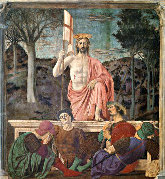
This post’s first picture is Piero della Francesca’s “Piero della Francesca – Resurrezione.”

The fresco was made in the 1460s. It’s in the Museo Civico di Sansepolcro, Arezzo, Italy.

1 Our Lord’s death and resurrection:

Posted in Being Catholic | Tagged , , , , , , , , , , | Leave a comment

Good Friday

Our Lord’s triumphal entry into Jerusalem was like a ticker tape parade. The original one, in 1886, an impromptu celebration.

Jesus had grassroots support that few celebrities or politicos achieve. Our Lord could have written his own ticket. All he had to do was keep that enthusiasm going.

Next thing we read in Luke’s account is our Lord saying that something awful will happen to Jerusalem. That’s in Luke 19:4144.

That’s a bit odd, coming from someone riding the crest of popularity’s wave.

But doom and gloom play well to some audiences, and that’s another topic.

Luke’s next stop is Jesus going berserk in the temple area. Or, as John put it, exhibiting impressive zeal.

“He made a whip out of cords and drove them all out of the temple area, with the sheep and oxen, and spilled the coins of the money-changers and overturned their tables,
“and to those who sold doves he said, ‘Take these out of here, and stop making my Father’s house a marketplace.’
“His disciples recalled the words of scripture, ‘Zeal for your house will consume me.'”
(John 2:13-17)

I don’t see a problem with what Jesus did. I think he’s the Son of God, and was exercising legitimate authority. Sort of like the boss seeing that someone set up a BYOB bar, and telling them to get back to work.

I can also see the cleansing of the temple as several criminal offenses. These days, they’d probably include disturbing the peace, vandalism and interference with commerce by threats or violence.

The Powers that Be

Pharisees and Sadducees didn’t agree on Hellenization, the Torah and Mosaic Laws.

They didn’t see liturgy the same way either.

But I’m pretty sure they liked being among the powers that be.

They weren’t the only major players.

Judea was a Roman province in the first century. Pontius Pilate was nominally in charge. He was one of the equites, sort of like medieval knights; above plebeians on Rome’s ladder but below senators. (November 26, 2017)

Pilate was in an unenviable position. Judea was a a vital and vulnerable link in the Rome-Egypt trade route.1

Being put in charge of a strategically important and volatile province was probably a high honor. If he kept the route open, sent taxes back to Rome, and didn’t use too many resources doing it.

The Pharisees and other folks in the Sanhedrin had their own concerns.

“So the chief priests and the Pharisees convened the Sanhedrin and said, ‘What are we going to do? This man is performing many signs.
“If we leave him alone, all will believe in him, and the Romans will come and take away both our land and our nation.'”
(John 11:51:8)

No wonder the Pharisees and Sadducees tried saddling Pilate with their Jesus problem. Pilate tried passing the buck to Herod. Who sent the troublemaker back to Pilate.

Viewpoints

I’ve read that Pilate’s interview with Jesus was ‘circuitous’ or ‘ambiguous.’ It arguably is, by contemporary American standards.

I’ll give Pilate credit for asking our Lord reasonable questions.

Reasonable from his viewpoint. Folks aren’t all alike. Neither are cultures.

On the other hand, we’re all alike. Each of us has “the same nature and the same origin.” Differences exist. This is a good thing, or should be. (Catechism of the Catholic Church, 814, 19341938, 1957)

I see our Lord’s part of that interview as reasonable, too. That’s partly because I’m living about two millennia later, with access to what some of the world’s best minds have said about our Lord’s life and death. (November 26, 2017)

Trial by Opinion Poll

I don’t know why Pilate washed his hands, literally and figuratively, turning the trial of Jesus into a referendum. Or opinion poll.

“The chief priests and the elders persuaded the crowds to ask for Barabbas but to destroy Jesus.
“The governor said to them in reply, ‘Which of the two do you want me to release to you?’ They answered, ‘Barabbas!’
“Pilate said to them, ‘Then what shall I do with Jesus called Messiah?’ They all said, ‘Let him be crucified!’
“But he said, ‘Why? What evil has he done?’ They only shouted the louder, ‘Let him be crucified!’
“When Pilate saw that he was not succeeding at all, but that a riot was breaking out instead, he took water and washed his hands in the sight of the crowd, saying, ‘I am innocent of this man’s blood. Look to it yourselves.'”
(Matthew 17:2024)

That is not how judicial proceedings should work. Not America’s, Imperial Rome’s, or any other. (June 1, 2018; March 19, 2018; February 5, 2017)

Torture, Humiliation and Death


(From “On the Physical Death of Jesus Christ,” used w/o permission.)

I’m not sure why folks who believe Jesus is God occasionally balk at thinking he’s also human. Maybe it didn’t seem sufficiently ‘spiritual.’ (April 21, 2018)

Maybe that’s understandable.

Believing that a human could be killed is one thing. Folks die every day.

Believing that someone who actually was the Son of God could die?

That’s not so easy.

But believing that our Lord died comes with being Catholic. (Catechism, 599)

So does accepting Jesus as the Son of God, human and divine. (John 1:14; Catechism, 285, 456478, 517)

I don’t know how Jesus can be human and divine. Not on an operational level. I don’t understand how the Trinity works either. (March 12, 2017)

Getting back to that first Good Friday.

After a dubiously-legal trial, Jesus was tortured, humiliated and nailed to a cross on Golgotha. Between two criminals.

Folks in Jerusalem didn’t want dead bodies hanging around. Not with Passover coming. Someone asked Pilate to expedite the process.

“So the soldiers came and broke the legs of the first and then of the other one who was crucified with Jesus.
“But when they came to Jesus and saw that he was already dead, they did not break his legs,
“but one soldier thrust his lance into his side, and immediately blood and water flowed out.”
(John 19:3234)

Jesus was dead.2 With the physical, mental and emotional stress he’d endured, it’s almost a wonder he lasted as long as he did, and that’s yet another topic.

For anyone else, that would have been the end. But Jesus isn’t anyone else.

I’ve said that before:


1 Background:

2 Dead? Dead:

Posted in Being Catholic, Discursive Detours | Tagged , , , , , | 2 Comments

Fukushima Cleanup: Slow Progress

A tsunami flooded the Fukushima-Daiichi nuclear power plant eight years ago.

Fires, explosions and meltdowns followed.

Folks living within 20 kilometers were told to leave the area.

Radiation levels are dropping. A few folks are moving back. Clearing debris and removing radioactive fuel rods is taking more time than expected.

Yesterday, April 15, 2019, engineers started removing fuel rods from Fukushima Daiichi Unit 3’s storage pool. Unit 3 is one of six reactors hit by a tsunami in 2011.

TEPCO says they’ll finish the Unit 3 job by April of 2021.1

By the time I’d finished writing about the cleanup, I’d talked about natural law, ancient history, and what Thomas Aquinas said about making sense.


Rules and Principles

Loving God and my neighbor, seeing everyone as my neighbor and treat others the way I’d like them to treat me makes sense. (Matthew 5:4344, 22:3640; Mark 12:2831; Luke 6:31, 10:2537; Catechism of the Catholic Church, 1789)

That hasn’t changed, and won’t.

Rules we make up are another matter. Sometimes they work. Sometimes they don’t. When they no longer apply to our circumstances, it’s time to change them. The same goes when they’re not in line with natural law: unchanging ethical principles like ‘love your neighbor.’ (Catechism, 19541960)

Respect for legitimate authority is another one of those principles. Ideally, folks in authority would be consistently wise, just and all the rest.

We don’t live in an ideal world. Sometimes the king, president, CEO or other boss is incompetent or worse. That’s why unthinking obedience is a bad idea. None of us is above the natural law, and we’re all expected to use our brains. (Catechism, 17761782, 18971917, 2155, 22422243, 2267, 2313, 2414)


The Fukushima-Daiichi Disaster, Eight Years Later


(From AFP, via BBC News, used w/o permission.)
(“Fuel will be lifted from the crippled reactor and taken away for storage elsewhere”
(BBC News))

Fukushima: Japan begins removal of nuclear fuel from damaged reactor
BBC News (April 15, 2019)

The operator of Japan’s Fukushima nuclear plant has begun removing nuclear fuel from one of the reactors that melted down after the devastating 2011 earthquake and tsunami.

“Remotely controlled equipment is lifting fuel rods from a storage pool inside reactor number three.

“The delicate work at the contaminated site is expected to take two years….”

I suspect that we know more about the Chernyobyl nuclear disaster than the Fukushima-Daiichi one. Mostly because Chernobyl happened about 33 years back.

It’s only been eight years and a month since the Tōhoku earthquake and tsunami. That was the biggest earthquake recorded in Japan, and the fourth most powerful since 1900. Top place goes to the 1960 Valdivia quake.2

That doesn’t mean that earthquakes were comparatively mild until wireless telegraphy and heavier-than-air flight offended Mother Nature.

Maybe someone’s blamed Marconi and the Wright Brothers for post-1900s disasters. But not recently, I suspect.

Conspiracy theorists and angst merchants use other hot buttons these days, and that’s another topic.

History, Records, and Estimates

We’ve got records for earthquakes going back for millennia.

Some of them may have been more powerful than the Tōhoku or Valdivia events. We don’t know exactly how powerful, since somewhat-precise seismometers weren’t developed until around 1900.

We can make educated guesses about earlier events, based on written records and physical evidence. We’re getting better at finding and analyzing both.

My guess is that some ancient disasters didn’t get recorded. Not in writing.

Written records aren’t made unless at least a few survivors were close enough to be eyewitnesses. And have time to write down what happened, or talk with someone who’s literate and interested.

A Minoan Digression

The Minoan/Thera eruption, roughly three and a half millennia back, may be what’s behind tales that inspired Plato’s Atlantis.

Minoan civilization was on Crete about 110 kilometers, 68 miles, south of Thera. Tsunamis from event were between 35 and 150 meters, 115 and 492 feet, high when the washed over Crete’s northern coast.

At least some Minoans were most likely abroad when Thera exploded. Someone rebuilt a scaled-down version of Minoan culture that lasted for centuries.

We’re pretty sure Linear A, a writing system that’s apparently unrelated to anything else, is in the Minoan language.

We’ve got the equivalent of about two typewritten pages of Linear A. Maybe it includes a record of the “violent earthquakes and floods … a single day and night of misfortune” Plato describes. (May 26, 2017)

Another mostly-unrecorded disaster is the Late Bronze Age collapse, a few centuries after Thera exploded and before Plato’s day.3 Survivors returned to the Aegean-Egypt corridor rebuilt, eventually, but I suspect a great many records were lost. (November 3, 2017)

Bad News

The Fukushima nuclear plant disaster was bad news, but comparatively minor compared to the 2011 Tōhoku earthquake.

The quake and tsunami killed nearly 16,000 folks, left over 6,000 injured and about 2,500 missing.

The Fukushima-Daiichi power plant disaster killed or will kill between a handful and hundreds of folks. Maybe 1,600.

Death toll numbers depend on who’s talking. Also on whether they’re looking at folks who were killed in the incident, died later, or may die over the next few decades.

About 37 folks were injured. Maybe more. We’re more certain about how many were relocated: 160,000.

Speculation and Decisions

A 2017 risk analysis said that the evacuation and relocation was unnecessary and killed 1,600 refugees.

Maybe so. Folks at the Universities of Bristol, Manchester and Warwick — six and a half years later — had a Monday morning quarterback’s advantage.

Their scholarly analysis will probably help fine-tune procedures for handling future disasters.4

But even assuming that the academics were right, I don’t feel like writing a screed aimed at local and regional authorities.

My guess is that emergency responders and folks in charge had only a little more information than the rest of us. They’d have known that a tsunami had hit, and that there’d been an explosion at a nuclear power plant.

In their position, maybe I’d have started getting folks away from the area before experts had time for a thorough analysis.

Or maybe I’d have waited until after official investigators arrived, studied the situation and made a preliminary report.

That’d likely be after cleanup crews plowed paths through what was left of the city. And cleared space for a helicopter to land. Roads between cities wouldn’t have been particularly passable.

Then, if the experts said that radiation levels were off the chart and evacuation should have started immediately, I’d start looking for a good lawyer.

Or, if I’d gotten a lethal dose, put my affairs in order.

Official Estimates

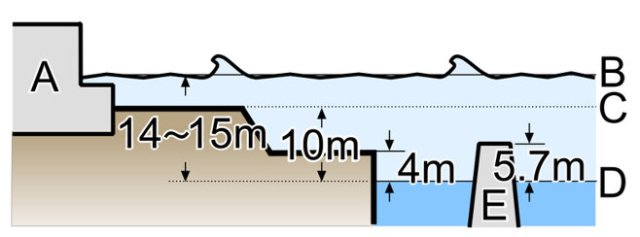
(From Shigeru23, via Wikimedia Commons, used w/o permission.)
(A – Plant building, B – Tsunami’s peak height, C – Ground level of site, D – Average sea level, E – Seawall. Fukushima Unit 1 diagram.)

The good news is that TEPCO’s Fukushima power plant was mostly above average sea level and had a seawall.

The not-so-good news is that the seawall was nowhere near high enough to stop the 2011 tsunami. I’m not sure why so many of the plant’s backup generators were housed in basements.

And accessible from spots low enough to let seawater from the tsunami flood them.

Another blank patch in my knowledge is why TEPCO executives ordered an in-house study of tsunami risks. And ignored the results.

The study said that 10.2 meter tsunamis were possible, said that such a wave would flood key parts of the plant. In 2008, the execs said that waves 10.2 meters tall wouldn’t happen. In 2011, a wave at least 12 meters high arrived.

Maybe they didn’t feel like acknowledging that an official maximum wave height of 5.6 meters, reported in 2004, was overly-optimistic.

TEPCO’s decision-makers eventually started admitting that they’d lied about inspections and repairs. Many government officials didn’t come out looking much better.5

I figure most folks have an inner Monday morning quarterback. I certainly do. With my background and attitudes, I might feel that the TEPCO executives and government officials were incompetent, greedy, stupid, or all of the above.

But I won’t claim that the Fukushima debacle shows that regulations never work or decide that nuclear power is evil. Or dismiss disasters that don’t support my views as fake news.

Or something even less reasonable.

(Slow) Recovery


(From AFP, via BBC News, used w/o permission.)
(“Fuel from reactor four at the Fukushima Daiichi power plant was removed in 2014”
(BBC News))

Eight years after the disaster, radiation levels are lower in towns like Okuma. Folks are being allowed to move back.

Some are returning to their homes. Many or most of the town’s former residents probably won’t.

Can’t say that I blame folks for being cautious about official assurances.

Assertions encouraged Japan’s government to showcase their new and improved safety standards arguably haven’t helped boost confidence.6

It’s a plausible claim. Tokyo’s hosting the 2020 Summer Olympics. I’d like to think that embarrassment, if nothing else, from a now-public list of remarkably dicey decisions would encourage good sense. And that’s almost another topic.


Using Our Brains


(From WiNG, via Wikimedia Commons, used w/o permission.)

No technology is absolutely “safe.”

Even fire, something we’ve used for maybe a million years, can cause damage. All it takes is someone ignoring or forgetting what we’ve learned.

St. Thomas Aquinas had a few words to say about living in a world where we can get hurt, and who’s to blame for falling into a fire. Quite a few, actually:

“In the words of Augustine (Super. Gen. contr. Manich. i): ‘If an unskilled person enters the workshop of an artificer he sees in it many appliances of which he does not understand the use, and which, if he is a foolish fellow, he considers unnecessary. Moreover, should he carelessly fall into the fire, or wound himself with a sharp-edged tool, he is under the impression that many of the things there are hurtful; whereas the craftsman, knowing their use, laughs at his folly. And thus some people presume to find fault with many things in this world, through not seeing the reasons for their existence. For though not required for the furnishing of our house, these things are necessary for the perfection of the universe.’ And, since man before he sinned would have used the things of this world conformably to the order designed, poisonous animals would not have injured him.”
(“The Summa Theologica,” First Part, Question 72; St. Thomas Aquinas [emphasis mine])

“…Now action is properly ascribed, not to the instrument, but to the principal agent, as building is ascribed to the builder, not to his tools. Hence it is evident that use is, properly speaking, an act of the will….”
(“The Summa Theologica,” First Part of the Second Part, Question 16, Article 1; St. Thomas Aquinas)
(translated by Fathers of the English Dominican Province (Benziger Bros. edition, 1947))

I think St. Thomas Aquinas was right. Stumbling around a workshop, falling in the fire or getting cut isn’t the tech’s fault. That’s what happens when we don’t pay attention or use our brains. I’ve said that before. (February 10, 2017)

We don’t live in an ideal world. Unthinking obedience is a bad idea. No king, president, or other boss, is above the natural law. We’re supposed to use our brains. (Catechism, 1778, 1902, 19541960, 2155, 22422243, 2267, 2313, 2414)

More, mostly technology and making sense:


1 Eight years later:

2 Earthquakes and disasters:

3 History and lore:

4 Looking back:

5 Admissions and image:

6 Cleanup and controversy:

Posted in Discursive Detours | Tagged , , , , , , | 2 Comments

Triumphal Entry into Jerusalem

Seeing Jesus as a charismatic wannabe revolutionary is possible. So is assuming that he was politically inept or stark raving mad. Maybe both.

Another option is seeing Jesus as a great teacher, one of the world’s best: in the same league as Socrates, Kapila and Confucius.

The ‘up’ side of the ‘great teacher’ view is that it acknowledges our Lord as someone who talked about ethics and made sense.

The ‘down’ side, and it’s a big one, is that Jesus of Nazareth said this:

“You do not know him, but I know him. And if I should say that I do not know him, I would be like you a liar. But I do know him and I keep his word.
“Abraham your father rejoiced to see my day; he saw it and was glad.
“So the Jews said to him, ‘You are not yet fifty years old and you have seen Abraham?’
“Jesus said to them, ‘Amen, amen, I say to you, before Abraham came to be, I AM.'”
(John 8:5558)

Odds are that you recognize “before Abraham came to be, I AM” as a reference to the interview Moses had with God. Folks in first century Jerusalem would have.

“‘But,’ said Moses to God, ‘if I go to the Israelites and say to them, “The God of your ancestors has sent me to you,” and they ask me, “What is his name?” what do I tell them?’
“God replied to Moses: I am who I am. Then he added: This is what you will tell the Israelites: I AM has sent me to you.”
(Exodus 3:1314)

Viewpoints

Jesus of Nazareth claimed that he’s God. Several times.

Folks who claim they’re divine can be charismatic. Sometimes they’ll attract followers. But these days, they become celebrities or residents of psychiatric institutions.

They’re not hailed as great teachers.1

Familiarity doesn’t necessarily breed contempt — my opinion — but I strongly suspect it can deposit a bland veneer on extraordinary realities. Or bring greater appreciation of their magnificence.

And I am not going to get sidetracked by convoluted concepts of perception, cognition, recollection and a whole mess of other -tions.

Well, maybe just a few.

Perspectives

John Martin's 'Seventh Plague of Egypt' (1823)Folks living in first century Jerusalem almost certainly didn’t think of themselves as living in ancient times.

They were living in their “now.” Their homeland was a Roman province.2 (November 26, 2017)

Their ancestors had followed Moses out of Egypt a half-dozen centuries earlier. Abraham had been dead for a thousand years or so.

In my “now,” that’s about as far back as Thomas Aquinas and Odoacer. Neither of which are much like Moses and Abraham. (August 6, 2017; January 29, 2017)

A half-century back, more or less, academic types started saying that Abraham and Moses are mythic figures: maybe based on real people, maybe not.

The academics have a point. Apart from Scripture and related texts, we have precious little documentation for either of them.

That doesn’t surprise me.

Our records say that Moses went back to Egypt and had several unsatisfactory interviews with the Pharaoh. Ten “plagues” later, Pharaoh told Moses to get out and take his people with him. Pharaoh and company realized, a bit late, that a substantial chunk of Egypt’s workforce were leaving.

I’ll give Egypt’s chief executive credit for flexible decision-making.

Taking what sounds like a substantial part of his army, including at least one elite unit, Pharaoh chased after Abraham’s descendants: catching up with them as they were crossing a large body of water.

Maybe the Pharaoh survived the encounter. Maybe not. Either way, he’d lost part of his workforce and his army. That’s in Exodus 5 through 14.

Back-to-back national disasters topped off by evicting valuable workers and obliterating his own army isn’t in any Pharaoh’s official annals.

Maybe the Hebrews made up the whole thing, or maybe something else.

Perceptions

Ancient Egyptian leaders had a habit of documenting their accomplishments on durable media.

There’s a remarkably complete record of glorious victories and magnificent public works. Crushing defeats and disastrous mismanagement, not so much.

That’s not surprising. Like most ancient rulers, Pharaohs used their official records the way we use press releases. Historians, serious ones, have been learning to piece together what actually happened by analyzing more practical documents, like invoices.

I’ve run across plausible explanations for each of the ten Egyptian plagues. I won’t claim that they couldn’t have been what we call natural phenomena. If so, they were remarkably well-timed.3

The ‘crossing the Red Sea’ incident is a bit less obviously a colossal bit of good luck. Not if what’s described in Exodus 14:1029 is somewhat accurate.

In a way, I can’t blame today’s scholars for assuming that the Exodus events are make-believe. Nothing quite like them has happened since.

Nobody quite like Jesus has shown up, either. There’s been no shortage of folks claiming that they’re Jesus, and that’s another topic for another day.

My opinion is what Simon Peter said:

“When Jesus went into the region of Caesarea Philippi he asked his disciples, ‘Who do people say that the Son of Man is?’
“They replied, ‘Some say John the Baptist, others Elijah, still others Jeremiah or one of the prophets.’
“He said to them, ‘But who do you say that I am?’
“Simon Peter said in reply, ‘You are the Messiah, the Son of the living God.'”
(Matthew 16:1316)

Jesus Christ, Superstar?

Our Lord’s behavior and off-the-charts popularity gave the powers that be good reason for concern.

Pharisees and Sadducees were the most influential folks in Judea.

Rome’s provincial boss had considerable clout, too. He had troops and imperial backing, which arguably reduced his grass roots support.

Pharisees and Sadducees, I’m back to those good old boys now, had reason for concern.

Jesus of Nazareth, a nobody from a squeedunk village, was enormously popular. ‘The masses’ were listening to the Nazarene: not the established good old boys.

Then Jesus started talking crazy.

Like the time our Lord said that he’d give eternal life to folks who eat his flesh and drink his blood. That’s in John 6:5160.

Some folks who’d been following Jesus started edging away after that, understandably. But some didn’t. (November 20, 2016)

Just what the Pharisees and Sadducees needed: an off-the-charts superstar lunatic acting like he wanted to seize power. No, like he had seized power.

A Triumphal Entry

We’re celebrating Palm Sunday this week.4

It’s when we remember Jesus’ triumphal entry into Jerusalem. Which I think sounds a bit odd, since our Lord was riding a critter we see as pack animals, or a mount for folks who can’t afford a horse.

From that viewpoint, our Lord’s ride displays great humility. Sort of like a dignitary arriving in a pickup.

That’s how I’d probably see it. If I didn’t realize that cultures aren’t all alike. And that change happens.

Variables and Constants

Nearly two millennia have rolled by since our Lord rode into Jerusalem.

Folks living in 1st century Jerusalem weren’t all that different from me and my neighbors here in 21st century Minnesota.

We share humanity’s strengths, weaknesses and “transcendent dignity.” (Catechism of the Catholic Church, 396409, 1929, 19341938)

We’re not exactly alike, either.

Folks in 1st century Jerusalem had grown up with the ancient Middle East’s cultures. Shepherds, donkeys, horses and all were as familiar to them as factory workers, VIPs, pickups and limousines are to us.

Back then, rulers on a peaceful visit arrived riding an ass, not a horse. Today’s equivalent might be riding in an escorted limousine.

A Middle Eastern king riding a horse would be at the head of an army, trying to conquer the city or taking possession. In today’s world, national leaders generally aren’t physically leading their troops into battle; and that’s yet another topic.

Matthew, Mark, Luke and John each describe our Lord’s triumphal entry. The accounts don’t quite match up, by contemporary Western standards.

We read that Jesus rode an ass, a colt, and an ass’s colt. Folks waved palm branches and/or spread their cloaks on the road.5

I could let that upset me, or decide the discrepancies mean the events didn’t happen. Or I could figure that folks with related but different points to make, living in a culture that’s not just like mine, might describe them in different ways. That makes more sense to me.

Fronds and Crosses

Palm fronds are part of this Sunday’s celebration, in this area anyway. Folks take a few home with them, folding them into crosses. The style varies from family to family.

My wife introduced me to a tradition that she learned from her father.

My understanding is that he’d learned the technique as a cowboy in the Dakotas. If we used leather instead of palm fronds, we’d end up with a wonderfully flexible lanyard. As it is, we get something resembling a St. Andrew’s Cross. And that’s — what else? — yet again another topic.

“Good news of great joy,” two millennia and counting:


1 Philosophers, celebrities and lunatics:

2 Our past, their “now:”

3 Phenomena, natural and otherwise:

4 More about Palm Sunday:

5 Two triumphal entries:

Posted in Being Catholic, Discursive Detours | Tagged , , , , , | Leave a comment