Old St. Peter’s, Visigoths and a Henry

St. Peter’s Basilica in Rome isn’t nearly as old as it looks.

John Goldicutt's 'View in Rome,' watercolor over pencil. (1820) Huntington Library Art Collections, via Wikimedia Commons, used w/o permission.Architects in ancient Rome often covered large interior spaces with barrel vaults and semicircular arches, although they hadn’t invented either.

Someone started using arches and vaults, probably in Mesopotamia, long before Romans started a republic. Several someones, most likely.

Those architectural forms date back at least to the 13th century B.C., when Egypt’s Seti I and Ramses II built the Abydos temple of Seti I and the Ramesseum.

I’m guessing that ancient Romans often get credit for inventing barrel vaults because so many of the ones they built are still around. Plus, the Italian Renaissance was all about ancient Roman glories. That’s how I see it, and that’s another topic.1

At any rate, in this “A Tale of Two Churches…” series, I’ll be talking about St. Peter’s Basilica in Vatican City. Both of them. As well as people, politics and ideas in play during the most recent two millennia.

Today I’ll be taking a quick look at a famous Roman architect, Vitruvius, and then recap what happened during the half-dozen centuries after Emperor Constantine signed off on building the first St. Peter’s basilica.


Architecture, Partly

Ricardo André Frantz's photo of Bernini's baldacchino, inside Saint Peter's Basilica, Vatican City. (2005)
(From Ricardo André Frantz, via Wikimedia Commons, used w/o permission.)
(St. Peter’s Basilica, Vatican City: Bernini’s baldacchino, under the dome.)

Vitruvius was the chap who wrote “De architectura,” around the time Caesar Augustus said he was “first amongst the citizens” and made it stick. “De architectura” was the go-to resource for Western civilization’s architects for more than a dozen centuries.

Oddly enough, we don’t know much about Vitruvius apart from what’s in his ten-volume work. These days we’d call him a civil and military engineer, as well as an architect.2

If — this is a very hypothetical “if” — Vitruvius visited today’s St. Peter’s, then he’d see a nice, normal first-century B.C. Roman interior.

Normal, that is, aside from electric lights, a bronze canopy supported by squiggly pillars, and the outlandish clothing everyone’s wearing.

Virtuvius would likely notice all that.

Domes and Squinches

Andrea Herrera's illustration, comparing pendentives and squinches.
(From Andrea Herrera, via Riverside City College, used w/o permission.)
(One of the better illustrations I found, comparing pendentives and squinches.)

But I’m pretty sure he would be particularly interested in the not-quite-triangular bits connecting the dome with the vault intersection’s corners.

Depending on who you listen to, they’re pendentives or squinches. Either way, they transfer the dome’s weight to corners of a lower rectangular space. And they don’t show up until maybe the third century.3 That’s more than two centuries after Vitruvius.


History and Getting a Sense of Scale

Duc Du Berry's Book of Hours: January, February, March. And the Limbourg brothers' Christ Led to Judgment.

What’s “a long time ago” and what isn’t depends on your frame of reference.

On a cosmic scale, everything since Sargon of Akkad’s day is current events.

Last year’s fall fashions are, well, last year’s fashions.

And the last I checked, historical scale hasn’t been formally defined; so I’ll list a few ‘long ago’ examples, on a decades-to-millennia scale.4

  • Three decades ago
    • United Nations General Assembly revokes Resolution 3379
    • Soviet Union nominally ends
  • Three centuries ago
    • Peak of the Little Ice Age
    • Statute of Anne/Copyright Act 1710
  • Six centuries ago
    • Joan of Arc ends Siege of Orléans
    • Très Riches Heures du Duc de Berry finished
  • One millennium back
    • Erik the Red/Erik Thorvaldsson exiled
    • Medieval Warm Period begins
  • Two millennia back
    • Pliny the Elder publishes first 10 volumes of Naturalis Historia
    • Pax Romana begins
  • Three millennia back
    • Villanovan culture flourishes (earliest phase of the Etruscan civilization)
    • Mycenaean Greece transitions to Greek Dark Ages
  • Five millennia back
    • Egypt’s First Dynasty begins
    • Cuneiform in use

Old St. Peter’s and a Post-Roman World

Encyclopedia Britannica's 'facade of old St Peter's, Rome.' (1910)
(From Encyclopedia Britannica; via Florida Center for Instructional Technology, University of South Florida; used w/o permission.)
(Old St. Peter’s, Vatican City, Rome.)

Emperor Constantine had Old St. Peter’s Basilica built in the 300s. He also decriminalized Christianity, got sick and died.

But before that happened, he turned the empire over to his sons, Constantius II, Constantine II and Constans. Then they died, too.

Meanwhile, work continued and Old St. Peter’s was finished after about 30 years. Or maybe after about 40 years.

Which it was and who was emperor at the time depends on who’s telling the story. I figure it was in the year 360 or thereabouts, and that Constantius II or maybe Julian was emperor.

These days we’ll occasionally call Emperor Constantine “The Great.” I’ll talk about him some other time.

Old St. Peter’s was a basilica in the architectural sense. It was rectangular, with a central nave flanked by aisles.

It was also a Catholic basilica, which has nothing to do with architecture.

Catholic basilicas are important ceremonial and pilgrimage sites. We’ve currently got four major ones, a little over 1,800 minor ones, and that’s yet another topic.

St. Peter’s Basilica was particularly important because its altar was directly over St. Peter the Apostle’s tomb.5 Which I think goes a long way toward explaining why Constantine picked such an otherwise-unsuitable site. I’ll get back to that, later in this series. (A Tale of Two Churches: St. Peter’s, Rome)

Gauls, Visigoths, Vandals, Ostrogoths and Normans

The Walls and Gates of Rome in the 6th century, with Gothic camps from the Siege of Rome 537-538 from Edward Stanford's 'Procopius, History of the Wars, Books V-VI' (1919)
(From Edward Stanford, via Project Gutenberg and Wikimedia Commons, used w/o permission.)
(Old St. Peter’s, Vatican City, Rome.)

St. Peter’s was still standing when King Brennus of the Gauls raided Rome in 387.

Or maybe the year was 390. Documentation for that era is a trifle sketchy. Understandably, I think.

Anyway, Alaric’s Visigoths hit Rome in 410, give or take a few years. Geiseric’s Vandals went through around 455, followed by Totila’s Ostrogoths in 546. And there was that siege of 537-538.

Someone else raided Rome in 846. Some European chroniclers said they were “Saracens.” Others called them “Moors.” That narrows the field to Aghlabids, Maghreb, muscle hired by Radelchis and/or Siconulf — or someone else.

Holy Roman Emperor Henry IV started attacking Rome in 1081. Three tries later, in 1082, he held part of the city. Robert Guiscard’s Normans — liberated? — the city in 1084.6

There’s a bit of a story behind that.

“It Was the Best of Times….”

science fiction movie postersAs a youth, I may have watched more Hollywood fantasy and/or historical tales than was good for me.

Science fiction flicks, too, with titles like ‘Atomic Cockroach’ or ‘Invaders From Planet Q.’

Those memories, and today’s experience with social media, suggest that seeing a particular nation, culture or mutant horror as utterly evil is fairly common.

The attitude’s flip side, assuming that the ‘good guys’ are paragons, doesn’t seem any more reasonable.

I think one film actually had a “Prince Paragon.” He spent most of the story as some sort of ape. There had been a difference of opinion involving a wizard, as I recall. And that’s yet again another topic.

Where was I? Visigoths, Vandals and Ostrogoths.

Saracens, Aghlabids and Holy Roman Emperor Henry IV.

“Cosmic Monsters” and history by Hollywood. Right.

Europe’s 11th century was a mixed bag, like any other era.

“It was the best of times, it was the worst of times” — although that famous literary quotation’s story was set in an 18th century puree of politics, patriotism and paranoia.

During the 11th century, folks like Hildegard of Bingen and Albert of Lauingen were laying groundwork for today’s science.

But Albert’s work was controversial, inspiring tales of dark arts. And, eventually, a Liebig’s Extract of Meat Company Trading Card.

I think Hildegard’s work was good news. Albert’s, too. Others get skittish about “tampering with things….”

What we call the Holy Roman Empire had been in northern hands since Otto I’s day.

That wasn’t its name at the time. Folks started calling it the Heiliges Römisches Reich, Holy Roman Empire, a few centuries later.

Whether Otto’s takeover was good news or bad news depends on viewpoint.

Unruochings, Franks living in what’s now northern Italy, lost power and prestige. Otto and his folks probably celebrated.7

Saxons and Viewpoints

William R. Shepherd's map of stem duchies in the German kingdom 919–1125. (
(From William R. Shepherd, via Wikimedia Commons, used w/o permission.)
(The German kingdom’s stem duchies, 919-1125.)

Otto I, Otto the Great, Otto der Große, whatever, lived in the 10th century.

His father, Heinrich der Vogler, was elected East Francia’s king in 919. That’s roughly where the western bit of Germany is today.

Heinrich earned the der Vogler or der Finkler epithet by being an avid hunter. Folks speaking my language translate his name as “Henry the Fowler.” European epithets are the sort of thing that became surnames a few centuries back.

Heinrich was a non-foreign German king, for folks living in Saxony. It’s part of today’s Germany; south of the Danish peninsula, down to around Arnsberg and Dunderstadt.

Maybe having Heinrich in charge was good news for grass-roots Saxons. Some German aristocrats weren’t so happy. Heinrich apparently figured kings should act like kings.

I’ve read that Heinrich was too “weak” to crush every bothersome aristocrat. Maybe so, but I suspect “savvy” might be a better term. In any case, Heinrich passed the mixed blessing of kingship on to his eldest son.

That brings me back to Otto I. He was as Saxon as his father, but wore Frankish clothes to his 936 coronation. Maybe that’s another sign of ‘weakness.’ I agree with folks who say it was an ‘image’ tactic. Otto wanted folks to see him as Charlemagne’s successor.

A few rebellions, wars, and negotiations later, Otto I was Holy Roman Emperor. His term lasted from 962 until 973.

In the meantime, Swabian aristocrats with names like Burkhard and Friedrich were dealing with their current realities. Swabia’s story — is still another topic.8

Pope Problems

Emmeram Evangeliary's Henry IV, Holy Roman Emperor, miniature. (1105/1106)A few emperors after Holy Roman Emperor Otto I, Emperor Henry IV — I’m back to him now — had Pope problems.

Henry IV was among the 11th century’s big names. His diplomacy got him in trouble with three different popes.

Oversimplifying the story, a lot, Henry IV said Pope Gregory VII shouldn’t be the Pope.

Henry’s choice was Wibert of Ravenna. Wibert had boycotted Gregory’s election partly because Gregory wanted to decouple the Church and Imperial Court.

So Wilbert of Ravenna became Henry’s Pope Clement III.

But Pope Gregory VII began a long-overdue housecleaning anyway.

Henry kept backing Wibert, and then Cencio I Frangipane kidnapped Gregory. I’m not sure why Frangipane decided to snatch Gregory at the Santa Maria Maggiore. During the Christmas evening Mass.

Folks who’d been at the Mass apparently saw where Frangipane took the Pope. Word of the snatch spread. Concerned citizens got together and sprung Gregory the next day.

Gregory figured Henry was involved. Maybe so. Or maybe Frangipane was the sort of friend who makes enemies superfluous.

Henry kept saying Gregory wasn’t Pope. Gregory excommunicated Henry and said that his subjects needn’t recognize Henry’s authority.9 That wasn’t at all like the occasionally-cordial state-church 11th century status quo.


The Donation of Pepin

'Central States of the Church after the Papal Restoration c. 1430', from Reginald Lane Poole's 'Historical Atlas of Modern Europe.' (1902)I don’t envy Catholics living in Henry’s turf. Those who heard about the Pope’s decision, that is.

They’d be in the awkward position of choosing between the Church’s authority and Henry’s not-inconsiderable clout.

Henry IV went on to survive the Saxon Rebellion and the Battle on the Elster.

I could blame the Henry-Gregory-Wibert imbroglio on Gregory’s refusal to go with the flow.

Instead, I’ll skip back three centuries, to the Donation of Pepin; a shrewd bit of statecraft by Pippin der Kurze. Pepin the Short we call him in my language.

Pippin der Kurze lacks name recognition these days. He’s chiefly famous for being Charlemagne’s father. And for the 756 Donation of Pepin. That, and for almost sharing a name with a hobbit.

I think the Donation of Pepin made sense at the time. Let’s remember that St. Peter’s Basilica was outside the walls of Rome. And Rome itself was none too safe from pillage.

Speaking of which, remember the Vandals who hit Rome in 455? Those were capital-V Vandals, Germanic folks who ruled Mallorca, Sicily, Sardinia, Corsica and parts of north Africa from around A.D. 435 to 534.

Anyway, Gaiseric was the Vandal king around that time.

Then he died, his kingdom ended and — finally! I’m getting to Pepin the Short’s day — Aistulf, King of the Lombards, conquered a sizable chunk of land in northern Italy and told Roman authorities to start paying tribute.10

If you want a simple story line, then I’d recommend an action-adventure novel. This is real life. It’s complicated.

It Seemed Like a Good Idea at the Time

Map of Lombard Kingdom under Liutprand at his death, A.D. 744. Castagna's adaptation from Paulus the Deacon's' Historia Langobardorum.' (ca. A.D. 790)Bottom line, Pippin der Kurze arranged to be elected King of the Franks.

Then he defeated Aistulf. Or made life hard for Aistulf and his subjects until the Lombardi king fell of his horse and died.

I’ve seen it told both ways.

Along the way, Pippin der Kurze seized property and land Aistulf had acquired, and returned it to the Pope.

That’s assuming that the property and land had been Papal property before.

Like I said, it’s complicated.

The Donation of Pepin in 756 is our name for Pepin the Short’s formally transferring ownership of real estate he’d acquired from Aistulf.

Good news, this gave the papacy legal ownership of land outside Rome; along with a tad more security than before the transfer.

Not-so-good news, in 20-20 hindsight, the Donation of Pepin gave the papacy legal ownership of land that grew into the Papal States.

That arguably gave Frankish kings too much influence over who became pope.

Leading first to ‘Frankish Popes;’ then the ‘Saeculum obscurum’ and the ‘Tusculan Papacy,’ when the papacy was a subsidiary of the Theophylacti family. Allegedly.

My guess is that the Theophylacti family was sufficiently savvy to either leave no paper trail, or have a system for destroying incriminating documents.

Pope Gregory VII sorted out that mess about three centuries after Pepin the Short’s day.

More time passed. European aristocrats and nobles followed Pepin’s example, giving land to bishops: and so, indirectly, to the Catholic Church.

And that, also and very indirectly, led to the Hundred Years’ War, Thirty Years’ War and the French Revolution.11

All of which helps explain why Old St. Peter’s Basilica had to be demolished. And that’s something I’ll talk about in another part of this series. (A Tale of Two Churches: St. Peter’s, Rome)


Authority, Faith, and Living in Chickenman’s12 World

Dick Orkin's Chickenman, opposing crime and/or evil. From  radio-ranch.com, used w/o permission.This is where I’d usually talk about history, authority, faith and why I’m a Catholic: despite the occasionally appalling popes we’ve had.

But this week’s deadline is fast approaching; and besides, I’ve talked about natural law and accepting reality before:


1 Arches, vaults and a little history:

2 Two Romans, a book and a title:

3 Impressive architecture:

4 Assorted temporal landmarks:

5 Emperors and basilicas:

6 Sacking and — liberating? — Rome:

7 Good times, bad times:

8 Otto I. and Swabia, too:

9 11th century SNAFU:

10 History and epic fantasy:

11 Church, state and politics:

12 Remembering Chickenman and his never-ending struggle against crime and/or evil:

Posted in A Tale of Two Churches: St. Peter's, Rome, Series | Tagged , , , | 2 Comments

Sifting Through the Ash Heap of History

Willem van Nieulandt's 'View of the Forum Romanum.' (ca. 1601-1625)

Petrarch called Rome “a rubbish heap of history.”

That’s what Ferdinand Gregorovius says Petrarch wrote in a letter, at any rate.

“…Petrarch, who was then in Avignon, wrote on this occasion his patriotic epistle in Latin verses to Aeneas Tolomei of Siena. He bewails the ruin of his native country, on which a baibarian(!) prince was now again descending….
“…we may observe the pompous processions of senators … In poverty and obscurity she withered away, decayed and crushed, a rubbish heap of history, while the Pope, forgetful of her claims, accumulated gold and treasures in distant Avignon….
(“History of the City of Rome, in the Fourteenth Century, FROM 1305 until 1354;” Ferdinand Gregorovius; Translated from the fourth German edition by Annie Hamilton (1898) via Cornell University Library, Internet Archive)

The Gregorovius book’s translation is as far back as I’ve been able to track that Petrarch quote. I gather that Petrarch’s hopes for a glorious rebirth of the noble Roman Republic had suffered a head-on collision with 14th century European politics.

A bit over a half-millennium after Petrarch, a fair number of notables have used variations on “rubbish heap of history:”1

  • “Ash heap of history”
    (Ronald Reagan (1982))
  • “trash heap of history”
    (Somebody or other (probably 20th century))
  • “Dustbin of history”
    (Leon Trotsky (1917))
  • “That great dust heap called ‘history'”
    (Augustine Birrell (1887))

George Vertue's procession portrait of Elizabeth I of England, with her Knights of the Garter. (ca 1601)Referring to people, places or things who don’t matter any more, it’s an effective figure of speech.

But assuming that all history is an ash heap, a dream world or Erewhon, where folks dress funny, talk funny and aren’t worth remembering?

That doesn’t make sense. Not to me.

So I’ll be sifting through our ash heap: starting with a wrap-up of what I said about Pericles and good times (for some) in Athens three weeks back.


“The Glory that was Greece”

Leo von Klenze's 'The Acropolis at Athens.' (1846)
(From Leo von Klenze, via Wikimedia Commons, used w/o permission.)
(The Athenian Acropolis, remembered with rose-colored glasses.)

Three millennia after the Trojan War and a nearly-forgotten apocalypse, two and a half millennia after Pericles ran Athens, a poet reminisced about ancient times:

“…Naiad airs have brought me home
To the glory that was Greece,
And the grandeur that was Rome….”
(“To Helen,” Edgar Allen Poe (1845) via Wikipedia)

I’ll enjoy nostalgia. In small doses.

But I think remembering that Pericles and Aristotle, Plato and Thucydides, are people as well as Famous Names in History is prudent.

They’re not ‘just like everyone else,’ of course, since their actions and/or publicists have made them famous. Take Pericles, for example.

“…Brilliant General, Orator, Patron of the Arts….”

I’ll occasionally see introductions to the Age of Pericles that make the Athenian leader seem too good to be true.

“…Athenian culture flourished under the leadership of Pericles (495-429 B.C.), a brilliant general, orator, patron of the arts and politician….”
(Pericles, History.com)

In fairness, the History.com page also explains that a helmet always tops Periclean statuary because he had a big head. Literally.

Or maybe an unusually long head.

Poets of his day nicknamed him “Schinocephalos,” “Squill-head” or “sea onion-head.” That’s what Plutarch said, at any rate.

“…His personal appearance was unimpeachable, except that his head was rather long and out of due proportion. For this reason the images of him, almost all of them, wear helmets, because the artists, as it would seem, were not willing to reproach him with deformity. The comic poets of Attica used to call him ‘Schinocephalus,’ or Squill-head (the squill is sometimes called ‘schinus’)….”
(“The Parallel Lives,” The Life of Pericles, Plutarch (ca. A.D. 100) Loeb Classical Library edition (1916) via The University of Chicago)

I’m guessing that Plutarch’s squill is Drimia maritima, AKA squill, sea squill, sea onion, and maritime squill. The plant’s bulb looks a bit like a pointy onion’s.2 If Pericles’ head looked like that, I can see why he’d encourage ‘with helmet’ portraiture.

And I can certainly see why comic poets would dub him ‘onion-head.’

So, aside from giving poets something to joke about, what did Pericles do for Athens and Athenians?

Periclean Legacy

Singinglemon's map of ancient Athens, ca. 430 B.C..First, what Pericles didn’t do.

He didn’t free Athenian slaves, extend voting rights to women or establish child labor laws.

But he did make a difference. Maybe for the better. And arguably continuing a process started by Cleisthenes.

For example, Pericles sponsored a law that limited citizenship to children whose mother and father were both Athenians.

Up to that point, having an Athenian father was all that mattered.

Men from aristocratic families often married non-Athenian women, so the Periclean proposal threatened the sons of Athenian aristocrats who had married outsiders.3

I’m not sure whether I like that Periclean reform or not.

On the one hand, giving non-aristocrats a break looks like a good idea.

On the other, denying citizenship to folks whose mothers didn’t come from Athens strikes me as unreasonable. At least partly because I’m an American whose ancestors didn’t come on the Mayflower. And weren’t even English.

Either way, my opinion doesn’t matter. Not to Periclean Athens. I live on a continent Pericles never heard of, and he’s been dead for two and a half millennia.

Times have changed. A lot. Human nature, not so much. I’ll get back to that.

And slavery? That’s a bad idea. Period. (Catechism of the Catholic Church, 2414)

Empire and Nomenclature

'The Athenian Empire at its Height (about 450 B.C.). 'Historical Atlas,' William R. Shepherd (1926)
(From William R. Shepherd’s 1926 ‘Historical Atlas;’ via the Perry-Castañeda Library Map Collection; U. of Texas, Austin; used w/o permission.)
(The Athenian “Empire,” around 450 BC: where the Delian League used to be.)

What’s big and what isn’t depends on your frame of reference.

For example, the town I call home, Sauk Centre, is huge compared to Funkley, Minnesota.

Funkley is up in northern Minnesota, between Blackduck and Northome: two other places you’ve probably never heard of.

As of the 2010 census, five folks lived in Funkley. About 800 times as many live in Sauk Centre. Like I say, my town is huge. Comparatively speaking.

But Periclean Athens was even bigger.

Between a quarter and a third of a million folks called Athens home, back when Pericles was running the place.4

That’s about the population of Anoka, Minnesota. Anoka County, that is.

A Suburb, Cities and Names

Unless you live in Minnesota, you probably haven’t heard of Anoka: the self-described Halloween Capital of the World.

Anoka County is a suburban county at the edge of what we call the Twin Cities. Or, occasionally, the Metro. About a third of a million folks live there. That’s a lot of people, not quite a hundred times as many as live here in Sauk Centre, my town.

Then there’s Minnesota’s Metro, the Twin Cities: Minneapolis, St. Paul and their suburbs.

Three and two thirds or four million people call the Twin Cities home. The Metro’s population depends on whether I define the Cities as the Minneapolis-St. Paul, MN-WI CSA or Minneapolis-St. Paul-Bloomington, MN-WI MSA.

That’s a big metropolis, for the Upper Midwest, although not in Chicago’s class.

But Minnesota’s Minneapolis-St. Paul isn’t a big city. Not in a world with cities like Tokyo (population 37,400,000), Dehli (pop. 28,514,000) and Shanghai (pop. 25,582,000).

Back when Pericles was running Athens, having a third of a million people in one place was a very big deal. In its heyday, the city was huge.

One place? Make that one area.

Some historians write about Athens and Attica as if they were the same thing.

It’s confusing, but I can’t say that I blame them. Attica is Athens, and vice versa, sort of. Attica is, or was, territory south of the Cithaeron range. Athens was the area’s big city.5

If Attica was a sociopolitical region in America, we might call it GAMA — the Greater Athens Metropolitan Area. I suspect we caught our penchant for acronyms from ancient Rome, and that’s another topic.main004

Towns, Cities and Places

Sauk Centre's Ash Street South, Our Lady of the Angels church in the distance. (May 22, 2021)I called Sauk Centre, where I live, a town. But it’s officially a city.

A bit over 4,000 folks live here, so in Louisiana this would be a town. Officially.

Here in Minnesota, since we’ve got a “city council,” we’re a city. Again, officially.

Seems that Minnesota has four tiers of “cities,” ranked by population. And since fewer than 10,001 folks live in Sauk Centre, we’re one of 835 fourth-class cities.

On the whole, I’d prefer living in a plain old “town” instead of a “fourth-class city.”

But I can’t change whatever events, attitudes and decisions led to Minnesota’s current system. And I sure don’t think our official definitions matter enough to warrant protest. Not as far as I’m concerned, anyway.

I also learned that the U.S. Census —

“…defines a place as a concentration of population; a place may or may not have legally prescribed limits, powers, or functions. This concentration of population must have a name, be locally recognized, and not be part of any other place….”
(“Geographic Areas Reference Manual” (GARM), Chapter 9 — Places, United States Census Bureau (Last Revised: October 8, 2021))

So I live in a “place” that would be a “town” in it was in Louisiana, but is a “city” since it’s in Minnesota. And I think of the place I live in as a “town” because I think of cities as, well, as cities.

Making this matter of names more complicated, Minnesota’s parishes are called counties. Or Louisiana’s counties are called parishes. I live in the Our Lady of the Angels parish, but that’s not the same kind of parish.

Well, actually, it is: etymologically.6 And that’s another topic.

End of an Era

'The Piraeus and the Long Walls of Athens,'  	'The story of the greatest nations, from the dawn of history to the twentieth century,' John Steeple Davis. (1900))
(From John Steeple Davis, via Wikimedia Commons, used w/o permission.)
(The Long Walls, connecting Athens to Piraeus, the city’s port.)

Recapping, we figure Attica’s population in the fifth century B.C. was somewhere between 250,000 and 300,000.

That’s a little smaller than Anoka County, here in Minnesota.

But back then, Athens was huge. And it was the thriving center of an archê. That’s what Thucydides called the Athenian realm.

Scholars have been translating archê as “empire,” which may or may not be accurate.

At any rate, many Athenians were enjoying good times around 450 B.C.. Thanks to, or in spite of, Periclean leadership.

Then a war started between the Delian League — or Athenian Empire, I’ve seen both names used — and Sparta’s Peloponnesian League.

Pericles moved much of Attica’s population into Athens.

It seemed like a good idea, since it kept them comparatively safe from Sparta’s armies.

Athens was the big Aegean naval power, and its Long Walls secured access to the city’s port, so running short of supplies wasn’t a problem.

Reconstruction of Myrtis, 11 years old when she died during the plague of Athens. Her skeleton was found in the Kerameikos mass grave. Tilemahos Efthimiadis's photo, forensic reconstruction by professor Manolis Papagrigorakis and others, National Archaeological Museum of Athens. (September 25, 2010)But the city’s infrastructure couldn’t handle both residents and suburbanites.

Patient zero for the Plague of Athens was probably in Piraeus, the city’s port.

About one of every four folks in Athens died, including Pericles. And an 11-year-old girl researchers dubbed Metis.

Athens never recovered.

Not politically or economically. The city-state stopped being the Aegean pond’s biggest metaphorical frog.

On the other hand, it weathered the Alexandrian, Parthian, Roman, Byzantine and Ottoman empires; and the 20th century’s global war(s).

And the city of Athens is alive and well and prospering in the 21st century. But it hasn’t been Western civilization’s shining city on a hill for millennia.7

Small wonder that some folks say 429 B.C. was the end of the Athenian Golden Age.

Socrates, Plato and Aristotle: Brilliance in the Afterglow

Schematic diagram of Peter Apian's (Petrus Apianus) cosmology, largely reflecting Aristotelian physics and cosmology. From Peter Apian's 'Cosmographia,' annotated by Gemma Frisius. (1524) Reproduced in Edward Grant's 'Celestial Orbs in the Latin Middle Ages.' (1987)On the other hand, Socrates survived the Peloponnesian War and the Plague of Athens; but not postwar politics.

He was tried and convicted in 399 B.C. of lacking faith in the gods of the state and corrupting Athenian youth.

Then he obligingly drank hemlock and died.

Plato’s achievements include starting the Platonic Academy, arguably my civilization’s first academic institution. Aristotle studied there before opening his Lyceum.8

Maybe their era wasn’t the Athenian Golden Age by some standards.

But that trio — Socrates, Plato and Aristotle — kept adding to my civilization’s store of methods, ideas and the occasional bit of wisdom for a century after Pericles died. That’s an achievement worth remembering.


Ancient Empires and an Apocalypse We Nearly Forgot

'States of the Diadochi, c. 300 B.C.', 'Historical Atlas,' William R. Shepherd (1911)
(From William R. Shepherd, via Wikimedia Commons, used w/o permission.)
(Kingdoms in 301 B.C. — and, in the upper left, the Roman Republic.)

Aristotle is also remembered for tutoring Alexander III of Macedon, Philip II’s son.

Philip II had formed an Aegean alliance against the Persian empire. Some historians call it the Corinthian League these days. Or the League of Corinth. Tomayto, Tomahto, and that’s another topic.

Philip II’s alliance seems to be the first time (almost) all Greek city-states were part of a single political entity.

I don’t know why that achievement doesn’t qualify Philip II’s era as the start of a Grecian golden age. Particularly since we call his son Alexander the Great.

Maybe it’s because Alexander’s empire died with him.

And maybe because we realize that another empire had been brewing in southern Etruria.

I gather that at least since Pliny the Elder’s day, there’s been debate over whether the post-Alexander Hellenistic period was good news or bad news.9

Alleged Hellenistic decadence, degeneration, enlightenment and academic attitudes are cans of worms I’ll leave for another day.

Etruscan Civilization’s Uncertain Origins

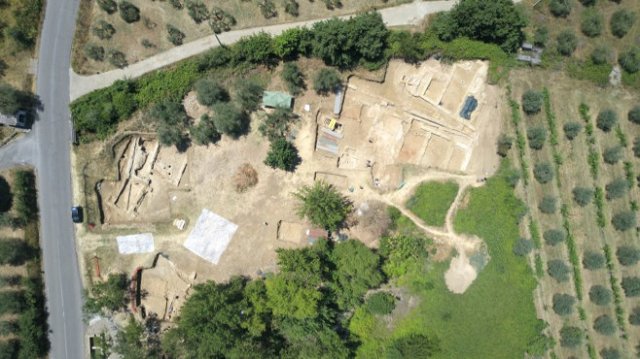
Aerial view, The Coriglia/Orvieto Excavation Project, Archaeological Institute of America. (Season: May 17, 2020 to June 26, 2020)
(From Archaeological Institute of America, used w/o permission.)

Archaeologists and historians generally agree that Etruscan civilization started just shy of three millennia back: mostly where Tuscany is now.

Etruscans had always been where they were when Phoenicians founded Carthage — According to Dionysius of Halicarnassus, who lived around Julius Caesar’s time.

In 1942, Italian historian Massimo Pallottino said maybe they were the alleged Sea Peoples. Or a Sea Peoples colony.10

“Sea Peoples?”

The Sea Peoples came from somewhere. Maybe Asia Minor, southern Europe, or someplace in between.

Wherever they came from and whoever they were, they weren’t called “Sea Peoples” until 1855.

That’s when a French Egyptologist inferred their existence from a mural and snippets from Egyptian records. He called them peuples de la mer: “peoples of the sea.”

If he and scholars of the last century and a half are on the right track, the “Sea Peoples” were one or more of up to maybe nine groups. Maybe.

They’ve been identified as folks from the Hittite Empire, a tribe of Israel, pre-Sardinian Sardinians, and an assortment of other groups you probably haven’t heard of.

They may have been a formal confederation. Or maybe their joint effort to invade Egypt was an impromptu affair.11

There’s a great deal we don’t know about them.

Late Bronze Age Collapse: Unburied Corpses, Lost Records

Finn Bjørklid's (?) map showing the Bronze Age collapse.
(From Finn Bjørklid(?), via Wikimedia Commons, used w/o permission.)
(Late Bronze Age Collapse: yes, what’s on the evening news could be worse.)

If the ‘Sea Peoples’ or their pre-invasion neighbors had written records, those documents did not survive the Late Bronze Age Collapse. Or haven’t been found yet.

Events leading to that catastrophe might help explain why they thought invading Egypt was a good idea.

But like I said, whatever documents they had have been lost or destroyed. That’s hardly surprising, under the circumstances.

As far as I’ve been able to learn, we didn’t know that the Late Bronze Age Collapse had happened until after I earned my degree in history.

A half-century later, we’ve got lively discussions going over how fast it happened. As well as when it happened, exactly what happened and what caused it.

What’s more certain is that well upwards of a dozen places made an abrupt transition from thriving cities to fire-gutted ruins inhabited by unburied corpses.

We haven’t experienced anything quite like it since, happily. I think our 20th century near miss inspired films like “Mad Max/Road Warrior” and “On the Beach.”

I also think academia’s getting back to recognizing that the Trojan War really happened. Although I gather that they’re still not convinced that Homer was really real.”12

And now; Etruscans, scholars, and villages on the Etruscan borderland.

Origin Stories, Attitudes and Assumptions

Livy and Pliny the Elder said Etruscans came from a confederation of Alpine tribes.

Herodotus said that a Lydian story involved a famine and a king who ordered half of the population to leave. The evicted Lydians went west, literally but not figuratively, and became the first Etruscans.

Each version has eloquent supporters.

I gather that supporting Herodotus is out of vogue at the moment. Partly because there isn’t recognized archaeological evidence making it the only viable explanation. Etruscan stuff doesn’t look like Lydian stuff.

But archaeologists in the 46th century might conclude that Puritans in New England couldn’t possibly have come from England. Because New England Puritan churches didn’t look like King’s College Chapel in Cambridge.

It doesn’t help that Herodotus and Lydia are both what we think of as “Greek.” Maybe “Hellenistic” would be more accurate.

Rejecting the Lydian account as repeated by Herodotus because it reminds contemporary academics of American jingoism almost makes sense.

I wouldn’t insist that Herodotus has to be right, but I’m willing to remember that he was four centuries closer to Etruscan origins than either Livy or Pliny the Elder.

Whoever the Etruscans were, they grew and prospered.

So did folks living in a few villages on hills near a river at the south edge of Etruscan territory. The villages became Rome, and kept growing.13


History and Human Nature

Detail of 'The Apotheosis of Washington,' United States Capitol rotunda; Constantino Brumidi. (1865)As I see it, learning from history is an option, and a good one. Part of the trick is remembering the right lessons.

And remembering both that we’re living in what will be history, and that we’re often too close to people and events to see the ‘big picture.’

Dr. Benjamin Franklin: “Don’t worry, John, the history books will clean it up.”
John Adams: “Hmm… Well, I’ll never appear in the history books anyway. Only you. Franklin did this, and Franklin did that…. Franklin smote the ground and out sprang George Washington — fully grown and on his horse. Franklin then electrified him with his miraculous lightning rod and the three of them, Franklin, Washington and the horse, conducted the entire revolution all by themselves.”
(“1776” (1972) quotes via IMDB.com)

I also think remembering that laws, customs and hairstyles change: but human nature hasn’t.

Still “Very Good,” but Wounded

'Expulsion from the Garden of Eden,' Thomas Cole (1828) Museum of Fine Arts, Boston.That’s good news, actually.

“God created mankind in his image; in the image of God he created them; male and female he created them.”
“God looked at everything he had made, and found it very good. Evening came, and morning followed—the sixth day.”
(Genesis1:27, 31)

So, if we’re “in the image of God” and “very good,” how come we’re not perfect people living perfectly in perfect societies?

It’s because the first of us decided that ‘what I want’ outvotes what God says. Then the man tried blaming his wife: and God. The interview did not end well, and we’re living with a wounded nature. But we are still “very good.” Basically. (Genesis 3:120; Catechism, 385412)

And we’re learning, slowly, that acting as if ‘love God, love your neighbor and everyone’s your neighbor’ makes sense — is a good idea.

I’ve talked about that sort of thing, and history, before. Rather often:


1 Metaphors, famous names and a little history:

2 Plutarch, Pericles and plants — a distinctly non-comprehensive look:

3 Democracy, Athenian style:

4 Funkley and other places:

5 More places:

6 Places and names in America:

7 Athens after Pericles:

8 Famous names, mostly:

9 Alexander and after:

10 Not-entirely-forgotten names:

11 (Almost) remembering an ancient apocalypse:

12 A poet, a war and two movies:

13 Perspectives:

Posted in Golden Ages, Series | Tagged , , | 2 Comments

October 25, 2021: A Blue Day in Sauk Centre

Looking across Ash Street South in Sauk Centre, Minnesota. Our front yard is green again, after the summer's drought. (October 25, 2021)

Autumn color in Sauk Centre, Minnesota. This isn't our best 'fall colors' year, but I've been enjoying what we do have. (October 25, 2021)

October’s weather isn’t necessarily “bright blue,” here in the Upper Midwest.

But today was a bright blue day. So I spent a little time this afternoon, sitting on the front stoop, enjoying sunshine and what autumn colors we have this year.

And remembering this poem:

October’s Bright Blue Weather
“O suns and skies and clouds of June,
And flowers of June together,
Ye cannot rival for one hour
October’s bright blue weather;
“When loud the bumblebee makes haste,
Belated, thriftless vagrant,
And goldenrod is dying fast,
And lanes with grapes are fragrant….”
(Helen Hunt Jackson (published 1893) via AllPoetry.com)

Looking west across Ash Street South, Sauk Centre; in mid-June. (June 14, 2021)This summer’s drought was a bad one. An ‘up’ side to the nearly-rainless weather is that I didn’t see a mosquito until August.

I’ve talked about that — the drought, not the mosquito — and other stuff:

Posted in Journal | Tagged , , , | Leave a comment

HD 63935: Two Sub-Neptunes and Maybe More

Designations like HD 63935 b and c don’t exactly roll of the tongue.

Although with a little work I might pronounce them “trippingly on the tongue,” as Hamlet put it.

Maybe saying “sixty five ninety three five bee and cee” would do the trick. Then again, maybe not. I thought, briefly, of calling HD 63935, HD 63935 b and HD 63935 c “Sam, Fred and Chuck;” but thought better of it.

At any rate, I’d been catching up on ‘exoplanet’ notes from the last year or so when I read about the HD 63935 planetary system.

HD 63935’s known planets there, sub-Neptunes, should help scientists learn more about how planets form. Or, rather, observing them and analyzing those observations should.


Defining and Detecting Planets

We’ve known about five planets since long before we started keeping written records.

Six, maybe, if you count Uranus.

Seven, including Earth, but we didn’t start thinking of our world as a “planet” until recently. Then there’s Earth’s moon and the sun, and that’s another topic. Topics.

How we define “planet” has shifted, most recently in 2006, when the International Astronomical Union issued a definition that’s still debatable. And debated.

Today’s telescopes let us see the Solar System’s planets, and about two dozen exoplanets: planets orbiting other stars.

The vast majority of exoplanets, however, aren’t directly visible. Not yet.

We know they’re there because they affect the stars they orbit.

Some are massive enough to move their stars toward and away from us as they orbit, or move the star back and forth across the sky.

Others pass between us and their star during each orbit. I’ll be talking about two of these transiting exoplanets.1


HD 63935’s Twin Sub-Neptunes

Scarsdale et al's Figure 4: transits of HD 63935 b and c. (2021)
(From Scarsdale et al., via Phys.org, used w/o permission,)
(“Phase-folded transits of HD 63935 b and c.”
(Phys.org.))

Astronomers discover twin sub-Neptune exoplanets orbiting nearby star
Tomasz Nowakowski , Phys.org (October 20, 2021)

“By analyzing the data from the TESS-Keck Survey (TKS), an international team of astronomers reports the detection of two almost identically sized sub-Neptune exoplanets orbiting a nearby star. The newly found alien worlds, designated HD 63935 b and HD 63935 c, are about three times larger than the Earth. The finding is detailed in a paper published October 13 on the arXiv pre-print server.

“NASA’s Transiting Exoplanet Survey Satellite (TESS) is conducting a survey of about 200,000 of the brightest stars near the sun with the aim of searching for transiting exoplanets. So far, it has identified over 4,500 candidate exoplanets (TESS Objects of Interest, or TOI), of which 161 have been confirmed so far….”

HD 63935 is about 159 light-years out, in the general direction of Procyon. It’s a tad cooler than our star: 5,534 °K or maybe 5,560 °K, compared to Sol’s 5,772 °K.

The lower number for HD 63935 is from The Extrasolar Planet Encyclopaedia’s page, the arXiv paper’s number is 5,560 °K.

“K” temperatures are degrees Kelvin. The Kelvin temperature scale starts at absolute zero. Comfortable room temperature is 294 °K, eggs fry at 343 °K or thereabouts, and a nicely-burning hearth fire may be around 534 °K.

Getting back to HD 63935, that star is slightly cooler than ours, not quite a tenth as massive and chemically similar. It’s not a ‘Solar twin,’ but it’s close.2

Designations: A Digression

The Winter Triangle: Procyon, Betelgeuse and Sirius. From Akira Fujii; via Hubble Space Telescope, ESA, NASA; used w/o permission.As far as I know, neither HD 63935, HD 63935 b nor HD 63935 c have names yet.

But they’ve got other designations.

I talked about star names and designations last month.3

Basically, now that astronomers are studying far more than the 10,000 or so stars we can see without telescopes, catalog numbers and other designations are more convenient than names.

The planet HD 63935 b, for example, is also TOI 509.01; and the star is TIC 453211454.

The “HD” in their designations stands for Henry Draper Catalogue, which lists spectroscopic classifications for about a quarter-million stars.

HD 63935 is also known as HIP 38374 and TIC 453211454. “HIP” stands for the Hipparcos catalog: data from ESA’s Hipparcos observatory, first published in 1997.

The ESA project’s named after Hipparcus. He was an astronomer, geographer, and mathematician who lived when Mithridates I was putting Parthia on the map. We lost his star catalog sometime during the two millennia that’s elapsed since then.

Finally, TIC stands for Third International Conference, Titanium Carbide, Thermal Imaging Camera and Thames Innovation Centre.

But in this context TIC means TESS Input Catalog.4

Twin Sub-Neptunes: Unlike Anything in the Solar System

Goddard Space Flight Center's illustration of transmission/absorption spectroscopy.
(From NASA’s Goddard Space Flight Center, used w/o permission.)

The diameters of HD 63935 b and c are about 2.99 and 2.9 times Earth’s. That’s big, but not as big as Neptune’s 3.883 Earth-diameters.

On the other hand, HD 63935 b has only around 10.8 times Earth’s mass, which makes its density 2.2 g/cm3. Give or take.

HD 63935 c is smaller but heavier, with around 11.1 Earth masses. Its density is about 2.5 g/cm3.

Neither is nearly as dense as Earth — 5.514 g/cm3 — but they’re more tightly packed than Neptune’s 1.64 g/cm3.

And they’re much warmer than either Earth (287 °K) or Neptune (72 °K where air pressure is like Earth at sea level).

HD 63935 b’s calculated ‘surface’ temperature is between 884 and 938 °K. HD 63935 b’s is a bit cooler, 663 to 705 °K. By comparison, the Solar System’s Mercury surface temperatures max out at around 700 °K at the equator.

That’s because their sun is nearly as bright as ours, and both their orbits are smaller than Mercury’s. HD 63935 b orbits the star every 9.06 days, while a year for HD 63935 c 21.4 days long. Earth’s 24-hour days, that is.5

Exploring the “Radius Cliff”

Fulton and Petigura's exoplanet radius distribution (2018), illustrated by Edwin S. Kite et al. to show 'radius cliff' at ca. 3 Earth-radii. (2019)Since they’re smaller than the Solar System’s Neptune, the recent paper calls HD 63935 b and c “sub-Neptunes.”

Although the label’s accurate by current standards, neither is particularly like Neptune. Or Earth.

The Solar System’s Uranus and Neptune are almost, but not quite, twin planets: almost exactly four times Earth’s diameter and 3.883 Earth-diameters, respectively.

Oddly enough, we’ve been finding a whole lot of planets less than three Earth-diameters, but not nearly as many in the Neptune-Jupiter range. Not with short-period orbits, at any rate.

Scientists have been calling this discontinuity the “radius cliff.”

One of the best, or least-improbable, explanations is that larger planets have a sort of plateau in their growth curves. If this is the case, then when a planet’s core and atmosphere reaches about three Earth-diameters, pressure at the surface of its magma ocean lets the magma start absorbing hydrogen.

The planet keeps on gathering gas, but won’t get bigger until the magma’s saturated.6

Or maybe there’s another explanation. If so, I figure we’ll discover it as we collect more data: and review what we’ve already learned.

“Space Oddities…” — or — Studying Starlight

NASA/STScI's illustration, showing how absorption spectroscopy works. (1998)
(From NASA/STScI, via Wikimedia Commons, used w/o permission,)

Light from HD 63935 travels some 159 light-years before reaching us, which is almost next door or unimaginably distant, depending on what distance scale is in play.

And that’s yet another topic.

The point is that HD 63935 isn’t a particularly dim star and it’s close enough to for spectroscopic analysis. “Spectroscopic analysis” is a five-dollar phrase that means taking a look at the colors in starlight.

And, since the two sub-Neptunes orbiting HD 63935 pass between their sun and our planetary system, scientists can measure what happens to light passing through their atmospheres. Assuming that they have atmospheres, which seems like a safe bet.

Three of the scientists who published the paper discussed in that Phys.org article made a case for follow-up observations back in January.7

  • “HD 63935’s Space Oddities: Two Atmospheric Targets in Sparse Regions of Mass-Radius Space”
    Nicholas Scarsdale, Joseph M. Akana Murphy, Natalie M. Batalha; American Astronomical Society meeting #237 (January 2021)

“Space oddities” is hardly an original phrase, and far from the erudite appellations bestowed upon many of yesteryear’s documents of natural philosophy.

On the whole, I’ve enjoyed watching scientists unstarching their collars in recent decades, and that’s yet again another topic.

Worth a Closer Look

Nicholas Scarsdale et al.'s chart of radial velocity points for HD 63935. (2021)With two sub-Neptunes, HD 63935 is already a two-for-one research opportunity.

But there’s a good chance there’s at least one more planet in that system.

After Scarsdale et al. sorted out radial velocity measurements attributable to HD 63935 b and c, the remainder looked a lot like a wobble made by a third planet.

Or maybe it’s the star’s surface bouncing, but these scientists figure that’s not likely.

The radial velocity remainders probably aren’t linked to the star’s rotation period, 30 to 35 days, either.

On the other hand, Scarsdale et al. didn’t find reasonably certain evidence of a third planet. Which, if it’s there, doesn’t produce effects that would affect the data they did analyze.8

Bottom line? HD 63935 b and c are high-value targets for scientists, and their planetary system may include more worlds for us to study.


Perspectives and Paying Attention

NGC 4848 and other galaxies, image by Hubble/ESA.

“Indeed, before you the whole universe is as a grain from a balance, or a drop of morning dew come down upon the earth.”
(Wisdom 11:22)

We’ve learned a bit about this universe during the two millennia that have passed since those thoughts were recorded.

But as I see it, they’re still true. From God’s viewpoint, a drop of morning dew and our world of planets, stars and galaxies are — all pretty much the same size.

Which, I suppose, could be a scary thought.

Or a reassuring one, since:

“Our God is in heaven
and does whatever he wills.”
(Psalms 115:3)

So, again as I see it, God is large and in charge. And if we pay attention to this wonder-filled creation, we can learn a little more about the Almighty.

“For from the greatness and the beauty of created things their original author, by analogy, is seen.”
(Wisdom 13:5)

And that, I think, is a good idea:


1 Planets past and present:

2 Units of measure and stars:

  • Wikipedia
  • TKS V. Twin sub-Neptunes Transiting the Nearby G Star HD 63935
    Nicholas Scarsdale, Joseph M. Akana Murphy, Natalie M. Batalha, Ian J. M. Crossfield, Courtney D. Dressing, Benjamin Fulton, Andrew W. Howard, Dnaiel Huber, Howard Isaacson, Stephen R. Kane, Erik A. Petigura, Paul Robertson, Arpita Roy, Lauren M. Weiss, Corey Beard, Aida Behmard, Ashley Chontos, Jessie L. Christiansen, David R. Ciardi, Zachary R. Claytor, Karen A. Collins, Kevin I. Collins, Fei Dai, Paul A. Dalba, Diana Dragomir, Tara Fetherolf, Akihiko Fukui, Steven Giacalone, Erica J. Gonzales, Michelle L. Hill, Lea A. Hirsch, Eric L. N. Jensen, Molly R. Kosiarek, Jerome P. de Leon, Jack Lubin, Michael B. Lund, Rafael Luque, Andrew W. Mayo, Teo Močnik, Mayuko Mori, Norio Narita, Grzegorz Nowak, Enric Pallé, Markus Rabus, Lee J. Rosenthal, Ryan A. Rubenzahl, Joshua E. Schlieder, Avi Shporer, Keivan G. Stassun, Joe Twicken, Gavin Wang, Daniel A. Yahalomi, Jon Jenkins, David W. Latham, George R. Ricker, S. Seager, Roland Vanderspek, Joshua N. Winn; The Astronomical Journal (Submitted October 13, 2021) via arXiv
  • The Extrasolar Planet Encyclopedia
  • Fireplace Safety
    Adapted from Shawn Shouse, Iowa State University Extension Field Specialist/AG Engineering; Backyards & Beyond; The University of Arizona

3 Some stars have names, many don’t:

4 Names, catalogs and descriptions:

5 Introducing the HD 63935 planetary system; and, for comparison, Mercury:

6 Background: planets and magma oceans:

7 Starlight and science:

8 Looking ahead:

Posted in Exoplanets and Aliens, Science News, Series | Tagged , , , , | Leave a comment

New on My Blogroll+: mr o shays (Still Learning)

I’ve added “mr o shays (Still Learning)” to my link list page: Blogroll+ > Bloggers and other writers.

And, while I was at it, reviewed and updated the page’s other links.

Now I really should start writing. Or maybe get a cup of coffee.

Posted in Journal | Tagged , | 2 Comments