Early Agriculture, New Tech

‘Genetics news’ caught my eye this week.

DNA from barley that’s been sitting in a cave for six millennia is helping scientists learn about agriculture’s origins.

A fits-in-your-hand Biomolecule Sequencer is at the International Space Station. If it works, folks up there won’t have to send samples down for analysis.

Finally, the world’s first farmers were an unexpectedly diverse lot.

  1. Ancient Barley
  2. Testing a DNA Sequencer in Space
  3. First Farmers, DNA, and Origins

Science? In a “religion” blog??


Dogs, Wolves, and Laban’s Sheep

We’ve known that traits are inherited for upwards of 10 millennia, and applied that knowledge.

Paleontologists and archaeologists figure that agriculture, planting genetically-modified plants and harvesting them, started independently in several spots; with folks in southwest Asia getting there first.

The last I checked, they’re still not sure about dogs. The genetic evidence is clear enough: a particular breed of wolf started hunting with humans somewhere between 27,000 and 40,000 years ago, and eventually became today’s dachshunds, akitas, and mutts.

Quite a few researchers insist that a particular sort of wolf started being really good at getting along with humans without any help. Maybe, but I’ve learned to be skeptical about assertions regarding “primitive” people.

I figure that when an apex predator ‘just happens’ to start helping us, we helped the process along. Folks who lived during and just before the Last Glacial Maximum were as human as I am: and that’s another topic.

Getting back to agriculture, livestock, and all that, Jacob’s deal with Laban in Genesis 30:27–3:13 at least hints that Jacob knew how to make a bumper crop of dark sheep and spotted or speckled goats. Laban doesn’t come across as the brightest bulb in the box.

Attack of the Mutant Macaroni?

We don’t think of “domesticated” animals as “GMOs,” but today’s cattle are the result of more than ten millennia of genetic tweaking.

Genetic engineering tech like gel electrophoresis is new — but genetic manipulation isn’t. Unless you’re a hunter, the odds are pretty good that you’ve never eaten food that didn’t come from a genetically modified plant or animal.

We’re developing new technology: but people have been using ‘synthetic’ organisms like chickens, macaroni wheat, and dogs, for a very long time.

We’ve come a long way from the days of, for example, introducing a red junglefowl and grey junglefowl and hoping for the best: but gene-swapping between species has been going on for — most likely — billions of years. What’s new is that we’re doing the swapping.

I don’t see ethical issues with tweaking the genetics of livestock and plants. We’ve been doing that for — a very long time, not that ‘we’ve always done it’ is an excuse for bad behavior. More to the point, grafting olive trees is a metaphor in Romans 11:19–24: and those verses apparently don’t condemn the practice.

Maybe someone’s assumed that Deuteronomy 22:9 forbids grafting; or condemns marrying someone with a lower Dun & Bradstreet number, or whatever.

I don’t: particularly since it’s about seeds, and comes between a rule about parapets and another about using draft animals.1

Thinking is Not a Sin
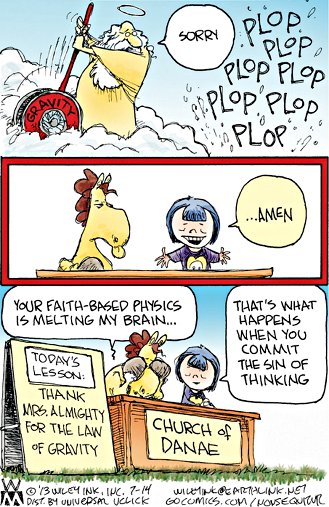
I’ve run into folks who act as if they think God gave us brains, and is offended when we use them: particularly if we start wondering how things work.

That doesn’t make sense, not to me.

I’m a Catholic, so I see the universe as a place of order and beauty: being created and upheld by God, in a “state of journeying” toward an ultimate perfection. (Genesis 1:1–31; Catechism of the Catholic Church, 31–32, 302, 341)

We’re rational creatures, created in the image of God, “little less than a god;” left in charge of this world, with the power and frightening responsibilities that come with our nature. (Genesis 1:26–27, 2:7; Psalms 8:6; Catechism, 355–373, 2402, 2415–2418, 2456)

Forgetting that “little less than a god” isn’t “God” gets us in trouble, and that’s yet another topic.

Studying this world is okay. Using reason, we can see God’s work in the universe. (Catechism, 35–36, 282–289, 1704, 2292–2295)

Thinking is not a sin. Using the brains God gave us is part of being human. (Wisdom 7:17; Catechism, 35, 159, 1730–1738)


1. Ancient Barley


(From Paul Shaw, via BBC News, used w/o permission.)
(“Barley fields of 6,000 years ago may have looked very similar to those of today”
(BBC News))

“Ancient barley DNA gives insight into crop development”
(July 18, 2016)

“An international group of scientists have analysed the DNA of 6,000 year old barley finding that it is remarkably similar to modern day varieties.

“They say it could also hold the key to introducing successful genetic variation.

“Due to the speed at which plants decompose, finding intact ancient plant DNA is extremely rare.

“The preserved ancient barley was excavated near the Dead Sea, the journal Nature Genetics reports….”

Folks harvested that grain about the time Uruk, or Erech, depending on what you’re reading, was starting to grow into an important city.

About two millennia later, Utu-hengal, governor of Uruk, led Sumerian cities against Tirigan, the last Gutian ruler in Sumer.

Then Ur-Nammu took over and started the Third Dynasty of Ur. He’s mostly famous for the Code of Ur-Nammu, and that’s yet again another topic.


(From Ningyou, based on “Atlas of the Bible Lands,” C S Hammond & Co (1959); via Wikimedia Commons, used w/o permission.)

Over the next two millennia, the Old, Middle, and Neo-Assyrian Empires were a big deal until the Achaemenid Empire took over; then Alexander the Great rolled over that part of the world.

Meanwhile, Abraham and Sara’s descendants were planting crops, building cities, getting conquered, and rebuilding. Some of that shows up in 1 and 2 Kings. Alexander’s generals inherited pieces of his empire, including Yehud Medinata/Province of Judea.

The territory changed hands a few more times before Pompey took over. That was a little before the Roman Republic’s leadership went sour.

Found in Masada’s Yoram Cave

Folks in Iudaea Province revolted a few decades after our Lord stopped being dead, and that’s still another topic.

It was not a good time to be in Jerusalem.

Rebel forces held out in an unconquerable fortification on Masada until Roman forces re-engineered the terrain and conquered it.

Fighting didn’t reach Yoram Cave, in a southeastern cliff of the Masada Horst, so the grain stayed there.

Another two millennia of assorted good times and bad passed before researchers found it.

They selected ten grains and spikelets and split them, one set of halves getting analyzed to work out how old they were; the other half getting their DNA extracted and studied.

Genetic Time Capsules

Looks like folks were “tampering with things man was not supposed to know” long before Uruk became a city.

“…The DNA analysis showed that these 6,000 year old seeds were remarkably similar to modern day crops in the same region. Meaning that at the time they were harvested barley was already an advanced crop that had been heavily domesticated.

” ‘These 6,000 year-old grains are time capsules, you have a genetic state that was frozen 6,000 years ago. This tells us barley 6,000 years ago was already a very advanced crop and clearly different from the wild barley,’ Dr Nils Stein of the IPK Plant Genetics institute in Germany told BBC News.

“He added: ‘Already 6,000 years ago the barley fields may have looked very similar to barley that is grown today.’…

“…As well as providing a detailed insight into the archaeology and history of this ancient crop, the seeds could provide the key to ensuring successful reintroduction of genetic variation in modern day species….”
(BBC News)

That doesn’t bother me, partly because I remember when quite a few folks thought science and technology would solve all our problems; or at least make “the future” a magical place.

Now that we’re living in “the future,” it’s easier to find folks who fear that science and technology will destroy us all; after killing all the cute animals. I think that’s as silly as the old ‘science will solve all problems’ attitude.

Science and technology aren’t transgressions: they’re tools. Ethics apply, but studying this universe and using that knowledge to make new tech is part of being human. It’s part of our job. (Catechism, 2292–2296, 2402–2405, 2456)

Re-Diversifying

Tweaking a wild grass like barley let folks spend time developing things like writing, bronze tools, and barley beer: which I think is okay. (July 10, 2016)

Over the last several millennia, we got really good at fine-tuning domestic plants and animals.

The good news is that our harvests brought in high-quality barley, wheat, and potatoes.

The bad news is that by now quite a few domesticated critters are monocultures: pretty close to clones of each other. We got things like the Great Famine (Ireland) when a ‘clone crop’ caught a disease and died.

It’s not entirely bad news, though. We’re learning a great deal about how genetics works: including potato blight‘s coding. That’s Phytophthora infestans, for folks who like scientific/Latin names for microcritters.

The name for that sort of name is Binomial nomenclature, which goes back to Carl Linnaeus.2

There’s a great deal left to learn, too, but I’m reasonably confident that we’ll develop ways to re-diversify barley, potatoes, and goats.

More than you may want or need to know about:


2. Testing a DNA Sequencer in Space


(From NASA, via BBC News, used w/o permission.)

“DNA sequencer sent to space station”
BBC News (July 18, 2016)

“Nasa has sent a DNA sequencer to the International Space Station in an effort to help astronauts monitor their own health.

“A SpaceX cargo ship sent the sequencer into orbit on Monday, along with other items for the crew.

“It was developed by the UK-based company Oxford Nanopore Technologies.

“The device is designed to show whether DNA sequencing is possible in microgravity….”

NASA calls the experiment “Biomolecule Sequencer:”

“…The objectives of Biomolecule Sequencer are to (1) provide proof-of-concept for the functionality and (2) evaluate crew operability of a DNA sequencer in the space environment. The immediate capabilities from the sequencer are, but are not limited to, in-flight microbial identification for crew and vehicle health assessments….”
(NASA)

The rest of NASA’s page is informative, but a trifle on the dry side.

The facts are straightforward enough. If this gadget works as expected, folks on the ISS won’t have to send samples down and wait for lab results. Sounds like a good idea to me.

That didn’t stop me from wondering if someone’s glanced at the headlines after watching Leviathan, Gattaca, and Babylon A.D. — and started writing a screenplay about genetically-engineered game show hosts, NASA, and international corporations.


3. First Farmers, DNA, and Origins


(From Thinkstock, via BBC News, used w/o permission.)
(“The new study analysed the genomes of early farmers from Iran’s Zagros mountains”
(BBC News))

“First farmers had diverse origins, DNA shows”
(July 15, 2016)

“Analysis of DNA from some of the world’s first farmers shows that they had surprisingly diverse origins.

“Researchers compared the genomes of ancient Neolithic skeletons from across the Near East, where farming began.

“The results shed light on a debate over whether farming spread out from a single source in the region, or whether multiple farmer groups spread their technology across Eurasia.

“The findings by an international team appear in the journal Science….”

These farmers lived in part of the Zagros Mountains that’s now in Iran. The earliest of them lived around the year 8000 BC, the others from roughly 7450 to 7100 BC.

Their genes were more than a bit like folks in today’s Afghanistan, Pakistan, Iran: and Sardinia, an island off Italy.


(From Broushaki1 et al., via Science, used w/o permission.)
(Map showing how descendants of these farmers settled in other parts of the world.)

I’m interested, but not particularly surprised, that descendants of these farmers traveled around over the next 10 millennia. Folks move for many reasons: but sooner or later, we’ll head for the horizon and settle somewhere else.

My ancestors didn’t arrive in central North America until about a century back, after a long layover in northwestern Europe, and that’s — you guessed it — another topic.

Or maybe not so much.

My family tree has roots in southern Norway — we’re the short, dark-haired Norwegians — and the northwest part of the British Isles. That overlaps areas where folks from the Zagros Mountains settled, which gives me a personal interest in their story.

More:

  • “Early Neolithic genomes from the eastern Fertile Crescent”
    Farnaz Broushaki1, Mark G Thomas, Vivian Link, Saioa López, Lucy van Dorp, Karola Kirsanow1, Zuzana Hofmanová, Yoan Diekmann, Lara M. Cassidy, David Díez-del-Molino, Athanasios Kousathanas, Christian Sell, Harry K. Robson, Rui Martiniano, Jens Blöcher1, Amelie Scheu1, Susanne Kreutzer, Ruth Bollongino, Dean Bobo, Hossein Davudi, Olivia Munoz, Mathias Currat, Kamyar Abdi,, Fereidoun Biglari, Oliver E. Craig, Daniel G Bradley, Stephen Shennan, Krishna R Veeramah, Marjan Mashkour, Daniel Wegmann, Garrett Hellenthal, Joachim Burger; Science (July 14, 2016)

Last week’s ‘science’ post:


1 I take Sacred Scripture seriously. (Catechism, 101-133)

I also realize that cultures have changed in the 26 centuries since Deuteronomy was written.

” ‘When you build a new house, put a parapet around the roof; otherwise, if someone falls off, you will bring bloodguilt upon your house.

“1 ‘You shall not sow your vineyard with two different kinds of seed; if you do, its produce shall become forfeit, both the crop you have sown and the yield of the vineyard.

“You shall not plow with an ox and an ass harnessed together.”
(Deuteronomy 22:8–10)

2 Carl Linnaeus published “Systema Naturae” in 1735.

Those were exciting times.

In 1778 Georges-Louis Leclerc, Comte de Buffon published his “Les époques de la nature,” saying that Earth was about 75,000 years old. He’d measured how fast iron cooled in his laboratory. The Sorbonne condemned Leclerc’s ideas, and he issued a retraction.

Physicist William Thomson, using similar methods in 1862, calculated an age of Earth at somewhere between 20,000,000 and 400,000,000 years. That was pretty good work, considering that scientists didn’t know about heat from radioactive decay, and effects of convection currents in Earth’s mantle yet.

This sort of thing fascinates me. Your experience may vary.

Posted in Science News | Tagged , , , , , | 6 Comments

Art, Truth, and Reflecting


(“Not All Times” – posters, art prints, greeting cards, and postcards available on DeviantArt.com.)

“l’art pour l’art,” “Art for art’s sake,” popped up in the early 19th century.

The idea is that “the only ‘true’ art, is divorced from any didactic, moral, or utilitarian function.” George Sand, Friedrich Nietzsche, and Chinua Achebe, said it was an empty phrase, self-contradictory, and Eurocentric, respectively. (Wikipedia)

I think it’s a silly idea: at least when applied to anything other than doodling to pass the time.

Come to think of it, in that case creating the doodles is meant to pass time.

At another extreme, there’s the idea that art must be ‘relevant’ — serve the state, be useful in worship, or be ‘uplifting.’

I won’t go that far, either: particularly if it means “art” must be propaganda or persuasion pieces like Currier’s “Drunkard’s Progress” over there.

That sort of thing can backfire, like “Reefer Madness,” and I talked about that last week. (July 10, 2016)

Then there’s sacred art. We’ve two millennia of traditions (lower-case “t”) expressing “…in images the same Gospel message that Scripture communicates by words….” (Catechism of the Catholic Church, 1159-1162)

Taking Tradition with a capital “T” seriously doesn’t mean trying to live as if it’s still the 1st, 11th, or 19th century, and that’s another topic. (Catechism, 75-83, 1200-1206)

Facets

The stuff I make, like Hangar 7, isn’t even close to being sacred art, which doesn’t bother me. That’s because I try to show some facet of truth and beauty in each picture.

Some, like Night Shift and Inventory, aren’t particularly pretty: but I paid attention to principles of symmetry and composition, and the images may resonate with a viewer’s memories.

Then again, maybe not.

Art and Being Human

Oddly enough, although I think art should involve truth and beauty; every picture is, in a sense, a lie.

René Magritte‘s “La trahison des images/The Treachery of Images,” for example, isn’t a pipe. It’s an image of a pipe — and I am not going to get sidetracked by Plato’s theory of forms, virtual reality, and metaphysics.

Not today, anyway.

I was going somewhere with this. Let me think – – – got it!

Truth is very important:

“‘You shall not bear false witness against your neighbor.”
(Exodus 20:16)
“‘Again you have heard that it was said to your ancestors, “Do not take a false oath, but make good to the Lord all that you vow.””
(Matthew 5:33)

I’m pretty sure that representational art isn’t ‘lying,’ since folks I’ve known can easily tell the difference between a picture and the real thing: just as most folks realize that saying “a cat” isn’t the same as a cat.

And that gets me into communication theory: never mind.

Not everyone is an artist, but creating art is part of being human:

“…art is a distinctively human form of expression; beyond the search for the necessities of life which is common to all living creatures, art is a freely given superabundance of the human being’s inner riches. Arising from talent given by the Creator and from man’s own effort, art is a form of practical wisdom….”
(Catechism, 2501)

I think art is important, but it shouldn’t be the most important thing in my life:

“…To the extent that it is inspired by truth and love of beings, art bears a certain likeness to God’s activity in what he has created. Like any other human activity, art is not an absolute end in itself, but is ordered to and ennobled by the ultimate end of man.”
(Catechism, 2501)

There’s more to say, but that’ll wait for other posts. For now, I’ll add a few quotes and call it a day.

Artists, Icons, and Reflecting Divine Beauty

From a letter to artists:

“None can sense more deeply than you artists, ingenious creators of beauty that you are, something of the pathos with which God at the dawn of creation looked upon the work of his hands. A glimmer of that feeling has shone so often in your eyes when—like the artists of every age—captivated by the hidden power of sounds and words, colours and shapes, you have admired the work of your inspiration, sensing in it some echo of the mystery of creation with which God, the sole creator of all things, has wished in some way to associate you.”
(Pope St. John Paul II (April 4, 1999))

About icons and sacred images:

“…Art for art’s sake, which only refers to the author, without establishing a relationship with the divine world, does not have its place in the Christian concept of the icon. No matter what style is adopted, all sacred art must express the faith and hope of the Church. The tradition of the icon shows that the artist must be conscious of fulfilling a mission of service to the Church….”
(“Duodecimum Saeculum,” Pope St. John Paul II (December 4, 1987))

Art and being human:

“…Art certainly must be listed among the noblest manifestations of human genius. Its purpose is to express in human works the infinite divine beauty of which it is, as it were, the reflection. Hence that outworn dictum ‘art for art’s sake’ entirely neglects the end for which every creature is made. Some people wrongly assert that art should be exempted entirely from every rule which does not spring from art itself. Thus this dictum either has no worth at all or is gravely offensive to God Himself, the Creator and Ultimate End.

“Since the freedom of the artist is not a blind instinct to act in accordance with his own whim or some desire for novelty, it is in no way restricted or destroyed, but actually ennobled and perfected, when it is made subject to the divine law….”
(“Musicae Sacrae,” Pope Pius XII (December 25, 1955))

Sources:

Posted in Being an Artist, Being Catholic | Tagged , , | 2 Comments

Sandra and Tommy: Apes and Ethics

A court in Argentina said that Sandra the orangutan is “una persona no humana (non-human person)” in 2014.1 Or maybe 2015. I’ll get back to that.

Instead of going ape over that news, I learned a little about Sandra, the Buenos Aires Zoo, and the curious case of Tommy the chimp:

  1. ‘A Non-Human Person:’ the Story Continues
  2. Sandra the Orangutan: Law and “Persons”
  3. The Curious Case of Tommy the Chimp

Chimps and orangutans don’t have much in common with cephalopods, apart from being the subject of intelligence-related research; but I wrote about them, anyway:

Now, a few words about science, faith, and what I see in a mirror.


Looking in a Mirror

When I look in a mirror, I see eyes, nostrils, and a mouth: it’s pretty obvious that I’m an animal, a vertebrate.

The hair shows that I’m a mammal. Other features peg me as a primate; specifically a hominid: the sort of critter we used to call “great apes.”

That doesn’t bother me: which may need some explaining.

I’ve run into folks who seem to feel “set apart” from the rest of God’s creation.

Maybe it feels more “spiritual” to pretend that physical reality is nasty, and that humans aren’t supposed to have biological functions. That doesn’t make sense. Not to me.

I’m a Christian, a Catholic, so I must believe that I’m made from the stuff of this world:

“2 the LORD God formed man out of the clay of the ground and blew into his nostrils the breath of life, and so man became a living being.”
(Genesis 2:7)

That doesn’t mean that my faith is shaken when I check my blood sugar, and see something other than phyllosilicate minerals — literal clay — come out of the pinprick.

Taking the Bible seriously does not mean believing that Sacred Scriptures were written from a contemporary Western literalist’s viewpoint. Not even close. (Catechism of the Catholic Church, 101-133)

It does mean believing that God doesn’t make junk:

“God looked at everything he had made, and he found it very good. Evening came, and morning followed – the sixth day.”
(Genesis 1:31)

If God thinks this world is “very good,” I’m not going to argue.

Besides, I agree. I like the world I’m in. I don’t think it’s perfect, and that’s another topic.

Greater Admiration

We’re told that God created a good, beautiful, and ordered world, and that studying it is okay.

Scientific discoveries are invitations to “even greater admiration for the greatness of the Creator.” (Psalms 19:2; Wisdom 7:17; Catechism, 283, 299, 341)

We’re a special sort of animal, endowed with reason, with free will. We’re also people. We’re made in the image of God: rational, with free will. (Catechism, 1951, 1700-1706, 1730)

That freedom comes with personal responsibility, and that’s yet another topic. (Catechism, Catechism, 1731-1742)

Part of our job is taking care of the physical world, including animals. (Genesis 1:27–28; Catechism, 16, 341, 373, 2415-2418)

Galenus: Almost, but Not Quite, Right

Noticing similarities between ourselves and other primates, and looking for differences, is nothing new.

Aelius Galenus/Claudius Galenus/Κλαύδιος Γαληνός was a doctor when Antoninus Pius was Emperor, and died around the time Justin Martialis assassinated Caracalla.

Martialis was upset because Caracalla hadn’t promoted him to Centurion. We’re pretty sure that Praetorian prefect Macrinus aimed Martialis at Caracalla, with predictable results.

Then a Scythian archer killed Martialis, a few days later Macrinus was the new emperor, and that’s yet again another topic.

Where was I? Galenus, monkeys, Caracalla. Right.

The Roman Empire didn’t allow autopsies back then, except in very rare cases, like Julius Caesar’s assassination; so Galen dissected monkeys, not humans.

He figured that since monkeys look a lot like humans, human anatomy was the same as monkey anatomy: apart from the tail. He was almost, but not quite, right.

I’ve said this before.

Truth and Pope Leo XIII

“Saeculum obscurum/dark ages” is what Caesar Baronius called the time between 888, when the Carolingian Empire ended to the Georgian Reform of 1050 (more or less). That was around 1600.

He had a point. Toward the end of that period, Pope Benedict IX was Pope three times: the only one to have been kicked out and reinstated, and the only Pope who sold the Papacy.

Those were not good times.

We’re up to Benedict XVI now, and Pope Francis.

The “dark ages” name caught on, along with the notion that religion drenched (European) civilization in superstition and ignorance from the 6th to the 13th centuries.

The notion is — inaccurate.

St. Albertus Magnus, patron Saint of scientists, lived toward the end of that period. It’s hardly surprising that he studied natural processes. That’s one way we can learn more about God. (Catechism, 31-35)

Since we don’t worship nature — that’d be idolatry — we can study it without fear of offending ‘the spirits.’ (Catechism, 282-283, 2112-2114)

We think God is large and in charge, and rational. As St. Iranaeus pointed out, we’re rational and therefore like God; with free will — and that brings up still more topics. (Catechism, 268, 2112-2114, 1730, 1934, 1951)

Bottom line, the Greco-Roman prohibition of autopsies no longer applies. Not where folks understood the Catholic faith. (Catechism, 2301)

Today’s medical science and technology probably exists in large part because Christianity’s attitude toward the study of nature allows autopsies and other scientific research.

Getting back to Galenus, we’re a bit like monkeys, but not as close as he figured. Eventually folks like Andreas Vesalius started studying human bodies.

Fast-forwarding to the 19th century, Charles Darwin’s On the Origin of Species inspired some folks to compare ape and human anatomy, and others to panic. That’s still going on, but I figure Pope Leo XIII is right:

“…God, the Creator and Ruler of all things, is also the Author of the Scriptures – and that therefore nothing can be proved either by physical science or archaeology which can really contradict the Scriptures. … Even if the difficulty is after all not cleared up and the discrepancy seems to remain, the contest must not be abandoned; truth cannot contradict truth….”
(“Providentissimus Deus,” Pope Leo XIII (November 18, 1893) [emphasis mine])

Getting a Grip About Owen, Huxley, and Primate Brains

The “Great Hippocampus Question” was a hot topic during the mid-19th century.

Biologist, comparative anatomist and paleontologist Richard Owen agreed that evolution happened: but was more complicated than Darwin’s model.

Owen also said that humans were mammals, but not primates: and so couldn’t have evolved from apes.

Owen based his argument on the (alleged) fact that only human brains have a hippocampus minor.

Biologist Thomas Henry Huxley thought Darwin was right.

The debate devolved into something resembling the current American presidential election, producing satiric poems and cartoons: and, happily, some serious research.

Scientists eventually found something a whole lot like a hippocampus minor in other primate brains, and we moved on:

These days we call that part of the brain the Calcar avis. Human brains aren’t exactly like those of other primates, but we’re not all that different, either.

I’m about as sure as I can be that humans are people and orangutans aren’t. But I’m also quite certain that we may use animals, and that we are responsible for their humane care: particularly those which we directly control. (Catechism, 2417, 2457, 2415-2418)


1. ‘A Non-Human Person:’ the Story Continues


(From AP, via BBC News, used w/o permission.)
(“Sandra the Orang-utan hit international headlines when A Buenos Aires court declared her ‘a non-human person’ deserving rights”
(BBC News))

“Buenos Aires to shut scandal-prone zoo”
BBC News (June 24, 2016)

“The mayor of Buenos Aires has announced that his administration has taken over the running of the city’s zoo after a series of scandals about the condition of its animals and buildings.

“It will now become an eco-park promoting environmental conservation.

“Its 2,500 animals will be moved to sanctuaries in other parts of Argentina and abroad where they can be housed in better conditions.

“Mr Larreta said the animals had been living in degrading conditions.

“The zoo has been in existence since 1875, run by a private company which won a concession to manage it….”

Turns out, the Parque Tres de Febrero was built on land which used to be owned by Juan Manuel de Rosas.

The project started in 1974, the park opened on November 11, 1875, and was owned by Argentina’s Federal Government until 1888.

That’s when ownership transferred to the City of Buenos Aires, and Mayor Antonio Crespo started the Buenos Aires Zoo, separating it from the rest of the park. From around 1944 to 1991, a series of political appointees ran the place: and let it deteriorate.

The zoo was privatized in 1991, animals started being transferred from cages to natural-looking areas, and a Buenos Aries court said that an orangutan was “una persona no humana (non-human person)” in 2014. That’s what the BBC News article said.

Or maybe it was October 21, 2015, when Judge Elena Amanda Liberatori ruled on Sandra’s status.1

This isn’t a tidy little tale of capitalist profit-mongers oppressing the non-human proletariat, until thwarted by a wise and benevolent government — and that’s another topic or two.

I think it’s interesting that making the transition from animals in cages to animals in more open settings apparently started after privatization.

That would probably have happened anyway: the trend over the last few decades has been away from menagerie and towards immersion exhibit.


2. Sandra the Orangutan: Law and “Persons”


(From Reuters, via BBC News, used w/o permission.)
(“Sandra covers her head with a cloth to protect herself from the public gaze at the Buenos Aires Zoo”
(BBC News))

“Court in Argentina grants basic rights to orangutan”
(December 21, 2014)

“A court in Argentina has ruled that a shy orangutan who spent the last 20 years in a zoo can be granted some legal rights enjoyed by humans.

“Lawyers had appealed to free Sandra from the Buenos Aires zoo by arguing that although not human, she should be given legal rights.

“They had argued that she was being illegally detained.

“If there is no appeal, the ape will be transferred to a sanctuary in Brazil where she will enjoy greater freedom.

“The singular case hung on whether the animal was a ‘thing’ or a ‘person’.

“In December a New York State court threw out a request to free a privately owned chimpanzee arguing that the animal was property and had no legal rights….”

I’m no export on Argentine law and custom: so maybe “una persona no humana”1 doesn’t have the apparent connotations of “non-human person.”

In my country, a corporation is a legal person — but not a natural person, or human being. Both sorts of “persons” have legal rights and obligations: but not the same rights.

I’m okay with that: and am acutely aware that American federal, state, and local laws are not perfect.

Part of the good news about the 2014 decision is that Sandra may enjoy a better life as a result.

Another bit of good news is that apparently her new “rights” don’t include the right to vote. Don’t laugh: it’s been seriously suggested.1

I haven’t discovered whether the Buenos Aires court was a city, provincial, or federal court.1


3. The Curious Case of Tommy the Chimp


(From AP, via BBC News, used w/o permission.)
(“Chimpanzee Tommy is believed to be 40 years old”
(BBC News))

“US chimpanzee Tommy ‘has no human rights’ – court”
BBC News (December 4, 2016)

“A chimpanzee is not entitled to the same rights as people and does not have to be freed from captivity by its owner, a US court has ruled.

“The appeals court in New York state said caged chimpanzee Tommy could not be recognised as a ‘legal person’ as it ‘cannot bear any legal duties’.

“The Nonhuman Rights Project had argued that chimps who had such similar characteristics to the humans deserved basic rights, including freedom.

“The rights group said it would appeal….”

The photo reminded me of old movies like “White Heat” and “Little Caesar,” with lines like Rico Bandello‘s: “You want me, you’ll have to come and get me.”

“Tommy” went missing last month. The chimp may have escaped, like Inky did in April.2 My guess is that some one stole the famous chimp.

Thinking that the chimp was “stolen,” not “kidnapped,” doesn’t mean that I think “Tommy” shouldn’t be located and restored to a safe(er) place.

“Missing: ‘Tommy’ the Chimpanzee Featured in New Documentary about Animal Rights and Subject of Famous Lawsuit”
Roger Friedman, Showbiz411 (May 25, 2016)

“There’s no amber alert for chimpanzees, but maybe there should be. Tommy, the chimp who was at the center of a much publicized lawsuit over his rights and ‘personhood’ last year, is missing.

“Tommy is featured in an Oscar worthy documentary opening today in New York called ‘Unlocking the Cage’ by Oscar nominee Chris Hegedus and lifetime Oscar winner DA Pennebaker.

“Last night the film was screened at HBO….”

I talked about primate intelligence, human and otherwise, earlier; why I think humans are animals, but not-human animals aren’t people; and why we shouldn’t mistreat (other) animals.

Inky the octopus started me thinking about cephalopod intelligence, which seems like a good way to wrap up this post.

This sort of thing fascinates me. Your experience may vary.

Neurons, Brains, and Ethics


(From Science Photo Library, via BBC News, used w/o permission.)

Since animals use neurons to process information, we can get a very rough estimate of how smart a critter is by counting how many neurons it has. These numbers are averages, and rounded to the nearest hundred, hundred thousand, or whatever:

  • Human: 86,000,000,000
  • Cat: 760,000,000
  • Octopus: 500,000,000
  • Brown rat: 200,000,000
  • Cockroach: 1,000,000
  • Jellyfish (Hydra vulgaris): 5,600
    (Source: Wikipedia)

Okay, that’s how many neurons the critters have in their entire nervous system. Looks like octopi should be smarter than rats, but not quite as smart as cats. Makes sense to me.

We can get a slightly better estimate by counting neurons in the cerebral cortex:

  • Human: 21,000,000,000
  • Cat: 300,000,000
  • Rat: 18,000,000
    (Source: Wikipedia)

A chimp has roughly 6,200,000,000 neurons in the cerebral cortex: so yes, chimps are really smart, but not as smart as humans.

Only mammals have a cerebral cortex. Birds are smarter than the “birdbrain” epithet suggests, but their pallium isn’t wired like a mammal’s and I’m wandering off-topic.

An octopus is a mollusc, with about two thirds of the critter’s 300,000,000 neurons in its arms. Small wonder that octopus intelligence is “much debated among biologists.” They’re not wired at all like us.

However, it looks like those eight-armed mollusks could be at least as smart as the lab rats used in maze experiments.

That’s partly why some countries have protective legislation for octopuses, insisting that surgery performed on them be with anesthesia.

I think that’s a good idea. Responsibilities come with being human. Using animals is okay, but making them suffer or die needlessly isn’t. (Catechism, 2418)


1 I haven’t found much about the 2015 ruling, and only a little more about Judge Liberatori: the latter mostly in Wikipedia’s Spanish version. Either way, it looks like the Argentine court “…ordered the city of Buenos Aires to provide what is ‘necessary to preserve her cognitive abilities.’…” (Wikipedia)

More about Sandra the orangutan, animal rights, and all that; mostly from an American viewpoint:

2 Animal intelligence and Inky the octopus:

Posted in Science News | Tagged , , , , , , | 5 Comments

Temperance, Catholic Style


(From O. Herford, via Life Magazine/Wikipedia, used w/o permission.)
(“Life” magazine, Demon Rum, and Matthew 12:45: June 26, 1919.)

My household is “dry:” there’s no beer in the fridge, wine in a rack, or whiskey on a shelf. That’s partly because I drank too much, which was a very bad idea. (Catechism of the Catholic Church, 2290)

After that experience, I could get cherophobia and virtue confused — but I won’t.

Cherophobia, aversion to happiness; and hedonophobia, fear of pleasure; are real words. But “blessed are the miserable, for they shall spread misery” is not in the Beatitudes. 1

The ‘gloominess is next to Godliness’ attitude is yet another reason why I do not miss the ‘good old days:’

“Puritanism: The haunting fear that someone, somewhere, may be happy.”
(Sententiæ:2 The Citizen and the State, p. 624; H. L. Mencken; via wikiquote.org)

I think H. L. Mencken wasn’t entirely fair in his assessment of Puritans, although forbidding musical instruments in church seems excessive, and their attitude about Christmas celebrations was Grinch-like. Oddly enough, they didn’t object to alcohol in moderation.

I run into the occasional Catholic who seems to equate despondency with holiness, but that’s not what the Church teaches. Happiness is okay:

“BEATIFIC VISION: The contemplation of God in heavenly glory, a gift of God which is a constitutive element of the happiness (or beatitude) of heaven (1028, 1720).”

“HAPPINESS: Joy and beatitude over receiving the fulfillment of our vocation as creatures: a sharing in the divine nature and the vision of God. God put us into the world to know, love, and serve him, and so come to the happiness of paradise (1720).”
(Glossary, Catechism of the Catholic Church)

Following Our Lord, Remembering God

This sort of happiness isn’t the giddy every-day-is-a-party sort. Following our Lord means putting up with the occasional inconvenience:

“Then he said to all, ‘If anyone wishes to come after me, he must deny himself and take up his cross daily and follow me.”
(Luke 9:23)

“Every day I face death; I swear it by the pride in you (brothers) that I have in Christ Jesus our Lord.”
(1 Corinthians 15:31)

But in the long run — I’ve talked about that before. (November 1, 2015; October 5, 2014; September 13, 2014)

Basically, wanting to be happy is okay. Expecting to find ultimate happiness with anyone or anything other than God is unreasonable, and making pleasure-seeking my top priority is a really bad idea. (Catechism, 27, 1718-1719, 2112-2114)

On the other hand, I’m not expected to flee from pleasure.

“There is nothing better for mortals than to eat and drink and provide themselves with good things from their toil. Even this, I saw, is from the hand of God.
“For who can eat or drink apart from God?”
(Ecclesiastes 2:24–25)

Gluttony, Sin, and Moderation

The trick for me is learning to enjoy pleasure in moderation.

Gluttony is one of my problem areas, and a serious one. Aside from health considerations, gluttony makes the list of capital sins: sins that cause or lead to other sins. (Catechism, 1866, 2341)

Recognizing over- and under-eating as a health problem is one thing.3

But calling my habit of eating more than I should a sin? That may need some explaining: starting with what sin is.

Sin is a failure to love God. It’s “an offense against reason, truth, and right conscience; it is failure in genuine love for God and neighbor….” (Catechism, 1849-1853)

The good news is that God loves me — loves us — anyway.

“For God so loved the world that he gave his only Son, so that everyone who believes in him might not perish but might have eternal life.
“For God did not send his Son into the world to condemn the world, but that the world might be saved through him.”
(John 3:16–17)

It gets better. About two millennia back, we got the best news humanity’s ever had. God loves us, and wants to adopt us: all of us. (Matthew 5:44–5; John 1:12–14, 3:17; Romans 8:14–17; ; Ephesians 1:3–5; Peter 2:3–4; Catechism, 1-3, 27-30, 52, 1825, 1996)

“But to those who did accept him he gave power to become children of God, to those who believe in his name,

“who were born not by natural generation nor by human choice nor by a man’s decision but of God.”
(John 1:12–13)

Since I take God seriously, and decided to accept the offer, trying to act like part of the family makes sense: to me, anyway.

That doesn’t mean that I’ll always behave perfectly, and never ever do anything wrong.

Anyone who has raised kids knows that even the best child sometimes acts badly. When my son or one of my daughters misbehaved, I tried to show them what had gone wrong and how to fix it. I’m not God, so I didn’t do a perfect job. But I tried.

When I do something I shouldn’t, I try to patch things up: or should, and that’s another topic. (Catechism, 1460)

Recapping, I think sin is an offense against reason, truth, and God; and a bad idea.

That’s not even close to believing I’m one of the good guys, that God’s going to smite “sinners” who aren’t like me something fearful; and that’s yet another topic.

Where was I? Gluttony, sin, taking God seriously, right.

Eating and drinking are not sinful. Good grief, our Lord’s first miracle was providing wine for a wedding. (John 2:1–10)

God created a world that is “very good.” That hasn’t changed. Our problems started when we decided to misuse our freedom, and that’s yet again another topic. Topics. (Genesis 1:31; Catechism,299, 309–314, 385–406, 2290)

I handled my drinking problem by cutting alcohol consumption down to almost zero.

For me, that’s “moderate” drinking. But I won’t denounce folks who enjoy a pint of beer after work, or wine with their meals.

Drinking is okay. It’s getting drunk that’s a bad idea. (Sirach 31:25–31; 1 Timothy 5:23; Catechism, 2290)

Moderating my eating is harder, but I’m working on it: with some small measure of success. It’s a matter of practicing temperance.

Temperance, the Catholic version, is one of the cardinal virtues. The others are justice, prudence, and fortitude. (Catechism, 1805-1809)

Getting a Grip about Temperance


(From Nathaniel Currier, via The Library of Congress/Wikimedia Commons, used w/o permission.)
(“The Drunkard’s Progress. From the Glass to the Grave,” by Nathaniel Currier, circa 1846.)

As an American, I could think of “temperance” as the temperance movement’s anti-alcohol attitude; which led to the American Temperance Society, Carrie Nation, the Volstead Act, and Al Capone.

Folks here in central Minnesota, mostly Irish- and German-Americans, started producing Minnesota 13, a high-quality whisky. Federal agents finally burned enough buildings to slow us down: and that’s still another topic.

As a Catholic, I see “temperance” a bit differently: as a moderation of desires.

“TEMPERANCE: The cardinal moral virtue that moderates the attraction of pleasure and provides balance in the use of created goods. It ensures the mastery of the will over instinct, and keeps natural desires within proper limits (1809)”
(Glossary, Catechism of the Catholic Church)

Madness: Reefer and Otherwise

“Reefer Madness” enjoyed renewed popularity, starting in the 1970s, thanks to the exploitation film’s bonkers depiction of marijuana’s effects.

If you’re waiting for a rant on any side of the legalize-whatever position: you’ll have a long wait. I think any substance can be misused, but prefer rational caution to blind panic.

For example, drinking way too much coffee can induce psychosis in healthy folks, and makes it worse in folks with schizophrenia.4

That doesn’t mean that drinking coffee inevitably leads to psychosis, death, and the end of civilization as we know it.

It does suggest that there’s such a thing as too much coffee.

In my case, the limit was 12 cups of very strong coffee per day, the last one before 5:00 p.m., if I planned to sleep that night. I’m currently down to one or two per day, and I’ll get back to that — or maybe not.

About “Reefer Madness,” Demon Rum, and getting a grip: I think American culture around the mid-20th century encouraged pill-popping, legal and otherwise, as an easy way to solve complex issues.

It still does, but I think we’re getting past the uncritical ‘a pill for every problem’ attitude of my youth. The 1970 Controlled Substances Act was a milestone on that path to self-awareness.

It wasn’t just ‘those crazy kids,’ by the way. The ‘older generation’ liked their sleeping pills, happy pills, and – – – you get the idea.

Caution about pill-popping is not the same as thinking “Reefer Madness” makes sense, any more than an interest in exobiology is the same as thinking “Plan 9 From Outer Space” is a documentary. (August 2, 2015; July 31, 2015)

Making Sense

(Mis)using sleeping pills to get sleep, pep pills to clear the morning-after fog, more stimulants to get through the day, and sedatives to relax, is one problem.

Deciding that using any medicine is morally wrong is another, and potentially-lethal, problem.

It’s been a while since I read about someone who died because they, or their family, didn’t “believe in” medical treatment. It’s probably just a matter of time before a tragedy like that hits the news again.

I don’t doubt that folks who shun doctors and medicine are sincere. I’m also quite sure that they’re mistaken.

Don’t get me wrong: I rely on God for my continued existence, like every other creature. (Catechism, 301)

I don’t “believe in” medical science and technology in the sense of imagining that it’s the most important thing around, or an answer to all my problems. That’d be idolatry, and a daft decision: which does not make what we’ve learned over the last few centuries evil. (Catechism, 1723, 2292-2293)

God gave us brains, and expects us to use them. (Genesis 1:26, 2:7; Catechism, 355, 1730, 1778, 2112-2114, 2292-2295)

Using my brain, thinking about what I do and why I do it, is part of being human: or should be. So is worshiping God, and other aspects of faith. Faith and reason get along fine: including when we’re learning something new about this astounding world. (Catechism, 154-159, 283, 1730)

God is large and in charge, but I get to do some of the work myself.5 One of these days I’ll talk about secondary causes, science, and priorities. But not today. (Catechism, 302-308, 1723, 2292-2296)

My life and health are “precious gifts” from God. I’m expected to take care of both: within reason. (Catechism, 2288-2291)

Catechism, 2291, starts by saying “the use of drugs inflicts very grave damage on human health and life.” If I stopped reading there: that would be a very bad idea. The rest of that paragraph says that using/abusing drugs “except on strictly therapeutic grounds” is wrong.

I can’t — and won’t — argue with that, considering what happened to folks like Jackie Curtis, Hillel Slovak, and Lester Bangs.

But I’ll keep taking prescribed medications to control my diabetes, hypertension, and neurological glitches. The comparatively good health I enjoy is still a “precious gift,” one I intend to maintain. Within reason.

More about moderation and getting a grip, from A Catholic Citizen in America’s Blogger version:


1 Depending on how you break them out, there are eight or nine Beatitudes — blessed are:

  1. The poor in spirit
  2. Those who mourn
  3. The meek
  4. Those who hunger and thirst for righteousness
  5. The merciful
  6. The pure in heart
  7. The peacemakers
  8. Those who are persecuted for righteousness’ sake
    • You when men revile you and persecute you … on God’s account

    (From Matthew 5:3–12)

This is “…the heart of Jesus’ preaching….” (Catechism of the Catholic Church, 1716-1724)

2 I’m not sure if “Sententiæ” is a generic term used in this case as a proper noun, an unpublished document, or a document which was published and not particularly well-known these days. This is the closest I came to finding an explanation:

“…I have a copy of The Vintage Mencken, but I’m interpreting what it says on p. 231 a bit differently. For the sake of others who are reading this, it should be explained that the quote is part of a group entitled ‘Sententiae,’ with the following introduction:

” ‘These maxims, epigrams and apothegms cover a long range in time. The earliest were first printed in The Smart Set in 1912; the latest come from notebooks never printed at all. In 1916 I published a collection under the title of A Little Book in C Major. Four years later it was taken, in part, into a revised edition of A Book of Burlesques, and there survived until that book went out of print in the late 30’s.’…”
(Talk:H. L. Mencken, Wikiquote.org)

3 Overeating and obesity, the medical side:

4 I am not making that up:

  • “Caffeine-induced psychosis.”
    Hedges, Woon, Hoopes; CNS Spectrums (March 2009); via US National Library of Medicine, National Institutes of Health

5 God is in charge; and God’s creatures, including me, get to help.

“God is the sovereign master of his plan. But to carry it out he also makes use of his creatures’ co-operation. This use is not a sign of weakness, but rather a token of almighty God’s greatness and goodness. For God grants his creatures not only their existence, but also the dignity of acting on their own, of being causes and principles for each other, and thus of co-operating in the accomplishment of his plan.”
(Catechism, 306)

Posted in Being Catholic | Tagged , , , , , , , | 9 Comments

Everyone’s Life Matters


(From BBC News, used w/o permission.)

This has been a bad week.

Philando Castile, cafeteria supervisor at J.J. Hill Montessori Magnet School, was killed after two police officers had him stop his vehicle: allegedly as part of a traffic stop.

That happened in Falcon Heights, a suburb of Saint Paul, Minnesota; near Como Park Zoo and Conservatory.

I was quite upset about the incident when I heard about it on radio news the next day. Philando Castile had apparently done exactly what he should have done: followed instructions of the police officer.

Later Thursday, I heard and read that someone had started shooting police officers at a demonstration in Dallas, Texas.

So far, six people are dead as a result of that incident: five police officers, and the person who apparently killed them. Seven officers and two civilians are still alive, but injured. I was quite upset about that, too.

Life, Death, and Dignity

I’m still upset about these deaths: not because some of the folks died from bullet wounds, or because one died after a robot carried an explosive charge to his position.

I regret that these folks are dead, because all human life is sacred. Everyone’s life is sacred: no matter where the person’s ancestors lived, or what the person did. (Catechism of the Catholic Church, 2258, 2268–2283)

That’s because we’re all people, with equal dignity: no matter where we are, who we are, or how we act. (Catechism, 360, 1700–1706, 1932–1933, 1935)

Apparently the person who killed the police officers in Dallas did so because he was upset over unjustified killings committed by police officers. That’s understandable, but being upset doesn’t make killing someone okay. (Catechism, 2268–2269)

Police apparently tried to talk with the person who killed folks in Dallas, learned why he was upset, and failed to convince him that not killing them was a good idea.

That is when they decided to send in a robot with explosives, as an alternative to risking their own lives in an effort to capture him.

I grieve that the killer is dead; but, given what I have read, taking his life seems reasonable. As I said, all human life is sacred. But “legitimate defense of persons and societies” allows the taking of life: if there really is no other alternative. (Catechism, 2263–2267, 2307–2317)

Finally, something I’ve said before, a lot, and will almost certainly say again.

I should love God, love my neighbors, see everybody as my neighbor, and treat others as I want to be treated. Everybody, no exceptions. (Matthew 5:43–44, 7:12, 22:36–40, Mark 12:28–31; Luke 6:31 10:25–27, 29–37)

More, from A Catholic Citizen in America’s Blogger version:


Responses:

Background:

Posted in Being Catholic | Tagged , , , , , | 5 Comments