“Good News of Great Joy”

The Christmas Mass marathon — that’s not what it’s called — started yesterday with the Vigil Mass. Mass During the Night was next, followed by Mass at Dawn and Mass During the Day.

I didn’t go to all four, I don’t know how many folks do, but I looked up the Gospel readings for each:

We heard parts of the Vigil Mass Gospel last week. That’s Matthew 1:1824, when Joseph learns why Mary is pregnant.

The Vigil Gospel includes one of our Lord’s genealogies. The other one is in Luke. (December 18, 2016)

This weekend’s readings from Luke, Luke 2:1 through 20, are the familiar “Christmas story,” starting with Caesar Augustus ordering a census. That census was why Mary and Joseph went to Bethlehem, and our Lord’s first crib was a manger. Come to think of it, crib also means manger or grain bin.

“Do Not be Afraid”

The first shepherds lived roughly three millennia before our Lord’s birth.

By the time Judea became a Roman province, they didn’t own the sheep; although they were still important in the regional economy.

Most of them were unmarried men, paid to look after someone else’s sheep. My guess is that today’s equivalent, in terms of status, would be night watchmen or janitors.

Some of these near-the-bottom-of-the-ladder folks got the Messiah’s birth announcement. So did the Magi, but we won’t meet them until later.

4 Now there were shepherds in that region living in the fields and keeping the night watch over their flock.
“The angel of the Lord appeared to them and the glory of the Lord shone around them, and they were struck with great fear.
“The angel said to them, ‘Do not be afraid; for behold, I proclaim to you good news of great joy that will be for all the people.
5 For today in the city of David a savior has been born for you who is Messiah and Lord.
“And this will be a sign for you: you will find an infant wrapped in swaddling clothes and lying in a manger.'”
(Luke 2:812)

We don’t know if the shepherds said anything to the angel. Even if one of them had been chatty, there apparently wasn’t time for a long conversation:

“And suddenly there was a multitude of the heavenly host with the angel, praising God and saying:
6 ‘Glory to God in the highest and on earth peace to those on whom his favor rests.'”
(Luke 2:1314)

You know the rest. They said something like ‘you heard God’s message: let’s go see what’s happening.’ Luke 2:15 has them conversing in a somewhat more formal manner, and maybe they did. I don’t know, I wasn’t there.

Bethlehem “and the Infant Lying in the Manger”

Anyway, they made good time getting to Bethlehem “and found Mary and Joseph, and the infant lying in the manger;” like it says in Luke 2:16.

“When they saw this, they made known the message that had been told them about this child.
“All who heard it were amazed by what had been told them by the shepherds.
“And Mary kept all these things, reflecting on them in her heart.
“Then the shepherds returned, glorifying and praising God for all they had heard and seen, just as it had been told to them.”
(Luke 2:1720)

We don’t learn how Joseph was taking all this. I’m quite sure this isn’t how he imagined things working out, back when he and Mary got betrothed.

Life would get even more — interesting — soon, and I’m getting ahead of the story.

“The Light Shines in the Darkness”

From Calendar of Major Events, Jubilee of Mercy, 2015; used w/o permission.

Two millennia later, we’re still praising God for what has been told to us.

1 2 In the beginning was the Word, and the Word was with God, and the Word was God.
“He was in the beginning with God.
3 All things came to be through him, and without him nothing came to be. What came to be
“through him was life, and this life was the light of the human race;
4 the light shines in the darkness, and the darkness has not overcome it.”
(John 1:15)

It’s easier, sometimes, to notice darkness. “Destruction and violence, … strife, and clamorous discord” were happening off and on long before Habakkuk asked “How long, O LORD?” — and haven’t let up all that much since. (Habakkuk 1:23)

Let’s look at what the angels said again:

“And suddenly there was a multitude of the heavenly host with the angel, praising God and saying:
6 ‘Glory to God in the highest and on earth peace to those on whom his favor rests.'”
(Luke 2:14)

The footnote explains that this “peace” is more than the pax Augusta’s absence of war. Joseph, Mary, and the shepherds could have remembered the security and well-being that came with peace in the Old Testament.

Jesus said we could expect trouble. Matthew 16:2425 and Luke 9:2324 make that clear. But our Lord also said we shouldn’t ‘let our hearts be troubled.’

1 2 “Do not let your hearts be troubled. You have faith in God; have faith also in me.
“Peace 12 I leave with you; my peace I give to you. Not as the world gives do I give it to you. Do not let your hearts be troubled or afraid.”
(John 14:1, 27)

The Best News Humanity’s Ever Had

For me, the trick is remembering the big picture; not the current speed bump.

Jesus died on Golgotha.1

But that didn’t last.

He was back, alive, a few days later.2

Ever since, we’ve been in “the last hour,” passing along to anyone who will listen the best news humanity’s ever had.

God loves us, and wants to adopt us. All of us. (John 1:1214, 3:17; Romans 8:1417; Peter 1:34; Catechism of the Catholic Church, 1, 2730, 52, 1825, 1996)

I’ve accepted God’s offer, which comes with a job that’s not even close to being finished. I’m expected to love God, love my neighbor, and see everyone as my neighbor. (Matthew 5:4344, 22:3640; Mark 12:2831; Luke 6:31, 10:2527, 2937; Catechism, 2196)

It’s not just about me, of course. Learning that ‘everyone is my neighbor’ means everyone, no exceptions; and that respecting the “transcendent dignity” of humanity, and each person, matters — isn’t easy. But it’s necessary. (Catechism, 1929)

I think we are learning. Slowly.

Building a better world for future generations is hard work, starting within each of us, within me, with an ongoing “inner conversion.” (Catechism, 1888, 19281942)

But like I said, the trick is looking at the big picture.

We won. The war is over. This world’s renewal is in progress, and nothing can stop it. (Matthew 16:18; Mark 16:6; Catechism, 638, 670)

The “last hour,” two millennia and counting:


1 Matthew 27:2654; Mark 15:3439; Luke 23:1447; John 19:140.

2 Luke 23:4624:53) is a pretty good place to read what happened. I’ve talked about our Lord’s resurrection before:

Posted in Being Catholic | Tagged , , , , , , | 3 Comments

SETI: What If?

Contacting extraterrestrial intelligence, meeting people whose ancestors developed on another world, has been a staple of pulp fiction for generations.

Lately, it’s become a matter for serious discussion. I’ll be looking at an op-ed’s take on how learning that we’re not alone might affect folks with various religious beliefs. I’ll also share what I expect: and what I don’t.

  1. Aliens, Religion, and Two Jesuits
  2. Sense and Nonsense

Faith, Reason, and the Human Spirit

“Faith and reason are like two wings on which the human spirit rises to the contemplation of truth; and God has placed in the human heart a desire to know the truth—in a word, to know himself—so that, by knowing and loving God, men and women may also come to the fullness of truth about themselves (cf. Ex 33:18; Ps 27:89; 63:23; Jn 14:8; 1 Jn 3:2)….”
(“Fides et Ratio,” Pope Saint John Paul II (September 14, 1998))

Faith and reason, science and religion, get along fine; or should. (Catechism of the Catholic Church, 159, 2293)

I’ve talked about God, Aristotle, and the Condemnation of 1277, before. (December 9, 2016; December 2, 2016)

We live in a universe filled with wonders, unfolding in accord with physical laws which we are beginning to understand. This is a good thing. (Catechism, 32, 283, 339)

I’ve said this before — no matter where we look, we can see “wonderful things.” The trick is learning to notice them. (September 30, 2016)


1. Aliens, Religion, and Two Jesuits


(From BBC Future, used w/o permission.)

If we made contact with aliens, how would religions react?
Brandon Ambrosino, BBC Future (December 16, 2016)

“In 2014, Nasa awarded $1.1M to the Center for Theological Inquiry, an ecumenical research institute in New Jersey, to study ‘the societal implications of astrobiology’.

Some were enraged. The Freedom From Religion Foundation, which promotes the division between Church and state, asked Nasa to revoke the grant, and threatened to sue if Nasa didn’t comply. While the FFR stated that their concern was the commingling of government and religious organisations, they also made it clear that they thought the grant was a waste of money. ‘Science should not concern itself with how its progress will impact faith-based beliefs.’…”

Oddly enough, I almost agree with the FFRF’s statement about a NASA-funded study of how scientific research might affect ‘religious folks’ and others.

I can also see why NASA might want to know how folks might react to news of extraterrestrial life. If nothing else, it could help NASA decide how they break the news.

Let’s back up a little, and look at why folks at NASA would care how the American public feels about anything.

NASA is an American government agency, dependent on federal funding. Voters don’t have direct control over the NASA budget, but can indirectly affect what elected officials say they’ll do.

Quite a few Americans say that religion is at least somewhat important in our lives. (Wikipedia)

If officials learned about religion from high school social studies, movies and wacky media personalities, they might associate religion with torch-wielding mobs, televangelists, and the Salem witch trials.

Someone with that sort of background might reasonably want to know whether ‘those people’ would snap after learning about extraterrestrial life.

About keeping the state out of religion and vice versa, I think that’s a good idea.

The Catholic Church is not political. Individual Catholics may think some party or form of government is best, but the Church really is καθολικός, katholikos, universal, not tied to one era or culture. (July 24, 2016)

Catholics can work within any system; as long as a local regime works for the common good, and citizens are okay with how their country’s authorities work. (Catechism, 1901; “Gaudium et spes,” 28, 42; Pope Blessed Paul VI (December 7, 1965))

That doesn’t mean that Catholics should blindly go along with whatever the local boss says. I’d be expected to at least mention that genocide is a bad idea, for example. (Catechism, 22442246, 2313)

Respect for competent authority is a good idea. Blind obedience isn’t. (Catechism, 1900, 1951, 2155, 22422243, 2267)

Searching Beyond the Solar System


(From Jon Lomberg, for the Smithsonian Institution for display in National Air and Space Museum; via Wikimedia Commons, used w/o permission.)
(Jon Lomberg’s illustration showing the Kepler spacecraft’s search volume.)

Mars looked like a pretty good home for extraterrestrial life, until 1894. I talked about Mars, science, and pulp fiction, last week. (December 16, 2016)

I remember when high school science textbooks still mentioned stellar collisions and near-misses as plausible explanations for how the Solar System began.

If that’s the way planetary systems usually form, we might eventually find the other star involved in our beginnings. But space is vast, and stellar collisions rare: except, maybe, for places like globular clusters.

Variations on the ‘collision/near miss’ explanation replaced the second star with a cloud of interstellar gas; but they still made finding extrasolar planets seem unlikely, at best.

In 1978 A. J. R. Prentice applied what we’d been learning about the universe to the nebular hypothesis. There’s a great deal left to learn about how planetary systems start, but the nebular hypothesis is still a pretty good match with what we’ve found. (December 9, 2016)

Worlds Next Door


(From European Southern Observatory (ESO)/L. Calçada, via Wikimedia Commons, used w/o permission.)
(An artist’s impression shows a sunset on the super-Earth Gliese 667 Cc.)

A sensibly-cautious list of possibly-habitable exoplanets included Proxima Centauri b, Wolf 1061c, and Gliese 667 Cc; all within two dozen light years of us.

We may be alone, but the odds of finding some sort of life elsewhere keep looking better, as we find more roughly Earth-size planets in their stars’ habitable zones.1

Getting back to that BBC Future article, what if we find life on another world a few years from now?

Just to make it more interesting, let’s say we hit the jackpot.

They contact us: arriving in a reassuringly-recognizable spacecraft no more than a few miles across. Think a scaled-up version of the British Interplanetary Society’s Project Icarus interstellar probe, the Daedalus.

Starchildren?


(From “Realistic Interstellar Travel,” Les Johnson, NASA, used w/o permission.)
(Illustration of the British Interplanetary Society’s Project Icarus interstellar probe.)

“…Would the discovery make believers feel insignificant, and as a consequence, cause people to question their faith?

I would argue that this concern is misguided. The claim that God is involved with and moved by humans has never required an Earth-centric theology. The Psalms, sacred to both Jews and Christians, claim that God has given names to all the stars. According to the Talmud, God spends his night flying throughout 18,000 worlds. And Islam insists that ‘all things in the heavens and on the Earth’ are Allah’s, as the Koran says, implying that his rule extends well beyond one tiny planet. The same texts are unequivocally clear that human beings are special to God, who seems fairly able to multitask.

Second, we don’t reserve the word ‘special’ only for unrepeatable, unique, isolated phenomena. As Peters says, the discovery of life elsewhere in the Universe would not compromise God’s love for Earth life, ‘just as a parent’s love for a child is not compromised because that child has a brother or sister’. If you believe in a God, why assume he is only able to love a few of his starchildren?…”
(Brandon Ambrosino, BBC Future)

No matter how cute and cuddly the aliens looked, I’m pretty sure some folks would panic.

Others might assume they were benevolent missionaries, sent to save humanity from ourselves — or start worshiping them as gods. That would be a very bad idea. (Catechism, 21122114)

I’d be astounded if con artists didn’t start collecting donations for ‘non-profit’ groups with names like “Earth Defense League” and “Seekers of Celestial Enlightenment.”

Those who insist that their version of the Bible is literally true, by their standards, might have a hard time adjusting. Or maybe not.

And I figure the usual changes would be rung on the ‘religion and science don’t mix’ theme. Folks who seem convinced that religion is obsolete would declare that since non-human people exist, God doesn’t.

Meanwhile, loudly-pious folks who apparently don’t approve of what we’ve learned since 1277 might claim that the alien delegation isn’t there, or that it’s some sort of plot. (December 2, 2016; July 29, 2016)

“Our Cousins in the Cosmos”


(From NASA, via BBC News, used w/o permission.)

“…Thomas Paine famously tackled this question in his 1794 Age of Reason, in a discussion of multiple worlds. A belief in an infinite plurality of worlds, argued Paine, ‘renders the Christian system of faith at once little and ridiculous and scatters it in the mind like feathers in the air’. It isn’t possible to affirm both simultaneously, he wrote, and ‘he who thinks that he believes in both has thought but little of either.’ Isn’t it preposterous to believe God ‘should quit the care of all the rest’ of the worlds he’s created, to come and die in this one? On the other hand, ‘are we to suppose that every world in the boundless creation’ had their own similar visitations from this God? If that’s true, Paine concludes, then that person would ‘have nothing else to do than to travel from world to world, in an endless succession of deaths, with scarcely a momentary interval of life’….

…But there’s another way of looking at the problem, which doesn’t occur to Paine: maybe God’s incarnation within Earth’s history ‘works’ for all creatures throughout the Universe. This is the option George Coyne, Jesuit priest and former director of the Vatican Observatory, explores in his 2010 book ‘Many Worlds: The New Universe, Extraterrestrial Life and the Theological Implications.’

” ‘How could he be God and leave extra-terrestrials in their sin? God chose a very specific way to redeem human beings. He sent his only Son, Jesus, to them… Did God do this for extra-terrestrials? There is deeply embedded in Christian theology… the notion of the universality of God’s redemption and even the notion that all creation, even the inanimate, participates in some way in his redemption.’…”
(Brandon Ambrosino, BBC Future)

My hat’s off to Brandon Ambrosino for quoting Thomas Paine and Brother George Coyne.

But Brother Coyne didn’t write the whole book. “Many Worlds: The New Universe, Extraterrestrial Life and the Theological Implications,” was edited by Steven J. Dick. (Templeton Foundation Press (2010) ISBN 1-890151-42-4)

It’s a collection of short pieces by Christian de Duve; Paul C. W. Davies; Christopher P. McKay; Martin J. Rees; Lee Smolin; Arthur Peacocke; John Leslie; Freeman J. Dyson; Jill Cornell Tarter; Ernan McMullin; and George V. Coyne, S. J..

There’s a preview copy on Google Books. The preview skips part of Coyne’s contribution, which runs from page 177 to 188.

Brother George Coyne gave a quick overview of original sin, the Catholic version,2 then started speculating about our hypothetical neighbors. I put a longer excerpt near the end of this post.3

“…Did our extraterrestrials sin in this way?
“God freely chose to redeem human beings from their sin. Did he do this also for extraterrestrials? Now we are getting even more hypothetical, since we are determining what God, who is absolutely free, would freely choose to do. …
“…After this whole sequence of hypotheses, increasingly more difficult to make, theologians must accept a serious responsibility to re-think some fundamental realities within the context of religious belief. What is a human being? Could Jesus Christ, fully a human being, exist on more than one planet at more than one time? … But God has also spoken in the Book of Nature. While we may not need him, in fact should not need him, as a source of rational explanation, we can learn much about the manner in which he loves and, indeed, much about ourselves, from the best of science, both the life sciences and the physical sciences.”
(George V. Coyne, S. J, The Evolution of Intelligent Life on Earth and possibly Elsewhere: Reflections from a Religious Tradition, pp. 187-188; “Many Worlds…,” Steven J. Dick, editor (2010) [emphasis mine])

Bottom line, as I see it, is that we don’t know if we have neighbors.

If we do — God gave us brains; so we should be able to figure out what sort of folks they are, and how God has been dealing with them.

I also think Brother Guy Consolmagno, another Jesuit, is right about how “alien” “our cousins in the cosmos” would be. (September 2, 2016)

“…Frankly, if you think about it, any creatures on other planets, subject to the same laws of chemistry and physics as us, made of the same kinds of atoms, with an awareness and a will recognizably like ours would be at the very least our cousins in the cosmos. They would be so similar to us in all the essentials that I don’t think you’d even have the right to call them aliens.”
(“Brother Astronomer;” Chapter Three, Would You Baptize an Extraterrestrial? — Brother Guy Consolmagno (2000))


2. Sense and Nonsense

Arrival” hit theaters in September, giving film critics, assorted experts, and folks like me, something to talk about. I haven’t seen the movie, but these folk may have:

There’s also the usual assortment of imaginative headlines, like “UFO Researchers: 82 Alien Species Are Currently In Contact With Earth” (The Inquisitr) and “Extraterrestrial Exposé: Vatican to Reveal Its Best-Kept Alien Secrets Soon?” (Nature World News).

Some of those alternative-reality sites are a bit intrusive, digitally, so I won’t provide links.

About interstellar conspiracies and all that: no, I do not think that Area 51 is a cover story for a Reptilian embassy secretly allied with the Montauk people. Nifty story idea, though.

Protocol? What Protocol?

The “SETI expert” is Seth Shostak, the SETI Institute’s senior astronomer. SETI, the search for extraterrestrial intelligence, is still a science in search of a subject.

But it is a science, and being taken seriously. (December 2, 2016; September 16, 2016)

Contact with extraterrestrial civilizations has been moving out of pulp science fiction and into serious debate.

I think the discussions are interesting, and may be useful.

I also think the various post-detection policies are funny, partly for Seth Shostak’s reason.

My guess is that if we get visitors, or pick up a signal from elsewhere, we’ll be making up policies and protocols as we go: occasionally learning from our mistakes. And, probably, making some of the same old mistakes again.

Honestly, how many folks seriously believe we can make detailed plans for contact with folks who aren’t human, and (probably) have been around much longer than we have? (December 16, 2016)

If we learn that we’re not alone by finding physical evidence, like the alien analog of a 50-gallon oil drum: maybe some government or organization will ‘manage’ the knowledge for a while.

Depending on how many folks had seen the evidence, officials might keep that up for several years.4

If the physical evidence is one or more folks who aren’t human, in person, officials still might try to keep the hoi polli away from “their” discovery. How long that lasts might depend on how patient our visitors are.

Speculation and Mr. Chuckles

I hope we have neighbors.

For one thing, we’d have opportunities to learn which parts of “human nature” we share with all people: and which are uniquely “human,” resulting from our being this particular sort of ‘clay.’ (November 18, 2016; September 23, 2016; July 15, 2016)

If we do share this universe with other people, I’d be very surprised if they look much like us. Folks like Mr. Chuckles there might be the most reassuringly ‘human’ in appearance of the lot. They might think we look weird, too, and that’s another topic.

I’m pretty sure that a few folks would greet the aliens the way some other primates do when startled, frightened, or angry: by screaming and throwing stuff.5 Embarrassing as that might be for both sides, it could be a first step in establishing “meaningful dialog.”

The good news, as I see it, is that some “impact assessments” reflect an understanding that we probably won’t experience a replay of European colonization of the Americas.

On the other hand, quite a few “experts” don’t seem to realize that space aliens may not have Western civilization’s current preoccupations: or be human.

Sure, well-meaning extraterrestrials might try forcing us to play nice: by their standards. That might include multilateral nuclear disarmament, universal adoption of mauve headbands, learning to write with our left hands: or something completely different.

But the newcomers could be more like Kūruš and Dārayava(h)uš, and leave us alone; as long as we didn’t make trouble.

Right now, we don’t know if we have neighbors in the universe: much less what they’d be like. I think many discussions of ‘first contact’ are like Rorschach test ink blots: telling us more about the participants than the discussion topic.

That won’t stop me from indulging in some guesswork, though.

What If?


(From D.W. Miller, via Smithsonian Institution/Smithsonian Magazine, used w/o permission.)
(Cambrian animals in the Burgess Shale, including Anomalocaris and Hallucigenia.)

A great many critters got caught and buried in a mudslide roughly 505,000,000 years ago. That mud became the Burgess Shale, a sort of snapshot of Cambrian life.

Some animals, like the Burgessochaeta worm, are modestly familiar. Others, like that five-eyed — thing — with a probably-prehensile tentacle, are only vaguely similar to some of today’s critters.

These days, nearly all largish animals on Earth have two eyes, two pairs of limbs, and a tentacle inside the mouth. Maybe that’s the only body plan possible for critters that move around. Or maybe we’re just one possible variation on a theme.

Let’s take a look over the last half-billion years or so, and see what might have happened: but didn’t.


(© Marianne Collins, via burgess-shale.rom.on.ca, used w/o permission.)
(Reconstruction of Yohoia tenuis, a Cambrian critter, by Marianne Collins.)

Yohoia looked a little like today’s shrimp. This arthropod was small: no more than 23 millimeters long: just under an inch. But it had two ‘arms’ ending in four spikes that look a lot like stiff fingers.

Leanchoilia was a little bigger: about five centimeters, two inches, long. The odds are pretty good that it used those whip-like feelers at the ends of its arms to find food.

I’ve no idea how likely it is that animals like these would, over the course of a half-billion years, get bigger and smarter to the point that they’d be our analogues. But I don’t think it’s impossible.

Tiny as they are, those almost-hands let me see them as looking a bit more like potential ‘people’ prototypes than the lobe-finned fish that came along later.

Up to now, I’ve been assuming that extraterrestrial intelligence has to be the sort of critter that moves around. We move around, and everybody else has to be just like us, right?

Maybe. Then again, maybe not.

Not Human – – –

Earth’s crinoids, like today’s feather stars, are animals: but don’t have much in the way of a nervous system.

Maybe that’s typical of all sessile animals: but maybe not.

Before the Permian-Triassic extinction event, about a quarter-billion years back, about two thirds of animals in Earth’s ocean were sessile, like that fossil crinoid. After the Great Dying, we had a lot more animals that moved around. That’s how it’s been ever since. On Earth.

Again, maybe that’s a universal pattern of development: or maybe not. For all I know, most folks in this galaxy may spend their lives quietly anchored to a nice, safe seafloor.

All this is speculation, of course. We may be alone in the universe: or we may find that people throughout the universe bear an uncanny resemblance to Michael Rennie and Chris Hemsworth.

Or we may learn that reality is much more interesting.

– – – Not Even Close

We do our thinking/information processing with a huge mass of nerves right behind our eyes. That’s something we have in common with other vertebrates, but it’s not the only possible nervous system architecture.

Radiata, critters like jellyfish and comb jellies, have a nerve net with no brain. They don’t seem very bright,6 and maybe critters like that can’t be very smart. What we’re learning about how their nervous systems work at least hints at that.

Then there’s the way octopuses are wired.

They act as if they’re smart, and they’ve got a brain: but not a particularly big one. About two thirds of their nerves are in their arms: which can act on their own. Small wonder we’re having a hard time learning how they process information. They’re not wired like us.

Echinoderms, starfish, sea urchins, and the like, have a simple radial nervous system: no brain, and probably not particularly smart. The point is that it’s yet another approach to nervous system architecture.

We’re learning that how a critter is wired affects how it process information.7

Comparative psychology, studying the behavior and mental processes of non-human animals, arguably goes back to Al-Jahiz’sKitab al-Hayawan.”

That book apparently looked a lot like “Kitāb al-Hayawān,” a translation of Aristotle’s “Historia Animalium,” “De Partibus Animalium,” and “De Generatione Animalium.”

Don’t bother trying to memorize those names. There won’t be a test on this.

Most of today’s research got started in the 19th century. I think we’re still working out what sort of questions to ask, and how to organize what we have learned.

We’re making some progress, though. Apparently researchers have demonstrated that dogs, cats, pigeons, chimps, and parrots don’t all act the same way; and are pretty good at what they do. It’s a start.

If we share this universe with other folks, I think we’ll find that they have “an awareness and a will recognizably like ours,” as Brother Consolmagno said. Recognizably like, not identical.

I also strongly suspect we’ll learn that they don’t think and act exactly the same way we do: which may explain why we haven’t made contact yet, and that’s yet another topic.

More, mostly about “wonderful things” and being human:


1 Exoplanets, thousands of them, in still-growing catalogs:

2 How the Catholic Church sees original sin, sin, and the human tendency to make bad decisions:

CONCUPISCENCE: Human appetites or desires which remain disordered due to the temporal consequences of original sin, which remain even after Baptism, and which produce an inclination to sin (1264, 1426, 2515).

ORIGINAL SIN: The sin by which the first human beings disobeyed the commandment of God, choosing to follow their own will rather than God’s will. As a consequence they lost the grace of original holiness, and became subject to the law of death; sin became universally present in the world. Besides the personal sin of Adam and Eve, original sin describes the fallen state of human nature which affects every person born into the world, and from which Christ, the ‘new Adam,’ came to redeem us (396412).

SIN: An offense against God as well as a fault against reason, truth, and right conscience. Sin is a deliberate thought, word, deed, or omission contrary to the eternal law of God. In judging the gravity of sin, it is customary to distinguish between mortal and venial sins (1849, 1853, 1854).”
(Catechism of the Catholic Church, Glossary)

3 More of Brother George V. Coyne’s take on extraterrestrial intelligence and getting a grip:

“…Did our extraterrestrials sin in this way?
“God freely chose to redeem human beings from their sin. Did he do this also for extraterrestrials? How we are getting even more hypothetical, since we are determining what God, who is absolutely free, would freely choose to do. In fact, there are serious theological implications for our understanding of God. If God is good, and passionate, the answer is ‘yes, God did save them.’ How could he be God and leave extraterrestrials in their sin? After all, he was good to us. Why should he not be good to them? God chose a very specific way to redeem human beings. He sent his only Son, Jesus, to them and Jesus gave up his life so that human beings would be saved from their sin. Did God do this for extraterrestrials? Or did he choose another way to redeem extraterrestrials? The theological implications about God are getting every more seriously. Surely God is completely free to choose his methods. He certainly did not have to send his Son to us. But once he chose to do so, did he have to choose to redeem extraterrestrials in the same way? There is deeply embedded in Christian theology, throughout the Old and New Testament but especially in St. Paul and in St. John the Evangelist, the notion of the universality of God’s redemption and even the notion that all creation, even the inanimate, participates in some way in his redemption.
“After this whole sequence of hypotheses, increasingly more difficult to make, theologians must accept a serious responsibility to re-think some fundamental realities within the context of religious belief. What is a human being? Could Jesus Christ, fully a human being, exist on more than one planet at more than one time? We are obviously very limited today in our ability to answer such questions. We cannot rely, even theologically, solely on God’s revelation to us in the Scriptures and in the churches, since that revelation was to us and was received, therefore, in a very anthropocentric sense. But God has also spoken in the Book of Nature. While we may not need him, in fact should not need him, as a source of rational explanation, we can learn much about the manner in which he loves and, indeed, much about ourselves, from the best of science, both the life sciences and the physical sciences.”
(The Evolution of Intelligent Life on Earth and possibly Elsewhere: Reflections from a Religious Tradition; George V. Coyne, S. J, pp. 187-188; “Many Worlds…,” Steven J. Dick, editor (2010))

4 Some conspiracies have been real, which gave one physicist data to work with:

5 Throwing stuff is a very human thing to do, but it’s not uniquely human behavior. Scientists have started studying this behavior recently:

6 Box jellyfish are an exception. Some of their eyes have lenses, corneas, and retinas; and the critters act like fish:

7 We’re learning more about animals:

Posted in Science News | Tagged , , , , , , , , , , | 5 Comments

Gabriel, Joseph, and Mary

Monday’s Gospel reading, Luke 1:2638, is a repeat from December 8.

It starts with:

10 In the sixth month, the angel Gabriel was sent from God to a town of Galilee called Nazareth,
“to a virgin betrothed to a man named Joseph, of the house of David, and the virgin’s name was Mary.
“And coming to her, he said, ‘Hail, favored one! The Lord is with you.’ ”
(Luke 1:2628)

A little earlier in that chapter we get an account of Gabriel’s interview with Zachariah: Luke 1:1020. That’s when Gabriel personally delivers God’s response to Zachariah’s prayer — and Zachariah demands proof.

Zachariah got proof, all right. He couldn’t talk for months. Not until he agreed with his wife about his son’s name: in writing.

Elizabeth said the boy’s name was John, the same name Gabriel had specified:

18 When they came on the eighth day to circumcise the child, they were going to call him Zechariah after his father,
“but his mother said in reply, ‘No. He will be called John.’
“But they answered her, ‘There is no one among your relatives who has this name.’
“So they made signs, asking his father what he wished him to be called.
“He asked for a tablet and wrote, ‘John is his name,’ and all were amazed.
“Immediately his mouth was opened, his tongue freed, and he spoke blessing God.”
(Luke 1:5964)

Questions and Responses

I don’t know why Zachariah’s and Mary’s questions got different responses.

Figuring out what goes on in the head of another human is hard enough. Trying to understand what one of the few angels named in the Bible was thinking may be impossible.

That won’t stop me from guessing.

Maybe it’s my imagination, but Gabriel’s response to Zachariah seems a tad testy.

“Then Zechariah said to the angel, ‘How shall I know this? For I am an old man, and my wife is advanced in years.’
“And the angel said to him in reply, ‘I am Gabriel, 8 who stand before God. I was sent to speak to you and to announce to you this good news.
“But now you will be speechless and unable to talk 9 until the day these things take place, because you did not believe my words, which will be fulfilled at their proper time.’ ”
(Luke 1:1920)

Maybe I get that impression because a little earlier Gabriel had been calming Zachariah down:

“Zechariah was troubled by what he saw, and fear came upon him.
“But the angel said to him, ‘Do not be afraid, 5 Zechariah, because your prayer has been heard. Your wife Elizabeth will bear you a son, and you shall name him John.”
(Luke 1:1213)

And right after Gabriel had described what a great man John would be — Zachariah asks “How shall I know this?”!

That’s a pretty brash question from someone who’d been fearful a minute earlier. Plus, it was unnecessary. If Elizabeth was pregnant, he’d have his proof in a few months.

Mary’s question made more sense: “how can this be, since I have no relations with a man?”

Besides, Gabriel would know that he’d be taking orders from this young woman: and I’m getting ahead of the story.

Joseph and Mary’s Betrothal

We’re up to the familiar “Christmas story” today: Matthew 1:1824, when Joseph learns that he’s involved in a very special mission. All things considered, he took the news rather well.

Moses tried to talk his way out of his job in the ‘burning bush’ interview. I talked about Exodus 3:11, 13, 4:1, 4:10, and 4:13 two weeks back. (December 4, 2016)

Joseph had at least as much reason to balk as Moses did.

6 Now this is how the birth of Jesus Christ came about. When his mother Mary was betrothed to Joseph, 7 but before they lived together, she was found with child through the holy Spirit.
“Joseph her husband, since he was a righteous man, 8 yet unwilling to expose her to shame, decided to divorce her quietly.
(Matthew 1:1819)

Footnotes 7 and 8 explain that a betrothed man and woman were considered husband and wife.

Look at the situation from Joseph’s viewpoint.

Here he was, betrothed to someone he thought was a fine young woman: and she’s pregnant. Infidelity at this point was adultery, which could mean death by stoning.

If Mary hadn’t been pregnant, the betrothal would probably have lasted a few months, after which she would move into Joseph’s home.

I suspect, but haven’t researched this, that Mary could still have moved in with Joseph. Folks would simply have assumed that the couple got impatient.

But Joseph knows he’s not the father, which must have hurt. He had reason to think Mary was lacking in good sense, or had Gomer’s habits. (Hoseah 1:23)

That sort of thing doesn’t get a person permanently blacklisted, though.

Rahab was a “harlot.” we meet her in Joshua 2:1. She met someone named Salmon, settled down, had a son named Boaz, and all three show up in our Lord’s family tree. Like it says in James 2:25, what we do matters: and she did good. (Matthew 1:5)

“A Righteous Man”

Rembrandt's Jesus and the adulteress, via Wikimedia Commons, used w/o permission.Okay. Joseph was “a righteous man,” devoutly observing the Mosaic law: uncomfortable about Mary’s apparent infidelity and unwilling to let her get killed.

Let’s remember that there’s more to the Old Testament than ‘thou shalt not’ and death by stoning — Psalms 109:21; Wisdom 11:23; Sirach 2:7; and Daniel 3:35; for example.

I talked about our Lord, the woman caught in adultery, mercy, Matthew 5:2728, and getting a grip, before. (November 21, 2016; November 20, 2016)

Back to Joseph’s awkward situation.

“Such was his intention when, behold, the angel of the Lord 9 appeared to him in a dream and said, ‘Joseph, son of David, do not be afraid to take Mary your wife into your home. For it is through the holy Spirit that this child has been conceived in her.”
(Matthew 1:20)

Let that sink in: “For it is through the holy Spirit that this child has been conceived in her.” The ‘other man’ was — God.

Maybe Joseph didn’t argue because the angel showed up in a dream. Maybe he feared that the Almighty would get angry if he didn’t go through with the rest of the marriage.

Or maybe he had an attitude toward orders from God like Mary’s.

“May it be Done”

After Gabriel outlined how she could have a son, Mary said:

“Mary said, ‘Behold, I am the handmaid of the Lord. May it be done to me according to your word.’ Then the angel departed from her.”
(Luke 1:38)

No “buts,” no “what ifs,” just “may it be done to me according to your word.”

Mary was probably in her teens at the time.

She lived in a society that was unsympathetic toward women in her position, at best.

She would have known the risks she would face.

Her “may it be done to me” was “submissive,” since she accepted God’s authority.

But I do not think she was “submissive” in the sense of being passive or servile.1

Recognizing competent authority is one thing. Mindlessly doing what I’m told would be a bad idea for anybody. (Catechism of the Catholic Church, 8587, 156, 18971904, 2256)

I think Mary’s “may it be done to me” took guts and grit: qualities she’d need, a third of a century later.

And that’s another topic.

“Son of David”

The two genealogies of Jesus, in Matthew 1:117 and Luke 3:2338, don’t match up.

I figure a footnote in the New American Bible’s Luke 3 makes sense.

Matthew’s genealogy starts with Abraham because he was showing our Lord’s bonds with the Israelites.

Luke was showing that Jesus came for all of us. That’s why his genealogy goes back to “Adam, the son of God.”

Like I keep saying, the Bible wasn’t written by Americans.2 (Catechism, 101133)

I might not have called Joseph the “son of David.” But reading that phrase in Matthew 1:20 doesn’t make me doubt that Joseph really lived.

I’ve talked about reading the Bible and using my brains before, too. (December 13, 2016; November 8, 2016 ; August 28, 2016; July 29, 2016)

Angels, Advent, and all that:


1 I remember the ‘good old days,’ when folks who acted as if they’d read Ephesians 5:22, but not Ephesians 5:2130, were taken more seriously. I do not miss the ‘good old days.’ Men and women have equal dignity, and I’m expected to love my wife as Jesus loved the Church. (Catechism, 16011617, 23312336)

2 I like being an American, on the whole. But my native culture’s quirks are not unchanging realities. Faith and reason, science and religion, work together; or should:

Posted in Being Catholic | Tagged , , , , , , , , | 1 Comment

Mars, Aliens, and SETI

I’d love to be talking about unambiguously artificial signals picked up by the Allen Telescope Array, or reports of a ship from beyond the Solar System settling into orbit around our moon.

But that hasn’t happened, and probably won’t. Not in my lifetime.

Instead, I’ll talk about why I don’t “believe in” extraterrestrial life; and do not assume that we are alone in the universe. That puts me in the third of folks who aren’t sure, and I’ll get back to that.

My ‘Friday’ posts are usually about more-or-less-current ‘science news.’ That won’t happen this week. I’ve read a few interesting articles, and will be talking about them — after the Christmas-New Year’s gymkhana is over.

This week I’m using material that didn’t quite fit into an earlier post. I’ll also talk about the Great Moon Hoax, Nicola Tesla and Martians, and what I think about life in the universe.

  1. Science and Silliness in the 19th Century
  2. Lovecraft and “a Placid Island of Ignorance”
  3. Mars: Canals, Pulp Fiction, and Robot Spaceships
  4. Aliens, an Opinion Poll; Serious SETI and CETI

Alone in the Universe: or Not

As of this week, we don’t know whether life exists anywhere other than Earth: apart from what we’ve sent, and the occasional microscopic hitchhiker.

We may learn that life began on many other worlds.

Or we may still be searching for extraterrestrial life when our descendants are discussing the pros and cons of sending probes to other galaxies.

Either way, I think that we’ll learn a great deal about how this universe works — and discover that there is even more left to learn.

1. Science and Silliness in the 19th Century
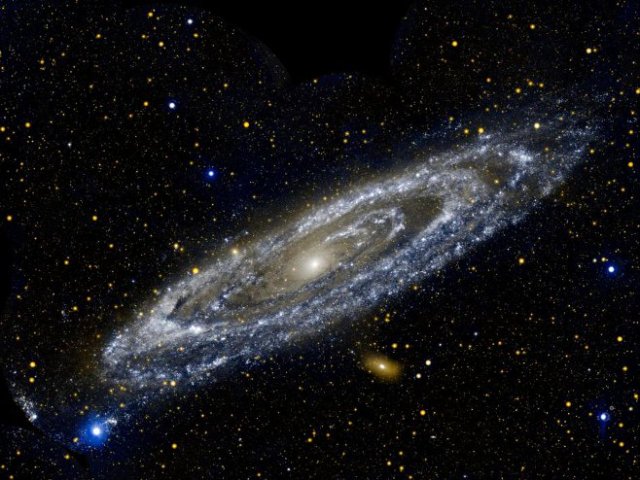

(From NASA/JPL-Caltech, used w/o permission.)
(M31, the Great Andromeda Galaxy, one of 54 galaxies in the Local Group, photographed in ultraviolet light by NASA’s Galaxy Evolution Explorer.)

We’ve been learning a great deal about the universe since Proposition 27/219 of the Condemnation of 1277 reminded academics that God decides what’s real, not Aristotle. (December 2, 2016)

As it turns out, Aristotle was wrong. There are other worlds. Thousands that we’ve found so far in our little corner of the Milky Way Galaxy.

We’ve got pretty good maps of several in the Solar System by now, and I’m getting ahead of myself.

In 1764, Charles Messier put the Andromeda Galaxy in his catalog as a nebula: object M31. By the 19th century, astronomers like William Huggins realized that some light from the Andromeda “nebula” resembled light from stars.

In 1925, Edwin Hubble used observations of Cepheid variable stars to demonstrate that the Andromeda Galaxy was another “island universe:” far outside our Milky Way Galaxy. I’m skipping a lot of folks, like Ernst Öpik.

The point of this trip down memory lane is that we were learning a lot, fast.

Going Ballistic over Darwin

Charles Darwin’s theory wasn’t the first discussion of how life has been changing.

Aelius Galenus was a doctor when Antoninus Pius was Emperor, and died around the time Justin Martialis assassinated Caracalla — there’s a story behind that, by the way.

Anyway, Galenus figured monkeys were like us, since they look a little like us. He was almost right. (July 15, 2016)

Darwin’s theory of natural selection got mixed up in 19th century English politics. (October 28, 2016)

That may help explain why so many folks go ballistic over Darwin, evolution, and science in general. H. P. Lovecraft didn’t help, and I’ll get back to that, too.

The Great Moon Hoax: 1835


(“Nouvelles découvertes dans la Lune….” A lithograph of The Sun’s ersatz “Great Astronomical Discoveries” coverage, translated into French.)
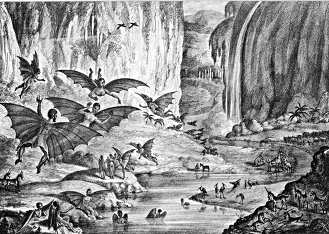
If you believe everything you see in the news, we’ve known that there is extraterrestrial life since 1835:

“GREAT ASTRONOMICAL DISCOVERIES LATELY MADE BY SIR JOHN HERSCHEL, L.L.D. F.R.S. &c.
At the Cape of Good Hope
[From Supplement to the Edinburgh Journal of Science]”
(Dr. Andrew Grant, The Sun, (August 25, 1835) via Wikipedia)

The smaller picture is a lithograph from The Sun’s six-day coverage of Sir John Herschel’s (alleged) observations.

Dr. Andrew Grant never existed, and we’re still not quite sure who wrote those articles for The Sun. Richard Adams Locke, a writer whose knowledge of history and science made his padded resume seem plausible, is the obvious suspect.

About the “great astronomical discoveries:” Sir John Herschel hadn’t really built a beyond-next-generation telescope at the Cape of Good Hope; and hadn’t seen bison, goats, unicorns, bipedal tailless beavers and bat-winged people on the moon.

Eventually somebody checked into the story’s source, learning that the Edinburgh Journal of Science had stopped publication in 1833: years before Herschel’s alleged discoveries.

The story was still worth reporting, though, and by 1852 was making the rounds in at least some European papers.1

Tesla, Wireless Telegraphy, Martians – – –

Nicola Tesla moved to Colorado Springs on May 17, 1899.

Folks could hear his artificial lightning and thunder 15 miles away. Tesla’s experiments raised sparks on nearby sidewalks, and caused a power outage in August.

He did not, however, use his magnifying transmitter as a reading light. That photo was a double exposure, made by Dickenson V. Alley as a promotional stunt. As Tesla later explained:

“Of course, the discharge was not playing when the experimenter was photographed, as might be imagined!”
(Nicola Tesla, Colorado Springs Notes, via Wikimedia Commons)

When he wasn’t electrifying his neighborhood, Tesla experimented with radio communications: a new field in those days. In December 8, 1899, he sent a letter to reporter Julian Hawthorne, saying that he’d picked up odd signals that could be from another planet.

Pretty soon, news that Tesla was communicating with Martians was spreading through at least the English-speaking world. It made a good story.

I think folks who figure that he’d picked up test transmissions from another human’s wireless experiments are right. Marconi was working on long-range transmitters around that time, and so were quite a few other folks.

Why were so many folks so ready to believe that non-human people lived on Mars, the moon, and elsewhere?

Let’s look at what had been happening in the 19th century.

– – – And the Wonders of Science

Steam locomotives were pulling freight and passengers faster and farther than horses ever could. Also adding phrases like “train wreck” to my native language.

Georg Ohm was bringing the world closer to electric lights, spin dryers and rolling blackouts.

The McCormick Reaper and other newfangled tech was making agriculture more efficient.

The Contagiousness of puerperal fever,” by Oliver Wendel Holmes Sr., and Ignaz Semmelweis’ observations eventually resulted in doctors killing fewer pregnant women, and I’ve talked about that before. (October 30, 2016)

Antoine Lavoisier, Joseph Louis Proust, and John Dalton were laying the groundwork for atomic theory.

Folks who didn’t know much about science or mathematics may have been ready to believe just about anything written about scientists. Don’t laugh: 43 out of 50 folks signed a petition to ban dihydrogen monoxide not all that long ago.

Meanwhile, János Bolyai, Nikolai Ivanovich Lobachevsky, and Bernhard Riemann unleashed non-Euclidean geometry upon an unsuspecting world.

2. Lovecraft and “a Placid Island of Ignorance”

Non-Euclidean geometry apparently gave H. P. Lovecraft fits. Or maybe he figured his readers would think it sounded cool.

Either way, I get the impression that he didn’t like science.

“…The most merciful thing in the world, I think, is the inability of the human mind to correlate all its contents. We live on a placid island of ignorance in the midst of black seas of infinity, and it was not meant that we should voyage far. The sciences, each straining in its own direction, have hitherto harmed us little; but some day the piecing together of dissociated knowledge will open up such terrifying vistas of reality, and of our frightful position therein, that we shall either go mad from the revelation or flee from the light into the peace and safety of a new dark age….”
(“The Call of Cthulhu,” H. P. Lovecraft (1929); via WikiQuote)

I don’t see knowledge and science that way, but I’m a Catholic who understands our faith.

Some of our Saints, like St. Albertus Magnus and St. Hildegard of Bingen. were scientists back when science was still called natural philosophy. (October 30, 2016; July 29, 2016)

I’ve talked about science, truth, and Pope Leo XIII, before. (July 15, 2016)

Basically, studying natural processes is a good idea. It’s one way we can learn more about God. (Catechism of the Catholic Church, 3135)

We think God is large and in charge, and rational. As St. Iranaeus pointed out, we’re rational and therefore like God; with free will. (Catechism, 268, 21122114, 1730, 1934, 1951)

We don’t worship nature — that’d be idolatry — so we can study it without fear of offending ‘the spirits.’ (Catechism, 282283, 21122114)

Greco-Roman culture and beliefs didn’t allow autopsies. That’s why Galenus studied monkeys.

The Church says treating bodies of the dead with respect and charity is important: and that autopsies are okay for legal inquests or scientific research. Organ donation is a good idea, too. (Catechism, 23002301)

Today’s medical science and technology arguably exists in large part because Christianity’s attitude toward the study of nature allows autopsies and other scientific research. Where folks accept the Catholic attitude toward using our brains, anyway.

Leaving the Island: and Loving It

It’s been nine decades since Lovecraft wrote “The Call of Cthulhu.” Some folks still fear leaving our “placid island of ignorance.”

Others are doing what folks have done for at least 1,900,000 years: wondering what’s over the horizon, and finding “wonderful things.” (December 9, 2016)

We’ve found scary things in “deep woods that no axe has ever cut,” as Lovecraft put it in “The Colour Out of Space.”

But we survived, developed better axes, have been learning to be careful with our tools, and that’s another topic. (August 12, 2016)

I don’t agree with Lovecraft’s2 view of reality, as reflected in his Cthulhu stories: but I sympathize with him, a bit.

Living from 1890 to 1937, Lovecraft experienced one of Western civilization’s less tranquil eras: including Modern art, the Titanic’s truncated voyage, and a global war.

Add a string of personal crises, and I can see how he might have imagined that the universe was at best indifferent: if not malevolent.

What we were learning about the scale of the universe probably didn’t help.

That brings me to Alfred, Lord Tennyson, 1809-1892, whose personal life and writing isn’t much like Lovecraft’s at all.

I like some of what he wrote, too. I also think he had a more sensible response to his century’s discoveries.3

“Many a hearth upon our dark globe sighs after many a vanish’d face,
“Many a planet by many a sun may roll with a dust of a vanish’d race.

“Raving politics, never at rest—as this poor earth’s pale history runs,—
“What is it all but a trouble of ants in the gleam of a million million of suns?…”
(“Vastness,” Tennyson, via Bartleby.com)

If I thought my faith depended on Mesopotamian assumptions being spot-on accurate about how the universe works, I’d be in a pickle. I don’t, so I’m not. (December 2, 2016; August 28, 2016; July 29, 2016)

I think truth is very important, and that God creates everything: the physical realities that science studies, and the spiritual realities that faith pursues. (Catechism, Prologue, 27, 74, 214217, more under Truth in the Catechism’s index)

Since I think my faith is built on truth, fearing truth would be — illogical. It’s like Pope Leo XIII wrote: “truth cannot contradict truth.” (“Providentissimus Deus,” Pope Leo XIII (November 18, 1893))

I also think insisting that there must — or must not — be other people in this universe is unreasonable. This is God’s creation, so whether or not we have neighbors is up to the Almighty. (July 29, 2016)

3. Mars: Canals, Pulp Fiction, and Robot Spaceships


(From NASA/JPL-Caltech/MSSS; via Jet Propulsion Laboratory, California Institute of Technology; used w/o permission.)

“This view of the downwind face of ‘Namib Dune’ on Mars covers 360 degrees, including a portion of Mount Sharp on the horizon. The site is part of the dark-sand ‘Bagnold Dunes’ field along the northwestern flank of Mount Sharp. Images taken from orbit indicate that dunes in the Bagnold field move as much as about 3 feet (1 meter) per Earth year.

“The component images of this scene were taken on Dec. 18, 2015, by the Mast Camera (Mastcam) on NASA’s Curiosity Mars rover during the 1,197th Martian day, or sol, of the rover’s work on Mars….”
(Jet Propulsion Laboratory, California Institute of Technology/NASA (January 4, 2016)

Curiosity is the Mars Science Laboratory’s lander, a car-sized robot that’s 1,546 sols/1,588 Earth days into its mission as I’m writing this.

We’ve come a long way since Schiaparelli published his maps.

Paul’s Martians, Secchi’s Canali


(From Giovanni Schiaparelli, via Meyers Konversationslexikon/Wikimedia Commons, used w/o permission.)
(Giovanni Schiaparelli’s 1877 map of Mars.)

Frank R. Paul’s Martian, from a 1939 science fiction magazine, was arguably more imagination than science.

Mars was looking less and less like Earth.

Astronomers noticed Martian polar ice caps in the 1600s. Giovanni Domenico Cassini’s 1666 observation may have been the first. Other astronomers observed Martian seasonal changes in the 1700s.

Better tech made mapping Mars practical in the 1800s. Fr. Pietro Angelo Secchi, working at the Vatican Observatory, drew some of the first color maps of Mars.

Fr. Secchi described “channels” (canali in Italian) on the Martian surface in 1858. His canali were large features: like “Canale Atlantico,” his name for what we call Syrtis Major Planum.

Giovanni Schiaparelli mapped an extensive canali network 1877. He’d developed an impressively-detailed map by 1886. We still use many of his names for Martian features: like Hellas, Tharsis, and Chryse.

Schiaparelli identified Hellas, one of the Solar System’s largest impact basins, as a small continent or large island. Assuming that bright Martian features were land and dark areas water seemed reasonable at the time.

William Wallace Campbell’s 1894 spectral analysis showed no water in the Martian atmosphere. Folks named Martian feature 991, a crater 125.26 kilometers across, after him. Crater Campbell is centered at latitude -54.25°, longitude 165.58°.4

Crash-Landing on Barsoom


(From Giovanni Schiaparelli, From NASA’s “On Mars: Exploration of the Red Planet. 1958-1978, via Wikimedia Commons, used w/o permission.)
(Giovanni Schiaparelli’s map of Mars, compiled 1877-1886.)

Percival Lowell was convinced that Schiaparelli’s canali were canals, artificial channels made by an advanced and dying Martian civilization.

Edgar Rice Burroughs published his first Barsoom story in 1912, and Mariner 4 sent back images of Martian craters in 1965.

We’ve been sending robot spaceships to Mars on a fairly regular basis since then.

Some are still in operation, including the ESA’s ExoMars Trace Gas Orbiter. That mission’s lander, Schiaparelli EDM lander, sent back quite a bit of data before crash-landing on the Meridiani Planum.

The lander probably hit at 300 kph, 186 miles per hour. I don’t think the lander mission was exactly a failure, though. The folks at ESA were testing the landing systems, collected a great deal of data; and that’s yet another topic.5

4. Aliens, an Opinion Poll; Serious SETI and CETI


(From Survata, used w/o permission.)

A Survata poll of Americans, done in 2013 or thereabouts, asked folks for their religious affiliation and then asked “Do you believe in the existence of extraterrestrial life?”6

Roughly a third of American Christians, Jews, Muslims, Hindus, and atheists/agnostics weren’t sure about whether we have neighbors.

Interestingly, over half of “other” “believe in the existence of extraterrestrial life.” That may help explain why some American Christians adamantly insist that life mustn’t exist anywhere except Earth.

Me? I’m not sure. We either have neighbors, or we don’t. Right now, we don’t know, and I’m okay with that.

I hope we do have neighbors. For one thing, it would make this universe seem a bit less empty.

For another, comparing notes with folks who aren’t human would be an opportunity to learn how much of ‘human nature’ comes from being critters with free will and bodies; and how much is strictly “human.”

My guess is that we’d learn that a great many of our neighbors are fine folks: but not “human.” At all. Which is why I think nearly every SETI and CETI effort makes unwarranted assumptions.

Herschel’s Solarians, Thousands of Cataloged Exoplanets

Earth’s moon and planets in the Solar system were as unreachable in the 19th century as planets circling other stars are today.

Scientists were learning more about these other worlds, and thought they might be inhabited. It wasn’t a new idea.

William Herschel presented “On the Nature of the Sun and Fixed Stars” to the Royal Society in 1795. He defended his view that our sun is a relatively dark object with a hot, luminous, atmosphere: and said it was probably inhabited, like other planets.7

That wasn’t a crackpot idea at the time.

We didn’t know about nuclear fission or fusion, in the late 18th century; and astrophysics was still learning that Aristotelian assumptions weren’t accurate.

We’ve learned quite a bit since then. William Thomson, 1st Baron Kelvin, showed that our sun would have long since cooled off — if Earth was as old as geologists said and mid-19th-century scientists had uncovered everything there is to know about the universe.

They hadn’t.

Henri Becquerel observed radioactive decay in 1896. Ernest Rutherford, Paul Villard, the Curies, and others, discovered quite a few more radioactive substances. The last I heard, folks were still working the bugs out of practical fusion reactors.

Along the way, we’ve discovered and cataloged more than three thousand planets orbiting other stars: some of which are not all that unlike the one we live on.

We may learn that there’s something very different about the universe beyond our Solar System. But at this point, the question doesn’t seem to be whether there could be extraterrestrial life. It’s why we haven’t seen or heard from extraterrestrial intelligence.8

Assumptions and the Fermi Paradox

The Fermi paradox is the ‘where is everybody’ question. (September 18, 2016)

We’re learning that many of this galaxy’s 100,000,000,000-plus stars have planets somewhat like Earth. We’re finding planets around a remarkable number of them. Some fraction of those planets may support life, which might lead to intelligent life.

Some of those planets are billions of years older than Earth. Folks who are anything like us could have sent interstellar probes here from the other side of the galaxy in about a million years. That’s a very short time, on a cosmic scale.

Maybe the pessimists are right, and we’ll all die horribly right after you read this sentence: just like everybody else has, all over the universe.

I don’t think so, but living with undiagnosed major depression for most of my life has taught me to be dubious about anything that seems like fashionable melancholy or unconsidered pessimism, and that’s yet again another topic. (August 12, 2016)

Maybe Lovecraft was right, and it’s a good thing that we don’t know about Cthulhu. Oddly enough, I think that’s close to one of the more reasonable explanations for why we’re not up to our hips in the Galactic Federation equivalent of empty oil drums.

Communication with Extraterrestrial Intelligence: the Early Years

Humans are chatty creatures, so we were thinking up ways to communicate with Martians as soon as our technology and economic structures made it practical.

We like acronyms, so these days we call that sort of thing CETI, or communication with extraterrestrial intelligence.

Carl Friedrich Gauss, or maybe someone else, suggested planting enormous square fields of rye or wheat, outlined in pine forests, forming a giant triangle in Siberia: visual proof that we knew about the Pythagorean theorem.

Joseph Johann von Littrow had pretty much the same idea, except he figured the Sahara would be a better ‘blackboard.’ von Littrow’s proposal was to dig giant trenches, drawing 20-mile-wide shapes.

Filled with water, topped off with kerosene, and ignited, these trenches could send a different signal each night. (Wikipedia)

Bear in mind that radio and environmental impact statements hadn’t been invented yet.

We’ve learned a great deal since the Gauss/von Littrow proposal. Communications satellites routinely route radio messages around the world, and our robot spaceships send reports back by radio.

We’ve learned how to send radio signals to the stars, and have been listening for such signals. Maybe that will be how we make first contact, or maybe not.

Quite a bit of SETI, the search for extraterrestrial intelligence, assumes that our neighbors, if they exist, use modulated radio signals for long-distance communications. That is an assumption. A big one.

A Million Years isn’t Much


(From Efbrazil, via Wikimedia Commons, used w/o permission.)

We’ve learned quite a bit since this was written:

3 Terrible and awesome are you, stronger than the ancient mountains.”
(Psalms 76:5)

We’ve learned that today’s “ancient mountains” aren’t nearly as old as our planet. But as I keep saying, scientific discoveries are opportunities for admiration of God’s work. (Catechism, 283, 341)

Earth has been around for about 4,540,000,000 years, give or take, and the universe is about three times older. On that scale, a million years isn’t much: 1/13,798th the age of the universe, or 1/4,540th Earth’s age.

I’m in my mid-60s, so 1/4,540th of my life is roughly one and three quarters to five days. Someone who had been born within a week of me would be almost exactly my age.

Let’s compare how many years before today a few key things happened:

On this scale, 154 years is a ‘blink and you’ll miss it’ sort of interval.

A million years is a bit longer, bit still only 1/4,540th Earth’s age, and 1/13,798th as long as the universe has been around.

We’ve developed some remarkable tech since Acheulean tools were the latest thing. But I very strongly suspect that talking drums, slit gongs, and the Inmarsat network are not the ultimate communication technologies.

Even if our neighbors are only a million years ‘older’ or ‘younger’ than we are, their cutting-edge tech might be almond-shaped stone hand axes — or whatever we’ll be developing a million years from now.

That’s assuming that they think the same way we do, and are as chatty, and that’s still another topic, for another post.

The quote is from Tennyson’s “Ulysses,” among my favorite poems; and the source for my Google Plus tagline:

“…To follow knowledge, like a sinking star,
“Beyond the utmost bound of human thought….”
(“Ulysses,” Tennyson (1833))

Still learning that there’s more to learn:


1 More about the Great Moon Hoax:

2 H. P. Lovecraft and all that:

3 Tennyson’s “Vastness” was originally published in Macmillan’s Magazine, November, 1885 (Vol.LII., pp. 1-4); reprinted in “Demeter, and Other Poems,” 1889. (“The Bibliography of Tennyson,” p. 61; Richard Herne Shepherd; Ardent Media (1896))

4 Mars in retrospect:

5 Mars, imagined; and current exploration:

6 Opinion polls are interesting, and can be useful; but I’m quite sure they measure opinion, not fact:

7 William Herschel and the Solarians is not a rock band:

8 Astrophysics, astrochemistry, and SETI:

Posted in Science News | Tagged , , , , , , , , , , | 3 Comments

God, Angels, and Belshazzar

I don’t know why encounters with angels,1 and God, aren’t all alike.

Sometimes, like Abraham’s meeting with the Almighty and two angels, described in Genesis 18:2, or Habakkuk’s getting airlifted in Daniel 14:3337, it’s apparently much like meeting another human.

Other times, like Daniel’s interview with Gabriel, it takes days to recover. I suspect that it depends on the personalities involved, and on just how much unshielded power we’re exposed to.

“The writing on the wall” is still an idiom in my language, meaning “the likelihood that something bad will happen.” (TheFreeDictionary by Farlex)

It comes from a reality check Belshazzar experienced.

The chap in the center is Belshazzar, as imagined by Rembrandt. The picture isn’t Babylonian, Neo- or otherwise.

Rembrandt painted it in the 1630s, roughly two millennia after Belshazzar’s time. The ladies seem to dressed along the lines of Henrietta Maria and Susanna Huygens. Folks didn’t always expect strict historical accuracy in paintings, and that’s another topic.2

Belshazzar, after getting at least slightly sloshed, ordered gold and sliver vessels stored with the rest of Nebuchadnezzar II’s loot brought out. (Daniel 5:130)

That, I think, wasn’t a big deal. Local and regional leaders had been raiding each other for at least a dozen centuries by then, and this was a big party.

I don’t think alcohol was an issue, either. Being drunk, maybe: indirectly. But let’s get a grip. Our Lord’s first miracle was when Mary told him “they have no wine.” (John 2:310)

No, I think the problem was that “they praised their gods of gold and silver, bronze and iron, wood and stone” while drinking from vessels that had been taken from God’s temple in Jerusalem. (Daniel 5:26)

That, in 20-20 hindsight, was a very bad idea.

Belshazzar should have known better, as Daniel said in Daniel 5:1823.

About that, each of us is a rational creature with free will. We can decide what we do or do not do, and are responsible for the consequences of our decisions. (Catechism of the Catholic Church, 17301742)

The Catholic view of responsibility isn’t as stupidly inflexible as it may sound.

If I didn’t know that an action is wrong, like walking off a cliff — I know, unrealistically extreme example, but I’m writing this in a hurry — there would still be consequences: more or less serious, depending on how high the cliff is and what’s at the bottom.

But that daft version of me probably wouldn’t be held accountable by the Almighty. (Catechism, 1735)

If I deliberately maintain ignorance, that’s a problem by itself. (Catechism, 17901794)

Lying to God about not knowing any better — would be incredibly stupid, and an exquisitely bad idea. (Catechism, 1859)

George Washington’s Cherry Tree

I think George Washington — bear with me, this makes sense, at least to me — really lived, despite the cherry tree tale.

I’m a trifle less certain about Daniel.

More accurately, I’m not convinced that every anecdote in Daniel is literally true down to the last detail.

I take the book of Daniel quite seriously, along with the rest of the Bible.3 As a Catholic, that’s a requirement. So is “frequent reading of the divine Scriptures.” (Catechism, 101133)

But I emphatically don’t have to believe that someone with an American viewpoint wrote the Bible.

We don’t know the name of Daniel’s author.

It’s not, strictly speaking, prophetic writing. It’s an early example of “apocalyptic” literature, and that’s another yet another topic.

I do not sift through Daniel, looking for verses that’ll support a nifty new End Times Bible Prophecy. That kind of trouble I don’t need.

“…The moral [of Daniel] is that men of faith can resist temptation and conquer adversity. The characters are not purely legendary but rest on older historical tradition. What is more important than the question of historicity, and closer to the intention of the author, is the fact that a persecuted Jew of the second century B.C. would quickly see the application of these stories to his own plight….”
(Daniel, Introduction, New American Bible)

Shadrach, Meshach, Abednego, and Getting a Grip

Daniel and others getting their names changed probably made keeping track of them in Chaldean records harder.

On top of that, Cyrus the Great rolled over that part of the world around 539 BC.

I suspect that cataloging and archiving all Chaldean records wasn’t high on the new regime’s to-do list. I’ve mentioned Cyrus before. (October 2, 2016)

While Chaldeans were still running Babylon, Daniel was among top-drawer young Israelites picked to be in the king’s court.

2 The chief chamberlain changed their names: Daniel to Belteshazzar, Hananiah to Shadrach, Mishael to Meshach, and Azariah to Abednego.”
(Daniel 1:7)

Like the footnote says, they’re “given Babylonian names as a sign of their adoption by the king.” I suspect the Babylonian names were also easier for the locals to pronounce.

Shadrach, Meshach, and Abednego, are chiefly famous for not dying when thrown into a furnace. (Daniel 3:1324)

The lesson here isn’t that worshiping God makes a person fireproof, or that bad things don’t happen to good people.

2 Maccabees 7:141 describes eight folks being tortured to death because they wouldn’t “eat pork in violation of God’s law.” Pork isn’t the issue here. It’s keeping God’s law, or not.

I think they made the right choice. Taking the long view isn’t always easy, but I think it makes sense.

“Slay me though he might, I will wait for him; I will defend my conduct before him.
“And this shall be my salvation, that no impious man can come into his presence.”
(Job 13:1516)

A Temple, Some Lions, and the Living God

That picture is Gustav Doré’s 1866 Bible illustration, “Daniel’s Vision of the Four Beasts.”

It’s over-the-top imagery appeals to me, and I’ll get back to that.

I like mystery stories, so Daniel 14:122 also appeals to me. You know how it goes: Daniel sprinkles ash on the floor in Bel’s temple, and has the door sealed.

Next morning, he and the king examine the seal and take a look around.

“But Daniel laughed and kept the king from entering. ‘Look at the floor,’ he said; ‘whose footprints are these?’
” ‘I see the footprints of men, women, and children!’ said the king.”
(Daniel 14:1920)

What happens next isn’t so appealing, but I was born in the 20th century and am living in the 21st. We’ve made some headway since Daniel’s time.

By the 46th century, I hope that at least some of what we consider normal legal sanctions will seem unnecessarily harsh. (October 30, 2016; November 21, 2016)

The point of the ‘Bel’s temple’ narrative, and Daniel’s seven days in a lion’s den — that’s in Daniel 14:2442 — is that God’s God, everything and everyone else isn’t. (Daniel 14:5)

Daniel’s experience with lions reminds me of St. Francis of Assisi and the Wolf of Gubbio, and that’s yet again another topic.

Gabriel

Daniel’s ‘four kingdoms’ vision, in Daniel 7:128, is chock-full of descriptions and discussion of “four immense beasts, each different from the others.” (Daniel 7:3)

I think it’s true, in the sense that we can learn something by reading and studying it.

Some of what’s there is a prediction of what would happen: and has happened, by now. Let’s remember that roughly two dozen centuries have gone by since Daniel’s day.

Some of Daniel’s visions tie in with what’s in Revelation: which is why the lion with eagle’s wings, the bear, the critter with iron teeth, and all the rest, sounded so familiar.

Radio preachers and folks selling the latest thing in End Times Bible Prophecies were full of that stuff in my youth.

They weren’t the first with false alarms and fizzled prophecies, or the last. And that’s still another topic. (December 11, 2016; August 7, 2016 )

Daniel had another vision, couldn’t make head or tail of it, which gets me to Gabriel. I’ll skip over the flying goat, assorted horns, and why I don’t try to second-guess God the Father. I take all that seriously: it’s wannabe prophets that I’m not keen on.

“While I, Daniel, sought the meaning of the vision I had seen, a manlike figure stood before me,
6 and on the Ulai I heard a human voice that cried out, ‘Gabriel, explain the vision to this man.’
7 When he came near where I was standing, I fell prostrate in terror. But he said to me, ‘Understand, son of man, that the vision refers to the end time.’ ”
(Daniel 8:1517)

Daniel was weak and ill for some days after that interview. (Daniel 8:27)

Like I said, I suspect that outcomes of angel-human meetings depend on who meets the angel, who the angel is, and how headquarters defines the mission.

Belshazzar and Ben Franklin

Apparently at least some scholars think Belshazzar really existed, and so did the Neo-Babylonian or Chaldean Empire: but that Daniel didn’t.

They’ve got a point, sort of. Daniel lived during the 6th century BC, after 538, more or less.

Someone, obviously not Daniel, wrote the book of Daniel while Antiochus IV Epiphanes was throwing his weight around, in 167 BC. give or take a few years.

Two millennia later, some folks still write stories whose narrators are either long-dead or entirely fictional. Oddly enough, I haven’t heard that Ben Franklin wasn’t real because Robert Lawson wrote “Ben and Me” in the 20th century.4

Nebuchadnezzar couldn’t possibly be Belshazzar’s father. (Daniel 5:2)

As a footnote says, the author may have meant “father” in the sense of “ancestor;” or the author wrote substituted “Nabonidus” with “Nebuchadnezzar.”

When the book of Daniel was written, Nebuchadnezzar II may have had better name-recognition value than Nabonidus.

Nebuchadnezzar II is the Chaldean king who hauled treasure and people from Jerusalem to Babylon. I’ve mentioned him and his urban renewal project before. (October 2, 2016)

My guess is that none of them were Americans, and didn’t have our obsession with “just the facts, ma’am” writing.

More, mostly my take on faith and using my brain:


1 Quick review — Angels are “spiritual, non-corporeal beings” with “intelligence and will,” persons who are as real as we are; but with no bodies. (Catechism of the Catholic Church, 328336)

2 More than you may need or want to know about art and realism:

3 Background:

“…Know what the Bible is – and what it isn’t. The Bible is the story of God’s relationship with the people he has called to himself. It is not intended to be read as history text, a science book, or a political manifesto. In the Bible, God teaches us the truths that we need for the sake of our salvation….”
(“Understanding the Bible,” Mary Elizabeth Sperry, USCCB)

From “10 points for fruitful Scripture reading:”

  1. Bible reading is for Catholics
  2. Prayer is the beginning and the end
  3. Get the whole story!
  4. The Bible isn’t a book. It’s a library
  5. Know what the Bible is – and what it isn’t
  6. The sum is greater than the parts
  7. The Old relates to the New
  8. You do not read alone
  9. What is God saying to me?
  10. Reading isn’t enough
    (From “Understanding the Bible,” Mary Elizabeth Sperry, USCCB)

4 These days, the Walt Disney Productions two-reel “Ben and Me” may be better-known.

Posted in Being Catholic | Tagged , , , , , , | Leave a comment