


Two and a half centuries back, quite a few English subjects who were living in colonies strung along North America’s east cast had become fed up.
Thoroughly.
Like pretty much anything else involving humans, it’s complicated.
It wasn’t just paying tax on tea, or government-mandated stamps on all paper goods and legal documents. Even having to buy tea exclusively from the British East India Company might have been tolerable.
1776

What really set them off was having zero representation in the British Parliament.
That, and divisive ideas about self-governance, individual liberty, and natural rights.
That’s why, two and a half centuries ago today, some of the worst troublemakers signed a document we call the Declaration of Independence.2
Looking back with twenty-twenty hindsight, I think it was a good idea.
It helps that I’m an American and grew up in the Sixties, when many folks were realizing that something being legal doesn’t mean it’s right. Also, I’m part-Irish and know about history. Being cautious at best about distant rulers is part of my heritage.
Besides, I know that, for all its faults, America is a good place to live. We’re not all in the top five percent in terms of wealth, but we enjoy a remarkable degree of freedom in what we may do or say.
Now, back to 1776 and all that.
Were all the English subjects in those 13 colonies so fed up that they thought telling their legal rulers to take a hike was a good idea? No.3
Has “the last great experiment, for promoting human happiness” been a complete and unqualified success? In my opinion, no. George Washington described America that way in a letter. I’ll share a longer excerpt a bit later.
19th Century


During the 19th century some Americans got — overenthusiastic — about this country and its founders.4
But we weren’t any more homogeneous then than we are now. Some Americans seemed convinced that others were trying to destroy their country.
What various Americans thought “our country” was and should be: that’s another topic for another day. Topics.
Those differences of opinion — again, none of this is simple — boiled over in our only major armed internal conflict. Depending on who’s talking, it’s The Civil War, War Between the States, War of the Rebellion, War for Southern Independence, or simply The Recent/Late Unpleasantness.5
We were still sorting out some of the mess that made when I was growing up. By then, Americans had accumulated even more experiences.
20th Century

Some folks having more than they need while others don’t have enough isn’t unique to America, the 20th century, or any other time or place.
It’s not a problem, or shouldn’t be. Everyone, each person, has the dignity that comes with being human. But we’re not all alike, and aren’t supposed to be. Each of us has needs that others can fill, while being able to fill the needs of others. This is a good thing. (Catechism of the Catholic Church, 1934-1938)
War

America played a major part in the 20th century’s two global wars. These days, we call them World War I and World War II. My father suggested that they could and should be seen as a single conflict: “The Colonial War”. I think he’s right.6
Times: Good and Changing

America had good times, at least economically, after World War II. I remember the trailing edge of that, and the common sentiment that this was a good place to live.
I also remember the problems we had.
Then came the Sixties. Those were interesting times.
Our oldest daughter said that a childhood and youth spent within a couple blocks of a college campus affected my viewpoints. She’s right. So did having parents who were librarians.
At any rate, in my youth I thought many if not most of the social reforms being made were good ideas. I’m not entirely pleased about how some turned out, but I still think trying to make our society more tolerant was a good idea.
The frothing ‘patriots’ of my youth were, I think, sincere in their belief that their country was in peril from communism, Catholicism, and other foreign ideas. At least I hope they were, for their sake.
Today’s right sort have different slogans and quirks. But I see the same zeal, determination, and apparent inability to consider the possibility that they might not be entirely in the right.
This isn’t the America I grew up in. But we endured the Fifties and Sixties, and I think we’ll endure the present nonsense. We may even learn a thing or two.
21st Century

(WCCO (June 2016))
In a way, the 21st century is more of the same for America.
We’ve been involved in more wars: which, this time around, our government called “wars”; a refreshing change of pace from the embarrassing euphemisms of my youth.
We’re still on a long learning curve, dealing with a society where everyone’s not on the same page. It hasn’t been and is not easy.
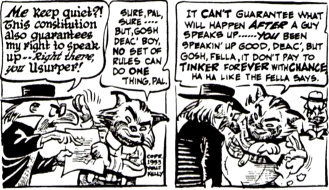
Some Americans have been striving mightily to preserve their freedom of speech, while being upset when others express opinions they don’t like.
The current situation isn’t exactly like the mess we call McCarthyism,7 but I see strong parallels. In both cases, we have self-described defenders of democracy and freedom using their positions of influence and authority to muzzle folks with the ‘wrong’ opinions. And, in the long run, failing. That’s how I see it, at any rate.
I’ve gathered that freedom of religion is a divisive topic. That, again, is not new. What’s changed are the quirks of folks who aren’t comfortable with the idea, and their slogans.
America, Two and a Half Centuries and Still Learning

I admit it. I like being an American. I haven’t always been happy about what’s happening in my country, or decisions our ‘better sort’ make.
But I like it here, and think that America is much more than the folks who sit in executive offices, convince enough voters to put them in office, and look good on screen.
This country has a great deal going for it: natural resources; folks with get-up-and-go who got up and went here, and their descendants; navigable rivers and good harbors.
But I think that the remarkably smart and savvy bunch we call the Founding Fathers made a huge difference. That was what this culture calls a “lucky break”.
I’ll wrap this up with a few things George Washington, John Adams, and Abraham Lincoln said; with a (brief) comment or two.
George Washington and “the Great Experiment”
“…Although, neither the present age or Posterity may possibly give me full credit for the feelings which I have experienced on this subject; yet I have a consciousness, that nothing short of an absolute conviction of duty could ever have brought me upon the scenes of public life again. The establishment of our new Government seemed to be the last great experiment, for promoting human happiness, by reasonable compact, in civil Society. It was to be, in the first instance, in a considerable degree, a government of accomodation as well as a government of Laws….”
(Letter, George Washington (New York) to Catharine Sawbridge Macaulay Graham (England).(January 9, 1790)8 [emphasis mine]
The United States is still a great experiment: a largely successful one, I think.
Some of the basic — and in the late 17th century disturbing — ideas shaping our government are that:
- A government’s power comes from the consent of the governed
- Checks and balances prevent autocratic rule
- The rule of law applies: notthe whims of some individual or well-connected group
Those ideas are still disturbing, particularly to folks who aren’t getting what they want.
Now, I said “largely successful”. I’ve been paying attention for about a half-dozen decades, and know my homeland’s history. America isn’t perfect. For that matter, neither were the Founding Fathers.
John Adams and “the Roman Catholic religion”
“Can a free government possibly exist with the Roman Catholic religion? The art of lawgiving is not so easy as that of architecture or painting. New York and Rhode Island are struggling for conventions to reform their constitutions, and I am told there is danger of making them worse. Massachusetts has had her convention; but our sovereign lords, the people, think themselves wiser than their representatives, and in several articles I agree with their lordships. Yet there never was a cooler, a more patient, candid, or a wiser deliberative body than that convention….”
(John Adams to Thomas Jefferson (May 19, 1821) via National Humanities Center) [emphasis mine] [the NHC has apparently taken down or blocked that particular document (July 1, 2026)] [see John Adams, Wikiquote]
More than two centuries later, “the Roman Catholic religion” is — well, we’re not running rampant over this fair land. But we’re definitely here. So is “a free government”.
I don’t think the concern John Adams expressed is reasonable. But I’m a Catholic and I wasn’t brought up as an Englishman.
I wasn’t brought up as a Catholic, either. Ironically, ranting one-hundred-percent-American-Good-Christian radio preachers helped set me on a path that led me to becoming a Catholic. And that’s another topic. Several, actually.
Abraham Lincoln and Human Nature
“…Human nature will not change. In any future great national trial, compared with the men of this, we will have as weak and as strong, as silly and as wise, as bad and as good. Let us, therefore, study the incidents of this as philosophy to learn wisdom from, and none of them as wrongs to be revenged….”
(“On Democratic Government” ; Response to a Serenade, November 10, 1864; Abraham Lincoln (November 10, 1864) via Project Gutenberg) [emphasis mine]
I think Lincoln’s right. We’ve got something like five millennia of written records. I see no indication that human nature has changed.
Our languages, customs, and every other aspect of our societies keep changing.
But the basics, the qualities that make us human? We’ve got the same sort of fools, knaves, heroes and just-plain-folks that we’ve always had. And we still, most of us, have the same feeling that we could and should do a whole lot better.
What we do with that feeling? I’ve talked about that before, a lot:
- “Building a Civilization of Life and Love, One Mind at a Time” (November 15, 2025)
- “King Josiah, Consequences, and Love” (September 13, 2025)
- “Free to Agree With Me: Cancel Culture and Freedom of Expression” (November 18, 2023)
1 Two artists and a good picture:
- Wikipedia
- “Congress Voting Independence”
Edward Savage, after Robert Edge Pine; National Gallery of Art (ca. 1803, printed 1859-1906)
- Wikipedia
- The Declaration of Independence, July 4, 1776
George Washington’s Mount Vernon
4 two of the more high-profile Washington euligizers:
- Wikipedia
- Mason Locke Weems (AKA Parson Weems)
- “Apotheosis of Washington”
Artist: Constantino Brumidi. (1865) Explore the Capitol Campus, Architect of the Capitol (aoc.gov)
5 The Civil War, a very quick look:
- Wikipedia
7 It wasn’t just Senator McCarthy:
- Wikipedia
8 Letter of a Founding Father to an English historian:
- George Washington to Catharine Sawbridge Macaulay Graham, 9 January 1790
Founders Online. National Archive
Discover more from A Catholic Citizen in America
Subscribe to get the latest posts sent to your email.





A nation freed from slavery and such destroying itself via things similar to what its citizens were fighting against? God has had to fight that even in the Old Testament, and His persistently and consistently loving challenges against and guidance for us fools help me love both the local and the foreign as He would.
Also, seeing that picture of Nagasaki and seeing my mom near me while I saw that got me showing that to her. She didn’t have much reaction to it, though, but anyway, I’m very thankful for you helping me know and remember the struggles of the Church in Japan during World War II, Mister Gill. And Happy American Independence Day to you!
Yes — I’ve suggested to my oldest daughter, who shares my frustrations with the world’s shortcomings, that we can see the ongoing need for refocusing on what’s good and right as job security. 😉
Re. the Church in Japan during WWII — what can I say? You are welcome! … and thanks for the anniversary wish/salutation.