

Minnesota and Minneapolis have been national news for more than a month now.
This is my home state. I’m not happy about what’s in the news, and concerned about what’s dropped out of the news.
Ignoring the mess isn’t an option. So this week I’ll talk about what’s allegedly been happening, and why I take so much of what I read with a few bulk lots of salt.
- Activists and a Distinct Perspective
- Political? No! Perturbed? Yes
- Minnesota: Good Grief, Another Month
- It’s Just Fraud, Pay No Attention
- It’s (Not) Simple
Activists and a Distinct Perspective

A few headlines highlighted our cold weather, but most of the sound and fury has been over some folks allegedly enforcing laws, and other folks allegedly expressing their indignation over an unseemly and improper effort to catch up on law enforcement.
This has been going on since December.
The activists have also been expressing shock over allegedly unjustified assaults which resulted in the death, on the seventh of this month, of someone with unalloyed virtue. They’ve also been expressing horror, disapprobation, and outrage: again, allegedly.
Then, last Saturday, the 25th, another allegedly-innocent activist was killed.
I’m not, putting it mildly, happy about the situation.
I could emulate Mark Twain’s hypothetical reader:
“…the reader of the Deerslayer tale dislikes the good people in it, is indifferent to the others, and wishes they would all get drowned together.…”
(“Fenimore Cooper’s Literary Offences” , Mark Twain (1895) via Gutenberg.org) [emphasis mine]
But that’s not an option, for reasons I’ll get to later.
Apparently (Over-) Cautious: an Alleged Disclaimer

Why scatter “allegedly” through that summary, and elsewhere in this post?
I don’t know nearly enough about what has been happening to be certain about who has been doing what and why they’ve done it. And what I suspect might be the reality behind the news inspires more than the usual degree of caution.
Political? No! Perturbed? Yes

Since how I see the current mess overlaps politics, and some of what I say may sound “political”, I’ll present a disclaimer. Or maybe an admission.
I live in Minnesota, but not in Minneapolis. My state’s “Metro” — Minneapolis, St. Paul, and the suburbs — are a couple hours down the road from my home. I am profoundly glad I do not live there.
I’m a Catholic. I take my faith seriously.
That doesn’t make me liberal, conservative, or in line with any other political position.
It does make me obliged to have —
- Respect for the human person, the individual
- Interest in the well-being and development of societies
- A desire for least a measure of security and stability for societies and individuals
(Catechism of the Catholic Church, 1905-1912)
So, even if I felt like it, I can’t sit back and munch popcorn while the usual suspects put on their dog and pony shows.
I’m just some guy living in central Minnesota. So changing the world is not something I can do. Which is fine by me. That level of responsibility would be scary.
I am, however, personally responsible for what I can do: taking a part in public life, as far as my circumstances permit. (Catechism, 1913-1917)
That’s why I’m touching on what we’re being told, how I see it, why I think people matter, and whatever else comes to mind.
About that —
Since I’m not on the same page as The Establishment,1 the folks in my society whose opinions matter, I may sound like a conservative.
But I’ve been paying attention. So either standing firm on a conservative platform, or jumping on the liberal bandwagon, is not an option.2
Out of Step With The Establishment: Five Decades and Counting

My teen years and the Sixties overlap.
Many long-overdue reforms got traction then.
I’m not happy about how some worked out.
Others: well, making new rules and regulations is one thing; encouraging folks to take ideas like “love your neighbor” seriously is emphatically a work in progress.
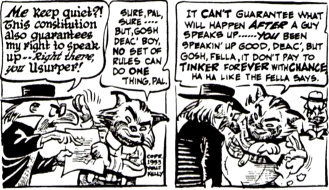
In my youth, I was not in step with The Establishment: which seemed increasingly frantic to make us more panicked by un-American influences, than by their efforts to protect us. I’ve got my faults, but striving to maintain that status quo wasn’t one of them.
Years, and decades, passed.
This country’s current self-described best and brightest have different quirks, preferences, and peeves. These days they’re ‘protecting’ us from other bogeymen, the ones they fear.

And I’m still not on the same page as the folks who promote freedom by telling us what to think, what to say, and how to say it.
On the other hand, I think many or most are sincere: that journalists, for example, objectively and without bias report exactly how they feel about events they see as newsworthy.
Minnesota: Good Grief, Another Month
Now, about the mess in my home state. The one that’s been running since December.
‘We Interrupt Your Worship to Bring You Our Message’

“Activists who protested at St. Paul church are released from custody at judge’s order”
Izzy Canizares, BringMeTheNews (January 24, 2026)“…A group of protesters led by Levy Armstrong interrupted a service at the church, which was chosen because one of its pastors also serves as a local Immigration and Customs Enforcement (ICE) director at a time Minnesota is the subject of an aggressive immigration crackdown by the Trump administration….”
About that incident: All I know about what happened is what little I’ve seen in the news.
I’m pretty sure that someone disrupted a worship service in the Metro. Possibly because a person who’s the wrong sort was a pastor there. It also looks like some judge decided that the disruptors shouldn’t be in jail.
I think there can be good reasons for having “due process”. I don’t know why a judge decided that folks who’d “interrupted” a worship service should be released. Maybe there were legitimate reasons for springing them.

But I don’t see someone ‘interrupting’ worship this way as acceptable, or prudent, behavior. Not even if the intent is to draw attention to a perceived injustice. Of course, I’m one of ‘those religious people’, so I wouldn’t.
These particular folks weren’t Catholic, but I am a Catholic, so taking all faiths seriously is a ‘must’ —
“843 The Catholic Church recognizes in other religions that search, among shadows and images, for the God who is unknown yet near since he gives life and breath and all things and wants all men to be saved. Thus, the Church considers all goodness and truth found in these religions as ‘a preparation for the Gospel and given by him who enlightens all men that they may at length have life.'”
(Catechism)

Maybe this month’s disrupted worship service isn’t getting much attention because nobody got killed.
Some disruptions are lethal.
Two people, kids, died in an attack on Church of the Annunciation in Minneapolis last August. Then the attacker killed himself.
It wasn’t all bad news. The death of two Catholic schoolkids was treated as a serious crime. All in all, the situation could have been a lot worse. (“Death and Evil: But Also Light and Hope” (September 6, 2025))
Alternatively-Legal Immigrants

The trouble in Minnesota, and now elsewhere, is allegedly due to Federal law enforcement catching up on long-standing violations of laws regarding immigration.
What gets lost in the shouting is that the problem isn’t folks coming to this country.
It’s that they’ve allegedly come to this country and stayed here by non-legal means.
And that a distressing number of these ‘rules are for other people’ immigrants have committed crimes besides non-legal entry while they were here.
In fairness, folks whose forebears have been in America legally for generations occasionally commit crimes, too. What fractions of which groups commit crimes: that’s something I lack both zeal and resources to dig out of public records.
Another detail that’s easy to miss is that, as far as I can tell, letting folks come to this country and settle down is still legal. Researching what those laws are, and who they affect, is another task I’m not starting this week.
Immigrants, Rules, and Unchanging Principles

Instead, I’ll take a quick look at how being a Catholic, and someone whose ancestors arrived after the Pilgrims landed, affects my view of immigration.
Being a Catholic — there’s a lot written about how I should see immigration. But basically, it’s what Catechism of the Catholic Church, 2241, says:
“2241 The more prosperous nations are obliged, to the extent they are able, to welcome the foreigner in search of the security and the means of livelihood which he cannot find in his country of origin. Public authorities should see to it that the natural right is respected that places a guest under the protection of those who receive him.
“Political authorities, for the sake of the common good for which they are responsible, may make the exercise of the right to immigrate subject to various juridical conditions, especially with regard to the immigrants’ duties toward their country of adoption. Immigrants are obliged to respect with gratitude the material and spiritual heritage of the country that receives them, to obey its laws and to assist in carrying civic burdens.“
(Catechism) [emphasis mine]
That seems straightforward enough. Political authorities and the common good — that’s a can of worms I’ll leave alone this week.
Obeying laws? The basics aren’t all that complicated.
Rules, ethics — natural law — are written into reality’s source code. They’re just there. They haven’t changed, and won’t. Some things are simply wrong. Always. Everywhere. (Catechism, 1950-1960)
Rules we make up, positive law, “varies greatly”; and that’s okay. Folks living in different times and places, cultures and climates, may have different rules (Catechism, 1957)
Positive law — like Minnesota Statutes 176, 256, 609, … for example — should line up with natural law: ‘don’t steal’, in those cases. Sometimes it doesn’t. When that happens, we’ve got problems. (Catechism, 1957-1958, 2273)
Finally, since my ancestral homelands are in various parts of northwestern Europe, not this continent, I can’t reasonably see immigrants as a threat.
And since a fair fraction of my ancestors are Irish — perpetually inebriate troublemakers in the eyes of some — I’m inclined to be cautious about ‘what everybody knows’.
It’s Just Fraud, Pay No Attention

It’d be nice if everyone, from the panhandler getting room and board in the city jail to the highest in all the land, were paragons of virtue whose actions could bear the closest scrutiny.
That’s not the world I live in.3
Expecting perfection isn’t reasonable. But if taxes are supposed to bankroll alleged social services, it’d be nice if that money went to real social services.
That brings me to this little item:
“FBI investigating Minnesota fraud scheme, director says”
Reuters (December 29, 2025)“The FBI has ‘surged’ investigative resources and personnel to Minnesota, bureau Director Kash Patel said on Sunday, in the latest instance of the Trump administration’s fraud investigations that have largely targeted the state’s Somali immigrants.
“Federal officials in recent weeks have portrayed Minnesota’s Somali community as a hotspot for fraud involving millions of federal dollars intended for social services. Immigrant-rights advocates have accused the administration of using the fraud investigations as an excuse to target Somali immigrants more broadly.
“The FBI declined to provide further details about Patel’s comment. Minnesota Governor Tim Walz’s office did not immediately respond to a request for comment.
“Patel on Sunday referenced ‘recent social media reports in Minnesota,’ without being more specific. But his X post came two days after an online video documented allegedly inactive daycare facilities that had received public funds as part of a wider network of allegedly fraudulent activities….”
There’d been rumblings in local and regional news before that. The alleged fraud got a bit more attention come December.
Which is when Operation Metro Surge, a catchy name for the protests, demonstrations, or whatever I’m supposed to call them, started in Minneapolis — and are now popping up elsewhere.
Since then, alleged tax funding of non-existent alleged social services has seemingly become a non-issue that never happened.
Coverage of heroic and dedicated protestors/activists/whatever, on the other hand, has eclipsed the Winter Olympics. In my news feed, at any rate.
Headlines and Me

I figure the dedicated protestors/activists/whatever are sincere.
Nobody with an ounce of sense goes outside this time of year in Minnesota, unless there’s a really good reason: striving for some cause, shoveling the walk, or enjoying winter sports.
What’s actually been going on in my state: that’s something I don’t know.
I am, however, very concerned at the way allegations of massive and long-term fraud disappeared from the news: replaced by coverage of heroic protestors and brutish agents of the law. Which, I’ll grant, is just my viewpoint.
I’m also impressed at how hard it is to find verifiable information either confirming or refuting claims that a few folks in my state have been enjoying the benefits of running social services which only exist on paper.
I’d prefer believing that Minnesota’s Brobdingnagian alleged fraud scandals were just politics as usual. But the way occasional ‘fraud’ headlines faded when an FBI investigation made international news — is unsettling.
As far as I can tell, the alleged mishandling of public funds has barely been recognized, let alone dealt with, by the folks who matter in my state. Seeing the sound and fury over protestors and bogeymen as a distraction is uncomfortably easy.
But that, again, is just my viewpoint.
I remember McCarthyism’s dying gasps, and haven’t felt an urge to join some Great Cause du Jour since my youth.4 I’ve also developed the opinion that bogeymen, no matter how frightening, aren’t necessarily our biggest problems.
It’s (Not) Simple

Critical thinking — the sort that involves analyzing and evaluating first, then forming a judgment — is more than I have energy or inclination to thrash out.

Besides, it’s kind of boring. Apart from humorous bits like this:
“…It was all very well to say ‘Drink me,’ but the wise little Alice was not going to do that in a hurry. ‘No, I’ll look first,’ she said, ‘and see whether it’s marked ‘poison’ or not;” for she had read several nice little stories about children who had got burnt, and eaten up by wild beasts and other unpleasant things, all because they would not remember the simple rules their friends had taught them: such as, that a red-hot poker will burn you if you hold it too long; and that if you cut your finger very deeply with a knife, it usually bleeds; and she had never forgotten that, if you drink much from a bottle marked ‘poison,’ it is almost certain to disagree with you, sooner or later….”
(“Alice’s Adventures in Wonderland”, Chapter 1, Lewis Carroll (1866) via Wikisource)
Humor notwithstanding, learning “simple rules” like Alice’s is a good start.
So is learning to think about what’s said, who’s saying it and why, and which hot buttons they’re pushing. Loaded language is arguably easier to spot when someone who’s “them”, not “us”, uses it.
Thinking isn’t as easy as reacting to slogans the ‘right sort’ use. But reality isn’t nearly that simple, and — well, I’ve learned that the ‘right sort’ can be wrong.5
Labels, Attitudes, and America: Then and Now

I sometimes indulge in nostalgia, but I do not yearn for the ‘good old days’.
“After all, the KKK is an old American institution.”
(John E. Ranking, member of HUAC (1946) in “The Ku Klux Klan in Mississippi A History”, Michael Newton (2010). via Wikipedia))
By the time I was paying attention, HUAC (House Un-American Activities Committee), had earned a reputation for being part of the problem, not a solution.
Meanwhile, using “un-American” as a one-size-fits-all label for ‘anything or anyone I don’t like’ had — my opinion — encouraged the notion that to be un-American was a good thing, and that “American” was a pejorative.
Those were interesting times.6 I don’t miss them.

brightly burning book”. (1953)
I’m not denouncing some politico, promoting some panacea, or protesting against ‘those people over there’.
So I don’t lean on words like these, assuming that nobody checks up on what I’ve been saying, or imagining that the labels are accurate and complete:
- Fascist
- Socialist
- Racist
- Un-American
- Intolerant
- Satanic
That’s not even close to an exhaustive list, but you get the idea.
Bogeymen

I’d better start wrapping this up with a few assertions of my own.
Versions of Reality Lite often include sincerely-held views like this: all [group] are [adjective].
An example that’s been out of fashion for some time now is that all [Irishmen] are [irresponsible].
Dire threats to the American way of life like me have lost appeal as bogeymen. Partly, I suspect, because — by learning to act, dress, and talk drably — we could pass as Anglo. And that’s another topic. Topics.
Times change, and so has what the ‘proper sort’ perceive as dire threats.

Being Irish isn’t, as far as I’ve seen, a problem in today’s America. Movies like “Going My Way” and “Top o’ the Morning” helped, or maybe reflected, changing attitudes.7
Occasionally I’ll run into assertions that ‘those religious people’ foment discord and discontent: discord and discontent that the ‘proper sort’ don’t like. That, of course, makes us perceived threats to the very fabric of society. I don’t see it that way, but I am one of ‘those religious people’, and a Catholic to boot, so I wouldn’t.
But frothing radio preachers of yesteryear indirectly and very unintentionally led me to become a Catholic. So seeing ‘those religious people’ in a dubious light is something I sort of understand.
Acting as if Humans are People

I said I’d explain, “later”, why I won’t emulate Mark Twain’s hypothetical reader; so I’ll wrap this up with something I’ve said before. Often.
“…I think human beings are people. ALL human beings. Who we are, what we’ve done, or who our ancestors are, doesn’t matter. Every human being is a person, made ‘in the image of God’: no matter how young or old, healthy or sick, that person is. Again, since human life is a gift from God, it’s precious, sacred. (Genesis 1:26–27, 2:7; Catechism, 355-357, 361, 369-370, 1700, 1730, 1929, 2258-2317)…”
(“Attack on Lawmakers: Politics, Life, and Making Sense Anyway”, Each Human Life Matters (June 21, 2025))
And as if that — thinking that all human beings are really people and shouldn’t be murdered, even when it’s legal — wasn’t bad enough, there’s my obligation to love God, love my neighbors, and see everyone as my neighbor. Always. (Matthew 5:43–44, 22:36–40; Mark 12:28–31; Luke 6:31, 10:25–27, 29–37; Catechism, 2196)
It’s not easy. But I think it’s a good idea, anyway.
I’ve talked about people, politics, and living with uncertainty, before:
- “Death and Evil: But Also Light and Hope” (September 6, 2025)
- “Attack on Lawmakers: Politics, Life, and Making Sense Anyway” (June 21, 2025)
- “Floyd/Chauvin Trial, Taser Trouble and Irksome Issues” (April 24, 2021)
- “Beyond George Floyd” (June 6, 2020)
- “Death at the Capitol: ‘Something Isn’t Working’” (January 18, 2021)
1 They’re slogans, but the words mean things, too:
- Wikipedia
2 My take on having beliefs that matter; participation in public life:
- “Principles, Priorities, Politics: and Being Catholic” (September 21, 2024)
- “Liberal? Conservative? Republican? Democrat? No: Catholic” (July 27, 2024)
A I don’t know how the legal part of this “Cities Church protest” will turn out. But I’ve noticed that American laws aimed at a particular group often end up being applied to other groups. And I’m pretty sure the journalist’s legal trouble will be packaged as a “freedom of speech” issue in the news. My opinion? this isn’t simple:
Don Lemon, Wikipedia (January 30, 2026)
“…Cities Church protest and attempted federal charges (2026)
In January 2026, Lemon livestreamed an anti-ICE protest inside Cities Church in St. Paul, Minnesota, during a worship service. Activists alleged that a pastor associated with the church also held a leadership role within U.S. Immigration and Customs Enforcement (ICE). Lemon interviewed protesters and congregants during a multi-hour livestream.[57]
Following the protest, officials within the U.S. Department of Justice sought to bring federal charges against Lemon. According to reporting, prosecutors considered charging him under the Freedom of Access to Clinic Entrances Act (FACE Act), codified at 18 U.S.C. §248, which prohibits the use of force, threat of force, or physical obstruction to interfere with a person’s exercise of religious worship; and under 18 U.S.C. §241, a Reconstruction-era civil rights conspiracy statute commonly associated with the Ku Klux Klan Act.[58][59]
A federal magistrate judge ultimately declined to approve the proposed criminal complaint, stating the government had not presented sufficient probable cause at that stage, and no charges were filed. Lemon stated he was present as a journalist, and his attorney argued his conduct was protected by the First Amendment.[59][60]
On January 29, 2026, Lemon was taken into custody by federal law enforcement.[61]…”
(Wikipedia (10:10 a.m. CST / 14:10 UTC, Friday, January 30, 2026) [emphasis mine]
A little background:
- Wikipedia
- Don Lemon
- First Amendment to the United States Constitution (1791) (“…respecting an establishment of religion; prohibiting the free exercise of religion; or abridging the freedom of speech, the freedom of the press, the freedom of assembly, or the right to petition the government for redress of grievances….”)
- Freedom of Access to Clinic Entrances Act (1994)
- Ku Klux Klan Act (1871)
- Reconstruction era (1865-1877) (“This article may be too long to read and navigate comfortably….”)
3 Original sin, authority, and why wealth doesn’t offend me:
- “King Josiah, Consequences, and Love” (September 13, 2025)
- “Truth, Beauty, and the Evening News” (June 15, 2024)
4 Alleged fraud, real incidents, and time-tested strategies:
- Wikipedia
- 2020s Minnesota fraud scandals (“The neutrality of this article is disputed. Relevant discussion may be found on the talk page. Please do not remove this message until conditions to do so are met. (January 2026) (Learn how and when to remove this message)”)
- Cui bono? (“to whom is it a benefit?” — a reasonable question)
- Dead_cat_strategy (AKA deadcatting: one way politicos distract attention from what they’re doing)
- Killing of Alex Pretti
- List of incidents of civil unrest in Minneapolis-Saint Paul
- List of Renée Good protests
- McCarthyism
- Operation Metro Surge
- Whataboutism (‘pay no attention to what I did, look at what someone I don’t like did’)
- How I see patriotism, nationalism, and making sense
- “Veterans Day and Patriotism” (November 11, 2025)
5 Things to be aware of, and to remember:
- Wikipedia
- Cui bono? (“to whom is it a benefit?” — a reasonable question)
- Loaded language
- McCarthyism
6 Times and labels change, principles — and appeals to unreason — not so much:
- Wikipedia
- 1960s (“This article has multiple issues. Please help improve it or discuss these issues on the talk page. (Learn how and when to remove these messages) / This article is written like a personal reflection, personal essay, or argumentative essay that states a Wikipedia editor’s personal feelings or presents an original argument about a topic. (June 2025) / This article may contain original research. (June 2025)”)
- Ad hominum (fancy name for mudslinging, these days “un-American” is out, “fascist” is in)
- Counterculture of the 1960s
- House Un-American Activities Committee (renamed a couple times, and presumably now less rabid)
- McCarthyism
- Red-baiting (AKA reductio ad Stalinum: current versions, involving other bogeymen, lack catchy names — so far)
- One of ‘those crazy kids’, a half-century later
- “Building a Civilization of Life and Love, One Mind at a Time” (November 15, 2025)
- “Veterans Day and Patriotism” (November 11, 2025)
7 Movies encouraging, or maybe reflecting, changing attitudes:
- Wikipedia
Discover more from A Catholic Citizen in America
Subscribe to get the latest posts sent to your email.





Reading this again, I am reminded of when I learned about fallacies and such in Philosophy and Communication classes in the big secular university I went to. Again, I feel lucky that I managed to achieve a considerable level of membership in an ecumenical Roman Catholic organization in said university, because for one, it’s super easy to find propaganda, something I used to think was cool while learning about my country’s history during my basic education years, and said propaganda in the uni I went to isn’t really friendly to the sort of person I am. Not like we who consider ourselves part of the Lord’s faithful don’t have a history of utilizing propaganda, but still, I like to think that the “well-intentioned” part of “well-intentioned extremism” doesn’t really make the “extremism” part as cool as we like to think it does in general. So many genuinely good ideas from these people who know little to nothing about God, but so much pride and wrath especially hindering those ideas from truly materializing. And while I currently think that my Bachelor’s thesis is a so-so thing that managed to pass, I feel quite thankful that my adviser there calling me out on the extreme ignorance I managed to have in the process of making that was something that was actually fairly delivered. That callout might be a major influence on my reflections on forgiveness, too. Helped me realize that, for one, the destruction of a person’s pride is just the beginning of their redemption, not the end of their life.
And about illegal immigration in the United States, what I’d like to say about that here is that I remember learning about my late paternal grandparents having managed to stay in the country for too long for the laws at the time to consider legal. And I remember first meeting them during the first five years of my life or so, and I think I had this ignorant awe while I mistook these two natives who just came back from the States for foreigners, all while I was also being grown on foreign culture and language that I thought was local. And as I got to know them through the years, I came to remember my paternal grandpa as this militant secular guy whose dream to go to the university I graduated from was fulfilled vicariously, while I remember my maternal grandma as this devout Catholic lady whom my family suspects to have been neurodivergent like me and a bunch of other members of my generation of our family. Also, I remember growing awe at the fact that they managed to raise their nine children well enough that said children and said children’s children also feel way less pressure to illegally be in another country. A bunch of them even live in the States and in Canada, and as far as I remember, there are more to come there! I don’t think my family puts much stock in what’s called the American Dream and other dreams of making it big outside the Philippines, but I think my dad and most, if not all, of his siblings would believe that God blessed our family there even while refusing to resort to illegal immigration.
Wow, yes – I don’t know how much of “education” anywhere is literally propaganda: a message deliberately biased and emotionally charged with intent to inspire a particular opinion or attitude. Over here, at least, much of what I’ve seen could be the result of well-intentioned folks having lived in isolation from ideas and values other than that of their culture. Or perhaps having learned that fervent rejection of outside ideas was rewarded with increased status and acceptance.
Whatever has been going on, I’m glad to hear that your advisor pointed out areas where you could become better informed — I think I got that right. There are advantages to having viewpoints and background which are at odds with whatever is currently fashionable. Learning to think, for example. 😉 And, as you put it, learning to reject “pride”: is self-esteem above and beyond the call of reason, forgetting that ‘I’m me’ and ‘God’s God’. Which seems like a very satisfactory situation. There’s considerable sense in acknowledging that I’m human – I’d better stop now.
About immigration, legality, and keeping track of all the rules — complicated, isn’t it?? 😉
Sounds like you have a wonderfully rich family heritage, hope you don’t mind my saying that.
Finally, for what it’s worth, some folks on my mother’s side of the family – I’m not clear on details, but apparently when they wanted to come over here, the rules said that they quota of immigrants from their homeland had been reached. Canada, on the other hand, WOULD let them come and settle. Which they did, before immigrating from Canada, which WAS legal. How they managed that, I don’t know.