Pictures of PDS 70b show a planet that’s still forming. It’s the youngest planet scientists have imaged so far.
They figure studying it will help them learn more about how planetary systems develop. I think they’re right.
- Attitudes and assumptions
- News and views
- Acceptance
Beliefs

I’m quite sure Professor Ferguson was wrong about Earth being square and stationary. But I’ll give him credit for having a lively imagination.
Professor Ferguson’s “Scripture that condemns the globe theory” starts with Exodus 17:12. His translation says that Abraham’s hands were steady “until the going down of the sun.”
Ferguson’s 1892 “Map of the Square and Stationary Earth” came complete with quotations from the King James Bible. Folks could get a copy for 25 cents.
I don’t know how many bought one. An online inflation calculator said that $100 in 1892 was equivalent to $2,663.74 in 2018. That may or may not be exactly right, but I’ll assume it’s close enough for a quick estimate.
The 100 to 2,663.74 conversion ratio makes $0.25 1892 dollars equivalent to about $6.66 2018 dollars — which I do not think proves that End Times are Nigh. I talked about numbers, Nero and getting a grip back in 2016.
England’s state church gave the King James Bible its stamp of approval — probably between 1600 and 1613. There’s a story behind that, which will wait until some other time.
I like the KJB’s flowery semi-Elizabethan style. But the Bible I read and study wasn’t approved by an island nation’s official church. Here’s Ferguson’s Exodus 17 verse, from my non-British Bible:
“Moses’ hands, however, grew tired; so they took a rock and put it under him and he sat on it. Meanwhile Aaron and Hur supported his hands, one on one side and one on the other, so that his hands remained steady until sunset.”
(Exodus 17:12)
American beliefs and traditions being what they are, I’d better explain why I don’t insist that Helios sets the sun down in the west each night. Or think that our sun literally sinks.
Basically, it’s because I’m a Catholic. One who learns what the Catholic Church says by studying resources the Church provides: not by absorbing my native culture’s traditions.
I also realize that words like “sunset” and “nightfall” are figures of speech: like “hedge fund,” which don’t necessarily involve a row of shrubbery. Folks who get hurt at nightfall aren’t crushed by Nyx falling on them.
Wisdom
 I don’t know how many folks seriously believe Earth is flat.
I’ve read that a few do, but never met one. Apparently they haven’t all been ‘Bible-thumpers.’
On the other hand, I’ve run into Christians who seem convinced that the entire universe is no more than a few thousand years old. Because, they sometimes explain, ‘it’s in the Bible.’
They’ve got a point. Select Bible verses, assumptions and 17th-century scholarship helped Ussher pick 4004 BC as the beginning. Folks in Mesopotamia and India started making wheels around that time, and that’s another topic.
Finding ‘Biblical’ proof that Earth is a flat plate is a little more straightforward:
“He has marked out a circle on the surface of the deep as the boundary of light and darkness.”
“Into what were its pedestals sunk, and who laid its cornerstone,
“While the morning stars sang together and all the sons of God shouted for joy?”
(Job 26:10; 28:6–7)
 I figure Job’s imagery shows that descendants of Abraham, Isaac and Jacob lived in a world where Mesopotamian beliefs and stories were well known.
It’s a bit like today’s Western way of life: an influence that’s just about everywhere.
The comparison isn’t exact. Ishtar and Gilgamesh, for example, aren’t just like Marilyn Monroe’s Lorelei Lee and Harrison Ford’s Indiana Jones. Or today’s Homer Simpson. The Simpsons and Indiana Jones??
The point I was stumbling toward is that many folks who aren’t Western are familiar with my culture’s ‘big names.’ Major Mesopotamian powers had a similar influence in their day.
History doesn’t repeat the same events. But I think human nature hasn’t changed. Learning how folks coped, and didn’t, makes sense. (May 12, 2018)
Mesopotamian culture wasn’t the only show in town when the book of Job took form. The morning stars singing together reminds me of Pythagoras and his celestial music. (December 2, 2016)
So does this:
“For the elements, in ever-changing harmony, like strings of the harp, produce new melody, while the flow of music steadily persists. And this can be perceived exactly from a review of what took place.
“For land creatures were changed into water creatures, and those that swam went over on land.”
(Wisdom 19:18–19)
Pythagorean cosmology wasn’t a good match with what we’ve learned since. But his idea of universal harmonies was on the right track. (June 2, 2017)
Reality
 Others folks apparently assume that since the Bible isn’t ‘scientific,’ it can’t be true.
I think that makes as much, or as little, sense as ignoring what we’ve learned since Job’s day. Or believing ‘creation science.’ (July 23, 2017)
In principle, I could decide that Babylonian astrologers had all the answers or that science gives me everything I need.
Those aren’t my only options. I could believe only what my senses show me. Or that physical phenomena are illusions.
Or that ‘spiritual’ is good and ‘material’ is bad. Or some other worldview.
I think what we see is real and that we can’t see all reality. That God creates the visible and unseeable world, and that what God creates is basically good. (Genesis 1:31; Catechism of the Catholic Church, 282–299, 325–346)
I don’t expect the Bible to be ‘scientific.’ It’s not the Christian equivalent of Aristotle’s “History of Animals” and “Physics.”
God could, I’m sure, have given us all the ‘science’ we’ll ever need. But that’s not how it is.
Curiosity, a thirst for knowledge, is part of being human. We can and should be learning how this universe works, using our God-given brains. (March 26, 2018; January 12, 2018; March 26, 2017)
Our search for truth, including what we learn about the world around us, will lead us to God. If we’re doing it right. (Catechism, 27–43, 282–289, 2467)
There’s more to God than what we’ll find in nature, which brings me back to the Bible.
The Bible is what God has been saying to us, using human words and speaking through human authors. Knowing and understanding Sacred Scripture is part of being Catholic. Trying to believe that the Bible is word-for-word true, in today’s Western scientific sense, isn’t. (Catechism, 101–133, 144–159, 390)
Folks warping Bible quotes around personal opinions isn’t new. Copernicus delayed publication of his “De revolutionibus,” partly to avoid “babblers:”
“To His Holiness, Pope Paul III,
Nicholas Copernicus’ Preface
to his Books on the Revolutions”
“…Perhaps there will be babblers who claim to be judges of astronomy although completely ignorant of the subject and, badly distorting some passage of Scripture to their purpose, will dare to find fault with my undertaking and censure it. I disregard them even to the extent of despising their criticism as unfounded….”
(“De revolutionibus orbium coelestium,” Niclaus Copernicus; translation by Edward Rosen, Baltimore, Johns Hopkins University Press (1992) via Calendars Through the Ages)
Four centuries later, newfangled ideas are still upsetting some folks. And fascinating others. Including me. (April 28, 2017; March 17, 2017)
“Strange New Worlds”

(From Survata, used w/o permission.)
I don’t “believe in” extraterrestrial life. I don’t disbelieve either. I think there’s life elsewhere in this universe, or there isn’t. If life is out there, I think we’ll find it. Eventually.
Even if Star Trek’s “new life and new civilizations” aren’t there, I’m quite sure some of us will keep looking. We’ve already found many “strange new worlds” since 1992, when scientists announced confirmation that a pulsar had planets.
The planets themselves aren’t particularly odd. What’s strange is that they exist at all. Scientists hadn’t expected to find planets orbiting a pulsar.
 The pulsar and its planets have had official names since 2014.
PSR B1257+12, the pulsar, was named Lich. PSR B1257+12 B and C are now Poltergeist and Phobetor. A third planet’s name is Draugr — appropriate for a system NASA described as “a graveyard.”
Phobetor is a super-Earth, a rocky planet more massive than our home. Poltergeist is probably rocky, too. Draugr is less massive than any planet in the Solar System.
Apart from their mass, super-Earths probably aren’t much different from the Solar System’s inner worlds.
The Extrasolar Planets Encyclopedia’s catalog listed 3,797 confirmed planets in 2,841 systems on July 1, 2018. The total may have gone up since then.
Worlds circling other stars aren’t ‘headline news’ any more, unless there’s something really odd about them.1
Or if there’s a ‘first-something’ to report. Like an image released this month, showing a planet we call PDS 70b.
PDS 70b isn’t the first exoplanet imaged by astronomers. That was Beta Pictoris b. Or 2M1207b. Or some other one. Which you pick depends on what’s meant by “first” and “imaged.” Among other things.
Beta Pictoris b is on an image made in 2003, but not particularly noticeable: a tiny speck. Scientists didn’t identify it as a planet until the image’s data was reprocessed in 2008.
Astronomers spotted 2M1207b on an image from ESO’s Very Large Telescope in 2004. The reddish speck could have been a star that happened to be near 2M1207 in Earth’s sky or a planet orbiting the brown dwarf. Followup images showed the object and brown dwarf moving together, so it’s most likely a planet.2
PDS 70b probably isn’t all that odd. It’s almost certainly going to be a gas giant, several times Jupiter’s mass. It’s the youngest planet that astronomers have imaged.
A Very New World
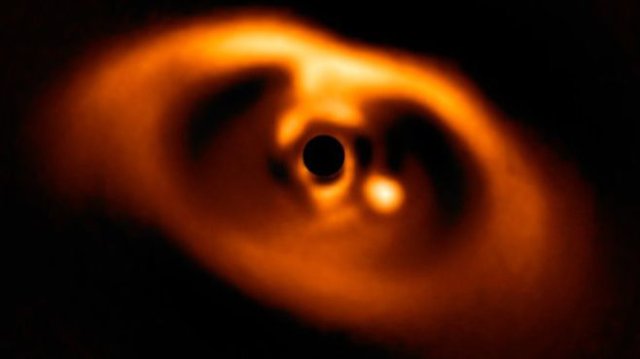
(From ESO, A. Müller et al., via BBC News; used w/o permission.)
(“The planet is visible to the right of its star, which has been obscured”
(BBC News))
“Newborn planet pictured for first time”
BBC News (July 2, 2018)
“Astronomers have captured this image of a planet that’s still forming in the disk of gas and dust around its star.
“Researchers have long been on the hunt for a baby planet, and this is the first confirmed discovery of its kind.
“Young dwarf star PDS 70 is less than 10 million years old, and its planetary companion is thought to be between five and six million years old.
“Known as PDS 70b, it appears to be several times the size of Jupiter and probably has a cloudy atmosphere….”
Astronomers knew about PDS 70 and the gap in its protoplanetary disk at least as far back as 2004. What we’re learning about planet formation said there should be a big planet in the gap. One that’s still taking shape.
Finding PDS 70b took folks at ESO’s Very Large Telescope, the VLT, a few more years. So did confirming that it’s a planet. What they learned told them a little more about PDS 70b.
PDS 70b’s approximate temperature and size are just that: approximate. Its ‘light’ at different wavelengths is a pretty close match to better-known gas giants. Those are between six and 14 times Jupiter’s mass.
PDS 70b’s diameter is almost certainly upwards of 1.3 times Jupiter’s. Its temperature, based on wavelengths scientists used, is probably 1,200 K. Give or take 200.
That’s close to BBC’s “1,000C,” 1,832 Fahrenheit.It’s hot enough to melt lead, below iron’s melting point and hotter than any planet’s surface in the Solar System.3
Names and Stars
 PDS 70 is about 370 light-years out, in Eta Centauri’s general vicinity.
“Eta Centauri” is a Bayer designation: a Greek letter plus the constellation name’s Latin genitive. Johann Bayer developed the designation system for his “Uranometria Omnium Asterismorum” star atlas. (1603)
Some stars, like Antares and Sirius, have proper names and Bayer designations. Antares and Sirius would be Alpha Scorpii and Alpha Canis Majoris in Bayer’s atlas.
Eta Centauri was called Kù lóu èr by Chinese astronomers, and that’s yet another topic.
Eta Centauri is part of the Scorpius-Centaurus Association, stars moving at pretty much the same speed in the same direction, spread across about 700 light-years.
Some, like Antares, are visible from Earth. Many aren’t. One of them, HD 113766, is more or less between Eta and Epsilon Centauri. It’s another young star. Two stars, actually.
HD 113766 A, the binary’s brighter star, has what looks like a planetary system forming around it. An Earth-like planet may be in 113766 A’s habitable zone in a few million years.
PDS 70 may or may not be part of the Scorpius-Centaurus Association. It’s at the right distance, the right age and headed in pretty much the same direction as those stars.4
More Names

(From ESO, IAU, Sky & Telescope; used w/o permission.)
(Part of Earth’s southern sky. PDS 70 is in the red circle.)
I don’t think we’ll be sending a probe to PDS 70 or Eta Centauri any time soon. If we did, it’d go past Theta Centauri on the way out. That star is just shy of 60 light years away.
It’s an evolved giant star. The star Earth orbits is a main-sequence star. That’s yet again another topic.
Theta Centauri has another proper name, Menkent. Calling it an “evolved giant star” isn’t improper. Not in the ‘banned in Boston’ sense. “Proper name” in this context is what English teachers call a proper noun: a particular person, place or thing’s name.
A common noun is the technical name for what we call something that’s one of a class of things, like a pencil or a bit of dust.
Common nouns aren’t capitalized. They’d blow their noses in public and don’t know which fork to use. Saying that stars have noses is farce, sort of. And that’s still another topic.
Menkent is what some folks call the “traditional name” for Theta Centauri. I’m not sure where or when the tradition started, or who started it. I’ve read that it’s an Arabic word for shoulder plus “kent.” If so, “kent” probably started as Latin “kentaurus,” or centaur.
PDS 70 doesn’t have a cool name like Menkent or Sirius. Not yet.
 The “PDS 70” designation is starting to work on my nerves, so I’ll make up a proper name. That’s why I started looking for stars with names.
Menkent’s name in China was Kù Lóu sān, third star in Kù Lóu. It’s not as memorable, to my Western ears, as Menkent.
I’m not sure what Kù Lóu means. Probably “arsenal” or “library.” Or something else.
Let me think. PDS stands for Phoenix Deep Survey, which is a proper noun. But it’s a catalog’s name, not an individual star’s. And I want something short. Shorter than “Phoenix Deep Survey,” anyway.
PDS 70 is also called V1032 Centauri. That’s not much of an improvement over PDS 70. Both designations are pronounceable, after a fashion: “pee dee ess seventy” and “vee ten thirty two Centauri.” Abbreviating and compressing both, I get “peedee” and “veetoo.”
“Veetoo” reminds me of “Star Wars.” “Peedee” reminds me of Dee Dee in Genndy Tartakovsky’s Dexter’s Laboratory series. This decision isn’t as easy as I thought it would be. But it’s trivial, so I’ll pick Peedee and move along.
Peedee is less massive than our star, a trifle cooler and dimmer. It’s not visible from Earth, unless you’ve got at least a small telescope.5
ESO’s Very Large Telescope

(From European Southern Observatory, via Wikimedia Commons, used w/o permission.)
(Paranal Observatory, part of the European Southern Observatory in Chile.)
I might have been more tolerant of PDS70 b’s designation if I hadn’t been wading through terms like NIR, VLT/NaCo, PDI and ADI. All of which relate to SPHERE on the VLT.
I don’t mind technobabble. Usually. Like any other specialized jargon, it helps folks share information without unnecessarily long words and phrases.
Imagine that you’re at the European Southern Observatory, ESO, putting a ‘where you can find me’ note on the break room message board. You’ll be using the Nasmyth Adaptive Optics System and Couder Near Infrared Camera.
You can write “I’ll be at the NaCo.” Or you could try fitting the whole name on one note. Maybe you could, and still be legible. My preference would be using the acronym.
I’ll probably say more about the ESO’s tech and alphabet soup in another post. Today I’ll keep it short. Shortish. The ESO’s Very Large Telescope, VLT, is part of Paranal Observatory.
The VLT includes four optical telescopes. Each has a primary mirror 8.2 meters across. That’s more than half again as large as Palomar’s famous 200 inch reflector.
Astronomers mostly use each telescope separately. Some observations take all four telescopes working together as an astronomical interferometer. That’s how researchers got images like the ones of PeeDee and its still-forming planetary system.
Different instruments can be mounted on or connected to the VLT, depending on what astronomers are looking for. Their ‘Peedee pictures’ came from NaCo and SPHERE. SPHERE stands for Spectro-Polarimetric High-Contrast Exoplanet Research.6
Finding Answers and Many New Questions

(From ESO, A. Müller et al.; used w/o permission.)
(PDS 70’s protoplanetary nebula, viewed in near-infrared at the VLT.)
Confirming that Peedee has a planet in its protoplanetary disk is a big step forward. So is getting images of the still-forming planetary system in several infrared wavelengths.
Scientists now know more about that planet than many others. Studying the Peedee system — I like that name, but don’t expect the IAU will make it official.
We’ll learn more about how planets form by studying the Peedee system.
The Nebular Hypothesis
 We know more today than we did in my youth. Or a few years ago.
But we’re not running out of questions. Scientists seem to be finding new puzzles faster than they’re solving old ones.
We still don’t know that the Solar System formed when a nebula, a cloud of gas and dust, collapsed. Or if that’s the way most planetary systems take shape.
Not the way I know that Abraham Lincoln made the Gettysburg Address.
That sort of well-documented certainty would take observations made and recorded over the last several billion years.
Our astronomical records cover an interval a millionth that size. “Three Stars Each,” the first Babylonian star catalog we’ve found, is about three and a half millennia old.
Maybe some galactic philosopher’s guild left a probe in what became the Solar System, and has been keeping a file on our planetary system. I wouldn’t count on it.
Our knowledge of what’s been happening in this universe comes from studying what we’ve seen since we started paying attention.
Until about four centuries back, what we knew about stars and planets was limited to what our eyes could tell us. Then Galileo and others repurposed the “Dutch perspective glass” for astronomical work.
Many of them realized that Aristotle and Ptolemy’s conclusions didn’t match what they were seeing.
Copernicus thought Earth went around our sun. He wasn’t the first with that idea, not by several millennia. But he had data and math to back up his heliocentric model.
He wasn’t entirely right. But he showed that Aristarchus, not Aristotle, had the right idea. Basically. His 1543 “De revolutionibus orbium coelestium” got attention. (June 2, 2017; January 12, 2018)
Some folks started making their own observations and calculations. Others supported Copernican ideas and their own offbeat theological notions. Still others saw what was happening and panicked. (October 13, 2017)
Time passed. Natural philosophy became science. Swedenborg published an early nebular hypothesis. Swedenborg’s idea about planetary system formation made sense, to a point. His theology didn’t. One the other hand, I think his take on End Times was imaginative.
But Swedenborg’s nebular hypothesis seemed like a reasonable explanation for how planetary systems form. So were several other ideas. My high school science textbooks discussed several scientific ideas about how stars and planets form.
One of them was an updated version of Swedenborg’s nebular hypothesis. Scientists using new data and math were solving some ‘nebular’ puzzles. Finding nebulae at different stages in the planetary system formation process helped.
It’s still a hypothesis, but the nebular model fits what we’re finding. It’s now the model nearly all scientists think works best.7
My guess is that we’re pretty close to what will be a theory, not a hypothesis, of planetary formation. Getting closer, at any rate.
I could start denouncing the nebular hypothesis and science, spouting “Scripture that condemns” it. I won’t.
“…Whatever God Wills….”

Thinking that this universe is ancient, vast and impressive is not a new idea.
“The heavens declare the glory of God; the firmament proclaims the works of his hands.”
(Psalms 19:2)
“Terrible and awesome are you,
stronger than the ancient mountains.”
(Psalms 76:5)
“All your works give you thanks, LORD and your faithful bless you.
“They speak of the glory of your reign and tell of your mighty works,
“Making known to the sons of men your mighty acts, the majestic glory of your rule.”
(Psalms 145:10–12)
“Indeed, before you the whole universe is as a grain from a balance, or a drop of morning dew come down upon the earth.”
(Wisdom 11:22)
Living in a universe that’s unlike Babylonian cosmology’s doesn’t bother me. Neither does thinking that it’s far older than a 17th century Calvinist’s chronology said.
Even if I felt distaste for God’s creation, it wouldn’t matter.
“Our God is in heaven; whatever God wills is done.”
(Psalms 115:3)
As it is, I like being surrounded by beauty and wonders. I see scientific discoveries as new opportunities to admire God’s “mighty works:”
1 Humanity’s new horizon:
2 Finding other worlds:
3 A very young planet:
- Wikipedia
- Planet PDS 70 b
The Extrasolar Planet Encyclopedia
- “First Confirmed Image of Newborn Planet Caught with ESO’s VLT”
ESO Science Release (July 2, 2018)
- “Discovery of a planetary-mass companion within the gap of the transition disk around PDS 70 ★”
M. Keppler, M. Benisty, A. Müller, Th. Henning, R. van Boekel, F. Cantalloube, C. Ginski, R.G. van Holstein, A.-L. Maire, A. Pohl, M. Samland, H. Avenhaus, J.-L. Baudino, A. Boccaletti, J. de Boer, M. Bonnefoy, G. Chauvin, S. Desidera, M. Langlois, C. Lazzoni, G. Marleau, C. Mordasini, N. Pawellek, T. Stolker, A. Vigan, A. Zurlo, T. Birnstiel, W. Brandner, M. Feldt, M. Flock, J. Girard, R. Gratton, J. Hagelberg, A. Isella, M. Janson, A. Juhasz, J. Kemmer, Q. Kral, A.-M. Lagrange, R. Launhardt, A. Matter, F. Ménard, J. Milli, P. Mollière, J. Olofsson, L. Pérez, P. Pinilla, C. Pinte, S. P. Quanz, T. Schmidt, S. Udry, Z. Wahhaj, J. P. Williams, E. Buenzli, M. Cudel, C. Dominik, R. Galicher, M. Kasper, J. Lannier, D. Mesa, D. Mouillet, S. Peretti, C. Perrot, G. Salter, E. Sissa, F. Wildi, L. Abe, J. Antichi, J.-C. Augereau, A. Baru, P. Baudoz, A. Bazzon, J.-L. Beuzit, P. Blanchard, S. S. Brems, T. Buey, V. De Caprio, M. Carbillet, M. Carle, E. Cascone, A. Cheetham, R. Claudi, A. Costille, A. Delboulbé, K. Dohlen, D. Fantinel, P. Feautrier, T. Fusco, E. Giro, L. Gluck, C. Gry, N. Hubin, E. Hugot, M. Jaquet, D. Le Mignant, M. Llored, F. Madec, Y. Magnard, P. Martinez, D. Maurel, M. Meyer, O. Möller-Nilsson, T. Moulin, L. Mugnier, A. Origné, A. Pavlov, D. Perret, C. Petit, J. Pragt, P. Puget, P. Rabou, J. Ramos, F. Rigal, S. Rochat, R. Roelfsema, G. Rousset, A. Roux, B. Salasnich, J.-F. Sauvage, A. Sevin, C. Soenke, E. Stadler, M. Suarez, M. Turatto, L. Weber; ESO Astronomy & Astrophysics manuscript (July 30, 2018)
4 Stars, dust and names:
5 Names and designations:
- Wikipedia
- Dictionary of Nomenclature of Celestial Objects
SIMBAD Astronomical Database – CDS, Strasbourg (updated: July 6, 2018)
- The Phoenix Deep Survey: Optical and near infrared imaging catalogs”
Mark Sullivan, Andrew Hopkins, Jose Afonso, Antonis Georgakakis, Ben Chan, Lawrence Cram, Bahram Mobasher, Cesario Almeida, University of Toronto, University of Durham, University of Pittsburgh, Observatory of Lisbon, NOA, University of Sydney, ANU, STScI; (updated: July 6, 2018)
6 Tech and technobabble:
7 Stars and science:
Like this:
Like Loading...


 Folks at Sauk Centre’s emergency room told me that what I was experiencing might be a stroke, or something else.
 Folks at St. Cloud gave me good advice, most of which I was already doing to deal with my weight and other health issues.
 I’ve got more to say about my experience and what we’re learning about the human brain. Quite a bit more. But that will wait until another day.