Mother Teresa: “The Moment Passed”

Mother Teresa of Kolkata/Calcutta gets canonized today. Here’s how she described herself:

“By blood, I am Albanian. By citizenship, an Indian. By faith, I am a Catholic nun. As to my calling, I belong to the world. As to my heart, I belong entirely to the Heart of Jesus.”
(“Mother Teresa of Calcutta (1910-1997),” vatican.va)

She established the Missionaries of Charity in 1950 and died in 1997, but the Missionaries of Charity are still around: giving “wholehearted free service to the poorest of the poor.”

Their facilities don’t look much like Mayo Clinic here in Minnesota, or Bumrungrad International Hospital in Thailand; and that’s another topic.

One of these days I’ll probably ramble on about Saints, miracles, and canonization. But today I’ll say that a Saint is someone recognized by the Church as someone who practiced heroic virtue and is currently dead, and leave it at that. (Catechism of the Catholic Church, 828, and see 61, 946, 1477, 2030)

“…Jesus invites his disciples to the total giving of their lives, … The saints welcome this demanding invitation … Their perfection, in the logic of a faith that is humanly incomprehensible at times, consists in no longer placing themselves at the center, but choosing to go against the flow and live according to the Gospel….”
(From an October 11, 2009, homily by Pope Benedict XVI; via Press Office of the Holy See; used w/o permission.)

I was going to write about Mother Teresa, but the my mind wandered — nothing unusual there — and this is what happened:

Teresa: a Troublemaker

Teresa” is my language’s version of a name that probably comes from the Greek verb θερίζω, “to harvest.” Depending on where you live, it’d be Rocel, Tèrag, தெரசா, ٹریسا, 特麗莎, or any of dozens of other variations.

Mother Teresa isn’t the first “Saint Teresa.” There’s “The Little Flower,” Saint Thérèse of Lisieux; and the troublemaker we call Saint Teresa of Ávila.

Teresa of Ávila’s El Castillo Interior or Las Moradas (The Interior Castle, or The Mansions) and Camino de Perfección (Way of Perfection) — are yet another topic.

She was, among other things, a Carmelite nun who thought restoring rules from the early 1200s would be good for her order.

The Carmelites had gone through proper channels, getting official approval when they eased up on the rules. Pope Eugene IV, for example, okayed rule changes about eating meat and being silent. (The Carmelites,” resource for a workshop held at Saint Andrew’s Abbey, Valyermo, California; St. John’s Seminary (1990))

By the mid-1500s, about a century later, ‘observance lite’ wasn’t doing much to protect and strengthen the spirit and practice of prayer. That was Teresa’s view, anyway.

She was in the process of upsetting that applecart when she met Juan de Yepes y Álvarez, who was planning to join a particularly hardcore outfit, the Carthusian Order.

She asked Juan to put off joining the Carthusians, and join her reform. In 1568, Friar Juan and Friar Antonio de Jesús de Heredia set up the first monastery for men following the nun’s principles.

Juan: Hardcore Faith

Fast-forward to December, 1577. Some of Juan’s superiors in the Carmelite Order told him to stop following the reformed rules. Juan said he had approval from the Spanish nuncio, who outranked them: which went over about as well as you might expect.

That’s when Carmelites who didn’t like the stricter rules kidnapped — or arrested, from their viewpoint — and imprisoned him.

Eventually he wound up in what we’d call solitary confinement: punctuated by public lashings. Around this time, one of the friars had given him paper — and presumably something to write with. I’ll get back to that.

Juan escaped August 15, 1578; Pope Gregory XIII signed off on a separation between the Calced and Discalced Carmelites; Juan came down with erysipelas, and died in 1591.

Today, Juan is known as Saint John of the Cross in my language.

“Dark Night of the Soul”

St. John of the Cross wrote a poem while he was imprisoned, in the late 1570s: “La noche oscura del alma.” In my language it’s called “Dark Night of the Soul.”

A few years later, in 1584 and 1585, he wrote a treatise explaining the poem, one stanza at a time.

I gather that “Dark Night of the Soul” is about the dry patches I can expect. Sometimes — quite often, actually — I don’t feel much like praying. Apparently it’s not just me. (Catechism, 2728, 2731)

Not everyone, and not all Saints, experience spiritual dryness, a stretch of life that’s singularly devoid of the emotional perks folks associate with ‘being spiritual.’

That’s probably just as well, since giving up on faith as a bad idea can look really good during those times.

Happily, faith is a matter of the will and reason, not how I’m feeling at the moment.

Feelings and Faith

Let’s back up a bit. I think that humanity is made in the image of God. Each of us is someone, not something; a person — able to reason, and decide how we act — and in these ways like God. (Genesis 1:27; Catechism, 357, 17001706)

Emotions are part of being human. They’re “…the connection between the life of the senses and the life of the mind….” (Catechism, 1764)

But there’s more to us than our feelings. Living with undiagnosed depression and something on the autism spectrum for decades taught me that my emotions are unreliable guides.

Emotions aren’t good or bad by themselves. What matters is what we decide to do about them, using our will and reason. (Catechism, 1767, 17621770)

The Church says that faith is “both a gift of God and a human act by which the believer gives personal adherence to God….” More of the definition is near the end of this post.1

Faith, like anything else, is easier when my emotions are in sync with my reason and will. But I think what we’re told about conscience applies here, too. “Conscience is a judgment of reason … a law of the mind….” (Catechism, 17621775, 1776, 1778)

We’ve got brains, and are expected to think.

“Ready to Wait for You for All Eternity”

I occasionally run into folks who act as if faith depends on ‘feeling spiritual.’

That attitude may explain why some folks were shocked when Mother Teresa’s letters became public knowledge, a few years back now:

“Often I wonder what does really God get from me in this state — no faith, no love — not even in feelings. The other day I can’t tell you how bad I felt. — There was a moment when I nearly refused to accept. — Deliberately I took the Rosary and very slowly and without even meditating or thinking – I said it slowly and calmly. The moment passed — but the darkness is so dark, and the pain is so painful. – But I accept whatever He gives and I give whatever He takes. People say they are drawn closer to God — seeing my strong faith. — is this not deceiving people? Every time I have wanted to tell the truth — ‘that I have no faith’ — the words just do not come — my mouth remains closed. — And yet I still keep on smiling at God and all.”
(Letter to Bishop Lawrence Trevor Picachy (September 1962), as quoted in Mother Teresa: Come Be My Light (2009) by Brian Kolodiejchuk, 2009, p. 238; via Wikiquote)

For me, a key part of that excerpt is “…Deliberately I took the Rosary and very slowly and without even meditating or thinking — I said it slowly and calmly. The moment passed….”

Deciding that the moment may pass, and that what matters is doing whatever task is at hand: that, I can appreciate.

One more excerpt from a letter, and I’m done for today.

“What do I labour for? If there be no God—there can be no soul.—If there is no soul then Jesus—You also are not true… Jesus don’t let my soul be deceived—nor let me deceive anyone. In the call You said that I would have to suffer much.—Ten years—my Jesus, You have done to me according to Your will—and Jesus hear my prayer—if this pleases You—if my pain and suffering—my darkness and separation gives You a drop of consolation—my own Jesus, do with me as You wish—as long as You wish, without a single glance at my feelings and pain… I beg of You only one thing—please do not take the trouble to return soon.—I am ready to wait for You for all eternity.”
(Letter addressed to Jesus, as quoted in Mother Teresa: Come Be My Light (2007) edited by Brian Kolodiejchuk, p. 192; via Wikiquote)


1 Definition:

FAITH: Both a gift of God and a human act by which the believer gives personal adherence to God who invites his response, and freely assents to the whole truth that God has revealed. It is this revelation of God which the Church proposes for our belief, and which we profess in the Creed, celebrate in the sacraments, live by right conduct that fulfills the twofold commandment of charity (as specified in the ten commandments), and respond to in our prayer of faith. Faith is both a theological virtue given by God as grace, and an obligation which flows from the first commandment of God (26, 142, 150, 1814, 2087).
(Glossary, Catechism of the Catholic Church)

Posted in Being Catholic | Tagged , , , , | 9 Comments

Proxima Centauri b, Looking for Life

Looking for extraterrestrial life is still a science in search of a subject, but it’s getting increasingly difficult to argue that there couldn’t be critters out there.

Today I’ll be talking about the search for life in the universe, a possibly-habitable planet circling the next star over, and a planet that couldn’t possibly be habitable.

Make that not habitable by life as we know it. Life using fluorine and carbon as we do hydrogen and carbon, with sulfur as a water-substitute — is a topic for another post.

  1. Looking for Alien Life
  2. Proxima Centauri b
  3. Gliese 1132 b: Still Worth Studying

Klaatu, The Thing, and Getting a Grip

Collage: promotional art for 'Plan 9 From Outer Space', 'Earth vs. The Flying Saucers', 'The Thing from Another World', 'The Day the Earth Stood Still', 'Invaders from Mars'. (1950s)I don’t ‘believe in’ space aliens, not in the sense that I believe space-alien emissaries of niceness will come to solve all our problems: sort of like Klaatu, in “The Day the Earth Stood Still,” who stopped just short of walking on water.

Putting anything where God should be in my priorities, divinizing what is not God, is a very bad idea; and I’ve said that before. (Catechism of the Catholic Church, 21122114) (August 21, 2016)

Invaders are another popular variety of space alien in the movies — like the featured creatures in “Plan 9 from Outer Space,” “Earth vs. the Flying Saucers,” and “Invaders from Mars.”

The title character in “The Thing from Another World” acted like an invader. But the Thing’s bad attitude may have come from being shot after the humans blew up his ship, and that’s another topic.

Between Klaatu, movies like “Prometheus,” and folks who believe space aliens are angels, I’m not surprised that some Christians don’t like the idea that we may have neighbors on other planets.

Me? I’m firmly convinced that there’s life elsewhere in the universe, or that life exists only on Earth. We don’t know — yet.

Either way, it’s not my decision: and I’m certainly not going to tell the Almighty whether or not we should have neighbors. That’s up to God:

“Then Job answered the LORD and said:
1 I know that you can do all things, and that no purpose of yours can be hindered.”
(Job 42:12)

Creatures on Other Planets?


(From Ittiz, via deviantart.com, used w/o permission.)
(“Double Planet,” by Ittiz. (2010))

Finding any sort of life, like the alien equivalent of bacteria, would be a huge discovery; but the ‘jackpot’ would be finding neighbors, folks like us, but not human.

If we meet during the next few centuries, I think the odds are that they’ll be finding us. Either way, I’m pretty sure that reactions would be mixed; and that’s yet another topic.

I think Brother Guy Consolmagno’s opinion about extraterrestrial life makes about as much sense as anything I’ve read.

“…Frankly, if you think about it, any creatures on other planets, subject to the same laws of chemistry and physics as us, made of the same kinds of atoms, with an awareness and a will recognizably like ours would be at the very least our cousins in the cosmos. They would be so similar to us in all the essentials that I don’t think you’d even have the right to call them aliens.”
(“Brother Astronomer;” Chapter Three, Would You Baptize an Extraterrestrial? — Brother Guy Consolmagno (2000))


1. Looking for Alien Life


(From Warner Bros, via BBC ews, used w/o permission.)
(“In the film Interstellar, astronauts leave Earth in search of other habitable planets”
(BBC News))

Where should we look for alien life?
Paul Rincon, BBC News (August 25, 2016)

Astronomers have discovered a small planet around Proxima Centauri, the closest star to the Sun. But how do astronomers decide whether a planet is hospitable to life?

“In the science fiction film Interstellar, astronauts leave a dying Earth in search of a hospitable planet for the human race to settle.

“But the first two worlds on their shortlist – deemed ‘potentially habitable’ from a distance – turn out to be nightmarishly hostile on closer inspection. The crew’s first stop is an ocean planet lashed by 1km-high tidal waves, while the second is a deep-frozen world choked by toxic ammonia.

“While Christopher Nolan’s movie is fantasy, it draws on a real-life aspect of the work done by astronomers who study exoplanets – worlds beyond our Solar System.

“The search for planets capable of supporting life could answer an age-old question: are we alone in the Universe? But what do astronomers mean when they refer to distant worlds as potentially habitable, or Earth-like?…”

Interstellar” (Warner Bros./Paramount Pictures (2014)) is on my ‘I’d like to see this’ list. I generally like epic/space opera tales, and well-thought-out special effects.

However, it looks like someone forgot to do their homework on the film’s central conflict: “a dying Earth.”

I strongly suspect that astrobiologist David Grinspoon is right:

“…they describe this ecological disaster on Earth. I like the fact they are talking about that and raising consciousness. It’s clear that it’s climate change and we screwed up the Earth…That’s a good theme. But the specific things they say about it—they say there’s this blight [attacking all crops] that’s building up the nitrogen [in the atmosphere] and that’s going to draw down the oxygen. Anybody who knows about planetary atmosphere is going to sit there at that point and go, ‘That’s a bunch of BS.’…”
(“What’s Wrong With the Science of ‘Interstellar’?,” Mother Jones (November 12, 2014))

Like I said a few weeks back, ‘thinking green’ makes sense. Taking Paul Ehrlich and Captain Planet and seriously, not so much. (August 12, 2016)

That started me thinking of other ‘we’re all gonna die’ scenarios that could be good enough for movies.

Magnetism, Mostly

They could have had Earth’s magnetic field failing: sort of like “The Core,” only slightly more reality-based.

Headlines like “Earth’s magnetic field ‘could flip in the space of 100 years’, scientists warn” would have made that scenario more “relevant” in the months following “Interstellar’s” release.

It’s true, by the way: Earth’s magnetic field is weakening a whole lot faster than scientists expected. Our planet’s north and south magnetic poles will switch places “soon” — on the geologic time scale.

But breathless journalism notwithstanding, magnetic poles switching places isn’t anything new. Geomagnetic reversal generally happens every 100,000 to 1,000,000 years.1

Sometimes the magnetic poles stay put for much longer, sometimes they’re downright twitchy. The Laschamp event, 41,400 years back — give or take a few thousand years — lasted centuries, not millennia.

Earth’s magnetic field dropped to 5% its current strength during the transition that time, and was at 75% strength for the duration.

If it went out entirely, and stayed that way, we’d have trouble. Besides letting us use compasses for navigation, Earth’s magnetic field keeps the solar wind from blowing bits of the upper atmosphere away, and keeps many charged particles from reaching the ground.

We think Mars lost most of its air that way, although there’s more to it than that. Venus, with no magnetic field to speak of, is closer to our sun than either Mars or Earth and has a massively dense atmosphere.

We know that more radiation got through during the Laschamp event, since scientists found more than the usual Beryllium-10 in ice cores from that period.2

Earth’s current ice age was in progress at the time, and had been for over two million years. We’d been around, too, and didn’t know about Beryllium-10, magnetic fields, or geomagnetic reversals, until quite recently.

“Ice age” is a lot simpler to say than “Quaternary glaciation,” which is what scientists call most recent of the five known glaciations during Earth’s history, and that’s yet again another topic.

No, actually, it’s not. We’ve been learning that Earth’s been nowhere near as serenely unchanging as it might have seemed between, say, 1880 and 1900, or 950 to 1250.

Oxygen’s Ups and Downs


(From D.W. Miller, via Smithsonian Institution/Smithsonian Magazine, used w/o permission.)
(Cambrian animals, including Anomalocaris, Hallucigenia, Wiwaxia, and Ottoia.)

Getting back to Earth and oxygen, our home’s atmosphere hasn’t always been 20.95% oxygen by volume.

Before cyanobacteria came along, 2,400,000,000 years back — roughly, scientists are still working on the exact timeline — there wasn’t much of any oxygen at all.

Photosynthesis led to the Great Oxygenation Event, roughly 2,300,000,000 years ago. Then the Huronian glaciation happened: quite possibly because Earth’s atmosphere lost its methane.

Oxygen would have combined with methane, forming carbon dioxide and water: good for us, since we’re not suited to breathing methane; but carbon dioxide and water vapor don’t retain heat as well as methane does.

The ice eventually melted, today’s sort of critters got started 541,000,000 to 485,400,000 years back — that’s phyla of animals, a phylum being the taxonomic rank below kingdom and above class, and aren’t you glad there won’t be a test on this?

The Cambrian critters in that illustration don’t look quite like today’s animals: hardly surprising, since it’s been a half-billion years since they were around.

The closest thing we’ve got to a trilobite these days is the horseshoe crab, Hallucigenia might or might not be an early version of velvet worm, and that’s still another topic.

Earth’s atmospheric oxygen supply peaked during the Carboniferous. That was 358,900,000 to 298,900,000 years ago, and Earth’s atmosphere hasn’t been 35% oxygen since.

Still, it could have been worse. “Interstellar” could have had humanity imperiled by killer bees infected with artificial botulism. Think The Swarm meets The Satan Bug.

Besides, I’m missing the main point of that BBC article: where should we be looking for extraterrestrial life?

Life and the ‘Goldilocks Zone:’ It’s Complicated


(From NASA, via BBC ews, used w/o permission.)
(“The cooler the star, the closer in their habitable zones have to be”
(BBC News))

“…’When we say “potentially habitable” exoplanets, that’s a term that refers to measurable qualities of a planet that are necessary for habitable conditions,’ says Prof Abel Méndez, from the University of Puerto Rico (UPR) at Arecibo.

“These are, then, promising targets where nothing is guaranteed. But two criteria dominate popular discussions of planetary habitability: first, whether it is within Earth’s general size range (and therefore has a chance of being rocky) and, second, whether it resides in what’s known as the habitable – or Goldilocks – zone.

“This is the range of distances around a host star where there’s just enough starlight to keep water in liquid form on a planet’s surface. Too close to the star, and the heat will cause water to boil off; too far away and any water will freeze.

“These are useful rules of thumb, but a host of factors influence how hospitable planets are. And some are excluded from the conversation because of limitations in technology….”
(Paul Rincon, BBC News)

This BBC News article assumes that life will live on or near the surface of a planet like Earth, which is a reasonable assumption; and that it’ll be ‘life as we know it:’ critters made of nucleic acid/protein in water.

There’s been serious discussions of life in Europa’s subsurface ocean, and other ‘biochemistries,’ but that’ll wait for another post.

Paul Rincon’s article also gets into how we have been finding planets circling other stars: and why so many seem to be around red dwarf stars.

The ‘wobble method,’ Dopper spectroscopy for folks who like the technical name, measures how fast the planet’s star moves towards and away from us as star and planet rotate around their center of gravity.

Measuring it is easier when the planet is heavy and the star small, which is one reason that so many of the first exoplanets spotted were so big.

Transit photometry, the method illustrated in that ‘brightness/light curve’ picture, measures how much a star’s light dims as a planet crosses in front. That method works better with smaller stars, too.

The good news about looking for habitable worlds around red dwarf stars is that there are a great many more of these smaller stars than ones like our comparatively bright sun.

The not-so-good news is that a red dwarf’s habitable zone is really small, which I think makes the number of ‘Goldilocks zone’ planets circling red dwarfs rather remarkable.

On the other hand, red dwarf stars last a really time, far longer than ours will, so life around a red dwarf’s planet would have a very long time to develop.

“Red dwarf” is a bit of a misnomer, as I said in an earlier post. Even a very cool red dwarf like TRAPPIST-1 has a surface temperature below 2,700 K/2,430 °C/4,400 °F: very roughly the temperature and color of a ‘warm’ LED or incandescent bulb. (July 29, 2016)

I put an unnecessarily-long link list of resources, mostly in Wikipedia, near the end of this post.3


2. Proxima Centauri b


(From ESO/M. Kornmesser, via BBC News, used w/o permission.)
(“Artwork: The planet’s mass would suggest it is a rocky world like Earth”
(BBC News))

Neighbouring star Proxima Centauri has Earth-sized planet
Jonathan Amos, BBC News (August 24, 2016)

The nearest habitable world beyond our Solar System might be right on our doorstep – astronomically speaking.

“Scientists say their investigations of the closest star, Proxima Centauri, show it to have an Earth-sized planet orbiting about it.

“What is more, this rocky globe is moving in a zone that would make liquid water on its surface a possibility.

“Proxima is 40 trillion km away and would take a spacecraft using current technology thousands of years to reach….”

Folks at the European Southern Observatory (ESO) discovered Proxima Centauri b with Doppler spectroscopy.

One of the many things we don’t know about Proxima Centauri b yet is its orbital inclination: how much its orbit around Proxima Centauri is tipped from our viewpoint.

If we’re ‘seeing’ it edge-on, or nearly so, Proxima Centauri b’s mass is only 1.27 times Earth’s. If it’s made of the same stuff as Earth, it’ll be at least 1.1 times as wide as our planet.

That’s the least possible value for its mass and size, but 90% of the possible orientations give it a mass less than 3 times Earth’s.

There’s a good chance Proxima Centauri b is what scientists call a super-Earth, a planet with more mass than Earth’s, but substantially less than the Solar System’s ice giants Uranus and Neptune.

Let’s assume — optimistically — that we’re seeing Proxima Centauri b’s orbit edge-on, which would mean that it’s mass is 1.27 times Earth’s, or 1.27 x 5.97237 ×1024 kilograms = 7.5849099 ×1024 kg.

That’s 7,584,909,900,000,000,000,000,000 kilograms, which helps explain why folks use exponential notation so often when dealing with big numbers.

I like comparisons, so here’s Venus, Earth, and Proxima Centauri b:

  • Venus mass: 4.8675×1024 kg
  • Earth mass: 5.97237 ×1024 kg
    (1.227 x Venus)
  • Minimum Proxima Centauri b mass: 7.5849099 ×1024 kg
    (1.27 x Earth)

That doesn’t prove much, apart from the newfound planet being roughly as close to Earth’s mass as Venus, only bigger.

Proxima Centauri b’s equilibrium temperature is 234 K; or -39 °Centigrade, -38 °Fahrenheit. That’s a bit cooler than Earth’s roughly 260 K, 8.33 °Fahrenheit, but not by much.

Earth’s surface is, on average, warmer than that because we’ve got an atmosphere, and that isn’t another topic, since a big question is whether life can exist on Proxima Centauri b.

The answer depends partly on the planet’s star.

Orbiting a Flare Star

Proxima Centauri is small, cool, and dim compared to our star: with about an eighth of the Sun’s mass; roughly 3,042 K at the surface, compared to our star’s 5,772 K; and about 0.0015 times as bright.

Since most of the energy coming from its sun is down in the infrared, Proxima Centauri b gets very roughly as much heat as Earth, but only a fraction of the visible light. ‘High noon’ wouldn’t be particularly bright.

Proxima Centauri is what astronomers call a “red dwarf,” but like I said earlier — standing on Proxima Centauri b’s surface, what we’d chiefly notice is that it looks bigger than our Sun. The color is a bit ‘warmer’ than we’re used to here, but it would not look like a stop light.

Orbiting as close to its sun as it does, Proxima Centauri b may be tidally locked, with one side always facing the star: as Earth’s moon always has one side facing us.

Or it might have a more complex spin-orbit resonance, like Mercury. This may or may not affect habitability.

The bad news, as far as hoping for habitability goes, is that Proxima Centauri is a flare star. Stars like that “can undergo unpredictable dramatic increases in brightness for a few minutes.” (Wikipedia)

Bright light would be the least of life’s problems on Proxima Centauri b. Orbiting as close to its star as it does, the planet gets something like 400 times as much x-ray radiation as Earth does.

A thick atmosphere and strong magnetic field might keep x-ray levels at the surface at safe levels for life. Or maybe life on a planet like that could be fine in the ocean, but not on land.

If there is life on Proxima Centauri b, it’ll have plenty of time to grow. At the rate the star’s burning fuel, it’s good for about another four trillion years: almost 300 times the current age of the universe.

More:


3. Gliese 1132 b: Still Worth Studying


(From CfA/Dana Berry/Skyworks Digital, via Phys.org, used w/o permission.)
(“This artist’s conception shows the rocky exoplanet GJ 1132b, located 39 light-years from Earth. New research shows that it might possess a thin, oxygen atmosphere – but no life due to its extreme heat.”
(Phys.org))

Venus-like exoplanet might have oxygen atmosphere, but not life
Harvard-Smithsonian Center for Astrophysics, Phys.org (August 18, 2016)

“The distant planet GJ 1132b intrigued astronomers when it was discovered last year. Located just 39 light-years from Earth, it might have an atmosphere despite being baked to a temperature of around 450 degrees Fahrenheit. But would that atmosphere be thick and soupy or thin and wispy? New research suggests the latter is much more likely.

“Harvard astronomer Laura Schaefer (Harvard-Smithsonian Center for Astrophysics, or CfA) and her colleagues examined the question of what would happen to GJ 1132b over time if it began with a steamy, water-rich atmosphere.

“Orbiting so close to its star, at a distance of just 1.4 million miles, the planet is flooded with ultraviolet or UV light. UV light breaks apart water molecules into hydrogen and oxygen, both of which then can be lost into space. However, since hydrogen is lighter it escapes more readily, while oxygen lingers behind.

” ‘On cooler planets, oxygen could be a sign of alien life and habitability. But on a hot planet like GJ 1132b, it’s a sign of the exact opposite – a planet that’s being baked and sterilized,’ said Schaefer….”

Wikipedia’s page on this planet hasn’t been updated as I write this, Thursday evening, September 1. Before Proxima Centaur b’s discovery, it was the nearest known rocky/Earth-like exoplanet:

“…It has been called ‘one of the most important planets ever discovered beyond the Solar System’: Gliese 1132 b is three times closer to Earth than any other known rocky exoplanet and telescopes should be able to determine the composition of its atmosphere, the speed of its winds and the color of its sunsets….”
(Gliese 1132 b, Wikipedia)

Gliese 1132 b is still an important subject of study, particularly since it may help us understand how Venus got to be the way it is now.

Many scientists think Venus started with about as much water as Earth.

Schaefer’s team thinks that Gliese 1132 b started out with quite a bit of water, like Venus and Earth; but may still be in the process of losing that water. If that’s the case, they think some of the planet’s water is still there, as water vapor.

If that’s the case, Gliese 1132 b’s water is in the process of being lost to space; but what’s left is acting as a sort of blanket, insulating the planet and keeping a ‘magma ocean’ on its surface molten.

That magma would react with oxygen in the atmosphere, but the team figures only around 10% of the oxygen would combine with the molten rock.

If that’s the case, and it’s a lot of “ifs,” some of the oxygen may be staying in Gliese 1132 b’s atmosphere; which may be detectable from here.

A process like what’s probably happening now on Gliese 1132 b is what scientists think turned Venus from a somewhat Earth-like world into the hotter-than-an-oven place it is today.

More:

Moderately-related posts:


1 I talked about geomagnetic reversal and headlines in the ‘Blogspot.com’ version of this blog:

Here’s what got me started that time:

2 More about Earth’s ice ages and how we study them:

Even more, mostly about atmospheres, magnetic fields, and Solar wind:

3 More that you probably need or want to know about life, the universe, and all that:

Posted in Science News | Tagged , , , , , | 3 Comments

Faith, the Universe, and Wisdom

I think the universe is billions, not thousands, of years old; Earth isn’t flat; Adam and Eve aren’t German; poetry isn’t science; and thinking is not a sin.

If you’ve been reading my posts, you know why being a Christian doesn’t interfere with my interest in science.

Feel free to skip the rest of this post. It’s mostly about reading the Bible, the universe, and getting a grip.

I’ll be back next Friday,1 most likely talking about Proxima Centauri b, a planet orbiting the next star over from ours: in Proxima’s habitable zone.

Meanwhile, maybe you’ve got something better to do: like sorting your socks, taking a walk, or watching grass grow. Or maybe looking at my ‘science posts’ link list:

Reading the Bible, Using Our Brains

I take Sacred Scripture, the Bible, seriously. It’s a vital part of my faith. (Catechism of the Catholic Church, 101133)

The Word of God wouldn’t do me much good sitting on a shelf, though, which is why reading the Bible, often, is so important. (Catechism, 133)

“…in the sacred books, the Father who is in heaven meets His children with great love and speaks with them….”
(“Dei Verbum,” Pope Blessed Paul VI (November 18, 1965))

The idea is that we learn what we need for our salvation: and “…learn the deepest meaning and the value of all creation, as well as its role in the harmonious praise of God….” (“Lumen Gentium,”2 Pope Blessed Paul VI; Catechism, 337)

We don’t read the Bible to learn how the universe works.3 That we can work out on our own, using the brains God gave us: which is what we’re supposed to do. Use our brains, that is, and keep learning about this marvelous creation. (Catechism, 35, 50, 159, 22922296)

“Waters Above the Heavens”

I could follow our Lord if I believed that we live on a flat plate with nothing between us and the cosmic ocean but a solid dome that holds the stars.

But maintaining ignorance of what we’ve learned over the last two dozen or so centuries isn’t necessary.

Imagery in 1 Samuel 2:8 and Psalms 148:4 is beautiful, poetic, and consistent with Mesopotamian cosmology. No surprises there, considering where the Hebrews lived.

We’ve learned quite a bit about the universe since the days when Urukagina tried cleaning up the government in Lagash. Then Lugal-zage-si conquered Lagash, after which Sargon of Akkad came along, and that’s another topic.

Ancient Mountains, Grasshoppers, and Baron Kelvin

We’ve known the universe was big and old for a long time:

3 Terrible and awesome are you, stronger than the ancient mountains.”
(Psalms 76:5)

“He sits enthroned above the vault of the earth, and its inhabitants are like grasshoppers; He stretches out the heavens like a veil, spreads them out like a tent to dwell in.”
(Isaiah 40:22)

3 Raise your eyes to the heavens, and look at the earth below; Though the heavens grow thin like smoke, the earth wears out like a garment and its inhabitants die like flies, My salvation shall remain forever and my justice shall never be dismayed.”
(Isaiah 51:6)

James Ussher wrote “Annales veteris testamenti, a prima mundi origine deducti” around 1650: in which he pegged the day of creation as near the autumnal equinox in the year 4004 BC.

It was pretty good scholarship for its day, and some Christians still insist that Ussher must be right. I’m not one of them.

If Christianity depended on a 17th-century British cleric being right, our faith would have started unraveling in 1778, when Georges-Louis Leclerc, Comte de Buffon published “Les époques de la nature.”

He had carefully measured how fast iron cools, extrapolated from that data, and found that Earth was about 75,000 years old. He was wrong by several powers of ten.

William Thomson, 1st Baron Kelvin, using similar methods in 1862, calculated an age of Earth at somewhere between 20,000,000 and 400,000,000 years. That was pretty good work, considering that scientists didn’t know about heat from radioactive decay, and effects of convection currents in Earth’s mantle yet.

So how come I don’t cry out “let the smiting begin?!

Basically, it’s because I’m a Catholic: and understand my faith.

I must believe that God created, and is creating, a good and ordered physical world: one that is changing, in a state of journeying toward an ultimate perfection. (Catechism, 282308)

Studying of this astonishing creation honestly and methodically cannot interfere with faith, because “the things of the world and the things of faith derive from the same God.” (Catechism, 159)

Like I’ve said before, I figure part of my job is admiring God’s creation, not telling the Almighty how it should have been made. That, I think, is pretty much the opposite of humility. (July 31, 2016)

The Last Few Billion Years, Briefly


(From Efbrazil, via Wikimedia Commons, used w/o permission.)
(This universe, so far: 13,800,000,000 years mapped onto a 12-month calendar.)

About 13,799,000,000 years back, give or take 21,000,000, this universe started so abruptly that Fred Hoyle called it a big bang.4 The cosmic fireball cooled down and became transparent, some 380,000 years later.

Massive stars formed, ran out of fuel, collapsed, and exploded; adding heavy elements to this galaxy’s interstellar mix.

About 4,600,000,000 years ago a cloud of the stuff got dense enough for molecules to form. Part of it collapsed into a dusty spinning disk with a bulge in the center — which became the star we call the Sun.

Earth took shape some 4,540,000,000 years back, plus or minus 50,000,000. These numbers have changed, by the way, over the last few years: but only by a few fractions of a percent.

Our home cooled down, oceans formed, and life began here. The oldest fossilized bacteria are about 3,000,000,000 years old, and we’re still not sure exactly when the first microcritters began.

Fast-forwarding over the next two and a half billion years, Dickinsonia costata flourished from 560,000,000 to 555,00,000 years ago. Scientists think it was an animal, a fungus — or something else, a member of an “extinct kingdom.”

Something dreadful happened about 66,000,000 years back, one of Earth’s glacial epochs started some 63,000,000 years later, we appeared, and that brings me back to James Ussher, William Thomson, and Fred Hoyle.

Cosmic Scale and Wisdom

ESO/INAF-VST/OmegaCAM, OmegaCen/Astro-WISE/Kapteyn Institute; via Wikimedia Commons; used w/o permission.The scale of this universe doesn’t bother me. Even if it did, my preferences wouldn’t count for much. As Psalms 115:3 says, “…whatever God wills is done.”

I’m quite confident that God isn’t overwhelmed by the size of this creation, and that’s yet another topic. Topics.

4 Indeed, before you the whole universe is as a grain from a balance, or a drop of morning dew come down upon the earth.

“But you have mercy on all, because you can do all things; and you overlook the sins of men that they may repent.

“For you love all things that are and loathe nothing that you have made; for what you hated, you would not have fashioned.

“And how could a thing remain, unless you willed it; or be preserved, had it not been called forth by you?”
(Wisdom 11:2225)

Somewhat-related posts:


(From NASA, ESA, and the Hubble Heritage Team (STScI/AURA) – ESA/Hubble Collaboration; used w/o permission.)


1 I plan to get next Friday’s post ready by Friday. But like Proverbs 19:21 says, “many are the plans in a man’s heart, but it is the decision of the LORD that endures.”

The August 19 ‘Friday’ post is a case in point:

2 Resources:

3 Background:

“…Know what the Bible is – and what it isn’t. The Bible is the story of God’s relationship with the people he has called to himself. It is not intended to be read as history text, a science book, or a political manifesto. In the Bible, God teaches us the truths that we need for the sake of our salvation….”
(“Understanding the Bible,” Mary Elizabeth Sperry, USCCB)

That’s from “10 points for fruitful Scripture reading:”

  1. Bible reading is for Catholics
  2. Prayer is the beginning and the end
  3. Get the whole story!
  4. The Bible isn’t a book. It’s a library
  5. Know what the Bible is – and what it isn’t
  6. The sum is greater than the parts
  7. The Old relates to the New
  8. You do not read alone
  9. What is God saying to me?
  10. Reading isn’t enough
    (From “Understanding the Bible,” Mary Elizabeth Sperry, USCCB)

4 That was 1949, after astronomers had noticed that galaxies were running away from us, but before COBE data backed up the Big Bang model.

Posted in Being Catholic | Tagged , , , , , , | 16 Comments

Brodgar, Öetzi, and Piltdown Man

Archeologists found a big stone structure buried under a 43-century-old garbage dump in the Orkney Islands.

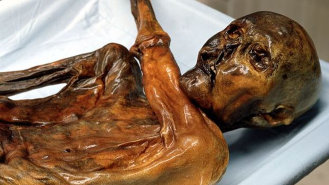
Öetzi, Europe’s frozen mummy, got his wardrobe from many different critters: why, we don’t know.

Piltdown Man’s in the news again, too. Looks like Dawson was the only culprit.

  1. Buried for Millennia: Big Stones and Unanswered Questions
  2. Öetzi’s Eclectic Wardrobe
  3. Piltdown Man: Dawson Acted Alone

Ersatz Science


(From “Indigenous races of the earth,” Josiah Clark Nott, George Robbins Gliddon (1857); and “The Evolution of Man,” Ernst Haeckel (1874): via Wikimedia Commons, used w/o permission.)
(Nott, Gliddon & Haeckel: ‘Proofs’ that the 19th century’s upper crust were superior to the rest of us.)

One of these days I’ll probably harangue about Marcellin Boule’s notion of what Neanderthals looked like: hairy, gorilla-like, with opposable toes.

In fairness, Boule’s Neanderthal skeleton was the first one analyzed — the remains of an old man, crippled with arthritis. We’ve learned a lot since then.

The ‘caveman‘ in the top picture is František Kupka’s ‘Neanderthal’ reconstruction, from L’Illustration & Illustrated London News (1909). The I. L. N. was the world’s first illustrated weekly news magazine: sort of like today’s Time or Newsweek.

My best guess is that Kupka’s picture is “extrapolation and invention” — mostly from Marcellin Boule’s Neanderthal reconstruction.

The other illustration, showing an “Irish Iberian” and two other folks in profile, made its way into Harper’s Weekly. It’s an example of why I don’t miss the ‘good old days:’

“The Iberians are believed to have been originally an African race, who thousands of years ago spread themselves through Spain over Western Europe. Their remains are found in the barrows, or burying places, in sundry parts of these countries. The skulls are of low prognathous type. They came to Ireland and mixed with the natives of the South and West, who themselves are supposed to have been of low type and descendants of savages of the Stone Age, who, in consequence of isolation from the rest of the world, had never been out-competed in the healthy struggle of life, and thus made way, according to the laws of nature, for superior races”
( H. Strickland Constable, via Wikimedia Commons; see “Disorientations: Spanish Colonialism in Africa and the Performance of Identity,” Susan Martin-Márquez (2014) p. 47)

The motives for bigotry dressed up as science seem clear, at least to me. Having ‘proof’ that looking like me makes people superior to folks who don’t could be a dandy excuse for despising them — that’s a hypothetical situation, by the way.1

Bigotry disguised as science is out of fashion at the moment, happily. I think the more recent notion that there aren’t — or shouldn’t be — any measurable differences between folks whose ancestors are from different continents is just as silly, and that’s another topic.

Getting back to “Irish Iberians” and bias: If I thought intelligence depended on looking “Anglo-Teutonic,” I’d be in a pickle. From the side, my head’s somewhere between that English analog of das Herrenvolk and the “Irish Iberian.”

No surprises there. Before crossing the Atlantic, half my ancestors came from Ireland and Scotland; as far back as we’ve got records, anyway. The other half are from Norway.

I’ll be talking about another sort of fake science: Dawson’s Piltdown man. I don’t know why folks make fake ‘discoveries’ like the Piltdown Man, Cardiff Giant, and Archaeoraptor. I suspect hubris is involved, and I talked about that a month ago. (July 31, 2016)

Rip-Roaring Tales and Being Human


(From Wonder Stories, via DavidSZondy.com, used w/o permission.)
(Illustrations for Edmond Hamilton’s “The Man Who Evolved.” (1931))

The Man Who Evolved” is science fiction, but not particularly scientific. Edmond Hamilton may or may not have known that dosing a human with heavy concentrations of cosmic rays would result in a very dead human: but scientists of the 1930s did.

Some folks, exposed to tales like “The Man Who Evolved” and “Creature from the Black Lagoon,” might grow up to be scientists: because of, or despite, the melodrama.

Others — sometimes I think nobody could mistake rip-roaring tales like those for serious science. But sometimes I’m not so sure: particularly when I’m feeling grim, or enduring a cold.

I introduced you to Mr. Squibbs, the intense little fellow over there, last week; and — have used that picture rather often, I see. (August 21, 2016; August 5, 2016; July 22, 2016)

Where was I? Cavemen, ersatz science, monster movies. Right.

This is not where I start ranting about “tampering with things man was not supposed to know.”

I have to believe that: God created and is creating a good and ordered universe; we’re made in the image of God, rational creatures — and stewards of the physical world. (Genesis 1:2728, Psalms 19:2; Wisdom 7:17; Catechism of the Catholic Church, 16, 341, 373, 1730)

We’re supposed to be curious about where we came from and where we’re going. This curiosity isn’t idle. We’re “called to a personal relationship with God,” and can learn something of God by studying God’s creation. (Catechism, 282289, 299, 301)

Learning more about this universe, and using that knowledge to develop technologies, is part of our job. Ethics apply, of course. (Catechism, 22922296)

It also gives us opportunities for “even greater admiration” of God’s greatness. (Catechism, 283)

And now, paraphrasing Rocket J. Squirrel’s line, here’s something I hope you’ll really like.


1. Buried for Millennia: Big Stones and Unanswered Questions


(From James Robertson/Orkneyskycam.co.uk, via BBC News, used w/o permission.)
(“Archaeologists say they can only speculate at the moment as to the reason why the structure was built”
(BBC News))

Mystery stone structure under Neolithic dump on Orkney
Steven McKenzie, BBC News, (August 22, 2016)

Archaeologists have uncovered a mysterious stone structure buried under what they describe as Scotland’s ‘largest Neolithic rubbish dump’.

“The layout of the stone slabs, known as orthostats, found during a dig at Ness of Brodgar on Orkney is unlike anything previously found on the islands.

“Archaeologists are also mystified as to why the structure was covered over by a huge midden.

“They have speculated that it could possibly be a chambered tomb.

“However, the dig team, which is led by University of the Highlands and Islands Archaeology Institute, said further ‘hard work’ would be needed to properly understand the find….”

If I was an archeologist living around the year 5300, I might find a collection of Steuben crystal interesting.

But I’d likely be more interested in a well-preserved 20th-century landfill. My guess is that there isn’t much, short of disaster zones like Pompeii, that’s a better ‘snapshot’ of how folks lived and worked.

The Ness of Brodgar is between Stonehenge-style installations near Brodgar and Stenness on the Orkney Islands, off Scotland’s north shore.

Construction at the Ness of Brodgar started roughly five millennia back, around the time Merneith was running Egypt, give or take a few centuries. Folks kept building there for another millennia, until about the time Sargon started the Akkadian Empire.

Given the massive stonework and the effort involved in building and rebuilding it for a millennium; I think it’s obvious that it was very important to folks who lived in the area.

Why they built it, and then started dismantling it, is a good question.

Archeologists have found pottery, cremated animal bones, stone tools, and polished stone mace heads: which suggests that some sort of ceremonies happened there. Maybe it was a “temple:” or maybe ceremonies happened there because it was an administrative center.

Think about it: archeologists on Chesapeake Bay’s west shore in the 52nd century might find evidence of ceremonial activity around the Tomb of the Unknowns.

Only a few kilometers (or whatever units they’re using), they’d find the remains of something very much like Greek temples, but built about two dozen centuries after the Aegean prototypes.

They might speculate that the area had been a temple complex —

I recommend Robert Nathan’s “The Weans” (1960, available through Amazon.com) for a “…fascinating story of the expeditions of Kenya’s greatest scientists who discovered the civilization of the Weans.”

It’s a funny (my opinion) look at how wildly wrong archeologists could be, getting evidence and assumptions confused.

More:


2. Öetzi’s Eclectic Wardrobe


(From Institute for Mummies and the Iceman, via BBC News, used w/o permission.)
(“Researchers from Ireland and Italy studied nine samples from six items”
(BBC News))

DNA traces origins of Iceman’s ragtag wardrobe
Jonathan Webb, BBC News (August 18, 2016)

DNA analysis of Oetzi the Iceman’s clothes has traced their origin to at least five different species of animal.

“Among his kit were a hat of brown bear skin and a quiver made from roe deer.

“Despite being well preserved and studied, the 5,300-year-old mummy’s various leather items had not all been identified at the species level.

“These findings, published in Scientific Reports, reveal a mix of wild-hunted animals with sheep, goat and cattle related to modern domestic breeds….”

“Oetzi’s” coat was a patchwork of sheep and goat skin; his fur cap started out on a brown bear; and his leggings were goat skin.

Maybe he was a fashionista, sporting the latest thing in menswear. Or maybe his coat was the best he could do with materials on hand. We may never know.

We also don’t know why he was in the stretch of mountains we call the Ötztal Alps — that’s where our nickname for him, Ötzi, comes from — or what he did for a living.

Copper particles and arsenic in his hair hint that he worked in or lived near a copper smelting operation, but his legs and pelvis look like he spent a lot of time walking in hilly country.

Maybe he was a high-altitude shepherd. Or maybe he worked in a copper refinery and liked to take long hikes.

We do know, from pollen, dust grains, and isotopes in his tooth enamel, that he grew up eastwards of where he was buried; near where Feldthurns is now. Later he moved to valleys around Bolzano — that’s what folks call Bauzanum these days.

His clothing, physical condition, and tech found with his body, tell us that he was an agropastoralist: someone whose daily life involved agriculture and livestock herding.

Although we’re pretty sure about when he lived, some folks put him in the Neolithic, others in the copper age, or Chalcolithic. That’s because periods overlap. In Ötzi’s day some folks had been smelting and using copper for some two millennia, while others weren’t up to speed with the new tech.

Pollen from his second-to-last meal puts Ötzi’s death in the spring. He was around 45 years old at that point; 1.65 meters, around five and a half feet, tall; and weighed about 50 kilograms, 110 pounds.

That’s about average for folks living after agriculture caught on, short and scrawny compared to the earlier hunters. It took about five millennia for us to work the bugs out of agricultural tech and social structures, and that’s yet another topic.

Arrowheads, Genes, and Respect

Ötzi apparently died fighting. There’s an arrowhead lodged in his left shoulder, a deep cut on one hand hadn’t had time to heal, and there’s evidence of a blow to his head.

His final encounter wasn’t one-sided, though. There’s blood from a total of four other folks on his gear: including some from two individuals on one of his arrowheads, and blood from another on his coat.

Ötzi may have carried one of them on his back, suggesting that he was with someone and they were both attacked. The odds are that Ötzi died near where his body was found — or maybe he’d been carried uphill after being killed. That’s another detail we don’t know.

We’ve learned a great deal about genetics in the quarter-century since Ötzi’s body turned up. Analyzing mitochondrial DNA told scientists what critters his clothes were made from. His body is very well-preserved — including intact blood cells — so we’ve got his DNA profile, too.

Ötzi has at least 19 male relatives living in Tyrol, but most of his kinfolk live elsewhere in southern Europe; particularly places like Corsica and Sardinia.

When they’re not being studied, his body and possessions are displayed at the South Tyrol Museum of Archaeology: established in 1998 specifically to house Europe’s famous mummy.

“…The body is held in a climate controlled chamber within the museum at a temperature of -6 Celsius and 98% humidity, replicating glacier conditions in which it was found. Along with original finds there are models, reconstructions and multimedia presentations showing Ötzi in the context of the early history of the southern Alpine region….”
(Wikiepdia)

This is a far cry from the postmortem commercial exploitation of Elmer McCurdy’s body, so I’m not overly concerned about the museum’s display.

I certainly don’t fear “Ötzi’s curse:” the notion that bad things happen to folks who disturb the mummy’s existence. True, seven of the several hundred folks involved have died during the intervening 25 years: but that’s about what you’d expect, statistically.

My concern is more a matter of respect. Ötzi didn’t stop being a person when he died. He’s not using his body at the moment, but it’s still the physical component of a human person. (Catechism, 23002301)

I talked about civilization, autopsies, and being human, last month. (July 15, 2016)

More:


3. Piltdown Man: Dawson Acted Alone


(From Karolyn Shindler, via BBC News, used w/o permission.)
(“CSI Piltdown: DNA analysis was conducted on the specimens (seen in the background)”
(BBC News))

Piltdown review points decisive finger at forger Dawson
Jonathan Webb, BBC News August 10, 2016)

Researchers have finished an eight-year study of one of the most infamous forgeries in the history of science – the fake human ancestor Piltdown Man.

“They conclude that the forged fossils were made by one man: the prime suspect and ‘discoverer’ Charles Dawson.

“The human-like skull fragments and an ape-like jaw, complete with two teeth, shook the scientific world in 1912 but were exposed as a hoax in 1953.

“The research, published in Royal Society Open Science, was a multi-disciplinary collaboration including palaeobiologists, historians, dental experts and ancient DNA specialists….”

Not all scientist thought Piltdown Man was what Dawson claimed. In 1915, for example, Gerrit Smith Miller said the Piltdown jaw was from a fossil ape. He was right.

The jaw and a tooth were from an orangutan that most likely came from southwest Sarawak. Dawson apparently pried teeth out of the jaw, ground them down to look more ‘human,’ and stuck them back in place.

The rest of the skull was human, from the medieval era, Mr. Dawson stained the bones to make them look old, used dentist’s putty to cement the pieces together, and got his 15 minutes of fame.

This is not the sort of legacy I’d want:

“The Piltdown man forgery of 1912 was one of the most successful and wicked of all scientific frauds….”
(“Piltdown Man: The Great English Mystery Story,” Keith Stewart Thomson (1991))

Dawson’s forgery succeeded partly because he made his ersatz fossil look like the ‘missing link’ between apes and humans that some scientists figured should exist. It also made England’s East Sussex humanity’s cradle. I talked about bias disguised as science earlier.

It’s been decades since I’ve run into the Piltdown Man used as an example of how evolution is wrong, or the Scopes Monkey Trial as proof that Christians are willfully ignorant. Like I keep saying, I don’t miss the ‘good old days.’

I’m not sure what bothers me most about the Piltdown hoax: the decades of wasted effort spent studying the fake, attention that wasn’t paid to real evidence, or the brouhaha represented by the Scopes Monkey Trial.

More:

More-or-less-related posts:


1 Seriously: I should love God, love my neighbor, see everybody as my neighbor, and treat others as I’d like to be treated. (Matthew 5:4344, 7:12, 22:3640, Mark 12:2831; Luke 6:31, 10:2527, 2937; Catechism, 1789)

If I found myself despising someone else, my job would be rooting out that attitude: not finding excuses for it.

Posted in Science News | Tagged , , , , , | 4 Comments

Why Friday’s Post Came on Sunday

There’s a reason for my ‘Friday’ post showing up Sunday morning; and this week’s ‘Sunday’ post, whatever it’ll be about, getting delayed until next Sunday.

It’s been ‘one of those weeks.’

Starting Monday afternoon, I’ve experienced a series of minor technical glitches and a major one, simple tasks that turned complex, swift errands that took hours – – – you get the idea. Then on Friday I discovered that I couldn’t update this blog.

On the ‘up’ side, I was getting the same “Fatal error: Call to undefined function wp_raise_memory_limit…” message each time I tried logging in, right after WordPress crashed.

That gave me and my son something to talk about when he got home from work.

We agreed that something had gone wrong when I updated WordPress — before adding Friday’s ‘science’ post, not one of my better decisions — and that fixing the problem would take much less time and effort if I let him sit at my desk and work: undistributed.

That discussion started late Friday, continued in sporadic bursts through Saturday evening, and ended with my son playing a choral “ALLELUIA!” on his phone: by way of announcing that the errant software was (probably) working again.

I can’t complain. I could, actually, but it wouldn’t be reasonable or helpful.

More good news: my wife and #3 daughter got back from St. Cloud, an hour down the Interstate; and the family van is (probably) safe for in-town driving. The brakes, probably, had started smoking after they got lost. After dark. In the larger town.

I spent part of Saturday catching up on tasks that hadn’t gotten done since Monday, and expect to be doing more of the same through part of tomorrow: at least. Then I hope that I’ll be back to my usual Weekly Schedule, getting next Friday’s post ready.

That’s the plan. What actually happens: we’ll see.

Posted in Being a Writer | Tagged | 3 Comments