A Jordanian couple have a baby boy: who does not have a lethal genetic disorder, thanks to DNA transplanted from a third person. Four of his siblings did not survive the procedure.
I’ll be talking about the decisions involved in that procedure, research involving “tiny brains” grown from human cells, genetically modified humans grown as research subjects, and water bears.
- It’s a Boy: With DNA from Three People
- Growing “Tiny Brains”
- “Breaking Taboo” and Disposable People
- DNA and Water Bears
After discussing recent genetics news, I’ll share why I take human experimentation and medical ethics personally, and what I see coming in the near future:
First, a look the Tuskegee experiments, Shakespeare’s Richard III, and emotions.
Tuskegee and the Hippocratic Oath
 Someone, Hippocrates or one of his students, wrote the Hippocratic Oath about two dozen centuries back.
It’s been rewritten, or ignored, quite a few times since.
But the basic idea, that doctors should behave ethically, won’t go away.
The World Medical Association’s Declaration of Geneva, 1948, followed embarrassments like Josef Mengele, Sigmund Rascher, and Unit 731.
A few decades later, the Tuskegee syphilis experiment (1932-1972) was finally exposed.
Around the same time, Hepatitis studies at Willowbrook State School were shut down; possibly because too many folks got squeamish over using mentally disabled children as lab animals.
Using humans in medical or scientific experiments isn’t bad by itself. What’s wrong is exposing the subject’s life, health, or sanity “to disproportionate or avoidable risks.” Taking that sort of risk without informed consent makes it worse. (Catechism of the Catholic Church, 2295)
That does not make doctors evil, or science bad.
Scientific research, including “research aimed at reducing human sterility,” can be a good thing: provided that we behave ethically. (Catechism, 2292-2295, 2375)
Ends and Means
 I don’t need a cochlear implant, happily; but both my hip joints were swapped out a few years back, and several medications correct chemical imbalances in my brain.
I’m not racked with guilt because I didn’t ‘trust God,’ expecting miracle cures — because health is a “precious gift,” and I’m supposed to take reasonably good care of mine. (Catechism, Catechism, 2288-2289)
Wanting to cure disease or reduce suffering is a good thing, but the end doesn’t justify the means. Doing something bad and saying it’s for a good cause doesn’t make it right. (Catechism, 1753, 1789, 2278-2279, 2288)
Shakespeare has the title character say ‘I’ll be a villain’1 when the curtain goes up in Richard III: getting away with it because he’s Shakespeare, and Elizabethan audiences loved that sort of thing.
I strongly suspect that most folks who behave badly don’t see themselves as villains:
“And what’s he then that says I play the villain? When this advice is free I give and honest….”
(Iago, act II, scene III. “Othello,” Shakespeare, via Project Gutenberg)
Using humans as experimental subjects isn’t necessarily bad. Forgetting that humans — all humans — have equal dignity is. (Catechism, 372, 872, 1700 and following, 1934, 2203, 2334)
It’s not too hard, these days, to convince many Americans that subjects of the Tuskegee experiments were people whose lives mattered. That’s good news.
Changing Standards
 Our standards have changed since the mid-19th century:
“…’…We blowed out a cylinder-head.’
” ‘Good gracious! anybody hurt?’
” ‘No’m. Killed a [redacted].’
” ‘Well, it’s lucky; because sometimes people do get hurt….’…”
(“The Adventures of Huckleberry Finn,” Part 2 (1885), Chapter XXXII, Mark Twain; via gutenberg.org)
“Huckleberry Finn” is fiction, but I’m pretty sure that Mark Twain knew folks who shared Aunt Sally’s belief that some folks weren’t, or weren’t quite, “people.”
Aunt Sally was nice enough, with no more than the usual human failings. But she lived in a society which treated some people as if they were property. It was a bad idea then, and still is. (Catechism, 2414)
I’m a Catholic, so I must believe that humans are people. All of us.
Human Life and Beliefs
 I’m obliged to believe that each of us is someone, not something; a person; made in the image of the God. (Genesis 1:27; Catechism, 355-–357, 362)
God creates each of our souls. My soul is the immortal part of me, made by God at my conception, which will be separated from my body at death, but reunited at the final Resurrection. (John 5:28–29; Acts 24:15; Catechism, 366, 1038)
That’s why human life is sacred. (Catechism, 2258)
Everyone’s life is precious, no matter who our ancestors are, where we live, what we look like, or how old we are. (Catechism, 357, 361, 369-370, 1700, 1730, 1929, 2273-2274, 2276–2279)
We’re not all alike, and we’re not supposed to be. But we each have equal dignity. (Catechism, 33, 366, 1934-1938, 2232, 2393)
We can think, and decide how we act. In these ways we are like God. (Catechism, 1700-1706)
People, including children, are not property. My wife and I see our children as gifts from God: people in their own right, who we have been blessed to raise. (Catechism, 2221-2224, 2373-2379, 2414)
I must respect local, regional, and national, authorities; and be a responsible, active, citizen. (Catechism, 1897-1904, 1913-1917)
That does not mean blindly following orders, or committing acts which are legal but wrong. I shouldn’t steal, for example, unjustly taking another person’s property — even if my action is legal and socially acceptable — and “one is morally bound to resist orders that command genocide.” (Catechism, 1905-1912, 2242, 2313, 2409)
Science and technology are fine. Learning how the universe works and using that knowledge to make new tools, is part of being human. Ignoring ethics isn’t — or shouldn’t be. (Catechism, 159, 2292-2296, 2375-2377, 2414)
“I have a Very Bad Feeling About This”
 In the movies, these are good lines:
“I have a very bad feeling about this.”
(Luke Skywalker)(via IMDB.com)
“Luke, trust your feelings!”
(Obi-Wan Kenobi)
I didn’t find Obi-Wan Kenobi’s advice from the 1977 movie “Star Wars” in IMDB’s lists of movie quotes, except for something involving Mystery Science Theater 3000, which surprised me a bit.
I’ve seen plenty of references to “trust your feelings” elsewhere though: mostly in discussions or rants about how it’s a bad idea.
I talked about trusting emotions, within reason, on Wednesday. (October 5, 2016)
Basically — emotions2 aren’t good or bad by themselves. Emotions happen. Sometimes they tell me that I should pay attention to something. What matters isn’t the emotion. It’s how I use my will and reason. (Catechism, 1767)
Humanity’s track record for using our freedom is far from perfect, and that’s another topic. (Catechism, 1707-1709)
1. It’s a Boy: With DNA from Three People

(From New Hope Fertility Centre, via BBC News, used w/o permission.)
(“Dr John Zhang holding the baby boy who was conceived thanks to the new technique that incorporates DNA from three people”
(BBC News))
“First ‘three person baby’ born using new method”
Michelle Roberts, BBC News (September 27, 2016)
“The world’s first baby has been born using a new ‘three person’ fertility technique, New Scientist reveals.
“The five-month-old boy has the usual DNA from his mum and dad, plus a tiny bit of genetic code from a donor.
“US doctors took the unprecedented step to ensure the baby boy would be free of a genetic condition that his Jordanian mother carries in her genes….”
The mother is healthy, but about a quarter of her mitochondria have genes for Leigh disease, or Leigh syndrome.
Her first two babies died from this disorder. Leigh disease affects the central nervous system, and generally kills its victims after a few very unpleasant years. Small wonder that this couple decided to get help.
A family; mother, father, and children; is very important. Families are where societies start, where children learn to care for themselves and for others. That’s how it’s supposed to work, anyway. (Catechism, 2201-2213)
Having kids is a good thing. “…Children are really the supreme gift of marriage….” (“Gaudium et Spes,” Pope Paul VI (December 7, 1965))
Some folks are catching on that sub-replacement fertility is happening in nearly half of the world’s nations, and that’s yet another topic.
My hat’s off to couples who decide that raising more than one or two kids is a good idea.
“…Among the couples who fulfil their God-given task in this way, those merit special mention who with a gallant heart and with wise and common deliberation, undertake to bring up suitably even a relatively large family….”
(“Gaudium et Spes“)
Not having kids can be a good thing, too.
Married couples who cannot have children “…can radiate a fruitfulness of charity, of hospitality, and of sacrifice.” Adoption can be a win-win situation for an infertile couple and a child who needs a home. (Catechism, 1652-1654, 2379)
My wife and I had no trouble getting kids started. Keeping them alive was another matter. Two of the six died before we got a chance to know them, and we nearly lost my wife the second time. That was a stressful experience.
Some couples discover that they cannot conceive children. That can be stressful, too. (Genesis 30:1; Catechism, Catechism, 2373-2379)
Sole Survivor

(From BBC News, used w/o permission.)
“Exclusive: World’s first baby born with new ‘3 parent’ technique”
Jessica Hamzelou, New Scientist (September 27, 2016)
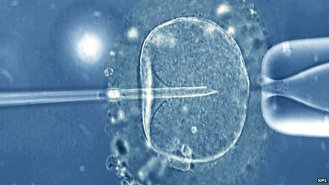
“…The method approved in the UK is called pronuclear transfer and involves fertilising both the mother’s egg and a donor egg with the father’s sperm. Before the fertilised eggs start dividing into early-stage embryos, each nucleus is removed. The nucleus from the donor’s fertilised egg is discarded and replaced by that from the mother’s fertilised egg.
“But this technique wasn’t appropriate for the couple – as Muslims, they were opposed to the destruction of two embryos. So Zhang took a different approach, called spindle nuclear transfer. He removed the nucleus from one of the mother’s eggs and inserted it into a donor egg that had had its own nucleus removed. The resulting egg – with nuclear DNA from the mother and mitochondrial DNA from a donor – was then fertilised with the father’s sperm.
“Zhang’s team used this approach to create five embryos, only one of which developed normally. This embryo was implanted in the mother and the child was born nine months later….
“…Neither method has been approved in the US, so Zhang went to Mexico instead, where he says ‘there are no rules’. He is adamant that he made the right choice. ‘To save lives is the ethical thing to do,’ he says….”
I am happy for the couple and their surviving baby. The four siblings who died in the process — I trust that their deaths were unintentional.
Given what I’ve read about this situation, I am reasonably certain that the couple did not knowingly agree to a ‘winner takes all’ situation, with life as the prize for the one child who survived.
Whether or not the doctors involved understood what they were doing is a good question. I prefer to assume that Dr. Zhang and others believe they acted correctly.
My take on this situation is counter-cultural, and starts in Deuteronomy:
“1 ‘Hear, O Israel! The LORD is our God, the LORD alone!”
(Deuteronomy 6:4)
A bit over a half-dozen centuries later, our Lord said that “This is the greatest and the first commandment.” (Matthew 22:38)
He also said that loving our neighbor, and seeing everyone as our neighbor, is a very good idea. (Matthew 5:43–44, 22:36–40; Mark 12:28–31; Luke 6:31, Luke 10:25–27, 29–37; Catechism, 2196)
That’s everyone: the neighbor using power tools outside at night, the guy who took ‘my’ parking space, folks I’ve never met. Everyone — including folks who aren’t “people” by my native culture’s standards.
I can’t pick and choose who I want to believe is a person and who isn’t.
Well, actually, I can. I’ve got free will, and that’s yet again another topic.
This is where it gets awkward.
Some of what follows may seem familiar. I discussed this sort of gene therapy last year, when A Catholic Citizen in America was on Blogger. (February 13, 2015)
Therapy, Death, and “Rational Reflection”
 Mitochndrial donation is a new form of in vitro fertilisation where part of the baby’s mitochondrial DNA comes from a third party.3 As of last year, it’s legal in the UK:
I could assume that this medical technology is bad because it’s new: or good for the same reason. That doesn’t seem reasonable.
Instead, I’ll look at what’s involved.
I’m pretty sure that scientists who developed this technique didn’t see major safety or ethical issues. Unless they’re daft, the scientists wouldn’t ask for human testing until they were confident that their tech would work.
Preventing lethal disease of any sort, including mitochondrial diseases, is a good idea. (Catechism, 1503-1510)
I could get excited by the prospect of a world without birth defects.
It’s a personal issue for me. A friend and classmate died in her teens of a cancer that might have been due in part to an inherited metabolic glitch.
My defective hips may be inherited, or could have happened for other reasons. My quirky neurochemistry is almost certainly inherited. My father was the same way, although less so; and two of my kids enjoy — or suffer — what I do.
However:
“…what is technically possible is not for that very reason morally admissible. Rational reflection on the fundamental values of life and of human procreation is therefore indispensable for formulating a moral evaluation of such technological interventions on a human being from the first stages of his development….”
(“Instruction Dignitas Personae on Certain Bioethical Questions,” William Cardinal Levada, Prefect; Luis F. Ladaria, S.I., Titular Archbishop of Thibica, Secretary; Congregation for the Doctrine of the Faith (September 8, 2008)) [Emphasis mine]
Life and Leftover Parts

(From HFEA, via BBC News, used w/o permission.)
(“1) Two eggs are fertilised with sperm, creating an embryo from the intended parents and another from the donors 2) The pronuclei, which contain genetic information, are removed from both embryos but only the parents’ are kept 3) A healthy embryo is created by adding the parents’ pronuclei to the donor embryo, which is finally implanted into the womb[.]”
(James Gallagher, BBC News (February 3, 2015))

(From HFEA, via BBC News, used w/o permission.)
(“1) Eggs from a mother with damaged mitochondria and a donor with healthy mitochondria are collected 2) The majority of the genetic material is removed from both eggs 3) The mother’s genetic material is inserted into the donor egg, which can be fertilised by sperm.”
(James Gallagher, BBC News)
Like I said earlier, I must believe that human life is sacred; and that humans are people; no matter how young, old, or sick we are. (Catechism, 2258, 2270, 2276-2279)
That’s why I’m pretty sure that “method one” isn’t acceptable.
You’d start with two people: one from the parents, and one from donors. You’d wind up with one person: with the donor-child’s mitochondrial DNA and the parent’s DNA in his or her cells’ nuclei.
I could rationalize that half a person is better than none, or that two halves make a whole, or dive into metaphysical gibberish.
I won’t, because I’m pretty sure that when two living people go into an operating room, and one comes out — someone’s missing, and the leftover parts suggest that one of the originals died.
That doesn’t seem right.
I think “method two” may, in at least some cases, be acceptable. In theory, at least.
That’s because the church doesn’t insist that every bit of material with human DNA is a person.
“Method two” could start with two eggs — not people — and ultimately end with a person. Nobody dies, and that’s a good thing.
Four out of Five
 More accurately, that would be a good thing, if nobody died.
As Jessica Hamzelou’s article in New Scientist (September 27, 2016) points out, five people were conceived in this procedure.
Only one “developed normally” and was allowed to live.
Four out of five non-survivors is an 80% mortality rate.
Again, I’m happy for the baby boy who survived, and for the couple who will raise him: but that’s a lot of death for one life.
The death rate leading to this couple’s new arrival was about as low as can be hoped for. That was the case in 2008, at least, mentioned in footnote [27] of “Instruction Dignitas Personae:”
“…It is true that approximately a third of women who have recourse to artificial procreation succeed in having a baby. It should be recognized, however, that given the proportion between the total number of embryos produced and those eventually born, the number of embryos sacrificed is extremely high.[27] These losses are accepted by the practitioners of in vitro fertilization as the price to be paid for positive results….”
(“Instruction Dignitas Personae on Certain Bioethical Questions;” William Card. Levada, Prefect; Luis F. Ladaria, S.I., Titular Archbishop of Thibica, Secretary (September 8, 2008)
“[27] Currently the number of embryos sacrificed, even in the most technically advanced centers of artificial fertilization, hovers above 80%.”
“…The practice of keeping alive human embryos in vivo or in vitro for experimental or commercial purposes is totally opposed to human dignity. In the case of experimentation that is clearly therapeutic, namely, when it is a matter of experimental forms of therapy used for the benefit of the embryo itself in a final attempt to save its life, and in the absence of other reliable forms of therapy, recourse to drugs or procedures not yet fully tested can be licit….”
(“Donum vitae,” “Instruction on respect for human life;” Joseph Card. Ratzinger, Prefect; Alberto Bovone, Titular Archbishop of Caesarea in Numidia Secretary (February 22, 1987))
2. Growing “Tiny Brains”

(From BBC, used w/o permission.)
“The genius who grows tiny brains in a lab”
BBC Earth (26 September 26, 2016)
“Our brains are complex organic computers – some believe the most complicated in the Universe. Yet one scientist has managed to create mini brains that mimic how our minds work.
“Deep in a lab in Cambridge, England, you will find see an extraordinary thing: tiny, exact replicas of the human brain growing in a petri dish.
“Their creator, Madeline Lancaster, still remembers the day she first wanted to study the human brain as a small girl. Her father was a scientist, and one day he allowed her to peer down a microscope and view a neuron growing in a petri dish. ‘I was completely struck by how beautiful and how complex the neural structure is. It’s just amazing.’…”
The human brain is amazing, and I agree with BBC Earth’s assertion that “animal studies can only tell us so much about our own minds.”
I talked about our version of the SRGAP2 gene last month. (September 23, 2016)
I’m not so sure about this:
“…Unfortunately, it’s been enormously difficult to probe its secrets – it’s not as if a scientist can just lift off the skull, like the hood of a car, and peer inside at the tissue underneath….”
(BBC Earth)
It’s true that craniotomies are major operations, and that finding enough student volunteers for a research project might be a challenge.
However, imaging tech has come a long way since my youth, when shoe-fitting fluoroscopes were still in fairly common use. As I’ve said before, I don’t miss the ‘good old days.’
These days, surgeons often get an MRI scan before the operation, to see where the various parts are. That would be an example of structural neuroimaging.
Functional neuroimaging tech, like positron emission tomography, functional magnetic resonance_imaging, and magnetoencephalography — try saying that fast, five times — lets us “see” what a brain is doing.
I’ll grant that neuroimaging, like anything else, has limitations.
That, apparently, is why Lancaster is growing miniature versions of human brains in her lab.
Neurons and Confidence

(From keval_tilva, Shakhova, O., and Sommer, L., Neural crest-derived stem cells (May 4, 2010); via Wikimedia Commons; used w/o permission.)
“…She uses stem cells cultivated from skin samples and then bathes them in nutrients and vitamins designed to trigger their development into neurons, before planting them in a dense protein gel. Amazingly, as the cells replicate and grow, they start to organise themselves into a tiny model of our own brains.
” ‘Although they don’t have any sensation or any feeling we now have this tool that we could use to answer all kinds of questions about a developing brain,’ says Lancaster….”
(BBC Earth)
I hope she’s right, that “…they don’t have any sensation or any feeling…” — and that these tiny brain-like clusters of human neurons are no more than useful laboratory specimens.
About the stem cells used to get these organoids started: stem cells in my skin aren’t “embryonic,” and haven’t been for decades. But they can be reprogrammed to act embryonic stem cells, after which they’d be called induced pluripotent stem cell.
I probably wouldn’t enjoy the process of collecting stem cells from my skin any more than I enjoyed giving blood samples for routine lab work yesterday. But aside from discomfort, I’d be unharmed; and very nearly unaffected.
Getting back to the brain-like clusters of human neurons, I’d be more confident that they don’t feel anything if so many folks weren’t convinced that animals don’t experience pain. That idea goes back at least as far as Descartes.
I’ll agree that humans are a special sort of animal, and I’ve talked about that before. (July 15, 2016)
Brains in a Vat?
 Since the mini-brains aren’t connected to eyes, ears, or other body parts, they can’t tell researchers what they see or feel.
I’m not entirely convinced that this inability proves that they aren’t aware to some extent.
A near-worst-case scenario is that they’re very young people, experiencing something like locked-in syndrome combined with total sensory deprivation.
Folks have used partial sensory deprivation for millennia.
Hitbodedut, dark retreat, Pratyahara, and various disciplines of monastic silence, involve reducing or avoiding sensory stimulation. Some folks think it’s therapeutic, and they may be right.
I do an hour of Eucharistic adoration each week in a very quiet room. That sort of spiritual exercise does not come naturally to me: but I think it’s a good idea.
On the other hand, complete sensory deprivation for 15 minutes sometimes leads to hallucinations or delusions. Researchers figure some of that comes from source-monitoring errors in our brains.
Longer-term sensory deprivation. particular when it’s forced on someone, can lead to more unpleasant experiences.
Maybe those clusters of human neurons really are no more than experimental subjects. They’re certainly not equivalent to adult human brains.4
But I’d be a whole lot less uneasy, if I limited my notion of “people” to folks who are at least a few months old.
3. “Breaking Taboo” and Disposable People

(From Rob Stein/NPR, via NPR, used w/o permission.)
(“Fredrik Lanner (right) of the Karolinska Institute in Stockholm and his student Alvaro Plaza Reyes examine a magnified image of an human embryo that they used to attempt to create genetically modified healthy human embryos.”
(NPR))
“Breaking Taboo, Swedish Scientist Seeks To Edit DNA Of Healthy Human Embryos”
NPR (September 22, 2016)
“NPR recently got exclusive access to Lanner’s labs at the Karolinska Institute in Stockholm to watch some of his early efforts.
“During the visit, Lanner and a graduate student carefully thawed five embryos donated by couples who had gone through in vitro fertilization at the Karolinska University Hospital to try to have children.
“One of the embryos didn’t survive the freezing and thawing process. The researchers gingerly placed each of the remaining 2-day-old embryos into a dish on a special microscope….”
I say this a lot: learning how the universe works, and using that knowledge to make new tools, is part of being human. But being curious isn’t an excuse to misbehave.
Experiments on humans are okay, but not if the experiment “…exposes the subject’s life or physical and psychological integrity to disproportionate or avoidable risks….” (Catechism, 2292-2295)
I don’t imagine that humans become people at some arbitrary age: convenient as that might be. (Catechism, 2270)
That’s why I think that therapeutic treatment of folks who haven’t been born yet can be a good idea: but growing disposable people so they can be used in experiments isn’t. (Catechism, 2275, 2292-2295)
4. DNA and Water Bears

(From Eye of Science/Science Photo Library, via Nature, used w/o permission.)
(“Water bears are renowned for their ability to withstand extreme conditions.”
(Nature))
“Tardigrade protein helps human DNA withstand radiation”
Jason Bittel, Nature (September 20, 2016)
“Experiments show that the tardigrade’s resilience can be transferred to cultures of human cells.
“Water bears are renowned for their ability to withstand extreme conditions.
“Tardigrades, or water bears, are pudgy, microscopic animals that look like a cross between a caterpillar and a naked mole rat. These aquatic invertebrates are consummate survivors, capable of withstanding a host of extremes, including near total dehydration and the insults of space.
“Now, a paper published on 20 September in Nature Communications pinpoints the source of yet another tardigrade superpower: a protective protein that provides resistance to damaging X-rays. And researchers were able to transfer that resistance to human cells.
” ‘Tolerance against X-ray is thought to be a side-product of [the] animal’s adaption to severe dehydration,’ says lead study author Takekazu Kunieda, a molecular biologist at the University of Tokyo. According to Kunieda, severe dehydration wreaks havoc on the molecules in living things. It can even tear apart DNA, much like X-rays can….”
Takekazu Kunieda and others picked Ramazzottius varieornatus, an exceptionally indestructible tardigrade species, for their research.
The first step was sequencing the critter’s genome.
Apparently observing the processes that happen inside tardigrade cells is easier if the tardigrade genome gets inserted into mammalian cells. These researchers reprogrammed cultures of human cells to produce pieces of the water bear’s metabolic machinery.
They learned that a protein called Dsup (“damage suppressor”) kept tardigrade DNA from breaking under the stress of radiation and desiccation. They also discovered human cells with tardigrade DNA weren’t as susceptible to X-ray damage as those without.
This is good news, since the research may lead to treatments that reduce risk for folks working in and near nuclear plants.5
I’m not eager to get my cells reprogrammed with tardigrade DNA: partly because I’m not near radiation hazards, partly because we haven’t sorted out some interesting ethical concerns yet.
“Instruction Dignitas Personae on Certain Bioethical Questions” (2008), 33., specifically addresses reprogramming human somatic cells with another animal’s oocytes.
In other words, the Catholic Church has looked at the implications of mixing human and animal DNA in ways that pass the genetic reprogramming on to succeeding generations.
It’s something we can do, but “…such procedures represent an offense against the dignity of human beings on account of the admixture of human and animal genetic elements capable of disrupting the specific identity of man.…”6
Unchanging Principles, Changing Applications
 I feel a little frustration at the 2008 decision about reprogramming human reproductive cells: and think it makes sense, given what we know today.
The idea isn’t that we should be afraid of knowledge.
It’s that we should remember who we are.
We’re made in the image of God, with a dignity that goes with that our nature. Respect for the dignity of the human person is why social justice is so important, and that’s still another topic. (Catechism, 1700, 1701-1706, 1928-1942)
I accept what the Church says about mixing human and other DNA.
I am also certain that the Church will still say that humanity is made in the image of God two millennia from now — with the dignity and responsibilities that implies.
Since we’re rapidly discovering more about previously-unknown aspects of genetics, I suspect that rules about DNA will be reviewed within the next century: probably sooner.
The Church doesn’t ‘change its mind’ about underlying principles: but how we apply those principles gets revised occasionally.
Cremation, for example, was forbidden at one time: but now is allowed, unless the act is a denial of the body’s resurrection. (Catechism, 2301; “Some Current Questions in Eschatology,” 6.4, International Theological Commission (1992))
Horizontal Gene Transfer, Being Human
 Getting back to genetics — over the last few years, we’ve been learning that gene swapping between species happens regularly. It’s called horizontal gene transfer.
Pea aphids have genes from fungi; a malaria pathogen got genetic material from humans that may help it stay in our bodies.
A recent study says that 100 of the 20,000-odd genes in our DNA probably came from other species. Those figures may or may not be accurate: debate and research were still happening, the last time I checked.
If we learn that some of our inherited genes come from horizontal gene transfer, and if this turns out to be how our bodies are supposed to work — maybe the Church will decide that mixing human and other DNA is acceptable.
It could, I suspect, be seen as equivalent to implants like fillings and artificial joints, but on a molecular level.
Meanwhile, like I said, I accept what the Church says.
Reminiscence of a Lab Rat
 Rotating the hips was part of a newborn’s first checkup, even back in 1951. When I screamed, the doctor said something like ‘that hurts, doesn’t it?’
I don’t know why he didn’t tell my parents that I had congenital hip dysplasia. That’s a five-dollar term meaning that my hips hadn’t grown correctly.
He definitely knew what I was going through, writing a learned paper on what happens when this particular birth defect is ignored.7
My parents eventually learned about my substandard hips. Two operations in early childhood put me on my feet, and after decades of perhaps-avoidable pain I got both hips replaced. It’s a nice change of pace.
That experience, and what happened to my mother when I was twelve, made human experimentation and medical ethics personal issues for me.
Problems — and Opportunities — Ahead
 I think we’ve got problems — and opportunities — ahead.
Strictly therapeutic genetic manipulation may, in some cases, be okay: and a blessing to folks with inherited disorders.
The same technologies could be used to purge “undesirable” traits from humanity. Since many of my ancestors are of an ‘inferior race,’ I can hardly be expected to show enthusiasm for eugenics. And that’s still another topic, for another post.
More posts about faith, science, and making sense:
- Polio, Zika, and Using Our Brains”
(August 21, 2016)
- Bulldogs, Transgenics, and a Robot”
(August 5, 2016)
- Humility isn’t Being Delusional”
(July 31, 2016)
- Sandra and Tommy: Apes and Ethics”
(July 15, 2016)
- Temperance, Catholic Style”
(July 10, 2016)
1 The original line is “I am determined to prove a villain” — my language has changed a bit over the last few centuries. Shakespeare’s Richard III is a very successful play, but not particularly accurate:
2 Some folks seem to be “emotionless;” but my guess is that we have a very great deal left to learn about how we use our neural circuitry, and what can go wrong:
3 ‘Three-parent’ baby, background:
4 Grow-your-own brains, brain in a vat thought experiment, and all that:
5 Tardigrades and somewhat-related topics:
- Wikipedia
- “Extremotolerant tardigrade genome and improved radiotolerance of human cultured cells by tardigrade-unique protein”
Takuma Hashimoto, Daiki D. Horikawa, Yuki Saito, Hirokazu Kuwahara, Hiroko Kozuka-Hata, Tadasu Shin-I, Yohei Minakuchi, Kazuko Ohishi, Ayuko Motoyama, Tomoyuki Aizu, Atsushi Enomoto, Koyuki Kondo, Sae Tanaka, Yuichiro Hara, Shigeyuki Koshikawa, Hiroshi Sagara, Toru Miura, Shin-ichi Yokobori, Kiyoshi Miyagawa, Yutaka Suzuki, et al.; Nature Communications (Received June 21, 2015; Accepted August 3, 2016; Published September 20, 2016)
- “Three-dimensional reconstruction of the central nervous system of Macrobiotus hufelandi (Eutardigrada, Parachela): Implications for the phylogenetic position of Tardigrada”
Juliane Zantke, Carsten Wolff, Gerhard Scholtz; Zoomorphology, via ResearchGate.net (February 2007)
6 A longer excerpt:
“…33. Recently animal oocytes have been used for reprogramming the nuclei of human somatic cells – this is generally called hybrid cloning – in order to extract embryonic stem cells from the resulting embryos without having to use human oocytes.
“From the ethical standpoint, such procedures represent an offense against the dignity of human beings on account of the admixture of human and animal genetic elements capable of disrupting the specific identity of man. The possible use of the stem cells, taken from these embryos, may also involve additional health risks, as yet unknown, due to the presence of animal genetic material in their cytoplasm. To consciously expose a human being to such risks is morally and ethically unacceptable….”
(“Instruction Dignitas Personae on Certain Bioethical Questions,” Congregation for the Doctrine of the Faith (June 20, 2008))
7 Reminiscence of a Lab Rat, continued:
My parents learned about my hips after noticing that I had trouble rolling over and wasn’t very good at crawling.
A surgeon sculpted a socket for my left hip, using bone from my femur. I was able to walk back into the hospital a few years later, when something went wrong with the remodeled hip. The right socket was definitely not up to specs, but was good enough to leave alone.
Neither of the operations, or the physical therapy, were a medical experiment. I’m getting to that.
My father was head librarian at a college, getting himself assigned to the reference desk from time to time. He enjoyed being able to connect students with information they needed: and having time to read a book or periodical from the shelves.
One day, he noticed an article titled something like “Effects of Delayed Treatment on Congenital Hip Dysplasia.” Decades later told me that, as he read the author’s name and realized what the good doctor had done, it felt like the top of his head had come off.
Before he got to the doctor, my mother discussed the matter with him. He returned to his duties at the library. She made an appointment with the doctor.
During that appointment, I suppose that she discussed the matter of congenital hip dysplasia, certain aspects of medical research, and her son. I understand that she did not speak — ever — of what happened in that room.
It might have been more humane, in a way, to let an enraged Irishman get at the doctor, instead of five-foot-nothing of concentrated viking determination.
Like this:
Like Loading...



 We thought our sixth pregnancy would end in a normal delivery. This baby was doing fine. We, and our four surviving children, were looking forward to seeing the newest member of the family.

 Sooner or later, I’ll die. I’m not looking forward to my final performance review, but it’s unavoidable.3
 My hope and goal is to be where death, mourning, and pain, no longer exist: and that’s another topic. (Revelation 21:4)