I keep meaning to get back to this, but haven’t. About six months back, I was introduced to an ‘art’ site:
Better Kaul Vakil Using screens to bring us off the screen. Lets make art together.
It’s — no, you’re better off checking it out yourself.
You’ll find a small but varied set of pictures/paintings, videos, and an introduction to camera lucidia. That’s Latin for ‘light chamber/room’: a 19th-century gizmo that helped folks draw. Turns out there’s at least one way of using today’s tech and the 19th century principles to get similar results.
There. That’s pretty much all I’ve got to say about it today.
A big tip of the hat to Viral Vakil, for introducing me to this site, and for putting it together.
I’d say more, but seriously: check it out yourself.
Robert Edge Pine & Edward Savage’s “Congress Voting Independence”.1 (ca. 1784-1788)
United States Semiquincentennial “America250” logo.
Two and a half centuries back, quite a few English subjects who were living in colonies strung along North America’s east cast had become fed up.
Thoroughly.
Like pretty much anything else involving humans, it’s complicated.
It wasn’t just paying tax on tea, or government-mandated stamps on all paper goods and legal documents. Even having to buy tea exclusively from the British East India Company might have been tolerable.
1776
Enlightenment-era folks reading Voltaire in Madame Geoffrin’s salon, as imagined by Lemonnier. (1812))
What really set them off was having zero representation in the British Parliament.
That, and divisive ideas about self-governance, individual liberty, and natural rights.
That’s why, two and a half centuries ago today, some of the worst troublemakers signed a document we call the Declaration of Independence.2
Looking back with twenty-twenty hindsight, I think it was a good idea.
It helps that I’m an American and grew up in the Sixties, when many folks were realizing that something being legal doesn’t mean it’s right. Also, I’m part-Irish and know about history. Being cautious at best about distant rulers is part of my heritage.
Besides, I know that, for all its faults, America is a good place to live. We’re not all in the top five percent in terms of wealth, but we enjoy a remarkable degree of freedom in what we may do or say.
Now, back to 1776 and all that.
Were all the English subjects in those 13 colonies so fed up that they thought telling their legal rulers to take a hike was a good idea? No.3
Has “the last great experiment, for promoting human happiness” been a complete and unqualified success? In my opinion, no. George Washington described America that way in a letter. I’ll share a longer excerpt a bit later.
19th Century
Alfred Gale’s anti-abolition broadsides (ca. 1865) via Library of Congress.
Detail, Constantino Brumidi’s “The Apotheosis of Washington”, U.S. Capitol rotunda. (1865)
During the 19th century some Americans got — overenthusiastic — about this country and its founders.4
But we weren’t any more homogeneous then than we are now. Some Americans seemed convinced that others were trying to destroy their country.
What various Americans thought “our country” was and should be: that’s another topic for another day. Topics.
Those differences of opinion — again, none of this is simple — boiled over in our only major armed internal conflict. Depending on who’s talking, it’s The Civil War, War Between the States, War of the Rebellion, War for Southern Independence, or simply The Recent/Late Unpleasantness.5
We were still sorting out some of the mess that made when I was growing up. By then, Americans had accumulated even more experiences.
20th Century
“…You don’t have to talk. This large person is making socialists faster than you can make them!” (1911)
Some folks having more than they need while others don’t have enough isn’t unique to America, the 20th century, or any other time or place.
It’s not a problem, or shouldn’t be. Everyone, each person, has the dignity that comes with being human. But we’re not all alike, and aren’t supposed to be. Each of us has needs that others can fill, while being able to fill the needs of others. This is a good thing. (Catechism of the Catholic Church, 1934-1938)
War
Urukami Roman Catholic Cathedral, Nagasaki, Memorial service. (November 23, 1945)
America played a major part in the 20th century’s two global wars. These days, we call them World War I and World War II. My father suggested that they could and should be seen as a single conflict: “The Colonial War”. I think he’s right.6
Times: Good and Changing
Herb Block’s “Say, what ever happened to ‘freedom-from-fear’?” (August 13, 1951) (During McCarthyism)
America had good times, at least economically, after World War II. I remember the trailing edge of that, and the common sentiment that this was a good place to live.
I also remember the problems we had.
Then came the Sixties. Those were interesting times.
Our oldest daughter said that a childhood and youth spent within a couple blocks of a college campus affected my viewpoints. She’s right. So did having parents who were librarians.
At any rate, in my youth I thought many if not most of the social reforms being made were good ideas. I’m not entirely pleased about how some turned out, but I still think trying to make our society more tolerant was a good idea.
The frothing ‘patriots’ of my youth were, I think, sincere in their belief that their country was in peril from communism, Catholicism, and other foreign ideas. At least I hope they were, for their sake.
Today’s right sort have different slogans and quirks. But I see the same zeal, determination, and apparent inability to consider the possibility that they might not be entirely in the right.
This isn’t the America I grew up in. But we endured the Fifties and Sixties, and I think we’ll endure the present nonsense. We may even learn a thing or two.
21st Century
St. Mary’s in Melrose, Minnesota, a few miles down the road: torched in 2016. (WCCO (June 2016))
In a way, the 21st century is more of the same for America.
We’ve been involved in more wars: which, this time around, our government called “wars”; a refreshing change of pace from the embarrassing euphemisms of my youth.
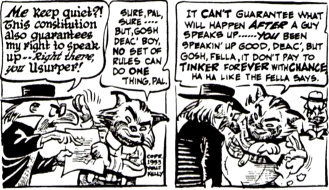
Walt Kelly’s Deacon Mushrat and Simple J. Malarky. (1953)
We’re still on a long learning curve, dealing with a society where everyone’s not on the same page. It hasn’t been and is not easy.
Some Americans have been striving mightily to preserve their freedom of speech, while being upset when others express opinions they don’t like.
The current situation isn’t exactly like the mess we call McCarthyism,7 but I see strong parallels. In both cases, we have self-described defenders of democracy and freedom using their positions of influence and authority to muzzle folks with the ‘wrong’ opinions. And, in the long run, failing. That’s how I see it, at any rate.
I’ve gathered that freedom of religion is a divisive topic. That, again, is not new. What’s changed are the quirks of folks who aren’t comfortable with the idea, and their slogans.
America, Two and a Half Centuries and Still Learning
“Uncle Sam — It’s all right! There’s no fighting! The noise you hear is just my family celebrating!” (1902)
I admit it. I like being an American. I haven’t always been happy about what’s happening in my country, or decisions our ‘better sort’ make.
But I like it here, and think that America is much more than the folks who sit in executive offices, convince enough voters to put them in office, and look good on screen.
This country has a great deal going for it: natural resources; folks with get-up-and-go who got up and went here, and their descendants; navigable rivers and good harbors.
But I think that the remarkably smart and savvy bunch we call the Founding Fathers made a huge difference. That was what this culture calls a “lucky break”.
I’ll wrap this up with a few things George Washington, John Adams, and Abraham Lincoln said; with a (brief) comment or two.
George Washington and “the Great Experiment”
“…Although, neither the present age or Posterity may possibly give me full credit for the feelings which I have experienced on this subject; yet I have a consciousness, that nothing short of an absolute conviction of duty could ever have brought me upon the scenes of public life again. The establishment of our new Government seemed to be the last great experiment, for promoting human happiness, by reasonable compact, in civil Society. It was to be, in the first instance, in a considerable degree, a government of accomodation as well as a government of Laws….” (Letter, George Washington (New York) to Catharine Sawbridge Macaulay Graham (England).(January 9, 1790)8 [emphasis mine]
The United States is still a great experiment: a largely successful one, I think.
Some of the basic — and in the late 17th century disturbing — ideas shaping our government are that:
A government’s power comes from the consent of the governed
Checks and balances prevent autocratic rule
The rule of law applies: notthe whims of some individual or well-connected group
Those ideas are still disturbing, particularly to folks who aren’t getting what they want.
Now, I said “largely successful”. I’ve been paying attention for about a half-dozen decades, and know my homeland’s history. America isn’t perfect. For that matter, neither were the Founding Fathers.
John Adams and “the Roman Catholic religion”
“Can a free government possibly exist with the Roman Catholic religion? The art of lawgiving is not so easy as that of architecture or painting. New York and Rhode Island are struggling for conventions to reform their constitutions, and I am told there is danger of making them worse. Massachusetts has had her convention; but our sovereign lords, the people, think themselves wiser than their representatives, and in several articles I agree with their lordships. Yet there never was a cooler, a more patient, candid, or a wiser deliberative body than that convention….” (John Adams to Thomas Jefferson (May 19, 1821) via National Humanities Center) [emphasis mine] [the NHC has apparently taken down or blocked that particular document (July 1, 2026)] [see John Adams, Wikiquote]
More than two centuries later, “the Roman Catholic religion” is — well, we’re not running rampant over this fair land. But we’re definitely here. So is “a free government”.
I don’t think the concern John Adams expressed is reasonable. But I’m a Catholic and I wasn’t brought up as an Englishman.
I wasn’t brought up as a Catholic, either. Ironically, ranting one-hundred-percent-American-Good-Christian radio preachers helped set me on a path that led me to becoming a Catholic. And that’s another topic. Several, actually.
Abraham Lincoln and Human Nature
“…Human nature will not change. In any future great national trial, compared with the men of this, we will have as weak and as strong, as silly and as wise, as bad and as good. Let us, therefore, study the incidents of this as philosophy to learn wisdom from, and none of them as wrongs to be revenged….” (“On Democratic Government” ; Response to a Serenade, November 10, 1864; Abraham Lincoln (November 10, 1864) via Project Gutenberg) [emphasis mine]
I think Lincoln’s right. We’ve got something like five millennia of written records. I see no indication that human nature has changed.
Our languages, customs, and every other aspect of our societies keep changing.
But the basics, the qualities that make us human? We’ve got the same sort of fools, knaves, heroes and just-plain-folks that we’ve always had. And we still, most of us, have the same feeling that we could and should do a whole lot better.
What we do with that feeling? I’ve talked about that before, a lot:
The Vatican/Holy See recognizing that the SSPX/FSSPX/Lefebvrists/Lefebvrians is not officially part of the Roman Catholic Church isn’t all that surprising.
I’m sharing excerpts: one from an AP article, another from Vatican News. There’s more detail and links in the Vatican News piece.
“…The Vatican responded aggressively Thursday to a traditionalist group that consecrated bishops without the pope’s consent, declaring the Society of St. Pius X had formally broken with the Catholic Church. It also excommunicated its bishops and priests, and warned its faithful that they too face the harshest sanctions in the church.
“By declaring a schism and extending sanctions to potentially thousands of Catholics…
“…The society, known by its acronym SSPX, celebrates the ancient Latin Mass and opposes the modernizing reforms of the Catholic Church, which it considers to be rife with heresies and errors … has been a thorn in the Vatican’s side for five decades because it claims to be even more Catholic than the Holy See….”
“Excommunication decreed for Lefebvrian episcopal ordinations” Vatican News (July 2, 2026) “A document signed by Cardinal Víctor Manuel Fernández, Prefect of the Dicastery for the Doctrine of the Faith, defines the rite celebrated on 1 July as an ‘act of a schismatic nature,’ with an explanatory note providing details of the grave canonical sanction of excommunication.”
“The bishops of the Priestly Fraternity of Saint Pius X, Alfonso de Galarreta and Bernard Fellay—respectively principal consecrator and co-consecrator—and the newly consecrated bishops Pascal Schreiber, Michael Goldade, Michel Poinsinet de Sivry, and Marc Hanappier have incurred ‘ipso facto’ the ‘latae sententiae’ excommunication reserved to the Apostolic See for having carried out ‘an act of a schismatic nature’: the ‘episcopal consecration of four presbyters, without pontifical mandate and against the will of the Supreme Pontiff.’
“This was stated in a decree released on July 2 and signed by Cardinal Víctor Manuel Fernández, Prefect of the Dicastery for the Doctrine of the Faith, and countersigned by the two Secretaries of the same Dicastery.
“The decision came twenty-four hours after the solemn ceremony celebrated in Écône, Switzerland, on the morning of July 1, 2026.
“The Dicastery for the Doctrine of the Faith’s decree establishes that, in the act of carrying out the consecration, both the consecrators and those consecrated incurred the prescribed excommunication….”
In a way, I get it.
Back in 1970, here in America, we were seeing a fair amount of screwball DIY liturgical stunts done “in the spirit of Vatican II”. I wasn’t a Catholic at the time, but even from the outside they seemed silly.
For someone who had grown up in a parish that’d been considered old-fashioned in 1900, “in the spirit of Vatican” antics could have felt — deeply offensive.
I don’t know why or how many priests and bishops actually bought into the “spirit of Vatican II” nonsense. I suspect part of the problem was that American culture was going through a ‘let’s review old habits’ cycle.
Another — let’s face it. Church documents are written in academese: in Latin, then translated into other languages. They’re not easy reading. It’d be a whole lot easier to pick up one’s favorite magazine or newspaper, and see what the reporters and editors said the documents said. Easy, yes. Accurate, maybe not.
I haven’t talked about the Piux X outfit before, but I have said a few things about the Church and making sense:
So far, I’ve had two ‘one of those weeks’ in a row. Our youngest daughter tells me there’s been a lot of tree and grass pollen in the air lately, so that may account for it.
Anyway, a homily I heard two weeks back and posted last week asked two questions:
“…What are you doing to pass on and give to the younger generation?
“Are you going to share your life story?
“Your vocational calling of how you met and allowed God to work in your lives….” (“Our Vocational Calling” Focus on Listening to God for Our Vocational Calling > Disciples, Then and Now > Sharing Our Stories, Fr. Mark Botzet)
Those are good questions. Teaching kids skills, telling them what to do and what to avoid; those are good ideas.
But I think sharing our stories; what we’ve experienced and how we were affected — that strikes me as a very good idea indeed.
There’s nothing wrong with teaching skills and rules. But stories — telling stories is how we show WHY the skills and rules matter.
“Every thing’s got a moral, if only you can find it.” “Alice in Wonderland”, the Duchess. (1866)
That doesn’t mean I think concocting ‘and the moral of this story is’ narratives is necessarily a good idea.
But sharing what we’ve learned with the next generation, that does make sense:
A tip of the hat to Father Mark Botzet for letting me post his homily from June 14, 2026. Putting what he said in context, here’s the Gospel reading for that day.
“At the sight of the crowds, his heart was moved with pity for them because they were troubled and abandoned, like sheep without a shepherd. Then he said to his disciples, ‘The harvest is abundant but the laborers are few; so ask the master of the harvest to send out laborers for his harvest.’
“Then he summoned his twelve disciples and gave them authority over unclean spirits to drive them out and to cure every disease and every illness. The names of the twelve apostles are these: first, Simon called Peter, and his brother Andrew; James, the son of Zebedee, and his brother John; Philip and Bartholomew, Thomas and Matthew the tax collector; James, the son of Alphaeus, and Thaddeus; Simon the Cananean, and Judas Iscariot who betrayed him.
“Jesus sent out these twelve after instructing them thus, ‘Do not go into pagan territory or enter a Samaritan town. Go rather to the lost sheep of the house of Israel. As you go, make this proclamation: “The kingdom of heaven is at hand.” Cure the sick, raise the dead, cleanse lepers, drive out demons. Without cost you have received; without cost you are to give.'” (Matthew 9:36–10:8) [emphasis mine]
The homily’s title, “Focus on Listening to God for Our Vocational Calling”, is Fr. Botzet’s; written across the top of the transcript he gave me.
I took the liberty of changing some punctuation so that it matches the style of this blog, and adding some headings. Finally, about the paragraph breaks: I figure those reflect the rhythm of a spoken presentation.
Okay, enough preface. Here’s Fr. Botzet’s homily.
Focus on Listening to God for Our Vocational Calling
Father Mark Botzet (June 14, 2026)
They were like sheep without a shepherd.
The harvest is abundant but the laborers are few, so ask the master of the harvest to send out laborers for his harvest.
The Farm: an Analogy
A few weeks ago, my brother and I loaded the Momma cows up with their calves.
It is kind of interesting loading them.
You would think loading the mother cow and the calf would follow.
But it is actually the other way around.
Get the baby calf up to the trailer.
Lift them in.
And then watch your back.
Because Momma is right behind you.
This Shepherd has to move quickly and I have to watch my back. For the calf, it is a new experience.
Momma has done this many times.
Last Monday as I was at the farm.
My brother and I checked on the Mothers with their babies calves that are now in the pasture.
The mother cows came running with their calves.
They stopped and gazed at us as we watched them.
The calves started to nurse.
It must have been meal time.
At the farm, we are going to have to address a real issue that is emerging very quickly.
The need for more calves in order to sustain the future viability of the family farm.
Steubenville Conference
I ask for your prayers.
On Monday I will be leaving on my canonical retreat.
Flying out to the University of Steubenville.
Attending the Priest, Deacon and seminarian conference.
It will be a gathering of the shepherds.
Don’t worry. I will be back on Friday.
So do not get lost without me!
Vocations
“They were like sheep without a shepherd.
And
“Jesus gathered a number of disciples around him.”
Yet, that number was small in comparison to the souls to be harvested.
Jesus tells them to pray to God to send out laborers.
Just like we should pray today for more vocations,
For Priests and Sisters to help lead souls to Christ.
Families and Priests
You may have noticed in the last few weeks we have had a large number of funerals.
It is starting to appear that we are having more funerals then weddings that lead to baptisms.
With that said, we need more children.
God willing more children — will mean more priests.
You see, priests just do not fall out of the sky.
Priests come from families.
It is hard to believe this.
But do you know that priests even come from families that are broken?
We are like sheep without a shepherd.
Addressing a Fear
There is a great fear among our young people in answering their vocational calling.
What is God wanting me to do with my life?
Recently, Pope Leo addressed 600,000 young people during his apostolic visit to Spain.
Telling them — do not be afraid of marriage and starting a family.
It is a calling.
Not something to delay indefinitely out of fear.
The biggest challenge that young people face today is just that — answering their vocational calling.
Fear.
Fear of the unknown.
We are living in a society that is walking around like a group of people without a shepherd.
Looking for that vocational calling that will lead to the great joy and happiness that is the fulfillment of our life.
They are looking for God in all the wrong places.
They are searching for the truth.
I urge you to not follow the crowd that is lost.
Disciples, Then and Now
Our young people are more hungry for the truth today than they ever have been before.
They are tired of getting hurt by the lies.
Love just does not occur between a Man and a Woman.
Recognizing that God pours love out into your relationship!
Without Priests there are no sacramental marriages.
Mothers and Fathers play a critical role.
So gather your children like Jesus gathered his disciples.
Do not be afraid to teach them to have a prayer life.
Sharing Our Stories
Today Jesus teaches us that we need to walk with our young people.
Like he walked with his disciples.
He bestowed special powers on them.
The ability to cure the sick, to heal the lepers, to expel the demons and even to raise the dead.
Jesus did all of this before dying on the cross and ascending back to God in Heaven.
All these miracles Christ had performed himself,
and he passed on this miraculous power to his Apostles.
Moms and Dads, Grandmas and Grandpas
What are you doing to pass on and give to the younger generation?
Are you going to share your life story?
Your vocational calling of how you met and allowed God to work in your lives.
A vocational calling that you answered that led you before this very altar.
To the sacrament of marriage and the beginning of a family.
Share with your kids and grandkids those little setbacks on the journey.
Pray with them, encourage them, teach them.
They do not need to live a life of being lost sheep without a shepherd.
God is there for them.
They need to recognize Him and what God is calling them to do.
“Do Not be Afraid”
Do not be afraid.
You greatest Happiness and Joy is found in what God calls you to in your vocation.
The harvest is abundant but the laborers are few;
so ask the master of the harvest to send out laborers for his harvest.
Definitions and Links
“Vocation” means several things:
“A strong impulse or inclination to follow a particular activity or career.
“A divine call to God’s service or to the Christian life.
“A function or station in life to which one is called by God.” (dictionary.com)
Fr. Botzen was talking about the third sort of vocation. The Catechism of the Catholic Church’s Glossary goes into a little more detail:
“VOCATION: The calling or destiny we have in this life and hereafter. God has created the human person to love and serve him; the fulfillment of this vocation is eternal happiness (1, 358, 1700). Christ calls the faithful to the perfection of holiness (825). The vocation of the laity consists in seeking the Kingdom of God by engaging in temporal affairs and directing them according to God’s will (898). Priestly and religious vocations are dedicated to the service of the Church as the universal sacrament of salvation (cf. 873; 931).” (Catechism of the Catholic Church, Glossary)
I’ve talked about vocations a few times, including:
Keep up with A Catholic Citizen in America: subscribe. (below) (Don't worry, I won't bug you. Check out my Privacy Policy.)
Weekly Schedule
Something new each Saturday.
Life, the universe and my circumstances permitting. I'm focusing on 'family stories' at the moment. ("A Change of Pace: Family Stories" (11/23/2024))
Blog - David Torkington
Spiritual theologian, author and speaker, specializing in prayer, Christian spirituality and mystical theology [the kind that makes sense-BHG]
I was born in 1951. I'm a husband, father and grandfather. One of the kids graduated from college in December, 2008, and is helping her husband run businesses and raise my granddaughter; another is a cartoonist and artist; #3 daughter is a writer; my son is developing a digital game with #3 and #1 daughters. I'm also a writer and artist.