Perseverance on Mars: February 18, 2021


(Mars 2020 getting ready for launch last year.)

I’ll be looking at NASA’s Mars 2020 Ingenuity helicopter, the spacecraft, and an experimental oxygen generator.

With a quick look at news of the mission’s landing this afternoon.


Outward Bound: July 30, 2020

Mars 2020 in flight. (July 30, 2020)

Mars 2020’s launch, last July, wasn’t perfect. Takeoff was a few milliseconds early.

Once in orbit, the spacecraft’s onboard computer noticed unexpected conditions, shut down all but vital systems, and radioed mission controllers that it was in safe mode.

The next day we learned that the spacecraft had cooled off more than expected while in Earth’s shadow. Non-vital systems were powered back up. And, as JPL deputy project manager Matt Wallace said, “Next stop, Jezero Crater.” (July 30-31, 2020)

Meanwhile, I’d been following NASA’s online coverage. And saving screenshots.

Mars 2020 Launch in Pictures and Video

3:09 after liftoff. (July 30, 2020)
(Three minutes and nine seconds after liftoff. Attitude control jet is firing. (July 30, 2020))

5:27 after liftoff. (July 30, 2020)
(Five minutes and 27 seconds after liftoff. (July 30, 2020))

Just shy of two and a half hours of NASA’s Mars 2020 launch coverage is still available on YouTube:


Experiments, Acronyms and a Helicopter

Jet Propulsion Laboratory in Pasadena, California.
(From Alan Mak, via Wikimedia Commons, used w/o permission.)
(Jet Propulsion Laboratory Control Room. (2005))

Let’s see. Last year I said I’d be talking about the first Martian helicopter, biosignatures and the MOXI experiment at some unspecified future date.

I got around to briefly discussing biosignatures last month. (January 16, 2021)

Recapping, biosignatures are something we can measure that indicates biological processes: life. Oxygen in Earth’s atmosphere, for example.

Today I’ll be talking about the MOXI experiment.

After taking a look at the Mars 2020 spacecraft.

New Spacecraft, Old(ish) Technology


(From JPL/NASA, used w/o permission.)
(Mars 2020 Flight System in Launch / Cruise Configuration.)

The Mars 2020 Flight System includes new technology. But this isn’t our first flight to Mars. Some of the tech was designed for the 2011 Mars Science Laboratory mission and Curiosity rover. Some of the MSL systems needed tweaking for Mars 2020.1

Acronyms (Mostly) Deciphered

JPL/NASA's Figure 6. Mars 2020 flight system in the Launch / Cruise Configuration. (2014-2017)
(From JPL/NASA, used w/o permission.)
(Mars 2020 flight system illustration.)

MSL is technospeak for Mars Science Laboratory, a mission launched in 2011. After a little digging, I learned what other acronyms in that illustration mean.

  • BTP: Build-to-Print
  • CEDL: Cruise, Entry, Descent and Landing
  • EDL Cameras: Entry, Descent and Landing Cameras
  • EECAMs: Enhanced Engineering Cameras
  • FSW: JPL Flight Software
  • gDRT: high pressure gas-driven dust removal tool
  • GN&C: Guidance, Navigation and Control
  • MEDLI2: Mars Entry, Descent, and Landing Instrumentation
  • MSL: Mars Science Laboratory
  • TDS: Terminal Descent Sensor
  • TRN: Terrain Relative Navigation (a technology for improving EDL capabilities)

T-0 Purge, though: that’s still a mystery.

My guess is that it’s a T-something gaseous purge system that’s designed to get toxic or damaging chemicals away from instruments and people. But that’s just a guess.

TRN, Terrain Relative Navigation, is something new. The Mars 2020 TRN system compares what it ‘sees’ during descent with images from orbital surveys. This lets the TRN system figure out where it is. And where it should go to land safely.2

Perseverance: a Rover With MOXIE

Mars Oxygen In-Situ Resource Utilization Experiment (MOXIE).
(From NASA/JPL-Caltech, used w/o permission.)
(Lowering MOXIE into the Perseverance rover. (March 21, 2019))

MOXIE is the Mars Oxygen In-Situ Resource Utilization Experiment.

It’s very roughly the size of a car battery, 9.4 by 9.4 by 12.2 inches, weighs around 33 pounds and should produce up to 10 grams of oxygen per hour.

That’s nowhere near enough for astronauts on Mars. But that’s not MOXIE’s mission. MOXIE, like the Mars 2020’s helicopter, is a technical demonstration. It’s there to see if what we figure should work, will work on Mars.

“…MOXIE makes oxygen like a tree does. It inhales carbon dioxide and exhales oxygen….”
(MOXIE, NASA)

That overview of MOXIE’s function isn’t wrong. MOXIE takes in Martian air, which isn’t quite pure carbon dioxide, and extracts the oxygen.

Photosynthetic organisms like trees do the same thing. Sort of. They take energy from sunlight, storing it in carbohydrates, with oxygen as a byproduct.

MOXIE works the same way. Except it uses electrical energy and a solid oxide electrolyzer cell (SOEC) to separate carbon dioxide into oxygen and carbon monoxide. Without, as far as I can tell, involving water.

MOXIE’s SOEC has a nonporous solid electrolyte between two porous electrodes.

Thermal dissociation and electrocatalysis liberates an oxygen atom from carbon dioxide. In other words, MOXIE’s SOEC heats Martian air and zaps it, breaking carbon dioxide into carbon and oxygen atoms.

Then oxygen ion valencies in the electrolyte’s crystal lattice transport oxygen ions to an electrolyte-anode interface. Uff da. more technojargon. I’ll say that electricity sorts what SOEC makes into oxygen and carbon atoms. And leave it at that.

So MOXIE works just like trees.

Except for how it doesn’t.3

Augustin Thompson’s “Moxie Nerve Food”

Moxie logo. (ca. 1922)Starting around 1876, an enterprising New Englander promoted “Moxie Nerve Food” as a cure for pretty much everything.

Moxie was purportedly particularly potent for those suffering nervousness, insomnia, paralysis, and softening of the brain.

All of which are real health issues.

Moxie Nerve Food’s active ingredient was gentian root.

Moxie is still sold in New England. Unlike Bailey Radium Laboratories’ “Perpetual Sunshine,” Radithor. That stuff’s no longer available. Partly because Eben Byers, an enthusiastic imbiber, was eventually buried in a lead-lined coffin. And that’s another topic.

Thompson may or may not have gotten the name for his Moxie Nerve Food from an Abenaki word meaning “dark water.” Abenaki is an Algonquian language, spoken by folks not all that far from New England.4 so that’s possible.

Maybe an MIT scientist associated with the MOXIE experiment thought having oxygen generator named after a regional beverage was funny. Or maybe not. Either way:

MOXIE
NASA
The Story Behind the Name
“MOXIE is a short, snappy name for a tool that helps lead to human footprints on Mars. It helps humans explore Mars by making OXygen. It works “In situ” (in place) on the Red Planet, and is an Experiment
“‘Moxie’ can also be a personality trait. Someone with moxie is considered bold and adventurous, hardy and spirited! No one is sure, but the word may trace back to Native American place names for ‘dark water.’ In the late 1800s, people drank ‘Moxie,’ a tonic and later a soft drink. Because the drink claimed health benefits, people began using moxie to mean vitality and endurance. It surely endures in American vocabulary today! You can still drink Moxie in some old-time, nostalgic soda-pop shops today”

Ingenuity: “… Just to Show That You Can Do It”

NASA's Mars helicopter Ingenuity.
(From NASA, used w/o permission.)
(If successful, Ingenuity will make the first powered flight on Mars.)

Ingenuity’s mission is simple: fly at least once, within 30 days of Mars 2020’s landing in Jezero Crater. It’s a test flight.

Folks at Caltech’s JPL, Jet Propulsion Laboratory, have a short list of goals for Ingenuity:

  • Achieve powered flight
  • Show that its miniaturized avionics and motors work
  • Fly autonomously

We’ve got aircraft that do all of the above. On Earth.

Mars is another matter.

Its surface gravity is only a third of Earth’s. But its atmosphere is maybe 1% as thick as ours. That’s why Ingenuity’s rotors are about four feet across: 1.2 meters.

“Fly autonomously” is a fancy way of saying that Ingenuity pilots itself. Mission controllers tell it where to go, but Ingenuity works out how to get there. I’m oversimplifying the situation enormously. But that’s the gist.

We’ve got autonomous aircraft and miniaturized avionics, and powered flight stopped being a novelty a century back now.

But a self-piloting helicopter on Mars? That recharges itself with a solar array? That’s new.

Flying robots equipped for science missions on Mars will come later.

As a narrator said in this JPL video, “sometimes you have to do something just to show that you can do it.”

Ingenuity carries two cameras: one black and white, one color. Again, it’s mission is testing technology, not doing science.5

But as as Bob Balaram, JPL’s Mars Helicopter Chief Engineer said — “I’m sure we’ll return a few … because they … look cool.”

After Landing: Analysis, Collecting and Caching


(From NASA, used w/o permission.)
(The Perseverance rover’s caching strategy.)

Assuming that Perseverance lands safely — and as soon as the rover’s ‘is everything working’ checklist is finished — the rover will start using MEDA, PIXL, RIMFAX and SHERLOC.

That’s a weather station, X-ray fluorescence spectrometer and camera, ground-penetrating radar and something that uses Raman spectroscopy. All of which I plan on discussing later. Again, assuming that Perseverance lands safely.

There’s only so much lab equipment we can pack in one rover, so Perseverance will collect and store samples: leaving them in caches for later missions to collect and return to Earth.6


Picking a Landing Site: Location, Location, Location


(From JPL/NASA, used w/o permission.)
(Top three landing sites for Mars 2020 mission. (2017))

Jezero Crater may not have it all. But the former Martian lake was top choice from more than 60 candidate locations.

Landing on its now-dry river delta gives Perseverance access to at least five different kinds of rock. Plus, if there was life on Mars, that’s a spot where we may find its traces.

And some of Jezero Crater’s landforms are upwards of 3,600,000,000 years old. Even if there’s no trace of Martian life, we’ll learn more about planetary development.

That’s the good news.

The anxiety-generating news is that it’s a dangerous place to land. “Challenging,” as NASA puts it.7

I don’t envy mission planners. Prime real estate for science, like Jezero Crater, by definition isn’t the featureless and boring sort that is safe.

But getting back to good news.

Mars 2020 is smarter than earlier probes. JPL and NASA are, I figure, hoping that it’ll have a better chance at landing safely.

I hope so, too. And I figure that eventually we’ll be setting up Martian landing fields with maintenance facilities for our flying robots.

And — also eventually — scientists and technicians who prefer working in the field. Maybe some of them will decide that settling offworld makes sense. And that’s yet another topic.


Yesterday’s and Today’s News: Perseverance Landing


(From BBC News, used w/o permission.)

Nasa Mars rover: Perseverance robot heads for daunting landing
Jonathan Amos, BBC News (February 17, 2021)

The moment of truth has arrived for the US space agency’s Perseverance rover.

“…It’s got to put itself down safely on the Red Planet – a task that has befuddled so many spacecraft before it.

“But if Perseverance is successful, it has an amazing opportunity to find signs of past life on Mars.

“Never has a science mission gone to the planet with so sophisticated a suite of instruments; never has a robot been targeted at so promising a location….”

Emphasizing that last sentence. The Mars 2020 mission is high risk and high reward.

My guess is that some rewards won’t be obvious, or even known, until decades from now. Centuries, maybe.

And that, looking back, many of us will see exploring Mars as worth the risk.

And

NASA’s Perseverance Has Landed
Mission Updates, Mars 2020 Mission, NASA (February 18, 2021 (ca. 3:00 p.m. Minnesota time))

“Cheers erupted in mission control at NASA’s Jet Propulsion Laboratory as controllers confirmed that NASA’s Perseverance rover, with the Ingenuity Mars Helicopter attached to its belly, has touched down safely on Mars. Engineers are analyzing the data flowing back from the spacecraft.

“A postlanding briefing is expected at 5:30 p.m. EST (2:30 p.m. PST) on NASA TV and YouTube. …”

Perseverance has landed, sent back two ‘engineering camera’ pictures. The view isn’t great, partly because dust from the landing hasn’t settled yet.

It’s now 3:02 p.m. here in Minnesota. I’ll post this, and get back to following NASA coverage. “Excited” doesn’t quite fit how I feel, but it’ll do for now. Wow.


Miscellanea

USGS Astrogeology Science Center's image: Mars 2020 landing area.
(From USGS Astrogeology Science Center, used w/o permission.)
(Mars 2020 landing area, from the US Geological Survey Astrogeology Science Center.)

This isn’t the world I grew up in.

Back then, space travel was ‘science fiction’ for most folks.

So were computers and robots.

But instead of waxing nostalgic over the ‘good old days’ — seriously, does anyone really miss cholera, polio epidemics and smallpox? — I’ll talk about Hohmann transfer orbits and why seeking truth doesn’t bother me.

Walter Hohmann described minimum-energy elliptical orbits connecting two circular orbits “Die Erreichbarkeit der Himmelskörper”/”The Attainability of Celestial Bodies.” (1925)

We don’t use Hohmann transfer orbits for navigation. None of the Solar System’s planetary orbits are circular, Hohmann’s elliptical orbits assumed that changes in speed were instantaneous, and didn’t take planetary gravity into account.

But they’re a pretty good approximation of actual spacecraft paths. Which is why Mars missions launch at about 26-month intervals and arrive within days of each other.8

There’s more to say about Earth-Mars-Earth round trips, but that will wait.

One more point, and I’m done.

Beauty, Truth and Paying Attention

Studio Foglio's Mr. Squibbs.Why doesn’t space exploration and science bother me?

Basically, it’s because I don’t have a problem with seeking truth.

In fact, I think it’s a good idea.

I also think learning about God makes sense.

We’re in a universe packed with beauty and wonders.

I figure that all truth points toward God. (Catechism of the Catholic Church, 27, 3135, 41, 74, 2500)

Paying attention to the order and beauty surrounding us will, if we’re doing it right, help us learn about God. (Catechism, 3132, 3536, 301, 303306, 311, 319, 1704, 22932296)

I’ve talked about this before. Quite a bit:


1 Mars 2020 tech:

2 CEDL, gDRT, TRN and all that:

3 Extracting oxygen:

4 Mostly Moxie, a non-lethal patent medicine:

5 First Martian helicopter:

6 Mars 2020 science:

7 Mars 2020’s destination:

8 Getting there, in theory:

Posted in Discursive Detours, Science News | Tagged , , , , , , , , | 2 Comments

Ash Wednesday 2021: Sprinkles, Social Media and Me

Today is Ash Wednesday. The COVID-19 pandemic is still in progress, so this one will be a bit different.

I’ll still get ash on my head. But instead of getting a thumb-drawn cross on my forehead, I’ll get a sprinkling on my head. Seems that this offends and affronts some Catholics.

Me? I’d prefer getting that cross on my forehead this year.

But I’m okay with doing what I can and not fussing — to excess — at what I can’t. And letting the Pope and bishops sort out policy during a pandemic.

Speaking of doing what I can, fasting — apart from meatless Fridays or similar ‘quality’ rather than ‘quality’ changes — isn’t, medically, a good idea. Not for me.

I talked about this a couple years back. (March 2, 2019)

And I put links to Lenten resources at the end of this journal entry.1

Doing What I Can

Happily, harming myself isn’t required. The Church recognizes age and disease, makes allowances — and has rules for this sort of thing. Seems I’m too old and too sick for the full fasting experience.

Which leaves me with working out what I will do for Lent this year. Apart from an extra set of prayers and meditations — which I’ll talk about another day. Maybe.

I also plan on changing my online habits during Lent.

If I thought I was overwhelmed by “information overload,” or feared that “loss of identity,” maybe I’d cut back or simply cut out Internet activity. I’m not feeling overwhelmed, and I’m too emphatically “me” to fear loss of identity.

So I’ll continue researching and writing. And plan on adding something new: making a point of reading what a few bloggers write, can commenting when it seems appropriate.

I’ve talked about social media, being Catholic and making sense before:


1 Regarding Lent:

Posted in Being Catholic, Journal | Tagged , , , | 2 Comments

Exploring Mars, Looking for Life: and Still Learning

Mars is and will be in the news this month.

The UAE Hope spacecraft settled into orbit around Mars Tuesday, February 9.

Then, a day later, China’s Tianwen-1 arrived.

The UAE, United Arab Emirates, is now the fifth outfit with a successful Mars orbiter. And, if all goes well, NASA’s Mars 2020 mission will land in Jezero crater Thursday, February 18.1

The UAE’s successful orbiter is historically significant. And China’s Tianwen-1 may collect useful data. But I’ll be focusing on the NASA mission. And Mars.


Martians?

None of this season’s arrivals will find signs of ancient and exotic Martian cities.

Not the colorful variety imagined by pulp science fiction artists, at any rate.

Anything that big, that blatantly artificial and dust-free would have been spotted by orbiters and/or rovers long since.

Something artificial, but not quite so dust-free? That’s something I’ll talk about later in this series.

NASA press releases have been focusing on the Perseverance rover’s astrobiology tech and the Ingenuity helicopter it’s carrying.

Both are important. But Perseverance also carries a weather station and a geology lab that includes ground penetrating radar and an X-ray fluorescence spectrometer.2

Lowell’s Canals, Mariner 4’s Craters

Lowell's Martian 'canals.' (before 1914)
(From Percival Lowell, via Wikimedia Commons, used w/o permission.)
(Lowell’s Martian “canals;” from “Distant Worlds,” Yakov Perelman (1914))

“…On the earth the sea-bottoms still hold seas, on Mars they only nourish vegetation….
“…once fertile fields become deserts….
“…That it [a canal network] joins the surface from pole to pole and girdles it at the equator betrays a single purpose there at work. … Nations must have sunk their local patriotisms in a wider breadth of view and the planet be a unit to the general good….”
(“Mars as the abode of life,” Percival Lowell (1908))

I gather that few, if any, other scientists took Percival Lowell’s Martian canals and the doomed civilization he said was building them seriously. (February 23, 2018)

But they gave generations of science fiction writers a nifty setting.

And I’m drifting off-topic.

The point I’m groping for is that life on Mars seemed possible when I was growing up.

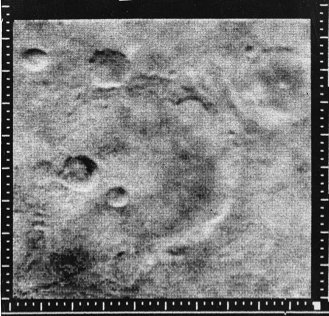
Then, in 1965, Mariner 4 sent back pictures of big craters, small craters — and not much except craters.

Cratered landscapes and a very thin atmosphere made Mars seem more like Earth’s moon than a maybe-habitable planet.3

But Mariner 4 was a flyby mission. What we saw was a strip of Mars that happened to be ‘under’ the spacecraft as it zipped by the planet.

It was as if Martians had gotten pictures and data from part of the Pacific Ocean and decided that Earth was all wet. Covered by water. You know what I mean.

Orbital Reconnaissance

Nirgal Vallis, Mars, from Mariner 9.
(From NASA/JPL-Caltech, used w/o permission.)
(Mariner 9’s view of Nirgal Vallis, Mars.)

Then we sent spacecraft that stayed in Martian orbit, letting us get more than snapshot of our neighbor. We saw more craters. But we also found what looked a great deal like riverbeds, deltas and other water-sculpted features.

Maybe Mars wasn’t so lifeless after all. Or hadn’t been.

The last I checked, there’s still lively debate about how much Martian water is near the surface and whether observed flows are water, dust or something else.

And whether Vastitas Borealis, the biggest Martian lowland area, was an ocean four billion years back.

There’s chemical and visual evidence that says a Martian ocean existed.4 But if that’s so, scientists have other puzzles. Like where did the water go?

That’s why it’s still the “Mars ocean hypotheses,” not the “Mars Ocean.” I figure that if there was a Martian ocean, we’ll find and analyze enough data to show that it was real.

Then the IAU will decide whether it’s called the Paleo-Ocean, Oceanus Borealis or something entirely different.

Like Ketchum, after Ketchum Lake here in Minnesota. Which is between Lengby and Bijou, two other places you probably never heard of.

Back to the Perseverance rover’s landing site.


MARS 2020 and Jezero Crater

Jezero Crater's delta, image from ESA Mars Express Orbiter. (September 21, 2020)
(From ESA/DLR/FU-Berlin, via NASA, used w/o permission.)
(Jezero Crater delta, Mars.)

Jezero Crater’s fan delta looks like the Mississippi River Delta. Not exactly, of course. But land near New Orleans would look a bit like that, if North America and the Gulf of Mexico was a desert. But hadn’t been while the Mississippi river and its silt flowed.

It’s a near-certainty that Jezero Crater was a lake, upwards of 3,500,000,000 years ago. Scans from orbit show that the river in what we call Neretva Vallis carried clay from upstream, dropping it in the Jezero Crater delta.

Neretva Vallis? That’s the Jezero Crater’s inflowing river’s channel. Neretva is a river in the Pliva-Jezero-Plivsko area.

The crater is named after the town of Jezero, Bosnia and Herzegovina. The Bosnia and Herzegovina town is on Plivsko Lake and the Pliva River. Which most likely explains why we call another Jezero Crater riverbed Pliva Vallis.

Or, since the Neretva is the a major stream in that region, they’re in the Neretva area.

More to the (scientific) point: if there was life on Mars, that river delta would have been a good place for microcritters. Back when Mars was wetter and presumably warmer than it is now.

The life, if any, would most likely be long gone. But it might have left detectable traces.

And that’s why the Perseverance rover carries a bio lab.5

Ingenuity, Briefly

NASA Mars Helicopter Ingenuity.Perseverance also carries a helicopter.

Ingenuity won’t be doing much science. It’s mostly there to make the first powered flight on another planet.

The Mars helicopter has limited autonomy. And that’s something I’ll save for another day.6

If all goes well, we may find the first evidence of extraterrestrial life this year.

Assuming that we didn’t find it a couple dozen years back.


Extraterrestrial Fossils?

ALH84001, Martian meteorite.
(From NASA, via Wikimedia Commons, used w/o permission.)
(Martian meteorite ALH84001, found in Antarctica’s Allan Hills. (December 27, 1984))

ALH84001 is a rock collected back in December of 1984.

Analysis confirmed that it’s a meteorite. More analysis pegged it as a shergottite-nakhlite-chassignite, or SNC, meteorite.

Don’t bother trying to memorize those names. There won’t be a test. The point is that this particular rock formed on Mars. And was blasted off that planet during an impact.

Either that — or pretty much everything we’ve learned about rocks, planets, physics and chemistry over the last few centuries is wrong. Which strikes me as unlikely.

Assorted Martian/Antarctic rocks got divvied up among assorted scientists. Including some working with NASA.

Then, on August 6, 1996, they said they’d found fossilized microcritters. In ALH84001.7

As I see it, we discovered extraterrestrial life in 1996. Or we didn’t.

Mini-Microbial Martians? Impossible!

'Hypothetical biogenic features' in ALH84001.
(From NASA, via Wikimedia Commons, used w/o permission.)
(Structures in ALH84001, seen through electron microscopy. (1996))

Those blobby linear things look like terrestrial bacteria. Chemical traces associated with them are also associated with terrestrial microcritters.

Problem is, the ALH84001 things are far too small to be bacteria. Terrestrial bacteria simply aren’t that small.

And some current biological theory says single-cell organisms can’t be that small.

I can follow that line of reasoning.

The ALH84001 structures look like bacteria.

But they’re much smaller than terrestrial bacteria. And what we know about cellular biology suggests that single-celled organisms can’t live if they’re under a certain size.8

So the ALH84001 fossils can’t be fossilized organisms.

Maybe.

Or Maybe Not

ALH84001: close-up photo.
(From Johnson Space Center/NASA, used w/o permission.)
(Close-up photo of ALH84001, rounded carbonate inclusions. (1995))

On the other hand, ALH84001 is around four billion years old. And from Mars.

And fossilized thingummies in it look like bacteria. Only they’re too small.

And some scientists have showed how non-biological process can leave similar traces.

So maybe the ALH84001 are just weird little shapes that aren’t fossilized Martians.

Or maybe Terrestrial bacteria aren’t just like Martian microcritters.

Again, ALH84001 is about four billion years old. If those shapes are organisms, they lived on Mars during Earth’s early Eoarchean era.

Our bacteria are end products of everything that’s happened during the last 4,000,000,000 years. What’s happened on a planet that’s been mostly covered with water and/or ice. With surface gravity three times that of Mars.

Arguments that the ALH84001 features can’t be fossilized critters strike me as being like someone studying photos of a hummingbird. And proving that it can’t be alive, since it’s so very much smaller than an elephant.

I’ll admit to having a bias.

Ball lightning entering through a chimney, from Hartwig's 'The Aerial World.' (1886)I’ve seen ball lightning’s status change from superstition to serious science.

And I remember when thunderstorm sprites were obviously — according to highly-confident experts — hallucinations reported by unstable soldiers and pilots.

Then a scientist with the University of Minnesota recorded sprites with a videocam.

To their credit, the scientific community did not close ranks, asserting that videocams can and do hallucinate.

And now we are learning more about transient phenomena and Earth’s weather

I figure one of the problems with ball lightning was that we still don’t know how it works. Sprites are almost another matter. I suspect NIH syndrome — not invented here — may be involved.9 And that’s another topic.

Equivocal Evidence: So Far

ALH84001: scanning electron microscope image showing tunnels and curved microtunnels. (NASA (2014))I’m willing to imagine that maybe hypothetical Martian critters could have been more, well, Martian than today’s terrestrial bacteria.

Then again, maybe scientists who think nanobacteria can’t exist because they’re not like today’s terrestrial bacteria are right.

But I strongly suspect that we haven’t learned everything there is to know about life, the universe and everything.

Maybe the ALH84001 “hypothetical biogenic features” are fossilized Martian microorganisms. Or maybe they’re not.

Right now, there’s evidence supporting both views. And no evidence disproving either.

Bottom line? We don’t know. Not yet.

But we’ve learned a great deal.

And are learning that we have a very great deal left to learn:


1 Arrivals, Mars; February 2021:

2 Percy the rover:

3 Viewing Mars:

4 Reconsidering Mars:

5 Names, Mostly:

6 Testing new technology:

7 AL84001, meteorite from Mars:

8 Tiny life, maybe:

9 Bacteria and ball lightning, science and an attitude:

Posted in Exoplanets and Aliens, Series | Tagged , , , , , , , | 2 Comments

Weather, Writing, Daily Entries and Another Change

This will be my 31st daily ‘journal’ entry.

I hadn’t been planning on a daily posting schedule. But Sauk Centre’s weather gave me something to write about three days in a row:

And I’d been getting daily positive reinforcement from the WordPress software that manages this blog’s content.

I’m not one of Pavlov’s dogs, but getting a daily digital ‘attaboy’ felt good. Besides, I figured posting daily might be good mental exercise.

And might encourage folks to check in regularly.

But, as I said a couple weeks and a day back, “I’m not a teen idol pop superstar YouTube influencer….” (January 28, 2021)

Nobody’s going to get excited about my daily routines. I’m not excited about most of what I do. Topics I write about, yes. Flossing my teeth, not so much.

So, now that I’ve shown myself, and anyone who’s had the patience to keep checking, that I can do daily posts; I’ll go back to what I’d been doing — writing these journal entries when I had something to say. Something that might be worth reading, that is.

Like the weather.

Cold, But it Could Be Worse


(From the National Weather Service, used w/o permission.)
(Assorted Wind Chill Advisories and Warnings in the Upper Midwest. (February 12, 2021))

I’ve heard that talking about the weather as common in, say, Hawaii.

Here in the Upper Midwest, Minnesota at any rate, variations on ‘how’s the weather’ vie with ‘how are you’ for top billing as conversation starters.

Maybe that’s because we’re boring people, with nothing else to talk about.

Or, I think more likely, it’s because weather is important in these parts.

One day, back when I was living in Moorhead, Minnesota — it’s across the river from Fargo, neither is in Canada, and that’s another topic — we had dense fog and near-hurricane-force winds in the morning.

Followed by intense thunderstorms and a tornado warning and a blizzard. All before nightfall.

Even up here, that’s unusual.

But like I said: weather is important here. Knowing whether to pack arctic survival gear, sunscreen or a rubber raft matters. Well, maybe not the rubber raft.

Nobody’s daft enough to try driving on a submerged road.

Make that shouldn’t be daft enough. News items about someone falling through ice or not getting out of a sinking car happen. Sad, that.

Meanwhile, Back at My Desk

Anyway, it may be a few days before I write another journal entry. Or weeks. It depends on how routine my routines are. And, this being Minnesota, the weather.

I’ve enjoyed my ‘daily journal’ experiment. But they’ve been taking time that could have been spent on my ‘essay’ posts.

Which reminds me. NASA’s Perseverance rover arrives next week, and I have more to say about that. And Mars. And, most likely, more.

More, and less, of the same:

Posted in Creativity, Journal, Series | Tagged , , , | 2 Comments

Anger and Justice: Aquinas, Berra and Me

Assorted versions of this quote popped up in my social media feed recently. Usually as a picture of St. Thomas Aquinas with a text overlay.

“He who is not angry when there is just cause for anger is immoral. Why? Because anger looks to the good of justice. And if you can live amid injustice without anger, you are immoral as well as unjust.”
(attr. Thomas Aquinas; via Master_Bruno_1084 on Reddit)

Those four sentences may be a translation of something St. Thomas Aquinas wrote.

Or maybe they’re a summary of what he wrote in “Summa Theologica,” First Part of the Second Part, questions 46 through 48 and Second Part of the Second Part, question 158.1

And maybe what Yogi Berra said applies in this case.

“I really didn’t say everything I said. […] Then again, I might have said ’em, but you never know.”
(Yogi Berra, “The Yogi book: I really didn’t say everything I said!,” p. 9 (1997) via WikiQuote)

In any case, jotting down what I think about anger, justice and making sense is easier than discussing today’s readings. Particularly if I went into what Genesis 2:1825 and Mark 7:2430 say about human nature, priorities, faith and all that.

Hmm. I’ve been saying “all that” a lot lately. Moving on.

(Self?) Righteous Rage?

Virtue signalling, displaying outrage with intent to impress, is a new term.

But I’m pretty sure that folks were expressing (self?) righteous outrage at their era’s fascists, communists, racists and long-haired freaks long before Mesannepada launched Ur’s first dynasty.

Mesannepada means “youngling chosen by An.” The name, or maybe title, was more impressive when most folks knew about An. Or Anu, as Akkadians called their top-rank god.2 And that’s another topic.

Anger Happens, Decisions Matter

'TDNN Totally Depressing News Network: What's Wrong With the World.I got angry while glancing over today’s headlines. As usual.

But I don’t see a point in composing screed aimed at vile malefactors.

Or swearing unswerving loyalty to some politico or party.

I also felt an impulse to despise pretty much all the congressional clowns, regardless of party or position. I don’t think that’s a good idea. In fact, I think it’s a bad idea. Bad for me, that is.

“But I say to you, whoever is angry with his brother will be liable to judgment, and whoever says to his brother, ‘Raqa,’ will be answerable to the Sanhedrin, and whoever says, ‘You fool,’ will be liable to fiery Gehenna.”
(Matthew 5:22)

On the other hand, I’d be worried if I didn’t feel angry at what I see as injustices.

The trick is remembering that I’m human, and able to think. Letting my emotions show me that something needs attention is one thing. Letting them decide what I do is a bad idea. I’ve said this before. Often. (February 4, 2021; January 11, 2017; October 5, 2016)

Sound, Fury — and Thinking

March 15, 1915: Billy Sunday giving another rip-roaring performance.Getting back to that “…if you can live amid injustice without anger…” meme that’s doing the rounds – I’m not lacking excuses for anger.

But I see no point in adding another outraged voice to my culture’s current scream-fests.

Seriously. How many folks would really want more of the sound and fury that passes for public discussion these days?

And, for that matter, in days of yore.

Take that discussion I talked about yesterday, for example. The one about wine that lasted three days and killed more than 90 folks in Oxford.

Which is why I’ll occasionally explain why I think currently-accepted actions are bad ideas. And why feelings can be okay, and thinking is a good idea.

But will keep trying to dial back my rage:


1 Anger, an Aquinian analysis:

2 Two old names and a new phrase:

Posted in Journal | Tagged , , | Leave a comment